




Abstract
In this study, the authors explore a heretofore unappreciated benefit of managerial openness to employee voice: internal attraction. Previous work has shown that managers who are more open to listening to employees receive valuable information and their units have higher relative retention levels. The authors explain and empirically demonstrate that managers who are more open to employee voice also more effectively attract workers from other units in their organizations. They describe how and why managerial openness to voice likely shapes the information that employees in a focal organizational unit (“employee insiders”) share with employees in other units (“employee outsiders”). They find that units with managers who are perceived as more open to voice are viewed as more attractive places to work. Conducting two field studies in separate US school districts, the authors find that managerial openness to voice positively predicts a work unit’s attractiveness among employees who work in other areas of the organization. They discuss the implications of their findings for organizations in general and school districts specifically.
Keywords
Research on managerial openness to voice, defined as the degree to which employees perceive that their manager encourages and takes seriously their ideas and suggestions for improvement (Detert and Burris 2007), has consistently shown that employee input can be mutually beneficial to managers and workers. Workers who feel their ideas are taken seriously are more satisfied, more likely to engage in citizenship behaviors, and more likely to provide suggestions leading to improved unit-level outcomes. Moreover, workers who perceive that their manager is open to voice are more likely to believe that the conditions initially prompting their concerns can be remedied, and these workers are therefore less likely to exit. Indeed, research has shown that relative to autocratic counterparts, managers who are receptive to employee voice are less likely to have subordinates voluntarily leave.
Yet, despite these well-established benefits of voice, managers vary in the degree of their reception to employee input. Recent studies have shown that workers’ opportunities for voice vary widely across work units within a single organization (Avgar, Sadler, Clark, and Chung 2016), and that employees generally want more voice in the workplace (Kochan, Yang, Kimball, and Kelly 2019). Given workers’ desire for increased voice and their varied perceptions of individual managers’ openness to voice within an organization, we explore whether managerial openness to voice may benefit organizational units in a previously unacknowledged way: Might managers who are more open to employee voice not only more effectively retain but also attract workers?
We explore this possibility by theorizing that managerial openness to voice shapes the extent to which employees in other work units (whom we call “employee outsiders”) evaluate a focal work unit as an attractive place to work. Specifically, we propose that employees working for managers perceived to be open to voice will more likely convey positive information about their unit to employee outsiders, thereby increasing the unit’s attractiveness to the broader organizational community. In other words, we suggest that within organizations, workers will gravitate toward work units whose managers encourage employee voice and away from units whose managers do not.
We tested our argument across two field studies in a setting uniquely suited to our purpose: US school districts. The hiring process for school districts has parallels to that of many private-sector companies. In school districts, however, many attributes known to affect attraction, such as pay and advancement opportunities, tend to be standardized through collective bargaining. Moreover, school and district data on many factors known to shape teachers’ preferences are publicly available. We are therefore better able to isolate in schools, compared to other settings, the effect of managerial openness to voice on attraction.
Our first field study combines survey responses collected from the superintendent, HR director, and teachers working across all 52 schools in a school district that, for the sake of anonymity, we have labeled SouthDistrict. This design allowed us to examine whether employee outsiders were more likely to actively pursue opportunities at schools whose managers are perceived to be more open to voice. We measured managerial openness to voice by asking teachers in each school to report how open their principal was to voice, and we measured internal attraction by asking the superintendent and HR director to report how much interest open jobs at each school received from teachers within the district. The results revealed a significant, positive relationship between managerial openness to voice and internal attraction.
We then conducted a second field study in a separate district (the similarly anonymized EastDistrict) to explore whether we would find similar results by using a more perceptual measure of attraction. We measured managerial openness to voice in the same way as in Study 1, but we measured internal attraction by directly asking teachers about the extent to which they perceived other schools in their district as attractive places to work. These results, too, show a significant, positive relationship between managerial openness to voice and internal attraction. Indeed, we find, across two studies using two different measures of internal attraction, that employee outsiders are more attracted to units whose managers are perceived to be open to voice, but they also avoid units whose managers are perceived to be averse to voice.
Together, these studies uncover a heretofore unappreciated benefit of managerial openness to voice by providing, to our knowledge, the first empirical evidence that such openness can generate interest and demand among potential job seekers in a contemporary internal labor market. A key strength is our article’s replication of similar results across multiple field studies from two separate organizations. Our research also offers valuable insights into public education, a sector that employs nearly four million workers in the United States (Vilorio 2016). US school districts face major hurdles in attracting teachers to struggling schools. Our work suggests that hiring “high-road” principals (Kochan 2006) who are open to their teachers’ input may help struggling schools attract teachers, thereby providing principals with more staffing options.
Background and Theory
Before developing our theory, we define several key terms. We define managerial openness to voice as the degree to which employees perceive that their manager encourages and takes seriously their ideas and suggestions for improvement (Clark, Clark, Day, and Shea 2001; Detert and Burris 2007; Avgar et al. 2016). Given our research setting, we focus on managerial (principal) openness to teacher voice regarding student instruction and school improvement. This approach enables us to examine a crucial aspect of voice that principals can influence and that likely varies across a district’s schools. In doing so, we build directly on recent industrial relations scholarship on employee voice (see Clark et al. 2001; Avgar et al. 2016). Whereas other scholars have focused on employees’ perceptions of how much input they had over patient-care issues in health care, we examine teachers’ perceptions of their opportunities to provide input to principals regarding student instruction, school policy, and school improvement. Note that managerial openness to voice reflects employees’ perceptions of their manager. It does not reflect the extent to which managers can act on those suggestions (see McClean, Burris, and Detert 2013).
We use the term employee outsiders to refer to teachers in the school district who work in a school other than the focal school. We explore whether managerial openness to voice shapes internal attraction, which we define as the extent to which these employee outsiders view the focal school as an attractive place to work. We use the term employee insiders to refer to teachers who work in the focal school.
Managerial Openness to Voice and Internal Attraction
Voice is discretionary, and while individuals choose to exert their voice or remain silent for many reasons, research has consistently shown that employees are more likely to direct their voices upward when they perceive that their managers are open to voice. As noted, openness occurs when a manager “listens to employees, is interested in their input, and gives fair consideration to their ideas and suggestions” (Morrison 2011: 389; Saunders, Sheppard, Knight, and Roth 1992; Detert and Burris 2007; Ashford, Sutcliffe, and Christianson 2009). Thus, the literature typically portrays managerial openness to voice as key in facilitating information flow from employees to managers.
Evidence also suggests, however, that information about the degree to which a manager is perceived to be open or closed to voice likely flows freely from the manager’s employees to others in the organization. Research on organizational information sharing has emphasized that organizations are inherently social learning communities (Argote, McEvily, and Reagans 2003; Wang and Noe 2010; McCarthy 2019) within which knowledge flows primarily through employees’ interactions. These interactions may take various forms. In formal terms, employees from distinct units may be assigned to work on special projects or to staff cross-functional teams. In less formal terms, employees may converse during company social events or at the proverbial watercooler (Dumas, Phillips, and Rothbard 2013). In addition to enabling employees to acquire information relevant to their own work tasks, interpersonal interactions are the primary mechanism through which employees acquire information about the broader organization’s attributes (Labianca, Brass, and Gray 1998; Hansen 1999). This information includes details about other managers; indeed, studies of workplace conversations have shown that, even in the context of formal interactions, employees regularly discuss what it is like to work for their managers (Hallett, Harger, and Eder 2009; Ellwardt, Wittek, and Wielers 2012).
We expect that managers’ openness to worker voice is a central part of these discussions. Workers who responded to both the 1999 and 2005 Worker Representation and Participation Surveys overwhelmingly reported that they would prefer to work in a unit in which they feel encouraged to make suggestions and decisions (Freeman and Rogers 2006). In the 2001–2002 California Workplace Survey (Piazza, Fligstein, and Weir 2002), 89% of repondents indicated that having more say in workplace decisions was somewhat or very important to them. Moreover, the number one attribute that younger workers seek in a manager is someone who empowers employees, and nearly 60% report opportunities to influence their organizations as the most attractive feature in a managerial role, in contrast to the less than 40% who selected higher future earnings as the most attractive feature (Bresman 2015). This collective evidence suggests that workers are intensely interested in seeking opportunities that provide voice, and are therefore likely to question colleagues in other work units about the extent to which their managers are open to voice.
Employees also respond favorably to managers who are open to hearing their opinions (Morrison 2011), and they feel more satisfied and energized when their ideas and suggestions are taken seriously. In addition, satisfied employees are more inclined to communicate positive information about their work units to employee outsiders (Van Hoye 2008; Edmondson and Lei 2014), compared to employees who feel less favorably about their work environments (Miles and Mangold 2004). As a result, when questioned by employee outsiders about what it is like to work for their manager, employee insiders who perceive their manager as open to voice are likely to speak more favorably about them, compared to employees who work for autocratic managers.
Furthermore, employees whose managers are open to voice are more likely to form and maintain communications with employee outsiders. Participative norms invite employees to contribute to organizational decisions and incline group members to be more receptive to (and engaged with) the external environment (Hage and Aiken 1967; Jansen, Van Den Bosch, and Volberda 2005). Of particular note, McCarthy (2019) found that teachers were more likely to build and maintain external communications with colleagues in other schools in their district when they worked in schools characterized by high levels of workforce participation. Ancona (1990) also showed that units whose leaders encouraged collective problem solving were more inclined to communicate with other units inside as well as outside the organization, findings later echoed by Edmondson (1999). In addition to increasing the likelihood that employee insiders will communicate positive information about working for their manager, managerial openness to voice should increase the frequency of such communication, facilitating the spread of this information through the organization.
In sum, we expect that managerial openness to voice affects internal attraction by influencing the content and frequency of employees’ conversations about working for their managers. Because workers value increased voice and participation at work (Feldman and Arnold 1978; Piazza et al. 2002; Chatman and Spataro 2005; Freeman and Rogers 2006; Bresman 2015), employee outsiders who hear favorable things about working conditions in another work unit will likely view it as an attractive place to work. Moreover, employee outsiders are more likely to hear such favorable information from employee insiders who work for managers who are open to voice. We therefore hypothesize that employee outsiders will be more attracted to work units in which managers are more open to employee voice.
Research Context
We tested this hypothesis by using data from two field studies conducted in two separate school districts in different regions of the United States. We chose this context for several reasons. In line with prior education research (Smylie 1992; Pashiardis 1994), our interviews and observations in schools suggested that teacher voice takes several forms. It may include, for example, principals soliciting teachers’ input for how to best implement the curriculum mandated by the district (Muijs and Harris 2007). In our interviews, teachers’ opportunities to provide voice could also center on school-level attendance and discipline policies, staff development opportunities, and the allocation of school resources. 1 Our research setting is advantageous in part because, like their private-sector counterparts (Kochan et al. 2019), teachers value and want more voice in the workplace. In particular, teachers want a voice on how to improve their schools, as a representative survey found that nearly 80% of teachers view input into school policies and practices as “absolutely essential” or “very important” for improving teacher retention (Mayer and Phillips 2012).
Moreover, myriad factors shape prospective workers’ perceptions of workplace attractiveness, such that it can be empirically challenging to isolate the effect of a single workplace attribute. This challenge is easier to address in school districts than in many private-sector organizations because potentially confounding attributes, such as pay and advancement opportunities, tend to be standardized in school districts through collective bargaining. Furthermore, because detailed data on schools are publicly available, we can control for school-level factors (i.e., student poverty) that education researchers have previously identified as affecting a school’s level of attractiveness to prospective teachers. Thus, high levels of homogeneity across locations allowed us to better isolate in schools, compared to other settings, the effect of managerial openness to voice on attraction.
A third reason for our research context relates to the nature of the hiring process for school districts, which has parallels to that of many private-sector companies. Particularly germane to our study is that K–12 educators, like their private-sector counterparts, often advance their careers by transitioning between schools within their district (e.g., Feng 2009). Indeed, among non-administrative educators, roughly half of teacher mobility occurs through (and more than half of all jobs are filled by) intra-organizational relocations (Luekens, Lyter, Fox, and Chandler 2004). Private-sector firms increasingly involve employees in the selection and hiring process (Bassi and McMurrer 2007). Likewise, some principals in the school districts we studied involved teachers and other staff, to varying degrees, in the selection and hiring processes, although principals typically had the final say over hiring decisions.
Of note, our theory suggests that workers find out about managers by talking with their colleagues in other units. School districts represent an organizational setting in which such conversations are likely to happen. Although teachers are assigned to individual schools, they have multiple opportunities to interact and converse with teachers in other schools. For example, various committees, professional development opportunities, and district-wide events bring teachers together at regular intervals throughout the school year (McCarthy 2019). Moreover, being part of a union provides an additional conduit through which teachers are able to share information about their own principal with other teachers in the district. Indeed, prior to collecting our field data, we conducted interviews and pilot studies with teachers; we confirmed that teachers talk with teachers in other schools in their district throughout the school year. Teachers who felt that their principal afforded them higher levels of voice were more likely to communicate with teachers in others schools, and these conversations informed teacher perceptions of other principals’ leadership styles. 2
Study 1: SouthDistrict
We conducted our first field study in SouthDistrict. The school district covers 147 square miles in the southwestern region of the United States. A large school district, it serves more than 50,000 students, roughly 40% of whom are socioeconomically disadvantaged and with roughly 50% identifying as Hispanic or Latino. We sent a confidential online survey inquiring about various school characteristics, including managerial openness to voice, to 1,799 full-time teachers across the district’s 52 schools. We received usable surveys from 1,140 teachers, for a response rate of approximately 63%. To assess each school’s attractiveness, we administered electronic surveys to the school district’s superintendent and HR director, both of whom returned completed surveys.
Dependent Variable
Our dependent variable of interest is internal attraction. Recruiting scholars have operationalized attraction in multiple ways (see Chapman et al. 2005). Some scholars have asked managers to evaluate the quantity of applications they receive (Collins and Han 2004), reasoning that jobs, units, and/or organizations that receive more applications are seen as more attractive places to work. We adopted this behavioral approach to operationalizing internal attraction in Study 1 by using superintendent- and HR director-reported items that reflect the degree to which individual schools generated interest and applications from job seekers employed in the district. The superintendent and HR director are high-level executives who are intimately familiar with recruiting and placement issues across their district’s schools. The superintendent must ensure that each school is adequately staffed, so they are in regular contact with HR officials during the hiring cycle and, thus, know the district’s mobility patterns and which schools have more difficulty or less difficulty filling jobs. Indeed, survey data reveal that hiring teachers is among the top priorities of most US school superintendents (Hammer et al. 2005). Thus, the superintendent and HR director are well positioned to accurately assess the extent to which teachers seek jobs in individual schools.
After reviewing a consent form and agreeing to participate, the superintendent and HR director were shown a list of every school in the district, with two column headings displayed to the right of each school name. We then asked the respondents to use a 3-point scale to evaluate the internal attractiveness of each school in their district, through two survey items: 1) “Compared to other schools in the district, this school is heavily sought after by job seekers who currently work in the school district” and 2) “Job openings at this school attract a lot of interest from people who currently work in the school district” (1 = disagree; 2 = neutral; 3 = agree). We averaged the two items for each participant and found that the superintendent’s and HR director’s responses correlated strongly with each other (r = 0.61). Thus, our final measure for internal attractiveness averaged the combined superintendent and HR director assessments for each school.
Independent Variable
Our primary predictor variable, managerial openness to voice, relied on teachers’ responses about their principals. We operationalized managerial openness to voice by using four items adapted from the scale of Clark and colleagues (2001). (See Appendix.) We coded responses from 1 (strongly disagree) to 7 (strongly agree). The scale items capture teachers’ views of the degree to which their principals solicit their input regarding issues in the school (Cronbach’s alpha: 0.75). For example, one item states, “My principal asks for my opinion about student education issues.” We chose to use Clark and colleagues’ (2001) employee voice measure, rather than alternatives, because the items explicitly ask whether one’s immediate supervisor proactively seeks and is receptive to their input. The intra-class correlation coefficient (ICC(2)) statistic, at 0.75, was above the threshold suggested by Klein and colleagues (2000) and suggests high levels of agreement within schools. In other words, teachers who felt that their principal was open to voice tended to have coworkers who felt the same way. Hence, we created a unit-level measure for managerial openness to voice by averaging teacher responses by school.
Control Variables
Prior research led us to control for several other factors likely to shape the attractiveness of other schools (e.g., Lankford, Loeb, and Wyckoff 2002; Boyd et al. 2010). Following this research, we controlled for school characteristics that could affect schools’ attractiveness to prospective transfers, including school performance (the maximum school score is 1,000), student poverty (percentage of students on reduced-price or free lunch), and school type (special education school, elementary school, middle school, junior high school, and alternative school = 1; high school as referent category). 3
Our primary argument is that workers are attracted to units because of managers’ openness to voice; however, workers likely see other factors as attractive as well. We included several additional controls to account for this possibility. Since managers may solicit more input from more-competent faculty and since employee outsiders may perceive work sites with more-competent staff as more prestigious and more desired, we also controlled for the faculty’s collective efficacy perceptions, by averaging a single item, coded 1 (strongly disagree) to 7 (strongly agree), by school (ICC(2): 0.76): “Teachers in this school have what it takes to get students to learn” (Goddard, Hoy, and Hoy 2000). Faculty members who are closer to their principal may attribute more-favorable qualities to the principal and speak more positively about them to others; we thus controlled for the overall quality of relationships between faculty members and their principals in the evaluated schools. Our measure faculty–manager relations averaged a single item (“I have a strong professional relationship with my principal”) coded on a 7-point scale for each school (ICC(2): 0.64). Given that managers who encourage employee voice also promote more-collaborative faculty interactions (Rubinstein and McCarthy 2016) and that employees in socially harmonious environments may be inclined to share positive information with employee outsiders, we controlled for faculty collegiality by using three items adapted from Leana and Pil’s (2006) social capital climate measure. Coded from “strongly disagree” (1) to “strongly agree” (7), the items assessed overall sentiments of trust (“Overall, teachers in this school are trustworthy”), information sharing (“Teachers in this school engage in open and honest communication with one another”), and goal alignment (“Teachers in this school enthusiastically pursue collective goals and mission”) (Cronbach’s alpha: 0.76; ICC(2): 0.71). We combined these three items for each respondent and then averaged them by school. We controlled for school resources using a single item averaged by school (“I can obtain the resources I need to do my job effectively”) (ICC(2): 0.70).
Although principals make the ultimate decisions on hiring, some principals involve teachers to a greater extent in these decisions (Glanz 2005). Teachers who are more involved in hiring decisions may be more inclined to communicate information about working conditions in their units, to attract internal candidates. Because teachers’ involvement in hiring decisions might be more common among principals who afford teachers higher levels of voice, we also controlled for collaborative hiring via a survey question administered to the teachers who served as each school’s teacher union representative: 4 “In this school, the principal and teachers collaborate to select a preferred job candidate” (1 = strongly disagree to 7 = strongly agree).
Final Sample
We could not obtain data on student poverty and school performance for three of the district’s schools: an adult education school and two centers serving young children. Since these variables served as important controls, we dropped these schools from our analyses. Thus, in all, our statistical models included the 49 schools for which we obtained complete data.
Results
Table 1 presents descriptive statistics and correlations corresponding to Study 1. We used ordinary least squares (OLS) regression in Stata 15 to assess the effects of managerial openness to voice on internal attraction. In Table 2, model 1 introduces our control variables. The betas (b) represent unstandardized regression coefficients. Student poverty (b = −0.89; p < .01) and collaborative hiring (b = 0.10; p < .05) show a negative and positive relationship, respectively, to internal attraction. The effects corresponding to school performance (b = 0.002; p < .10), faculty collegiality (b = 0.12; p < .10), and school resources (b = −0.10; p < .10) are marginally significant. Model 2 introduces our focal predictor, managerial openness to voice. Managerial openness to voice associates positively with internal attraction (b = 0.35; p < .01) and explains an additional 8% of the variance over the controls, providing support for our hypothesis. To compare relative effect sizes, we standardized our outcome variable and key predictor variables in post hoc analyses (full results available from the authors). The effect of managerial openness to voice was large (B = 0.37) and roughly equivalent to student poverty (B = −0.36) and school performance (B = 0.35).
Descriptive Statistics and Correlations (Study 1: SouthDistrict)
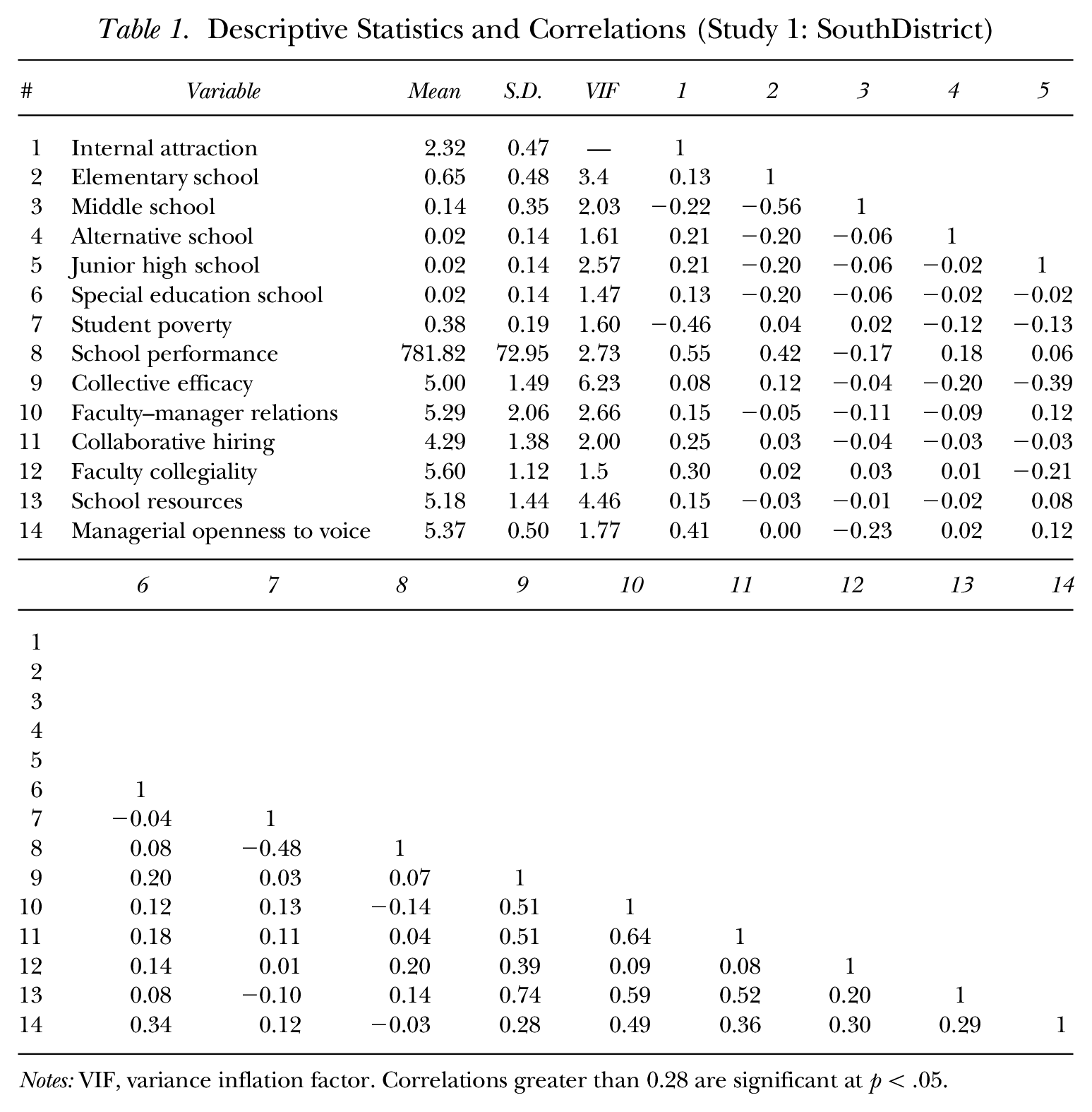
Notes: VIF, variance inflation factor. Correlations greater than 0.28 are significant at p < .05.
Impact of Managerial Openness to Voice on Internal Attraction (Study 1: SouthDistrict)

Notes: Unstandardized coefficients. Standard errors in parentheses.
p < .001; **p < .01; *p < .05; +p < .10.
Study 2: EastDistrict
While macro research on attraction has tended to use behavioral measures (as we did in Study 1), micro research has tended to ask workers directly about the extent to which they view a particular job, unit, or organization as an attractive place to work (Phillips et al. 2014). We therefore conducted a second field study to explore whether our results would replicate in another district, in which we used a more perceptual measure of attraction.
We conducted Study 2 in EastDistrict, which comprises 40 schools, covering a span of approximately 55 square miles. The school district is responsible for educating more than 33,000 diverse students, 80% of whom are socioeconomically disadvantaged. We used an email link to invite 1,030 full-time teachers in the district to participate in an online survey. The survey asked participants to answer questions about their principals’ openness to voice, their job attitudes, and demographics. In the last step, the survey displayed the names of ten other schools in the district (generated at random) and asked the participants to use the two survey items described below to provide information about, and an evaluation of, each school. The randomization of school names meant that the list of schools and their ordering varied for each participant. We used these data to examine whether managerial openness to voice, as evaluated by the teachers in that school, predicted whether teachers working in other schools in the same district were likely to evaluate that school as an attractive place to work.
Dependent Variable
As an alternative to management-reported indicators of attraction, Study 2’s measure of internal attraction derives from teachers’ perceptions of other schools, which we obtained via two scale items directly adapted from the recruiting literature (Phillips and colleagues 2014): “Based on what I know about this school, this school seems like an attractive place to work” and “Based on what I have heard about it, this school seems like a good place to work.” (r = 0.79). We coded the responses on a scale from 1 (disagree) to 5 (agree). As a fictitious example, a teacher at Riverdale Elementary might be asked to assess the attractiveness of working at Sunnyvale Elementary, Southbridge Elementary, Rolling Hills Elementary, and seven other schools in the district.
Independent Variable
We operationalized managerial openness to voice exactly as in Study 1 (Cronbach’s alpha = 0.87; ICC(2) = 0.74).
Control Variables
As we did in Study 1, we controlled for several school characteristics known to affect teachers’ perceptions of school attractiveness. We controlled for student poverty (percentage of students on reduced-price or free lunch) and school performance (percentage of students at or above standard level in math and reading). We controlled for faculty collective efficacy (1 = strongly disagree to 5 = strongly agree; ICC(2) = 0.79), faculty collegiality (1 = strongly disagree to 5 = strongly agree; ICC(2) = 0.74) (Cronbach’s alpha: 0.78; ICC(2) = 0.75), school resources (ICC(2) = 0.69), and faculty–manager relations (1 = strongly disagree to 7 = strongly agree; ICC(2) = 0.71) in the same manner as we did in Study 1. Our models accounted for the type of school being evaluated (high school served as the referent category). Moreover, our models also controlled for the same school type, that is, whether a respondent currently worked in the same type of school as the school they evaluated. For example, elementary school teachers were assigned the value 1 if they evaluated another elementary school; otherwise, they were assigned 0. We also controlled for whether the evaluated school resided in the same zip code as the respondent’s school, as teachers in nearby schools may interact relatively more frequently. Finally, we included fixed effects for respondents’ schools, to account for “push” factors in the respondents’ current school that might make other schools in the district appear more attractive.
Final Sample and Database Structure
A total of 516 respondents completed the first section of the survey, which assessed managerial openness to voice by asking questions about the principal of the school where they currently work. Hence, values for the focal predictor variable, managerial openness to voice, derived from 516 employee surveys, for a response rate of roughly 50%. Of this total, 412 progressed to the final stage of the survey, which asked whether teachers received positive information about other schools in the district and how attractive teachers found these other schools. Compared to individuals who completed both sections, the 104 respondents who terminated their survey prematurely did not significantly differ regarding measured characteristics. Given that we asked each respondent to evaluate 10 schools, we solicited 4,120 total evaluations; however, the random generation of school names meant that respondents were occasionally asked to evaluate the attractiveness of their own school. We dropped these instances. Moreover, we could not obtain data on student poverty or performance for four nontraditional schools in the district. Thus, we could not retain evaluations of these schools in our final analysis. In total, our analysis included 3,419 complete assessments of other schools, provided by 412 teachers. These 3,419 surveys collectively assessed teachers’ internal attraction to 36 of the school district’s 40 schools.
Our database structure was similar to the one described by Collins and Han (2004). Specifically, respondents’ evaluations of the attractiveness of other units serve as the unit of analysis. The rating that a teacher provides for the attractiveness of another school serves as our outcome variable. The extent to which the principal of the school being rated is perceived as open to voice by the teachers working in that school is our explanatory variable. Thus, our independent and dependent variables both reflect characteristics of the school being evaluated. All of our control variables also reflect characteristics of the school being evaluated. To account for push factors in the evaluator’s school, our statistical models include fixed effects for the school in which respondents work. Finally, we clustered errors by respondent to account for the fact that the same respondent evaluated multiple schools.
Results
Table 3 presents descriptive statistics and correlations corresponding to Study 2. Table 4 shows fixed-effects regression models. The betas (b) represent unstandardized regression coefficients. Model 1 introduces our control variables. In this model, poverty and school performance show strong effects in the expected direction: high-poverty schools are seen as less attractive (b = −0.52; p < .001) and higher-performing schools are seen as more attractive (b = 0.003; p < .001). The control variables for same school type (b = 0.13; p < .001) and faculty–manager relations (b = 0.05; p < .01) are also significant in sensible directions. In model 2, managerial openness to voice associates positively with internal attraction (b = 0.12; p < .001). This significant effect is consistent with our hypothesis and with the results from our first field study. A Wald test shows that the coefficient corresponding to managerial openness to voice significantly improves model fit, compared to the results of model 1. 5 After standardizing our outcome variable and key predictor variables in post hoc analyses to compare relative effect sizes (full results available from the authors), managerial openness to voice (B = 0.09) and student poverty (B = −0.06) showed similar effects on internal attraction. School performance showed the strongest effect on our outcome variable (B = 0.29).
Descriptive Statistics and Correlations (Study 2: EastDistrict)
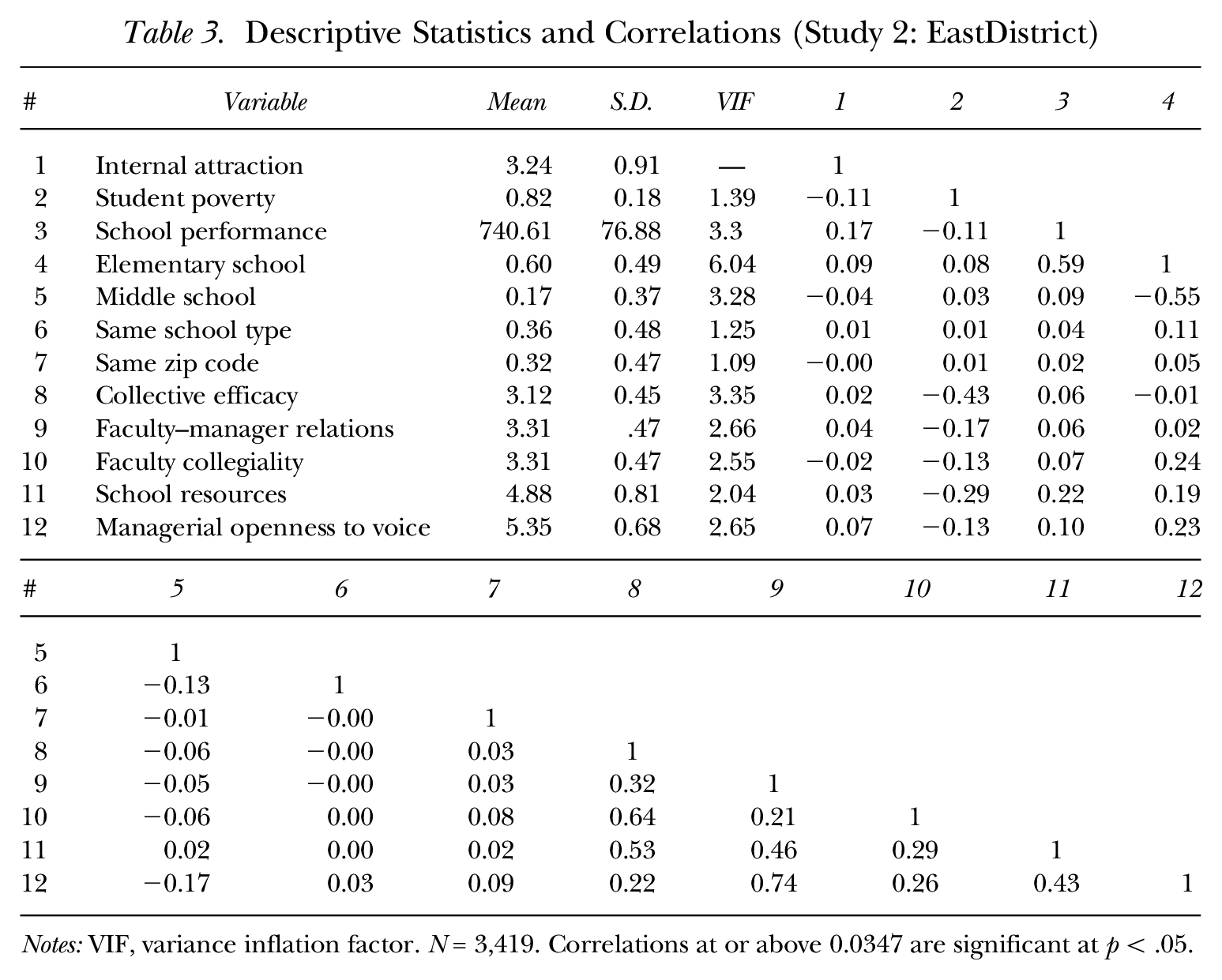
Notes: VIF, variance inflation factor. N = 3,419. Correlations at or above 0.0347 are significant at p < .05.
Impact of Managerial Openness to Voice on Internal Attraction (Study 2: EastDistrict)
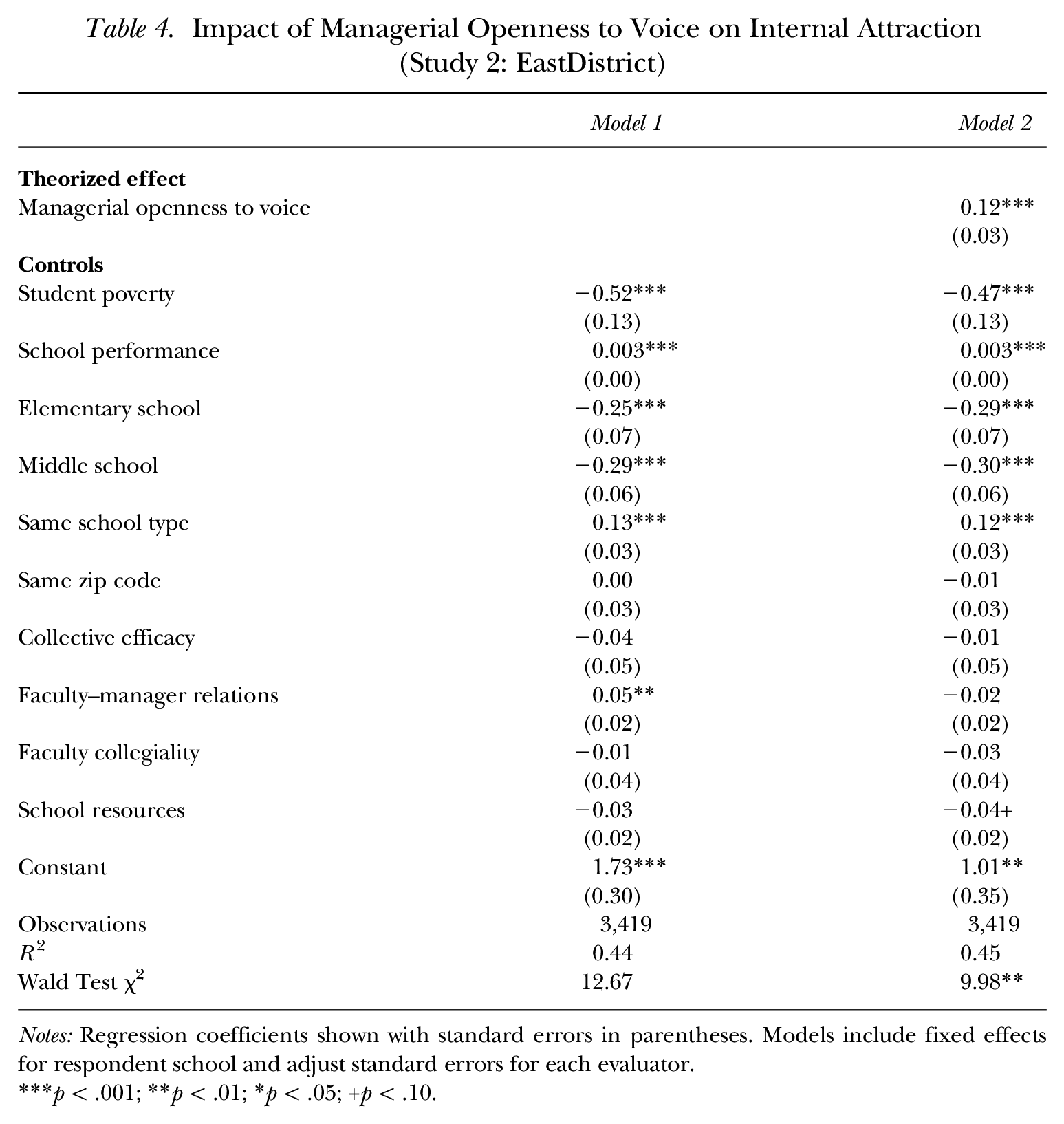
Notes: Regression coefficients shown with standard errors in parentheses. Models include fixed effects for respondent school and adjust standard errors for each evaluator.
p < .001; **p < .01; *p < .05; +p < .10.
Discussion
Informed by theory, interviews, and a pilot study, our first field study found a positive association between managerial openness to voice and internal attraction. We replicated these findings in our second field study by linking managerial openness to voice to teachers’ subjective attractiveness ratings of other schools in their district. Using two distinct field studies and multiple measures of internal attraction serves as a powerful robustness check. Moreover, it suggests that managerial openness to voice has both behavioral (Study 1) and psychological (Study 2) implications for employee outsiders.
Together, these findings expand significantly our understanding of worker voice and its relation to employee- and unit-level outcomes. Prior research has shown that managerial openness to voice correlates with various favorable employee attitudes and behaviors and thereby represents a powerful mechanism for increasing retention (Spencer 1986; Chandrasekaran and Mishra 2012). Yet, despite workers’ stated preferences for work environments offering greater voice (Freeman and Rogers 2006; Kochan et al. 2019), there has been limited evidence that the extent to which workers have opportunities to engage in improvement-oriented voice affects their actual preferences and job-search behaviors in organizations (Hutchison 2008). We found that managerial openness to voice is, indeed, relevant for employees’ career-related preferences and behaviors and that managers who encourage employee input may gain an internal recruiting advantage over those who do not encourage such input.
This study contributes to current research in several additional ways. Our findings illuminate the complex, nuanced ways in which employees conceptualize their organizations’ institutional environments. By focusing on how leaders affect their direct subordinates, earlier research has assumed that leadership styles in other work units are out of sight and mind. Our findings suggest that employees are, indeed, aware of and potentially affected by institutional variations that transcend their immediate managers or bosses. We highlight how employees’ impressions of other work units and managers play a critical yet previously unrecognized role in determining which opportunities employee outsiders find attractive and are likely to pursue. Thus, employees’ career-related attitudes appear to derive from complex cognitive maps that extend beyond their immediate work units and managers.
Our findings also have implications for career mobility in contemporary labor markets. Although managers rely on a combination of internal and external hiring to meet their needs (Royal and Althauser 2003; Bidwell and Keller 2014), research on job attraction has focused almost exclusively on external candidates (Chapman et al. 2005; Breaugh 2013). Our findings suggest not only that researchers should pay more attention to internal attraction but also that theories regarding external job seekers may not generalize internally, and vice versa. For example, prior research on external hiring suggests that job seekers struggle to evaluate tacit organizational attributes—such as leadership, climate, or culture—prior to the point of hire (Cable, Aiman-Smith, Mulvey, and Edwards 2000). This assumption is at odds with what we heard from teachers, as one teacher clearly expressed that within her district, she “could point to any school, and . . . even to a good number of teachers, and tell [us] how they feel about their principal.”
Thus, it seems likely that because internal candidates have access to particular—and likely more-accurate—information about job and work environments, they may evaluate the same opportunities quite differently than external candidates do. Indeed, similar to how employment stability allows organizations to monitor the workforce and thereby use nuanced information about workers’ attributes to inform internal placement decisions (Bidwell 2011), our research suggests that employment stability also enables employees to evaluate distal areas of their organizations in ways that inform their career preferences and job-search decisions. Employees’ privileged information about other units and managers may lead to more-fulfilling careers by helping employees target organizational areas with less-visible but nonetheless highly attractive characteristics. We encourage future research on how worker characteristics facilitate or inhibit information about other work units and managers.
Our findings should be considered in light of several limitations that suggest directions for future research. We conducted both of our field studies in public school districts in the United States. It is important to understand the degree to which our findings generalize to other school districts. Schools are under growing pressure from state departments of education to comply with standards and testing criteria, which has encouraged many school districts to try to standardize instruction, discipline, and student services throughout their school buildings (Royal and Gibson 2017). By contrast, administrators in the districts we studied contacted our research team because they valued (and wanted to better understand the nature of) frontline participation and collaboration throughout their schools. Thus, on average, teachers in our sample may have had more opportunities to provide input relative to their counterparts elsewhere. In a related way, the union and district administrators in the school districts we studied granted strong transfer rights to teachers, provided they were qualified and certified for the roles in question. Principals maintained fairly high levels of autonomy over the selection and hiring process. In other school districts, district administrators may retain a higher level of control over job placements, and principals may have to give preference to certain candidates over others. Managerial openness to voice might exert weaker effects on internal attraction in school districts in which job mobility decisions are more restrictive.
Indeed, the fact that managerial openness to voice had different effect sizes across our two field studies may be indicative of district-level moderators. We note that the mean level of student poverty is considerably lower in Study 1 (38% of students on reduced or free lunch) than Study 2 (82% of students on reduced or free lunch). It is notoriously difficult for high-poverty schools to attract and retain talent, with prior research suggesting that schools above a certain poverty threshold tend to be perceived largely equivalently (and negatively). In fact, this is one reason education researchers often treat “high-poverty” schools as a binary variable if they fall above a certain threshold (e.g., 50%) (Ingersoll 2001). Though we cannot know for certain, we suspect that the much higher percentage of high-poverty schools in Study 2 may be responsible for the observed effects. That is, teachers, in general, have negative impressions about teaching in high-poverty schools, and these negative impressions may decrease teachers’ likelihood of sharing positive information about their school to other teachers in the district even when they perceive their principal to be more open to voice, muting the effect of managerial openness to voice on internal attraction.
It is also important to consider whether and how our findings may generalize to other organizational settings. Decentralized hiring decisions are common in many private-sector organizations, as hiring units solicit applications from both internal and external candidates. Nevertheless, our research setting may differ from some private-sector companies in ways that limit the generalizability of our findings. For example, the relative proximity of the schools may allow employees to pursue transfers without the risk of severing ties to their local community. In organizations that have larger geographical distances between work units, workers may find internal moves to be more disruptive. While we would expect the same general patterns to hold, the effects of managerial openness to voice on internal attraction may attenuate when organizational work units are more geographically distant. In related terms, the standardization of pay, training, and promotion opportunities within school districts was methodologically advantageous for us: by holding these constant, we could better isolate the effects associated with managerial openness to voice. Indeed, other management scholars have noted how school districts provide similar methodological advantages (e.g., Leana and Pil 2006; Pil and Leana 2009). Extending this work to a context reflecting greater variation in other work unit and job attributes, however, would provide much-needed insight into how these attributes combine to shape attraction. For example, it would be fruitful to explore whether certain attributes such as pay or opportunities for training (e.g., Batt, Hunter, and Wilk 2003) are weighted more favorably and whether these attributes tend to multiply.
The relative proximity of schools may have also facilitated the information flow among schools. By contrast, the higher levels of geographical dispersion common among private-sector firms may make information exchange more difficult. Whether our effects would be the same in contexts in which employee communications are less frequent is an open question. Although we would still expect employees in other organizational settings to want voice and to find it attractive, for example, the relationship may diminish if employees cannot accurately evaluate managers in other units. A related limitation concerns the mediating informational processes through which employee voice affects internal attraction in the first place. Our interviews with teachers supported the notion that teachers communicate about principals at other schools. Moreover, our pilot study indicated that teachers can discern relatively accurately the degree to which principals in other schools adopt a leadership philosophy that embraces teacher input. Nevertheless, our interviews also revealed teachers who engaged in broader forms of gossip and information sharing that were not necessarily specific to a principal’s leadership style. While we hypothesized and found that employee outsiders perceive work units with high levels of employee voice as more attractive places to work, we could not capture the specific content of the information communicated by employee insiders to employee outsiders. Although we could not disentangle the extent to which employees’ attraction to a particular unit may result from direct knowledge about (or interest in) employee voice per se or from a more general notion that employees tend to be happy (or unhappy) there, both explanations are consistent with our theoretical arguments.
Despite these limitations, our research should be of broad interest to managers responsible for recruiting and hiring for their work units, particularly since studies show that internal hires outperform their externally hired counterparts (Bidwell 2011). We also see broader practical implications for organizations, which often find that certain work units are much harder to staff than others. For example, work units that have trouble attracting external talent, such as those in remote locations or that have received negative press, stand to benefit from encouraging the flow of internal talent to the unit. Our work suggests that units with managers who encourage employee input and organizations that incentivize those managers to stay in their jobs will encourage internal employees to seek positions in such work units. Moreover, if managers who are less open to voice see their employees leave to work for managers who are more open to voice, this may create isomorphic pressures that encourage “good” or “high-road” leadership, encouraging managers to become more receptive to employee input, to better attract and retain workers.
Finally, this research has particular consequences for public education, a sector that employs nearly four million workers in the United States (Vilorio 2016). Among US school districts’ biggest challenges is attracting teachers to struggling schools (García and Weiss 2019; Strauss 2019). To date, research on school recruitment has largely ignored the role of principals, focusing instead on district-level policies (e.g., financial incentives, credentialing requirements) and student demographics, which are beyond schools’ control. Our work suggests that in the quest to turn around low-performing schools, districts can offset this challenge, in part, by hiring principals who will commit to empowering their teachers and by encouraging those principals to stay in those schools for a minimum amount of time. Doing so will increase the likelihood that more teachers in the district will seek opportunities at those schools, giving principals more staffing options.
Footnotes
Appendix
For information regarding the data and/or computer programs used for this study, please address correspondence to the authors at

1
In our study districts, principals solicited teacher input in several ways. Most often, principals asked teachers for their suggestions about topics ranging from classroom dismissals (e.g., staggered bell schedules to avoid fights) to parental involvement (e.g., establishing parent–teacher social events) to curriculum design (e.g., how to best link instructional materials and strategies across subjects and grade levels). Principals also solicited teacher input more formally by placing teachers on committees devoted to key instructional and disciplinary issues.
2
For example, when teachers were asked to reflect on voice in the context of their broader school districts, they compared their experiences with their own principals to what they had heard about other principals from teachers in other schools. We also conducted a pilot study that allowed us to explore both the degree to which teachers know about other schools in their district and how teachers inside and outside of a school perceived the same principal’s openness to teacher voice. We found teachers to be keenly aware of what happens at other schools, with 76% of teachers indicating that they “somewhat agree” or “strongly agree” that teachers know what happens in other schools. We also found that teachers had highly accurate knowledge of other principals’ openness to voice, indicated by a high and statistically significant pairwise correlation between teachers’ perceptions of other principals’ openness to voice and how teachers in those other schools rate their principals’ openness to voice (r = 0.69; p < .05). Details about our interviews and pilot study are available upon request.
3
We did not control for school size because the variable correlated strongly to school type. That is, all elementary schools in the district were roughly the same size, and the same was true for middle schools, junior high schools, and high schools.
4
Union representatives are teachers who serve a quasi-leadership role on behalf of all teachers in their school. All union representatives have tenures greater than three years and are in a position to know about their school’s hiring norms.
5
To address the possibility that some teachers’ perceptions of other schools may derive from firsthand experience working with a principal in another school earlier in the teachers’ careers, we ran this same analysis but restricted our sample to teachers who had worked only at their current schools. Our results held.