




Abstract
In most industrialized countries, temporary and non-standard forms of employment have become a pervasive feature of the labor market. At the firm level, however, their diffusion is less uniform than expected. While some firms exhibit high propensity to use non-standard labor, others make no use of it. The most conventional explanations (market uncertainty, production regimes, competitive pressure) fail to account for such heterogeneity. In this article, the authors develop an alternative explanation that links non-standard employment to the firm-specific availability of managerial resources: Whenever the latter are relatively scarce, firms make larger use of non-standard labor to reduce coordination and operating costs. Using a linked employer–employee panel of manufacturing firms from the Emilia-Romagna region (Italy), the authors provide empirical support for this explanation. The result is robust to different estimation strategies and controlling for alternative drivers of non-standard employment. This finding suggests that the use of non-standard labor is motivated by the firm’s needs to compensate for specific managerial scarcities.
For the past decades, several countries have enacted labor market reforms to increase firms’ external flexibility, that is, the freedom employers enjoy to expand or contract their workforces as they wish and to employ workers on a temporary and part-time basis (Treu 1992). Since then, the use of non-standard forms of employment has become widespread in most advanced economies (Allmendinger, Hipp, and Stuth 2013; Keune 2013).
Such growing relevance of non-standard employment has attracted the attention of scholars and policymakers. The research has focused on two main issues. First, its impact on work relations and job conditions, which turns out to be sizable. In particular, non-standard employment is shown to increase job instability, persuade workers that they are replaceable (Kalleberg 2011), introduce wage penalties (especially for temporary agency workers, see ILO 2015, 2018), and shift part of the entrepreneurial risk to employees (Kleinknecht, Oostendorp, Pradhan, and Naastepad 2006). Moreover, as highlighted by OECD (2015), being on a temporary contract significantly reduces the likelihood of receiving employer-sponsored training. Second, a large number of studies investigate the impact of non-standard employment on a number of components of firm performance such as returns on equity (Lepak, Takeuchi, and Snell 2003), productivity growth (Boeri and Garibaldi 2007; Lucidi and Kleinknecht 2010; Damiani, Pompei, and Ricci 2016), innovation and R&D (Kleinknecht, van Schaik, and Zhou 2014), as well as workers’ motivations (Blanchard and Landier 2002; Battisti and Vallanti 2013) and the propensity to accumulate firm-specific skills (Lepak and Snell 2002). Overall, the evidence produced by these studies is mixed, fueling doubts about the role of non-standard employment as drivers of long-term firm efficiency.
In this article, we depart from this literature by studying what drives a firm’s propensity to rely on non-standard employment, rather than focusing on its effect on some outcome variable, for example, work conditions and/or firm performance. Answering this question is relevant for three key reasons. First, it helps explain where the need for external flexibility originates, either outside (e.g., rising uncertainty of market dynamics) or inside (e.g., managerial resources) the boundary of the firm (or both). Second, it improves our understanding of how firms may eventually respond to policy interventions aimed at tailoring the use of non-standard labor. Finally, it may explain the diversity of firms’ proclivity toward non-standard employment within and between industries.
To address this question, for the first time to the best of our knowledge, we compare key theoretical arguments that can explain the use of non-standard labor. Then, we test these arguments by analyzing a linked employer–employee database that combines two sources: 1) firm- and worker-level information taken from the Italian Statistical Office’s (ISTAT) registry of active firms for the years 2012 to 2016; and 2) accounting and financial information derived from ISTAT’s Limited Companies Balance Sheets Panel, which gathers the balance sheets of all Italian limited companies from 2001 to 2014. To limit issues related to labor market dualism and diffusion of informal employment, we focus our analysis on Emilia-Romagna, an Italian region where both features are limited and homogeneously distributed compared to the national average (Di Caro and Nicotra 2016). With our work, we outline a theoretical framework that can be used to study the drivers of non-standard employment at the firm level. We further find empirical support for an important driver that links non-standard employment to the firm-specific availability of managerial resources.
Common Theoretical Explanations and Preliminary Evidence
In mature economies, a growing number of labor market reforms have made it easier for manufacturing and service firms to hire workers through non-standard forms of employment (Millward, Bryson, and Forth 2000; Peck and Theodore 2007; Kalleberg 2011; Cappelli and Keller 2013; Hipp, Bernhardt, and Allmendinger 2015). The latter differ markedly from ordinary labor contracts, which provide an indefinite duration of the employment relationship, full-time schedules, and a long-term stable identification between employer and the hierarchical authority, that is, between work and employment (Allan 2000; Kalleberg 2000; Keller and Seifert 2005; Cappelli and Keller 2013). In non-standard employment, at least one of such requirements is missing.
The International Labour Organization (ILO) (2018) identifies four main types of non-standard employment: 1) temporary contracts; 2) part-time and on-call work; 3) temporary agency work and other forms of employment involving multiple parties; and 4) disguised employment relationships and dependent self-employment (e.g., freelancers and independent contractors). Among the latter, temporary contracts and temporary agency work are among the most frequent types (in Italy these two contracts account for approximately 50% of all non-standard forms [ISTAT 2017]).
Although the rate of non-standard employment varies depending on industry and country (Eichhorst, Feil, and Marx 2010; Hipp et al. 2015; ILO 2018), its diffusion is pervasive. Millward et al. (2000), for instance, showed that in Britain the share of workers hired on the basis of temporary as well as part-time and self-employment contracts has been on the rise since the 1980s. Keune (2013), Cappelli and Keller (2013), and Allmendinger et al. (2013) further confirmed the existence of a growing, although differentiated, trend in the use of fixed-term contracts in most advanced countries. Further, some recent work suggests that the firm’s propensity to rely on non-standard labor may increase in the presence of severe downturns, such as the Great Recession, following the need to adjust the use of inputs to demand shocks (Boeri, Garibaldi, and Moen 2013; Bachmann, Bechara, Kramer, and Rzepka 2015).
While the diffusion of non-standard employment is a widely debated topic, especially given the related social, economic, and organizational implications (Nienhueser 2005), its drivers are only partially known (Cappelli and Keller 2013). In fact, information concerning the characteristics of the firms that make use of non-standard labor and the actual reasons that lead them to adopt these contractual forms are relatively limited. Nevertheless, the available explanations converge around three structural/contextual factors 1 : 1) market uncertainty and volatility, 2) knowledge-intensive production regime, and 3) increasing market openness and competitive pressure.
Market Uncertainty and Volatility
Flexibility—that is, the firm’s ability to manage market uncertainty and volatility (see Stigler 1939)—represents one of the distinguishing features of the post-Fordist production regime, which has come to dominate most industries in advanced countries (Duguay, Landry, and Pasin 1997). In such a regime, unpredictable product demand and uncertainty in consumer preferences are considered the main factors that force firms to achieve some degree of flexibility in production (Gerwin 1993; Chang 2012). While in the past such flexibility was partly satisfied by holding stocks rather than by adjusting working time and production volumes, at the present time this solution is not viable. The adoption of business models based on production to order and the growing number of product varieties associated with mass customization limit the possibility to keep parts in stock as a buffer between market and production (Bosch 2004). An alternative is to adapt to unforeseen market signals by changing the internal composition of productive resources, including labor (Volberda 1996). In this sense, the design of labor market institutions and regulations is certainly influential, but, as argued by Saint-Paul (1996), the dichotomy between primary (stable) and secondary (unstable) employment can endogenously arise within a firm as a response to demand fluctuations. Since searching, recruiting, monitoring, and replacing workers with high skills is particularly costly (Biegert and Kühhirt 2018), firms are pushed to split their workforce into a higher-paid, primary workforce and a secondary, or peripheral, workforce, whose adjustment costs are substantially lower (Doeringer and Piore 1985). In this view, uncertainty leads employers to create a buffer of flexibility based on precarious, fixed-term or external employees (Kalleberg 2011; ILO 2015). Following this argument, the high market uncertainty of most modern industries leads firms to increase their use of non-standard employment. 2
Knowledge-Intensive Production Regime
A parallel argument focuses on the knowledge content of production activities. According to Piore and Sabel (1984), Tolliday and Zeitlin (1987), and Streeck (1987), together with market uncertainty, another central feature of the change toward post-Fordist production regimes lies in the emergence of knowledge-intensive modes of production. The evolution of the technological supply toward the adoption of fungible plants and machinery fosters the restructuring of firms (especially in manufacturing), making the constant accumulation of internal knowledge exceedingly important (Danneels 2002; Vrontis, Thrassou, Santoro, and Papa 2017). In a business environment characterized by globalization and rapid technological change (Vrontis and Thrassou 2013), activities such as the acquisition of new competencies and the collection and processing of information currently absorb most of the economic and managerial resources in nearly every sector (Verdu-Jover, Llorens-Montes, and Garcia-Morales 2005). At different organizational layers, firms need workers who are able to adapt to the demands of new technologies as they emerge, because this is the only way to maximize the advantage from technology and innovation (Brewster, Mayne, and Tregaskis 1997). In other words, the whole organization has to become functionally, and not only externally, flexible. This goal can be achieved by means of intensive internal training, enlarging worker participation in decision-making, and increasing incentives to individual and collective investment in firm-specific skills and competences. Clearly, such firm-specific commitment requires a time perspective that is at odds with short-term and flexible forms of employment (Mayer and Nickerson 2005). It follows that in the presence of highly sophisticated and firm-specific knowledge, the propensity to rely on non-standard employment will tend to be low (both to save on training costs and to improve firms’ internal know-how). As a result, increasing knowledge-intensive production regimes will tend to reduce the use of non-standard labor at plant/firm level.
Competitive Pressure
A third argument links the increasing use of non-standard employment to competitive pressure. Over the past decades, most advanced countries have experienced changes in market uncertainty and production technology coupled with extended trade and market liberalization (ILO 2018). As a consequence, in most industries both the market size of individual products and the number of market players expanded, amplifying the cost/price competitive pressures among incumbent firms (Feenstra and Weinstein 2017). As shown by Chen, Imbs, and Scott (2009), trade liberalization brought about a significant compression of prices and markups. The latter has become challenging to manage because of a hypercompetitive landscape (D’Aveni 1994, 1999), in which firms are not able to resort to stable barriers to entry or to leverage durable product differentiation to face heterogeneous global rivals (Harvey and Novicevic 2001). Faced with this competitive environment, firms rely on non-standard labor as useful tools to strengthen their bargaining power in wage negotiations, favoring a partial recovery of profitability through labor cost savings. Landini, Arrighetti, and Bartoloni (2020), for instance, showed that the larger availability of non-standard employment contracts is associated with a reduction in average wages. Consequently, the use of such contracts can be interpreted as deriving from firms’ attempts to search for sources of profit in contexts characterized by strong and growing competitive pressures.
The three arguments presented above share a common aspect: Whether it is the degree of market uncertainty, the characteristics of production technology, or the strength of competitive pressure, the firm’s choice to rely on non-standard labor depends on factors that are external to the firm and that affect in a similar way all firms operating in the same competitive environment (e.g., the industry). Consequently, one may expect the use of non-standard labor to be higher (lower) in industries where demand is more (less) volatile, the production technology is less (more) knowledge intensive, and the competitive pressure is stronger (weaker). Still, irrespective of the argument, the main prediction would be that firms’ recourse to non-standard employment tends to be relatively uniform within sectors (and possibly heterogeneous across them).
The evidence that emerges from our data, however, tells a different story. The left panel of Figure 1 shows the quantile distribution of the share of fixed-term and agency contracts for the firms included in our data set (using administrative data for the whole population of manufacturing limited companies operating in the Emilia-Romagna region in Italy; more details in Data section). The right panel reports the quantile distribution of the same variable after normalization by the industry mean. 3 On average, the workers hired with non-standard contracts account for only 7% of total employees. A more detailed analysis, however, reveals high heterogeneity in the population of firms. The median of this ratio, in fact, is barely above 3%, and nearly 35% of the firms do not employ such contracts at all. Meanwhile, the top decile of firms relies extensively on external flexibility, with non-standard contracts representing 20% to nearly 100% of the total employees among these firms (on average 33%). Such evidence is even more compelling if one considers that the observed heterogeneity remains high even within industries. The shape of the distribution after normalizing by industry mean (right panel) remains virtually unchanged, with the top decile of firms relying on non-standard employment from 3 to 15 times more than their industry average. 4
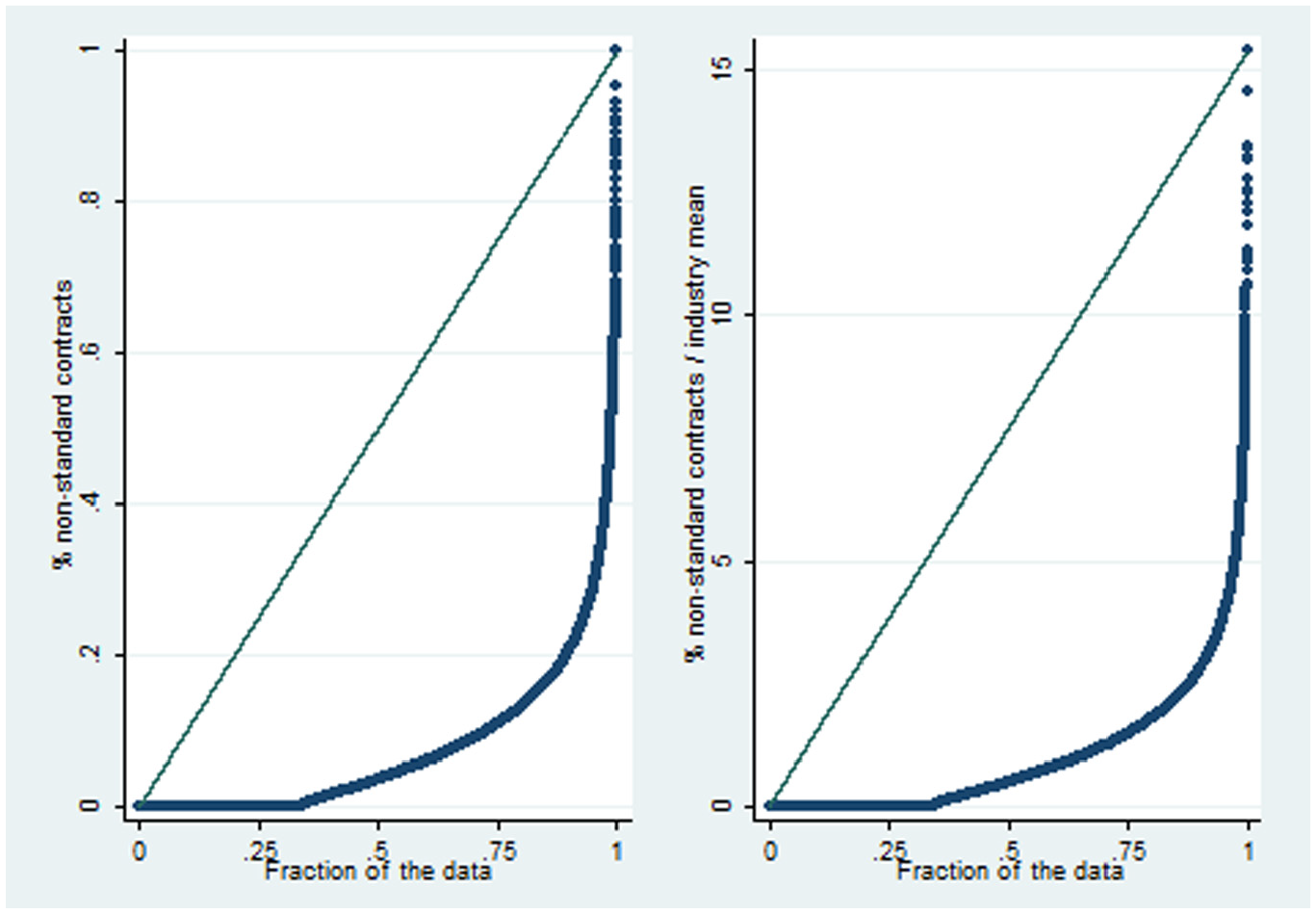
Non-Standard Employment: Quantile Distributions
The relatively low average diffusion of non-standard employment and, above all, the high within-industry asymmetry of its use, cast doubt on the explanatory power of contextual-structural factors alone, such as market uncertainty, production regimes, and competitive pressure. To explain such asymmetry, we need to focus on firm-specific factors that may lead firms operating within the same competitive environment to differentiate their recourse to non-standard labor.
An Alternative Explanation: Managerial Resources
An important factor that could explain part of the observed firm-level heterogeneity in the use of non-standard labor has to do with managerial resources. 5 Among the changes brought about by the advent of post-Fordism are not only the rising market uncertainty and complexity but also the relevance of management as the driver of firm behavior. The reasons are twofold. First, in the presence of uncertainty, firm success depends on the ability of managers to constantly review and update their decisions. The way such a process unfolds can differ, as managers do not react in mechanistic ways to external stimuli. Rather, as shown by recent management research, managers are subject to a variety of constraints (e.g., resource endowments, demand conditions, governance), incentives (e.g., performance compensation, stakeholder activism), and psychological biases (e.g., overconfidence, hyperbolic discounting) (Banker, Byzalov, Fang, and Liang 2018). It follows that, depending on the managerial resources available within the organization, firms’ decisions, including the use of non-standard labor, can be highly differentiated, even for firms within the same competitive environment (Sanchez 1995; Kalleberg 2001; Lepak and Snell 2002; Ketokivi 2006).
Second, the diffusion of post-Fordist production regimes has brought a significant reorganization of production activities, increasing the number of people involved in non-routine tasks (Acemoglu and Autor 2011). The latter are usually abstract cognitive tasks involving analytical and/or interpersonal skills (Autor, Levy, and Murnane 2003; Fonseca, Lima, and Pereira 2018). Typical activities include data analysis, creative thinking, directing or maintaining interpersonal relationships, which are all activities related to problem-solving, managing, or carrying out complex communications (Fonseca, de Faria, and Lima 2019). Such tasks are difficult to evaluate and compensate, requiring ad hoc activities related to direction and monitoring that go beyond the simple definition of wage schemes. Moreover, in the presence of rapid changes of the competitive environment, these tasks require a constant renewal of the related competences, which is often costly to accomplish. Altogether, this makes the coordination activity usually attributed to managers more challenging, increasing the importance of highly qualified managers. In this regard, recent studies show that the quality of management accounts for a large part of performance differentials among both manufacturing and service firms (Bloom et al. 2013; Bender et al. 2018).
Based on these prior considerations, we propose that managerial resources affect the recourse to non-standard employment. As suggested above, environmental uncertainty and technological volatility raise the costs of hierarchical coordination, generating strong pressures on management (Patel 2011). In line with contributions in the organizational economics and industrial relations literature, 6 we argue that managers can react in two ways: 1) strengthen internal flexibility, that is, enhancing the ability of standard employees to perform a variety of tasks and participate in decision-making; and/or 2) rely on external flexibility, that is, exploiting non-standard labor so as to reduce costs by limiting workers’ involvement in the organization (Kalleberg 2001).
Both options have advantages and disadvantages. Internal flexibility uses mainly standard forms of employment and thus entails relatively high operating costs (e.g., hiring and firing costs). Moreover, it requires an intensive and costly activity of coordination by highly qualified managers to ensure a smooth allocation of workers across a range of tasks. At the same time, the combination of job variety and participation in decision-making makes this option particularly convenient when the tasks involved are non-routine, because it is more effective in fostering learning and information sharing. By contrast, external flexibility is relatively expensive when it is used for tasks other than routine ones, since it discourages competence accumulation. However, it enjoys lower operating costs and less intensive use of managerial resources as the allocation of employees into tasks occurs primarily via the market (i.e., it exploits a mechanism of “external delegation” of coordination activities; see Bock, Opsahl, George, and Gann 2012). It follows that the firm’s rate of non-standard employment will depend both on the characteristics of the tasks and on the availability of managerial resources. For any given level of managerial resources, the probability to use non-standard contracts is lower (higher) the less (more) routinized the tasks. At the same time, for any given distribution of tasks, such probability is lower (higher) for firms with a higher (lower) level of managerial resources.
To illustrate our argument, we discuss a simple example. Consider an industry populated by a fixed number of firms. Each firm i needs to produce a given output at minimum costs. For reasons not explicitly modeled and related to previous investments and learning paths, firms differ in their endowment of managerial resources. In particular, we characterize such endowment by the ratio
Each firm needs to decide how to organize its production activities, which consist of a continuum of tasks of unit size. Let us assume such tasks can be ordered from the most to the least routinized and call
Figure 2 summarizes our argument. The horizontal axis reports the ordered segment of task
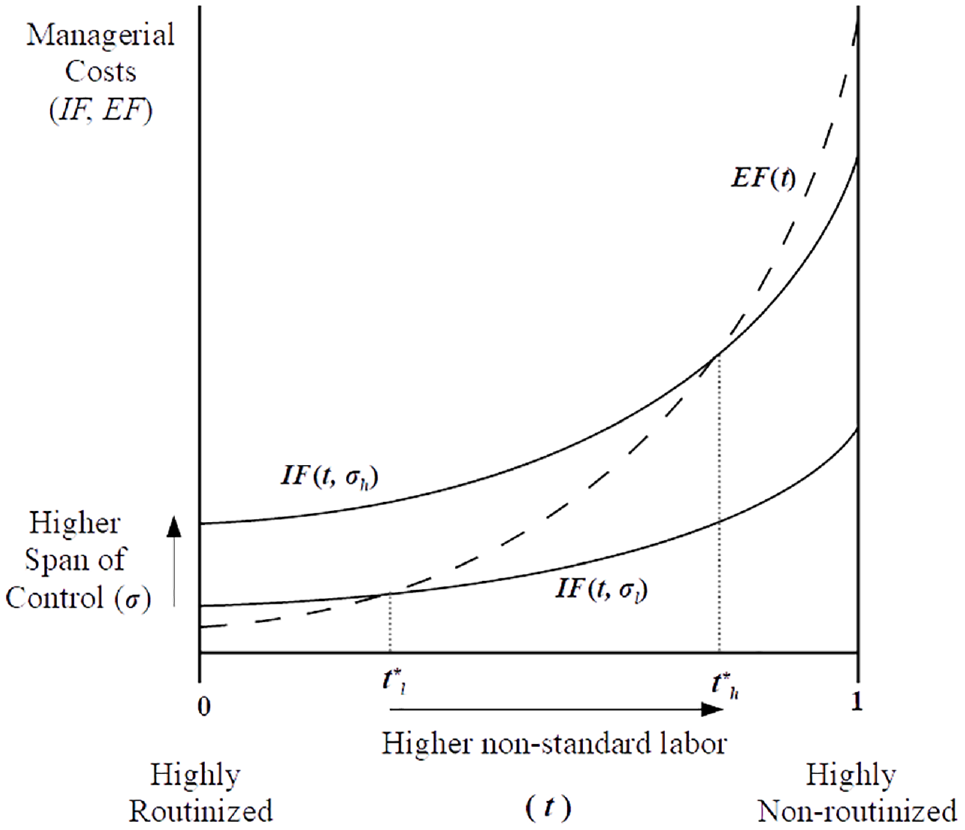
Internal vs. External Flexibility: Managerial Resources and Task Segmentation
Overall, our argument is consistent with the so-called core-periphery hypothesis as proposed by Kalleberg (2001) and Atkinson (1984): Firms seek to establish long-term employment relations with part of their workforces (the “core,” regular, permanent workers who are highly trained, skilled, and committed to the organization, which are attributes that are thought to be needed for functional flexibility) at the same time as they externalize other activities and/or persons by means of transactional contracts (Kalleberg 2001: 484). We suggest that the relative size of the core and the periphery is not predetermined but depends on the available managerial resources. When the latter are sufficiently abundant (scarce), the core (periphery) can be as large as the whole organization.
A key assumption in our argument is that managerial resources are heterogeneous across firms. Several works provide empirical evidence in support of that assumption (e.g., Bloom and Van Reenen 2010; Arrighetti, Landini, and Lasagni 2014). What leads these heterogeneous patterns of accumulation to unfold, however, is less clear. We suggest that two types of drivers exist. Some of them are of endogenous nature and depend on firm-specific strategies and learning paths (Landini et al. 2020). Others are the result of external conditionings, which affect the view about how firms ought to be managed. On this respect, Bagguley (1991) argued that the decision to combine scant accumulation of managerial resources and high use of non-standard labor can be motivated by corporate rhetoric and cultures. In this view, the adoption of external flexibility as a managerial reference model was not simply a consequence of changes in monitoring and resource management practices brought about by the diffusion of post-Fordism. It was also the rejection of some objectives that were typical of Fordism, such as medium-term planning, the adaptation of resources and investments to medium-long term goals, and the acquisition of stable competitive advantages (Volberda 1998; McGrath 2013). These objectives were replaced by short-term targets such as agility, exploitation of transitory strategic opportunities, and ad-hocracy (Volberda 1996; Hyman 2016). This shift allowed the managerial culture that presents external flexibility as a pragmatic managerial response to a given set of circumstances (Brewster et al. 1997) and identifies the flexible company as a universal organizational paradigm (Atkinson 1985; Dreyer and Grønhaug 2004) to prevail. Such a view was further strengthened by growing relevance of managerial “short-termism,” meaning the idea that management skills are to be assessed not by comparing different levels of profit among firms but by considering the short-term performances and steadiness of profits of the same firm over time (Hirshleifer and Thakor 1992; Laverty 1996). Obviously, the way these corporate cultures affect firm decisions is not general and depends on several idiosyncratic factors. For instance, it may be contingent on managerial preferences and ideology. In general, however, we may expect that the more differentiated these idiosyncratic factors are, the more heterogeneous the resulting managerial responses will be.
Institutional Context
We analyze the manufacturing sector of one Italian region, Emilia-Romagna. Manufacturing is by far one of the most relevant sectors of the Italian economy and a key driver of economic growth (Szirmai, Naudé, and Alcorta 2013; Andreoni and Chang 2016). Emilia-Romagna is one of the most prominent manufacturing regions in Italy. Approximately 60% of regional GDP is related to the manufacturing sector, 8 and the region ranks second in Italy and fifth in Europe for the number of people employed by this industry. 9 Moreover, the analysis of this region presents two additional advantages. First of all, Emilia-Romagna has a very low unemployment rate among all the Italian regions. In 2012 it was approximately 7%, compared to other regions such as Campania (19.2%) and Sicilia (18.4%), with the country average being around 10%. 10 This circumstance implies that the high risk of unemployment is not a relevant factor leading workers to accept non-standard labor contracts in our case. Second, according to Di Caro and Nicotra (2016), Emilia-Romagna has a relatively small diffusion of informal employment, whereas this is a relevant issue in other Italian regions. We can thus assume that for most firms in our data, informal employment does not represent a viable alternative to non-standard employment. These factors strengthen the external validity of our results.
The international comparative literature stresses the importance of institutional and regulative factors to explain the incidence of non-standard employment (Allmendinger et al. 2013). In fact, regulations on firing permanent workers and hiring non-standard workers have received the greatest attention. In theory, high levels of dismissal protection for regular workers and low entrance barriers for non-standard workers should be associated with a large proportion of the workforce being hired on a non-standard basis (Hipp et al. 2015). On both these dimensions, Italy presents some specific characteristics. Dismissal protection is regulated by the Workers’ Statute (Statuto dei lavoratori, Law 200/1970). According to this statute, dismissal is possible for justified “subjective” and “objective” reasons, with courts having the ultimate word on the need for reinstatement in appealed cases. If the dismissals are judged unlawful, the mechanisms for reinstatement apply on a size-contingent basis and are relatively stricter for firms with more than 15 employees. These features led some authors to classify Italy as having a relatively protected labor market (Bertola, Boeri, and Cazes 2000). However, the large prevalence of micro and small firms implies that reinstatement restrictions apply to a relatively small fraction of firms, which partly explains the relatively high rate of employee turnover (Biagioli, Reyneri, and Seravalli 2004). With respect to hiring non-standard workers, Italy followed a pattern similar to other European countries and since the mid-1990s went through a significant process of labor market deregulation, which made the recourse to non-standard employment easier (with the Legge Treu in 1997, the Legislative Decree 368 of 2001, and the Law 30 of 2003). These interventions introduced various forms of atypical contracts without changing the legislation on permanent (open-ended) positions. The combination of moderate dismissal protection and easy access to atypical contracts contributed to the spread of non-standard employment in Italy.
Among the types of full-time non-standard employment, the most popular is fixed-term contract, which accounts for nearly 60% of all atypical positions in manufacturing. 11 According to the Italian legislation, fixed-term contracts can last no more than 12 months, or in extraordinary circumstances, 24 months. 12 Workers hired with these contracts are formal employees of the company and are subject to the same line of hierarchical authority as workers with permanent contracts. This feature makes the two types of contracts easily comparable in our study: The only difference is the short duration of fixed-term contracts, which makes them a suitable tool to achieve external flexibility.
Other types of non-standard forms of employment available to Italian firms include agency contracts and collaboration contracts. Agency contracts rest on the involvement of three subjects: the firm demanding labor, the worker, and the intermediary agency that formally employees the worker—permanently or for a fixed term—and stipulates a supply contract with the firm. 13 Collaboration contracts are instead agreements in which the workers are formally considered self-employed and should be used primarily for consultancy reasons. Altogether these two contract types are not very common in Italy, as they cover approximately 4.5% of the total workforce (Devicienti et al. 2018). Unlike fixed-term contracts, workers under agency and collaboration contracts are not formal employees of the company. Therefore, at least officially, they are not subject to the firm’s hierarchical authority. Moreover, available data do not allow us to distinguish those collaboration or agency workers who actually replace standard employees from those involved in genuine consultancy or that have short-term labor relations with the firms. For the purposes of our analysis, at a first level of approximation, we therefore left agency and collaboration contracts out of the analysis and focus primarily on fixed-term contracts. 14
Data
To conduct our empirical analysis, we combined original data from three sources. We started with the entire population of manufacturing firms operating in Emilia-Romagna according to ASIA-Imprese, the ISTAT registry of active firms. Such registry was established in 1996 and reports yearly information about structural characteristics of all Italian firms, including the legal form, total employees, and geographic localization. It also provides a unique firm identifier that can be linked to ASIA-Occupazione, another ISTAT registry. The latter is a linked employer–employee database with detailed information of each worker employed in any firms recorded in ASIA-Imprese since 2012. The available information includes employee’s gender, age, place of birth and, most relevant for the purpose of our study, a classification of the employment relationship. In particular, the type of employment is divided into internal, distinguishing between open-ended and fixed-term contracts, and external when the worker participates in the production process through forms of work remunerated with collaboration or temporary agency contracts. In all cases, employment is measured in terms of average annual job positions (i.e., full-time equivalent), calculated on the basis of the worker’s presence in the reference week of each month. To obtain information about the economic and financial conditions of the firms, we merge the previous two databases with the ISTAT Limited Company Balance Sheets Panel, which gathers the balance sheets as well as information about import and export for all Italian limited companies from 2001 to 2014. The results make an unbalanced panel of nearly 9,000 manufacturing firms per year operating in Emilia-Romagna between 2012 and 2014. (In particular, the data set includes 9,388 firms in 2012, 8,542 firms in 2013, and 8,518 firms in 2014.) For each firm we therefore observe their demographic and structural characteristics, economic and financial conditions, workforce composition as well as details about the geographic location.
Our main dependent variable is the ratio between the number of employees with a fixed-term contract and the total number of employees. In both cases, employment is measured in full-time equivalent. According to the Italian legislation, temporary contracts distinguish in two main categories: those that contain a training clause, and those that do not (Devicienti et al. 2018). While the former are also used for screening purposes before a regular position is offered, the latter is typically exploited as a source of external flexibility. In our analysis we therefore consider only fixed-term contracts without a training clause.
Among the explanatory variables, our focus is on the structure of the workforce organization within the firm, proxied by the span of control. To measure span of control, we first distinguish between 1) roles that usually belong to high organizational layers and are endowed with strategic planning and coordination responsibilities, such as executives and top and mid-level managers; and 2) roles that belong to the bottom of the hierarchy and are engaged with more operative tasks, such as manual industrial workers and office workers. Then, we measure the span of control as the logarithm of the ratio between the number of employees in the latter roles (i.e., manual industrial workers and office workers) as the numerator, and the number of employees in the former roles (i.e., executives and top and mid-level managers) as the denominator. A high span of control means that executives and top and mid-level managers have to coordinate a relatively large number of subordinate workers. Consequently, the constraints on their coordination activities are likely to be binding. Conversely, a low span of control means that each executive and top and mid-level manager is responsible for a restricted number of subordinates, implying that the burden associated with coordination activities is relatively small.
Given that we cannot exclude that other factors affect the firm’s propensity to use non-standard labor alongside the span of control, we include a set of covariates using information retrieved from the firm’s balance sheets and other structural characteristics. In particular, we focus on factors that are commonly associated with the need to rely on external flexibility (see the Common Theoretical Explanations and Preliminary Evidence section).
To control for market uncertainty, we use three variables. The first one is the volatility of sales, which is computed for each firm i and year t as the ratio between the average standard deviation of sales over the 10 years previous to t and the average sales over the same period. It is a firm-specific proxy of demand variability (for a similar approach see Devicienti et al. 2018). The second variable is the yearly sales growth, which can be considered another firm-specific measure capturing short-term changes in product market. Finally, the third variable is a seasonality index that is computed starting from the ISTAT monthly series of industrial production indexes (2-digit ATECO) to account for sector-specific market fluctuations (see Online Appendix Table A.1 for more details).
Part of the literature links external flexibility to specific characteristics of the production technology, such as the adoption of knowledge-intensive production regimes that involve both hiring highly qualified workers and deploying advanced manufacturing equipment. To account for these two factors, we first use labor productivity, which we measure as the ratio between value added and total employees, in logs. We also use the physical asset trend, which we measure as the ratio between the value of tangible assets at time t and the mean value of the same variable over the previous 10 years, in logs.
Finally, to account for the competitive environment we combine information on international activities and profitability. In particular, we consider 1) whether the firm is exposed to international competition through exports, with a dummy variable taking the value 1 if the firm i is an exporter in year t and 0 otherwise; and 2) the firm’s profit variation using yearly growth rate of the return on sales (ROS).
Table 1 reports key summary statistics for our main covariates. For a full description of all variables and the correlation matrix, see respectively Tables A.1 and A.2 in the Online Appendix.
Descriptive Statistics: Non-Standard Temporary Contracts

Notes: Robust standard errors in brackets. For more details about how these variables are measured, see the Online Appendix. SD, standard deviation.
Significance levels: * 10%; ** 5%; *** 1%.
Analysis
Our analysis aims to assess the drivers of non-standard employment, placing particular attention on the role of the span of control. We do so by estimating a linear fixed-effects panel model:

where Yi,t is the temporary employment ratio in firm i in year t, SPANi,t is the log of the span of control (our main variable of interest), Xi,t is a vector of controls,
A potential issue in our empirical analysis is the endogeneity of the span of control, which could arise for two reasons. The first is omitted variables, that is, the span of control affects the use of non-standard labor through some unobservable variable (e.g., managers’ ideology) that we do not/cannot include in the model. The second is simultaneity, meaning the internal composition of the workforce (here included as the rate of non-standard labor) affects the managerial resources of the firm, giving rise to reverse causality. In the case of time-invariant omitted variables, we avoid potential endogeneity sources through fixed effects (FE). To deal with other sources of endogeneity, we rely on instrumental variable (IV) models. 16 We have greater confidence in the validity of our results when they are robust to the two alternative methods.
The main benefit of an IV approach is that it can potentially deal with both time-invariant and time-variant omitted variable biases as well as simultaneity. The major challenge, however, is to find suitable instruments for the span of control. Ideally, we would instrument
To build our instrument we use data on the percentage of coverage of the fiber-optic infrastructure in the municipality where the firm is located. The data are collected from Infratel Italia, an in-house company of the Italian Ministry of Economic Development. 17 A limitation of such a database is that it reports the stock of the infrastructures updated to the first trimester of 2015, whereas our firm-level data refer to the time span 2012 to 2014. However, several considerations can be made to ensure that such data can still be used in our IV strategy. First, the largest part of the programs for extending fiber-optic communication technologies in Italy took place from 2015 onward. In fact, the same data that we use to build the instrument were collected by the government as a basis for a publicly funded program to implement the service, which so far had been built only by private actors. Second, the data were collected in the first trimester of 2015. We can then assume that the coverage of such infrastructure in each municipality underwent small changes between 2014, the last year of our firm-level database, and the first three months of 2015 when the survey took place. At most, one can safely assume that the municipalities that were not covered by the service in 2015 had not been covered in previous years, while few changes might have happened in what was covered to some percentage in 2015. However, to further reduce the bias related to possible over-estimation of coverage, we take two precautions. First, we run only the IV model for 2014, as over-estimation of the coverage might arise the longer the lag between the instrument and the instrumented variable. Second, we run the IV considering both a continuous measure of broadband coverage as well as a dummy variable as instrument, where the latter takes the value of 0 if the municipality is not covered—which by definition was 0 even before 2015—and 1 if the town is covered. In this way we diminish the bias coming from a possible change in the percentage of coverage between the end of 2014 and the first months of 2015. 18
Main Results
Baseline Specification
Table 2 shows the results of our baseline specification, that is, our fixed-effect panel model. In column (1), we estimate a model in which we control only for firm and year fixed effects. In column (2), we add controls for firm-level characteristics such as size, age, and being part of a business group. In column (3), we control also for alternative drivers of non-standard employment. Finally, in column (4), we conduct a robustness check taking into account a broader definition of non-standard labor. In particular, we estimate the same model as in column (3) considering the share of fixed-term and agency contracts as our dependent variable.
Baseline Specification: Panel Fixed-Effects Model
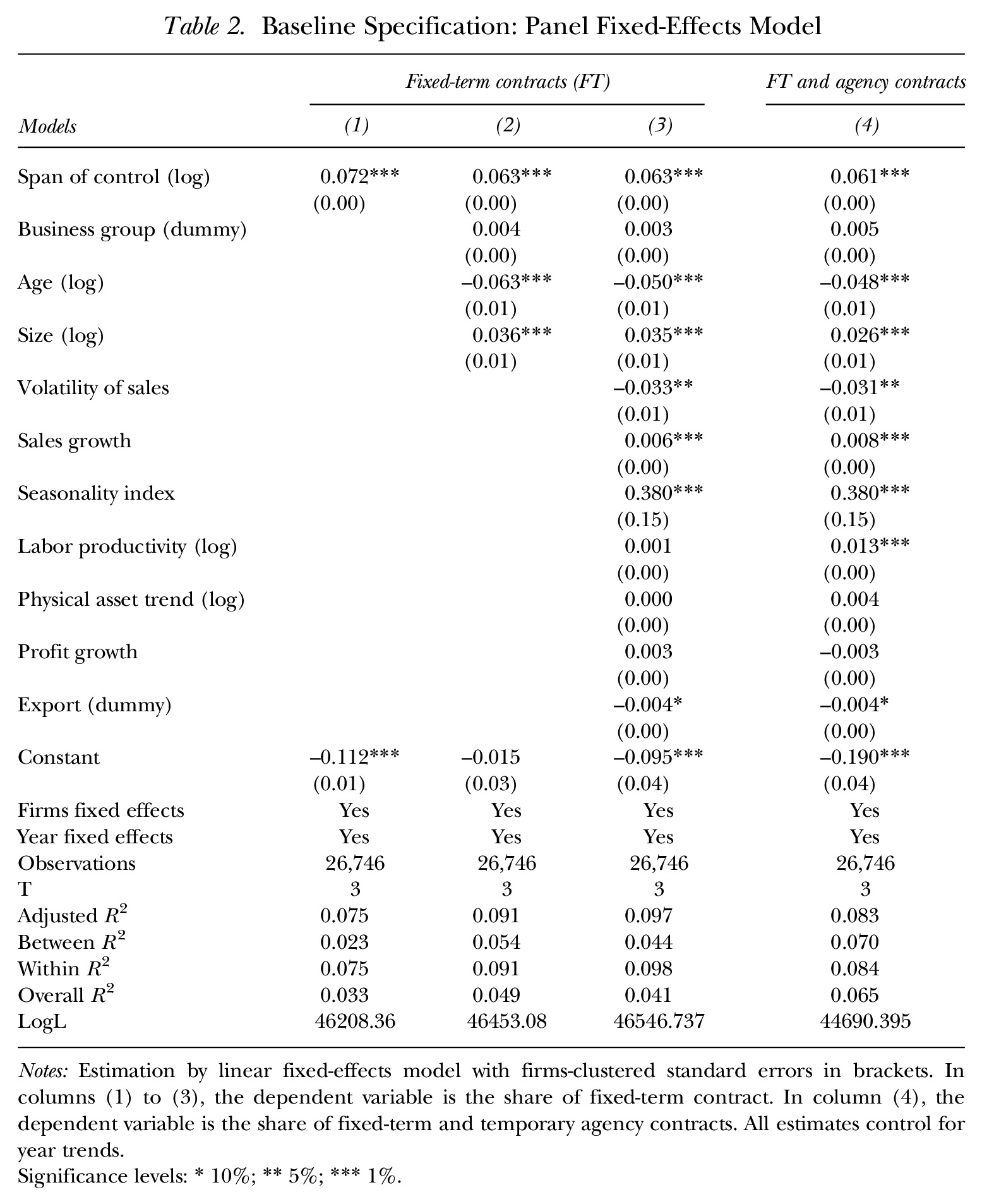
Notes: Estimation by linear fixed-effects model with firms-clustered standard errors in brackets. In columns (1) to (3), the dependent variable is the share of fixed-term contract. In column (4), the dependent variable is the share of fixed-term and temporary agency contracts. All estimates control for year trends.
Significance levels: * 10%; ** 5%; *** 1%.
In all the models, the span of control has a positive and statistically significant effect (p<0.001). Given that the average value of non-standard employment is 5.7% of total employment, this means that starting from the mean span of control of 16, an increase by one unit of the span of control is associated with an increase between 2.9% and 3.3% in the share of non-standard temporary employment. Such increase is nearly four times the increase one would have by a comparable unit increase in firm size (0.77%). When we consider fixed-term and agency contract jointly, the result does not change. This evidence is consistent with our argument that a larger span of control increases the managers’ coordination and monitoring costs, thus making the recourse to non-standard labor more likely.
Regarding the other key covariates, we find mixed evidence. First, referring to the market uncertainty and volatility argument, we find a positive and significant effect of both seasonality and sales growth. The latter effects hold also when we adopt a broader categorization of non-standard employment (see column (4)). These results are consistent with the theoretical explanations that link the use of non-standard labor to the need to be flexible to deal with a constantly changing business environment. This argument is not consistent with the result for sales volatility, however; its coefficient turns out to be negative and significant.
Second, regarding variables measuring knowledge-intensive production regimes, that is, labor productivity and physical asset trend, we find no significant effect for the physical asset trend. Labor productivity is significant only when we consider fixed-term and agency contracts jointly, and with a positive sign. As argued above, while these results contradict the idea that the most productive and technologically advanced firms make little use of non-standard labor, the positive sign of productivity might be consistent with the core-periphery hypothesis (Kalleberg 2001; Atkinson 1984). According to this hypothesis, firms with high technological endowments undergo a process of sustained polarization of the internal labor. Alongside highly qualified, trained, and stable workers in charge of core non-routine operations, the firms rely on atypical workers to deal with peripheral routine tasks. In that sense, our estimates capture the high productivity of core workers.
Third, competitive pressures, as proxied by export and profit growth, do not seem to be a strong predictor of non-standard labor. In particular, profit growth has no statistically significant effect on the share of temporary employment. Similarly, being involved in international markets via export has a weakly significant effect on the use of fixed-term contracts, but with a negative sign (whereas the competition argument would predict a positive association). Both results hold also when we include agency contracts in the analysis.
Finally, with respect to firm-level baseline characteristics, we find evidence that the use of non-standard labor is positively associated with firm size and negatively associated with firm age, while no effect is found for being part of a business group.
IV Specification
Given that the exogeneity of the span of control in our baseline specifications is a questionable assumption, we move to present the results of our IV estimation strategy. Table 3 shows the models in which municipality-level broadband coverage, our instrument, is measured both as a continuous variable and dummy variables. For comparative purposes, we also report the OLS results in column (1) for the single year we are taking into consideration. Columns (2) and (4) show the first stages: As theorized by previous studies, we find that the availability of broadband connection reduces the span of control. This finding is consistent with the theory, suggesting that advanced communication technologies reduce intra-firm communication costs and make it more convenient to rely on deeper organizational hierarchies (in our framework to reduce the span of control). The first stages of both models show a good explanatory power related to the instrumented variable. Columns (3) and (5) show the second-stage results. First, when instrumented, the span of control affects positively the use of non-standard labor. In particular, starting from the sample mean, an increase of one unit in the span of control generates an increase between 2.6% and 3.6% of the share of temporary employment. The results using such an instrumented variable remain strongly significant, although standard errors are, as expected, inflated if compared with OLS and with fixed effects. 19
Instrumental Variable (IV) Specification

Notes: Estimation by 2-stage least squares with robust standard errors in brackets. Sample is restricted to the 2014 cross section. Column (1) reports a benchmark ordinary least square (OLS) estimation based on the same cross section. Columns (2) and (4) report results for the first stage of the IV model; columns (3) and (5) for the second stage. In all models the dependent variable is the share of fixed-term contracts. In Columns (2) and (3), the instrument is the coverage of fiber-optic infrastructure at the municipality level. In Columns (4) and (5), the instrument is a dummy variable taking a value equal to 1 if the coverage of fiber-optic infrastructure at the municipality level is positive, and 0 otherwise. All estimates control for industry fixed effects.
Significance levels: * 10%; ** 5%; *** 1%.
With respect to the other covariates, when run only on 2014, the IV regression yields partially different results than the fixed-effect model, which, however, again do not confirm the usual theoretical explanations that link the use of non-standard contracts to exogenous factors. First, with respect to market uncertainty, we again find a positive relationship this time between volatility, on the one hand, and growth of sales, on the other. However, this relation is not confirmed when looking at the seasonality index. Second, we find additional support—stronger than in the fixed-effect model—for the theory of firm polarization when looking at those variables representing knowledge-intensive production (labor productivity and asset trend): Indeed, both variables have a positive effect on the share of temporary employment. Third, for the variables capturing the competitive pressure, while exporting firms are confirmed to use less fixed-term contracts than non-exporting firms, we find a positive relation between profit growth and the dependent variable, suggesting again that the explanations based on the role of competitive pressure are not confirmed in our study.
Conclusion
Most research has explained the use of non-standard labor on the basis of external flexibility requirements that are imposed on firms by increasingly uncertain global markets. Often, three structural/contextual factors are considered the main sources of the need for external flexibility: 1) wider and unpredictable demand fluctuations in product markets, which require the creation of a broad secondary workforce buffer; 2) the adoption of knowledge-intensive production regimes, which create incentives for firms to invest in training and the accumulation of firm-specific skills by highly qualified workers while shifting the burden of flexibility on the least qualified components of employment; and 3) the increase of competitive pressure in international markets, which brings about a significant compression of mark-ups, strengthening the role of non-standard employment as a means to reduce costs by transforming labor into a variable expenditure, closely related to demand and business cycles, rather than a fixed and long-term investment.
These three structural/contextual factors should in principle affect all manufacturing firms. It follows that a relatively uniform within-industry distribution of non-standard employment should be expected. The evidence gathered in this study, however, contradicts this conclusion. The use of non-standard labor is markedly heterogeneous, with some firms not making use of it and others that do so extensively. In fact, in our data more than two-thirds of all atypical contracts are underwritten by only a quarter of the firms. Such marked concentration led us to question the firm-level drivers of intensive non-standard employment.
In this article we study firm-specific factors that may push firms operating within the same competitive environment to differentiate their use of non-standard labor. In particular, we focus on the role of managerial resources (which we proxy with the span of control): Whenever such resources are relatively scarce (i.e., the span of control is high), we argue that firms are more willing to make large use of non-standard labor to reduce coordination and operating costs. We test this argument using a linked employer–employee panel of manufacturing firms from the Emilia-Romagna region (Italy). To be consistent with our theoretical framework, we focus our analysis on non-standard employment based on fixed-term contracts. In a robustness check we extend the definition to also include agency contracts.
In our analyses, we find that the span of control has a positive and significant impact on the use of non-standard labor. This result holds controlling for alternative drivers of atypical work and combining both IV and fixed-effects models. This finding provides strong support for the idea that managerial competences explain a large part of the observed firm-level heterogeneity in non-standard employment. When it comes to the three structural/contextual explanations proposed in the literature, we find less supportive evidence. Market uncertainty and volatility seem to affect the extra-use of non-standard employment, but this result is not robust to either alternative measures of volatility or to different model specifications. Concerning knowledge-intensive production regimes, we obtain results that contrast with the arguments prevailing in the literature. In particular, we find a positive and significant effect on the use of non-standard labor. In addition, competitive pressure does not seem to be a consistent predictor of non-standard employment.
It is worth acknowledging some limitations of our study. First, we base our analysis mainly on temporary employment and to some extent agency contracts, which, although predominant (especially the former), are only two of the types of non-standard forms of employment available in the market. Further research based on a more varied classification of non-standard employment could also check the validity of our results for other types of non-standard contracts. Second, in our measure of the span of control we infer individual positions within the firm’s hierarchy on the basis of the professional classification as defined by the Italian law and available in administrative registries. Although this is the best we could do with our data, future research may test the robustness of our findings using more detailed measures of the firm’s hierarchy. Finally, our analysis is based on data that refer only to Emilia-Romagna. Future research will have to investigate the extent to which our results are generalizable to other regions.
Overall, our study contributes to the previous literature by suggesting that, contrary to the prevailing arguments focusing solely on contextual/structural factors, non-standard employment has strong managerial roots: It allows firms to compensate for firm-specific managerial weaknesses. We believe this finding has important implications for policy design and implementation. Managerial roots in the use of non-standard labor should be taken into account especially while designing policy interventions such as labor market reforms. In fact, to assume that the demand for enhanced labor flexibility is entirely driven by factors that are outside the boundary of the firms may bias the perception of policymakers regarding the right amount of non-standard labor required by the markets. On the contrary, firms may ask for more flexibility in the labor market, that is, external flexibility, so as to avoid the need to increase managerial capabilities, which would allow them to rely on internal flexibility. Such misperception suggests that policymakers may have to be cautious and reconsider the appropriate diffusion of non-standard employment. Moreover, considering the social costs that precarious jobs entail, we support policy measures aimed at encouraging the use of internal flexibility, for example, supporting workforce training programs, team organization, and working time flexibility arrangements. We also see merit in policy measures that devote more resources to strengthening the manager’s ability to comply with complexity, for example, by promoting the diffusion of good managerial practices and more generally, managerial skills.
Supplemental Material
sj-pdf-1-ilr-10.1177_00197939211009515 – Supplemental material for Exuberant Proclivity toward Non-Standard Employment: Evidence from Linked Employer–Employee Data
Supplemental material, sj-pdf-1-ilr-10.1177_00197939211009515 for Exuberant Proclivity toward Non-Standard Employment: Evidence from Linked Employer–Employee Data by Alessandro Arrighetti, Eleonora Bartoloni, Fabio Landini and Chiara Pollio in ILR Review
Footnotes
Acknowledgements
We acknowledge the support of Roberto Monducci, Director for Economic Statistics, and Rosalia Coniglio, Director of the Regional Office for Lombardy. The views expressed in this article are those of the authors and do not necessarily reflect the views of ISTAT. We thank Sandro Montresor, Davide Castellani, Antonello Zanfei as well as participants to the workshop on “Technology, Work and Internationalization” held at the University of Urbino for the useful comments.
This work is the result of collaboration developed within two projects: “Competence for Manufacturing in Emilia-Romagna,” which is a two-year project funded by the Regione Emilia-Romagna in collaboration with EmiliaLab; and “Business Demography during the Great Recession: Patterns of Resilience and Productivity Dispersion,” which is part of a plan promoted by the National Institute of Statistics (ISTAT). The empirical part was carried out at the ISTAT Regional Office for Lombardy in Milano.
For information regarding the data and/or computer programs used for this study, please address correspondence to
1
Other explanations stress the role and strength of unions (Devicienti, Naticchioni, and Ricci 2018) and the use of temporary contracts as a screening device for the new hiring ( ).
).
2
The economics and management literatures show that temporary workers can indeed be used to help firms survive in adverse macroeconomic conditions (Holmlund and Storrie 2002) and deal with seasonal demand or with fluctuations in labor supply (Ko 2003). In addition, organizations in industries with highly volatile demand are more likely to recur to temporary labor (Cappelli and Keller 2013) but so also will organizations of smaller size, which are less likely to have employees available to meet temporary adjustment needs ().
3
In particular, the ISTAT’s ATECO 2-digit classification has been used for the industry. ATECO is the Italian classification of economic activities; it corresponds to the EU Rev. 2 NACE Classification.
4
Survey data confirm that the shape of the distribution remains unchanged also when considering firms outside of the Emilia-Romagna region (see Figure A.1 in the ).
5
This view is shared also by scholars who consider non-standard employment as the modern version of the labor contracts common in the initial phase of capitalism (Eichhorst et al. 2010). According to this view, the use of non-standard labor signals a lack of propensity toward innovation as well as managerial backwardness and de-skilling of the wage earners (Michie and Sheehan 2003; Fernández-Kranz and Rodríguez-Planas 2011; Kleinknecht et al. 2014). In this sense, referring to the temporary staffing industry, argued that non-standard employment is “a means to manage and dissipate the effects of product market/personnel fluctuations, to tap skills required on a discontinuous basis, as well as to (re)establish a form of at-will employment relationship among some segments of the labour supply” (p. 176).
6
Kalleberg (2001) emphasized two distinct strategies of flexible labor organization: enhancing employees’ ability to perform a variety of jobs and participate in decision-making, and reducing costs by limiting workers’ involvement in the organization. These two strategies have also been referred to as functional vs. numerical flexibility (Atkinson 1984; Hunter, McGregor, MacInnes, and Sproull 1993; Smith 1997), internal vs. external flexibility (Cappelli and Neumark 2001), clan vs. market (Ouchi 1980), dynamic vs. static flexibility (Deyo 1997), and organization-focused vs. job-focused employment relations (Tsui, Pearce, Porter, and Hite 1995).
7
For a similar definition, see Caliendo, Monte, and Rossi-Hansberg (2015). More general discussion about the span of control construct and its evolution can be found in Bell (1967), Blau and Schoenherr (1971), Ouchi and Dowling (1974), Garicano (2000), and .
8
11
12
The most recent Italian laws regulating fixed-term contracts are the Jobs Act (Decreto Legislativo 15 giugno 2015, n. 81) and the Decreto Dignità (Decreto Legge 12 luglio 2018, n. 87).
13
The temporary agency contracts were first introduced in the Italian legislation by the Pacchetto Treu in 1997 (Legge 24 giugno 1997, n. 196) and modified to the current form by the Legge Biagi (Legge 14 febbraio 2003, n. 30) and by the Decreto Dignità.
14
Sometimes agency workers happen to carry out tasks that are under the informal authority of top and mid-level managers. For this reason, in a robustness check we consider them alongside fixed-term workers as proxies for non-standard employment. Our main results do not change.
15
In other specifications, available upon request, we substitute the ATECO-2-digit dummies with the OECD technology-level dummies. Results are robust to the change.
16
We are aware that both approaches have benefits and costs. For this reason we do not depend solely on either the FE or the IV, but rather conduct the empirical analyses using both.
18
One potential limitation of our IV strategy is that fiber-optic coverage can affect the use of non-standard labor not only through the span of control but also through its impact on labor supply and demand. In particular, showed that residential broadband Internet access can increase women’s participation in the US labor market via a larger use of telework and saving time in home production. Although the teleworking option had a relatively limited diffusion in Italy at the time of our analysis, we cannot rule out this possibility and thus some care must be taken in interpreting the IV results.
19
To control for the potential influence of our instrument on firm’s location choice, we ran the same IV model after removing all firms that originated later than 2009, which was the year in which the Italian broadband program was started. The main results hold and are available upon request.
References
Supplementary Material
Please find the following supplemental material available below.
For Open Access articles published under a Creative Commons License, all supplemental material carries the same license as the article it is associated with.
For non-Open Access articles published, all supplemental material carries a non-exclusive license, and permission requests for re-use of supplemental material or any part of supplemental material shall be sent directly to the copyright owner as specified in the copyright notice associated with the article.
