



Abstract
Employment legislation intended to establish scheduling standards in hourly jobs is spreading across US cities. Yet the well-documented role that cost-focused business models play in shaping manager practices forecasts uneven compliance. Joining perspectives from labor and public policy studies, the authors examine variation in the organizational arena—local workplaces—where implementation of scheduling regulation is set to play out. Analyses draw on surveys and interviews with 52 retail and food service managers on the eve of enactment of Seattle’s Secure Scheduling Ordinance. By capturing the full range of variation in managers’ scheduling practices prior to enactment, and their distance from legal compliance, the authors contribute unique insight into the prospects of establishing universal work hour standards in service industries and the varying pathways employers will likely pursue toward regulatory compliance. Findings suggest targets for enforcement and manager training and offer insight into the implementation challenges posed by municipal-level regulation.
Keywords
Following on the heels of new municipal-level minimum wage and paid sick time laws, work scheduling legislation is moving quickly across the United States. Since 2014, six cities (San Francisco, Seattle, New York, Emeryville [CA], Philadelphia, and Chicago) and one state (Oregon) have passed comprehensive scheduling laws and several more initiatives are underway, all at the municipal level. The new regulations are intended to establish universal standards for scheduling hourly employees in targeted industries, primarily the retail and food service sectors, and in large corporations. Perhaps not surprisingly given the newness of the regulations, little research to date has examined how employers will and can respond to these laws. The well-documented role played by cost-focused business models in shaping manager practices in these industries foreshadows what may be weak or at best uneven compliance.
Scheduling regulation provides an intriguing context for considering the merits and drawbacks of a renewed federalism that builds on progressive coalitions in municipalities to advance employment protections. Although scheduling laws are now mainly local, the firms covered are national chains. For many covered worksites, business procedures and performance goals are set at the chains’ corporate level, raising questions about the ability of local managers to comply simultaneously with scheduling regulation and their company’s performance requirements. Moreover, scheduling legislation is not so much a matter of devolving federal authority to local actors, but rather of newly legislating aspects of employment that have seen little regulation at any level of government. Although the federal Fair Labor Standards Act establishes a floor on hourly wage rates and requires employers to pay hourly workers a wage premium when weekly hours exceed 40, no federal law sets minimum or maximum hours. In the absence of scheduling legislation, no law requires employers to provide employees with a work schedule, written or not. In retail stores and restaurants, managers rely on their control over employees’ work hours to meet corporate accountability metrics, often deploying labor flexibility practices that keep a tight link between staffing levels and fluctuating consumer demand. The new scheduling laws thus strike at the heart of business practices, considerably beyond the reach of laws governing wage rates and benefits: Labor hours are under the purview of operations management, whereas wages and benefits are human resource matters.
In this article, we join perspectives from labor and public policy studies to examine variation in the organizational arena—local workplaces—where implementation of scheduling legislation is set to play out. Our approach contrasts with conventional policy perspectives that evaluate the merits of laws by examining their effect on targeted outcomes at a particular point in time after implementation. We employ a street-level policy perspective that views implementation of adopted policy as an essential and ongoing part of policymaking: a complicated, contested process in which organizational actors interpret, amend, and sometimes evade policy in the course of establishing day-to-day routines amid scarce resources. Our emphasis on variation in scheduling practices within and across workplaces prior to policy enactment reflects our further integration of a labor studies lens, one that anticipates that differences in organizational factors and business incentives are likely to establish distinct starting points along which the complex implementation process then unfolds. By investigating the varying distances between managers’ pre-ordinance scheduling practices and the requirements of later-enacted scheduling laws, and delineating how those gaps may be linked to distinct frontline contexts, we offer early insights to improve policy implementation and enforcement.
Work Scheduling Regulation
Numerous accounts in the popular press have detailed the devastating ramifications of today’s work schedules for workers and families (e.g., Kantor 2014; Greenhouse 2015; Miller 2019), as has a rapidly growing scholarly literature. Unpredictable and unstable work schedules create stress and interfere with such fundamental tasks as arranging child care and engaging with children’s school lives, preparing family meals, studying, and holding a second job (Clawson and Gerstel 2014; Henly and Lambert 2014; Haley-Lock and Posey-Maddox 2015; Schneider and Harknett 2019). Households dependent on members with such work schedules face heightened economic insecurity because when hours are unpredictable and unstable, so are earnings (Morduch and Schneider 2017; Finnigan 2018; Lambert, Henly, and Kim 2019).
New questions in national surveys reveal, further, that problematic scheduling practices are widespread in the US labor market. For example, according to the 2016 General Social Survey, roughly 40% of hourly workers in the United States know when they need to work a week or less in advance (17% a day or less), 47% report they have little or no say in the number of hours they work each week, 64% report having little or no input into their start and end times, and 82% report fluctuations in weekly hours that vary by an average of 13 hours in a single month, which is more than a full day of pay (Lambert et al. 2019). The most disadvantaged workers—workers of color, those paid low wages, and those in part-time service jobs—are at heightened risk of the “triple whammy” of volatile, unpredictable, and employer-driven work hours (McCrate 2018; Lambert et al. 2019).
Across American cities, coalitions of activists have responded to this emerging evidence by calling for work schedule regulation in addition to more traditional minimum wage increases and paid leave measures. Advocates have cultivated city council members and state officials who are now well versed in the work–family challenges faced by workers in low-wage jobs, especially in retail and fast food, and have garnered support from national lawmakers to curtail what US Senator Elizabeth Warren and US Representative Rosa DeLauro term “unfair” and “abusive” scheduling practices (Clawson 2015). In efforts to capture the multidimensionality of scheduling practices as documented in the mainstream press and research, advocates and policymakers have pressed for a comprehensive approach to setting new work hour standards (Lambert 2020). The laws include multiple provisions targeted at improving several dimensions of work hours, though schedule predictability receives the most attention. Core provisions include a “good-faith estimate” of the number (and in some locales, also the timing) of hours an employee will be scheduled to work, including any on-call shifts; 14 days’“advance notice” of the work schedule; 1 the “right to refuse” to work shifts different from those on the original schedule; a “predictability premium” when an employee agrees to manager-driven changes to their work schedule, commonly one hour of pay; the “right to rest,” that is, to have a minimum number of hours between shifts; “access to hours” that become available because of changing demand or employee turnover; and the “right to request” a change to one’s work schedule without fear of retaliation. The complexity of multi-provision scheduling regulation and its intrusion into everyday business processes portends managers’ misunderstanding of legal requirements and subversion of policy goals; combined with pre-existing divergence in scheduling practices across covered businesses, policy implementation may be uneven at best.
Seattle’s Secure Scheduling Ordinance (SSO), the focus of our analysis, encompasses this set of intricate and interlocked provisions. Notably, and like other scheduling laws, it does not ban schedule changes per se; instead, it provides employers with two primary options for compliance: 1) eliminating employer-driven changes to the posted schedule, which avoids payment of the predictability premium and delivers greater schedule predictability to employees, or 2) paying employees the predictability premium for employer-driven schedule changes, which adds to labor costs as well as to employees’ earnings but does not deliver greater schedule predictability to employees. The extent to which scheduling regulation will deliver better work schedules to retail and food service workers will depend on the pathway(s) managers follow to compliance. Where managers start the process of implementation and the factors that drive their current scheduling practices will likely shape their trajectories.
Distance between Pre-enactment Scheduling Practices and Impending Regulation
Our focus is on the interplay between private employment practices and public employment laws. We build on a line of implementation research that has sought to understand patterns of noncompliance with legally guaranteed employment protections and benefits (Dobbin, Sutton, Meyer, and Scott 1993; Bernhardt et al. 2009; Milkman and Appelbaum 2013; Edelman 2016). We add to these perspectives by moving the gaze backward, prior to when the implementation process is launched and adjusted practices are institutionalized and compliance is structured. This prospective approach to policy implementation is intended to minimize the biases introduced by retrospective accounts of the factors driving the gap between policy as intended and as implemented. Even if only modestly effective, laws once enacted likely reduce variation in behaviors governed by legal requirements. Coupled with the high turnover rates among retail and food service managers, waiting until after enactment to study the implementation of scheduling legislation means missing the opportunity to gather data from frontline managers who can observe, not just recount, the organizational conditions onto which scheduling legislation will be layered. By capturing the full range of variation in managers’ scheduling practices prior to enactment, and their distance from legal compliance, we strive to provide a more accurate assessment of the prospects of establishing universal work hour standards in covered industries and the time it could take to do so. We first consider variation in pre-enactment scheduling practices in covered industries and then identify the organizational attributes and business incentives that may help explain frontline managers’ place at the starting line toward legislative compliance.
Variation in the Distance to Compliance
Street-level approaches to the study of policy implementation and compliance move beyond policy on paper to gain insight into how it is made in practice, molded through the everyday actions of organizational actors (Weaver 2009; Edelman and Talesh 2011). In the case of scheduling regulation, business managers who schedule workers constitute scheduling policy through their navigation of corporate expectations and resources, site-specific conditions, and the technical challenges of allocating staff amid constraints. Research on the implementation of employment law makes clear that neither fine policy crafting nor expansive organizational capacity assures manager compliance, leaving vulnerable workers outside of legally defined protections (Bernhardt et al. 2009). We have no reason to think it will be otherwise with scheduling regulation. The likelihood of noncompliance may be especially high given that the laws’ focus so far is on employers in retail and food service, two industries that Weil (2010) has identified as priorities for the strategic targeting of labor standard enforcement because of their large concentrations of vulnerable workers who are unlikely to submit a complaint on their own accord.
In addition to varying in their overall response to regulative requirements, however, scheduling managers will start the process of complying with new work hour regulation from potentially distinct places, which may vary by provision as well. Those different starting points stand to shape the process of implementation and the overall effectiveness of the policy at any particular point in time. Once enacted, pre-existing variation may be narrowed, obscuring the workplace realities that launch the process of implementation. We draw on interviews with frontline managers to address a foundational question:
Organizational Size, Market Niche, and Isomorphic Processes
Implementation of policy at the street level takes place within a confluence of factors internal and external to the organization, including industry norms, workplace size, and market niche. Studies of organizational behavior from neoinstitutional and political economy perspectives highlight the process of isomorphism, whereby organizations competing for resources adopt common policies and practices in a quest to look legitimate in the eyes of relevant stakeholders, such as investors (Meyer and Rowan 1977). By every indication, scheduling practices in retail and food service are highly institutionalized. As reported above, national data indicate that short advance notice, fluctuating hours, and lack of employee input are widespread in service industries in which pressures from Wall Street and private equity interests are concerned with minimizing outlays for labor (Appelbaum and Batt 2014; Carré and Tilly 2017). Indeed, the prevalence of problematic scheduling practices is one of the reasons a legislative solution has been sought.
Still, research from labor studies suggests that pressures for conformity are not uniform within an industry. Firms at the high and low ends of a sector may institutionalize distinct approaches to achieving labor flexibility. In the case of scheduling practices, high-end retailers tend to provide at least slightly better jobs than do low-end ones, including at least a bit more predictability and stability and a greater proportion of full-time than part-time jobs (Carré and Tilly 2017). The gap between pre-enactment scheduling practices and those required by the laws may also vary by organizational size, though it is unclear by how much. On the one hand, because all targeted businesses are a part of large chains—and large organizations are both subject to isomorphism and purveyors of policies and practices that smaller organizations seek to emulate (DiMaggio and Powell 1983)—the size of local worksites may matter little to the gap. On the other hand, worksite size may matter to managers’ participation in the adherence to industry norms. Fast-food franchises and gas station convenience stores are included in scheduling legislation by some municipalities, including Seattle. Their owner-managers may have limited organizational capacity for, and little interest in, conforming to industry norms for scheduling. Moreover, although the organizational literature draws mixed conclusions as to whether small firms are more employee-friendly than larger ones, the consensus is that practices tend to be more informal in small workplaces (MacDermid, Hertzog, Kensinger, and Zipp 2001; Haley-Lock 2012), suggesting that small worksites may start a further distance from compliance than larger ones. We ask:
Business Incentives and Resource Constraints
A key focus of the street-level lens is on the structures and processes that shape how workers ration scarce resources. The literature makes clear that organizational incentive structures, particularly accountability measures, constrain worker behavior and thus policy implementation, but also that workers devise strategies for managing resource shortages amid constraints by utilizing available discretion (Lipsky 1980; Brodkin 2016). To the extent that misalignment occurs between the incentives in an organization and the goals of the policy to be implemented, the greater the discrepancy between street-level workers’ allocation of resources and what is intended by the law.
Scheduling laws focus on the allocation of a valued and scarce resource: labor hours. As the US service sector has embraced lean staffing models as an approach to manage overall business costs, labor budgets have tightened to the point of generating understaffing, poor customer service, “phantom stockouts,” and lower sales (Mani, Kesavan, and Swaminathan 2014; Ton 2014). Many firms hold managers accountable for staying within hours, or maintaining a particular ratio between outlays for labor and markers of demand (e.g., customer traffic, sales; Lambert 2008). Corporate accountability metrics thus serve as an incentive for managers to employ scheduling and staffing practices that keep labor use flexible, including saving labor hours for times of peak demand, scheduling workers for on-call shifts just in case demand increases or a co-worker calls off, posting schedules close to the start of the workweek when the upcoming week’s demands become clearer, and making last-minute schedule adjustments as demand disappoints or exceeds expectations over the workweek (Lambert 2008).
Although cost-driven labor flexibility practices resulting in unpredictable, unstable, and scarce hours are widespread, national data indicate that their use is not uniform within any industry (Fugiel and Lambert 2019). Retail firms vary in the specific labor flexibility policies they adopt even when facing similar business and regulatory conditions (Carré and Tilly 2017). Notably, Costco Wholesale views labor as only one of many key costs to be managed, and its managers use a range of strategies to maintain their employees’ schedule predictability and stability, including guaranteeing minimum hours and reallocating highly trained workers from slower to busier departments, while simultaneously closely monitoring sales-to-labor ratios (Haley-Lock and Lambert 2015). Recent experimental research offers evidence that it is possible for retailers to increase the predictability, stability, and adequacy of work schedules in hourly jobs and that doing so yields positive business results (Kesavan, Lambert, Williams, and Pendem 2021).
Managers may also adopt distinct personal strategies for allocating scarce labor resources; whereas some energetically engage in “just-in-time” scheduling, others strike a different balance. For example, in a study of a women’s apparel retail firm, although the majority of store managers reported preferring to keep their staff on the large side to maintain a pool of associates to draw on as needed, a third reported preferring to keep a small number of staff to help ensure workers are scheduled for a reasonable share of hours, a difference reflected in actual store headcount (Lambert and Henly 2012). Managers may carve out “discretionary spaces” even in the context of intense regulation and standardization of business processes (Grugulis, Bozkurt, and Clegg 2011: 203). We ask:
Methods and Data
We draw on interviews with frontline managers in Seattle in the months leading up to the July 1, 2017, implementation of the city’s Secure Scheduling Ordinance (SSO) to examine variation across worksites in the gap between managers’ pre-enactment scheduling practices and the requirements in the new law. 2 All managers interviewed were directly responsible for scheduling workers in retail and food service jobs at SSO-covered worksites, which include retail chains, limited-service restaurant chains, and full-service restaurants with 500 or more employees globally (full-service restaurant chains must also have at least 40 sites). Our goal in selecting worksites was not one of generalization in a traditional sense but rather a purposeful selection of cases, consistent with rigorous comparative organizational case study methods (Yin 2014). We selected worksites to provide variation on 1) covered business type (retail and food service); 2) business subsector (e.g., retail [including apparel, specialty, grocery, etc.], limited-service food [including fast-food restaurants and coffee shops], and full-service restaurants); 3) number of employees at individual sites; 4) price point/market niche; and 5) geographic location across Seattle to capture diversity in customer and workforce bases. We selected an array of chains, and when possible gathered data at multiple sites of the same chain to try to distinguish individual manager practices from local area routines.
We used a two-part approach to collecting information from frontline managers at each selected site. An initial 50-item survey gathered basic information from managers prior to our interviewing them and covered such topics as the number of employees they supervise, the structure of posted schedules (e.g., length of time covered, number of total employees typically scheduled), and the existence of company policies that align with the regulatory provisions in Seattle’s SSO (e.g., policies that ban or limit on-call shifts). Then to understand the nuances of competing pressures on managers when scheduling employees and the strategies they devise in response, we conducted in-depth, in-person interviews. Questions systematically reveal managers’ scheduling practices, stated and hidden corporate accountability requirements, and relevant organizational norms and policies. Part of our interview protocol included securing physical schedules (75% of managers consented to this request) and talking managers through the process of posting and changing that week’s schedule. We also gathered information on managers’ understanding of the scheduling law and other employment regulations. We supplemented all of this by talking with corporate-level HR and operations staff and software vendors who serve retail and food service firms in Seattle.
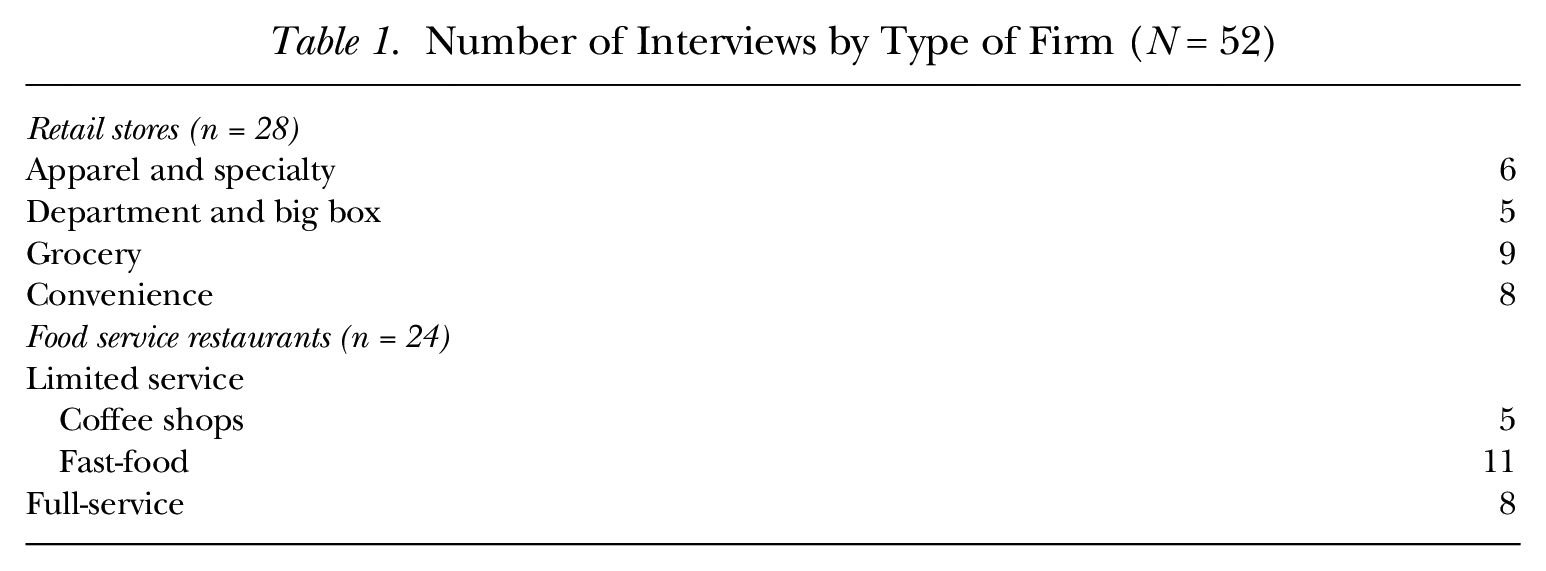
From April to June 2017, we gathered data from firms in every strata of our sampling frame, completing interviews with 52 frontline managers, 49 of whom also completed the initial survey, representing 31 unique business chains (see Table 1; a summary of the individual sites is provided in Table 2). We decided to conduct interviews during a single fiscal quarter, after the winter holidays and before the law went into effect, to balance the risk that employers might change their practices in anticipation of the law with the risk that post-enactment changes to scheduling might be attributable to business changes rather than the law. Ultimately, managers’ responses to our questions quelled our concerns about anticipatory implementation. Overall, 22 of the 52 frontline managers interviewed were unaware of the SSO until contacted by our research team (data not shown in table). Ten others had heard about the SSO but said they knew few details. Twenty reported that they were “well informed” about the SSO but were often unclear about some of the SSO’s provisions. For example, several managers stated that the SSO would require them to post the schedule three weeks in advance of the workweek, rather than the required 14 days. Our in-depth interviewing allowed us to probe for recent changes to scheduling practices and whether the SSO was the driver. We are reasonably confident that the practices we report on in this article pertain to pre-enactment practices.
Number of Interviews by Type of Firm (N = 52)
Summary of Managers’ Site Characteristics (from Survey; N = 49)
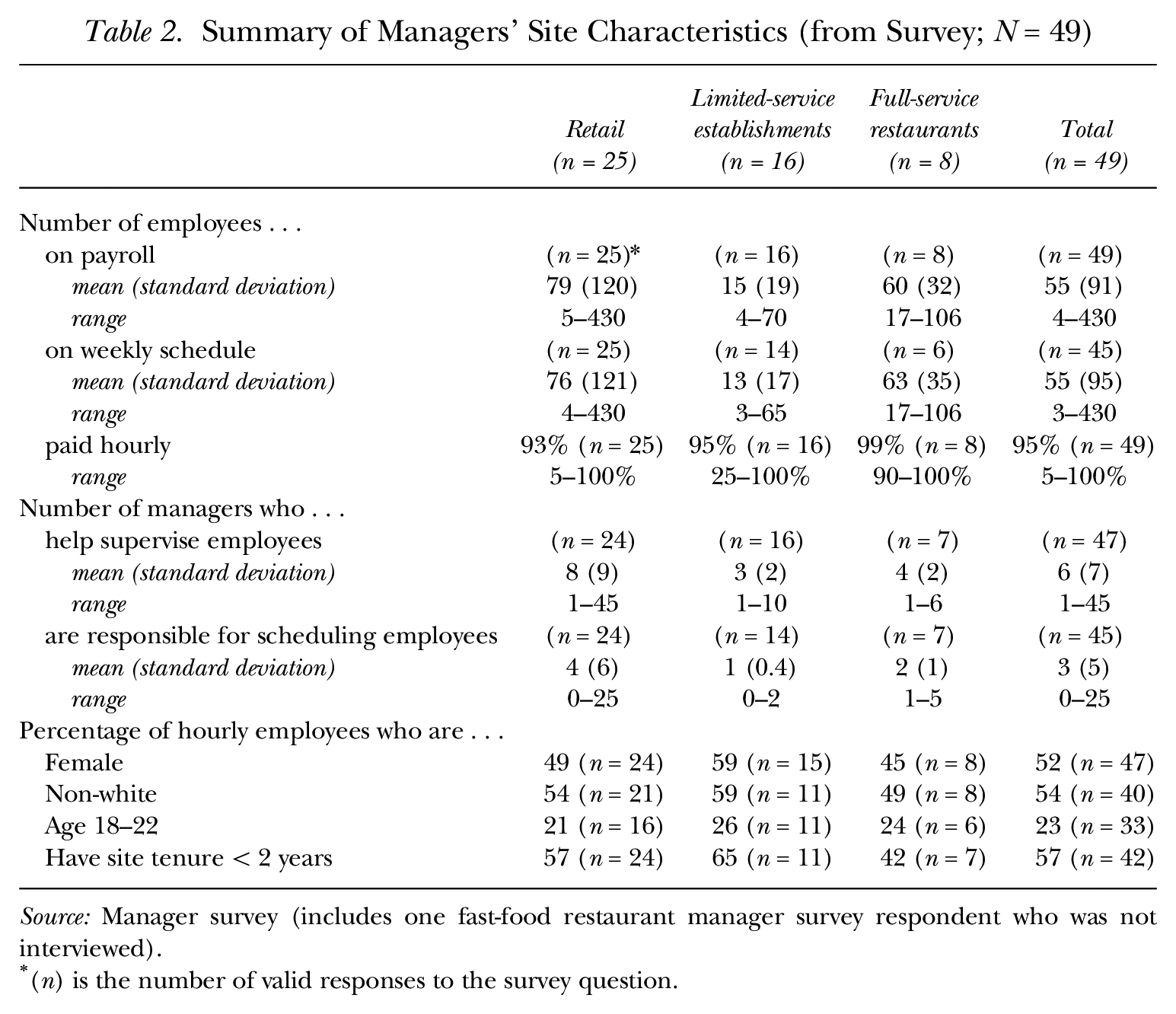
Source: Manager survey (includes one fast-food restaurant manager survey respondent who was not interviewed).
(n) is the number of valid responses to the survey question.
Following procedures approved by our Institutional Review Boards for human subjects research, our research team contacted managers at their place of work, screening to be sure the manager did the scheduling. When a manager at a site of a targeted firm declined, we approached a manager at another pre-matched site. Even though our selection was systematic, traditional response rates suggest nonresponse could bias results. The response rate is 34% including every individual worksite we targeted for participation, and 52% when we were able to have a conversation with the scheduling manager (versus leaving a card or message). We did as much as possible to secure participation, including offering a $100 cash incentive to participating managers, doing multiple follow-ups, providing documentation of our university affiliations, and encouraging managers to choose the place and time of the interview.
Analysis
Interviews were professionally transcribed and then coded using the qualitative-analysis program Dedoose. The themes presented here emerged through what Hsieh and Shannon (2005) referred to as a directed approach to content analysis, in which prior research findings and theory are used to code the data and explore variations within themes. As a first step, our team coded the transcripts to capture both emergent and pre-determined themes, organized around the central elements of Seattle’s scheduling law and also the firm’s dependence on labor flexibility practices to achieve business goals. We also coded for managers’ knowledge of the SSO and the supports to which they had access for easing implementation.
As a second step in the analysis, we developed a coding protocol to rate the match between managers’ current (pre-SSO implementation) scheduling practices and the legal requirements defined in the SSO’s administrative rules. We rated seven provisions separately in order to identify those that might be the most and least challenging to implement. The provisions are: 1) providing employees with information about hours of work at the point of hiring (good faith estimate); 2) the process of adding or extending shifts; 3) the use of on-call shifts; 4) the process of reducing hours; 5) length of advance notice; 6) accommodating employee schedule requests; and 7) the use of closely spaced shifts. We scored these scheduling practices on a scale of 1 to 3. A score of 1 indicates the manager was already scheduling in compliance with ordinance requirements or could do so with very modest adjustments, for example, by documenting a process or practice already in place. A score of 2 indicates that the manager was not scheduling in compliance but did not rely heavily on the practice; for example, the manager sometimes, but rarely, asked individual workers to change their schedule. A score of 3 denotes that the manager was not scheduling in compliance and also relied heavily on practices at odds with the regulation; for example, the manager regularly scheduled and canceled on-call shifts and did not compensate workers when the on-calls went unused. More details on these ratings are included below. Two researchers rated each provision for each interview, and we achieved a minimum inter-rater reliability of 90% in these paired ratings.
Results
We draw on our interviews with frontline managers to first summarize the distance between their scheduling practices before the enactment of Seattle’s Secure Scheduling Ordinance (SSO) and the legal requirements of the ordinance. We then examine how organizational factors and business incentives can help explain variation at the starting line toward compliance.
How Far a Distance from Compliance? (Research Question 1)
Overall, interviews with managers provide evidence that the worksites studied were indeed starting at different distances from compliance on the eve of SSO enactment. As described above, we sought to identify scheduling practices that were in sync with the regulation or nearly so, both in letter and spirit (rated 1); those that were far removed from compliance, suggesting that achieving compliance may be quite difficult (rated 3); and those occupying a middle ground, indicating that implementing the provision would conflict little with common business practices (rated 2). Across the seven provisions shown in Table 3 and across all subsectors, 27% of practices were rated as being close to compliance (rated 1) whereas 19% were rated as being a far distance from compliance (rated 3) (totals not shown in table). The mean distance between pre-enactment practices and SSO requirements was 1.84 (on our 1 to 3 scale; not shown in table), suggesting that, on average, compliance with the SSO may not be too heavy a lift for many of the worksites in our sample. But these means also suggest substantial variation across worksites, with 53% reporting a mean distance across provisions less than 2.0, implying that compliance will not be too difficult on most provisions, and 47% depicting a mean distance between 2.0 and 3.0, signaling that compliance will require substantial change. Below, we review what strong and weak alignment looks like in the practices described by this sample of managers for four SSO provisions: hours estimates at hiring, advance notice, adding hours, and reducing hours.
Comparison of Distance from SSO Compliance, by Business Subsector and Provision
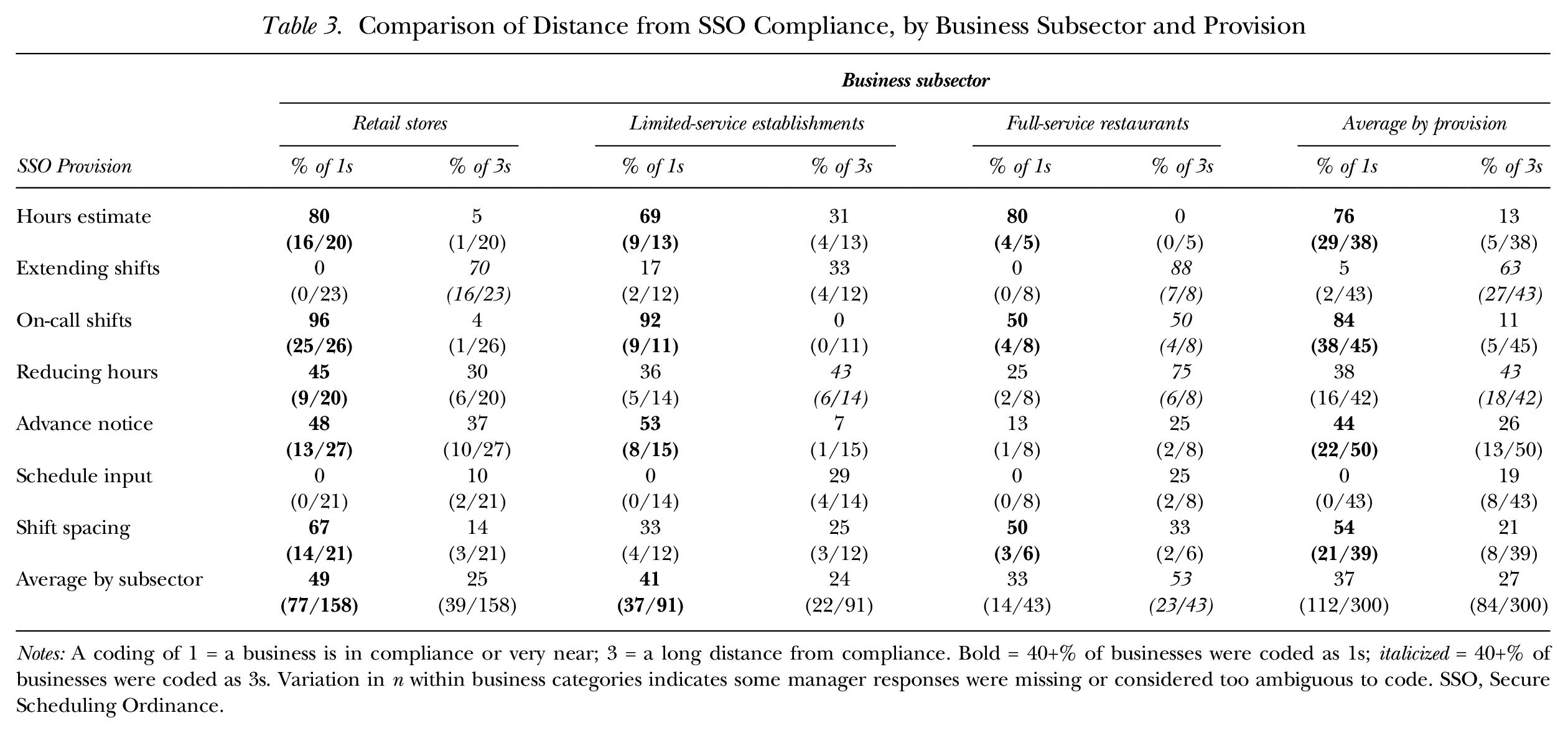
Notes: A coding of 1 = a business is in compliance or very near; 3 = a long distance from compliance. Bold = 40+% of businesses were coded as 1s; italicized = 40+% of businesses were coded as 3s. Variation in n within business categories indicates some manager responses were missing or considered too ambiguous to code. SSO, Secure Scheduling Ordinance.
Good Faith Estimate of Hours
The administrative rules in the SSO defining a good faith estimate mandate employers to provide workers with a written statement detailing the median number of weekly hours they will work over a one-year period, divided into three-month segments. Employers are not fined if they do not deliver the estimated hours, but an employer risks a fine if estimates are not updated when median work hours depart from the estimate by 30% or more for one or more three-month segment. Employers may update the estimate, upward or downward, as frequently as they want, but must provide an update at least annually for current workers.
Given the rules, managers will be able to technically comply with the letter of the law without conforming to the spirit of increasing schedule predictability and stability by providing frequent estimate updates that tell employees their hours are changing—again. Managers can also comply by scheduling close to, if not at, the provided good-faith estimate. Pre-enactment practices portend both approaches. Some managers talked about how they already did their best to schedule workers in accordance with their initial hours estimate. We coded these managers (76%; see Table 3) as closely aligned with the SSO, as captured by these quotes: I always stand behind whatever I say in an interview. I’m not going to hire somebody and say, “Hey, we’re going to give you thirty-eight hours a week,” and then we give them twenty. That’s horrible. (Grocery manager) If they say, “thirty-five [hours],” then I’ll say, “Honestly, I could probably commit to about twenty-five. I could definitely work with you on getting you those additional ten, but twenty-five [hours] is what I can give you my in-store commitment on.” . . . When they walk away from the conversation, they know I know how many they’re looking for, and they know how many I’m committing to. (Coffee shop manager)
For a small proportion of managers (13%), however, providing a written median hours estimate seemed in direct conflict with current practices. This raises the prospects that an estimate, even if in writing, might not help workers predict how much they will work and earn, and compliance in some cases will be more symbolic than substantive: I tell them when I hire them, “This is based on business need. I might send you home early. I might then go home early. Take a day off.” If there’s no business, there is no business. (Fast-food restaurant manager) I say [to the new employee] “I can generally just schedule twenty-eight hours.” (Full-service restaurant manager) And then are they generally sticking to that twenty-eight? (Interviewer) No, it can change. . . . It changes all the time. . . . Just depending on the business. (Manager)
Advance Notice
Requiring employers to provide 14-day advance notice would seem like the least complex provision in scheduling legislation, encompassing a single, numeric reference guiding a specific element of scheduling. Yet even it is open to misinterpretation. In our online survey, we asked managers how far in advance their company required them to post the work schedule, and 33% (14 of 42 managers responding to the question; data not shown in table) reported that they posted work schedules two or more weeks in advance. We learned from our in-person interviews, however, that “two-week” notice sometimes translated into a manager posting two schedules at one time, with the date of the first schedule only a few days in advance of the upcoming workweek. Several managers who posted multiple schedules in this fashion mistakenly felt they were already in compliance with the SSO.
From our interviews, we estimate that almost half (44%) of the managers were posting schedules consistent with the SSO’s 14-day advance notice mandate—more, and a somewhat different set, than who claimed they were doing so on the survey (see Table 3). Roughly another quarter of the managers (26%) reported schedule-posting practices that suggest complying with the 14-day notice may be difficult to accomplish without regularly paying the predictability premium: Sometimes you’ll find out that day that [a promotion] is happening the next day, and depending on what it is, is it [going to] bring in a ton of people or not? Then are you prepared and staffed? Then you got to call [employees]. . . . That’s when scheduling really gets rough. (Apparel retail store manager) Basically, when I have big orders, I have to change the schedule. I have to put more employees on so they can start early, depends on when I have to get [the] order in. . . . I have to call everybody and see who’s available to work. (Fast-food manager)
Adding Hours
Under the SSO, employees have a right to refuse extra hours not on the posted schedule; this includes full shifts not already on the schedule as well as working longer than scheduled, either coming in early or staying late. Employers seeking to extend an employee shift are required to provide one additional hour of compensation for time added beyond 15 minutes of what was scheduled (a “grace period”), but only under certain circumstances. If the manager extends the opportunity to work beyond scheduled hours to multiple workers already at the workplace (following what has been termed the “huddle” rule) and one of those workers volunteers, then no premium is owed. If a manager asks a particular employee to stay and she agrees, then the employee is owed one hour of predictability pay. These administrative rules thus present multiple options to employers for complying with this aspect of scheduling regulation.
Not surprisingly perhaps, no manager at baseline reported holding a huddle to see who was willing to stay later. But some reported that they rarely asked workers to stay later, and when they did, they tried to make it clear that the employee could decline to work longer. Only 5% of the managers interviewed, however, engaged in practices related to shift extensions that necessitate little modification for SSO compliance (see Table 3). The majority (63%) reported that extending shifts was a regular strategy for dealing with unanticipated increases in customer traffic and employee call-offs, and that they usually approached workers individually about staying later. Requesting an employee to extend a shift is, again, not prohibited by the SSO, but if a single employee is approached and agrees to work extended time, they will be due an additional hour of compensation. The more managers rely on shift extensions to meet upticks in demand, the more challenging they may find it to either reduce this practice or incorporate the additional cost into their labor budgets, as reflected in these managers’ descriptions: If it’s really busy I’m like, “Do you want to stay one more hour?” I would say we don’t usually schedule a ton of full eight-hour shifts so [there will be room for employees to stay longer]. (Apparel retail store manager) We really don’t change the schedule; we just extend shifts if somebody wants to stay late or come in earlier. (Grocery store manager) How often would you say that you end up extending a shift after it’s been posted? (Interviewer) Fifteen times a week, roughly. (Manager)
Managers reported certain established, and SSO-consistent, boundaries when it came to adding whole shifts to an employee’s work schedule. Although attempting to extend the work time of employees already on the job was common practice, the majority of managers we interviewed emphasized that they did not require or even expect employees to come in on a day they were scheduled to be off: I won’t be mad at [employees who] . . . can’t cover it, because everybody makes plans for their days off. (Convenience store manager)
But when they did ask workers to come in for an extra shift, they usually asked individual employees, which will require additional compensation under the SSO: I kind of ask the people who have the best work ethic and the want for more hours. (Apparel retail store manager)
Given that our interviews suggested that adding hours after the schedule is posted is commonplace by managers in both retail and food service, for many covered worksites compliance is likely to require either fundamental changes to current practices or regular payment of the SSO-required predictability premium. Our analysis of the gap between pre-enactment scheduling practices and SSO requirements suggests that employers will take both pathways to compliance.
Hour Reductions
The rules defining the conditions under which employers do and do not have to pay additional compensation to employees when management reduces their hours are less complex than those defining compensation for additional hours of work. Whenever management sends a worker home early or declines to call in an employee waiting on-call to see if they are needed, the employee will have to be paid for half of the time left on the reduced shift or half of the scheduled (on-call) shift.
In our survey, 80% of managers reported that they did not use on-call shifts (data not shown in table), at least partially reflecting changes to corporate-level policies brought about by pressures from state attorneys general (Deitch 2017). We were able to confirm this rarity in sites where we collected physical schedules; we rated 84% as having practices that portend little adjustment to bring into SSO compliance (see Table 3). By contrast, 11% of managers used on-call shifts frequently, further reporting that they do not see how they will be able to meet changing business demands without them. This was particularly true among full-service restaurant managers we interviewed: The hardest thing for us, honestly, we’re worried about is the on-calls; it’s our biggest concern. Because our model, we kind of rely on that. It’s gonna be hard [for us]. It’s gonna be good for them because nobody really likes the on-calls. (Full-service restaurant manager) Definitely number one concern is the on-calls. . . . Maybe we’ll find it’s better to schedule an on-call shift and pay [an employee] the two hours if we don’t use them. We might find out that’s the better policy for us. We don’t know yet. Guess we’ll find out in about two weeks. (Full-service restaurant manager)
Among the managers who indicated they did not rely on on-call shifts, reasons varied. A retail store manager stated that the company had stopped using such shifts a year prior to the passage of the SSO, primarily because on-call shifts had been stressful for managers themselves: It was also just one more thing you had to deal with while managing the floor. Do you need them? Do you not? . . . It was stressful. (Retail store manager)
Some of the managers who avoided using on-call shifts viewed this decision as an intentional human resource management strategy, as well as the right thing to do for employees: To believe that your employee has nothing better to do in their life but wait by their phone for you to call them is misguided. If you want to have a well-functioning team that’s happy, that gets along with each other, that gets along with your customer, is good to your customer, then you need to treat them like they’re a human being. (Grocery store manager)
With respect to shift cancellations, although no managers reported that they compensated workers for shortened shifts in the pre-enactment period in which we interviewed them, over one-third (38%) reported that they either rarely canceled shifts or limited shift reductions to instances employees asked the manager to leave early, practices aligned with the spirit of the SSO and conditions under which the schedule-change premium is not required. As an apparel retail store manager explained, when business is slower than anticipated, “Usually there’re other things to do in the store.” Other managers indicated that when traffic appears slow, employees sometimes volunteer to depart early: “I have a lot of students. . . . If it feels slower than normal, they can tell me, ‘I got a test tonight. If you don’t need me, I’m happy to go home.’”
Almost half of the managers (43%), though, reported that they frequently cancel scheduled shifts for some workers or send one or more home early, not always asking for volunteers: I will also just call people off in general, even if they were scheduled. If the weather turns and it’s not going to be sunny, I would simply call them and say, “Hey, I do not need you tonight.” And they would know that two hours before they were actually scheduled in. (Full-service restaurant manager)
Before the SSO was in effect, canceling shifts was without cost to the business, but the SSO shifts this calculus. Should these managers continue with current practices related to employer-driven reductions in hours, their companies are likely to incur regular expenses from mandated premium pay.
Organizational Context for Implementation (Research Question 2)
Our analyses of business subsector, workplace size, and price point (market niche) suggest that these factors are only loosely related to the distance that will have to be closed to bring worksites into alignment. With respect to industry, as shown in Table 4 the mean distance across the seven rated provisions is higher among full-service restaurants in our study (mean = 2.09) than among retail stores (mean = 1.76) and limited-service restaurants (mean = 1.80), though this difference is only marginally statistically significant (p = .057; differences in mean distance scores by other organizational characteristics were not significant). The detailed ratings across provisions provided in Table 3 present this variation. As shown, retail and limited-service restaurant managers were similarly situated overall heading into SSO implementation. Retail store managers reported being in near-compliance at very high rates (45 to 96% of retail sites) with four of the seven SSO provisions (53% of practices rated 1); for only one provision—shift extensions—were practices at substantial odds with compliance for a majority of managers (70%). Managers of limited-service restaurants reported a similar state, with 53 to 92% reporting practices in near-alignment with three of the seven SSO provisions (41% of practices rated 1); note, though, that 43% reported practices misaligned with the requirements for reducing hours. Full-service restaurants show distinctly less pre-SSO alignment; at least half described practices that were at great odds with compliance for three of the seven provisions coded (53% of practices rated 3).
Mean Distance Scores by Organizational Characteristics
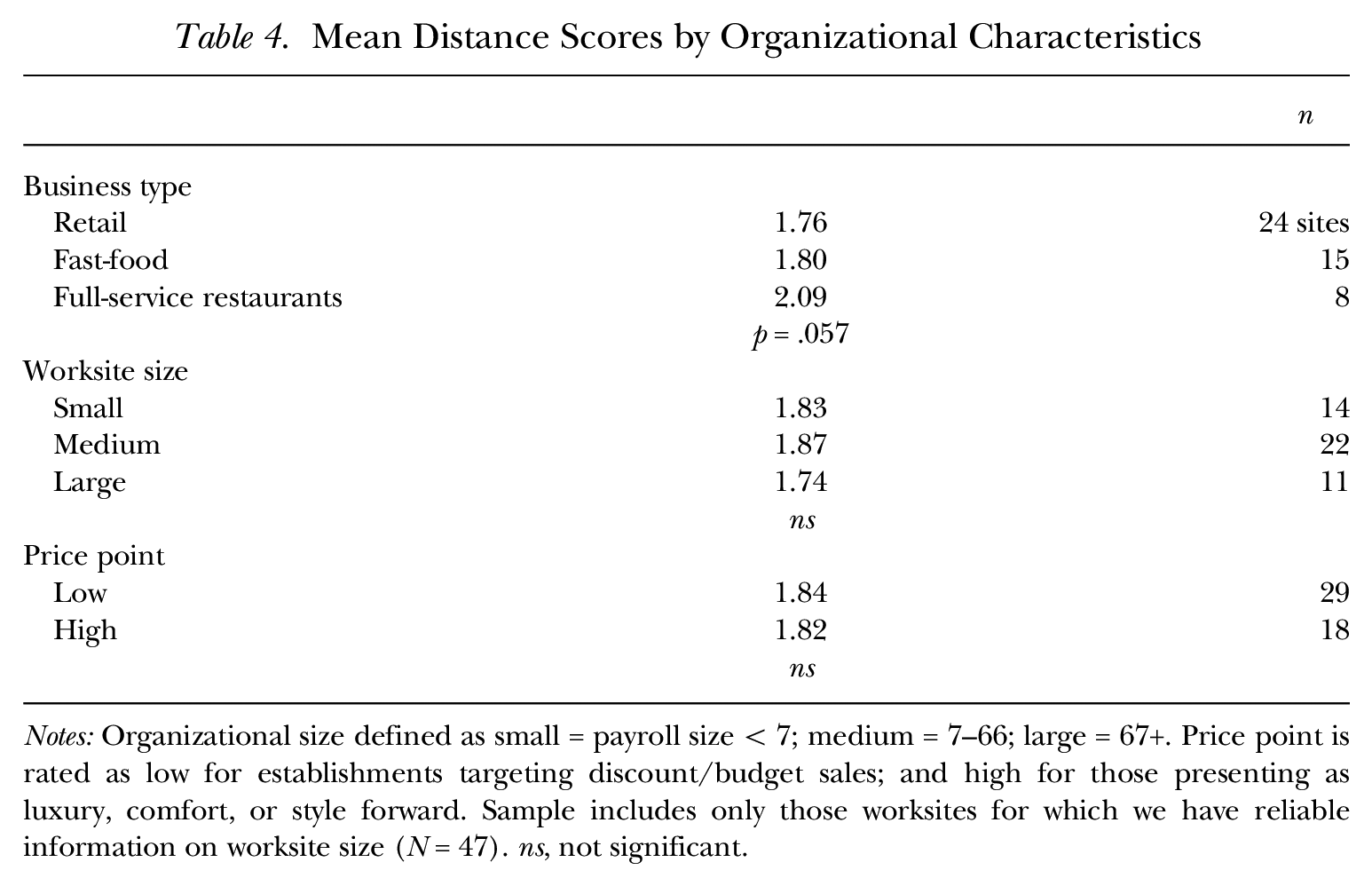
Notes: Organizational size defined as small = payroll size < 7; medium = 7–66; large = 67+. Price point is rated as low for establishments targeting discount/budget sales; and high for those presenting as luxury, comfort, or style forward. Sample includes only those worksites for which we have reliable information on worksite size (N = 47). ns, not significant.
Turning to market niche, although prior research indicates that firms at the higher versus lower end of an industry in terms of price point of goods and services are likely to have higher quality jobs, including scheduling practices, we did not see marked differences in mean distance by price point (see Table 4); analyses of the various provisions did not reveal patterns by price point either. Workplace size, measured in terms of employee headcount at the worksite, also does not help differentiate sites’ mean distance.
Although size and price point did not emerge as important in understanding the pre-enactment mean gap in our particular sample, interviews with managers suggest that being a part of a chain is likely to matter to implementation in several ways. Some firms that belonged to large chains had locations in San Francisco where a comparable scheduling ordinance had already been implemented, and the ability to consult with peers there reassured some Seattle managers about impending SSO implementation: When the scheduling ordinance in San Francisco was coming out, [HR there] just planned the worst situations possible. . . . [But after enactment] they had no problems at all, which I found funny. [HR had planned] just the worst possible scenario for every situation, and none of it happened. (Specialty retail store manager)
Being a part of a chain did not always hold an advantage in terms of anticipating smooth implementation of the SSO, though. Numerous managers at sites of major national chains with few Seattle locations told us that their corporations were not making changes to scheduling and payroll systems to align with the requirements in the Seattle law, in spite of sophisticated features in the corporations’ scheduling software. Instead, these managers told us that they were planning to set up separate, informal systems to track the nature of schedule changes, communications to employees about them, and any resulting compensation.
Although applied only to large chains, the reach of the SSO extends to nationwide fast-food and convenience store franchises, many with small establishment footprints. We found these sites generally operated informally and with limited corporate input on day-to-day operations. For example, several convenience store managers described comparatively relaxed approaches to drafting work schedules that will likely challenge regulative compliance. When asked to share the currently posted schedule, one manager simply stated that he works a certain five days, his brother works weekends and evenings, and his cousin fills in as needed; he politely asked the interviewer whether she would like him to write the schedule out. Manager-owners of fast-food franchises also reported few supports from their corporate sponsors.
Overall, patterns in the gap between pre-enactment scheduling practices and SSO regulation suggest that industry norms and franchise status, more than size of staff, are important parts of the organizational context in which managers are expected to change their usual scheduling practices and will likely play a role in managers’ prospects of doing so.
Business Incentives and Allocation of Scarce Labor Hours (Research Question 3)
Consistent with the literature on employer practices in service industries, most managers we interviewed described contexts for staffing and scheduling their sites that were bound by corporate constraints on labor use and enforced through strong accountability mechanisms. The nature of the constraints and the strategies managers developed to navigate them varied, however, though with some common features.
Managers described how they carefully monitor the number of hours their staff works, driven by metrics their larger companies use to judge not only their stores’ or restaurants’ performance but also managers’ own performance.
3
Although some managers volunteered that they had enough hours allocated at the corporate level to accomplish needed work, several said that hours can “be a little low” to provide good customer service. For example, when asked whether there were enough labor hours allocated “to complete the work that needs to be done and keep customers happy,” one coffee shop manager responded: Always a fun question. Realistically, it’s too low. I understand, having been in food management, restaurants for twelve years, it’s a balance. You need to have the [workers] so that when people come in they can be taken care of but . . . there’s sometimes when the company as a whole isn’t doing so well, so everybody needs to make up for it [by reducing hours]. (Coffee shop manager)
The incentive to stay within allotted hours was strong. Labor hours were regularly monitored at higher levels of the corporation and compliance with accountability guidelines was counted in managers’ performance reviews. Not surprisingly, managers explained how “going over hours” was to be avoided if at all possible: If [traffic]’s down, we gotta cut [staffing] hard and fast. (Full-service restaurant manager) You said you have to check to make sure you’re within budget. What happens if something gets thrown off? (Interviewer) I’ve got to trim [staff]. Yeah. (Grocery manager)
Notably, however, some managers explained that although they watched their labor budget closely, they had the support of upper management to schedule above forecasted hours if they thought it was good for business: My district manager always supports me. If I say my target is fifty hours, corporate expects you to schedule fifty hours. I might schedule fifty-five. I’ll send him an email saying, “Hey, here’s why I scheduled fifty-five.” [And he replies,] “Cool. Sounds great.” (Limited-service restaurant manager)
But even this manager responded to a question about increasing staffing hours after the schedule has been posted by saying, “Well, the first thing would be to prove to my boss that I need the increase.”
In addition to noting how tight labor hours affected corporate evaluations of their store and their own performance, many managers were aware that tight labor hours meant that workers were at risk of not getting “enough” hours: Yes, as a business we have a certain amount of hours, but these are my people, and we need to make sure their hours are met. (Coffee shop manager)
When asked what proportion of their staff they thought would like more hours, this restaurant manager said 80 or 85%; a manager at a fast-food restaurant said 70%. Retail managers were also aware that many of their employees would prefer to work additional hours: They’ll come up to me and say, “Is there any way I can get more hours?” Most of them, yes, would like more hours. (Specialty retail store manager)
With their appreciation for this tension, managers described various strategies for balancing accountability requirements to “stay within hours” with getting employees sufficient hours. Because the number of labor hours allotted to worksites is a fixed amount, the number of employees on total payroll, those who can be scheduled, inevitably represents a key factor in how many hours each employee stands to receive. When asked in the survey to choose between one of two staffing strategies, 63% chose the statement, “I like to keep my staff on the small side to help ensure that employees get hours,” whereas 37% favored, “I like to keep my staff on the large side so that I have several employees I can tap to work when needed” (data not shown in table). Managers in all three SSO-covered business categories were represented in support for both strategies, but the majority in full-service restaurants (6 out of 8) preferred to keep a large staff to maintain labor flexibility, whereas the majority of managers in retail (15 out of 24) and limited-service establishments (13 out of 16) chose the strategy of keeping a small staff on which to concentrate available hours. Spanning all three covered business types, several managers reported they were able to meet both labor hour requirements and employees’ needs for work hours by carving out “discretionary spaces” within tight accountability requirements: I don’t think any of them want any more hours right now. . . . But you do have those moments in the slower months, I would say maybe fifteen to twenty percent of them occasionally are like, “Hey, can I get a few more shifts?” But that’s not often. . . . And that’s when I try to accommodate week vacations or . . . longer trips. And that way, you don’t have to demote shifts or hours ‘cause you let people go on vacation. (Full-service restaurant manager) We’re lucky enough to be able to schedule everybody the amount of hours that they want, so if someone only wants four days, they’re getting four days. If someone wants five days, we can get them five days. I doubt there’s many people that want to work more than five days a week, but ninety percent of our team is part-time employees, meaning they can work up to forty hours. There’s no guarantee of hours, but [if an employee] that has the availability and wants the hours, we’ll schedule about thirty-eight hours a week. (Grocery store manager)
Our analyses of pressures on managers to minimize outlays for labor before Seattle’s scheduling law went into effect strongly suggest that, overall, business incentives in covered firms are likely to collide with the policy goals of increasing the predictability and stability of employees’ work schedules. Still, our analyses also revealed variation in the strength of accountability pressures and managers’ responses to them that portend uneven implementation across worksites and across the various provisions of the SSO.
Discussion and Conclusion
Establishing new work hour standards will be a process rather than a fixed event. Businesses are starting at different distances from compliance, business incentives to maintain labor flexibility are strong, and the potential for manager confusion is high. Across covered worksites, workers will likely encounter divergent scheduling practices rather than uniform standards, at least initially. Examining variation in employers’ scheduling practices before legislation is enacted offers insight into the state of affairs employees are likely to encounter for some period after enactment, which businesses may be most at risk of subsequent noncompliance or merely symbolic compliance, and the paths employers are likely to pursue toward compliance. Our prospective approach suggests that early intervention in the implementation process may be needed if scheduling regulation is to position employers on a path toward compliance that improves work schedules in hourly service jobs, as intended by policymakers and advocates.
Our interviews revealed three distinct groups among both retailers and food service establishments. In some sites, managers’ scheduling practices were close to or already in alignment with many of the provisions in Seattle’s Secure Scheduling Ordinance (SSO). In others, practices misaligned with SSO requirements were not viewed by the manager as critical to achieving business goals, suggesting relative ease of moving toward compliance. For a third group, however, managers depended heavily on labor flexibility practices targeted for change by the SSO—the regular cancellation of on-call shifts, publishing schedules close to the start of the workweek, and making last-minute changes to posted schedules. It seems reasonable to expect that these managers will find it especially challenging to meet both the provisions of the scheduling ordinance and their firm’s accountability requirements. Considering our second and third research questions—investigating the relationship between scheduling practices and organizational and industry factors (question 2) and business incentives (question 3)—we found a strong apparent link between business incentives focused on containing labor costs and frontline managers’ approaches to handling work hours, one inconsistently associated with establishment size and market niche. Although full-service restaurants relied particularly heavily on labor flexibility practices, this was also true of other managers in retail and limited-service restaurants covered by Seattle’s scheduling ordinance.
Although this study was conducted before policy enactment and enforcement, our interviews made it clear that the details of scheduling regulation hold implications for its implementation. Our analyses indicate that compliance is likely to occur more quickly and in a more standardized fashion for provisions on which there is already close compliance for a substantial proportion of covered worksites. Putting estimated hours in writing at the time of hiring seemed a modest step for most of the managers interviewed (at least none pinpointed this as a challenge), given that this information was already shared informally as part of the hiring process. And, with the key exception of full-service restaurants, reductions in or premiums paid for unused on-call shifts seem unlikely to pose a significant challenge at most of the worksites in our sample because most had terminated such shifts before the ordinance was passed. Adding and extending shifts, however, proved commonplace in retail stores, limited-service establishments, and full-service restaurants, and misunderstanding of when additional hours would require additional compensation was widespread; many managers will have to adopt substantially new approaches to staffing and scheduling if they are to manage in compliance with relevant requirements.
Variation in managers’ scheduling practices is also likely because the design of Seattle’s scheduling regulation permits different paths to compliance. The stated goal of work scheduling regulation is to improve the quality of schedules in covered jobs. Seattle’s ordinance allows employers to either avoid scheduling practices that incur predictability premiums (an option yielding more predictable worker schedules) or pay the premiums while retaining relatively full labor flexibility (perhaps increasing workers’ earnings but not schedule predictability). According to Weil’s (2010: 16) principle that “enforcement effects can be judged as having greater sustainability if they lead both to lasting compliance and the adoption more generally of employment policies consistent with larger policy objectives,” the latter course of action is less sustainable. It is also further from the policy goal of securing employees’ economic and work–life well-being. Perhaps fortunately, research suggests that avoiding payment of the predictability premium will be the frequent choice of many managers, given that many already assiduously avoid scheduling practices that generate overtime premiums (Carré and Tilly 2017). The intense pressure on many frontline managers to keep labor flexible may lead some to try to avoid payment in ways other than by curtailing changes to the posted schedule; our baseline data suggest that some managers will develop strategies for skirting administrative rules that comply with the letter but not the spirit of the law, or with neither. The complexity of administrative rules defining the conditions under which premium pay is due to employees for additional work hours creates further room for symbolic rather than substantive compliance (Edelman 2016).
We take seriously Weil’s (2010, 2014) view that a priority of enforcement is to create sustainable and systemic change by deterring violations not only through targeted investigation but also education and support to employers. 4 Our findings suggest that concentrating limited resources of municipal-level offices of labor standards on employers at high risk of noncompliance is not, in the case of scheduling legislation, simply a matter of targeting particular industries; all of the business types in our sample exhibited alignment issues, and all are industries already deemed priority targets for enforcement (Weil 2010). It is possible that deciding on certain provisions to target for employer investigation—as well as education—may be simpler and more effective than targeting specific business types or employers. The confidence, and pride, of managers who erroneously believed they were already providing 14-day advance notice highlights the challenges of moving daily organizational practice into legal compliance even when managers are willing partners and administrative rules are seemly straightforward.
The reluctance of firms to adjust scheduling and payroll systems that could ease implementation challenges by frontline managers highlights a key limitation of municipal-level employment regulation and raises concerns that evaluations of local regulations may underestimate the potential of federal regulation to improve work schedules. Although some managers reported that their firms were adjusting software systems to facilitate compliance, several—including managers in very large chains—indicated that their companies were leaving it to them to figure out how to comply, given that only a few locations (out of hundreds nationwide) would be covered by the new ordinance. Vendors of scheduling apps that employees use to swap shifts expressed similar reservations about customizing their product for a single municipality.
Although our selection of worksites was systematic, our sample is small (N = 52) and our response rate low (34%). We do not think our analyses are unduly biased by managers’ views of the law since only 22 of the managers interviewed said they knew anything about it. However, the managers who agreed to talk with us may have been more comfortable with their scheduling practices than those who declined to participate. If so, then our results may underestimate the distance between pre-enactment scheduling practices and legal compliance, and, in turn, overestimate the potential for setting uniform work hour standards in retail and food service worksites. Further, whether the forces we saw at work pre-enactment lead down the paths anticipated by our study in a consistent, linear progression awaits empirical examination. Public pressure may propel employers toward common norms and universal standards. Alternately, economic uncertainty in the aftermath of the COVID-19 pandemic may change firms’ trajectories toward compliance, conceivably hastening progress at worksites in subsectors with essential workers, such as retail grocery, while delaying compliance at worksites susceptible to public health regulations that limit customer service, such as full-service restaurants and fast-food franchises. Our ongoing research on the implementation of fair workweek laws by frontline managers is designed to investigate these possibilities.
In conclusion, whether new work scheduling legislation can realize a shared set of standards for scheduling workers in targeted jobs within the American municipalities aspiring to them is an intriguing organizational and policy question. We have reason for cautious optimism that the new scheduling laws can measurably influence employer behavior. Carré and Tilly’s (2017) cross-national comparative research of retail firms showed that social policy can establish minimum standards of job quality by tempering employers’ use of labor flexibility practices. To the extent business incentives and, more modestly, organizational factors ultimately help explain policy implementation, it may be possible to identify probable implementation laggards even before policies go into effect and to encourage employer compliance by offering “carrots” (information and technical assistance) before employing “sticks” (fines). Given the widespread reliance on demand-driven labor flexibility practices by many American service-sector employers, solidifying new work hour standards will require early and continuous attention to policy implementation on the frontlines of firms.
Footnotes
Acknowledgements
We are grateful to our research team, the staff of Seattle’s Office of City Auditor, the City of Seattle, and the business managers who shared their time and expertise with us.
For information regarding the data and/or computer programs used for this study, please address correspondence to

1
For New York retailers, advance notice requires only 72 hours.
2
The SSO includes a requirement that the City of Seattle engage academic researchers to conduct an evaluation of the ordinance that gauges responses by employers and employees; this study is funded through a contract with the City of Seattle for that purpose. The contract specifies that the city cannot censor our report of the findings, but the city council has the right to advance notification of public reports and to respond to any and all publications.
3
Exceptions are convenience stores and some franchises, which we discuss above.
4
We also appreciate the value, as noted by Weil, of extending support to employees, but our current research is on manager practices.