



Abstract
Using case studies of labor’s interaction with Uber in the United States, the author investigates how legal relations between cities and states affect labor relations models. The case studies demonstrate a persistent dilemma for labor actors outside the National Labor Relations Act: While local regulations might be more politically accessible, these interventions are also more legally vulnerable to state and federal preemption attempts. The implications of this common dilemma are explored through the struggles of unions and labor actors with Uber in New York City, Seattle, and California. The case studies show that city–state relations affect both how innovative and how assertive a local labor relations model can afford to be. These findings can influence broader discussions about ossification and power outside traditional labor relations frames.
Keywords
Uber served as a defining nemesis of US workplace advocates and labor groups through the 2010s. Hiring millions of drivers as algorithmically managed independent contractors, Uber positioned itself as the focal point in the struggles over the future workplace, a prelude to an Uberized labor market, and the hill to die on for large segments of the US labor movement and the progressive wing of US politics. The efforts to regulate Uber as a workplace harnessed the attention, funds, ingenuity, organizing capacities, and political capital of large segments of both business and labor communities.
Notably, this significant labor struggle occurred outside of the United States’ primary labor institution for the private sector—the National Labor Relations Act (NLRA). Years of ossification, legal and political beatings, and institutional drift turned the NLRA into a tombstone of its founding principles (Weiler 1983; Estlund 2002). In a hydraulic process of a sort, labor responded to this ossification by shifting from operating almost exclusively within the procedures and protections of the NLRA to experimenting with alternative forms of organizing and advocating for workers’ interests (Estlund 2002; Sachs 2011). This historical narrative is known, yet it still made developing coherent contemporary labor relations (LR) theories a challenge. This theoretical difficulty is true regarding the—by-now—impressive collection of alt-labor endeavors of the US labor movement, as it is true regarding Uber’s case.
One explanation for this theoretical gap is that the NLRA offers unions a clear and relatively straightforward road map of dos and don’ts, governed by a centralized federal National Labor Relations Board (NLRB). Alt-labor endeavors offer none of that structure. In place of clear-cut majority recognition rules and adjudication of labor law violations the NLRA offers, labor unions and loosely coupled private-sector-workplace-oriented coalitions are operating outside the NLRA in the Wild West of the United States’ general pluralistic political institutions. The vast array of alt-labor endeavors may be summed up by the oft-quoted words of Thucydides, “The strong do what they can; the weak suffer what they must.”
This article aims to fill some of this theoretical gap, first, by identifying one policy feature that influences all non-federal LR regulatory endeavors—cities and states’ legal relations, and second, by using case studies of Uber and labor’s struggles to offer some tentative suggestions for how this legal terrain, far from providing a single game plan for labor advocates and managements, still provides consistent LR strategic dilemmas about confrontation and innovation.
Literature Review
In the United States, cities are considered “creatures of the state” in the sense that cities, like other forms of sub-state local governments (such as counties or towns), are created by state law and considered to have no independent regulatory authorities other than those state law provided them (Frug 1984). This legal structure in practice means that state authorities can (explicitly or implicitly) grant localities legal authorities and regulatory powers and can (explicitly or implicitly) prohibit local authorities from engaging in other government-like authorities. This legal feature places local governments at the very bottom of the overlapping geographical jurisdictions’ hierarchy of local, state, and federal regulatory authorities (Barron 2003).
The legal question underlying many city–state conflicts over regulatory powers is not whether the rule is that only the state can serve as the source of local regulatory authorities, but rather, what this rule’s outcomes in a particular circumstance are (Davidson 2019). In the 2010s, this legal fixture was used—abused perhaps—by Republican-controlled “red” state legislators to push back against progressive regulations in “blue” cities (Briffault 2018; Johnson 2021). And while normative arguments for stronger localism pervade public and scholarly discussions in the United States (Gerken 2010; Davidson 2019), this tilt of regulatory powers toward the state and the federal levels existed before these recent manifestations of this rule and will likely outlive it.
LR scholarship has largely ignored this legal fixture. This gap is likely because the NLRA, the founding institution of US private sector LR, was interpreted as prohibiting—“preempting” in legalese—almost all local and state LR regulations and interventions. In a series of Supreme Court rulings, the NLRA was read to prohibit local government and states from interfering in 1) activities that the NLRA arguably covers (also known as a “Garmon” preemption) and 2) those activities that Congress intended the NLRA not to cover, meaning, those activities Congress left for the “free play of economic forces” (known as a “Machinists” preemption).
This dual legal prohibition of local LR regulations left little wiggle room for states and localities’ intervention in LR (cf. Sachs 2011). As a by-product of this strictly federalized LR regime, no meaningful private-sector LR regulations emerged in localities. As a further by-product, no derivative scholarship developed on the effects of the interaction of various geographical jurisdictional units on the LR in the United States.
The lack of local, state, and city regulatory authority over LR is considered a crucial factor in the ossification of the private-sector LR (Estlund 2002). As Estlund framed it, because only a single, centralized institutional route for private-sector unionization existed, unions and labor advocates were wedded to the Wagner model’s relatively limited strategic arsenal. As this strategic toolbox proved inadequate (or perhaps was made ineffective) for facilitating unionization and workers’ representation in contemporary economic times, some labor advocates continued pushing the same Sisyphean rock up the same high hill, ossified in their methods, whereas others moved away from focusing solely on the NLRA and its outdated strategic playbook into other domains (Estlund 2002).
Some of the more explored exemplars of extra-NLRA labor activities include workers’ centers, focused on improving and enforcing workplace rights of mostly low-wage and immigrant workers (Fine 2006), and social-movement-like labor mobilization attempts such as the “Fight for $15” (Andrias 2016). Both such alternative forms of labor activities share a focus on winning regulations and individual rights enforcement. Sometimes this is done in a way that builds on—or leads to—collective workers’ capacity. But this collective capacity is primarily extralegal, not directly facilitated by the individual employment regulations being advocated for (cf. Sachs 2008). According to some scholars, “labor’s legacy” lies in establishing the frameworks for securing such personal workplace rights, not collective ones (Galvin 2019).
A feature of those alt-labor endeavors that distinguishes them from their traditional NLRA-wedded organizing counterpart is their operation under overlapping local, state, and federal regulatory jurisdictions. Such a legal environment is notoriously complex and prone to institutional arbitrage (Pierson 2011) and was documented as detrimental for local regulatory attempts of labor actors. As an anecdotal example, Cummings (2014) documented how attempts to improve independent contractor truck-drivers’ working conditions using local port regulations in California were preempted by a federal law deregulating freight delivery. This work, and other similar ones (Andrias 2016; Johnson 2021), serves as a reminder that labor actors, like other progressive political forces in the United States, face the conundrum of a relatively robust local political capacity built on an unstable regulatory basis. Alt-labor advocates must consider many possible interactions with potential preemptive state and federal regulatory regimes. The scholarly inquiry into the nature of the responses of labor actors to this persistent dilemma is in its initial stages (Johnson 2021).
The struggle over Uber’s working relations was carried out in precisely this kind of regulatory environment and with exactly such formative dilemmas for its advocates. Building on improvement in communication and tracking technologies, Uber created a market-like organizational structure that directly connects drivers with passengers, facilitating the transaction’s concrete terms through an online platform and pricing algorithm (Lobel 2018). The platform workplace is broadly considered hostile for effective workers’ organizing as app-workers are thought of as socially isolated (Sundararajan 2016) and under constant monitoring (Calo and Rosenblat 2017). Furthermore, as is true with many other platform workers, Uber drivers are classified as independent contractors, excluded from all the protections and guarantees US law provides for employee-status workers (such as minimum wage and safety and health protections) and from the NLRA and its protection of workers’ collective action (Cunningham-Parmeter 2016; Racabi 2020). Also, the definition of drivers as independent contractors and their exclusion from the protective coverage of work law means that independent contractors are exposed to claims of antitrust violations if workers engage in concerted economic activity (Paul 2016; Racabi 2020).
The classification of Uber drivers as independent contractors excluded them from the coverage of the NLRA but opened the path for local experimentations with labor regulations. The Trump administration also made federal appeals for platform companies’ workplace regulations an undesirable venue for labor advocates, which served to increase labor advocates’ focus on the state and local levels (Light 2017).
Studying how specific policy features affect political behavior is derived from policy-focused political science analysis, which examines how policy breeds politics (Hacker and Pierson 2014). In this type of literature, specific policy characteristics, such as “policy accumulation” (Hinterleitner and Sager 2019), or the change of policy effects over time (Galvin and Hacker 2020), affect the political behaviors and interaction between various actors (such as activists, coalitions, parties, and firms). This literature is drawn to studying “positive feedback-loops” between specific policies and their political entrenchment (Levinson and Sachs 2015; Galvin and Hacker 2020). But understanding the mechanisms tying policies to political outcomes other than entrenchment is also a fruitful theoretical endeavor.
Analyzing the effects of policy features on actors’ choices is not new to US LR studies. LR scholarship has long identified LR as a product of systemic interactions (Dunlop [1958] 1993; Hall and Soskice 2001). The systemic LR conception relied on assumptions regarding a stable set of actors (unions and managements) that are situated within a relatively stable environment (production techniques, legal landscape, and so on), which in turn creates a defined set of possible strategic choices (Kochan and Barocci 1985). As the traditional LR system began to unravel, so too did the more rigid theorizing of this system lose its grip. Expanding this canonical LR tradition outside the workplace and into the less institutionalized environments outside of the NLRA is a called for—yet less examined—form of LR scholarship.
This article aims to close some of this gap, using case studies of labor and Uber struggles to analyze how city–state legal relations affected actors’ LR strategies. Stretching the traditional LR analogy, what, if any, systemic LR features exist outside of the NLRA?
Methodology
To examine the effects of city–state relations on Uber’s LR, I rely on three case studies: New York City (NYC), Seattle, and California. The case studies are constructed from legal materials (court decisions, statutes, and regulations), publicly available materials (such as news coverage), other secondary sources exploring these cases, and background interviews I conducted with organizers, lawyers, and regulators from 2016 to 2020 (Racabi 2020). For context, the article describes developments in the state regulation of Uber-like transportation network companies (TNCs) as compiled in a 50-state regulatory survey.
The case studies represent a variety of strategic choices by labor actors regarding how to advance their claims toward Uber as a workplace. Far from covering the entire array of collective action attempts Uber drivers have made, these examples represent the most regulatory-oriented and successful endeavors undertaken by labor actors toward Uber in the United States. Note that few labor actors managed to achieve sustainable workplace-related regulatory advances toward Uber. And even the merits of those advances, such as the case of NYC, are in an ongoing dispute among labor actors. Understanding why that is the case is not the focus of this article (Racabi 2020, 2021). Instead, I draw from those endeavors the different strategic choices labor actors made in the shadow of a unified legal background feature—the city–state regulatory tilt.
Case Studies
The New York Independent Drivers’ Guild Case
In February 2016, after a sharp cut in pay, hundreds of New York City Uber drivers went on a strike in protest. Attempts to mobilize these collective energies resulted in a union turf war, in which four unions attempted to organize New York’s drivers (Racabi 2020). These organizing attempts culminated with Uber’s recognizing an association of drivers, the Independent Drivers’ Guild (IDG, or the Guild), as representative of all New York City Uber drivers (Greenhouse 2016; Racabi 2020). To this day, NYC is the only place in the United States where a ride share company cooperates with a drivers’ representative.
In May 2016, Uber and Local 15 of the International Association of Machinists signed a contract that founded the IDG. According to Machinists’ and IDG representatives, this contract put “labor’s foot in the door in the gig economy” (Greenhouse 2016: 12). The agreement provided the Guild with some funding from Uber, established monthly IDG and Uber management meetings, and founded a deactivation (Uber-equivalent of termination or suspension) review board whereon the Guild has representatives. IDG members also gained access to discounted life insurance, legal services, and professional courses. Another feature of the deal was that Uber facilitated IDG’s access to contact information of Uber drivers operating in NYC, allowing the IDG to reach and mobilize drivers directly to petition regulators or solicit the IDG’s benefits plan. Additionally, the IDG agreed to refrain from unionizing drivers during the contract’s five-year period unless the NLRB makes a contrary classification decision regarding NYC’s Uber drivers’ status, and the IDG cannot negotiate fares with Uber (Scheiber and Isaac 2016). The IDG asserts that it represents 65,000 drivers working for Uber in NYC and offers a full membership for a fixed $18 per month (IDG 2018).
The IDG enjoys the advantages gained by the recognition contract (such as the appeals board) and its operation in the vicinity of a potent local taxi regulator—NYC’s Taxi & Limousine Commission (TLC), which the IDG focused on influencing. The campaign to push Uber to install an in-app tipping option offers an interesting test case for this model.
Uber’s official policy regarding tipping swayed over the years. In June 2017, and as part of its “180 days of change” campaign initiated after its controversial founder/CEO Travis Kalanick left Uber’s management, Uber rolled out an in-app tipping option in select US cities. This change to Uber’s app architecture did not come easy. For years Uber opposed adding a tipping option (which was available on its competitor’s app—Lyft) (Loizos 2017). The IDG recognized in-app tipping as an essential drivers’ interest and started campaigning for its implementation.
IDG officials probed the possibility of adding a tipping feature with Uber officials in one of their routine working meetings. Uber officials responded negatively to the idea (Johnston and Land-Kazlauskas 2018). The IDG started an online petition calling for Uber to add an in-app tipping option, garnering approximately 11,000 signatures (Action Network 2017). In February 2017, the IDG and the Machinists’ union filed a petition urging the TLC to consider mandating the addition of a tipping option to its local operators. The petition was followed by a public campaign that mobilized drivers to send thousands of emails supporting the petition. The TLC pushed the rulemaking forward in April 2017, acknowledging the role of IDG in promoting it (Fitzsimmons 2017). An unusually silent Uber saw the rulemaking process through. The TLC adopted the tip rule in July 2017 and it entered into effect in August 2017. This win is one of a handful of examples of workers’ advocates influencing regulations of the user interface of a work platform. Additionally, IDG’s vicinity to local regulators and its hold over NYC’s Uber drivers’ contact information helped the IDG, alongside other labor groups, push for a quasi-minimum wage for TNC drivers (Holley 2018) and a cap on the number of cars available on the streets of NYC.
The IDG as LR Innovation
The innovative aspects of the IDG rest both with developing cooperative (and perhaps, semi-dependent) relations with Uber and focusing on mobilization and regulatory changes on the local level rather than on the traditional emphasis on collective bargaining. The type of consent and endorsement Uber provides for the IDG is illegal under the NLRA and is only feasible as long as Uber drivers are excluded from its coverage (Hirsch and Seiner 2018). Under section 8(a)(2), the NLRA prohibits employers from dominating, assisting, or interfering with labor organizations, defined under section 2(5) of the act as employee-participated organizations that “deal with” employers regarding conditions of work (Hyde 1993; Estreicher 1994).
Both “employer domination” and “labor organizations” were read by the courts and the board to prohibit many forms of labor–management cooperation. Such cooperation includes various forms of worker-representation plans, such as employee–management joint committees and workers’ councils. 1 This prohibition was enforced for far more tangential forms of management involvement in workers’ organizations than for the ones the IDG case presented, namely, Uber’s funding of the IDG and its contractual structure and powers and lack thereof, such as the prohibition on organizing and appealing to the NLRB. And though public lobbying is not a regular feature of what defines a labor organization for the banning of employer domination, the IDG’s monthly meetings with Uber officials, involvement in the deactivation boards, and the work conditions parts of IDG’s contract with Uber likely falls well within the realms of “dealing with” management.
The Seattle Case
Seattle has a strained history of struggles with Uber. This history included a city initiative to cap the number of platform drivers on its streets, answered by a swift political backlash and retraction of the proposal (Garden 2017). The regulatory status quo in Seattle was not long-lasting. In December 2015, Seattle adopted a unique ordinance of LR regulations for limousine, taxi, and platform drivers (Greenhouse 2016; Paul 2016). This city law covers non-employee status drivers only and is the first US municipal labor regulation built for independent contractors. The law was pushed forward by drivers’ groups cooperating with the Teamsters Local 117 against intense legal and political pushback by Uber and other platforms (Greenhouse 2016).
The negotiation ordinance initiates with designating a pool of potential drivers’ representatives (qualified driver representatives or QDRs) by the city’s director of finance and administrative services. A QDR must be a nonprofit and hold organizational bylaws that allow membership of drivers who have “democratic control” of the organization; 2 the regulations prohibit the QDR from coercing drivers to choose it as their exclusive representative (exclusive driver representative or EDR); the QDR cannot be dominated, controlled, or created by any platform nor can it receive any financial support from it. The selection of an EDR from the potential QDRs is made by eligible drivers who meet some minimum requirements.
After the director approves a QDR for the selection pool, the QDR notifies the relevant platform about its intent to become an EDR. The platform must provide the QDR with all the contact information of all eligible drivers. 3 The QDR then needs to have the drivers sign on “statements of interest” indicating their will to be represented by the specific QDR. A QDR that submits signatures of more than half the number of eligible drivers will be designated as an EDR. 4
After an EDR is selected, the platform must meet with its representatives and “negotiate in good faith certain subjects to be specified . . . by the director” during a 90-day timeframe. 5 According to rules issued by the director, a mandatory list of bargaining subjects includes 1) Best practices regarding vehicle equipment standards; 2) Safe driving training and/or practices; 3) The manner in which the driver coordinator will conduct criminal background checks of all prospective drivers; 4) The nature and amount of payments to be made by, or withheld from, the driver coordinator to or by the drivers; 5) Minimum hours of work; 6) Drivers’ conditions of work; and 7) Rules that apply to drivers, including discipline, termination, or deactivation. 6 The parties can also agree on non-mandatory issues within this time limit. 7 A failure to reach an agreement within the mandatory 90 days will result in transferring the subject to be decided in interest arbitration. 8
The director then reviews the signed or arbitrated agreement and determines whether it complies with the ordinance’s purposes. If the director determines that the agreement is not in compliance, he or she can send the agreement back for revisions. 9 If the parties failed to reach a revised agreement within 90 days, interest arbitration might follow. 10 Even after approving the contract, the director can withdraw its approval from the agreement and cancel it altogether. 11
The ride platform is forbidden from making unilateral changes in areas covered by the ordinance without “discussing” the changes with the EDR, even when the agreement does not cover these issues. 12 The legislation also includes anti-retaliation provisions for drivers who participate in the process. 13 The director is in charge of receiving and handling all complaints and is authorized to deliver daily penalties of up to $10,000 for violations of the ordinance. 14
Innovation in the Seattle Ordinance and the Legal Pushback
Labor scholars quickly recognized that the ordinance reflects the implementation of years-long critiques by labor scholars about the NLRA’s structure (Garden 2017). Seattle’s rejection of the NLRA-type election process, its limitation of the negotiation period by mandatory interest arbitration, and its remedial regime for violations all reflect lessons learned but not implemented in the NLRA framework. Moreover, the ordinance is local, corresponding to ongoing critiques on the rigidity of the federally uniform NLRA (Garden 2017). It is also sectoral, covering only the ride-for-pay industry, channeling its collective bargaining process through a single administrative process in a way that might lead to uniformity across the sector (Andrias 2016).
After an initial legal attack failed, 15 the statute was enjoined on antitrust grounds by a District Court order; 16 the court proceeded to reject opponents’ claims on their merits, only to be reversed on appeal by the 9th Circuit and remanded for further proceedings to the lower court. 17 The city then amended the ordinance, only to be contested again in court. Next, I briefly analyze this first legal backlash against the city ordinance, one that effectively moved the regulatory authority to create Seattle-like local labor regulations to the state level.
The Seattle ordinance faced multiple legal threats and from its inception was susceptible to an aggressive counter-political campaign from Uber and other TNC companies. In March 2017, an early attempt to stop the ordinance in court was determined as “unripe.” 18 Later that month, the city administrator designated the Teamsters Local 117 as a QDR. The Local notified Seattle’s ride-share companies that it intended to serve as an EDR and requested their qualified drivers’ contact information. This action triggered the Chamber of Commerce to file suit again on behalf of Uber and other ride-share companies against the ordinance on NLRA preemption and Sherman Act violation and preemption grounds.
The application of NLRA preemption doctrine to workers who are excluded from the NLRA might be surprising, but it highlights the broad scope of the NLRA’s preemption doctrine. To recap, this doctrine holds two core prongs: State and local governments are preempted from regulating activities that: 1) are arguably protected or prohibited by the NLRA (i.e., a Garmon preemption), 19 and 2) were meant to be unregulated by any regulator, federal or local, and left for the “free play of economic forces” (i.e., a Machinists preemption). 20
The Garmon strand preempts the Seattle ordinance if Uber drivers were to be classified as employees. The Chambers argued that even when drivers are classified as independent contractors, the Seattle ordinance is still preempted on both fronts of the doctrine. In a fairly cynical way the Chambers claimed that Uber drivers are “arguably” covered by the NLRA, because drivers and their advocates have claimed in courts and administrative procedures that they are employee-status workers. These pending claims, according to the Chambers’ claims, made drivers’ employment status ambiguous, and therefore, drivers are arguably covered by the NLRA. Because Uber drivers are arguably employees covered by the NLRA, their labor-like activities, such as forming unions and conducting collective bargaining, are arguably covered activities. The upshot of this long chain of “arguably” is that localities are preempted from regulating Uber drivers’ LR under the Garmon preemption doctrine. Regarding the Machinists preemption, Chambers claimed Congress intended that labor-like activities of independent contractors would not be regulated by any regulator (federal or local) and that such activities be up to the “free forces” of the economy.
Both the District and Circuit Court examined and rejected those claims. The Circuit Court dismissed the Garmon preemption on the ground that the Chambers failed to prove that the NLRA arguably covers Uber drivers. According to the Circuit Court, Chambers would have needed to argue why platform drivers are employee-status workers, not only that arguments were made in legal forums that they are. The Machinists preemption argument was rejected because the court found no evidence in the legislative history that Congress intended to preempt localities or states from regulating the LR of independent contractors.
In their antitrust arguments, the Chambers claimed that the ordinance was void on two legal grounds. First, that section 1 of the Sherman Act prohibits market collusion by allowing independent contractors to join unions and to bargain collectively. The second—and winning argument—was based on antitrust preemption grounds. Accepting that horizontal collusion between independent contractors regarding sale or purchase prices is a per se antitrust violation, the District Court decided that the ordinance is saved from preemption under state-action immunity (known as “Parker” immunity). 21 The Circuit Court reversed that ruling, determining that the Parker exemption did not apply and ordered the District Court case to analyze the antitrust claims further.
The Parker immunity requires that when a municipal regulator authorizes per se prohibited activity by antitrust laws, with a significant involvement of private parties in the regulators’ decision-making process, the regulation in question must be “clearly articulated” and “actively supervised” by the state. 22 Parker immunity has been extended in the past to cities and other municipalities. But, the Circuit Court read this as a limited extension only. The rationale for the exacting scrutiny of the Parker requirements of municipal rules was the court’s suspicion of captured localities pursuing state-unregulated self-interest. 23 The Circuit Court then followed, failing the ordinance on both conditions. The Circuit and the District Courts’ first disagreement was about what market, or price, is being “fixed” in regulating what was “clearly articulated” in the state law.
The delegating state statute, the Revised Code of Washington Sec. 46.72.001, states that “it is the intent of the legislature to permit political subdivisions of the state to regulate ride for hire transportation services without liability under federal antitrust laws.” 24 The regulatory authority of municipalities includes the power to adopt regulations “controlling the rates charged for providing taxicab transportation service and the manner in which rates are calculated and collected,” 25 “establishing safety, equipment, and insurance requirements,” 26 along with “any other requirements adopted to ensure safe and reliable taxicab service.” 27
The District Court had found that the Washington State exemption of antitrust liability provided so municipalities could regulate ride-for-hire companies was “articulated” to a sufficient degree to protect the city’s current legislative scheme. The Circuit Court, however, disagreed. According to the Circuit Court’s ruling, the state of Washington did not “clearly articulate” in its delegating law a state policy to allow drivers to fix the price of the fees charged to them by platforms. 28 As per the Circuit Court reading of it, the state law allowed municipalities to interfere with the cost of rides for passengers, but not in the fees that platforms charge their drivers for their service. Such fixing of the fee was not a “foreseeable result” of such a law and therefore was not “clearly articulated” for the sake of antitrust exemption of such activities. 29
The second point of departure from the District Court’s decision was at the active-state supervision requirement. The Circuit Court rejected the argument that “state supervision” stands for “states or municipality supervision” (Garden 2017; Elhague and Geradin 2018: 36). Cities, the Court stated, are not “sovereign entities” in regulating their economies; states are. 30 This distinction is significant because the facilitation of private bargaining between the QDRs and the platforms proved too great a private involvement for the Circuit Court to trust to municipal government alone. According to the District Court, the significant role the director had in the municipal LR scheme was the decisive factor. By the Circuit Court standards, because Washington State had no supervisory role to play in the regulatory system, the Circuit Court failed the Seattle ordinance on that front as well.
At the end of her article on the Seattle ordinance, Charlotte Garden wrote: “A prediction: within the next three years, there will be low-wage independent contractors who are unionized under state or local law” (Garden 2017). This is precisely the prediction that the Chambers feared. In the Chambers’ complaint, they claim:
31
If allowed to stand, Seattle’s Ordinance would threaten one of the most vibrant, cutting edge sectors of the economy. . . . If Seattle is permitted to adopt and implement its Ordinance here, then approximately 40,000 other municipalities may attempt to do so as well. . . . Seattle’s Ordinance reflects a broadside attack on the fundamental premises of independent contractor arrangements, as well as the nascent on-demand economy that relies on it. (citations within original omitted here by the author)
The Chambers Circuit decision allows for such a prediction. Local LR institutions covering independent contractors, even in sectors or firms that face direct reclassification threats such as Uber drivers, may be legally permissible under the Chambers decision. However, and here is the catch, those institutions need to be clearly articulated by state law and actively supervised by it. This legal condition poses some real challenges in the case of Uber and other ride-share companies.
The California Case
California, the platform economy’s birthplace, was one of the first states to regulate non-labor aspects of platform companies, allocating the regulatory authorities over transportation network companies to its California Public Utilities Commission (CPUC) in 2013. 32 This meant that localities could not regulate or interfere with issues under the CPUC’s jurisdiction, the extent of which is debated. 33 California was also the locus of much of labor actors’ struggles of regulating platform workers’ working conditions in the 2010s. Unlike in NYC and Seattle, perhaps representing the zeitgeist within the labor movement and its surrounding political spheres, the leading regulatory endeavor that labor pursued in California was the reclassification of drivers as employee-status workers under the California labor code.
In the early 2010s, attempts to reclassify Uber drivers as employee-status workers focused on appeals to courts and agencies, with misclassification suits claiming that Uber misclassifies drivers as independent contractors to evade various workplace regulatory regimes (such as minimum wage and unemployment benefits). One such major litigation attempt was a class action suit named O’Connor v. Uber. Simplifying this years-long litigation effort, this collective claim on behalf of a class of Uber drivers aimed to gain court recognition of Uber drivers as employees under the California labor code and other employment statutes. The suit’s arguments received hospitable substantive treatment by courts. Yet the class of claimants withered as courts enforced private arbitration agreements and class action waivers signed by significant portions of the plaintiffs’ class (Racabi 2020). The enforcement of private arbitration of the classification question effectively blocked status litigation efforts and the early major strategic push at influencing working conditions at ride-share platforms.
The blockage of the court-focused strategy did not halt California advocates’ attempts to gain legal pathways into regulating Uber as a workplace. California had experienced decades of taxi workers organizing, a historical effort with ebbs and flows with a brief revival shortly before Uber emerged into the scene (Dubal 2017). California was also the home to various organizations aiming to organize tech workers and tech-adjacent sectors that were also pushed into organizing Uber drivers, as well as empowered labor unions in the service and construction sectors. As the litigation route to employee status was blocked, these diverse actors did not stop trying to find headways into regulating Uber as a workplace.
As arbitration agreements weakened the classification litigation front, two other strategic routes for workplace-like interventions at the state level opened up. The first was to replace the various statute-specific employee classification tests used under the California Labor Code with a unified, more stringent one, known as the ABC test (Gould 2018). Statutory intervention could also help labor advocates surpass the private arbitration obstacles to enforce the labor code by empowering state and city attorneys to implement the new classification bill instead of relying on individual plaintiffs’ legal capacity (most by now had signed arbitration and class waiver agreements). After a California Supreme Court judicially mandated the ABC test for deciding status claims under the California minimum wage and overtime law in 2018 (Gould), labor advocates’ efforts galvanized around the shaping and then pushing for the passage of a California Assembly Bill 5 (AB5).
But another venue for labor intervention in Uber continued to emerge: In exchange for excluding Uber drivers from the California labor code, Uber offered, in various settings, to agree to a sectoral bargaining model in which the terms and conditions of Uber drivers’ work would be agreed upon with a sectoral representative union (Scheiber 2019; Racabi 2020). This kind of settlement offer was not new for Uber. One of Uber’s settlement offers at the O’Connor class-action suit suggested a similar organizational solution alongside compensatory settlement. This proposal, though accepted by the plaintiffs’ representatives, was rejected as monetarily inadequate by a reluctant court (Racabi 2020).
As some labor advocates kept pushing for the passing of AB5, some localities started threatening to legislate specific minimum wage laws (e.g., Peters 2019), and other labor actors such as the Service Employees International Union (SEIU) were more willing to negotiate state-wide exclusion from the labor code in exchange for a sectoral bargaining model with Uber and other platforms under the auspices of the newly elected California’s governor, Gavin Newsom (Scheiber 2019). Internal strife within the California labor coalition, which included harsh internal criticisms, leaking of the details of the compromise to the press, and the veto made by some unions on conceding on the employee status of drivers, effectively terminated this path for a sectoral bargaining model for platform drivers in California (Scheiber 2019). Whether such a measure could have been implemented even if labor had managed to coalesce behind it is unclear. Still, without the support of a broad labor coalition, and facing the stark resistance of major actors of the California labor coalition, it was unfeasible both for labor actors to promote the measure and for Uber to accept such a volatile compromise.
The dissolution of the negotiations over a sectoral model galvanized labor’s push for AB5, which passed in 2019 to much rejoicing within labor circles (Rosenfeld 2020). Notably, AB5 included an empowerment of city attorneys, alongside the state’s attorney to enforce its clauses, bypassing the obstacle of individual arbitration agreements, which now blocked most private class litigation efforts (Rosenfeld 2020).
Uber’s response to the passage of AB5 was a push for a statewide ballot measure asking the California electorate to support the exclusion of app-based drivers from the California labor code in exchange for some lax workplace regulations (Ballotpedia 2020; Fuentes, Smith, and Chen 2020). This time, conditions of the measure would explicitly preempt localities from regulating TNCs (Fuentes et al. 2020). The ballot measure, Proposition 22, was funded by a coalition of platform companies in sums exceeding $200 million and was answered by a labor coalition’s relatively modest $20 million (Manthey 2020). The ballot vote concluded with a resounding defeat for labor advocates, as it passed with a margin of approximately 17 percentage points in the November 2020 election (Ballotpedia 2020).
The passage of this ballot measure cemented platform workers’ exclusion from the California labor code and provided some very minor workplace protections. These terms are locked in place as it now requires a majority of seven-eighths (7/8) of the California legislature to modify nearly almost any term or condition of work carried out in ride-platform companies (Fuentes et al. 2020). This loss was the most resounding defeat for labor advocates in their decade-long struggle with Uber and marked the end of the long 2010s’ struggles of labor advocates with Uber across the United States.
Shifts in the Regulatory Landscape: State-Preemption of TNC Regulations
The development and struggles for an LR model in the platform economy occurred in the context of a significant shift in platform companies’ regulatory terrain. Through the 2010s, Uber and its allies pushed the vast majority of states to pass transportation network company (TNC) laws. These laws profoundly affect the ability of advocates to shape LR models on the basis of local governments’ power and authority.
The IDG, for example, operates within a unique political and legal context. Exempt from New York State’s TNC law’s preemption of municipalities and other local government subunits to engage in the regulation of Uber-like entities, 34 New York City is the exception that proves the rule. This exemption from the preemption regime allows the city to regulate significant aspects of ride-share companies’ activity. Between 2013 and 2018, 49 states passed TNC laws regulating platform/ride-share driving; 45 states passed substantive TNC laws that are not limited to insurance requirements. 35 (See Figure 1.)
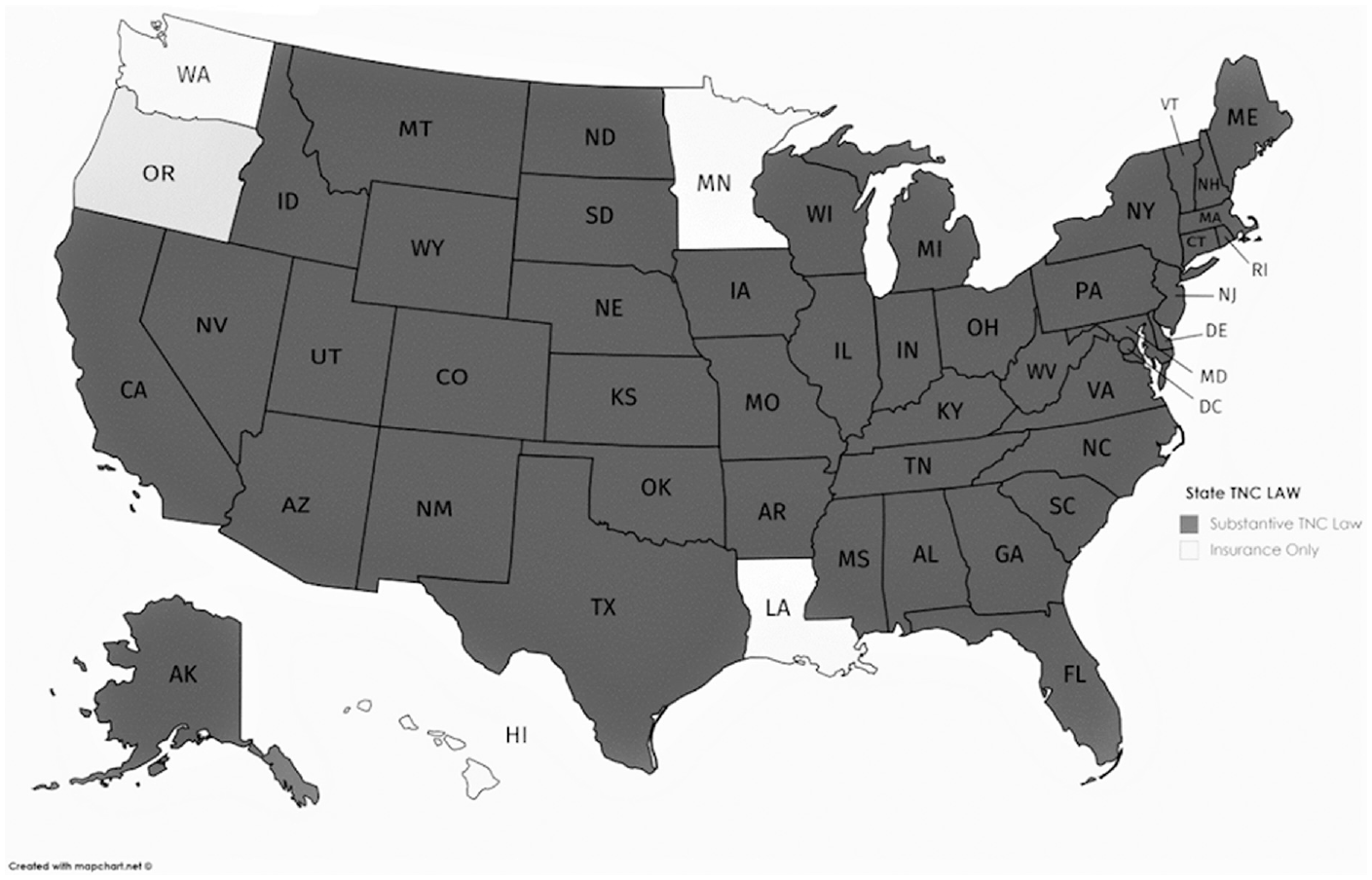
Transportation Network Companies (TNC) State Laws, October 2018 (all)
Of the 49 state TNC laws, 42 states now preempt at least some (and usually major) municipal or sub-state regulations of TNCs such as Uber and Lyft. (See Figure 2.) Those state laws usually exempt airports and traffic regulation, but most can be read broadly to at least create an assumption of state authority over TNCs or TNC drivers’ local regulations. Of the 42 preemptive state TNC preemption laws, three states (New York, Pennsylvania, and Vermont) exempt their major cities. Three (Alaska, Alabama, New York) allow some local governments to ban TNCs completely but not to regulate them. Illinois is another exception, offering a unique floor preemption model, allowing municipalities to provide stricter regulations of TNCs.

Transportation Network Companies (TNC) State Laws: Preemption of Local-Government Regulations, October 2018
These prohibitions on local involvement include most of the direct regulatory powers municipal governments can hold over TNCs, setting the political and regulatory stage at the state level. A hypothetical Boston, Massachusetts–based IDG would be extremely limited in what it could accomplish using New York City tactics. The Massachusetts TNC state law, enacted in 2016, states: Except where expressly set forth in this chapter, no municipality or other local or state entity, except the Massachusetts Port Authority, may: (i) impose a tax on or require any additional license for a transportation network company, a transportation network driver or a vehicle used by a transportation network driver where the tax or licenses relate to facilitating or providing pre-arranged rides; (ii) require any additional license for a transportation network company or transportation network driver; or (iii) subject a transportation network company to the municipality’s or other local or state entity’s rates or other requirements, including but not limited to entry or operational requirements; provided, however, that a municipality or other local or state entity may regulate traffic flow and traffic patterns to ensure public safety and convenience.
36
Other than the preemption regime, most states adopted in their TNC regulations other substantive features. In what appears to be a standard package of TNC regulations, state laws address issues such as an insurance requirement; licensing of TNC drivers; background check procedures; the prohibition of discrimination of riders (not drivers); placing limits on time logged in to an app; and the use alcohol and drugs by drivers (usually a zero tolerance policy). Additionally, 32 states offer some treatment of the employment status of drivers, usually in a way that reinforces their status as independent contractors (Racabi 2020).
The formation of the state-centered regulatory framework for Uber did not escape scholarly and labor activists’ attention. Some scholars characterize this landscape’s formation as a state regulatory response to the lack of federal leadership in correcting the economic imbalance of the platform economy (Light 2017). Others portray this flush of regulation as a triumph of corporate interests capturing state legislators and preempting the possibility for an experimental and progressive city ride-share agenda (Light 2017; Smith, Borkholder, Montgomery, and Chen 2018). The National Employment Law Project (NELP), in a special report, characterized these state laws as a concrete response to employment-like regulatory threats originating in cities and state agencies and part of a more significant trend in the corporate and right-wing backlash of states working against workers’ interests (Smith et al. 2018).
The NELP report offers the example of Alaska. In 2015, the Department of Labor and Workforce Development in Alaska ruled that Uber could not operate in Alaska without paying workers’ compensation taxes. In response, the 2017 TNC state law declared that drivers are not employees, stripping them of rights they would otherwise have under state employment law and blocking the state agency’s decision (Smith et al. 2018). This case, while illuminating, is an outlier in its direct suggestion of cause and effect, as all other TNC laws were not aimed at reversing state agency decisions regarding employment classification, but rather perhaps sought to prevent the possibility of such decisions.
Discussion: How Do City–State Relations Shape the Strategic Choices of Labor Actors?
Previous literature and the case studies in this article demonstrate that cities and other local governments in the United States hold unstable regulatory powers. The legal ground is tilted, as local governments enjoy no independent regulatory authorities. Those authorities they are considered to possess can be stripped away by state legislation or can be interpreted by courts as preempted by state or federal law. This bias most clearly manifested itself in cases in which the supposed authorities are new. This includes the slew of state TNC laws that preempt localities from regulating platform companies, as well as the court’s reluctance to see the city regulations as covered by the state exemption to antitrust law in the Seattle case. But the legal inferiority of localities, and the possibility of stripping or challenging localities’ authority, was also present as a background feature for California and the New York City cases.
The city–state bias affects the strategic choice set labor actors have in their pursuit of non-NLRA strategies. Preemption has a bite, and limited resources and opportunities necessitate considering the effects of this bite. The contribution of this article is to offer possible connections between the city–state slanted relations and two relatively familiar LR variables: the level of innovation of the LR measure pursued (as opposed to traditional LR strategies), and the level of confrontation (as opposed to cooperative relations) between the implementers of the LR intervention and those who might oppose it.
The relations between confrontation, innovation, and city–state relations may be summarized as such: 1) State preemption is triggered by conflicts, making confrontational local-based regulatory interventions riskier. But 2) achieving state LR regulations requires constructing and maintaining broader political coalitions, which makes accomplishing innovative LR interventions less likely. In sum, the legal weakness of local jurisdictions makes it less likely that confrontational local LR interventions will arise, or innovative ones on both the local (if innovative and confrontational) and the state regulatory levels. The hypotheses can be framed as:
Conflict Breeds Preemption
The level of labor–management conflict versus cooperation is a known variant in LR writing (Kochan, Eaton, McKersie, and Adler 2011). In the case studies discussed above, the clearest example of high-conflict LR interventions are those of Seattle and California. In both, Uber pushed back using political lobbying and appeals to courts. In the Seattle case, labor’s adversaries won an antitrust preemption legal argument that is based on the notion of inferior regulatory powers of cities versus those of states. As described in the Seattle case, this legal argument was not a clear winner. But, it does bode well for the overall inferiority of cities’ regulatory powers versus those of the state.
In choosing a high-conflict LR intervention, both California and the Seattle labor advocates exposed their intervention to legal and political attacks. When LR intervention is locality-based, a preemption challenge, either undertaken by state legislation or by court arguments, is a likely countermove. This response might be ad hoc and aimed at stopping the LR intervention in its tracks, or it could be used as a preemptive measure in other states and against other localities. Here, local confrontational or adverse models are nipped in the bud ahead of possible conflict. Perhaps this kind of strategy is manifested in the broader TNC policymaking demonstrated by shifts toward states and away from cities.
Statewide Politics Breed Less Innovative LR Interventions
In the case studies presented, both the Seattle local law and the relationship between the IDG and Uber show a substantial deviation from traditional US LR models. The IDG has a cooperative, semi-dependent connection with Uber and its reliance on local regulatory sway to gain power and voice. In Seattle, highly progressive labor law was implemented on the local level. Both LR interventions are unusual in the US LR landscape and unorthodox considering that both are premised on Uber drivers’ classification as independent contractors and not as employee status workers.
In this sense, the California intervention stands as a manifestation of the canonical LR intervention for labor’s dealing with independent contractors—aiming to reclassify them as employees as a benchmark for further interventions. AB5 was not chosen because it was the only viable path but was formed after another strategic path—that of implementing a unique sectoral bargaining model for platform drivers—failed because the proponents of that approach could not sustain a broad enough coalition to support it.
While tentative, these examples might hint at a broader logic underlying what the choice of jurisdictional levels (city, state, federal) of LR intervention entails. In New York City and Seattle, the scope of the coalition that needed to be maintained to go through with the LR intervention was narrow. There were fewer coalitional gatekeepers to overcome to pass the innovative intervention. And while both stand in contrast to the traditional logic of dealing with independent contractors, and as a deviation to the labor instinct of universal protections that manifest in broad universal legal frameworks, both could succeed with little interference from internal coalitional strife (cf. Racabi 2020).
For labor advocates in California, no such luxury existed. As California arguably already preempted localities from regulating TNCs by granting authority to the CPUC, and the risk of ad hoc state legislative or ballot-based initiative already existed, labor actors had to construct broader statewide coalitions to pass their preferred LR policies regarding Uber. In this setting, the capacity of labor actors to pass any LR measure is highly dependent on their ability to harness many other actors for their coalition, circumventing coalitional gatekeepers (Andrias 2016). This need for broader partnerships increases the political and monetary price tags for LR interventions and makes it less viable to pursue innovative LR interventions. The shift in focus from local to state has a political price labor actors have to pay to achieve statewide possibilities.
Conclusion
The tilt of city–state regulatory relations toward states and away from cities has a profound effect on LR. This is the case because labor advocates must constantly keep in mind potential legislative or court-based preemption challenges to their preferred policy interventions. This insight gains in significance as increasing amounts of US LR action occurs outside the federalized but defunct NLRA and as labor advocates pursue regulatory interventions rather than state-autonomous LR models. To a large extent, the nature of this persistent strategic choice has eluded LR theorists.
Using three case studies of labor attempts to form LR interventions in the case of Uber, the ride-share start-up giant, this article offers two possible effects of this city–state tilt on LR. The first is that because the city–state bias needs to be activated, local LR interventions are more susceptible to challenge when the intervention is in conflict with a relevant stakeholder. One such likely actor is the firm at which the LR intervention is aimed. But, one can imagine broadening the scope of potential interest holders to other firms in the sector, local or state political actors, and various special interest groups. All of these conflicted interest groups can try to activate state superiority using legal arguments in courts or pushing for statewide preemption measures. In this sense, the policy landscape of city–state relations shapes the sustainability of conflict-ridden LR relations.
A second hypothesis stemming from the case studies is that the transition to non-local LR intervention, expected because of the susceptibility of local interventions to preemption challenges, leads to a reduction in innovation. As labor actors are pushed into broader political arenas by preemption risks, they press for less innovative and less controversial LR interventions because they need to harness a broader political coalition than is needed in local arenas.
This article identifies another source of LR ossification outside the known variant of it within the NLRA (Estlund 2002). Even in labor frameworks outside the NLRA, city–state relations push labor actors into broader coalition-building endeavors, which puts a higher price tag on innovation and more aggressive forms of LR interventions. The least likely, or most exposed, LR interventions are local, innovative, and conflictual. This tendency is not endemic to US labor actors; it is simply the result of the city–state regulatory tilt policy.
More research is needed to specify and validate these hypotheses in additional case studies and in more traditional alt-labor settings. This framework, though, offers LR scholars one more way to conceptualize the connection between law, alt-labor actors, and LR features.
