



Abstract
What are useful ways to characterize varying employment systems? This article returns to an older idea, Internal Labor Markets (ILMs). The traditional assumption characterized ILMs as the core of the labor market but current thinking argues that ILMs have frayed. Little direct measurement has been carried out, however, and both viewpoints have relied on proxies or case studies. The author utilizes a new survey of employed US workers to provide an estimate of the incidence of ILMs and finds that between 25 and 40% percent of adult workers are in ILMs. The article then elaborates theory regarding the practices of ILMs, a theory grounded in the idea of complementary bundles of human resource practices, and asks what are the correlates of being in an ILM. Findings show that although wages in ILMs are no higher than non-ILM wages, ILMs are positively associated with other aspects of job quality and attitudes across the board.
Keywords
Internal Labor Markets (ILMs)—the web of personnel rules concerning promotion and compensation that are focused on internal considerations rather than the external labor market—have long provided the central framework around which much of the discussion of employment was organized (Doeringer and Piore 1971; Baron 1984; Althauser 1989; Dobbin, Sutton, Meyer, and Scott 1993; Kalleberg, Knoke, Marsden and Spaeth 1996; Davis-Blake and Broschak 2010; Avent-Holt and Tomaskovic-Devey 2014; Weil 2014.
Throughout the postwar period until (roughly) the mid-1980s the assumption, explicit or implicit, was that most employers organized their work through ILMs. Surprisingly, however, ILMs were rarely directly measured and analyzed. The literature relied on case studies and a limited number of interviews (e.g., Doeringer and Piore 1971; Baker, Gibbs, and Holmstrom 1984) as well as three quite old surveys, only one of which was nationally representative (Pfeffer and Cohen 1984; Baron, Davis-Blake, and Bielby 1986; Kalleberg, Knoke et al. 1996).
More recently the conventional wisdom has shifted in the direction of believing that the penetration of market forces into the firm, new ideas such as core competency, and the loss of union power have meant that occupational ILMs are no longer important. This perspective is broadly shared in literature reviews of employment patterns (Pfeffer and Baron 1988; Smith 1997; Cappelli 2001).
While the new conventional wisdom is that ILMs are no longer important, direct measurement is still lacking and the view that ILMs have left the scene is supported by proxies that represent aspects of ILMs but that are not direct measures. These proxies include trends in the erosion of the firm size wage premium (Hollister 2004; Hollister and Smith 2014; Cobb and Lin 2017), negative trends in job tenure (Bidwell 2013), declining wage returns to job tenure (DiPrete, Goux, and Maurin 2002), and growth in the use of contractors and freelancers (Pfeffer and Baron 1988; Weil 2014). The difficulty with the foregoing view however is that proxies, including data on job tenure as well as turnover, on the other side of the argument point to stability in job attachment.
The first contribution of this article is to provide nationally representative US evidence on the incidence of occupational ILMs by way of a large, new and original survey of employees that asked detailed questions about the nature of their employment and the policies of their employers. The ILM measure I focus on is whether the employer mostly fills vacancies from inside the company. I also consider whether skill training is provided and whether compensation determination is internally focused. I find that (depending on the measure) between 25 and 40% of the adult workforce are in jobs characterized by ILMs. This estimate shows that ILMs remain important in the labor market although they are not the dominant feature that much of the earlier literature explicitly or implicitly assumed.
With an estimate of ILM incidence in hand I take up an additional issue: Do features of employment vary according to whether the work is organized along the lines of an ILM?
I study the relationship between ILMs and earnings, provision of pensions and health insurance, and job security. The attitudinal correlates I examine are job satisfaction, commitment to the employer, and willingness to undertake extra effort on the employer's behalf. In the analysis, I hold constant the more widely utilized explanations: human capital, unions, occupations, industry, employer size, and labor market regulation and tightness.
With respect to the economic measures, I find no relationship between ILMs and the level of earnings. Employees working in an ILM are considerably more likely to receive employer contributions to health insurance and pensions, however, and more likely to report that their jobs are secure. Additionally all of the attitudinal measures are more positive in ILMs.
ILMs and Their Incidence
The idea of ILMs came to prominence through the work of Doeringer and Piore (1971) although it was present in earlier research by institutional economists. Althauser (1989: 144) in his review wrote that “ILM is conceptually anchored in administrative rules governing hiring, promotion, layoffs, and the pricing of labor.” Other researchers drew on the definition offered by Dunlop (1944) that an ILM is “the complex of rules which determine the movement of workers among job classifications within administrative units such as enterprises, companies, or hiring halls (quoted in Kalleberg and Sørensen 1979: 359).” All this said, while the adoption of formal personnel practices is certainly of considerable interest it is not per se an ILM. Consider a big-box retailer who hires large numbers of cashiers and stockers, who expects short employment spells and considerable churn, and who provides little in the way of promotion opportunities. This firm will nonetheless likely have a large and sophisticated human resources department to manage hiring, deal with discipline, and perform all of the functions necessary to keep the large operation afloat. Procedures and bureaucracy do not an ILM make.
The key is to focus on the word “internal” in ILM. A firm with an ILM determines its employment policies with an eye toward internal organizational considerations rather than the external labor market. A central feature is that some positions are ports of entry but, these aside, when filling a vacancy the firm draws from the internal pool of candidates and does not ask whether a better person is available externally. This is the core practice cited in the classic literature (Doeringer and Piore 1971; Althauser and Kalleberg 1981) and, as we will see, the older empirical literature on ILMs also focused on internal hiring and promotion. In addition to filling jobs internally the classic descriptions of ILMs emphasize that compensation is driven by concerns for internal relativities and that firms with ILMs provide skill training to their workforce.
The foregoing is, of course, in some sense an extreme version of an ILM since, as an example, if the firm is growing it must grow through external hiring and hence some jobs higher up (i.e., beyond the port of entry) will be likely hired from the outside. Nonetheless, ILMs have a strong bias toward filling positions internally with hiring oriented toward entry positions.
Note also that this characterization leaves considerable scope for variation. One firm may promote only internally and use seniority as a criteria while another firm ignores seniority and runs an internal bidding process, but both are ILMs. Some firms with ILMs may be Tayloristic in how they design jobs while others may have adopted high commitment work systems and are structured around broad job designs. In some cases there might be substantial upward mobility but in other situations not. On this point consider the success of the United Automobile Workers in organizing automobile production plants. These were considered an example of ILMs in manufacturing (Doeringer and Piore 1971; Jacoby 1984), yet few production employees were able to move up in the organization in meaningful ways (Chinoy 1955). It should also be understood that although employers may use largely internal systems to fill jobs and set compensation there can still be complications and variations in the implications for individual outcomes and attitudes (Cobb, Keller, and Nurmohamed 2022; Groysberg, Healy, and Lin 2022; Keller and Dlugos 2023).
Incidence
The long-standing assumption in the literature has been that most firms organized their employment systems along the lines of an ILM. As an example of this assumption Jacoby (1984: 58), perhaps the leading historian of employment systems, wrote that “the practices that comprise the Internal Labor Market have become what Robert Solow has termed ‘social conventions or principles of appropriate behavior.’” Similarly Kalleberg, Marsden, Knoke, and Spaeth (1996: 88) wrote that “Firm Internal Labor Markets are central features of employment relations in modern societies.” A review of the personnel economics literature focused on the importance of ILMs (Waldman 2013).
All this said, the assumption regarding the centrality of ILMs has changed. Many scholars now argue that ILMs have lost their relevance. A review of the newer literature that makes this assumption is found in Bidwell, Briscoe, Fernandez-Mateo, and Sterling (2013).
Weighing on the scales pointing to decline is that wage returns to job tenure have fallen (DiPrete et al. 2002); as firms restructure rents captured by employees are reduced (Dencker and Fang 2016), and pay setting centered on internal comparisons has given way to an emphasis on compensation based on the external market (Lemieux, Macleod, and Parent 2009; Adler 2022; Massenkoff and Wilmers 2023). Additionally the firm size premium has diminished and given that large firms are more likely to have well-developed ILMs (Baron et al. 1986) this implies a reduction in the scope of those ILMs (Hollister 2004; Cobb and Lin 2017).
Some scholars also believe external hiring beyond ports of entry at the bottom of job ladders has become much more common. As an example, the prevailing view of the Silicon Valley is that job hopping is typical (Fallick, Fleischman, and Rebitzer 2006) and in a more representative survey of college graduates with IT-related degrees, Bidwell and Briscoe (2010) found support for this perspective. Cappelli (2019) and Cappelli and Keller (2014), drawing upon a range of reports from consulting firms and professional organizations, estimated that prior to 1979 employers filled 90% of their openings internally but that more recently the figure is 30% or less.
Set against these views, however, is evidence on the other side. First, overall the incidence of job hopping seems to have declined, not increased. Setting aside the so-called great resignation triggered by COVID and the recovery, the data suggest that over the period during which ILMs presumably shrunk, in fact the overall trend in job hopping was down and not up (Davis and Haltiwanger 2014; Molloy, Smith, Trezzi, and Wozniak 2016; Pries and Rogerson 2019). As an illustration, Shambaugh, Nunn, and Liu (2018) using data from the U.S. Bureau of Labor Statistics Job Openings and Turnover Survey (JOLTs) reported that whereas in 1994 the monthly job switching rate was about 3%, by 2017 it had fallen to just over 1.6%.
In addition, job tenure has been stable. For example, in the Current Population Survey (CPS) tenure supplements in January 2002 among employed people ages 45–64, 53.5% of men and 44.4% of women had 10 or more years of tenure with their employer, and in January 2020 (just pre-pandemic) the figures were 51.7% for men and 47.5% for women. The rates for both genders were 49.2% in 2002 and 49.7% in 2020. 1 In short, whether ILMs are of continued importance remains an open question.
Relationship between ILMs and Outcomes
A surprising feature of the ILM literature is that although considerable theorizing has been developed regarding why ILMs emerged as the (assumed) dominant form of work organization (Doeringer and Piore 1971; Edwards 1979; Baron 1984; Pfeffer and Cohen 1984; Osterman 1987; Baron, Jennings, and Dobbin 1988; Jacoby 1997; Waldman 2013), relatively little theory or empirical work has emerged regarding correlates of working in ILMs.
One possible explanation for this gap is that because of the assumption that essentially the entire core of the economy was organized in ILMs (Reich, Gordon, and Edwards 1973; Tolbert, Horan, and Beck 1980; Piore 2001), the correlates of not being in an ILM seemed obvious: They were the conditions of work in the periphery or secondary labor market. The questions that received the most attention then became understanding why ILMs emerged and why this periphery existed. Another way of making this point is that given the (in my view incorrect) conflation of ILMs with all formalized bureaucratic personnel practices, the literature veered away from more sharply understanding the implications of ILM practices. Additionally the lack of direct measures of the presence or absence of ILMs also likely contributed to this thin body of work.
This article focuses on three categories of possible correlates of ILMs: wage determination, personnel policies that impact the economic well-being of those in and not in ILM systems, and attitudinal consequences.
Wage Determination
Wages are the measure most commonly considered when discussing employment systems and there is indeed a literature regarding ILMs and wages. It is reasonable to expect a positive correlation between ILMs and wages given the literature showing a positive relationship between the presence of ILMs and both unions and employer size (Baron et al. 1986). However, with respect to the inherent logic of ILMs per se, arguments point in opposite directions. On the one hand, ILMs may increase productivity because of more reliable and better trained labor supply or because of higher levels of employee effort (an effect discussed below). On the other hand, the non-wage benefits of ILMs, also discussed below, may lead employers to offer, and employees to accept, below market level wages in the sense of compensating differentials.
Pensions, Health Insurance, and Job Security
An important strand of literature argues that an organization's human resources policies are best conceived of as bundles of complementary practices rather than specific practices. Early presentations of this idea are found in McGregor's (1960) distinction between management grounded in Theory X versus Theory Y and Walton's (1985) distinction between commitment and control systems of human resources. This broad idea has been picked up in three distinct literatures: the economics literature on organizational complementarities, the industrial relations literature on high commitment work systems, and the human resources literature on human resource practice bundles.
In the economics literature the focus is on efficient production. Milgrom and Roberts (1990) defined complements as the effect when an increase in one practice increases the productivity of other practices. A similar line of thought was developed in the literature on so-called High Performance or High Commitment Work Systems (Appelbaum and Batt 1994; Kochan and Osterman 1994; Osterman 1994; MacDuffie 1995). These systems, which are essentially variants on the well-known Toyota Production System (Adler, Goldoftas, and Levine 1999), center on the idea of employees being flexible with respect to assignments and taking responsibility for quality. This approach in turn requires a set of complementary human resource practices including employee voice, training, and job rotation. Additionally the broader literature on human resource management has turned to the idea of bundles of practices that logically hold together (Arthur 1994; Becker and Huselid 1998; Pfeffer 1998).
In the presence of ILMs the heavy reliance on internal labor supply points us toward expectations regarding other personnel policies—pensions, health insurance, and job security—with implications for the economic well-being of the workforce. Pensions are a form of backloaded compensation that reward long-term attachment. A commitment to the incumbent workforce as the main source of labor supply implies an interest in the health of that workforce and hence a firm with an ILM is more likely to contribute to health insurance. Finally, internal hiring should improve job security given that employers' capacity to engage in outside hiring is muted.
Attitudes
Literature that tests the relationship between attitudes and ILMs is scant. One study, Kalleberg and Mastekaasa (1994), did consider the question by linking responses in the General Social Survey to employer interviews on job practices. The measure of ILMs was a firm-wide estimate of the extent of internal mobility and they found no relationship with citizenship behavior. Nonetheless other scholars have argued that employer investment in employees and provision of higher levels of job security—logical outcomes of ILMs—seem likely to lead to higher levels of job satisfaction, increased commitment to the organization, and increased effort (Pfeffer and Baron 1988). Lee (2015) in the Korean context showed that ILMs encourage cooperation among managers. Along similar lines O’Reilly and Chatman (1986) identified three mechanisms that lead to higher levels of organizational commitment, and ILMs potentially deliver on two of these: the instrumental mechanism of higher rewards and job security and identification via membership in a stable group.
Several related lines of work suggest that this mechanism is plausible and worth further exploration. The personnel economics literature points toward increased commitment and effort in ILMs albeit with a distinct vocabulary. Efficiency wage theory argues that increased effort is attributable to employees recognizing that their economic rewards are above market levels and they fear losing employment if their effort and commitment falter. In other versions of the theory, the motivating mechanism is gift exchange (Akerlof 1982; Stoft 1982; Shapiro and Stiglitz 1984). Related to this, the literature on the impact of the minimum wage and living wage campaigns points to increased employee effort and reduced absenteeism for those employees who are affected by either minimum wage increases or passage of local minimum wage ordinances (Fairris 2005; Reich, Hall, and Jacobs 2005; Chapman and Thompson 2006).
If ILMs are correlated with positive attachment and effort, this fact is important because it becomes a virtuous circle, that is, a mechanism that at least partially underwrites the cost of more extensive benefits and job security. This increased effort these attitudes may engender is similar to the idea of organizational citizenship that Organ (1988: 4) characterized as “individual behavior that is discretionary, not directly or explicitly recognized by the formal reward system, and that in the aggregate promotes the effective functioning of the organization.”
Contractors
In the empirical work that follows I exclude freelancers because they lack an employer who can provide an ILM. Contracting poses a distinct challenge. Contractors are W2 employees of one organization—the staffing firm—but assigned to the worksite of the client (to avoid confusion I use the term “freelancers” to refer to what are sometimes called independent contractors who have no W2 employer). The consensus in the literature is that the fraction of the workforce that consists of contractors has grown (Abraham and Taylor 1996; Smith 1997; Kalleberg 2009; Dey, Houseman, and Polivka 2012; Pedulla 2013; Weil 2014; Bernhardt, Batt, Houseman and Appelbaum 2016; Pedulla 2020).
Contractors are related to ILMs in two ways. First, firms increasingly utilize contractors when they seek to remove some jobs from the ILM and, by putting the work out for bid, push down wages and other forms of compensation for the tasks that are contracted out (Dube and Kaplan 2010; Howell and Kalleberg 2019). In effect it is the ILM that is the motivation for contracting.
Second, contractors themselves may work under an ILM in their staffing firm and this implies that the expectations are not clear. Some higher-end staffing firms provide their employees with careers and have well-developed ILMs. Scholars who study the contracting market support this observation. Bidwell and Fernandez-Mateo described the advantages, with respect to obtaining clients and establishing favorable pricing, that high-end staffing agencies gain if they can build long-term relationships with their contractors. They conclude, referring to the workforce and the staffing firms, that “long-term relationships are also a feature common to this market” (Bidwell and Fernandez-Mateo 2010: 1143). In the work that follows I control for contracting status.
Data
I utilize the American Training Survey (ATS), which was conducted in two waves—the first in January 2020 and the second in March and April of 2022. Here I work with the 2022 wave. The surveys drew from the NORC at the University of Chicago standing AmeriSpeak panel. The 2022 sample was limited to adults between the ages of 26 and 66 and was conducted in English and in Spanish. 2
Standing panels have been used in recent academic research (Kochan, Yang, Kimball, and Kelly 2019; Pedulla and Mueller-Gastell 2019; McGinty, Presskreischer, Han, and Barry 2020), government research reports (Robles and McGee 2016; Board of Governors Federal Reserve System 2018), and Pew Survey Research (Horowitz and Graf 2019). With respect to the reliability of online surveys in general the literature is reassuring (Chang and Krosnick 2009; Keeter and McGeeney 2015; Foote et al. 2021).
The AmeriSpeak panel is intended to be nationally representative. NORC describes the construction of the AmeriSpeak Panel in its technical report (NORC 2020) but the key statistic is that 24.1% of those who were the sampling frame agreed to join the panel. Among the panel members who meet our screening criteria, 30.2% agreed to undertake the survey and 94.3% completed the survey.
Appendix A compares the characteristics of the ATS 2022 sample for those who were working to the March 2022 CPS of people in the same age range who were working. As shown, the ATS tracks the CPS quite well with the exception that ATS overrepresents better-educated respondents and underrepresents those with less education. In the analysis that follows I control for education as appropriate.
My survey stands in contrast to most prior ILM research that collected data from firms. Both approaches have their advantages. For example, firm surveys are better able to obtain measures of technology or product market concentration whereas surveys of individuals can utilize rich personal controls and can capture the actual experience of employees. Given the current approach, consider the findings to be saying that X percent of employees experience this or that as opposed to saying that X percent of firms implement this or that.
Additionally, because the survey asks respondents about their experience in their occupation, this work is best thought of as studying ILMs at the level of occupations rather than characterizing an entire firm. This approach is congruent with the literature that has long recognized that a given firm may contain varying employment systems (Althauser and Kalleberg 1981; Osterman 1987). However, keeping in mind that I work with a nationally representative sample of employees, any findings from my sample can be interpreted as applying to the entire workforce.
Operationalizing ILMs
My measure of ILMs will be drawn from three indicators: the extent of internal hiring, whether internal considerations play an important role in compensation, and whether the organization provides training.
The studies that do seek to directly measure ILMs have focused on internal hiring (Pfeffer and Cohen 1984; Baron et al. 1986; Kalleberg, Knoke et al. 1996). This will be the core measure given that it is consistent with the argument developed earlier that the essence of ILMs is that their personnel policies are internally focused.
The survey question regarding internal hiring asked (and the distribution of responses was): “For jobs like yours does your employer: (a) Mostly fill vacancies from inside the company (35.6%); (b) Mostly hire new people from outside the company (16.5%); (c) Do both about equally (38.9%); (d) Don’t know (8.8%).”
With respect to compensation the survey asked (and the distribution of responses was): “For jobs like yours does our employer (a) Set pay based on what people outside the company make for similar jobs (19.8%); (b) Set pay based on what employees above and below me make (19.9%); (c) Do both about equally (31.2%); (d) Don't know (28.9%).”
The third component of our ILM operationalization is training, a central practice typically associated with ILMs in the literature. The connection is straightforward: Firms with internal hiring and with a commitment to its workforce will invest in training because their labor supply is internal and hence they need to prepare that workforce to move up. The survey asked, “Has your employer who pays you and withholds taxes at your main job provided you job-related training (for example, training on how to run a new machine, a new administrative process, or use a new piece of software, that we will call additional skills training).” The stem to this question carefully distinguished skills training from orientation, safety, and workplace behavior training (for a discussion of the extent and determinants of firm training that uses the same survey as that employed here see Osterman 2021). The rate was 81.4%. 3
I discuss three ILM indicators below: whether hiring is largely internal; the internal hiring measure plus the receipt of training; and the internal hiring measure, the training measure, and the indicator whether compensation was mostly or equally internally focused.
Dependent Variables
Earnings: I asked about annual earnings rather than hourly wage in part because it is easier for people to answer (given that many people are paid by the week or month, not hour) and in part because contract company employees frequently work for multiple employers with varying compensation levels.
Pensions and Health Insurance: I asked respondents “whether your employer offers you a pension plan to which it makes a contribution” and the same question for health insurance. I create a dummy value for each that takes on the value of 1 if the response is affirmative.
Security: I asked on a five-point scale how secure respondents feel their job to be and measure security as a binary variable that takes on the value of 1 if the response was “very secure.”
Attitudes: The survey asked questions aimed at understanding the relationship between ILMs and employee satisfaction, commitment, and effort. The questions were, “On a scale of one to five how much do you care about the success of your employer?” and “On a scale of one to five how satisfied are you with your main job?” and “On a scale of one to five how much do you agree with this statement: ‘I am willing to put in a great deal of extra effort to help this organization be successful.’?” The questions regarding care and effort are the same as those used in Kalleberg and Mastekaasa (1994) and the job satisfaction question is a simplified version of standard job satisfaction measures. The three binary variables for each of these measures take on the value of 1 if the respondent is very satisfied, very much cares about the success of their organization, and is very much willing to undertake extra effort.
Control Variables
Human Capital Measures
The variables in this group are:
Education and Experience: The rationale for education is straightforward and experience (and experience squared) is standard in earnings models and is measured as age minus years of education minus six.
Health: Respondents were asked on a five-point scale to characterize their health status. I create a fixed effect that takes on the value of 1 if they report their health to be excellent and 0 otherwise.
Part-Time Status: Part-time employees are known to experience an earnings hit (Golden 2020); it is also possible that they are less committed to the organization than are full-time workers. In addition any discussion of gender-based disparities must take into account the empirical fact that women are more likely than men to work part-time (in these data 20.0% of women work part-time compared to 6.5% of men). I create a dummy variable if the respondent reported that she/he worked part-time.
Tenure: The number of years with the current employer.
Specific Skills The importance of specific skills—skills that are more useful in the current employer than elsewhere—in wage setting has been prominent in the earnings determination literature since Becker (1964) introduced the concept. The specific skills variable used here is based on the question: “If you changed jobs how useful would the skills you received in training be to a new employer in the same industry.” The answers to this question were on a one-to-five scale, from totally transferable to not at all transferable, and I create a dummy variable that takes on the value of 1 if the answer was not totally or mostly transferable. The framing is similar to that used elsewhere in the literature (Loewenstein and Spletzer 1999; Waddoups 2014).
Ascriptive Measures
I create fixed efforts for race, ethnicity, and gender.
Organizational Measures
Contractor Status: As discussed earlier, contractors may work in ILM systems at their staffing agency. I include a fixed effect for whether the respondent is a contractor. The survey collected detailed information on the employment status of the sample, distinguishing among standard employees, contract company employees (a category that includes temporary workers), and freelancers. Note that I use the term “freelancer” instead of “independent contractor” in order to avoid confusion. Appendix B describes how I measure and distinguish each of these categories. The focus here is on the main job (defined as the job at which people spend the most time) although some people may also have a second job as a freelancer or contractor. Among the respondents 7.9% were freelancers in their main job and 12.0% were contract company employees. 4 I exclude freelancers from all the analyses.
Size: An extensive literature documents that employer size is related to outcomes such as earnings and career progression (Blau and Schoenherr 1971; Brown and Medoff 1989). Although the more recent literature argues that the employer size effect with respect to earnings has diminished (Hollister 2004; Cobb and Lin 2017), control for size is important. The measure of size refers to the establishment at which the respondent is employed.
Occupation, Sector, and Industry: The original formulations regarding ILMs were based on research in blue-collar settings but as the concept took hold scholars assumed that white-collar employment was organized along the same lines. By contrast, dual labor market theory and core-periphery models of the labor market assumed that low wage service employment was not organized into ILMs. As noted, the evidence on all of these assumptions is not strong but the balance of evidence does suggest that occupational controls are appropriate. I classify people into four occupation groups: blue-collar, professional, white-collar, and low service. Additionally I distinguish between public (government) and private employment. Public agencies face a different set of economic incentives than do organizations in the private sector and it is possible that the absence of pressure from financial markets will lead to employment practices that place greater emphasis on internal considerations. Finally I also include controls for industry given that industries vary in their average compensation levels and these variations are stable over time (Krueger and Summers 1988; Katz and Summers 1989).
Countervailing Power
Unionization: Unions typically negotiate for employment practices—seniority and incumbent job preferences—that are consistent with ILMs, and the internal politics of unions likely lead to an emphasis on setting compensation based on maintaining relative differentials (Freeman and Medoff 1984; Rosenfeld 2014). This said, considerable evidence has shown that non-union firms in industries that perceive a threat of being organized will imitate union practices to fend off the real thing (Dunlop 1944; Western and Rosenfeld 2011) and that even absent a threat, non-union firms adopt ILM practices (Foulkes 1980; Jacoby 1997).
Minimum Wage: I also include a variable for the binding minimum wage as of April 2022 in the respondents’ state. I utilize either the federal minimum wage or the state’s minimum wage if it is higher than the federal rate.
External Labor Market Conditions
Unemployment Rate: Compensation is known to be influenced by labor market conditions and I include a measure of the state unemployment rate in the first quarter of 2022 (U-6, a measure that captures discouraged workers as well as people searching for work).
The Incidence of ILMs
I work with three alternative ILM measures and present results for each. For these incidence measures (and for all the empirics that follow) I drop cases that have missing values for any of the relevant variables. This approach helps ensure a consistent data set throughout the analyses. This means, for example, that the figures I report in this section differ slightly from the marginals reported earlier for the variables underlying the operationalization of ILMs.
The first measure simply takes on the value of 1 if the response indicates the employer mostly fills vacancies from inside the firm. The percentage of the workforce (standard and contract) employed in a setting with the measure is 41.2% (the figure is 37.8% if freelancers are included in the denominator).
The second measure takes on the value of 1 if three conditions are true: the employer mostly fills vacancies internally, compensation is either mostly or equally determined by internal considerations, and the respondent has received employer-provided skill training. For this measure the incidence of ILMs in the workforce is 24.9% (22.9% if freelancers are included). 5
A reasonable concern is that the respondents might not be able to accurately describe the basis of their compensation system. This concern is given weight by the observation in the human resource management literature that compensation systems are often opaque and difficult for employees to understand (Gerhart and Newman 2019). With this in mind I provide a third ILM measure in which I drop the compensation question and define an ILM only in terms of the internal hiring and training questions. For this measure the incidence is 35.6% (32.6% if freelancers are included). In the models that follow below I show results for all three versions of the ILM indicator.
When the sample is limited to full-time employees the ILM indicators are essentially the same: 41.7% for the internal hiring only measure, 36.2% for the internal hiring plus training measure, and 25.8% for the internal hiring plus training plus internally oriented compensation measure.
As a final precaution I also estimate the ILM measures after eliminating recent hires (people with one or less years of tenure at the organization). The rationale is that when new hires are asked about how vacancies are filled their reference point might be their recent experience, which obviously points toward external hiring. This adjustment has only a very small effect on my estimates. 6
As the foregoing discussion noted, contractors can be in ILMs—and my data support this. The incidence of ILMs for the internal hiring only measure is 41.1% for non-contractors and 42.3% for contractors. For the full ILM measure the incidence is 25.1% for non-contactors and 23.1% for contractors.
Keep in mind the earlier explanation that these figures refer to the percentage of the workforce employed in ILM settings, not to the fraction of organizations that have ILMs. It is also quite possible for an individual to work “under” an ILM, yet elsewhere in the organization jobs are structured differently. As such our incidence can be thought of as capturing occupational ILMs (Spilerman 1977).
The incidence of ILMs is quite a bit different than implied by the literature that divides the workforce into a (large) core and a (much smaller) periphery and that explicitly or implicitly characterizes the core as uniformly consisting of well-developed ILMs. However, if ILMs are not the dominant feature of employment neither is the incidence consistent with the view that ILMs are no longer an important feature of employment systems. In thinking about this recall that an organization can be bureaucratic with well-developed personnel rules but not have ILMs as that term is (or should be) understood. 7
It would be valuable to compare my incidence of ILMs with that found in previous studies but, as noted, the only national survey that sought to estimate incidence is the 1991 National Organizations Study (Kalleberg, Knoke et al. 1996). This was, unlike the current survey, establishment based and it included 657 firms. The question closest to mine was a yes/no item asking whether vacancies were filled with current employees and the response was 57.5%, which is higher than my equivalent rate of 41.2%. This said, not too much should be made of this gap given the difference in sampling. The other study for which some comparison is possible is Baron et al. (1986), which sampled 100 California establishments and used Employment Service narratives to characterize hiring and promotion patterns. Ignoring jobs at the bottom of the ladder (i.e., ports of entry) they reported that 57% of the sampled jobs were closed to outside hires. Pfeffer and Cohen (1984) also focused on ladders but did not report the results of the individual items in their index.
Results
Because I am working with cross-sectional data it is difficult to draw conclusions regarding causality. With this in mind as we proceed I will use language to the effect that a given measure (earnings, etc.) is associated with or correlated with ILMs. Because my underlying theory relies upon the idea of bundles of practices this framing seems most appropriate. I begin with descriptive data on the relationship between working in an ILM and the outcomes under study. I then estimate models presenting results for the three alternative ILM measures. For each outcome I first estimate an equation with only the dependent variable and the ILM measure and then introduce controls. This process enables me to understand the extent to which the relationship of the ILM measures and the outcome is due to the covariance between the presence of an ILM and the controls versus the direct correlation of the ILM.
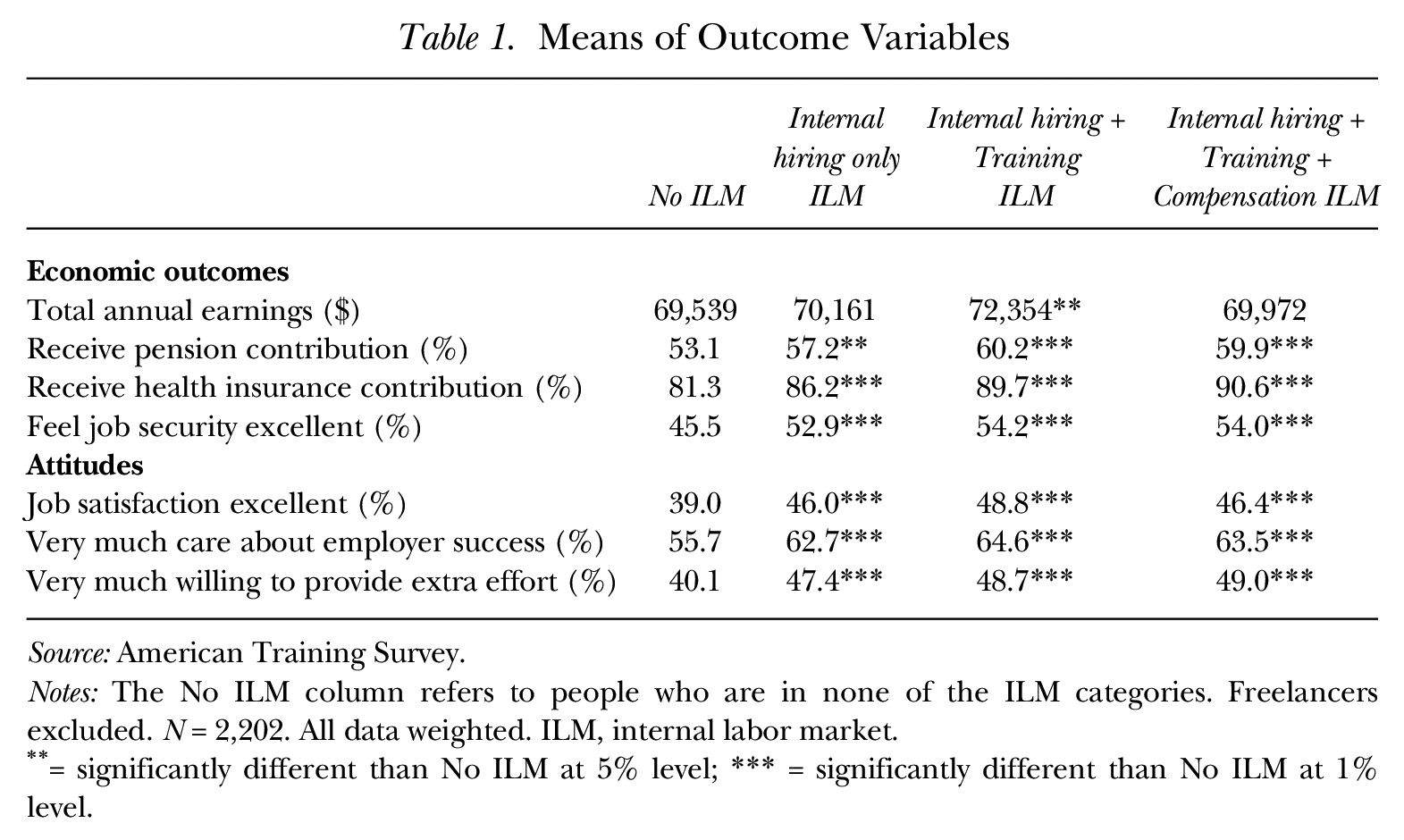
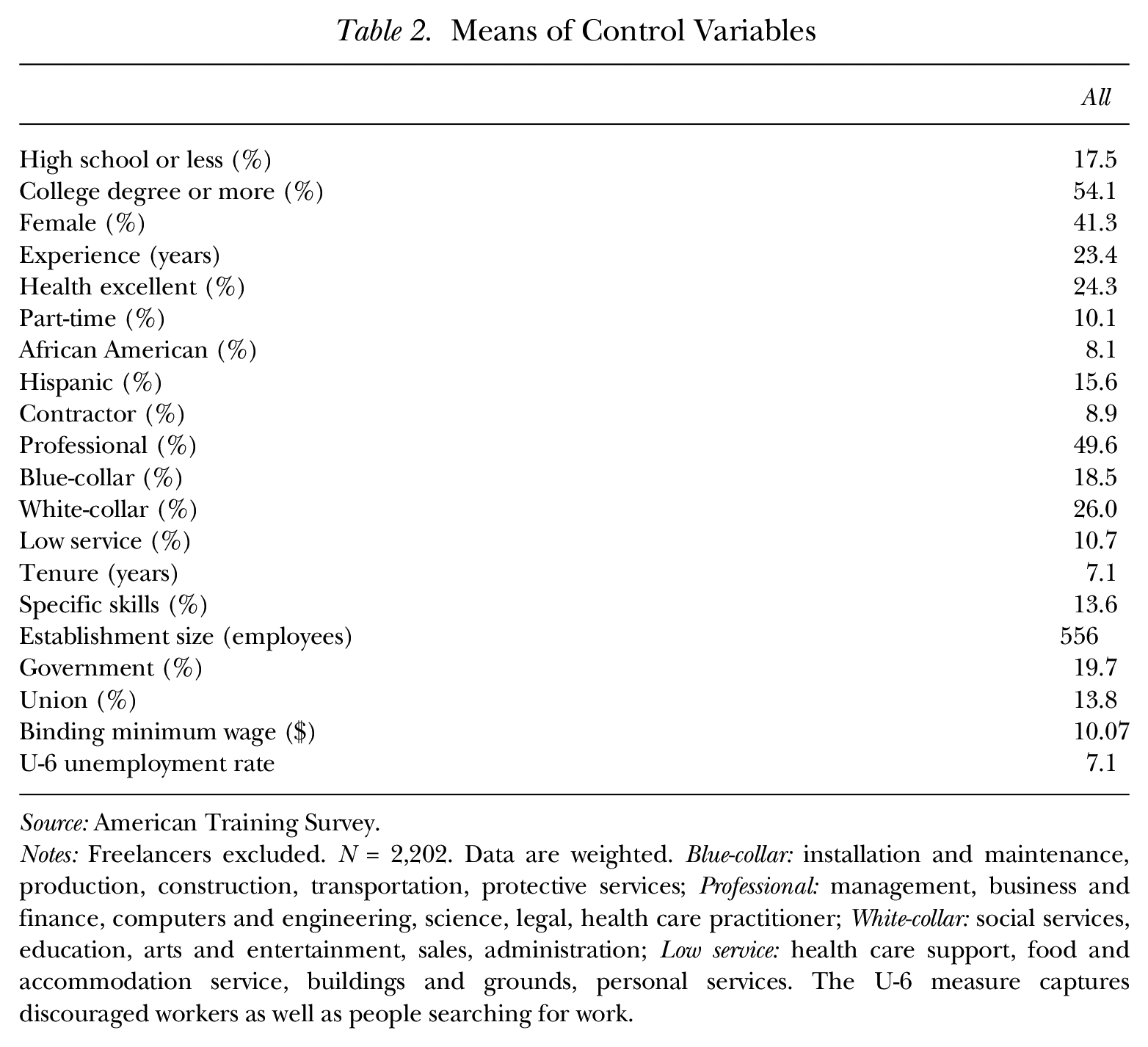
Table 1 shows the values of the dependent variables with which I work separately for those out of ILMs and for those in each of the three ILM measures. Table 2 shows the means for the control variables.
Means of Outcome Variables
Source: American Training Survey.
Notes: The No ILM column refers to people who are in none of the ILM categories. Freelancers excluded. N = 2,202. All data weighted. ILM, internal labor market.
= significantly different than No ILM at 5% level; *** = significantly different than No ILM at 1% level.
Means of Control Variables
Source: American Training Survey.
Notes: Freelancers excluded. N = 2,202. Data are weighted. Blue-collar: installation and maintenance, production, construction, transportation, protective services; Professional: management, business and finance, computers and engineering, science, legal, health care practitioner; White-collar: social services, education, arts and entertainment, sales, administration; Low service: health care support, food and accommodation service, buildings and grounds, personal services. The U-6 measure captures discouraged workers as well as people searching for work.
One pattern that immediately stands out is that Table 1 shows clear differences between ILM and non-ILM settings. Of course, it remains to be seen if these differences persist after the full range of controls is included. This said, the second conclusion from the table is that while there are differences the data do not paint a picture of a world in which working in ILMs implies quality work whereas outside the ILM, in the supposed periphery, the situation is grim. There are clearly “good” jobs that are not in ILMs and the old core-periphery or primary-secondary distinctions are not supported.
Earnings
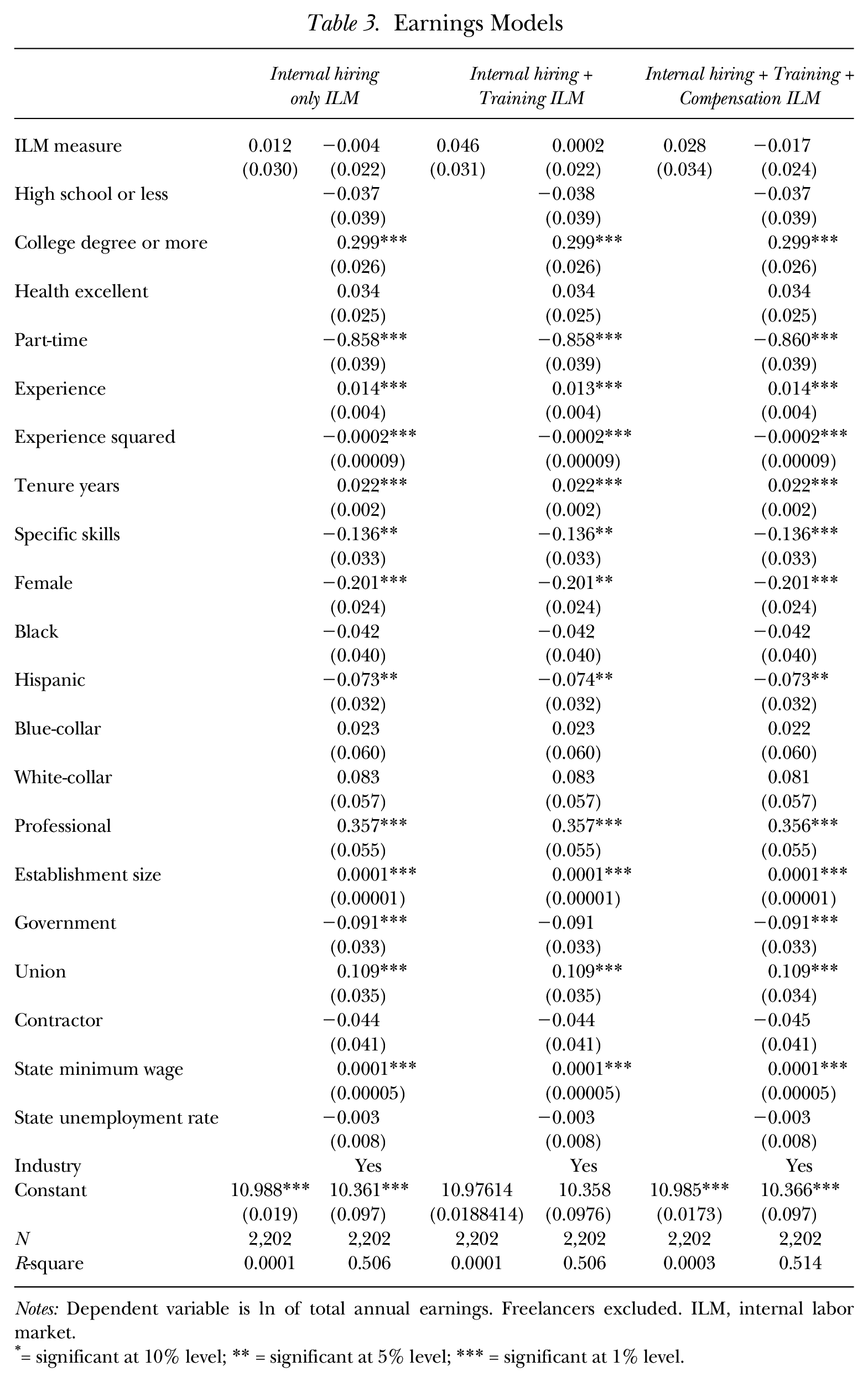
I take up the level of earnings in Table 3. The first two columns show the estimates for the simple ILM measure, the second two show the internal hiring plus training measure, and the final two show the full ILM measure including compensation. For each measure I first estimate the consequences of the measure alone and then introduce the full set of controls.
Earnings Models
Notes: Dependent variable is ln of total annual earnings. Freelancers excluded. ILM, internal labor market.
= significant at 10% level; ** = significant at 5% level; *** = significant at 1% level.
In all formulations it is apparent that ILMs are not correlated with the level of earnings. One interpretation of this is that the other benefits of ILMs, which are demonstrated in the models that follow, are offset (in the sense of compensating differentials) by lack of earnings gains. In a pure compensation differentials framework, however, this would imply that the earnings coefficients be negative, which they are not. Additional evidence that compensating differentials are not at work is that, again as demonstrated below, ILMs entail higher levels of overall satisfaction and other affective responses.
The magnitude and significance of the gender and ethnicity measures are striking and are, of course, consistent with a very large literature demonstrating disparities in the labor market. Keeping in mind how extensive are our controls, the persistence of these disparities is notable. In unreported regressions I interacted the ILM variables with the race and gender measures and found no consistent pattern. It is not surprising that ILMs do not eliminate or reduce ascriptive disparities given that ILMs are social institutions and there is no reason to think that disparities based on race or gender are less relevant in ILMs than elsewhere in the labor market. This concern is deepened by the organizational research demonstrating the mechanisms by which disparate treatment is institutionalized within what are seemingly neutral organizational structures via organizational routines (Castilla 2008; Kalev 2009; Fernandez and Campero 2017; Small and Pager 2020) and via disparate treatment by supervisors (Hensvik 2014; Glover, Pallais, and Pariente 2017; Storer, Schneider, and Harknett 2020).
The institutional literature on how labor market institutions affect wages has focused on unions, wage standards, and employer size and my results are supportive of these considerations. Earnings are higher for employees who are covered by a union contract, they are higher in states that have raised their minimum wage above the federal level, and establishment size remains important although I cannot speak to the question of whether the effect has declined. Government employment is associated with lower wages and professional jobs pay more than other occupations.
Pensions, Health Insurance, Job Security
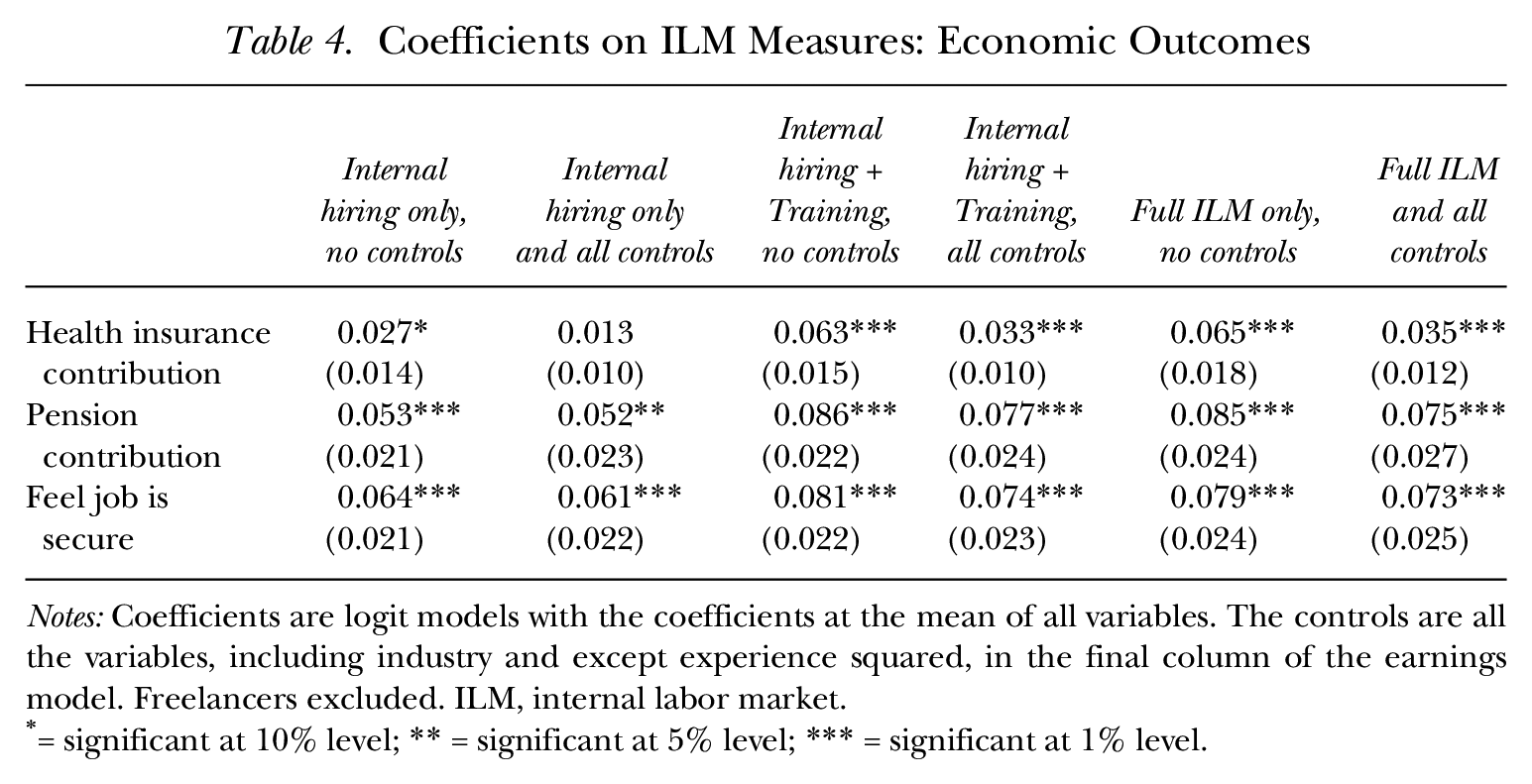
Table 4 presents results for the additional economic measures: pensions, health insurance, and job security. The equations are estimated with logit and the coefficients are the marginal effects at the means of all variables. The table shows the ILM coefficients for a simple equation with only the three ILM measures and for equations with the same set of controls as the earnings model with the exception that experience-squared is omitted.
Coefficients on ILM Measures: Economic Outcomes
Notes: Coefficients are logit models with the coefficients at the mean of all variables. The controls are all the variables, including industry and except experience squared, in the final column of the earnings model. Freelancers excluded. ILM, internal labor market.
= significant at 10% level; ** = significant at 5% level; *** = significant at 1% level.
In all but one model the ILM is positive and significant and this holds in the simple models and when the full set of controls are introduced. Recall that our theory predicted that when firms are reliant on an internal labor supply, which is the case with internal hiring, they are more likely to adopt human resource practices—pensions and health insurance—which support their workforce and they are more likely to provide job security. These measures are tightly linked to the theory of ILMs elaborated earlier and it is clear that the theory and hypotheses are supported.
A final point with respect to the earnings models and these additional economic measures is that one might worry about unobservables that drive differentials regarding ILM status. This is always a concern and impossible to totally dispose of when working with cross-sectional data. One reassuring factor, however, is that a very full range of controls capture the considerations that are thought to drive outcomes. Additionally pensions, health insurance, and (to a lesser extent) job security are more likely to be employer policies for which it is difficult to make distinctions based on individuals. Health insurance contributions are, since the Affordable Care Act, essentially mandatory for full-time employees for most firms (and I control for part-time status and firm size). For pensions I control for employee characteristics—job tenure, part-time status, and union coverage—which are the typical basis for exclusion. Job security does not have this feature and person-based layoffs are certainly possible but a wide range of legal constraints do curtail employer discretion.
Attitudes
As discussed earlier, there are theoretical reasons for expecting that working in ILMs affects employee attitudes toward their organization. In Table 5 I show the ILM coefficients, with and without controls, for logit models for each of the affective variables. These results are striking: ILMs are strongly related to every attitudinal measure. As hypothesized the nature of ILMs leads to strong attachment and commitment. The consistency of these findings along with the results for pensions, health insurance, training, and security point toward conceiving of ILMs as a logical self-reinforcing system of employment practices.
Coefficients on ILM Measures: Attitudinal Outcomes

Notes: First three outcomes are logit models with the coefficients at the mean of all variables. Scale estimated via ordered probit. The controls are all the variables, including industry and except experience squared, in the final column of the earnings model. Freelancers excluded. ILM, internal labor market.
= significant at 10% level; ** = significant at 5% level; *** = significant at 1% level.
With respect to these attitudinal measures one might worry that firms with ILMs are selective about whom they hire and that they will look for people who are likely to respond positively to the attachments inherent in ILMs. I have no personality measures and cannot rule out this concern but it is worth noting that the attitudes I measure seem to be directly related to the economic measures. I created a “good job” index that summed the training, insurance, pension, and security variables and hence ran from zero to five. When I regress each of the attitudinal measures as well as the attitude scale on this index, the relationship is large, positive, and significant in equations with only the good job variable and also in equations with all of the controls. The implication is that the attitudes are driven by the nature of the employment settings rather than something about the underlying personality of the respondent. 8
In all of the foregoing regression and logit estimates the data were unweighted but the conclusions are unchanged when the models are re-estimated using sampling weights. 9 Additionally when the sample is limited to full-time employees only, all three ILM measures are positive and significant for each dependent variable.
Discussion
Internal Labor Markets (ILMs) have long been a central construct in the sociological, economic, and industrial relations literatures on employment. For many years the implicit, and frequently explicit, assumption was that the core of the economy was organized along the lines of ILMs and that the low quality of jobs in the periphery could be attributed to their lack of ILM protections. A rich body of scholarship was devoted to elaborating the nature of ILMs and explaining why firms might adopt them. Surprisingly, however, very little research was devoted to developing measures of their actual incidence. Furthermore, and related to this gap, although the common assumption was that ILMs provided “good” jobs relative to the alternative, this assumption was also unexamined in the literature.
ILMs have continued to retain their hold on how scholars think about the organization of work but with a new twist. They have become the touchstone against which changes in the rules of employment are measured. The assumption that ILMs dominated employment patterns has been reversed and among many scholars the view now is that they have given way to the “market-in” pressures of finance, competition, and declining unions. When these new rules are described the discussion typically begins by contrasting them to the perceived nature of ILMs in the past.
Utilizing a new nationally representative survey I provide what has long been missing, an estimate of the incidence of ILMs. Beyond measurement I elaborate a theory of the relationship of ILMs to a range of outcomes building on the idea of complementary bundles of practices. The argument is that the nature of ILMs implies the employer must rely on internal hiring to fill positions. This consideration points toward complementary human resource practices and specifically toward provision of pensions, health insurance, and job security. The provision of these features is hypothesized to lead to higher levels of employee satisfaction and higher levels of commitment and effort.
Keeping in mind that the results are associational, this article tests the theory for earnings levels, for the provision of pensions, health care insurance, and job security, and for affective attitudes toward the employer. I also consider whether ascriptive considerations affect these patterns and whether women and racial and ethnic minorities benefit, or suffer, from working in ILMs. Finally, the article distinguishes between standard employees and contract employees, a distinction that is important given the widespread interest in the spread of contracting in the labor market.
I provide a range of estimates based on various measures but a reasonable conclusion is that a bit over one-third of the adult workforce does work under ILM systems. This finding is new to the literature. This said, the data do not support the older core-periphery view of employment, that is, they do not paint a picture of a world in which working in ILMs implies quality jobs whereas outside the ILM, in the supposed periphery, the situation is grim. Clearly “good” jobs exist that are not in ILMs and the old core-periphery or primary-secondary distinctions are not supported.
I find that working in an ILM is not associated with higher average earnings but this was not unexpected. Consistent with the theory I developed, I find that working in an ILM is associated with improved economic outcomes with respect to pensions, health care insurance, and job security. Also consistent with the theory, I show that satisfaction, commitment, and effort measures are higher in ILMs. The association of ILMs with affective outcomes might, at least in part, be attributable to some degree of “family feeling” induced by the internal hiring and commitments to the incumbent workforce. Some accounts of “best practice” firms suggest that this channel is important (Peters and Waterman 1982; Pfeffer 1998). I have no data on organizational performance but a reasonable speculation, based on the literature that demonstrates that organizational citizenship leads to improved organizational outcomes (Podsakoff, Whiting, Podsakoff, and Blume 2009), is that the virtuous circle I describe is self-reinforcing.
Finally I show that contractors are in ILMs with the same frequency as are standard employees, a finding that is new, but that their economic experience is worse than for standard employees. I also find that women face the same earnings disadvantages within ILMs as they do in the labor market as a whole.
Given these findings it is useful to link the continued relevance of ILMs to three other frameworks or debates current in discussions of employment. The first of these is the job quality or precarity discussion. Concern about job quality has become a central theme in the literature regarding economic fairness (Schmitt 2008; Kalleberg 2009; Dwyer and Wright 2019; Howell 2019; Schneider and Harknett 2019; Kelly and Moen 2020). Given that I have shown that working in an ILM is associated with important benefits, economic and non-economic, the implication is that if ILMs are indeed becoming less common then this has distributional consequences. This is particularly true with respect to precarity given that one of the demonstrated benefits associated with ILMs is enhanced job security.
Second, thinking in terms of ILMs brings some clarity to an important emerging school of thought about employment outcomes that goes under the broad rubric of “firm effects.” The main thrust of this literature has been to take into account human capital and then ask if a firm effect with respect to wage setting remains (Card, Cardoso, and Heining 2018; Song et al. 2018). This “firm effect” appears to be substantial (Song et al. report that it accounts for approximately one-third of the growth of wage inequality) but the challenge is that the literature is typically silent with respect to the actual policies that underlie it. Stepping into this gap, sometimes referring to the “firm effects” literature and sometimes not, has been a rich literature on specific practices such as outsourcing, changing pay practices, union power, intra-organizational power relationships, job reorganization, compensating differentials, and supplier relationships. The thrust of the present article is not to argue against any of the foregoing but rather to point out, and demonstrate, that it is helpful to think about the employment practices of an organization in a unified way, that is, as constituting a system that is logical, identifiable, and internally consistent. This focus on ILMs is particularly evocative because of the long history, indeed the centrality, of the idea in much of the sociological and economic literature on employment.
Thinking about ILMs also adds important insights because many other classic frameworks are played out and refracted through the employment systems of employers and those employment systems can usefully be considered within the ILM framework. A simple example is that while occupations are a useful organizing frame (Spilerman 1977; Weeden 2002; Mouw and Kalleberg 2010), the same occupation has a distinct character and entails distinct outcomes if it is embedded in an ILM or is instead either cut loose from organizations in contractor or freelance status or perhaps located in an organization that pits incumbents against outside hires when it comes to promotions.
My findings also speak to the broader question of whether “market-in” has come to characterize the organization of work. On the one hand, roughly one-third of the workforce is in ILM settings and the nature of these settings is that the jobs are filled internally and not by searching for the “best” external candidate available in the market. Furthermore a range of important outcomes are associated with ILMs. On the other hand, another way of reading the data is that two-thirds of the workforce are not in such settings and in these settings internal jobs are open to the outside. The tagline in the literature that refers to the old and no longer relevant ILM system is not correct but nonetheless there is much to support the view that employment is more open to the external market than in the past.
Conclusion
I offer two reasons to deepen our understanding of ILM incidence and consequences. The first is that scholars from multiple disciplines have focused on the concept as a powerful way of organizing their thinking, theoretically and empirically, about how work is organized. Second, the long-standing assumption about ILMs is that they provide high quality jobs and hence their incidence, and any decline in their incidence, is of interest. The data I provide on the incidence of ILMs are unique and the theory I present regarding the consequences of ILMs is supported by the empirics for an unusually broad range of outcomes. Nonetheless ample room remains for further work. The estimate of ILM prevalence is new and speaks to the conventional wisdom that ILMs have faded away but I lack any time series that can enable us to speak confidently about the trend.
Additionally I cannot speak to the question of why firms adopt, or sustain, ILMs given their costs as measured in benefits and the loss of flexibility inherent in job security. The greater effort and organizational commitment that my data demonstrate for ILMs might offset these costs but this, while plausible, is speculative. The older ILM literature focused on the importance of union power, government regulation, and isomorphism in leading to adoption but scope for updating this discussion certainly exists and new surveys of firms that can bring to bear data on technology and product markets would help speak to this.
All this said, I have shown that it is too soon to write the obituary of ILMs and that they have important consequences for the level of outcomes in organizations and, potentially, for the trend over time in those outcomes.
Footnotes
Appendix A.
Comparison of American Training Survey (ATS) and Current Population Survey (CPS)
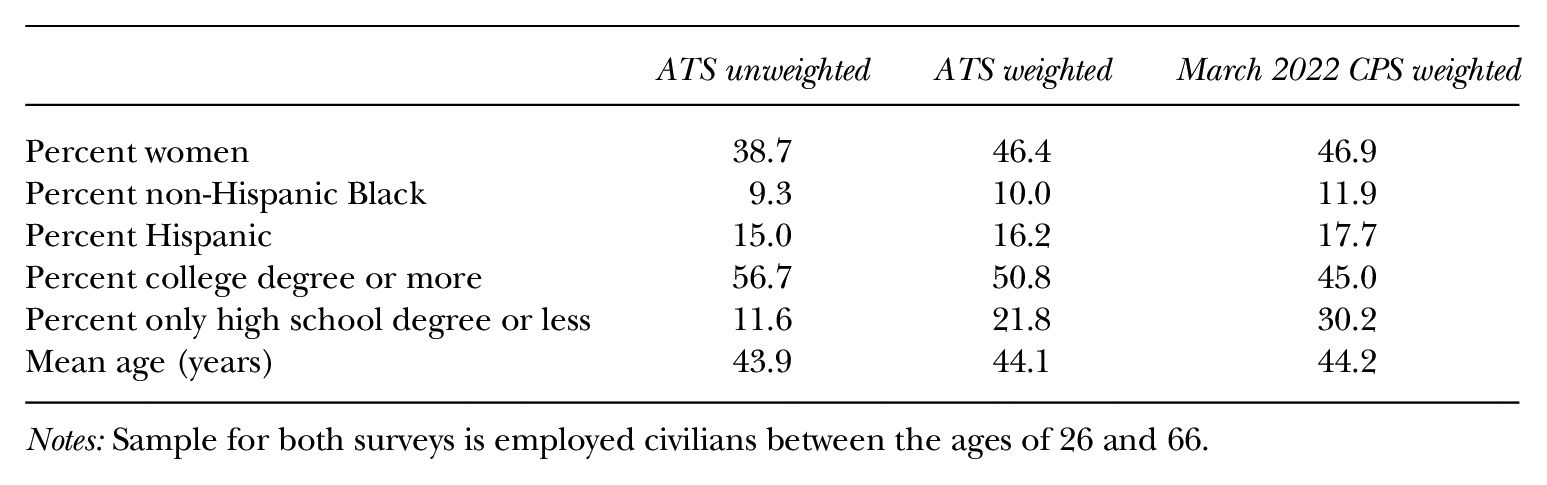
| ATS unweighted | ATS weighted | March 2022 CPS weighted | |
|---|---|---|---|
| Percent women | 38.7 | 46.4 | 46.9 |
| Percent non-Hispanic Black | 9.3 | 10.0 | 11.9 |
| Percent Hispanic | 15.0 | 16.2 | 17.7 |
| Percent college degree or more | 56.7 | 50.8 | 45.0 |
| Percent only high school degree or less | 11.6 | 21.8 | 30.2 |
| Mean age (years) | 43.9 | 44.1 | 44.2 |
Notes: Sample for both surveys is employed civilians between the ages of 26 and 66.
Appendix B
Acknowledgements
I am grateful to Frank Dobbin, Michael Piore, and Nate Wilmers for comments.
This article is part of the ILR Review’s ongoing Policy Paper Series.
Funding for the survey used in this paper was generously provided by the Russell Sage Foundation and the Lumina Foundation.
For general questions as well as for information regarding the data and/or computer programs used for this study, please contact the author at
1
Author’s calculation.
2
The first wave of the survey, conducted in 2020, sampled people ages 24 to 64. The 2022 survey used here updates these ages by two years to facilitate longitudinal research.
3
This measure differs from the one used in the literature on employer training, which is typically whether any training was received in 12 months prior to the survey. For that measure, the outcome is 60.4% in the current sample.
4
Of the sample, 6% had second jobs as freelancers or contract company employees while having been in standard employment in their main job.
5
An alternative approach is to imagine the response to the focus of compensation question to always be mostly internal. If this is done then the ILM indicator falls to 9.8%. But it does not seem reasonable to expect that external considerations not be at all important since even traditional ILM theory points to ports of entry that are open to the outside.
6
The estimates are 41.1% for the internal hiring only measure, 35.9% for the internal hiring plus training measure, and 25.1% when the compensation indicator is added.
7
In an unreported regression I estimated a model of the features of the employer for whether an ILM is present. The independent variables were part-time status, contract status, government, establishment size, union status, the occupational fixed effects, whether skills were specific, and industry fixed effects. The only significant coefficients were part-time status, which was negative, and union coverage, which was positive.
8
I also created an affect index, running from 0 to 4, by adding together the responses to the job attitudinal measures (a Cronbach's Alpha of 0.715). I estimated three ordered probit models for the index on pensions, health insurance, and job security. The models included all of the controls used in the models presented earlier. The coefficient on pension receipt and job security was large, positive, and highly statistically significant. The coefficient on health insurance did not attain significance.
9
Tables 3, 4, and  include 21 coefficients of interest on the several ILM measures. No signs are changed by weighting. For 2 out of these 21 estimates (once for the simple ILM measure and once for the full ILM measure and never for the intermediate ILM measure) the relevant ILM variable loses significance in the weighted relative to unweighted version. These shifts do not change any of my conclusions.