



Abstract
This article investigates the transnational labor politics associated with the Europeanization of wage policy, based on process tracing of Irish minimum wage regulation reforms over the past two decades. The policy struggle in Ireland started as an employer-led domestic challenge to market-embedding regulation and was then affected by two EU interventions on wage policy: one with a de-regulatory orientation (during EU-IMF conditionality) and one with a re-regulatory one (with the approval of the EU minimum wage directive). Findings show that differences in collective action undertaken by employers and trade unions to influence wage policy at the national level can be explained by the intersection of each actor’s preferences toward market-constraining or liberalizing labor regulation and their access to supranational (EU-level) institutions and support. This analysis contributes to debates on how transnational opportunity structures can alter labor’s and employers’ local power resources and strategies.
Keywords
Since its establishment in 1957, the competences of the European Union (EU) on industrial relations have massively expanded. There is now abundant EU regulation on issues such as working time, part-time work, and workers’ information and consultations rights. Until the outbreak of the 2007–2008 global financial crisis, however, EU interventions on wage policy remained a taboo. Its member states, in fact, regarded wage determination—be it through free collective bargaining or statutory legislation—as an exclusive national competence. Yet, in the space of a decade, we have observed unprecedented European encroachment on national wage policy, with diverging policy orientations.
In the aftermath of the global financial crisis, several member states were forced to request financial assistance from the EU and the International Monetary Fund (IMF). As happened to Global South countries subject to structural adjustment programs (Anner and Caraway 2010), bailout countries had to commit not only to spending cuts but also to implementing structural reforms aimed at fostering wage moderation (Armingeon and Baccaro 2012). Since 2011, the EU started to prescribe commodifying reforms to wage policy to even more of its member states through the European Semester, which is a new mechanism to coordinate national macro-economic and social policy (Erne 2015; Jordan, Maccarrone, and Erne 2021).
After years of austerity, the EU’s view on the role of wage-setting institutions has changed. In 2019, Ursula von der Leyen, incoming president of the European Commission, announced in her candidacy speech her intention to introduce legislation to ensure “that every worker in our Union has a fair minimum wage” (von der Leyen 2019). This gave rise to a process that led to the approval of a Directive on adequate minimum wages in 2022. The Directive invites EU member states to put procedures in place to ensure the adequacy of their statutory minimum wage, if they have one. It also supports collective bargaining, by requesting all member states with a collective bargaining coverage lower than 80% to present an action plan to increase it.
The process of minimum wage reform in the Republic of Ireland is an example of the increasing EU interventionism in national wage policy. In 2010 the Irish government requested a conditional loan from the EU and the IMF. As part of the bailout, the lenders requested to lower the national minimum wage and reform the only existing sectoral wage-setting mechanisms. These steps empowered those employers who had been seeking to overhaul domestic labor market-embedding institutions since the middle of the first decade of the 2000s. A decade later, the approval of the EU minimum wage directive created a new opportunity structure that was more favorable to labor. This empowered Irish unions, who sought a reversal of the liberalizing measures implemented under EU-IMF conditionality.
In this article, I investigate how national industrial relations actors in Ireland adapted their strategies to influence national wage policies in response to the shifting opportunity structures presented by EU de-regulating and re-regulating interventions. Combining insights from the industrial relations and the international relations literature, I argue that collective action undertaken by employers and trade unions at the national level differed based on the intersection of each actor’s preferences toward market-constraining or liberalizing labor regulation and their access to supranational (EU-level) institutions and support. Depending on the outcome of this intersection, industrial relations actors adopted alternative strategies of layering, insulation, defense, or challenge (Farrell and Newman 2016) vis-à-vis EU interventions on Irish wage policy. This analysis contributes to debates on how transnational opportunity structures can alter labor’s local power resources and strategies.
The Europeanization of Wage Policy
The EU regulatory powers on industrial relations were initially very limited. The then European Economic Community (EEC) was born in 1957 as a custom union of six countries—Belgium, Italy, France, Luxembourg, the Netherlands, and West Germany. Its founding treaty—the Treaty of Rome—left to the EEC member states the freedom to regulate their industrial relations as they pleased. In the post–World War II decades of embedded liberalism, supranational economic integration supported the creation of strong national welfare states and industrial relations institutions (Erne et al. 2024).
This changed throughout the 1980s, when EU leaders furthered the integration process through the 1986 Single European Act (SEA), which removed the still-existing non-tariff barriers between member states. The SEA was followed by the 1992 Maastricht Treaty, which foresaw the birth of the European Monetary Union. The increased freedom of movement of goods, capital, services, and people led to the creation of transnational labor markets (Meardi 2018). With increased market integration, national industrial relations were put in competition, resulting in a downward pressure on wages (Streeck 1998). These pressures were exacerbated by the strong anti-inflationary stance of the newly created European Central Bank (ECB).
Nevertheless, as the then Commission’s president Jacques Delors remarked, “One cannot fall in love with a market” (quoted in Streeck 1998: 455). To ensure labor’s support for the relaunched EU integration, member states’ governments agreed to share some of their regulatory competences on labor policy with the EU, so that the latter could pass supranational flanking measures to embed some of the commodifying pressures generated by ever-increasing market integration. Armed with new regulatory powers, throughout the 1990s the EU adopted decommodifying legislation on issues such as health and safety, working conditions, and information and consultation rights. Some of these laws were directly negotiated by European representative organizations of labor and employers by virtue of the role now formally granted to the European Social Dialogue (Im, Larsen, and Pircher 2024). However, member states made sure to maintain regulatory competence on wage policy, collective bargaining, and the right to strike as a sole national prerogative. Governments as well as employers and trade unions—especially those from countries with a voluntarist approach to industrial relations—opposed any EU interference in these areas (Léonard, Erne, Marginson, and Smismans 2007).
While being subject to increasing indirect market pressures, until the late 2000s national wage policy remained thus shielded from direct EU interventions (Erne 2019). This arrangement was to change following the outbreak of the global financial crisis, which soon turned into the Eurozone crisis. In response, EU leaders put in place a new European economic governance regime that allowed for unprecedented EU intrusiveness on member states’ industrial relations, including on wage policy and collective bargaining (Erne 2019; Erne et al. 2024).
Seven EU member states—Hungary, Latvia, Romania, Greece, Ireland, Portugal, and Cyprus—were forced to rely on loans by the EU and the IMF. These loans were conditional on pursuing austerity policies and commodifying structural reforms, which included wage retrenchment through lowering of statutory minimum wages and decentralization of collective bargaining (Marginson and Welz 2015; Jordan et al. 2021). Since 2011, these structural reforms fed into the yearly “Country Specific Recommendations” that the EU adopts as part of the European Semester (Erne 2015; Jordan et al. 2021). This new EU interventionism on national wage policy had a commodifying orientation, which stemmed from an interpretation of the Eurozone crisis by EU leaders as a crisis of competitiveness, caused primarily by an excessive rise of unit labor costs (Miró 2021).
This EU crisis management regime, however, caused an electoral backlash, leading to the rise of Eurosceptic parties in successive European and national elections (Erne et al. 2024). It is in this context that one can understand the legislative proposal made by the European Commission led by Ursula von der Leyen for a directive on “adequate minimum wages in Europe,” which the Parliament and the Council adopted in the fall of 2022 (Natili and Ronchi 2023). Whereas the directive signals a decommodifying turn in the EU orientation toward wage policy, it also marks a further step toward the Europeanization of wage relations.
Since the relaunch of EU integration in the mid-1980s, scholars have attempted to understand its effects on national industrial relations (Meardi 2018). The literature has highlighted the increasing multilevel character of European industrial relations (Streeck 1998; Marginson and Sisson 2004), which created constraints and opportunities for labor actors (Lillie and Greer 2007; Keune and Marginson 2013). With the creation of transnational labor markets, firms could engage in practices of regulatory arbitrage on labor standards, as with the posting of workers from lower wage countries (Lillie and Greer 2007; Arnholtz and Lillie 2020). On their side, unions could try to uphold labor standards by re-enacting legislation at the national and the European level, given the widening of EU regulatory powers (Lillie and Greer 2007; Arnholtz and Lillie 2020). Yet, the process of transposition and enforcement of EU legislation at the national level opened further regulatory struggles, as shown by the weak transposition of the European directive on information and consultation in the United Kingdom and Ireland (Dundon et al. 2014).
Until the outbreak of the 2007–2008 global financial crisis, however, there was skepticism among industrial relations scholars that the EU could expand its competences to wage policy. In their seminal work on European industrial relations, Marginson and Sisson (2004) argued that “it seems inconceivable that . . . member states will cede competence in the key areas necessary to achieve a vertically integrated [IR] system, i.e., wage determination, the right of association, the right to strike and the right to lock-out” (p. 306). Yet, in the space of a decade, we have observed both commodifying and decommodifying EU interventions on wages and collective bargaining.
The industrial relations scholarship has acknowledged the increasing Europeanization of wage policy. Scholars have teased out the characteristics of EU’s post-2008 economic governance regime and have highlighted the primarily commodifying orientation of labor policy prescriptions issued by the Troika and within the European Semester (Erne 2015; Marginson and Welz 2015; Schulten and Müller 2015; Copeland 2020; Jordan et al. 2021; Erne et al. 2024). Schulten and Müller (2021), and more recently Erne et al. (2024), have also analyzed the paradigm shift of EU wage policy toward decommodification following the passing of the EU Minimum Wage Directive.
Some scholars have also attempted to analyze the impact of the EU new interventions on wage policy on labor actors’ power resources. Focusing on the European level, Copeland (2020) argued that throughout the Eurozone crisis, social objectives have been subordinated to economic objectives, with the effect of weakening “social actors,” including trade unions and nongovernmental organizations (NGOs). Erne (2015) highlighted that at both the European and national level, EU commodifying interventions on wage policy favored employers over labor. Rathgeb and Tassinari (2022) and Seikel (2023) showed that by creating pressures for domestic wage moderation, the Eurozone disempowered national trade unions.
While this strand of literature is more attentive to power resources, it suffers from two limitations. On the one hand, it does not consider the most recent decommodifying turn in EU wage policy, which offers more levers to labor. On the other hand, while highlighting that the post-2008 EU economic governance has systematically favored capital over labor, it has not yet studied how it shapes the strategic choices of employers and trade unions, that is, their agency throughout domestic policy struggles. In other words, since EU interventions on national wage policy affect their power resources, how do employers and trade unions react to such interventions? These strategic choices, in turn, affect the outcome of processes of institutional change. This article aims to fill this gap, by studying the interplay of power resources and actors’ strategies within the opportunity structures created by EU interventions on wage policy, and how this interplay shapes the outcomes of policy struggles.
Actors’ Strategies and Power Resources within the Europeanization of Wage Policy
To analyze the impact of EU interventions on national wage policy, this article heeds calls to “join the two IRs” (Harrod 1997; Giles 2000; Brookes 2023) and employs an analytical framework that draws insights from both the industrial relations and the international relations literature, in particular from its international political economy (IPE) strand.
From an industrial relations perspective, trade unions and employers involved in a multilevel governance framework such as European industrial relations have different power resources (Lillie and Greer 2007; Keune and Marginson 2013; Marginson 2016). Building on the power resources approach, Refslund and Arnholtz (2022) distinguished between structural, associational, institutional, ideational, and coalitional power resources. The outcome of policy struggles depends then on the specific configuration of power resources that unions and employers possess (Refslund and Arnholtz 2022). Golden and Erne (2022) noted that actors’ power resources are also affected by the scale at which policy processes take place. Within multilevel regulatory settings, the capacity of articulation (Levesque and Murray 2010: 343–44) or rescaling (Turnbull 2006; Golden and Erne 2022), meaning to be able to arbitrate across different levels, becomes therefore an additional power resource.
Within the international relations field, Neo-Gramscian scholars have long noted how “many of the so-called domestic social and political forces in fact operate within a transnational setting” (van Apeldoorn 2002: 45). Starting from this premise, they then studied capital (van Apeldoorn 2002) and labor (Bieler 2005) as transnational social forces, analyzing how they shaped and have been shaped by the process of European integration. More recently, institutionalist IPE scholars have also acknowledged the transnational nature of the world economy. Theorists of the “new interdependence approach” (Farrell and Newman 2014, 2016) have focused on situations of rule overlap and their impact on collective actors’ strategies. Rule overlap creates “new opportunity structures that are open to some actors and not others, hence generating new power asymmetries” (Farrell and Newman 2016: 720).
Starting from these insights, it is possible to conceptualize the strategic choices faced by unions and employers vis-à-vis EU interventions on national wage policy. Table 1 presents a taxonomy of industrial relations actors’ strategies adapted from Farrell and Newman’s works (2014, 2016).
A Taxonomy of National Industrial Relations Actors’ Strategies vis-à-vis EU Interventions on National Wage Policy

Source: Adapted from Farrell and Newman (2014, 2016).
Let us consider the situation of a policy struggle over domestic labor market-embedding institutions, such as statutory minimum wage or sectoral erga omnes wage-setting mechanisms. In the absence of direct EU interventions on wage policy, actors who wish to change a domestic institution can challenge it with the resources they have within the perimeter of the nation state (Farrell and Newman 2014). Yet, EU interventions on national wage policy generate situations of rule overlap (Farrell and Newman 2016), which create constraints and opportunities for trade unions and employers depending on their orientations.
If the EU intervention on wage policy is oriented toward de-regulation (as in the case of EU-IMF conditional bailouts), industrial relations actors who wish to overhaul domestic market-constraining regulation will attempt to take advantage from it. They will aim at layering the supranational legislation on top of the domestic institution “to create arrangements that may fundamentally alter domestic institutional structures” (Farrell and Newman 2014: 347). In this instance, actors who wish instead to protect market-embedding institutions might try to intervene on EU actors to change their orientation and to provide defense for such institutions. If, however, they do not have access to convince EU actors, their best chance to protect national market-embedding institutions is to try to insulate the process of policymaking from external influences, limiting as much as possible the reach of supranational legislation.
If instead the EU intervention on wage policy is oriented toward re-regulation (as in the case of the EU minimum wage directive), industrial relations actors who favor market-embedding institutions might use this opportunity to put forward a strategy of layering to shape the policy struggle in their favor, while those actors who favor de-regulation will either use a strategy of defense or insulation to diffuse the impact of supranational regulation on the national policy struggle. Thus, an EU intervention on domestic wage policy could alter the power balance between national industrial relations actors and affect the outcome of a labor policy struggle. If their interest aligns with EU’s policy approach, actors can rescale and use a strategy of transnational layering to augment their power resources. If not, their power resources will be diminished, and they will have to resort to counterstrategies of defense or insulation.
In turn, the degree of access to the opportunity structure created by the situation of rule overlap also intersects with other actors’ power resources (Farrell and Newman 2014). Actors with a high degree of institutional power at the national level are more likely to have a higher access at the supranational level. For instance, employers’ organizations with well-established participation in national policymaking are more likely to be consulted by EU institutions than smaller employers’ groups and thus may be able to lever a strategy of layering. Yet, other power resources can compensate for a limited or altogether absent transnational access and make a strategy of challenge or insulation quite effective. As we shall see, this was the case with EU interventions on Irish wage policy. Hence, actors’ degree of access to transnational opportunity structures and their capacity to wage strategies over time needs to be assessed empirically, rather than simply assumed.
As shown in Table 1, the strategic choice by industrial relations’ actors depends also on their preferences toward market-constraining labor regulation. Such preferences are linked to their broader class interest. Historically, trade unions favor institutions that reduce workers’ exposure to the vagaries of the market (Korpi 2006). That said, unions might be divided over the introduction of regulation that reduces their autonomy in collective bargaining, as in the case of a statutory minimum wage. In turn, firms and their representative organizations generally favor liberalizing measures that expand their discretion over wage setting, hiring and firing practices, and workplace organization (Baccaro and Howell 2017; Boumans 2024). Yet, cleavages might emerge (Bulfone and Afonso 2020). More than a century ago, John Commons (1909) observed that established firms have an interest in regulating wages to restrict competition from the “marginal producers” with the lowest production cost. Thus, rather than pre-assign actors to categories, I will use the taxonomy detailed in Table 1 as a heuristic device to map the strategies followed by unions and employers vis-à-vis the transnational opportunity structures created by EU interventions on Irish wage policy.
Case Selection and Research Methods
To analyze the labor politics of EU interventions on domestic wage policy, I chose the reform of minimum wage regulation in Ireland. This reform process started in the mid-2000s as a domestic struggle in which employers’ groups launched a challenge to market-embedding labor regulation. Over time, the process of reform became increasingly Europeanized. First, reform to the Irish minimum wage regulation became part of the (commodifying) bailout conditionality when the Irish government requested a loan from the EU and the IMF in 2010. Then, the struggle over Irish minimum wage regulation was affected by the approval of the (decommodifying) EU directive on adequate minimum wages in 2022.
The process of reform of minimum wage regulation in Ireland is selected as an “extreme” case of the Europeanization of wage policy. Extreme case studies show unusually high values either in the dependent or the independent variable (Seawright and Gerring 2008: 301–302). Ireland was subject to a higher number of EU interventions on domestic wage policy (independent variable) than other member states. First, it was one of the seven EU countries that was under the EU-IMF bailout conditionality. Second, it is a country particularly affected by the provisions of the EU minimum wage directive since it has both a statutory minimum wage and a collective bargaining coverage lower than 80%. Extreme case studies are ideal for exploratory, open-ended theory building (Seawright and Gerring 2008: 301–302). Analysis of the interplay of actors’ strategies and power resources in the struggle over Irish minimum wage regulation provides the basis to theorize the processes of institutional change triggered by EU interventions on domestic wage policy, as well as to understand their outcomes.
The reform of Irish minimum wage regulation also offers the possibility of conducting an embedded case study (Yin 2018) of the Europeanization of wage policy as it features two distinct EU interventions on wage policy, one with de-regulatory orientation (during the EU-IMF conditionality) and one with a re-regulatory one (with the EU minimum wage directive). Nevertheless, because most fieldwork was undertaken prior to the approval of the EU minimum wage directive, the article focuses more on the first instance of EU intervention on wage policy.
Throughout the article, I provide a “thick narrative” of the case (Della Porta and Keating 2008) that enables an analysis of the unfolding of social events while considering the larger context in which they are embedded (Langley 1999). This approach is consistent with interpretivist perspectives to case-study research, which use “theoretical frameworks to provide an explanation of particular cases, which can lead as well to an evaluation and refinement of theories” (Vennesson 2008: 227). I use process tracing to establish the link between the observed factors of interest, by looking at “the ways in which this link manifests itself and the context in which it happens” (Vennesson 2008: 232). The process tracing analysis for this article relies on data from interviews and documentary analysis.
Interviews were collected throughout periods of extensive fieldwork conducted in Ireland and Brussels between June 2018 and March 2019. I carried out additional interviews in the fall of 2022 to account for more recent developments. Overall, I conducted 22 semi-structured interviews with trade union officials, employers’ representatives, civil servants, and politicians (detailed in the Appendix), selected through “snowball sampling” (Yin 2018). All the interviewees were at a senior level in their organization, and almost all had direct participation in the process of reform of minimum wage regulation in Ireland. Interviewees were granted anonymity and are referred to with a code throughout the text.
Data from the interviews were analyzed thematically and triangulated to the findings that emerged through the document analysis. This method also addressed interviewees’ recollection issues (Mosley 2013). For documentary analysis, three main types of evidence were used: EU and national legislation; data collected from Irish newspaper archives and specialized industrial relations websites; position papers and policy briefs produced by key actors.
The Process of Reform to Minimum Wage Regulation in Ireland
In this section, I analyze the reform of minimum wage regulation in Ireland and its outcomes. I distinguish between three main phases. In the early 2000s, when there was no rule overlap, various employer groups started to challenge the legitimacy of the existing sectoral wage-setting mechanisms (Phase 1). Before these challenges could have any legal effect, the outbreak of the global financial crisis led to the first situation of rule overlap. The reform process that ensued (Phase 2) reduced the scope of sectoral wage-setting mechanisms and introduced an opt-out clause and a de facto veto power for employers to the establishment of new sectoral agreements. In the last phase (Phase 3), the approval of the EU directive on adequate minimum wage led the government to announce the raise of the statutory minimum wage to 60% of the median wage and to commit to implementing the recommendations of a tripartite High-level group to strengthen sectoral collective bargaining, which included removal of the employers’ veto to new sectoral agreements.
Phase 1: Irish Minimum Wage Regulation before the Global Financial Crisis
Following the introduction of the National Minimum Wage (NMW) in 2000, various groups of employers started to challenge the existence of sectoral wage-setting mechanisms, known as Employment Regulation Orders (EROs), which they now considered redundant. EROs provided legally enforceable minimum wage criteria as well as broader regulation for employment (e.g., the right to sick pay and Sunday premium) in low-paid sectors where collective bargaining was limited, if not altogether absent. They applied especially to low-paid service industries—such as cleaning, security, retail, and hospitality—covering approximately 15% of private-sector employees in Ireland in 2009 (between 150,000 and 205,000 workers) (Duffy and Walsh 2011).
In 2005, in the context of a state-led review of the EROs, the Irish Business and Employers Confederation (Ibec) (the main employers’ body in Ireland) asked for the abolition of the EROs, or at least their radical reform. In 2007, the Irish Hotel Association, an affiliate of Ibec, initiated a legal challenge against the ERO in its sector, which they withdrew once they reached an agreement with the Services Industrial Professional and Technical Union (SIPTU) (O’Sullivan and Royle 2014). This action reflected Ibec’s commitment to social dialogue through the Social Partnership, the national tripartite agreements that shaped Irish industrial relations throughout the 1990s and the 2000s (O’Sullivan and Royle 2014).
In fact, it was a group of fast-food employers outside Ibec that in 2009 organized the Quick Service Food Alliance (QSFA) to launch another legal challenge to the ERO in their industry (O’Sullivan and Royle 2014). Before the challenge could have any effect, however, the outbreak of the financial crisis moved the issue of minimum wage regulation from the national to the supranational level.
Phase 2: The Reform of Minimum Wage Regulation under EU-IMF Conditionality
When the Irish government requested an €85 billion loan from the EU and the IMF in November 2010, it had to commit to various reforms and austerity measures. These measures were spelled out in a subsequent Memorandum of Understanding (MoU), which the IMF, the EU Commission, and the ECB (the Troika) were entrusted to monitor. Among the conditions listed in the first MoU, some were aimed at reducing unit labor cost (ULC), which stemmed from the EU’s interpretation of the Irish recession as a crisis of competitiveness caused also by excessive ULC growth (see DG ECFIN 2011a: 8).
The Social Partnership had already collapsed in 2009, prior to the arrival of the Troika (Geary 2016). Labor market reforms listed in the MoU focused instead on the institutions of minimum wage regulation. The first MoU committed the Irish government to reduce the minimum wage by 1 euro per hour (approximately 12%) and to introduce legislation to “prevent distortions of wage conditions across sectors associated with the presence of sectoral minimum wages in addition to the national minimum wage” (DG ECFIN 2011a: 65). Hence, the MoU prescribed the establishment of an independent commission to review the EROs, along with the only other sectoral wage-setting mechanism in the Irish legislation, the Registered Employment Agreements (REAs), which were important in the construction sector (Maccarrone, Erne, and Regan 2019). The government applied the cut to minimum wage at the end of 2010, while the independent commission was set up shortly after.
At the beginning of 2011, a new general election was held and support for the ruling party, the centrist Fianna Fáil, plummeted. The conservative Fine Gael and the Labour Party formed a new government. In their Programme for Government, the two parties had committed to re-instate the minimum wage at its original level. This was achieved following a negotiation with the Troika. Notably, to maintain a reduction in labor cost, employers’ pay-related social contributions were lowered. Moreover, the Troika’s focus remained on the EROs, as the European Commission suggested “that the effective ability of firms to adjust wages downward . . . would be rather addressed in the future reform of the sectoral wage bargaining system” (DG ECFIN 2011b: 18–19).
The reform process took more than a year and was further complicated by the intervention of the judiciary, which in July 2011 upheld the fast-food employers’ legal challenge and ruled the EROs as unconstitutional (Maccarrone and Erne 2023: 601). Following the judgement, the European Commission asked for the acceleration of the process of reform (DG ECFIN 2011b), which it monitored closely through its quarterly reviews (e.g., DG ECFIN 2012), with precise policy prescriptions.
The reform resulted in the 2012 Industrial Relations (Amendment) Act, which re-introduced the EROs after the Court’s annulment, but also altered them significantly. These changes went in a direction favorable to employers. EROs would now have to account for competitiveness factors, such as the wage trends in similar sectors within the country and the EU, as well as for the possible impact of the wage set on employment levels. In addition, the act established the legal framework for employers to seek an opt-out clause from the minimum rates prescribed by EROs in case of financial difficulties (Higgins 2012). The act also provided for a reduction to the number of sectors covered by the EROs, as well as their scope, as they could no longer set the Sunday premium. Crucially, the reform introduced a de facto veto power for employers, who could object to the establishment of a new ERO in a sector (Prendergast 2014).
The Troika left Ireland at the end of 2013. Reforms implemented under bailout conditionality influenced Irish minimum wage regulation in several ways, overall favoring employers. While the national minimum wage was re-instated to its pre-crisis level, employers’ social contributions were also lowered to guarantee a reduction of ULC. Following the 2012 Industrial Relations Act and the introduction of employers’ veto power, collective bargaining coverage fell (Maccarrone et al. 2019). Given staunch employers’ opposition, EROs were not re-instated in large, low-paid sectors such as retail, hospitality, and catering. Instead, new EROs were signed only in the cleaning and the security industries. In these industries, larger firms saw sectoral agreements as a way to avoid an unorganized race to the bottom, as most projects in both sectors are awarded through procurement (Higgins 2017).
Phase 3: The Struggle over Minimum Wage Regulation in the Shadow of the EU Minimum Wage Directive
Almost a decade after the Troika left Ireland, the reform of Irish minimum wage regulation again became subject to an EU intervention, following the European Commission’s proposal for a directive on adequate minimum wages. This time, however, the orientation of the EU’s intervention on wage policy was toward re-regulation, as the directive provides a framework for increasing minimum wages and supporting collective bargaining institutions.
The Irish government (ran by a coalition of Fianna Fáil, Fine Gael, and the Greens) opposed the directive. In January 2021, Fine Gael’s Leo Varadkar—then Tánaiste (Deputy Prime Minister) and Minister for Enterprise, Trade and Employment—signed a letter together with his counterparts of eight other countries asking to adopt only a non-binding recommendation (Irish Legal News 2021). Nevertheless, the battle at the EU level resolved in favor of a directive, 1 following the crucial shift in the German government’s position (Natili and Ronchi 2023).
The directive has the twofold objective of ensuring the adequacy of statutory minimum wage for those EU member states that have it, as well as increasing the coverage of collective bargaining, especially for those countries with a coverage below 80%. Ireland is affected by both objectives. While the final text of the directive was approved only in autumn 2022, and member states have two years to implement it, the directive might be contributing to fostering some labor-friendly changes to Irish minimum wage regulation.
First, in June 2022 Varadkar announced the phased introduction of a living wage that would replace the NMW from 2026 and set at 60% of the median wage in any given year. Notably, the 60% threshold is one of the indicators that the directive (see Directive (EU) 2022/2041, art. 5(4)) suggests will ensure the statutory minimum wage provides an adequate standard of living for workers.
Second, in March 2021 the minister announced the constitution of a tripartite High-Level Working Group “to review collective bargaining and the industrial relations landscape in Ireland” (LEEF 2022: 2).
In October 2022, the group published its final report, which also recommended improvements to the ERO system that would end the employers’ veto power on the establishment of new sectoral wage agreements, thus reversing some of the changes introduced under bailout conditions. The final report clearly recognized the impact of the directive, noting that “the EU context (particularly proposed EU legislation) was of paramount importance to the Group’s work” (LEEF 2022: 5–6; Interview #21, #22). While the effectiveness of the recommendations will depend on their implementation through law, the government has committed to follow up on them. When questioned in the Dáil (the Irish lower chamber of Parliament) about his plan for the implementation of the report’s suggestions, Varadkar said, “We will get moving on this. The new directive is now European law. It is not a choice. We cannot ignore it, nor do we want to” (Dáil Éireann Debate 2022).
Irish Industrial Relations Actors’ Strategies and Power Resources under Rule Overlap
In this section, I analyze the interplay of actors’ strategies and power resources created by EU interventions on Irish minimum wage regulation. I employ the taxonomy presented in the analytical section to systematically assess Irish employers’ and unions’ strategies in these contexts of rule overlap. By providing uneven opportunity structures to the industrial relations actors involved in the reform process, EU interventions on Irish wage policy contributed to crucially shaping the outcome of the struggle over Irish minimum wage regulation.
The first situation of rule overlap was created by Ireland’s entry in a conditional loan program. Table 2 shows the strategies followed by Irish industrial relations actors involved in the process of minimum wage regulation in the context of the Troika intervention.
A Taxonomy of Irish Employment Relations Actors’ Strategies during the EU-IMF Conditionality

The process of reform of Irish minimum wage regulation started prior to the arrival of the Troika, with successive challenges against the EROs launched by various employers’ groups, using domestic institutions (O’Sullivan and Royle 2014). In 2005, Ibec used a state-led review of the EROs to ask for their abolition or at least radical reform, since the NMW and other pieces of employment protection legislation were already in place (Dobbins 2005). Ibec also lamented the impossibility for an employer to pledge an inability to pay clause under the EROs. Yet not only the Irish Congress of Trade Union (ICTU)—the only union confederation in Ireland—but also the state bodies involved in the review process argued for retaining the EROs. Thus, unions could leverage their institutional power to defend the system, which was essentially left as it was.
Prior to the arrival of the Troika, employers within Ibec had refrained from more radical challenges through the legal system, as they were still bound by the Social Partnership. This did not apply to the QSFA—the lobby group of fast-food employers—which was “an outsider organization” (O’Sullivan and Royle 2014), with “no history of negotiating with unions and no participation in social partnership” (O’Sullivan and Royle 2014: 41). Before the QSFA’s legal challenge had any effect, however, the outbreak of the recession and the arrival of the Troika in 2010 changed the dynamic of the reform process.
Throughout the bailout program, Troika officials regularly visited the country and met with government officials as well as with employers’ representative organizations and trade unions. This interaction offered to actors interested in overhauling Irish minimum wage regulation an opportunity to pursue a strategy of transnational layering. Indeed, if policy reform was inserted in an MoU, its salience would increase dramatically.
However, not all actors had equal access to the opportunity structure created by the arrival of the Troika. First, only the top organizations of labor and capital were consulted by international institutions: Ibec and the Construction Industry Federation on the employers’ side, ICTU on the unions’ side. These were the same organizations that played a key role within the Social Partnership. Thus, “outsider” employer groups such as the QSFA did not have access to the Troika, nor did employers’ associations represent only small enterprises (Interview #17). Second, being consulted does not mean being heard. David Begg, then ICTU’s General Secretary, defined the meetings with the international institutions as “a dispiriting experience and utterly valueless” and the Troika as “an uncaring technocracy of neoliberal zealots devoid of empathy” (Sheehy 2015). This is unsurprising, given the Troika’s view of collective labor regulation as an obstacle to Ireland’s recovery (Dooley 2023), which unions fully opposed (Geary 2016).
Irish employers saw the presence of the Troika in more positive terms, as it could help to pass some policy changes they favored and that otherwise would have been approved more slowly or not at all. One employer representative argued that “if [the Troika] hadn’t come in, I think that it would have been much more difficult for us to do it on our own. . . . There was a need of someone who perhaps would have come across an independent broker, it wasn’t an employers’ spokesman spinning a story, it wasn’t a government spokesman spinning a story” (Interview #6).
The domestic institutional context had also changed, as tripartite national bargaining had collapsed in 2009. Unbounded by the Social Partnership, Ibec took advantage of the situation of rule overlap and pursued a strategy of transnational layering, lobbying the Troika to strengthen its bargaining position on the EROs’ reform. As a former Ibec executive recalls:
Prior to the crash we had been lobbying for their reform—with very little progress actually being made. . . . We hadn’t been getting any huge traction about that conversation domestically, but during the Troika period we found . . . this notion that it is very hard to be a prophet in your own land. So, one of the things that we deliberately would have engaged with is that we needed the Troika to understand why these sorts of issues were important. (Interview #8)
Ibec made use of the quarterly visit of the Troika in Ireland to lobby international institutions and also arranged meetings in Brussels with relevant European Commission officers to further reinforce their points. These events happened in June 2011, when the reform of the EROs was discussed more intensively (Interview #8; Cahill 2011). Heading to Brussels, the then Ibec director of industrial relations declared: “We want to influence the key stakeholders” (Cahill 2011).
Ibec focused on the issue of the EROs, while it showed less interest to the statutory minimum wage (Dooley 2023). As one former executive explained: “We took the view that’s where we should concentrate our effort [on the EROs] because if real reforms were introduced there, that had a more important influence in terms of helping to reduce service costs more generally in the economy” (Interview #8). Thus, there was little resistance from their side when the new coalition government reversed the cut to the minimum wage in 2011, also because this was done while reducing employers’ social contributions.
The employers’ front was not united with respect to the EROs reform, however. Whereas both Ibec and the QSFA wanted to abolish the sectoral wage-setting mechanism, larger firms in sectors heavily based on tenders, such as cleaning and security, wanted to retain them. By setting legally binding minimum rates, EROs allowed large firms to avoid being undercut by smaller firms competing on costs. This led larger companies within these sectors to try to put in place forms of transnational defense against the Troika’s interference in Irish wage-setting mechanisms. In spring 2011, the Confederation of European Security Service (CoESS)—the European employer organization of the security firms—wrote a letter to the European Commission to raise their concern about the ongoing reform of the EROs:
If the proposed review removes or significantly dilutes the process for providing legally enforceable minimum terms and conditions of employment, there will be an immediate race by irresponsible companies to the next legal minimum, i.e., the minimum wage, and into the hidden economy with the attendant result of poor employment, poor private security provision and reduction in exchequer income. (Higgins 2011)
The letter, however, had little effect. The Commission replied to the CoESS’s concerns with a considerable understatement of its own role, observing that the reform of the EROs was a “domestic process in which the European Commission is an observer” (Higgins 2011).
Finally, Irish unions, faced with an attack to minimum wage-setting institutions, put in place a strategy of insulation of the reform process from external interventions, relying on their residual power resources. In the words of a union leader, “Our business at its core was . . . get rid of the Troika and all that external interference” (Interview #2).
In 2010, when the Troika put for the first time under its focus the national minimum wage and the EROs, trade unions with members working in low-paid sectors 2 made use of their associational and coalitional power resources to create the “Coalition to Protect the Lowest Paid” with NGOs and community groups. As national elections would be held in February 2011, the coalition intensified its efforts during the electoral campaign (Interview #1). More than 150 parliamentary candidates pledged to support the Coalition. Eventually, the reversal of the cut to the minimum wage was inserted in the Programme for Government of the new ruling coalition. Reforming the EROs, however, remained among the MoU conditions.
To defend the EROs, ICTU focused on lobbying the government. Although unions had formal access to the Troika as they were consulted during the latter quarterly visits, such access was not effective, as their views fully diverged. The unions centered their efforts on the Labour party, with whom they had historically more connections (Interview #1, #2; Maccarrone and Erne 2023), rather than on the conservative Fine Gael, which was less friendly toward trade unions. In addition, unions used their associational power to promote sectoral defensive campaigns. In the cleaning industry, SIPTU put in place the campaign “Don’t Let Them Bin our ERO” (Interview #1; Geary and Gamwell 2017). This campaign also had a knock-on effect on the security sector (Interview #1). Notably, these were also the two sectors among all those previously covered by EROs in which trade union associational power was higher (Interview #1).
Thus, the transnational opportunity structure created by the arrival of the Troika played a critical role in shaping the outcome of reform of Irish minimum wage regulation. While until the arrival of the Troika employers’ attempts to challenge the EROs had been unsuccessful, the situation of rule overlap strengthened the power resources of those employers in favor of overhauling the EROs and who had access to international institutions. Ibec had the opportunity to arbitrate across different levels of regulation and use a strategy of transnational layering to shape the reform in their favor. As a former Ibec executive commented:
There was nonetheless a realization that, look, at least some of what we were saying made sense and that, I have no doubt, impacted in terms of how the Troika advised the government about some of the labor market reform that [was] needed. . . . If it wasn’t for those conversations, the legislation would not have [been] framed in the way it was. (Interview #8)
The analysis has also shown, however, that other power resources can partially compensate for a limited or altogether absent access to transnational opportunity structures created by situations of rule overlap. Irish unions leveraged on their institutional, associational, and coalitional power resources to insulate the reform of minimum wage regulation from external influence; to push for re-instatement of the minimum wage level; and to defend sectoral wage-setting institutions, which were eventually retained, albeit radically reformed.
The re-introduction of the EROs was also attributable to the presence of some employers in large firms in the cleaning and security industries, which favored legally binding sectoral minimum wages. Some of these firms even tried a strategy of transnational defense of the EROs, penning a letter to the European Commission, with no avail. Once the 2012 Industrial Relations Act re-introduced the EROs, these employers negotiated with the unions for new binding sectoral agreements in both sectors. However, large sectors previously covered by EROs, such as retail, hospitality, and catering, were no longer covered by sectoral wage-setting mechanisms because of the staunch opposition by employers in those sectors, who could now exercise a veto to the establishment of new sectoral agreements.
New challenges against the EROs arose even after the 2012 reform and the Troika’s departure from Ireland. Smaller firms within the security industry pursued a strategy of competition based on costs and contested the new ERO in their sector, arguing it created “an anti-competitive outcome” (O’Faolain 2021). Absent a situation of rule overlap, these firms relied on domestic institutions to advance their interest. They launched further legal challenges against the ERO in their sector, which slowed down the enforcement of new sectoral agreements and questioned their own survival (Managh and O’Faolain 2022).
However, the approval of the EU’s minimum wage directive led to a second situation of rule overlap, this time more favorable to labor. Table 3 shows the strategies followed by Irish industrial relations actors in the shadow of the EU minimum wage directive.
A Taxonomy of Irish Employment Relations Actors’ Strategies in the Shadow of the EU Minimum Wage Directive
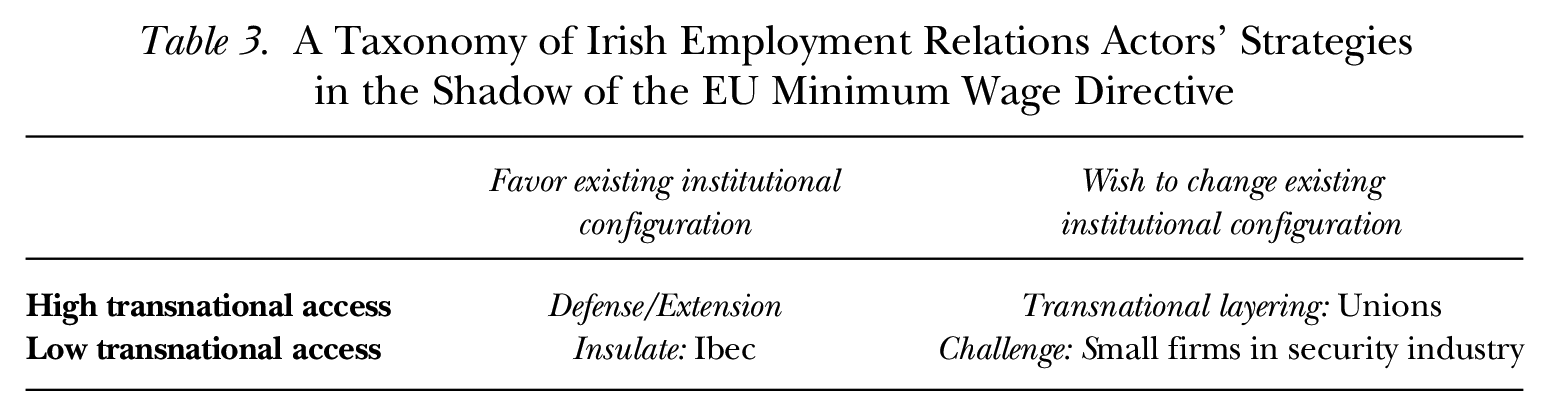
In 2019, ICTU’s general secretary Patricia King announced at the biennial delegate conference the intention to strengthen collective bargaining rights in Ireland through an EU directive, as there was little prospect of a labor-friendly reform taking place at the national level (ICTU 2019; Sheehan 2019). Once the Commission announced in 2020 the intention to promote legislation on adequate minimum wages in the EU, ICTU and its affiliates lobbied in favor of a directive through their European representative organization, the European Trade Union Confederation.
Irish unions then seized the changed opportunity structure at the national level provided by the decommodifying shift in EU wage policy. They used a strategy of transnational layering to strengthen the weak collective bargaining rights granted by Irish legislation, including the amelioration of the EROs. ICTU noted “a considerable sea-change in the Commission’s stance on wages and collective bargaining compared to the stance it took after 2008 when it advocated cuts to the minimum wage and the undermining of collective bargaining in many countries, including in Ireland” (ICTU 2021: 18).
Conversely, Ibec tried to insulate the domestic reform process of minimum wage regulation from the new EU intervention, pushing for the adoption of a “soft” EU recommendation rather than a “hard” directive (see footnote 1), on the grounds that the EU lacked formal competences on wage policy (Ibec 2021). Ironically, this argument is the same one the ICTU had used, unsuccessfully, to protest the Troika’s interventions on wage-setting institutions (Sheehan 2011). Ibec’s argument was employed also by the Irish government, who tried, unsuccessfully, to water down the directive into a recommendation.
While the battle at the EU level seemed to shift in favor of a binding legislative instrument, Ibec decided to engage in social dialogue at the national level to negotiate on the contours of a potential new legislation on collective bargaining. In March 2021, Ibec’s CEO Danny McCoy announced that its organization would agree to be part of the High-level group tasked to revise collective bargaining legislation under the auspices of the tripartite Labour Employer Economic Forum. In fact, the government set up the High-level group following a request of the social partners (Interview #21; McMahon 2021). This return to tripartitism was also favored by the events that took place during the COVID-19 pandemic, which had seen social partners negotiate and agree on a Return to Work Safely Protocol (Interview #21; Thomas 2022).
Beyond the desire of shaping the implementation of the EU directive, Ibec was also conscious of the changing political landscape at the national level (McMahon 2021). In the 2020 general election, the most voted for party had been the radical left Sinn Féin, which, along with other left-wing parties, advocates a constitutional referendum to strengthen collective bargaining rights and protect them from further legal challenges. There is no agreement among Irish labor and constitutional experts on whether this is necessary (Thomas 2022: 8); however, any significant slippage from the objectives of the Directive could open this path as a political possibility. Thus, an early reform of the Irish collective bargaining now might prevent more labor-friendly legal interventions by a possible Sinn Féin-led government in the future.
Whereas it is too early to establish the final impact on workers’ rights of the most recent legislative developments, the changed transnational opportunity structure following the approval of the EU minimum wage directive has already contributed to partially rebalancing the institutional power relations between labor and capital in Ireland, leading to foreseen labor-friendly improvements with respect to the two main institutions of minimum wage regulation, the NMW and the EROs.
Irish trade unions have used the changed opportunity structure at EU level and used a strategy of transnational layering to try amending the Troika-driven weakening of Irish minimum wage regulation. They will now have to deploy their domestic power resources to ensure an expansive transposition of the directive into national law. As for employers, while they have failed in their attempts to completely insulate the Irish legislation of collective bargaining from decommodifying EU pressures, they have used their institutional power resources to pre-emptively shape the contours of the national reform deriving from the new EU intervention. Moreover, the possibility of further domestic legal challenges remains open, both in the process of transposition of the directive in the national law and through further court actions, especially from those smaller employers that have less access to lobbying at the national and European level.
Conclusion
Until the outbreak of the 2008 global financial crisis, direct EU interventions on national wage-setting mechanisms remained a taboo for its member states. Over the past decade, however, EU interventions have directly affected key dimensions of national industrial relations, such as wages and collective bargaining (Erne et al. 2024).
While the industrial relations literature has acknowledged the relevance of these interventions, it has not given enough attention to the bottom-up dynamics they unleashed, especially with respect to the strategies followed by employers and trade unions. The analysis conducted in this article shows that to understand the Europeanization of wage policy, it is crucial to consider the collective action undertaken by employers and trade unions. It is only by looking at the interplay of their strategies and their power resources that we can understand the outcomes of EU interventions on national wage policy.
To do this, I have proposed an analytical framework that combines insights from both the industrial relations and the international political economy literature, and I have applied it to an extreme case of Europeanization of wage policy—the reform of Irish minimum wage regulation. An extreme case study provides an “entrée into a subject” (Seawright and Gerring 2008: 302), allowing for exploratory theory-building, which can then be tested further by being applied to other cases.
While no EU countries are currently under bailout conditions, all EU member states are still part of the European Semester procedures, for which the EU executives issue yearly prescriptions on labor policy (Jordan et al. 2021; Erne et al. 2024). Even large countries, such as France (Syrovatka 2021; Rathgeb and Tassinari 2022) and Italy (Jordan et al. 2021), while not being subject to a bailout did receive strong EU prescriptions through the European Semester to de-regulate their wage-setting institutions because of their external imbalances and the EU executives’ view of wage depression as necessary to regain competitiveness (Jordan et al. 2021).
The analytical framework outlined in this article could thus be usefully deployed to make sense of other situations of rule overlap triggered by further direct de-regulatory EU interventions on wage policy. While EU prescriptions on wage policy have become much sparser following the outbreak of the COVID-19 pandemic (Erne et al. 2024), they might become once again relevant with the end of the pandemic. Of course, as supranational interventions interact with national institutions and actors’ power resources—as the Irish case has shown—even similar EU policy prescriptions are likely to produce uneven patterns of institutional change, which need to be investigated empirically.
Moreover, the longitudinal analysis of the Irish case has highlighted that the analytical framework developed in this article can be fruitfully applied to other instances of EU interventions on wage policy in which the opportunity structure might be more favorable to labor, such as in the case of the European directive for adequate minimum wages. In the context of the struggle over minimum wage regulation, Irish unions have indeed been able to exploit the shift in EU wage policy. Developments similar to the Irish case seem to have happened in Romania, where under the shadow of the EU minimum wage directive and decommodifying post-COVID EU economic governance prescriptions, the government has recently reversed the course of de-regulatory reform to multi-employer collective bargaining that was introduced under EU-IMF conditionality (De Spiegelaere 2023; Erne et al 2024). The findings of this article are also very timely, considering that the EU legislators have recently approved new decommodifying labor legislation such as the EU Pay Transparency Directive and the EU Platform Work Directive.
Moving forward, the framework developed in this article might also be helpful to study labor politics in situations of rule overlap beyond the EU borders. Examples include the bailout conditionality applied by the IMF and the World Bank, which also involves de-regulatory supranational interventions on wage policy (Anner and Caraway 2010). Yet, other forms of transnational labor governance, such as the recent attempts to foster labor rights throughout global supply chains, might offer opportunity structures more favorable to labor (Amengual and Chirot 2016; Bair, Anner, and Blasi 2020). For instance, to strengthen its organizing campaign of non-unionized automakers, the United Auto Workers union has recently brought a case under the new German law on supply chain due diligence against Mercedes-Benz’s anti-union practices. 3
Recently, industrial relations scholars have forcefully argued that the field should give renewed attention to actors’ power resources to understand the outcomes of processes of institutional change (Refslund and Arnholtz 2022; Arnholtz and Refslund 2024). The findings of this article show that to do so, it will also be fundamental to consider the interaction of power resources and actors’ strategies vis-à-vis the opportunity structures that emerge as industrial relations become increasingly transnational.
Footnotes
Appendix
Acknowledgements
Many thanks to Roland Erne for his encouragement and support. Several other people provided help at different stages of the article, hence I express my gratitude to Gemma Gasseau, Costanza Galanti, Darragh Golden, Jamie Jordan, Mary Naughton, Sabina Stan, Imre Szabó, John Geary, Bill Roche, Aidan Regan, Tom Gormley, Guglielmo Meardi, Stefano Gasparri, Daniel Seikel, Virginia Doellgast, Sarosh Kuruvilla, Michelle Chen, and Pauline Jerrentrup.
This article is part of an ILR Review Special Issue on Transnational Employment Relations in the European Union.
Funding was provided by the European Commission, Horizon 2020 Framework Programme; European Research Council 725240; and the European Union’s Horizon Europe programme under the Marie Skłodowska-Curie grant agreement No. 101067573 – GLOGOLAB.

For general questions as well as for information regarding the data and/or computer programs, please contact the author at
1
In EU law, recommendations do not have legal force and are thus not binding for member states. Directives are binding, in so far as they have to be transposed in national legislation, as a rule within two years of their approval. That said, there is always a degree of freedom for member states in the transposition process.
2
These unions included the general unions SIPTU and Unite, the retail union Mandate, and the Communication Workers Union.