




Abstract
This article examines the Canadian data collected by the Teaching, Research and International Policy project to assess the state of Canadian international relations scholarship. The focus is on the divide, mentioned but not studied in previous work, between the higher profile PhD programs (UBC, McGill, Toronto) and other Canadian universities. The results indicate that the approaches, methods, and theoretical inclinations differ less than often averred, but that the two groups do value different scholars, journals, and presses. And there is more diversity within each side than often argued, which makes the divide itself less deep. The article concludes with some implications about the possibility of a distinctively Canadian international relations.
There has been much debate about how Canadian international relations (IR) scholarship in Canada is. 1 Whether the focus is on IR in general, Canadian foreign policy, or critical security studies, there is a tendency to identify basic trends among Canadian scholars and then note the exceptions of “Americanized” outposts at McGill University, the University of British Columbia, and the University of Toronto. 2 This contrast or division within Canadian IR is most often mentioned but underexplored. How different are the three most prominent PhD programs from other Canadian universities? 3 The task of this article is to use the Teaching, Research and International Policy (TRIP) survey of Canadian scholars to review the state of Canadian IR in the middle of the 2010s and to consider how united or divided the field is. The latest data suggest that there are some real divisions over who is hired and what kind of work is valued; that there are actually far more similarities in epistemology, methodology, and theoretical orientation than usually believed; and that there is significant diversity in both the “outposts” and in mainstream Canadian IR.
In this article I consider the previous debates about the state of Canadian IR and from these views of the field, distill a few key questions to address using the TRIP dataset. Next, I explain the TRIP survey and especially its Canadian content. From there, I use the data to examine key dimensions of Canadian IR, focusing largely on the apparent and real divisions between UBC, McGill, and Toronto and other Canadian programs. 4 To be clear, this article does not address the more obvious division in Canadian IR between anglophones and francophones. While this has been covered before quite thoroughly, 5 I do not address it here because other scholars are addressing this divide with TRIP 2014 data.
What we think we know about Canadian IR
Despite sociologies of IR written by those elsewhere, which can conflate Canadian and American IR, 6 the consensus of Canadians and of previous TRIP surveys is that Canadian IR is definitely not American. 7 “Canadian students of IR have overwhelmingly rejected the dominant theoretical perspective of the American academy.” 8 “Neither rational choice nor neo-realism migrated north to any appreciable degree.” 9 Canada is viewed by many as being far more tolerant of diversity. 10 While these assertions are based on old data (late 1990s), they remain relevant and ought to be examined. 11 According to these scholars, there is no hegemony of rational choice, which is said to dominate the American IR scene, but a rejection. “Rational choice, quantitative methods, formal modeling are simply not found in the crimson world [the non-American anglophone countries].” 12 Boucher’s study of the literature of Canadian foreign policy concurs on the lack of quantitative work. 13
Some argue that American-style social science is not dominant in Canada, but its antithesis, critical security studies, is “the heart of the international relations community in Canada.” 14 Indeed, Cox argues that, along with the British and other English-speaking communities, the Canadian tradition is “dominated by critical perspectives, post-positivist epistemologies, a healthy dose of sceptism regarding rational choice and problem-solving methods ….” 15 Bow argues that there is a hole in the middle: that there is much traditional work in Canadian foreign policy and much post modern work but very little “sophisticated social science” in between to serve as a correction for the former and a foil for the latter. 16
How does Canadian IR remain distinct from the pressures exerted by the behemoth to its south? The literature focuses on two key forces that help to foster a distinct IR community in Canada. The first is the federal laws limiting the importation of American scholars: “no other country in the English speaking world embraced this degree of academic protectionism.” 17 By keeping Americans out, Canadian departments, except for UBC, McGill, and Toronto, also keep out the methods and theoretical approaches that are said to dominate American IR. By having Canadian PhDs teach the next generation of Canadian PhDs, Canadian IR is regenerated. 18
The second major factor cited is the abundant funding for Canadian IR regardless of method or theory or approach via the Social Sciences and Humanities Research Council (SSHRC) and the Department of National Defence’s Security and Defence Forum (SDF). 19 Of course, this raises questions since the SDF program is dead, replaced by the Defence Engagement Program, which provides not just less funding but far more targeted calls for proposals. It is not clear what impact the changes in SSHRC funding (from shorter, smaller grants to more people to a program of longer, bigger grants to fewer scholars) will have on Canadian IR.
Together, the existing discussions about Canadian IR suggest some beliefs that can be tested by examining the results of the latest survey of IR scholars in Canada. How different are the hiring policies and outcomes at UBC, McGill, and Toronto from those at other Canadian programs? How distinct are the preferred epistemologies and theoretical inclinations? Is Canadian IR dominated by critical approaches? Are “American” forms of political science—rational choice, formal modeling, and quantitative methods—as alien as suggested by Nossal and others? While the “two solitudes” metaphor is usually applied to the linguistic divide, the question here is whether there is one or are there two IR communities in Canada defined not by language but by degree of “Americanization”?
TRIP and Canada
To address these questions, I examine the most recent TRIP survey. The TRIP surveys are an effort to understand IR scholarship around the world. 20 The survey has been expanded to cover more than 30 countries and over 10,000 scholars, although the current version of the global dataset includes 25 countries and 9,969 scholars (several country surveys are still in the field or about to be launched). In this article, I use the survey that was directed at Canadians, including questions that were asked only of Canadians, but also refer to the results from surveying scholars elsewhere.
The TRIP project aspires to: identify and survey all faculty members at colleges and universities in thirty-two national settings who do research in the IR sub-field of political science and/or who teach international relations courses. The overwhelming majority of our respondents have jobs in departments of political science, politics, government, social science, international relations, international studies, or in professional schools associated with universities.
21
The surveys focus on several dimensions: what do these IR scholars teach, what are their theoretical leanings, what do they research and how do they do it, what are their stances toward policy research, what are their political orientations, what are their foreign policy views, and so on. 22 The codebook for the entire survey is at: https://data.itpir.wm.edu/reports/codebooks/cb_2014/. 23
The Canadian TRIP survey of 2014 identified via searches of webpages, communications with departments, and other efforts 611 IR scholars in Canada—“any scholar who taught or did research on trans-border issues as they relate to some aspect of politics.” The breakdown of those surveyed was 508 Anglophones and 103 Francophones. Of these 276 responses were received: 209 anglophones (41 percent of those approached) and 67 francophones (65 percent of those approached) for a response rate of 45.2 percent, which is slightly above the average of the entire 2014 survey (42.8 percent). 24 The TRIP personnel released most but not all of the data, with some being held back (age, gender, where their respondents got their PhD) so that users of the data cannot easily identify individual respondents. Because of both space and focus here, I report the general demographic statistics of the Canadian TRIP survey elsewhere, 25 but to summarize briefly, Canadian IR scholars have characteristics similar to those in the US and UK: mostly male (70 percent) and mostly white (83 percent). 26
To assess the differences between UBC, McGill, and Toronto versus other Canadian universities, the TRIP personnel at the College of William and Mary coded a couple of dummy variables to facilitate the comparisons—does the person work at one of these schools, did the person receive their degree from one of these schools—and I created a variable that combined the two results. The existing literature refers to the reputation of distinctive hiring practices—that McGill, UBC, and Toronto hire more American-trained PhDs. As we see further below (Table 13), the reputation is deserved. The assumption in the literature is that these American-trained PhDs are distinct from Canadian-trained PhDs—that they are more likely to be positivist, to rely on rational choice, to be more skilled in quantitative methods, and to identify themselves in the paradigms popular in the US. By considering the TRIP data, we can test these assumptions.
I make a further assumption—that the graduate students who go through PhD programs pick up the values and beliefs of their mentors. Part of this is self-selection—students will pick programs that share their values. Part of this is in the admissions process—departments will choose to admit students who will be successful in their programs. For example, if the views about these schools are correct, it is likely that McGill, Toronto, and UBC will require and care more about the quantitative results of the Graduate Record Exams than other schools in Canada. A key dynamic is socialization through classes and through the examples of their professors. If UBC, McGill, and Toronto professors, for instance, value different journals than IR professors in other Canadian programs, they will assign different articles in their graduate classes and on their comprehensive exam reading lists. This practice, along with conversations during office hours, will inform students what are the “right” journals and presses in which to publish.
As a result of these two key assumptions, for most of the survey results below, I split Canadian scholars into two groups: those who work at McGill, Toronto, and UBC, or are trained by one of these three programs, or both; and those respondents who teach IR in Canada but not at the three aforementioned programs and were not trained at one of the three schools.
Throughout this article, I will often compare the Canadian results with the US and the UK results to assess where Canadian IR fits. For those comparisons, I use data generated by the TRIP website which can build reports for each country and for the entire survey: https://data.itpir.wm.edu/reports/reports/rp_2014/.
What kind of IR Canadian scholars do
Are the views about scholars trained and/or working at some schools based on reality or not? In the tables below, I compare the answers provided by scholars trained by and/or working at the three universities to responses by scholars in the rest of Canada and to the US and the UK.
Comparative epistemology.

Perceptions and reality match rather well. Toronto, McGill, and UBC hire and produce somewhat more non-positivist IR scholars than the US, and they are less likely to train or hire post-positivist scholars than other Canadian programs. Indeed, more than half consider themselves to be positivists. However, more than 40 percent of UBC, McGill, and Toronto scholars view themselves as other than positivist. The view that Canadian IR scholars are critical theorists outside the bastions of Toronto, McGill, and UBC has a basis in reality. Perhaps the more surprising result is that nearly 40 percent of other Canadian scholars see themselves as positivists, more than one might expect given the prominence of critical security studies and the arguments Bow makes about the hole in the middle between traditional and critical IR. 27 To be clear, the correlation between positivist and UBC/Toronto/McGill (trained and/or hired) is significant: .17 and p. <.01. This shows that positivism is correlated but weakly so with where one works and is trained. That is, UBC, McGill, and Toronto IR scholars are distinct but perhaps the gap is not as wide as advertised.
Rationalist or not.
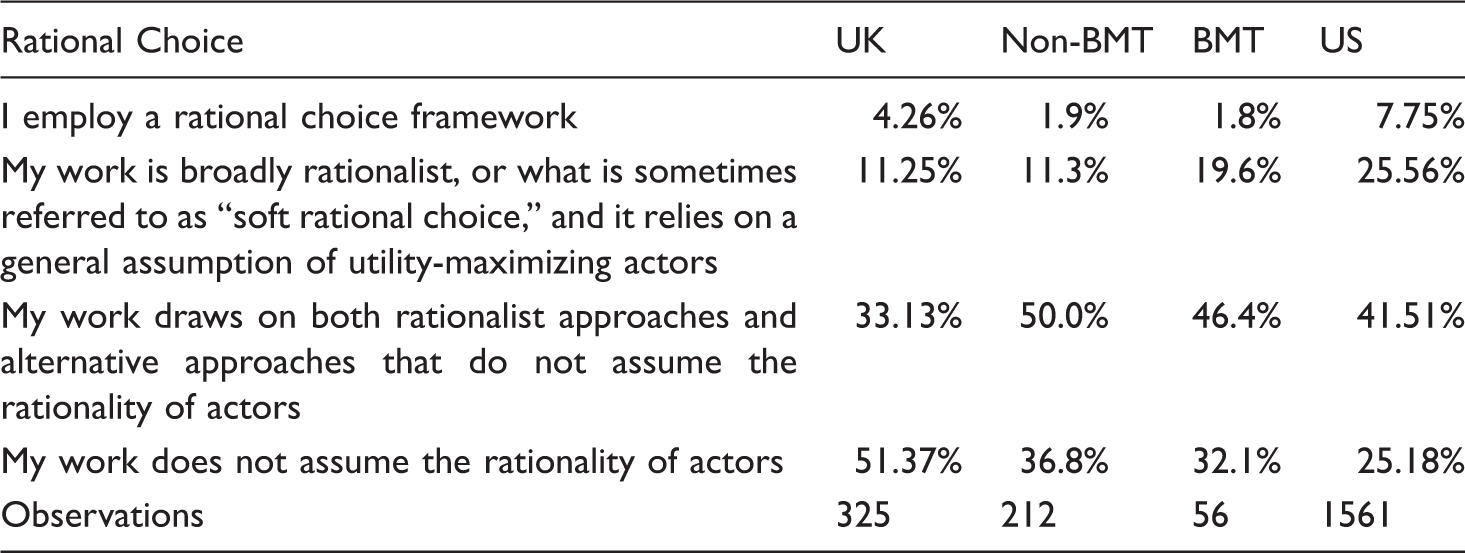
Nossal among others is correct that rational choice theorists are few and far between in Canada, scarcer than even in the UK. 28 Soft rational choice is somewhat more popular at McGill, UBC, and Toronto. Half of the scholars elsewhere draw on both rationalist approaches and alternatives, making Canadian IR scholars less hostile to the rationality assumption than their British cousins. The IR scholars trained by/working at the three universities are not significantly different from those trained by/working at other universities in Canada. To be fair, few American IR scholars describe themselves as rational choice (contrary to how they are viewed by Nossal and others), so this finding does not make McGill, Toronto, and UBC very distinct from the American IR programs from which they hire.
Paradigms.
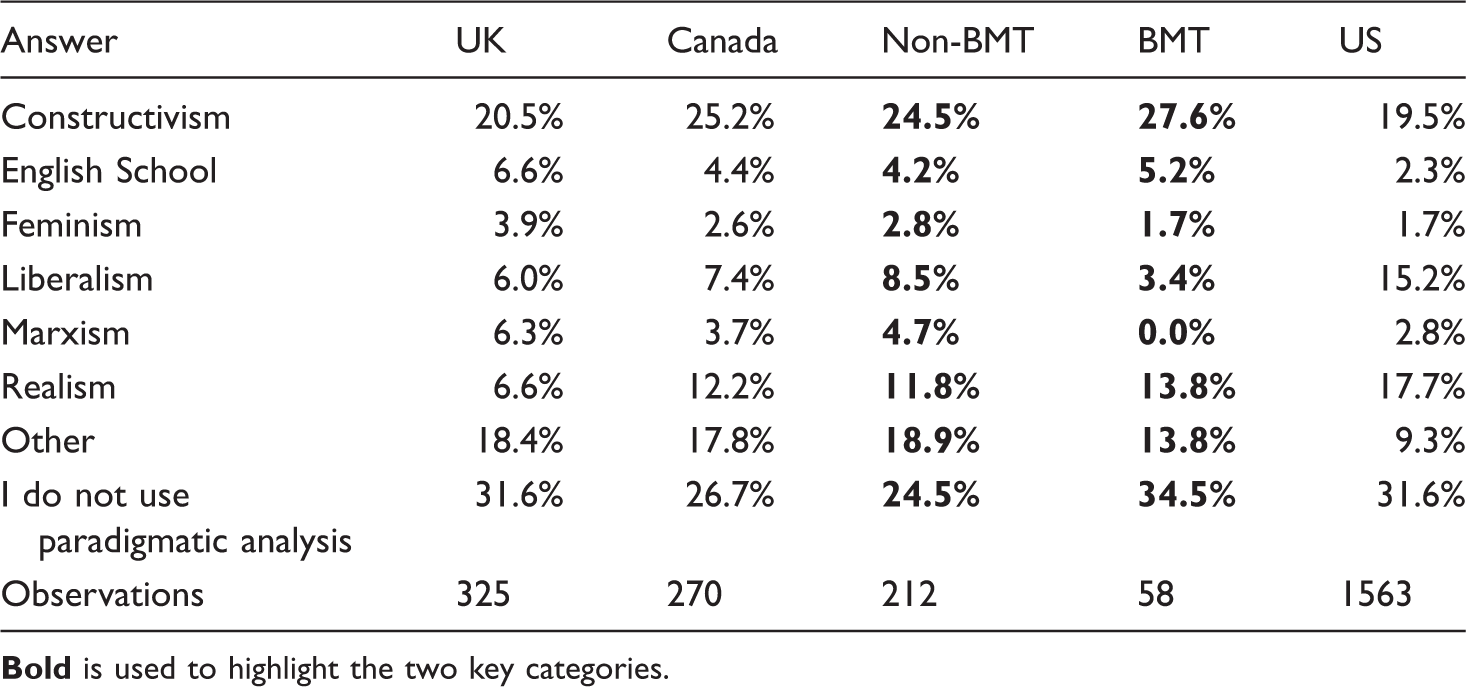
These results support Nossal’s contention that Canadian IR is “marked by a diversity of intellectual approaches, with no approach that comes anywhere close to being hegemonic.” 29 Constructivism is relatively popular throughout Canada, somewhat more so than in the US or UK, but characterizes only about a quarter of Canadian respondents. There are just about as many Realists in McGill, Toronto, and UBC as other in other Canadian programs, putting Canada in between the UK and US. There are also more liberals and Marxists outside of McGill, Toronto, and UBC. One surprising result is how few feminist IR scholars there are among the respondents in the survey. This runs contrary to how Canadian feminist IR scholars see themselves. 30 The phrasing of this question does not really distinguish critical IR scholars, although one might infer that feminists and Marxists might identify more with critical IR than with mainstream IR. Constructivism is broad enough to include those who consider themselves critical security scholars and those that do not. So, this question does not really demonstrate the centrality of critical IR scholarship.
We can read these results in two ways: that the apparent demise of Grand Theory and of paradigmatic analysis is stronger at UBC, McGill, and Toronto than in other Canadian schools where 75 percent claim to fit into one paradigm or another. 31 Or that UBC, Toronto, and McGill have bought into analytical eclectism more than the rest of Canada. 32 Still, except for the complete absence of Marxists working at or trained by UBC, McGill, and Toronto, the differences between these three universities and other Canadian universities are relatively modest and far less than often averred.
Methods.
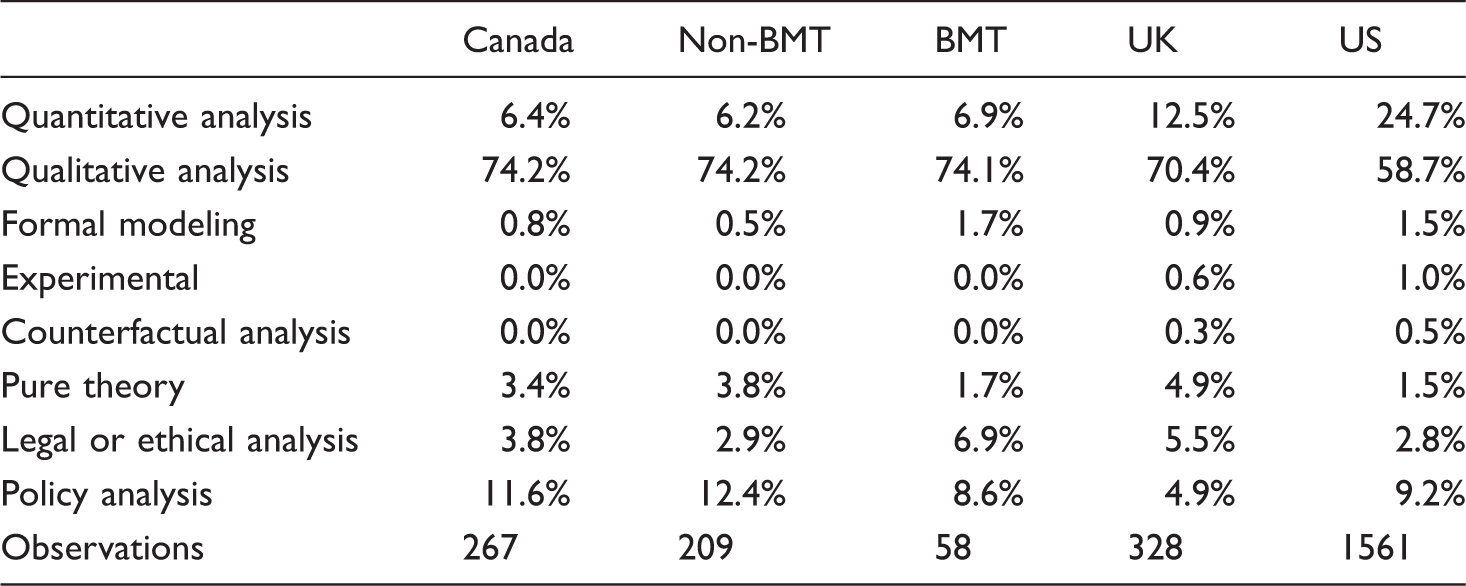
One consistency across Canada is the scarcity of IR scholars using quantitative methods, half as many in percentage terms as in the UK, supporting the conventional wisdom discussed at the outset of this article. Formal modeling, while a distinct minority everywhere, is as likely to be done at UBC, Toronto, and McGill as in the US. Pure theory and policy analysis are more popular outside of McGill, Toronto, and UBC, which may support the contentions of Boucher and Bow about traditional work still being significant. 33 The trend in experimental work has not yet made it across the border. Overall, whatever divides exist within Canada between the McGill, Toronto, and UBC and other Canadian schools, methodology is not one of them. That Canadian IR scholars do far less quantitative work may have implications for how visible Canadian scholars can be outside of Canada, particularly in outlets that publish more quantitative work. 34
In terms of self-identifying, the big divide between the three schools and other Canadian schools is epistemology. There are more positivists at McGill, Toronto, and UBC. There are some differences in rationalism with nearly twice as many rationalists in the former departments than the latter. Likewise, more than one-third of the scholars at UBC, McGill, and Toronto do not identify as using any paradigm, whereas one-quarter of scholars elsewhere in Canada feel the same way. However, Canada is essentially one country of IR scholars when it comes to methods since there are relatively minor differences. Overall, though, the differences are of degree and not of magnitude. Both communities have significant diversity within them.
The next question is how these differences in the basic approaches to the field relate to how Canadian IR scholars see the profession itself.
Canadian rankings of scholars, outlets and programs
Thus far, we have found modest but consistent differences between scholars working at or trained by UBC, McGill, and Toronto and those trained/working in other programs. The logical question that flows from this is: do the scholars in these communities converge or disagree on what counts as good scholarship? Which scholars are influential? Which programs are better? How do Canadian IR scholars see the profession? Who do they see as the major influences? Are there patterns in the outlets in which they place their work? Are there differences in how they look at hiring and promotion?
Influential world scholars.35

While scholars around the world see Wendt’s work to be influential as well as that of Keohane and Waltz, 36 some interesting differences emerge. More scholars in North America view Buzan, Mearsheimer, and Nye as influential except at Toronto, McGill, and UBC (although the first two are just outside the top ten). Scholars at/trained by the three programs are more similar to Americans in that they see Fearon, Finnemore, and Walt as quite influential. The scholars trained/working elsewhere in Canada more often cite Robert Cox, John Ruggie, and Cynthia Enloe as influential, which speaks to the attraction of critical and feminist IR in much of Canada. This does suggest that the constructivists elsewhere in Canada may be critical IR types who do not show up in Table 3, and fewer constructivists trained/working at UBC, McGill, or Toronto consider themselves to be critical IR people because they find the more mainstream constructivists more influential. UBC, McGill, and Toronto, perhaps because of their greater attraction to non-paradigmatic work and rationalist approaches, mention Lake more often. Finally, Canadians do not consider Sam Huntington to be as influential as Americans do. The differences may be modest since the number of votes separating those from 6–20 are small.
Influential journals.

There is far more consistency than variation: Canadian scholars most commonly view International Organization, International Security, International Studies Quarterly, Foreign Affairs, and the European Journal of International Relations as the most influential journals. The best evidence that McGill, Toronto, and UBC look south and other Canadian programs look to Europe and/or the former are more rationalist and the latter more post-positivist is that Millennium is the highest ranking journal outside of the shared top four journals for most Canadian scholars while the American Political Science Review is near the top of the list for the scholars at McGill, Toronto, and UBC.
Preferred journals.
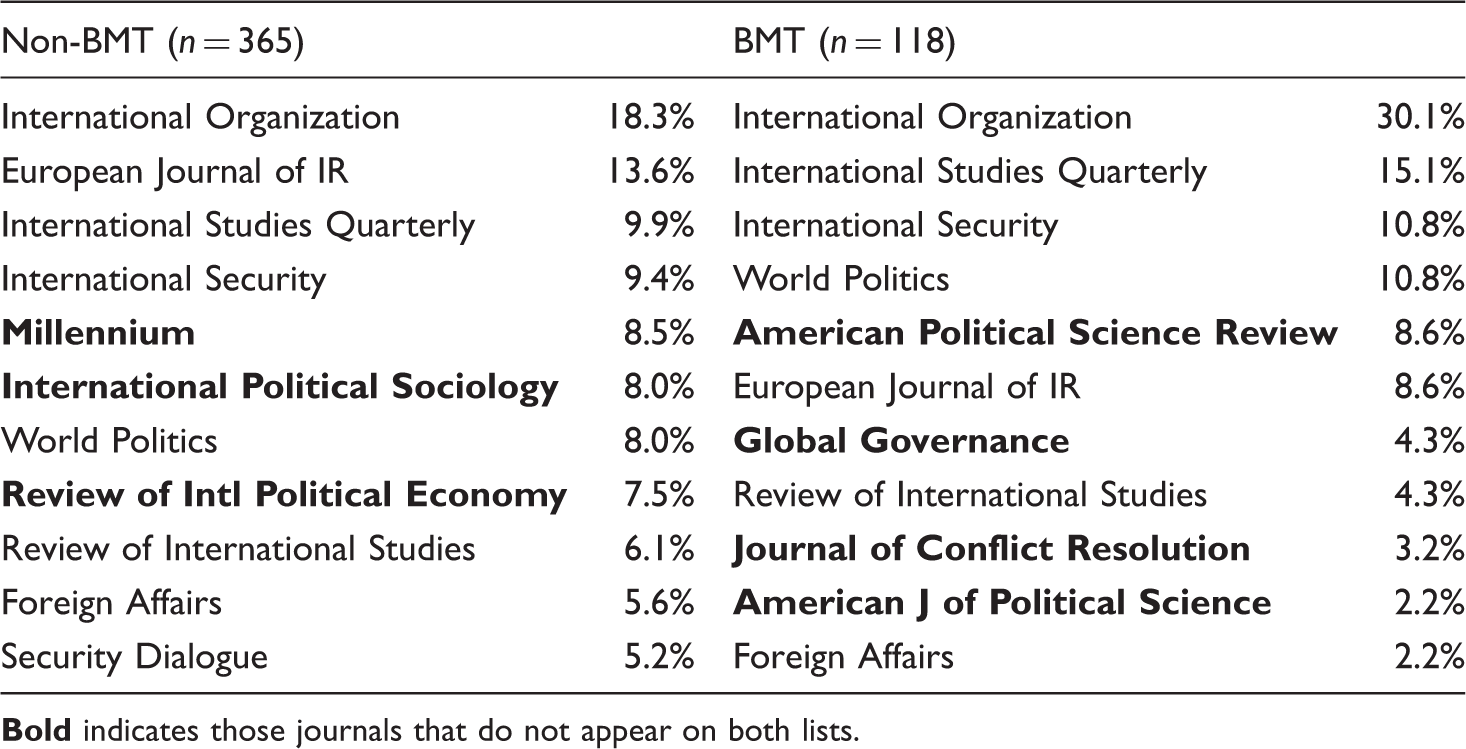
Asking a slightly different question makes the divide a bit clearer. More scholars at McGill, Toronto, and UBC prefer to place their work in the major journals in the US, including those that tend to publish more positivist research, more quantitative work, and more rationalist arguments. Most Canadian scholars prefer Millennium, International Political Sociology and Security Dialogue because they seek the most visible outlets that publish post-positivist scholarship. Also, European Journal of International Relations moves up to near the top. Note that neither International Journal nor the Canadian Foreign Policy Journal appears on either list. This belies the assertion that only Toronto, UBC, and McGill are more focused on American/international journals. 37 Instead, Canadian IR scholars prefer non-Canadian journals as well, but they differ somewhat on which journals depending on their current location and previous training.
Influential presses.

Scholars trained by and/or working at McGill, Toronto, and UBC do not list the commercial presses as frequently as scholars in the rest of Canada, which puts Princeton and Cornell at the top of the lists of influential presses behind Cambridge and Oxford for scholars at/trained by UBC, Toronto, and McGill. Critical IR scholars may find Routledge and Palgrave friendlier to their approach. Still, the differences among preferred or valued presses are not that distinct, compared to the journals or scholars. Notably, for all Canadian IR scholars, Canadian presses are at the very bottom of the lists, even below the lesser commercial presses.
Most influential Canadian IR scholars

It should not be that surprising that Toronto, UBC, and McGill scholars do well when ranked by scholars trained at and/or working at those schools. The decline in Robert Cox's ranking and increase in Emanuel Adler’s (and the appearance of Price and Pouliot) as we move from the responses of most Canadian scholars to those at/trained by UBC, McGill, and Toronto indicate a distinct difference in what kind of post-positivist work is preferred on either side of the Canadian IR divide. This again underlines the general pattern—that while there are only modest differences in how Canadian IR scholars identify themselves, there are differences in what they value.
PhD programs.

There are only five schools listed in this column, as the remaining answers were recommended by only a single scholar each.
Carleton has two distinct PhD programs—Political Science and Norman Paterson School of International Affairs (NPSIA); Ottawa has multiple programs producing PhDs in IR-related areas, and Basillie/Waterloo/Wilfred Laurier responses were combined as it is not clear to which the respondents are referring.
There is consensus in Canada: that Toronto, UBC, and McGill are generally seen by Canadian IR scholars as the best places to pursue an academic PhD. On the other hand, York, Ottawa, and Carleton 38 are seen by many scholars as being a good place to do a PhD, but none was listed by any respondent trained by and/or working at the top three ranked graduate programs. This may be a case of narcissism. 39 However, it might also be that the scholars at these schools favour PhD programs that are a mix of positivist and post-positivist scholarship, and York is stereotyped largely, if not entirely, as a home to post-positivists. This explanation is buttressed by the relative rankings of the University of Montreal versus the University of Ottawa, where the former is seen as more positivist and the latter more post-positivist. 40 Finally, this set of findings justifies the use of the UBC, McGill, and Toronto category in this article, since both communities see these programs as distinct.
Conference attendance.

The differences are significant as McGill, UBC, and Toronto scholars are correlated with attending the CPSA less than most Canadian scholars (−.13, p < .05), and attending ISA (.13, p < .05) and APSA (.30, p < .001) more. Simply put, scholars at the big three programs rely on and dwell in different networks, attending the CPSA less and the American-based conferences more. Why do these scholars tend to avoid the CPSA? This is debated at every CPSA (as this author witnessed again at the Ottawa 2015 conference). They report that the CPSA IR program tends to favour topics (Canadian foreign policy) and approaches (Critical IR) that are not as attractive to them and that their kind of IR is not welcome. 42
Overall, the rankings of scholars, outlets, and programs, as well as conference attendance, demonstrate that there is much in common among all Canadian IR scholars, but the divide is real since there are some consistent differences—that the small but real differences in epistemology and paradigm ultimately produce significant differences in which outlets, programs, and conferences are valued. Given that Nossal and others focus on hiring patterns as the source of these differences, this article turns to perceptions and realities of hiring.
Canadian career dynamics
In this section, I focus on the questions relating to career dynamics and largely on the most controversial issue—hiring. Are the divisions within Canada reflected in how Canadians do IR and value scholarship reflected in what they value when they participate in hiring?
American PhD advantage (n = 247).
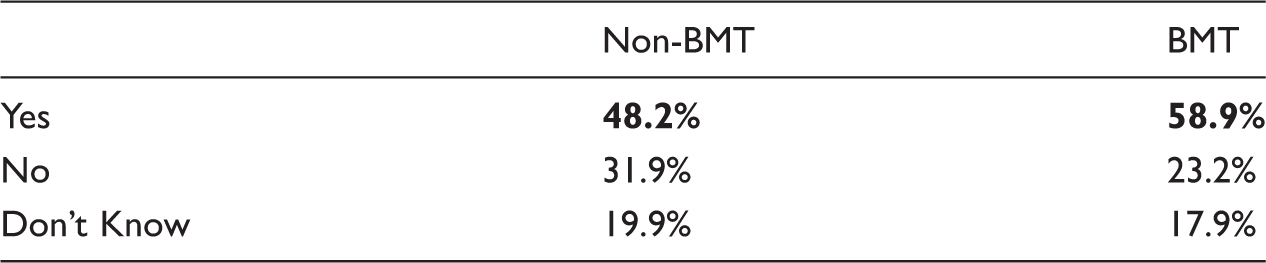
Nearly a majority of IR scholars in much of Canada view an American PhD as an advantage in getting a job in Canada and nearly 60 percent at McGill, Toronto, and UBC feel the same way. This contradicts Cox and Nossal, since nearly half of those scholars in other Canadian schools view an American PhD as an advantage AND the scholars at/trained by UBC, McGill, and Toronto favour American PhDs but not as unanimously as averred. The difference of 10 percent is not as extreme as Cox and Nossal indicate.
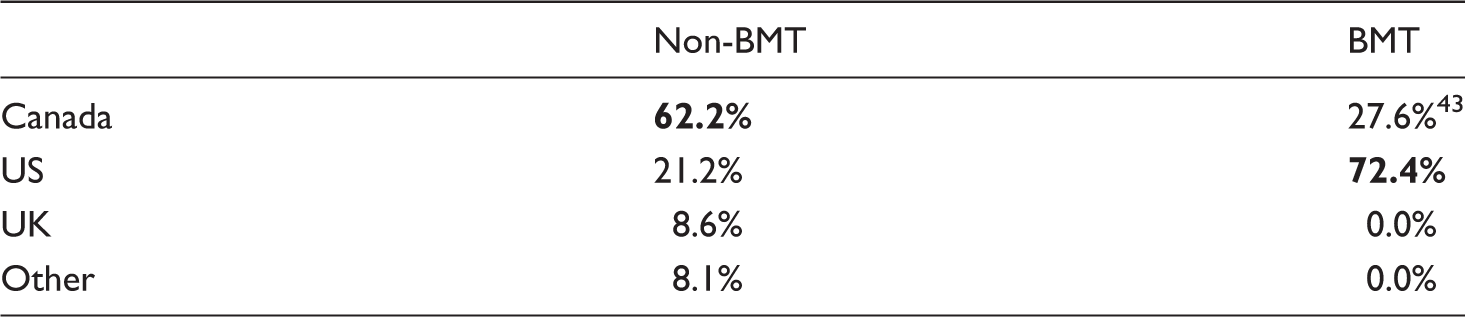
In Table 13, BMT refers to those who work at McGill, Toronto, and UBC (in the rest of the tables, BMT also includes those trained at these three schools). The perception of the higher value of an American PhD is only actually accurate for British Columbia, McGill, and Toronto as they are much more willing to hire those with American PhDs. 45 Nearly three-quarters of the respondents from McGill, Toronto, and UBC were trained in the United States. On the other hand, over 60 percent of scholars in the rest of Canada were trained in Canada. It turns out that the big perceived advantage for American PhDs illustrated in Table 12 is a real advantage only at three schools and not nearly as helpful at other Canadian programs. There is one other difference—UBC, McGill, and Toronto do not seem to be fond of British PhDs while scholars with British degrees as well as from other parts of the world are welcome elsewhere in Canada.
Canadian priority in practice (n = 214)

There are some significant differences in how Canadian IR scholars see the policy in practice. At most Canadian schools, over 40 percent of the respondents viewed their departments as prioritizing Canadians and permanent residents. This may be less than expected, as the law is exactly that—a law. It may be the case that university administrations vary in how willing they are to make the case that non-Canadian candidates are more qualified (or that there are no qualified Canadians in the pool of candidates). As expected, scholars at McGill, Toronto, and UBC do not believe that their schools are as bound by the regulation: the categories of Rarely, Strategically, and Irrelevant sum to 40 percent. Less than 20 percent of McGill, UBC, and Toronto scholars believe that their department always hires Canadians or gives them priority. Twenty-two percent of the respondents at these programs do not know, which seems higher than one would expect, but might be an artifact of the size of Toronto’s program—that their hiring process may be more mysterious to those who do not participate in hiring committees.
Canadian Priority Preferences (n = 215).

The responses here are mostly similar. Canadian scholars outside of McGill, Toronto, and UBC feel that Canadians should be preferred more than do those at McGill, Toronto, and UBC, but this law receives more support among scholars trained by/working at the latter than the conventional view would suggest. 46 This leads to an interesting contradiction—McGill, Toronto, and UBC scholars do not think the Canadian preference matters as much in their hiring even though they value it almost as much as scholars elsewhere. In turn, the popularity of American PhDs at UBC, McGill, and Toronto is suggestive: that the scholars at these programs allow their shared values about which journals and presses matter more, which affects which candidates are seen as most qualified, to override their weak but real support for the preference law. Of course, the difference between hiring practices and these values may be due to the distinction between hiring American PhDs and hiring Americans. In any case, the results imply that whatever the scholars at the top three programs say they value in terms of nationality of those they hire and the law regulating these matters, in practice, they value American PhDs more.
Conclusion
The purpose of this article is to identify both how Canadian IR scholars view the discipline and whether the perceptions of a divide within Canadian IR have a basis in reality. We find that there are some key differences between the top three PhD programs and the rest but perhaps more similarity than was expected. As noted in earlier work, the big difference between UBC, McGill, and Toronto is the willingness to hire American PhDs. These American-trained scholars are not as different in terms of epistemology, theoretical inclinations, or methodology as often averred but they do tend to value different scholars, seek to publish in different outlets, and go to American-based conferences.
Perhaps the perception that American-trained scholars are more alien—more quantitative, more rational choice, more realist, etc.—is the result of Canadian IR scholars overestimating the homogeneity of American IR. The reality is that both Canadian and American IR are diverse. Nossal argues that “the huge proliferation of scholarly journals in the last generation has also helped: with the expansion of the number of specialized peer reviewed journals, it is now possible for scholars with markedly diverse intellectual perspectives to find quality outlets for their work.” 47 This boom in additional outlets fosters diversity both north and south of the border.
There are some interesting contradictions in these results. The first is that Canadian IR is unlikely to ever be significantly distinct from the IR elsewhere if Canadian IR scholars prioritize publishing outlets outside of Canada. Cox and Nossal criticize the focus on non-Canadian journals due to the desire of administrators “to claim their institution is ‘world-class’ in various bean-counting exercises,” 48 as scholars in the rest of Canada are as focused on journals outside of Canada including many that the big three value—International Organization, International Studies Quarterly, International Security, and the European Journal of International Relations. The respondents did not list any major Canadian journals as preferred or influential outlets. The Canadian presses were rarely mentioned by scholars as desirable outlets for their books. It is unlikely that publishing outlets outside of Canada will be conducive to the development of a distinctly Canadian form of IR. This is neither necessarily good nor bad but simply the reality of today’s IR.
The second paradox is that in most of Canada, departments hire Canadian PhDs, yet they think that programs that rely on American PhDs are the elite programs. Consider this quote: “some top-tier schools, such as universities of Toronto, McGill, and UBC, try to hire non-Canadian doctorates to demonstrate that their own program is the best in Canada.” 49 Looking at these results suggests that this strategy, whether it really is intended or not, works. Of course, it is probably the case that McGill, Toronto, and UBC hire American PhDs precisely because they share the same values: they go to the same conferences, seek to publish in the same journals and presses, lean more positivist, and so on.
Ultimately, we cannot make too much of the differences because both communities are diverse. There are many positivists in Canada and not just at the most prominent PhD programs. Neither group has a singular theoretical approach to IR, since there is plenty of non-critical IR outside of McGill, Toronto, and UBC and some critical IR inside. Maybe it is precisely this shared diversity that facilitates the ranking of these three as the top PhD programs. This might be a paradox worth further exploration.
Footnotes
Acknowledgements
This article is only possible due to the efforts by the TRIP project at the College of William and Mary. Sue Petersen and Mike Tierney have been unfailing collaborators with the Canadian franchisees, as we developed the Canadian questions and the survey of Canadian IR scholars. Darin Self, a student at William and Mary, has been very helpful with coding variables and answering questions about the dataset. Ryan Powers and Nicholas Bell were also integral to the data collection effort. I am thankful to Anne-Marie D’Aoust and Jérémie Cornut for their hard work as the other Canadian TRIP franchisees. Uri Marantz helped code some of the Canadian findings. Stephanie Carvin, Jérémie Cornut, Patrick James, and David Long provided insightful comments. I am very thankful to the anonymous reviewers and especially Adam Chapnick who shepherded this piece quickly through the process. Any problems remaining are solely my responsibility.
Declaration of Conflicting Interests
The author(s) declared no potential conflicts of interest with respect to the research, authorship, and/or publication of this article.
Funding
This research received no specific grant from any funding agency in the public, commercial, or not-for-profit sectors.
1
Tony Porter, “Can there be national perspectives on inter (national) relations,” in Robert M.A. Crawford and Darryl Jarvis, eds., International Relations–Still an American Social Science? Toward Diversity in International Thought (Albany: SUNY, 2000) 131–147.
2
Kim Richard Nossal, “Home-grown IR: The Canadianization of international relations,” Journal of Canadian Studies 35, no. 1 (2000): 105–106; Wayne S. Cox and Kim Richard Nossal, “The ‘crimson world’: The Anglo core, the post-imperial non-core, and the hegemony of American IR,” in Arlene B. Tickner and Ole Waever, eds., International Relations Scholarship around The World (New York: Routledge Press, 2009), 301; David R. Black and Heather A Smith, “Still notable: Reassessing theoretical ‘exceptions’ in Canadian foreign policy literature,” International Journal 69, no. 2 (June 2014): 147; Miguel de Larrinaga and Mark B. Salter, “Cold CASE: A manifesto for Canadian critical security studies,” Critical Studies on Security 2, no. 1 (2014): 10; Wayne S. Cox, “Canadian critical security studies as a non-American social science: A rejoinder to de Larrinaga and Salter,” Critical Studies on Security 2, no. 1 (2014): 35–38.
3
4
After much crowdsourcing, I decided to use BMT in the various tables as shorthand for UBC, McGill, and Toronto as the most concise way to describe the three schools collectively.
5
Jérémie Cornut and Stéphane Roussel, “Canadian foreign policy: A linguistically divided field,” Canadian Journal of Political Science 44, no. 3 (2011): 685–709; Claire Turenne Sjolander, “Two solitudes? Canadian foreign policy/politique étrangere du Canada,” Canadian Foreign Policy Journal 14, no.1 (2007): 101–108; Claire Turenne Sjolander and Heather A Smith, “The practice, purpose, and perils of list-making: A response to John Kirton's ‘10 most important books on Canadian foreign policy,’” International Journal 65, no. 3 (September 2010): 751–762.
6
Ole Waever, “The sociology of a not so international discipline: American and European developments in international relations,” International Organization 52, no. 4 (autumn 1998): 687–727.
7
Porter, “National perspectives,” 141; Daniel Maliniak, Amy Oakes, Susan Peterson, and Michael Tierney, “The view from the ivory tower: TRIP survey of international relations faculty in the United States and Canada,” Program on the Theory and Practice of International Relations (Williamsburg, VA: College of William and Mary, 2007), 6; Michael Lipson, Daniel Maliniak, Amy Oakes, Susan Peterson, and Michael J. Tierney, “Divided discipline? Comparing views of US and Canadian IR scholars,” International Journal 62, no. 2 (2007): 327–343.
8
Nossal, “Home-grown IR,” 96.
9
Ibid., 103.
10
Porter, “National perspectives,”140; Nossal, “The Heart of the Matter,” Critical Studies on Security 2, no. 1 (2014): 20.
11
I am grateful to one of the anonymous reviewers for pointing this out.
12
Cox and Nossal, “Crimson world,” 302.
13
Jean-Christophe Boucher, “Yearning for a progressive research program in Canadian foreign policy,” International Journal 69, no. 2 (June 2014): 222.
14
De Larrinaga and Salter, “Cold CASE,” 14.
15
Cox, “Canadian critical security studies,” 36.
16
Brian Bow, “Paradigms and paradoxes: Canadian foreign policy in theory, research, and practice,” International Journal 65, no. 2 (June 2010): 371–380.
17
Nossal, “Home-grown IR,” 105. Others emphasizing these laws include Cox and Nossal, “Crimson world,” and de Larrinaga and Salter, “Cold CASE.” To be clear, the immigration rules have changed over time, softening in the 2000s and apparently tightening again more recently. Also, as I note below, the universities and the local immigration officials vary in their willingness to approve exceptions.
18
Cox, “Canadian critical security studies.” Of course, these laws do not restrict Canadians with American PhDs.
19
Nossal, “Home-grown IR” and Black and Smith, “Still notable.” Neufeld and Healy have a contrary view, asserting that critical IR does not do well in SSHRC competitions, in Mark Neufeld and Teresa Healy, “Above the ‘American discipline’: A Canadian perspective on epistemological and pedagogical diversity,” in Crawford and Jarvis, eds., International Relations, 13.
20
Richard Jordan, Daniel Maliniak, Amy Oakes, Susan Peterson, and Michael Tierney, “One discipline or many? TRIP survey of international relations faculty in ten countries,” in Program on the Theory and Practice of International Relations (Williamsburg, VA: College of William and Mary, 2009).
22
This article focuses on a few specific issues. Subsequent work will focus on policy stances and policy relevance/public engagement.
24
We have no reason to expect any particular bias in the non-respondents, except that we did receive some emails from people who said that they did not see themselves as IR scholars. The respondents include 56 scholars who are not regular faculty (assistant/associate/full professors) but rather post-docs, adjuncts, visitors, and emeritus. I report the results below with all respondents. The findings do not change much if only regular faculty is analyzed.
25
26
I combined the non-positivist and post-positive categories in the survey, which has become standard procedure for TRIP scholars. Non-positivist originally was viewed as pre-behavioral IR, but the category is really defined by the respondent’s perceptions. The key distinction we are trying to assess here, given the characterization of American IR as positivist, is between positivists and everyone else. Informed by conversations with Michael Tierney, who, along with Sue Peterson, runs the TRIP project.
27
Bow, “Paradigms and paradoxes.”
28
Nossal, “Home-grown IR,” 103.
29
Nossal, “The heart of the matter,” 20.
30
Black and Smith, “Still notable,” and Heather A. Smith, “Naming, labels and manifestos: A response to Miguel de Larrinaga and Mark Salter,” Critical Studies on Security 2, no. 1 (2014): 31–34. Again, we have no reason to believe that certain groups of scholars, feminists or others, responded more or less frequently.
31
See the 2013 special issue of European Journal of International Relations.
32
Rudra Sil and Peter J Katzenstein, “Analytic eclecticism in the study of world politics: Reconfiguring problems and mechanisms across research traditions,” Perspectives on Politics 8, no. 2 (2010): 411–431.
33
Boucher, “Yearning,” and Bow, “Paradigms and paradoxes.”
34
One way to get cited more often is to develop a valuable dataset. By eschewing quantitative work, Canadian scholars may be limiting their visibility.
35
The survey asked: List four scholars whose work has had the greatest influence on the field of IR in the past 20 years.
36
See the TRIP reports cited above for the general esteem around the world for Wendt, Keohane, and Waltz.
37
Cox and Nossal, “Crimson world,” 302.
38
It is not clear how distinct the subunits at Ottawa are, but much might be conflated in the Carleton outcome, as NPSIA’s relatively new PhD program is quite positivist while the Political Science Department has long been viewed as a leading center of Critical IR.
39
It is almost certainly not driven by size of program. Of the BMT programs, only Toronto is very large. Due to concerns about protecting identities, the dataset does not have individual university affiliations, but a study of the websites of the listed PhD programs shows that Toronto is the outlier with more than 140 IR professors. McGill and UBC have fewer permanent faculty members than Basillie, Carleton, Ottawa, and York, even before one considers the graduate IR policy programs at Carleton and Ottawa. Of the programs listed in  , only McMaster and Queen’s are smaller than McGill and UBC.
40
I am grateful to Jérémie Cornut for pointing this out.
41
I considered European conferences and found little difference among Canadian IR scholars.
42
Based on informal (not systematic) observations and conversations. Nossal notes that McGill, UBC, and Toronto scholars do not focus on Canadian foreign policy, “Home-grown IR,” 105–106. I have not tried to perform a content analysis of the titles of panels and papers at recent CPSAs, as the scope of this article is limited.
43
Cox and Nossal, “Crimson world,” 302.
44
Re-running the data for with only respondents with Canadian PhDs reveals that as many Canadian PhDs with non-BMT training are working at McGill, Toronto, and UBC as those trained at the Big 3, belying the perception that these schools only hire from their fellow programs (about half of the Canadians with degrees from other Canadian schools working at the BMT programs are adjuncts/post-docs).
45
Nossal, “Home-grown IR,” 105–106; and Cox and Nossal, “Crimson world,” 297–298.
46
Nossal, “Home-grown IR,”, Cox and Nossal, “Crimson world,” and de Larrinaga and Salter, “Cold CASE.”
47
Nossal, “Heart of the matter,” 21.
48
Cox and Nossal, “Crimson world,” 302.
49
De Larrinaga and Salter, “Cold CASE,” 10.
Author Biography
Stephen Saideman holds the Paterson Chair in International Affairs at Carleton University’s Norman Paterson School of International Affairs. His most recent book is Adapting in the Dust: Lessons Learned from Canada’s War in Afghanistan. He writes online at OpenCanada.org, and tweets at @smsaideman.