



Abstract
The Synthetic Environment (SE) takes the power of computing, digital processing, artificial intelligence, extended reality technology, and other advancements borrowed from the gaming industry to create a computer simulation with near-perfect levels of realism. Designed to enable connectivity across all domains and platforms, SE has the potential to dramatically improve military training, force development, situational awareness, and communications. Our article provides a technical overview of SE and offers a high-level analysis of its use in Canada, the US, UK, and Australia. Informed by dozens of interviews and a roundtable workshop held with experts from academia, industry, and government, this article relates SE to Canada’s future defence policy. We argue that leveraging SE effectively will require that Canada commit to a long-term SE program, promote new government-industry partnerships, encourage top-down leadership from both civilian and military officials, and consolidate domestic skillsets and industry knowhow to maintain and retain Canadian sovereignty.
Keywords
In August 2021, the US Navy launched Large Scale Exercise 2021, which consisted of 25,000 participants across 17 time zones, 25 ships, 36 live and 50 virtual constructive units, along with six Navy and Marine Corps commands. 1 The purpose of the exercise was to test, improve, and ultimately adopt a new, agile, and digitally relevant method of warfighting that would help eliminate traditional stovepipe approaches to Command and Control (C2) by incorporating and relying upon a Synthetic Environment (SE). SE takes the power of computing, digital processing, artificial intelligence (AI), machine learning (ML), and other technologies borrowed from the gaming industry to create a computer simulation with near-perfect levels of realism. Designed to enable connectivity across all domains and platforms, SE has the potential to dramatically improve situational awareness, communications, C2, training, and force development strategic planning. 2 The US, UK, and Australia have all taken note of SE’s emerging role in current and future operations. In Canada, several teams across the Canadian Armed Forces (CAF) and the Department of National Defence (DND) are currently tasked with investigating and implementing initiatives that will support a future infrastructure. In comparison to its Five Eyes (FVEY) partners, however, the Canadian government has demonstrated that it is not optimally organized, nor has it prioritized fully leveraging this emerging capability across the national defence enterprise. Instead, Canada is approaching SE on an “as-needed basis”—an additional input that can be used to support Canada in accomplishing specific defence functions. This places Canada as an outlier among its closest allies.
Research around Canada’s SE has yet to garner any serious theoretical attention from defence scholars. Nor is it well documented in open-sourced material. The purpose of this article, then, is to provide a broad, empirically driven overview of the effects SE will have on the future of Canada’s defence policy, and to help spur theoretical research on, and policy debate surrounding, this emerging challenge. Our analysis suggests that a Synthetic Environment is essential for modernizing and digitizing the CAF and for defending and retaining Canada’s sovereignty into the next decade(s). We also find that if Canada expects to remain a critical ally to both the United States and the FVEY more broadly, Ottawa must embrace this technological shift by addressing the institutional, cultural, industrial, and resource challenges that obstruct the process of transition.
This article stems from a larger Mitacs Accelerate project that examines the nexus between technology, Canadian defence, and national security. 3 Our analysis is driven by a series of interviews and a roundtable discussion held with experts from the CAF, DND, Defence Research and Development Canada (DRDC), industry, and academia between June and November 2021. 4 We employ a modified Delphi approach throughout our analysis, developing observations using a combination of interviews, group discussions, and open-sourced material. 5 Due to the innovative and restrictive (i.e., technical) nature of the Synthetic Environment, participants were first selected on the basis of known expertise (i.e., technologists, engineers, executives, and personnel or analysts who openly advertised their work in SE). Snowball sampling was used thereafter. 6 Experts were asked to speak to three specific areas of Canada’s Synthetic Environment: concepts of operation (CONOPS), force development, and training. Broad questions were intentionally asked, allowing us to cover a body of information on a topic that is still relatively new and largely misunderstood, while also letting experts determine the most salient points worth noting and exploring further. After receiving some initial feedback from our interviewees, we were prompted by a small community of experts to host a follow-up group discussion open to all participants. Additional policy officials representing the DND and CAF joined this 1.5-hour (virtual) roundtable. In preparation, roundtable participants were provided with a preliminary report of our research findings, as well as a scenario note outlining two additional themes for discussion: (1) the effect SE might have on continental defence; and (2) the near-term (5 years) and long-term (15+ year) future opportunities and challenges that Canada might face in exploiting SE. The latter exercise used a technique borrowed from strategic foresight to generate observations. 7 Our analysis is derived from the sum of these interactions.
Our paper unfolds in four sections. First, we provide a contextual and technical overview of SE and a high-level analysis of its experimentation and use in Canada, the US, UK, and Australia. Second, we present expert and stakeholder findings regarding the likely consequences SE will have on the CAF’s future concepts of operation, force development, and training. Third, we explore what a Canadian SE might mean for continental defence and Canada-US relations more broadly within the context of NORAD modernization. And in conclusion, we discuss short- and long-term opportunities and challenges that accompany building a Canadian SE infrastructure. The article outlines several recommendations therein.
Imagining a synthetic environment: International perspectives
In his 1930 patent application, Edwin Albert Link Jr stated that he hoped to invent “an apparatus simulating almost exactly every actual condition which a flier encounters in actual flight.” 8 Link’s device was not an actual flying machine, but rather a stationary one that emulated the realities and challenges of flying. 9 In the following years, militaries and commercial airliners around the world raced to procure this technology. Avionic simulators were born. The Link Trainer is an important piece of history because it demonstrates the value of training for standards assessment and mission readiness. Technological improvements in adjacent sectors of activity since then have made way for a new type of ecosystem: the Synthetic Environment. Extending beyond the air domain, SE combines live and virtual training to mimic the full complexity of military operations. 10 By merging with, and relying on, a host of enabler technologies, including AI, ML, extended reality (XR), mixed reality, artificial reality, and gaming engines, military personnel operating in different domains, on different platforms, and even in different countries, can train, rehearse, and gather feedback analytics together and in real time. As a result, allied armed forces can develop an unprecedented level of situational awareness, pan-domain capability, connectivity, and interoperability. Today, Canada and its FVEY partners are developing SE in a piecemeal and siloed approach. An exploration of these various international approaches follows.
In the United States, the Synthetic Training Environment (STE) aims to modernize the Army’s training doctrine by increasing soldier lethality and by instituting changes that reflect the new realities of warfare. 11 This is accomplished by using enabler technologies that help create a comprehensive, realistic, virtual, and flexible training environment. One example of a specific SE platform is the Integrated Visual Augmentation System headset, which allows soldiers—aided by augmented reality—to have computer assistance on a heads-up-display when target spotting. 12 This technology can also be used through simulations, although the information presented will come from a constructed scenario, rather than from real or live inputs.
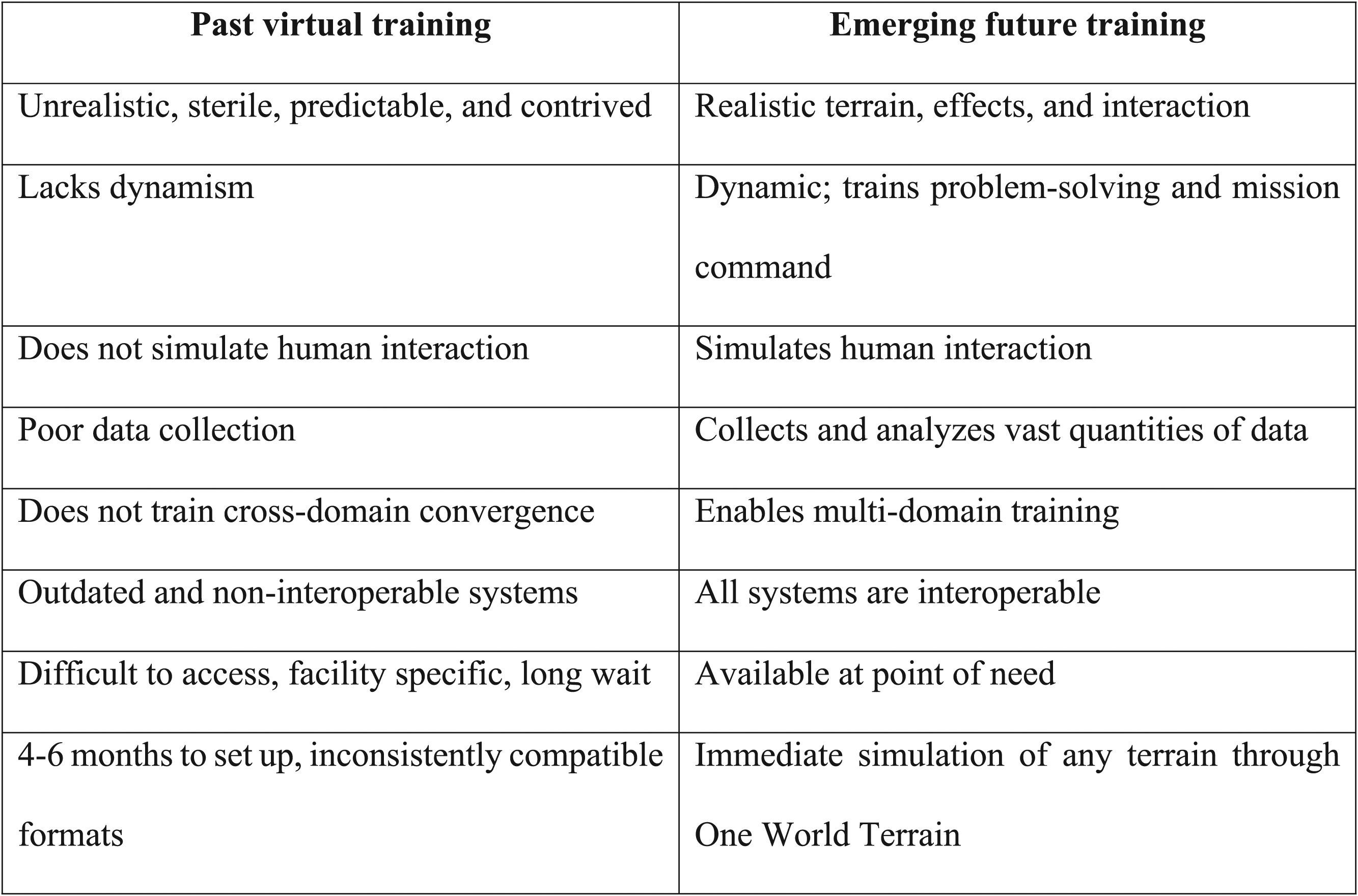
The shift from more conventional means of training and simulation programs, such as the Integrated Training Environment and the Multiple Integrated Laser Engagement System, to the STE will also allow the US (and, presumably, its allies) to overcome the challenges of a quickly evolving threat landscape. For example, modern mapping programs like One World Terrain help train and replicate different missions taking place in different terrains—ranging from desert storms to urban centres.
13
Furthermore, the STE combines live training exercises with virtual soldiers and computer-generated forces. This allows decision-makers to influence various situations and change the operating environment, providing users with an opportunity to practice scenarios that were, until recently, deemed impractical or unforeseeable.
14
These programs not only contribute greatly to force development, training, and doctrine refinement, but they also help bridge a major technological gap in developing and delivering a modern connected battlespace.
15
Figure 1 demonstrates the key differences between the old training paradigm and the new, synthetic one. Synthetic training environment training gaps.
16
The UK’s version of the STE is the Future Collective Training System (FCTS), which is a subproject of the British Armed Forces’ greater modernization strategy, the Collective Training Transformation Programme. Like its American counterpart, the goal of the FCTS is to train the future soldier in more dynamic and complex environments by constructing a nexus between the physical, virtual, and cognitive worlds. This requires partnering with key players in the gaming industry to procure the latest and best-fitting enabler technologies and programmes, including, for instance, the Virtual Battlespace (VBS4). The VBS4 is a whole-earth rendering environment that can be used for tactical training, experimentation, and mission rehearsal through the creation of specific virtual battlespaces. 17 Ultimately, this allows for the creation of complex 3D virtual scenarios, gives trainees a first-person virtual reality experience through heads-up-display, and permits data collection for multiple tasks that can be fed into performance reviews. 18
In another industry collaboration, the British Ministry of Defence created a partnership with QinetiQ to manufacture the Virtual Reality in Land Training (VRLT2). This is complex software that allows trainees and commanders to connect with the Virtual Battlespace whole-earth simulation with the use of mixed reality, cloud computing, and AI/ML. 19 The adaptation of VRLT2 within the VBS4 currently lets ninety trainees—each using virtual reality headsets and computers—train for movement, weapon control, and stance. 20 At full capacity, VRLT2 should allow for complex input of land, air, and sea kit, strategizing input by commanders within the VBS4, all the while creating a real-life feeling for each trainee. By implementing this technology at the point of need, the British Armed Forces can assure interoperability within its own forces, as well as with allied partners who develop similar capabilities.
The Australian Defence Force is not nearly as advanced as the US and the UK in building SE infrastructure, although the general observation is that they are still ahead of Canada. Its Future Ready Training System is designed to modernize the Australian Army by obtaining the cultural and infrastructure requirement needed to implement a blended virtual-physical training environment within the joint force. The Australian Defence Force takes a three-stage, multi-year approach to this goal, starting with initiation (2020), bridging to transformation (2024), and development (2028). Its objective is to develop and implement modern training systems and enabling technologies, such as XR, AI, gaming engines, and cloud computing, by the end of the decade. 21 Like the UK, Australia is also working closely with industry, academia, and allied forces to foster new partnerships that will assist in the development and procurement of the necessary technologies and capabilities. 22
Lastly, Canada plans to integrate live, virtual, and constructive simulations, both at the individual and collective level, through the Future Integrated Training Environment (FITE) program. FITE is a subproject of Canada’s larger modernization policy under Strong, Secure and Engaged, which calls for improvements in interoperability, readiness, infrastructure, and capabilities. 23 Under FITE, multiple projects are set to be developed over the coming decade, including the Land Crew Vehicle Training System, the Urban Operations Training System, the Unit Weapons Training System, and the Weapons Effects Simulation system. 24 The Canadian Army Doctrine and Training Centre—the developer of FITE—seeks to amalgamate all these enabling technologies under one coherent training infrastructure, the Virtual Training and Experimental Network. 25 This “integrated procurement approach” will eventually connect the training infrastructure and bases across Canada through the development and use of common software and hardware standards and protocols. 26 The DND is also investing in the Canadian Advanced Synthetic Environment (CASE), which is scheduled for completion in 2022. The objective of CASE is to “establish network-based infrastructure and processes for Distributed Mission Training, Joint Mission Rehearsal, and air & ground crew training.” 27 The project, which has a budget of $99 million, focuses exclusively on three defence capability areas: air, emerging technology, and training and simulation. 28 While Canada has made some niche advancements—notably with the Royal Canadian Navy’s Fleet Synthetic Training environment 29 —it remains behind its FVEY partners in adopting, in scale and intensity of deployment, a larger goal of realizing a truly centralized, interoperable, and synthetic training ecosystem. Canada’s laggard development of a Synthetic Environment relates as much to force development as it does to the DND/CAF’s inner information management and information technology capabilities. Canada’s slow pace in digitizing the DND and CAF has impacted its ability to achieve full interoperability with its allies, to increase connectivity between assets, to develop novel defence capabilities, and to conduct joint operations. One example is the Canadian government’s ambitious plan to purchase fifth-generation fighter jets, autonomous aircraft, and new radar systems without first having developed a functional digital backbone, processing power, or the ability to test new scenarios in either a digital or blended environment. Canada’s traditional process of looking at materiel and digital procurement in a siloed fashion has handicapped the country’s force development compared to some of its closest allies, making this a central tenet for attaining future success.
Building a synthetic environment in Canada: Promises and pitfalls
According to several experts we spoke to, many Canadian decision-makers have yet to realize the future possibilities associated with building and relying upon a full-fledged SE. Nor have they imagined the associated potential implications of failing to do so. The concept itself is novel and not yet well understood, and the speed with which various technologies emerge and integrate into SE makes it difficult to fully envisage what exactly a Canadian SE might constitute. To spur greater awareness of the potential promises and pitfalls of Canada’s SE, what follows is an analysis of expert insights relating SE to Canadian concepts of operation, force development, and training.
Concepts of operation
Concepts of operation (CONOPS) is a document, graphic, or description of characteristics by the end user of a proposed military system or strategy that may be implemented. The purpose is to communicate both the quantitative and qualitative characteristics that will encompass the system to all stakeholders. 30 Military strategists typically envision a defence project with CONOPS, before transitioning to defining requirements. However, the impact of emerging (and potentially disruptive) technologies that are being developed at rapid speed—often by private sector entities—has upended the status quo. Increasingly, governments are partnering and co-developing with industry on loosely defined challenges. This newly found symbiosis differs considerably from the traditional paradigm, wherein industry was tasked with fixing problems, guided by comprehensive requirements, for national defence departments.
One consequence of this reversal is that SE technology enables more sophistication around digital and mission engineering, both of which are becoming more relevant in shaping the strategic investments, divestments, and procurement decisions of tomorrow. 31 For example, it is generally well accepted that Canada must contribute to interoperability and continental defence should it wish to remain a strong partner to the US within (and beyond) NORAD. SE can help inform which technologies and decisions to prioritize by simulating a given platform or capability and then wargaming it to determine its effectiveness and mission costs. 32 According to one participant, some industry stakeholders are submitting specifications to the DND to engage in this practice. This includes using low-fidelity models to narrow down proposals, high-fidelity models to develop countermeasures, and enemy weapon capability simulations to model adversarial positions. It also includes balancing the government’s current policy with a future-oriented view of what the world might eventually look like, and deciding on what should be prioritized and optimized as a result. What does this process look like in practice? Consider this particular example: after simulations supported the development of new maritime capabilities (during Operation Mobile, 2011), the CP-140 Aurora aircraft’s role was expanded to include an over-land mission set. 33
The real challenge to CONOPS comes with joint modelling and operations. According to another expert, modelling at a high-level strategy is very different from modelling at an engineering level. The process remains distinct, and specialities are disparate across the greater enterprise. At DRDC in Toronto, for example, there is considerable focus on developing an integrated operational management system that can organize and amalgamize data coming from various sources. In the Royal Canadian Air Force (RCAF), however, the progression towards developing a blended environment is moving far more slowly, with operators choosing to either focus exclusively on live or virtual training programs. In the effort to compete with its allies, Canada’s actions may result in developing SE that fails to integrate with other systems, thus jeopardizing its opportunity to form a connected battlespace.
Lastly, thanks to advances in modelling and simulation and augmented and virtual reality, SE will help develop future CONOPS by reducing the number of personnel required to master a specific task. As the DND/CAF further advances its SE program, simulation and training costs could be reduced significantly through an optimal match between user and capability. This would entail both low and high degrees of sophistication (depending on the required task), coupled with a more effective data-centric customized training module. This tailor-made approach would also drastically improve the feedback loop, which ultimately helps with training and wargaming. This has already been demonstrated with the CAF’s use of the Small Arms Trainer for the C7A2 automatic rifle; the feedback offered helped personnel learn from their mistakes and improve on future action.
Force development
In the era of digitization and rapid technological development, there is a growing need to modernize the CAF. In its current state, the procurement process has been a major hinderance because of its slow-moving pace. Canada’s history of procurement mishaps, which range from the Canadian Surface Combatant program to the Future Fighter Capability Project, has resulted in much higher costs and lengthier timelines than anticipated. Incidents like these pose a risk to the CAF because the systems and platforms needed to operate become obsolete before they are even deployed. Incorporating simulations and SE into the procurement process will enable rapid prototyping and testing feedback between industry partners and the DND/CAF. One successful example of this is the US Army Futures Command, which fosters a rapid-prototyping and collaborative culture alongside industry and academia to spur early-stage innovation and platform development. 34 Former US secretary of state, Mark Esper, referred to the Army Futures Command as the Army’s version of Shark Tank, where cross-functional teams integrate the Army’s acquisition corps with program managers and industry experts to speed up the Army’s modernization efforts. 35 Furthermore, simulations will help determine whether military off-the-shelf (MOTS) solutions or homegrown systems provide the best value and quickest path to deployment. This was demonstrated by the British Armed Forces’ decision to select an Israeli MOTS to fit its new Challenger 3 main battle tank with an active protection system.
The emergence and use of digital twins is also proving to be innovative. Digital twins consist of a physical entity, a virtual counterpart, and the data connections in-between. 36 Designed to provide a live representation of a real-time digital counterpart, digital twins enable high-level command and control training that allow militaries to model the state of a physical entity or system through sensor-derived data collection. 37 This technology lets decision-makers assess various outcomes by tweaking the environmental conditions of any given scenario. This ranges from substituting warfighting tactics; testing different types of technology, systems, or weapons; changing the weather conditions or time; and a myriad of other factors. The use of these predictive analytics has already proven helpful for training armoured fighting vehicle drivers, sailors, and air force pilots, drastically reducing the cost and risk associated with live operations. One notable example is the Griffon CH-146 Mission Rehearsal Tactics Trainer, which is a prototype cockpit of the Griffon CH-146 helicopter used by the CAF. Likewise, the use of digital twins can address emerging skill gaps amongst operators and maintenance personnel, allowing for remote operational and maintenance training. Other benefits include increasing retention rates, informing sustainment models, and providing innovative industrial approaches to technology and capability development, such as mission engineering.
While SE can reduce the training cycle for specific tasks, the shift from an SE prototype to a reality must be supported by government and industry programs and collaboration. The DND’s Innovation for Defence Excellence and Security (IDEaS) program has already contributed to this process, but it is not as agile as the American Defense Innovation Unit, which has proven effective at attaining quick and time-sensitive solutions to procurement challenges. 38 Moreover, IDEaS continues to fund many of these challenges at a micro-scale, rather than incentivizing major industry players or consortia to move in a significant fashion—that is, by tackling large projects with proportionally large budgets. These innovation and procurement challenges extend to the broader theme of military culture. Several experts informed us that a generation gap exists where some senior military officials are skeptical about, or do not fully comprehend, the implications of building SE. Similarly, different branches of the military, such as the Navy, are keener to fully exploit SE—technology that would keep sailors ashore for longer periods of time—than other branches of the military who are not regularly faced with similar constraints or obstacles. Although both sailors and aviators tend to prefer live training exercises, the latter appear to be more hesitant—both from the instructors’ and the pilots’ points of view—to make the transition towards virtual training. The Navy’s long history working with VR, along with the associated cost and time efficiencies that accompany this training method, have made it the leading unit in this space. Developing a holistic SE program that considers the specifications and fidelity needed by each military unit, along with the requirements imposed by Canada’s allied nations and partners, is a critical endeavour for defence purposes and for retaining sovereignty. Such a program would give Canada a voice at the table among its closest allies regarding technology specifications, best practices, and future requirements. This would simultaneously bolster domestic R&D while also ensuring cross-country standards and integration over time. The more Canada relies on others to supply these capabilities, the less autonomy it will have over specifications, development, price, and fit-for-purpose.
Training
A Synthetic Environment provides trainees with the necessary exposure and experience ahead of live-fire exercises, without the costs and dangers that are typically associated with this sort of activity. Currently, CAF members are providing instantaneous feedback in the Cave Automatic Virtual Environment (CAVE), which is a virtual reality SE used to instruct future operators. Surrounded by large screens, the CAVE exposes students to systems and interactions that might be used in future operations. It also allows students to experiment with potential weapons, test evolving technologies, and alter prospective strategies to define the best course of action. 39 Furthermore, technological breakthroughs, specifically in XR and the video gaming industry, provide users with near-limitless mission design and flexibility. This improves not only the skillsets of operators, but also the military’s efficiency in training more personnel, at a faster pace and in greater detail.
The operational function of each CAF branch can likewise be improved upon by relying on AI to speed up training programs by prioritizing certain aspects of the curriculum. For illustration, work is underway with the RCAF to establish a “simulation certification policy” to determine one-for-one equivalencies between simulated and live exercises and training. XR capabilities combined with modelling and simulation could result in a totally immersive and individualized training experience that would allow students to practice up to a certain level or proficiency. In a similar manner, one expert noted that because modern fighter jets are becoming so technologically advanced, it is becoming difficult for an individual pilot to master how to operate each system; SE can emphasize certain training tasks for certain pilots, thus dividing the expertise and competencies across the force. Another example comes from the US, where the Undergraduate Pilot Training Program 2.5, enabled by cloud simulations, helps identify and track the strengths and weaknesses of student profiles, thus improving the training curriculum overall. The program emphasizes the use of new technologies, such as virtual reality, artificial intelligence, and increased simulation time, to train future US Air Force pilots. 40 This technology has single-handedly shifted the pilot training paradigm from a “teacher-centric model” to a “learner-centric model,” allowing instructors to focus their attention on helping students master specific skillsets where they might be experiencing challenges without requiring them to retake an entire course. 41
Finally, the use of AI within a military platform can help manage the information being presented to the operator, thus reducing the chances of information overload. Data collection and processing remains a major challenge of building a true SE ecosystem, and advances in AI and ML can help absorb, dissect, and relay critical data to end users in real time. These predictive analytics will help instructors and students focus on specific areas where refined skillsets or alterations may be needed, both in the short- and long-term.
SE and continental defence: Future implications for Canada
Continental defence is imperative for Canada’s force development and security. While the funding specifications remain broad, recent announcements suggest that the Canadian government is starting to take the threat of overseas adversarial action more seriously. In June 2022, Canada’s minister of national defence, Anita Anand, committed to further modernizing Canada’s North Warning System by investing in an Arctic over-the-horizon radar, a polar over-the-horizon radar, a group of sensors called “Crossbow” located throughout North America, and a space-based surveillance system that will collect intelligence and track threats. 42 Moreover, Canada has recently established a space division (similar to the United States’ Space Force) and signed a memorandum of understanding with the US around a NORAD maritime awareness mission. 43 The broadness of the current budget makes it difficult to discern exactly how defence spending will flow or where it will be spent—at least not until a comprehensive review of Canada’s defence policy is conducted. 44
The Canadian government has remained relatively transparent about what might be included in the review, reiterating Canada’s commitments to NORAD and NATO, along with promising to assess Canada’s military size and capabilities and the role of the CAF around the world, and detailing the necessary tools and resources Canada needs to succeed. 45 The DND/CAF’s official intent to ensure that all existing and future capabilities be fully integrated, from future fighter jets to space assets, and combat or patrol ships, however, remains noticeably absent. As the US and Canada’s FVEY allies push forward with developing these capabilities, one central question remains: how is SE going to be leveraged, alongside mission engineering, to contribute to continental defence over the coming years? Our analysis, generated from both our expert interviews and roundtable discussion, suggests three inter-related themes: (1) cohesion, collaboration, and coordination; (2) technological needs; and (3) improving allied relations.
First, a recurring theme throughout the interviews and roundtable discussion was that although simulation and SE technologies are in use throughout the CAF, they are being explored and implemented in a disparate and under-coordinated fashion. As we highlight above, there are multiple examples of SE already in use, including for determining what capabilities should be invested in, what products will perform most optimally, and how to conduct training exercises. However, despite several windows of opportunity for integration, such as a maritime awareness dimension under NORAD modernization, current SE capabilities are generally not implemented in a cohesive manner. Different branches of the CAF appear to have varying perspectives on how SE should be developed and used. The RCAF is mainly using modelling and simulation for individual training purposes, whereas the Royal Canadian Navy uses SE for tactical improvement. One example of this is the Navy’s use of models to simulate a torpedo being fired at a Canadian ship, determining under what circumstances and conditions the ship might manoeuvre to defend itself. Creating simulations that work across different levels of the military and for a variety of desired functions creates a technical challenge. DRDC is presently exploring various ways to introduce and improve SE integration, but it remains a work in progress. If decision-making remains siloed, modelling and attaining a comprehensive SE at any scale—let alone one that will prove itself useful to updating continental defence—will be virtually impossible.
Second, AI/ML and extended reality technology will allow soldiers to train and control multiple elements, in multiple environments, and (eventually) in multiple countries at the same time. The current singular and limited digital element—which contains the CAF’s abilities across time and space—will therefore become obsolete, resulting in a dramatic cost reduction for training and deployment purposes. The principal challenge with transitioning into a mixed reality environment, however, is attaining high fidelity and a reliable feedback loop. This is a necessary metric for instructors to gauge the performance of troops and equipment alike. Ensuring technological capabilities and integration—including data governance—for NORAD presents Canada with an opportunity for further coordination and alignment with the United States. According to some participant experts, Canada could offer value for continental defence and NORAD, by extension, by exporting and continuing to develop technologies in niche areas, such as underwater sensing, earth observation, high frequency communications, radars, and cold-weather operations. For special forces, Canadian snipers have garnered a global reputation for their abilities, something that could be continued and improved upon with the aid of the gaming industry and VR technology. Moreover, Canada’s unique experience with the Arctic and freezing temperatures can make it a leader not only in simulating operations, but also in building technologies, such as sensors, radars, and cameras, that are durable and capable of withstanding the harsh northern elements.
Third, Canada will have difficulty meaningfully operating alongside its closest allies (within and beyond NORAD) unless it succeeds in its digitization efforts, which include a broader, smarter, and more comprehensive approach to SE. The growing capability gap between Canada and the US (and, to a lesser degree, the UK and Australia) poses a risk to its ability to protect and exert sovereignty within the guise of continental defence. As the US moves towards implementing its own data cloud sharing and distributed model, Canada will need a greater capacity for sustained interoperability, as described by one expert, than what currently exists. This means ensuring that novel technologies—as well as legacy systems—across the alliance, such as the United States’ Advanced Battle Management System, can synchronize and securely share information when needed. In addition, Canada will need to strengthen its own cybersecurity capabilities to avoid being a liability to allied partnerships and to work with allies to ensure that there are common standards on data, security, and privacy. Future joint force missions will require considerable plugin data to create visualizations. Unless interoperable industry standards are implemented across NORAD, these data points will be processed and communicated in a non-harmonized fashion. Put simply, Canada, the US, and their extended allies will need to speak the same language when it comes to data processing, mining, and exploitation. If Canada fails to plan appropriately for common data-sharing, it will become increasingly difficult to achieve interoperability in the long run. Canada might likewise miss the opportunity to port data from platforms and systems between armed forces, thus limiting crucial joint situational awareness during larger coalition exercises or in live theatre. One costly example would see a reconnaissance team unable to parse through the large volumes of data and warn ground or air forces about an impending attack or enemy military action until it is too late. Furthermore, several experts warned that compared to its closest global partners, the CAF and DND are lacking in the area of research and development. Despite having excellent simulators for training air force pilots, it is challenging and resource-intensive for these simulators to plugin with other entities, either inside or outside of Canada. This is not simply a connectivity, security, or geography issue, but also a bandwidth one: Canada’s key infrastructure points, including (remote) military bases, were not designed to support largescale online activity. For meaningful change to occur, a whole-of-government approach is essential, one that includes numerous stakeholders such as the DND and CAF, but also Shared Services Canada, Infrastructure Canada, and Public Services and Procurement Canada.
At the 2022 Ottawa Conference on Defence and Security, Canada’s minister of defence told the audience “Make no mistake: Canada will be at the table in the short term with a robust package to modernize NORAD—a system that has kept Canadians and Americans safe for over 60 years.” 46 These recent comments come in the wake of Russia’s invasion of Ukraine, renewing the urgency for continental defence. Specifically, there is an urgency for Canada to modernize or replace the North Warning System, consider joining the American continental ballistic missile defence program (a necessary, if unlikely, step), and prepare for adversarial threats in the Arctic (specifically those coming at hypersonic or supersonic speeds, either by air or silently below the ocean surface). Moreover, the Canadian government’s recent commitment to undergo a defence policy review could have major implications for SE: the program could either emerge as a key contributor to the re-prioritization effort or, conversely, be treated simply as an added benefit. The way SE is analyzed at the policy level could ultimately serve as a gauge in assessing the government’s seriousness in developing these capabilities vis-à-vis the United States and our other close allies. And while it appears that SE technology may be critical to virtually all CAF missions, continental defence (and, to a larger extent, NORAD modernization) is just one of many examples and scenarios of implementation—an example that lends itself well to other CAF missions, too. International security and the preservation of national sovereignty make the stakes particularly high when discussing Canada’s future footing within this binational construct. In an almost paradoxical sense, the US has partnered with Canada on NORAD modernization yet it has also strayed away from working on emerging technology projects in tandem, such as Joint All Domain Command and Control (JADC2). The nexus between continental defence and Synthetic Environments is therefore critically important both for maintaining the longevity and effectiveness of the Canada-US security relationship and for combatting tomorrow’s threats.
Conclusion: The short- and long-term opportunities and challenges of Canada’s SE
This article provides some context comparing Canada’s SE program to the FVEY, while also outlining what a Canadian SE might mean for CONOPS, force development, training, and continental defence. Our research shows that SE will help introduce a new reality to operators and decision-makers alike. The use of the technology will reduce long-term training costs, allow troops to practice skillsets in hard-to-test environments, and provide important feedback loops that will improve subsequent courses of action. Despite the benefits, three major challenges remain for both the CAF and its industry partners: (1) creating a harmonized understanding and development of new CONOPS, based on enhanced connectivity of existing assets and future capabilities, using modelling and mixed reality; (2) developing and integrating superior digital and mission engineering capabilities that can be used to accelerate platform development; and (3) rethinking how we use simulation and training technologies in multi-domain environments, ensuring that high-fidelity models are top-of-mind. Our future thinking must abandon the traditional linear and sequential process of understanding force development:
Policy –˃ doctrine –˃ CONOPS –˃ requirements –˃ procurement –˃ fielding –˃ training –˃ sustainment
Thanks to the emerging centrality of data, it appears that all the above steps can be advanced in tandem and influence one another in no definite sequence—this is one of the revelations coming from the latest largescale tests, demonstrations, and experiments conducted under the umbrella of JADC2 in the US. Currently, an operator can train on a fielded platform in a SE where digital models of future autonomous assets can be injected into the scenario to define and refine CONOPS, evaluate platform architecture, and factor in human elements to training requisites. More of this will be needed if Canada wants to catch up with allies on both procurement speed and operational capability.
A fourth and final challenge also persists when thinking about the future of SE: how can we ensure it will succeed at its intended function? The Link Trainer discussed at the beginning of this article was indeed ground-breaking technology, but it was also a constant work in progress—a technology that never truly reached full levels of realism. The simulator replicated conditions in a cockpit, but it was unable to simulate the conditions of the air. 47 Likewise, in an effort to simulate real-world landing on the moon in the 1960s, NASA created the Lunar Landing Training Vehicle and the Lunar Landing Research Vehicle—vehicles that almost killed the astronauts in the training process (Neil Armstrong was forced to eject from his seat at 200 feet). 48 And both the Germans and the Americans had faulty torpedoes in the leadup to World War II, despite extensive wargaming and testing. These examples lend themselves well to the unknown about emerging SE technology. How can we be certain that SE will operate as designed? How much confidence should an F-35 pilot, for example, have in these systems and the data they are showing? And what safeguards can militaries and defence companies designing these technologies include to ensure that any damage—either human, physical, or digital—be minimized?
Despite these concerns, the experts consulted during our study, for the most part, felt that building a Canadian Synthetic Environment will allow the CAF to seamlessly integrate itself into the connected battlespace and to operate effectively alongside its core allies while also contributing to core defence policy items such as NORAD modernization. The experts also felt that conflicting messages from siloed leadership, resource constraints, and bureaucratic inertia risk stymying some policy outcomes. If Canada develops SE technologies and practices in a disjointed and delayed fashion, there may be serious consequences for force development and readiness, continental defence, and national security writ large. And yet, to a certain degree, SE is still very much an emerging concept that requires further in-depth research and discussion. Some speculation is needed to chart out its future use and utility—and for that, nothing surpasses a well-planned military simulation or exercise. By way of conclusion, then, what follows is an exploration of the near-term (i.e., 5 year) and far-term (i.e., 15+ year) opportunities and challenges SE may present to Canada, informed by a foresight exercise completed with participants during our stakeholder meeting.
Near- and far-term opportunities
As for opportunities, in the near and immediate term, a Canadian Synthetic Environment will provide some of the necessary ingredients needed for soldiers to train, rehearse, and alter scenarios in a safe, replicable, and user-friendly way. By implementing SE into the training curriculum, the CAF will be better suited to train in new and unfamiliar terrain, with both traditional and non-traditional allies and supporting actors. Modelling and simulation will also permit the CAF to practice skillsets before they are used on the field, reducing both training and live-fire costs and fatalities. 49 Building a Canadian SE might also advance opportunities for developing the relationship between the government, academia, and industry. By sharing capability needs, industry and academia will have a better grasp—and potentially the flexibility and funds—to develop and exploit technology and skillsets that are not readily available to the DND or DRDC. For example, one research team at the Royal Military College in Kingston, Ontario, is developing a simulation program that can be used as a practice tool for soldiers who are engaging in overseas missions—specifically those being deployed for peacekeeping purposes. 50 Programs like this not only enhance the performance of the trainees, but also improve and diversify the skillsets of the instructors.
Moving into the next decade and beyond, experts agree that SE expansion and pervasiveness will continue for the foreseeable future. While the core conceptual features of SE may still be relevant in the far future, the technology and capabilities certainly will not. Simulations will be larger, more complex, and with much higher fidelity than what is currently possible. This will help facilitate dream-like virtual scenarios. The real opportunities, however, come with Canada’s standing on the world stage. According to one expert, Canada has the ability to seize a market demand for high-end technological data, including in robotics, ML, XR, and simulations, all of which comprise and feed into SE. If Canada defines itself as a niche producer and exporter of some of these enabling technologies, policymakers could then expand their global influence and weight, force development and readiness would improve, and Canada would be far more self-sufficient, thus retaining a degree of autonomy and sovereignty. This newfound industrial ecosystem could make Canada a defence hub for research, innovation, and development. This would also create avenues for Canadian policymakers to push the use of Synthetic Environments for humanitarian purposes, as well as to lead the international community in drafting coherent SE doctrines and norms.
Near- and far-term challenges
Turning to near-term challenges, one of the greatest concerns is that the DND/CAF will be unable to harness enough highly skilled individuals to make tangible advancements on the digital front. It is essential for the DND to either employ the necessary personnel to tackle these problems, or to partner with businesses who can build models, run simulators, maintain IT, and provide data solutions, while also having enough time to experiment with, and develop, tomorrow’s capabilities. Likewise, it is also difficult to move forward with building a holistic SE without having answers (or readable solutions) to current roadblocks, like prolonged motion sickness caused by VR goggles. 51 Cognitive limitations, latency, cybersecurity, bandwidth, and fidelity—coupled with the everchanging speed of enabler technologies—are also persistent challenges currently facing the American STE program. 52 The US, however, appears to be acting with consensus in exploiting, investing, and developing SE. In Canada, one longstanding challenge remains simply convincing decision-makers, both at the civilian and military level, that there is a need for this type of ecosystem. It also requires improving the procurement system, making it easier to bring concepts to reality. 53
As for the far-term stretching out 15 or more years into the future, SE must be continuously monitored and assessed to ensure that it is being optimally developed and leveraged for training and force development and aligns with programs that contribute to our shared goals with critical allies, specifically in making a data-centric connected battlespace that enables multi-domain and joint operations. In the long-term, this means making sure that there is sufficient transfer of training (mechanically and with personnel), appropriate levels of fidelity, 54 and fit-for-purpose (i.e., it is capable of realistically reaching its objectives). The very nature of experimenting with and building SE may lead some militaries to either procure more technology than they can actually deploy, or to procure technology that may not be necessary for their particular forces. Neither is an option for Canada. According to one expert, maintaining a resource-conscious yet well-equipped SE will be a persistent, long-term challenge. Domestically, the DND must ensure that Canada’s SE can connect across the entire country, linking bases and operators from coast to coast to coast. Doing so will also entail procuring novel technologies that are able to integrate properly with legacy systems. Any future SE program must be fully interoperable with Canada’s FVEY, NORAD, and (eventually) NATO partners. In sum, building a true SE is a multifaceted, expensive, rapidly changing, complicated, and ambitious endeavour. Without explicit support from political leaders, the biggest long-term challenge will be sustained government funding and support.
Finally, in the coming decades, Canada must prepare for the eventuality that adversarial nations will also develop SE that will make it harder to defend against and deter potential threats. Adversarial SE would provide aggressors with the means to test and train against Canadian and allied interests, improve their performance and responsiveness, and potentially develop novel types of attacks—either digitally or physically—where a countermeasure is yet to exist. Developing an integrated and coordinated response and strategy for countering these emerging threats alongside allies will also be a challenge. How, for example, will these allied coalitions defend against cyber breaches targeting the vast amount of training data being uploaded into a shared cloud? What happens if an expansive virtual training exercise is targeted or hacked, putting the well-being of soldiers at risk? And how should Canada and its allies respond to adversarial nations building and using their own blended environments? Answers and solutions to these long-term challenges will be needed.
With an eye towards leveraging and meeting both near- and long-term opportunities and challenges, our research suggests several next steps for Canada’s continued foray into SE. First, committing to a long-term, adequately funded SE program built around key capability gaps and infrastructure investments will allow the CAF to be well prepared for defending against emerging and future threats. Canada’s SE program should rely on industry to test, demonstrate, and experiment with the technology, scaling it up as needed in an iterative fashion, and invite new government-industry partnerships that could expedite Canada’s legacy procurement process. Second, Canada needs to encourage and sustain top-down leadership from both civilians and military officials on the importance of exploring and adopting SE. The generational gap at the DND and CAF should be narrowed, and emphasis should be placed on promoting those who are committed to exploring the possibilities and utilities of a Canadian SE. Third, improving collaboration and knowledge-sharing on SE within the DND, CAF, and other major government departments and agencies is needed. Without better communication on SE across the government, siloed groups within the DND and CAF will continue to inefficiently work in parallel on similar issues. Fourth, Canada should explore partnering in joint development and research with allied nations, including, notably, Australia’s Defence Science and Technology Group and the UK’s Defence Science and Technology Laboratory. Finally, consolidating domestic skillsets, industry knowhow, and technical self-sufficiency in order to maintain Canadian sovereignty should remain a priority. Depending on allies for too much of Canada’s military modernization will ultimately cost more in the long run, as the CAF will be forced to make technical leaps to keep pace in the future rather than taking smaller, wiser steps today.
Footnotes
Acknowledgements
The authors thank Albert Johnson for assisting with the expert consultations and for undertaking much of the preliminary research needed for this article. The authors also thank NPSIA grad students Sean Murphy, Zoe Fajber, Avneet Darred, and Simon Langelier for their research input.
Declaration of Conflicting Interests
The author(s) declared no potential conflicts of interest with respect to the research, authorship, and/or publication of this article.
Funding
The author(s) disclosed receipt of the following financial support for the research, authorship, and/or publication of this article: The Impact of Emerging Technologies on Defence Policy, Mitacs Accelerate/IT17023.
