




Abstract
This article examines whether social class influences the likelihood of engaging in political consumerism in Western Europe. Political consumption is the intentional buying or abstention from buying (boycotting) specific products for political, ethical, or ecological reasons. The interest in analyzing political consumerism lies in substantive and theoretical reasons. First, it is a widespread but not very adequately studied form of noninstitutionalized political participation. Second, various theories claim that class is an inadequate category for explaining political behavior. According to the postmodern theory of social stratification, patterns of consumption are among the key factors that define the new status communities, thus breaking with the traditional logic of social classes. Along the same lines, individualization theory suggests that in contemporary societies, individuals are free to continuously redefine their identity and choose the lifestyle they prefer. We argue that the study of political consumption offers a particularly appropriate case for testing the empirical plausibility of the hypothesis of the ‘decline of class politics’. Multilevel analysis using European Social Survey data reveals, contrary to the above-mentioned postulates, that social class strongly affects the likelihood of being one’s a political consumer.
Introduction
The decline of social class is one of the most controversial issues in recent sociological debate (Atkinson, 2007a, 2007b; Beck, 2007; Beck and Beck-Gernsheim, 2001; Goldthorpe, 2002; Pakulski, 2005). Within the field of political sociology, this debate has focused on the question of voting behavior and hence on the electoral sphere of political participation (see, for instance, Elff, 2007; Evans, 1999; Nieuwbeerta and Ultee, 1999). The literature also covers (although to a lesser extent) the influence of class on the propensity of individuals to be involved in political groups (particularly unions or parties) while almost completely leaving aside the question of other modes of political participation (however, some notable exceptions are Norris, 2002; Parry et al., 1992; Stolle and Hooghe, 2011; Verba et al., 1995).
This almost exclusive concern with electoral politics seems unjustified in the light of a general decrease in the levels of electoral participation and civic engagement, especially with regard to membership of traditional organizations such as trade unions and, in particular, political parties (Dalton and Wattenberg, 2000; Katz et al., 1992; Mair and van Biezen, 2001; Visser, 1992). In contrast, empirical evidence has shown a general tendency of increased political activity over the last two decades in other forms of participation, such as demonstrations, signing petitions, Internet activism, and political consumption (see, inter alia, Barnes and Kaase, 1979; Norris, 2002; Norris et al., 2005; Stolle et al., 2005; Stolle and Hooghe, 2004).
The aims of this article are to fill the aforementioned gap in the existing literature and to address the ‘decline of the social class hypothesis’ by focusing on political consumerism (in this article, we use different adjectives such as sustainable, critical, or political consumption, always with the same meaning). This mode of political participation includes both boycotting and purchasing for political, ethical, and/or ecological reasons. This study shows that the hypothesis of the decline of social class, for the case of political consumerism, lacks empirical evidence.
Our interest in political consumerism lies both in substantive and theoretical reasons. First, it is an emerging form of political participation, which recently generated academic interest among researchers (Baek, 2010; Koos, 2012; Neilson and Paxton, 2010; Newman and Bartels, 2011; Yates, 2011; see also the special issue in the Annals of the American Academy of Political and Social Science of November 2012). Data from the first wave of the European Social Survey (ESS) show that in Western Europe, one citizen in every three practiced some form of political consumerism in the year 2002–2003 and the trend is still increasing up to the present day. 1 Several authors posit that political consumerism represents an alternative form of political involvement beyond those traditional or more conventional forms such as civic participation, voting, or party membership (Bennett and Entman, 2000; Shah et al., 2007). Moreover, this kind of activism is often considered as individualized but global-oriented action, less demanding in terms of time when compared with other forms of action that involve acting collectively (Micheletti, 2003; Pattie et al., 2003; Stolle et al., 2005) or trying to influence the political system directly (Marien et al., 2010). Finally, the fragmentation of traditional ideological politics and the increasing information available about ‘conscious’ consumption and boycotting campaigns through social networks make political consumption appealing for certain citizens in Western societies.
Second, patterns of consumption are among the key factors that define the new status communities, thus breaking with the traditional logic of social classes. Moreover, in contemporary societies, individuals are free to continuously redefine their identity and choose the lifestyle they prefer. Political consumerism appears, then, as a typical action that shows how the relationship of social stratification and political behavior in contemporary societies is changing (Beck, 2006; Beck and Beck-Gernsheim, 2001; Bennett, 1998; Inglehart, 1990, 1997).
However, against these claims, we take into account Bourdieu’s path-breaking work on social distinction and cultural capital (Bourdieu, 1984), and the work of authors who follow his analytical framework (Holt, 1998; Johnston and Baumann, 2007, 2010) to explain politically motivated consumption as a function of class status. For Bourdieu, among other factors, class status is gained and lost through consumption. The connection between production, consumption, and valuation of cultural capital with the social practices of establishing hierarchies and legitimizing differences explains different patterns of consumption among social classes. Bourdieu’s claims can also be used to explain politically motivated consumption.
Using data from the ESS survey, we study political consumerism by social class in 14 Western European countries as a way of testing the vivid debate about the role of social class in explaining nonelectoral political participation in Europe. Our findings show that contrary to the postmodern theory of social stratification, which predicts a decline of social class in explaining political participation, social classes are alive and well in Western Europe. Moreover, the empirical evidence shows that the chances of engaging in political consumerism are higher for those citizens with the highest level of socioeconomic resources. These results are quite robust across countries. However, we also find that the magnitude of the differences in the probabilities of engaging in critical consumption across different social classes is higher in some countries (such as Finland and Switzerland) and smaller in Southern European countries (Italy, Spain, and Greece). We close this article by pointing out the need to open a new research agenda on the contextual factors shaping cross-country variation in the levels of political consumerism.
Political consumerism as a form of political action
The concept of political consumerism was first used in Denmark in the mid-1990s and is traditionally employed in reference to the boycott of products or firms, undertaken by consumers. Boycotting, also known as negative consumerism, has been practiced for over a century. 2 Apart from this type of activity, political consumerism also refers to the deliberate purchase of products, sometimes termed positive consumption or ‘buycotting’ – in other words, the exercise by citizens of their consumption and purchasing power, as a way of expressing their support for political, ethical, or environmental causes. This form of political consumerism has been on the rise since the 1990s (Goul Andersen and Tobiasen, 2004; Micheletti, 2003; Stolle et al., 2005). A recent contribution, which focuses on the study of fair-trade consumption, prefers to use the adjective of a conspicuous (rather than political) kind of consumerism (Brown, 2013). In many Western societies, fair-trade goods have recently entered the main supermarkets, allowing consumers to have easy access to them and paying relatively competitive prices. In these cases, the meaning derived from political consumption might be based more on a status display than on a motivated political action.
In addition, traditional studies of political participation only consider as political activities, the kinds of behavior where people directly cooperate with political actors and public institutions or, inversely, challenge them. Contemporary political consumerism implies a change in the target of the action: from the political sphere to the market. Political consumerism often involves concerns over transnational issues of human rights, fairness, and defense of the environment or the labor conditions of workers and tends to target corporations or private enterprises. Therefore, the market appears as ‘the new location of politics in the twenty-first century’ (Micheletti et al., 2004: xii). Scholars generally accept that policies related to consumption and the economy are the backbone of many social movements (Lien and Nerlich, 2004), for example, the antiglobalization movement and the protests against the World Bank or the World Trade Association (Levi and Murphy, 2006), the groups and cooperatives promoting fair trade, or activism against child labor or maquiladoras (Bennett and Lagos, 2007; Stolle and Micheletti, 2007). In fact, previous individual-level cross-national empirical analysis shows that political consumerism is clearly correlated with other modes of political participation, in particular, less institutionalized actions such as protest (Ferrer-Fons, 2006). Hence, there are theoretical justifications for conceiving of consumption participation as a political phenomenon, even if its organizing principles and strategies tend either to be less collectivist or more novel in orientation, in comparison with other traditional forms of nonelectoral political actions (Clarke et al., 2007; Micheletti, 2003).
The apparent decline of class politics in contemporary societies
The hypothesis about the decline of class politics is by no means new (Clark and Lipset, 1991). Both the postmodern theory of stratification and individualization theory posit that the concept of occupational-based social classes is increasingly inadequate to predict individual political behavior. According to Beck (1987, 1992), the structure of inequality is currently undergoing radical transformations, and social classes do not significantly shape individual lifestyles and opportunities any more. The process of individualization lies at the base of this structural change. With the concept of individualization, Beck refers to a deep transformation of social institutions and, more generally, of the relationship between the individual and society. The individualization process frees individuals from constraints and roles conventionally associated with a given social position and allows them to choose the life options they prefer.
The key condition for the advent of the individualization process is that the majority of the population enjoys a relatively high level of economic affluence and benefits from the social rights afforded by the welfare state and labor regulation. Once economic affluence and protection against social risks (unemployment, sickness, old age, and poverty) are guaranteed, the labor market becomes the active engine of individualization. The transition from traditional roles associated with given social positions, which determine ‘normal biographies’, to freely chosen and constantly redefined roles, which determine ‘elective biographies’ characterizes the individualized society. The individual emerges as the lone demiurge of his or her biography and choices and is the main person responsible for his or her successes and failures.
Traditional structures, such as social classes and the family that once shaped individuals’ biographies, have nowadays largely lost their regulatory capacity. In particular, social classes are fading away as a base of both individual identity and collective political action. Therefore, individualized activists are free from traditional constraints and engage in political mobilization in response to global (human rights, environment, and peace) and local (e.g. neighborhood and Not In My Back Yard protests) issues that are not directly related to their class position.
Similarly, other scholars suggest that lifestyle identities formed by individual tastes form the basis for our postmodern communities and, in particular, on consumption patterns that citizens are free to choose and change as they please (Pakulski, 2005; Pakulski and Waters, 1996). Scholars from both individualization and postmodern theory emphasize the relevance of individual choices being progressively less constrained and influenced by traditional social forces. This phenomenon implies that social class becomes less and less relevant in shaping political behavior. This claim should hold even more forcefully in the case of political consumerism.
This peculiar type of political action fits well with the idea of the centrality of conspicuous consumption in postmodern society. The use of the market as a channel to express moral, ethical, and political concerns is also a manifestation of what authors such as Bennett (1998) have termed ‘lifestyle politics’. This concept defines the tendency to interpret and live out politics as a recreational and personal experience; this is also related to the form of consumption of each individual, how they entertain themselves, their musical options, their style of dressing, and so on. The straightforward hypothesis, therefore, that one can draw from the claim of the ‘decline of class’ is that the likelihood of engaging in political consumerism should not be correlated with one’s social class.
However, consumption behavior and tastes can also be interpreted as a result of class position. Bourdieu (1984) argues that social status is expressed and reproduced through social practices in everyday life. These practices comprise micropolitical acts of ‘status claiming’. Several researchers use this approach for the study of political consumerism (Holt, 1998; Johnston and Baumann, 2007, 2010). More specifically, the above-mentioned scholars working within the field of consumption and consumer culture argue that social class influences political consumption. According to this line of reasoning, consumption practices can be interpreted as the basis for affiliation and distinction in everyday social interactions, thus perpetuating social stratification. Lifestyles then are conceived as determined by class position (Holt, 1998: 4). As Holt (1998) demonstrates, consumption patterns vary by cultural capital across different dimensions and ‘tastes are never innocent of social consequences’ (p. 18). In short, cultural elites are in a privileged position to engage in critical consumption because they are socialized in contexts that are free of material scarcity.
A recent qualitative study from the United States shows that food operates as a source of status and distinction for economic and cultural elite, indirectly maintaining and reproducing existing socioeconomic inequalities (see Johnston and Baumann, 2007, 2010). These authors demonstrate that food constitutes a new way of creating identity and class distinction among citizens since food choices are more achievable for people with high economic and cultural capital. Political consumerism, which often includes the choice of ecological and fair-trade goods or being supportive of the slow-food movement’s philosophy, might not be an action available for all types of citizens.
Additional studies from the field of political science demonstrate that economic and educational individual-level resources constitute an important determinant of political activism, in general (Verba et al., 1995), and political consumerism, in particular. Citizens need a certain level of resources and motivation to be involved in any type of political action (Verba et al., 1995). Among resources, they stress the amount of money, time, or knowledge needed to overcome the cost of any action. In parallel, these resources influence the motivation to be an active citizen, in particular, in those activities that individual initiative for action is more important. Critical political consumption requires particular skills, a certain level of information, and a personal predisposition that is more likely to be found in high educational groups and in people with cultural capital. The resources associated with this kind of citizen (such as money, educational capacities, employment situation, type of profession and, more abstractly, and class position) constitute individual determinants influencing the propensity to engage in this sort of political action.
To recapitulate, we have identified here two competing expectations regarding the role of objective social class in influencing political consumerism. The first expectation derives from both postmodern and individualization theories and predicts that social class and political consumerism are not related. An alternative expectation argues that existing class inequalities in political action are persistent in this form of participation. We now turn to the empirical analysis to test these two competing hypotheses.
Research design: data and empirical strategy
We employ data from the first wave of the ESS. This survey includes 22 European countries plus Israel. However, we restricted the analysis to 14 Western European countries. 3 Practical and substantive reasons are the main grounds for choosing to focus our analysis on these 14 countries. Regarding the latter, the theoretical discussion summarized in the previous section refers specifically to the case of advanced capitalist countries that share a relatively high standard of living. With respect to practical reasons, we lack suitable information about individuals’ occupations for the cases of France, Luxembourg, and Norway, which we have not included in our analysis.
The ESS is one of the first public cross-national surveys to provide information on both boycotting and ‘buycotting’ (but unfortunately only in the first wave; the subsequent ESS waves only ask about boycotts). 4 The survey asked respondents, among other activities related to political participation, whether they had boycotted certain products and whether they had deliberately bought certain products for political, ethical, or environmental reasons during the last 12 months. In our study, we consider as political consumerists those who engaged in at least one of the two aforementioned activities in the last year before the survey. 5 More precisely, we define a dichotomous variable that distinguishes between citizens who have performed at least one of the two activities and those who have not performed either. This is the dependent variable in our analysis. 6 We replicate the same analyses for each of the two political actions separately (i.e. boycott and buying) and the results are very robust, especially with regard to the effect of social class. To be more specific, while the magnitude of the effect of social class is similar for both boycotting and buying critically, the magnitude of the effect of income and gender appears to be slightly higher for buying than for boycotting confirming the previous findings of Koos (2012). 7
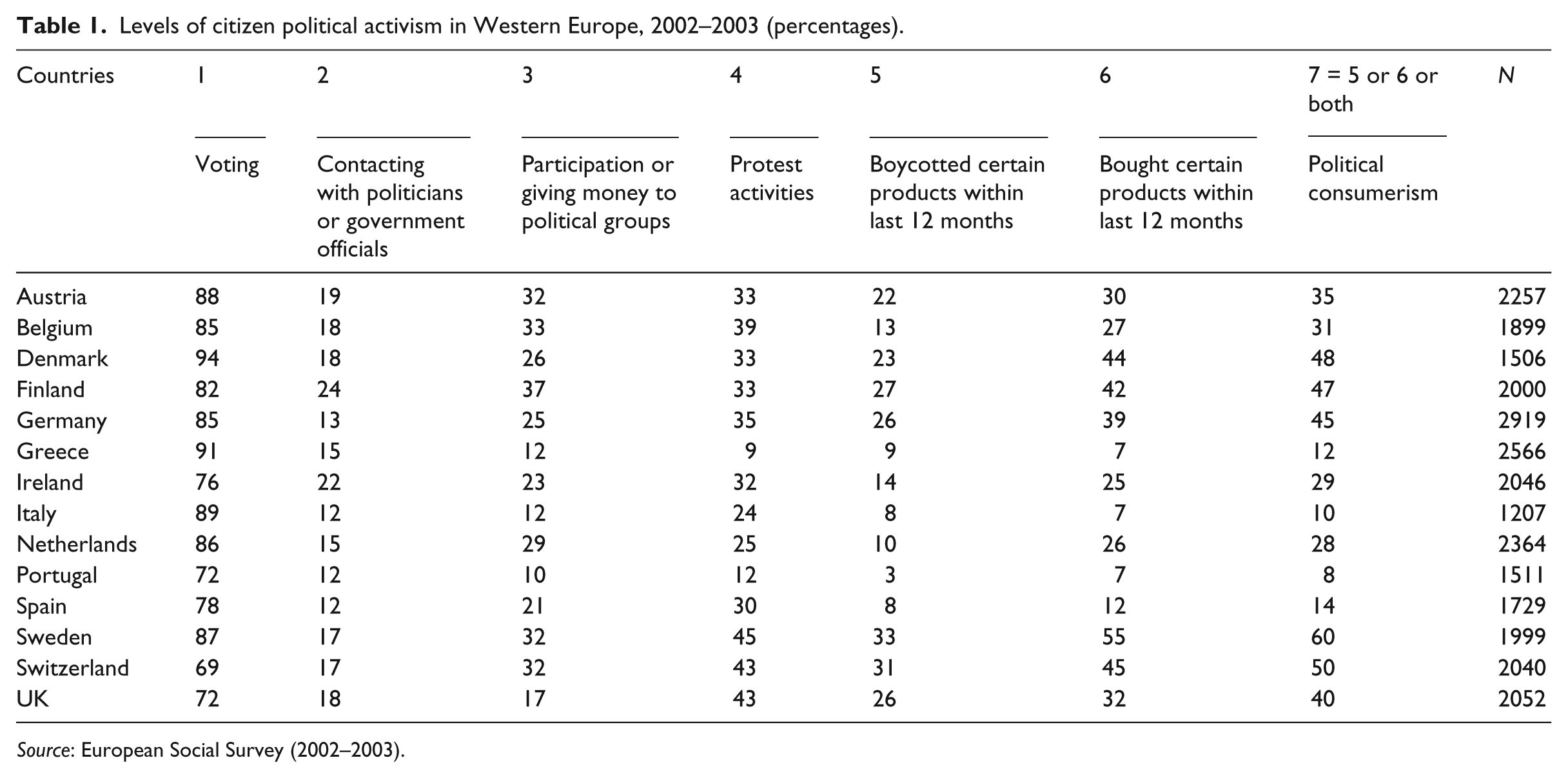
Table 1 presents the rates of different types of political activities in Western Europe and compares the frequency of political consumerism (column 6) with other types of political actions such as voting (column 1), contacting politicians or governmental officials (column 2), participating in or financing political groups (column 3), or being involved in political protests. This table shows that political consumerism is the nonelectoral form of political action that is most frequently reported among respondents across countries, together with protest activities.
Levels of citizen political activism in Western Europe, 2002–2003 (percentages).
Source: European Social Survey (2002–2003).
Table 1 also suggests that there is a huge cross-national variation in political consumerism in Western Europe. This is particularly true of the action of buying products for political, ethical, or ecological motivations (column 6). More specifically, the range of variation between the top (Sweden) and bottom countries (Portugal for boycotting, and Portugal, Italy, and Greece for ‘buycotting’) is 30 percent for negative consumerism and 50 percent for positive consumerism. Sweden presents the highest rates of citizens engaging in both activities followed by Switzerland. In the case of boycotts, the countries that are next highest in ranking are the other Scandinavian countries, the United Kingdom, Germany, and Austria, with rates between 27 and 22 percent. Regarding positive political consumption, we find Denmark and Finland in the top positions with rates around 40 percent, followed by Germany, Norway, and the United Kingdom with one-third of the respondents behaving as political consumers. In contrast, countries presenting the lowest rates of participation in political consumerism are the Southern European countries.
This evidence points to the existence of factors at the macrolevel which influence participation and consumption patterns, which opens up a future line of research to determine why a particular behavior is so deeply rooted in some societies but not in others. Although this is not the aim of the present study, we speculate about the potential influence of various factors based on some evidence provided by recent studies. First, the availability and extension of the distribution points of the supply side (for instance, for eco, organic, or fair-trade products) in each country (Koos, 2012); second, the cultural patterns of consumption, food culture, postmaterialist values, and environmental concern in each country (Thogersen, 2010). There are some European countries, such as the Nordic states, Germany, or the Netherlands, where vegetarianism and ‘green’ consumption are deeply rooted in broad sectors of society. Other factors deal with institutional facilities for financing ecological production and the establishment of legal procedures to stimulate the market share of ethical and sustainable products (or the prohibition of the use of genetically modified products) and the actions adopted by labeling organizations (ecological and fair trade labels) in each country. Moreover, a recent study shows that consumers’ confidence in labels of organic food is higher in countries with substantial state involvement (such as Denmark). This implies that governments have the capacity to influence green consumerism through their involvement in eco-labeling (Sonderskov and Daugbjerg, 2011). An example of institutional involvement, closely related to the next-mentioned factor, is the adoption of fair-trade town policies by cities, villages, boroughs, and so forth as a result of advocate’s campaigns to become recognized as a fair-trade town. 8 Finally, the mobilization strategies of nongovernmental organizations (NGOs) and social movements to stimulate more responsible consumption and/or the realization of boycotting campaigns of certain products or companies might account for contextual differences. Unfortunately, we do not have comparative data available at the country level to measure all these contextual aspects simultaneously. In addition, this research question is well beyond the aim of the present study. For an interesting and recent attempt to operationalize some of the aforementioned factors, see the study of Koos (2012). 9
Table 1 also shows that ‘buycotting’ constitutes a more frequently reported activity than boycotting in most of the countries considered here. This may be related to the fact that the politically motivated boycott of certain goods/enterprises is a more temporary action and easily influenced by the dynamic context of the mobilization campaigns of political or economic groups (Holzer, 2006), whereas ‘buycotts’ may imply more regular patterns of behavior in daily life. Consequently, the indicator of overall political consumerism has a higher representation of positive political consumerism than boycotting actions.
Our key independent variable is social class. We use a modified version of Erikson and Goldthorpe’s (1992) class schema, as summarized in Table 2. Social class is defined on the basis of the employment relation and social characteristics: (a) of the occupation at the time of the interview, if the respondent is employed; (b) of the last occupation, if the respondent is unemployed or inactive but with previous employment experience; and (c) of the occupation of the head of household, if the respondent has never worked. 10 We performed two deviations from the Erikson and Goldthorpe (1992) class schema. First, we separated managers and professionals, and among the latter, we distinguished sociocultural specialists (who include, for instance, medical doctors, social scientists, and teachers) from technical experts (who include, for instance, engineers, computer programmers, and physical scientists). In doing this, we followed recent attempts to take into account the implication of postindustrial transformation for social stratification and, in particular, the coexistence of different ‘work logic’ and ‘interests’ within the service class of Erikson and Goldthorpe’s class schema (Güveli and De Graaf, 2007; Güveli et al., 2007; Kriesi, 1989; Oesch, 2006). Our tripartition of the service class is based on Oesch (2006). 11 Previous research has shown that the service class fractions do differ in their political orientation and voting behavior, with the sociocultural specialists being more leftist (Güveli et al., 2007; Oesch, 2006). We, thus, expected that this distinction would also be relevant to predict the likelihood of engaging in political consumerism. 12
Description of the adapted Erikson and Goldthorpe’s class schema used in the empirical analysis.

The second deviation is that we joined the original category of agricultural laborers (VIIb) with the category of farmers (IVc) under a single heading. The reason is that in the majority of Western European countries analyzed here, the percentage of the total individuals classified as farmers or agricultural laborers is so small that we might encounter problems of statistical efficiency when keeping the two categories separated. 13 We replicated the same analysis, specifying the social class of only those who are currently employed, whereas for the rest of the individuals, we grouped them into their labor market position (that is as unemployed, retired, students, or housekeeping). The results were identical to those presented here (available on request to the authors). 14
In line with previous accounts of political consumerism (and contrary to both postmodern and individualization theories), we expected to find an empirical relationship between citizens’ objective social class and their propensity to engage in political consumerism. More specifically, we expect that the likelihood of engaging in political consumerism might be higher for sociocultural professionals in comparison to other social classes. Moreover the differences might be different in magnitude depending on the class category considered. Our expectation was to find the greatest differences in the likelihood of engaging in political consumerism between sociocultural professionals and manual workers (both skilled and unskilled) followed by the self-employed. Two mechanisms might explain these differences: the different degrees of socioeconomic resources (especially for the contrast between sociocultural professionals and manual workers) and the different values regarding the importance of ethical and environmental causes (especially for the contrast between sociocultural professionals and the self-employed).
Regarding the first mechanism, manual workers are those with the lowest level of income and with the lowest chances to increase their standard of living in the future, whereas sociocultural professionals are those with the highest level of income (together with technical experts, managers, and administrators). Biological, ethical, and organic products are often more highly priced and less accessible than other products at the supermarket; therefore, people with a higher standard of living (like sociocultural professional or technical experts) are more likely to be aware of and have access to these products.
Regarding the second mechanism, we rely on Inglehart’s thesis about the rise of postmaterialist values to explain it (i.e. values connected with a high concern about quality of life, the environment, democracy, and human rights: all of them directly connected with the reasons for practicing political consumerism). If people have a hierarchy of needs (from survival to security, belonging and then self-actualization), then those with the highest standard of living are more likely to have these kinds of priorities in their life, thereby appreciating to a higher extent the value of acquiring biological, ethical, organic products, and so on despite their higher prices in comparison with normal products in the supermarket. Furthermore, sociocultural professionals hold jobs that are not directly instrumental to profit maximization. This fact provides them with relative autonomy in regard to their work tasks. As a consequence, sociocultural professionals are more concerned with the quality of the service they offer than with economic outputs. They also possess specialized knowledge (humanistic and value-laden knowledge) which makes them more sensitive to noneconomic or postmaterialist issues (Güveli et al., 2007).
With regard to the other independent variables, in our empirical analysis, we considered the following individual control variables: gender, age (three categories: from 15 to 34 years, from 35 to 54 years, and from 55 onward), education (four categories: from not completed the first stage of basic education, second stage of basic education, from upper secondary, and tertiary education), monthly family income (four categories corresponding to the four quartiles plus a last noninterpretable category that includes all those respondents who did not provide an answer), and a variable contrasting urban with rural areas where respondents live (value 1 is for urban areas – big cities, suburbs of big cities and small cities, whereas 0 is for rural areas – country villages and farms). 15 We did not include in the empirical analysis, attitudinal variables which might affect political consumerism since our concern is not with finding the best-fitting model, but with testing the hypotheses on the social determinants of political consumerism in Western Europe, much in the same vein as Evans (1999) does in his analysis of class voting. Our contention is that the attitudinal variables (such as interest in politics or trust in institutions) can be considered more as complements rather than rival explanations of political consumerism. Previous studies show that this is indeed the case (see Koos, 2012; Neilson and Paxton, 2010).
In the analysis, we proceeded as follows: First, we discuss the results of the estimation of the social determinants of political consumerism by way of a binomial logit equation whose main results are summarized in Table 3. To better interpret the results of this latter analysis, we calculate the expected probabilities of behaving as a political consumer across countries, education, and class by way of simulations. The result of this exercise is summarized in Table 4 and permits a comparison of the magnitude of the effect of class versus education on the probability of engaging in this type of political action 16 across countries. Finally, we perform a multilevel estimation, which takes into account the clustering of respondents within a given country. Table 5 summarizes the results from this estimation where we also include the results of the estimation of three different equations. The first one replicates the same equation (whose results we have just commented on) separately by country for all pooled data coming from the 14 countries considered here, including robust standard errors adjusted for the 14 country clusters. The second equation departs from the null model – where no information relating to individuals is considered – by analyzing variance between countries (i.e. the variance in the mean level of participation in political consumerism). Finally, the third equation includes all variables at the individual level. Our objective with this last estimation is to test the robustness of the results even after considering the clustering of respondents within countries and to have an idea of the cross-country variation reduced once we control for the individual level variables of relevance here.
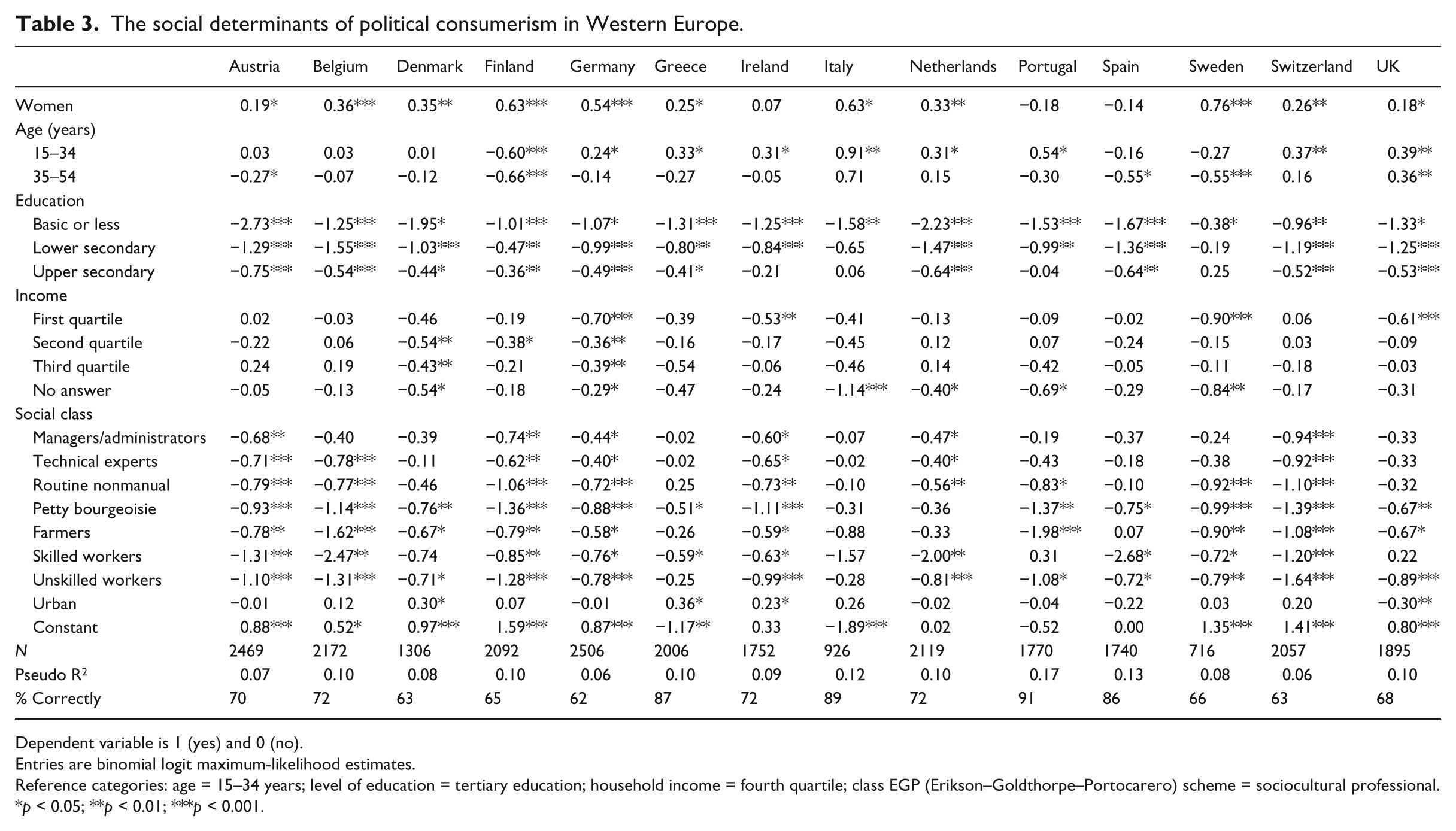
The social determinants of political consumerism in Western Europe.
Dependent variable is 1 (yes) and 0 (no).
Entries are binomial logit maximum-likelihood estimates.
Reference categories: age = 15–34 years; level of education = tertiary education; household income = fourth quartile; class EGP (Erikson–Goldthorpe–Portocarero) scheme = sociocultural professional.
p < 0.05; **p < 0.01; ***p < 0.001.
Predicted probabilities of behaving as political consumers in Western Europe for different levels of education and social classes.

Source: our elaboration based on the results of the estimations summarized in Table 3 (for each country, respectively).
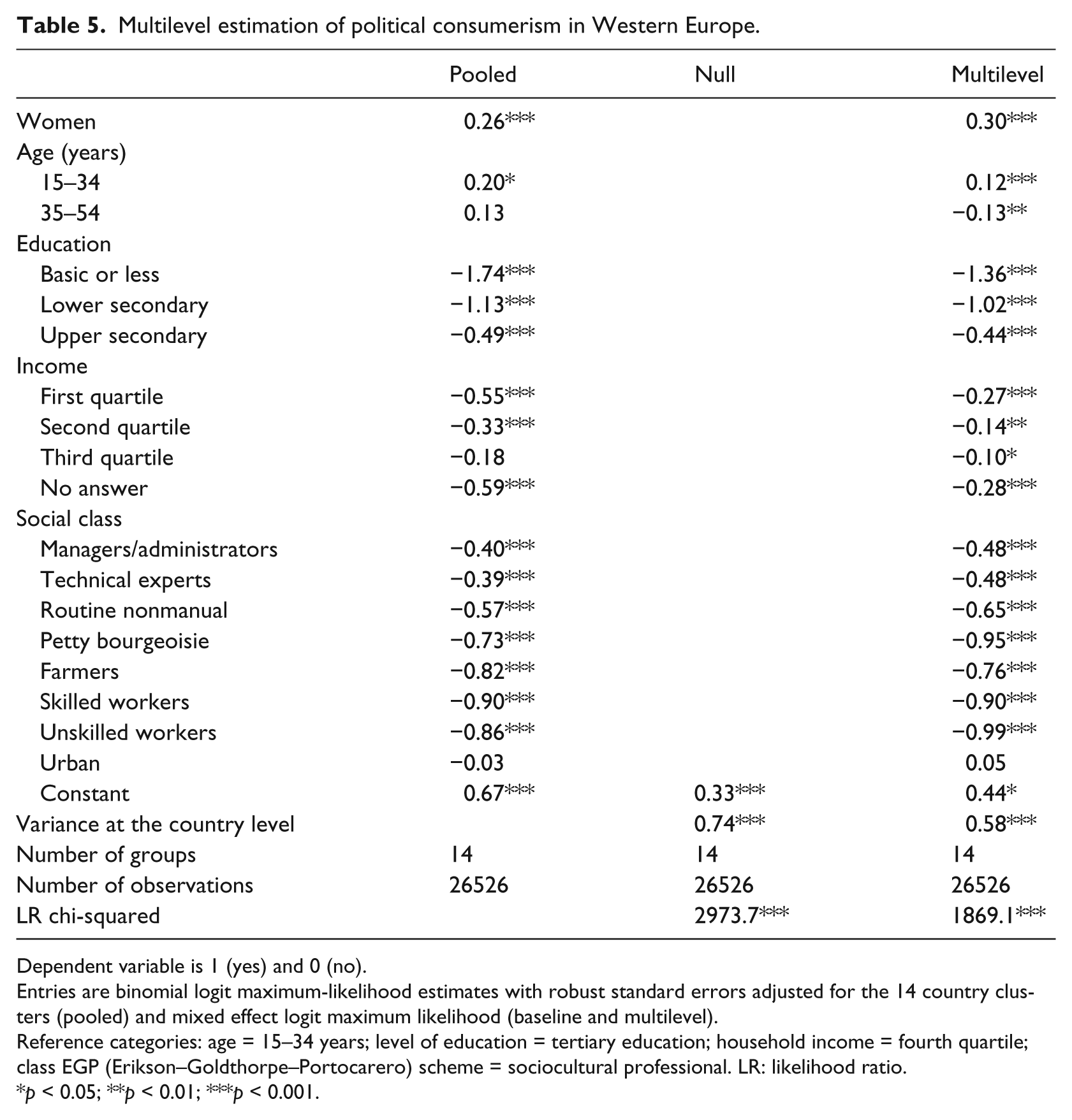
Multilevel estimation of political consumerism in Western Europe.
Dependent variable is 1 (yes) and 0 (no).
Entries are binomial logit maximum-likelihood estimates with robust standard errors adjusted for the 14 country clusters (pooled) and mixed effect logit maximum likelihood (baseline and multilevel).
Reference categories: age = 15–34 years; level of education = tertiary education; household income = fourth quartile; class EGP (Erikson–Goldthorpe–Portocarero) scheme = sociocultural professional. LR: likelihood ratio.
p < 0.05; **p < 0.01; ***p < 0.001.
Empirical findings
We estimated a binomial logit equation of the propensity of having performed an action of political consumerism as a function of gender, age, education, family income, urban versus rural areas of residence, and social class. Table 3 summarizes the results of the estimation. Initially, it suggests an interesting result, which is that women are more likely to engage in political consumerism than men. This pattern is in line with previous studies on historical forms of boycotts that show that the leading figures of this form of protest are women (see Friedman, 1999; Micheletti, 2003). Recent empirical works also signal political consumerism as a women-friendly form of political engagement (Ferrer-Fons, 2006; Stolle et al., 2005; Stolle and Micheletti, 2005). A possible explanation for this gender effect is that women have usually been, and still are, in charge of the ‘shopping basket’ in most European countries. Other alternative explanations highlight the traditional discrimination against women in the recruitment networks for political action and the most institutionalized political activities (Burns et al., 2001). Following this reasoning, women act as political consumers as an alternative to their exclusion from participating in the mainstream of politics. Furthermore, the situational model explains that women behave differently in their political participation than men due to their responsibility as partners and mothers. In the case of critical consumption, women participate more because they are more worried about the effects of consumer goods on their families and on humanity in general. The perception of risk in questions such as climate change, the consumption of genetically altered products and world hunger is greater in women, and this has also been related to their greater political consumerism (Halkier, 2004; Micheletti, 2004).
The effect of age is, however, less clear-cut. On the one hand, the youngest group (15–34 years old) shows the highest levels of political consumerism in eight countries (Germany, Greece, Ireland, Italy, the Netherlands, Portugal, Switzerland, and the UK) thereby confirming the findings from previous literature (see, for instance, Stolle et al., 2005). On the other hand, the age group from 35 to 54 years is the most active in political consumerism in four countries (Austria, Finland, Spain, and Sweden). Finally, we find no age differences in the case of Belgium and Denmark.
Table 3 also shows that political consumers are highly educated citizens in all the countries considered. The differences between citizens with tertiary education (the category of reference in the estimation equation) and citizens with the lowest level of education (those who have not completed studies up to first basic education) are huge in most countries.
Regarding the effects of monthly family income, Table 3 also suggests that the likelihood of engaging in political consumerism is higher for citizens with higher economic resources, as previous studies demonstrated (Koos, 2012; Neilson and Paxton, 2010), for this and other forms of nonelectoral political participation (Parry et al., 1992; Stolle and Hooghe, 2011; Verba et al., 1995). However, the evidence is limited to only some of the countries considered here. More specifically, citizens in the first, second, and third quartiles present a significantly lower propensity to engage in political consumerism in comparison to citizens in the fourth quartile only in two countries: Germany and Denmark. This contrast turned out to be statistically significant only for the case of first versus fourth quartile in Ireland, Sweden, and the United Kingdom. The fact that these results cannot be inferred to the whole sample of countries considered here might be due to the classic lack of validity for the indicator used for operationalizing income (i.e. the social desirability problem when measuring income with surveys).
Finally, the contrast between urban and rural areas of residence does not generate relevant findings. Living in an urban area (instead of a rural area) increases the likelihood of engaging in political consumerism only in three countries: Denmark, Greece, and Ireland. The effect is exactly the opposite for the case of the United Kingdom where living in a rural area increases the probabilities of political consumption.
But what appears to be more relevant for the aim of this study is that the effect of social class still holds after controlling for both education and family income. The sociocultural professionals are the reference category. The negative coefficients of the bottom part of Table 3, thus, suggest that in all countries, the likelihood of engaging in political consumerism tends to be lower in all social classes when compared to the sociocultural professionals. The lowest likelihood is generally found among manual workers (skilled and unskilled) and among the self-employed. These findings are, thus, in line with the results of previous studies showing that the political orientation and behavior of sociocultural professionals differ from that of managers and technical experts (Güveli et al., 2007; Oesch, 2006). Differences between sociocultural professionals and managers and technical experts are statistically significant in seven of the total countries considered here. Moreover, the distinction of different factions within the service class seems particularly relevant in the countries of continental Europe and Ireland. 17
To make the results more easily comparable across countries, in Table 4, we have transformed the estimated coefficients through the binary logit function into predicted probabilities of having behaved as a political consumer by way of simulations. The results of Table 4 show that the magnitude of class differences varies across country. If one focuses on the sociocultural professionals and the unskilled workers, the differences in their probabilities of being political consumerist are particularly low in Southern European countries. One possibility is that the result might simply reflect a ‘floor effect’, that is, the overall incidence of political consumerism is so low that differences between classes cannot be large, but further research is needed to infer some robust conclusions from this evidence. On the other extreme, one finds rather large differences (above 30 percentage points) in Switzerland and Finland. The other Scandinavian countries considered in the analysis (Denmark and Sweden) and the Netherlands lean toward the cluster of those with relatively small class differences although the differences with the remaining countries are not clear-cut.
All these findings do not, therefore, portray a clear pattern of cross-country differences in the magnitude of the relationship between class and political consumerism. One possibility is that the meaning of political consumption (in particular, critical buying) might be different across countries – being less political in more affluent and egalitarian societies. The rhythm of the expansion of the availability of eco, organic, and fair-trade products in the supermarkets is definitely faster in Central and North European countries than in their Southern European counterparts. When these products are easily available in the stores, people get used to them and normalize their frequent acquisition, thereby converting the action of shopping for these products as a form of status consumption rather than a kind of thoroughly motivated political action. In contrast, the expansion of these products is a more recent phenomenon in Southern European countries (at the time when the survey was carried out, the beginning of the 2000s, the availability of these products was quite limited in these countries, basically through NGOs, small-scale cooperatives, etc.). So buying eco, organic, or fair-trade products might have a stronger political meaning in terms of motivations in those countries where the prices of these products are still very high (in comparison with the others) and their availability quite limited.
We performed a further explorative analysis at the aggregated (country) level by plotting the differences in the probabilities of engaging in political consumerism between a citizen classified as a sociocultural professional and a citizen classified as a skilled worker with two indicators of affluence and social inequality in Europe: the gross domestic product (GDP) per capita and the Gini index, respectively (both indicators where obtained in United Nations, 2001).
Figure 1 suggests that the higher the affluence of the countries, the higher the magnitude of the class differences in the probabilities of engaging in political consumerism. In fact, the correlation coefficient between these two variables at the aggregated level is statistically different from 0 (0.76). Figure 2 as a complement suggests that the magnitude of the class differences decreases as country inequalities increase (the correlation coefficient is equal to −0.52 and statistically significant). Even if these results are interpreted with caution because they refer to a correlation with only 14 observations, they speak in favor of the hypothesis that the meaning of political consumption (especially positive buying) might be different across countries.
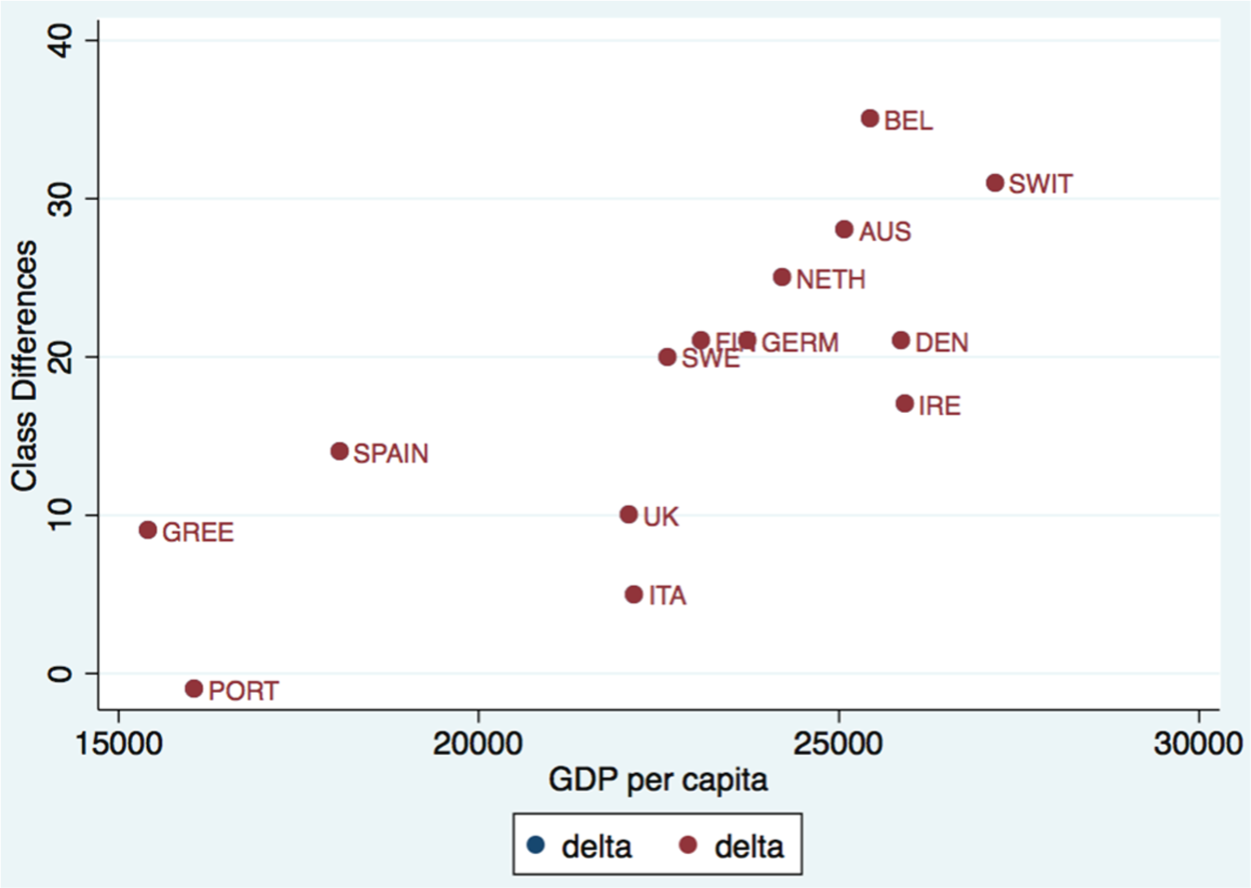
Class differences and GDP per capita across countries.

Class differences and Gini coefficient across countries.
An alternative and final strategy to deal with the cross-country variance in the propensity to engage in political consumerism is to take the clustering by country into account when estimating the effect of class on political consumerism. Again, we lack statistical efficiency since we only have 14 countries at the second level. Even so, we want to explicitly measure the percentage of country-level variation in relation to individual-level variation and to control for the cross-country variation, once we specify in the equation all the individual-level variables considered here.
The results of these last estimations are summarized in Table 5. The third column (which includes the results of the estimation of the null model with no information at the individual level) provides a measure of the total variance across countries. This variance is reduced from 0.74 to 0.58 when we take into account the individual-level variables considered here – that is class and all the socioeconomic resource variables that represent the main rival hypothesis to that of the decline of social class as a predictor of political behavior. How can we interpret these results? On the one hand, they confirm the robustness of the previous findings since the effect of class on political consumerism remains statistically significant after taking the clustering by country into account. Hence, we might conclude that the social determinants of political consumerism appear to be highly relevant and reproduce the patterns of social inequality associated with other modes of political participation (see, inter alia, Verba et al., 1978, 1995). In general, the results of the analysis suggest that political consumers are, by and large, found among citizens with high levels of socioeconomic resources, that is, the well-educated, high-income earners, and middle-aged citizens, who are employed and, in particular, belong to the fraction of the sociocultural professionals of the service class.
The relatively modest degree of reduction of variance at the country level also suggests the relevance of cross-national variation in political consumerism. To answer this question is, however, beyond the scope of this article but future research on the field of political consumerism might go in this direction as two recent studies do (Koos, 2012; Neilson and Paxton, 2010).
Discussion
To use an expression of Robert Merton (1987), in this article, we endeavored to establish a social phenomenon, namely, the extent of class differences in political consumerism across countries. We argued, therefore, that this mode of political participation (which includes both boycotting and buying for political, ethical, and/or ecological reasons) offers a particularly appropriate case for testing the hypothesis of the decline of social classes drawn from individualization and postmodern theories of social stratification. A derivation from these theories states the hypothesis that social classes are blurring as predictors of individual political behavior. This claim, then, should be particularly true for political consumerism that is defined as individualized and global-oriented action, which requires only sporadic mobilization efforts (Micheletti, 2003).
However, other lines of research demonstrate that individual resources constitute an important determinant of political consumerism as a particular form of political engagement (Koos, 2012; Stolle and Hooghe, 2011). In line with these recent studies, the main findings of our empirical analysis can be summarized as follows. First, political consumerism is the most common nonelectoral political action in which Western European citizens engage, together with protest activities. On average, in the 14 European countries considered in this article, one citizen in three had engaged in at least one act of political consumerism in the year before the survey (2002–2003). Second, country differences are huge. At the extremes, 60 percent of the Swedes are political consumers compared with only 8 percent of the Portuguese. Third, and most importantly, besides these country differences in the overall diffusion of this sort of political behavior, a common sociodemographic profile of political consumers is found in all countries. In general, political consumers are well-educated, high-income earners and middle-aged citizens, who belong to the class category of sociocultural professionals. Moreover, the differences among sociocultural professionals, managers, and technical experts within the service class are statistically significant in most of the countries considered. In this respect, our results confirm the usefulness of separating distinct fractions of the service class in order to better predict people’s current political orientation and behavior (Güveli et al., 2007; Oesch, 2006).
Still, the main theoretical interest of our article lies in the large class-effect that is consistently documented for all the countries, with the sole exception of Italy. Contrary to the hypothesis of the decline of class politics, we show in fact that social class strongly affects the likelihood of engaging in political consumerism, thereby confirming the alternative arguments of the literature on consumption and consumer culture. For instance, in Sweden, the probability of a sociocultural professional engaging in political consumerism is high (0.76). This probability decreases to 0.58 for an unskilled manual worker (see Table 4). A similar effect is also found in the other countries, although with changing magnitude among them (in any case, with a difference in the probabilities of becoming political consumerists still above 20 percentage points between service-class members and unskilled workers). In Southern Europe, one finds class differences but these are, in general, smaller although statistically significant as Table 3 suggests.
In sum, the results of this article cast a number of serious doubts on the claims of the decline of class politics that postmodern and individualization theories popularize, both in the academic literature and in the media. In line with Bourdieu’s perspective of consumption as a determinant of class (and vice versa), and also with the literature studying nonelectoral political participation, our findings rather suggest that the emergence of new channels of political participation does not automatically mean the decline of class politics since the social determinants of political consumerism largely reproduce the pattern of social inequality intrinsic to other modes of political participation (Verba et al., 1978, 1995).
Finally, our results raise an important question for future research, which is the study of the contextual determinants of political consumerism. Why is it the case that in Nordic countries, about 1 in 2 citizens consumes politically, and only 1 in 10 does so in Southern Europe? The multilevel estimation shows that the social determinants of political consumerism contribute to significantly reduce the cross-country differences, but with a relatively modest magnitude. The compositional effects of individual-level variables significantly reduce the variance at the country level from 0.74 to 0.58. This suggests the need for additional research and theoretical reflection on these issues and the importance of the systematic study of the potential contextual factors in shaping cross-country differences in political consumerism.
Although this constitutes a promising line of research in the literature, systematic studies about the contextual determinants of political consumerism are still scarce. A recent contribution is the study of Koos (2012) who finds that economic opportunities and statist political institutions are the most relevant contextual factors influencing political consumerism at the individual level. He finds, however, no evidence in favor of the effect of social movement organizations, postmaterialist values, or civic cultures of trust. In contrast, a study by Neilson and Paxton (2010) shows that citizens with greater personal social capital and those living in regions with higher mean levels of social capital are more prone to engage in political consumerism.
Two other studies show the importance of the comparative dimension in the study of political consumerism. Research on consumers’ attitudes to animal welfare suggests cross-national European differences regarding the subjective understanding of consumer responsibilities (Kjaernes et al., 2007). In a critical assessment of the literature on political consumerism, Jacobsen and Dulsrud (2007: 469) argued that consumers in different countries assess their responsibilities and their powers as consumers differently due to diverse institutionalizations within distinctive contexts.
To close, the scarce evidence about the contextual determinants of political consumerism appears to be inconclusive. A future research agenda needs to develop both additional analytical frameworks and empirical tests of the potential determinants of individual participation in political consumerism at the country level. This implies the need to develop comparable indicators of all the potential institutional, cultural, and economic factors shaping political consumerism across countries and time. While this study shows that social class is alive and well and in good shape in influencing citizens’ likelihood of engaging in political consumerism, it also highlights the need to look for additional explanations of this economic and political phenomenon that has been gradually growing since the beginning of the century.
Footnotes
Funding
This research received no specific grant from any funding agency in the public, commercial, or not-for-profit sectors.