




Abstract
Observers of economic policy-making in developing countries often suggest that consensus and cohesion within technocratic policy elites facilitate the implementation and consolidation of reforms, but have not clearly defined these terms or the relationship between them. Likewise, political sociologists argue that social networks account for elite cohesion, but have not adequately specified the relevant structural properties of these networks. This article argues that structural network cohesion facilitates elite consensus formation by enabling cooperation, while fragmented networks promote competition between factions and hence conflict. I support this hypothesis empirically by examining two cases in which elite consensus was severely challenged by financial crises: Mexico and Argentina. Mexican policy elites sustained consensus throughout the crisis, whereas conflict plagued the Argentine elite. Likewise, while the Mexican technocratic elite is highly cohesive, the Argentine elite is fragmented and factionalized. I document this hypothesis using a mixed-methods approach that embeds an analysis of elite networks within a comparative analysis of policy-making patterns drawing on extensive fieldwork in both countries.
Technocratic elites are key actors in the transformation of economic policy, particularly in the developing world. Many researchers argue that professional economists and other policy experts occupying senior positions in state agencies such as central banks and finance ministries have facilitated the emergence of pro-market policy consensus (Babb, 2001; Centeno, 1997; Chwieroth, 2010; Dezalay and Garth, 2002; Fourcade, 2006). Scholars also argue that the ability of these technocratic elites to maintain internal consensus is a crucial variable in the policy-making process, because internal unity helps reform advocates maneuver in difficult political environments (Chwieroth, 2007; Dargent, 2014; Haggard and Kaufman, 1995; Teichman, 2001; Williamson and Haggard, 1994). However, the literature does not define elite consensus and cohesion systematically, risking conflation of ideational and structural concepts; likewise, while political sociologists claim that networks account for elite cohesion, they do not adequately specify the relevant structural features of these networks. This article clarifies this relationship, differentiating between consensus as a state of expressed policy opinions and structural network cohesion, and showing that variation in elite cohesion can account for policy consensus.
In order to do so, I examine consensus formation among technocratic policy elites in two countries, Mexico and Argentina, during major financial crises (in 1994 and 2001, respectively). Financial crises impose major strains on elites and pose a series of macroeconomic policy challenges including fiscal policy, debt management, monetary and exchange rate policy, financial regulation, and bank ‘bailouts’. In this context, elite consensus is not a foregone conclusion, and the absence of policy debate invites explanation. In the Mexican case, technocrats sustained consensus despite adopting policies that garnered significant external criticism. In contrast, Argentine elites were divided by intense conflict despite shared professional backgrounds and partisan affiliations. In comparative perspective, these two cases pose a puzzling contrast between elite consensus and conflict. Conventional theories based on political institutions, elite professionalization, and sectoral business interests cannot account for these divergent policy-making processes. This article thus underscores the importance of a relational perspective on policy-making, and in particular the role of elite networks in shaping policy-making dynamics.
I argue that the structure of elite networks plays an important role in moderating elite conflict, facilitating cooperation and consensus formation when networks are cohesive while promoting dissent when elites are fragmented and factionalized. In Mexico, a cohesive elite formed in the 1980s, effectively putting policy control in the hands of a close-knit group of technocratic officials; this cohesive structure facilitated consensus formation despite major policy failures and external criticism. In contrast, the Argentine policy elite is fragmented: structurally disconnected individuals and factions compete for policy influence, promoting conflict. This article documents the link between elite cohesion and consensus formation using a mixed-methods approach that embeds an analysis of elite networks within a comparative examination of policy-making dynamics relying on extensive interview-based fieldwork. The broad analysis follows a cross-national comparative design, while the network analysis deploys a larger-N approach within each country. Cohesive blocking analysis (Moody and White, 2003) of elite networks documents the greater cohesiveness of the Mexican bureaucratic elite, while qualitative data provide evidence of the varying level of consensus and the mechanisms linking this outcome to elite network structure.
The following section reviews previous discussions of elite consensus and cohesion in the literature on economic policy-making, clarifying these concepts and the relationship between them. Next, I briefly introduce the qualitative data, document the varying level of elite consensus, and describe mechanisms of consensus formation. The following section details the network methodology and shows that the Mexican bureaucratic elite was substantially more cohesive than its Argentine counterpart. Then, I address alternative explanations for elite consensus. The conclusion returns to the implications of elite cohesion for policy implementation and consolidation, as well as broader theoretical implications.
Technocratic elite cohesion and policy-making
Many scholars observe that in developing countries, technocratic elite cohesion and consensus are crucial variables in the policy-making process. When policymakers adopt often unpopular liberalization and austerity measures, internal unity facilitates policy implementation and consolidation. For example, Centeno (1997) notes that ‘no reform program can proceed if there are divisions regarding appropriate policies within the ruling circles … The alternative to such a cohesion may be elite gridlock’ (p. 36). Likewise, many political scientists argue that a ‘coherent’ or ‘cohesive’ technocratic ‘reform team’ is critical to the success of liberalization projects (Chwieroth, 2007; Haggard and Kaufman, 1995; Teichman, 2001; Williamson and Haggard, 1994). Similarly, Dargent (2014: 55–57) claims that consensus among technocratic experts increases their leverage by de-legitimizing policies not supported by these elites.
However, the literature has not defined elite ‘cohesion’ and ‘consensus’ explicitly and risks conflating distinct concepts. Cohesion most often implicitly refers to homogeneous policy preferences among elites; however, some authors also imply a structural component. For example, Williamson and Haggard (1994) equate cohesion with both the unity and the ‘organization’ of the reform team, without defining ‘organization’. Similarly, Teichman (2001: 90) moves freely between the terms ‘consensus’ and ‘cohesion’, a concept with structural implications. These discussions thus risk conflating two distinct concepts: the homogeneity or unity of elite policy preferences, and the organizational or structural properties of the policy elite. In order to avoid this conflation, I distinguish between consensus, defined as the homogeneity of expressed policy preferences, and cohesion as a structural property of policy elites (defined shortly). Observationally, consensus is the absence of visible dissent among elites. This is a deliberately limited conception of consensus, because the absence of dissent does not necessarily imply positive acceptance of a policy program. However, suppressed beliefs are unobservable to other elites, making them like the proverbial tree falling in an empty forest. Hence, this definition refers to observable behaviors, rather than latent attitudes.
The fact that cohesion and consensus seem so closely linked to many researchers suggests that there may be an underlying regularity linking structural cohesion to consensus. Discussions of elite networks in the political sociology literature suggest, but do not systematically theorize or investigate this relationship. For example, Centeno (1997) suggests that in Mexico, the character of elite political networks ‘helps explain the surprising cohesiveness of the elite’ (p. 146). More broadly, Evans (1995: 49) argues that in developmental states ‘internal [interpersonal] networks are crucial to the bureaucracy’s coherence’, above and beyond the ‘Weberian’ features at the core of his account. These accounts imply that networks somehow account for ‘cohesion’ and ‘coherence’, but do not adequately specify the features of networks that produce cohesion. Insofar as cohesion is a property of social networks, it risks circularity to argue that networks ‘account for’ cohesion. Thus, I reformulate this suggestion more precisely as the hypothesis that the structural cohesion of policy elites facilitates the formation of policy consensus.
This hypothesis is consistent with a long line of social network theory which links cohesion to consensus and group solidarity more broadly (Friedkin, 1998, 2004; Knoke, 1990; Mizruchi, 1992; White and Harary, 2001). Broadly, network theorists define cohesion as a structural pattern of ties (relationships) among nodes (individuals) in which dense, reciprocated, or multivocal ties define closely interconnected social groups. This broad definition can be operationalized in multiple, mutually complementary ways, many of which rely on the concept of shortest paths, or the most efficient set of steps between any two nodes in a social network. From this standpoint, cohesion is defined as the degree to which a network is held together by multiple independent paths. More formally, a group of actors is cohesive to the extent that its survival is not contingent on any particular relationship; severing one relationship does not break apart the group as whole (Moody and White, 2003; White and Harary, 2001).
Discussions of elite cohesion in the political sociology literature cited above are, at best, partially compatible with this approach. Some authors equate cohesion with connectivity – the prevalence of ties – itself. For example, Evans (1995: 49) implies that connections based on informal school ties are sufficient for ‘coherence’. Other authors go further in the structural direction; Centeno (1997: 146) describes Mexican elite networks as pyramidal patronage structures. However, mere connectivity is the weakest conception of cohesion; moreover, from the standpoint of network theory, hierarchical patronage systems (see Martin, 2009: ch. 6) are by definition not structurally cohesive. This is because hierarchical structures are highly vulnerable to the removal of central nodes: if the ‘patron’ at the apex of the pyramid is removed, the network falls apart. For example, if a senior political figure retires, the network ceases to meet even the most minimal definition of cohesion.
Thus, it is important to specify more carefully the properties of elite networks that make them cohesive. Following social network theory, a cohesive policy elite is one in which dense interconnections make senior policymakers members of a meaningful social group, independent of the formal bureaucratic structure of the state. These connections are informal ties of trust which shape elite behavior in the policy-making process. These informal ties may originate in common education, accumulated experience, or joint affiliations with external organizations (such as think tanks). Conversely, when the elite is divided into multiple groups, the elite is fragmented or factionalized. Two key dimensions of cohesion, inter-organizational cohesion, or the extent to which technocrats in different state organizations are members of the same cohesive group, and inter-cohort cohesion, or the extent to which successive waves of senior officials, are densely interconnected. When either organizations or cohorts are not densely linked, the elite structure is fragmented.
Because this article relies on a cross-national comparative methodology, specifying and documenting clear mechanisms linking network structure to consensus formation provides an important source of evidence (Mahoney, 2004). To the extent that technocratic policymakers form a cohesive group, two main mechanisms enable elites to cooperate and form consensus: deference and dialogue. Deference refers to the willingness of individuals to ‘subordinate their desires to collective expectations in anticipation of … the long run market advantages [that accrue] by virtue of group membership’ (Portes and Sensenbrenner, 1993: 1325). These long run advantages include both material payoffs (particularly opportunities for career advancement) and more symbolic benefits, such as the identity associated with group membership itself (Podolny and Baron, 1997). Dialogue refers to sustained, multi-directional communication resulting in collective (rather than individualistic) formation of preferences. Both deference and dialogue facilitate cooperation, rather than competition, in the policy-making process, helping elites form consensus.
Conversely, when elite structure is fragmented, officials are isolated or form distinct factions. These individuals and groups compete, rather than cooperate, in the policy-making process. Freed of the strictures of group deference, policy-making behavior is entrepreneurial and opportunistic, as elites seek to promote their policy agendas over those of competitors. Rather than develop policy preferences collectively, individual elites or factions formulate their policy preferences independently and seek to impose these preferences, even in the face of criticism. Such entrepreneurial behavior foments conflict when multiple individuals or factions simultaneously attempt to shape the direction of policy. To the extent that distinct factions or individuals are locked in a zero-sum competition for policy influence, they are more likely to engage in opportunistic behavior, such as attacking competitors’ policy positions in order to gain attention and advance their own agenda. Due to the absence of channels for dialogue, communication failures are common, exacerbating conflicts.
While these mechanisms of consensus formation are difficult to observe in the opaque world of high-level policy-making, in the next section I present evidence of deference and dialogue in Mexico and elite competition, policy entrepreneurship, and communication failure in Argentina. Combined with evidence of differing network structures, these mechanisms provide substantial support for the hypothesis that network cohesion facilitates elite consensus formation. Nevertheless, it is also important to consider alternative explanations for the outcomes described below. I consider three such alternatives empirically below.
First, elite network structure may not be an independent determinant of policy consensus, but rather a reflection of underlying political institutions, such as the political regime and party system. Partisan political actors have incentives to appoint loyalists rather than independent technocrats (Geddes, 1994). Different levels of elite conflict may therefore be a result of variation in the level of political competition between parties. Before 2000, the Mexican state was dominated by a stable, semi-authoritarian regime directed by the Institutional Revolutionary Party (PRI). In contrast, despite a long history of military rule, in 1983 the Argentine polity transitioned to a competitive (if chaotic) democratic system characterized by regular alternation between political parties. These institutional features undoubtedly play a role in explaining the structure of elite networks. However, there is no simple correspondence between political institutions and elite cohesion or consensus; in particular, elite cohesion and consensus varied over time in Mexico while political institutions remained roughly constant. Thus, broader political institutions shape, but do not determine, elite network structure and consensus.
A second alternative explanation rests on the role of economic ideas (Blyth, 2002) and the professional training of policy elites (Chwieroth, 2007). Many analysts argue that the increasing influence of technocratic policymakers with economics credentials, particularly from elite North American economics departments, contributes to the formation of a pro-market policy consensus in developing countries (Babb, 2001; Chwieroth, 2007; Dezalay and Garth, 2002). Chwieroth (2007) measures ‘coherence’ as the number of US-trained economists among senior macroeconomic policymakers. Thus, the greater level of elite consensus in Mexico may be explained by more extensive professionalization of the policy elite, and in particular the dominance of US-educated economists. However, I find that common training may facilitate consensus but is not sufficient; in Argentina, conflict occurred both among policymakers with elite economics backgrounds and those without them. Thus, while ideas are certainly relevant to policy preferences, professional training does not provide a systematic explanation of elite consensus.
A final alternative explanation concerns the role of organized economic interests outside the state. Both crises involved policy issues with differential effects across economic sectors, giving organized business a substantial stake in policy decisions. 1 If technocrats are the agents of business principals, differing degrees of permeability or capture of state organizations to these external demands might explain varying levels of elite conflict. However, as I show below, the preferences of technocratic elites cannot always be reduced to those of particular sectors of business.
Crisis, macroeconomic policy, and elite consensus
In order to document the level of elite conflict and the mechanisms of consensus formation, I draw on qualitative data, including author’s interviews, recorded oral history interviews, 2 published and unpublished documents, and press reports. I interviewed 100 individuals (49 in Argentina, 44 in Mexico, and 7 in Washington, DC), primarily between 2008 and 2010. Interviewees included 11 former finance ministers and central bank presidents; 63 percent of in-country interviews were with former senior policymakers and 68 percent with elites who had occupied any policy position. The remaining interviews were with academics, private sector observers, and international policymakers with insight into the policy-making process in these countries. Interviews were open-ended and varied in content depending on the knowledge of the interviewee. These sources permitted reconstruction of the decision-making process around particular policies. For each policy decision, I determined, to the extent possible, the central actors involved, the origin of policy initiatives, and the positions taken by influential officials. In the course of producing these accounts, it became clear that there were frequently sharp differences of opinion, competing policy proposals, mutual attacks, and open struggles over policy in Argentina, while these dynamics did not occur in Mexico. In what follows, I first discuss the macroeconomic dynamics of the crises in order to establish their similarity, and then discuss the variation in elite conflict and mechanisms of consensus formation.
Macroeconomic dynamics: similarities and differences
Like many ‘emerging market’ countries during the 1990s and early 2000s, Mexico and Argentina experienced major financial crises sharing a number of common features (Calvo, 2007; Eichengreen, 2004; Kaminsky and Reinhart, 1999). Following the ‘lost decade’ of the 1980s, both countries achieved monetary stability and experienced economic booms in the early 1990s. In both cases, monetary policies known as ‘exchange rate-based stabilization’ attracted financial inflows, fueling growth but also resulting in currency over-valuation, balance of payments deficits, and growing debt (Woodruff, 2005). In the Argentine case, fiscal deficits exacerbated debt accumulation. When capital flows reversed due to a variety of economic and political shocks, both countries were faced with economic collapse and large stocks of dollar-denominated debt. Both were forced to devalue their currencies, threatening to drive both the financial system, and the state itself into bankruptcy. While Mexico narrowly avoided default, Argentina ceased payments on its foreign debts in what was at the time the largest sovereign default on record (Blustein, 2005).
Despite these similarities, it could be that differences between these crises might themselves account for the greater level of elite conflict in Argentina. The Argentine crisis was longer, deeper, and involved a more dramatic political collapse, sparked by a presidential resignation in 2001, suggesting that consensus may have been simply easier to reach in Mexico. Nevertheless, while the Argentine crisis was indeed more dramatic, the severity of the Mexican crisis should not be understated. In some respects, the Mexican crisis was actually stronger; for example, International Monetary Fund (IMF) estimates put the fiscal cost of the Mexican bank bailout at 19 percent of gross domestic product (GDP), nearly twice that of Argentina (Valencia and Laeven, 2012). An important assumption of this article is that elite consensus in Mexico cannot be explained by the absence of controversial policy decisions. This assumption is justified by substantial external criticism of Mexican policies and the political consequences of the crisis.
Mexican policymakers made several policy errors and controversial decisions that drew international criticism, but did not create internal conflict. First, international economists (Dornbusch and Werner, 1994) criticized policymakers’ inertia on the over-valued exchange rate and balance of payments deficits. Second, many international observers (such as the Wall Street Journal) blamed the central bank’s monetary policy for the crisis. Third, finance ministry officials switched to dollar-denominated government bonds during the crisis, thus absorbing exchange rate risk for international investors. This had the effect of dramatically increasing the Peso value of the Mexican debt following the devaluation, driving the state to the brink of bankruptcy. Fourth, inadequate financial supervision and an ill-managed bank bailout received criticism from international observers, including an independent auditor commissioned by the Mexican Congress. 3 Yet while these problems attracted the attention of international observers, they did not generate competing policy proposals and internal conflict – as a similar set of issues did in Argentina.
Moreover, while Mexico did not experience the deep political crisis that Argentina did, the political strain imposed by the crisis was significant: dissatisfaction with the ruling PRI probably contributed to the party’s loss of control over Congress in 1997 and subsequent historic loss of the presidency in 2000 (Starr, 1999). The re-invigorated legislative arena resulted in broader contestation of the technocratic elite’s handling of the financial crisis, particularly over the fiscal cost of the bank bailout. Yet while this broader political contestation directly implicated the technocratic elite, it occurred post hoc and reflected criticism of this elite, rather than conflict within the elite itself. Thus, the political strain imposed by the crisis was substantial, raising the question of how technocratic elites closely linked with the PRI were able to avoid conflict despite these strains.
Finally, some observers might attribute elite conflict in Argentina to particularities of the policy context, such as the particularly rigid version of exchange rate-based stabilization (the so-called ‘convertibility’ system, which fixed the national currency to the dollar by law). However, elite conflict was greater across a wide range of policy issues, including the rescue of the financial sector, the design of a post-crisis monetary policy, and management of sovereign debt. For example, conflicts between the Argentine central bank and finance ministry over the bank bailout were more intense than in Mexico, despite the fact that the bailout in Mexico proved more costly. These conflicts began before and persisted well after the peak of the crisis and the collapse of the government; contention between the central bank and finance ministry remained intense even when the leaders of these organizations were appointees of the same president, and when the economy was beginning to emerge from the crisis. Thus, while the longer and deeper Argentine crisis may have created more raw materials for elite conflict, the character of the crisis itself does not explain the policy-making dynamics.
Mechanisms of elite conflict and consensus formation
This section shows that despite facing similar policy issues, the Mexican bureaucratic elite was able to sustain consensus, while policy-making in Argentina was plagued by internal conflict. One simple indicator of the level of elite conflict in the two countries is the frequency with which senior officials resign or are removed from office: Argentine policy disputes often culminate in the resignation or removal of the losing side in a conflict. The resignation or removal of a senior official can often been traced to a concrete, observable conflict. Table 1 summarizes the incidence of conflict-induced resignations and removals in Mexico and Argentina in the years surrounding the crises. 4 The table shows that several Argentine finance ministers and central bank governors ended their terms in resignation or removal by the executive, often because of a policy dispute. In contrast, during the same time period in Mexico only one official was removed (in this case, because of perceived incompetence rather than to policy conflict). In short, policy conflict leading to turnover is common in Argentina, but relatively rare in Mexico.
Summary of the incidence of Conflict-induced resignations and removals (10 year window around crisis peak) in Mexico and Argentina in the years surrounding the crises.

Normal: appointment ended as scheduled.
In order to illustrate the variation in elite conflict and the mechanisms linking elite network structure and consensus formation, I turn first to elite conflict in Argentina. During the first years of the crisis (1999–2001), three main groups competed for policy influence; I refer to these as the Center for Macroeconomic Studies of Argentina (CEMA) group, the ‘heterodox’ network, and the Cavallo faction (the existence of these groups is verified below using network data). The CEMA group consisted of conservative, University of Chicago-trained economists affiliated with the CEMA think tank. At the end of the 1990s, this group dominated the incumbent policy elite; both the finance minister and the governor of the central bank belonged to this faction. As elections neared, the heterodox network (led by a former governor of the central bank) gained influence within a center-left coalition contesting the presidency. This faction began to aggressively criticize the incumbent finance minister, in occasionally ad hominem attacks. 5 These attacks went against ideological type, underscoring the opportunistic quality of elite conflict in Argentina: ironically, the ‘heterodox’ group criticized the University of Chicago-trained finance minister for failure to balance the budget. Because this group was isolated from incumbent policymakers, vocal criticism and dissent were the only means to compete for policy influence; this strategy paid off when the group’s leader was appointed finance minister following the elections. Conflicts continued after policy control shifted between groups; the CEMA group now assertively denounced the tax policies of the heterodox faction. 6
A second theme of conflict was a proposal for dollarization (adoption of the dollar in place of the national currency) introduced by the CEMA-aligned governor of the central bank. 7 The dollarization proposal exemplifies the entrepreneurial policy-making process in Argentina: the central bank governor and his allies designed the plan without consulting the broader elite; the proposal only became public when the outgoing President announced his support. Criticism of this proposal came not only from the heterodox faction, but also from Domingo Cavallo, a powerful former finance minister (widely recognized as the policy entrepreneur responsible for the ‘convertibility’ system), who called the proposal a ‘colossal error’. 8 This conflict emerged despite similar ideological dispositions and partisan affiliations: as finance minister, Cavallo’s faction and the CEMA group both worked on market reforms under the Peronist Menem administration. Yet despite the appearance of unity, the crisis exposed a deep structural rift between these factions. Cavallo, temporarily isolated from power following his earlier resignation from the finance ministry, competed for policy influence by loudly denouncing the CEMA group.
Conflicts between these factions escalated as the crisis neared its nadir during 2001. After Cavallo’s vocal criticism paid off with his re-appointment as finance minister, he proposed a relatively incremental modification of the currency system, which the CEMA economists aggressively denounced. In response, Cavallo branded the CEMA group as a whole ‘traitors to the fatherland’, whereupon one member responded by comparing Cavallo to Joseph Goebbels. 9 Like the dollarization proposal, this plan exemplifies entrepreneurial policy-making in Argentina; Cavallo developed the policy without broader consultation and announced the proposal as a fait accompli. Relations between the finance ministry and central bank deteriorated, reflecting the lack of dialogue within the Argentine elite; communication was reduced to formal channels such as letters to the President, rather than face-to-face dialogue. 10 Cavallo introduced reforms to the central bank without informing the governor, intensifying the conflict between them and culminating in the central banker’s ouster. 11
Competition and conflict continued with new faces after the peak of the crisis. The political crisis of December 2001 resulted in the wholesale replacement of senior officials; yet structural fragmentation remained and conflict between the central bank and finance ministry continued. These conflicts centered on the financial sector rescue, debt negotiations, and the design of a monetary regime to replace the convertibility system. Despite the change in personalities, communication failure continued to be a problem; the finance minister and central bank governor ‘[didn’t] speak to each other’ and resorted to communicating through intermediaries. 12 Officials competed to determine the direction of policy, resorting to opportunistic strategies; for example, the finance minister excluded the central banker from key meetings with the IMF, 13 and the head of the central bank allegedly resorted to strategically leaking a confidential document in an attempt to gain leverage. 14 These opportunistic maneuvers and communication failures underscore the competitive logic of policy-making in Argentina and the absence of policy dialogue.
In contrast, Mexican officials managed to avoid internal conflicts by exercising deference and capacity for dialogue in the policy-making process, despite their sometimes divergent ex ante preferences. For example, there is substantial evidence that deference and communication helped defuse potential conflicts over currency policy prior to the devaluation of 1994. Ex ante, Mexican officials held diverse policy preferences: for example, at least one key Treasury official argued internally for devaluation, 15 and many central bank officials favored currency flexibility. 16 Outside of Mexico, the issue generated conflict; the finance minister’s own former PhD adviser criticized the policy, drawing the minister’s denunciation of his former mentor as ‘a dangerous man’. Within Mexico, however, there were no visible signs of conflict; elites did not break ranks, publicly advocate for alternative policies, or resign their positions – as Argentine elites frequently did. Rather, officials exercised deference, publicly supporting a policy about which they privately expressed reservations. Ongoing policy dialogue among senior officials enabled the elite to jointly formulate policy, rather than engage in policy entrepreneurship. For example, prior to the transfer of presidential authority in 1994, outgoing and incoming economic officials met to discuss the option of currency devaluation. 17 At the outset of the meeting, some officials supported devaluation; however, the outgoing finance minister was able to persuade others that devaluation was unnecessary, ‘achieving consensus among all of the participants’. 18
Manifest consensus was not confined to the exchange rate problem (a particularly sensitive issue due to the possibility of self-fulfilling dynamics). There was no apparent conflict over supervision of the banking sector during the years leading up to the crisis and the management of the bailout in the wake of the devaluation. According to international observers, lax financial supervision in the years prior to 1994 was one of the major causes of the crisis. This policy area required close cooperation between the central bank and finance ministry, yet there is no evidence of competing policy proposals. Similarly, the ill-managed and costly bank bailout deeply implicated both organizations, yet cooperation between them appeared seamless. In the context of democratic opening after 1997, the decisions of the technocratic elite became intensely politicized; one powerful congressman (a future president of Mexico) demanded the dismissal of the central bank governor. But members of the technocratic elite did not step forward to criticize existing policies or offer alternatives. In contrast, the Argentine central bank and finance ministry feuded bitterly over a similar policy issue.
Similarly, the Mexican technocratic elite was able to reach a consensus on a new monetary regime following the 1994 devaluation despite the fact that finance ministry and central bank officials held divergent ex ante preferences. 19 Central bank officials were able to persuade the finance ministry to defer to the Bank’s policy preference (for a flexible exchange rate), defusing a potential source of conflict between the organizations. Adoption of the Bank’s favored policy was not a foregone conclusion: the decision of Mexican policymakers occurred at a time when flexible currencies were widely seen as risky and untested in developing countries. 20 At least one prominent central banker, Francisco Gil, openly advocated adoption of a ‘hard peg’ similar to Argentina’s ‘convertibility’ system. In contrast to Argentine elites, Gil did not attempt to impose his preferred policy over the objections of competing elites, criticize alternatives, or resign his position when his proposal was not accepted. 21 Indeed, even after his promotion to the position of finance minister, he did not attempt to impose this preference. Rather he showed deference rather than break ranks with his peers. This cooperation was enabled by the capacity of the Mexican elite for dialogue. 22 As one official puts it, ‘there’s always communication [between the Bank of Mexico and Treasury] … if the Treasury Secretary has an opinion [about monetary policy], he simply invites them to a meeting. There’s a permanent dialogue’. 23 This fluid dialogue contrasts sharply with the frequent breakdown of communication in Argentina.
Elite cohesion in Mexico and Argentina
Inferring policy networks
In order to document the varying cohesion of the Mexican and Argentine technocratic elites, I compiled career history data for senior officials in the central banks and finance ministries (the Mexican Secretariat of the Treasury and Argentine Economy Ministry). I also include the Mexican Secretariat of Programming and Budget (SPP) until its dissolution, because it was historically an important force shaping macroeconomic policy. Despite comparing three Mexican organizations to two in Argentina, I still find substantially higher cohesion in Mexico. Data sources include official directories, archival sources, and reliable Internet sources (such as official biographies and CVs). The full data begin in 1977 in Mexico and 1984 in Argentina, because inferring networks at the time of the crises require data on past appointments, as explained below. The main analysis infers elite networks from positions held since 1983 (1984 in Argentina); this starting point is appropriate because it marks the transition to democracy in Argentina and the shift toward neoliberalism in Mexico (Babb, 2001; Centeno, 1997). Then, I extend the analysis by incorporating earlier data for Mexico in order to document the temporal variation in elite cohesion under the one-party regime.
The data include the top three levels of the bureaucratic hierarchy: organizational heads (finance ministers and central bank governors), their immediate subordinates, and third-tier officials such as department directors and central bank Board members. These three levels of the hierarchy encompass the most visible officials in these countries: for example, these elites’ names are listed on official documents, and their appointments receive media attention. Within finance ministries, the data include third-tier officials only in departments with general macroeconomic policy responsibilities, excluding those with tax, trade, or other more specific duties. This decision reflects the difficulty of collecting career history data in these countries, which required limiting the scope of data collection. While the data therefore encompass only a specific policy area, this dataset complements previous biographical sources on senior policymakers in developing countries (e.g. Chwieroth, 2007), which typically focus on organizational heads. Moreover, the data encompasses the population (not a sample) of occupants of the top three tiers of macroeconomic policy authority in these countries. The dataset includes records of each senior position held by these officials during the time period, as well as other biographical information including educational background and affiliations with external organizations. The full dataset includes 150 officials in Mexico (126 for the period since 1982) and 246 in Argentina.
In order to infer networks from career paths, I make three plausible assumptions about the implications of organizational co-affiliations to code ties based on recruitment, experience, and joint external affiliations. First, senior bureaucrats select trusted individuals as their subordinates. The coding scheme thus defines a recruitment tie as a link between the head of each organization (minister or governor) and his appointees, creating a star-shaped network around the head. A subordinate is an appointee if they change positions between year t and t − 1. Second, officials who have extensive joint work experience are more likely to develop a relationship of trust. To capture this, I define an experience tie as a link between pairs of bureaucrats (both within and between organizations) in each presidential administration who had worked together during a previous administration. 24 In other words, for each pair of individuals who hold any job in period p, an experience relationship is coded as present if they previously worked in the same organization in any period before p. 25 For example, if two central bank Board members (third-tier officials) are both appointed to positions in the finance ministry in a subsequent administration, a tie is coded as present at the second time point. Similarly, if only one official moves to the central bank, the prior experience creates a tie between officials across organizations. Third, previous studies point to the role of external organizations such as universities and think tanks in shaping elite recruitment. Thus, affiliation ties are between pairs of bureaucrats (both within and across organizations) who have both worked in the same outside university or think tank in a research or teaching capacity. The organizations included in the analysis (summarized in Table 2) have been recognized in previous literature on these countries as important for the formation of policy elites (Babb, 2001; Biglaiser, 2002; Heredia, 2004). For both experience and affiliation ties, between-organization ties (i.e. across finance ministries and central banks) are particularly important, insofar as these informal bridges facilitate inter-organizational cooperation. All ties are binary and undirected. In order to test the robustness of these results to the coding scheme, I report results below dropping experience and external ties from the analysis.
External policy organizations included in analysis.

Ties based on these coding rules cumulate over time, such that relationships formed in early periods remain in later periods. This approach assumes that relationships are durable and remain socially meaningful over decades. In the main analysis, I select a subset of elites who held positions during a 10-year window around the peak of the financial crises (1989–1999 in Mexico and 1996–2006 in Argentina). In further analyses, I select subsets of elites active during each presidential administration in order to explore temporal variation.
While a variety of common network measures report higher levels of elite cohesion in Mexico than in Argentina, the most rigorous approach to measuring cohesion is the cohesive blocking method (Moody and White, 2003). This technique conceptualizes cohesion in terms of multiple independent paths. The algorithm iteratively identifies sets (or blocks) of nodes in a network that are connected by a specified number of paths by ‘removing’ a set of nodes that disconnects the graph. The cohesiveness of each block is defined as the value k, equal to ‘the minimum number of independent paths linking each pair of actors in the group’ (Moody and White, 2003: 109). The algorithm allows for both nesting and overlapping blocks, yielding a rich description of the cohesive structure of a network. Visualization is a key tool for interpreting networks, allowing complex structures to be understood intuitively and conveying information difficult to summarize via summary indexes (Moody et al., 2005). In this sense, the observation that the Mexican elite is more cohesive than its Argentine counterpart is best demonstrated by examining the cohesive blocking structure. I also summarize the results of the cohesive blocking analysis by reporting the cut-level cohesion (the level of k of the most cohesive block of which two nodes are members) between senior officials (organization heads) and the mean cut level across all officials. The former has two variants: inter-organizational cohesion, or the dyadic cohesion between the finance minister and governor of the central bank, and inter-cohort cohesion, or the cohesion between each incumbent official and their successor. This is an important metric on which to judge elite cohesion: the Argentine policy conflicts discussed above often occurred between the competing heads of these policy organizations or between incumbents and their successors.
The full dataset contains nearly twice as many individuals for Argentina as it does for Mexico due to faster turnover in the Argentine elite. 26 The subset of nodes active during the crisis period contains 64 nodes for Mexico and 108 for Argentina. The different N introduces the possibility that differences in elite cohesion are an artifact of population size or turnover. This is one reason to interpret cautiously standard cohesion measures such as density, which is influenced by network size. However, cohesive blocking is less sensitive to differences in network size with these data. The cohesion level k of a group is bounded by the size of this group, because the maximum possible k in a network of N nodes is N − 1, when N forms a clique. However, this is only a concern as the density of networks approaches 1, because only if the full network forms a clique does this constraint become relevant. These networks are far less dense (Table 3). Experience ties reflect turnover by construction, but in practice exclude ties formed simply because elites remain in the same positions, because extremely few appointments last longer than a single administration. Below, I show that the results are robust to excluding both experience ties (which are sensitive to turnover) and affiliation ties (which are not).
Summary indicators of network cohesion.

The structure of bureaucratic elites
I begin by visualizing the full cumulative networks for both countries, spanning the period from the early 1980s to 2010, in Figures 1 and 2. These figures suggest striking variation in the cohesiveness of the Mexican and Argentine technocratic elites. Figure 1 depicts a densely interconnected cluster of nodes at the core of the Mexican elite, which includes most of the senior organizational heads active over this period of nearly 30 years. The densest area at the center of the diagram includes many officials active during the crisis period (see node descriptions in the diagram). In contrast, the Argentine elite network consists largely of distinct ‘stars’ representing the allies of particular organization heads, with minimal interconnection. Some more cohesive structures are present, such as the cliques associated with nodes 14 and 13, but these clusters are locally cohesive but structurally isolated. These initial visualizations suggest that the Argentine elite network has been composed of competing factions, while the Mexican network has formed a single cohesive group.
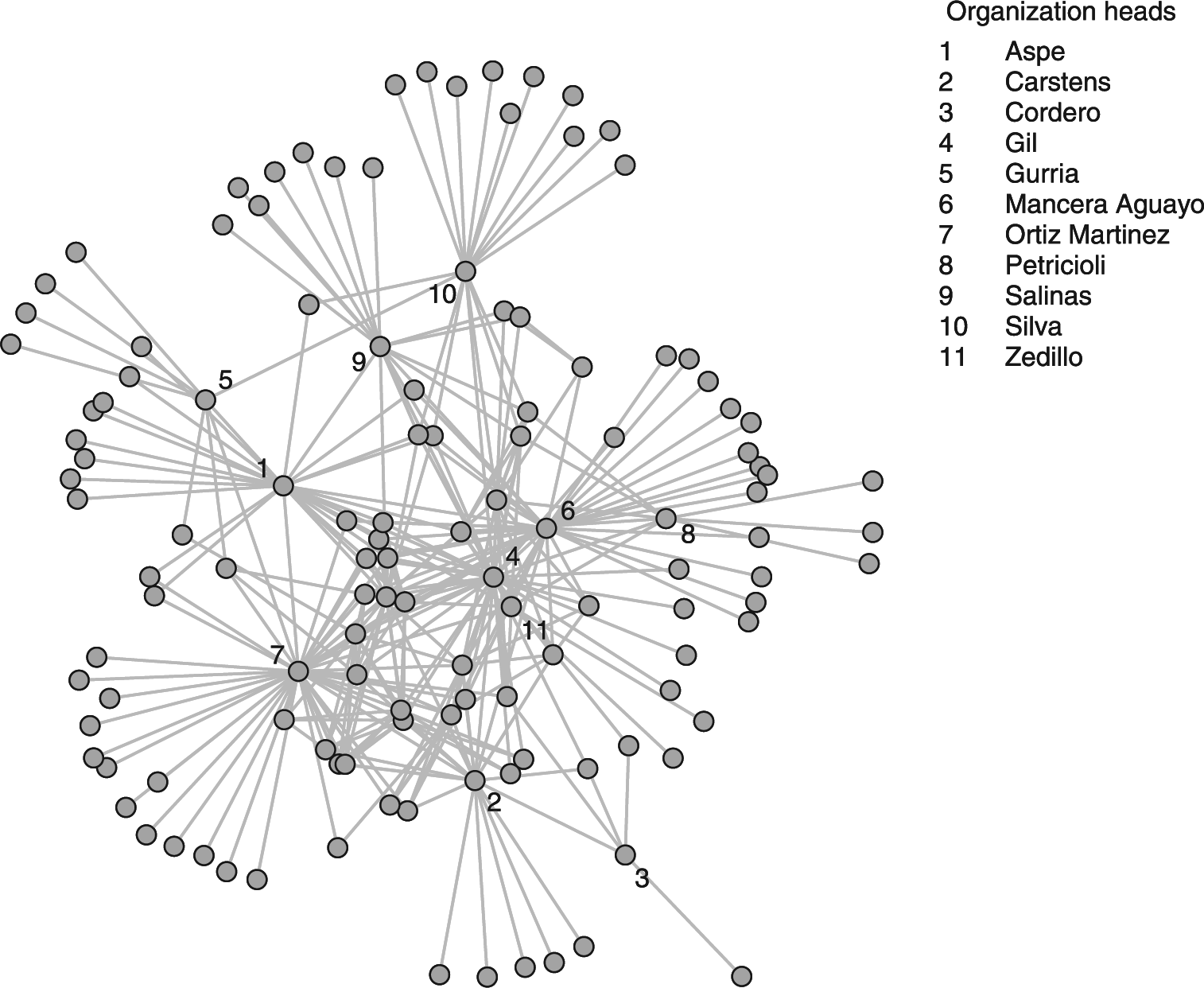
Mexican technocratic network, 1983–2010.

Argentine technocratic network, 1984–2010.
A number of standard indicators of network cohesion reported in Table 3 confirm this visual impression. This table reports network measures calculated for elites active during the crisis period, as defined above. The density of the Mexican elite is more than twice that of Argentina (although density may be confounded with network size). Mexican elites are also better connected: the crisis-period elite forms a single component, whereas less than half of Argentine elites are connected. Because the Argentine diagram is disconnected, standard shortest path measures are not appropriate. To correct for this, I calculate compactness (Borgatti et al., 2013: 154), or the average of reciprocal shortest path lengths (substituting zero in disconnected paths). By this metric, the Mexican network is five times as cohesive.
The final line in Table 3 reports mean cut-level cohesion based on the cohesive blocking methodology. By this metric, the Mexican network is nearly three times as cohesive as its Argentine counterpart. However, the best way to interpret the cohesive blocking method is via the block structure of these networks. This structure is represented in Figures 3 and 4 using an Euler diagram (a Venn diagram generalized to nesting and multiple overlaps). 27 Darker shades of gray correspond to higher values of k in that block. For illustrative purposes, the names of organizational heads are noted on the diagram, along with the number of additional nodes included in each block.
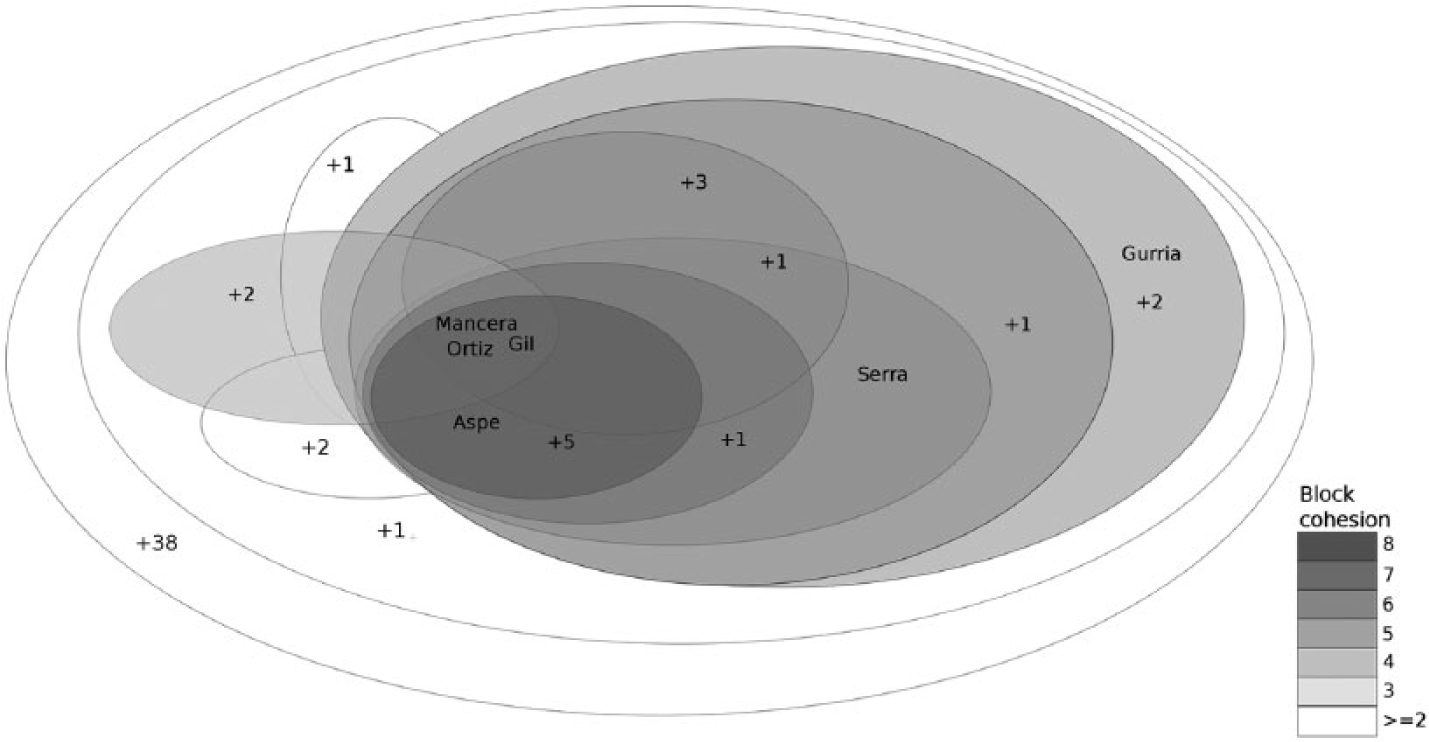
Mexican elite core (selected cohesive blocks).
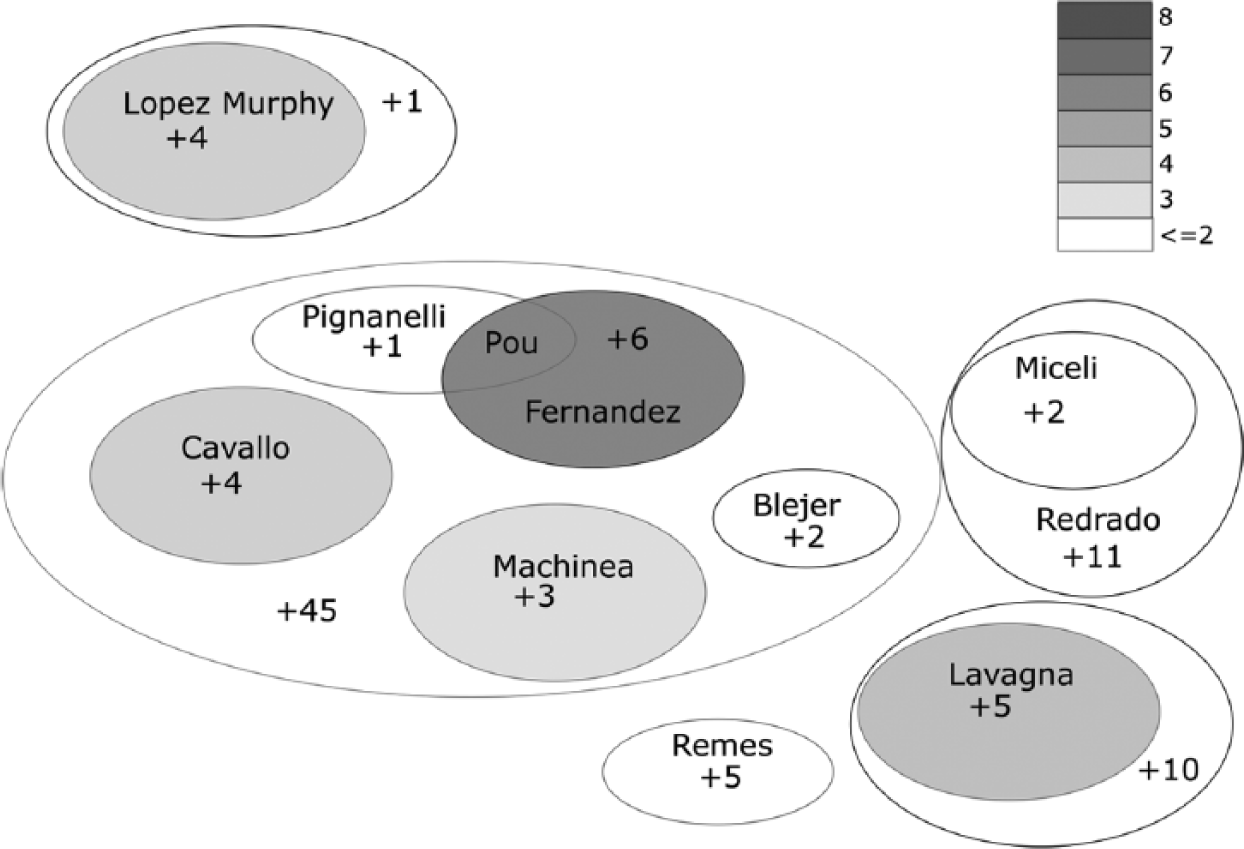
Argentine elite core (selected cohesive blocks).
The structure of cohesive blocks reveals the fragmentation of the Argentine policy elite into several competing factions, as well as minor groups and isolated individuals. Figure 4 shows four relatively small cohesive groups, corresponding to the heterodox (centered on finance minister Machinea), CEMA (centered on finance minister Fernández and central bank governor Pou), and Cavallo factions discussed above (the fourth cohesive faction corresponds to the FIEL think tank, which briefly controlled the finance ministry during 2001). While these factions are internally cohesive, ties between factions are diffuse: the pre-2001 elite network can be split apart by removing only two nodes, while the post-2001 network is entirely disconnected. In contrast, Figure 3 shows that the cohesive blocking structure of the Mexican policy elite consists of a single densely interconnected group. At the center of this network is a deeply nested core of officials which includes the senior officials active during the crisis: finance ministers Aspe (1988–1994) and Ortiz (1994–1997) and central bank governor Miguel Mancera (1982–1998). Jaime Serra (who served briefly as finance minister during the crisis before being dismissed) is also tied to this group at the level k = 5. The least cohesive connected organization head in the Mexican elite is finance minister Gurria (1997–2000), who assumed this position relatively late in the crisis. Even so, this actor is connected to the core of the elite at the level k = 4, twice as high as the cohesion level connecting the Argentine elite.
A complementary perspective on the cohesive structure of these elites is provided in Figure 5, which depicts inter-organizational (solid lines) and inter-cohort cohesion (points) at the senior level during the 10-year period surrounding the crises in both countries. Figure 5 shows that throughout the crisis period, inter-organizational and inter-cohort cohesion remained substantially higher in Mexico than in Argentina. While inter-organizational cohesion fell in 1998 (reflecting the appointment of the less-densely linked Gurria), cohesion remained twice that in Argentina. Inter-organizational cohesion was relatively high in Argentina until 1999, when both the central bank and finance ministry were controlled by the CEMA faction, but fell to low levels in 2000 and did not recover. In other words, whereas the Mexican finance ministry and central bank were controlled by elites embedded in a single cohesive group throughout the crisis, in Argentine this ceased to be the case early in the crisis. Moreover, the replacement of the CEMA-affiliated finance minister by his ‘heterodox’ opponent in 2000 reflects the transfer of control of the ministry between competing factions.
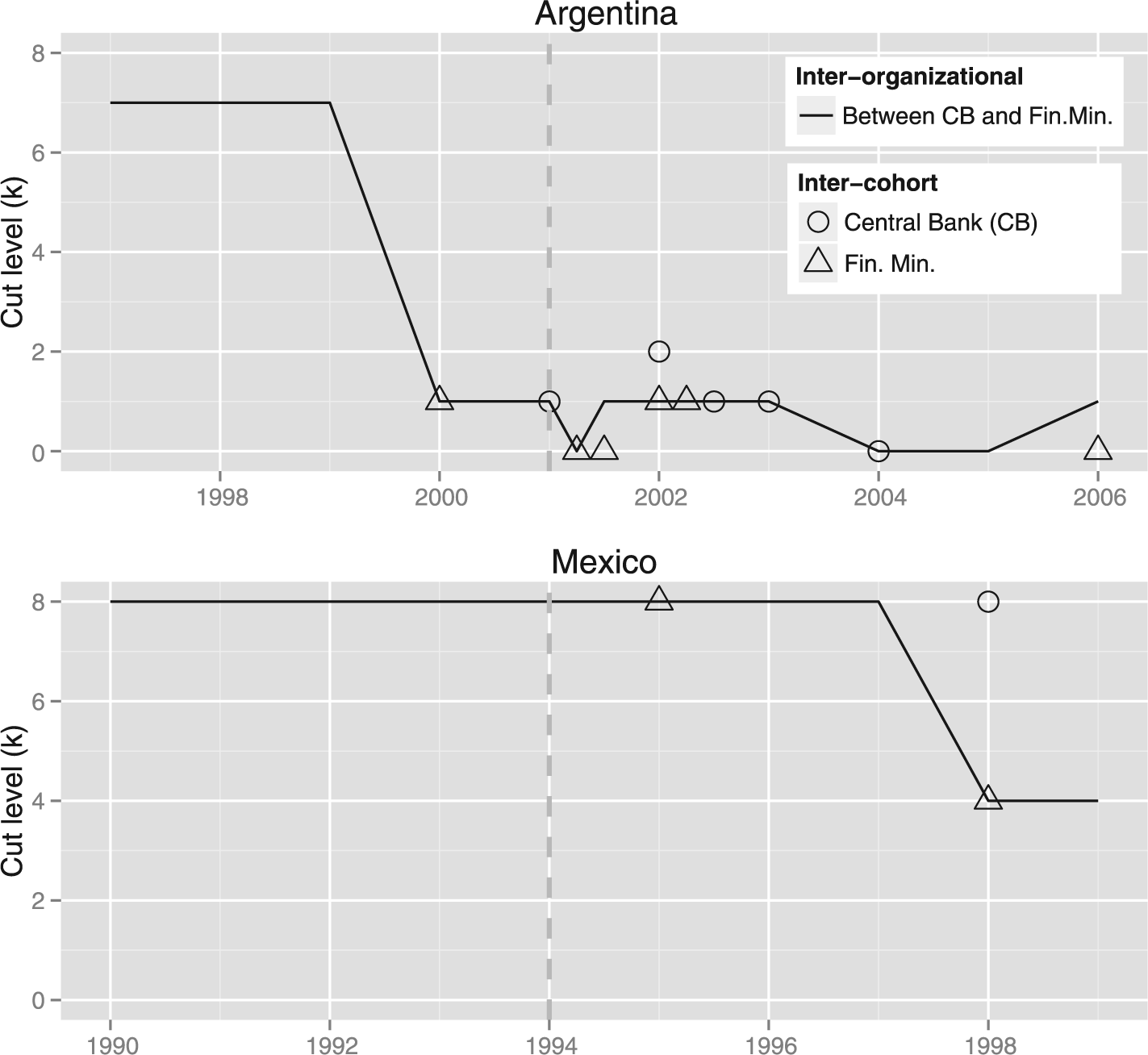
Inter-organizational and inter-cohort cohesion.
One concern about these results is that the varying level of cohesion may be an artifact of the assumptions of particular coding rules. One possibility is that the results are driven by organizational turnover rates (which, as noted above, are higher in Argentina), which are reflected in experience ties. Greater cohesion due to lower turnover is not necessarily an artifact, but it is still instructive to consider how turnover affects these results. Table 4 shows that differences between the Mexican and Argentine elite structures hold when excluding either experience or external affiliation ties from the coding scheme. Indeed, even when including only recruitment ties (which discards much of the information available from career histories), the Mexican elite remains twice as cohesive by the mean cut-level metric.
Sensitivity: mean dyadic cohesion under alternate coding.

The central implication of these findings is that the Argentine policy elite was composed of competing factions during the 2001 crisis, while the Mexican elite was composed of a single cohesive group. In the next section, I extend the analysis by showing how temporal variation in elite cohesion, particularly in Mexico, helps establish the weak link between elite network structure and political institutions.
Political institutions and elite conflict
The analysis thus far shows that elite conflict was much greater in Argentina than Mexico, documents the mechanisms of consensus formation, and demonstrates that the Mexican technocratic elite is more cohesive than its Argentine counterpart. An obvious concern is that elite networks may be endogenous to underlying political institutions, such as party systems and political regimes, which account for both elite network structure and policy consensus. In this case, elite networks may simply be a conduit transmitting the influence of political institutions to technocratic elites. Indeed, the correlation between elite structure and consensus might be spurious if elite networks simply reflect political institutions but have no true impact on consensus.
Certainly, political institutions can shape the structure of elite networks. To a significant extent, the political institutions that dominated Mexico for most of the twentieth century facilitated the formation of a cohesive elite. However, the PRI system was not always capable of sustaining either cohesion or consensus; these varied over time while the political regime remained roughly constant. Thus, there are two empirical inconsistencies facing an account of Mexican elite consensus that rests on political institutions alone. First, both cohesion and consensus vary over time in Mexico; during the early 1980s, the Mexican elite was more fragmented and conflict more intense. Second, elite cohesion outlasted the demise of the one-party regime; a decade after the democratic transition of 2000, network structures remained cohesive.
The cohesive network structure that existed in the mid-1990s was not a permanent feature of the Mexican political elite; rather, it was a structure that emerged following a period of fragmentation during the 1970s and 1980s. Figure 6 reports mean cut-level cohesion and compactness for time varying networks, incorporating the earlier data for Mexico. This figure selects nodes active during each presidential administration, making use of the full dataset. During the early 1980s, Mexican elite cohesion was at low levels comparable to those observed in Argentina; the cohesive Mexican elite did not form until the mid-1980s. Thus, these results show that the existence of a one-party regime in Mexico was not a sufficient condition for elite cohesion.
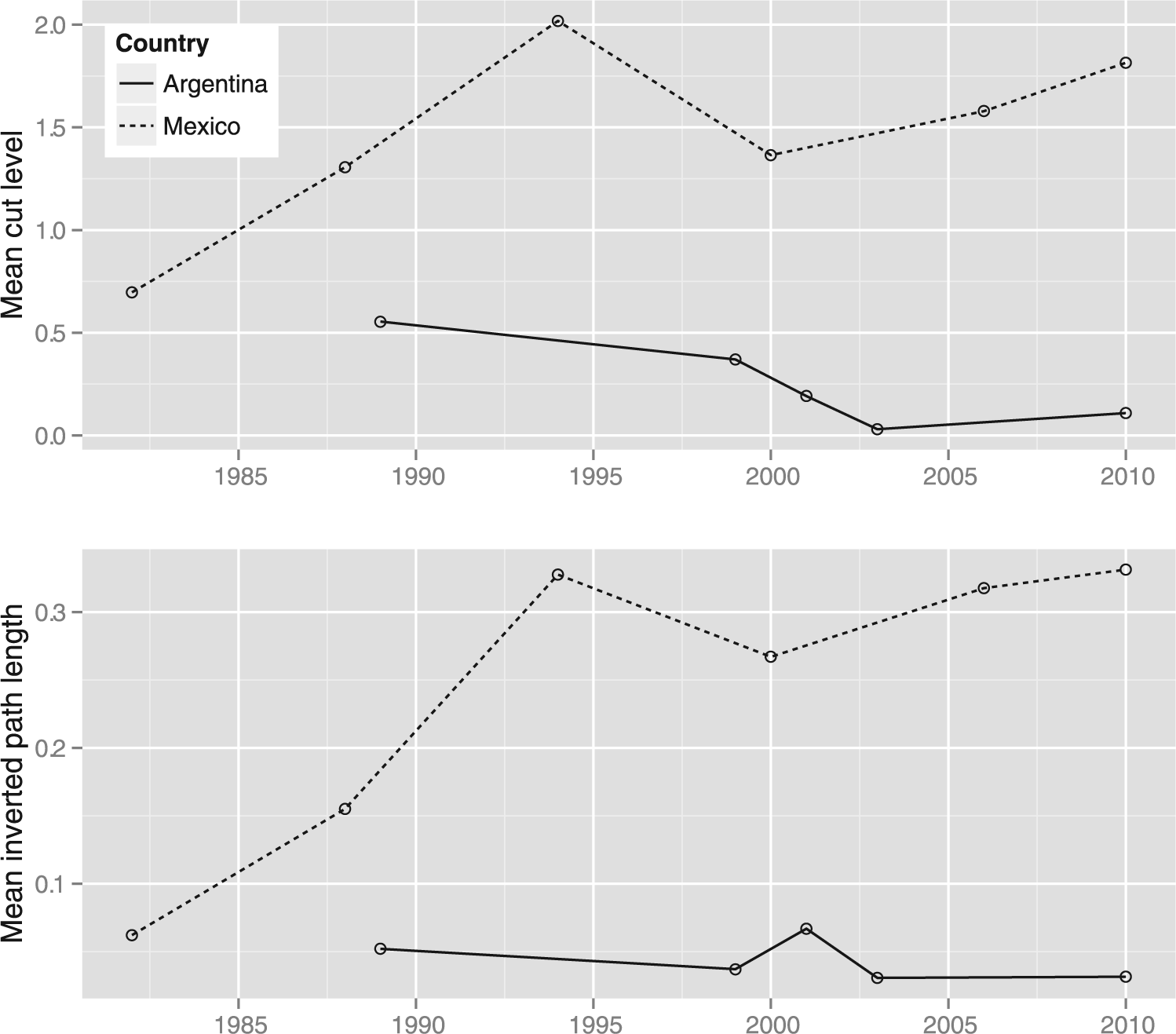
Evolution of elite cohesion.
Lower levels of cohesion in Mexico were matched by greater elite conflict during this period. In contrast to elite consensus in 1994, during an earlier financial crisis in 1982, policy-making dynamics resembled those in Argentina: competing factions attempted to impose their differing policy proposals in the face of internal opposition. The clearest illustration of this dynamic was the deep conflict over nationalization of the banking system. In this debate, a ‘heterodox’ faction of elites championed nationalization and other policies over the objections of more ‘orthodox’ central bank and finance ministry officials (Babb, 2001; Centeno, 1997). In a close parallel to the competitive Argentine policy-making process, the head of the central bank resigned his post in protest after losing the battle. The nationalization dispute was the most dramatic of several internal policy conflicts, including budget balance, wage adjustment policies, and foreign exchange controls. This conflictual and entrepreneurial policy-making process resembled the competitive dynamics of Argentine policy-making.
A second empirical limitation for an institutional theory of elite cohesion is that the structure of the Mexican elite outlasted the demise of these institutions with the defeat of the PRI in the 2000 presidential elections. The persistence of cohesion is also reflected in Figure 6 which shows that mean dyadic cohesion remained high in Mexico in the period following 2000. This persistence reflects the remarkable fact that, despite gaining control of the executive branch following 70 years of one-party rule, the incoming National Action Party government appointed technocratic elites with decades of experience under PRI governments to senior positions. Thus, there was substantial continuity in the individual elites represented in the bureaucratic elite following the democratic ‘transition’ of 2000, which facilitated the maintenance of elite cohesion. The persistence of cohesion after 2000 shows that the correlation between political institutions and network structures is loose, undermining the view that elite structure is a simple function of political regime or party system. It is likely that the one-party Mexican regime facilitated the emergence of a cohesive network; however, this particular political institution was not a sufficient condition for a cohesive technocratic elite.
Elite professionalization and ideas
A second alternative explanation for elite consensus is that shared ideas drawn from common experiences of elite training and professionalization are the primary determinant of technocratic consensus. Chwieroth (2007) presents a measure of technocratic ‘coherence’ based on the number of senior central bank and finance ministry officials with PhDs from elite US economics departments. Similarly, Babb (2001) argues that the emergence of US-trained economists as key policymakers facilitated the emergence of consensus on market reforms in Mexico.
However, a combination of quantitative and qualitative data suggests that shared educational backgrounds are not a sufficient condition for elite consensus. Figure 7 reports the proportion of officials with elite economics PhDs, following the definition of Chwieroth (2007). At first glance, these time trends might seem to support a professionalization theory of elite conflict: in Argentina, the proportion of elite economists declined sharply during the crisis years, falling to zero. However, elite conflict was high in Argentina both when the proportion of elite economists was at its peak in 1999 (at about 40% of elite officials), and when the proportion of elite economists fell to zero in 2003. Conflict in 1999 occurred among officials with elite economics backgrounds, while conflicts later occurred among officials without them. Thus, the level of elite conflict in Argentina remained high while the educational composition of the technocratic elite fluctuated wildly.
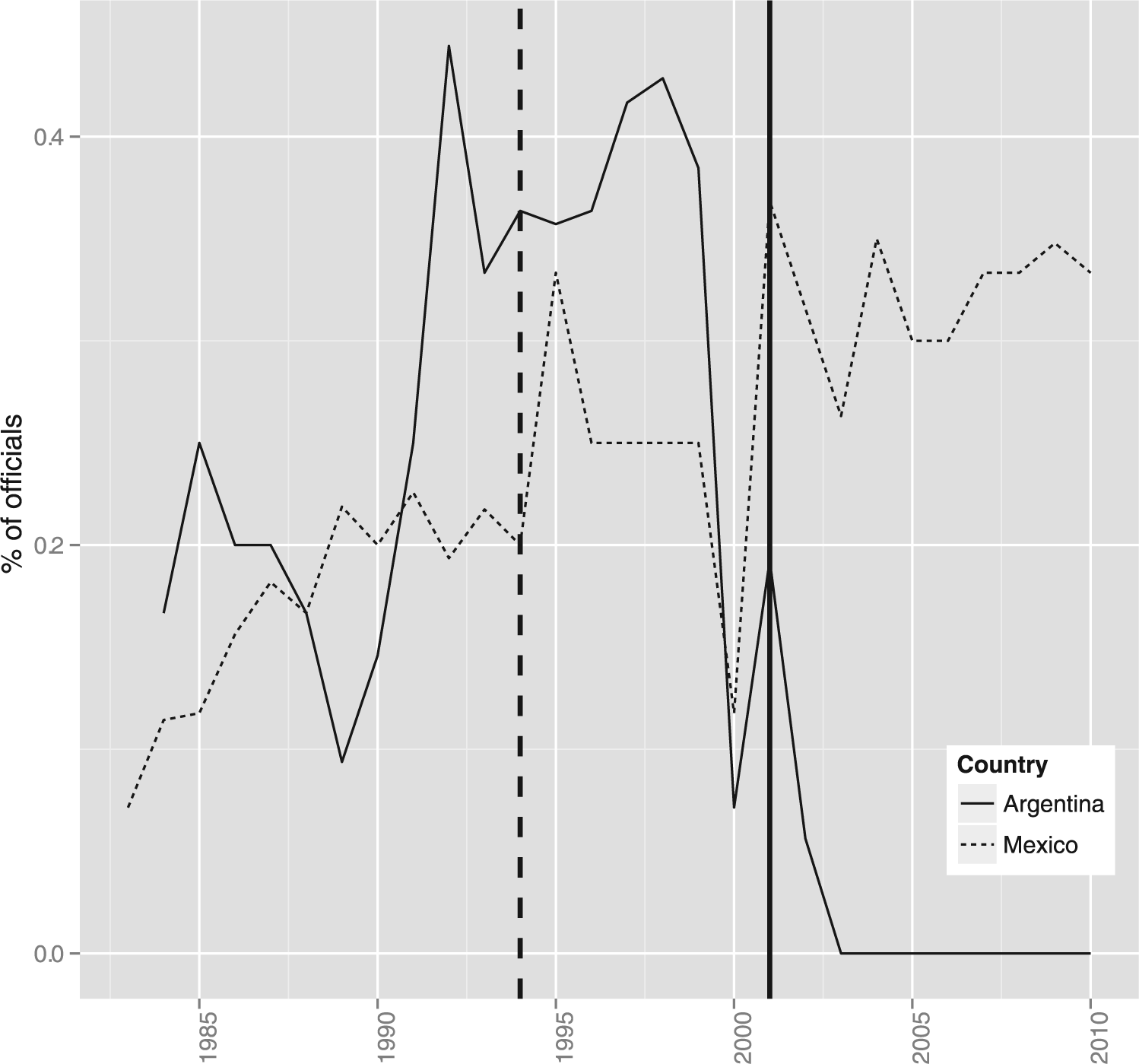
Policymakers with elite economics PhD.
Moreover, at the peak of the crises (1994 in Mexico and 2001 in Argentina), the proportion of elite US-educated economists was similar: roughly, 20 percent. While this figure does represent a sudden shift in the educational composition of the Argentine elite (the rapid decline in the proportion of elite PhDs from around 40% in 1999 to less than 10% in 2000, followed by a temporary recovery), the low proportion of elite economists in Mexico is not sufficient to account for elite consensus. These data show that elite economists represent a minority of senior bureaucrats in both countries; while the proportion of American PhDs increased in both countries during the 1990s, the dominance of this educational trajectory is somewhat overstated. At its peak, the proportion of such officials in Argentina was less than 40 percent, in Mexico, roughly one-third of officials have held an elite PhD in recent years. Thus, in both countries, officials with elite economics PhDs represented a minority (albeit sizable) of officials, and at the time of the crisis this minority was of similar size.
Qualitative data behind these aggregate trends reveal the limitations of shared educational background as an indicator of consensus. Conflicts in Argentina often occurred between elites with similar professional backgrounds. Both the CEMA group and Domingo Cavallo held economics PhDs from elite US economics departments (Chicago and Harvard, respectively), but feuded bitterly over economic policy. A similar ‘Chicago versus Cambridge’ split failed to emerge in Mexico, despite the co-existence of officials with degrees from these institutions. Even many members of the ‘heterodox’ faction in fact held economics degrees from the United States. Conversely, because the proportion of elite PhDs in the Argentine elite dropped to zero by 2003, conflicts between the central bank and finance ministry were not disputes between liberal US technocrats and those with different educational backgrounds: there were no elite US economists left to fight with.
Ideas clearly matter; elites form policy preferences drawing on their educational backgrounds. However, comparison of these cases shows that professional training – and in particular elite economics PhDs – is less predictive of policy positions than has been previously suggested. Indicators based on economics training such as that used by Chwieroth (2007) undoubtedly capture important variations in these elites, but describing this property as ‘coherence’ may not be accurate. Stated differently, appointing elite economists to senior positions is not a sufficient condition for elite consensus.
Sectoral interests
A final alternative explanation assumes that technocrats are ‘agents’ of organized business and infers their preferences from the economic interests of particular economic sectors. While a full discussion of the role of business politics in these countries goes beyond the scope of this article, this section shows that there are major limitations to a theory which reduces technocratic conflict to business interests.
Some scholars (e.g. Castellani and Schorr, 2004) argue that the main axis of conflict in Argentina during the 1999–2001 period was between pro-dollarization financial interests and industrialist supporters of devaluation. However, there is little evidence that these sectors actively lobbied for these policies. Rather, the main business associations, including both the manufacturer’s association and banking association, publicly supported continuity with the convertibility system. Indeed, the organized financial sector publicly opposed dollarization. 28 Similarly, there is little evidence of lobbying for devaluation on the part of the industrial sector. 29 Rather, firms lobbied for measures to compensate for the over-valued exchange rate, such as favorable tax treatment. Indeed, because many firms were highly indebted in dollars, many firms would (and in fact did) suffer from devaluation, complicating the formation of any pro-devaluation industrial coalition (cf. Woodruff, 2005). Rather than a sectoral conflict, the dollarization debate was largely a dispute between different factions of the Argentine technocratic elite.
Even when Argentine technocratic elites expressed commitments to specific business interests, their policy positions were often loosely connected to those interests. For example, one Argentine central bank governor, Aldo Pignanelli (a former public sector banker), was an adherent to the ‘productive movement’, an industrialist lobby dedicated to advocating for the interests of the manufacturing sector. Yet in his conflict with the finance ministry, Pignanelli took positions similar to those of his predecessor, an economist and former IMF official, and his successor, a former J.P. Morgan trader. Thus, even the explicit sectoral alignments of technocratic officials are loosely linked at best to their actions as government officials. Scholars of Latin American business politics (Schneider, 2004) have shown that Argentine business is politically fragmented; in this sense, it is not surprising that state elites did not express unified sectoral preferences.
Of course, the fact that sectoral interests do not explain conflict among technocratic policymakers does not mean that these interests have no impact on policy outcomes; business interests have many means to influence economic policy without acquiring agents within the state. However, the preferences of technocratic actors cannot be reduced to the particular interests of organized business.
Conclusion
To summarize, historical analysis and systematic network data provide strong evidence that the structural cohesion of elite networks facilitates policy consensus. In Mexico, a cohesive policy network formed in the 1980s, facilitating consensus formation within this elite despite substantial errors and external criticism during the 1994 crisis. Temporal variation in the level of elite cohesion shows that this network was not a simple reflection of the one-party Mexican state; cohesion was lower and conflict greater during the earlier 1982 crisis and, conversely, elite cohesion outlasted the 2000 democratic transition. In contrast, elite cohesion in Argentina remained perennially low; competition among factions and individuals contributed to elite conflict throughout the 2001 crisis.
This article began by noting that previous scholars have argued that elite consensus and cohesion shape the ability of technocrats to implement and consolidate policy reforms. The Mexican and Argentine cases suggest that cohesion is more important for consolidation than for implementation. Both countries implemented market reforms during the 1990s, but these reforms were consolidated in Mexico but reversed in Argentina following the crisis. Argentine economic policy has been considerably more volatile than in Mexico: policies have swung from the ‘heterodox’ stabilization strategies of the 1980s to the neoliberal reforms of the 1990s to the reversal of these reforms in recent years. Without suggesting that technocratic cohesion explains everything about economic policy-making in these countries, the failure to consolidate neoliberal reforms in Argentina is probably related to the fragmentation of the technocratic elite. During the 1990s, the technocratic elite appeared unified around liberal reforms; the crisis exposed a deep rift between the two main factions responsible for these policies. The competition and infighting between these groups ultimately undermined them both, opening the door for the entrance of elites with opposing policy agendas. In contrast, Mexican economic policy has been stable, despite the historic transformations associated with the 2000 elections.
More generally, this article has theoretical implications for competing perspectives on economic policy-making, often summarized by their varying emphasis on interests, institutions, and ideas (Hall, 1997). Scholars also discuss policy networks, but networks do not fit standard definitions of these concepts. In keeping with a broader theoretical shift toward relational sociology (Emirbayer, 1997), this article shows that relations and networks cannot be neglected. Obviously, networks do not supplant ideas, interests, and institutions, but this analysis shows that ignoring relational structures may lead to incorrect inferences. For example, temporal variation in the cohesion of the Mexican policy elite shows that a relational phenomenon which might at first appear a simple reflection of an institution – the one-party Mexican regime – is in fact relatively independent of that institution. Similarly, some scholars attribute elite consensus around the ‘Washington consensus’ to the ideas of technocratic policymakers, as shaped by their education (Babb, 2001; Chwieroth, 2007). However, this article shows that ideas in this sense are not a sufficient condition for consensus; despite similar backgrounds, competing factions in Argentine fought bitterly. This does not imply that ideas or professionalization do not matter, but rather that these factors are refracted through the relational dynamics of elites. Finally, while I have shown that elite policy conflicts (such as those in Argentina) cannot always be reduced to interests outside the state, further research should consider how the interests of technocratic elites depend on the structure of elite networks.
To conclude, sociologists and political scientists have long discussed the importance of elite policy-making networks in the developing world, but have seldom studied the structure of these networks, particularly using systematic data. Both theoretically and empirically, a gulf remains between political sociology and social network analysis literatures. This article takes a step toward closing this gulf by specifying cohesion as a property of elite networks and demonstrating its effects.
Footnotes
Acknowledgements
The author would like to thank Erik Olin Wright, John Levi Martin, Gay Seidman, Adam Slez, Joseph Harris, and audiences at the 2010 American Sociological Association meetings and the Juan March Institute for comments on earlier versions of this article.
Declaration of Conflicting Interests
The author(s) declared no potential conflicts of interest with respect to the research, authorship, and/or publication of this article.
Funding
The author(s) disclosed receipt of the following financial support for the research, authorship, and/or publication of this article: This work was supported by the Social Science Research Council, the National Science Foundation (SES-0957298), and the Robert F. And Jean E. Holtz Center at the University of Wisconsin-Madison.