




Abstract
Worker self-management has proliferated at key historical moments, worldwide, since 1917. In the wake of decolonization and the national liberation movements of the mid-20th century, unprecedented levels were attained across the globe. By examining the major cases of worker self-management that began in 1952–1979 in the periphery and semi-periphery, I highlight the varied historical trajectories leading up to state suppression or absorption of worker self-managed firms. Management literature predicts that all states would respond more favourably to profitable rather than less profitable enterprises; Marxist approaches predict that socialist states would be more likely than capitalist states to favour workers’ control, and world-systems analysts would expect states in the semi-periphery to be more hospitable than states in the periphery to worker self-management. I show that none of these theoretical predictions are empirically sustained. Instead, I employ an inductive historical analysis and find that states are equally likely to terminate profitable and unprofitable enterprises, whether in socialist or capitalist states, and in periphery or semi-periphery. To explain this phenomenon, I propose an alternative theory – focused on social unrest and the balance of class forces – for states in the Third World having by and large called a halt to the experiment of worker self-management.
Introduction
In reclaiming space and time (Anon, 2012) by occupying, ‘occupy’ activists create a space in which liberation – both political and ontological – can occur. In their goal of transforming global political economy, these occupy movements fit Immanuel Wallerstein’s (1984) definition of an antisystemic movement, to ‘enact a transformation either of the interstate system or of the world-economy’ (p. 107). However, Wallerstein (1984: 105, 2002) also posits that, ‘there is scarcely a movement which is not nationalist, and there are few national movements which are not socialist’. In other words, antisystemic movements typically aim to take state power or make demands upon a single state structure in order to transform the political economy of the world-system. In so doing, Wallerstein (1984) contends, antisystemic movements that make claims upon a single state inevitably end up making compromises and thereby fall short of their goals (p. 107). In the current conjuncture, occupy movements that similarly aspire to transform global political economy do not, however, seek state power, nor do they make demands upon individual states to transform global political economy (Anderson, 2013: xv; MacPherson, 2014: 194, 198). Transformation, these movements alternately contend, occurs through the act of occupying.
Worker self-management, as specific type of occupy movement, is a direct intervention into the organization of the workplace in which ownership of the means of production is transferred from capital to labour. It is thus one of the most important occupations in the current conjuncture, as it strikes at the heart of capitalist political economy. Worker self-management re-organizes production horizontally, and by so doing, eliminates the wage relation, thereby providing labour with higher earnings. But rather than refusing to labour, worker self-management withholds labour (and therefore surplus value) from capital, and workers continue working while reaping the total value of their efforts. As workers increasingly forfeit control of the labour process (Braverman, 1998: 86–94), worker self-management promises pushback by allowing workers to determine the pace, design, quality, quantity and organization of their work (Bayat, 1991: 3). This is even more relevant in the peripheries and semi-peripheries of the capitalist world-system. While the combination of the demands of the working class in the core, ‘for relatively few people, but quite a lot per person’, and the demands of the peripheral working class, ‘relatively little per person but for a lot of people’, is more than the capitalist world-economy can provide (Wallerstein, 1995: 25), worker self-management has the potential to provide for the demands of peripheral working classes by removing capital and the managerial classes from the production process in places where surplus value is already scarce.
In the past 100 years, there were three waves of worker self-managed firms in the peripheries of the capitalist system. Each of these waves occurred during periods of systemic chaos marked by economic downturn, war and antisystemic movements. The first wave happened from 1917 to 1936 with the cases of Ukraine and Siberia (Archibald, 2007; Arshinov, 2005; Avrich, 1967, 1973; Azarov, 2008; Makhno, 2007 [1929], 2009 [1936]; Mandel, 2011; Schmidt and Van der Walt, 2009; Shubin, 2013; Skirda, 2004; Smith, 1983; Yaroslavsky, 1937), Italy (DiLembo, 2001; DiPaola, 2011; Gramsci, 1919; Malatesta, 1965; Spriano, 1964), and Spain (Ackelsburg, 1991; Bookchin, 1998; Christie, 2008; Dolgoff, 1974; Durgan, 2011; Paz, 2011; Peirats, 1998, 2011).
The second wave occurred during the mid-20th century in the context of decolonization (Hirsh and Van der Walt, 2013). I term this second wave of worker self-management in the peripheries of the capitalist world-system the ‘Third World wave’ after Frantz Fanon’s historically delineated concept of the Third World, which was a foundational concept for Wallerstein’s (1979) analysis of the link between class structures and anticolonial movements in the 20th century (p. 266). Fanon (2004) contends that the Third World ‘project must be to try and solve the problems this Europe was incapable of finding the answers to’ (p. 238). Worker self-management outside of North America and Europe in the mid-20th century was part of the Third World rejection of ‘the notion of catching up’ (Fanon, 2004: 238), and instead, innovating ‘a new way of thinking’ (Fanon, 2004: 239) about society that takes account of the colonial crimes committed by Europe including ‘the bloody tensions fed by class’ and ‘the racial hatred, slavery, exploitation’ (Fanon, 2004: 238).
The current wave dates from 2001 to present and includes cases in Argentina (Atzeni and Ghigliani, 2004; Forment, 2013; Gracia, 2011; Heller, 2004; Kabat, 2011; Lavaca, 2004; Quijoux, 2012; Ranis, 2013; Rebón and Saavedra, 2006; Sitrin, 2006; Vieta, 2010; Vieta and Ruggeri, 2009; Wyczykier, 2009), Uruguay (Burdín and Dean, 2009), Paraguay (Guerra, 2002), Brazil (Sardá de Faria and Novaes, 2011),Venezuela (Azzellini, 2011) and Egypt (Benin, 2012; De Smet, 2012).
Existing scholarship provides little theoretical leverage over the question of the long-term viability of worker self-managed firms. While worker self-management is once again proliferating today, the scholarly literature reexamining cases of worker self-management, particularly in the English-speaking world, has lagged behind. In the 1970s and 1980s, a literature on earlier cases emerged (Bayat, 1987, 1991; Clegg, 1971; Dolgoff, 1974; Espinosa and Zimbalist, 1978; Kester, 1980; Fuller, 1992; Sirianni, 1985; Sketchly, 1979). This previous scholarship focused on cases of worker self-management in the peripheries of the capitalist system in the first and second waves, had mixed conclusions about its potential for success and longevity. While the literature examining worker self-managed workplaces in the global north is optimistic about chances for financial success and longevity (Dow, 2003; Hunnius et al., 1973; Krimerman and Lindenfeld, 1992), worker self-managed workplaces outside of North America and Europe experience different structural pressures, and therefore, these cases must be assessed independently of cases from the global north.
Rooted in a political economy of the world-system perspective, I assess the potential success or failure of the current wave of worker self-management in Latin America and North Africa, by looking to previous cases of worker self-management in the Third World. I find that nearly every case of worker self-management in this Third World fails to endure. Why so? I assess three theories of worker self-management and the state – management theories, world-systems analysis, and Marxist theories – concluding that all three theories lead to hypothesis that do not conform to the empirical experience of worker self-management in the Third World. The antisystemic nature of worker self-management in the periphery and semi-periphery causes them to (almost always) be repressed regardless of the type of state, systemic location, or profitability of the firm. The analysis of worker self-management is in two parts. I first account for this failure by uncovering the temporal pattern of state intervention of each case through a universalizing comparison (Tilly, 1984: 81) to find the common properties of worker self-management across cases using truth-table analysis (Ragin, 1997, 2014). I then use a variation-finding comparison (Tilly, 1984: 82), examining systematic differences among cases by tracking emergence conditions and subsequent path dependence (Mahoney, 2000) to examine the emergence conditions of each case, determining whether worker self-management was state-led, labour movement-led, or emerged through revolution. These emergence conditions explain the varied trajectories of worker self-management in the Third World, specifically the temporal patterning of state termination of worker self-managed firms.
Worker self-management and the state
Theories of management, world-systems analysis, and Marxist theories offer three different hypotheses about worker self-management’s potential for success. Theories of management predict that states would respond more favourably to profitable rather than less profitable enterprises. World-systems analysts would expect states in the semi-periphery to be more hospitable to worker self-management compared to states in the periphery. And Marxist approaches predict that socialist states would be more likely than capitalist states to favour workers’ control.
Theories of management
Theories of management predict that states would be less likely to terminate profitable rather than less profitable enterprises. Worker self-managed firms may actually be leaner than other firms because they are able to eliminate the expense of employing managers, along with the principal-agent problems that result from employing managerial strata. In the management literature, there are numerous qualities that a good manager possesses that are seen as essential to firm success. Hemphill (1959) claims that good managers supervise to make sure that work gets done and engage in long-range planning. Sayles (1964) claims that good managers serve as advisors to employees and build networks both inside and outside of the firm along with innovating production. Pheysey (1972) describes the role of a manager as someone who conducts meetings, and monitors employee progress. Mintzberg (1979) writes that a manager acts as a leader, disseminator, spokesman, decision maker and resource allocator. While Kotter (1982) echoes similar sentiments on what managers do, he adds that managers set job boundaries so that workers’ tasks do not overlap. Hayles (1986) writes that managers act as figureheads of organizational units, form and maintain contacts, disseminate information, allocate resources, handle disturbances and maintain workflows, negotiate, innovate, plan, and control and direct subordinates.
In a more recent literature on management and employee happiness, Amabile and Kramer (2011) claim that a good manager helps his or her employees to feel joy, engagement and creativity in the workplace. This is accomplished by assigning employees tasks that they are good at, giving them room to experiment, praising or rewarding them when they succeed, and allowing them to take risks. Arguably, however, in a worker self-managed firm, this can be accomplished better than in any other form of workplace. Hamel (2011) argues that the position of management should be abolished because managers are expensive, they make decisions that are often unworkable on the ground, they slow down the decision making process, and the hierarchical structure systematically disempowers lower-level employees thereby stifling creativity and ability to contribute to the organization (p. 50). Hamel (2011) argues that a better corporate structure is one in which no one has a boss, employees negotiate responsibilities among each other, everyone can spend company money, each person is responsible for the tools to do their work, there are no titles or promotions, and compensation decisions are peer-based (p. 51). Hamel offers, by way of example, a firm in California with no managers – just ‘colleagues’ and a CEO – to demonstrate how this organizational structure can operate. This firm has lower costs and therefore, better salaries; employees have deeper expertise in their area of specialty, and therefore higher quality work; Hamel (2011) finds more collegiality because ‘colleagues’ are not competing for promotions, there is better decision making because decision makers are at the ‘front lines’, ‘colleagues’ take greater initiative because they have the freedom to do so; there is higher firm loyalty, and increased flexibility which means that ‘colleagues’ can respond rapidly to challenges and are free to experiment with new ideas (p. 56).
In response to Hamel’s (2011) article in Harvard Business Review, managers from across the globe voiced concerns with Hamel’s arguments about the benefits of a corporate organization that promotes self-management. Concerns ranged from statements that employees are unable to manage themselves and perform without being rewarded by managers, to claims that ‘today’s managers’ lack the necessary leadership skills for a changing global economy. But in the global south, this type of organizational form historically was met with far more resistance from the interstate system than simply letters to the editor, with violent opposition from the states in which these firms are located supported by the international business community. This stance has certain contradictions, as states and international financial institutions employ the rhetoric of small government, growth above all else, and free markets. While these theories would support the conclusion that worker self-management would succeed as long as it is profitable, and that self-management may be leaner and therefore more profitable since it eliminates the managerial class, these theories of management focus solely on firms in Europe and North America. In order to adequately analyse the second wave of worker self-management in the Third World, along with the conflicts that it engendered in all its varying trajectories, it is crucial to understand how worker self-management operates outside of the European and North American context where different structural pressures are present, in other words, in the periphery and semi-periphery of the capitalist world-system.
Theories of peripheral and semi-peripheral states
While theories of management focus on firms headquartered in core countries, world-systems analysis provides an analytical framework that can help to uncover the specific conditions under which worker self-management may succeed or fail in peripheral and semi-peripheral states. World-systems analysis posits that are three main positions within the world hierarchy of wealth: the core, the periphery and the semi-periphery. The core is engaged in the most profitable activities, and the periphery is relegated to the least profitable (Wallerstein, 1979: 38). The semi-periphery contains within it some core activities and some peripheral activities (Wallerstein, 1979: 99). Semi-peripheral countries are defined by their position within global commodity chains (Hopkins and Wallerstein, 1986: 159; Wallerstein, 1979: 99), comprising the middle link in the global division of labour. Semi-peripheral countries are characterized by a mix of core-like, profitable activities and also, peripheral-like, least profitable activities (Arrighi and Drangel, 1986: 26). Some semi-peripheral states have more core-like activities occurring within their borders while others are engaged in more peripheral activities than core activities (Arrighi and Drangel, 1986: 28). This mix of activities produces contradictory political and economic interests within an individual country. As a result of the contradictory elements of their systemic location, semi-peripheral states are more likely to produce antisystemic movements (Arrighi et al., 1989: 93; Chase-Dunn, 1998: 211–214; Wallerstein, 1984: 110). Because worker self-management is both an antisystemic movement and an economic activity organized within firms, in taking a world-systems perspective, it seems likely that worker self-managed firms are most likely to thrive in semi-peripheral states, particularly if they are engaged in ‘core-like’ activities.
Peripheral countries’ economies have little capacity to be involved in the most profitable global business activity (Arrighi and Drangel, 1986). Thus, the periphery is most often relegated to the most competitive, and therefore, least profitable business activities in the global economy (Amin, 1974: 170). Market forces serve to differentiate the core, semi-periphery and periphery through their different roles in the world-economy and institutionalize them, rendering differentiation insurmountable in the short term (Wallerstein, 2000: 89). The fact of unequal rewards for similar productive activities is central to how the pressure of competition is transferred from the core to the periphery (Amin, 1974: 170; Arrighi and Drangel, 1986: 16–17; Emmanuel, 1972: 70–71; Wallerstein, 2000: 86). This pressure to remain profitable is pushed downwards onto the workers of the world’s peripheral states in the form of lower wages, lack of labour rights and a more coercive labour process. The mechanism by which this pressure is pushed downward is through the competition for firms that are moving production from the core to the periphery thereby capitalizing on the global reserve army of labour (Fröebel et al., 1982: 44; Silver, 1995: 174, 2003: 64). Political coercion is more prevalent in peripheral states, and this coercion plays a key role in maintaining the power-relations necessary to ensure that the process of producing commodities occurs without disruption (Chase-Dunn, 1998: 204). In the periphery, where firms are relegated to the least remunerative actives and subject to unequal exchange, it seems probable that worker self-managed firms would have difficulty taking root. Furthermore, if established, it seems unlikely that worker self-managed firms would flourish given that political coercion is more prevalent and labour oppression and exploitation is more severe in the periphery. Given the different pressures facing peripheral states as compared to semi-peripheral states, world-systems analysts would expect states in the semi-periphery to be less likely to intervene in trajectories of worker self-management compared to peripheral states.
Marxist theories of class politics
Critics of world-systems analysis contend that its main weakness is the precarious position of the nation state within the world-systems framework (Skocpol, 1977; Zolberg, 1981), therefore I employ Marxist theories of class politics to analyse the relationship between the state and class agency. Worker self-management often emerges as a result of working-class collective action, and just as often, the end of self-management occurs as a result of the collective action of capital. The time and place of such action affects the way in which it is constrained by the structural pressures of the capitalist world-system, but there are some general tendencies in the relationship among the state, capital, and working classes. Marxist theories of class and the state can be placed into two categories: theories of the state as an organ of domination (Lenin, 1974 [1932]; Miliband, 2009 [1969]; Sweezy, 1942) and theories of hegemony (Gramsci, 1971; Jessop, 1990; Poulantzas, 1978).
The state, as an organ of class domination, endeavours to create an order that legalizes and perpetuates class oppression through the bourgeois facade of class reconciliation (Lenin, 1974 [1932]: 9). The state emerges as the product of a struggle in which a class that occupies key positions in the production process creates a state that enforces a set of property relations that are in that class’ interest (Domhoff, 1967: 114; Sweezy, 1942: 242). The state not only enforces property relations, but protects the capitalist system as it engenders an increasingly unequal distribution of property (Braverman, 1998: 197). State power affords the capitalist class with the ability to further enrich itself through creating effective demand (Baran and Sweezy, 1966: 143) and as a means to redistribute wealth into the hands of special groups (Braverman, 1998: 197). Ralph Miliband (2009 [1969]) contends that most political leaders come from the business or professional class (p. 48), and are deeply committed to capitalism (p. 51), but see that commitment as serving the national interest, rather than a specific class interest (Block, 1987: 53; Miliband, 2009 [1969]: 52). Because political leaders and the government they comprise see capitalist enterprise as a fundamental and desirable aspect of society, they ‘help business in every possible way, yet do not feel that this entails any degree of bias toward particular classes interests and groups’ (Miliband, 2009 [1969]: 54). The division of labour between capitalists and state agents allows state agents to appear neutral in the class struggle (Block, 1987: 53–54). Capitalist governments, therefore, protect the power and privilege of the capitalist class particularly when faced with leftist dissent (Miliband, 2009 [1969]: 60). Likewise when left governments come to power, business confidence declines (Block, 1987: 60). Because capitalist states favour the capitalist class in their continuing struggle with the working class, one would conclude from these theories that view the state as an instrument of domination, that worker self-managed firms have little chance for success since they withhold surplus value from the managerial and capitalist classes. One would hypothesize that in the case where a worker self-managed firm is located in a workers’ state, these class dynamics would be reversed and therefore state would be more amenable to worker self-management.
Marxist theorists of the state who posit that the state exercises power through hegemony have a different conceptualization of the national class struggle. Nicos Poulantzas (1978) critiques existing Marxist theories for conceptualizing the state as a purely economic structure reflective of the relations of production (Aglietta, 1998: 50; Poulantzas, 1978: 124). Instead, he contends, class struggle and political domination are central to the definition of a capitalist state (Poulantzas, 1978: 124). The primary role of the capitalist state is to organize and represent the dominant classes (Aglietta, 1998: 60; Poulantzas, 1978: 127). The hegemonic project of a dominant class has the goal of securing state power and maintaining it in such a way that all subordinate classes believe that the dominant class’ interest is their interest as well (Gramsci, 1971: 182). State power brings political unity to the hegemonic class because of its relative autonomy from particular factions or interests of the dominant class (Poulantzas, 1978: 127). This relative autonomy separates it from the relations of production and thereby, the state is a ‘specific material condensation of a relationship of forces among classes and class factions’ that relegate the state to the class struggle (Poulantzas, 1978: 129). But the state has no materiality of its own; it is malleable to the interests of the class that manipulates it. Therefore, Poulantzas (1978) contends that, ‘with various secondary modifications, that same tool could be used by the working class for a change in state power and a transition to socialism’ (p. 129). The state does not inherently have a particular class content, but bias can be undermined or reinforced by particular strategies. The outcome of state power depends on the changing balance of forces engaged in political action within and beyond the state (Jessop, 1990: 353). Theorists of hegemony would then posit that through political and ideological struggle, workers could take state power, establish their own hegemony and create favourable conditions for workers control (Gramsci, 1919: 160, 1971: 53).
While theorists of the state as an organ of domination see the state as an arena of the domination of labour by capital, and theorists of hegemony see the state as a crystallization of one particular class’ hegemony, the consistent theme among all of these Marxist theories of the state is that while capitalist states subordinate the interests of the working classes, states appropriated and dominated by the working classes could potentially foster the interests of the working classes, including supporting worker self-management. Therefore, it is more likely that worker self-management will be suppressed in a capitalist state compared to a communist state.
Theories of management predict that states would respond more favourably to profitable rather than less profitable enterprises. World-systems analysts would expect states in the semi-periphery to be more hospitable to worker self-management compared to states in the periphery. And Marxist approaches predict that socialist states would be more likely than capitalist states to favour workers’ control. In order to test the three hypotheses presented above, I analyse the varying trajectories of Third World worker self-management in the periphery and semi-periphery. I find that in every case, the state intervenes in order to end worker self-management, but different temporal patterns of state intervention lead to this singular endpoint.
Methods
In order to test these three hypotheses, I employ a hybrid approach using both truth-table analysis, the first step of Qualitative Comparative Analysis (Ragin, 1997, 2014), and path dependency (Mahoney, 2000) approaches. I analyse the set of cases (Ragin, 2014: xxiii–xxiv) of worker self-managed enterprises in the Third World that begin from 1952 to 1979 that were all terminated by the state (Skocpol and Somers, 1980: 183). My constructed population (Ragin, 2014: xxvi) consists of historical trajectories of worker self-management in the Third World from 1952 to 1979. This timeline is designed in order to best capture the ‘new movements’ (Arrighi et al., 1989: 101) that comprised part of the world revolution of 1968 (Arrighi et al., 1989: 97). I choose 1952 as a starting point in order to capture more cases of worker self-management associated with the ‘Third World nationalist movement’ (Arrighi et al., 1989: 101) and chose 1979 as an endpoint since the Third World movement further evolved and intensified as a result of the political-economic developments of the 1970s (Arrighi et al., 1989: 106–107). By the 1980s, political and economic backlash against both the world revolution of 1968 and against the Third World movement was well underway (Arrighi et al., 1989: 108) and therefore experiments with worker self-management operated under different global politico-economic conditions in the 1980s and beyond. To best analyse the possibilities for worker self-management in the peripheries of the capitalist world-system, I therefore relegate this study to the Third World wave of the mid-20th century.
The 19 cases in this study from the period 1952–1979 constitute the entire population of worker self-management in the periphery and semi-periphery during the global wave of social unrest in 1968 except for Zambia and Nigeria due to lack of historical data available on these cases. Some scholars include workplaces in which owners or management look to workers committees or panels for suggestions on how to continue to manage and operate the firm as worker self-managed firms (Praznikar, 1991). In this study, those workplaces are not included, because they are not completely self-managed and therefore, are not an appropriate gauge as to whether workers can manage an enterprise independently, and if so, to what consequences. Following Erik Olin Wright (2010), I define worker self-managed firms as workplaces in which labour has direct control of the firm. By this definition, potential cases including Guyana, Bangladesh, Congo, among others are thereby excluded.
The qualitative outcome (Ragin, 2014: xxv; Skocpol and Somers, 1980: 182) of interest in this study is the temporal patterning of worker self-management and not solely its endpoint. In order to analyse worker self-management’s potential in the Third World, I will test the three hypotheses presented in the previous section ((1) that states would respond more favourably to profitable rather than less profitable enterprises; (2) states in the semi-periphery will be more hospitable to worker self-management compared to states in the periphery; (3) that socialist states would be more likely than capitalist states to favour workers’ control) to determine whether different types of states, structural conditions, or firms have any bearing on the temporal patterning of worker self-management. By examining many instances of worker self-management in its multiplicity of forms, I hope to find variation in the temporal patterning of worker self-management (Tilly, 1984: 81) based on the market orientation of the state, the structural conditions, and the profitability of the firm. Therefore, I must conceptualize the key hinge points for each of the theories: profitability, market oriented state versus socialist state, and periphery versus semi-periphery.
I define profitability as a binary concept of whether the firm is able to reproduce itself or whether it fails as a result of lack of funds. A state with a socialist market orientation is one that has one-party rule and that party claims to follow a Marxist–Leninist ideology. A market oriented state is one that is oriented towards providing the necessary preconditions to aid business in realizing profit. Following Giovanni Arrighi et al. (2003), I use Gross Domestic Product per Capita (GDPPC) to distinguish between periphery and semi-periphery. 1 I constructed three measures of GDPPC, one using the Maddison Project’s measures (Figure 1), and two different measures of GDPPC using the Penn World Tables (PWT), one that uses the Geary–Khamis method of measuring purchasing power parity (PPP) (G-K) (Figure 2) and another that averages G-K with the country product dummy-weighed measure (Figure 3). While both PWT measures of GDPPC yield the same results for the purposes of classifying countries as periphery versus semi-periphery (Iran, Jamaica, Costa Rica, Malta, Cuba, Peru, Algeria, Chile, Nicaragua and Bolivia comprise the semi-periphery), the Maddison Project data places fewer countries in the semi-periphery (Libya, Iran, Jamaica, Costa Rica, Peru, N icaragua), but these are countries that PWT similarly identifies as semi-peripheral. PWT has GDPPC measures for Malta, while the Maddison Project does not. The Maddison Project has measures for Libya but the PWT does not. Therefore, I rely on the Maddison Project’s figures for Libya and the PWT measures for Malta. Finally, following Robert Wade (2004), I opt to use the PWT measure of GDPPC using G-K (Table 3) because G-K measures the price of services as they cost in that particular country, while other measures tend to use the price of those services in rich countries thereby over-estimating the incomes of poorer countries (Wade, 2004: 4).
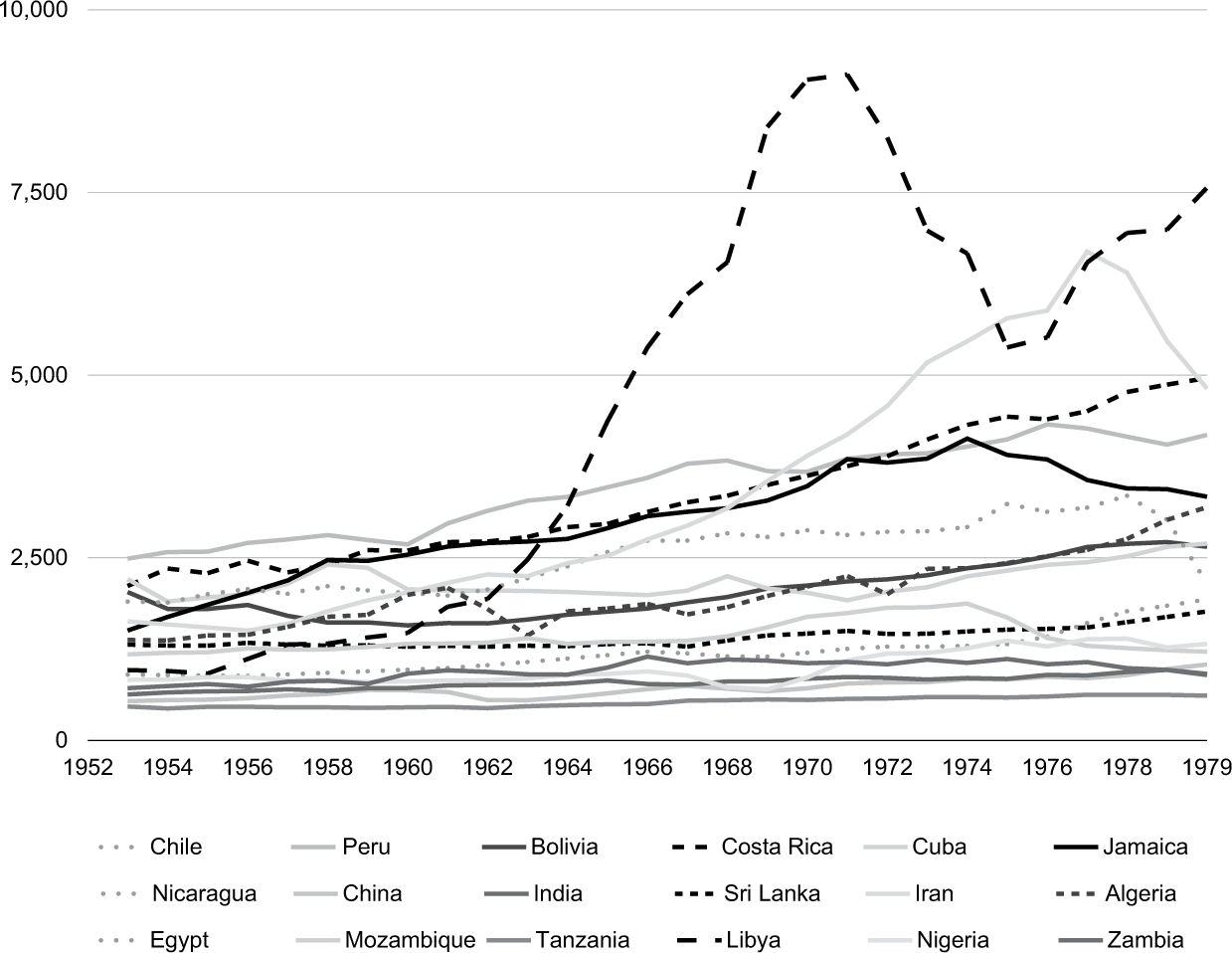
Gross domestic product per capita (G-K), 1952–1979 (author calculation based on The Maddison Project).

Gross national product per capita (GK-CPDW), 1952–1979 (author calculation based on data from Penn World Tables) (Heston et al., 2012).
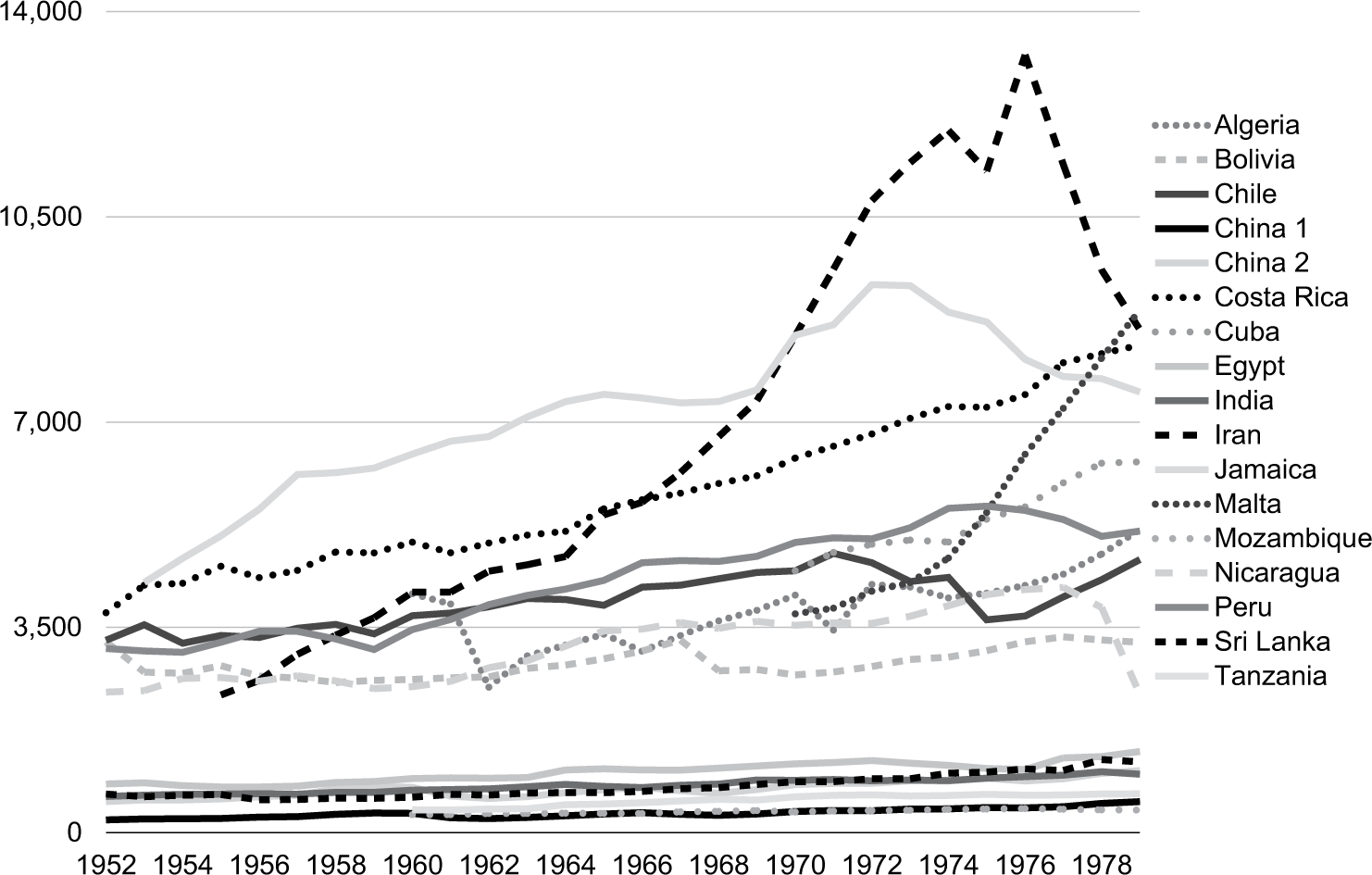
Gross domestic product per capita (G-K), 1952–1979 (author calculation based on Penn World Tables) (Heston et al., 2012).
In Figure 3, there is a clear delineation between the semi-peripheral countries and the peripheral countries. Libya, Iran, Jamaica, Costa Rica, Malta, Cuba, Peru, Algeria, Chile, Nicaragua and Bolivia comprise the semi-periphery, while India, Egypt, Tanzania, China, Sri Lanka, Mozambique, Zambia and Nigeria comprise the periphery.
Now that each of my concepts is well defined, I intend to construct a truth table (Ragin, 1997, 2014: xxvii) to test the three theoretical hypotheses. The truth table will examine whether firms end because they are unprofitable, will show outcomes for worker self-management based on market orientation, and will show whether the structural location of the firm is associated with a particular outcome.
The data are based on secondary sources. The research for most of these sources was based on scholarly observation of worker self-management during the 1970s. Three of the studies, however, are comparative studies themselves based on secondary sources (Bayat, 1991; Petras and Veltmeyer, 2002; Praznikar, 1991). As a result, the information on each case varies based on the availability of secondary sources. Most cases have about three sources that are either devoted solely to explaining worker self-management in that country or provide data about worker self-management in that country in comparison with other countries. For some cases there is little data available. For the data regarding Sri Lanka, Nicaragua and Costa Rica, I used secondary sources in which that case was used comparatively (Bayat, 1991; Praznikar, 1991). Therefore, for the cases with many sources, I am able to get a more unbiased picture of worker self-management since I am able to incorporate more perspectives on self-management, whereas on the countries with little data, I am forced to rely on one or two sources. Another issue with the secondary sources is that many cases studies of worker self-management were conducted while self-management was occurring. In those cases, the source does not address the full temporal pattern of state intervention in self-management. Therefore, this study relies disproportionately on the sources that detail cases of worker self-management from their inception to their endpoint (Avrich, 1973; Bayat, 1987; Cooper, 1983; Espinosa and Zimbalist, 1978; Frölander-Ulf and Lindenfeld, 1984; Issac et al., 1998; Munslow, 1983; Fuller, 1992; Petras and Veltmeyer, 2002; Praznikar, 1991; Shkliarevsky, 1993; Sirianni, 1982, 1985; Sketchly, 1979; Smith, 1983; Stephens, 1980; Von Freyhold, 1979).
Results
Profitability
Most historical cases of worker self-management occurred from the mid to late 1960s until the late 1970s and this article only addresses those cases initiated in the years 1952–1979. I construct a truth table (Ragin, 1997, 2014) to analyse the various outcomes of worker self-management in each case. Table 1 presents the cases of worker self-management in the Third World wave and their varied temporal patterning.
QCA table of temporal patterning of state intervention in worker self-management.
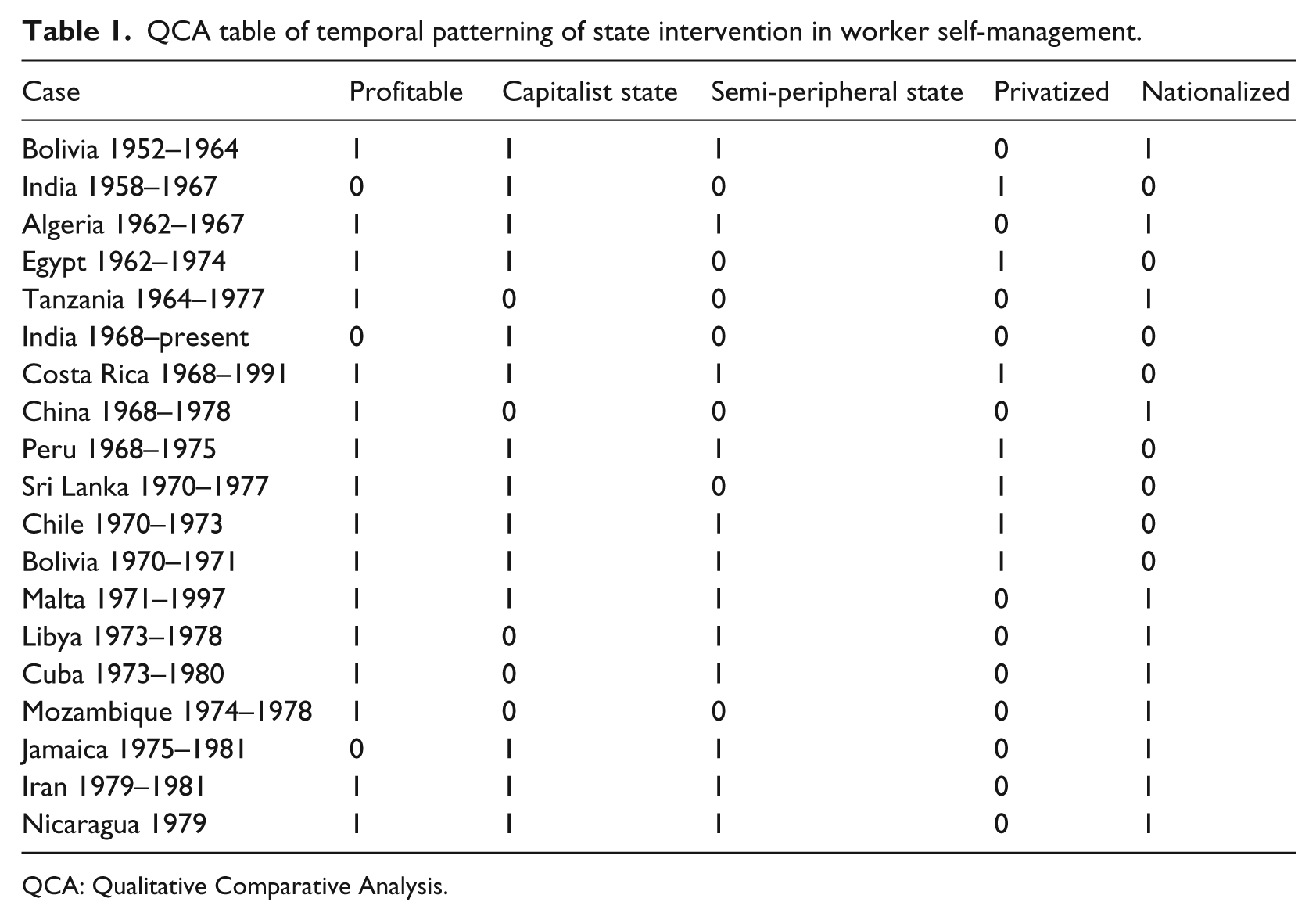
QCA: Qualitative Comparative Analysis.
Based on an analysis of the table, the majority of cases of worker self-management fail to endure, and end in either nationalization or privatization. None of the cases, however, end because the worker self-managed firm is not profitable; therefore, I reject the theories of management hypothesis that worker self-managed firms endure as long as they are profitable.
Market orientation
I employ the truth table (Table 1) to discern whether the market orientation of the state in which worker self-managed firms are located provides insight about why states intervene to either nationalize or privatize worker self-managed firms. None of the socialist cases endure beyond the period of study, all of them are terminated by the state in which they are located, and all cases in socialist states end in nationalization. In market oriented states, the state is equally likely to privatize or nationalize. Six of the cases in market oriented states were nationalized, and seven cases in market oriented states were privatized. Therefore, I reject the hypothesis that socialist states are more likely to foster worker self-management compared to market oriented states.
Structural location
To test the hypothesis that structural location affects a worker self-managed firm’s chance for success, I look to the truth table (Table 1) to analyse whether worker self-management in semi-peripheral states versus peripheral states has differential chances for success. I find that semi-peripheral states terminate worker self-management just as frequently as peripheral states, and moreover, semi-peripheral states are equally likely to nationalize as they are to privatize worker self-managed firms. In the periphery, we see a similar pattern that about as many cases are nationalized as they are privatized. This may lend evidence to reject the hypothesis that structural location affects workers self-managed firms; however, one might reasonably conclude that worker self-managed workplaces in the semi-periphery are possibly engaged in peripheral-like economic activities (those economic activities which are least remunerative) within global commodity chains, and therefore, it would be problematic to conclude that this truth table marks an accurate test of structural location.
Nevertheless, failed worker self-management does not seem tied to firms engaged in peripheral-like activities. Table 2 shows that self-managed firms in the semi-periphery were engaged in skilled production that would place them in a more central node in a global commodity chain.
Industries of worker self-managed enterprises in the semi-periphery.

Furthermore, the type of industry in which the worker self-managed enterprise is engaged does not have any bearing on the state response. Therefore, I now look to reasons other than profitability, structural location, and market orientation of the state to explain state response to worker self-management.
Worker self-management and the politics of the state: Emergence conditions
Having rejected each of my initial hypotheses, I now employ the historical data on the Third World wave of worker self-management using a path-dependent approach (Mahoney, 2000) to better explain the temporal patterning of state intervention in worker self-management. In so doing, I shift from a universalizing comparison to a variation-finding comparison (Tilly, 1984: 81–82). The remaining analysis is split into two positive finding sets. The first (this section) looks to emergence conditions to explain the temporal pattern of state termination of worker self-management. In the subsequent section, I look to the reasons for termination to explain why the state chooses a particular organizational form in terminating worker self-management.
I begin this inductive analysis by examining the temporal patterning of worker self-management in the Third World based on each case’s emergence conditions: (1) worker self-management in the context of revolution, (2) worker self-management in the context of a labour movement, and (3) worker self-management that is state initiated. These three emergence conditions explain the temporal pattern of state termination of worker self-management.
Worker self-management in a revolutionary context: Two types
In Bolivia, 2 Mozambique, Nicaragua, Tanzania, Algeria, Iran, Chile and Peru, worker self-management occurs during a revolution. There are two types of revolutionary contexts during which self-management occurs. In Mozambique, Tanzania and Algeria, worker self-management arose as part of a national liberation struggle, in which a political order directly controlled by foreign nationals is overturned with the goal of establishing home rule. In Bolivia, Nicaragua, Iran, Chile and Peru, worker self-management emerged from a revolution aimed at replacing state structures. These revolutions, which are not national liberation struggles, occur when the political order is overturned with the goal of making fundamental changes to society.
In national liberation struggles, a goal of the movement establishing worker self-management and of the state in temporarily supporting worker self-management is to break ties with the colonial economy. This context structures the political choices of the state in suppressing self-management. In most of the cases where worker self-management occurs in the context of any type of revolution, self-management flourishes when the state is in a period of crisis, but once the state regains its authority, it finds a way to terminate worker self-management.
Worker self-management in a revolutionary context: National liberation struggles
In Mozambique and Tanzania, the state terminated self-management because it was perceived as a threat to the newly independent socialist states. Self-management was implemented by the Tanzanian state to prevent corruption in fledgling industries and force foreign capital to take a secondary role in the development of industry (Arrighi and Saul, 1973: 243; Bayat, 1991: 134). In Mozambique, state implemented self-management was supposed to transfer ownership to workers to oppose capitalism and imperialism and to break ties with Portuguese and other colonizers (Bayat, 1991: 100), but the state was unable to break from the Portuguese colonial model and ended up squeezing workers for surplus value (Mbah and Igariwey, 1997: 78). In both cases, the state eventually terminated worker self-management and worker self-managed enterprises were nationalized. According to Micheaela Von Freyhold (1979), collective workplaces in Tanzania ended as a result of conflict with the state and its authorities. State authorities intervened in workers’ council elections, ensuring that workers elected to the executive committees were loyal to the state (Mbah and Igariwey, 1997: 77). Yet, the members of executive boards of workers’ councils with loyalties to the state would often embezzle funds from the collective (Von Freyhold, 1979: 188). Workers abandoned self-management and hoped to form new self-managed workplaces without corrupt leaders. Once workers began to form new collectives, the state under Sokoine, nationalized the workplaces rather than lose control over the workforce (Von Freyhold, 1979: 191). The Tanzanian state then replaced worker self-management by state management committees with a 1977 government mandate (Praznikar, 1991: 60). It was the perceived threat of worker self-management that compelled the Mozambican and Tanzanian states to undermine worker’s councils.
Algerian worker self-managed enterprises, as in Mozambique and Tanzania, emerged from a struggle for national liberation and were later nationalized. In 1967, Algerian President Ben Bella was able to nationalize self-managed workplaces based on the official edict, the Décrets de Mars, which was issued in 1963 to legalize worker self-management in Algeria (Clegg, 1971: 57; Southgate, 2011: 235). The state, as a newly independent former French colony, needed to dominate labour and maintain its power vis-a-vis the newly emerging national capitalist class. As Ian Clegg (1971) writes,
In the years after independence, Algeria witnessed a continuous struggle for power between its emergent national bourgeoisie and the working class, with the mass of the peasantry as unemployed and disillusioned onlookers. Autogestion stood at the centre of this conflict … in time autogestion became a threat to [the state’s] developing hegemony. (p. 74)
3
Worker self-management did not end in Algeria because Algerian workers were incapable of managing their factories. On the contrary, Algerian worker self-managed workplaces were numerous and successful (Dominelli, 1986: 171; Porter, 2011: 136). According to Asef Bayat (1991), self-managed workplaces made up 15 percent of the Algerian manufacturing industry (Bayat, 1991: 74). The state nationalized Algerian worker self-management to incorporate the emerging national capitalist class into the state bureaucracy, thus preventing their opposition to the state. By incorporating worker self-management, the state could offer capitalists a role in the state bureaucracy overseeing these factories.
Worker self-management in a revolutionary context: General revolution
In Bolivia, Nicaragua, Iran, Chile and Peru, worker self-management arose from a revolution aimed at replacing state structures. Once the state regained control, it terminated worker self-management. In these cases, either revolution allowed workers to form their own collectives, or state officials granted labour the legal authority to collectivize their workplaces.
In Bolivia, once the Nationalist Revolutionary Movement gained power, the state, under President Ortuño, created its own mining company, COMIBAL, with the intent to bureaucratize and nationalize mines into what James Petras and Henry Veltmeyer (2002) describe as a ‘bourgeois state’. As individual mines began to be incorporated into the state apparatus, the Bolivian Workers Movement organized strikes and opposed the state through armed confrontation, but to no avail. By 1964, the Bolivian military occupied the mines and nationalized them (Boeger, 1997: 238; Petras and Veltmeyer, 2002).
In Iran, despite high productivity, the state, led by Prime Minister Mahdavi-Kani, nationalized the Shuras (factory committees) in 1981. The Iranian state had an ambivalent relationship with the Shuras. The right declared that collectivization was un-Islamic, while moderates believed that with more state control over the production process, the Shuras would be a useful way of gaining the support of labour for national development projects. Ultimately, state appointed managers aligned with capital to create a semblance of the capitalist relations of production. Asef Bayat (1987) explains that, ‘Although … the relationship between the Islamic state and capital remained contradictory, it was primarily the anti-authoritarian orientation of the worker’s councils to which they both expressed their opposition’ (p. 155). Furthermore, the state made the purchase of products manufactured by Shuras illegal, based on its desire to eradicate and prevent ‘communism’ from taking hold in Iran. When Shura members resisted state appropriations, workers were executed and their factories’ assets liquidated (Bayat, 1987: 157).
In Chile, Pinochet terminated worker self-management after a state initiated land reform led to an exodus of capital. Layoffs and factory closures followed. Workers returned to work without management rather than join the ranks of the unemployed (Bayat, 1991: 68). Chilean self-management was violently ended in 1973 by the Chilean state, despite its financial and social success and high productivity. James Petras and Henry Veltmeyer (2002) report that, ‘… the displaced capitalist and landlord class turned toward violence and repression to recapture control over the means of production’.
Similarly, in Peru, the Revolutionary Government of the Armed Forces terminated worker self-management. The Peruvian state was instrumental in setting the legal foundations of collective ownership, yet self-management necessitated a loss of the state’s ability to please any potential constituency. The state soon regretted legalizing worker self-management. According to Evelyne Huber Stephens (1980), self-management in Peru alienated capital, and precipitated a mass exodus of foreign investment. Once self-management was established, workers were alienated as a result of the inability of the legal framework to provide for the extent of autonomy that was promised. This situation ‘rendered the whole process vulnerable to pressures from domestic and foreign capital interests’. The state was looking for a power base, and international and national capital wanted to take back their enterprises in Peru (Stephens, 1980: 250).
Nicaragua differs in that the pressure acting on the state to terminate worker self-management came not from the Nicaraguan state but from the United States. Worker autonomy was restricted during the war between the Frente Sandinista de Liberación Nacional (FSLN) and the Contras. Because the United States supported the Contras against the FSLN, US sanctions were placed on Nicaragua. With sanctions in place, worker collectives were nationalized to finance the state. Workers maintained a degree of participatory privileges, but the enterprises remained under state control (Bayat, 1991: 102). Nicaraguan self-management did not fail because of workers’ inability to manage their collectives, but as a result of US sanctions.
While the pressure to terminate worker self-management in Nicaragua came from the core, Mozambique, Algeria, Tanzania, Bolivia, Iran, Chile and Peru follow a common pattern of state termination of worker self-management. In all cases in which worker self-management occurred during a revolutionary takeover of the state, the state terminated worker self-management as worker self-management is contrary to the interests of the state.
Worker self-management in the context of a labour movement
In Cuba, Jamaica, Malta, Bolivia, Costa Rica and India, the state terminated worker self-management after it is established was part of a labour movement. The labour movement context was distinct from the revolutionary context in that workers combined to make specific demands, but did not seek to change the political order. In these cases, the opportunity structures for labour that arise during a revolutionary period of turmoil were absent, and so the state usually utilizes a different mechanism to terminate these cases of worker self-management.
Cuba, Jamaica, Malta, Bolivia and Costa Rica were terminated by the state in response to a perceived threat. In Bolivia, the state violently ended self-management returning workplaces to private capital via a military coup supported by the national capitalist class (Petras and Veltmeyer, 2002). In Cuba, workers petitioned for self-management and Castro capitulated in order to combat inefficiency, sabotage and absenteeism in industry, but worker self-management was later criminalized by rectificación, 4 a series of reforms aimed at curbing the rights of labour. The Cuban Communist Party wanted to become more involved at the point of production in order to ensure that qualified personnel made informed decisions about how to manage the workplace, even though worker self-management in Cuba resulted in productivity gains (Fuller, 1992). Castro terminated worker self-management not because it was unproductive, but for greater control over the workforce. In Malta as well, because of its relationship to worker self-management from such an early point (the Maltese state gave workers self-management as an unintended consequence of a 7-month-long strike), the state was able to slowly erode the power of worker self-management by influencing management decisions of worker’s councils thereby nationalizing the drydocks peacefully (Bayat, 1991: 160; Kester, 1980: 35).
In Jamaica, as in Bolivia, Malta and Cuba, worker self-management was terminated by the state despite initial support. Michael Manley initially supported Jamaica’s sugar workers in their struggle to self-manage their refineries (Edwards, 2014: 122). The state wanted sugar workers to participate more in workplace decision making, without displacing management, in hopes that it would garner working-class support for Manley’s party (Frölander-Ulf and Lindenfeld, 1984: 35), but sugar workers fought menagement 5 and mechanization, as workers saw them as fighting for the principles of anticolonialism, anticapitalism and Black-power (Edwards, 2014: 55). However, when Jamaica’s sugar industry was unable to meet European Economic Community’s sugar quotas in 1978, Europe began to replace Jamaican sugar with sugar from other countries and with beet sugar and corn syrup produced in the United States and Europe (Frölander-Ulf and Lindenfeld, 1984: 163). Sugar production facilities in Jamaica, starting in 1974, were running at a loss (Frölander-Ulf and Lindenfeld, 1984: 164). Both self-managed and privately owned firms in the sugar-refining industry were nationalized during this time period (Frölander-Ulf and Lindenfeld, 1984: 180–181). Monica Frölander-Ulf and Frank Lindenfeld (1984) conclude that Jamaican self-managed sugar production failed not because it was poorly managed, but because collectivization coincided with a decline in the global price of sugar.
India was an exceptional case of self-management as it was privatized because it was unsuccessful. Most Indian cooperatives lacked a definitive marketing strategy, their products were of low quality, the scale of production was not sufficient enough to take advantage of economies of scale, there was not enough capital to expand or invest in production, and unions were not committed to the cooperatives. All 14 beedi (hand-rolled cigarette) collectives were privatized by 1967 (Issac et al., 1998: 60–61). In other cases where worker self-management was relatively unprofitable, the state terminated it because the collectives posed a threat to the viability of the state, not because of enterprise profitability. In all cases, except for India, the state intervenes to terminate worker self-management, not because of the inability of workers to manage their collectives, but because self-management conflicts with the politics of the state.
Worker self-management initiated by the state
In China, Egypt, Libya and Sri Lanka, the state imposed worker self-management. As a result, it was easier to terminate self-management than in the other contexts. Because of its involvement from the beginning, the termination of self-management in these cases is relatively painless for the state since legislation or executive decree will suffice.
In Sri Lanka, China and Libya, the state terminated self-management. In Sri Lanka, the state was instrumental in establishing worker self-management; however, when management refused to cooperate, the state acquiesced and abolished self-management (Praznikar, 1991: 59). In China, worker self-management was reorganized when Deng Xiaoping came to power in 1978 (Bayat, 1991: 98). Factions within the state did not support worker self-management. Once Mao died, restrictions on democratic workplace organization were implemented in order to shift the focus from what Asef Bayat (1991) calls ‘political production’ (the workplace as a site of political mobilization) to economic production (p. 98). Deng Xiaoping’s reforms were aimed at controlling labour and favouring economic production over political production, with the goal of increased productivity. Moammar Qadhafi initiated worker self-management on the prophet Muhammed’s birthday (15 April) in 1973 (Hajjar, 1980: 185) under the slogan ‘partners not wage workers’ (Rashid, 1983: 149). Worker self-management in Libya was part of Qadhafi’s Jamahiriya (self-management) experiment (Rashid, 1983) as elaborated in Qadhafi’s Green Book (Hajjar, 188) to eradicate bourgeois and colonial social values in Libya (Rashid, 1983: 149). When Qadhafi disbanded the Revolutionary Command Council in 1978, and incorporated worker self-managed firms into the state structure (Hajjar, 1980: 187), this ended Libya’s experiment with worker self-management. While Rashid (1983) lays blame with colonial sympathizers with capitalist values infiltrating and sabotaging worker self-managed firms (Rashid, 1983: 149), Hajjar (1980) claims that while Jamahiriya was a world-historically unique attempt at direct democracy, and the Libyan people, particularly older citizens, were not willing to put in the work necessary to make direct democracy possible (Hajjar, 1980: 200).
Egypt was another exception in that the state terminated worker self-management because it was unprofitable. Egyptian self-management was marked by declining productivity in the context of national inflation, draining of national savings to finance national industrial projects and involvement in war in Yemen (Cooper, 1983: 143). Egypt privatized self-managed workplaces to prevent any further economic losses through state subsidies to self-management (Cooper, 1983: 84).
In all 19 cases of worker self-management, the state intervened. In some cases, the state nationalized worker self-managed firms, while in others, the state privatized worker self-managed workplaces. While the mechanism through which the state influenced outcomes for worker self-management differs from case to case, there are some general trends. In states where worker self-management accompanied revolutionary upheaval such as national liberation movements, socialist or other revolutions, worker self-management flourished during the revolutionary turmoil, but once the state regains control, it terminated worker self-management. In cases where worker self-management arose from a labour struggle, the state used legal reforms to terminate worker self-management once it was clear that the goals of the labour movement conflicted with those of capital and the state. These legal reforms were usually accompanied by the takeover of workers’ councils. In the three cases where the state initiated worker self-management, once the state perceived that worker self-managed enterprises acted as independent entities beyond the scope of state control, the state incorporated these workplaces.
The mechanisms through which the state can terminate worker self-management differ based on how worker self-management arises. There are three contexts out of which worker self-management arises: (1) a revolutionary context in which a group overturns the political order with the goal of making fundamental changes to the society, (2) during the context of a labour movement when workers combine to make specific demands of an identified target (i.e. the state, capital, international institutions, etc.), and (3) state initiated worker self-management where the state grants workers the legal foundation for worker self-management without any previous worker demands for self-management.
The context in which self-management emerges is key in structuring the options for states to suppress self-management. In the context of a revolution, the state momentarily loses the capacity to react, so suppression of self-management tends to occur once the state regains that capacity. In the context of a labour movement, the state tries to prevent the labour movement from gaining any concessions, but when the movement succeeds, the state often struggles to find a legitimate way to suppress self-management. When the state initiates self-management, it is easy for the state to later suppress it. In the case of state initiation of worker self-management, the state usually suppresses worker self-managed enterprises once the state perceives that self-management is no longer under its control. I have shown how the state terminates worker self-management, but the question still remains, why does the state terminate worker self-management?
Why does the state terminate worker self-management in the Third World?
In examining the historical trajectories of worker self-managed firms I find that there are three reasons for state intervention in worker self-management: (1) to control labour, (2) to strengthen capital, and (3) due to financial failure. Those cases terminated by the state to control labour are those in which the rationale for terminating worker self-management was related to state subordination of labour and capital. To strengthen capital, the state terminated worker self-management to support capital, either at the bidding of capital or not. Cases of financial failure are those in which state termination of worker self-management was contingent upon the financial failure of worker self-managed enterprises. While in some cases, the state terminated worker self-management to both strengthen capital and suppress labour, in all cases one of these two reasons was always more significant. The reason the state cites as the key reason for terminating worker self-management takes precedence.
To control labour
In 10 of the 19 cases, the state suppressed worker self-management to control labour. In Bolivia, Tanzania, Mozambique, Costa Rica, Malta, Libya and Cuba, the state suppressed worker self-management to control labour. In Tanzania, the state nationalized worker self-management to supervise worker’s committees and ensure loyalty to the newly independent state (Von Freyhold, 1979: 188). Mozambican workers organized in order to gain a greater degree of self-management. The state then took over workers’ councils and voted to nationalize rather than lose control over the workforce (Sketchly, 1979: 34). In Libya, Qadhafi questioned the socialist and anticolonial commitments of the working class, and thereby their ability to fully participate in the Jamahiriya experiment (Hajjar, 1980: 200). Therefore, Qadhafi altered the structure of worker self-managed firms so that they would be managed by the state and workers’ councils which would ensure workers participation in industry (Hajjar, 1980: 191).
Similarly, the Maltese state slowly eroded the power of worker’s councils nationalizing them in order to tame the workforce (Bayat, 1991: 160). In Cuba, the state did not eradicate self-management through co-optation of workers’ council, but through legal reforms. The official explanation for the eradication of self-management was to involve more qualified personnel at the point of production, but the series of legal reforms issued under rectificación were aimed instead at curbing labour’s legal rights (Olson, 1985: 387).
In Costa Rica and Iran, capital aligned with the state to regain control over the means of production by appropriating self-managed workplaces (Bayat, 1987: 155; Petras and Veltmeyer, 2002). In Bolivia, the same state–capital alliance was present, but it took two attempts to appropriate self-managed workplaces. First, the state nationalized the factories, and after the second attempt at self-management, the workplaces were privatized (Petras and Veltmeyer, 2002).
In China, the state undermined worker self-management when Deng Xiaoping came to power. Once in power, Deng Xiaoping executed a series of liberalizing reforms in China (Bayat, 1991: 98). The reforms were aimed at controlling labour so that industry could experience productivity gains (Bayat, 1991: 113).
In the Nicaraguan case, the impetus to suppress labour came not from the state, but from international pressures. In the late 1970s, the United States pushed for international sanctions against the Nicaragua because of its support for the Contras over the Sandinistas during the Nicaraguan Revolution. Because of their need to finance the state solely though internal sources, the Sandinistas nationalized industry to raise state revenue (Bayat, 1991: 119).
To strengthen capital
In the cases of Iran, Chile, Sri Lanka, Algeria and Peru, the state undermined worker self-management to cement alliances between capital and the state. The Chilean capitalist class aligned with the state to suppress worker self-management, staging a military coup to recapture the means of production through control of the state (Petras and Veltmeyer, 2002). In Sri Lanka, the state initiated worker self-management but management resisted. Eventually, the state acquiesced to management’s demands, returning worker self-managed workplaces to capital (Praznikar, 1991: 59).
In Iran, the state violently suppressed worker collectives, deciding to side with capital rather than give into labour. According to Asef Bayat (1987), historically, the alliance between capital and the state in Iran was tenuous. Yet, both the state and capital were opposed to the shuras (Bayat, 1987: 155). The Iranian state suppressed the shuras in order to form a peaceful relationship among capital, labour and the state. Workers’ councils were seen as undermining this relationship, and thus were repressed (Bayat, 1987: 156). In Peru, the revolution drove capital out of the country. Thus, state power was open to influence from other classes. The state returned self-managed enterprises to capital in the hopes that capitalists would return to Peru to reclaim their assets and provide a power base for the state once again (Stephens, 1980: 250).
In Algeria, worker self-management was suppressed in order to control the capitalist class and to maintain internal class relations. Ian Clegg (1971) writes that post-independent Algeria was characterized by a power struggle between the working class and capital (Clegg, 1971: 74; Porter, 2011: 132). After independence, the Algerian capitalist class was not able to take advantage of independence as a result of autogestion; workers legally owned the most productive enterprises. Thus, the capitalist class opposed Ben Bella, because he legalized autogestion (Clegg, 1971: 111–112). The state then nationalized the worker self-managed enterprises in order to tap the surplus value generated by worker self-management and to maintain dominance over the capitalist class, enticing their participation in the state bureaucracy (Clegg, 1971: 114–115).
Financial failure
In India and Egypt, the state privatized worker self-management as a result of the self-managed enterprises’ lack of financial success. According to Issac et al. (1998), the first phase of worker self-management in India had five main failures: (1) it lacked a clear marketing strategy, (2) the product was of low quality, (3) the scale of production was insufficient to maintain profitability, (4) there was not enough capital to expand production, and (5) unions were not ideologically committed to the cooperatives (pp. 60–61). Egyptian self-management experienced declining productivity in an inflationary time while national savings were being exhausted to finance the war in Yemen. Egypt decided to privatize self-managed workplaces to prevent any further economic losses through state subsidies to self-management. The Egyptian state, through imposing managers on self-managed firms, tried to create more profitable national enterprises (Cooper, 1983: 84).
In Jamaica, worker self-management was nationalized as a result of its inability to compete on a global scale. However, all sugar-processing facilities in Jamaica, both privately and collectively owned, were failing during the late 1970s. The Jamaican sugar industry was not able to meet European quotas, and thus, Europe substituted beet sugar and corn syrup from producers in the United States and Europe (Frölander-Ulf and Lindenfeld, 1984: 163). Jamaican sugar plantations were nationalized despite their financial failures. In the Jamaican case, failure was not unique to self-management – privately owned sugar-refining plants were nationalized along with self-managed enterprises.
Self-management is terminated by the state as a result of the contradictions between the goal of the peripheral and semi-peripheral state as the very existence of self-managed enterprises poses a threat to the state. There are three reasons for state termination of self-management, yet why a state chooses a particular form of terminating worker self-management – nationalization or privatization – has not yet been addressed. Table 3 shows the end result of self-management by country based on the reason for state termination of self-management.
Outcomes of worker self-management by reason for state intervention.

Generally, cases in which the state terminated worker self-management in order to control labour end in nationalization, while cases in which worker self-management was terminated to strengthen capital tend to result in privatization. There are exceptions. In Algeria and Iran, worker self-management was terminated to strengthen the capitalist class, but workplaces were nationalized. This is a result of the specific class relationships between the state and the capitalist class. In Algeria, the state nationalized worker self-management to incorporate the capitalist class into the state bureaucracy (Clegg, 1971). In Iran, the relationship between the national capitalist class and the state was tenuous. While the state preferred a strong capitalist class to a strong working class, there was also a need to control the growth of power among the national capitalist class (Bayat, 1987).
Cases that end as a result of the state seeking to control labour generally result in incorporation into the state. The few exceptions to this general trend, Costa Rica and Bolivia, are countries with strong capitalist classes that are greatly involved in the politics of the state. In Bolivia, nationalization was attempted before privatization, but the capitalist class financed a military coup to privatize the collectively owned mines (Petras and Veltmeyer, 2002).
While these findings show a general trend, the extent to which they definitively indicate why states choose one particular form terminating self-management – privatization or nationalization – is questionable, since there are a few exceptional cases. States terminate worker self-management to control labour, to strengthen capital, or because of financial failure. Cases of states terminating worker self-management to control a specific class, far outnumber the cases of financial failure. Generally, to strengthen capital the state gives business access to the means of production (privatization), whereas to control labour, it takes control of the workplace (nationalization).
Conclusion
While some argue that worker self-management fails because of workers’ inability to manage their own workplaces, I have shown that worker self-management ends as a result of a conflict between worker self-managed enterprises and the state. States do not respond to worker self-management differently based on their market orientation or location within the world-system. Socialist states and market oriented states similarly perceive workers’ self-management as a threat. States in the semi-periphery and periphery suppress workers’ self-management through similar patterns. The type of state – semi-peripheral or peripheral, market or socialist – does not have a bearing on how or why the state represses worker self-management.
From my historical inductive analysis, I employ a path-dependent approach (Mahoney, 2000) to explain the temporal pattern of state intervention in worker self-management. The emergence conditions of worker self-management – whether in the context of a revolution, labour movement, or state-led – structure how and when the state then terminates worker self-management. But national class forces determine why worker self-managed firms are nationalized or privatized. Contrary to my initial hypotheses, I find that while market oriented states and socialist states, peripheral states and semi-peripheral states may be different in important and fundamental ways, they similarly intervene in worker self-management to terminate it. Having started the analysis from a universalizing perspective, I conclude with a variation-finding perspective (Tilly, 1984: 81), and find that worker self-management in the Third World points to a more fundamental contradiction between worker self-management and states outside of the core, that because worker self-management prevents capital from appropriating surplus value from labour, this enterprise form conflicts with the goals of the capitalist state in the Third World context of scarcity, and therefore, the state acts to terminate self-management and either appropriate that surplus value itself or aid capital in appropriating it.
If worker self-management does not fail because of worker’s management abilities, but because of the contradictory relationship between worker self-managed firms and the state, we can begin to hypothesize about the fate awaiting the current wave of worker self-management in Venezuela, Argentina, Uruguay, Paraguay, Brazil and Egypt. While I have analysed the historical trajectories of worker self-management in the Third World from 1952 to 1979, it remains an open question whether the theories generated from these historical cases similarly hold for the current wave of worker self-management in Latin America and North Africa. The framework presented in this study shows that in the Third World wave, the state terminates worker self-management, and that the outcome of worker self-management is structured by the way in which worker self-management begins, along with the reasons that the state perceives worker self-management as a threat.
What bearing do these results have on theories of antisystemic movements? Movements that are not directed at state power, such as worker self-management and other occupy movements, circumvent some of the typical problems of antisystemic movements – most importantly their relative ability to be co-opted by the interstate system and the capitalist world-economy. However, occupy movements raise a different set of problems for theories of antisystemic movements. While antisystemic movements aimed at the state (either at gaining concessions from the state or taking state power) can be absorbed and co-opted by the system, antisystemic movements that do not make claims on state nor seek state power pose a greater challenge for the state to co-opt. Therefore, in cases where states are unsuccessful in co-opting these movements, occupy movements are more likely to be violently repressed. Future research is needed to fully assess the potential of occupy movements to transform the world-system given, first, that they do not make claims on the state as do traditional antisystemic movements and therefore may not be as easily co-opted, and second, because they are proliferating in the current conjuncture.
While the objectives of occupy movements (MacPherson, 2014: 195) may differ from the classic definition of antisystemic movements (Wallerstein, 1984: 107), when it comes to taking state power or making demands upon individual states to transform global political economy, ultimately, they similarly create and sustain antisystemic ideology. Regardless of its success or failure, worker self-management remains important as an ideology that counters dominant conceptualizations of economic development. Reflecting on the Biennio Rosso (1919–1921),
6
Errico Malatesta (1965) wrote,
workers thought that the moment was ripe to take possession once [and] for all of the means of production. They armed for self-defence … and began to organise production on their own … and the government stood by because it felt impotent to offer opposition. (p. 134)
Malatesta was confident that the state would be powerless to suppress the factories if the syndicalist movement were to remain strong, but inevitably the Biennio Rosso (1919–1921) was suppressed.
Nearly 50 years later, Walter Rodney (1972) wrote,
Capitalism has created its own irrationalities such as a vicious white racism … incredible poverty in the midst of wealth … trying to subjugate nations and continents outside of Europe, so that workers and peasants in every part of the globe have become self-conscious and are determined to take their destiny into their own hands. Such a determination is also an integral part of the process of development. (p. 10)
While worker self-management failed to bring about radical political and economic transformation in the Third World, just as it failed to take root in the Biennio Rosso (1919–1921), it was an integral part of the political economy of the Third World project. As Joseph Edwards (2014) wrote in 1975,
Self-management is what the revolution is all about. The struggle being waged by masses of people to gain direct control over all areas of social life – the absence of which is responsible for their poverty, oppression, and alienation – this struggle is the struggle for self-management. (p. 119)
While it remains an open question whether current cases of worker self-management will endure, worker self-management nonetheless continues to offer ideological alternatives to dominant paradigms of economic development across the Global South.
Footnotes
Acknowledgements
I am thankful to Julia Adams, Rina Agarwala, Giovanni Arrighi, Eric Brown, Sara Castro-Klaren, Miguel Centeno, Christopher Chase-Dunn, Patricia Fernandez-Kelly, Carlos Forment, Michael Geyer, Siba Grovogui, Kevan Harris, Phillip Hough, Anna Jurkevics, Melvin Kohn, Ching Kwan Lee, Charles Lemert, Erin Pineda, Jensen Sass, Ben Scully, William Sewell Jr, Beverly J Silver, Sid Ahmed Soussi, Peter Stamatov, Dawn Teele, Nicholas H Wilson and Immanuel Wallerstein for their helpful comments. Thanks to the participants of the conference Travail et syndicalisme at the Université du Québec à Montréal, and the regular session on Comparative Sociology at the 2012 American Sociological Association Annual Meeting. Finally, thanks to editor David A Smith and to the reviewers for their detailed and helpful comments.
Declaration of Conflicting Interests
The author(s) declared no potential conflicts of interest with respect to the research, authorship, and/or publication of this article.
Funding
The author(s) received no financial support for the research, authorship and/or publication of this article.