



Abstract
Hundreds of millions of people live in weak states that are functionally incapable of protecting their citizens, yet few studies consider the implications of state weakness for human rights practices. Using data for 134 countries between 1984 and 2010, I construct a factor-analytic score of bureaucratic capacity and use it to analyze two categories of human rights: bodily integrity and civil liberties. Results from multivariate regression analyses show that bodily integrity outcomes improve as the quality and strength of a state’s institutions increase, independently of democracy and other key determinants. Bureaucratic capacity also promotes respect for civil liberties, but only in conjunction with executive constraints or competitive elections. When democratic mechanisms are absent, enhanced state capacity results in worse civil liberties practices. Supplementary analyses using instrumental variables rule out the possibility of reverse causality between bureaucratic capacity and human rights.
‘The worst fate that can befall a human being is to be stateless’.
At least 10 million people today are literally stateless: they lack a legal nationality and therefore exist outside the juridical purview and protective umbrella of any national state. 1 Without a state, Strayer (2005) argues, individuals have ‘no rights, no security, and little opportunity for a useful career. There is no salvation on earth outside the framework of an organized state’ (p. 3).
‘Organized’ is the operative term in Strayer’s understandably bleak assessment. If one treats statelessness as an empirical condition and not merely a legal status, the problem becomes monumental. More than 845 million people – roughly 12 percent of the world’s population – live in states that, while existing in law, lack the basic capacities to govern effectively. 2 For all intents and purposes, these people are stateless as well. Their ‘disorganized’ states cannot provide services, implement policies, or offer protection.
Weak states are endemic to the postwar international system. Historically, states that were unable to defend their borders or administer their territories were wiped off the map, swallowed up by stronger neighbors or invaded by colonizing powers (Fazal, 2007; Herbst, 2000; Tilly, 1992). Today, weak states enjoy protection from unilateral dismemberment and conquest (Herbst, 2000; Hironaka, 2005; Jackson, 1990; Jackson and Rosberg, 1982; Krasner, 1999).
What are the implications of state weakness for human rights protections? Weak states ‘cannot always protect human rights even if they desire it’ (Jackson, 1990: 47). Strong states, in contrast, may have the capacity but lack the will or incentives to respect human rights. Indeed, under some conditions, increasing a state’s capacity may simply enable it to repress or restrict human rights more effectively.
Students of human rights too often overlook state capacity or else reject its importance out of hand. World society researchers, for example, suggest that human rights advancements often trace to global-cultural norms and diffusion processes. Linkages to international non-governmental organizations (Hafner-Burton and Tsutsui, 2005), ratification of international human rights treaties (Cole 2012a, 2012b), and the establishment of national human rights institutions (Cole and Ramirez, 2013) have all been shown to improve countries’ human rights practices. Yet, these studies take for granted a state’s ability to implement global norms or respond to international pressures. In later work, Hafner-Burton (2009) summarily rejected the causal significance of capacity, alleging that egregious human rights violations ‘can rarely be explained by bureaucratic failure’ (p. 33).
I show that state capacity is in fact a crucial determinant of human rights outcomes. This finding confirms a foundational (though often ignored) insight of the world society approach: namely, that worldwide processes affect countries ‘with variable impact depending on local resources and organizational capacities’ (Meyer et al., 1997: 157). Taking this insight as my point of departure, I draw on recent empirical research and classical theories of the state (Berliner et al., 2015; Börzel and Risse, 2013; Evans and Rauch, 1999; Fortin, 2012; Mann, 1986, 1993; Norris, 2012; Tilly, 2007; Weber, 1978) to analyze whether and how state capacity – conceptualized as the quality of a state’s bureaucratic institutions – affects human rights practices, both independently and in conjunction with democracy. I focus on two categories of rights: bodily integrity rights such as freedom from torture, political imprisonment, and extrajudicial killing; and civil liberties such as the freedoms of speech, assembly, and religion.
Cross-sectional-time-series regression analyses of 134 countries between 1984 and 2010 demonstrate that bureaucratic capacity improves bodily integrity rights outcomes independently of democracy and other key determinants. Bureaucratic capacity also improves civil liberties, albeit only in conjunction with democracy. In non-democratic regimes, strong bureaucracies empower governments to restrict civil liberties more extensively.
Key components: regime type and state capacity
Krasner (1999) subsumes two dimensions of stateness, regime type and state capacity, under the rubric of ‘domestic sovereignty’ (p. 4). This concept encompasses both the ‘formal organization of political authority within the state’ (i.e. regime type) and the ‘ability of public authorities to exercise effective control within the borders of their own polity’ (i.e. state capacity). To understand how regime type and state capacity interact empirically to shape countries’ human rights practices, we must first regard them as analytically distinct.
Defining democracy
Study after study reports a positive relationship between democracy and human rights (e.g. Davenport, 2004, 2007a, 2007b; Bueno de Mesquita et al., 2005; Henderson, 1991; Landman, 2013; Mitchell and McCormick, 1988; Poe and Tate, 1994; Poe et al., 1999; Regan and Henderson, 2002; Richards et al., 2015; Zanger, 2000). Diamond (2008) asserts that democracy improves human rights practices by restraining the ‘natural predatory tendencies of rulers’ (p. 44). Two democratic mechanisms in particular – executive constraints and competitive elections – are thought to curb human rights abuses by holding political leaders accountable horizontally and vertically (Conrad and Moore, 2010; Davenport, 2007a). Executive constraints limit the discretion of a state’s top leaders and make them answerable to other branches or organs of government. Should these mechanisms fail to mitigate human rights abuses, elections empower ordinary citizens to ‘oust potentially abusive leaders from office before they are able to become a serious threat’ (Poe and Tate, 1994: 855).
Most theories of democracy and human rights emphasize the centrality of institutions such as constraints and elections to the exclusion of norms. Davenport (2007a) declares, in a footnote, that ‘democratic political systems … socialize government personnel to believe not only that repression is difficult to apply but also that it is “wrong” to do so’ (p. 10). Nevertheless, after admitting that this normative view of democracy ‘is not frequently highlighted in the literature’, he never raises the issue again. Conrad and Moore (2010), for their part, argue that institutional settings, not norms, determine whether governments torture their citizens. But democracy is more than a set of institutional structures and characteristics; it also engenders values that stress compromise, negotiation, and peaceful conflict resolution, all of which should reduce human rights abuses (Henderson, 1991).
Norms are difficult to observe and measure, however, forcing analysts to infer their influence. Comparing the human rights practices of high- and low-capacity democracies can help adjudicate between normative and institutional explanations. If executive constraints or competitive elections improve human rights outcomes even when bureaucratic capacities are deficient, we have a strong indication that democratic norms matter. But if constraints and elections fail to protect human rights in the absence of strong state institutions, then norms alone are clearly insufficient.
Conceptualizing capacity
What exactly does it mean for state institutions to be ‘strong’? Max Weber (1946: 78) famously equated statehood with monopoly control over the use of physical force within a given territory. This dimension of capacity pertains to the size, strength, and reach of a state’s coercive apparatus. But modern states not only monopolize the means of domination; perhaps more importantly, they also centralize the means of administration. Weber (1978) argued that bureaucracy, in particular, ‘was and is a power instrument of the first order’ (p. 987).
Corresponding roughly to Weber’s distinction between the means of domination and administration, Mann (1986, 1993) distinguishes despotic from infrastructural forms of power. 3 Despotic power determines ‘the range of actions that state elites can undertake without routine negotiation with civil society groups’, whereas infrastructural power refers to ‘the institutional capacity of a central state, despotic or not, to penetrate its territories and logistically implement decisions’ (Mann, 1993: 59). These capacities concern a government’s ability to exert control, implement policy, or otherwise get things done within its territory, either through imposition or coordination.
I focus on the bureaucratic or infrastructural dimensions of state capacity, as opposed to the militaristic or despotic aspects of statehood. It is well established that militarily strong states violate a range of human rights (Albertus and Menaldo, 2012; Blanton, 1999; Davenport, 2007b; de Soysa et al., 2010; Fortin-Rittberger, 2014; Vadlamannati and Pathmalal, 2010), but little is known about the consequences of bureaucratic capacity for human rights. This gap represents a curious blind spot, given that the ‘existence of an extensive, internally coherent bureaucratic machinery is the first prerequisite for effective state action’ (Rueschemeyer and Evans, 1985: 80) – including, presumably, the protection of human rights. ‘Without an autonomous bureaucracy’, Hironaka (2005) warns that ‘citizens cannot be protected from local interests or, in many cases, from the malignant power of the state itself’ (p. 60).
Despite the importance of state capacity for human rights, few studies investigate the relationship between them. Two exceptions, both published in 2009, broke early ground. Englehart (2009) maintains that physical repression occurs most often in states where the central government exerts only tenuous control over its security forces, which violate human rights opportunistically and with impunity. Young (2009) took a different approach, arguing that rulers themselves, not their unruly agents, are responsible for most abuses. Leaders violate human rights when they are insecure or weak relative to potential challengers. Both studies found that strong states are less likely to violate human rights.
More recently, Berliner et al. (2015) studied the effects of administrative capacity on labor rights in developing countries, reaching very different conclusions. They found that increased capacity improved labor rights only in the presence of political conditions favorable to workers – namely, democracy or left party power. By itself, administrative capacity was actually detrimental to labor rights.
The work of Berliner et al. (2015) raises a crucial point, one that Weber (1978) noted long ago: bureaucracy ‘is easily made to work for anybody who knows how to gain control over it’ (p. 988). Much as military strength can be deployed alternately as ‘instruments of security’ or ‘tools of repression’ (Blanton, 1999), bureaucratic capabilities can be used either to implement or impede rights. A state’s capacities must therefore be defined in terms of means rather than ends. Whether a regime is democratic may determine whether these means are mobilized for protective or repressive ends.
Capacity, democracy, and human rights: expected patterns
Taking inspiration from Tilly’s (2007) analysis of democracy, Figure 1 schematizes the relationship between democracy and state capacity. Relationships along the main diagonal – when democracy and capacity are both high or both low – are relatively straightforward to hypothesize. Expectations for regimes falling in the off-diagonal regions – weak democracies and strong autocracies – are less definitive. I consider each combination in turn.
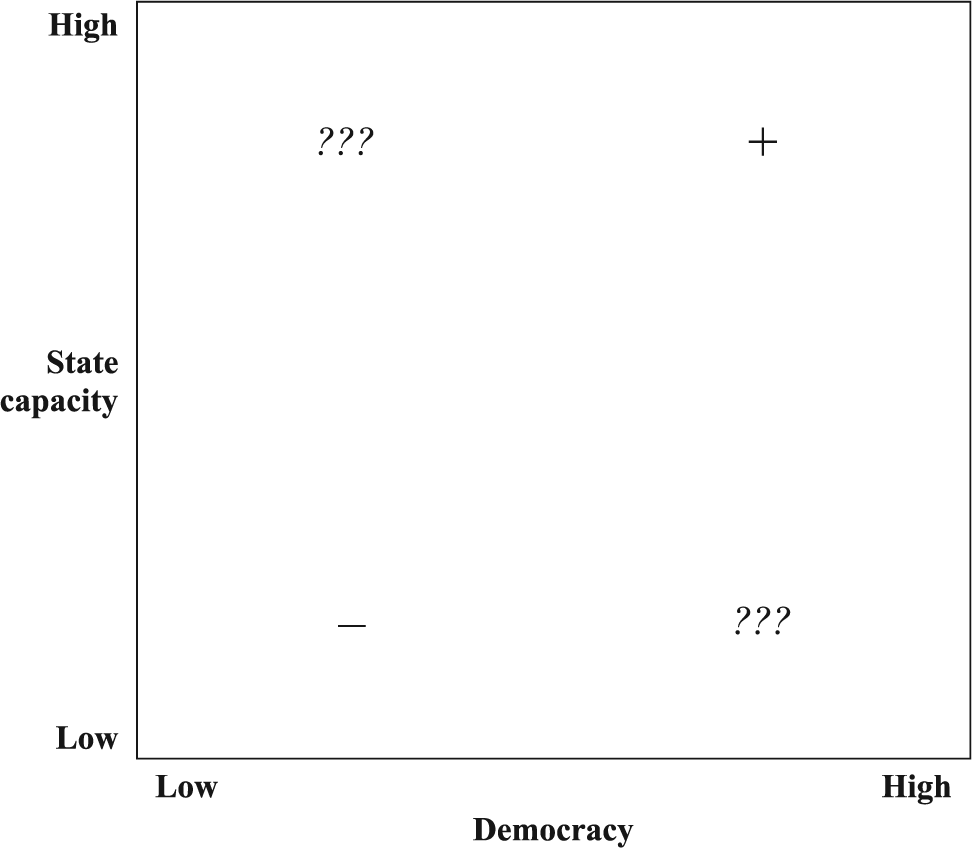
Hypothesized relationships between democracy and state capacity.
Strong democracies
Bureaucratically strong democracies, located in the northeastern quadrant of Figure 1, are both willing and able to protect a broad range of human rights (Berliner et al., 2015; Young, 2009). Capable bureaucracies ensure that the ‘pacifying’ mechanisms of democracy function smoothly and effectively (Davenport, 2007a). It is no small feat, for example, to mobilize the resources and personnel necessary for administering routine elections (Fortin-Rittberger, 2014). More generally, bureaucratic rationalization deepens democracy by enhancing transparency, accountability, and oversight (Drori et al., 2006). Strong democracies also command the ability to train, monitor, regulate, and if necessary constrain local agents who might otherwise abuse human rights on their own accords (Englehart, 2009). Finally, as Mann (1993) reminds us, ‘infrastructural power is a two-way street’ that not only enables governments to penetrate and coordinate civil society, but reciprocally gives civil society groups access to and influence over government – an important facilitator of bottom-up accountability (p. 59). For all of these reasons, I expect strong democracies to respect a full range of human rights.
Weak autocracies
Weak autocrats – so-called fragmented tyrants (Tilly, 2006) or lame leviathans (Callaghy, 1987) – fall on the opposite end of the spectrum. Tilly (2007) paints a gloomy picture of low-capacity non-democratic states, noting that they experience ‘frequent violent struggle’ and harbor ‘multiple political actors including criminals deploying lethal force’ (p. 20). Being unconstrained by effective state institutions or routine elections, government officials in weak autocracies have little incentive to respect human rights, and in any event they lack the means for doing so. Quite the contrary, their incapacitation compels weak autocrats to enforce policies coercively rather than administratively, and to violate rights indiscriminately rather than tactically.
Compare, for example, the different means by which Syria and China clamp down on speech freedoms in the era of Internet technology. In China, an ‘Internet czar’ heads a massive agency staffed by some 2 million bureaucrats who monitor hundreds of millions of Web users and selectively censor content the government deems subversive (British Broadcasting Corporation, 2013; Mozur and Perlez, 2014). In stark contrast, a weak Syrian regime lacks the capacity to target particular websites or users, and must instead resort to wholesale Internet blackouts when threatened (Fisher, 2013). In short, I expect weak non-democratic regimes to have the worst human rights practices. 4
Weak democracies
Weak democracies, which occupy the lower-right portion of Figure 1, pose an anomaly for the many scholars who argue that effective democracy presupposes at least a modicum of state capacity (Fortin, 2012; Norris, 2012; Rose and Shin, 2001; Tilly, 2006, 2007). Without sufficiently strong institutions, democratic accountability mechanisms may be impotent to prevent or redress human rights violations. One such mechanism, elections, succumbs to fraud when infrastructural capacities are weak (Fortin-Rittberger, 2014). Many observers emphasize that physical repression and civil liberties restrictions occur from time to time even in democracies (Cingranelli and Richards, 1999; Conrad and Moore, 2010; Davenport, 2007a), and I consider whether poor human rights conditions in democratic regimes can be attributed, at least in part, to weak institutional capacities. 5
Others suggest that democracy alone is sufficient to improve a variety of quality-of-life outcomes, irrespective of capacity. Hanson (2015) finds that ‘state capacity does not have to reach a high level before democracy can have a positive effect on development outcomes’ such as school enrollments and infant mortality rates (p. 327). ‘[D]emocratic weak states’, he concludes, ‘perform better than their non-democratic counterparts’. The same trends might be expected to hold, a fortiori, for human rights conditions in weak democracies. States must actively deliver and regulate public services to achieve better educational and health outcomes, but many human rights provisions require merely that states refrain from harming or interfering with their citizens. If democracy can improve ‘positive’ social and economic rights outcomes even when administrative capacities are weak, it should also be effective in boosting respect for ‘negative’ bodily integrity rights and civil liberties.
Strong autocracies
The other off-diagonal position in Figure 1 combines low democracy with high capacity. As with low-capacity democracies, expected human rights outcomes for high-capacity autocracies are indeterminate. The same capacities thought to deepen democracy might also enable Orwellian states to infiltrate nearly every facet of society, greatly increasing the extensiveness and expansiveness of repression. After all, ‘repression [is] a policy that requires implementation’ (Bohara et al., 2008: 1). The bureaucratic ‘banality’ with which Nazi officials carried out the Holocaust is perhaps the most infamous example (Arendt, 1994). Saddam Hussein’s ‘bureaucracy of repression’ in Iraq is a more recent case in point: the Iraqi regime’s brutal repression of Kurdish minorities during the first Gulf War ‘was filtered through the bureaucratic vernacular of civil servants following a dull routine of inflexible procedures’ (Human Rights Watch, 1994: x).
Governments can also use bureaucratic procedures to encumber civil liberties in red tape. Amnesty International (2008) warns that ‘bureaucratic barriers [can be] applied in politically motivated ways to hamper … organizations working for the defence of human rights’ by, among other things, ‘deny[ing] organizations legal registration, restrict[ing] their meetings, obstruct[ing] fact-finding visits, and forc[ing] them to cease operating, either directly or by preventing access to sources of funding’ (p. 7). In this vein, Human Rights Watch (2008) laments that Russian civil society is ‘choking on bureaucracy’ due to the proliferation of regulations designed to stifle non-governmental organizations.
An opposing perspective suggests that human rights conditions improve as state institutions strengthen, even among non-democratic regimes. Huntington (1968) contends that ‘the most important political distinction among countries concerns not their form of government but their degree of government’ (p. 1). State capacity, in other words, trumps regime type. Bureaucratic authoritarian regimes represent ‘a kinder, gentler, more secure and stable authoritarianism’ (Huntington, 1991: 129) that violate human rights less frequently and less extensively than disorganized, unstable regimes. Along these lines, Young (2009) found that rulers in strong states, whether democratic or not, are indeed less likely to engage in repression, ostensibly because they feel more secure in their positions.
Bodily integrity rights and civil liberties
To make sense of these indeterminate, even contradictory, theoretical predictions for high-capacity autocracies and low-capacity democracies, we must also account for different categories of human rights. I expect that weak democracies will couple relatively high levels of respect for civil liberties with relatively low levels of respect for bodily integrity rights. Decisions to honor or restrict civil liberties are generally centralized, made by central governments rather than local officials (Cole, 2015b; Lutz and Sikkink, 2000). Whether state capacities are strong or weak, democratic leaders may decide to respect basic liberties on a principled basis (although perhaps not as effectively as in high-capacity democratic regimes). Decisions to violate bodily integrity rights, in contrast, are often decentralized. Weak bureaucracies inhibit the ability of central leaders to monitor and regulate their local agents. Cingranelli and Richards (1999) recognize that
It is difficult for government leaders to put a stop to torture, disappearances, and extrajudicial killings. Police, soldiers, and prison guards, often without the permission or even the knowledge of high government officials, usually carry out these acts. Therefore, making significant improvements in these practices requires re-socializing or replacing large numbers of people in the civilian and military bureaucracy. (p. 531)
Managing and preventing agency loss of this sort becomes very difficult in the absence of highly capable, tightly integrated state institutions (Englehart, 2009). In brief, weak democracies will have difficulty preventing bodily integrity abuses, even if respect for basic civil liberties remains relatively high.
I expect high-capacity autocracies to display the opposite pattern, combining relatively low levels of physical repression with extensive restrictions on civil liberties. Strong autocrats all but obviate the need to deploy physical repression, precisely because they restrict civil liberties so thoroughly. The journalist Anjan Sundaram cites post-genocide Rwanda, often heralded as ‘an island of order and relative prosperity in a poor and politically volatile region’ (New York Times, 2014: A22), as an example of this dynamic:
Rwanda’s a very calm place. There’s very little crime on the streets. … But the longer one stays in Rwanda, one realizes that that calm is not a benign calm. It’s a calm that has been achieved through government repression. It’s a calm that exists because Rwandans cannot and dare not speak up. (Sundaram, 2016)
Here, repression and restriction function as substitutes, with improvements in physical security coming at the expense of steeply curtailed personal freedoms. The result is what Davenport (2007b) calls a tyrannical peace: strong autocracies are ‘peaceful’ only to the extent that citizens, fearful of provoking government repression or retaliation, remain quiescent. When citizens lack the freedom to express opposition or dissent, leaders resort less often to violence as a means of social control (Young, 2009). If strong autocracies represent a kinder and gentler form of authoritarianism (Huntington, 1991), it is primarily with respect to bodily integrity rights.
Data and method
To analyze how democracy and capacity combine to shape human rights practices, I compiled annual cross-sectional-time-series data for unbalanced panels of up to 134 countries between 1984 and 2010, yielding a total number of 2905 country–year observations. Table 1 presents descriptive statistics for each of the following dependent, independent, and control variables. Appendix 1 lists sampled countries.
Descriptive statistics.

GDP: gross domestic product.
Dependent variables
Bodily integrity
I measure bodily integrity practices using a score developed by Fariss (2014) that synthesizes measures of political terror, physical repression, and state-sponsored torture from a variety of sources, including the widely used Political Terror Scale (Wood and Gibney, 2010) and physical integrity rights index from the Cingranelli–Richards Human Rights Database (Cingranelli and Richards, 2010; Cingranelli et al., 2014); ordinal scales of torture compiled by Hathaway (2002) and Conrad et al. (2013), and an indicator of ‘massive repressive events’ assembled by Harff and Gurr (1988).
The resulting measure is designed to account for the ‘changing standard of accountability’ (Fariss, 2014: 297) in the global human rights regime. Human rights observers such as the Amnesty International and the US State Department, whose reports serve as the primary source material for most social-scientific measures of human rights, identified new forms of abuse, redefined existing abuses more expansively, and intensified their monitoring efforts over time (Clark and Sikkink, 2013; Keck and Sikkink, 1998). These processes can inflate perceptions of human rights abuse, at least in the short term (Cole, 2015a; Cole and Ramirez, 2013). Fariss’ measure corrects for biases arising from these information effects. In the analyses that follow, I standardize bodily integrity scores to have a mean of 0 and standard deviation of 1.
Civil liberties
To operationalize civil liberties, I use an ordinal index from the Civil Liberty Dataset (Møller and Skaaning, 2014), with subcomponent scores that tap government respect for the freedoms of expression, association, religion, and movement. Each subcomponent indicates whether the associated liberty is severely restricted (1), fairly restricted (2), modestly restricted (3), or unrestricted (4), resulting in a cumulative index that ranges from 4 to 16. For comparability with bodily integrity outcomes, I also standardize the civil liberties score (mean = 0, standard deviation = 1).
The specificity of this civil liberties score gives it an advantage over alternative measures. The widely analyzed Cingranelli–Richards empowerment rights index (Cingranelli and Richards, 2010; Cingranelli et al., 2014) covers many of the same liberties as the Civil Liberty Dataset, but also includes workers’ rights and the right to vote in free and fair elections. The effects of democracy and capacity on workers’ rights have already been analyzed (Berliner et al., 2015), and suffrage rights are in many ways tautological with electoral democracy. Another common measure of civil liberties, from Freedom House (Puddington et al., 2011), also collapses qualitatively different rights into a single measure: in addition to conventional liberties such as the freedoms of speech, assembly, and religion, it gauges respect for bodily integrity and property rights. 6
Independent variables
State capacity
State capacity is a multifaceted concept and notoriously difficult to measure. One common proxy for state capacity, extractive capacity, is measured as the ratio of taxes to gross domestic product (GDP) (Besley and Persson, 2010; Cheibub, 1998; Englehart, 2009; Hendrix, 2010; Lieberman, 2002; Thies, 2010). North (1981) goes so far as to argue that a state’s ‘boundaries are determined by its power to tax constituents’ (p. 21). Taxation is problematic, however, because it is unclear which specific dimension of capacity it is intended to capture. In his analysis of physical repression, Englehart (2009) contends that a ‘state’s ability to extract taxes is … at the heart of its control over the use of violence, or indeed its ability to engage in any policy’ (emphasis added) (p. 168). Yet, this is precisely the problem: states can devote tax revenues to such varied and contradictory projects as war making (Kiser and Linton, 2001; Tilly, 1992), social service provision (Hanson, 2015; Taydas and Peksen, 2012), and income redistribution (Rueschemeyer and Evans, 1985). Whether tax revenues are devoted to warfare, welfare, or other purposes, taxation itself also contributes to bureaucratization (Tilly, 1992). This polysemic quality makes taxation an ill-suited measure of state capacity. 7
Along somewhat similar lines, Young (2009) uses GDP as a general proxy for state capacity, on the assumption that it determines a state’s ‘financial, administrative, police, and military capabilities’ (Fearon and Laitin, 2003: 80). But again, resources can be invested to develop either bureaucratic and infrastructural or militaristic and despotic capabilities. Revenue-based capacity measures also conflate size with strength. High-consumption states may be weak (Thies, 2010) and low-revenue states may be strong (Chase-Dunn, 1998). For example, states that extract relatively few resources during stable periods may nevertheless be capable of mobilizing resources rapidly during economic or military crises.
To avoid these problems, I use principal-components factor analysis to construct a latent bureaucratic capacity score from three variables in the International Country Risk Guide (ICRG) database (Political Risk Services Group, 2008): a 5-point index of bureaucratic quality gauging whether a country’s ‘bureaucracy has the strength and expertise to govern without drastic changes in policy or interruptions in government services’ (Political Risk Services Group, n.d.: 7); a 7-point index assessing government efforts to control political corruption; and a 7-point index evaluating the strength, impartiality, and observance of the law. Each of these items is measured at monthly intervals and then averaged to produce a yearly score. The resulting factor score has a mean of 0 and standard deviation of 1, and ranges between −2.31 and 2.02.
Many analysts have drawn from the ICRG database to construct similar state capacity scores. To survey a few, Berliner et al. (2015) used the same three measures to construct a simple additive index of administrative capacity; Drori et al. (2006) combined these measures with a ‘favorable investment profile’ score into a latent rationalized governance score; 8 Hendrix and Young (2014) excluded the corruption control measure from their factor analysis but retained the other two variables; and Bäck and Hadenius (2008) combined the bureaucratic quality and corruption control measures into an additive index.
Unlike objective measures such as the ratio of taxes to GDP or GDP itself, ICRG scores are based on the subjective ratings of country experts, which can raise questions as to their validity. Nevertheless, bivariate correlations with several widely used objective measures of state capacity, depicted in Figure 2, lend considerable prima facie validity to the bureaucratic capacity score. This score correlates strongly with indicators of communications development such as domestic mail volume, phones per capita, and newspaper circulation (Cole, 2015b; Cutright, 1963; Hechter, 2000); fiscal measures such as government revenue per capita, GDP per capita, government spending as a percentage of GDP, and the ratio of taxes to GDP; a measure of regime durability that tallies the number of years since a major regime change (Young, 2009); urbanization, which facilitates the projection of power (Herbst, 2000); and income redistribution, measured as the percentage reduction in income inequality due to government taxes and transfers. Bureaucratic capacity is also strongly associated with government spending in education and health, two important indicators of service provision (Hanson, 2015).

Bivariate relationships between bureaucratic capacity and various alternative measures of state capacity.
Other factors thought to facilitate or inhibit a state’s ability to project power – population density (Herbst, 2000) and mountainous terrain (Fearon and Laitin, 2003) – are only weakly associated with bureaucratic capacity; so, too, are measures of military strength (personnel and expenditures). Bureaucratic and military capacities are therefore operationally as well as conceptually distinct.
Democracy
When analyzing human rights scores, it is crucial to select appropriate measures of democracy. The most popular variable in the human rights literature, and indeed the social science literature more generally, is the institutionalized Polity score (Marshall et al., 2013). This score, which ranges from −10 (most autocratic) to +10 (most democratic), combines six component items describing a variety of regime characteristics. One such component, an index of competitiveness of political participation, indicates (among other things) whether political opposition is repressed, and hence is partly redundant with human rights practices (Hill and Jones, 2014).
To avoid tautology, Hill and Jones (2014) recommend abstracting an index of executive constraints from the Polity score. This index, which ranges from 1 to 7, ‘refers to the extent of institutionalized constraints on the decision-making powers of chief executives, whether individuals or collectivities’ (Marshall et al., 2013: 24). A score of 1 indicates no regular limitations on executive action; 3, slight to moderate limitations; 5, substantial limitations; and 7, executive parity with or subordination to other accountability groups. 9 Even-numbered scores represent intermediate categories. Gleditsch and Ward (1997) demonstrate empirically that ‘executive constraint is the most important variable in determining the democracy score for a given polity’ (p. 369).
Figure 3 plots executive constraints against bureaucratic capacity, using values averaged throughout the observation period. Consistent with previous research (Bäck and Hadenius, 2008), the relationship is curvilinear: bureaucratic capacity scores initially decrease as executive constraints advance from low to intermediate values but then turn dramatically upward as executive constraints increase further. Singapore, which falls well off the best-fitting quadratic line, represents the prototypical high-capacity authoritarian state. Low-capacity autocracies include Iraq, Sudan, Liberia, and the Democratic Republic of the Congo. Many post-conflict, ‘third-wave’ democracies (Huntington, 1991) in Latin America populate the low-capacity democratic quadrant. Finally, Western European countries and their derivative settler states (e.g. the United States) are overrepresented among high-capacity democracies.
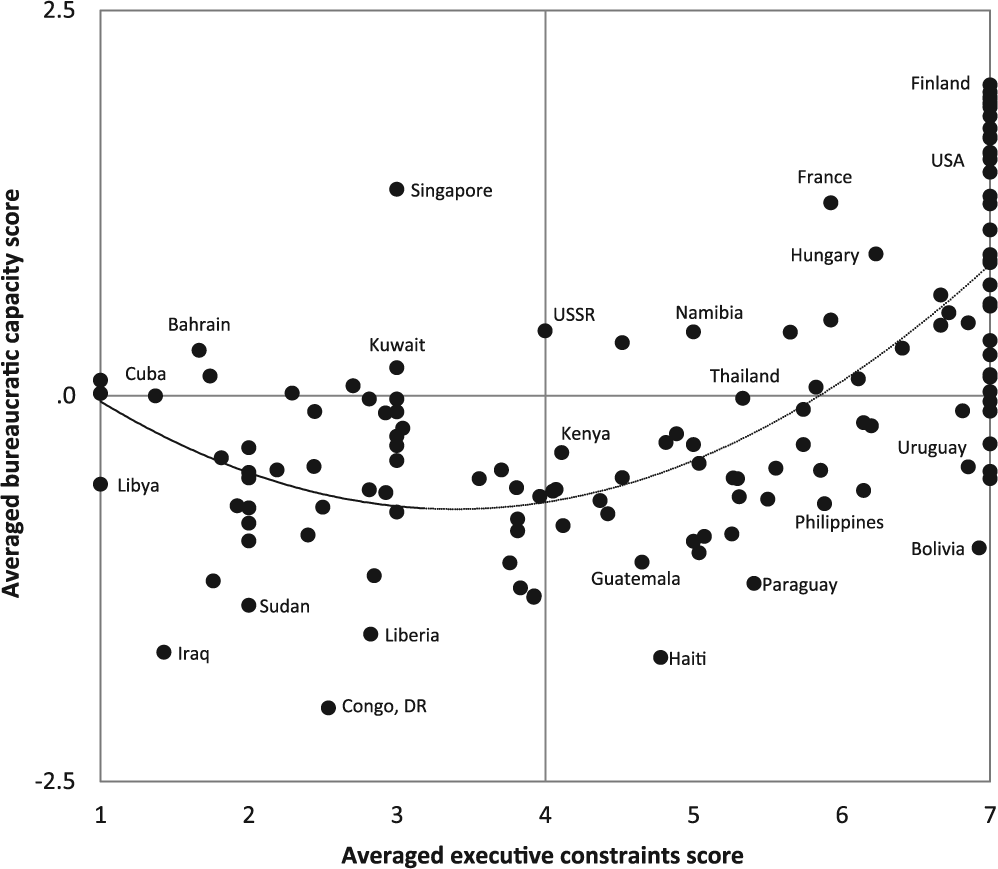
Bivariate relationship between executive constraints and bureaucratic capacity.
In addition to the executive constraints index, I also construct a dummy variable indicating whether a country holds competitive elections, based on variables in the Polity database. Elections are competitive to the extent that executive authorities are chosen in regularized and institutionalized contests that feature two or more parties or candidates, and when the politically active population has an opportunity, in principle, to attain executive positions (Marshall et al., 2013: 20–23). Roughly 52 percent of all country–year observations in my sample are coded as having competitive elections.
Control variables
The analyses include standard control variables drawn from the literature on human rights practices. GDP per capita, measured in constant 2005 US dollars (World Bank, 2013), is almost invariably associated with better human rights conditions (Hafner-Burton and Tsutsui, 2005; Henderson, 1991; Mitchell and McCormick, 1988; Poe and Tate, 1994; Poe et al., 1999; Richards et al., 2015). This variable has also been used as a proxy for state capacity (Fearon and Laitin, 2003; Young, 2009), making it an essential control.
Domestic and international conflict increases rights abuses (Davenport and Armstrong, 2004; Hafner-Burton and Tsutsui, 2005; Poe and Tate, 1994), reduces levels of democracy (Fearon and Laitin, 2003; Hegre et al., 2001; Krain and Myers, 1997), and weakens state capacities (Fearon and Laitin, 2003; Hironaka, 2005; Sobek, 2010; Thies, 2010). To account for these processes, I include three ordinal measures of conflict from the Major Episodes of Political Violence dataset (Marshall, 2015): civil violence intensity ranges from 0 to 4 in the sample; civil war intensity ranges from 0 to 6; and international war intensity ranges from 0 to 7. War is distinguished from violence by virtue of its ‘stronger institutional, or institutionalized, component and more definite objectives’ (Marshall, 2015: 2).
Finally, population pressures – measured as (logged) population size (World Bank, 2013) – increase human rights violations due to competition over scarce resources, the threat (real or perceived) that large populations pose to sitting regimes, and, more generally, the greater opportunities for abuse (Hafner-Burton and Tsutsui, 2005; Henderson, 1993; Keith, 1999; Mitchell and McCormick, 1988). Large populations are additionally thought to complicate efforts to implement and administer policies (Young, 2009).
Estimation strategies
Most of the analyses employ a standard ordinary least-squares (OLS) estimator with kernel-based standard errors that are robust to both heteroscedasticity and autocorrelation. 10 These models include (but do not report) fixed effects for years and regions. Year effects partial out temporal trends that affect all countries simultaneously. Regional effects control for durable but unmeasured heterogeneity across the following United Nations (UN)-designated regions: Australia and New Zealand, Caribbean, Central America, Central Asia, Eastern Africa, Eastern Asia, Eastern Europe, Melanesia, Micronesia, Middle Africa, Northern Africa, Northern America, Northern Europe, Polynesia, South America, Southern Asia, Southern Europe, Western Africa, Western Asia, Western Europe. 11
The subjective nature of my state capacity measure raises additional methodological concerns that must be addressed. Widespread human rights violations could lead experts to conclude that a state’s institutions are weak, corrupt, and arbitrary; by the same token, favorable rights conditions might be interpreted as a sign that institutions are strong and effective. If a country’s record on human rights influences how experts assess the quality and strength of its institutions, regression estimates using the ICRG-based measure of bureaucratic capacity will be biased. To inspire confidence that causal directionality flows from bureaucratic capacity to human rights and not vice versa, I estimate and report supplementary two-stage regression models with instrumental variables, which are equipped to diagnose and mitigate endogeneity bias.
Results
Constraints and capacity
Table 2 presents OLS estimates for the effect of executive constraints, bureaucratic capacity, and control variables on bodily integrity scores (Models 1 and 2) and civil liberties scores (Models 3 and 4). For each outcome, the first model assesses the independent effects of executive constraints and bureaucratic capacity, and the second model evaluates potential interaction effects between these variables.
OLS regression models for the independent and interactive effects of executive constraints and bureaucratic capacity on human rights outcomes, 1985 to 2010.

OLS: ordinary least-squares; GDP: gross domestic product.
N (country–years) = 2905; N (countries) = 134.
Heteroscedasticity- and autocorrelation-robust standard errors in parentheses.
All time-varying independent and control variables are lagged 1 year relative to human rights scores.
Analyses include (but do not report) fixed effects for years and the following United Nations (UN) regions: Australia and New Zealand, Caribbean, Central America, Central Asia, Eastern Africa, Eastern Asia, Eastern Europe, Melanesia, Micronesia, Middle Africa, Northern Africa, Northern America, Northern Europe, Polynesia, South America, Southern Asia, Southern Europe, Western Africa, Western Asia, Western Europe.
**p < .01; ***p < .001 (two-tailed).
Model 1 demonstrates that bodily integrity scores increase as an independent function of both executive constraints (β = .053, p < .001) and bureaucratic capacity (β = .231, p < .001), although the net effect of capacity is much larger than the net effect of constraints. Estimated bodily integrity scores increase from −0.518 to 0.481 across the empirical range of the bureaucratic capacity score, holding all other variables in the model constant at their mean values. By comparison, the bodily integrity score is −0.190 when executive authority is unconstrained and 0.129 when it is fully constrained.
The main effects for executive constraints and bureaucratic capacity remain significantly positive in Model 2; this means, for example, that when bureaucratic capacity is 0, the relationship between executive constraints and bodily integrity scores continues to be positive. Although the positive coefficient on the interaction term in Model 2 is statistically insignificant, it is nevertheless possible to observe a significant conditional effect at some values of the constituent variables (Brambor et al., 2006). To consider this possibility, Figure 4 diagrams the interaction effect from Model 2, with control variables held constant at their sample means. Two interpretations are presented. Panel A illustrates how executive constraints channel the relationship between bureaucratic capacity and bodily integrity, and panel B shows how bureaucratic capacity conditions the relationship between executive constraints and bodily integrity.
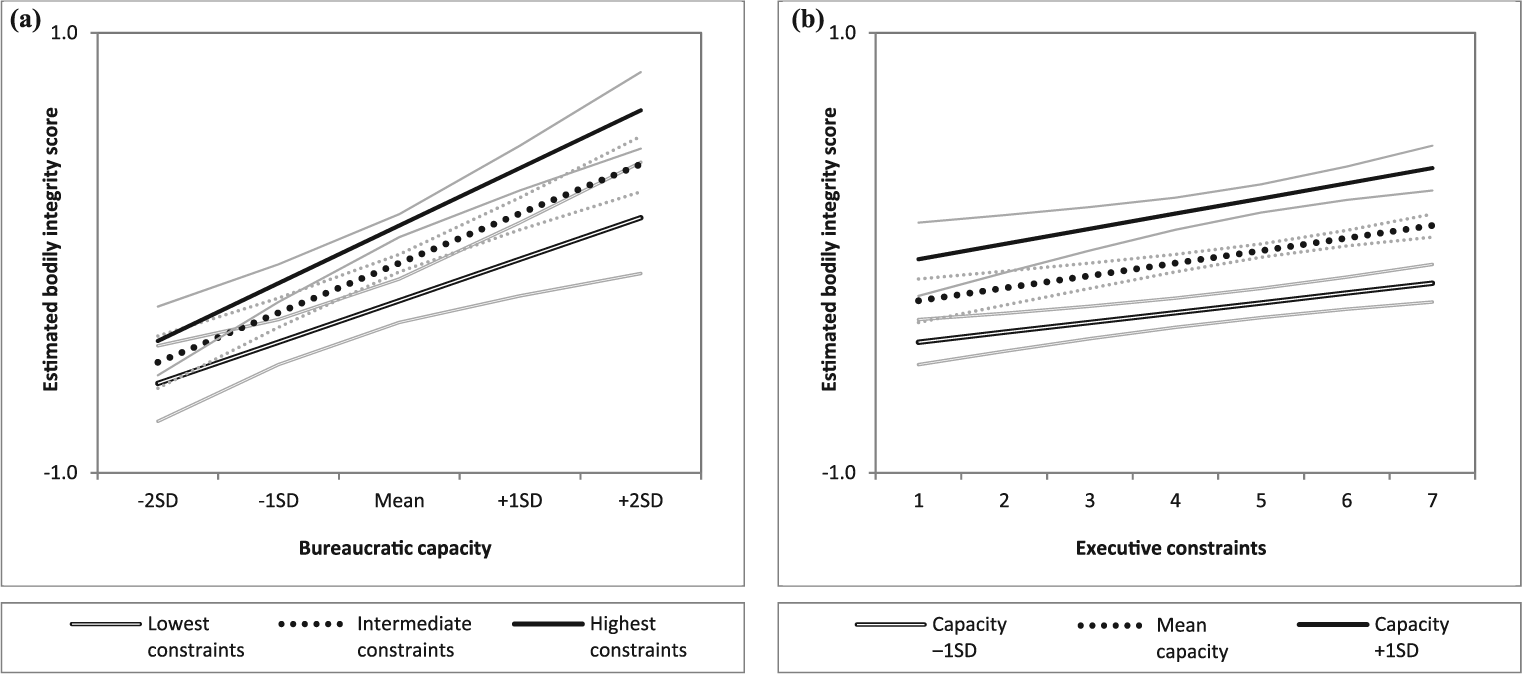
Estimated effect of (a) bureaucratic capacity and (b) executive constraints on bodily integrity scores.
Consider the effect of bureaucratic capacity on bodily integrity scores for countries with high (7), low (1), and intermediate (4) executive constraints scores (panel A). When bureaucratic capacity is low, bodily integrity scores are also low, irrespective of executive constraints. Absent sufficient capacity, executive constraints do not protect bodily integrity rights. As bureaucratic capacity scores increase, bodily integrity scores also increase, albeit at a somewhat faster rate when executive constraints are high. When evaluated at the middle of the bureaucratic capacity distribution, estimated bodily integrity scores improve significantly as executive constraints strengthen – as indicated by the non-overlapping confidence intervals around the point estimates. In sum, the relationship between bureaucratic capacity and bodily integrity rights is uniformly positive, but executive constraints amplify the effect.
Panel B uses the same regression findings to illustrate how bureaucratic capacity conditions the relationship between executive constraints and bodily integrity scores. Estimated bodily integrity scores improve as executive constraints increase, but high-capacity states (evaluated at one standard deviation above the mean bureaucratic capacity score) significantly outperform their low-capacity counterparts (one standard deviation below the mean) at all but the lowest levels of executive constraints. These trends reiterate the independent salutary effect of bureaucratic capacity on bodily integrity.
For their part, coefficients for control variables in Models 1 and 2 conform to expectations: GDP per capita is associated with higher bodily integrity scores, whereas population size and each conflict index are associated with lower bodily integrity scores.
Models 3 and 4 repeat the foregoing analyses for civil liberties scores. Executive constraints improve civil liberties independently of other variables (Model 3: β = .262, p < .001) but bureaucratic capacity does not. Rather, the relationship between bureaucratic capacity and civil liberties is contingent on executive constraints. The estimated effect of bureaucratic capacity on civil liberties is positive only when executive authorities are adequately constrained. When executive constraints are low, the relationship between bureaucratic capacity and civil liberties becomes negative.
As before, Figure 5 illustrates different ways to interpret the estimated interaction effect in Model 4. Both interpretations underscore the paramount importance of executive constraints for civil liberties. Panel A clearly shows that executive constraints steer the relationship between bureaucratic capacity and civil liberties in different directions. When executive authorities are fully constrained, increasing bureaucratic capacity improves civil liberties. When executive constraints are low, however, the relationship between bureaucratic capacity and civil liberties is negative. Even when bureaucratic capacity is very weak, civil liberties scores are significantly higher in regimes that constrain executive authority; increased capacity serves merely to intensify this effect.
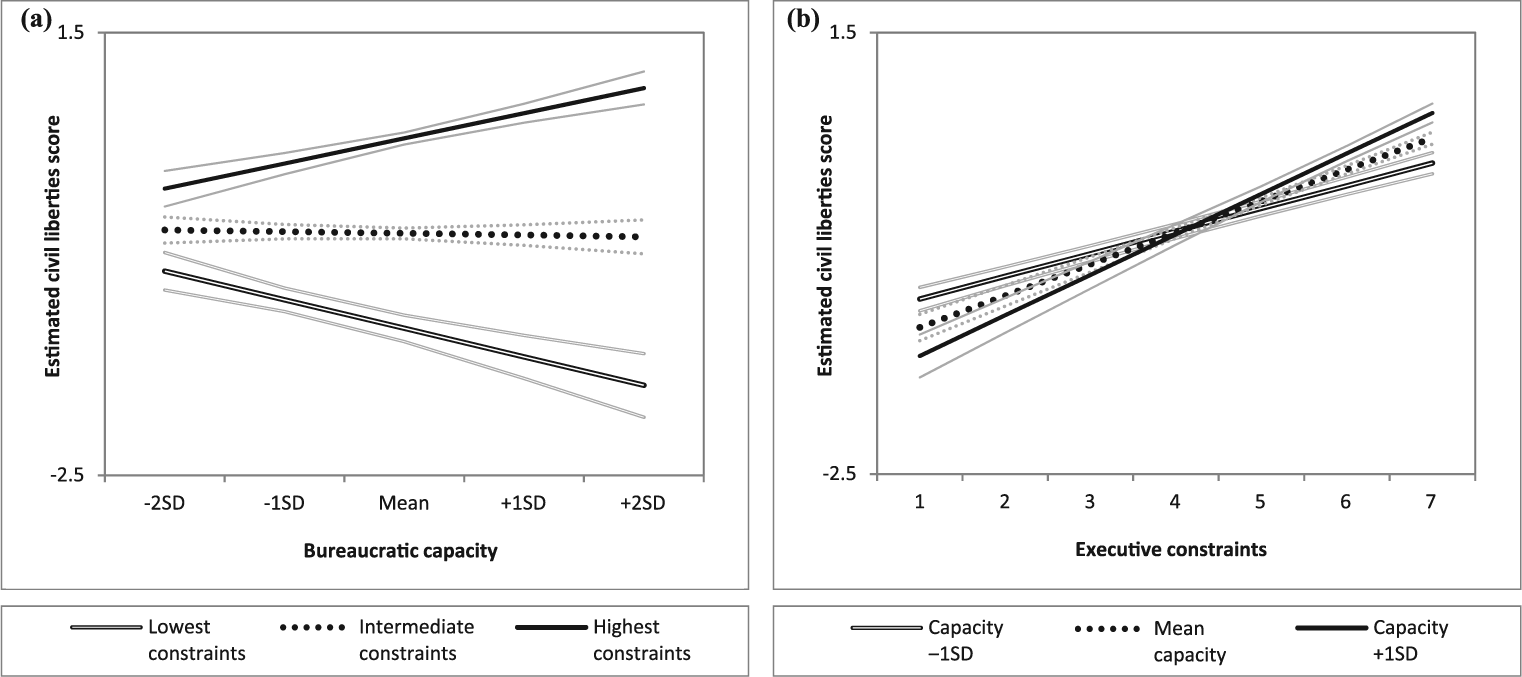
Estimated effect of (a) bureaucratic capacity and (b) executive constraints on civil liberties scores.
Panel B confirms the powerful relationship between executive constraints and civil liberties. Bureaucratic capacity conditions this effect only at the extremes. When executives are completely unconstrained, states with weak bureaucracies have slightly but significantly higher civil liberties scores than states with strong bureaucracies. When executives are fully constrained, civil liberties scores are higher in stronger states. Apart from these effects, most forms of conflict also reduce civil liberties scores, as does population size; GDP per capita, conversely, improves these scores. 12
Elections and capacity
To assess the robustness of these patterns, Table 3 presents results from structurally identical models that substitute competitive elections for executive constraints. Models 5 and 7 indicate that bureaucratic capacity is independently associated with higher human rights scores, although the magnitude of this effect is much larger for bodily integrity than for civil liberties. Across the empirical range of the bureaucratic capacity factor, estimated bodily integrity scores in Model 5 increase from −0.563 to 0.517 (holding all other variables constant at their means). The corresponding increase in civil liberties scores is relatively modest, moving from −0.205 to 0.196. Competitive elections also improve human rights scores, albeit more so for civil liberties than for bodily integrity: bodily integrity scores are an estimated 0.131 points higher in countries with competitive elections than in countries without, all else being equal, whereas civil liberties scores are 0.854 points higher when elections are present. These findings confirm that capacity matters more for bodily integrity and democracy matters more for civil liberties.
OLS regression models for the independent and interactive effects of competitive elections and bureaucratic capacity on human rights outcomes, 1985 to 2010.

OLS: ordinary least-squares; GDP: gross domestic product.
N (country–years) = 2905; N (countries) = 134.
Heteroscedasticity- and autocorrelation-robust standard errors in parentheses.
All time-varying independent and control variables are lagged 1 year relative to human rights scores.
Analyses include (but do not report) fixed effects for years and the following United Nations (UN) regions: Australia and New Zealand, Caribbean, Central America, Central Asia, Eastern Africa, Eastern Asia, Eastern Europe, Melanesia, Micronesia, Middle Africa, Northern Africa, Northern America, Northern Europe, Polynesia, South America, Southern Asia, Southern Europe, Western Africa, Western Asia, Western Europe.
p < .10; *p < .05; **p < .01; ***p < .001 (two-tailed).
The positive interaction term in Model 6 shows that bureaucratic capacity and competitive elections also combine to improve bodily integrity scores, and both main effects remain significantly positive. In contrast, Model 8 suggests that bureaucratic capacity improves civil liberties only in countries with competitive elections. The estimated effect of bureaucratic capacity in countries without elections is negative but statistically insignificant.
Figure 6 plots these interaction effects, again with control variables set to their mean values. As with executive constraints, bodily integrity scores increase with bureaucratic capacity regardless of whether competitive elections are present or absent (panel A). At above-average bureaucratic capacity scores, countries with competitive elections slightly but significantly outperform countries without competitive elections. Conversely, the effect of bureaucratic capacity on civil liberties is contingent on elections (panel B): when elections are present, civil liberties scores increase with bureaucratic capacity; when elections are absent, strengthened capacities are mildly pernicious for civil liberties.
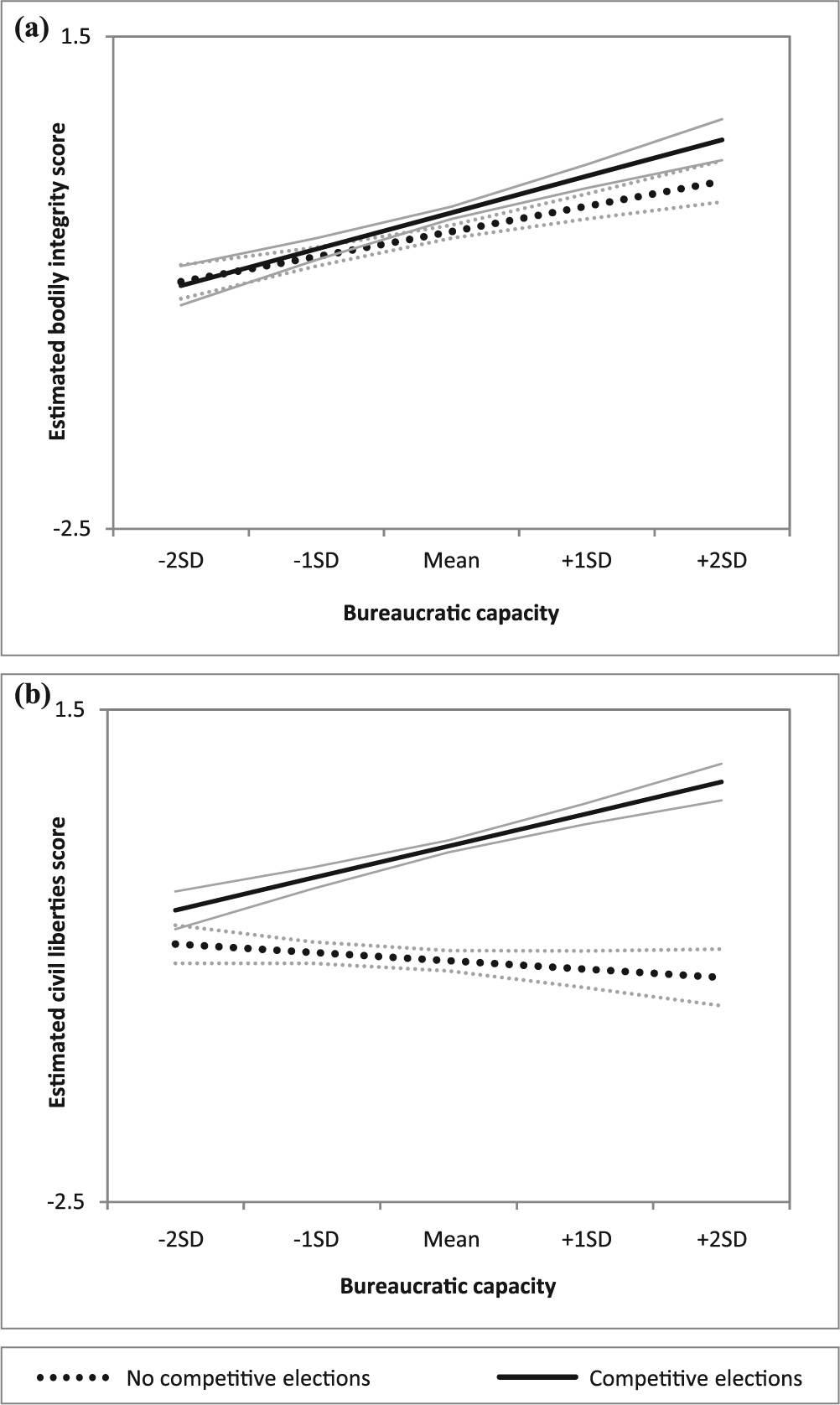
Estimated effect of competitive elections and bureaucratic capacity on (a) bodily integrity and (b) civil liberties scores.
Assessing causal directionality
The foregoing analyses clearly demonstrate the importance of bureaucratic capacity – whether positive or negative, independent or contingent – for human rights outcomes. I now consider whether bureaucratic capacity is causally prior to human rights by estimating two-stage models with instrumental variables. Table 4 presents the results of these analyses. The first pair of models estimates the effects of executive constraints and bureaucratic capacity on bodily integrity (Model 9) and civil liberties (Model 10). The final two models repeat these analyses using the competitive elections indicator of democracy.
IV-LIML regression models for the effects of bureaucratic capacity on human rights outcomes, net of executive constraints and competitive elections, 1985 to 2010.

IV-LIML: limited-information maximum likelihood estimator with instrumental variables; GDP: gross domestic product.
Robust standard errors in parentheses.
All time-varying independent and control variables are lagged 1 year relative to human rights scores.
Analyses include (but do not report) fixed effects for years and the following United Nations (UN) regions: Australia and New Zealand, Caribbean, Central America, Central Asia, Eastern Africa, Eastern Asia, Eastern Europe, Melanesia, Micronesia, Middle Africa, Northern Africa, Northern America, Northern Europe, Polynesia, South America, Southern Asia, Southern Europe, Western Africa, Western Asia, Western Europe.
External instruments:
Models 9 and 11. Government expenditures (% GDP), t – 2; regional international war index, t – 2; and newly independent country indicator, t – 1. Models 10 and 12. Government expenditures (% GDP), t – 2; regional conflict score, t – 2; and foreign direct investment inflows (% GDP), t – 2.
Kleibergen–Paap rk Lagrange Multiplier (LM) test of underidentification – H0: excluded instruments are not correlated with the endogenous regressor.
Cragg–Donald Wald F test of weak identification – H0: equation is weakly identified, that is, the instruments are only weakly correlated with the endogenous regressor. Evaluated against Stock and Yogo (2005) critical value, 10-percent maximal IV size: 6.46 for all models.
Hansen’s J test of overidentification – H0: instruments are uncorrelated with the error term in the structural equation and are correctly excluded.
Anderson–Rubin weak-instrument-robust inference Wald test of orthogonality conditions – H0: orthogonality conditions are met, that is, the instruments are not significantly correlated with the dependent variable in the structural equation (i.e. human rights scores).
Endogeneity test – H0: the suspected endogenous regressor can be treated as exogenous, indicating that the model estimated by ordinary least-squares (OLS) is preferred.
p < .10; *p < .05; **p < .01; ***p < .001 (two-tailed).
To obtain valid estimates using two-stage models, the selected instruments for bureaucratic capacity must satisfy two criteria. First, they must be sufficiently correlated with bureaucratic capacity scores: the stronger the correlation, the better the instrument. Second, they must be uncorrelated with the error term of the structural equation (i.e. the equations modeling human rights scores). The first condition, instrument relevance, can be directly observed, and the second condition, instrument exogeneity, must be inferred because the error term is unobserved.
Instruments for bureaucratic capacity in the bodily integrity models include government expenditures as a percentage of GDP (World Bank, 2013) and a regional score for international war magnitude (Marshall, 2015), each lagged 1 year relative to bureaucratic capacity; a third instrument, a dummy variable indicating the first 5 years following independence, is measured concurrently with bureaucratic capacity. Instruments in the civil liberties models include government expenditures and foreign direct investment inflows, each as a percentage of GDP (World Bank, 2013), and a regional violent conflict score (Marshall, 2015), all measured 1 year prior to bureaucratic capacity. 13
The estimated effects of each independent and control variable do not necessarily concern us in these analyses, although the fact that coefficients are similar in sign and magnitude to those obtained by OLS is reassuring. The primary focus is instead on the battery of diagnostic tests for evaluating the validity of the selected instruments. The underidentification and weak identification tests indicate that the instruments are valid – the correlation between each set of instruments and the bureaucratic capacity factor is strong. The overidentification and orthogonality tests further suggest that the instruments are exogenous to human rights scores. The instruments, at the very least, are appropriately orthogonal: they exert no systematic effect on human rights scores when conditioned on other variables in the model.
Given that the instruments for bureaucratic capacity are valid, a Hausman-like endogeneity test can be estimated. This test considers whether bureaucratic capacity is endogenous to human rights scores, or whether it can instead be treated as exogenous. The final row of Table 4 reports these results for each model. Under the null hypothesis, endogeneity bias is not present; failure to reject the null hypothesis means that the corresponding OLS estimates – which are more efficient and less biased than those obtained using instrumental variables – are preferred. Each test indicates that the bureaucratic capacity factor is exogenous to human rights scores, thus favoring the OLS estimates presented in Tables 2 and 3.
Discussion and conclusion
This article considers whether and how two mechanisms of democratic accountability (executive constraints and competitive elections) combine with state capacity (measured as the quality of a state’s bureaucratic institutions) to shape countries’ human rights practices (bodily integrity and civil liberties). To recap, bureaucratic capacity improves bodily integrity practices independently of democracy, but it improves civil liberties outcomes only when executive authorities are constrained or competitive elections are held. In the absence of either constraints or elections, bureaucratic capacity actually curtails civil liberties.
The quality of a state’s institutions matters more than democracy for bodily integrity protections, although executive constraints and competitive elections serve to enhance this effect. When bureaucratic capacity is low, even democratic regimes have difficultly safeguarding their citizens. Bodily integrity abuses are often committed by decentralized agents and officials acting without authorization and beyond the reach of their central governments. As bureaucratic capacities strengthen, government ‘principals’ are better able to monitor, manage, and control their local ‘agents’ (Englehart, 2009). Bureaucratic capacity also improves physical security in autocracies. When it comes to egregious bodily integrity abuses, strong authoritarian regimes do in fact appear to be ‘kinder and gentler’ than either weak autocracies or weak democracies (Huntington, 1991).
In marked contrast, respect for civil liberties is greater in countries that impose constraints on executive authority or that hold competitive elections, even when bureaucratic capacities are low. Democracy, not bureaucracy, is decisive, although bureaucratic capacities significantly improve the effectiveness of democratic accountability mechanisms. Executive constraints and competitive elections, on the one hand, and civil liberties, on the other hand, represent two sides of the same coin: one side represents the procedural elements of democracy, the other its substantive aspect.
But if strong institutions increase respect for civil liberties in democracies, they also empower autocracies to restrict the same liberties. Effective restrictions on civil liberties depend on ‘administration, monitoring, and the pretense of legality’ (Davenport, 2007a: 49). So it is that civil liberties scores in autocratic regimes are higher when bureaucratic capacity is weak than when it is strong. Bureaucratic capacity, in short, is a tool that states can use either to protect or restrict civil liberties, depending on whether central government authorities are held accountable by other state elites or the electorate.
These results suggest that a complete understanding of the relationship between democracy and capacity requires a concurrent analysis of bodily integrity rights and civil liberties – something the extant literature, with its focus on physical repression, generally fails to do. Strong democracies respect a full spectrum of bodily integrity rights and civil liberties. These regimes are willing to honor and able to protect individuals’ rights, and their leaders are held accountable when practices fall short. Weak democracies, for their part, are somewhat more likely than weak autocracies to respect civil liberties, but they are no better at protecting bodily integrity rights. Governments in weak democracies attempt more or less successfully to honor civil liberties, but they appear impotent to prevent decentralized bodily integrity abuses.
Even more revealing are the outcomes for strong non-democratic regimes, which generally protect bodily integrity but restrict civil liberties. Existing research suggests that these two trends are systematically linked. Extreme restrictions on civil liberties prevent citizens from voicing their grievances or mobilizing against powerholders. The resulting sense of security renders authoritarian leaders less likely to deploy repression as an instrument of rule or a means for ‘neutralizing’ regime opponents (Davenport, 2007b; Young, 2009). Bureaucratic capacity seems to be the (as yet) unspecified mechanism joining these trends together.
Finally, these conclusions speak to a crucial policy question: should parties who seek to improve human rights focus on developing democratic institutions or strengthening bureaucratic capacities? This study suggests that regime change, by itself, will typically not be enough to curb most human rights violations (Englehart, 2005). For human rights conditions to improve, investments in bureaucratic capacity must accompany, and perhaps even precede, transitions to democracy (Rose and Shin, 2001; Tilly, 2007). 14 Either way, state building is no easy task. Effective, autonomous, and stable bureaucracies presuppose a host of social and cultural underpinnings – what Rueschemeyer and Evans (1985) call, following Durkheim, the ‘non-bureaucratic foundations of bureaucratic functioning’ (p. 59). Rationalized governance depends on ‘broad and transformative cultural changes in local societies, such as the degree of scientization, or the penetration of science-like logics, and expanded systems of rationalized education’ (Drori et al., 2006: 211). Such changes occur gradually and incrementally, and they often confront a good deal of social, cultural, and political inertia or even resistance. Developing these capacities is no easy task, but it is essential to the realization of basic human rights.
Footnotes
Appendix
Sampled countries.

| Albania | Greece | Pakistan |
| Algeria | Guatemala | Panama |
| Angola | Guinea | Papua New Guinea |
| Argentina | Guinea-Bissau | Paraguay |
| Armenia | Guyana | Peru |
| Australia | Haiti | Philippines |
| Austria | Honduras | Poland |
| Azerbaijan | Hungary | Portugal |
| Bahrain | India | Qatar |
| Bangladesh | Indonesia | Romania |
| Belarus | Iran | Russian Federation |
| Belgium | Iraq | Saudi Arabia |
| Bolivia | Ireland | Senegal |
| Botswana | Israel | Serbia |
| Brazil | Italy | Sierra Leone |
| Bulgaria | Jamaica | Singapore |
| Burkina Faso | Japan | Slovak Republic |
| Cameroon | Jordan | Slovenia |
| Canada | Kazakhstan | South Africa |
| Chile | Kenya | Spain |
| China | Korea, Rep. | Sri Lanka |
| Colombia | Kuwait | Sudan |
| Congo, Dem. Rep. | Latvia | Suriname |
| Congo, Rep. | Lebanon | Sweden |
| Costa Rica | Liberia | Switzerland |
| Cote d’Ivoire | Libya | Syria |
| Croatia | Lithuania | Tanzania |
| Cuba | Luxembourg | Thailand |
| Cyprus | Madagascar | Togo |
| Czech Republic | Malawi | Trinidad and Tobago |
| Czechoslovakia | Malaysia | Tunisia |
| Denmark | Mali | Turkey |
| Dominican Republic | Mexico | Uganda |
| Ecuador | Moldova | Ukraine |
| Egypt | Mongolia | United Arab Emirates |
| El Salvador | Morocco | United Kingdom |
| Estonia | Mozambique | United States |
| Ethiopia | Namibia | Uruguay |
| Finland | Netherlands | USSR |
| France | New Zealand | Venezuela |
| Gabon | Nicaragua | Vietnam |
| Gambia, The | Niger | Yemen, Rep. |
| Germany | Nigeria | Zambia |
| Germany, West | Norway | Zimbabwe |
| Ghana | Oman |
Acknowledgements
An earlier version of this article was presented to the Comparative Sociology Workshop at the University of California, Irvine, whose participants offered many helpful suggestions. I also thank several anonymous reviewers for their critical and constructive engagement with an earlier version of this article.
Declaration of Conflicting Interests
The author(s) declared no potential conflicts of interest with respect to the research, authorship, and/or publication of this article.
Funding
The author(s) received no financial support for the research, authorship, and/or publication of this article.