




Abstract
This study investigates the relationship between the division of household labor and individuals’ perceived fairness concerning this division. We applied multilevel multinomial logistic regression to analyze data on both men and women across 29 countries using the International Social Survey Programme (ISSP) from 2012 (N = 16,633). It was found that people who perform a larger share of household tasks are more likely to indicate that they do more than a fair share. Furthermore, we uncovered that in more gender egalitarian countries and in countries where women spend more time in the labor market, women and men are more likely to consider doing a larger share of housework to be unfair. Interestingly, when both country characteristics were included in the same model, we found that for women the effect of country’s female labor force participation lost statistical significance, while for men the country-level gender ideology resulted in a non-significant effect. Implications for future research are discussed.
Introduction
Contemporary Western societies experienced substantial developments leading to more gender equality over the years. Most crucial in this respect is women’s increased labor force participation (Blossfeld and Drobnič, 2003; Van Dijk and Van Der Lippe, 2001), which implies more equality between men and women in the domain of paid labor. Partly as a result of this trend, the gendered division of household work shifted toward more equality as well (Bianchi et al., 2000). This shift is the result of both an increase in men’s domestic labor and a decrease in the hours women spend doing housework (Bianchi et al., 2012). Nevertheless, women currently still take up the larger share of household tasks (Bianchi et al., 2000; Hook, 2006). Developments toward more gender equality in the labor market and in the home generally are considered desirable. The point of view that men and women should have equal opportunities in Western countries is uncontested. In several domains, however, it is not so much the actual degree of equality in division of labor that matters, but the perceived fairness of this division (Greenstein, 1996). For instance, an unequal division of household labor may not reduce subjective well-being and marital quality, if women are satisfied with doing more housework than their husbands (Braun et al., 2008; Treas et al., 2011). Mikula (1998) found in an overview study that while many women take up the majority of household work, only 20–30 percent of all women perceived this division as unjust. In addition, studies found that women who perceive the division of labor in their households as unfair were also less satisfied with their marital quality (Lavee and Katz, 2002) and their family life (Greenstein, 2009). In our study, we are interested in the link between the actual division of household labor and how it is perceived in terms of fairness, and more importantly, we are interested in whether institutional factors condition this link. It could well be that in countries where structural and cultural factors are stimulating gender equality, an unequal division of household labor is perceived as most unfair, whereas the same situation in a more traditional country is observed as a relative fair division of tasks.
This macro-level approach may offer relevant insights. Many governments aim for gender equality as they believe in its positive returns to society. They therefore strive to implement policy measures that facilitate members of households to divide their actual division of household labor more equally, such as parental leave and childcare policies. However, some desirable outcomes may not be a function of gender equality as such, but of the fairness perceptions people hold about the level of equality in their households’ labor division. In those cases, policies are likely more effective when they intervene in ways that actual divisions of household labor translate into fairness perceptions. In this study, we adopt a country-comparative design to address the following question: To what extent do structural and cultural country characteristics affect the relationship between actual division of household labor and perceived fairness?
Previous literature identified several individual characteristics that affect how the division of household labor is perceived given an actual division. Women who work more, who have a higher income compared to their partner, who adhere to an egalitarian gender ideology, or who feel they have alternatives to marriage more often report feelings of unfairness in a situation of an unequal division of household labor (Braun et al., 2008; Greenstein, 1996; Lennon and Rosenfield, 1994; Öun, 2013). The dominant individual-level theoretical explanation on how actual divisions of labor are judged in terms of fairness is addressed in distributive justice theory (Ruppanner, 2008; Thompson, 1991). This theory states that perceived (un)fairness is the result of three sources: outcomes (the actual division of housework and other tasks), comparative referents (the extent to which people compare their division to their partner or to other couples), and justifications (in how far people adhere to gender roles which espouse an imbalanced division of household labor) (Perales et al., 2015; Ruppanner, 2008, 2010). Only a few recent studies took a comparative approach examining whether fairness perceptions – given actual divisions of household labor – are conditioned by the national context (Braun et al., 2008; Davis, 2010; Greenstein, 2009; Öun, 2013). They found that women perceive an unbalanced division of housework as more unfair in countries with higher levels of gender equality (Greenstein, 2009; Ruppanner, 2008), in countries where women spend more time and have more equal opportunities on the labor market (Braun et al., 2008), and in countries with policy regimes that promote gender equality (Öun, 2013). Relative deprivation theory (Crosby, 1976) offers a framework to explain these contextual effects: a situation is mainly judged as fair when it is similar to the situation of a comparative referent. People within a national context serve as comparative referents (Greenstein, 2009).
Our study elaborates on the limited number of comparative studies dealing with perceived fairness of household divisions of labor in three ways. First, unlike previous works, we will include not only structural but also cultural macro-level conditions. This implies a more thorough test of relative deprivation theory. Whereas structural factors indicate a country’s practical standard, cultural factors likely signify the normative standard to which people compare their own situation. Previous research predominantly focused on countries’ structural characteristics, with the exception of Öun (2013) who investigated the role of prevailing gender role attitudes. She found that in countries where gender equality was promoted, both women and men became more sensitive to inequalities in the household. Second, we will include these structural and cultural macro-level explanations simultaneously. Since structural factors such as female labor force participation and gender equality are likely to be high in countries with non-traditional gender role ideologies, effects of structural factors found in previous literature may be spurious. A direct competition between the two most likely explanatory factors will reveal whether previous conclusions about conditioning effects of structural characteristics are in fact driven by conditioning effects of cultural characteristics. Third, we will use more suitable and subtle measurements of the actual division of household labor (X) and fairness perceptions (Y). Öun measured perceived fairness (Y) as a scale running from very unfair to fair and characterized households by their position on a scale with equal sharing on the one extreme and unequal sharing (i.e. one partner does all household tasks) on the other extreme (X). This operationalization potentially masks the moderating impact of the national context. Whereas it is plausible to expect that in more egalitarian countries unequal divisions of household labor (i.e. divisions in which one partner does all or most household tasks) will be more strongly perceived as unfair, it is not straightforward that in traditional countries unequal divisions will be perceived as fair; this may be the case if the woman carries out all household tasks, but not if it is the man who does the household labor. Collapsing two types of unequal divisions (respondent does more and respondent does less than his or her partner) into one category may therefore result in an underestimation of contextual effects. We therefore study the influence of a respondent’s relative share of the couples’ time investment in household labor (X) on the odds that one perceives this situation as doing more than one’s fair share versus doing one’s fair share (and on the odds of doing less than one’s fair share versus doing one’s fair share) (Y).
Following the work by Öun (2013) and Ruppanner (2010), we investigate both men and women instead of only women. Enlarging men’s role in the family home is considered as a necessary next step in female emancipation and gender equality (Gornick and Meyers, 2003). For that, it is especially important to understand how men judge their actual share of household work, as well as how they respond to a country’s contextual condition when assessing how fair they perceive their share (Bianchi et al., 2012). We will analyze recently released International Social Survey Programme (ISSP) 2012 data containing a module on Family and Changing Gender Roles IV (ISSP Research Group, 2014). Our analyses include 29 countries from Europe, North and South America, Asia, Australia, and Africa.
Theory and hypotheses
In studying the relationship between partners’ division of household labor and the perceived fairness of this division, we differentiate between individual-level aspects related to the actual share of individuals in doing household tasks and country characteristics that define the context in which individuals evaluate their personal situation. In order to understand differences in the relationship between actual division of household tasks and the perceived fairness, we theoretically build on a relative deprivation framework (Greenstein, 2009). We apply this theoretical framework to both cultural and structural features of countries. Figure 1 presents a conceptual model of our expectations.

Conceptual model on the relation of division of household labor and perceived fairness, conditioned by a country’s female labor participation and gender role attitudes.
Prior research often found that women are more likely to perceive their share of household labor to be more than is fair (Mikula, 1998; Öun, 2013). Not only because women do more household work in absolute terms, but also because more masculine household chores can be perceived as less tedious and more pleasant (Erickson, 2005; Poortman and Van der Lippe, 2009; Shaw, 1988; Tai and Treas, 2013). Since country characteristics might also influence perceptions regarding the fairness of their division of housework differently, we will analyze both genders separately.
Individual-level hypothesis
To start, our central individual-level association is between partners’ actual division of household labor and the perceived fairness of this division. We distinguish three types of fairness evaluations: the perception that one’s share of the household labor is fair, the perception that one is doing more than one’s fair share, and the perception that one is doing less than one’s fair share. According to distributive justice theory, perceived fairness closely follows the actual division of household labor and it is this division (i.e. the relative share), rather than the absolute hours spent doing housework, that drives fairness evaluations (Ruppanner, 2008; Thompson, 1991). We therefore expect that the higher the share of household labor men and women are doing, the more likely they are to have the perception that they are doing more than their fair share (and the less likely they are to have the perception that they are doing less than their fair share) (Hypothesis 1).
Aside from the share of housework, there are other factors which are known to influence the perception of fairness concerning the division of household labor. First, the number of hours spent doing paid work is important since more time spent in the labor market means less time available at home; doing a large share of the household work is then more easily considered as unfair (Braun et al., 2008; Ruppanner, 2008). Second, it has been found that the share of income within a household is related to unfairness since women are more likely to judge the housework division as unfair if they contribute more resources to the household (Braun et al., 2008). Another important individual factor is a person’s gender ideology since both men and women who hold more traditional opinions regarding household labor more easily judge an unequal division of labor as fair (Fuwa, 2004). Finally, children being present in the household influence perceptions of unfairness since children represent more housework which is most often done by mothers (Ruppanner, 2008).
Country-level hypotheses
The focus of our article is on the country level. One of the most relevant theories to explain country differences in the fairness assessment of one’s division of household labor is relative deprivation theory (Crosby, 1976). People tend to compare their own situation with the situation of people in their (close) environment. As a result of such comparisons, people may feel they are deprived of certain things that others in their immediate environment do have (Crosby, 1976). Thus, when evaluating a personal situation, people take the circumstances of referents into consideration. Consequently, whether someone perceives one’s actual situation as fair or unfair is context-specific. In typical applications of relative deprivation theory, referents stem from a person’s direct network, so-called ‘particular others’. However, it can be argued that a similar process of comparison applies to ‘generalized others’, which implies that people compare themselves to a typical or average situation in a wider context, such as a country (Davis, 2010; Greenstein, 2009). According to this view, a particular division of household labor may be judged as fair, if it is similar to that of fellow countrymen, while the same actual division could be judged as unfair in a country with another standard. The relative deprivation framework may thus be used to derive hypotheses about the conditional impact of structural as well as cultural country characteristics on the relationship between the actual division of household labor and perceived fairness.
First, we consider countries’ female labor participation as a structural condition. Following relative deprivation theory, it may be expected that a positive relationship between the share of household labor one is actually doing and the perception that one is doing more than one’s fair share is stronger for women and weaker for men as the female labor force participation in the country is higher (i.e. when women work more hours in paid labor) (Hypothesis 2). After all, women will find their larger contribution to the household labor in comparison with their partner harder to justify when women in their country are more active in paid labor. For men, the opposite may be expected: if they take up a relatively large share of the household labor compared to their partner, they will perceive it as more fair, if women are working more hours in their social surrounding, and presumably as a result of that, other men in their country will also take larger shares of household labor.
Second, we consider the countries’ cultural climate, in particular a country’s average attitude on egalitarian gender roles. Again, we apply the comparison argument. However, we now argue that people evaluate the fairness of their division of household labor by comparing their situation to the cultural standard in their country instead of the practical standard in their country (as we did in Hypothesis 2). We expect that the positive relationship between the share of household labor and the perception that one is doing more than one’s fair share is stronger in more egalitarian countries (on gender roles) and that this holds for both men and women (Hypothesis 3). Egalitarian gender role attitudes relate to the opinion that men and women should divide labor equally. Hence, doing a relatively large share of the household labor (all else equal) in an egalitarian context will be considered as unfair.
Methods and data
The data we use for our analyses come from the 2012 wave of the ISSP on family and changing gender roles. The ISSP is a cross-national collaboration of surveys which covers a wide range of topics comparable between countries (ISSP Research Group, 2014). In total, 37 countries participated in the 2012 survey, of which 29 are included in our analyses. 1 We selected people who were between 18 and 65 years old and married (or in a civil partnership), as only these persons are (potentially) active on the labor market. This means that these individuals will have to discuss and decide on the division of paid work and housework tasks with their partner. Missing information on the number of hours a respondent and his or her partner, respectively, spend on paid work and household labor is replaced by multiple imputation separately in each country (Rubin, 1987). Also, missing information on items that measure individual-level gender ideology is imputed. 2 Individuals with missing information on other variables are removed from the dataset. Our total sample consists of 16,633 individuals nested in 29 countries.
To test our hypotheses, we employ multilevel multinomial logistic regression. Multilevel techniques take account of the nesting of individuals in countries (Snijders and Bosker, 1999) and allow us to test our expectations on contextual effects of living in a certain country on perceived fairness. A multinomial logistic structure is required since our dependent variable consists of three non-linear categories (Heck et al., 2012).
Perceived fairness of the division of household labor
An individual’s perceived fairness of the division of household labor is measured by the question, ‘Which of the following best applies to the sharing of household work between you and your spouse/partner?’ Answers are measured on a 5-point scale: (1) ‘I do much more than my fair share of the household work’; (2) ‘I do a bit more than my fair share of the household work’; (3) ‘I do roughly my fair share of the household work’; (4) ‘I do a bit less than my fair share of the household work’; and (5) ‘I do much less than my fair share of the household work’. Thus, the scaling of this measure runs in two directions with equity in the middle. We collapsed the original variable into three categories indicating that a respondent (1) perceives the division of household work as fair, (2) perceives it as doing more than a fair share of the household work, or (3) perceives it as doing less than a fair share of the household work. 3 Employing the original five categories in a multinomial regression did not lead to different results.
Independent individual-level variables
The first independent variable we constructed was respondents’ actual share of household tasks. This was measured as the amount of time respondents spend on household labor (relative to their partner). Respondents were asked, ‘On average, how many hours a week do you personally spend on household work, not including childcare and leisure time activities?’ To calculate an individual’s share of household work, we divided the hours that a respondent indicated to spend on household labor by the total hours of household labor of both the respondent and his or her partner. Next to this relative measure, we also included the exact number of hours a respondent spends on doing housework. Inclusion of this absolute number of hours was not only done to deal with workloads in absolute terms but also to adequately interpret the effects of the share of household labor. 4
For the control variables, we constructed, first of all, a relative measure of a respondents’ share of paid work. To do so, we divided the hours a respondent spends on paid labor by the total working hours of both the respondent and his or her partner. Again an absolute measure of the number of hours in paid labor is included as well. 5 Second, we constructed a gender role attitude scale, measuring a person’s adherence to egalitarian gender role attitudes, employing seven items (α = 0.74). Respondents were asked to what extent they (dis)agreed with the following statements: ‘A working mother can establish just as warm and secure a relationship with her children as a mother who does not work’; ‘A pre-school child is likely to suffer if his or her mother works’; ‘All in all, family life suffers when the woman has a full-time job’; ‘A job is all right, but what most women really want is a home and children’; ‘Being a housewife is just as fulfilling as working for pay’; ‘Both the man and woman should contribute to the household income’; and finally, ‘A man’s job is to earn money; a woman’s job is to look after the home and family’, with five answer categories running from strongly agree to strongly disagree. 6 Third, information on respondent’s contribution to the household’s income was included. Respondents answered the question ‘Considering all sources of income, between you and your spouse/partner, who has the higher income?’ on a scale from (1) only the respondent earns money to (7) only the spouse/partner earns money. We rescaled this variable to ensure that a high score indicates that the respondent contributed most to the household income. Next, age was included as a continuous variable running from 18 to 65 years. For educational attainment, we distinguished three categories: primary education (no formal education or primary school), secondary education (lower secondary, upper secondary and post-secondary education), and tertiary education (lower level tertiary and upper level tertiary). Finally, we constructed a dichotomous variable which measured whether the respondent has none (0) or one or more children (1). Table 1 presents all descriptive information.
Descriptives of individual-level variables.

Source: International Social Survey Programme (ISSP, 2014).
SD: standard deviation.
Country-level characteristics
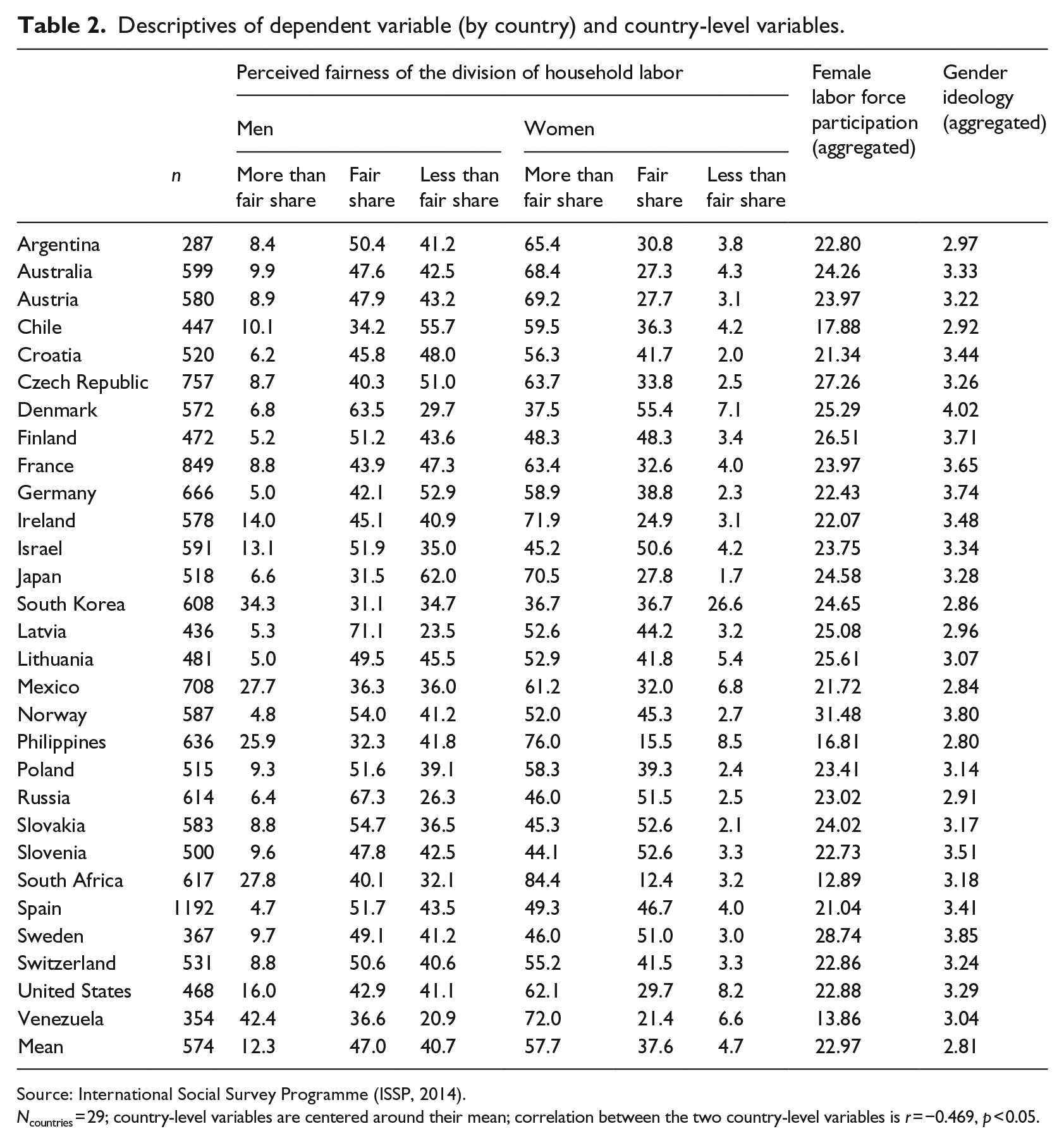
To test our hypotheses, we include two country characteristics. First, we constructed a variable measuring a country’s female labor force participation by aggregating the hours that women in our dataset spend on the labor market. Note that work hours of both single and partnered women were considered and that non-employed women were assigned zero hours. Women spend most time in the labor market in Sweden (28.74), while women in South Africa seem to spend least time in the labor market (12.89). A country-specific gender ideology measure was constructed by aggregating available information on individual gender ideology attitudes. Note that in this construction we also included singles and respondents younger than 18 years and older than 65 years. Moreover, listwise deletion of missing information was used (no imputation), to avoid affecting country differences. A higher score indicates more egalitarian gender roles in a country. Table 2 shows that people in Denmark (4.02) hold on average the most egalitarian gender role attitudes, whereas Philippine citizens (2.80) express the most traditional gender role attitudes.
Descriptives of dependent variable (by country) and country-level variables.
Source: International Social Survey Programme (ISSP, 2014).
Ncountries = 29; country-level variables are centered around their mean; correlation between the two country-level variables is r = −0.469, p < 0.05.
Analyses
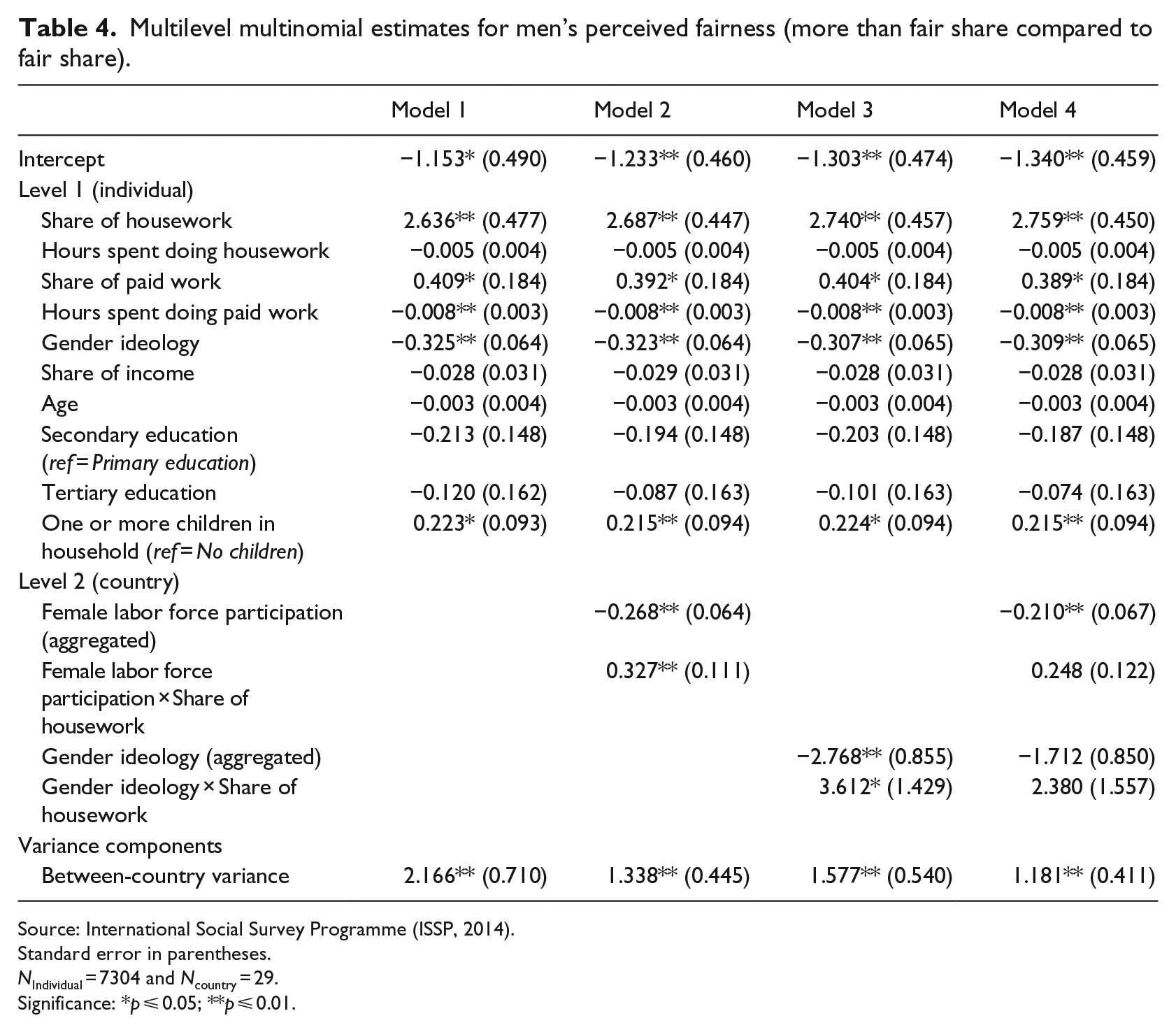
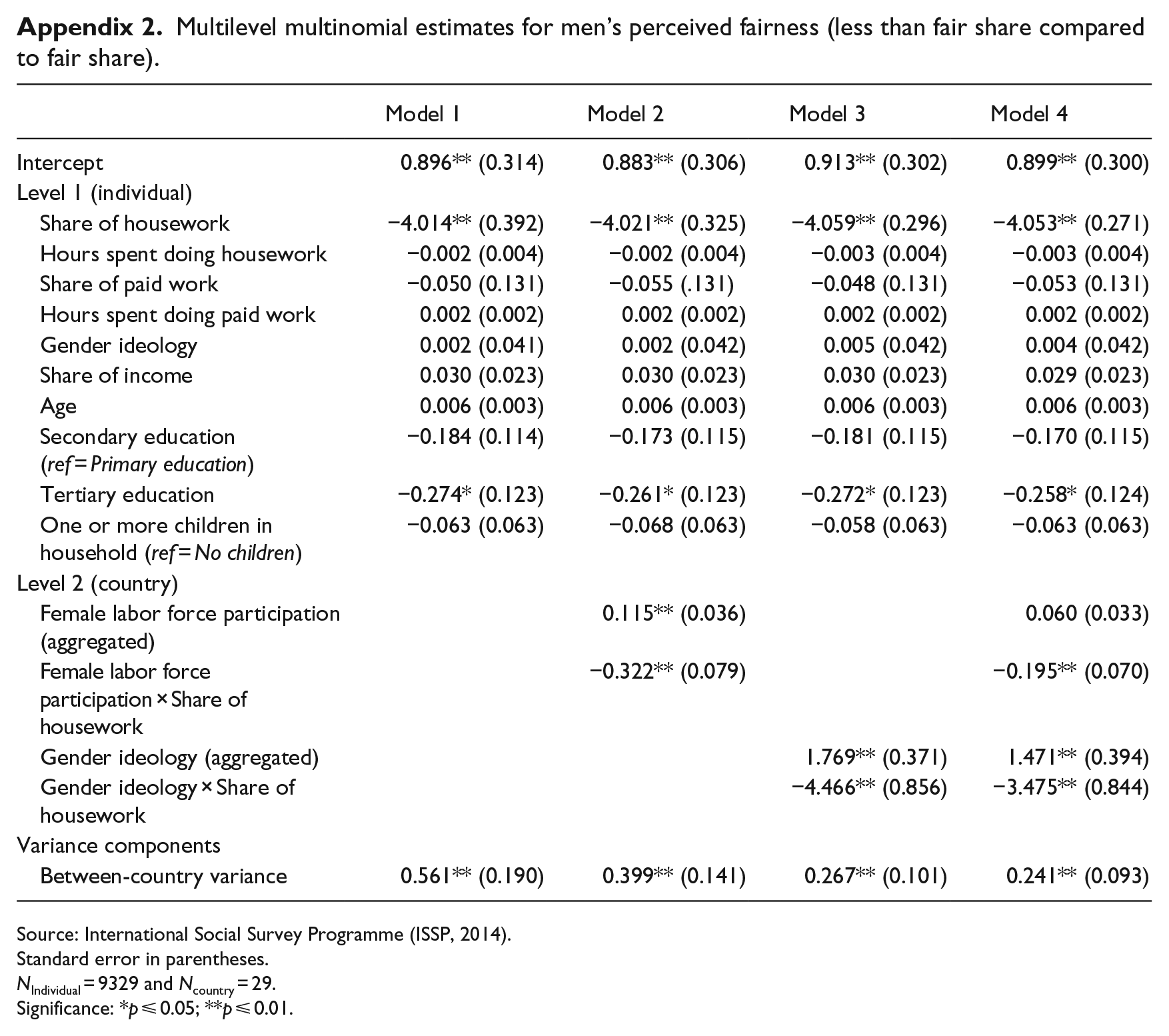
To test our hypotheses, we estimated four multilevel models for women (Table 3) and men (Table 4). Because of the multinomial nature of our dependent variable, the perception of doing more than one’s fair share (and less than one’s fair share) has to be interpreted in reference to the perception of doing one’s fair share (contrast category). For reasons of parsimony, we only present the regression models for the contrast doing more than a fair share versus doing a fair share in Tables 3 and 4. In the appendix, the contrast less than a fair share versus a fair share is presented (see Appendices 1 and 2). For all models, we used random intercepts and random slopes for the variable share of household work so that we could take variation between countries into account when testing our cross-level interaction hypotheses (all other slopes being fixed). Model 1 shows the estimations for the respondent’s relative share of housework, as well as the absolute amount of household duties, and all individual-level control variables. Model 2 adds female labor force participation (aggregated) as a structural country feature, while Model 3 includes a country’s gender role attitudes (aggregated) as a cultural country feature. Both main effects and interaction effects with relative share of household labor are estimated in order to explicitly test our hypotheses. Finally, in Model 4, the country effects of female labor force participation and gender role attitudes are included simultaneously.
Multilevel multinomial estimates for women’s perceived fairness (more than fair share compared to fair share).

Source: International Social Survey Programme (ISSP, 2014).
Standard error in parentheses.
NIndividual = 9329 and Ncountry = 29.
Significance:*p ⩽ 0.05; **p ⩽ 0.01.
Multilevel multinomial estimates for men’s perceived fairness (more than fair share compared to fair share).
Source: International Social Survey Programme (ISSP, 2014).
Standard error in parentheses.
NIndividual = 7304 and Ncountry = 29.
Significance: *p ⩽ 0.05; **p ⩽ 0.01.
Differences in perceived fairness of the household division?
Table 2 describes for each country (men and women separately) the percentage of people indicating to do more than a fair share, less than a fair share, or a fair share of household labor. Obviously, in almost all countries, women more often indicate that they do more than a fair share, or a fair share, while men are more likely to indicate they do a fair share, or less than a fair share. Most importantly, while differences between both genders are greatest, there is notable variation between the countries.
We now discuss the results from the multilevel multinomial models. We first expected that the more hours people spend on household labor compared to their partner, the more likely they are to indicate that they do more than a fair share and the less likely they are to indicate they do less than a fair share (Hypothesis 1). As can be observed in Tables 3 and 4 (and in Appendices 1 and 2), this is confirmed in all models. For both men and women, spending more time on household work compared to your partner makes it more likely that a person reports to do more than a fair share and less likely to do less than a fair share (compared to a fair share).
Table 3 shows the results for women to perceive their share of housework as more than is fair (compared to doing a fair share). Their relative share of paid work does not affect whether the division of household labor is perceived as fair, but a higher absolute amount of paid work does increase the likelihood for women to report more perceived unfairness (b = 0.004). Moreover, women earning a higher share of the family’s income report more often that they do more than a fair share (b = 0.082). Adhering to more egalitarian gender roles for women seems to lead less often to the perception that they do more than a fair share in the household (b = −0.081), other factors held constant. No differences are found between women of different ages, but lower educated women seem to be more unsatisfied with their share of household work than secondary and tertiary educated. Finally, having children in the household makes it more likely for women to perceive that they do more than their fair share of housework (b = 0.295). These findings are thus in line with the expectations laid out by distributive justice theory.
In Model 2 of Table 3, the effects of a country’s female labor participation are in line with our expectations (Hypothesis 2). The tendency that performing more housework in comparison with one’s partner goes together with a higher likelihood for females of perceiving this as unfair is stronger in countries where the average number of hours that women spend on the labor market is higher (b = 0.253). Model 3 shows the results for aggregated gender ideology in countries. In line with Hypothesis 3, women in more egalitarian countries perceive doing a high share of the household as more unfair than in more traditional countries (b = 4.400). Model 4 includes both country characteristics at the same time. Interestingly, the cross-level interaction with female labor participation loses its significance. This indicates that effects concerning female labor force can actually be explained through a country’s cultural level of gender role egalitarianism. 7
Table 4 shows the models for men. Besides the previously noted finding that higher shares of household work go together with a higher likelihood of perceiving one’s share as more than what is fair instead of fair, Model 1 shows that for men the absolute amount of household work does not matter. Unlike women, a male respondent’s relative share of paid labor matters. When men perform a larger share of paid labor, they more often perceive their share of housework as unfair (b = 0.409); this relationship is controlled for men’s absolute number of paid working hours, which negatively affects an unfair perception (b = −0.008). Adherence to egalitarian gender norms for men is also relevant. The more a man subscribes to egalitarian norms, the less likely he is to interpret the division of household labor as unfair (b = −0.325). Share of income does not show a significant result, suggesting that for men time might be a more important factor than income when assessing fairness. Finally, like women, having children in the household makes it more likely that men perceive their share of housework to be more than is fair (b = 0.223). Age and education do not show any significant effects.
Model 2 shows to what extent the relationship between actual share and perceived fairness depends on countries’ average female labor working hours. Contrary to our expectations, the higher the share of a man in household labor, the more this is perceived as unfair (rather than fair) in a country where women spend more hours in the labor market as compared to countries with less hours being spent in paid labor by women (b = 0.327). Perhaps in countries with high female labor participation, norms of equity are more prevalent.
Model 3 supports our hypothesis regarding the conditioning impact of countries’ gender norms for men. In more egalitarian countries, doing relatively much household work is perceived as more unfair than in traditional countries (b = 3.612). Finally, Model 4 reveals that when female labor force and country-level gender ideology are entered in the same model, the interaction effect of gender ideology drops below the level of significance. This indicates that, unlike for women, cultural influences on perceived fairness might actually be due to structural influences for men.
Conclusion and discussion
In this study, we set out to investigate the relationship between the division of household work and the perceived fairness of this division. Results from previous research emphasized the importance of understanding how this perceived fairness is influenced, as an unfair perceived division may have negative consequences, such as decreased marital quality (Lavee and Katz, 2002) and lower satisfaction with family life (Greenstein, 2009). We investigated to what extent both a country’s female labor force participation and gender ideology affect fairness perceptions on the division of household work, and whether these effects are spurious. By analyzing 29 countries from the ISSP 2012 and by looking at men and women separately, we tested our expectations.
First, we found that both men and women are more likely to indicate that they do more than what they perceive as fair when they do a larger share of household work. Subsequently, we found that both country-level egalitarian gender norms and higher rates of female labor force participation in a country strengthened the relationship between doing a larger share of the household labor and perceiving this as unfair (in contrast to fair), for both men and women. This largely confirmed our expectations following from relative deprivation theory that in countries with more egalitarian gender norms and women working more hours, people are more sensitive to feelings of inequity, injustice, and deprivation. The only finding that contradicts our expectations is that men are more likely to indicate higher shares of household work as more unfair (rather than fair) when women in their country work more hours.
In contrast to previous studies, we simultaneously tested the moderating impact of a structural (female labor force participation) and cultural (gender ideology) country feature. Although structural and cultural country characteristics are mutually dependent, theoretically they imply different types of standards to which people compare their own situation: structural characteristics set a practical standard, whereas cultural characteristics signify a normative standard. Investigating both types of standards implies a more extensive test of relative deprivation theory. Interestingly, we found that for women, the effect of a country’s female labor force participation became insignificant when a country’s gender ideology was included. For men, we found the opposite: the cultural macro-effect disappeared when controlling for structural macro-effects. Although robustness tests on pooled models (combining men and women) demonstrated that the effects do not significantly differ by gender, this pattern is intriguing and may guide future research.
Most studies, however, have drawbacks, and ours is no exception. A first drawback concerns the reporting of the hours both the respondent and the respondent’s partner put in household labor. Only respondents themselves were asked how much they and their partner spend on household chores. It is therefore likely that respondents who have feelings of dissatisfaction will overestimate their own hours and/or underestimate their partner’s hours. This may exaggerate found differences in hours spent on household labor, and coefficients of this unequal division on perceived fairness might be overestimated. It is therefore recommended for future researchers to use information on the actual division of household labor provided by both partners in a household. Second, we could not differentiate between different types of household labor. For example, certain household tasks, such as fixing a car, might be perceived as household labor by women, but as leisure time by men (Shaw, 1988). This might skew our measurement of time spent doing household labor, which in turn could render the differences between men and women to be inaccurate. Related to this is the fact that women perceive it as salient when men spend relatively more time on tasks that are considered to be ‘female tasks’ (Blair and Johnson, 1992); an actual unfair household division might in these cases be more quickly perceived as fair. Thus, taking into account the type of household labor is a final recommendation for future research.
Our study improved on previous literature by looking at both genders, employing a recently released dataset, and including both a cultural and structural country characteristic. More importantly, by simultaneously testing the moderating impacts of the country characteristics (female labor force participation and gender ideology), we discovered that the two moderating impacts did not co-exist; it was either one or the other. One interpretation of this result is that previous studies that assessed the impact of a single country characteristic thus reported partially spurious results. Another interpretation could be that it does not matter much which aggregate measure is considered, as similar interaction effects with the share of the housework at the individual level were found. We will need more studies for decisive answers in this respect.
Footnotes
Appendix
Multilevel multinomial estimates for men’s perceived fairness (less than fair share compared to fair share).
| Model 1 | Model 2 | Model 3 | Model 4 | |
|---|---|---|---|---|
| Intercept | 0.896** (0.314) | 0.883** (0.306) | 0.913** (0.302) | 0.899** (0.300) |
| Level 1 (individual) | ||||
| Share of housework | −4.014** (0.392) | −4.021** (0.325) | −4.059** (0.296) | −4.053** (0.271) |
| Hours spent doing housework | −0.002 (0.004) | −0.002 (0.004) | −0.003 (0.004) | −0.003 (0.004) |
| Share of paid work | −0.050 (0.131) | −0.055 (.131) | −0.048 (0.131) | −0.053 (0.131) |
| Hours spent doing paid work | 0.002 (0.002) | 0.002 (0.002) | 0.002 (0.002) | 0.002 (0.002) |
| Gender ideology | 0.002 (0.041) | 0.002 (0.042) | 0.005 (0.042) | 0.004 (0.042) |
| Share of income | 0.030 (0.023) | 0.030 (0.023) | 0.030 (0.023) | 0.029 (0.023) |
| Age | 0.006 (0.003) | 0.006 (0.003) | 0.006 (0.003) | 0.006 (0.003) |
| Secondary education (ref = Primary education) | −0.184 (0.114) | −0.173 (0.115) | −0.181 (0.115) | −0.170 (0.115) |
| Tertiary education | −0.274* (0.123) | −0.261* (0.123) | −0.272* (0.123) | −0.258* (0.124) |
| One or more children in household (ref = No children) | −0.063 (0.063) | −0.068 (0.063) | −0.058 (0.063) | −0.063 (0.063) |
| Level 2 (country) | ||||
| Female labor force participation (aggregated) | 0.115** (0.036) | 0.060 (0.033) | ||
| Female labor force participation × Share of housework | −0.322** (0.079) | −0.195** (0.070) | ||
| Gender ideology (aggregated) | 1.769** (0.371) | 1.471** (0.394) | ||
| Gender ideology × Share of housework | −4.466** (0.856) | −3.475** (0.844) | ||
| Variance components | ||||
| Between-country variance | 0.561** (0.190) | 0.399** (0.141) | 0.267** (0.101) | 0.241** (0.093) |
Source: International Social Survey Programme (ISSP, 2014).
Standard error in parentheses.
NIndividual = 9329 and Ncountry = 29.
Significance: *p ⩽ 0.05; **p ⩽ 0.01.
Declaration of Conflicting Interests
The author(s) declared no potential conflicts of interest with respect to the research, authorship, and/or publication of this article.
Funding
The author(s) received no financial support for the research, authorship, and/or publication of this article.