



Abstract
A growing body of research connects diversity to anti-welfare attitudes and lower levels of social welfare expenditure, yet most evidence comes from analyses of US states or comparisons of the United States to Europe. Comparative analyses of European nation-states, however, yield little evidence that immigration – measured at the country-level – reduces support for national welfare state programs. This is not surprising, given that research suggests that the impact of diversity occurs at smaller, sub-national geographic units. Therefore, in this article, we test the hypothesis that immigration undermines welfare attitudes by assessing the impact of immigration measured at the regional-level on individual-level support for redistribution, a comprehensive welfare state, and immigrants’ social rights. To do this, we combine data from the European Social Survey with a unique regional dataset compiled from national censuses, Eurostat, and the European Election Database (13 countries, 114 regions, and 23,213 individuals). Utilizing multilevel modeling, we find a negative relationship between regional percent foreign-born and support for redistribution as well as between regional percent foreign-born and support for a comprehensive welfare state. Objective immigration, however, does not increase opposition to immigrants’ social rights (i.e. welfare chauvinism). We discuss the implications of these results and conclude that traditional welfare state attitudes and welfare chauvinism are distinct phenomena that should not be conflated in future research.
Introduction
Due to immigration, Western European countries are more racially, ethnically, and linguistically diverse now than they have been at any point in their respective histories (Castles and Miller, 2003). These demographic changes have not gone unnoticed. Indeed, immigration has become one of the greatest sources of political turmoil in recent years. The European migrant crisis, the United Kingdom’s vote to leave the European Union (Brexit), and the increasing popularity of Trump and European neo-nationalists (Eger and Valdez, 2015) are examples just from 2016. Central to these politics are questions about the relationship between immigration and the welfare state. By the end of 2008, of the roughly 70 million immigrants residing on the European continent, approximately 75 percent immigrated to Western Europe (United Nations, 2010) – the region that boasts the most robust and redistributive welfare states in the world. As foreigners make up an increasing proportion of populations in these democracies, many have asked whether immigration undermines the social solidarity required to maintain popular support for the welfare state (e.g. Banting and Kymlicka, 2006; Eger, 2010).
One of the most significant achievements of the world’s advanced countries, the welfare state has many functions involving the reduction of economic risk and labor market uncertainty (Barr, 2000; Iversen, 2005). It is also the modern institution responsible for the distribution of social services and benefits to members of society. At a minimum, a welfare state includes programs to reduce income inequality and poverty (Brady, 2009; Kenworthy, 1999; Moller et al., 2003) but also provides varying degrees of universal benefits like education, health care, and childcare (Kenworthy, 2014; Roosma et al., 2013).
In this article, we ask whether there is a negative relationship between immigration and support for social welfare. Given an extensive literature on racial and ethnic diversity and fractionalization, there is reason to expect that increasing immigration may undermine popular support for European welfare states. Scholars have identified diversity as an obstacle to empathy (Gutsell and Inzlicht, 2010), solidarity (Lipset and Marks, 2000), interpersonal trust (Alesina and La Ferrara, 2000; Brewer, 2001), and reciprocal altruism (Habyarimana et al., 2009; Trivers, 1971). Moreover, there is a large, cross-disciplinary literature that connects racial and ethnic diversity to the relatively weak American welfare state (e.g. Alesina et al., 1999; Gilens, 1999; Lipset and Marks, 2000; Quadagno, 1994). Furthermore, cross-national studies find negative relationships between ethnic diversity and social expenditure (Alesina et al., 2001; Steele, 2016) and immigration and welfare state growth (Soroka et al., 2006). Therefore, it is no surprise that some cite immigration as a potential challenge for Western European welfare states (Alesina and Glaeser, 2004; Eger, 2010; Larsen, 2011).
However, a growing body of research on immigration and European welfare attitudes has produced mixed findings, leading some to conclude that this relationship is weak or non-existent (e.g. Brady and Finnigan, 2014; Crepaz, 2008). We argue that these mixed findings may actually be due to methodological decisions and choice of data. Previous research in this area is either cross-regional, where individuals are nested in sub-national geographic units, or cross-national, where individuals are located in countries. While single-country analyses demonstrate a negative relationship between regional variation in immigration and welfare attitudes (Dahlberg et al., 2012; Eger, 2010; Spies and Schmidt-Catran, 2016; Stichnoth, 2012), evidence from cross-national analyses is weaker (Brady and Finnigan, 2014; Mau and Burkhardt, 2009).
The relative lack of evidence from cross-national research may exist for two reasons. First, previous cross-national studies measuring the relationship between immigration and welfare attitudes have relied on a small number of cases at the country-level, making it more difficult to assess the true impact of contextual variables. Thus, we must be cautious in our interpretation of previous cross-national findings. Second, given the privileging of countries in comparative research and, by extension, an overreliance on country-level measures, earlier studies may have modeled the effect of a variable that holds little meaning for individuals. Recent research implies that national measures of immigration may be imperceptible for Europeans (Herda, 2010). Furthermore, relying on national measures ignores the geographic distribution of immigrants within countries and therefore substantial variation in actual exposure to immigrants. Although data limitations have not permitted scholars to focus equal attention on sub-national regions, there is a good reason to believe that, if immigration is significantly associated with welfare attitudes cross-nationally, we will find evidence of the relationship at a sub-national level. Therefore, in this article, we design research that is both cross-regional and cross-national to test the hypothesis that immigration is inversely related to support for the welfare state.
In the sections that follow, we review previous scholarship on diversity and welfare attitudes. Then, we make the case for measuring immigration at a lower, sub-national geographic unit and present our hypotheses about the relationship between immigration and three different welfare attitudes: support for redistribution, support for a comprehensive welfare state, and opposition to immigrants’ social rights. The latter is often called welfare chauvinism, or the notion that immigrants should not have the same access to the welfare state as native-born citizens (Andersen and Bjørklund, 1990; Kitschelt, 1995). This phenomenon receives much less attention in the literature (cf. Mewes and Mau, 2013; Van Der Waal et al., 2010), and scholars advocate for its inclusion in future research of this kind (Brady and Finnigan, 2014). To test these hypotheses, we use multilevel models and individual-level data from the European Social Survey (ESS) (2008) combined with a unique regional and national dataset (N = 23,213 individuals nested in 114 regions in 13 countries). We conclude with a discussion of our results and identify directions for future research.
Diversity and welfare attitudes
Early scholarship on the relationship between diversity and welfare state attitudes comes from case studies of the United States, where racial and ethnic heterogeneity varies considerably by region. In his book, Why Americans Hate Welfare, Gilens (1999) finds that racial stereotypes about blacks’ work ethic negatively affect whites’ attitudes toward social welfare spending to a greater extent than individualism and economic self-interest. Although it does not have a direct effect on welfare attitudes, living in the South (a binary variable in the analysis), where the majority of the African-American population resides, has a significant, positive effect on the perception that welfare recipients are undeserving and on the belief that blacks are lazy.
Fox’s (2004) analyses also show that stereotypes about African-American’s work ethic are negatively associated with whites’ support for welfare spending between 1992 and 2000, and that the magnitude of this effect appears largest in states that are disproportionately black and Latino. She also finds a significant and negative relationship between percent Hispanic at the state-level and whites’ welfare support. More recently, Fullerton and Dixon (2009) show that, between 1990 and 2002, opposition to welfare is greatest in US states that are disproportionately African-American and have high levels of prejudice.
Other evidence comes from Luttmer (2001), whose analysis reveals that the race of welfare recipients matters for welfare attitudes. Results demonstrate a negative relationship between non-blacks’ support for welfare and the percentage of black welfare recipients in a respondent’s US community as well as a negative relationship between blacks’ support for welfare and the percentage of non-black welfare recipients in one’s community. This indicates that it is not the presence of ‘poor people’ in general but instead the presence of welfare recipients who are members of a racial out-group that determines support for welfare.
Based on this previous research, scholars have hypothesized that as a consequence of increasing immigration to Western Europe, similar processes may be at work there (Alesina and Glaeser, 2004; Eger, 2010; Larsen, 2011; Putnam, 2007; Taylor-Gooby, 2005); however, evidence from analyses of European attitudes is mixed. Relying on ESS data from 17 countries in 2002, Mau and Burkhardt (2009) demonstrate only a small effect of immigration – measured at the country-level – on support for redistribution, and this effect disappears once unemployment rates are included in the model. Hjerm and Schnabel (2012) also use ESS data from 18 countries in 2004, and find no effect of immigration on support for redistribution or acceptance of taxation. Relying on International Social Survey Programme (ISSP) data from 17 Western countries, Brady and Finnigan (2014) provide evidence that immigration undermines support for the government provision of jobs but report mixed results regarding its relationship to other social welfare policies. Kwon and Curran (forthcoming) find similar patterns using the same data but from only 13 countries. Finally, two recent studies assessed the impact of immigration on opposition to immigrants’ social rights (Mewes and Mau, 2012; Reeskens and Van Oorschot, 2012), yet, results do not demonstrate a direct relationship between a country’s share of foreigners and welfare chauvinism. This has led some to conclude that the negative relationship between diversity and support for welfare is limited to the United States.
However, results from single-country case studies suggest that immigration does affect welfare attitudes in Europe. Eger (2010) finds a negative relationship between immigration and support for the welfare state in social democratic Sweden. Results from multilevel models show that the proportion of immigrants at the county-level is negatively associated with individuals’ support for social spending on both universal and means-tested programs between 1986 and 2002. Using a smaller geographic unit (municipalities), Dahlberg et al.’s (2012) analysis also reveals a negative relationship between immigration and welfare attitudes in Sweden between 1985 and 1994. Additional European evidence comes from two German studies: Stichnoth (2012) demonstrates that natives are less supportive of unemployment policies in regions where the share of foreigners among the unemployed is high in 1997 and 2002; Spies and Schmidt-Catran (2016) also find that the share of foreigners at the regional-level is negatively associated with native-born support for social welfare between 1994 and 2010.
How can we understand these divergent results? We contend that different methodological approaches have led researchers to disparate conclusions about immigration and European welfare attitudes. Currently, the only research that demonstrates robust statistical relationships between objective measures of immigration and welfare state attitudes come from cross-regional analyses of the United States, Germany, and Sweden. We do not argue that these three countries are all ‘exceptional’. In fact, welfare state scholars identify these countries as specific institutional types (Esping-Andersen, 1990) and often treat the United States, Germany, and Sweden as the prototypical liberal, conservative, and social democratic welfare states (e.g. Janoski, 1994).
Instead, we contend that there are two likely reasons why previous cross-national research does not find consistent effects of immigration on attitudes. First, earlier studies may suffer from the small-N problem, as analyses of Western Europe or Western democracies rely on a small set of countries at level 2. Previous research in this area uses no more than 18 countries to assess the relationship between objective measures of immigration and welfare attitudes. From a methodological standpoint, this means we must be cautious in interpreting results (Bryan and Jenkins, 2015).
Second, we are skeptical of previous results for theoretical reasons. We argue that, due to the privileging of the nation-state in cross-national, comparative research, social scientists rely almost exclusively on country-level measures to capture the effects of the context – or individuals’ social, economic, or political environment. We find this problematic given our research question, which asks if the context matters for attitudes, and a large body of research on group dynamics that suggests diversity at lower levels of analysis should affect individuals’ attitudes and behavior (e.g. Allport, 1954; Barth, 1969; Blau, 1977; Festinger, 1954; Horowitz, 1985; Tajfel, 1970).
Indeed, the national context may not be as meaningful – or perceptible – for individuals as a more local context. Research indicates that country-level measures of immigration are poor indicators of Europeans’ perceptions of the diversity of their respective country (Herda, 2010). Other research shows that the statistical effects of diversity on attitudes are more robust when a smaller geographic unit is analyzed (Putnam, 2007: 155–156). Furthermore, recent scholarship in related areas of inquiry suggests that measuring immigration in smaller geographic units has the potential to more accurately capture individuals’ exposure to or experiences with diversity (Dinesen and Sønderskov, 2015; Kaufmann, 2014; Koopmans and Schaeffer, 2016; Oliver and Mendelberg, 2000; Weber, 2015).
Thus, we argue that by relying exclusively on country-level measures of immigration, previous cross-national studies have modeled the effect of a variable that may be less meaningful for individuals than immigration measured at a lower geographic unit. Single-country case studies, which happen to represent three ideal types of welfare states (Esping-Andersen, 1990) show that diversity measured at a sub-national level is significantly related to welfare attitudes in the United States (Fox, 2004; Fullerton and Dixon, 2009; Luttmer, 2001), Sweden (Dahlberg et al., 2012; Eger, 2010), and most recently in Germany (Spies and Schmidt-Catran, 2016; Stichnoth, 2012). As it is more likely that these countries are representative of other welfare states rather than exceptional, research that is both cross-regional and cross-national is warranted.
Hypothesis
In this article, we test a hypothesis about the relationship between immigration and European welfare attitudes, specifically attitudes regarding redistribution, a comprehensive welfare state, and immigrants’ social rights (i.e. welfare chauvinism). Although we cannot provide an empirical test of the mechanism responsible for this hypothesized relationship, it is nevertheless important to provide a plausible account of how and why an independent variable affects a dependent variable (Hedström and Swedberg, 1998). In this case, this means thinking about how contextual variables influence the internal states of individuals (Coleman, 1990). Like previous research in this area (Breznau and Eger, 2016; Crepaz, 2008; Eger, 2010), we use social identity theory to hypothesize about the relationship between immigration and welfare attitudes.
The salience of subjective group boundaries is central to any discussion of race and ethnic relations or reactions to diversity more generally. According to social identity theory (Tajfel and Turner, 1979), humans automatically categorize the world into social groups and then identify to which group one belongs (Allport, 1954; Festinger, 1954; Tajfel, 1970). This in-group identification develops in part by identifying to which out-groups a person does not belong and how these groups differ from one’s in-group. This process of social comparison is critical, as one’s in-group membership has consequences for one’s self-esteem, which to maintain requires that one’s in-group compare favorably to out-groups. Individuals may identify with more than one social group (e.g. age, ethnicity, gender, and nationality), and in-group/out-group boundaries become salient depending on the context and personal motivations (Reicher, 2004).
Once subjective group boundaries are salient, social psychological experiments show that in-group bias, the tendency to prefer or show favor toward one’s own group, leads individuals to engage in differential treatment of in-group and out-group members (Tajfel, 1970, 1981; Tajfel and Billig, 1974; Turner, 1975). Showing preference for one’s in-group does not necessarily mean that in-group members will discriminate against out-groups (Allport, 1954; Brewer, 1999), but research does demonstrate that in-group members are more willing to allocate resources to members of their own group versus out-group members (Brewer, 1979; Brewer and Campbell, 1976; Mullen et al., 1992; Tajfel, 1970, 1982; Tajfel et al., 1971). These experimental findings are consistent with the idea that homogeneity helps facilitate the solidarity necessary for welfare state development (Baldwin, 1990; Hammar, 1985) and that declining homogeneity makes advancing others’ interests less likely (Dahl, 1996).
Based on social identity theory, we posit that immigration makes national in-group and out-group boundaries salient. This categorical distinction triggers in-group bias, and as a consequence, public support for the welfare state – the state apparatus that distributes resources to the residents of a country – wanes. According to social identity theory, the context elicits in-group identification, thus, we use measures of immigration that have the potential to capture social categorization and subsequent social identity based on national origin. Countries differ in the spatial distribution of immigrants, and it is reasonable to expect that native-born who live in a region where immigrants make up a relatively large percentage of the population experience diversity differently than individuals living in a region with relatively few immigrants.
Therefore, we hypothesize that
The proportion of the regional population that is foreign-born is negatively associated with native-born support for the government provision of social welfare.
We test this hypothesis with three dependent variables: attitudes about redistribution, the welfare state, and immigrants’ social rights.
Data and methods
We analyze the impact of immigration on individual-level attitudes within sub-national regions across 13 European countries. Our individual-level data come from the ESS, a comprehensive, biennial multi-country survey covering over 30 nations in Europe between 2002 and 2010. We rely on the fourth round of the ESS (2008) because it includes a special module on welfare state attitudes, and because it offers random samples representative at the regional-level in Western European countries. The regions sampled in the ESS correspond to the European Union’s Nomenclature of Territorial Units for Statistics (NUTS). 1
Our research examines how the presence of immigrants impacts the native-born population’s attitudes toward social welfare, thus, we include only native-born individuals in our sample, 2 which includes all Western European countries in the survey except, due to data limitations, Portugal, Cyprus, and Greece. 3 For each of our three dependent variables, the total loss of individuals due to missing values on the independent variables is under 1.4 percent, therefore, we drop all respondents with missing data on any of the variables in our models. Ultimately, our sample includes 23,213 individuals, nested in 114 regions, across 13 countries (Austria, Belgium, Denmark, Finland, France, Germany, Ireland, the Netherlands, Norway, Sweden, Switzerland, Spain, and Great Britain). Table 1 provides descriptive statistics on the individual-, regional-, and country-level data employed in the analyses.
Descriptive statistics.
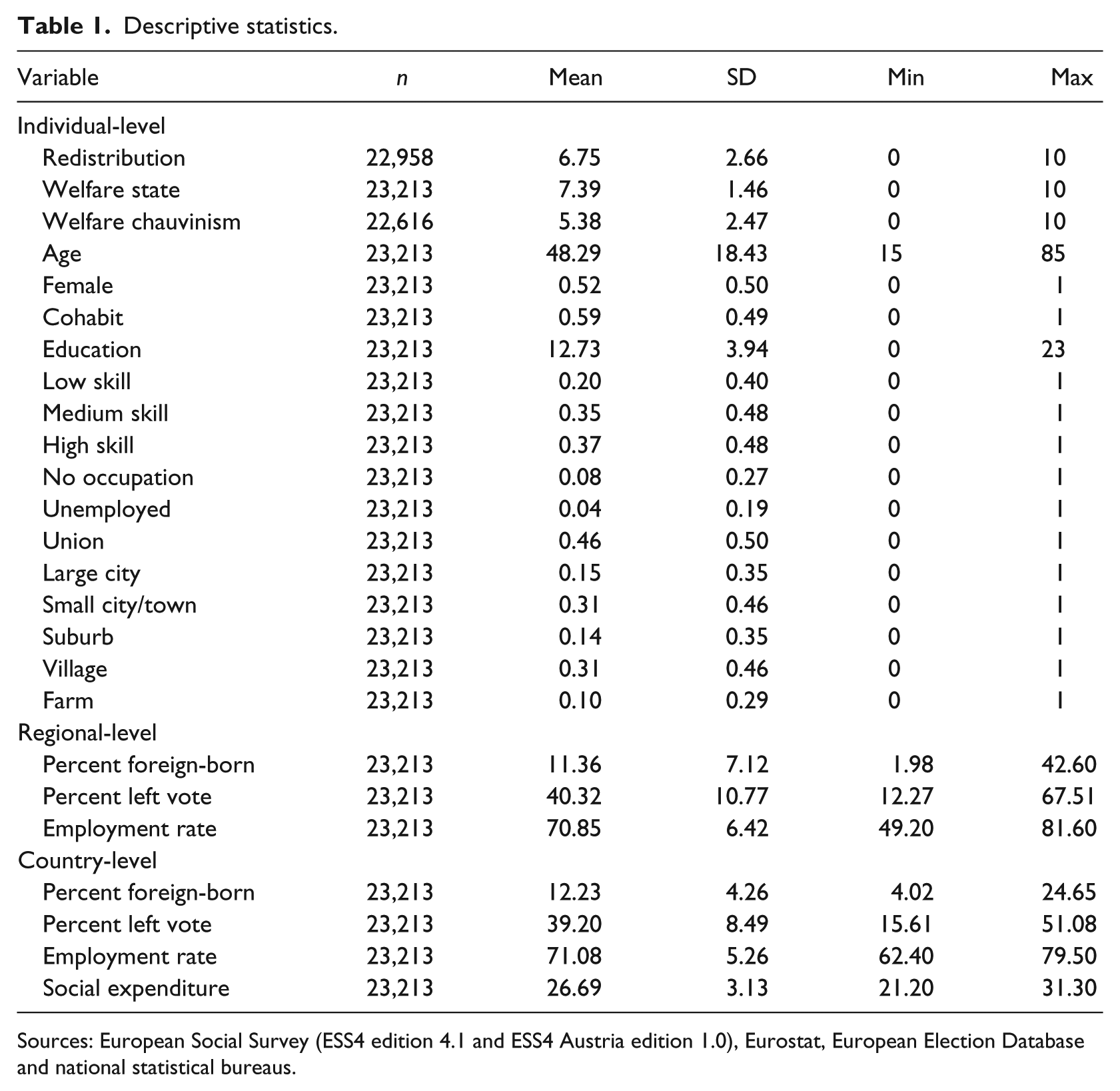
Sources: European Social Survey (ESS4 edition 4.1 and ESS4 Austria edition 1.0), Eurostat, European Election Database and national statistical bureaus.
While single-country studies may use variables that capture attitudes toward levels of social expenditure (Eger, 2010), cross-national analyses must rely on welfare state attitudes that are comparable across countries (Svallfors, 1997). Statements about what the government ought to do, therefore, are ideal for this type of research (Brady and Finnigan, 2014). Our first dependent variable measures attitudes toward redistribution. This classic question asks whether ‘the government should reduce differences in income levels’. Possible answers are ‘strongly agree’, ‘agree’, ‘neither agree nor disagree’, ‘disagree’, and ‘strongly disagree’. We transform the variable so that values range from 0–10, with higher values indicating support for redistribution.
Our second dependent variable measures support for a comprehensive welfare state, specifically normative attitudes about the role of government in the provision of social welfare benefits. Our approach follows from seminal comparative welfare state research in which we use an index that combines normative support for a range of policy dimensions to capture general support (e.g. Svallfors, 1997, 2006). Recent research confirms that support for the welfare state is best operationalized as a latent construct of general support versus attitudes toward single policies. Using confirmatory factor analysis (CFA), tests for measurement invariance, and the 2008 ESS welfare module, Roosma et al. (2013) show that in the Western/Northern European countries ‘welfarism’ is either positive or negative attitudes toward the welfare state in general (p. 249). Using Dutch data, Van Oorschot and Meuleman (2012) find a similar underlying latent construct.
Our comprehensive measure of welfare state support includes the six items in the ESS that capture respondents’ attitudes regarding the responsibility of government to provide health care, childcare, sick leave, employment programs, and a standard of living for the old and unemployed. Not only does this multidimensional construct have strong theoretical validity (Roosma et al., 2013; Van Oorschot and Meuleman, 2012), previous research has validated it empirically (Kulin and Meuleman, 2015). Furthermore, the Cronbach’s alpha (0.81) indicates that these items form a coherent measure for respondents in our sample. For all 6 variables, an 11-response scale, ranging from 0 ‘no responsibility’ to 10 ‘fully responsible’, denotes respondents’ attitudes. Row means are used to generate the index. 4
Our third dependent variable captures respondents’ level of welfare chauvinism, or exclusionary attitudes about immigrants’ access to the welfare state. The question asks, ‘When should immigrants obtain social rights to benefits/services?’ and answers indicate increasing degrees of welfare chauvinism: ‘Immediately on arrival’, ‘After a year, whether or not they have worked or paid taxes’, ‘After they have worked and paid taxes at least a year’, ‘Once they have become a citizen’, and ‘They should never get the same rights’. Original values range from 1–5, and, for ease of interpretation and comparison, we transform the variable so that values range from 0–10. 5
Regional- and country-level data come from a unique dataset complied from Eurostat, the European Election Database, and national censes. To test our hypothesis, we utilize the variable percent foreign-born – or the proportion of residents born abroad – by region. Although other types of ethnic diversity exist in each of these countries (e.g. historic, linguistic, or religious minority populations), the point of this article is to measure the impact of the ethno-national diversity created by immigration – and to do this across a number of countries. Thus, we must use a standard measure that is comparable across Europe. Although information on the foreign-born population is available for countries in 2008 from Eurostat, at the regional-level there is no comprehensive source. Therefore, we searched national censes’ databases to locate this variable for the year 2008 or the closest available year. ‘Percent foreign-born’ captures the proportion of the regional population that is a first-generation immigrant, regardless of country of origin, naturalization status, length of stay, or any other way that the immigrant population could be sub-divided. This is the only comparable measure of immigration that is available at the regional-level across these 13 countries. See Appendix 1 for more information on these data.
We also include controls at the regional- and country-levels. 6 To account for economic conditions, 7 which are known to influence welfare attitudes (Blekesaune, 2007), we include the percentage of the working age population that is employed in 2008. We obtain these measures from Eurostat. 8 Given its potential to counteract the impact of diversity (Taylor-Gooby, 2005), we also control for the political culture of the region and country with the percentage of the population that voted for a traditional left party (i.e. social democratic, labor, and socialist) in the previous national election. We construct these variables using data from the European Election Database. Finally, given that previous research indicates welfare attitudes are associated with variation in welfare state institutions (Brooks and Manza, 2007; Larsen, 2008), we control for social expenditure as a percentage of gross domestic product (GDP) in 2008. We also obtain these measures from Eurostat. 9
According to the welfare state literature, demographic characteristics and class interests are important predictors of welfare attitudes (Svallfors, 2007); thus, we also employ individual-level variables as theoretical controls. First, we control for socioeconomic status. 10 Using a program for Stata (iskoegp), we first construct a measure of occupational skill-level from a number of variables found in the ESS (ISCO-88 occupational codes, self-employment, and supervision) based the Erikson–Goldthorpe–Portocarero (EGP) class scheme (Erikson et al., 1979). We then collapse this scale into categories to reflect the skill-level (low, medium, or high) of the respondents’ occupation. Respondents who do not report an occupation (mostly students and homemakers/stay-at-home parents) are coded as such. Second, we include a dummy variable for unemployment status and, third, a continuous measure of education (years). We also control for union membership (respondents who currently or have ever belonged to a union also receive a score of 1, while those without a history of union membership receive a 0). Additionally, we control for age, which is a continuous variable measured in years. We also include age-squared to assess whether the effect of age is non-linear. Cohabitation, a binary variable, captures whether respondents live with a spouse or partner. Finally, sex is a dichotomous variable with females coded as 1 and males 0. Given a large body of previous research, we expect these variables to affect welfare state attitudes and include them to assess the impact of regional immigration on support for social welfare net of individual-level effects. Finally, we include dummy variables to control for respondents’ residential location. Although we sort individuals by regions, within a particular region, respondents may live in a large city, suburban neighborhood, or rural environment.
To test our hypothesis about the effect of a contextual variable on an individual-level outcome, we rely on a multilevel linear regression model (Snijders and Bosker, 1999). The structure of our dataset is nested, with individuals residing in regions that make up countries. A three-level model takes into account the clustered nature of the data and the repeated observations of characteristics specific to each of the 114 regions and 13 countries and assigns a random intercept for each country and region to capture the effects of unobserved heterogeneity. This allows us to implicitly control for any qualitative features of national welfare states that structure their respective support (Brooks and Manza, 2007; Larsen, 2008; Rothstein, 1998) and might otherwise bias our results. Moreover, this method uses far fewer degrees of freedom and clusters regional-level and country-level standard errors so as not to bias the results by producing significant effects where there are none (DiPrete and Forristal, 1994). Importantly, by including sub-national regions and increasing the contextual-level sample size, we also increase the statistical power of our analysis compared to previous research (Weber, 2015).
We also use mean-centering in order to account for the collinearity of our regional- and country-level variables (e.g. regional percent foreign-born contributes to percent foreign-born measured at the country-level). Thus, For each regional variable, we generate the average regional score by country and then subtract the score from the original regional variable. This produces a new variable that captures the distance between a region and the average region by country. This mean-centered variable makes it possible to identify separately the demographic, political, and economic contextual effects of regions and countries.
For each dependent variable, we first run an empty model with no independent variables to reveal the variance that exists at each level. This provides a baseline for comparing subsequent models and reduction of variance to-be-explained. In model 1, we add individual-level control variables, and we use models 2–7 to test our hypothesis about the relationships between regional diversity and three welfare attitudes.
Results
Table 2 reports results from our analysis of attitudes toward redistribution. Model 0 reports the grand intercept for the empty model and variance components of the random effects. Model 1 introduces individual-level controls. Age is positively associated with support for the government provision of welfare, but, as indicated by age-squared, there is a curvilinear effect: the positive effect of age decreases slightly with age. Other results are also consistent with the literature: unemployment, union membership, and being female are positively associated with welfare attitudes, while years of education, the skill of one’s job, and cohabitation are negatively associated with support. These associations are consistent across models.
Multilevel models of support for redistribution.
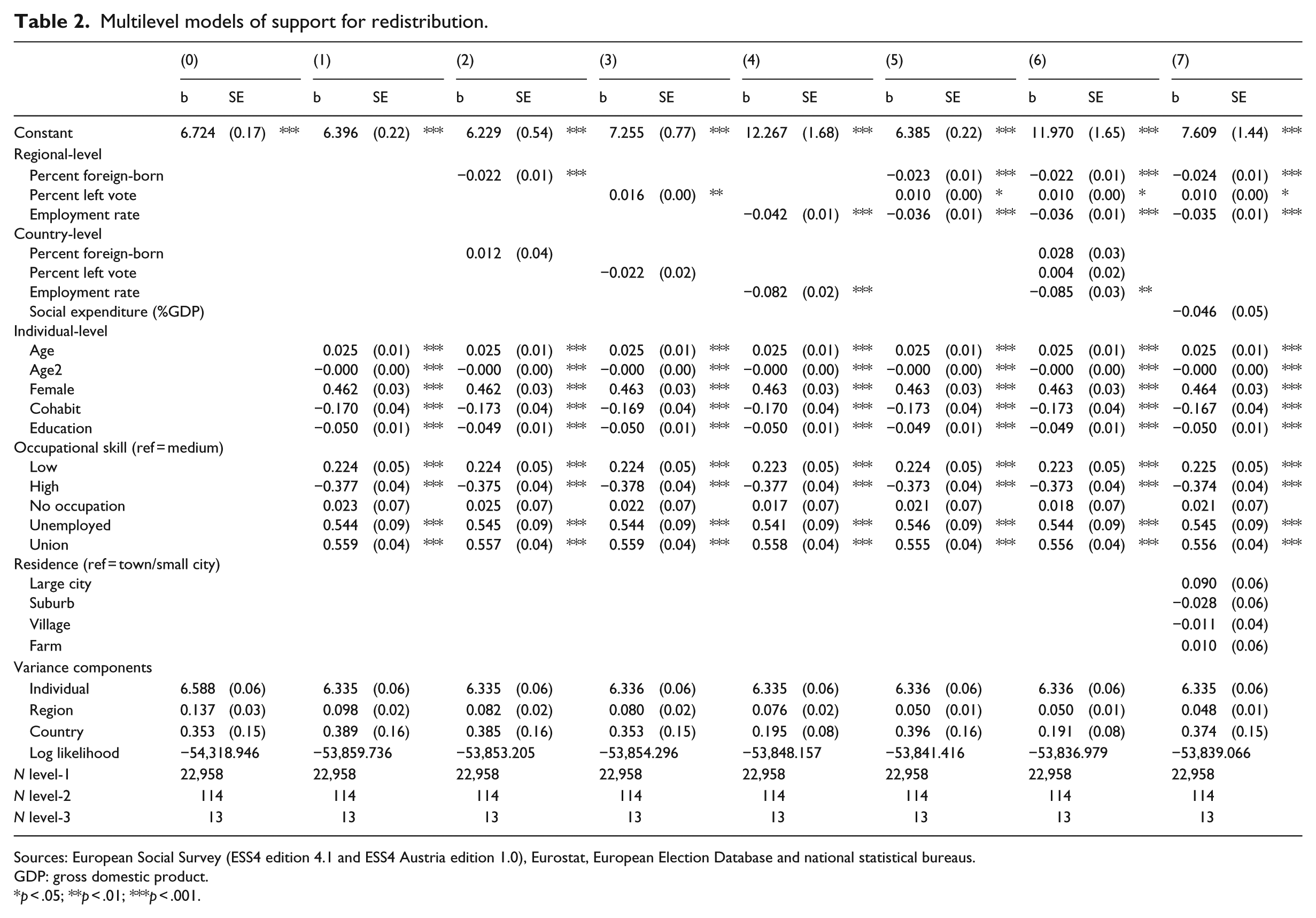
Sources: European Social Survey (ESS4 edition 4.1 and ESS4 Austria edition 1.0), Eurostat, European Election Database and national statistical bureaus.
GDP: gross domestic product.
p < .05; **p < .01; ***p < .001.
In model 2, we assess the impact of immigration on attitudes. As hypothesized, in regions where immigrants constitute a larger proportion of the population, individuals are significantly less supportive of redistribution. We do not find a statistically significant relationship between immigration measured at the country-level and individual attitudes, however. In models 3 and 4, we assess separately the impact of regional- and country-level political and economic controls. In regions where a larger proportion of the population supports left parties, individuals are significantly more supportive of redistribution. There is no relationship between the political context and redistributive preferences at the country-level. Consistent with theoretical expectations (Blekesaune, 2007), in regions with higher employment rates, individuals are significantly less supportive of redistribution. This relationship is also negative and significant at the country-level.
Model 5 assesses the impact of immigration on attitudes while controlling for the political and economic context. All three regional variables remain significant, lending further support to our hypothesis. In model 6, all regional- and country-level variables are included. Despite being limited in the number of country-level variables we can reasonably include in the same model, model 6 allows for comparison with previous cross-national research on attitudes toward redistribution. Immigration measured at the regional-level is negatively associated with attitudes while immigration measured at the country-level is not. Model 7 introduces two additional controls. Neither welfare state spending nor one’s residential location is systematically related to attitudes. The effect of regional diversity remains significant.
To summarize, results from these models provide support for our hypothesis that regional percent foreign-born is negatively associated with support for welfare. The ratio of levels 1, 2, and 3 variances to the total variance in model 0 indicates that approximately 93 percent of the variance is due to differences between individuals, while 7 percent of the variance is due to differences across regions (2%) and countries (5%). Full models only explain 4 percent of the variance that exists at level 1 – yet account for approximately 64 percent of the variance at the regional-level and 46 percent of the variance at the country-level. This indicates that these contextual variables substantially contribute to our understanding of attitudes toward redistribution.
Table 3 reports results from our analysis of attitudes toward a comprehensive welfare state. In model 0, we report the grand mean and variance components. Model 1 includes only individual-level theoretical controls. With the exception of cohabitation, the relationships among these variables and the dependent variable are consistent with theoretical expectations as well as with results from the previous set of models of support for redistribution.
Multilevel models of support for the welfare state.
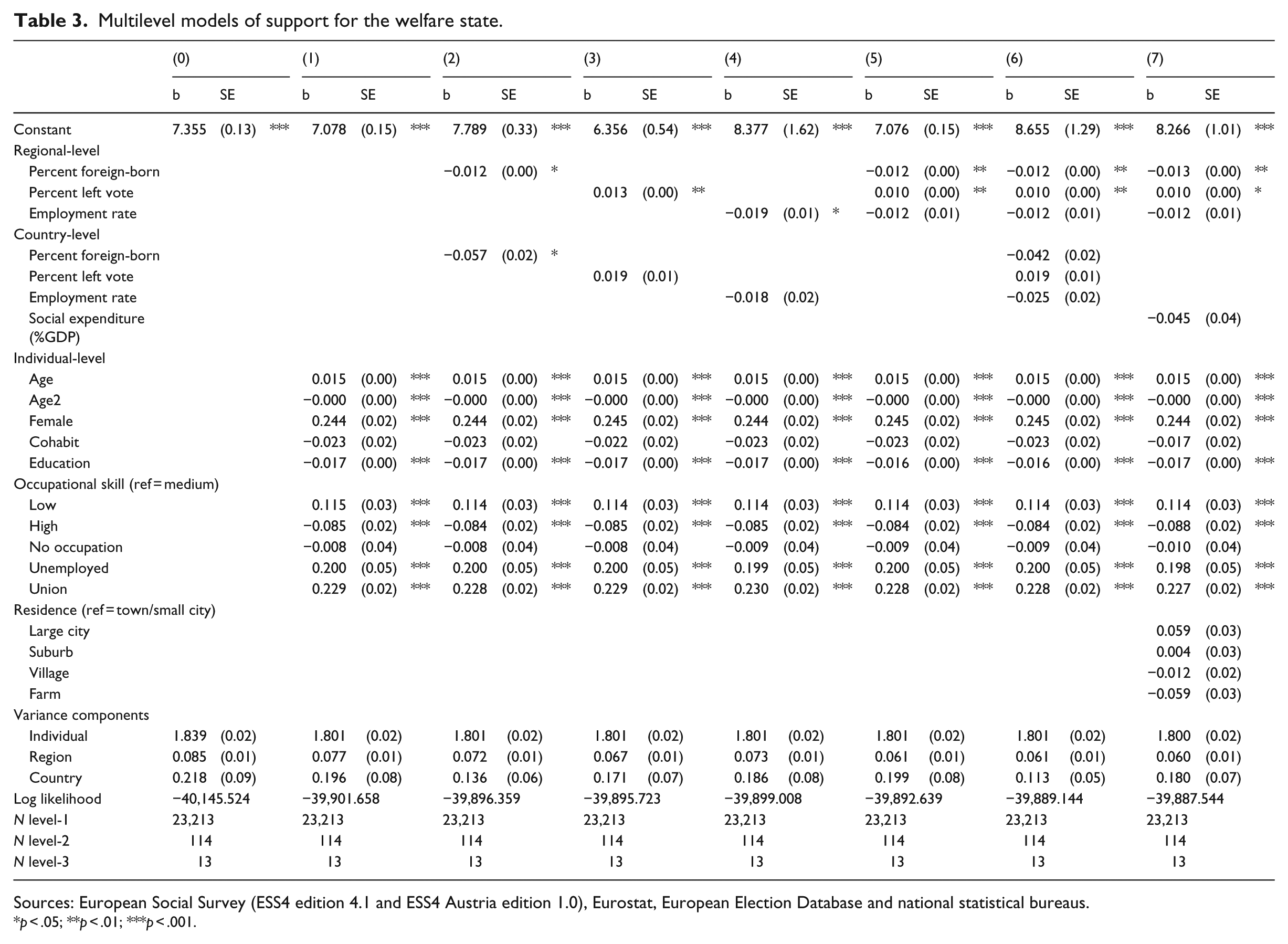
Sources: European Social Survey (ESS4 edition 4.1 and ESS4 Austria edition 1.0), Eurostat, European Election Database and national statistical bureaus.
p < .05; **p < .01; ***p < .001.
In model 2, we assess the impact of percent foreign-born and find significant and negative effects at both levels. In regions and countries where immigrants make up a larger proportion of the population, individuals are less supportive of the welfare state. 11 In models 3 and 4, we assess separately the impact of regional- and country-level political and economic controls. There is a positive relationship between the percentage of the regional population that voted for a left party and support for the welfare state. There is also a negative relationship between the percentage of the regional population that is employed and welfare attitudes. Neither of these variables is significant at the country-level.
Models 5–7 assess the impact of immigration on attitudes while controlling for economic and political contextual factors at the regional- and country-levels. Consistent with our hypothesis, regional percent foreign-born remains negative and significant across all models. Regional percent left-vote also remains significant, while regional percent employed is not significant in these models. Results from model 6 are consistent with previous research that finds that after controlling for the economic context at the country-level, the effect of percent foreign-born at the country-level becomes insignificant (Mau and Burkhardt, 2009). However, in unreported analyses, percent foreign-born at the country-level remains significant when we only control for percent left vote. Consistent with our models of support for redistribution, model 7 shows that neither welfare state spending nor residential location is significantly associated with these welfare attitudes.
In summary, results from these models provide evidence of a negative relationship between regional percent foreign-born and support for the welfare state. According to the empty model, 10 percent of the individual variance can be explained by country-level differences and 4 percent by regional differences. According to changes in the variance components, full models account for over 29 percent of the variance at the regional-level, indicating that incorporating contextual variables into our models substantially improves our understanding of welfare attitudes. In comparison, these models explain only 2 percent of the variance that exists due to differences between individuals, even though we have controlled for the individual-level variables deemed important by the welfare state literature.
We report our results from our analysis of welfare chauvinism in Table 4. Beginning with model 1, we can immediately see that the relationships among these characteristics and welfare chauvinism are much more consistent with the literature on anti-immigrant sentiment (Ceobanu and Escandell, 2010) than welfare state support (Blekesaune and Quadagno, 2003; Svallfors, 2007). For example, support for redistribution and a comprehensive welfare state is higher among older individuals, but this support does not appear to extend to social rights for immigrants, as age is positively associated with welfare chauvinism. Similarly, low levels of education, lower occupational skill, and unemployment are positively associated with support for redistribution and the welfare state, but these factors are also associated with welfare chauvinism. This is noteworthy as one of the most consistent individual-level indicators of anti-immigrant sentiment is low education (Coenders and Scheepers, 1998, 2003; Hainmueller and Hiscox, 2007; Hello et al., 2002; McLaren, 2003; Quillian, 1995), while low education also predicts support for social welfare (Brady and Finnigan, 2014; Burgoon et al., 2012; Eger, 2010; Jæger, 2009; Svallfors, 1991). Additionally, both being female and a union member are positively associated with support for the welfare state and negatively associated with welfare chauvinism. This means that women and union members are more positive toward welfare, regardless of the recipient. These results are also consistent with the literature on anti-immigrant sentiment. Research consistently shows that women hold more positive attitudes toward immigrants (e.g. Gorodzeisky and Semyonov, 2009) and that union members are also more positive toward immigrants in Western European countries (Gorodzeisky and Richards, 2016).
Multilevel models of welfare chauvinism.
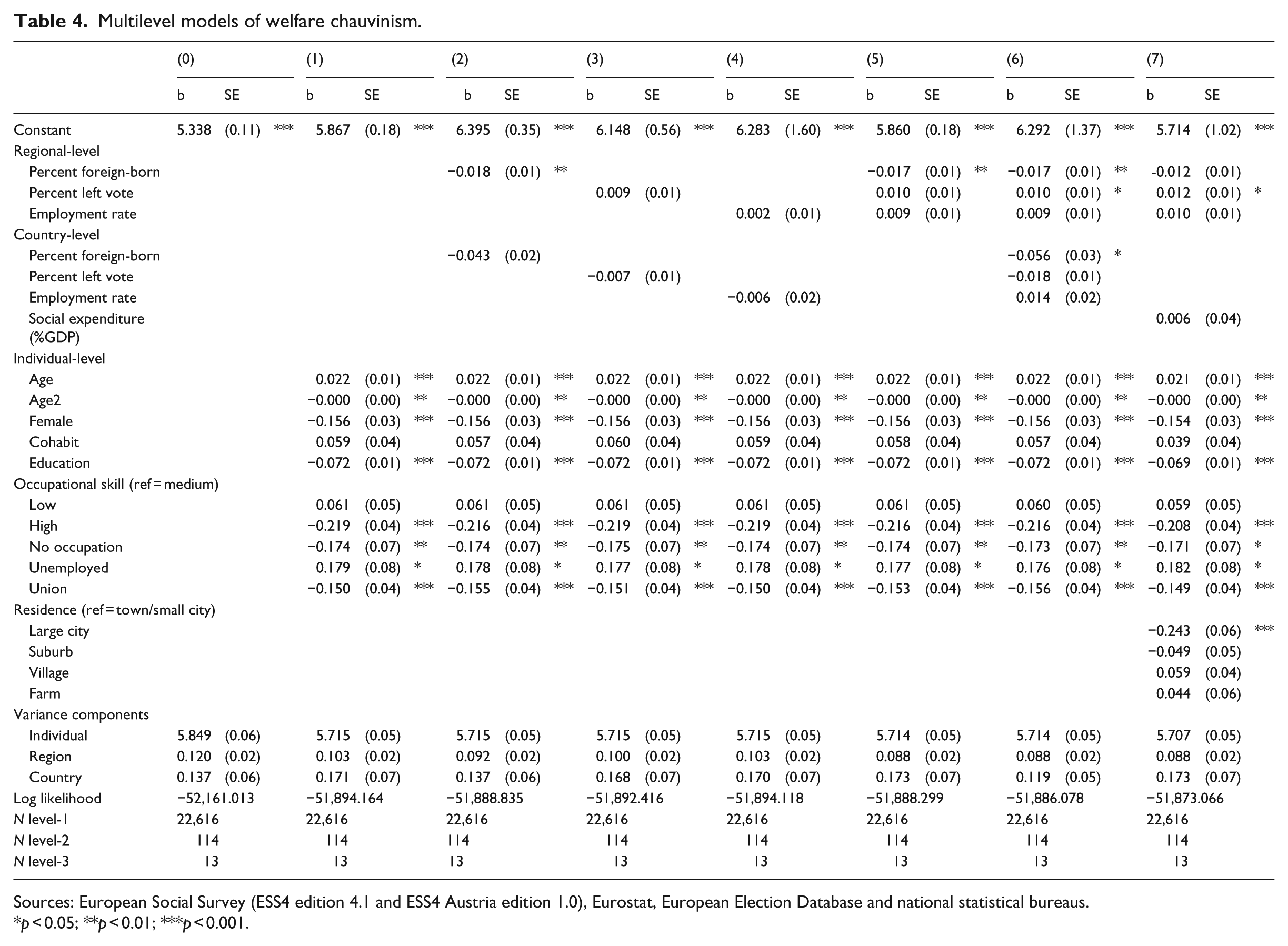
Sources: European Social Survey (ESS4 edition 4.1 and ESS4 Austria edition 1.0), Eurostat, European Election Database and national statistical bureaus.
p < 0.05; **p < 0.01; ***p < 0.001.
Furthermore, as shown in models 6 and 7, in regions where there is more support for left parties – the political bedrock of the welfare state – respondents articulate higher levels of welfare chauvinism. Although this political variable falls in and out of significance depending on the model, these findings (coupled with the fact that welfare state spending does not appear to play a role in these attitudes) imply that support for the welfare state and welfare chauvinism are distinct phenomena.
Finally, results from models that assess the impact of regional diversity also suggest that welfare chauvinism may be indicator of social exclusion as opposed to more traditional welfare state policy preferences. Models 2, 5, and 6 show that regional percent foreign-born is inversely related to welfare chauvinism. In regions with a larger proportion of foreigners, individuals articulate lower levels of welfare chauvinism. 12 These results are consistent with recent research that finds a similar relationship between regional percent foreign-born and anti-immigrant sentiment (Weber, 2015).
In model 7, however, this variable dips below the level of significance (p < 0.05) when controlling for place of residence. Living in a large city, where immigrants are more likely to reside, is negatively associated with the dependent variable. Unfortunately, we have no way of measuring interpersonal contact with immigrants or whether respondents have immigrant friends or colleagues. Nevertheless, these results imply that the presence of immigrants allows for the interpersonal contact necessary for the reduction of prejudice and discriminatory attitudes (Allport, 1954; McLaren, 2003; Pettigrew, 1997; Schneider, 2008; Wagner et al., 2006). Of course, an alternative explanation reverses the causal order: immigrants move to regions where natives are more inclusive. Either way, these findings suggest that welfare chauvinism is more closely related to attitudes about immigrants rather than attitudes about welfare more generally.
Because the mean-centering of regional percent foreign-born by country makes the interpretation of coefficients less straightforward, we have run additional two-level models with regional percent foreign-born in its original form, individual-level controls, and country dummies. Predicted values for each dependent variable are available in Appendix 2.
Conclusion
In this article, we test the hypothesis that the proportion of the regional population that is foreign-born is negatively associated with native-born support for the government provision of social welfare in Western European countries. Using a comparative strategy and multilevel modeling, we find that the proportion of a region’s population that is foreign-born has a negative effect on support for redistribution and a comprehensive welfare state. In other words, in regions where the relative share of immigrants is greater, individuals are less supportive of social welfare. Changes in variance components indicate that incorporating sub-national contextual variables into our analyses substantially contributes to our understanding of traditional welfare attitudes. Our third analysis demonstrates that regional percent foreign-born is negatively associated with opposition to immigrants’ social rights. In other words, in regions where the proportion of immigrants is higher, individuals are less welfare chauvinistic. Both regional- and individual-level results are consistent with studies of anti-immigrant sentiment – not research on traditional welfare state attitudes. This suggests that welfare chauvinism may be more closely related to anti-foreigner sentiment rather than general welfare state preferences.
Our research makes several contributions. This is the first study to assess – both cross-regionally and cross-nationally – the impact of the size of the foreign-born population on a variety of welfare attitudes. Results from our analyses provide support for our hypothesis that regional percent foreign-born is negatively associated with support for redistribution and a comprehensive welfare state. While our approach is novel, our results are nevertheless consistent with the literature on immigration and welfare attitudes. Like previous country case studies, we find a significant and negative relationship between regional immigration and welfare attitudes (Dahlberg et al., 2012; Eger, 2010; Spies and Schmidt-Catran, 2016; Stichnoth, 2012). And, like previous cross-national research, we find some evidence of a relationship between immigration measured at the country-level and support for the welfare state (Brady and Finnigan, 2014), but this effect disappears once we control for economic conditions (Mau and Burkhardt, 2009).
Second, we maintain that our comparative approach, with its focus on the distribution of immigrants not only between countries but importantly within countries, helps clarify the relationship between immigration and welfare attitudes and provides an account of previous ‘mixed results’. Cross-national research on Western countries inevitably makes use of a small set of cases, and therefore risks results that may suffer from the statistical phenomena known as the small-N problem. Thus, it is possible that with a larger sample of countries, analyses would yield a clearer picture of the relationship between immigration and welfare attitudes. Indeed, we must be cautious about our interpretation of our own country-level effects given we have only 13 units at level 3.
However, it is also possible that, by relying exclusively on country-level measures, previous cross-national research on immigration and welfare state support may have misspecified the relationship between the two. From a theoretical standpoint, immigration measured at a smaller geographic unit has greater potential to capture exposure to out-groups and/or intergroup dynamics, as social categorization is an automatic response to one’s environment (Festinger, 1954). From a statistical perspective, regional measures may more accurately measure the relevant social context. Arguably, some geographic units are too large: Previous research indicates that country-level measures of immigration are poor indicators of Europeans’ understanding of the demographic makeup of their entire country (Herda, 2010). Meanwhile, other geographic units may be too small because it is more difficult to self-select into a region versus an even smaller geographic unit (such as a neighborhood). With a regional analysis, we are less likely to simultaneously capture individuals’ preferences regarding living in areas with either a low or high concentration of foreigners (Dustmann and Preston, 2001).
Third, our research also focuses on an attitude that has received comparatively less attention in the literature on immigration and welfare: opposition to immigrants’ social rights. In most models, there is a significant negative relationship between regional immigration and welfare chauvinism. Given this is the first cross-regional analysis of the phenomenon, we have no previous findings for comparison. However, country-level results are consistent with previous research where the relationship between country-level measures of immigration and welfare chauvinism is insignificant (Mewes and Mau, 2012; Reeskens and Van Oorschot, 2012).
Yet, it is worth emphasizing that, at the individual-level and regional-level, results from our analysis of welfare chauvinism are actually consistent with studies of attitudes toward immigrants – not the welfare state. This implies that opposition to immigrants’ social rights may not be a welfare attitude so much as an indicator of anti-foreigner sentiment (Scheepers et al., 2002). This empirical distinction is consistent with psychological research that differentiates between in-group bias and out-group bias (Allport, 1954; Brewer, 1999). Furthermore, with the research on the racialization of American welfare attitudes in mind (Federico, 2004; Gilens, 2003; Winter, 2006), it is possible that welfare chauvinism is a blatant form of prejudice while declining support for the welfare state in response to immigration is a subtle form of prejudice (Pettigrew and Meertens, 1995). Or, it is possible that in Western Europe welfare itself may be increasingly ‘immigrationalized’ (Garand et al., 2015). Further research is necessary. We can, however, conclude that welfare chauvinism and traditional welfare state attitudes are distinct phenomena that should not be conflated in future research.
As in all research, this study has limitations. The ESS welfare state module is currently available only for 2008, thus, we are unable to model a dynamic process or capture how increases in immigration affect variation in welfare state attitudes. Second, questions about interpersonal contact with immigrants are unavailable, so we are unable to incorporate this component into our models. Third, due to data limitations, we are not able to model the effect of different types of immigration on attitudes. Variation in immigration and asylum policies, geographic location, and membership in the European Union among other things contribute to differences in the ethno-national makeup of countries’ immigrant stock. Being able to utilize a more fine-grained measure that captures the country-specific or region-specific aspects of immigration that are most salient in a geographic unit would be ideal.
This research improves upon previous comparative work by providing greater clarity regarding the relationship between contemporary immigration and welfare state attitudes in Western Europe. While our results imply that immigration does pose a challenge for European welfare states, the extent to which depends largely on how these attitudes affect party politics and voting behavior. Recent research on Western Europe shows that opposition to redistribution decreases the likelihood of supporting left-wing parties (Stegmueller, 2013), while welfare chauvinism increases the likelihood of supporting the so-called radical right (De Koster et al., 2012; Eger and Valdez, 2015). In terms of economic positions, the radical right has shifted to the left in recent decades (Eger and Valdez, 2015); however, its coalition partners tend to be parties of the mainstream right (Mudde, 2013) who target welfare. Therefore, in addition to investigating further how specific combinations of individual- and contextual-level features affect welfare attitudes (Breznau and Eger, 2016; Burgoon et al., 2012), future research should also explore how different types of immigration-welfare attitudes (Kulin et al., 2016) translate into support for political parties.
Footnotes
Appendix
Percent foreign-born by regions.

| Country | NUTS a | Geo unit | N | Year | Sources | Accessed | Mean | SD | |
|---|---|---|---|---|---|---|---|---|---|
| Austria | 2 | Bundesländer | 9 | 2010 | Statistics Austria | http://www.statistik.at | 14 Feb | 15.98 | 7.49 |
| Belgium | 1 | Gewesten/Régions | 3 | 2007 | Stat Bel | http://statbel.fgov.be | 14 Feb | 21.17 | 18.66 |
| Denmark | 2 | Regioner | 5 | 2008 | Statistics Denmark | http://www.dst.dk | 11 May | 6.23 | 2.54 |
| Finland | 2 | Suuralueet | 4 | 2008 | Statistics Finland | http://www.stat.fi | 11 Jun | 3.24 | 1.63 |
| France | 1 | ZEAT | 8 | 2006 | National Institute of Statistics and Economic Studies | http://www.insee.fr | 11 Apr | 10.38 | 5.65 |
| Germany | 1 | Länder | 16 | 2007 | German Microcensus | https://www.regionalstatistik.de/ | 11 Apr | 11.17 | 5.74 |
| Ireland | 3 | Regional Authorities | 5 b | 2006 | Ireland’s Central Statistics Office | http://www.cso.ie | 11 Apr | 16.30 | 2.31 |
| Netherlands | 2 | Provincies | 12 | 2007 | Centraal Bureau voor de Statistiek | http://statline.cbs.nl | 11 Apr | 9.20 | 3.74 |
| Norway | 2 | Regioner | 7 | 2008 | Stat Nord | http://www.scb.se | 11 Jun | 8.97 | 4.05 |
| Spain | 2 | Comunidades y ciudades autónomas | 18 | 2007 | Instituto Nacional de Estadística | http://www.ine.es | 11 Jun | 9.45 | 4.75 |
| Sweden | 2 | Riksområden | 8 | 2007 | Statistics Sweden | http://www.ssd.scb.se/ | 11 Apr | 11.50 | 4.59 |
| Switzerland | 2 | Regionen | 7 | 2010 | Federal Swiss Statistics | http://www.pxweb.bfs.admin.ch | 12 Apr | 27.32 | 6.84 |
| UK | 1 | Regions | 12 | 2007 | Office for National Statistics | http://www.statistics.gov.uk | 11 Apr | 9.02 | 7.81 |
| Total | 114 | 11.66 | 7.68 | ||||||
NUTS: Nomenclature of Units for Territorial Statistics.
NUTS 1: Pop = 3–7 million; NUTS 2: Pop = 800,000–2.99 million; NUTS 3: Pop = 150,000–799,999.
Ireland’s 8 units collapsed into 5 in ESS.
Acknowledgements
The authors thank Erin Eger, Olaf Groh-Samberg, Michael Hechter, Mikael Hjerm, Tomás Jiménez, Edgar Kiser, Pau Marí-Klose, Steffen Mau, Judith Offerhaus, Susan Olzak, Steven Pfaff, Erin Powers, and anonymous reviewers for their critical feedback and useful suggestions.
Funding
The author(s) disclosed receipt of the following financial support for the research, authorship, and/or publication of this article: This research was supported in part by the Marianne and Marcus Wallenberg (MMW) Foundation Grant No. 2014.0019 and the Swedish Foundation for Humanities and Social Sciences (Riksbankens Jubileumsfond (RJ)) Grant No. P14-0775:1.