



Abstract
Values of deference to authority have long been prevalent in Japan and China. These two societies feature hierarchical social structures, harmonious orientations, and collectivism, which are regarded as cultural characteristics of East Asia. Through distinguishing traditional values in the political sphere from those in the non-political sphere, this article examines the relationship between traditional values and political deference levels in Japan and China. The empirical results show that conformity in family and school, preference for political harmony, and prioritization of national interests positively correlated with political deference in the two countries. However, prioritizing family and collective interests significantly correlated with political deference in China, while no significant effect was observed in Japan. Neither did preference for harmony in community and in the workplace have a positive effect on political deference in Japan.
Introduction
Values are at the deepest layer of culture and change slowly. Along with values, rituals, heroes, and symbols, cultural practices manifest different levels of culture (Hofstede, 1991). The state of and change in values are a crucial lens through which social scientists view and understand our societies. Hofstede, Schwartz/Davidov, and Inglehart provide three major theoretical approaches that guide world values research (Tausch et al., 2015: 139). Hofstede (1980) proposed four basic dimensions of culture for comparing human values at the cultural level. Schwartz (1992) established a theory about the basic values that people in all cultures hold. These basic values significantly influence political attitudes and behavior (Schwartz, 1994, 2012).
In world values research, Inglehart pays particular attention to the theme of changing values. Observing changing values in Western European societies in the 1970s, Inglehart (1977, 1990) argues that rising levels of material security are conducive to a shift from materialistic values toward post-materialist values. Inglehart and Welzel (2005) further develop a self-expression values theory, stating that self-expression values transform modernization into a process of human development. They contend that a rise in emancipative values is part of a universal model of human development (Welzel, 2011, 2012; Welzel et al., 2003). Do traditional values of East Asia erode and no longer sustain political deference after several decades of modernization?
It is a widely shared assumption that conformity to authority, a preference for harmony, and the primacy of the group over the individual are central tenets of the traditional culture of East Asia (Hwang, 2012; Rozman, 1991, 2002; Shin, 2012; Tu, 1993, 1996; Xu, 1998). Values of deference to authority have been prevalent in Japan and China. Rather than valuing independence and individual autonomy, people in these two countries tend to be embedded in hierarchical relationships. So far, a large body of research has investigated the role authority relationships play in socialization (Dalton and Ong, 2005; Epaminonda, 2014; Fukushima et al., 2009; Tyler, 1997). Is political deference an extension of deference to authority in one’s everyday life? Moreover, what is the relationship between traditional values and political deference levels? Given the multidimensional nature of the traditional values, some components of these values weakened or strengthened in the course of social development. Empirical research is needed to understand the relationship between different components of the traditional values and political deference levels.
This article seeks to clarify the relationship between the traditional values and political deference levels in Japan and China and how a different political context moderates this relationship. First, citizens in the two countries share their values of respect for authority, preference for harmony, and group orientations as a common cultural tradition (Rozman, 1991, 2002; Tu, 1993, 1996). Even today, hierarchical social relationships and a preference for harmony are influential values in both societies. Second, despite a common cultural heritage, Japan and China have undergone different developmental trajectories in the past half-century. This political context affects socialization (Jennings, 2007; Sears and Levy, 2003). Major transformations in each society reshaped and changed the value system (Flanagan and Lee, 2000; Shi, 2008; Zhai, 2016b). There might be differences between Japan and China in the effect traditional values have on political deference levels in their populations. Third, even though the two countries have different political systems, one party has always dominated their respective politics. The Liberal Democratic Party (LDP) held power in Japan for several decades after World War II, and there have been only two changes of ruling party during the past half-century. The Chinese Communist Party plays a central role in Chinese politics, and no political forces are allowed to challenge its authority. There is probably some similarity in the two countries’ levels of political deference. A comparison between Japan and China will show the complex relationships between traditional values and political deference levels.
Traditional values of Japan and China
The traditional values of Japan and China hold that social orders and behavioral norms should be in accordance with hierarchical obedience, preference for harmony, and the emphasis on group over individual rights (Rozman, 1991, 2002; Shin, 2012; Tu, 1996; Xu, 1998; Zhang et al., 2005). The controversial term ‘Asian values’ was used to describe the cultural characteristics of Asia, which invited confusion and criticisms because of its overstated geographical scope (Langguth, 2003; Sen, 1997; Welzel, 2011). Asia is so large and diverse that it is impossible to characterize Asian cultural heritage by reference to a single set of ‘Asian values’. It is an exaggeration to see a set of cultural traditions as a regional cultural phenomenon when this article primarily focuses on a particular aspect of Japanese and Chinese culture.
To avoid any underlying misunderstanding around the term ‘Asian values’, this article employs the phrase ‘traditional values’ to refer to the cultural characteristics of Japan and China, based on Kuan and Lau (2002). These may include Buddhism, Confucianism, Shintoism, and Taoism. Despite their many differences, these faiths commonly share a philosophy that emphasizes harmony, group orientations, and respect for authority. Nakane (1984) uses the expression ‘vertical society’ to describe the Japanese form of social institutions and interactions. In Japan and China, ‘the maintenance of order and respect for hierarchy were central values’ (Huntington, 1991: 301). Lower ranked people were required to exercise their duty – to respect the authority of the higher ranked – in return for the protection of the latter (Kupperman, 2010; Zhai, 2017). Both Japanese and Chinese people seek to establish interdependence with other members of the family and society (Stevenson and Stigler, 1992: 89).
Conformity, a preference for harmony, and the primacy of the group over the individual are the three main components of traditional values of Japan and China (Feldman, 1997; Shin, 2012; Thompson, 2001; Zhai, 2017). They reflect authority relations in the hierarchical social structure (Pye and Pye, 1985). Self is a group-based conception, and interdependence with other members in groups is highly stressed in Japan and China. A person’s individual rights and interests are secondary to those of the group if there is a conflict. A cross-cultural survey shows that the Japanese and the Chinese considered an orderly society and interpersonal harmony as more important than personal liberty, while Americans ranked personal freedom and rights of the individual as critically important (Hitchcock, 1994). In the socialization process, the Japanese and the Chinese learn to be deferential to superiors in higher statuses, to avoid conflicts with others, and to seek group-oriented interests. These three main components of traditional values may operate at different levels in the two countries because of their distinct social development after World War II. This study will empirically examine the effect of the traditional values on political deference in Japan and China. 1
Political deference in Japan and China
The traditional values induce feelings of obligation to defer to group authorities (Tyler, 1997). In the family, filial obedience is an important ethic, and children are encouraged to obey their parents. In social circles, people show respect for seniors and consult them when making decisions. A seniority-based promotion system dominates the workplace. Besides deference to authority in the family and social spheres, political deference is an indispensable element in a value system of deference to authority and shapes the cultural basis of politics.
Deference to political authority is interpreted as loyalty to the state. During World War II, the public’s political deference permeated through Japan and constituted the cultural-psychological foundations of the country’s militarism (Winfield et al., 2000). Similarly, political deference took root in the minds of ordinary Chinese people. These values of deference to authority are so subconscious that the Chinese may not even be aware of them. Red Guards in Mao’s era, who were regarded as the most radically revolutionary and the least traditional activists, ‘displayed a loyalty towards Mao very similar to that which loyal subjects displayed towards the Emperor in imperial times’ (Hua, 2001: 11). Even today, civil society does not challenge the state in either Japan or China but cooperates with it (Chen and Dickson, 2008; Ma, 2006; Pekkanen, 2006). Values of deference to authority become part of people’s internalized belief systems and guide their social behaviors (Hoffman, 1977).
As political deference limits individual’s autonomy and discourages citizens’ political participation, it provides a cultural means to the reproduction of a hierarchical political system. People with a higher level of political deference tend to believe that ordinary people have no say in politics, allow authority to decide important things in his or her life, and support authority unconditionally. Political deference not only indoctrinates people with a blind trust in rulers but also shapes a false self-consciousness of impotence in the people themselves. This reflects two sides of the same coin. Deferential people are more likely to accept all unfair treatment voluntarily and view themselves as politically incompetent and ignorant.
To better understand the values of deference to authority, this study attempts to divide and analyze three dimensions of political deference: cognitive, evaluative, and affective. In the cognitive dimension, people believe that they should comply with political authority. They perceive conformity to political authority as a rightful relationship between citizens and the state. Even when a person disagrees with government decisions, he or she believes that it is unacceptable to challenge political authority. In the evaluative dimension, people make an evaluation of government authority. They evaluate that political authority has a legitimate right to allow people to do or not to do something. In the affective dimension, people feel affection toward political authority. Governments are not only authorities in the political sphere, but they are also like one’s parents. Deference to political authority is equivalent to a person’s love and respect for his or her parents. From the cognitive, evaluative, and affective dimensions, this study conceptualizes political deference as unconditional support for government, ideological domination of the government, and paternalism.
Socialization theory
Socialization theory argues that a person’s value orientations are shaped in one’s childhood, adolescence, and early adulthood (Alwin and Krosnick, 1991; Jennings and Zhang, 2005; Nieuwbeerta and Wittebrood, 1995). Socialization theory provides the theoretical perspective for the empirical investigation of values of deference to authority (Boehnke et al., 1998; Torney-Purta, 2002; Xiao, 1999). The family, school, community, and workplace are all important venues where children acquire political and social orientations (Dubow et al., 2006; Feldman, 2003; Power and Shanks, 1989; Yau et al., 2009). These traditional values, such as family solidarity, hierarchical conformity, harmony in personal relationships, and a group orientation, are acknowledged as a ‘correct’ and socially desirable value system, which establishes standards for appropriate behavior or social norms. Citizens in Japan and China acquire these values in their socialization process.
Values of deference to authority are not isolated but correlate with other values, such as pursuit of harmony and group orientations. Prioritizing collective interests or avoiding voicing different opinions tends to strengthen authority. These values may have an effect on political deference levels. Conventional socialization theory only states that conformity of children is a result of children learning from their parents (Kapinus, 2004; Steenhof and Liefbroer, 2008), but there is no analytical framework to examine the formation of deference to authority in the political sphere and how it relates to values acquired in the non-political sphere. To analyze the relationship between traditional values and political deference levels, this article puts forward a theoretical framework for examining values of deference to authority (see Figure 1).
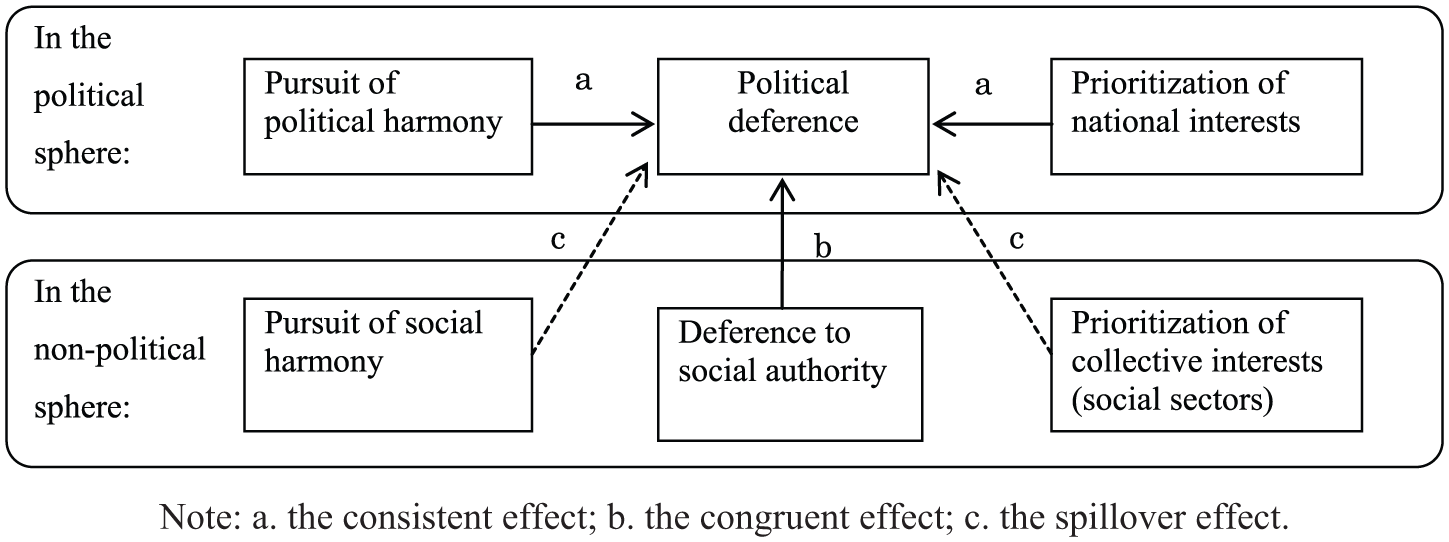
Values of deference to authority at the non-political and political spheres.
In this theoretical framework, a distinction is made between the traditional values in the political sphere and values in the non-political sphere. Traditional values affect political deference levels in three ways – the consistent, congruent, and spillover effects. First, pursuit of political harmony and prioritization of national interests are traditional values in the political sphere. These political orientations may have a consistent effect on values of deference to political authority. Second, deference to authority in the non-political sphere includes obedience to parents in the family, obedience to teachers in school, or obedience to seniors in the workplace. The values of deference to authority in the non-political sphere may have a congruent effect on political deference levels. Third, pursuing harmony in the community or in the workplace and prioritizing family or collective interests over individual interests are traditional values in the non-political sphere. These value orientations are not directly related to politics, but they may have a spillover effect on political deference levels. Identifying the above three effects that the traditional values have on political deference levels helps clarify the mechanism by which political deference results in socialization.
Consistent effects
Political deference first forms through direct acquisition of values of deference to political authority in a person’s socialization process. A person is taught to respect and conform to authority in the political arena and takes political deference as his or her moral obligation. In the political value system, political deference has to be compatible with other political beliefs, or dissonant attitudes will create psychological tension (Burns, 2006; McGregor, 2013). Traditional political values, such as maintenance of political harmony and prioritization of national interests over individual interests, remain compatible with political deference. Preference for harmony produces ‘a person psychologically attuned to deference, compliance, and cooperativeness within delimited groups’ (Redding and Wong, 1986: 287). Prioritization of national interests justifies a discourse about sacrificing personal interests for the sake of the country.
Political elites in Japan and China had taken advantage of prioritization of national interests to strengthen their rules. Japanese people in World War II were encouraged to die for the Japanese empire. It was a great honor to devote one’s life to one’s country. In China, prioritization of national interests is a basis of one’s loyalty to one’s country. Pursuit of political harmony and prioritization of national interests may correlate positively with political deference. Formation of political deference through socialization will accompany concurrently developed traditional values in the political sphere.
Congruent effects
The second route by which political deference forms is a congruent result of internalizing values of deference to authority in the non-political sphere. According to congruence theory, socialization in non-political spheres is regarded as one of the most relevant factors in shaping people’s attitudes toward political institutions (Hetherington, 1998). Eckstein (1968, 1998) states that political authority patterns are congruent with the authority patterns of other social units (the workplace, the school, or the family). Similarly, Etzioni (1968) contends that value orientations toward small groups establish a basis for those expressed toward the nation. The virtue highly valued in the family is filial obedience in East Asia, correspondingly political allegiance is the state’s due (Hahm, 2004: 98). The hierarchical and paternalistic authority structures of family and society are the basis of relations of authority in the political system. Therefore, obedience to authority in family and social circles may be congruent with people’s willingness to defer to political authority.
Spillover effects
The spillover effect depicts how traditional values in the non-political sphere affect people’s political deference levels. These traditional values do not involve relations of authority directly. Pursuing harmony in the community or in the workplace and prioritizing family or collective interests over individual interests are important traditional values in the non-political sphere. People adopt these codes of behavior and social norms in social activities. Given the lack of clear boundaries between the public and the private spheres in East Asia (Kuan and Lau, 2002; Tu, 1993), the spillover effect of these social orientations may have a positive correlation with political deference. However, it is worth noting that these traditional values and political deference are not directly related. Clearly, pursuing harmony in the community or in the workplace and prioritizing family or collective interests over individual interests are neither political orientations nor values of deference to authority. Preference for harmony and group primacy in social life spill over into the political sphere, which may have an indirect effect on political deference levels.
Data and measures
This study uses the data from the second round of the Asian Barometer Survey (ABS). 2 The surveys were conducted in 13 Asian societies from 2005 to 2008. Up to 2016, the ABS has undertaken four waves of surveys. Since other rounds of ABS did not include major items measuring the traditional values, the empirical analyses in this research make use of data from the second wave of ABS.
ABS data were collected by using a multistage stratified probability random sampling method, which ensures the representativeness of samples and generalizability of the results. The Census Yearbook from the National Statistics Bureau was used as the basic source to select the primary sampling units (PSUs). The standard questionnaire was carried out using face-to-face interviews. In mainland China, 5075 valid samples of respondents were obtained with a mean age of 47.06 years (standard deviation (SD) = 15.21 years). There were 2598 male respondents (51.19%) and 2477 female counterparts (48.81%). The Japanese sample comprised 1067 valid cases with a mean age of 54.56 years (SD= 16.01 years). There were 505 male respondents (47.33%) and 562 female counterparts (52.67%).
Dependent variables
This study conceptualizes citizens’ levels of political deference to government authority through three items: unconditional support for government, ideological domination of the government, and paternalism. They are cognitive, evaluative, and affective dimensions of political deference. Unconditional support for the government was measured by understanding whether the respondents would support the decisions of their government, even if they disagree with them. Ideological domination of the government was measured by the question of whether the government should decide which ideas can be discussed in society. Paternalism was measured by the degree of agreement with the statement that the role of government leaders is similar to that of the head of a family. Responses to the three items above were coded on a 4-point Likert scale, respectively. The higher scores indicate a greater level of political deference.
Independent variables
Conformity reflects group members need to obey superiors’ demands in a hierarchical system. As the dependent variable is political deference (conformity in the political sphere), conformity here focuses on the non-political aspect in family and school. Conformity in family was measured by the statement that even if parents’ demands are unreasonable, children should still do what they ask them to. Conformity in school was measured by the statement that being a student, one should not question the authority of one’s teachers. Both these items were coded on a 4-point Likert scale. The higher scores indicate a greater level of conformity orientation.
Preference for harmony promotes group members to pursue harmonious relationships and to prevent disputes and conflicts with others. Pursuit of harmony was divided into two categories: preference for harmony in the non-political and the political spheres. Preference for harmony in the non-political sphere was composed of harmony in community and harmony in the workplace. Harmony in community was measured by the statement that when one has a conflict with a neighbor, the best way to deal with it is to accommodate the other person. Harmony in the workplace was measured by the statement that a person should not insist on his own opinion if his coworkers disagree.
Preference for harmony in the political sphere is described as political harmony. Political harmony was measured by two items: One item is that conflict among political groups is a bad thing for our country; the other is that open quarrels among politicians are harmful to society. Both items were coded on a 4-point Likert scale. The higher scores indicate a greater level of political harmony orientation. They were organized into a single index for political harmony by principal component analysis (PCA). 3
Group primacy indoctrinates people to put personal interests second to those of the group. This study incorporates three aspects of group primacy – prioritization of family interests, prioritization of collective interests, and prioritization of national interests. Prioritization of family interests was measured by the statement that one should put his or her personal interests after the interests of the family. Prioritization of collective interests was measured by the statement that if a government policy serves the interests of the majority of people, I should support it even if it jeopardizes my private interests. Prioritization of national interests was measured by the statement that, for the sake of the national community, the individual should be prepared to sacrifice his or her personal interests. All of these items were coded on a 4-point Likert scale. The higher scores indicate a greater level of group primacy orientations.
Control variables
Age, gender, and education were controlled in the regression analyses. Age and education were two continuous variables. Education was measured in years of schooling. Gender was coded on a dummy scale, with 0 indicating female and 1 indicating male.
Analytical strategy
The independent variables measure related facets of traditional values pertaining to deference. If the independent variables highly correlated with one another, they could be suppressing one another, explaining some of the weak or absent effects in the regressions. I test the variance inflation factors of variables in regressions to check multicollinearity. All indicators are below 2, which implies low multicollinearity.
The dependent variables were originally coded on a 4-point Likert scale. I compare political deference in the two countries in Figure 2(d). The outcome measure is going to be treated as ordinal because there is a clear ordering between categories. However, the size of the difference between categories is inconsistent, and they are not interval variables. This violates ordinary-least-squares (OLS) assumptions. The parallel regression assumption is crucial for the appropriateness of the ordered logit model. I tested the parallel regression assumption. Unfortunately, the test statistic was significant, which indicates that the parallel regression assumption has been violated. Therefore, the dependent variables were recoded on a dummy scale, respectively, with 0 indicating non-political deference and 1 indicating political deference. Since the dependent variables are binary variables, a logit regression model is an appropriate method for parameter estimation.
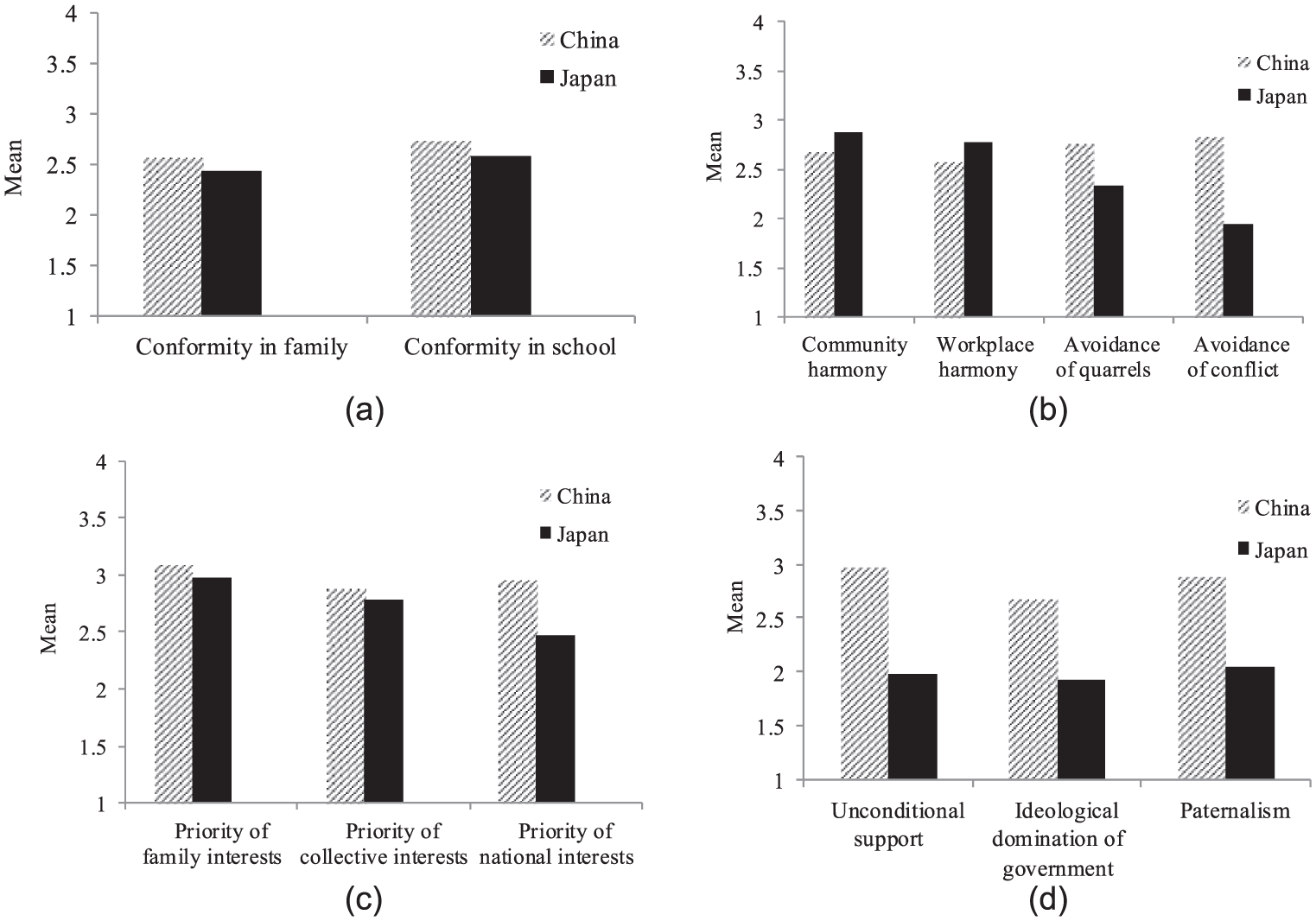
A comparison of multiple dimensions of traditional values in Japan and China: (a) conformity to non-political authority, (b) multifaceted preference for harmony, (c) multifaceted group primacy, and (d) political deference orientations.
It is almost inevitable that some observations will be missing in datasets in large-scale social surveys. Multiple imputation (MI) is widely accepted as a preferred method of addressing missing values (King et al., 2001; Schafer, 1999). MI estimates the parameters of a model based on information in cases which are not missing, avoiding the need to delete cases with missing values. The study conducted MI before estimating the parameters of models. 4 The number of cases for logit regression analysis is 1046 in Japan and 4540 in China.
First, I test and compare the relationships between traditional values and political deference in Japan and China. Then, I examine the effects of the interaction between country and traditional values. Finally, the effect of demographic factors on political deference will be discussed.
Results
Values of deference to authority in Japan and China
Considering the different social and political developments of post-war Japan and China, it is conceivable that the traditional values may have varied effects on political deference levels in the two countries. Figure 2(a) to (c) displays the distribution of three components of the traditional values. Figure 2(d) shows the level of political deference orientations in Japan and China.
First, Chinese citizens’ conformity in family and in school was slightly higher than that of Japanese citizens (see Figure 2(a)), but there was not a substantial gap between them. Second, a mixed picture was revealed in terms of preference for harmony. Figure 2(b) shows that the Japanese preferred keeping a harmonious relationship with others in their community and workplace more than their Chinese counterparts. However, the Chinese were inclined to avoid quarrels and conflicts in the political sphere. Third, group primacy orientations encourage people to prioritize group interests and even sacrifice personal interests on behalf of the group. Figure 2(c) also shows variations in prioritization of group’s interests. With respect to prioritization of family and collective interests, the Chinese and the Japanese were almost at the same level. However, when it comes to prioritization of national interests over personal interests, the Japanese score dropped. Chinese citizens put national interests ahead of individual interests.
There is a striking disparity between Japan and China in political deference orientations. Figure 2(d) shows that Chinese scores were higher than those of Japanese in all three components of political deference. The gap was most salient in unconditional support for government and paternalism. Because Japan had a higher level of political deference during the era of militarism and both countries have undergone a different social and political development after World War II, a tentative explanation of the results is that citizens in the two countries experienced distinct levels of socialization. Political socialization is a process of political learning. Values of deference to political authority have declined in Japan.
The consistent effects
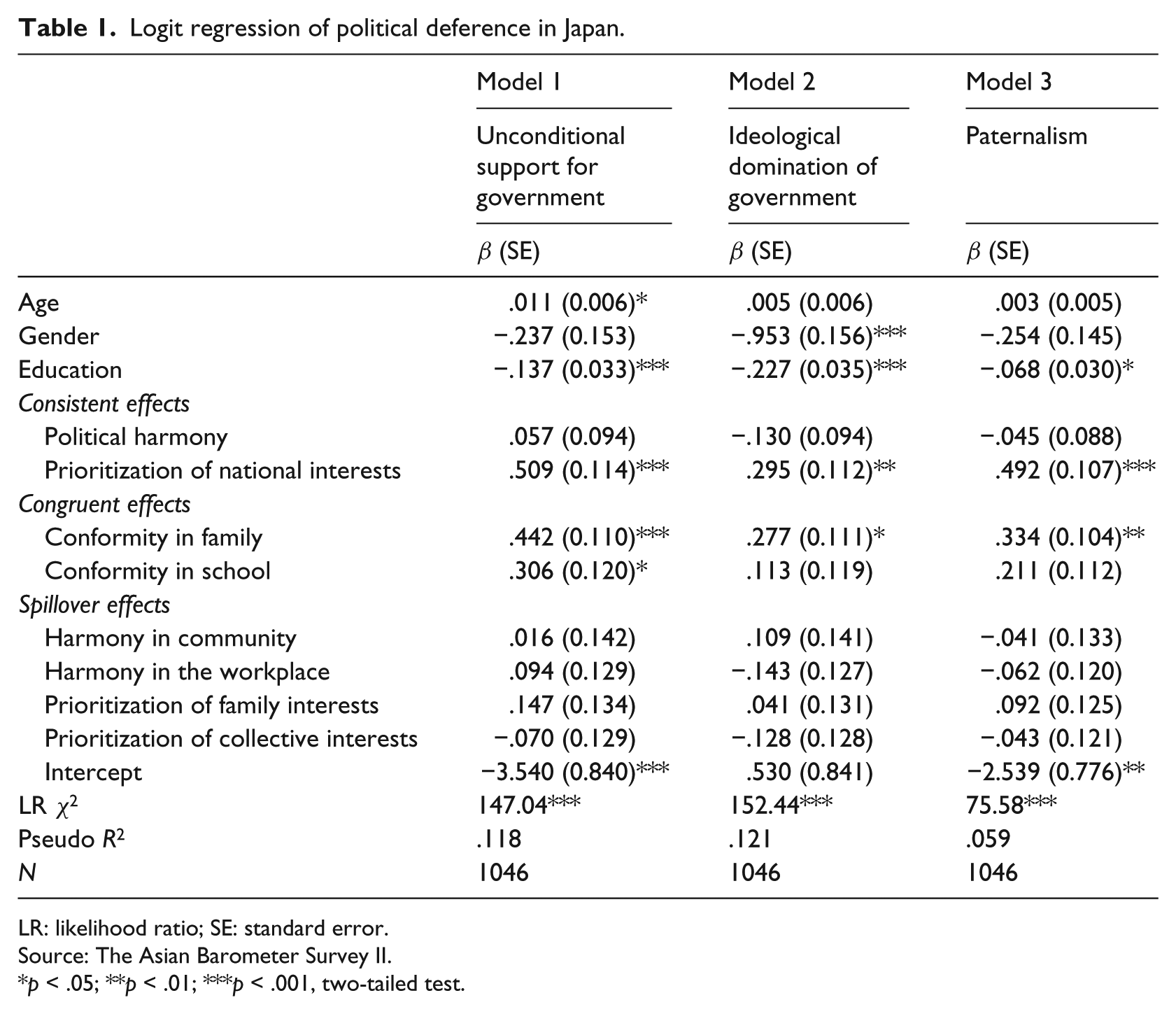
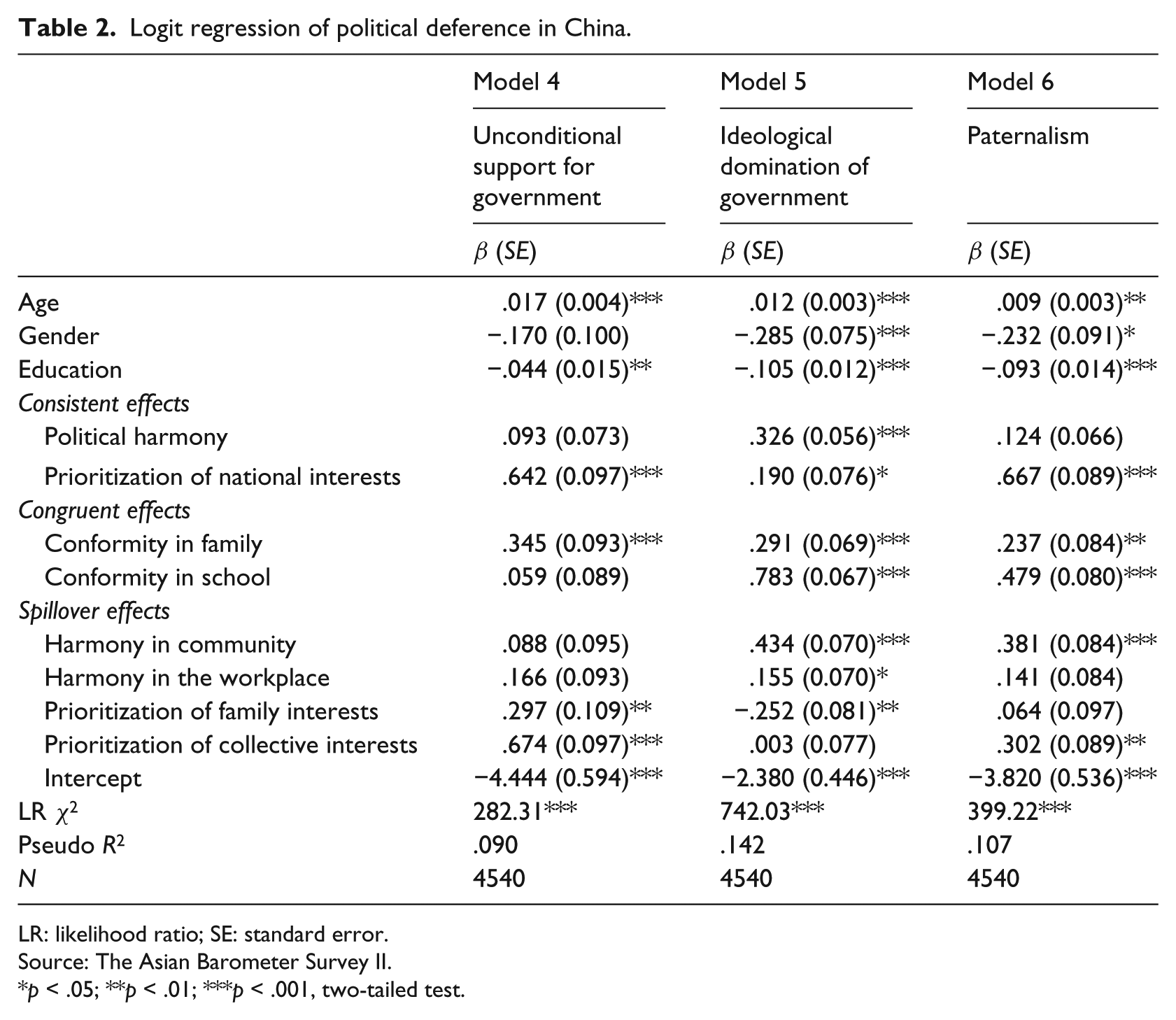
The traditional values in the political sphere, such as pursuit of political harmony and prioritization of national interests, may have a consistent effect on deference to political authority. Table 1 displays the consistent effect in Japan; Table 2 displays the consistent effect in China. In Japan, the pursuit of political harmony did not significantly correlate with unconditional support for the government, ideological domination of the government, and paternalism. Prioritizing national interests positively correlated with unconditional support for government (β = .509, p < .001, Model 1), ideological domination of the government (β = .295, p < .01, Model 2), and paternalism (β = .492, p < .001, Model 3). In China, pursuing political harmony positively correlated with ideological domination of the government (β = .326, p < .001, Model 5) but did not significantly correlate with unconditional support for government and paternalism. Prioritizing national interests positively correlated with unconditional support for government (β = .642, p < .001, Model 4), ideological domination of the government (β = .190, p < .05, Model 5), and paternalism (β = .667, p < .001, Model 6). Therefore, the consistent effects of the traditional values in the political sphere on levels of political deference are confirmed for China, but only partially confirmed in the case of Japan.
Logit regression of political deference in Japan.
LR: likelihood ratio; SE: standard error.
Source: The Asian Barometer Survey II.
p < .05; **p < .01; ***p < .001, two-tailed test.
Logit regression of political deference in China.
LR: likelihood ratio; SE: standard error.
Source: The Asian Barometer Survey II.
p < .05; **p < .01; ***p < .001, two-tailed test.
The congruent effects
According to congruence theory, values of deference to authority in the non-political spheres are congruent with political deference. Table 1 displays the congruent effect in Japan; Table 2 displays the congruent effect in China. In Japan, conformity in the family positively correlated with unconditional support for government (β = .442, p < .001, Model 1), ideological domination of the government (β = .277, p < .05, Model 2), and paternalism (β = .334, p < .01, Model 3). Conformity in school positively correlated with unconditional support for government (β = .306, p < .05, Model 1) but did not significantly correlate with ideological domination of the government and paternalism. In China, conformity in the family positively correlated with unconditional support for government (β = .345, p < .001, Model 4), ideological domination of the government (β = .291, p < .001, Model 5), and paternalism (β = .237, p < .01, Model 6). Conformity in school positively correlated with ideological domination of the government (β = .783, p < .001, Model 5) and paternalism (β = .479, p < .001, Model 6) but did not significantly correlate with unconditional support for government. In general, deference to family and social authority is congruent with political deference in Japan and China. These results confirm congruence theory.
The spillover effects
Traditional values in the non-political sphere are not equivalent to the values in the political sphere. They do not relate to relations of authority directly and are not necessarily authoritarian. This section tests whether traditional values in the non-political sphere have spillover effects on deference to political authority. Table 1 displays the spillover effect in Japan; Table 2 displays the spillover effect in China. In Japan, traditional values in the non-political sphere and deference to political authority were not positively related. As seen in Figure 2(b), the degree of pursuing harmony in community and workplace is greater in Japan than in China. However, pursuing harmony in social lives does not translate into deference to political authority in Japan. The Japanese case indicates that a preference for social harmony does not correlate with political deference. This empirical evidence supports some East Asian philosophers’ statements that harmony does not foster conformity; harmony presupposes the existence of different things (Li, 2006).
By contrast, some spillover effect was observed in China. Pursuing harmony in the community positively correlated with ideological domination of the government (β = .434, p < .001, Model 5) and paternalism (β = .381, p < .001, Model 6) but did not significantly correlate with unconditional support for government. Pursuing harmony in the workplace positively correlated with ideological domination of the government (β = .155, p < .05, Model 5) but did not significantly correlate with unconditional support for government and paternalism. Prioritizing family interests positively correlated with unconditional support for government (β = .297, p < .01, Model 4), whereas prioritizing family interests negatively correlated with ideological domination of the government (β = −.252, p < .01, Model 5). Prioritizing family interests did not correlate with paternalism. Prioritizing collective interests positively correlated with unconditional support for government (β = .674, p < .001, Model 4) and paternalism (β = .302, p < .01, Model 6) but did not significantly correlate with ideological domination of the government. In general, pursuit of harmony and group orientations in the non-political sphere have a greater spillover effect on deference to political authority in China than in Japan.
The moderation effects
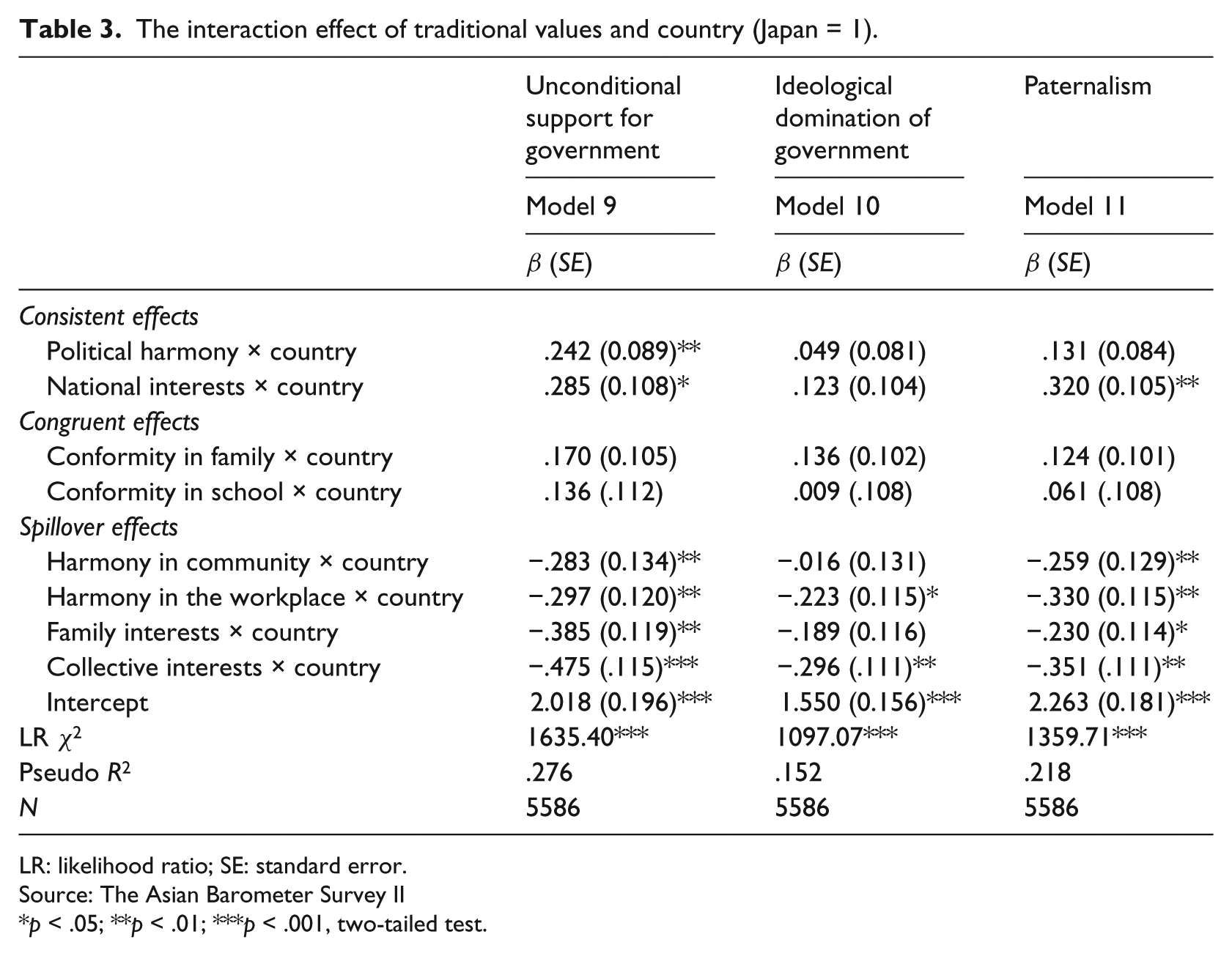
Different social and political developments in the two countries moderate the impact of traditional values on political deference levels. To test the moderation effect, a dummy variable of ‘country’ was created (0 = ‘China’ and 1 = ‘Japan’). This study investigated the interaction effects of traditional values and country in pooled samples that included both countries (see Table 3). The results indicate that the effects of traditional values on political deference levels were significantly moderated by different social and political developments in the two countries. 5
The interaction effect of traditional values and country (Japan = 1).
LR: likelihood ratio; SE: standard error.
Source: The Asian Barometer Survey II
p < .05; **p < .01; ***p < .001, two-tailed test.
With the exception of conformity in the family and conformity in school, the moderation effects were observed in the remaining elements of traditional values. First, the interaction terms between pursuing political harmony and country, and between prioritizing national interests and country were positive. Traditional political values were more strongly correlated with unconditional support for government in Japan than in China. Prioritizing national interests was more strongly correlated with paternalism in Japan. However, it goes too far to say that the consistent effect is more significant in Japan because the interaction terms were not significant in explaining ideological domination of the government. Second, the interaction terms between conformity in family and country, and between conformity in school and country were not significant. The results indicate that there is no difference between Japan and China with regard to the congruent effect of traditional values on political deference. Third, the interaction effects between pursuing harmony in community and country, between pursuing harmony in the workplace and country, between prioritizing family interests and country, and between prioritizing collective interests and country were negative. In general, traditional values in the non-political sphere have a stronger correlation with political deference levels in China than in Japan. The results indicate that spillover effects are more significant in China. Clearly, the social values are more likely to encroach on the political sphere and support political deference in China. The interaction effects revealed structural differences between the effects of traditional values on political deference levels in Japan and China.
The variations in the effect of demographic factors on political deference
Variations in the effect of demographic factors on political deference had important implications. This section examines the effects of education, gender, and age on political deference. Tables 1 and 2 show that education negatively correlated with unconditional support for government, ideological domination of the government, and paternalism in both Japan and China. Modernization theory optimistically posits that socioeconomic development empowers ordinary citizens through education, and that political deference orientations decline with a rise in educational level. However, we should not neglect the control and manipulation of education by state authority. Both Japanese and Chinese political elites seek to embellish their nations’ disgraceful histories and strengthen loyalty to the state through education (Dittmer, 1996; Hook, 1988; Sasada, 2006; Wang, 2008).
Gender did not have much effect on political deference in Japan. But females, on average, showed a significantly higher level of support for ideological domination of the government. However, gender plays a more significant role in China than in Japan. Chinese women are more likely to support ideological domination of the government and paternalism.
The older generations tended to have higher political deference in China, while age did not significantly correlate with political deference in Japan. To clarify variations in the effects of age on political deference in Japan and China, this study computed unconditional support for government, ideological domination of the government, and paternalist orientations into a single index of citizens’ political deference to government authority by PCA. 6 To examine the generation-based shift, I recoded the age variable into generational groups (a categorical variable), which have six age groups (1 = 18–29, 2 = 30–39, 3 = 40–49, 4 = 50–59, 5 = 60–69, 6 = 70+). A bivariate analysis was conducted between age cohort and political deference (factor score).
Figure 3 displays how political deference changed across different age cohorts in Japan and China.
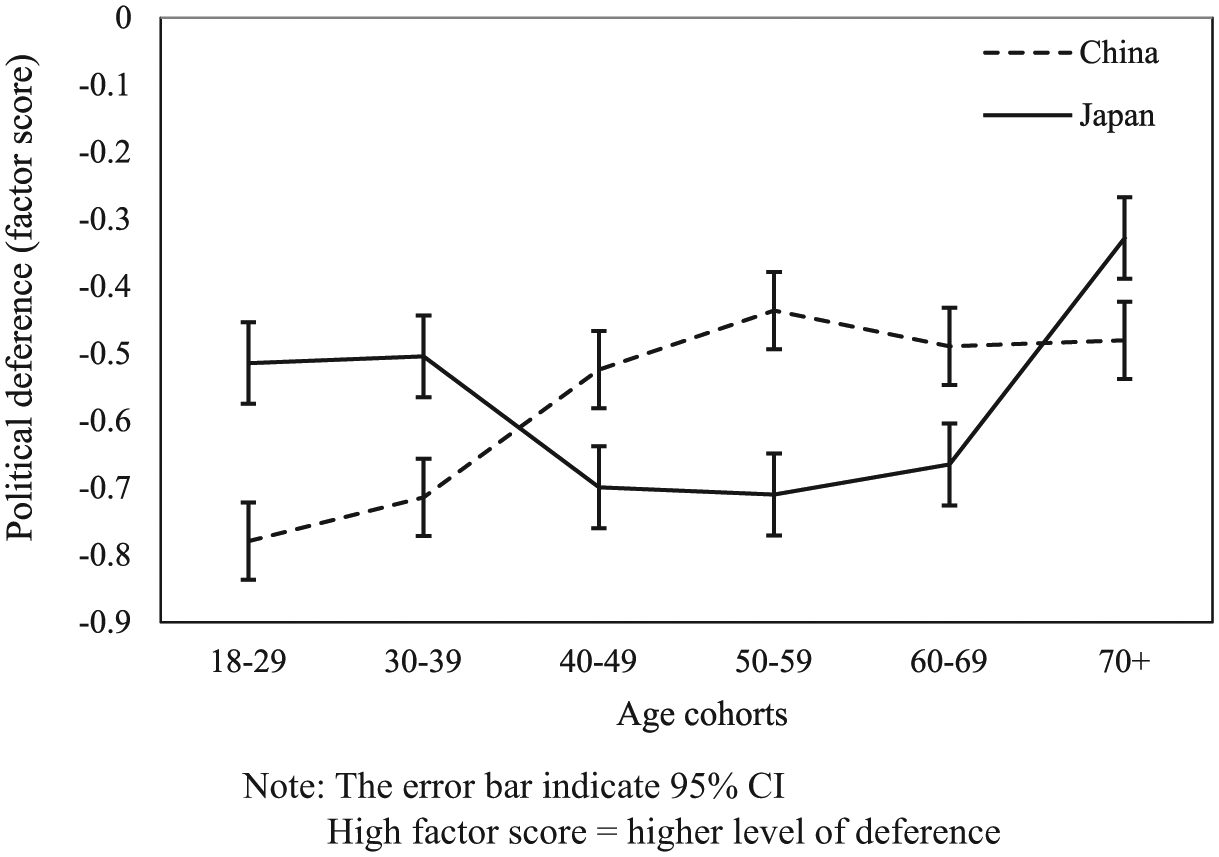
Political deference in different age cohorts in the two countries.
The age effect varied by countries. In Figure 3, generation was divided by 10-year age cohorts. In China, political deference increased with a rise in age. Chinese people between 50 and 59 years of age reached the highest level of political deference. Political deference of the Chinese older than 60 decreased slightly. Chinese aged between 18 and 29 were the lowest group in terms of political deference.
However, the age effect on political deference reveals a U-shape in Japan. The Japanese between the ages of 40 and 69 had a lower level of political deference. However, those aged 70 years or older and those younger than 40 years of age had a higher level of political deference. Since the Japanese data of the second round of the ABS were collected in 2006, the Japanese aged 70 years or older were born before World War II and had experienced the massive war mobilization under military authoritarianism. Similarly, in 2006, the Japanese younger than 40 years were the generation born during or after rapid Japanese economic growth. Figure 3 shows that the Japanese born between the 1940s and the early 1960s (aged between 40 and 69) were the generation with the lowest political deference. This might be linked to the surging student movements in the 1960s since this is the generation born in the 1940s and 1950s, which actively engaged in an anti-authority movement as youth.
Moreover, the results show the interesting finding that there was a high level of political deference among Japanese youth even though political deference in Japan was lower than that in China in general (see Figure 2(d)). It is beyond the scope of this article to explore the reasons why political deference was higher in the Japanese younger generations. Previous studies demonstrated that there is a rise in private-life orientation in Japan (Ikeda, 2007), which causes Japanese citizens, especially the younger generations, to withdraw from politics. Some recent studies discuss a rise in conservative orientations and a popularity of right-wing politicians among the Japanese youth (Yamada, 2009; Yoshino, 2007). 7 Their relationship with political deference needs more careful scrutiny.
Conclusion and discussion
This study is part of an academic endeavor to research values, prompted by Hofstede, Schwartz, and Inglehart. The empirical results confirm that traditional values in the non-political sphere are influential in both Japan and China (see Figure 2). Regardless of the political system, values of obedience in family and school, preference for harmony in the community and the workplace, and prioritization of family and collective interests over personal interests remain influential among the Japanese and the Chinese.
Different political systems do not make a difference in traditional values in the non-political sphere. A liberal democracy in Japanese society does not erode deference to authority in the non-political sphere, which is as strong as that in China. In Japanese society, social hierarchy strengthens relations of authority in school, the workplace, and even voluntary associations, as revealed in the oyabun-kobun (boss–follower) or sempai-kohai (senior–junior) social relationships. Both require juniors to defer to their seniors in return for protection and benefit. Japanese people use honorific language toward their seniors, and the seniority system is dominant. Both the Japanese and the Chinese adhere to respect for authority and maintenance of harmony.
However, Japan and China show considerable difference in how these traditional values manifest themselves in the political sphere (see Figure 2). It was the long-sustained authoritarian rule that perpetuated political deference among the Chinese public. By contrast, the Japanese had lower scores in pursuing political harmony and prioritizing national interests over individual interests. Empirical evidence shows that traditional values in the political sphere were attenuated in Japan. One possible explanation is that Japan’s democratic development over half a century reduces Japanese people’s preference for political harmony and values of prioritizing national interests over individual interests. 8
This article examines how the traditional values affect political deference levels. These values have consistent, congruent, and spillover effects on political deference levels (see Tables 1 and 2). The empirical results indicate that the consistent and congruent effects of traditional values on political deference levels are fairly similar in the two countries. However, the spillover effect differs in Japan and China. Pursuing harmony in community or workplace and prioritizing family and collective interests are social values, but they also have great political relevance in China. This study shows that these value orientations positively correlated with political deference, and social values could be converted into societal bases of Chinese authoritarian regime (Zhai, 2016a). A similar spillover effect was not observed in Japan. The results are consistent with Ikeda and Richey (2012). Confucian normative theory states that harmony is not mere agreement without difference, and harmony does not foster conformity. ‘The junzi harmonizes but does not seek sameness, whereas the petty person seeks sameness but does not harmonize’ (Analects 13.23). Diversity is the prerequisite of Confucian harmony (Li, 2006). The empirical results indicate that pursuit of interpersonal harmony in non-political life does not lead to political deference in Japan.
The effect of the traditional values on political deference levels varies by country (see Table 3). The consistent and congruent effects remain similar in Japan and China, while the spillover effects are more salient in China. One explanation is that different political contexts generated variations between Japan and China, even though alternative explanations of the empirical results are debatable. The political system shapes socialization and intervenes to influence the cultural tradition (Zhai, 2016b). The empirical results show that the pursuit of social harmony and prioritization of family and collective interests hardly had a positive effect on political deference in Japan, while they were significantly associated with political deference in China. It is probable that post-war social and political development weakens the spillover effect of traditional values on political deference in Japan, while traditional values in the non-political sphere still have a spillover effect on deference to political authority in China.
Socioeconomic modernization does not mean a complete break with a country’s cultural tradition, culture has an enduring influence. The traditional values do not disappear but coexist with modernity (Tu, 1993, 1996; Zhang et al., 2005). These traditional values may have a far-reaching influence on the legitimation of power. The results show that traditional values, by and large, maintain the consistent and congruent effects on political deference in Japan. Japanese citizens’ values of deference to political authority are relevant to understanding Japan’s dominant party system. The conservative LDP has long controlled Japanese politics, and the ruling party has only been out of power twice in the past 60 years. The left progressive forces receded in the past few decades, and Japan is moving toward a reinterpretation and revision of its pacifist constitution (Yazawa, 2015). In particular, a rise in deferential values among the younger generations may have important implications for Japan’s future.
Footnotes
Appendix 1
Table 4 displays the descriptive statistics of variables.
Acknowledgements
The author thanks Professor Ken’ichi Ikeda of Doshisha University, IJCS editor Professor David Smith, and anonymous referees for their constructive comments in improving the quality of the article.
Funding
The author(s) received no financial support for the research, authorship, and/or publication of this article.