



Abstract
This article examines the causes of criminalization of forced marriage in European countries. The first part of the article locates the debate on forced marriage within the wider discourse of immigration, national identity, and women’s rights. The second part uses qualitative comparative analysis to analyze 29 European nations, 20 of which criminalized forced marriage. Our findings indicate that criminalization of forced marriage emerges out of a complex set of conditions and the causal recipes differ for early (before 2013) and late adopters (after 2013) of the policy of criminalization. For nations in which criminalization policy was adopted before 2013, the intermingling of world cultural, feminist, and right-wing policies is the main causal mechanism. For the late adopters, a similar causal path fails to emerge indicating that criminalization became normative in European policy environment. In other words, late adopters simply mimic others.
Keywords
Introduction
Starting in the 1990s, forced marriage arose as an object of public concern in many European countries. Media coverage of the stories of migrant girls forced to marry someone from their country of origin without their consent, and girls abducted or killed when they protested against a marriage, played a considerable role in the emergence of public awareness of the issue (Razack, 2004). Yet, the way in which governments address the issue has been a highly contested topic because of how it is bound up with issues pertaining to immigration, cultural rights, and women’s rights. In this article, we focus on one aspect of this social issue, the policy processes in which countries develop specific criminal legislation to target forced marriage. We engage in a comparative analysis of 29 European nations to understand what configurations of factors have an influence on the policy choices addressing forced marriage. In particular, we examine why some of these nations criminalized forced marriage over and against the objections of various non-governmental and civil society groups. We then examine the different patterns of conditions leading 20 of our 29 cases to criminalize forced marriage, finding that a complex mixture of conservative, exclusionary, and feminist political forces, led to the adoption of such policies in the early 2000s. Over time and in the context of the growing refugee crisis, however, the process becomes normative and less contingent upon national political factors.
Forced marriage: definition and problematization
The term ‘forced marriage’ refers to a marriage in which free and full consent of at least one of the parties is absent. Although in the European context the term forced marriage is used extensively, advocacy groups in the international community use the terms ‘child’, ‘early’, and forced marriage interchangeably. Although not all forced marriages are child marriages, the problem is defined and discussed with reference to the same factors and consequences by the international community. Following the European practice, throughout this article, we use the term forced marriage.
The literature on forced marriage suggests that in various national contexts public discussion of forced marriage treats it as an immigration issue and frames it as one of the cultural practices presenting a threat to ‘European values’ (Dustin and Phillips, 2008; Kool, 2012; Razack, 2004; Sabbe et al., 2014; Urbanek, 2012; Yurdakul and Korteweg, 2013). Framing the issue in these terms impacts strategies used to fight against forced marriage. Among different policies against forced marriage in Europe, the most common ones are immigration measures and criminalization. Immigration measures take two forms: (1) modification of extant consent laws through raising the minimum age requirement for marriage (Belgium, Denmark, the Netherlands, the United Kingdom) and (2) the addition of income/subsistence requirements for family reunification (Germany, Norway, the Netherlands), along with other requirements, such as proof of basic language competence (Germany), or passing a pre-arrival integration test (the Netherlands). Criminalization as a measure against forced marriage identifies the practice as a distinct crime, and is often championed by its supporters because it ‘gives the powerful message that this indefensible abuse of human rights will not be tolerated’ (Press Association, 2014).
As of July 2016, almost half of the European Union (EU) member states have criminalized forced marriage by identifying it as a specific crime. This development followed the recommendation in 2011 of the Council of Europe Istanbul Convention 1 that urges states to criminalize ‘the intentional conduct of forcing an adult or a child to enter into a marriage’ (Article 37). The Istanbul Convention frames the issue within the concept of violence against women and as a violation of women’s human rights.
Feminist and civil society groups contest criminalization and immigration measures against forced marriage on various grounds, as both have potential discriminatory impacts against immigrant populations – as we shall see, this is hardly accidental. In addition to discrimination, some argue that criminalization is ineffective because victims would likely be unwilling to penalize their own families (Gangoli and Chantler, 2009). Some claim that it is not only ineffective but also likely to create even worse conditions for women, since it may force minority communities to isolate themselves and cling more tightly to their traditional beliefs, as they would feel threatened and subject to discrimination. Use of immigration law, similarly, is ineffective and particularly unfavorable to women. Gangoli and Chantler’s (2009) study concludes that immigration measures do not work because a minimum age requirement is not a strong protective factor against forced marriage since even older girls do not always have the means to resist their families. Hester’s study confirms this conclusion and suggests that increasing the marriage age may even be riskier for victims since this would result in ‘forced relocation of young women to their country of origin until they would be able to sponsor their spouse’ (Hester et al., 2008). On the whole, studies examining the impact of existing measures show either no or negative effects on the practice or prevalence of forced marriage, finding rather that existing measures are more about controlling immigration than preventing forced marriage.
Theoretical background
Existing literature on forced marriage discusses criminalization as a national-level policy decision, and is rooted primarily in a realist or neo-realist theoretical perspective that views nations and their political players as rational self-interested actors. In this section, we review this literature, and find that while it provides key insights, it fails to account for the rapid diffusion of policies criminalizing forced marriage throughout the EU following 2012. We thus incorporate neo-institutionalist theories of ‘world culture’ (Lechner and Boli 2005; Meyer 2010) that emphasize the importance of global norms and policy diffusion in shaping national policies and institutions. These theories are also critical for understanding the nexus of conservative and feminist political actors at the nation-state level.
Realist/neo-realist theories: gender equality, migration, and politics of belonging
In Europe, forced marriage together with female genital mutilation, honor killings, and polygamy was in the center of heated political and philosophical debates in the late 1990s. Issues about gender equality and minority populations exacerbated tensions between the supporters of multiculturalist and liberal ideologies in the European community – particularly among feminist activists and organizations. On the one side of the spectrum were those who focus on the cultural rights of minority groups, while on the other side were those who reject rights of cultures that are not in favor of individual autonomy or freedom of choice. This debate between liberalism versus multiculturalism has played out in the political discourse surrounding forced marriage in Europe. The literature on the policy process surrounding forced marriage shows that the liberal narrative dominates in the European political context and, somewhat surprisingly, both right-wing political parties as well as feminist advocacy organizations take up the issue. Indeed, some scholars argue that the main reason behind the concern over the rights of minority women is the drive to consolidate votes by the political right through advocating a ‘politics of belonging’ (Enright, 2009; Phillips, 2009; Yuval-Davis, 2011). The ‘politics of belonging’ refers to a political/discursive strategy in which social boundaries are constructed, typically along nationalist (citizen/immigrant) lines, thereby excluding some groups from citizenship, at least on a symbolic level. In this discursive field, gender issues hold a particular place in boundary construction because women’s bodies are a battlefield for symbolic politics.
Right-wing actors framed the issue of forced marriage predominantly as a cultural practice of the non-European, uncivilized or not modernized, in contrast with European identity that is modern and considerate of human and women’s rights. Dustin and Phillip’s (2008) work draws attention to the intermingling of policies that strive to protect women and those that are simply anti-immigration. Urbanek (2012) claims that conservative and anti-immigrant politicians in Germany welcomed the New Immigration Act (2007), which has restrictive provisions regarding family unification. She continues, ‘conservative political actors have discovered and promoted gender equality as a value central to German society’ (Urbanek, 2012: 36) but their hidden agenda is preventing or discouraging new migrants from entering Germany.
A number of studies across Europe show similar trends in political discourse and policy framing of the issue of forced marriage. In Denmark, Fair (2010) studied what she calls the ‘integration project’ in which ministry officials frame forced marriage as a cultural practice that ‘threatens “Danishness”, characterized as having respect for “freedom, human dignity and self-determination”’ (p. 36). Bredal (2005) finds similar trends in Denmark and Norway, pointing to right-wing parties such as the Progress Party in Norway and the Danish People’s Party becoming core advocates of forced marriage legislation (p. 343). Both Razack (2004) and Joppke (2004) note how even countries such as Norway, with a strong history of multicultural policy, have undertaken a major discursive shift toward ‘civic integration’ and discriminatory eviction policies.
Throughout Europe, then, studies in a variety of fields focusing on forced marriage note the ironic convergence of anti-immigrant and nationalistic European policy with liberal discursive principles of individual freedom, autonomy, and equality voiced by progressive feminist groups. Meret and Siim’s (2013) study of gender discourses of right-wing populist parties in Denmark, Norway, and Austria is emblematic here, as these are dominated by ‘exclusionary neo-nationalist discourse and positions, but combined with a growing emphasis on the importance of liberal values, including gender equality and women’s rights’ (p. 93). Akkerman and Hagelund (2007) reach similar conclusions in their comparative study of the Netherlands and the United Kingdom.
Neo-institutionalism: world culture, feminism, and right-wing politics
Although we believe that the conservative and anti-immigrant agenda is central to the criminalization of forced marriage, it is not the whole story. In many European countries, women and children’s rights groups as well as human rights organizations are key players in the fight against forced and child marriage. Thus, we cannot overlook the important role played by human rights and feminist groups in advocating on the issue and constructing forced marriage as an issue. We also need to address the fact that child, early, and forced marriage is now on the agenda of the international development community. To understand the nexus of feminist advocacy and right-wing political parties, we need to turn to the global cultural material upon which they both draw, a line of neo-institutional theory that posits a growing world culture whose sacred principle is the inviolable autonomous individual of Western capitalist modernity. 2 In this model, ‘world culture’ refers to the
… culture of world society, comprising norms and knowledge shared across state boundaries, rooted in nineteenth century Western culture but since globalized, promoted by nongovernmental organizations as well as for-profit corporations, intimately tied to the rationalization of institutions, enacted on particular occasions that generate global awareness, carried by the infrastructure of world society, spurred by market forces, riven by tension and contradiction, and expressed in the multiple ways particular groups relate to universal ideas. (Lechner and Boli, 2005: 6)
Theorists of world culture see the autonomous individual person as its primordial actor (Meyer, 2010: 8), meaning that the rights of the individual, that is, human rights, are constantly growing with the expansion of world culture. Defining the rights of women, children, the disabled, and the elderly are examples of the expansion of such rights, and the international agenda on forced marriage is clearly an example of such processes taking place. For example, the recently adopted United Nations (UN) Sustainable Development Goals includes a target to end child, early, and forced marriage by 2030. Although the global agenda emphasizes child marriage over forced marriage, involuntary marriages are clearly under scrutiny in global civil society. Following this line of neo-institutionalist thinking, we argue that world cultural processes are important in understanding the recent interest in the issue of forced marriage. Marriage is increasingly considered as a matter of personal choice, preferably based on love (as opposed to a matter of familial/tribal well-being) forming the world cultural assumptions on which debates and policy-making about forced marriage take place.
Moreover, neo-institutionalists argue that policies and institutions across nations are often comparatively quite similar, and argue for the importance of norms, ideas, and institutional architectures diffusing through ‘epistemic communities’ (such as NGOs) and between nations. Given the fact that many European countries passed nearly identical legislation criminalizing forced marriage in a very short period of time, we need to take account of these broader processes of norm diffusion and mimicry. World cultural or world polity theories in stark contrast to the ‘neo-utilitarian’ scholars who almost exclusively highlight the causal force of material interests and power, argue that shared ideas and knowledge are very important ‘building blocks of international reality’ (Payne, 2001: 37).
We argue that the criminalization of forced marriage represents a mesh point between political right parties pursuing anti-immigrant and xenophobic platforms and feminist civil society groups pursuing female empowerment. Feminist NGOs and female politicians and populist nationalist parties are key actors in this process, yet their discursive position is articulated through and constituted by the larger principles of world culture, particularly the core principle of the sacrality of the individual (Matthias, 2013). To explore this thesis, we engage in a comparative analysis of 29 European nations, 20 of which passed specific criminal legislation targeting forced marriage, to assess how nationalist right government and anti-immigration stance, world culture, and feminist politics combine in the European assessment of the practice.
Methods: qualitative comparative analysis
We use fuzzy-set qualitative comparative analysis (fsQCA; Ragin, 2008; Ragin and Rubinson, 2009; Schneider and Wagemann, 2010). Qualitative comparative analysis (QCA) is a form of comparative analysis based in set theory that uses multiple conjunctural causation of closely studied cases and explores how different causal factors conjoin to form multiple ‘recipes’ leading to the outcome (Ragin, 1987; Ragin and Rubinson, 2009: 26). As with most comparative research, this method depends upon the researchers’ close knowledge of the cases and the factors that are most important in leading to the outcome of interest. Our research draws on close case studies of forced marriage, and interviews with organizations that fight the practice and victims of it from Germany and Austria.
QCA specifically is predicated upon drawing out theoretically specified combinations of causal conditions and comparing their presence or absence relative to the presence of the outcome. QCA also draws on Boolean algebra to adjudicate which conditions can be understood as causally (un)important, and Boolean notation to express the conjunctions and combinations of conditions.
Boolean notation
In QCA and Boolean notation, we give causal conditions labels and represent combinations of conditions in solutions of these labels. For example, causal conditions such as a large number of women members of parliament (MPs) and the presence of a rightist governing cabinet might be specified WMP and RTCAB, respectively; in shorthand notation, these may be further delimited to a single letter (or two) such as W and R.
We indicate the presence or absence of conditions (or set membership) by notation of the label in capital or lower case letters, respectively; thus, the presence of relatively large numbers of women parliamentarians would be denoted WMP (or W) while the absence of a governing rightist cabinet would be written as rtcab or r. When conditions combine to form a causal recipe, this combination is noted with the ‘logical and’ (*) while the conjunction of different causal recipes is noted with the ‘logical or’ (+). An arrow from the outcome to the solution (solution ← outcome) indicates a relationship of causal necessity, or that the score on the outcome is consistently less than or equal to the solution. An arrow running from the solution to the outcome indicates causal sufficiency (solution → outcome) – or that the score in the outcome is greater than or equal to the scores on the solution.
Thus, if we find that both high numbers of female parliamentarians and a rightist cabinet are causally sufficient for criminalization, we would note this as: WMP*RTCAB→CRIM or in shorthand as WR→C. Alternatively, if we found that either the presence of WMP and the absence of rtprt, or the presence of RTPRT and the absence wmp were causally sufficient (but not the co-presence or absence of both), we would note this as follows: WMP*rtcab + wmp*RTCAB → CRIM, or in shorthand as Wr + wR → C (Schneider and Wagemann, 2010). Labels for conditions in our analysis are laid out in the calibration section below.
Calibration
Unlike operationalization in much quantitative analysis, in QCA operationalization of conditions involves calibrating them according to the researcher’s knowledge and the broader knowledge of the social scientific community. Calibration involves determining qualitative breaking points that indicate a case’s membership in relevant sets – for example, membership in the set of EU countries that have criminalized forced marriage, or in the set of countries that have a high number of female parliamentarians. In QCA analysis, the key qualitative breakpoints are those which denote full set membership (or the full presence of a causal condition/outcome), the point of maximum ambiguity, and the point of full set non-membership (or the full absence of a causal condition; Ragin, 2008).
In fsQCA, cases are calibrated in terms of degrees of membership in a set, with some cases being ‘more in’ or ‘more out’ of a set but not considered by researchers to be fully in or fully out. What we are concerned with here is whether membership in a conjunction of sets of causal conditions leads to criminalization of forced marriage (or that forced marriage is a subset of those combinations of conditions). While in principle calibration of fuzzy sets can be done on a continuous scale between full set membership (1) and full set non-membership (0), such fine-grained set calibration often relies on quantitative data that does not apply to the data used in this research. For this reason, we have manually calibrated sets along a five-point scale in which cases can be assigned a position which is ‘more in than out’ (0.67) and ‘more out than in’ (0.33) of the set, with a midpoint (0.5) of maximum ambiguity. Set membership may also be thought of as the relative presence or absence of causal conditions in a given case (see Appendix I).
Determining cases for comparison
As in all comparative analysis, determination of the universe of cases relevant for comparison is the crucial first step. For our analysis, several scope conditions were considered – the first level being membership in the EU. EU membership constitutes a specific policy environment and discursive arena in which members face particular proscriptions, prescriptions, and pressures which differ significantly from non-members. EU’s criminalization policy is unique in the sense that it is the only supranational policy that specifically recommends criminalization, and in the sense that Europe is the only region to systematically pursue criminalization of the practice. Although systematic and up-to-date global level data on forced marriage laws is not available, review of the academic literature and non-academic sources such as NGO publications and reports indicate that forced marriage is a specific crime only in Europe. In many countries, perpetrators of forced marriage can be prosecuted for associated crimes such as kidnapping, rape, child abduction, or assault (Equality Now, 2014), but forced marriage is not the target of specific criminal legislation.
We drew upon a recent EU report, Forced Marriage from a Gender Perspective (Psaila et al., 2016), to establish dates when nations criminalized forced marriage, or when nations amended existing legislation with the intention of limiting the practice. Table 1 lists all 29 nations we included in our initial analysis, both criminalizing and non-criminalizing cases, with dates indicating the year criminal legislation was adopted.
Nations criminalizing/not criminalizing.

FM: forced marriage.
Bracketed cases indicated cases ultimately excluded from analysis.
Bold font indicates cases included in analysis of early criminalizing states.
In addition to EU members, we include Norway and Switzerland in our set which are not formally part of the EU, but are both deeply enmeshed in the cultural milieu and political economy of Europe. Both countries have been members of the European Free Trade Association since the 1960s and are signatories of the Schengen Agreement that effectively abolishes border controls between EU member states. These and other factors effectively entwine the institutions, organizations, and culture of Norway and Switzerland within the broader European community such that they are inextricable from the comparative context we consider here.
Outcome: criminalization of forced marriage (CRIM; C)
We determined the set membership in our primary outcome of criminalization of forced marriage using the EU report by Psaila et al. (2016), primarily Appendix A of that report on measures of criminalizing forced marriage. 3 Full set membership (1) indicates when a nation adopted criminal legislation specifically targeting forced marriage, while full exclusion (0) indicates when nations have not addressed the issue or drafted laws. In nations that did not draft specific criminal legislation but altered extant legislation on marriage and consent to more readily apply to forced marriage, we calibrate these countries as more in than out of the set of criminalizing countries (0.67). Similarly, some countries that have not taken up the debate on forced marriage in an explicitly legislative context but do have laws on human trafficking and age of consent which may challenge forced marriage, we calibrate as not fully out of the set (0.33). Given that all nations had some laws potentially applying to forced marriage, no cases are fully excluded (0).
Condition 1: Muslim practitioners (MSLM; M)
We view the presence of a relatively large number of Muslim practitioners in a nation as causally important because the practice of forced marriage is discursively located in Muslim communities. 4 We calibrated two indicators for set membership in nations with a high population of Muslim practitioners: (1) a measure of the overall percentage of the national population that claim to be Muslim practitioners, and (2) the percentage of the migrant stock that originates from Muslim majority nations (MMN).
Data on migrant stock originating from MMN come from the Pew Research Data (Pew Research Center, 2016) and World Bank data on migrant flows (World Bank, 2015). Membership in the set of nations with high migrant stock is calibrated based on the migrant stock originating in MMN as percentage of the overall migrant stock, and as a percentage of the overall population. 5 Full set membership (1) is calibrated when MMN stock is greater than a quarter of the migrant stock and more than 4 percent of the overall population – whereas full set exclusion (0) is calibrated when less than one-tenth of the migrant stock is MMN and less than 1 percent of the population. Intermediate set membership was calibrated, based on considerations of overall population size and the relative size of MMN migrant stock.
We also look at the numbers of citizens within European nations who are Muslim practitioners, drawing on the National Profiles from the Association of Religion Data Archives (ARDA) measured for the 2010 year (Association of Religion Data Archives (ARDA), 2016). 6 We calibrate according the relative size of Muslim practicing populations, and take account of the overall size of population as above. Thus, European nations with some of the largest Muslim populations – France and Belgium – are coded as fully in the set of nations with a large Muslim practicing population (1), but neither has more than 10 percent of their populations in this category. Nations with less than 1 percent of the population practicing the Muslim faith are fully excluded from the set (0); nations with large overall populations, with over 3 percent of practitioners are considered more in than out (0.67) while less than 2 percent, especially in nations with smaller overall populations, are considered more out than in (0.33).
Note that we use a combined measure here, of either migrant stock or Muslim practitioner population, because the causal effect is likely the same and this aids in the clarity of presentation.
Condition 2: Right Party Cabinet rule (RTCAB; R)
We theorize the presence of a conservative or right-leaning party dominating the ruling cabinet as having an important effect upon the articulation of the discourse against forced marriage in practice. We choose to focus on cabinets rather than parliamentary bodies as a whole to distinguish the elements of parliament that have the greatest weight in passing and shaping final legislation. This allows us to bypass the often marvelous complexity of parliamentary bodies in European politics.
We draw on the Chapel Hill Expert Survey (CHES) data sets from 2010 and 2014 to calibrate the conservatism of the parties in the cabinet (Bakker et al., 2015a, 2015b). We consider this data already calibrated as it draws on the knowledge of political science experts to score the conservatism on a scale of 1 (fully to the left) to 10 (extreme right). We used the ParlGov database (Döring and Manow, 2012) to identify the ruling party proximate to the relevant nation and year, and cross-checked the average CHES score with individual expert scores to ensure that mean party ratings were not skewed by outliers. We calibrated full membership (1) as a party scoring above six with a clear majority of cabinet seats, full set exclusion (0) when a party rated less than four (e.g. leftist) has a clear majority of cabinet seats. The crossover point occurs where no clear majority or right/left leaning can be established. We supplemented data with journalist accounts of elections and the parties.
Condition 3: anti-immigration policy (IMMG; I)
We also consider immigration policy, and view the general national attitude toward immigration and immigrants as having a similar impact as the right governing party. We see a general negative stance on immigration as increasing a government’s likelihood to embrace the path of criminalization of forced marriage out of an exclusionary stance toward ‘non-Europeans’.
We used UN Data on governmental population policy, specifically two indicators for ‘government policy on immigration’ and ‘views on immigration’. Government policy on immigration in this index is rated as ‘raise, maintain, lower’ while views on immigrate are rated as ‘too high, satisfactory, too low’. We looked at these indicators for each nation for the years 2001, 2005, and 2011 to gain a sense of the overall policy direction and views of the government, and how they changed in the years between 2001 and 2011. A nation is calibrated as having full set membership (1) in anti-immigrant position if it has both negative policy and views (lower and ‘too high’) on immigration, more in than out if the policy is to lower when the view is not negative, more out than in if the view is that immigration is satisfactory and policy is to maintain, and fully out (0) if the government has a pro-immigration view and policies to raise immigration flow. Nations were calibrated primarily based on the score for the closest year prior to the criminalized legislation adoption, though views and policies over time are taken into account in this calibration.
Condition 4: world cultural participation (WRLDC; P)
Given that world cultural principles form a crucial mesh point for feminist organizations and right-wing parties, we calibrate for nations’ connections to the world polity using measures established in world polity scholarship, namely the breadth of INGO (International Nongovernmental Organization) membership in each country. It is well documented in this research that global norms are more widely adopted in countries embedded in INGO networks (Schofer et al., 2012). Our measure takes account of the number of INGOS to which residents of each country belong – a standard way of measuring embeddedness in world culture among scholars. INGO data is derived from the Yearbook of International Organizations from the year 2005. Data were also borrowed from Matthias (2013).
We calibrated by breaking the data on European nations into three levels of participation, arguing that the greater number of INGOs in which a country participates the greater their imbrication within world culture and institutions. No countries were calibrated as fully out (0) because no nations in Europe have fewer than 700 connections; by way of comparison, Afghanistan in 2005 had connections to only 105 INGOs. We coded nations with 1500 or fewer connections to INGOs as more out than in (0.33), nations who had between 2000 and 2600 as more in than out of nations with high world cultural embeddedness (0.67), and we coded nations with higher than 2600 as fully in (1). Overall, 2000 was our crossover point (0.5). The maximum number of INGO connections was 4184 (Germany).
Condition 5: women MPs (WMP; W)
We calibrated for both the strength of feminist positions in the political arena. This condition affects national-level issues, as women in parliament tend to bring up issues related to women somewhat more often (Wängnerund, 2009). However, we also see this condition as an enshrinement of women’s rights in national law because – as both the access and the license to pursue political office are seen as a good measure of both rights protections and cultural empowerment of women and perforce individual rights. We calibrated the strength of feminist politics and women’s rights using the number of female parliamentarians as a percentage of the total parliament. Set membership here is calibrated using World Bank data on the percentage of national MPs who are female (World Bank, 2016).
Sociological and political science scholars generally agree that having women occupy 30 percent of the seats in parliament is a very high number – though some nations in our sample had as much as 45 percent women MPs (Krook, 2010). Thus, 30 percent serves as our anchor point for full membership (1). We treat 20 percent as the crossover point – such that nations who have less than 20 percent are considered more out than in (score 0.33) the set of nations with high numbers of female parliamentarians. Having numbers lower than 20 percent indicates a great deal of difficulty for women to gain access to positions of political power. We calibrated full set exclusion as less than 10 percent of parliamentarians being female.
Analysis
In assessing the necessity and sufficiency requirements for criminalization of forced marriage in the EU nations, it is worth reiterating that QCA is designed to capture the complexity of causality in social life, and so we are concerned here not with the simplest solution but the solution that most closely aligns with social scientific knowledge on the issue. Analysis of both necessity and sufficiency was conducted using Kirq software, a free QCA analytical software developed by Rubinson. 7 Note, consistency thresholds throughout are set 0.90 as suggested in Ragin (2008: 44–45); raising the consistency threshold to 0.95 would crest some nuanced changes in our analysis, but the substantive thrust of our findings would remain.
Initial analysis of all 29 cases in Table 2 produces confusing and contradictory results that are difficult to interpret, even if we consider the fact that fuzzy scores are not represented. We see in Table 2 that criminalizing nations and non-criminalizes are spread over 11 different causal recipes, which is not necessarily problematic in QCA as the method is designed to capture multiple conjunctural causal paths, but it is fairly high and the difference between recipes indicates a lack of parsimony. The very wide ‘spread’ of cases seen in the above table is problematic for a comparative analysis because it neither has any clear patterns among cases where criminalization appears nor is there any distinct difference between instances where the outcome does and does not occur. Furthermore, there are two recipes that contain contradictory results – or have both criminalization and non-criminalization as the outcome. Following best practices in QCA, we explored recalibration of several conditions to resolve contradictions and continue our analysis, but contradictions persisted. Ultimately, we decided that reservations we had at the outset of our analysis about the sharp increase in pace and number of criminalization policies after 2012 were justified, and we adjusted our research design. 8 In our second round of analysis, we focused more closely on the historical dimensions of policy developments. Table 1 shows that there is a slow trickle of nations criminalizing throughout the early 2000s followed by a flood of nations adopting criminal laws in 2013–2015. This suggests to us that there may be a critical distinction in the causal processes that led nations to criminalize forced marriage earlier as opposed to late adopters.
Truth table all 29 cases.
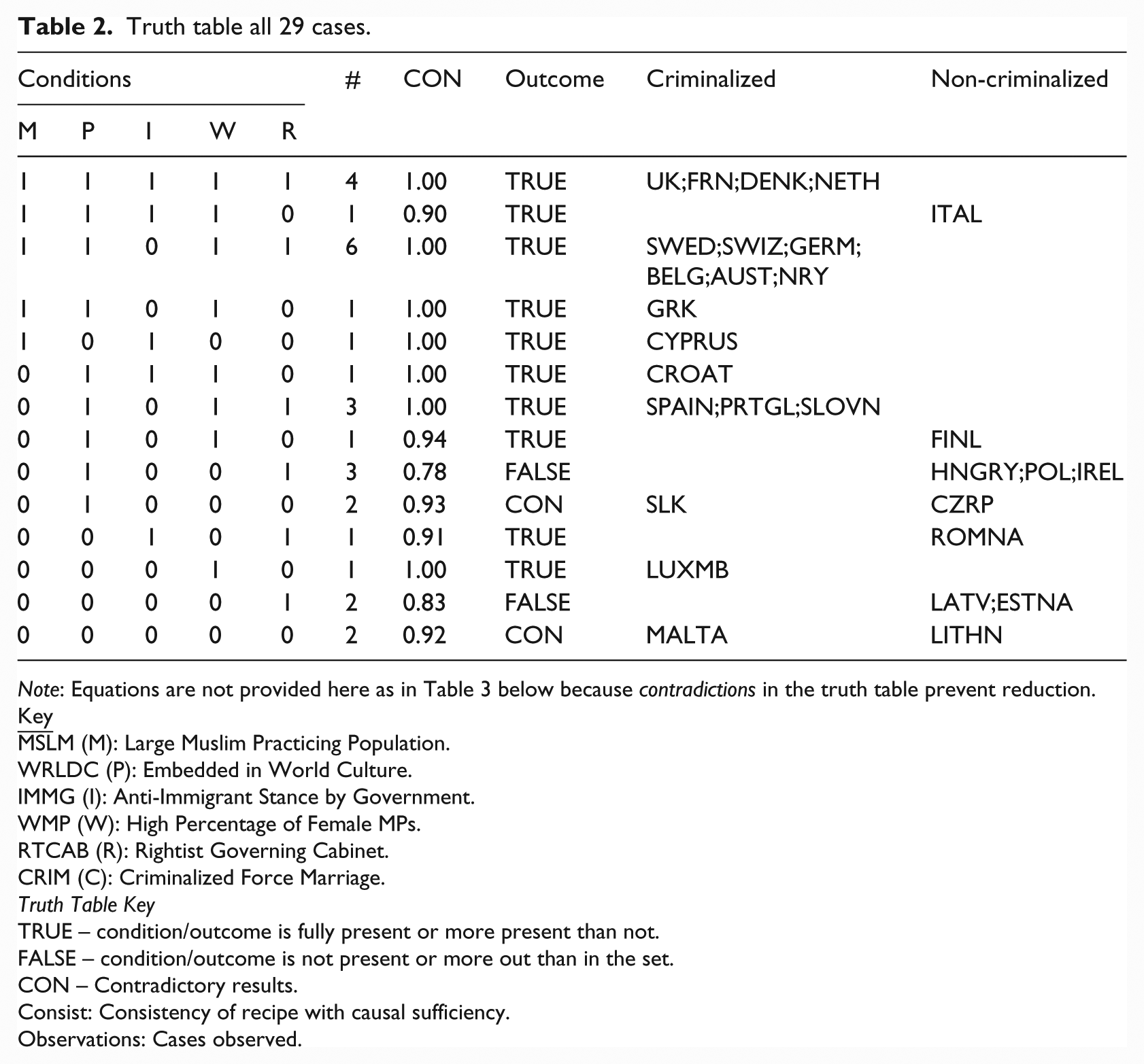
Note: Equations are not provided here as in Table 3 below because contradictions in the truth table prevent reduction.
MSLM (M): Large Muslim Practicing Population.
WRLDC (P): Embedded in World Culture.
IMMG (I): Anti-Immigrant Stance by Government.
WMP (W): High Percentage of Female MPs.
RTCAB (R): Rightist Governing Cabinet.
CRIM (C): Criminalized Force Marriage.
Truth Table Key
TRUE – condition/outcome is fully present or more present than not.
FALSE – condition/outcome is not present or more out than in the set.
CON – Contradictory results.
Consist: Consistency of recipe with causal sufficiency.
Observations: Cases observed.
We argue that the aforementioned Istanbul Convention in 2011 marked a decisive shift in the political discourse and policy discussion on criminalizing forced marriage. The Istanbul Convention was opened for signature on May 2011 and entered into force on August 2014 and obliges signing nations to criminalize the intentional conduct of forcing a person to enter into a marriage. As can be seen in Table 1, between 2005 and 2011 only seven countries criminalized forced marriage, and after a break in 2012 13 more countries criminalized in the 3-year span between 2013 and 2015. This suggests the convention accelerated the pace of criminalization after 2012, altering the causal factors in play by pushing a process of policy diffusion (Finnemore and Sikkink, 1998; Keck and Sikkink, 1999). By this we mean that the policy approach to forced marriage diffused from the EU level among member states.
To illustrate our position, it is worth examining the case of the United Kingdom, which criminalized in 2013, and the effect the EU policy process had on the national debate on forced marriage. The UK government discussed criminalization of forced marriage as early as 2007, but it was not until 2012 that the government announced legislation to actually do so (Home Affairs Committee, 2008). The UK government started to discuss criminalization after passage of the Forced Marriage Civil Protection Act (2007). The first report provided by the Home Affairs Committee, Domestic Violence, Forced Marriage and ‘Honour’-Based Violence (2008), did not recommend the government to make forced marriage a criminal offense. The government affirmed that recommendation by stating that,
[i]ncreased awareness of forced marriage, of the Act, and of the support available to victims, is likely to lead to an increase in reported cases over the coming years. This alone would not necessarily indicate a need to change our approach, but the Government will keep open the option of revisiting the question of criminalization. (Secretary of State, 2008)
In this response to the report by the Home Affairs Committee, the attitude toward criminalization prior to the convention is apparent, in that the UK government explicitly elaborates that those in favor of criminalization failed to provide information ‘on why this would be the best way to tackle forced marriage’ (Secretary of State, 2008) whereas those against expressed substantive reasons for not doing so, such as criminalization deterring or disempowering victims. Then, in December 2011, the government launched a new consultation on forced marriage, and asked various civil society groups about their ideas on criminalization. Following this consultation, in 2012, Prime Minister David Cameron declared that forced marriage would be criminalized. Acknowledging the concerns of the civil society groups that criminalization may force the issue underground, he argued that the new law would not have this effect. The importance of the Istanbul Convention is clear in declaration by Foreign Minister Alistair Burt:
Today the government also signed up to the Council of Europe’s convention on preventing and combating violence against women and domestic violence (CAHVIO). Signing the convention reflects the government’s continuing commitment to tackling violence against women and girls, including forced marriage, female genital mutilation, stalking, physical and psychological violence and sexual violence. (Foreign Commonwealth Office, 2012)
Thus, after 2011 the Government started to refer to the European level policy and the Convention while discussing why criminalization is the preferred path. This shift in the discourse and policy around forced marriage is also reflected in the papers of the European Parliament, in which discussion of forced marriage prior to 2012 was largely confined to right-wing actors. Following the Istanbul convention, discussion of the practice and criminalization becomes much more diffused throughout European parliament.
Thus, we argue that prior to 2012 treatment of forced marriage as an issue, and policy decisions concerning it, involve a distinct set of causal conditions, and split our analysis into early criminalizing and late criminalizing nations. We consider nations that criminalize on or before 2011 as ‘early’ criminalizers, and those who adopt the policy on or after 2013 as ‘late’ criminalizers.
Table 3 presents the truth table for analysis of early criminalizing European nations.
Truth table of early criminalizing nations.
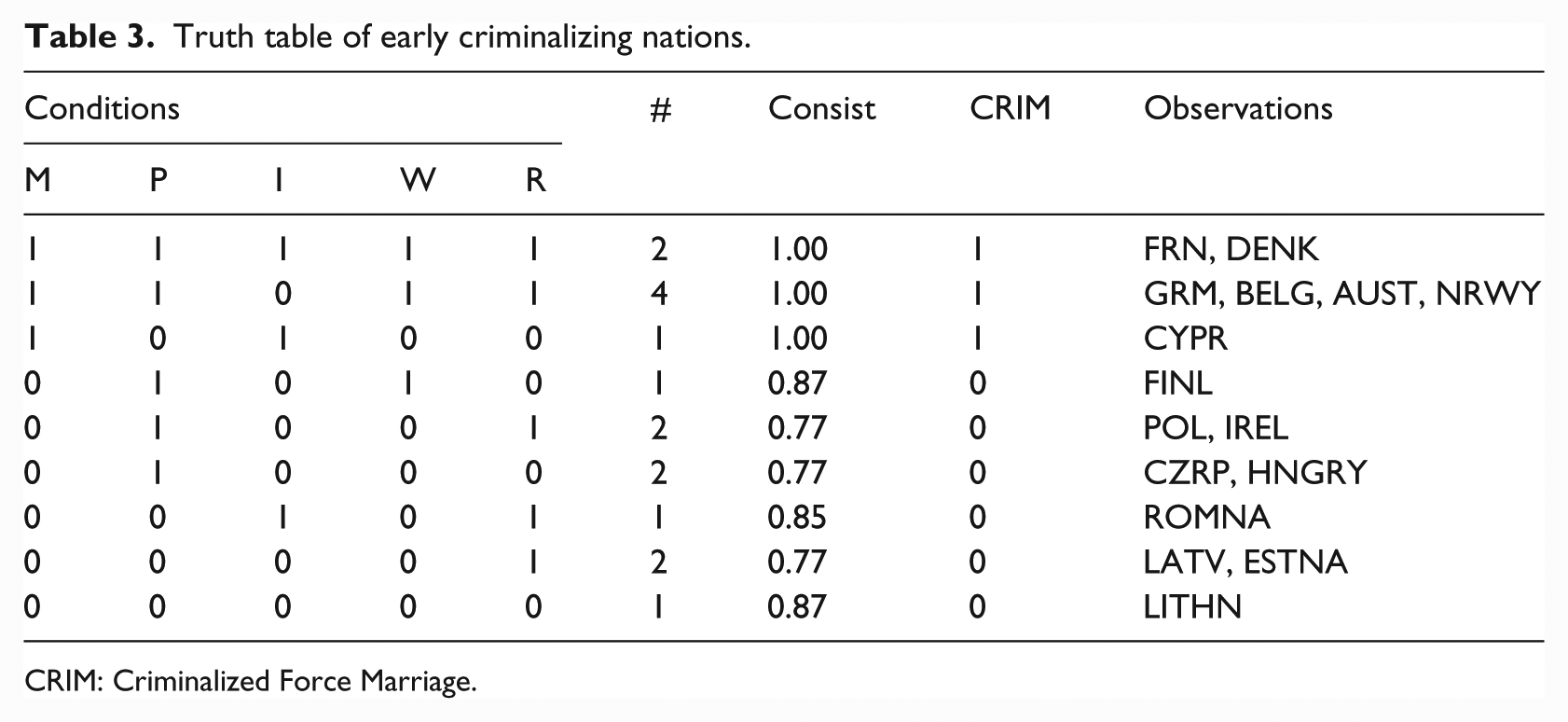
CRIM: Criminalized Force Marriage.
Analysis of necessary conditions
As argued above, we see the acceptance of the sacred principles of world culture as necessary for the nexus of forces that lead to criminalization of forced marriage. We ran causal necessity analysis on early criminalizing cases in Kirq, however, and found that no single condition is necessary for causal necessity. It is worth noting, however, that world cultural embeddedness (WLRDCLT) is close to being necessary (Consistency = 0.93, Coverage = 0.79); as shown in Figure 1, Cyprus (the dot on the coordinate above the line) is the key outlier, but the case is not a near miss (it is well above the line, not just over it), as it has relatively low world cultural participation (X axis) and full membership in the outcome (Y axis).

Necessity analysis.
Our sufficiency analysis will show that Cyprus’ path to criminalization is unique, and as such we find the case is anomalous. We thus would not argue that world cultural embeddedness is necessary for early criminalization, but for the path taken by the majority of early criminalizers, it plays a fundamentally important role. To support this claim, we present our analysis of causal sufficiency for early criminalization.
Sufficiency analysis
To assess sufficiency, we must compare among cases in which the outcome has occurred and ascertain combinations or recipes of causal factors which lead to the outcome of criminalization through specifically drafted legislation. We conducted sufficiency analysis in Kirq, and analyzed parsimonious and complex solutions. To achieve the parsimonious solution, we used a unique feature of Kirq software that allows the researcher to manually designate some remainders as ‘impossible’ if they are outside the realm of theoretical possibility. In essence, this produces a parsimonious solution that drops incoherent or implausible counterfactuals from the analysis. To do this, we used the full universe of cases that have occurred in both early and late criminalizing cases to delimit the realm of hypothetically ‘possible’ outcomes and minimize theoretically implausible remainders. Note that this process only affects the parsimonious solution, not the complex solution. Given that the complex solution clearly displays patterns theorized above, and that we argue the anomalous case of Cyprus is best explained by its complex solution, we focus on these for our analysis here (Schneider and Wagemann, 2010). We present both parsimonious and complex solutions in Table 4. 9
Early criminalizers solutions CON/COV table.
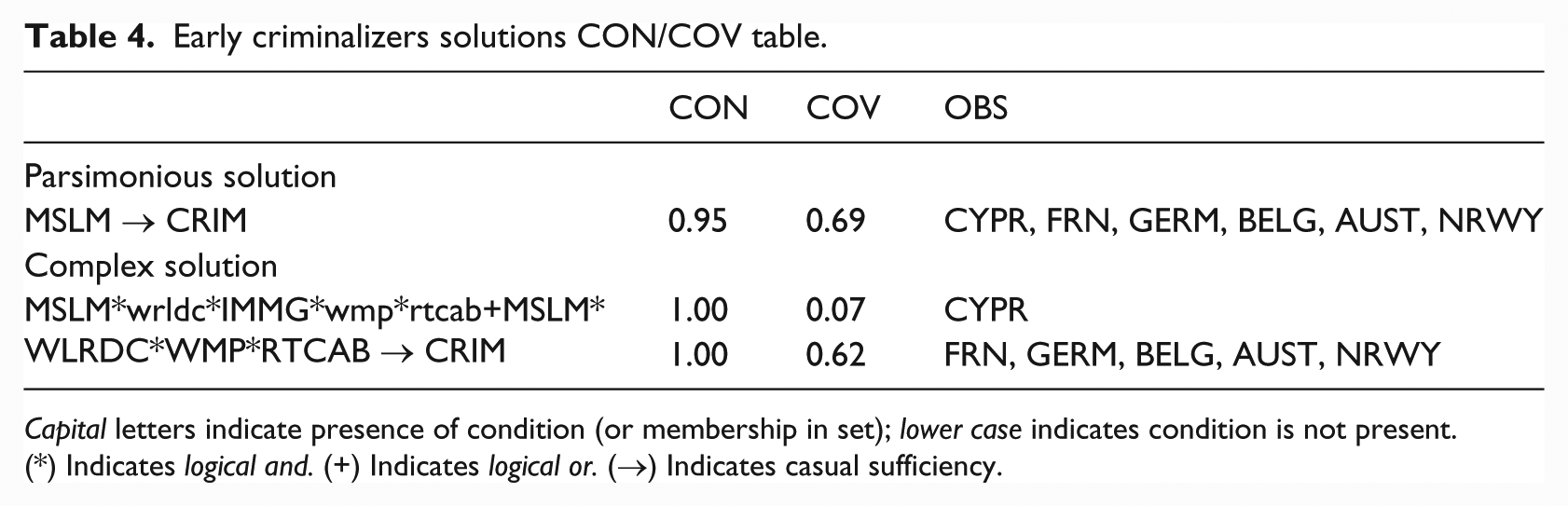
Capital letters indicate presence of condition (or membership in set); lower case indicates condition is not present.
(*) Indicates logical and. (+) Indicates logical or. (→) Indicates casual sufficiency.
Explanation
Complex solutions for sufficiency fall in two clear patterns:
Solution I. (MSLM*WRLDC*WMP*RTCAB) In the first solution, nations with relatively high Muslim populations, strong institutionalization of world cultural principles, high numbers of female parliamentarians, and rightist governing cabinets criminalized forced marriage on or before 2011. This finding suggests our hypotheses that world cultural as well as national factors combine to create the conditions for criminalization to occur. The relatively large Muslim populations present in all countries which criminalize suggests these populations are treated as ‘social problems’ and serves as a basis to construct forced marriage as a pressing national concern. Furthermore, in a narrowly national sense, the relatively large number of women in parliament is conducive to bringing issues related to women’s interests into the legislative arena, as is the dominance of a right party in cabinet which seeks to frame immigration issues or nationalist concerns within the larger discourse of human rights. These parties are also more apt to pursue criminal legislative solutions. At the same time, the strong institutionalization of world cultural principles – reflected in both the large numbers of women in parliament and the embeddedness of criminalizing nations in the world polity – drive the above actors to frame forced marriage as a human rights concern rather than a nationalistic or anti-immigrant issue. Thus, the outcome of criminalization is reflective of a reactionary form of Euro-nationalism that both in discourse and in practice seeks to construct European-national identity contra the relatively large population of Muslim practitioners. We call this pathway one of reactionary nationalism in so far as the large Muslim population serves as a springboard for a reactionary rightist policy (criminalization).
Solution II. (MSLM*wrldc*IMMG*wmp*rtcab) The second solution is unique to Cyprus. Cyprus has a very high Muslim population; indeed, the island-nation has a functionally bifurcated government, one part of which claims national allegiance to Turkey. In this case, there is not a high percentage of female MPs or a rightist cabinet nor a deep institutionalization of world cultural norms, and a clear anti-immigrant stance by the government. The Cypriot path is grounded in the country’s unique tension with its Muslim population and thus criminalization here is an outcome of this tension and not a feminist-right cabinet path. Recent scholarly analysis shows that Cyprus is increasingly a destination for immigrants and asylum seekers, particularly the southern part (Trimikliniotis and Demetriou, n.d.) which has led to a rise in racism and xenophobia. In the absence of strong feminist groups, issues like forced marriage and honor killings are framed as an ethnic minority problem and criminalization has become the championed solution. Thus, while the complex solution for Cyprus has less coverage and thus explanatory power than our intermediate solution, we argue Cyprus has a unique set of conditions related to its Muslim population, and that greater coverage is not necessarily preferred to theoretical and explanatory clarity.
Algebraically our complex solutions for early criminalizing nations can be expressed in the following formula.

Non-criminalizing recipes (NCRIM)
Analysis of non-criminalization is one way of supporting our analysis of sufficiency, specifically our causal argument. Here, we present the parsimonious and complex solutions to the non-criminalization of forced marriages (Table 5).
Non-criminalizers solutions CON/COV table.
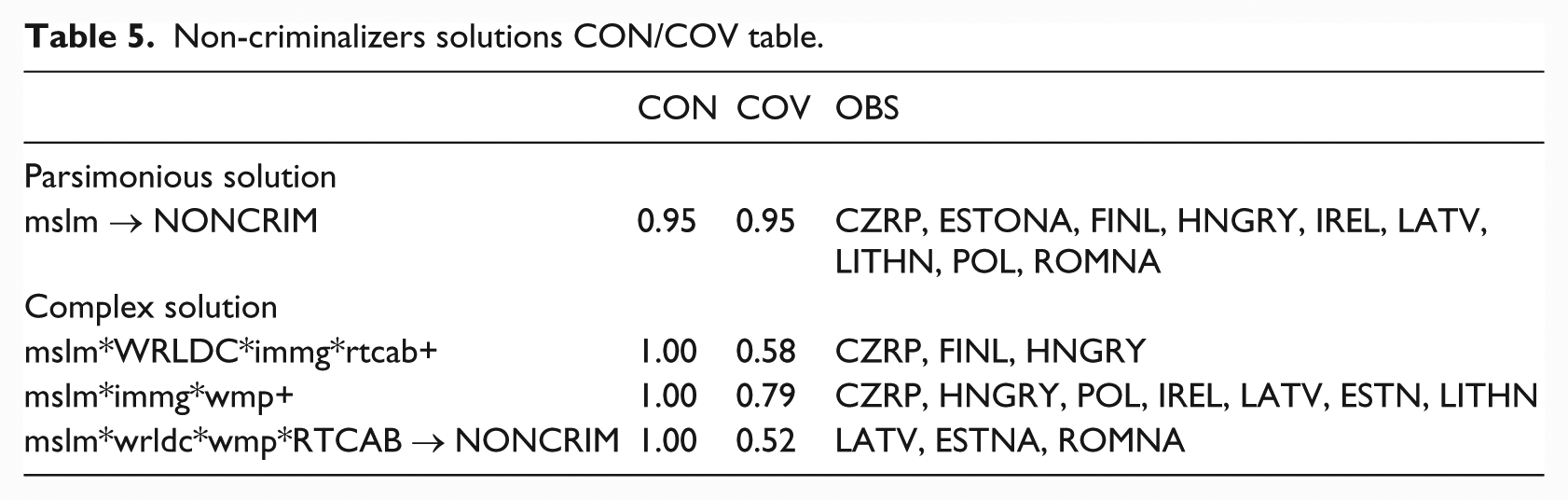
The pathways to non-criminalization, show that right cabinets may be in rule, or a nation may be deeply embedded within the world culture, and still not criminalize forced marriage. They also confirm our necessity analysis, as in no cases of non-criminalization do we see strong or full membership in the set of nations with large numbers of women parliamentarians or Muslim practitioners.
Late-adopting nations
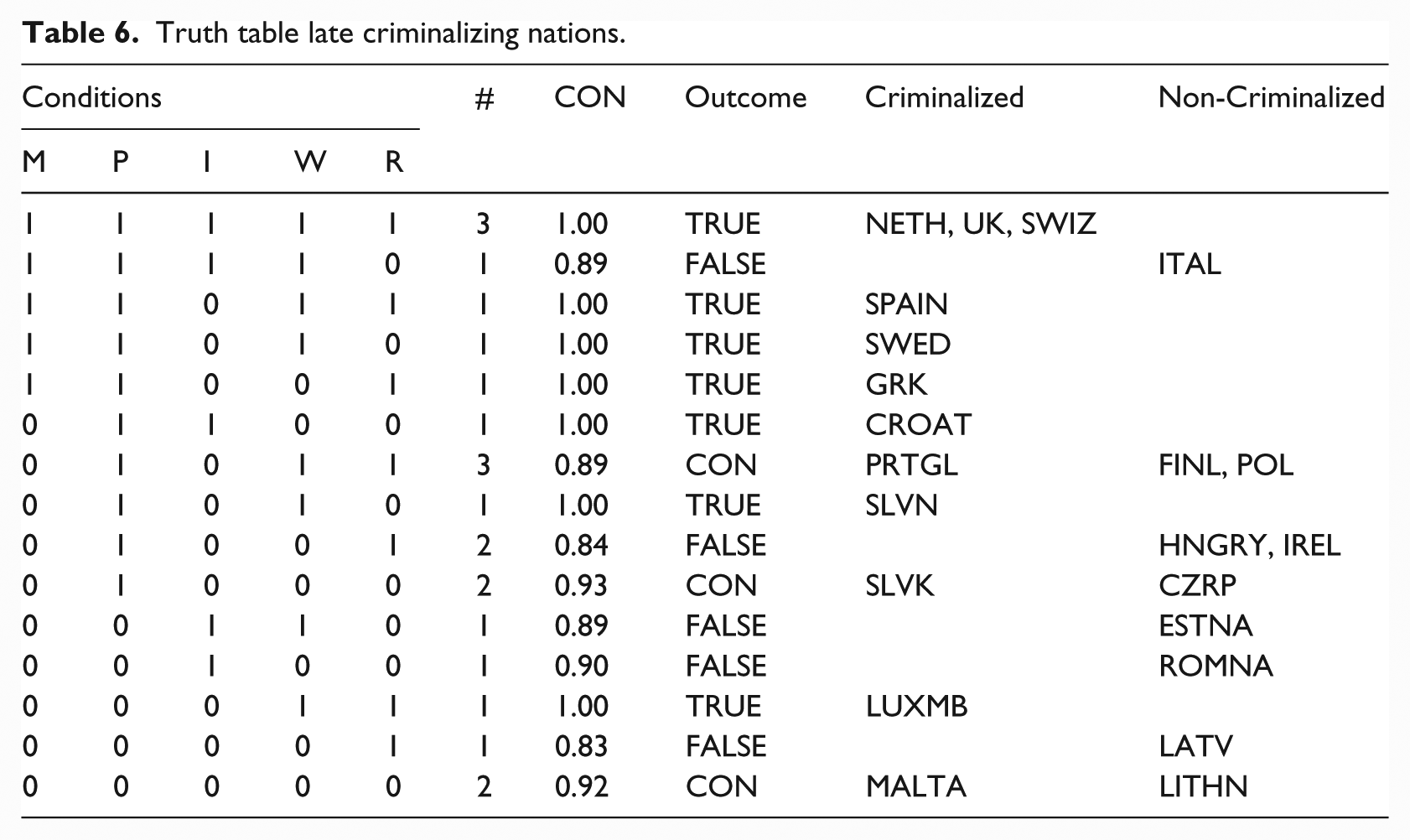
We present the truth table of later criminalizing nations in Table 6.
Truth table late criminalizing nations.
Necessity analysis in Kirq demonstrates weak consistency with causal necessity – as relatively high ‘consistency’ with necessity is only achieved when we consider large Muslim population or large numbers of female MPs or deep embeddedness in world culture.
CON COV
MSLM+WRLDC+WMP ← CRIM 0.91 0.81
A cursory examination of the data set (RAW DATA TABLE) demonstrates that arguing any of these conditions are necessary for causality is problematic, as there are numerous cases for each condition in which scores on criminalization are greater than scores in the condition (Ragin, 2008). Figure 2 is illustrative of this point – if high numbers of women in parliament were consistent with necessity, most of the points would be on or below the central line, but as the scatterplot shows, scores are in fact scattered.
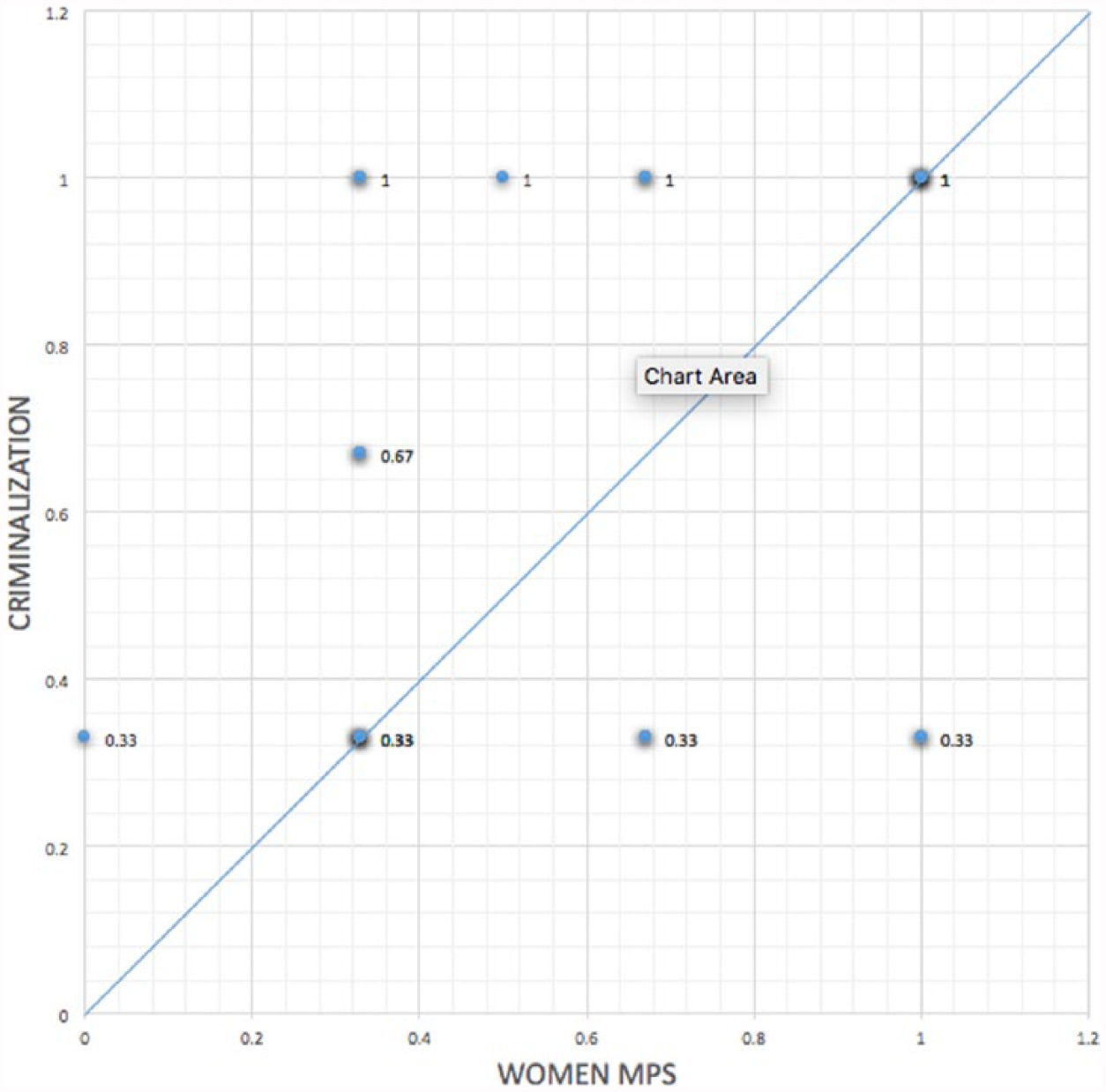
Women MPs.
Analysis of the truth table (recalling that scores are not represented as fuzzy scores in the table) also demonstrates that the conditions which are causal in early criminalizing cases do not appertain to later cases. There are over nine different pathways leading to the outcome, which is not insurmountable but is fairly high for QCA analysis, and indicates a lack of parsimony among recipes. Moreover, there are three recipes that have contradictory outcomes, meaning they lead to both criminalization and non-criminalization. Recalibration does little to change these contradictions. Our conclusion is that the conditions that led countries to criminalize forced marriage were no longer causally important after the Istanbul Convention shifted norms and policy imperatives at the EU level in 2012. A good example of this is row 32 of Table 5, in which none of the causal conditions are present and yet we find a case of criminalization (Malta) and non-criminalization (Lithuania). Thus, it seems clear that if none of the conditions is present, and a nation nonetheless criminalizes forced marriage, something else is driving this policy decision. The evidence cited above for the United Kingdom – which criminalized after 2013 and explicitly referenced the EU convention when going against the precedent of non-criminalization – supports our position that the convention spurred on a process of norm or policy diffusion throughout the EU (Finnemore and Sikkink, 1998; Keck and Sikkink, 1999; Payne, 2001). In addition to the plenary debates from the European Parliament, the recent adoption of criminal legislation in the Netherlands is also revealing. Previous comparative research on forced marriage policy in the Netherlands and the United Kingdom showed that the Dutch legal system was designed such that new criminal legislation is discouraged in favor of altering extant laws to cover new issues – leading the Netherlands not to criminalize forced marriage as the United Kingdom did (Haenen, 2014). Yet in 2016, the Netherlands did criminalize forced marriage, suggesting that even in cases where the legal structure is antithetical to new criminal legislation, policy discussions and conventions at the European level have led nations to alter their calculus on forced marriage.
Put succinctly, in later adopting nations, no one causal combination in particular seems to matter, whereas in early adopting nations, there are clear patterns of causal conditions leading to adopting criminal legislation. This conclusion is supported by Rubinson (2013), who notes that contradictions in fsQCA can be an important indicator that a model is underspecified, for example, that causal conditions are missing. We argue that the contradictions suggest that criminalization as a practice became normative within the European policy environment. 10 In other words, late adopting nations are simply doing what everyone else is doing and taking the position of the European community; hence, the national characteristics relevant for early adopters do not matter as much here nor do they help us explain adopting criminal legislation. Hence, conditions specified in the model for early criminalization are not all causally relevant for late adopters, and understanding causal complexity in the later cases requires a new model and analysis rather than refinement of our first model.
Robustness
To test the robustness of our findings, we need to ensure that our calibration of key conditions is strong – or that our findings would not change significantly given slight recalibration of those variables. We recalibrated set membership in women parliamentarians (making full membership more stringent), Muslim practitioners (revised so that full set membership in high Muslim population nations – in terms of relative percent of Muslim practitioners or migrant stock – must be 5% for full membership), immigration policy (recalibrated to focus only on policy (not government views and policy) on the year of criminalization (not taking into account changes in the period around the year of criminalization)), and right cabinet (recalibrated to focus only on the Left-Right score of the majority party, excluding consideration of other parties included in the cabinet or the strength of the majority). The consensus within the neo-institutionalist school on measures of world culture participation is strong enough that we could not find a way to recalibrate that we considered reasonable.
Recalibration of the immigration policy condition and the right cabinet condition did not change set membership or the solutions arrived at in our initial analysis. Recalibrating our Muslim population condition produces the most problematic results, as Norway shifts from 0.67 to 0.33, disrupting the parsimony of findings, as seen in Table 7.
MSLM recalibrations solutions.
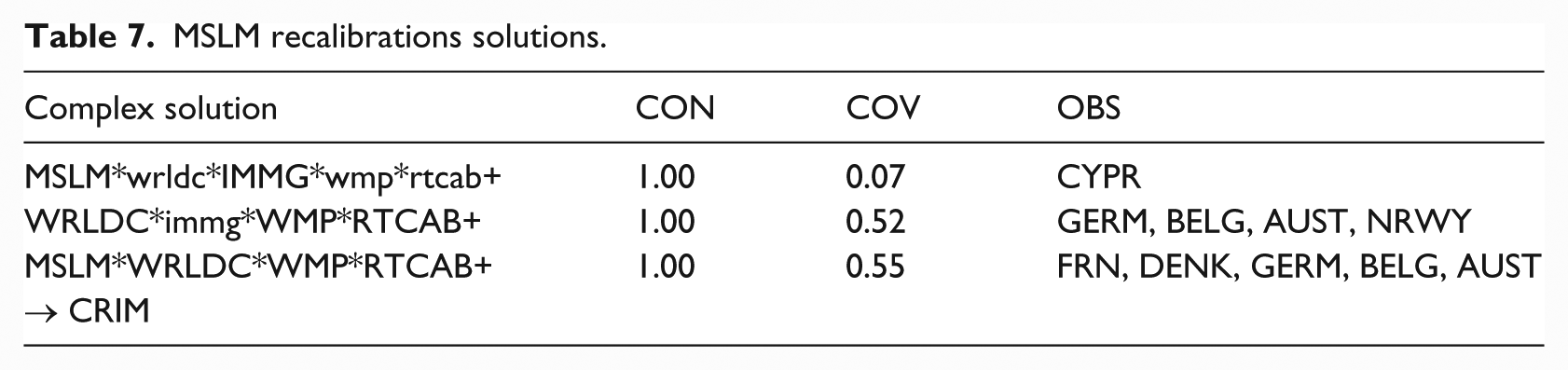
The main conclusion we take from this is that the importance of the presence of a relatively large Muslim population is uncertain. However, while this test suggests the Muslim population variable is not necessarily robust, we are not necessarily convinced it should be discarded outright, as all early criminalizing nations have much higher percentages of Muslim populations than non-criminalizers, and recalibration affects only Norway. 11
Recalibration of women parliamentarians also affects the robustness of our findings; however, we argue this recalibration – while illuminating – is problematic. We chose to raise the anchor point for full membership to 35 percent of parliamentarians, and the crossover point to 25 percent – and we also limit the focus of our calibration to the specific year of criminalization. The only major effect this recalibration has is dropping France from more in to more out, which again affects the parsimony of the results. Ultimately, we view this recalibration as problematic and do not think it seriously challenges the robustness of our results because France has relatively large numbers of female MPs the year before and of criminalization and it only increases the year after. We also argue this calibration is outside of the consensus on what constitutes a relatively high number female MPs. Thus, we consider our findings overall to be robust.
Summary and a few conclusions
The patterns in our causal recipes suggest that the conjunction of conservative or anti-immigrant governments with liberal individualist discourse on forced marriage is key to leading governments to criminalize the practice. In most cases, feminist politics and female MPs are also a key factor. Thus, when feminist politicians and political organizations appeal to the core principle of the sacred individual to legitimate and rationalize their position against the practice of forced marriage, this provides a platform for conservative and anti-immigrant projects to articulate their position in culturally palatable terms. Consequently, the measures against forced marriage took a punitive path as opposed to a preventive one, which would consider creating alternatives for immigrant women so that they can resist forced marriages successfully.
These findings have important implications for organizations addressing the situation of women and children who suffer from exploitation under the practice of forced/child marriage. Organizations fighting to bring important issues such as forced marriage to light need to consider the policy climate in which they do so. Such organizations find themselves at a contradictory juncture in which they seek to promote women’s rights as universal human rights while not ‘othering’ migrant communities at a time in which xenophobia and anti-immigrant sentiments are being incorporated into mainstream platforms of politically conservative parties in Europe and elsewhere. While a number of studies note the convergence of feminist politics with right-leaning and anti-immigrant groups, our study shows that such alliances can lead to legislation like criminalizing forced marriage that has detrimental outcomes for the desired goal of protecting women and children.
Our findings also extend the conclusions of Akkerman and Hagelund (2007) and Meret and Siim (2013) that the discursive account of Euro-nationalist values framed in terms that invoke core world cultural principles – individual sacrality and equality – can serve as a platform for reactionary and exclusionary policies of rightist parties. This raises some thorny questions for theorists of world culture and globalization, and suggests that we should continue to pay attention to the complex dynamics between the local and the global – the way in which universal principles are locally interpellated. On the one hand, there is clearly broad acceptance of human rights and the core principle of the sacred individual is invoked by both feminist activists and right-wing parties. Yet, and perhaps ironically, such universalizing principles, when mixed up in a recipe of national and regional tensions, become a tool of populist and exclusionary projects, a sort of contemporary orientalism that replaces the European civilization of modernity with supposedly universal ‘human rights’ and individualism that is understood to be European, White, and rational.
The nationalist and populist turn in Western politics reflects a broader dissension among global elites in a (post)recession world that witnessed the splintering of the globalization project. While theorists of world culture argue that this rationalizing global culture long transcended its European roots, in the current environment, this common cultural palate allowed right-wing leaders to reclaim and rearticulate the universality of national self-determination in ethnic nationalist terms. The most recent example is Brexit in which globalism is constructed in opposition to national identity. In Europe (and in the United States, somewhat differently), the groups most negatively impacted by the globalization project and its vicissitudes in the West – minority and immigrant women and working classes – are caught up in these fractious politics. As the fractiousness among both global elites and working class grows (even as the latter become more structurally integrated; Bodirsky, 2016), we will likely continue to see such contradictory policy processes that negatively impact groups already laid low by the global economy and continuing recession. The question then becomes whether the universality and rationality of human rights and world culture continue to be their defining characteristic, or whether they are subsumed under a reactionary politics of belonging.
Footnotes
Appendix
Calibrated data set.
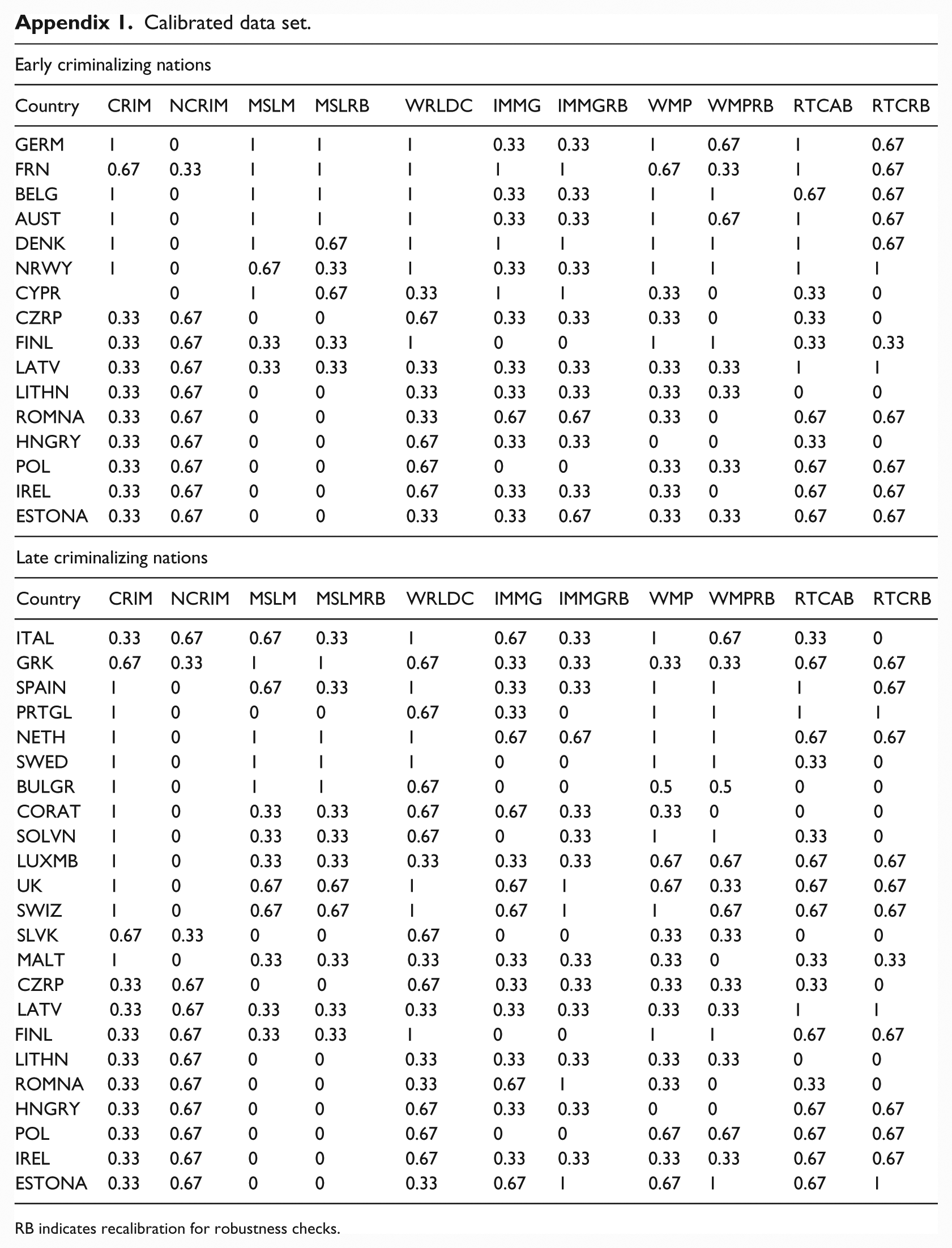
| Early criminalizing nations | |||||||||||
|---|---|---|---|---|---|---|---|---|---|---|---|
| Country | CRIM | NCRIM | MSLM | MSLRB | WRLDC | IMMG | IMMGRB | WMP | WMPRB | RTCAB | RTCRB |
| GERM | 1 | 0 | 1 | 1 | 1 | 0.33 | 0.33 | 1 | 0.67 | 1 | 0.67 |
| FRN | 0.67 | 0.33 | 1 | 1 | 1 | 1 | 1 | 0.67 | 0.33 | 1 | 0.67 |
| BELG | 1 | 0 | 1 | 1 | 1 | 0.33 | 0.33 | 1 | 1 | 0.67 | 0.67 |
| AUST | 1 | 0 | 1 | 1 | 1 | 0.33 | 0.33 | 1 | 0.67 | 1 | 0.67 |
| DENK | 1 | 0 | 1 | 0.67 | 1 | 1 | 1 | 1 | 1 | 1 | 0.67 |
| NRWY | 1 | 0 | 0.67 | 0.33 | 1 | 0.33 | 0.33 | 1 | 1 | 1 | 1 |
| CYPR | 0 | 1 | 0.67 | 0.33 | 1 | 1 | 0.33 | 0 | 0.33 | 0 | |
| CZRP | 0.33 | 0.67 | 0 | 0 | 0.67 | 0.33 | 0.33 | 0.33 | 0 | 0.33 | 0 |
| FINL | 0.33 | 0.67 | 0.33 | 0.33 | 1 | 0 | 0 | 1 | 1 | 0.33 | 0.33 |
| LATV | 0.33 | 0.67 | 0.33 | 0.33 | 0.33 | 0.33 | 0.33 | 0.33 | 0.33 | 1 | 1 |
| LITHN | 0.33 | 0.67 | 0 | 0 | 0.33 | 0.33 | 0.33 | 0.33 | 0.33 | 0 | 0 |
| ROMNA | 0.33 | 0.67 | 0 | 0 | 0.33 | 0.67 | 0.67 | 0.33 | 0 | 0.67 | 0.67 |
| HNGRY | 0.33 | 0.67 | 0 | 0 | 0.67 | 0.33 | 0.33 | 0 | 0 | 0.33 | 0 |
| POL | 0.33 | 0.67 | 0 | 0 | 0.67 | 0 | 0 | 0.33 | 0.33 | 0.67 | 0.67 |
| IREL | 0.33 | 0.67 | 0 | 0 | 0.67 | 0.33 | 0.33 | 0.33 | 0 | 0.67 | 0.67 |
| ESTONA | 0.33 | 0.67 | 0 | 0 | 0.33 | 0.33 | 0.67 | 0.33 | 0.33 | 0.67 | 0.67 |
| Late criminalizing nations | |||||||||||
| Country | CRIM | NCRIM | MSLM | MSLMRB | WRLDC | IMMG | IMMGRB | WMP | WMPRB | RTCAB | RTCRB |
| ITAL | 0.33 | 0.67 | 0.67 | 0.33 | 1 | 0.67 | 0.33 | 1 | 0.67 | 0.33 | 0 |
| GRK | 0.67 | 0.33 | 1 | 1 | 0.67 | 0.33 | 0.33 | 0.33 | 0.33 | 0.67 | 0.67 |
| SPAIN | 1 | 0 | 0.67 | 0.33 | 1 | 0.33 | 0.33 | 1 | 1 | 1 | 0.67 |
| PRTGL | 1 | 0 | 0 | 0 | 0.67 | 0.33 | 0 | 1 | 1 | 1 | 1 |
| NETH | 1 | 0 | 1 | 1 | 1 | 0.67 | 0.67 | 1 | 1 | 0.67 | 0.67 |
| SWED | 1 | 0 | 1 | 1 | 1 | 0 | 0 | 1 | 1 | 0.33 | 0 |
| BULGR | 1 | 0 | 1 | 1 | 0.67 | 0 | 0 | 0.5 | 0.5 | 0 | 0 |
| CORAT | 1 | 0 | 0.33 | 0.33 | 0.67 | 0.67 | 0.33 | 0.33 | 0 | 0 | 0 |
| SOLVN | 1 | 0 | 0.33 | 0.33 | 0.67 | 0 | 0.33 | 1 | 1 | 0.33 | 0 |
| LUXMB | 1 | 0 | 0.33 | 0.33 | 0.33 | 0.33 | 0.33 | 0.67 | 0.67 | 0.67 | 0.67 |
| UK | 1 | 0 | 0.67 | 0.67 | 1 | 0.67 | 1 | 0.67 | 0.33 | 0.67 | 0.67 |
| SWIZ | 1 | 0 | 0.67 | 0.67 | 1 | 0.67 | 1 | 1 | 0.67 | 0.67 | 0.67 |
| SLVK | 0.67 | 0.33 | 0 | 0 | 0.67 | 0 | 0 | 0.33 | 0.33 | 0 | 0 |
| MALT | 1 | 0 | 0.33 | 0.33 | 0.33 | 0.33 | 0.33 | 0.33 | 0 | 0.33 | 0.33 |
| CZRP | 0.33 | 0.67 | 0 | 0 | 0.67 | 0.33 | 0.33 | 0.33 | 0.33 | 0.33 | 0 |
| LATV | 0.33 | 0.67 | 0.33 | 0.33 | 0.33 | 0.33 | 0.33 | 0.33 | 0.33 | 1 | 1 |
| FINL | 0.33 | 0.67 | 0.33 | 0.33 | 1 | 0 | 0 | 1 | 1 | 0.67 | 0.67 |
| LITHN | 0.33 | 0.67 | 0 | 0 | 0.33 | 0.33 | 0.33 | 0.33 | 0.33 | 0 | 0 |
| ROMNA | 0.33 | 0.67 | 0 | 0 | 0.33 | 0.67 | 1 | 0.33 | 0 | 0.33 | 0 |
| HNGRY | 0.33 | 0.67 | 0 | 0 | 0.67 | 0.33 | 0.33 | 0 | 0 | 0.67 | 0.67 |
| POL | 0.33 | 0.67 | 0 | 0 | 0.67 | 0 | 0 | 0.67 | 0.67 | 0.67 | 0.67 |
| IREL | 0.33 | 0.67 | 0 | 0 | 0.67 | 0.33 | 0.33 | 0.33 | 0.33 | 0.67 | 0.67 |
| ESTONA | 0.33 | 0.67 | 0 | 0 | 0.33 | 0.67 | 1 | 0.67 | 1 | 0.67 | 1 |
RB indicates recalibration for robustness checks.
Funding
The author(s) received no financial support for the research, authorship, and/or publication of this article.