



Abstract
Many comparative studies of home-leaving examine behavior associated with this transition and the relative importance of both structural and cultural factors in helping or hindering it. Yet, we know surprisingly little about how youth understand these factors on a broad scale to be influencing home-leaving for their generation. This article compares young people’s beliefs across cultures about why late home-leaving occurs using Eurobarometer survey data from 28 countries. I incorporate comparative home-leaving literature with theories about attitudinal worlds of welfare and explanations for social problems to argue that modes of explanation for late home-leaving hinge on whether youth see external, structural causes preventing earlier leaving (constraint-oriented explanations) or internal, more culturally motivated causes that lead individuals to stay at home longer (choice-oriented explanations). Demographic and institutional conditions that capture aspects of nations’ home-leaving contexts, such as women’s mean age at childbirth and the robustness of labor and housing markets, significantly correlate with the prevalence of these explanations. Findings suggest that youth tend to perceive their generation’s housing exits as structurally limited by scarce housing and weak purchasing power. However, in richer countries with more effective employment markets and better access to rental housing stock, choice-oriented explanations are more popular.
Introduction
Leaving the parental nest is a pivotal moment of transition into adulthood. How young people perceive the accessibility of that transition is core to how they perceive the possibility of, and barriers to, becoming fully recognized adults. In Europe, youth transition researchers examine young people’s beliefs about choice, flexibility, security, and agency in their transitions (Van de Velde, 2008; Walther, 2006), while researchers in Middle Eastern and African countries observe how young people’s frustrations with being denied adulthood (“waithood”; Honwana, 2014) result in political unrest. For a significant portion of youth around the world, structural and often institutional barriers disrupt young people’s ideal timing for their key transitions to adulthood. The process of leaving home and the varying degree of difficulty in moving out when one wants is one of the clearest examples of this.
Cross-national studies of young people’s public opinion about housing and moving out are rather uncommon (Manza and Brooks, 2012). Scholarly work on home-leaving often focuses on empirical behaviors, with many studies using panel data and analyzing timing and destination (Mulder, 2009) as the key dependent variables. Yet, young people’s interpretations of reality matter. Their perceptions of their peers’ behavior, including how they think other young people negotiate the timing of home-leaving, might be just as important as empirical reality regarding how they structure their orientations toward their own departure (Bandura, 2006; McWhirter, 1997). From this view, their beliefs about why other youth seem to stay at home longer is of interest to parents, policy-makers, and the wider community of adults. Do youth tend to see their peers as staying in the home longer by choice, or do they see them as facing barriers to moving out when they want? Their sense of hopelessness and whether their generation is being given fair opportunity or not to leave home may impact their political engagement, as well as their attitudes toward the government and the welfare state.
Subjective views of the transition out of the parental home and the factors that help or hinder this are somewhat neglected by the home-leaving literature, which has long recognized the empirical effects of structural and cultural factors (Aassve et al., 2013: 385) on the timing of leaving. Most authors prioritize economic factors to explain delays in home-leaving, but cultural factors making parental homes more appealing to young adults also bear mentioning, as generation gaps narrow and as parents develop less hierarchical relationships with their emerging adults (Beaujot, 2006). For all that is written about patterns and determinants of home-leaving, few studies examine young people’s views on these features and their effects on the timing of this transition. How do youth see these factors as operating to effectively postpone the age of leaving home, especially in a context where the average age at home-leaving in most countries continues to edge up (Corijn and Klijzing, 2001; Eurostat, 2015; Holdsworth and Morgan, 2005)? In other words, to what extent do youth see either themselves or structural deficits as responsible for later home-leaving?
Using representative Eurobarometer data, I compare young people’s beliefs about why late home-leaving occurs in 28 countries across Europe and explore how explanations for this trend differ between countries. Existing research provides some initial clues as to how youth might explain late home-leaving differently. First, the framing of the situation matters in influencing the associated responses (Chong and Druckman, 2007), and in most countries, the idea of leaving home at a later age than usual often carries a negative connotation (e.g. Boyd and Pryor, 1989; “cluttered nest”). People typically see delayed departure as a sub-optimal transition outcome that both youth and their families must reckon with. However, national differences in institutions and cultures act as prisms through which people interpret certain phenomena as occurring for different reasons. In that respect, theories about how welfare regimes shape collective psychologies regarding responsibility for social ills (Sabbagh and Vanhuysse, 2006) and theories about people’s explanations of the Black/White status disparity (Hunt, 2007; Kluegel, 1990) are good starting places to hypothesize about young people’s interpretations of why “unfortunate” late-leaving occurs.
Second, at the national scale, clear and path-dependent differences in home-leaving contexts and the associated climate of opportunity (Holdsworth, 2000) to leave early are linked with different cultural meanings behind home-leaving and the appropriate timing of it (Luetzelberger, 2014; Newman, 2008). Accounting for the different explanations of why late home-leaving happens must take into consideration the wide differences between countries in institutions such as the education system, the labor market, the housing market, and the family. In some countries, home-leaving in the late 20s has been the norm for generations, while in other countries, it is a relatively recent development (Holdsworth and Morgan, 2005).
To make sense of how young people in considerably different contexts understand this delay, I extend Apostle et al.’s (1983) concept of “modes of explanation” to young people’s causal accounts of why late home-leaving occurs. Modes of explanation are differing rationales (often, but not always mutually exclusive) for why a certain phenomenon or event occurs. Until now, authors have used the concept almost exclusively to describe different explanations for social inequality or social problems (Hunt, 2007; Kluegel, 1990; Thompson and Bobo, 2011). In this article, I conceive of late home-leaving as a case of a “delayed transition,” which likely represents a social problem to young people. Similar to what previous studies on modes of explanation find, I argue that two ideal-type rationales exist in the case of late home-leaving. The primary mode of explanation shifts attention away from personal inclinations and places the blame for late-leaving on external structural deficits involving the poor availability and affordability of housing. In contrast, the secondary mode of explanation highlights young people and their culturally influenced choices for deciding to stay at home longer. After correlation analyses, I find that choice-oriented explanations are associated with richer countries, effective employment markets, stronger welfare states, and more available and accessible housing stock.
To my knowledge, this is the first study to investigate young people’s modes of explanation for delayed home-leaving across a large cross-national sample. It represents a unique contribution to both political sociologists interested in young adult attitudes, as well as to comparative and largely quantitative home-leaving researchers, and demographers who tend not to examine young people’s subjective views on the process. To provide background, the next section of the article gathers insights from the home-leaving literature and sociopsychological literature on beliefs about inequality to help provide argumentation about the variation we might expect to see across nations. I then introduce the data and analytical procedures, present results, and discuss implications for understanding how youth interpret delayed home-leaving.
Literature review
Home-leaving contexts
Young people experience very different levels of choice and constraint in their transitions from the parental home across Europe (Pohl and Walther, 2007; Van de Velde, 2008; Walther, 2006). These different home-leaving contexts likely shape their judgments about what is delaying their generation, particularly the salience of different factors like the adequacy of the housing market, youth labor market, and social policies, as well as the importance of family expectations and young people’s own inclinations. Home-leaving contexts in Europe are frequently clustered into three groups or household formation models (hereafter HHFMs) (Bendit et al., 2006) that largely overlap with the classic three-way welfare regime typology (Esping-Andersen, 1990). First, the Northern model combines relatively earlier home-leaving (early to mid-20s) with delayed family formation and is illustrated in the cases of the United Kingdom, France, Belgium, Germany, and Austria. Rental housing stock is more abundant compared to Southern Europe and is related to the younger age at which youth leave home (Iacovou, 2002: 66). School-to-work transitions occur quicker and are more flexible (in the United Kingdom) or more secure (in the continental conservative regime) compared to the extended “waithood” that exists in Southern European labor markets (Walther, 2006). Parents expect young people to leave home before marriage to learn self-sufficiency and responsibility (Holdsworth, 2004). For young people in the Northern model, domestic transitions are characterized by relative autonomy, meaning that young people are expected to leave home as soon as possible, but delays in the process are accepted as increasingly normal.
Second, the Nordic model represents an “extreme” version of the Northern model that promotes “earliest-early” (age 18 or earlier) home-leaving (Billari, 2004) and is best captured by Finland, Denmark, Sweden, and the Netherlands. These countries follow an enabling youth citizenship strategy (Chevalier, 2016) marked by high levels of social investment in youth. This cultural logic manifests in young people’s entitlement to generous public subsidies for education and training that allow for movement in and out of both spheres over the life course (Pohl and Walther, 2007). In addition, emancipation policies for youth are among the most substantial in Europe, leading some scholars to refer to Nordic home-leaving patterns as “state-subsidized experiments in independence” (Newman, 2008: 647). Youth transitions are characterized by more choice than constraint. Cohabitation levels are among the highest in Europe, and young people often move in together, as friends or as romantic partners, and explore employment and education opportunities in an environment with limited parental oversight (Billari, 2004).
Third, the Southern model (represented by Italy, Spain, Portugal, Greece, and, following Iacovou (2010), Ireland) is characterized by unappealing structural conditions for residential independence. Labor markets dominated by older generations of working men effectively prevent youth from full-time work (Chauvel and Schröder, 2014), while low levels of rental housing stock (Poggio, 2008) and strong family-based norms (Luetzelberger, 2014) help prevent home-leaving before marriage. Tight credit conditions additionally make housing markets inhospitable for new entrants (Mínguez, 2016). These countries have the highest average age of home-leaving (often late 20s or early 30s), and typical departures are illustrated by direct (or “traditional”) transitions from the family home into a new household consequent with marriage or full-time employment. Parents and youth value their relationships and time together, with home-leaving often causing significant emotional loss on both sides (Moreno, 2012). Young people’s transitions are marked more by constraint than by choice. The dominant aim for youth is to “install themselves” and “settle down” as adults in a society marked by high labor market stratification, weak public policies, and strong family ties (Van de Velde, 2008).
Given the lack of comparable data and the scarcity of analytical discussion upon which to build (Mandic, 2008; Roberts, 2003), the post-socialist countries of Eastern Europe have only recently been included in comparative home-leaving studies, but initial findings report that youth in these countries are faced with “outstandingly unfavorable” conditions in all aspects of the welfare mix, suggesting high constraint. Home-leaving occurs late, but not extremely late as in Southern Europe. Housing shortages are severe due to an overall decline in the social rented housing sector after the fall of communism and an underdeveloped private rented sector (Mandic and Cirman, 2012). Along with cultural values that promote early parenthood and extended generations living together, this exacerbates overcrowding. Furthermore, high levels of unemployment and low wages contribute to housing cost overburden (Mandic, 2008: 632). Young people’s transitions from home in these countries, as well as in Southern Europe, are characterized by extended dependence (Bendit et al., 2006).
Bearing these profiles in mind, both the normativity and meaning of “late” home-leaving vary by country. For instance, “latest-late” leaving (Billari, 2004) has been part of the dominant transition pattern in Southern Europe for generations and is generally expected by youth and their families (e.g. Mínguez’s (2016) “in-house adulthood”; Sgritta’s (2001) emancipation within the family). In contrast, late-leaving is a departure from the norm for youth in Scandinavia and to a lesser extent for youth in continental Europe and the United Kingdom (Bendit et al., 2006). While parents in Southern Europe understand the riskiness of home-leaving in current conditions and to some degree encourage longer co-residence (Holdsworth, 2005), parents in Northern and Nordic countries interpret later leaving as undue dependence on them and worry that longer stays in their home will diminish their youth’s desire to become residentially independent (Luetzelberger, 2014). The attitudes of parents, then, and their receptivity to having young adults in the house longer likely play a role in the degree to which young people see their generation as willingly staying home longer. Similarly, a probable age for “late” leaving for Nordic youth, say age 22, is still quite “early” for youth in the Southern model or even “on-time” for youth in the Northern model. This inconsistency in the semantic meaning of the phrase across Europe does not pose a problem for the current analysis, since I seek only to understand how explanations for late-leaving, whatever that may mean in a given country, can be categorized into a useful typology.
Explaining delays in home-leaving
The mixture of causes for delayed home-leaving varies considerably across the countries illustrated in the above profiles. Scholars often distinguish between structural and cultural factors (Bendit et al., 2006: 11; Billari and Liefbroer, 2007: 181) as the two main camps of determinants for the timing of home-leaving. Structural factors indicate external conditions that youth and family confront that are largely beyond their control. These factors circumscribe home-leaving opportunities available to youth and their families. Common structural factors delaying home-leaving include a lack of housing (either rental or owner-occupied), housing cost overburden, rigid mortgage markets and young people’s lack of access to credit to enter these, segmented labor markets that prevent youth from stable employment, low wages for those who are employed, and minimal or no state support for youth emancipation (Golsch, 2003; Luetzelberger, 2014; Mandic, 2008; Moreno, 2012; Newman, 2008). Studies emphasizing such factors tend to note the cumulative effect of each of these on the overall age at leaving home. As more of these conditions converge, the less feasible earlier home-leaving seems.
Cultural factors involved with the timing of home-leaving include historically rooted norms surrounding the maintenance of certain living standards, the perceived quality of the parental home, and the warmth and openness of the parent–child relationship (Giuliano, 2007; Seiffge-Krenke, 2010). Particularly in Southern Europe, such norms can contribute to household income’s positive relation to the age at leaving home (Iacovou, 2002). If parents are willing to let their children remain at home longer, the lower the incentive for youth to move out to a new household that is likely less comfortable (Aassve et al., 2001: 8). Non-transferable material resources, like adequate space in the parental household and the preparation of meals, are associated with delays in leaving home (de Jong Gierveld et al., 1991). Parents who create a “feathered nest” consisting of high material and consumption standards can undermine youth aspirations for independence, especially when these conditions are combined with parents’ desires to keep youth nearby or conforming to their expectations (the “gilded cage”). Indeed, depending on their priorities, youth may elect to stay in the parental home indefinitely provided that material well-being remains high and their parents allow them a measure of increased autonomy (Avery et al., 1992; Giuliano, 2007). Cultural norms also include notions of religiosity, family responsibility, and obligation that encourage mutual support between kin and intergenerational solidarity that involves providing welfare for young, elderly, ill, or otherwise vulnerable family members (Luetzelberger, 2014; Moreno, 2012).
Few studies examine young people’s beliefs about how these two sets of factors matter in determining home-leaving. Iacovou (2002) and Seiffge-Krenke (2010) both find evidence that in Southern European countries, cultural factors based on family responsibility and proximity are perceived to be more important in determining the timing of departure than structural issues associated with the housing, education, or labor market. Examining Italian youth, Sgritta (2001: 76) finds that age is strongly associated with offering subjective preferences as the main reasons for living at home. As young people age, their explanations for remaining at home shift from emphasizing structural obstacles to more “convenience-based” and discretionary reasons. Thus, some initial evidence suggests that cultural or subjective factors might be interpreted in Southern Europe (where home-leaving tends to be late) as having increased importance in delaying leaving.
Sgritta (2001) also examines cross-national Eurobarometer data from 1997 on the issue and offers a descriptive analysis, concluding that “the impression one receives from the replies is that, both from a material point of view and from a sentimental one, there are no clear-cut differences between the Southern European countries and the rest (p. 79).” Billari (2004) uses some of the current data to briefly examine 15 EU countries’ percent of agreement with three different reasons for why youth are living longer at their parents’ home: youth cannot afford to move out, not enough suitable housing, and parents are less strict nowadays than in the past. His conclusion is the opposite: young people’s reasoning about why they take longer to leave home accords with the opposite patterns of “latest-late” and “earliest-early” leaving and the cultural and structural factors that drive them. Affordability problems were frequent in Sweden, where youth are relatively more subsidized in their push for independence. Housing problems were mentioned most frequently in Denmark and the Netherlands, where the state provides relatively more housing support. More relaxed parenting was cited somewhat equally over the continent.
I build on these prior works by utilizing a more rigorous statistical technique that approximates the most common response patterns and therefore the different “types of thinking” about this issue. Moreover, I examine how the prevalence of these views is related to certain institutional aspects of each country, with the hypothesis that key aspects of the education, labor, or housing markets might help determine the likelihood on the national level of “cultural” or “structural” explanations. The variation in young people’s types of explanations for delayed leaving also might resemble the cross-national distinctions already found in adult samples for explanations of social problems, in terms of whether blame is assigned to larger structural forces circumscribing the individual or the individual’s own cultural choices.
How people understand social problems
Two bodies of literature that can potentially help explain differences in the interpretation of late home-leaving (or of delayed transitions in general) are the “attitudinal worlds of welfare” (AWW) theory developed by European scholars to explain attitudes about social problems and the “modes of explanation” concept developed by American scholars to explain different racial groups’ explanations for social inequality. Distinct AWW stem from different welfare state arrangements and the underlying logic of the principles that uphold these arrangements (Arts and Gelissen, 2001). A small subset of this literature examines how people interpret responsibility for social problems, specifically whether they hold the state and structural flaws at fault or whether they ascribe responsibility to individuals and their choices (Örkény and Székelyi, 2000). These rationales for “negative” outcomes, in particular their ascriptions of the causal reasons behind them, are linked to larger, more complex sets of interlocked attitudes that stem from two competing, core value frames at the national level: those emphasizing market-based values and those emphasizing state-based values (Sabbagh and Vanhuysse, 2006).
Countries in the liberal welfare regime, such as the United States, Canada, Australia, and New Zealand, typically employ a market-based value frame to explain poverty, unemployment, and other social problems. Market-based frames direct attention away from collective responsibilities for justice and toward ill-advised individual choices, justifying minimal state involvement in rectifying social ills. People attribute social problems more frequently to personal issues, like the failure to take advantage of opportunities, laziness, lack of talent, or loose morals (Hasenfeld and Rafferty, 1989). This is referred to as an internal attribution. Conversely, the class coalitions and long-term power structures of countries such as France, Germany, Sweden, Finland, and the Netherlands have developed state-based frames to explain social inequalities and justify state interventions. In these nations, social and economic problems are more likely to be seen as a consequence of larger social forces like prejudice, limited opportunities, bad schooling, and exploitation (Svallfors, 1993); this is known as an external attribution.
These opposing attributions also appear in studies of Americans’ “modes of explanation” for disparities between social groups, like the Black–White income gap (Apostle et al., 1983; Hunt, 2007; Kluegel, 1990). Authors operationalize these modes or types of explanations based on the joint configuration of endorsements of different causes for Blacks’ economic situation compared to Whites. In explaining Black–White inequality, Whites historically tended to favor reasons like motivation or innate ability, while Blacks tend to cite causes like discrimination and unequal chances (Kluegel, 1990). Those who are part of the group affected by the problem are more likely to offer structural explanations for why it occurs, shifting attention away from possible individual faults. Conversely, those who are unaffected by the problem tend not to see these structural causes and are more likely to attribute its occurrence to individual choices. In the case of late home-leaving, similar dynamics (degree of affectedness) might indeed be at work in shaping explanations. For instance, those who have left already and at a normative age might be more likely to offer individualist or cultural reasons for why others cannot do the same, while those who are still home despite wanting to move out might be more likely to offer the structural explanation of poor opportunity. In this study, since my data do not allow me to control for people who have left home already, I examine this potential mechanism at the country level by seeing whether explanations of late-leaving are associated with the nation’s relation to late-leaving, operationalized as the proportion of 18–34 year olds currently living at home.
Hunt (2007) notes that most research on explanations for inequality tends to make a general distinction between beliefs that locate reasons for this in either the personal attributes of individuals or features of the broader social structure. However, he also notes that dichotomies of these explanatory strategies are not always appropriate, since seemingly inconsistent or contradictory beliefs can be combined into “compromise” explanations (Lee et al., 1990). Therefore, analyses of explanations for negative outcomes should allow for “mixed mode” response patterns (Thompson and Bobo, 2011) that do not assume unicausality in one’s beliefs about the root causes for a given phenomenon.
Current study
As noted, few studies examine how youth perceive their transitions out of the parental home to be hindered for certain reasons. Yet, there are important reasons to expect national-level differences in causal explanations for the relatively increased time to leave home. First, wide variation exists across Europe in the structure of the educational system, the labor market, the linkages between the two, and perhaps most important, the housing market and the type of preferred tenure (renter or homeowner) (Kemeny, 1981). For instance, it would not be surprising to see clear differences between countries in external attributions of housing deficits, since rental housing is abundant in some countries and very sparse in others. Second, as noted, in some countries, the population is socialized to interpret social problems (of which late home-leaving might be a particularly youth-relevant example) as due to personal attributes of people, whereas in other societies, these systemic problems are seen as due to larger structural forces constraining the individual. This article adds to existing studies comparing adults’ modes of explanation for social problems by examining how these modes appear to youth. Evidence suggests a degree of crystallization on basic social values by the time adolescents reach young adulthood as a result of various forms of political socialization (Sabbagh and Vanhuysse, 2010).
I address two primary research questions in this article. First, what are the different modes of explanation young people employ for late home-leaving, and can these be sorted into individualist (internal attribution) and structuralist (external attribution) groups similar to explanations for other social problems? Second, what are the institutional aspects of countries associated with either structuralist or individualist explanations? Correlations at the national-level will help detect whether there are certain institutional and demographic “components” (House, 1981) linked with the prevalence of these views.
Data and methods
Data
I use data from two Eurobarometer surveys that were administered 2 years apart (2001 and 2003). Both surveys gauge youth (age of 15–24 years) opinions on reasons for young adults living at home with their parents. The substantive questions asked were identical across the two surveys, which led to the creation of a combined dataset that matched the equivalent variables. The first survey, conducted in 2001, took place during the fieldwork for Eurobarometer 55.1: Globalization and Humanitarian Aid, which targeted adults only (April to May 2001). An oversample of young respondents aged 15–24 years (Eurobarometer 55.1 OVR: Young Europeans; Christensen, 2010) was added to the basic sample in order to obtain a total of at least 600 young respondents per country. The usual 15 Eurobarometer countries were surveyed: Austria, Belgium, Denmark, Finland, France, Germany, Greece, Ireland, Italy, Luxembourg, the Netherlands, Portugal, Spain, Sweden, and the United Kingdom. After 2 years in March 2003, another Eurobarometer survey, “Candidate Countries Eurobarometer 2003.1 YouthOVR: Youth in New Europe,” queried youth in the 13 candidate countries that had applied for membership in the EU: Bulgaria, Cyprus, Czech Republic, Estonia, Hungary, Latvia, Lithuania, Malta, Poland, Romania, Slovakia, Slovenia, and Turkey (Papacostas, 2010). I loosely include Malta, Cyprus, and Turkey as part of the Southern HHFM in analyses, since these countries do not have a history of communist rule.
These are the most recent and comprehensive data on youth interpretations of late home-leaving. Despite potential issues regarding the time lag between the early 2000s and the present day, recent research on trends in home-leaving shows that countries’ home-leaving contexts are largely path-dependent, meaning that the current data, albeit aged, are likely still valid and can potentially speak to the current variation in interpretations nowadays. “[T]he presence of multiple equilibria and path dependence imply a much stronger stability of long-term differences (i.e. based on long-term family models or on institutional settings), independently of the convergence in terms of other factors” (Billari, 2004: 29). Because home-leaving “may be rooted in systems that are consistent and particularly resisting to changes and common trends” (Billari, 2004: 32), the data should be useful in understanding where and for whom the delay in home-leaving is attributed to structural faults as compared to individual preferences.
Eurobarometer polls employ multi-stage random probability sampling designs that attempt to represent the whole territory of the respective country while gathering a representative picture of the opinions of that country (Inglehart and Reif (2016); see Christensen (2010) and Papacostas (2010) for more information on Eurobarometer survey design and sampling). The oversample collected in each nation covers the population of the respective nationality aged 15–24 years. In the process of collecting the oversample, survey administrators imposed overriding controls to verify the sample based on sex and age. All interviews were conducted face-to-face in the home and in the appropriate national language. The final sample for analysis consisted of respondents who had valid answers to the item serving as the dependent variable (n = 18,440). I combine within-nation weights from both surveys using a “weight the weights” procedure (Korn and Graubard, 1999) and utilize these in the analysis.
I take advantage of a relatively young sample, most of whom have not left home already and are in varying stages of planning their departure. Thus, the sample provides a depiction of how especially young Europeans, such as students in secondary school, perceive the delay in home-leaving. Youth plan their futures around the act of leaving home and likely have some impression formed already of when and how they would like to leave and how hospitable the external conditions are for potentially earlier leaving. Based off their social network and exposure to older family members or peers, they might have some degree of knowledge about how the moving out process occurred for some of them, including when it occurred and for what reasons. Young people still living in the parental home may or may not be knowledgeable of the actual extent of delayed leaving in their region, but the primary point of the article is not to see how “accurate” youth interpretations are. Rather, the objective is to assess what extent European youth assign the same causes to the phenomenon of “late” home-leaving, whether the dominant modes of explanation for this can be classified into structuralist and individualist explanations, and if institutional and demographic conditions are related to the dominance of some types of views over others.
Variables
The dependent variable in this study is a question asking about perceived reasons why youth are staying at home longer. Respondents were asked, “Some people say that nowadays, adolescents and young adults tend to live in their parents’ homes longer than they used to. What do you think are the three main reasons for this?” The respondent could pick up to three from eight possible answers:
Young people can’t afford to move out;
Young people get married or move in with their partner later than they used to;
Not enough suitable housing available for young people;
Young people want to save up so they can make a good start later;
Sharing accommodations with friends is not as popular as it used to be;
Young people want all the home comforts without all the responsibilities;
Parents don’t impose such strict rules on young people in the home as they used to;
Parents need their children to help out financially.
This question was asked only to the oversample of youth aged 15–24 years. Respondent selections of these answer choices were not weighted or ranked, only mentioned or not mentioned. In addition, the phrasing of the question supports the interpretation that respondents are reporting a generalized sense of why the age at leaving home has increased and not about their own personal situation, although there may be some overlap between the two. These responses range from financial concerns to changing cultural norms to housing deficits and cover a wide spectrum of possible reasons for late home-leaving.
This article is concerned with the direction of “national opinion” regarding late home-leaving. As such, although differences in interpretations of this phenomenon undoubtedly vary significantly by individual-level factors like age, gender, education, income, and having left home already, I refrain from any individual-level analysis. In the current data, respondents make an overall statement about others in general without specifying their own situation. Thus, an individual’s answers do not necessarily hold for the respondent themselves. Similarly, theories about home-leaving or interpretation of social problems do not offer any clues as to why individuals who are married, highly educated or female should interpret home-leaving behavior any differently than their referent groups. To avoid concluding from personal circumstances to the behavior of others, I maintain a country-level focus of analysis.
The independent variables in this study are nation-level indicators for important aspects of the home-leaving context that may help explain why some countries have substantially different frequencies of structuralist or individualist interpretations. To best re-construct what the actual conditions would have been at that time, these values are predominantly drawn from Eurostat for the years 2001 or 2003 (depending on the country’s survey year), or as close to these years as possible (see Appendices 1 and 2 for specifics on all data used in the analysis). For two indicators, I consulted the 1999 wave of the European Values Survey (EVS, 2011). Indicators were selected according to two overall criteria. First, they had to be recognized in the comparative literature on home-leaving as having an impact on the timing of leaving. Second, they had to be available for both the original member states as well as the candidate countries. This latter specification significantly narrows the choice of variables since many new member states lack reliable data prior to 2004. Following Mandic (2008: 625), I organized the most relevant structural factors into five domains: the demographic/historical factor, the robustness of the labor market, robustness of the housing market, the extent of welfare state involvement, and the extent of family in welfare production. In addition, I used an indicator for the extent of tertiary educational opportunities, since routes out of the parental home nowadays are often linked to attending higher education. I also incorporated a proxy measure of the extent to which a country used a state-based or market-based frame. I looked for one or two reliable indicators that would approximate these concepts in all countries considered in the analysis. Still, some variables were not available for all states. I note the slightly limited number of countries in some of the correlation analyses where appropriate.
For the demographic/historical factor, I used mean age of women at childbirth. This is a commonly used proxy for family formation dynamics. For the country’s extent of late home-leaving, I used the percent of young people aged 18–34 years living with parents. For the health of the labor market, I used both youth unemployment rates for the population aged 15–24 years and overall 3-year averaged unemployment rates for the population aged 15–74 years. In anticipation that young people’s responses might be especially related to the housing market, I used three measures for this domain. First, to gauge which countries were homeowner societies as opposed to renting societies (Ronald, 2008), I used the percent of the population at least 18 years old living in rented housing. Second, I used the overcrowding rate for youth aged 15–24 years and the housing cost overburden rate, which refers to the percent of the population spending 40 percent or more of their disposable household income on housing expenses. This approximates the relative availability and affordability of housing in a nation. For the extent of state involvement in welfare production, I used expenditures on social protection as a percent of gross domestic product (GDP) and housing benefits as a percent of GDP. For the importance of family in welfare production, I consulted a measure from the EVS asking respondents how willing they would be to do something to improve the conditions of their immediate family; I use the proportion of respondents in a nation saying they would “absolutely” act in order to help. In addition, I included Eurostat’s indicator on the percent of households reporting contact with family or relatives every day. This serves as a general proxy for the relative importance of family in everyday life. For the robustness of tertiary education, I used the total public expenditure on tertiary education as a percent of GDP and the tertiary education participation rate. For measuring whether national populations used market-based or state-based frames, I examined a measure from the EVS asking respondents to rate whether the individual should take more responsibility providing for themselves or whether the state should take more responsibility in ensuring that everyone is provided for. This variable ranges from 1 (individuals) to 10 (the state); I computed the mean value for each country. Finally, I included some typical “control” variables when comparing youth populations across countries: the size of the youth population and GDP per capita.
Analysis technique
To assess what the different modes of explanation are for late home-leaving, I first construct a typology of beliefs about delayed leaving. Compared to a technique like factor analysis that is more concerned with the underlying relations between variables (i.e. correlations), a typology focuses on the structure of cases (clusters of subtypes) and the way they appear empirically. I employ latent class analysis (LCA) to model the most common response patterns observed in the data and observe whether these response patterns resemble structuralist, individualist, or mixed-mode explanations. LCA is an empirically based statistical method for explaining heterogeneity in response patterns in terms of unobserved, underlying classes that are distinct from one another, yet are internally homogeneous (Lanza and Rhoades, 2013). Second, to address how these modes relate to country-level conditions, I examine bivariate correlations at the national level between institutional factors associated with aspects of the home-leaving context and the prevalence of these explanatory modes.
Latent class models are a popular modern alternative to cluster analyses, attempting to illustrate the association between a given phenomenon (in this case, categorically different attitudes about why late home-leaving occurs) and its observed empirical indicators through a finite number of underlying patterns. As a data reduction technique, it identifies distinct subgroups of cases based on how they respond to multiple categorical indicators (Collins and Lanza, 2013). For a given case, LCA estimates two parameters: the overall probability of being in a given class (posterior class probability or latent class membership probability) and the probability of responses to a set of categorical indicators conditional on class membership (item-response probabilities). The item-response probability parameters capture the association between the observed items and the latent classes and are the basis for interpreting what the latent classes mean. Individuals are assigned to their most likely class based on the class for which they have the highest posterior probability of being in, which stems from their individual response pattern (Muthén, 2001).
I first determined the underlying structure of the data by estimating models with different numbers of classes. Each model was estimated with only the necessary information to construct the classes (the eight different binary reasons youth could have mentioned) and did not use covariates such as age, gender or education, since these are unrelated to the current research question and also can complicate model identification (Clark and Muthén, 2009). To make sure that each class solution was the maximum likelihood solution for that number of classes, 100 versions of each model were run using random sets of starting values. G2 values (likelihood ratio chi-square statistics) were compared across the 100 models. The modal solution most frequently resulting in the same G2 value was identified as the maximum likelihood solution.
In Table 1, I compare measures of model fit for latent class solutions for two through six classes based on different information criteria, including log-likelihood values, G2, Akaike information criterion (AIC), CAIC (a consistent version of AIC), Bayesian information criterion (BIC), sample-size-adjusted BIC, and entropy R2. Entropy R2 values in all models are quite high, with over 95 percent of respondents being correctly classified into their most likely class, which supports using the latent class variable as an observed variable, since it is highly accurate. Although model selection based on BIC and G2 values is typically recommended, I also considered pragmatism and past research in selecting the final model. In particular, a “good” model meant that the solution could be readily interpreted, the classes could be easily labeled, showed minimal overlap and redundancy, and agreed closely with prior findings (Lanza and Rhoades, 2013). I judged a three-class solution to be the most appropriate, striking a balance between parsimony and redundancy.
Latent class solutions.

LL: log-likelihood; AIC: Akaike information criterion; CAIC: consistent version of AIC; BIC: Bayesian information criterion.
Based on pseudo-likelihood since weights and clusters (nation-level) are used. All models have 18,440 cases.
In separate analyses available from author on request, I explored the effect of using a collapsed range of answer categories and running analyses within groups of countries and found that the same general typology emerged. This three-class solution is highly robust across a majority of countries. The structure of resulting typologies from these robustness checks was similar, but not as easily interpretable as the “full information/big N” model. All models and underlying data are available from author upon request.
Results
Results of the three-class solution in Table 2 show how response patterns cluster to form three distinct modes of explanation for late home-leaving. The largest mode, which I term “Affordability,” is characterized by always mentioning affordability issues, while never mentioning lack of housing. Respondents in this class have somewhat lower probabilities of mentioning economically rational preferences in addition to affordability, such as having to save up or enjoying the comfort of living at home without having the responsibilities of homeownership. Youth with this interpretation seem to perceive suitable housing as available, but see other youth lacking the economic capacity to move into this housing, with preferences seen as playing a somewhat minor role in delaying home-leaving. The causes of late home-leaving are interpreted to be primarily economic and not related to the housing market. Approximately 48 percent of the sample (8291 respondents) fall into this class.
Three modes of explanation for late home-leaving.
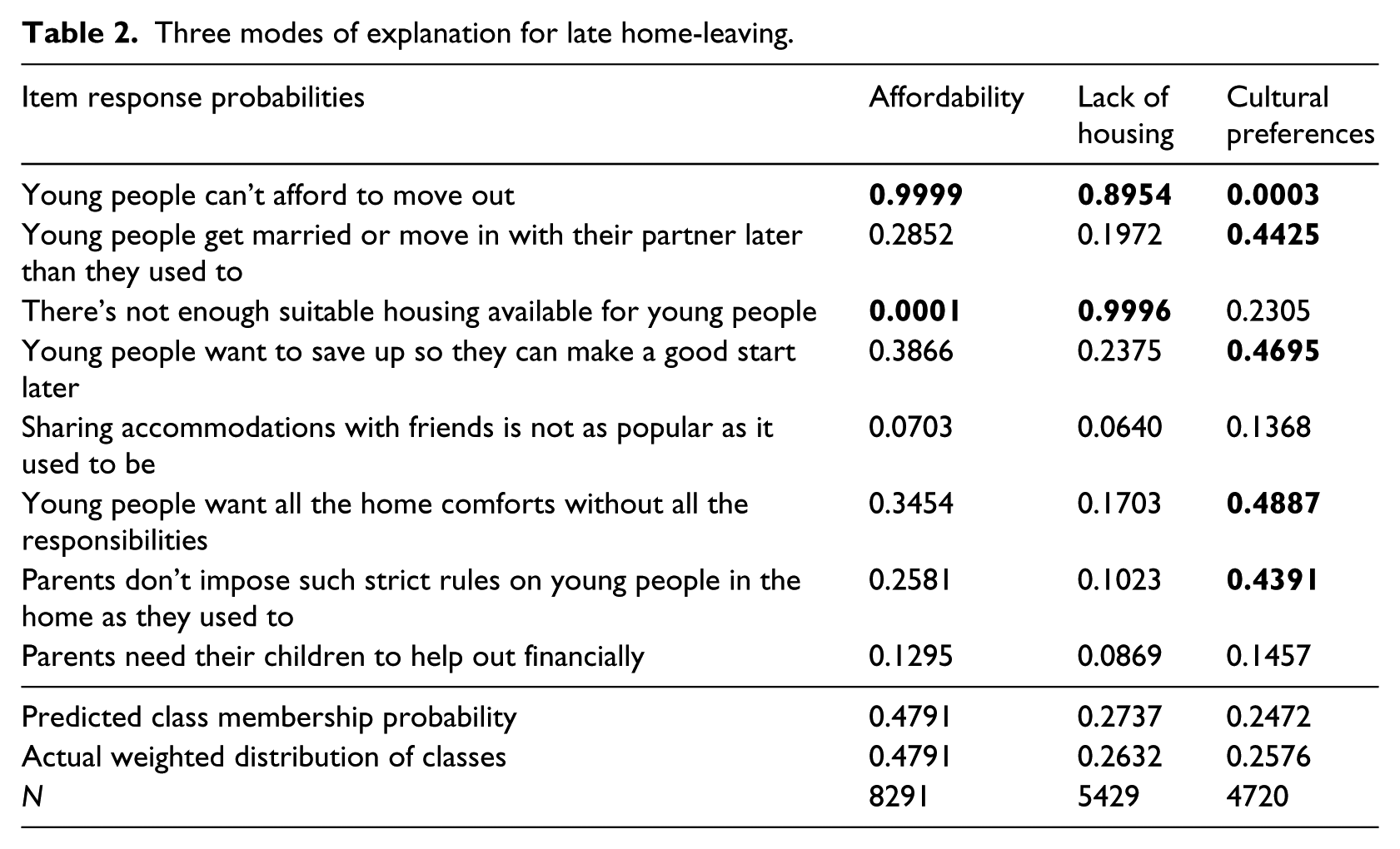
The second mode of explanation, deemed “Lack of Housing,” is like the first mode, except that now housing is also perceived to be in short supply. For youth in this class, there is almost a 90 percent chance of mentioning affordability and an almost guarantee of mentioning a lack of suitable housing. Although these first two classes are highly similar regarding affordability reasons, I name them differently in order to help keep the distinction between those youth who do and do not report housing issues. Youth with this interpretation see delays in leaving as being due to both the deficits in the housing market and the insufficient economic means that youth possess to move out in the first place. In total, 26 percent of the sample (5429 individuals) were assigned to this interpretation as their most likely latent class membership.
The final mode of explanation with 26 percent of the sample (4720 respondents) is the “Cultural Preferences” class. Respondents in this group never mention affordability as a reason why youth are taking longer to leave home. Nor do they see housing as playing too large of a role, although there is a 23 percent chance of mentioning lack of housing. Instead, the primary explanation lies in the choices of young people to remain at home longer. In this view, instead of poor housing markets and weak purchasing power, norms and values that promote enjoying the tangible and intangible benefits of living with parents for longer while are seen as the dominant force keeping youth in the home. Youth in this class perceive other young people taking advantage of several benefits from living at home, such as accumulating types of capital while often paying little to no rent. This response pattern is typified by around a 46 percent chance of mentioning one or more of these cultural reasons, such as that youth are getting married later, saving up money while living at home, enjoying access to food, laundry, and other resources without having to maintain their own residence and benefiting from parents who are more democratic and to some extent more supportive of later home-leaving. Youth with this interpretation perceive delays in leaving to be primarily caused by one or more of these inclination-related reasons, not by a lack of housing or an inability to pay for it.
The characteristics of the first two modes resemble those of the “structuralist” views seen in explanations of other social problems: people with these types of beliefs locate the causes of a given social outcome to be external to people and not due to individuals’ own traits. Taken together, these two interpretations suggest that structural or constraint-oriented explanations of late home-leaving make up the bulk of young people’s explanations. I find two clear structuralist explanations: one emphasizing affordability issues but implying that housing availability remains adequate, and one emphasizing that both the availability and affordability of housing are serious deterrents to leaving earlier.
The “cultural preferences” explanation is similar to the “individualist” view seen in other studies in that respondents locate the causes for a given social outcome as occurring mainly within individuals. This view might be termed a choice-oriented explanation as a counterpart to constraint-oriented interpretations. However, the latent classes are ideal subtypes; endorsing internal attributions also occurs to some degree in the constraint-oriented classes, albeit to a lower level. While I find support for the existence of distinct explanations emphasizing external and internal attributions for late-leaving, I also find support for the idea that these differing interpretations are in themselves mixed-mode to some extent.
Figure 1 displays the weighted proportion of individuals in a given country having one of the three modes of explanation and is sorted within each HHFM by the mode with the highest mean prevalence (see Appendix 3 for corresponding heat map visuals). Constraint-oriented explanations dominate in Eastern Europe and are fairly split between economic and housing issues, while choice-oriented explanations appear slightly subdued compared to other HHFMs. The Northern model and the Southern model show similarly dominant affordability interpretations, while lack of housing is a less popular explanation. Choice-oriented explanations compose a significant minority of responses in these core countries. In the Nordic countries, housing-constraint explanations are dominant, but not by much.
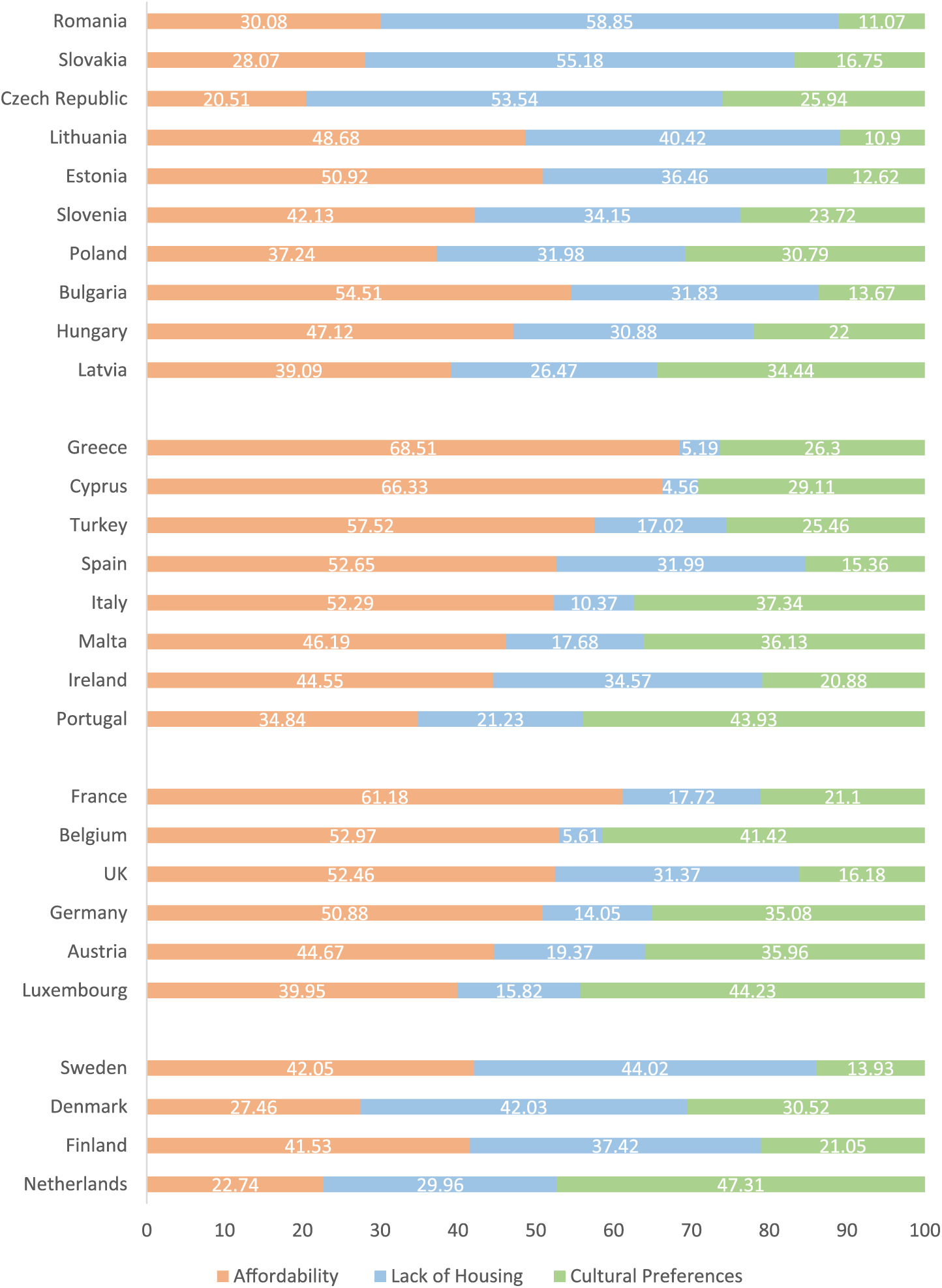
Weighted proportion of modes of explanation by household formation models.
Explanations based on cultural preferences appear to be strongest in some of the richest European countries, such as the Netherlands, Luxembourg, Belgium, Germany, and Austria, but Italy and Portugal, as well as Poland and Latvia, show high proportions, too. Choice explanations are least prevalent in Eastern European countries like Bulgaria, Romania, and Lithuania, but also in the United Kingdom and Spain. Constraint-oriented explanations focusing on the lack of housing vary considerably across Europe. Housing shortages are perceived to be widespread in many Nordic and Eastern European countries, including Denmark, the Czech Republic, Slovakia, and Sweden, as well as in “homeownership” countries like the United Kingdom, Spain, and Ireland (Kemeny, 1981), where at least 30 percent of youth feel there is no housing available. In contrast, such explanations are much rarer in Southern European countries like Italy, Cyprus, and Greece, where affordability of existing housing is perceived to be the dominant cause for delay. Overall, constraint-oriented explanations eclipse choice-oriented ones as the primary interpretation for why leaving takes longer. Nevertheless, the makeup of the constraint-oriented views, and to what degree the housing market is additionally found responsible for keeping youth at home longer, shows considerable variation.
Figure 2 summarizes the tendencies in Figure 1 and shows clear differences in the mean proportions of each explanatory mode by HHFM. Eastern European countries display the lowest prevalence of choice-oriented explanations while showing almost equal proportions of affordability and housing-constraint explanations. The Southern and Northern HHFMs resemble each other very closely, with affordability explanations being the most popular belief followed by choice-oriented beliefs. Lack of housing is clearly perceived as less of an issue in the core of the continent, while choice-oriented explanations are more popular here than anywhere else. Nordic countries are the most evenly balanced in their explanations, but show the strongest concern about sparse housing.
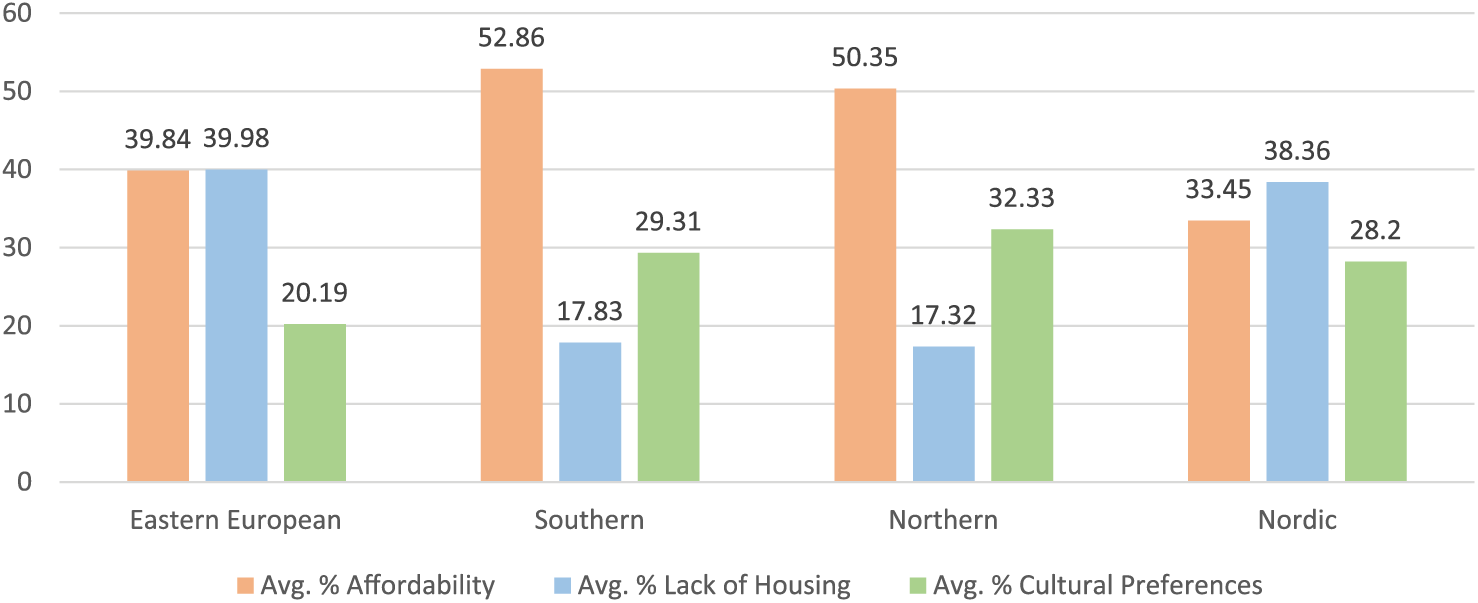
Weighted proportion of explanations by household formation model.
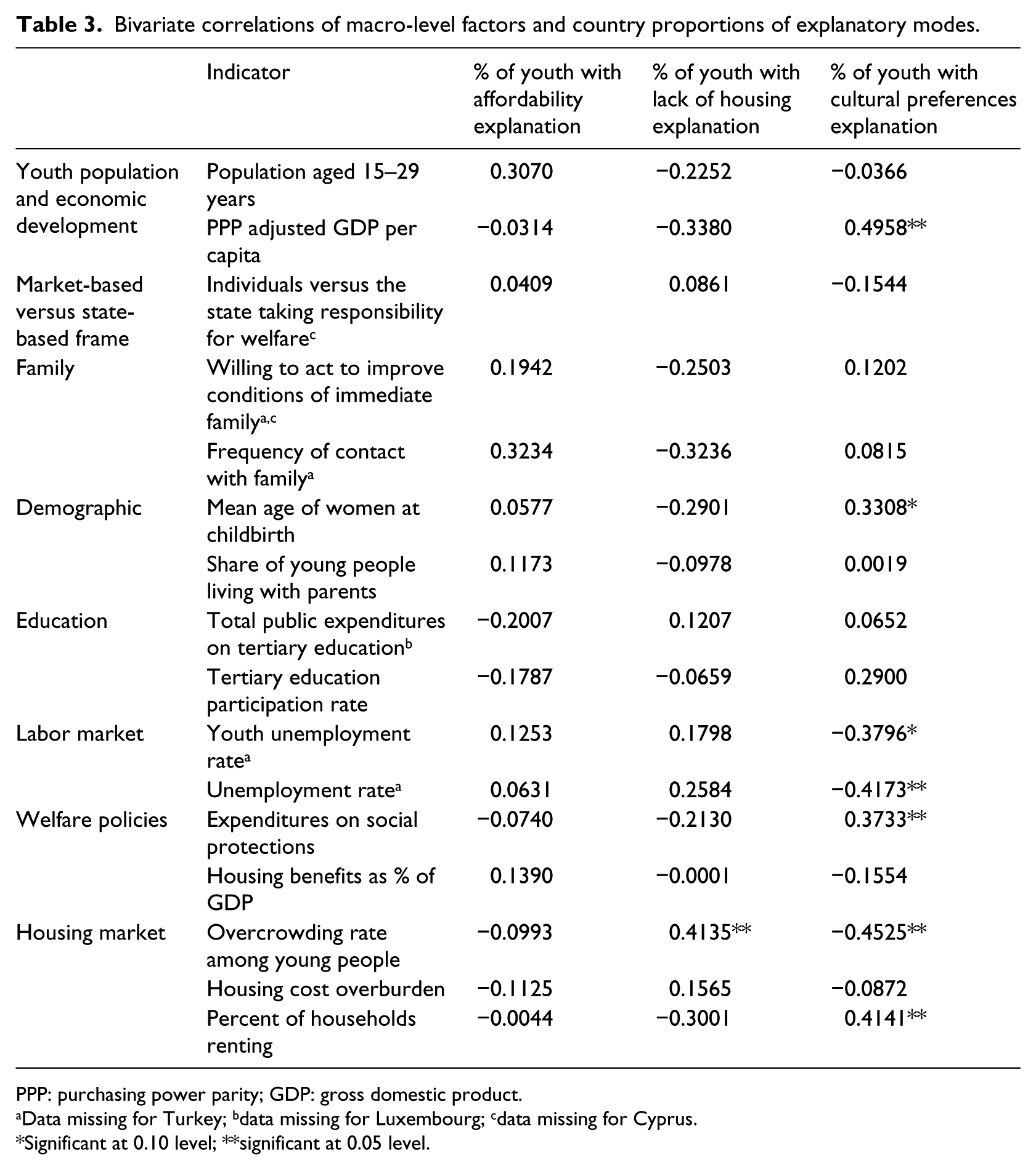
Correlation analyses in Table 3 demonstrate that at the national level, these views are indeed linked to macro-level factors structuring home-leaving. The size of the youth population is positively associated with the frequency of affordability views and negatively associated with housing deficit views. GDP per capita shows an extremely strong positive relationship with choice-oriented explanations. Economic development seems to be associated with increased belief that cultural norms are encouraging later leaving. Increased economic development also correlates with fewer beliefs that housing shortages are to blame.
Bivariate correlations of macro-level factors and country proportions of explanatory modes.
PPP: purchasing power parity; GDP: gross domestic product.
Data missing for Turkey; bdata missing for Luxembourg; cdata missing for Cyprus.
Significant at 0.10 level; **significant at 0.05 level.
The measure of the state versus market-based frame is insignificant, but results are in the expected direction. In nations where people tend to believe that states are responsible for ensuring welfare provision, structuralist-based explanations are slightly more common and choice explanations are slightly less common. The two measures for willingness to act for family and frequency of contact with family show positive associations with both affordability and cultural choice explanations and negative associations with the lack of housing view. This corroborates nicely with theory about homeownership being a source of intergenerational wealth that is passed down in Southern Europe (Filandri and Bertolini, 2016). In these countries, the combination of family norms supporting later leaving and the focus on homeownership or construction of one’s own home is associated with decreased attention to the lack of housing, though rental housing tends to be sparse in those countries.
In countries where women delay childbirth longer, cultural preference explanations are significantly more prominent, meaning that delayed leaving is believed to be more of a choice in countries where parenthood happens later. These countries also tend to be places that are seen as having better housing markets, although this relationship is non-significant. Except for a slight relation to affordability interpretations, the nation’s own extent of late home-leaving as operationalized by the share of 18–34 year olds still at home appears to have almost no relation to the prevalence of different modes.
Educational measures show generally negative associations with affordability interpretations and positive associations with choice interpretations. Therefore, the extent to which the state subsidizes higher education and the extent to which youth participate in it are linked to fewer perceptions that youth are being constrained by affordability issues and more frequent perceptions that youth are choosing to stay at home longer.
Both youth and adult unemployment are significantly linked with lower likelihoods of choice-oriented explanations: where the job market is worse and fewer people are employed, fewer people likewise believe that late home-leaving is due to choice. These correlations suggest that cultural preference explanations, then, might only hold validity for the population when there are relatively few problems with the affordability or availability of housing.
Higher levels of social protection show a significantly positive relationship with choice-oriented explanations. Countries with higher relative social protections and stronger social safety nets tend to be ones that started experiencing the individualistic tendencies of the Second Demographic Transition (SDT) earlier (Lesthaeghe, 2010). Therefore, the increased protections might go hand in hand with supporting young people to take more individualized routes out of the parental home, which might mean waiting longer before making an “appropriate” exit, whatever that might mean for an individual.
The indicators for the housing market show the strongest relationship to the prevalence of these views. In particular, the rate of overcrowding among young people in a given country is both positively associated with the belief that a lack of housing is to blame for late-leaving and negatively associated with the belief that late-leaving is due to choice. Overcrowding refers to the situation when young people of adolescent or young adult age do not have a room of their own. It has been likened as a “push” factor encouraging earlier departures from home (Mandic, 2008), but in cases where no suitable housing exists for these young people to land in, it becomes a situation youth must simply adapt to, despite their preference for moving out on their own. The correlations for the proportion of households renting homes corroborate this inference: as the proportion of renters rises (and so, we assume, the stock of available rental housing rises, too), constraint-oriented explanations focusing on the lack of housing decrease and the propensity for choice-oriented explanations rises. Rental housing stock – its availability and affordability – appears to be a major influence on whether young people interpret delays in leaving as occurring due to choice or not.
Discussion
Similar to other studies about explanations for social problems, I find that young people’s interpretations of the reasons for delayed home-leaving can be clustered into two primary groups: one camp prioritizing “structuralist” factors that constrain young people’s options to move out, and one camp emphasizing “individualist” and often culturally motivated choices to stay at home longer. The relative dominance of constraint- and choice-oriented modes of explanation can be contextualized against prior research showing that value frames disseminated and perpetuated at the national and sub-national levels influence the way that people make sense of social issues like inequality (Sabbagh and Vanhuysse, 2006, 2010). Although not statistically significant, my measure for market-based and state-based framing showed a slight relationship with constraint- and choice-oriented explanations, lending support to the idea that young people’s interpretations of social “problems” might be similar to adults’ in that two ideal-type explanations representing opposite attributions can be derived.
In two respects, the geographic distribution of these attitudes loosely followed the cleavages of the different HHFMs and the important factors driving home-leaving patterns there, as concluded by Billari (2004). Housing constraints were dominant in Nordic countries, where state-subsidized housing is more common, and in Eastern European countries, where state-controlled housing was the norm for generations (Mandic and Cirman, 2012). Cultural preferences were a more popular explanation in Italy and Portugal, where family-based norms are stronger. Yet, in other respects, the distribution of these beliefs tells a more complicated story. Considerable variation exists within each HHFM, and taken together, the Northern and Southern HHFMs look quite alike despite significant differences in available housing and cultural norms, lending support to Sgritta’s (2001) conclusion of “no clear-cut differences” in explanations between the two groups.
Bivariate correlations reveal that the relative popularity of constraint- and choice-oriented explanations for late-leaving relates to macro-level factors that are key in determining home-leaving patterns. Economic development, expenditures on and enrollment in higher education, increased social protections, and higher shares of people renting households all correlate with greater prevalence of choice-oriented explanations. Conversely, unemployment and weak labor markets are associated with decreased attention to choice explanations. Overcrowding in particular is strongly associated with the prevalence of housing-constraint explanations and decreased choice-oriented explanations. Overall, the correlation analyses suggest that both economic and housing constraints are the predominant explanations for delayed leaving until countries reach a certain threshold whereby the availability and affordability of housing are perceived to be within reach for most.
These results suggest that at the national scale, economic, social, and cultural developments are key in shaping young people’s beliefs about the causes behind delayed home-leaving. Countries with the highest levels of constraint-oriented explanations are characterized by low economic development, early age at childbirth, high unemployment, weak social protections, high degrees of overcrowding, and high proportions of homeowners. However, choice-oriented explanations are more prevalent in countries where the education and labor markets function well, welfare states are more comprehensive, and where the population has for generations been experiencing the cultural effects of the SDT, which promote later child-bearing and more “individualized” trajectories into adulthood (Billari, 2004). Yet, in no country were choice-oriented explanations more prevalent than constraint-oriented ones: in every nation, the majority of youth felt that their generation was more or less “stuck” at home due to some combination of the affordability and availability of suitable housing.
The dominance of constraint-oriented views implies that feelings of social exclusion among young adults seeking to enter their first independent household might be fairly common. The ramifications of feeling “shut out” from the housing market and thus unable to leave the nest potentially include increased family conflict, lowered life satisfaction (Mínguez, 2016), and delays in other transitions (Barakat et al., 2010). Because of contingent transitions in many countries, failure to achieve one of the common milestones of adulthood (economic independence, moving out, family formation) often prevents young people from achieving any of the others, particularly in countries with “traditional” norms where the unemployment of young males can hinder them from finding housing and getting married (Strachan, 2015). In particularly severe cases, feelings of social exclusion can lead to political unrest (e.g. the Arab Spring movement). Yet, youth in other parts of Europe are experiencing the same issues, albeit to a lesser degree. In many Southern European countries, transitions into full adulthood are marked by a long waiting period during which young people have limited status and power. When youth feel that the wait period has become meaningless in an uncertain economic environment and that their future prospects are growing bleak (Mínguez, 2016), they rightfully feel frustrated over a perceived violation of the social contract.
Above, I extended theory about adults’ explanations of social problems to youth explanations of late transitions. Institutional and demographic differences related to countries’ labor, education, housing, and family formation markets clearly help shape young people’s interpretations of why transitions are taking longer. Although this article did not look at mechanisms, SDT literature and Inglehart’s (2015) research on value change provide a basic explanation for how collective psychologies and mass values change as nations shift from industrializing to de-industrializing processes (Lesthaeghe, 2010). From this perspective, social change brings new ways of understanding the process of growing up, such that delays in leaving home might be interpreted as necessary, if not beneficial, in order to reach adulthood. The cultural and lifestyle changes that accompany the rising existential security of modern-day economic and technological development, including delayed family formation and the rise in non-traditional living arrangements (cohabitation, living alone and living with roommates) provide an avenue through which people might come to explain delays in growing up as being due to choice, not from constraint.
In particular, this article’s findings tell us something informative about the extent to which young people believe their generation is pursuing choice biographies (Du Bois-Reymond, 1998) that include leaving home later than “normal.” Choice biographies refer to individualized sequencing of transitions in whatever order makes sense for the individual. These de-standardized biographical pathways are often contrasted against the linear model of the Baby Boomer generation in which full-time employment, home-leaving, marriage, and parenthood all happened rather quickly and in that order. The current findings suggest that perceptions of choice biographies are linked to economic, social, and cultural developments associated with increasing economic productivity, the size of the rented housing sector, increased privacy within the home (low overcrowding), enhanced social protections, elevated investments and participation in tertiary education, minimal unemployment, and delayed parenthood.
However, it would also be a mistake to characterize the cultural preferences mode of explanation as strictly a choice-oriented one; “choosing” to stay at home can still be motivated by feelings of constraint. Under the influence of structural factors like unemployment, precarious economic and work conditions, elevated housing costs and the cultural influences of the family, young people try to embrace the benefits of staying at home longer (Mínguez, 2016). This choice is made easier by parents who “not only endorse not leaving home, but may also continue to provide economic support to children as long as they conform to parents’ expectations about leaving home and family formation (Holdsworth, 2005: 563).” Thus, choice explanations also tell us something about how youth are coping with current conditions and making sense of leaving home in a volatile context characterized by more competition for stable jobs and urban rent prices that are out of proportion to average wages. In many countries, the cost of living has only increased while real wages and purchasing power have remained largely stagnant. From a political economy perspective, the value of youth labor has dropped over time (Beaujot, 2006), while governments typically fail to see youth as an important civic group, since they do not contribute much to the formal economy (Strachan, 2015). Youth are the generation hit hardest by structural changes as they seek to establish themselves in labor markets that often look quite different from what their parents experienced.
Although providing an important contribution, this study is not without its limitations. First, the typology characterized relationships only as they existed in a particular point in time. Second, more recent attitude and opinion data capturing these topics over the current span of countries could not be located. Third, the inability to control at the individual-level for those who have moved out and those who have not prevents any real attempt at a regression analysis that would capture the effects of individual-level variables like age, gender, and education. Despite these drawbacks, future studies can apply the same framework to see if young people’s explanations of other social problems, such as unemployment or difficulties in getting a job, follow the same pattern. Young people’s beliefs about the timing of home-leaving, and in general about why growing up is taking longer, are an understudied but important research area. This study found clear differences in how youth explain issues affecting their generation with respect to structural or individual attributes.
Footnotes
Appendix 3
Appendix 1.
Nation-level variables used in analysis.
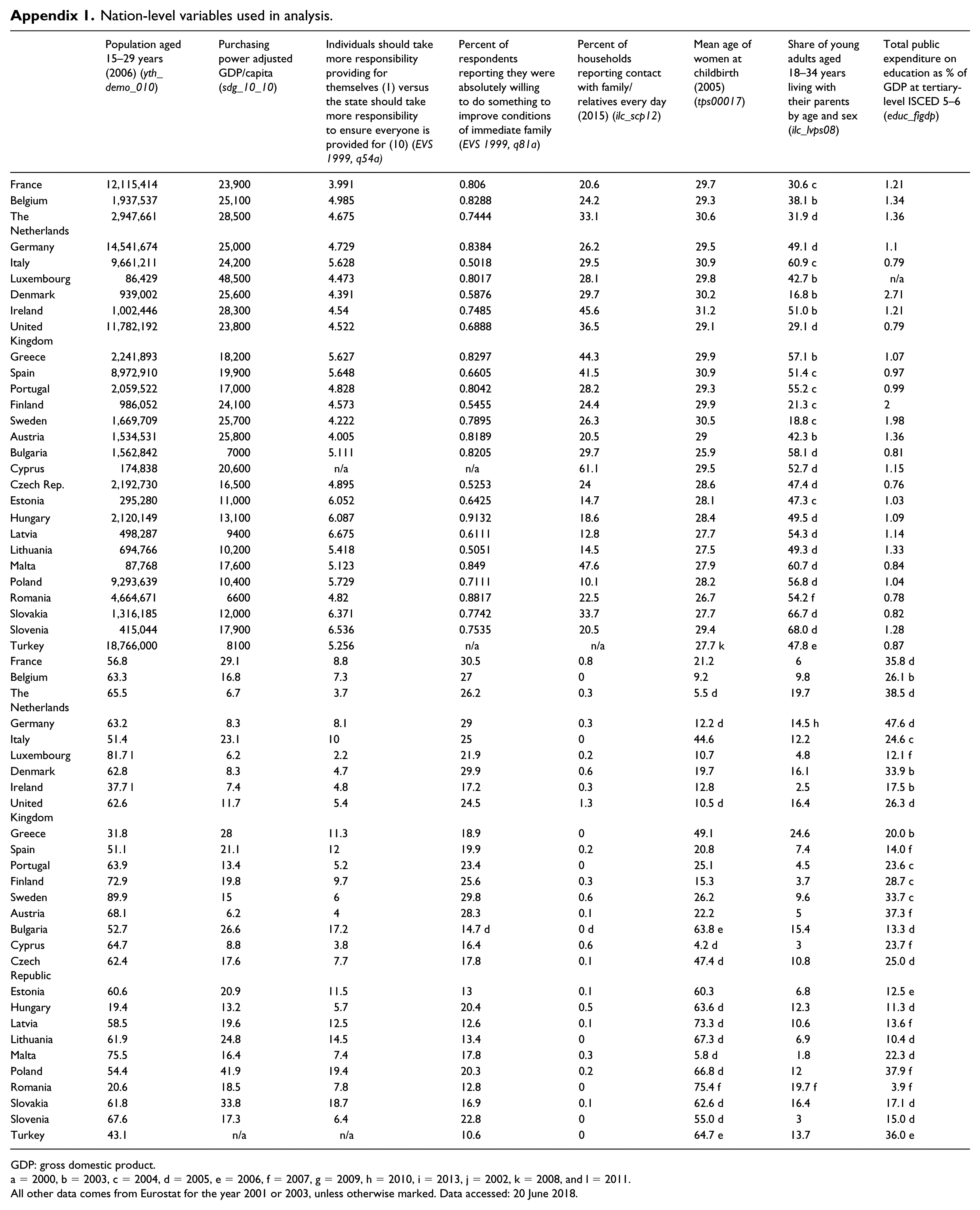
| Population aged 15–29 years (2006) (yth_demo_010) | Purchasing power adjusted GDP/capita (sdg_10_10) | Individuals should take more responsibility providing for themselves (1) versus the state should take more responsibility to ensure everyone is provided for (10) (EVS 1999, q54a) | Percent of respondents reporting they were absolutely willing to do something to improve conditions of immediate family (EVS 1999, q81a) | Percent of households reporting contact with family/relatives every day (2015) (ilc_scp12) | Mean age of women at childbirth (2005) (tps00017) | Share of young adults aged 18–34 years living with their parents by age and sex (ilc_lvps08) | Total public expenditure on education as % of GDP at tertiary-level ISCED 5–6 (educ_figdp) | |
| France | 12,115,414 | 23,900 | 3.991 | 0.806 | 20.6 | 29.7 | 30.6 c | 1.21 |
| Belgium | 1,937,537 | 25,100 | 4.985 | 0.8288 | 24.2 | 29.3 | 38.1 b | 1.34 |
| The Netherlands | 2,947,661 | 28,500 | 4.675 | 0.7444 | 33.1 | 30.6 | 31.9 d | 1.36 |
| Germany | 14,541,674 | 25,000 | 4.729 | 0.8384 | 26.2 | 29.5 | 49.1 d | 1.1 |
| Italy | 9,661,211 | 24,200 | 5.628 | 0.5018 | 29.5 | 30.9 | 60.9 c | 0.79 |
| Luxembourg | 86,429 | 48,500 | 4.473 | 0.8017 | 28.1 | 29.8 | 42.7 b | n/a |
| Denmark | 939,002 | 25,600 | 4.391 | 0.5876 | 29.7 | 30.2 | 16.8 b | 2.71 |
| Ireland | 1,002,446 | 28,300 | 4.54 | 0.7485 | 45.6 | 31.2 | 51.0 b | 1.21 |
| United Kingdom | 11,782,192 | 23,800 | 4.522 | 0.6888 | 36.5 | 29.1 | 29.1 d | 0.79 |
| Greece | 2,241,893 | 18,200 | 5.627 | 0.8297 | 44.3 | 29.9 | 57.1 b | 1.07 |
| Spain | 8,972,910 | 19,900 | 5.648 | 0.6605 | 41.5 | 30.9 | 51.4 c | 0.97 |
| Portugal | 2,059,522 | 17,000 | 4.828 | 0.8042 | 28.2 | 29.3 | 55.2 c | 0.99 |
| Finland | 986,052 | 24,100 | 4.573 | 0.5455 | 24.4 | 29.9 | 21.3 c | 2 |
| Sweden | 1,669,709 | 25,700 | 4.222 | 0.7895 | 26.3 | 30.5 | 18.8 c | 1.98 |
| Austria | 1,534,531 | 25,800 | 4.005 | 0.8189 | 20.5 | 29 | 42.3 b | 1.36 |
| Bulgaria | 1,562,842 | 7000 | 5.111 | 0.8205 | 29.7 | 25.9 | 58.1 d | 0.81 |
| Cyprus | 174,838 | 20,600 | n/a | n/a | 61.1 | 29.5 | 52.7 d | 1.15 |
| Czech Rep. | 2,192,730 | 16,500 | 4.895 | 0.5253 | 24 | 28.6 | 47.4 d | 0.76 |
| Estonia | 295,280 | 11,000 | 6.052 | 0.6425 | 14.7 | 28.1 | 47.3 c | 1.03 |
| Hungary | 2,120,149 | 13,100 | 6.087 | 0.9132 | 18.6 | 28.4 | 49.5 d | 1.09 |
| Latvia | 498,287 | 9400 | 6.675 | 0.6111 | 12.8 | 27.7 | 54.3 d | 1.14 |
| Lithuania | 694,766 | 10,200 | 5.418 | 0.5051 | 14.5 | 27.5 | 49.3 d | 1.33 |
| Malta | 87,768 | 17,600 | 5.123 | 0.849 | 47.6 | 27.9 | 60.7 d | 0.84 |
| Poland | 9,293,639 | 10,400 | 5.729 | 0.7111 | 10.1 | 28.2 | 56.8 d | 1.04 |
| Romania | 4,664,671 | 6600 | 4.82 | 0.8817 | 22.5 | 26.7 | 54.2 f | 0.78 |
| Slovakia | 1,316,185 | 12,000 | 6.371 | 0.7742 | 33.7 | 27.7 | 66.7 d | 0.82 |
| Slovenia | 415,044 | 17,900 | 6.536 | 0.7535 | 20.5 | 29.4 | 68.0 d | 1.28 |
| Turkey | 18,766,000 | 8100 | 5.256 | n/a | n/a | 27.7 k | 47.8 e | 0.87 |
| Participation rate in tertiary-level formal and non-formal education and training (2007) (trng_aes_102) | Youth unemployment rate – % of active population aged 15–24 years (tipslm80) | Unemployment rate, aged 15–74 years; 3-year average (tipsun10) | Expenditures on social protection as % of GDP (2004) (tps00098) | Housing benefits as % of GDP (tables by functions, aggregated benefits and grouped schemes – (spr_exp_gdp) | Overcrowding rate for youth aged 15–24 years (2004) (yth_incl_150) | Housing cost overburden rate (2006) (tespm140) | Percent of population 18 years and over living in rented housing (tenure status) (ilc_lvps15) | |
| France | 56.8 | 29.1 | 8.8 | 30.5 | 0.8 | 21.2 | 6 | 35.8 d |
| Belgium | 63.3 | 16.8 | 7.3 | 27 | 0 | 9.2 | 9.8 | 26.1 b |
| The Netherlands | 65.5 | 6.7 | 3.7 | 26.2 | 0.3 | 5.5 d | 19.7 | 38.5 d |
| Germany | 63.2 | 8.3 | 8.1 | 29 | 0.3 | 12.2 d | 14.5 h | 47.6 d |
| Italy | 51.4 | 23.1 | 10 | 25 | 0 | 44.6 | 12.2 | 24.6 c |
| Luxembourg | 81.7 l | 6.2 | 2.2 | 21.9 | 0.2 | 10.7 | 4.8 | 12.1 f |
| Denmark | 62.8 | 8.3 | 4.7 | 29.9 | 0.6 | 19.7 | 16.1 | 33.9 b |
| Ireland | 37.7 l | 7.4 | 4.8 | 17.2 | 0.3 | 12.8 | 2.5 | 17.5 b |
| United Kingdom | 62.6 | 11.7 | 5.4 | 24.5 | 1.3 | 10.5 d | 16.4 | 26.3 d |
| Greece | 31.8 | 28 | 11.3 | 18.9 | 0 | 49.1 | 24.6 | 20.0 b |
| Spain | 51.1 | 21.1 | 12 | 19.9 | 0.2 | 20.8 | 7.4 | 14.0 f |
| Portugal | 63.9 | 13.4 | 5.2 | 23.4 | 0 | 25.1 | 4.5 | 23.6 c |
| Finland | 72.9 | 19.8 | 9.7 | 25.6 | 0.3 | 15.3 | 3.7 | 28.7 c |
| Sweden | 89.9 | 15 | 6 | 29.8 | 0.6 | 26.2 | 9.6 | 33.7 c |
| Austria | 68.1 | 6.2 | 4 | 28.3 | 0.1 | 22.2 | 5 | 37.3 f |
| Bulgaria | 52.7 | 26.6 | 17.2 | 14.7 d | 0 d | 63.8 e | 15.4 | 13.3 d |
| Cyprus | 64.7 | 8.8 | 3.8 | 16.4 | 0.6 | 4.2 d | 3 | 23.7 f |
| Czech Republic | 62.4 | 17.6 | 7.7 | 17.8 | 0.1 | 47.4 d | 10.8 | 25.0 d |
| Estonia | 60.6 | 20.9 | 11.5 | 13 | 0.1 | 60.3 | 6.8 | 12.5 e |
| Hungary | 19.4 | 13.2 | 5.7 | 20.4 | 0.5 | 63.6 d | 12.3 | 11.3 d |
| Latvia | 58.5 | 19.6 | 12.5 | 12.6 | 0.1 | 73.3 d | 10.6 | 13.6 f |
| Lithuania | 61.9 | 24.8 | 14.5 | 13.4 | 0 | 67.3 d | 6.9 | 10.4 d |
| Malta | 75.5 | 16.4 | 7.4 | 17.8 | 0.3 | 5.8 d | 1.8 | 22.3 d |
| Poland | 54.4 | 41.9 | 19.4 | 20.3 | 0.2 | 66.8 d | 12 | 37.9 f |
| Romania | 20.6 | 18.5 | 7.8 | 12.8 | 0 | 75.4 f | 19.7 f | 3.9 f |
| Slovakia | 61.8 | 33.8 | 18.7 | 16.9 | 0.1 | 62.6 d | 16.4 | 17.1 d |
| Slovenia | 67.6 | 17.3 | 6.4 | 22.8 | 0 | 55.0 d | 3 | 15.0 d |
| Turkey | 43.1 | n/a | n/a | 10.6 | 0 | 64.7 e | 13.7 | 36.0 e |
GDP: gross domestic product.
a = 2000, b = 2003, c = 2004, d = 2005, e = 2006, f = 2007, g = 2009, h = 2010, i = 2013, j = 2002, k = 2008, and l = 2011.
All other data comes from Eurostat for the year 2001 or 2003, unless otherwise marked. Data accessed: 20 June 2018.
Appendix 2.
Latent class indicators.
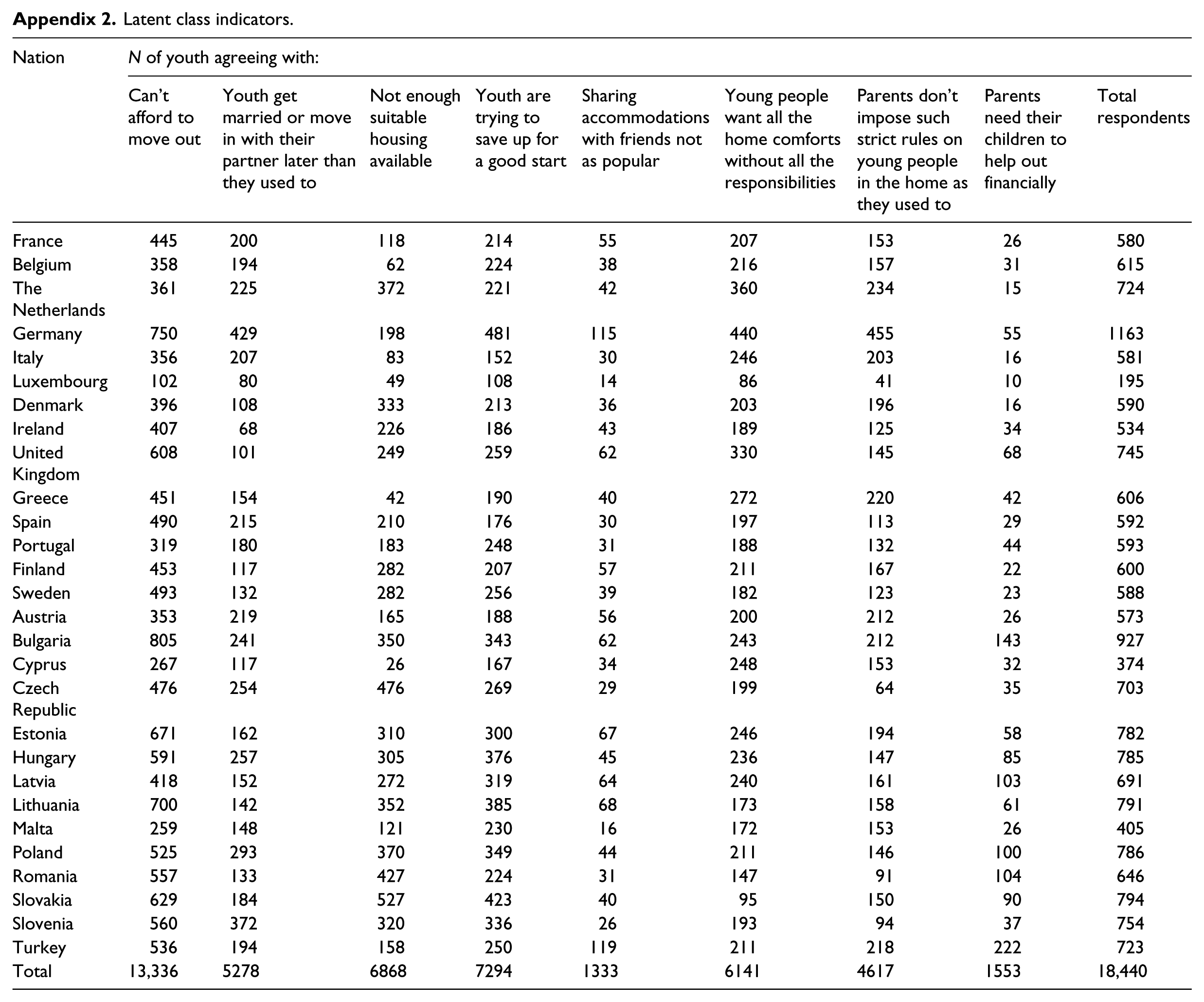
| Nation | N of youth agreeing with: |
||||||||
|---|---|---|---|---|---|---|---|---|---|
| Can’t afford to move out | Youth get married or move in with their partner later than they used to | Not enough suitable housing available | Youth are trying to save up for a good start | Sharing accommodations with friends not as popular | Young people want all the home comforts without all the responsibilities | Parents don’t impose such strict rules on young people in the home as they used to | Parents need their children to help out financially | Total respondents | |
| France | 445 | 200 | 118 | 214 | 55 | 207 | 153 | 26 | 580 |
| Belgium | 358 | 194 | 62 | 224 | 38 | 216 | 157 | 31 | 615 |
| The Netherlands | 361 | 225 | 372 | 221 | 42 | 360 | 234 | 15 | 724 |
| Germany | 750 | 429 | 198 | 481 | 115 | 440 | 455 | 55 | 1163 |
| Italy | 356 | 207 | 83 | 152 | 30 | 246 | 203 | 16 | 581 |
| Luxembourg | 102 | 80 | 49 | 108 | 14 | 86 | 41 | 10 | 195 |
| Denmark | 396 | 108 | 333 | 213 | 36 | 203 | 196 | 16 | 590 |
| Ireland | 407 | 68 | 226 | 186 | 43 | 189 | 125 | 34 | 534 |
| United Kingdom | 608 | 101 | 249 | 259 | 62 | 330 | 145 | 68 | 745 |
| Greece | 451 | 154 | 42 | 190 | 40 | 272 | 220 | 42 | 606 |
| Spain | 490 | 215 | 210 | 176 | 30 | 197 | 113 | 29 | 592 |
| Portugal | 319 | 180 | 183 | 248 | 31 | 188 | 132 | 44 | 593 |
| Finland | 453 | 117 | 282 | 207 | 57 | 211 | 167 | 22 | 600 |
| Sweden | 493 | 132 | 282 | 256 | 39 | 182 | 123 | 23 | 588 |
| Austria | 353 | 219 | 165 | 188 | 56 | 200 | 212 | 26 | 573 |
| Bulgaria | 805 | 241 | 350 | 343 | 62 | 243 | 212 | 143 | 927 |
| Cyprus | 267 | 117 | 26 | 167 | 34 | 248 | 153 | 32 | 374 |
| Czech Republic | 476 | 254 | 476 | 269 | 29 | 199 | 64 | 35 | 703 |
| Estonia | 671 | 162 | 310 | 300 | 67 | 246 | 194 | 58 | 782 |
| Hungary | 591 | 257 | 305 | 376 | 45 | 236 | 147 | 85 | 785 |
| Latvia | 418 | 152 | 272 | 319 | 64 | 240 | 161 | 103 | 691 |
| Lithuania | 700 | 142 | 352 | 385 | 68 | 173 | 158 | 61 | 791 |
| Malta | 259 | 148 | 121 | 230 | 16 | 172 | 153 | 26 | 405 |
| Poland | 525 | 293 | 370 | 349 | 44 | 211 | 146 | 100 | 786 |
| Romania | 557 | 133 | 427 | 224 | 31 | 147 | 91 | 104 | 646 |
| Slovakia | 629 | 184 | 527 | 423 | 40 | 95 | 150 | 90 | 794 |
| Slovenia | 560 | 372 | 320 | 336 | 26 | 193 | 94 | 37 | 754 |
| Turkey | 536 | 194 | 158 | 250 | 119 | 211 | 218 | 222 | 723 |
| Total | 13,336 | 5278 | 6868 | 7294 | 1333 | 6141 | 4617 | 1553 | 18,440 |
Acknowledgements
The author thanks Reuben Jack Thomas, the editor, and the anonymous reviewers at IJCS for their helpful comments on successive drafts of this article.
Funding
The author(s) received no financial support for the research, authorship, and/or publication of this article.