




Abstract
This article investigates cross-national variation in the types of locally based actors, or “receptor sites,” that connect with international non-governmental organizations (INGOs) in local contexts. Empirics center on an INGO disseminating global best practices for education in humanitarian crises to a membership of around 10,000 individuals in over 150 countries. Members reported working at a range of organizations, here conceptualized as receptor sites. Using multivariate regression, I examine cross-national differences in a subset of these workplace affiliations. Findings show that members join primarily in Western countries and in specific sites of humanitarian crises. However, they tend to be affiliated with different types of receptors in these two contexts due to differences in the underlying factors that generate INGO ties. Receptors influential in the construction of global norms (such as aid donors and universities) dominate in the Western core, where ties serve as a means for promoting cultural ideals elsewhere. In contrast, implementing organizations (such as local schools, non-governmental organizations (NGOs), and governments) prevail in humanitarian crises, where ties offer access to global resources in tackling local issues. Country-level ties to INGOs are thus not always equivalent, but can capture locally variant pathways for diffusion.
Keywords
Introduction
It is a broadly recognized sociological insight that policies and institutions travel the world (Dobbin et al., 2007). Across domains—from education to the environment to human rights—models of society are drawn at the world-level and diffused into local contexts (Frank et al., 2000; Hafner-Burton and Tsutsui, 2005; Meyer et al., 1992, 1997). At the same time, not all countries are equally prone to adopting these models. One of the most ubiquitous findings is that uptake depends on linkages to international organizations (Ramirez, 2012). International non-governmental organizations (INGOs) are especially important, as they exert distinctly cultural (as opposed to political or economic) pressures (Cole, 2017). Myriad studies thus show an “INGO effect”: Countries with extensive ties to INGOs are more likely to adopt world society policies and principles (see, for example, Bromley et al., 2011; Fernández and Lutter, 2013).
The global–local dynamics through which INGO ties facilitate diffusion, however, deserve much more scholarly attention. We know that such ties represent critical linkages between the global and the local, but existing scholarship rarely examines the nature of these linkages in great detail. I address this issue by investigating patterns and predictors of cross-national variation in the locally based “receptor sites” that engage with INGOs in diffusion processes. Receptor sites are social structures capable of “receiving, de-coding, and transmitting signals from world society,” such as universities, NGOs, or government agencies (Frank et al., 2000: 96). The literature highlights such receiving structures as central intermediaries, with INGOs theorized to influence local settings by “conveying global models to domestic receptor sites” (Schofer et al., 2012: 7), which in turn translate these global normative ideals into their local contexts (Frank et al., 2009).
Despite this important role, the receptor sites to which INGOs transmit global norms tend to be implicitly assumed rather than explicitly studied. This is unfortunate, considering the multitude of possible receptors involved in any given diffusion process. Many types of receptors exist at all levels of a social system, ranging from local NGOs to universities, thus facilitating diffusion into various social levels and sites (Pope and Meyer, 2016). And yet few studies explicitly investigate the composition of receptor site landscapes around the world. Are there cross-national differences in the types of locally based actors that serve as receptor sites for INGOs in different places, and if so, what explains this variation? Addressing this question is essential for understanding the multi-sited and locally divergent pathways through which INGOs interact with local contexts. Different types of receptors have different domains of influence, ranging from policy and practice to theorization, meaning that cross-national receptor site diversity may ultimately engender divergent patterns of norm institutionalization.
Through a study of INGO memberships in the education sector, I reveal striking cross-national differences in receptor sites and illustrate some of the factors that explain this variation. I focus my analyses on the “Inter-Agency Network for Education in Emergencies” (INEE), which is an influential INGO dedicated to disseminating global best practices for the provision of education in humanitarian crises (e.g. in refugee camps). In 2014 (the latest year analyzed here), the INEE had a membership of around 10,000 individual members in over 150 countries, where they reported working at a range of organizations. I conceptualize these workplace affiliations as receptor sites and analyze a subset of them using multivariate regression. Models of overall membership patterns show that members join primarily in two types of settings: in Western countries and in countries that are affected by specific types of humanitarian crises. Predictors change dramatically, however, when the membership is disaggregated by receptor site type, which I theorize reflects differences in the underlying factors that generate INEE memberships in these two contexts. Receptors influential in the construction of global norms (e.g. aid donors and universities) dominate in the West, where memberships in this particular INGO serve primarily as a means for promoting global best practices for education in humanitarian crises elsewhere. Conversely, implementing organizations (such as local schools, NGOs, and governments) are prevalent in countries affected by humanitarian crises, where memberships serve as a means of accessing global best practices in tackling education issues on the ground.
Building on these findings, I contend that we are missing an important piece of the picture in considering only where people join INGOs without paying attention to receptor sites. It may simply not be appropriate to assume that all INGO linkages are equivalent. Indeed, my analyses document substantial cross-national variation in receptor site landscapes, which has important implications for diffusion processes and outcomes, as I outline in the article. Of course, the precise predictors and receptor site patterns may work differently in domains and organizations other than the one I study. Nonetheless, the broader theory developed here suggests that cross-national receptor site variation is bound to be a relatively common phenomenon and appears to be linked to diversity in the factors that drive INGO participation in different contexts. These insights make an important contribution to the literature on international organizations, global diffusion, and world society.
INGO memberships and receptor sites in global diffusion
I draw on macro-sociological work in the world society tradition, which highlights the global arena as a shared cultural and organizational environment, built around originally Western but continuously evolving ideals of modernity (Krücken and Drori, 2009; Lechner and Boli, 2005; Meyer, 2010; Meyer et al., 1997). This global environment penetrates down into local settings and supplies globally legitimated models of society, thus constructing the identities and behaviors of national states and producing cross-national similarities across many different areas (Frank et al., 2000, 2009; Hafner-Burton and Tsutsui, 2005; Ramirez et al., 1997).
Early theorization strongly emphasized the uniform adoption of global models, rooted in the cultural construction of national states as homogeneous instantiations of the broader nation–state ideal (see, for example, Meyer et al., 1992; Strang, 1990). As the theory matured, however, it began to ask questions around the mechanisms through which global models spread and the conditions under which diffusion was most likely (Pope and Lim, 2017; Schofer and Hironaka, 2005; Strang and Meyer, 1993). Today, it is understood that diffusion in a given domain is contingent on the specific world societal structures at play, the nature of the element being diffused, and, importantly, on subunit characteristics (Hironaka, 2014; Pope and Meyer, 2016).
One of the most important subunit characteristics is embeddedness in world society, captured via memberships in international organizations. The majority of attention centers on INGOs, which have grown exponentially over time (Schofer et al., 2012). Compared with political or economic organizations (such as intergovernmental organizations or multinationals), INGOs uniquely represent normative, as opposed to coercive, pressures for diffusion (Boli and Thomas, 1997, 1999 see also DiMaggio and Powell, 1983). Current scholarship thus conceptualizes INGOs as the main organizational conduits for world culture. Numerous studies show greater receptiveness to world models in countries where residents hold more INGO memberships (Bromley et al., 2011, 2015; Fernández and Lutter, 2013; Frank et al., 2011; Wotipka and Ramirez, 2008).
At the same time, our understanding of the global–local interactions that allow INGOs to function as bridges between world society and local contexts remains poor. To begin to address this gap, I focus on the concept of the “receptor site.” The literature describes receptor sites as “social structures set up to receive and decode signals from world society and transmit them to domestic actors” (Frank et al., 2011: 557). Studies conceptualize various receptor site types, including local NGOs, professions, universities, and state ministries (Frank et al., 2000, 2007; Givens and Jorgenson, 2013; Larson et al., 2008; Suárez and Bromley, 2016). Although these studies do not specifically focus on receptors linked to INGOs, the literature posits them as important intermediaries. INGO ties are thought to channel world cultural norms to domestically based receptors, which translate these norms into their local environments, thus contributing to their diffusion (Schofer et al., 2012). Despite this key idea, the receptor sites to which INGOs transmit global norms are largely assumed rather than studied; few studies explicitly investigate the receiving organizational structures attached to INGOs in different places.
I argue that we can expand our understanding of local variation in the mechanisms through which INGO ties facilitate diffusion by explicitly studying the cross-national patterning of the receptor sites involved. World society theory is often criticized for assuming a simplistic downward broadcasting of world models (see, for example, Anderson-Levitt, 2003). But recent scholarship points to a much richer conceptual understanding of diffusion and the contexts for reception. It is now understood that world models do not simply flow from global to local but instead their diffusion involves uptake by many different receptors at various social levels and sites (Schofer and Hironaka, 2005). Receptor sites can be “individuals, organizations, nation-states, regional groups, or intergovernmental organizations,” with the global–local imagery a “simplification” for complex and often “vertically structured” fields for diffusion (Pope and Meyer, 2016: 296).
INGO memberships are especially likely to involve connections to such myriad receptor sites, because INGOs are associations of individuals (Boli and Thomas, 1997, 1999). In this aspect, they differ quite fundamentally from intergovernmental organizations (IGOs), which imply a membership consisting largely of state actors. INGOs facilitate a much broader collection of constituents, with their individual members themselves representing potentially very diverse receptor sites. The implication is that while we conceptualize INGO memberships as broadly signaling a country’s receptiveness to world cultural norms, there might be great diversity in who is doing the receiving in different places.
Cross-national diversity in receptor site landscapes may ultimately have significant impacts on diffusion, including the content of global norms themselves. Receptor sites are ascribed a crucial intermediary role in explaining how INGOs filter global blueprints into domestic settings. They are seen as “interstitial locations” where global concerns are translated into local environments (Larson et al., 2008: 66). This translation is likely to differ depending on the nature of the receptor site, meaning that cross-national differences in receptors might entail diffusion into different social sites. In my empirical case, for example, school receptors may funnel global norms into local educational practice by implementing them on the ground, whereas university receptors might channel them into knowledge systems by engaging in their theorization. Aside from divergent patterns of institutionalization, cross-national differences in receptors might also provide some national settings with more influence over the content of global norms themselves. As I explain below, some receptors are much more likely than others to not simply receive world cultural ideals, but also contribute to their construction. Again, the contrast between schools and universities is instructive; the former receptors are much more likely to be predominantly norm recipients, whereas university receptors play a key role in constructing global norms through theorization. While I am not able to study diffusion outcomes directly, these considerations suggest that cross-national differences in receptor sites are important and warrant greater attention.
To examine the issue, I study the cross-national patterning of receptor sites linked to an INGO in the education sector. Education is a major sector for world cultural influence (Meyer et al., 1992), making it a suitable domain for investigating receptor site patterns. I focus on a relatively new educational priority for world society—education in humanitarian emergencies—which allows me to examine the patterning of receptors in an ongoing process of diffusion. The next section introduces this empirical setting before I turn to my arguments about the factors that I expect to shape cross-national variation of receptor sites in my empirical case.
Education in emergencies and the INEE
Education in emergency programs aim to secure educational opportunities for refugees, internally displaced persons (IDPs), and children and youth who are otherwise affected by humanitarian crises (like conflicts, disasters, droughts, or epidemics). This includes, for instance, the establishment of temporary learning facilities to continue schooling in the midst of crisis, supplemental education programs to promote psychosocial recovery, as well as broader efforts to rebuild destroyed education systems and improve emergency preparedness (Sinclair, 2002).
While such interventions are not new, education was until recently rather marginalized in humanitarian responses, which addressed primarily survival-based needs (Burde, 2007, 2014; Kagawa, 2005; Waters and LeBlanc, 2005) With few exceptions, global refugee education initiatives were very limited for much of the post–World War II period (Dryden-Peterson, 2016). And while international organizations supported education in low- and middle-income countries at least since the 1950s, it was primarily considered a development activity (Burde, 2007, 2014; Waters and LeBlanc, 2005). Humanitarian relief prioritized material needs (Barnett, 2011), which left education marginalized in crisis situations, when aid shifted from development to humanitarian assistance. Over the past two decades, however, the provision of education in emergencies has become a prominent world society goal, as reflected in the rise of a new sub-field of international assistance, built around new funding streams and projects, global networks and working groups, and newly developed global standards for emergency education (Bromley and Andina, 2010; Lerch and Buckner, 2018; Novelli and Lopes Cardozo, 2008). All these developments have led some scholars to observe that “education is increasingly recognized as the ‘fourth pillar’ of humanitarian aid […] along with food and water, shelter and health care” (Kagawa, 2005, 487).
Paramount in channeling this new world cultural imperative into local settings is the INEE, an influential INGO 1 established in 2000 by a group of aid workers to advocate for emergency education (United Nations High Commissioner for Refugees (UNHCR), 2000). Over the course of the subsequent decades, the INEE emerged as the most prominent world infrastructure for the development and diffusion of global emergency education models (Mendizabal and Hearn, 2011). Most importantly, the network developed the first global standards for emergency education in 2004, which defined global best practices and a common standard of education to be provided in emergencies (INEE, 2004). These standards were widely disseminated in humanitarian crises through the network’s membership and training programs and earned the emergency education cause global recognition (Bromley and Andina, 2010).
Since its inception in 2000 the INEE’s membership expanded into ever more corners of the world. By 2014, the network reached over 10,000 individual members (Figure 1) in just over 150 countries (Figure 2). The network does not directly fund or implement emergency schooling but describes its mission as “community building, convening diverse stakeholders, knowledge management, advocating and amplifying ideas and knowledge, facilitating collective action, and providing members with the resources and support they need to carry out their work on education in emergencies” (INEE, 2017b). It has a rotating leadership team working on these tasks, but its main world cultural influence stems from its mass membership, which is openly and freely accessible to “all interested individuals and organizations who implement, support, advocate, and study education in emergencies” (INEE, 2017a).

INEE membership growth, 2000–2014.

INEE membership expansion across countries, 2008–2014.
Members receive weekly email bulletins with emergency education news, resources (e.g. reports, training materials, implementation tools), and job listings and can connect with each other via a database. They can also participate in INEE consultations and task teams. Joining the INEE thus connects individuals across the globe to the global emergency education community and associated ideas and discourses. These connections are likely to disseminate global models into local contexts, which might lead to the creation or expansion of emergency education initiatives in a range of organizations, as well as standardize some already existing but locally rooted emergency education programs and policies (Bromley and Andina, 2010).
For greater insight into the varied organizational pathways through which this diffusion takes place, I study cross-national variation in the workplace affiliations of INEE members, here conceptualized as receptor sites. I recognize that an INGO member’s workplace might not always be the most relevant receptor site to conceptualize. For instance, in social movement domains, such as human rights, we might theorize that individual activism is the key dynamic and focus directly on individual members as the receptor site. That being said, the INEE acts and indeed presents itself as a global professional network, making it reasonable to theorize a member’s employment affiliation as a primary receptor site location.
Table 1 presents the organizational affiliations reported by INEE members. 2 They reported working at schools (4%), national and subnational NGOs and community-based organizations (CBOs) (5%), national and subnational governments (7%), as well as universities (18%), donor organizations (3%), international NGOs (28%), UN agencies (10%), and in the private sector (8%). Evidently, this is quite a diverse collection of receptor sites. It includes not only the kinds of local organizations predominantly discussed as receptors in the literature (such as local NGOs or governments). It also includes organizations that are global in nature, such as international NGOs and UN agencies. I recognize that interpreting these latter organizations as receptor sites is unconventional, considering that the extant literature theorizes receptors as being “local” in nature. However, INGOs and UN agencies do maintain a local presence in countries through their field offices and increasingly employ local citizens in addition to expatriates. As such, I consider it appropriate to treat them also as receptor sites (in line with my broader argument in this article regarding the multi-leveled nature of diffusion processes).
Organizational affiliations of INEE members (total membership in 2014).
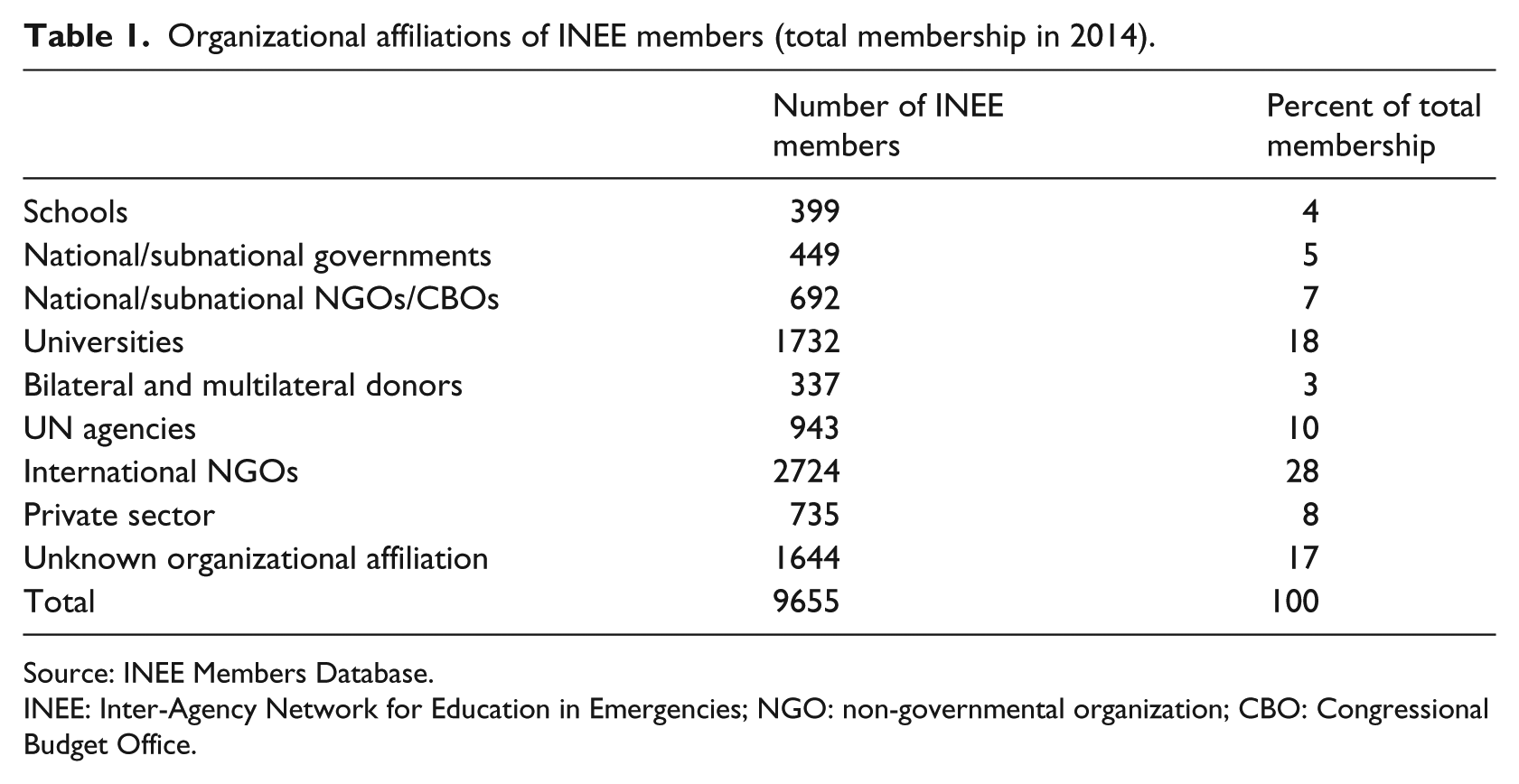
Source: INEE Members Database.
INEE: Inter-Agency Network for Education in Emergencies; NGO: non-governmental organization; CBO: Congressional Budget Office.
Clearly then, INEE memberships entail not monolithic linkages from global to local, but heterogeneous channels into multi-leveled social sites. The following section argues that the patterning of these diverse receptor sites is likely to vary cross-nationally in a systematic fashion.
Factors predicting receptor site patterns in the INEE
While little work centers on receptor sites, many studies examine nation-level factors that shape participation in INGOs (Boli and Thomas, 1997; Boli et al., 1999 Beckfield, 2003; Frank et al., 1999; Hughes et al., 2009; Paxton et al., 2015; Smith & Wiest, 2005, 2012; Tsutsui and Wotipka, 2004; Hughes et al., 2018). Drawing on insights from these studies, I argue below that the different types of country characteristics leading individuals to join the INEE are unlikely to generate membership growth from all receptor sites equally. I first outline the factors likely to shape membership growth overall, and then develop hypotheses about their differential effect on specific receptor sites.
One line of argument suggests that domestic social problems generate engagement with INGOs. For instance, individuals in repressive states may join human rights INGOs to tap into global networks of influence that will help them improve the human rights situation on the ground (Tsutsui and Wotipka, 2004). Research documents engagement with INGOs as a key strategy through which individuals connect with global actors to tackle local problems, including in situations of armed conflict (Swed, 2018). INGOs act as sources of information and expertise that can help build local capacities (Campbell et al., 2018). Many INGOs channel aid and services into local contexts; even those not directly involved in service and aid provision offer connections to funding sources (Watkins et al., 2012). INGOs also help locally based actors enforce global standards by linking them to international networks and channels of information (Keck and Sikkink, 1998; Tarrow, 2001). All these dynamics are especially pertinent in aid-receiving countries, where local actors rely on, and are often unable to disregard, global organizations in addressing domestic social problems (Smith and Wiest, 2005).
A rather different argument suggests that a country’s globally dominant position is a major factor in engendering INGO participation. Indeed, a consistent finding is that the global core tends to have the highest number of INGO ties. The West stands out most dramatically; numerous studies reveal that Western societies dominate INGO memberships, even controlling for country wealth (Beckfield, 2003; Hughes et al., 2009, 2018; Paxton et al., 2015). Notwithstanding normative diffusion, contemporary world culture originates in the West (Finnemore, 1996). This privileged status endows Western societies with inordinate influence over world culture, including via participation in INGOs, which represents a major avenue for asserting, shaping, and promoting normative ideals.
There is much reason to suspect that both factors are at work in producing country-level membership growth in the INEE. On one hand, individuals in countries with extensive emergency education needs are likely to join the INEE, especially in aid-dependent settings. A major focus for the network is to support individuals working on education in low income emergency-affected contexts. Although the INEE does not supply aid or services directly, it provides members with a variety of resources to help in emergency education programming, including training materials and implementation tools (INEE, 2016). It also carries out trainings in conflict and disaster zones, which beyond building local capacities may also offer opportunities to connect with global resources (Anderson and Mendenhall, 2005). On the other hand, dominance in world society is also likely to generate INEE memberships. The network is situated within the international aid sector, which is widely recognized as a key arena through which the core-periphery hierarchy is maintained and legitimized (Peet and Hartwick, 2015). While the circle of aid donors is broadening, Western countries continue to hold vast financial and cultural sway. INGOs in the sector are recognized as major channels of this influence and considered by some as a transmission belt extending world models from the core to the periphery (Schnable, 2015). These considerations suggest the baseline hypothesis:
H1. Individuals are likely to join the INEE at higher rates in Western countries and in countries affected by humanitarian crises, especially in aid-dependent settings.
The main focus of the article, however, is not on these country-level dynamics producing overall membership patterns, but on their varying importance in generating memberships from particular receptor site types. Indeed, the diverse receptor sites depicted in Table 1 are positioned rather differently vis-à-vis the two factors I emphasize. Two dimensions of difference in particular are useful for theorizing what receptor sites are likely to be associated with the different engines for membership growth: (1) the extent to which a given receptor site is involved in the implementation of emergency education programs and (2) a given receptor site’s influence on world culture (and specifically global emergency education norms).
Categorizing receptor sites along these two dimensions allows us to make predictions about where the different receptors are likely to be more or less prevalent. In countries affected by humanitarian crises, we are likely to see a higher presence of receptors directly involved in implementation. The literature reviewed above suggests that participation in the INEE in these types of settings is likely driven by local emergency education problems. Accordingly, it is reasonable to expect that the organizations most closely involved in addressing these problems would join at higher rates. Conversely, in Western countries we are likely to see a prevalence of receptor sites that are highly influential in the construction of global norms. If INGO memberships in the Western core reflect and reproduce its powerful role in the making and enforcement of world culture, it makes sense to surmise that receiving organizations that are influential in norm construction would dominate in these settings.
These considerations allow me to generate a number of hypotheses. Amid the receptor sites linked to the INEE, local schools, NGOs, and governments are likely to be most closely involved in emergency education programming on the ground. As the primary organizations providing education, schools are deeply embedded in local contexts of implementation. In this task, they are governed by local governments (e.g. education ministries) (Nicolai et al., 2015) and supported by local NGOs, which act as the main local implementers of aid programs (Watkins et al., 2012). At the same time, local schools, NGOs, and governments are some of the least influential organizational actors in the international aid industry. As the local “partners” of international donors, INGOs, and UN agencies, they are situated at the bottom of the international aid chain and tend to be on the receiving end of global norms and discourses (Fowler, 1998). While this is not to say that these local actors have no influence on global norms (see, for example, Tsutsui, 2017), their influence is much more marginal compared with the other receptor sites. Based on these considerations, I hypothesize the following:
H2. Local schools, NGOs, and governments are likely to be some of the most prevalent receptor sites in countries affected by humanitarian crises and some of the least prevalent receptor sites in Western countries.
On the opposite end of the spectrum, aid donors and universities are likely to be furthest removed from the implementation of emergency education. Generally, bilateral and multilateral aid donors (such as the US Agency for International Development or the World Bank) do not work at the operational level, but provide funds and loans to low income countries or sub-contracting organizations to implement projects. Primarily engaged in the production and dissemination of academic and professional knowledge, universities are similarly far removed from the actual implementation of emergency education programs. Unlike local schools, NGOs, and governments, however, donors and universities are extremely influential in the construction of global norms. Universities are integral in the process of theorizing global norms, that is, in providing scientifically legitimated accounts of world cultural scripts (Strang and Meyer, 1993). And donors are widely recognized to set world cultural agendas through their lending and assistance strategies, which determine the funding going into different areas (Morfit, 2011). These considerations suggest the following hypothesis:
H3. Donors and universities are likely to be some of the least prevalent receptor sites in countries affected by humanitarian crises and some of the most prevalent receptor sites in Western countries.
My final hypothesis suggests that UN agency and INGO receptor sites are likely to be similarly prevalent across all contexts of INEE membership growth. On one hand, UN agencies and INGOs are highly influential in norm construction. The United Nations is the primary site for high-level international deliberation and assumes a central role in defining global norms across many domains, for instance through UN resolutions (Barnett and Finnemore, 2004). Likewise, the influence of INGOs in shaping world culture is widely recognized, with INGOs “employing limited resources to make rules, set standards, [and] propagate principles” in world society (Boli and Thomas, 1997, 172). On the other hand, many INGOs and UN agencies also have a substantial field presence and are directly involved in implementation and coordination on the ground. This is especially true of UN agencies and international NGOs in the humanitarian sector (see, for example, Morris, 2008). These considerations indicate that INGO and UN receptor sites are likely to bridge the global sphere of norm construction with the local context of implementation: 3
H4. UN agencies and INGOs are likely to be similarly prevalent receptor sites across humanitarian crises and Western countries.
Before turning to data and methods, some qualifications are in order. First, I recognize that there are other factors driving INGO memberships. Most importantly, social movement theorists point to political opportunity structures (e.g. democracy) and availability of resources (e.g. economic development) (McAdam et al., 1996). My models simply control for these factors, as I do not expect them to be linked to specific receptor sites. Second, I consider country-level processes; my data do not capture the individual-level processes that lead a person to join. But we can imagine that these work in a manner consistent with my hypotheses. For instance, local teachers in emergency-affected schools might join the network to learn about best practices in educating refugees. In other scenarios, donor agencies might mandate local NGO staff to join to ensure adherence to INEE standards. While there are different processes at work, these scenarios fit with my theory of why implementers might join in humanitarian crises. Turning to the dominant world core, we can envision faculty in Western universities seeking connections for research projects focused on education in humanitarian crises or students looking for aid work in these places. Staff in donor, United Nations, and INGO headquarters might join to disseminate their strategies and position papers regarding emergency education. Again, a range of processes are possible, but it is reasonable to suggest that engagement by these receptors is grounded in their countries’ privileged position in world society, which positions them to promote world cultural ideals elsewhere (for instance through research and aid work).
Data and methods
Data
I use annual data on new INEE members, coded from anonymized membership profiles, obtained from the INEE secretariat. This is a new data source, which offers more information than the standard sources for INGO memberships, with members reporting not just their country of residence but also their organizational affiliation. While these data are unique to the INGO studied here, my data collection process is replicable with other organizations and domains.
Country of residence
Out of 10,861 members who joined between 2000 and 2014, 9911 (91%) contained information on their country of residence, which I coded. Using the UN list of recognized nation-states, I then calculated counts of new INEE members per country-year from 2009 to 2014; if a country had no new members in a given year, that observation was coded “0.” Unfortunately, country-year disaggregation is only possible starting in 2009. Until then, the network did not track what year an individual joined, meaning that for everyone who joined before it is only known that they joined between 2000 and 2008. 4 This makes it tricky to use the data prior to 2009 in regression analyses, as prior membership growth reflects past processes in unknown years, necessitating the restriction of the analysis from 2009 to 2014. However, as detailed below, I include a control variable for pre 2009 membership and, importantly, the years from 2009 to 2014 capture the vast majority of members, given accelerating membership growth. After dropping several countries due to a lack of covariate data, my dataset thus captured a substantial number of INEE members (7919). My balanced final panel dataset consisted of 160 countries with six observations (i.e. years) each (total N = 960). 5
Organizational affiliation
I was able to determine organizational affiliations for 6417 (81%) of the 7919 INEE members contained in my final panel dataset. Wherever a member provided an organization name as their affiliation (not all filled in this information), I coded it according to the receptor site categories displayed in Table 1 (for coding detail, see Appendix 1). 6 In many cases, I could classify organizations easily as they were well-known agencies or very obviously fell into one category. In other cases, I conducted online searches to find information about the organization that allowed me to categorize it. As my typology is relatively simple, I did not need much information. However, if I was unable to find information about the organization after a reasonable online search, I coded a member’s affiliation as unknown. The typology glosses over important differences; however, a more fine-grained classification was simply not possible. For each type of organization, a country count of new members per year (2009–2014) was calculated and merged into my country-year dataset.7,8
Measures
Dependent variables
The dependent variable used to test my first hypothesis is a count of how many new INEE members there are in each country-year from 2009 to 2014. To test Hypotheses 2 through 4, the dependent variables used are counts of how many new INEE members there are in each country-year from a given receptor site type from 2009 to 2014.
Independent variables
Humanitarian crisis
As articulated in my hypotheses, I expect a country’s affliction by a humanitarian emergency to generate INEE membership growth (although I argue that this factor is more important for some receptors than others). To test this idea, I employ a number of different variables. Considering that emergency education programs primarily target displaced children, I test time-varying measures of the numbers of IDPs (Internal Displacement Monitoring Center (IDMC), various years) and refugees hosted by a country (UNHCR, various years). I standardize these displacement variables by a country’s population (World Bank, 2015) and log the resultant variables to reduce skewness. 9 Second, I consider the idea that humanitarian crises might generate engagement especially in places financially dependent on the global system. I thus test a time-varying variable that measures whether a country is under a UN humanitarian appeal in a given year, which connotes a global appeal for funds issued by the United Nations in the context of a humanitarian crisis (United Nations Office for the Coordination of Humanitarian Affairs (UNOCHA), 2016). In earlier models not reported here, I also tested measures for whether a country is experiencing a natural disaster or armed conflict. These variables were never significant and did not change my substantive results. I thus exclude them from the analyses presented here, although results are available upon request.
Western country
A second key idea tested in my hypotheses is that Western cultural status is likely to generate membership growth (although again this factor is likely to produce varying growth among receptors). My variable for West is a non-time-varying dichotomous indicator measuring whether a country is in North America, Western, Northern and Southern Europe, or Australia and New Zealand (World Bank, 2015).
Control variables
All analyses include a number of controls. First, I control for a country’s size by including a logged time-varying continuous variable measuring population (World Bank, 2015). Second, the social movement literature indicates that political opportunity structures and availability of resources matter for civil society participation. I thus control for a country’s political regime using the combined polity score from the Polity IV Project, which is a time-varying variable ranging from −10 indicating a complete autocracy to 10 indicating a complete democracy (Marshall et al., 2016). I also control for gross domestic product (GDP) per capita (World Bank, 2015); this variable is logged to reduce skewness. Finally, given that I am only able to measure membership growth starting in 2009, I control for prior patterns through a binary variable for whether a country had no members (of a given receptor site type) in 2008. Table 2 lists descriptive statistics for all predictors and controls.
Descriptive statistics for covariates (N = 960).
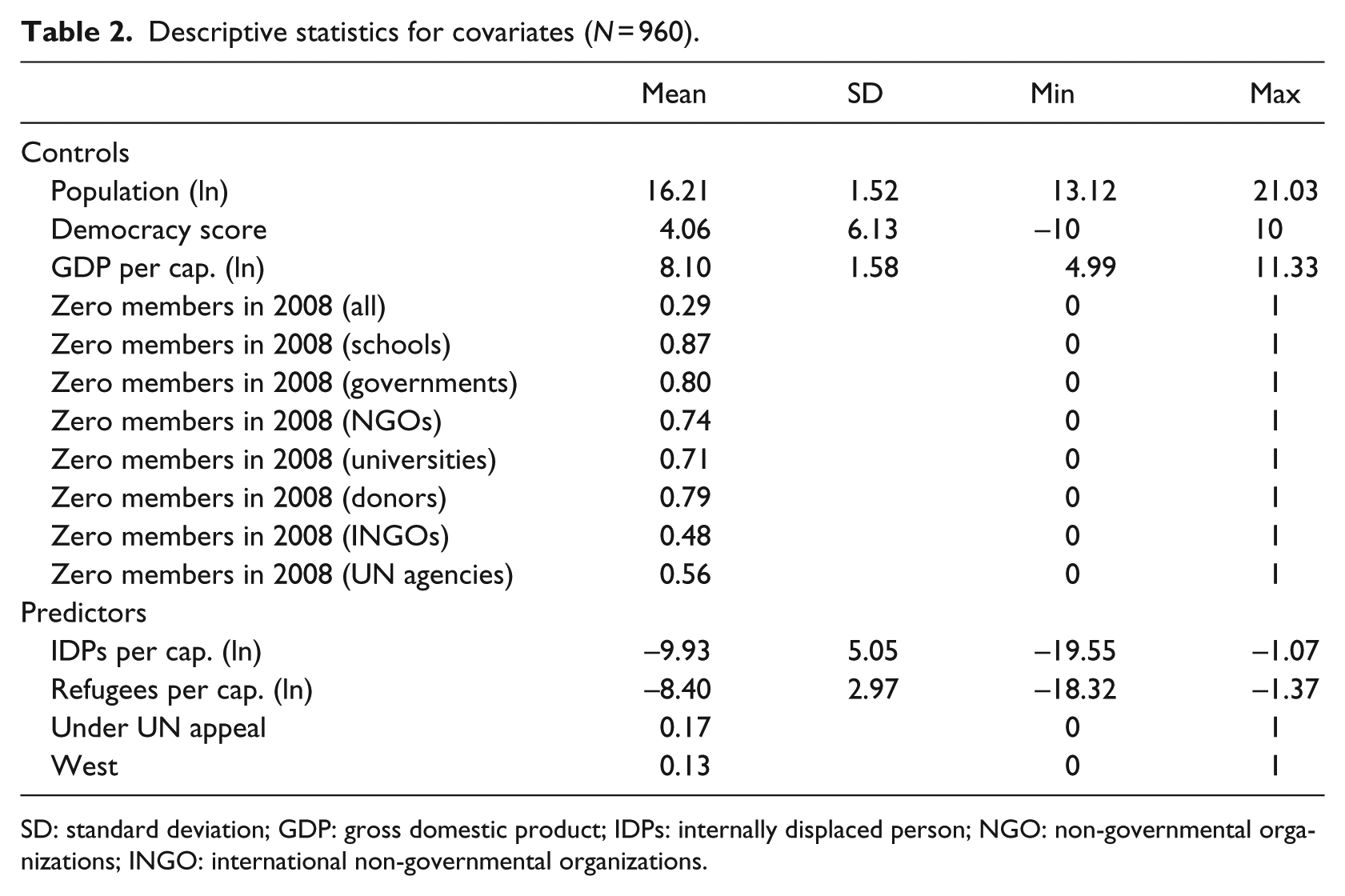
SD: standard deviation; GDP: gross domestic product; IDPs: internally displaced person; NGO: non-governmental organizations; INGO: international non-governmental organizations.
Model
My dependent variables consist of counts and may thus in principle be modeled as following the Poisson distribution. However, the Poisson model assumes equidispersion, meaning that the conditional mean is equal to the conditional variance (Long, 1997). This assumption is violated in my data, which is overdispersed. I instead use the negative binomial model, which relaxes this assumption by adding a parameter of overdispersion. I also consider the panel structure of my data and use a random-effects negative binomial model, appropriate for overdispersed panel count data. 10
All models report incidence rate ratios (exponentiated coefficients); values above 1 signify positive associations and below 1 negative ones. For example, a value of “1.04” would mean that each unit increase in the predictor increases the expected annual count of new members by a factor of 1.04 or 4%. A value of “0.30” would mean that each unit increase in the predictor decreases the expected annual count of new members by a factor of 0.30 or 70%.
Findings
Table 3 presents the results of the analyses. Models 1a through 1d present the overall model to test Hypothesis 1; the dependent variable in these models is a country-year count of new members from all types of organizations. Model 1a includes simply my controls. Model 1b then tests the variables for a country’s affliction by humanitarian crises (IDPs, refugees, and the appeal variable) and Model 1c the variable for Western cultural status. Model 1d is the full model. Models 2 through 8 then present the analyses disaggregated by organizational affiliation, using the full model (Model 1d), in order to test Hypotheses 2 through 4. The dependent variables for these models are annual counts of new members affiliated with the following: schools (Model 2), national and subnational NGOs/CBOs (Model 3), national and subnational governments (Model 4), universities (Model 5), bilateral and multilateral donors (Model 6), international NGOs (Model 7), and UN agencies (Model 8).
Random-effects negative binomial models predicting counts of new INEE members, 2009–2014.
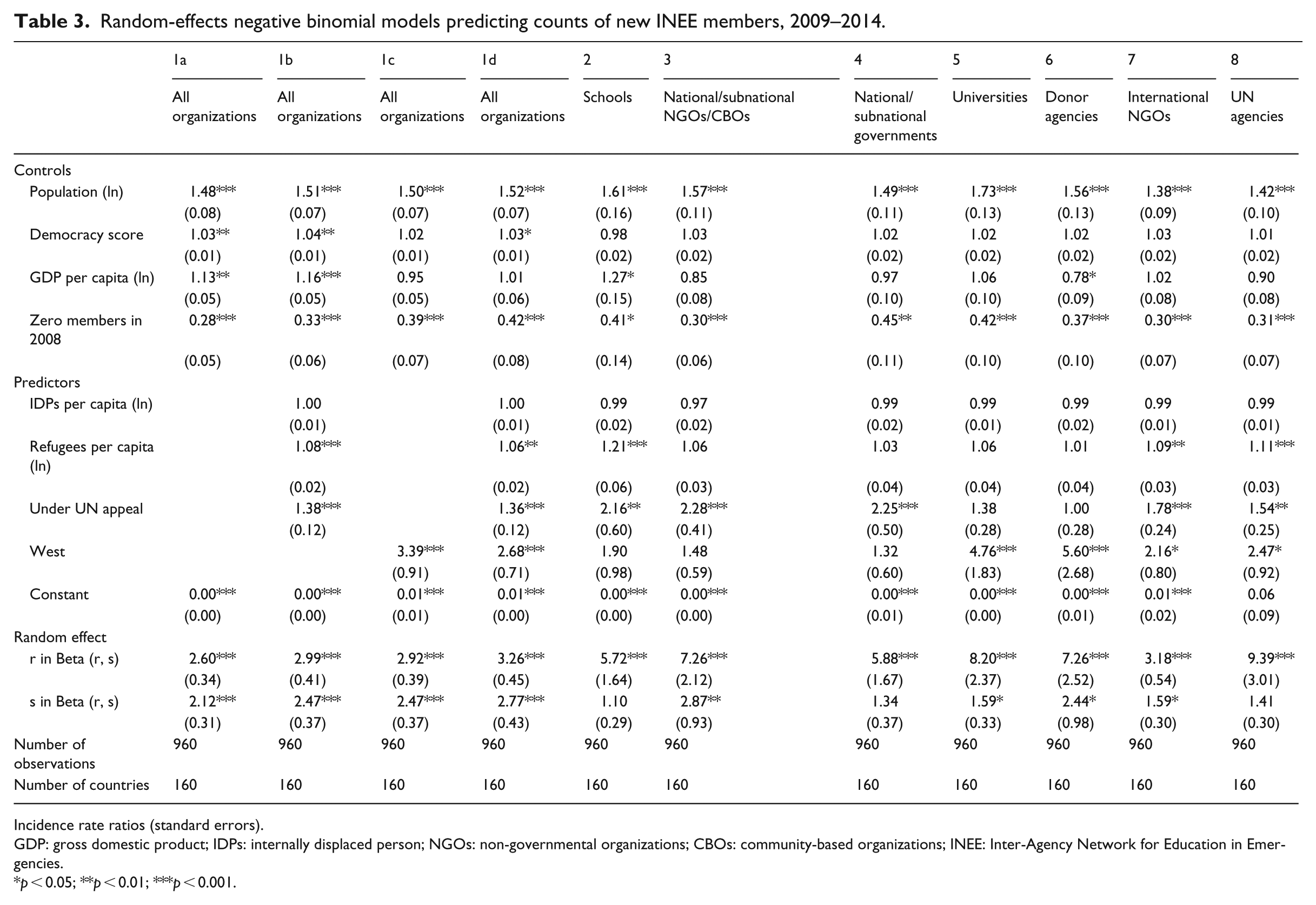
Incidence rate ratios (standard errors).
GDP: gross domestic product; IDPs: internally displaced person; NGOs: non-governmental organizations; CBOs: community-based organizations; INEE: Inter-Agency Network for Education in Emergencies.
p < 0.05; **p < 0.01; ***p < 0.001.
The overall patterns shown in Models 1a through 1d offer support for Hypothesis 1, but also indicate that not all types of humanitarian crises matter equally in driving INEE membership growth. Interestingly, the IDP variable is not significant; only the variable capturing refugee displacement and the humanitarian appeal variable have a positive and significant association with the outcome. The finding fits with the idea, suggested above, that INGO ties serve as tools for addressing local problems especially in contexts that are dependent on world society. A UN appeal by definition indicates a considerable national dependence on international aid in the context of a humanitarian emergency. And refugee crises see populations spilled across national borders, which may overwhelm local capacities. Model 1c shows that the variable for West is large, positive, and highly significant. Entering all predictors in one model (1d) confirms my findings; individuals are joining the INEE at especially high rates from countries dealing with refugee crises, from countries under a UN appeal, and from Western countries. My controls work as predicted, although the GDP variable loses significance in the full model.
I now turn to my main models of interest. In line with my overall argument, Models 2 through 8 reveal striking differences when comparing the effects of predictors across receptor sites. I begin with Models 2 through 4, which capture local schools, NGOs, and governments and allow me to examine support for Hypothesis 2. As shown in Model 2, the rate at which individuals affiliated with schools join the INEE is positively and statistically significantly associated with the variables for refugee displacement and appeal. Similarly, Models 3 and 4 show the appeal variable to have a positive and significant association with new members joining from local governments and NGOs. Clearly, local schools, NGOs, and governments overall tend to be highly prevalent receptor sites in the types of humanitarian crises that generate INEE memberships overall. It is interesting that the refugee variable is significant for schools, but not for governments and NGOs, suggesting that involvement by these latter receptor sites might be substantially driven by aid dependence. Strikingly, the Western variable is no longer significant in Models 2, 3, and 4. These findings are not simply an artifact of fewer schools, NGOs, or education ministries existing in the West, as there is no reason to assume that fewer organizations of these types exist in the West than in humanitarian settings. Instead, they fit with my argument that the culturally dominant West is not a significant source of membership growth from less influential receptor sites. Overall, Hypothesis 2 is supported.
Next I consider Models 5 and 6 which examine membership held by individuals based at universities and donor agencies. Focus on these receptor sites reveals a radically different picture. The main predictor of membership growth from people based at universities and donors is the variable for West; its coefficient is large, positive, and significant. Specifically, a country being categorized as West increases the rate at which people from university and donor receptor sites join the INEE around fivefold. Evidently, these types of receptors are extremely prevalent in the Western sphere. In striking contrast, none of the variables measuring humanitarian crises are significant. This finding may seem like the obvious result of local organizational landscapes, such as fewer universities existing in humanitarian settings or donor agencies being based in the West. Yet my findings persist even when controlling for university enrollments, and it is worth remembering that donor agencies not only have headquarters in the West, but also local missions in the countries where aid is delivered. Examination of select donors suggests that for some donors, staff in local missions participate at lower rates than headquarters staff. For instance, 22 INEE members working at the US Agency for International Development (USAID) are based in the United States, compared with 17 USAID staff spread across 14 country offices. The World Bank has 10 INEE members based in the United States, compared with 6 members spread across six country offices. Considering that USAID and the World Bank each have over 100 country offices, the representation of these offices in the INEE seems rather low. It looks like the regional distribution of donor offices is not the full story in explaining the salience of donor receptors in the West. Overall, Hypothesis 3 is also supported.
Contrasting with these variations, it is only when we get to the final two models that we see consistency with the overall membership patterns. Models 7 and 8 indicate that members based at international NGOs and UN agencies join the INEE at significantly higher rates from all three main settings; the variables for West, refugee displacement, and UN appeal are all positive and significant. 11 Hypothesis 4 thus receives support; UN agencies and INGOs appear to be similarly prevalent receptor sites not just in refugee crises and humanitarian appeals, but also in the dominant Western core of world society.
A qualitative example helps to illustrate these quantitative findings. The Netherlands (a Western country) and Côte d’Ivoire (a country that was under a UN appeal for 5 out of the 6 years studied here) experienced very comparable membership growth, with the Netherlands registering 129 total members by 2014 and Côte d’Ivoire 134. But affiliations differ greatly. Only about half a percent of the members in the Netherlands with a known organizational affiliation reported working at a school or a local government or NGO; in Côte d’Ivoire the number is 45%. In sharp contrast, around 37% of members in the Netherlands reported an affiliation with universities or donors; in Côte d’Ivoire only around half a percent did. Compared with these divergent patterns, the percentages are very similar for members reporting an affiliation with UN agencies or international NGOs: 45% in the Netherlands and 46% in Côte d’Ivoire.
Discussion
Previously a sporadic endeavor, education in emergencies has become an increasingly prioritized domain for world society intervention, complete with newly developed global standards and best practices. My findings illuminate the multi-leveled and locally divergent pathways through which this new world cultural imperative is diffused, with important implications for diffusion outcomes and processes in this field and beyond. While I am unable to investigate these implications with my data, they represent valuable areas for future research.
Receptor sites are broadly conceived as intermediary bodies that help institutionalize global norms into their local environments. As such, the cross-national diversity of receptor sites studied here may well result in divergent patterns of norm institutionalization. In countries dealing with refugee crises and those under a UN humanitarian appeal, the prevalence of local school, NGO, and government receptors may institutionalize global standards primarily in local educational practice, policy, and advocacy. This institutionalization is likely to take different forms, depending on the local context. Where relevant programs and policies already exist, global norms might apply isomorphic pressures, bringing what earlier were locally embedded projects in line with global models. For instance, schools might mandate teachers to utilize the INEE’s standards or NGOs might draw on global “best practices” in their emergency education projects. In places with very few or no prior initiatives, we might see the creation of new emergency education programs or the expansion of existing ones. Importantly, however, patterns might look very different in the West, where donors and universities may funnel norms into funding mechanisms, for instance, by mandating the use of INEE standards in projects, and into academia, for instance, by developing teaching and research programs on the issue.
These patterns may also provide Western countries and humanitarian crisis settings with unequal influence over global emergency education models. Much of the literature conceives of the global–local interplay in a unidirectional manner, wherein INGOs broadcast global norms to locally based receptors. Recent work, however, emphasizes that receptor sites also contribute to global norms by consolidating and expanding them (Tsutsui, 2017). Critically, my argument implies that the different types of receptors studied here may not be equally positioned to help shape global norms in this manner. On one hand, the translation work of universities and donors affords them with substantial normative influence (I here conceive of translation work as the activities through which receptor sites translate global norms). If these receptors indeed channel the INEE’s materials into foreign aid agendas and university programs, they are likely to help shape these norms in influential ways. For example, universities might construct shared theoretical understandings around them. On the other hand, the translation work of the receptors prevalent in humanitarian crises grants them a more limited influence over global norms. As these sites translate INEE materials into local policy, practice, and advocacy they might largely be consuming global norms even as they “edit” and “domesticate” them (Sahlin and Wedlin, 2008). In part because of receptor configurations, humanitarian crisis settings might thus be positioned to largely receive global norms, whereas the West might be positioned to help construct them. These patterns are likely to affect the content of the scripts themselves. The places arguably most able to determine “best practices” in emergency education, that is, humanitarian crisis zones, might be least involved in their definition. Instead, the content of these models may in great part be shaped from afar—in the Western centers of world society. This is an important insight, pointing to cross-national variation in receptor sites as one mechanism through which INGOs may reproduce Western world cultural influence.
At the same time, this imagery is complicated by the cross-national distribution of United Nations and international NGO receptor sites. As hypothesized, these receptors were found to be similarly prevalent across humanitarian-type settings and the Western core. They can be unique receptor sites because they are oriented toward both local implementation and global norm construction. By virtue of that dual role, they might offer important channels through which humanitarian settings are able to contribute to the construction of global norms. Although INGOs and UN agencies might funnel the norms flowing from the INEE into programming on the ground, they might also translate them “upward” into high-level global discourse and global civil society, thus perhaps carrying insights from the field into norm construction. In addition, it is worth noting that all INEE members are periodically invited to participate in consultations, which feed into the network’s materials, including its influential minimum standards. While only a small proportion of members actively participate in this way, this suggests that there are feedback loops whereby local implementers can contribute their knowledge into global emergency education models, despite representing otherwise less influential receptor sites.
Future research might explore such connections between receptor site patterns and global inequalities in greater detail. To better understand possible differences in the nature of INGO ties in the North versus the South, future analyses could examine membership processes and receptor site patterns in these contexts in separate samples. My use of the West variable to demarcate this difference offers some evidence that receptor sites may be different in the West than elsewhere, but it does not tell us whether the factors driving membership growth also differ between the North and the South. Extant literature on inequality in world society suggests this may well be the case, pointing to the usefulness of considering the North and South in separate models. Related, future analyses could use detailed measures of foreign aid to better understand the ways in which aid giving or receiving mediates the patterns I observe. As I note throughout my findings, the types of humanitarian crises that appear to generate INEE memberships suggest that aid dependence might be at work in producing membership growth from implementing receptor site types. Similarly, growth from donor receptors might be driven by a country’s provision of foreign assistance. While my analyses offer some insight into the issue through the UN appeal variable, they do not fully address it, leaving this as an important area for future research.
My findings also expand on the literature by showing that diffusion processes may often operate through world society receptor sites rather than purely local ones. With world society increasingly entwined with local contexts, international organizations seem to act as important locally based receptors, at least in this field. This finding speaks to the growing recognition that a straightforward global–local imagery of diffusion is too simplistic. International organizations establish local offices and increasingly hire local staff, in addition to employing expatriates, blurring the distinctions between the global and the local. My findings highlight that world society structures may be some of the most pervasive receptor sites worldwide, challenging the literature’s still dominant conception of receptor sites as “local.”
Of course, the patterns, predictors, and specific implications may be quite different in other world society domains. An important area for future research is thus to replicate these types of analyses examining different INGOs and fields for diffusion. Cross-national receptor site diversity is likely a fairly common phenomenon. And my argument that distinct receptors are associated with different factors generating INGO participation can certainly be extended to other empirical settings. Nonetheless, comparisons of patterns and predictors across diverse domains and organizations would greatly enhance our understanding of what patterns might be domain- or organization-specific and which ones might not.
As a first point of interest, there might be variation in terms of how diverse the collection of receptor sites is. INEE membership is open to anyone, but membership criteria in other INGOs might be more restrictive, narrowing the range of receptors. We could also envision a restricted range of receptor sites in highly technical and specialized areas, such as some scientific domains. Conversely, we might expect an even more diverse receptor site landscape if we were to examine an INGO with a broader focus (such as a general humanitarian INGO) or the generic collection of INGOs, which is likely linked to an enormous diversity of receptor sites. In short, receptor site landscapes may be more or less multi-sited than the case examined here. Second, we should expect differences in the specific types of receptors represented, as some of them are contingent on domain. For example, outside of education, schools are less likely to be involved. Moreover, the extent to which global organizations act as locally based receptors likely varies depending on how integral a domain is to world society.
Finally, the specific predictors linked to INGO membership and their association with specific receptors might also look quite different in other settings. Various forms of domestic social problems likely affect receptor site constellations in INGOs focused on specific issue areas, but they might be less consequential in INGOs with more diffuse goals. Likewise, global hierarchy may be less consequential in domains that are less tightly mapped onto global inequalities than the aid industry. Finally, dynamics not considered here might shape receptor site patterns in other domains. For instance, economic development might matter in domains or organizations that require resources to participate and political opportunities might differentially affect receptors in contentious domains (for instance, local human rights NGOs might be disproportionately prevented from joining human rights INGOs under repressive regimes).
Conclusion
In their review of the diffusion literature, Dobbin et al. (2007) called for more attention to the specific diffusion mechanisms operating across countries. My findings speak to this important issue, specifically in relation to INGO memberships as a widely theorized mechanism for world cultural diffusion. The dominant approach in the literature is to count INGO ties cross-nationally to gauge the receptiveness of a given context to world cultural pressures. Counting memberships, however, does not tell us much about who is doing the receiving in different places. Recent literature highlights the multi-leveled and multi-sited nature of global diffusion processes. Hironaka (2014) captures this through her “bee swarm” imagery with world society pressures representing “myriad influences applied asymmetrically” (p. 159), allowing for much heterogeneity across a given field for world society activity.
Building on this insight, I contribute to the literature by documenting substantial cross-national differences in the constellation of receptor sites in the education sector and demonstrating some of the mechanisms that produce this variation. INGO memberships and associated receptor sites are thus not only laterally variable, but vertically as well, generating much heterogeneity in the channels for diffusion. As others already observed, the institutional structure of world society involves substantial variation and nesting (Pope and Meyer, 2016). In simply counting INGO memberships laterally, we might therefore be obscuring a number of different and locally variant pathways for diffusion. While world society theory was born out of the recognition that existing theories failed to account for the many similarities in our world, recent scholarship complements this insight with the theorization of difference and complexity in world cultural diffusion (see, for example, Bromley, 2014; Pope and Lim, 2017). This article builds on and contributes to this important body of work.
Footnotes
Appendix 1
Receptor sites—coding typology.
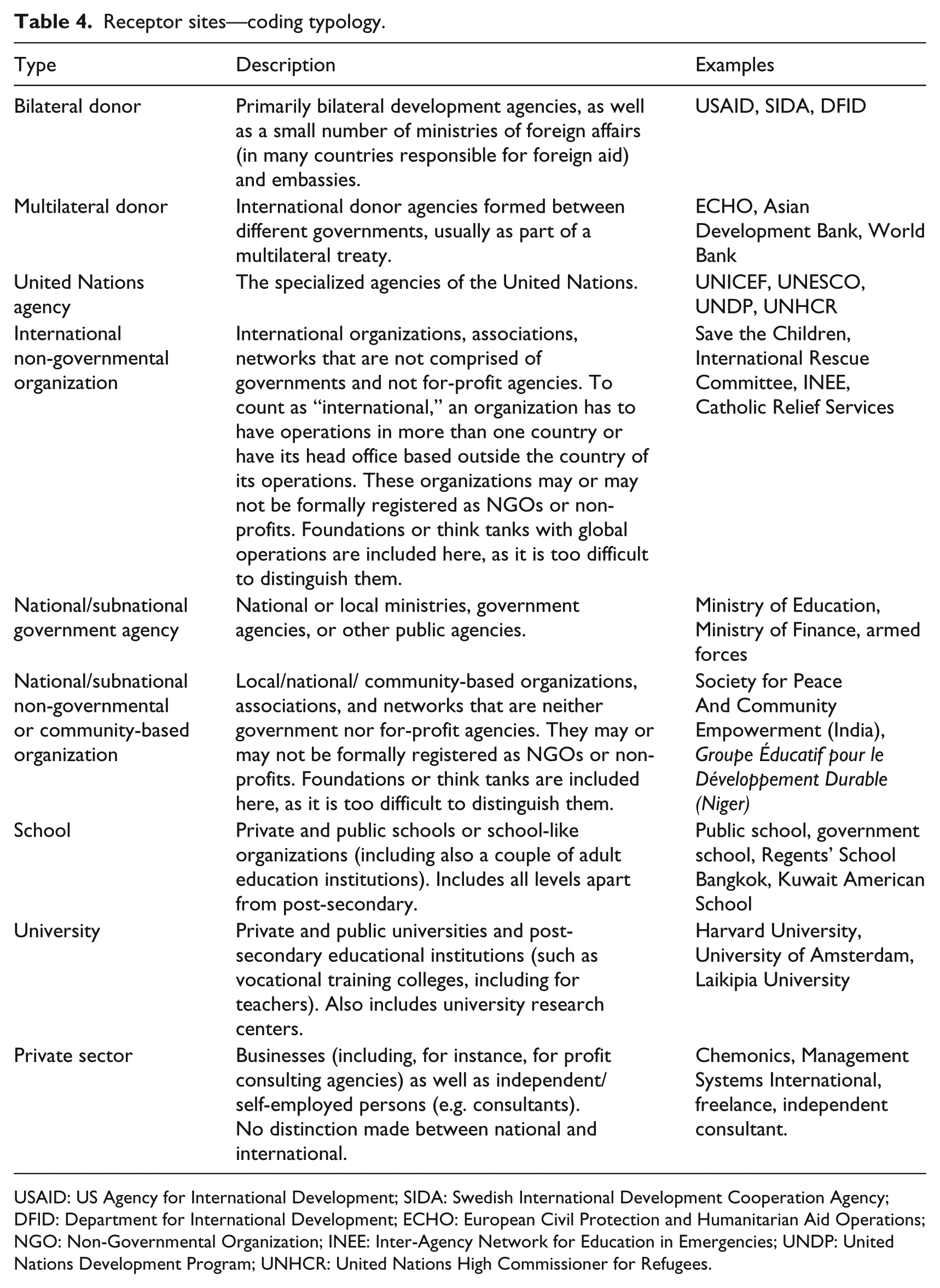
| Type | Description | Examples |
|---|---|---|
| Bilateral donor | Primarily bilateral development agencies, as well as a small number of ministries of foreign affairs (in many countries responsible for foreign aid) and embassies. | USAID, SIDA, DFID |
| Multilateral donor | International donor agencies formed between different governments, usually as part of a multilateral treaty. | ECHO, Asian Development Bank, World Bank |
| United Nations agency | The specialized agencies of the United Nations. | UNICEF, UNESCO, UNDP, UNHCR |
| International non-governmental organization | International organizations, associations, networks that are not comprised of governments and not for-profit agencies. To count as “international,” an organization has to have operations in more than one country or have its head office based outside the country of its operations. These organizations may or may not be formally registered as NGOs or non-profits. Foundations or think tanks with global operations are included here, as it is too difficult to distinguish them. | Save the Children, International Rescue Committee, INEE, Catholic Relief Services |
| National/subnational government agency | National or local ministries, government agencies, or other public agencies. | Ministry of Education, Ministry of Finance, armed forces |
| National/subnational non-governmental or community-based organization | Local/national/ community-based organizations, associations, and networks that are neither government nor for-profit agencies. They may or may not be formally registered as NGOs or non-profits. Foundations or think tanks are included here, as it is too difficult to distinguish them. | Society for Peace And Community Empowerment (India), Groupe Éducatif pour le Développement Durable (Niger) |
| School | Private and public schools or school-like organizations (including also a couple of adult education institutions). Includes all levels apart from post-secondary. | Public school, government school, Regents’ School Bangkok, Kuwait American School |
| University | Private and public universities and post-secondary educational institutions (such as vocational training colleges, including for teachers). Also includes university research centers. | Harvard University, University of Amsterdam, Laikipia University |
| Private sector | Businesses (including, for instance, for profit consulting agencies) as well as independent/self-employed persons (e.g. consultants). No distinction made between national and international. | Chemonics, Management Systems International, freelance, independent consultant. |
USAID: US Agency for International Development; SIDA: Swedish International Development Cooperation Agency; DFID: Department for International Development; ECHO: European Civil Protection and Humanitarian Aid Operations; NGO: Non-Governmental Organization; INEE: Inter-Agency Network for Education in Emergencies; UNDP: United Nations Development Program; UNHCR: United Nations High Commissioner for Refugees.
Acknowledgements
Many thanks go to John W. Meyer, Francisco O. Ramirez, Christine Min Wotipka, and Elizabeth Buckner for insightful feedback on several drafts and to Woody Powell, Patricia Bromley, Garnett Russell, and Evan Schofer for generous feedback on the project. I would also like to thank the editor and anonymous referees for their helpful insights. In addition, the article benefited from useful comments and related work by participants in Stanford’s and UCI’s Comparative Sociology Workshops. The data analyzed come from the Inter-Agency Network for Education in Emergencies, whose secretariat has been extraordinarily helpful.
Funding
The author(s) received no financial support for the research, authorship, and/or publication of this article.
