



Abstract
This article examines the links between education, democratic values, and political trust. Research on education systems as carriers of modern orientations and democratic values worldwide predicts that educated individuals will exhibit more democratic values than less educated ones, regardless of the country’s level of democracy. In the political culture approach, political trust can be understood as a reflection of the congruence or incongruence between individual democratic values and the level of democracy of the political system, which emphasizes trust’s relational character. Integrating these strands of literature, I formulate hypotheses about the mediating effect of democratic values between education and political trust. To test these hypotheses, I employ multilevel models of data from the World Values Survey and the European Values Study covering 73 countries. The results show that democratic values partially mediate the effect of education on political trust, but the magnitude of this effect depends on the level of democracy. Analyses also show that, while education is positively associated with democratic values regardless of the country’s level of democracy, this association is much stronger in democratic countries than in non-democratic ones.
Keywords
Introduction
Political trust is an essential ingredient for sustaining and strengthening political institutions and a key source of stability and legitimacy for political systems (Easton, 1975; Norris, 2002; Putnam, 2000). Multiple studies in democratic countries, primarily in Europe, have found a positive association between education and political trust (e.g. Bäck and Kestilä, 2009; Berg and Hjerm, 2010; Hooghe et al., 2017; Van Der Meer, 2010). This is in line with the general expectation that educated individuals have more of the “good” values and attitudes than those with less education (Almond and Verba, 1963; Converse, 1972), and supports the notion of political trust as a desirable property of individuals and societies. Meanwhile, analyses conducted outside Western Europe provide less consistent evidence, and find education either to be negatively associated (former Soviet republics, Latin America, and Sub-Saharan Africa) or not associated with political trust (new Eastern European democracies; Catterberg and Moreno, 2005; Mattes and Moreno, 2018). These irregularities have only recently attracted the attention of social scientists, perhaps because education as an individual-level predictor typically serves as a control variable and is at best reported in passing or not at all. An exception to this rule is the analysis of survey data from Europe by Hakhverdian and Mayne (2012), which explicitly focused on the effect of education on political trust and found that it depended—both the magnitude and direction—on the pervasiveness of public sector corruption. The authors attributed this to the “norm-inducing” and “accuracy-inducing” function of schools and their socializing role, suggesting that national education systems promote values represented by their polities.
The theoretical model developed in the present article proposes that education systems promote democratic orientations regardless of the type of political regime, which becomes visible when extending the analysis beyond the Western, Educated, Industrialized, Rich, and Democratic (WEIRD) zone. 1 In this model, the early or deeper adoption of democratic values, orientations, and aspirations by the more highly educated strata of populations leads to systematic patterns of congruence or incongruence between individual values and values of the political system, reflected in the levels of political trust. In institutionalized democracies, the congruence in values will be higher among the more educated strata than among the less educated, which will lead to greater political trust in the first group compared to the latter. In non-democratic countries, where free and fair elections are not present, and civil liberties and political rights are not respected, the situation will be the opposite: values–structure congruence will be lower among the more educated, and higher among the less educated, so in this case, more highly educated citizens will have less trust in state institutions. In other words, the theoretical model presented in this article proposes that democratic values serve as a mediator between education and political trust and that this mediation effect is moderated by the country’s level of democracy.
I test the consecutive steps of this model with combined data from three waves of the World Values Survey (WVS) and European Values Study (EVS). The results provide support for the hypothesized relationships and point to new insights. First, as expected, education is positively associated with democratic values regardless of a country’s level of democracy. This positive association grows stronger as the level of democracy increases, a finding that invites further investigation. Second, the association between democratic values and political trust is positive in democratic countries and negative in non-democratic countries. Third, the results point to the partial mediation effect of education on political trust by democratic values, which is considerably stronger among full democracies compared to non-democratic countries.
Beyond these specific results, this article makes a number of broader contributions. First, it adds to the understanding of the sources political trust, a key factor for effective governance and policy-making (Letki, 2006; Marien and Hooghe, 2011; Scholz and Lubell, 1998). By showing how political trust depends on the combination of characteristics of the truster and the trustee, this study improves our theoretical understanding of the evaluative nature of political trust and its relational character: political trust is a result of the evaluation of the object of trust relative to the values or preferences of the citizen. Second, the results suggest that the normative understanding of political trust as a condition for and product of democracy does not hold universally. In non-democratic countries, high political trust is associated with low levels of democratic values, thus providing a support base for the status quo and possibly inhibiting democratic change. Third, this study highlights the crucial role of education in the global dissemination of democratic values and attitudes. By establishing what seems to be a universal positive effect of education on democratic values, it provides a foundation for future research to build on. Relatedly, the global scope of this analysis and the inclusion of non-democracies make it possible to distinguish between education as a carrier of values represented by the national polity and as a carrier of values promoted by the world society. In doing so, it demonstrates the advantages of large-scale cross-national research. Finally, this study points to the importance of cross-national research that examines within-country associations instead of focusing on between-country differences in levels of selected characteristics, and the opportunities this analytic strategy creates.
Democratic values, education, and political trust
Scholars in the political culture tradition emphasize the role of value orientations and community cohesion around shared values for shaping political trust (Almond and Verba, 1963; Newton, 1997; Ostrom, 1990; Rose, 1994). A fundamentally relational concept (Hardin, 2002), trust emerges from the interaction between properties of the subject and the object of trust. Political trust is therefore derived from the citizens’ agreement with values represented by the state, and “the beliefs citizens hold about the normative appropriateness of government structures, officials, and processes” (Levi et al., 2009). Consequently, if high trust in state institutions signals high congruence between citizens’ values and values represented by the political system, in institutionalized democracies, trust would be highest among the most democratically oriented individuals. On the other hand, in countries where democratic standards are violated, individuals with high democratic values would have low political trust. Empirical research supports these claims showing that the association between democratic value orientations and political trust depends on the country’s democratic performance (Mauk, 2019).
When considering the sources of democratic values, decades of research point to education as their strongest and most consistent predictor (Almond and Verba, 1963; McClosky and Zaller, 1984; Miller, 2017). Studies also repeatedly show that better educated persons hold more liberal values, including preferences for equality and tolerance (Bobo and Licari, 1989; Hyman and Wright, 1979; Nie et al., 1996; Stouffer, 1955), and an aversion to radical right-wing parties (Cornelis et al., 2015; Lubbers et al., 2002). There are several ways in which education could make individuals more democratically oriented, many of them indirect. Some researchers emphasize the cognitive benefits of education including improved access to information and the ability to process and use that information when making judgments (Ceci, 1991; Marks, 2013; Winship and Korenman, 1997). Educated individuals have better knowledge of the political system and the role of individual institutions and can more accurately evaluate their performance. In the case of under-performance, they are better equipped to take action. Along with technological innovations that reduce the cost of acquiring information, the growth of education is the other main process that leads to cognitive engagement (Barnes and Kaase, 1979).
Educated individuals also have more diverse social networks and are more likely to encounter individuals with ideas different from their own (Bian, 2008; Stouffer, 1955). They tend to have a better command of foreign languages and better communication skills (Green, 2001). In the course of formal education, especially at university, people are exposed to ideas and theories, learn to connect abstract concepts to reality, as well as to distinguish between ideas and practice (Prothro and Grigg, 1960), between the institutions and the incumbents (Carpini and Keeter, 1993; Hibbing and Theiss-Morse, 1995), and between the roles and responsibilities of different institutions (Wu and Wilkes, 2018).
Education is associated with more political competence (Milligan et al., 2004), but although civics classes have been shown to improve political knowledge, there is little evidence for the effect of specific curricular factors on tolerance or democratic attitudes (e.g. Finkel and Ernst, 2005 in South Africa; Morduchowicz et al., 1996 in Argentina; Niemi and Junn, 1998 in the United States; Slomcyznski and Shabad, 1998 in Poland; Westholm et al., 1990 in Sweden). It thus seems that the influence of education on democratic values is unrelated to the inclusion or exclusion of specific civic educational content, and rather associated with cognitive sophistication, self-esteem, and abstract thinking, all of which are developed in the course of formal education.
Research on political participation and attitudes is concentrated among at least nominally democratic countries, so the question remains whether the positive link between education and democratic values also holds in non-democratic contexts. According to functionalist theories, institutions emerge and expand responding to internal needs. Since nations have immediate control over schooling, national education systems should instill values represented by their polities in order to raise loyal citizens. Thus, the direction of the association between education and democratic values would vary across countries, and in particular, depend on the country’s level of democracy.
World society theory, on the other hand, draws attention to the role of education systems as a product of worldwide diffusion of a common global culture (Boli and Thomas, 1997; Meyer et al., 1997). Mass schooling is a vital element of world society and serves as a carrier of global cultural messages, including the promotion of values such as individualism or human rights (Bromley et al., 2011; Meyer et al., 1997, 2010; Ramirez et al., 2016). The standardization of organizational forms and curricular content includes, among others, the instruction of foreign languages and developing cognitive capacities such as problem solving and abstract thinking that are all part of “modern education.” Consequently, individuals who are exposed to these ideas and norms for a longer time, should have internalized them to a greater extent than those with less education (Roberts, 2019), resulting in a positive association between education and democratic values regardless of the type of political regime. 2
Supporting the world society hypothesis, studies in non-democratic countries have consistently found a positive link between education and democratic values 3 (Chunlong, 2004: China; Evans and Rose, 2007a: Malawi; Jamal, 2006: Egypt and Jordan; Kotzian, 2011). The positive effect of education on the endorsement of democratic procedures is present even if the education itself took place under a non-democratic regime, and even when looking only at the effect of primary school completion (Evans and Rose, 2007a, 2007b). Broad cross-national studies provide further evidence of the positive association between education and democratic values in countries at all levels of democracy (Chong and Gradstein, 2015).
Hypotheses
I started from the puzzling observation that the association between political trust and education is strongly positive in institutionalized democracies and declines as the level of democracy decreases to become negative in non-democratic countries. Building on prior research in the political culture tradition, I propose that democratic values serve as a mediator between education and political trust, moderated by the country’s level of democracy.
Testing this claim involves three steps. First, I expect to find a positive association between education and democratic values regardless of the country’s level of democracy (Hypothesis 1). Furthermore, if individual trust in state institutions stems from the congruence between the values of the individual and the values represented by the political system, this should be reflected in the following patterns: in democratic countries, high levels of democratic values translate into high trust in state institutions; in non-democratic countries, having democratic orientations is associated with low values-system congruence, and results in low values of trust in state institutions (Hypothesis 2). Finally, I expect that part of the effect of education on political trust is mediated by democratic values (Hypothesis 3). Figure 1 schematically presents the theoretical framework, where arrows represent the relationships I will test. It is worth emphasizing that the theorized relationships and the resulting hypotheses concern within-country associations between education, political trust, and democratic values, not between-country comparisons of mean levels of these characteristics.
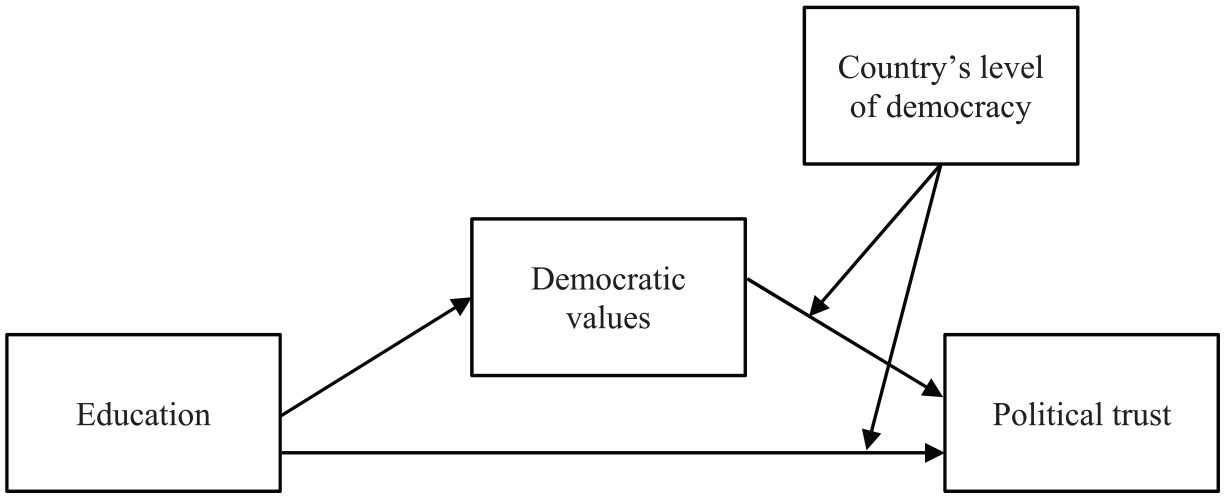
Theoretical scheme.
The theoretical foundations for the hypothesized associations are the clearest in two extreme cases: countries that perform well in all aspects of democracy and countries that are clearly non-democratic. In flawed democracies, with generally free and fair elections but problems with governance and limitations to political participation, and in hybrid regimes, where elections take place but are not always free and fair, the associations between democratic values and political trust are likely weaker and more ambiguous for at least two reasons. First, the mismatch between values of the individual and of the political system may go in both directions, and if the country’s level of democracy is too high for some residents and too low for others, the average size of the gap may be similar for everyone leading to a weak or nonexistent association between democratic values and political trust. For example, countries with occasional violations to the freedom of speech might have some individuals (those with high levels of democratic values) disappointed with the shortcomings, and others (with low levels of democratic values) dissatisfied due to the perceived excess of freedom of speech. Second, flawed democracies and transition countries may perform better in some respects than others, leading to different levels of satisfaction among residents depending on their individual preferences and sensitivities.
While the hypotheses stated above apply most strongly to institutionalized democracies and authoritarian regimes, I expect that the patterns of associations change gradually between these two extremes. In the case of education and political trust, this would mean that the association is strong and positive in democracies, becomes weaker as the level of democracy declines, eventually turns negative, and exhibits the strongest negative effects in non-democratic countries. What level of democracy corresponds to the neutral point of no association remains an empirical question that this article will explore.
Data and method
Data
I use data from the WVS (Inglehart et al., 2014) and the EVS (2015), two survey projects that have to some extent been harmonized ex ante and thus contain sets of similar or identical questionnaire items, including questions about political values and preferences. Both projects collect individual-level data in several countries in each wave with largely complementary country coverage: EVS focuses on Europe and WVS surveys the rest of the world. The coordination between both projects concerning questionnaire content and the presence of tools for combining the two datasets in a convenient way provide researchers with a rich data source with almost global coverage.
The key variables in this analysis are three individual-level characteristics, democratic values, political trust, and education, as well as the country’s level of democracy. A review of the empirical literature shows a lack of consensus about the measurement of democratic values. Some scholars use declared preference for democratic governance as an indicator of democratic values (recent examples include Foa and Mounk, 2016; Norris, 2017) or declared opposition to non-democratic rule (Mauk, 2019). Others argue that declared preferences for democracy are not meaningful if they are not accompanied by an explicit rejection of non-democratic alternatives (Bratton and Mattes, 2001; Klingemann, 1999; Mishler and Rose, 2001a; Sin and Wells, 2005; Welzel, 2007).
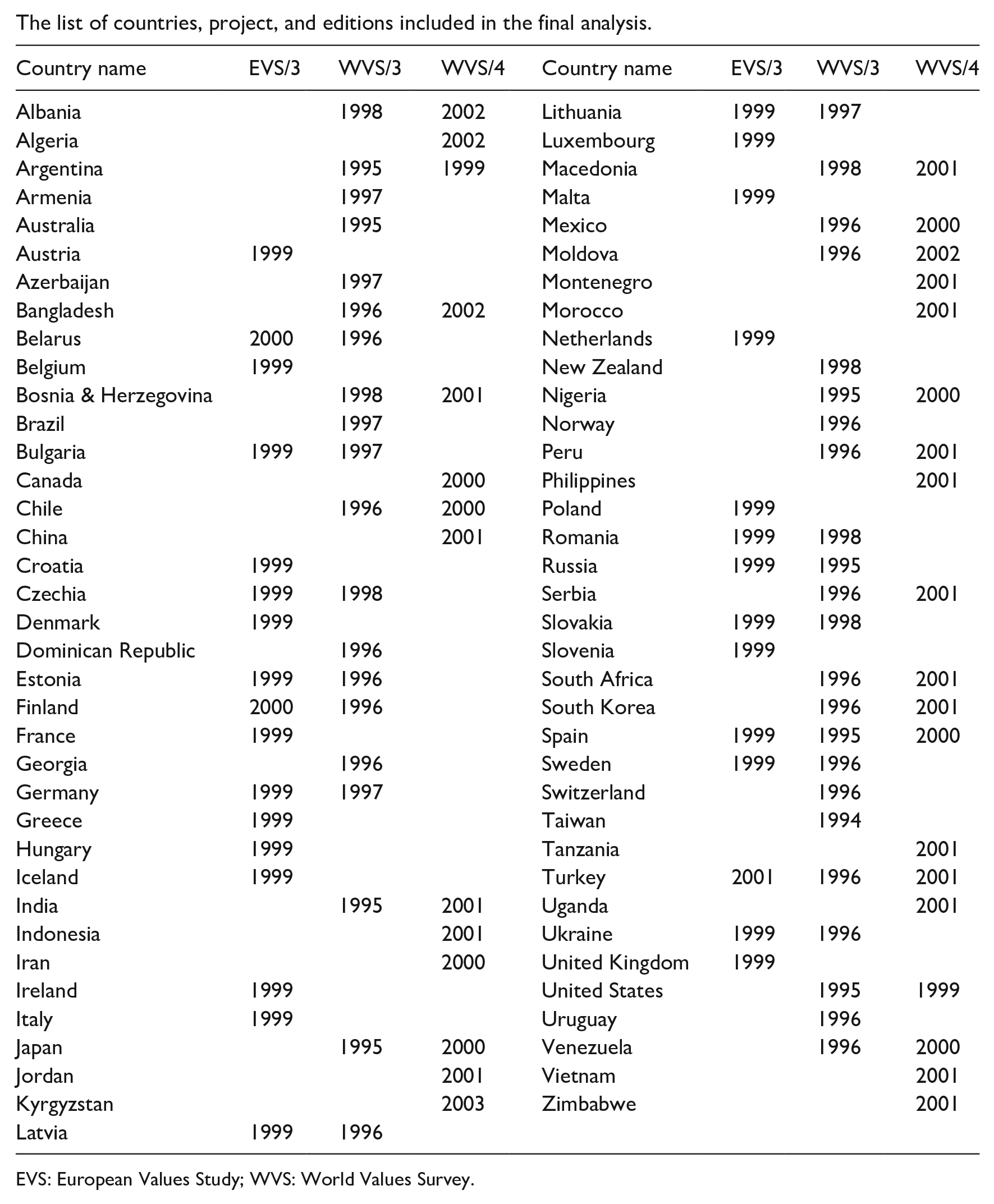
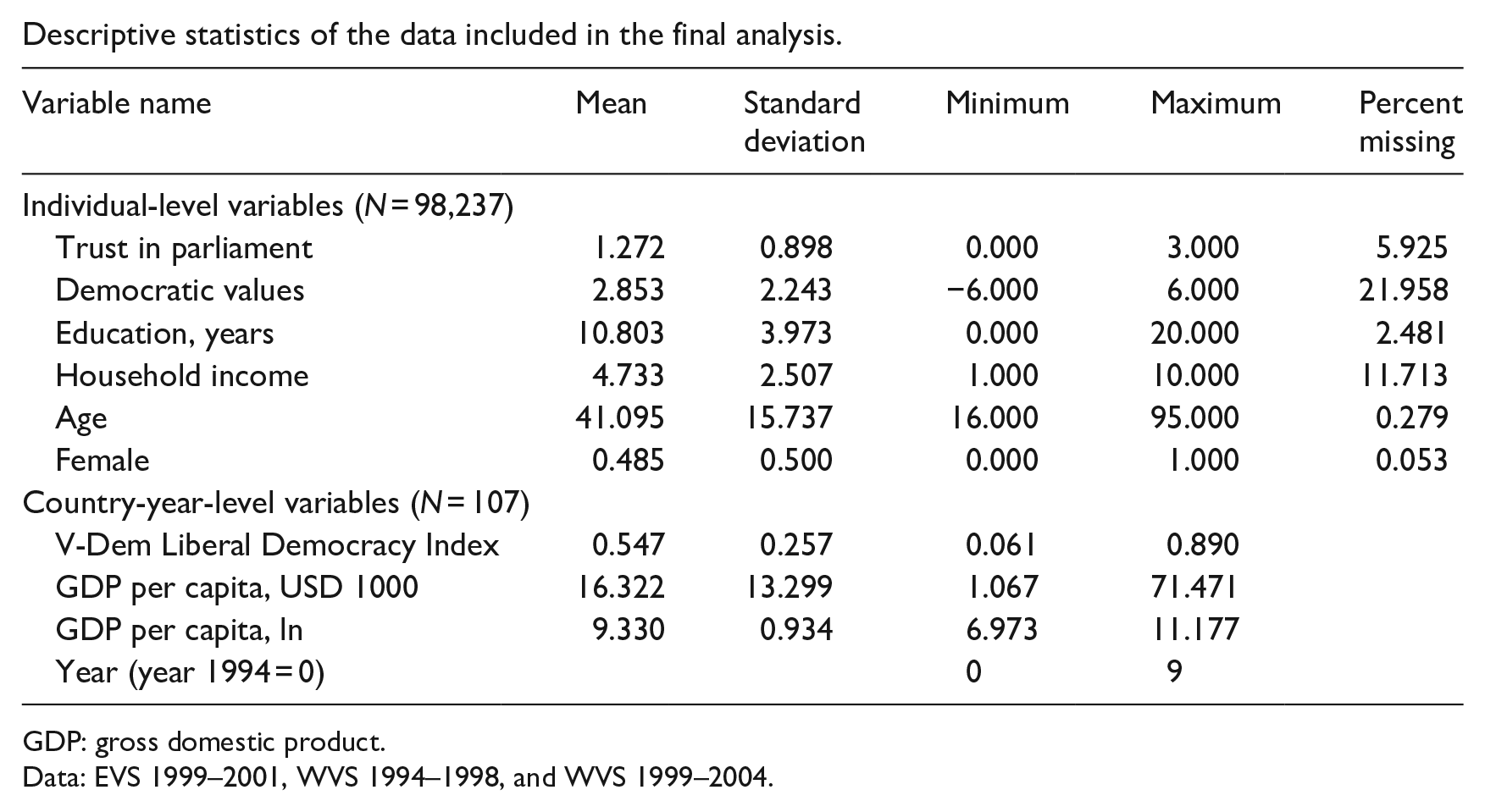
Following the latter approach, I measure democratic values as the preference for a democratic system over non-democratic forms of governance (Inglehart and Welzel, 2003; Jamal and Nooruddin, 2010; Welzel and Inglehart, 2005), defined as the difference between favorable evaluations of democracy as a system of governance, and preference for non-democratic regimes. The democratic values index is constructed as the sum of agreement scores to the statements “Having a democratic political system is a good way for running a country” and “Democracy may have problems but it’s better than any other form of government,” minus the sum of the support scores for the statements “Having a strong leader who does not have to bother with parliament and elections” and “Having the army rule” (the exact wording and response coding is available in the Online Supplementary Materials). The resulting index, referred to as “overt support for democracy” (Inglehart and Welzel, 2003), ranges from −6 to 6, where lower values indicate less support for democracy and higher values indicate more support. The variables necessary to construct this measure of democratic values are available in WVS waves 3 and 4 and EVS wave 3. Appendix 1 presents the list of all countries covered by the analysis, while Appendix 2 includes descriptive statistics for all variables.
The comparability of this democracy index across countries can be verified via invariance testing, a framework for evaluating measurement equivalence (Davidov et al., 2014). Since the hypotheses tested in this article deal with within-country associations between political trust, education, and democratic values, not with between-country comparisons of mean levels of these variables, it is necessary to establish metric invariance, but the stricter equivalence level—scalar invariance—is not required. I test for approximate metric invariance using the multi-group factor analysis alignment method (Asparouhov and Muthén, 2014), which relies on an algorithm to find a solution with many approximately invariant parameters and few strongly invariant parameters in a way that resembles rotation in exploratory factor analysis, and is more suitable for cases with large numbers of groups than traditional invariance testing. Applying this procedure shows that, within the recommended tolerance levels, the democratic values scale is approximately invariant in terms of factor loadings in almost all surveys, with the exception of Morocco in WVS Wave 4. This survey is not an outlier in any of the analyses and excluding it does meaningfully change the results (analysis available in the Online Supplementary Materials).
The theoretical model proposed in this article deals with system trust, or diffuse support for state institutions and the political system. System trust is typically measured with indicators related to confidence in major state institutions, such as parliament, political parties or politicians, and/or the legal system, either as a factor score, or a simple sum or mean (see Breustedt, 2017, for a review). Prior research also used the single trust in parliament item as a measure of support for the political system even for non-democratic regimes, taking advantage of the fact that trust in parliament measures are available in the greatest number of national surveys (e.g. Dalton et al., 2010; Klingemann, 1999; Newton and Zmerli, 2011). 4 Multi-group factor analysis with the alignment method (Asparouhov and Muthén, 2014) shows that the political trust scale meets the requirements for approximate metric invariance in the subset of 43 national surveys that include items referring to trust in parliament, political parties, and the justice system. Results of these analyses are available in the Online Supplementary Materials.
To measure democracy, I primarily employ Liberal Democracy Index from the Varieties of Democracy project (Coppedge et al., 2019b), which assesses the protection of civil liberties, the presence of rule of law and an independent judiciary, as well as effective checks and balances, in addition to meeting the basic requirements of electoral democracy (Coppedge et al., 2019a: 40). In the dataset used in this article, the values of the Liberal Democracy Index range from 0.06 in China to 0.89 in Denmark. To check the robustness of my results, I use Freedom House (2016) combined ratings for political rights and civil liberties (these additional analyses are available in the Online Supplementary Materials). 5
I measure education with the number of schooling years derived from age at the completion of education. While this is not without problems because of the reliance on the respondents’ reporting of school leaving age, issues related to repeating grades and levels, returning drop-outs and adult education, it is the most consistently available measure of educational attainment in the WVS and EVS.
In order to not conflate the effect of economic conditions and democracy, I control for GDP per capita (in purchasing power parity, constant 2011 international $) using data from the World Bank’s World Development Indicators (2019). I further adjust for respondents’ age (adding the squared term to capture non-linear associations) and sex. Both characteristics are typically only weakly related to democratic values and political trust, but may be more strongly associated with education, especially in countries undergoing rapid modernization. I also adjust for household income, to avoid confounding the effects of education and economic status. While the household income measure in WVS and EVS appears to be standardized across national surveys, in fact different countries recorded responses differently—using objective categories, an open “fill-in-the-blank” method, or subjective rankings—which raises concerns regarding the comparability of the resulting measurements (Donnelly and Pop-Eleches, 2018). Still, the variable maintains the ordinal character within national surveys in that individuals with a higher household income have higher values than those with a lower household income, which satisfies the requirements of the present analysis. I also control for the year of the survey, using the earliest year—1994—as the reference “year zero.”
Analytic approach
Respecting the hierarchical nature of the data, the analysis consists of multilevel linear regression models with individuals nested in country-years, which in turn are nested in countries. The modeling strategy follows the logic of moderated mediation analysis and consists of steps corresponding to the hypotheses stated earlier. First, I model democratic values as a function of individual education and the country’s level of democracy, to verify that education is positively associated with democratic values regardless of the regime’s level of democracy (Hypothesis 1). The second set of models regresses trust in parliament on democratic values to test the values–structure congruence hypothesis (Hypothesis 2). Third, I test for the mediation effect of democratic values between education and trust in parliament at different levels of democracy (Hypothesis 3). The same mechanism can be tested with a multi-level structural equation model to estimate direct and indirect effects of education on political trust simultaneously. This analysis yields substantively similar results, which are presented in the Online Supplementary Materials. In all analyses, data are weighted with individual case weights provided in the source datasets. The analysis was performed in R (R Core Team 2018). 6
Results
Figure 2 presents the relationships between the key variables of interest. In the three scatter plots, the x-axes correspond to the country’s level of democracy, while the y-axes present bivariate correlation coefficients between (a) democratic values and education, (b) democratic values and trust in parliament, and (c) trust in parliament and education, calculated within each national survey. Since some countries in the dataset have more than one survey, as shown in Appendix 1, they appear more than once on the graph. Each facet also shows the correlation between the level of democracy and the within-survey bivariate correlation. While simplistic, these graphs nevertheless prove useful for a preliminary overview of the data.
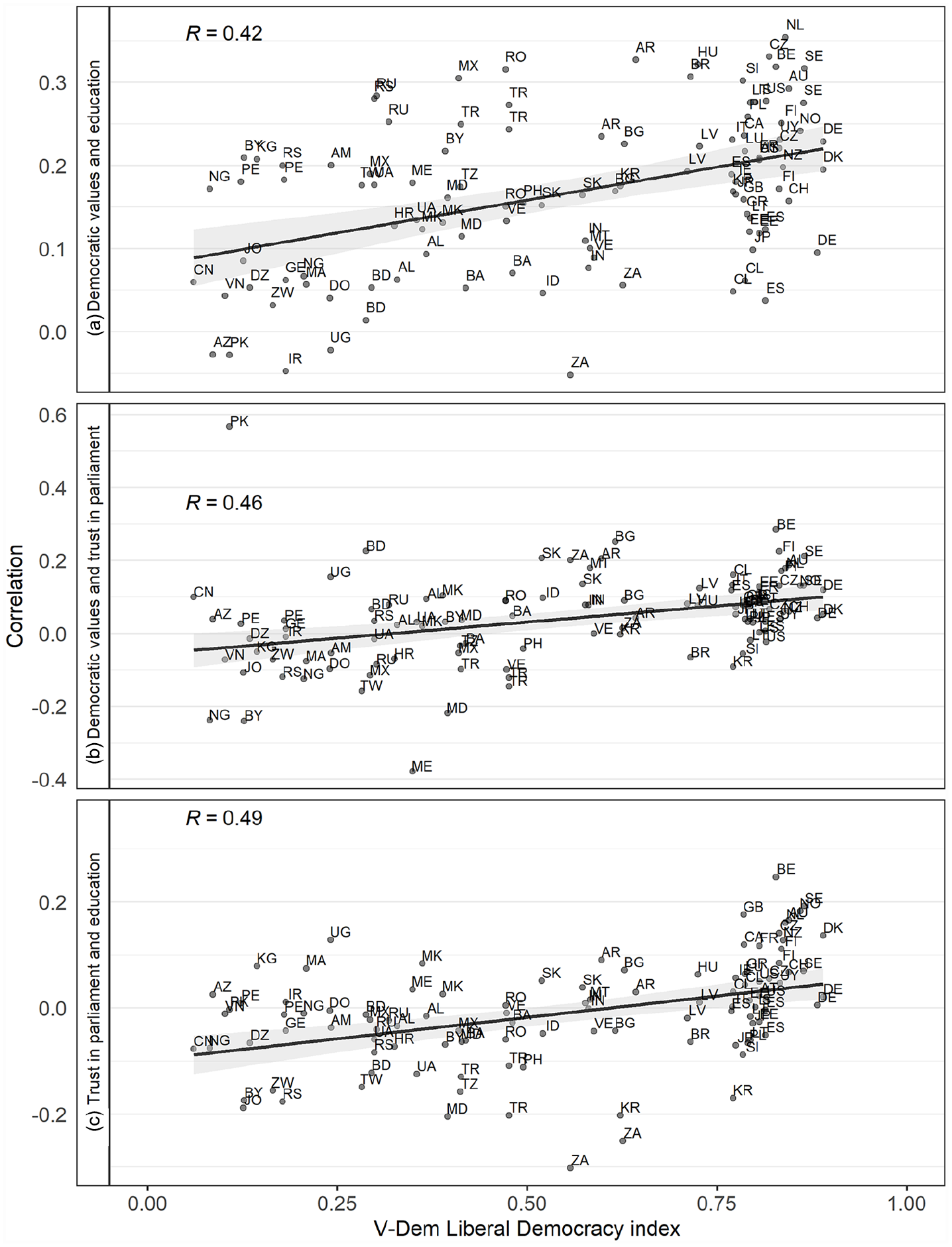
Bivariate association between the country’s level of democracy (V-Dem Liberal Democracy Index) and the correlation between (a) individual democratic values and education, (b) democratic values and trust in parliament, and (c) trust in parliament and education. N = 108 national surveys.
Panel A in Figure 2 shows that the correlation between education and democratic values is positive in all but five national surveys, from Azerbaijan, Pakistan, Iraq, South Africa, and Uganda. In some national surveys, including one from Bangladesh, the correlations are positive but very weak. The associations are the strongest in surveys from Argentina, Czechia, and the Netherlands, among others. The linear trend line superimposed on the scatter plot suggests that the association between education and democratic values becomes more positive as the level of democracy increases.
Panel B presents correlations between democratic values and trust in parliament. The coefficients range from close to −0.4 in Montenegro to almost 0.6 in Pakistan, with most national surveys in the range between −0.25 and 0.25. There is a positive relationship of this correlation and the level of democracy. Pakistan is a clear outlier from the trend, and preliminary analyses showed that it substantially influences slope coefficients and inflates their standard errors in multilevel models, especially those predicting trust in parliament with democratic values. Thus, the analyses that follow in the next section exclude the survey from Pakistan. Models including Pakistan are available in the Online Supplementary Materials.
Panel C displays the associations between trust in parliament and education—the puzzling result that constitutes the starting point of this article. These bivariate correlations range from around −0.2 to just over 0.2 and—again—exhibit a positive overall association with the level of democracy.
These descriptive results generally support the hypotheses formulated earlier, with additional unexpected findings regarding the association between the level of democracy and the correlation between democratic values and education in Panel A. Multi-level models in the following section will explore these patterns further. The graphs also clearly show the underrepresentation of countries with lower and middle levels of democracy. In 1999, in the middle of the time range covered by this analysis, the quartiles of the V-Dem Liberal Democracy Index for all 190 countries it covers equaled 0.14, 0.33, and 0.61. Among countries included in the present analysis, the respective values are 0.32, 0.58, and 0.79.
Education and democratic values
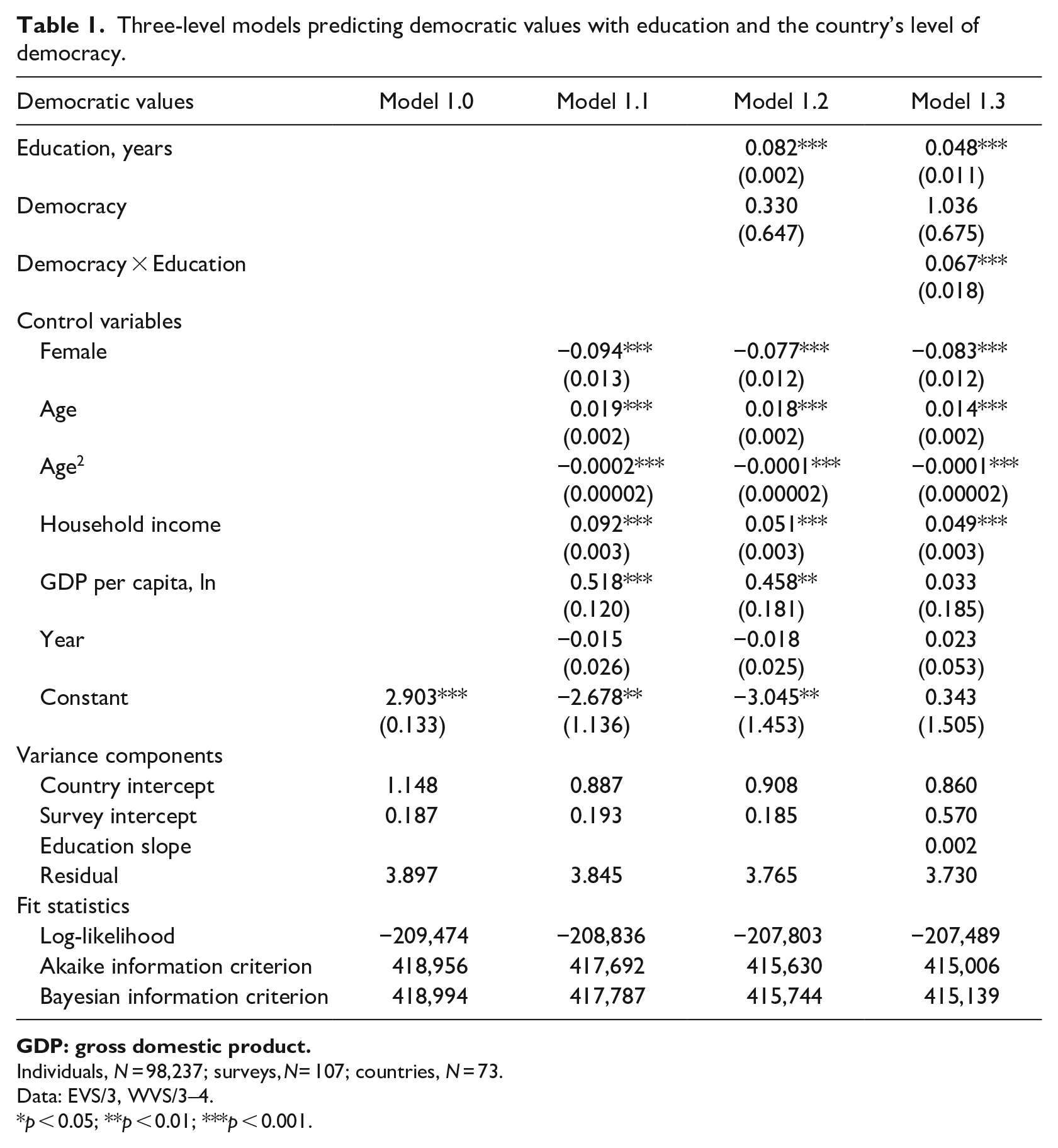
This section presents results of multi-level linear regression models. Table 1 contains estimates of the first set of models regressing democratic values on education and the country’s level of democracy. Model 1.0 decomposes the variance of democratic values into the three levels accounted for by the analysis, showing that 22 percent of this variation is explained by the level of countries, some 3.5 percent by surveys (or country-years), and the remaining 75 percent is individual-level variance. The modest proportion of variance at the country-year-level compared to the country level suggests that changes over time in the countries measured twice were rather small. Model 1.1 adds all control variables: age, gender, income, the country’s GDP per capita, as well as the year of the survey, which altogether explain just over 1 percent of the individual-level variance, and as much as 23 percent of the country-level variance. Model 1.2 adds the independent variables, education and the country’s democracy score, which further reduces unexplained variance at the individual level, as well as at the country-year level.
Three-level models predicting democratic values with education and the country’s level of democracy.
Individuals, N = 98,237; surveys, N= 107; countries, N = 73.
Data: EVS/3, WVS/3–4.
*p < 0.05; **p < 0.01; ***p < 0.001.
According to Model 1.2, the main effect of education on democratic values is positive, which means that on average, individuals with more education tend to be more democratically oriented than those with less education. The predicted change in democratic values (measured on a scale from −6 to 6) for each additional year of schooling is 0.08 points, which translates to a 1.6-point predicted difference between an individual with no schooling and one with a graduate degree.
The significant coefficient of the cross-level interaction between education and quality of democracy added in Model 1.3 shows that the effect of education on democratic values varies depending on the country’s level of democracy. 7 In more democratic countries, education has a greater positive effect on democratic values than it does in less democratic ones. Central to Hypothesis 1 is whether the association between education and democratic values is positive for all levels of democracy. To facilitate answering this question, Figure 3 plots the conditional effect of education on democratic values depending on the country’s level of democracy, as well as Johnson-Neyman intervals, which provide information about all levels of the moderator—in this case, democracy scores—for which the slope of the predictor is statistically significant. The graph clearly shows that the effect of education is positive at all levels of democracy (the bold line on the x-axis indicates the range of observed data). Even in countries with democracy scores close to minimal values, individuals with more education have higher predicted levels of democratic values than those with less education. This result is consistent with the findings of Chong and Gradstein (2015), who also used data from the WVS, but employed a different measure of democratic values.
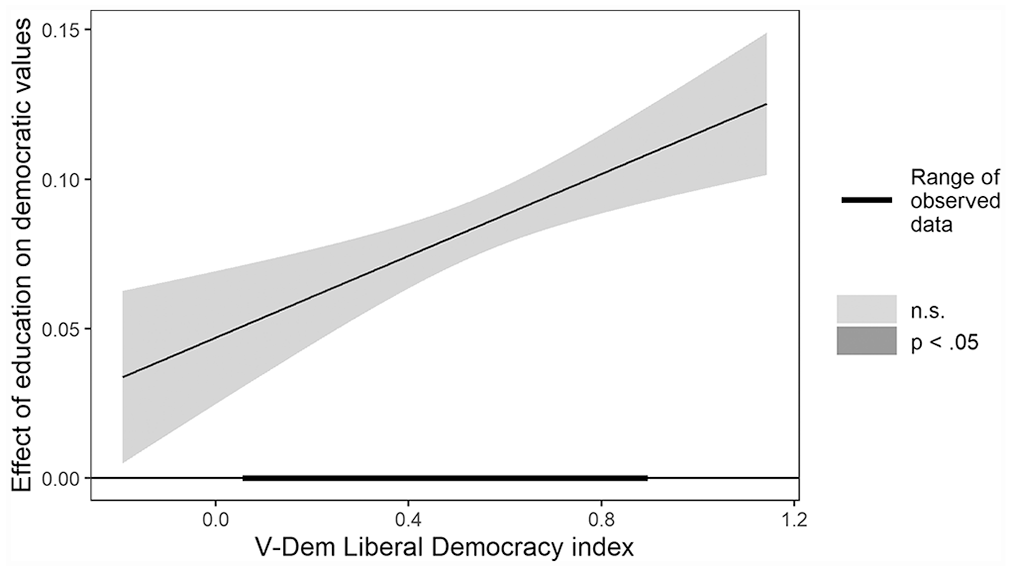
Conditional effects of education on democratic values by level of democracy based on Model 1.3.
Model 1.3 and Figure reveal another, unexpected, pattern. The estimated effect of education on democratic values is about twice as strong in countries with the highest democracy scores compared to countries with the lowest democracy scores. In countries with the V-Dem Liberal Democracy Index around 0.1, moving from the lowest level of education (0 years of schooling) to the highest (20 years) is associated with an increase in democratic values by about 1 point. In the most democratic countries with the Democracy Index of 0.9, the same change in education is associated with an increase in democratic values by over 2 points. I will return to possible explanations for this difference in the discussion.
Before moving forward, I will briefly discuss results for the remaining variables, noting that coefficients for adjustment variables should be interpreted with caution (Keele et al., 2020; Westreich and Greenland, 2013). On average, women tend to have slightly lower levels of democratic values compared to men, ceteris paribus, and the magnitude of this effect is comparable to the average effect of one additional year of education (cf. Model 1.2). The effect of age, net of all other factors, is weakly positive and decreases in magnitude for older ages, so that the predicted level of democratic values for individuals aged 50 and above is roughly the same. The difference between the predicted level of democratic values for the youngest and the oldest individuals is around 0.35 points. 8 Household income also has a positive effect on democratic values, with a 1-point increase in household income on the 1–10 scale associated with an 0.05 increase on the democratic value scale. Moving from the lowest to the highest level of income is associated with a change in democratic values by 0.44 points, which makes income a much weaker predictor than education. The effect of GDP per capita on democratic values is positive in Models 1.2 and 1.3 but disappears after adding the interaction between education and democracy level in Model 1.3. In this sense, economic development does not contribute to explaining democratic values above and beyond the effects of education and democracy. 9 Finally, there is no clear time trend, as indicated by the lack of an effect of the year of the survey.
Democratic values, education, and political trust
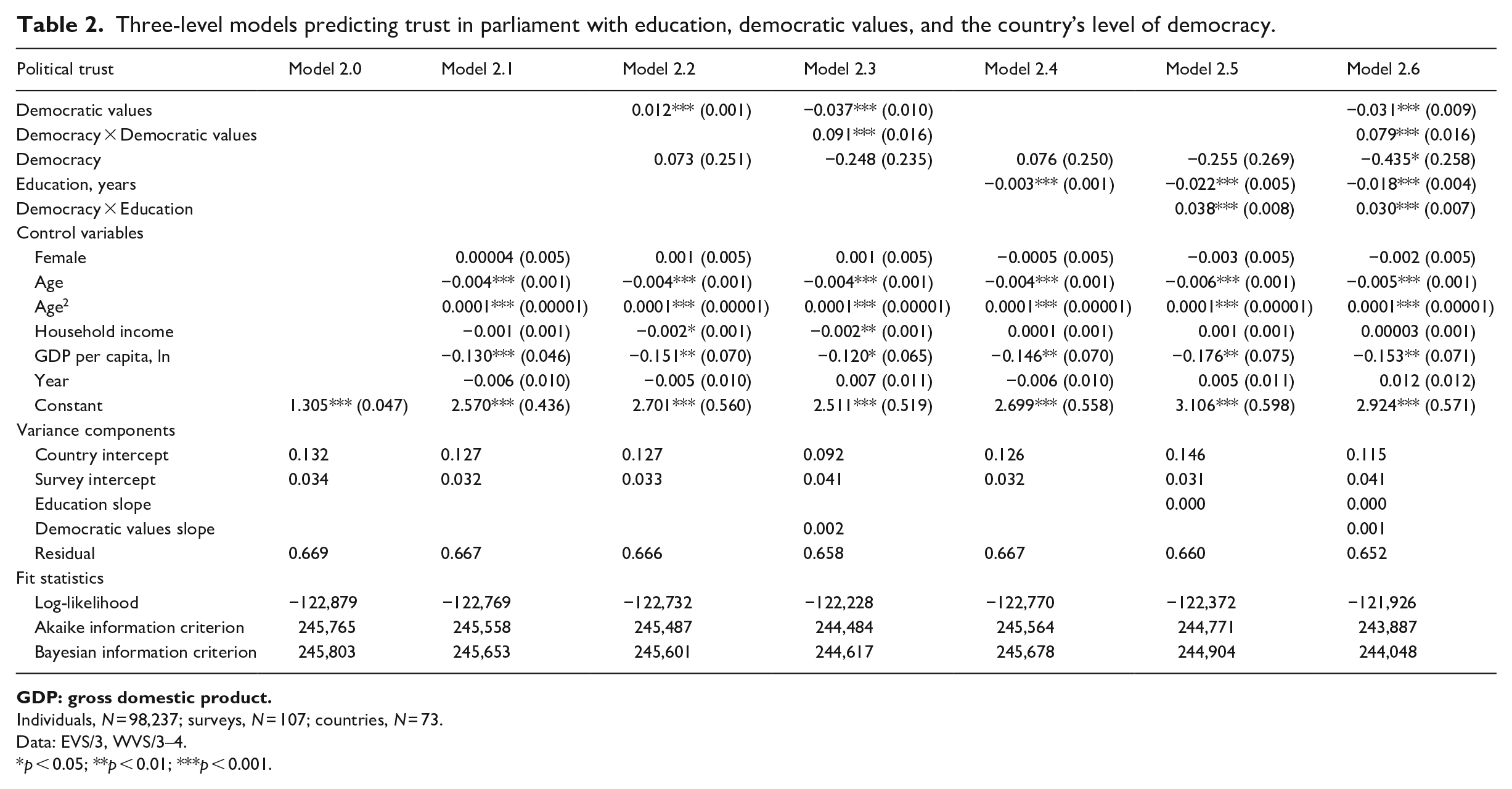
The second hypothesis states that higher levels of democratic values reduce political trust in non-democratic countries and increase trust in democratic countries. To test this hypothesis, Table 2 presents estimates of models predicting trust in parliament. Model 2.0 shows that about 16 percent of the variation in trust in parliament is explained by the country level, some 4 percent at the country-year level, and the remaining 80 percent at the individual level. Model 2.1 contains only the control variables, which explain between 4 percent and 6 percent of the variance at the macro levels, and little of the residual variance.
Three-level models predicting trust in parliament with education, democratic values, and the country’s level of democracy.
Individuals, N = 98,237; surveys, N = 107; countries, N = 73.
Data: EVS/3, WVS/3–4.
*p < 0.05; **p < 0.01; ***p < 0.001.
Model 2.2 includes democratic values, the country-level measure of democracy, as well as the controls, and shows an average positive effect of democratic values on trust in parliament. The cross-level interaction added in Model 2.3 reveals that the effect of democratic values depends on the country’s level of democracy. Figure 4 illustrates the estimated effects of democratic values on trust by level of democracy, showing that in countries with the highest democracy scores, democratic values are positively associated with trust in parliament, and the magnitude of the association declines as the level of democracy decreases. The effect of democratic values is significant and positive for values of the V-Dem Liberal Democracy Index above around 0.5, and significant and negative for the Index’s values below 0.3. In countries with low democracy scores, predicted trust (measured on a scale from 0 to 3) among individuals with the highest levels of democratic values is lower by some 0.3 compared to those with the lowest levels of democratic values. In democratic countries, those with high democratic values have higher trust than those with low democratic values by around 0.5 points.
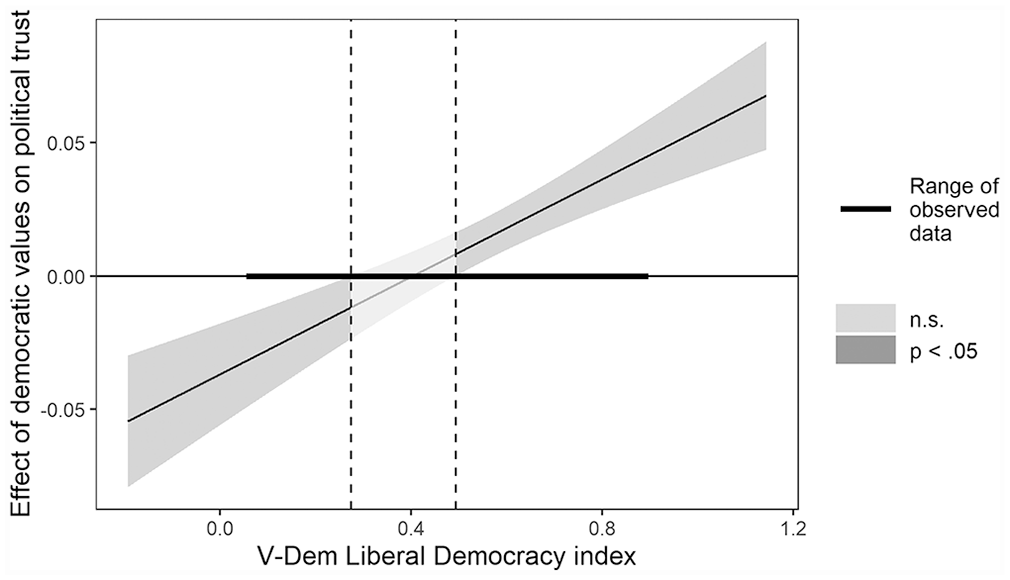
Conditional effects of democratic values on trust in parliament by level of democracy based on Model 2.3.
The remainder of the analysis focuses on the extent to which democratic values mediate the effect of education on trust in parliament. Model 2.4 predicts trust in parliament with only education and democracy as well as controls and indicates a weakly negative average effect of education on trust. This negative effect changes when adding an interaction effect with the country’s level of democracy in Model 2.5. In countries with the highest democracy scores, individuals with more education tend to have higher political trust, with the opposite association in countries with the lowest democracy scores. As shown in Figure 5, the effect of education on political trust is significant and negative for democracy scores lower than 0.45 and positive for democracy scores upward of 0.7. Thus, in a non-democratic country with the Democracy Index of 0.1, the predicted level of trust in parliament for an individual with no education is almost 1.4, and 1.0 for a person with higher education. In countries with the highest democracy scores of around 0.9, the predicted trust levels are 1.1 and 1.4 for an individual with no education and with higher education, respectively.
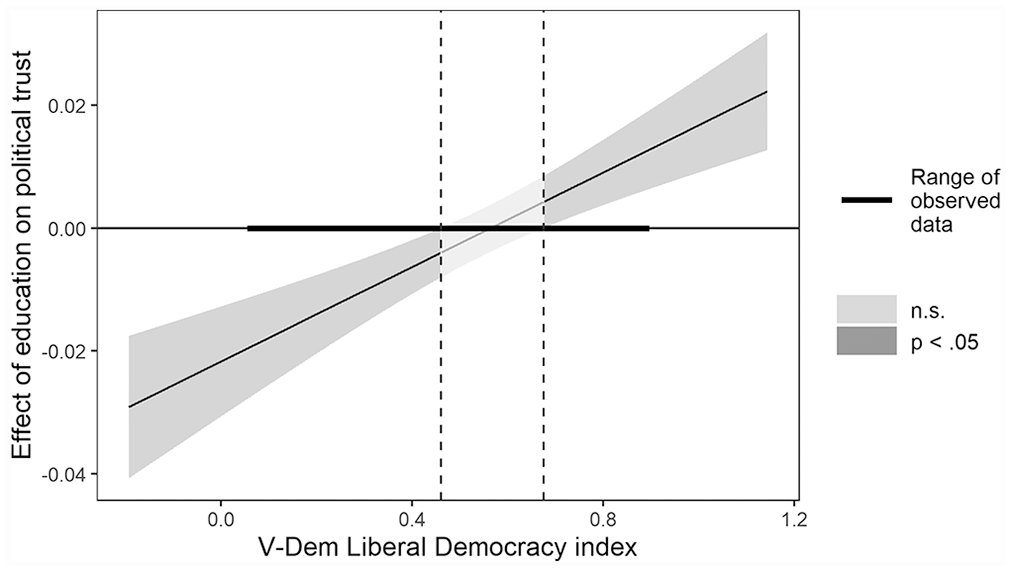
Conditional effects of education on trust in parliament by level of democracy based on Model 2.5.
Model 2.6 adds the measure of democratic values and its interaction with the country’s democracy score, which reduces the coefficient for the education–democracy interaction by about 21 percent, to 0.030 from 0.038, and the main effect of education by 16 percent.
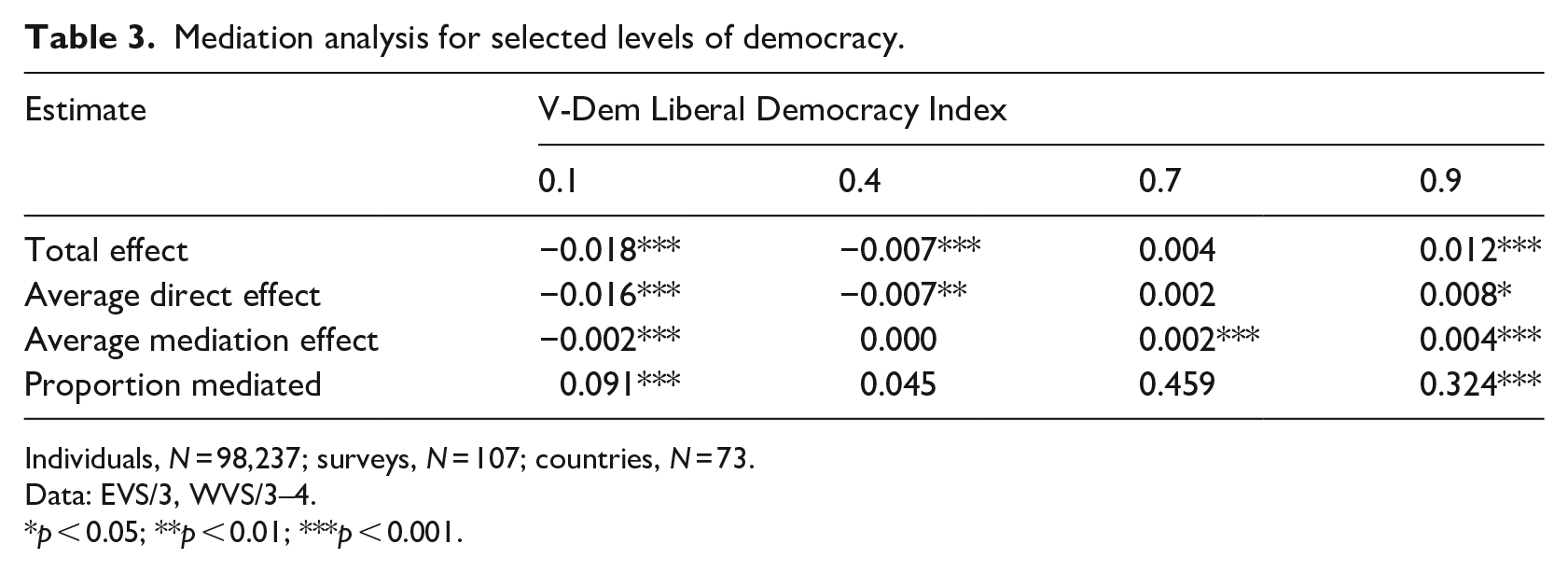
The question remains whether the partial mediation effect observed by comparing coefficients from Model 2.5 and Model 2.6 is statistically significant and what its size is at different levels of democracy. Table 3 presents summary results of mediation analysis for selected democracy levels, including average mediation effects, average direct effects, the proportion mediated, and significance levels based on quasi-Bayesian confidence intervals. In countries with the highest democracy scores (Denmark and Germany), the total effect of education on trust in parliament is around 0.011 (per year of schooling), of which one third is mediated by democratic values. Moving closer to the middle range of democracy scores, the effect of education on political trust declines, and with the Democracy Index equal to 0.7 (such as in Latvia and Brazil), it is not statistically significantly different from zero. Ratios with small denominators are unstable, which leads to a large point estimate of the proportion mediated by democratic values (0.461) with very high uncertainty (the 95% confidence interval ranges from −2.3 to 3.6). In countries with democracy scores of 0.4 (e.g. Moldova, Macedonia, Mexico), the total effect of education is negative but very small, and the average mediation effect is essentially zero. Finally, in the least democratic countries with democracy scores around 0.1 (e.g. Azerbaijan and Venezuela), the total effect of education is estimated at −0.018, with 9 percent mediated by democratic values. Altogether, the size of the partial mediation is over three times less in countries with the lowest democracy scores compared to countries with the highest scores. The lack of mediation effects in countries with intermediate democracy scores is not surprising, given that, as I showed earlier, in these countries, the overall effects of education and democratic values on political trust are very small.
Mediation analysis for selected levels of democracy.
Individuals, N = 98,237; surveys, N = 107; countries, N = 73.
Data: EVS/3, WVS/3–4.
*p < 0.05; **p < 0.01; ***p < 0.001.
Regarding the effects of the control variables on trust in parliament, models presented in Table 2 suggest that there is no discernible effect of gender on trust, while the effect of age is positive and increasing for higher values of age, ceteris paribus. While the predicted level of trust in parliament for individuals aged 16–45 is virtually the same, the oldest individuals tend to have trust higher by about 0.3 points when compared to the young. Household income has no effect on trust in parliament after all other variables are accounted for. Economic development has a negative effect on trust in parliament, but drawing conclusions about the meaning of this effect requires a more thorough investigation.
Conclusion
In this article, I analyzed the links between education, democratic values, and trust in state institutions with data from the WVS and the EVS. Building on studies of the role of education in the diffusion of democratic values worldwide, and relying on the values approach to explaining political trust, I proposed and tested a model, where democratic values serve as a mediator for the effect of education on political trust, and this relationship is moderated by the country’s level of democracy.
The first part of the analysis showed that, as predicted, education is positively associated with democratic values in countries at all levels of democracy. This supports the claim that schooling systems worldwide educate individuals to become citizens of the global society, in which democracy is the dominant form of political organization, rather than exclusively promoting values represented by the respective polity. However, the effectiveness of education in promoting democratic values is not the same everywhere, and the estimated effect of education on democratic values is twice as strong in institutionalized democracies as in the least democratic countries. Several explanations come to mind that call for further examination. First, it is possible that in non-democratic countries, education systems convey less of democratic and modern values than they do in democracies. This could be because of the content of the curricula (although existing research does not generally find such effects) or more general organizational features of the schools and of school instruction, and could refer to all education levels or to some levels in particular, for example, to higher education. Including system-level characteristics of education systems, such as investment per pupil, teachers’ qualifications, or data on international student exchange, could help flesh out this issue. The effect of education on democratic values may also depend on the country’s engagement in and exposure to the global culture, as world society theory would predict.
Second, in addition to being associated with cognitive skills and exposure to the school system, education is a crucial status dimension. Individuals with higher status may be more supportive of the system that granted them this privileged position, which in authoritarian countries would reduce the positive effect of education on democratic preferences. The analysis in the present article adjusted for household income to avoid confounding education with economic status, but a more in-depth investigation would shed light on the cognitive and structural role of education and their relative importance.
Third, it is possible that the indicator of democratic values has a different meaning (despite approximate measurement invariance) in different countries, languages, or cultures, including due to misshapen perceptions of the quality of democracy in one’s own country. The present analysis uses the assessment of democracy as a governance system and aversion to non-democratic alternatives as the measure of democratic values. The disadvantage of this approach is that democracy is a multifaceted concept and its popular understanding may be far from the theoretical conceptualization (see, for example, Kiewiet de Jonge, 2016). Alternative measures of democratic values using the endorsement of certain properties of democratic systems rather than the assessment of the abstract concept could clarify this possibility.
The second part of the analysis focused on the mediating effect of democratic values in the education–trust relationship. I found that part of education’s effect on political trust can be attributed to democratic values, but that this varies considerably across levels of democracy. The mediation effect is the strongest in countries with the highest democracy scores, where democratic values account for around one-third of the overall education–trust association. In countries with the lowest democracy scores, this proportion is close to one-tenth, likely as a result of the weaker positive association between education and democratic values in less democratic than in more democratic countries. In countries with intermediate democracy scores, there is not enough evidence to determine whether the mediation effect exists, although the point estimates support the claim about the gradual change in the effects of education on political trust along the spectrum of democracy levels.
If the stability and legitimacy of political regimes requires citizen’s political trust, as researchers have long claimed, these findings warrant the hypothesis that education—through democratic values—has the capacity of strengthening democracies and undermining authoritarian regimes by affecting political trust. A direct test of this hypothesis, as well as the exact mechanisms—through civil society, protest participation, or other forms of political engagement—are left for future investigation. More generally, these results substantiate the relational nature of political trust, where trust is jointly determined by the preferences of the truster (in this case, democratic values) and the characteristics of the trustee (the level of democracy). Studies that fail to recognize interactions between the two elements of the trust relationship are necessarily incomplete. This study also confirms the crucial role of education as a carrier of democratic values even in non-democratic countries, where it is contrary to the interests of the government. Establishing that the association between education and democratic values is universally positive is an important finding in cross-national research where much of the analyses only cover European democracies. Furthermore, the results point to the role of education as an explanatory factor of political attitudes, which merits an upgrade from a control variable to a more central position in cross-national research.
By examining the links between education, democratic values, and political trust at different levels of democracy, this analysis demonstrates the advantages of considering the continuity of levels of democracy instead of classifying countries into a small number of discrete groups, which necessarily entails some degree of arbitrariness. While imposing linear associations in models of social and political phenomena is an obvious oversimplification, treating the country’s level of democracy as a continuous moderator enables the exploration of, in this case, ranges of democracy scores where the associations between education and trust in parliament and between democratic values and trust in parliament are too weak or associated with too much uncertainty to be detected. According to the results presented in this article, education has no discernible effect on political trust at higher democracy levels than the range of democracy levels where no effects of democratic values on trust can be identified. This mismatch, if not an artifact, may result from another variable that intervenes in the education–democratic values link. One possible candidate for further investigation is satisfaction with government performance, the other major explanatory factor of political trust aside values (e.g. Mishler and Rose, 2001b; Van Der Meer and Dekker, 2011). Relatedly, by focusing on education and democratic values, this article examined two relatively stable factors contributing to political trust, while performance evaluations are known to be much more dynamic. Combining analyses of the stable and dynamic factors would shed light on their relative importance in shaping political trust and its changes.
Like most analyses with observational data, this study is subject to potential endogeneity bias, as the hypothesized relationship from education via democratic values to political trust can also develop in a different direction; hence, the results should be interpreted with caution. For example, individuals born into families or environments with high levels of democratic values may go on to invest more in education. Political trust may also develop in response to high performance of the state and its institutions, and lead to increases in levels of democratic values. Future research should explore the possibilities of addressing these issues with new data and research designs.
This article focused on the level of trust in institutions, while increasingly researchers are interested in the type and content of political trust. Continuing the debate inspired by research on “critical citizens” (Norris, 1999, 2011), Wu and Wilkes (2018) recently proposed a three-fold classification into “critical trusters,” who exhibit different levels of trust in different institutions, “compliants,” who trust all institutions, and “cynics,” who distrust all. They found that education increases the probability of being a critical truster, and that the proportion of critical trusters is the highest in full democracies compared to flawed democracies and hybrid regimes, and the lowest in authoritarian regimes. Even though the results are descriptive, they imply the potential difference in the democratic utility of trust across these three categories. While I mentioned several possible areas for further research on political trust, our understanding of this phenomenon, including its dimensionality, would benefit most from direct tests of the consequences of trust for macro-level outcomes, such as democratic governance or economic performance.
Supplemental Material
Online_supplement_Values_trust_education_-_revised3 – Supplemental material for Democratic values, education, and political trust
Supplemental material, Online_supplement_Values_trust_education_-_revised3 for Democratic values, education, and political trust by Marta Kołczyńska in International Journal of Comparative Sociology
Footnotes
Appendix 1
The list of countries, project, and editions included in the final analysis.
| Country name | EVS/3 | WVS/3 | WVS/4 | Country name | EVS/3 | WVS/3 | WVS/4 |
|---|---|---|---|---|---|---|---|
| Albania | 1998 | 2002 | Lithuania | 1999 | 1997 | ||
| Algeria | 2002 | Luxembourg | 1999 | ||||
| Argentina | 1995 | 1999 | Macedonia | 1998 | 2001 | ||
| Armenia | 1997 | Malta | 1999 | ||||
| Australia | 1995 | Mexico | 1996 | 2000 | |||
| Austria | 1999 | Moldova | 1996 | 2002 | |||
| Azerbaijan | 1997 | Montenegro | 2001 | ||||
| Bangladesh | 1996 | 2002 | Morocco | 2001 | |||
| Belarus | 2000 | 1996 | Netherlands | 1999 | |||
| Belgium | 1999 | New Zealand | 1998 | ||||
| Bosnia & Herzegovina | 1998 | 2001 | Nigeria | 1995 | 2000 | ||
| Brazil | 1997 | Norway | 1996 | ||||
| Bulgaria | 1999 | 1997 | Peru | 1996 | 2001 | ||
| Canada | 2000 | Philippines | 2001 | ||||
| Chile | 1996 | 2000 | Poland | 1999 | |||
| China | 2001 | Romania | 1999 | 1998 | |||
| Croatia | 1999 | Russia | 1999 | 1995 | |||
| Czechia | 1999 | 1998 | Serbia | 1996 | 2001 | ||
| Denmark | 1999 | Slovakia | 1999 | 1998 | |||
| Dominican Republic | 1996 | Slovenia | 1999 | ||||
| Estonia | 1999 | 1996 | South Africa | 1996 | 2001 | ||
| Finland | 2000 | 1996 | South Korea | 1996 | 2001 | ||
| France | 1999 | Spain | 1999 | 1995 | 2000 | ||
| Georgia | 1996 | Sweden | 1999 | 1996 | |||
| Germany | 1999 | 1997 | Switzerland | 1996 | |||
| Greece | 1999 | Taiwan | 1994 | ||||
| Hungary | 1999 | Tanzania | 2001 | ||||
| Iceland | 1999 | Turkey | 2001 | 1996 | 2001 | ||
| India | 1995 | 2001 | Uganda | 2001 | |||
| Indonesia | 2001 | Ukraine | 1999 | 1996 | |||
| Iran | 2000 | United Kingdom | 1999 | ||||
| Ireland | 1999 | United States | 1995 | 1999 | |||
| Italy | 1999 | Uruguay | 1996 | ||||
| Japan | 1995 | 2000 | Venezuela | 1996 | 2000 | ||
| Jordan | 2001 | Vietnam | 2001 | ||||
| Kyrgyzstan | 2003 | Zimbabwe | 2001 | ||||
| Latvia | 1999 | 1996 |
EVS: European Values Study; WVS: World Values Survey.
Appendix 2
Descriptive statistics of the data included in the final analysis.
| Variable name | Mean | Standard deviation | Minimum | Maximum | Percent missing |
|---|---|---|---|---|---|
| Individual-level variables (N = 98,237) | |||||
| Trust in parliament | 1.272 | 0.898 | 0.000 | 3.000 | 5.925 |
| Democratic values | 2.853 | 2.243 | −6.000 | 6.000 | 21.958 |
| Education, years | 10.803 | 3.973 | 0.000 | 20.000 | 2.481 |
| Household income | 4.733 | 2.507 | 1.000 | 10.000 | 11.713 |
| Age | 41.095 | 15.737 | 16.000 | 95.000 | 0.279 |
| Female | 0.485 | 0.500 | 0.000 | 1.000 | 0.053 |
| Country-year-level variables (N = 107) | |||||
| V-Dem Liberal Democracy Index | 0.547 | 0.257 | 0.061 | 0.890 | |
| GDP per capita, USD 1000 | 16.322 | 13.299 | 1.067 | 71.471 | |
| GDP per capita, ln | 9.330 | 0.934 | 6.973 | 11.177 | |
| Year (year 1994 = 0) | 0 | 9 | |||
GDP: gross domestic product.
Data: EVS 1999–2001, WVS 1994–1998, and WVS 1999–2004.
Acknowledgements
I would like to thank Kazimierz M. Slomczynski, Craig Jenkins, Edward Crenshaw, and Vinnie Roscigno for their feedback on early drafts of this paper, Przemek Powałko and Robin Krauze for their help with completing the final version of the manuscript, and the editor and the anonymous reviewers for their helpful comments and advice. I also acknowledge the support of the Visiting Scholar Program at the Chair for Central and Eastern European Studies at the Chemnitz University of Technology.
Funding
The author(s) disclosed receipt of the following financial support for the research, authorship, and/or publication of this article:This work was supported by the National Science Centre, Poland (grant number 2019/32/C/HS6/00421).

Notes
References
Supplementary Material
Please find the following supplemental material available below.
For Open Access articles published under a Creative Commons License, all supplemental material carries the same license as the article it is associated with.
For non-Open Access articles published, all supplemental material carries a non-exclusive license, and permission requests for re-use of supplemental material or any part of supplemental material shall be sent directly to the copyright owner as specified in the copyright notice associated with the article.
