




Abstract
As a motivational factor of action, political efficacy is an important predictor of political behavior. The term was invented to capture the extent to which people feel that they can effectively participate in politics and shape political processes. Today, we have a comprehensive knowledge of the individual-level factors (socio-demographic variables, political preferences, etc.) that shape the level of internal and external dimensions of political efficacy. However, while it is widely demonstrated that media consumption influences the level of political efficacy, the country-level media context factors affecting it have rarely been studied. This article reports the findings of extensive research on how two crucial features of the media context, the political significance of the media and the level of political parallelism in the media system, shape the level of external and internal political efficacy. The investigation draws upon the data set of the seventh round (2014–2015) of the European Social Survey (ESS) and includes more than 22,000 respondents from 19 European democracies. The research hypothesizes that in countries where the media play a more important role, people have lower levels of external and higher levels of internal political efficacy. Political parallelism, which shows the extent to which media outlets are driven by distinct political orientations and interests within a particular media system, is expected to directly increase both external and internal political efficacy. Its indirect effect is also hypothesized, arguing that partisan media amplifies the winner–loser gap in political efficacy as a kind of “echo chamber.” The findings show that in countries where the media play a major role in shaping political discourse, people have lower levels of external political efficacy, while the political parallelism of the media system indirectly affects the external dimensions of political efficacy. Internal political efficacy is, however, not related to these context-level factors.
Keywords
Introduction
The role of mass media is changing these days. While their gatekeeping role has decreased due to the emergence of social media, the social network sites open novel channels for the reach of professional media outlets. Though many pundits expected that mass media would lose its prominent role in people’s information consumption, these outlets now exploit the possibilities offered by social media platforms to reach a broader audience beyond their fixed readership. At the same time, there is a growing concern regarding the political polarization of the media all over Europe. Amid the current “populist zeitgeist” (Mudde, 2004) and “post-truth condition” (McIntyre, 2018) experienced by several Western countries, mass media are increasingly polarized and used by political actors as tools for gaining political power.
However, these patterns are far from being uniform. In some countries, mass media play a rather limited role in people’s political orientations whose attitudes and behavior are predominantly shaped by other factors (Strömbäck, 2008; Vliegenthart and Damstra, 2019). Also, in some media systems, the traditional mass media are able to preserve their independence from politics and professional norms still prevail in their daily work (Dahlgren, 2019). Arguably, these differences of media systems may affect people’s political experiences. Moreover, they may shape how they perceive their own role in the larger political environment. This perception referred to as political efficacy in political sociology is a crucial feature as it largely determines the level of people’s political participation.
The concept of political efficacy is one of the widest used variables in political behavior research (see Niemi et al., 1991), since Campbell, Gurin and Miller introduced it in their seminal work, The Voter Decides (1954). The term was invented to capture the extent to which people feel that they can effectively participate in politics and shape political processes. Theorists in social sciences long argued that inner sense-making activity and the constant interpretation of the external and inner reality is a crucial determinant of human actions (e.g. Bandura, 1997; Goffman, 1959; Mead, 1934). The concept of political efficacy translated this idea into the understanding of political behavior. Its popularity is due to the fact that political sociologists realized that the proper understanding of political behavior requires that subjective attitudes regarding politics should be taken into account.
The concept of political efficacy is usually broken into two components: one external and one internal (Balch, 1974; Niemi et al., 1991). External political efficacy refers to individuals’ perception of the responsiveness of political authorities, while internal political efficacy relates to their beliefs about their own political competences. The belief in both the responsiveness of political actors and self-capacities could contribute to the feeling that it makes sense to act politically.
Studies demonstrated that political efficacy is a crucial determinant of political activity: people’s level of external and internal political efficacy has a strong impact on their willingness to participate in politics (e.g. Abramson and Aldrich, 1982; Pollock, 1983). Therefore, it is crucial to uncover the factors that shape the level of external and internal political efficacy. While most work focuses on individual-level demography and political behavior-related explanations, such as gender, education, political interest, or partisanship (see Campbell et al., 1954, 1960; Clarke and Acock, 1989; Verba et al., 1997), studies also reveal that the media play a crucial role in shaping people’s political efficacy. For most citizens, the mass media are major sources of information about political processes: key studies demonstrate that the frequency, content, and form of media consumption all shape citizens’ political efficacy (e.g. Moeller et al., 2014; Pingree, 2011; Robinson, 1976). Significant contextual differences exist, however, across countries in how the media works (Hallin and Mancini, 2004), and divergent media contexts may result in diverse outcomes in political efficacy. However, while individual perceptions and attitudes are developed in highly mediated contexts (see Gamson et al., 1992), comparative sociology and political science seem to ignore the effects of the different features of media systems when investigating the contextual determinants of these inner processes. Accordingly, there is no research that investigates how context-level differences in the media system affect political efficacy.
This research is designed to fill this gap, its purpose is to uncover the role of media systems on the level of both external and internal political efficacy. This study reports the findings of extensive research on how two crucial features of media systems, the political significance of the mass media and the level of political parallelism in the media system, shape the two dimensions of political efficacy: external and internal political efficacy. The seventh round of the European Social Survey (ESS) covering more than 22,000 respondents from 19 European countries offers a unique opportunity to test both individual- and context-level hypotheses, as it includes a set of questions in relation to both dimensions of political efficacy. Media system-related variables come from a cross-national expert survey, the European Media System Survey (EMSS).
The media system may play a complex and varied role in people’s political experience. It informs them about political events, simplifies, and explains complicated processes, presents a particular or even biased approach to politics, or secures a safe space for reinforcing pre-existing political views. This research hypothesizes that in a more media-dominated political context people have lower external political efficacy as the media transmit an elite and scandal-driven view of politics. At the same time, by simplifying complex political phenomena, the mass media is expected to increase internal political efficacy. The level of political parallelism shows the extent to which media outlets are driven by distinct political orientations and interests within a particular media system (Seymour-Ure, 1974). While partisan media outlets exist everywhere, Hallin and Mancini (2004) demonstrated that there are large variations across European countries in the level of political parallelism. In some countries, the most popular mass media outlets openly support political actors or groups—the most well-known example for this is the current situation in the United States, where Fox News clearly sympathizes with the presidency of Donald Trump, while MSNBC leans toward the Democratic Party (Nechushtai, 2018). In other countries, the media system is still dominated by media outlets whose popularity stems from their balanced and professional approach to politics. This is especially true for countries where strong and independent public service broadcasters still enjoy high level of public trust irrespective of political leanings, such as in Nordic countries and Germany (Dahlgren, 2019). While the literature usually focuses on the negative consequences of political parallelism (see Druckman et al., 2018; Levendusky, 2013; Perloff, 2015), this study argues that it may be beneficial when it comes to political efficacy. It may paint a more favorable picture of one group of political actors and confirm people’s pre-existing views, thereby increase their external and internal political efficacy. People who consume Fox News regularly may have a rather positive view on the responsiveness of the Trump administration (external political efficacy) and their own political capabilities that make them support the appropriate candidate (internal political efficacy). Also, political parallelism is expected to indirectly affect political efficacy. As creating an echo chamber-like media context, a media system with a high level of political parallelism holds the potential to amplify partisan-motivated joy or disappointment over the political situation. Put differently, consuming Fox News may make supporters of Donald Trump more satisfied with the political elite, while Democrats who watch MSNBC regularly may be more pessimistic regarding the responsiveness of the political establishment as otherwise. Therefore, I hypothesize a significant cross-level interaction effect with the variable of voting for the winning party on political efficacy.
Beyond the investigation of context-level media effects, the research controls for several individual and context-level factors that may offer some intriguing findings in the light of the literature. While on the individual level, there are several, sometimes competing hypotheses regarding the effects of socioeconomic and political behavior variables, the impacts of some non-political variables related to life quality, such as social embeddedness, interpersonal trust, happiness, and health have received no attention. As these life quality factors were found to be important in other aspects of political behavior (see Mattila et al., 2017; Zuckerman, 2005), there is an urgent need to test their impacts on political efficacy as well. This study addresses this gap, and besides socioeconomic and political behavior variables, the effects of four non-political, life quality-related factors are also tested as control variables.
The findings indicate that in countries where the media play a major role in shaping political discourse, people have lower levels of external political efficacy, while the political parallelism of the media system indirectly affects the external dimensions of political efficacy. Internal political efficacy is, however, not related to these context-level factors.
Literature review and hypotheses
One of the most central and traditional topics in sociology is the understanding of human action, especially social action. As a motivational factor of action, the concept of self-efficacy emphasizes the importance of the perception of exercising control over action and its outcome. This perception originates from personal interpretation and evaluation of social and individual reality (Bandura, 1997). According to the self-efficacy theory, this perception is a major determinant of human action. As conceptualized by Bandura (1997), “perceived self-efficacy refers to beliefs in one’s capabilities to organize and execute the courses of action required to produce given attainments” (p. 3). While the concept is rooted in psychology, it has several theoretical antecedents in sociological thinking as the inner sense-making of external and personal reality that affect actions was a central issue for seminal thinkers from Karl Marx through George Herbert Mead to Erving Goffman (see Gecas, 1989). Furthermore, the concept becomes popular as a bridge for the traditional structure versus agency debate in the explanation of the motives of human action: the perception of individual control over action is shaped by both inner psychological attributes and external structural realities (Bandura, 1997: 5–7). This way many competing theories are reconcilable in the frame of this empirically testable concept.
Efficacy appeared as an explanatory factor behind collective and political actions, too. It was an important step forward as the power of traditional sociological explanations of political activity weakened over the last few decades. Rationality-based theories of political actions were called into question due to the well-known problem of collective action (Olson, 1965). Social class- and norms-based explanations of political behavior dominated the understanding of political behavior for a long time, but scholars revealed the shrinking role of the normative and traditional base of political participation over the last few decades (see Bennett, 2012; Knutsen, 2007).
For these reasons, political sociologists made efforts to understand the motivations behind political activity and inactivity more deeply. While some of the motivational concepts discussed in the literature on political participation are rooted in individual personality—such as political interest, political knowledge, or partisanship, others seem to be more situational and linked to the actual political context—such as political trust or satisfaction with the government. As the concept of self-efficacy is able to connect structure and agency in the explanation of human action, the term political efficacy was also introduced as a motivational factor behind political action that is shaped by both individual and contextual characteristics.
Actually, political sociology applied the concept of efficacy sooner than other areas of the social sciences. It was first introduced in 1954 by Campbell et al. (1954) in their seminal voter study, The Voter Decides. The concept of political efficacy was originally formulated to capture citizens’ subjective attitudes toward politics, more specifically, their notions about their role and position within the political system. As Campbell et al. (1954), the inventors of the term, put it: “[The] sense of political efficacy may be defined as the feeling that individual political action does have, or can have, an impact upon the political process, i.e., that it is worthwhile to perform one’s civic duties.” (p. 187). In this sense, political efficacy can be understood as a specialized version of self-efficacy: it shows the extent to which people perceive that they exercise control over their political actions and their outcome. If people feel that they can effectively shape political processes, they are more likely to carry out political actions.
However, this perception depends on the inner evaluation of both the political context and personal capabilities. As a result, later the concept was broken into two separate components: one external and one internal variant (Balch, 1974). External political efficacy is defined as “beliefs about the responsiveness of governmental authorities and institutions to citizen demands” (Niemi et al., 1991: 1408); thus, it represents a subjective perception of the role of citizens in general within the political system, while internal political efficacy refers to “beliefs about one’s own competence to understand, and to participate effectively in politics” (Niemi et al., 1991: 1407), so it indicates a subjective conception of the role of respondents in particular within the political system. Both types of efficacy increase the perceived control over the action and its outcome. If people believe that political actors are responsive to their demands and it is possible to achieve political change through participation, they can attribute meanings and possible outcomes to their actions (external political efficacy). Also, if they feel that they have the basic personal capabilities to participate in politics in a meaningful way, they become more confident that their actions truly serve their own interests (internal political efficacy). Although the concept of political efficacy has been remarkably inflated, and over the decades numerous variants and subtypes appeared in the literature, the external—internal distinction is widely acknowledged and research demonstrated its validity (Balch, 1974; Craig et al., 1990).
The term and its two dimensions truly advanced our understanding of political behavior as they proved to be effective in the explanation of political actions. While Campbell et al. (1954, 1960) found connection between political efficacy and voter turnout early on, subsequent research significantly deepen and expand our knowledge about the effects of external and internal efficacy on political actions. Abramson and Aldrich (1982) showed that the one-half of the major decline of electoral participation in the United States between 1960 and 1980 can be attributed to the erosion of people’s external political efficacy. The remarkable effects of internal political efficacy on the different forms of political participation are also demonstrated (e.g. Moeller et al., 2014). Others found that the combination of external and internal political efficacy also matters: political participation is most likely to occur when people have lower level of external and higher level of internal political efficacy (e.g. Pollock, 1983). Furthermore, comparative studies showed that the positive effect of political efficacy on political activities is not context-dependent: this association is demonstrated in each country that was investigated by previous research (e.g. Grasso and Giugni, 2016; Karp and Banducci, 2008). To sum up, studies convincingly demonstrated that external and internal political efficacy lead to political actions, they are crucial motivational predictors of political behavior.
While the beneficial effects of political efficacy are well established, our knowledge is more limited on its antecedents. As an outcome variable, research primarily focused on individual-level predictors of external and internal political efficacy. Studies showed that sociological and political factors, such as higher income, the level of education, political interest, or strength of partisanship are positively associated with political efficacy (e.g. Campbell et al., 1960; Clarke and Acock, 1989; Kenski and Stroud, 2006). However, there are still large cross-country variances unexplained by individual-level factors (Andersen and Roßteutscher, 2007). Even less scholarly attention is paid to understanding the potential effects of contextual factors on the level of political efficacy. Comparative sociological research, however, demonstrated that the inner sense-making of external and personal reality is strongly shaped by economic, political, and social contexts. Societal pessimism (Steenvoorden and Van Der Meer, 2017), welfare redistribution preferences (Reeskens and Van Oorschot, 2012), economic threat perceptions (Callens and Meuleman, 2017), and anti-immigrant sentiments (Davidov and Semyonov, 2017) are all affected by contextual factors.
The small number of studies adopting a more comparative approach addressed some important issues and provided valuable findings on macro-level determinants of political efficacy, but they focused only on the political and economic context. For instance, Karp and Banducci (2008) and Kim (2013) demonstrated that the disproportionality of the electoral system and the number of parties in the coalition are negatively associated with external political efficacy. Kim (2013) also shows that the level of corruption depresses the level of external political efficacy, but using a different methodology and sample, Borgonovi and Pokropek (2017) found no significant relationship.
These contextual factors form citizens’ direct experiences with politics; studies show that these impressions can shape the level of political efficacy. However, many experiences of politics are indirect. Mass media are key actors in the social construction of reality (Gamson et al., 1992), and people’s political knowledge, policy preferences, attitudes, and even the perception of their role in the overall society (e.g. gender, social class, etc.) are largely shaped by their media experiences (see Gauntlett, 2003; De Vreese and Boomgaarden, 2006). “Politics is largely a mediated experience” (Delli Carpini and Williams, 2001: 161) and mass media now plays a major role in citizens’ knowledge of how the political system works.
Media systems, however, significantly differ by country (Hallin and Mancini, 2004), and the mediated experience of politics may be the function of media context. Due to the advanced level of the mediatization of contemporary politics (Strömbäck, 2008), the media system is now an inherent part of the political context that shapes people’s perceptions on the working of politics. Yet, when the effects of the political context on attitudes and behavior are under scrutiny, comparative scholars usually ignore features of the media context. This is especially true for research into political efficacy: while a few studies demonstrate the effects of some elements of the media context on political participation (Van Kempen, 2007), the winner–loser gap (Lelkes, 2016), or partisan attachment (Horwitz and Nir, 2015), to my knowledge, there is no research that tests these effects on the level of political efficacy. It is surprising, as political efficacy research recognizes the role of media consumption. Numerous papers demonstrate that the frequency, the content, and the form of media consumption can influence citizens’ political efficacy (e.g. Moeller et al., 2014; Pingree, 2011; Robinson, 1976). Yet the effects of its contextual variant, the specific characteristics of the media system are not examined. This research is designed to fill this gap by investigating how contextual differences in media systems affect the level of political efficacy.
Another gap of existing cross-country investigations is that they almost exclusively deal with the external dimension of political efficacy (for a notable exception, see Marx and Nguyen, 2016). To my knowledge, there is no cross-country research focusing on the effects of context-level variables on both external and internal political efficacy. Internal political efficacy is also a crucial predictor of political participation (Pollock, 1983), therefore, its contextual determinants are as relevant as for external political efficacy. Still, the literature predominantly ignores this issue, and treats internal political efficacy as a construct shaped exclusively by individual-level variables. This research tests the hypothesized contextual effects of both the external and the internal dimensions of political efficacy.
In this research, the impacts of two central features of media systems are tested. First, media systems differ from each other in terms of the role they play in their political environment. In some countries, the mass media are able to widely shape political discourse and citizens’ political experiences, while in others, the media have a more limited political influence (Strömbäck, 2008; Vliegenthart and Damstra, 2019). The political reality the mass media present has some specific features, as media reporting is significantly affected by several more or less shared practices. Media reporting of political events strongly concentrates on scandals and negativity (Soroka, 2014), and the mass media tends to present politics primarily as interactions between political elites (Bennett, 1996; Davis, 2003). Therefore, this study assumes that citizens are more likely to perceive politics as struggles between elites, thus to be unresponsive to citizens’ claims in countries, where the media play a larger role in political discourses (external political efficacy). At the same time, the media may simplify and explain complex political processes (Bennett, 1996), and may even force political elites to be more comprehensible (Amsalem et al., 2017). Consequently, citizens may feel more comfortable in relation to politics in countries where the media play a more important role (internal political efficacy).
Another crucial feature of media systems is their level of political parallelism (Hallin and Mancini, 2004; Van Kempen, 2007). Partisan media outlets that have obvious political orientations and sympathies exist everywhere, but their significance in the overall media system varies. Political parallelism is the system-level variant of the concept of partisan media. The term “political parallelism” is introduced to capture the extent to which media outlets are driven by distinct political orientations and interests within a particular media system (Seymour-Ure, 1974). In their seminal work, Hallin and Mancini (2004) define political parallelism as “one of the most obvious differences among media systems” (p. 27). While political parallelism is highly specific to Western world media systems due to historical circumstances (see De Albuquerque, 2013), there are large variances across European countries in this dimension. Hallin and Mancini (2004) categorized the media system of 18 Western democracies and they differentiate between three ideal models. They demonstrated that the high level of political parallelism is the main feature of the Mediterranean or polarized pluralist model that includes South-European countries, such as France, Greece, Italy, Portugal, and Spain. While the party press is historically strong, the democratic corporatist model in countries of Northern and Central Europe is characterized by lower level of political parallelism due to advanced professionalism in journalism and strong and independent public service broadcasting. Political parallelism is the lowest in the North Atlantic or liberal model which is specific to Anglo-Saxon countries. While Hallin and Mancini’s (2012) original work did not include the former communist countries of Central and Eastern Europe, later studies showed that they are rather similar to the polarized pluralist model as they are characterized by high level of political parallelism in their media system (Voltmer, 2008).
Previous work demonstrated that political parallelism in media systems have consequences on the level of individual-level political behavior and attitudes. It affects citizens’ political participation (Baek, 2009; Van Kempen, 2007), their partisan attachment (Horwitz and Nir, 2015), and the winner—loser gap in the satisfaction with democracy and institutional trust (Lelkes, 2016). However, its impact on political efficacy has yet to be tested. Political parallelism is generally described as something that is not good for democracy as it increases political polarization (Levendusky, 2013), erodes trust in media (Perloff, 2015), and the detrimental effects of partisan media extend beyond their direct audiences via a two-step communication flow (Druckman et al., 2018). However, this research argues that it may also have positive effects, as it hypothesizes that people feel more efficacious in context where media system is politically structured. In a media system characterized by a high level of political parallelism, selective exposure is more common in citizens’ political information consumption (Goldman and Mutz, 2011). Partisan media convey a more positive image of political actors belonging to the same political block, which may strengthen citizens’ belief in politicians’ responsiveness (external political efficacy). Moreover, information consumption that reinforces individuals’ pre-existing views may arguably increase their political self-confidence (internal political efficacy).
Also, the political parallelism of the media system may shape political efficacy not only directly, but also indirectly by amplifying the effect of whether or not respondents voted for the winner party in the last election. Several studies showed that voting for the winners has a significant positive effect on political efficacy (Bowler and Donovan, 2002; Clarke and Acock, 1989), even if there are some contradictory findings (Iyengar, 1980). The perceptions of both the responsiveness of the political system (external political efficacy) and subjective political competence (internal political efficacy) may increase when one feels that his or her vote contributed to the electoral win and the political actors one supported are in power. In contrast, if people voted for the losing party, it may raise doubts on their external and internal political efficacy. This partisan-motivated disappointment or joy over the consequences of electoral results is likely to be echoed in like-minded partisan media, which amplifies voters’ political sentiments as echo chambers. Consequently, people who live in countries with higher levels of parallelism in the media system may have lower external and internal political efficacy if they did not support the winning party in the last election, and higher external and internal political efficacy if they voted for one of the winning parties. Indeed, Lelkes (2016) demonstrated a connection between political parallelism and the winner–loser gap when it comes to institutional trust and satisfaction with democracy. Therefore, we can reasonably assume that a similar relationship exists in the case of political efficacy. Thus, a significant positive cross-level interaction effect is expected between the political parallelism of the media system and voting for the winning party.
To obtain valid results on the effects of the media context on external and internal political efficacy, we have to control for several individual and context-level factors. On the context level, the political factors listed in the literature review are included in the models. In line with the literature, we expect that the disproportionality of the electoral system, the larger number of parties in the coalition and the higher level of corruption decrease the level of political efficacy. In case of proportional electoral system, voters may feel that their political demands are more clearly reflected in the results (external and internal political efficacy). However, the large numbers of political actors, alternatives, and relations may make it more difficult to properly understand politics and political processes (internal political efficacy). Also, inner conflicts and compromises of political elites are in the forefront which may decrease the perception that political actors are responsive to voters’ demands. In case of corruption, it is easy to see that high levels of corruption may erode the belief that the political system works for ordinary people and they can effectively shape political processes (external political efficacy). Also, political processes that are experienced as being intertwined with obscure private interests and relationships may seem more difficult to understand, while more transparent politics are easier to comprehend (internal political efficacy). Since gross domestic product (GDP) is a widely used proxy for a country’s state of development, its effect is also considered in this work. In a more highly developed country, people may perceive the political system as working more properly in line with the interests of its citizens (external political efficacy). In a comparative study, Kim (2013) investigated the effects of countries’ GDP per capita as a control variable on three indicators of external political efficacy. Interestingly enough, while two of these indicators were not influenced by GDP, the third was negatively associated with it. Furthermore, Marx and Nguyen (2016) also found that GDP per capita is negatively related to internal political efficacy. With the exception of past research on GDP, the effects of these context-level variables have not been tested yet in the case of internal political efficacy, therefore, this analysis may advance our knowledge on their role in political efficacy.
As for individual-level determinants, three sets of variables are included in the models: socio-demographic, political and non-political attitude, and quality of life–related variables. A substantial amount of research indicates that political efficacy is strongly shaped by social-economic factors. Higher income and education were repeatedly found to increase efficacy (see Campbell et al., 1960; Karp and Banducci, 2008). Better socioeconomic status may be associated with higher level of confidence (internal political efficacy), and more privileged people may feel the political elite is aligned more closely to them and their demands than those with more deprived background. In contrast, there are contradictory findings regarding the role of gender (Campbell et al., 1960; Verba et al., 1997) and age (e.g. Karp and Banducci, 2008; Kenski and Stroud, 2006) as individual predictors.
As political constructs, external and internal political efficacy may be strongly connected to other political experiences and sentiments. Political interest as a motivational factor is one of the most important predictors in political behavior research (see Prior, 2010). By ensuring the motivational background, research found that political interest increases both internal and external efficacy (Kenski and Stroud, 2006). In addition, studies demonstrate that the strength of partisanship also significantly boosts political efficacy (Karp, 2012; Karp and Banducci, 2008; Kenski and Stroud, 2006), as it may offer a crucial emotional resource for developing it. First, because when one is strongly identified with some political actors one may experience them as more responsive (external political efficacy). Second, because strong emotional identification probably involves more sturdy political standpoints that may increase one’s internal political efficacy as well. While political interest and the strength of partisanship are fairly fixed individual attributes, a more reflective political behavior variable is whether one voted for either the winning or the losing candidate/party, a factor that was discussed in more detail in relation to H3a and H3b. Participation in political processes may also be associated with higher external and internal political efficacy, but it is difficult to establish the direction of the relationship (see Balch, 1974; Finkel, 1985). Still, political participation is a crucial factor to control for.
Finally, political efficacy may also be shaped by non-political individual-level factors. Interestingly, political efficacy research does not consider life quality variables, which is surprising, as their importance is demonstrated for other political behavior outcomes (e.g. Mattila et al., 2017; Zuckerman, 2005), and because the concept is frequently tied to personality or other non-political dispositions (Campbell et al., 1960). This research controls for the effects of four non-political variables related to life quality. While they receive limited attention in political efficacy research, we may reasonably assume their influence on the perception of the working of politics. A high degree of social embeddedness may be an important resource for citizens to increase their internal political efficacy. Social support and intimate closer social ties may result in larger confidence in every sphere of life (Lee and Robbins, 1998; Wellman and Wortley, 1990), thereby, it may boost internal political efficacy as well. Corcoran et al. (2011) found social embeddedness to be positively associated with efficacy, although they applied a more general, personality-based efficacy variable rather than political efficacy. For similar reasons, interpersonal trust may also be related to both external and internal political efficacy. A positive view of people in general may contribute to the perception that people can work together effectively for common goals. Zmerli and Newton (2008) demonstrate that social trust is significantly and positively associated with confidence in political institutions and satisfaction with democracy. Also, people’s perceptions and attitudes may be formed by their general emotional state. Political behavior research treats happiness primarily as a dependent variable that may be affected by political activities (see Stadelmann-Steffen and Vatter, 2012). However, through the cognitive and evaluative biases that happiness involves (Clore and Huntsinger, 2007; Cummins and Nistico, 2002), it may influence political attitudes as well. Therefore, one can assume that happier people perceive politics in general (external political efficacy) and their role in the political system in particular (internal political efficacy) more positively than less happy people. Health is also a crucial dimension of life quality, and previous studies showed that it is an important predictor of political sentiments (Mattila et al., 2017). For instance, Mattila and Rapeli (2018) report that people’s health is negatively associated with their level of political trust. As happiness may result in positive cognitive and evaluative biases, the same can be assumed for health. People with worse health may perceive politics in general (external political efficacy) and their role in particular (internal political efficacy) more negatively than healthier people.
Data and methods
To test the hypotheses, I use multiple data sets. Individual-level data are obtained from the seventh round of the ESS, 1 a representative survey conducted in 22 European countries between 2014 and 2015. While one political efficacy question had sometimes appeared in the previous rounds (last time in 2008), only the seventh round of ESS questionnaire included political efficacy items in a more comprehensive form, covering both external and internal dimensions of the concept. ESS used a strict random probability sampling method, and the questionnaires were conducted by face-to-face interviews between August 2014 and December 2015. The mean response rate is 56.1 percent. The database used for the analysis includes 19 countries. Three countries are excluded from the analysis: data from Latvia were still not accessible at the time of the research, some contextual variables used in this study were not available for Israel, and in the Estonian sample, there were no comparative data about income, a crucial predictor variable in this research. As a result, this study draws upon representative samples of the adult populations of 19 countries 2 with 34,466 respondents. Each country involved counts as a developed country, based on both their GDP per capita data and their Human Development Index (HDI), and they all have a democratic political system (see The Economist Intelligence Unit, 2014) even if they show significant differences in both respects.
Context-level data come from different resources. Media system variables are acquired from the 2013 round of the European expert survey, the EMSS (Popescu et al., 2013). The Organisation for Economic Co-operation and Development (OECD) database is used to collect GDP data in 2014. 3 The level of corruption is defined by the estimations of Transparency International from 2014. 4 Variables measuring particular elements of political systems are gathered from the Comparative Political Data Set (CPDS) database (Armingeon et al., 2017).
Variables
Dependent variables
Political efficacy is traditionally measured as an index created from several indicators (Balch, 1974; Campbell et al., 1954; Craig et al., 1990). A major gap in existing cross-county research is that due to the limitations of data sets used in these studies: typically, they employed either only one indicator to measure political efficacy (Borgonovi and Pokropek, 2017; Karp and Banducci, 2008) or analyzed the limited number of items separately (Karp, 2012; Kim, 2013).
In contrast, in the seventh round of the ESS questionnaire, six questions are concerned with political efficacy. Of the six items, three seem to be related to the external, and another three to the internal dimensions of political efficacy. The questions tapped with external political efficacy were as follows: (1) “How much would you say the political system in [country] allows people like you to have a say in what the government does?” (2) “How much would you say the political system in your country allows people like you to have an influence on politics?” (3) “How much would you say that politicians care what people like you think?” The questions about internal political efficacy were as follows: (1) “How able do you think you are to take an active role in a group involved with political issues?” (2) “How confident are you in your own ability to participate in politics?” (3) “How easy do you personally find it to take part in politics?” For each question, respondents had to indicate their answers on an 11-point scale.
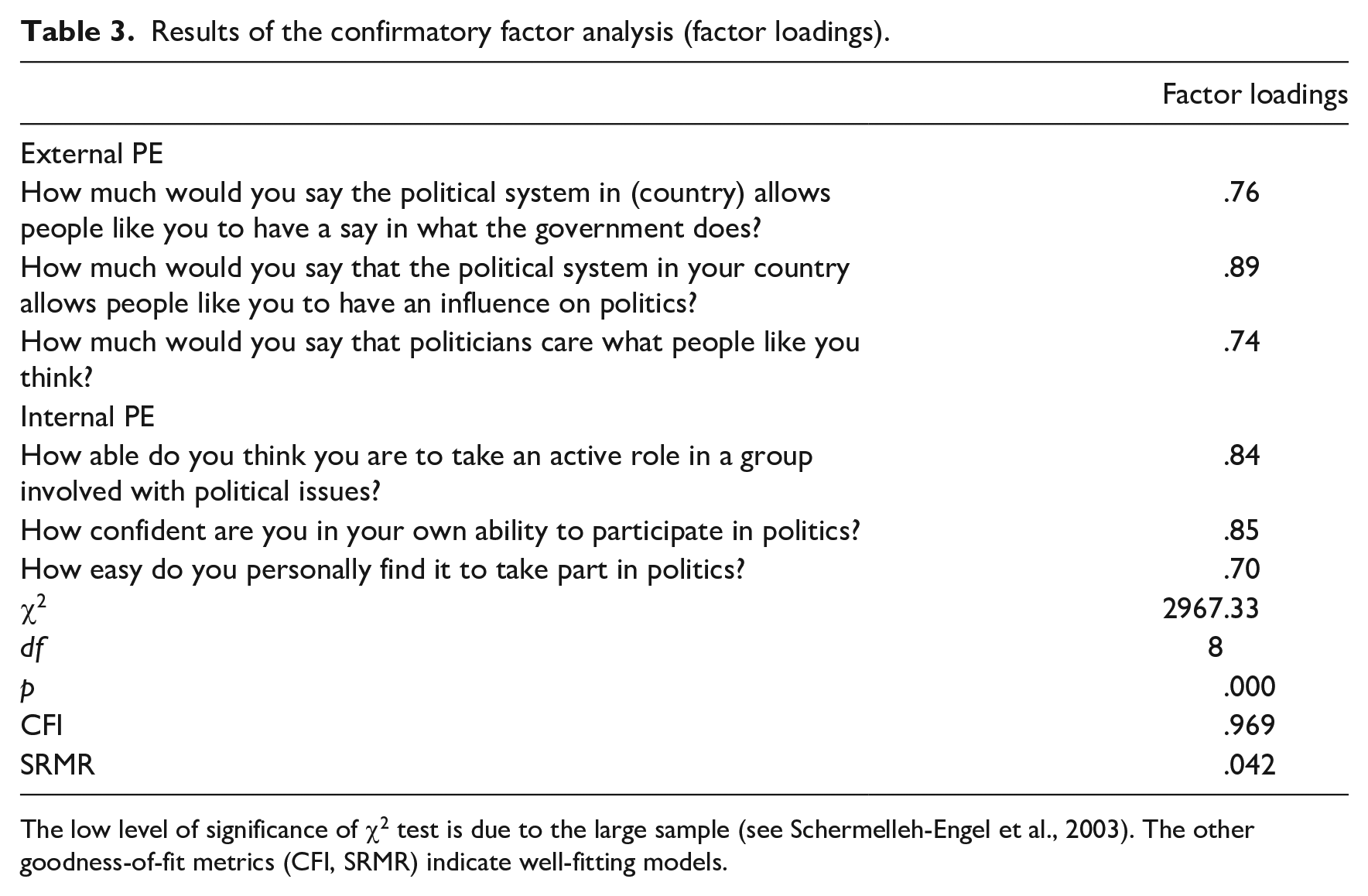
To test whether these items indeed capture two different constructs, a total of six variables were submitted into a confirmatory factor analysis. The analysis supports the expectations: the six items were organized into two factors. The three questions that tapped the external dimension were assigned to the first factor, and the other three were assigned to the second factor (all factor loadings are high (>.7); χ2 = 2967.33; df = 8; p < .01; CFI = .969; SRMR = .042; see Appendix 1). In line with these results, two indexes were created by averaging the three items belonging to the same factor: an external political efficacy index (M = 3.55; SD = 2.06; Cronbach’s α = .84), and an internal political efficacy index (M = 3.87; SD = 2.34; Cronbach’s α = .84). Although the two variables are clearly separate constructs, they are not independent of each other (r = .58, p < .001). Figure 1 shows the cross-country differences in the two dependent variables.

Mean values of external and internal political efficacy by country.
Independent variables
The significance of media in politics was calculated from two indicators of the expert survey, EMSS. Experts were asked to rate on a 10-point scale the extent to which they agree with the following two statements: (1) “Media coverage of public affairs has a lot of influence on public opinion in your country” and (2) “Media coverage of public affairs has a lot of influence in political and policy circles in your country.” The mean values of these two variables were summed into the new political significance of media variable used in this study (ranging between 10.60 and 16.3; M = 14.51; SD = 1.32; higher values indicate higher significance). For calculating the level of political parallelism, I followed Lelkes’s (2016) method based on the EMSS data. Experts were asked to rate leading media outlets in their countries (13–20 media outlets in each country, covering TV channels, news websites, serious, and tabloid daily newspapers) based on some specific questions. Three questions were used for creating the political parallelism variable. Experts rated on a 10-point scale the extent to which they agree with the statements: (1) “Medium X coverage is influenced by a political party”; (2) “Medium X presents equally well the arguments of all sides” (reverse coded); and (3) “Medium X advocates particular views and policies.” Political parallelism of the media system variable is the sum of the mean values of these three items (ranging between 11.45 and 20.31; M = 14.51; SD = 2.47).
Individual-level control variables
As socioeconomic and demographic variables, gender (1 = female; 51.6%), age (ranging between 18 and 102; M = 51.41; SD = 17.02), number of years in education (0 and 40; M = 13.16; SD = 3.83) and income measured by the income decimals of the particular country respondents come from (1 and 10; M = 5.45; SD = 2.76) were employed. As the direction of the effect of age is ambiguous based on the literature, a squared version of age was also included in the models. As political behavior variables, the data set includes political interest (ranging between 1 = not at all interested and 4 = very interested; M = 2.51; SD = .89), level of partisanship 5 (1 = no party is felt close and 4 = a party is felt very close; M = 2.01; SD = 1.02), whether respondents had voted for a party in the last election that was in governmental position at the time of the survey (1 = winning voter; 37.96%) and the level of political participation 6 (ranging between 0 and 6; M = .91; SD = 1.21). With regards to non-political life quality variables, the study uses four items. Social embeddedness was measured by asking respondents how many people they can discuss intimate and personal matters with (0 = there are no such people and 6 = more than 10 people; M = 2.92; SD = 1.41). For measuring interpersonal trust, respondents indicated on an 11-point scale to what extent they think that most people can be trusted (0 = “you can’t be too careful” and 10 = “most people can be trusted”; M = 5.21; SD = 2.36). As for happiness, respondents were asked to rate on an 11-point scale how happy they were overall (0 = extremely unhappy and 10 = extremely happy; M = 7.41; SD = 1.82). They also reported on their health using a 5-point scale (1 = very bad and 5 = very good; M = 3.81; SD = .90)
Context-level control variables
As for political system variables, the CPDS database includes a variable on the disproportionality of electoral systems (ranging between .45 and 17.81; M = 6.82; SD = 5.02; larger values indicate a more disproportional electoral system). 7 Data on the number of parties in government were collected from public sources (ranging between 1 and 5; M = 2.49; SD = .99). The GDP per capita in the 2014 data were obtained from the OECD database (in current USD based on purchasing power parity (PPP); ranging between 26,393 and 65,790; M = 41,781.14; SD = 10,646.77). For the estimation of the level of corruption, I used the 2014 corruption perception index of Transparency International. Its theoretical range is between 0 and 100, where a higher value originally represents a lower level of corruption, but for the analysis this was inverted, that is, a higher value indicates a higher level of corruption (ranging between 8 and 49; M = 27.45; SD = 12.38).
Results
Due to the multilevel nature of the data set, multilevel ordinary least squares (OLS) regression with random intercepts was applied to test the hypotheses. 8 The comparison of models including only the fixed and random intercept showed that adding random intercept significantly (p < .001) improved the model, that is, there are remarkable cross-country differences in the level of external and internal political efficacy. As there is no theoretical reason for random effects, and the slopes of the two-way relationships between dependent and each independent variable per country do not vary, fixed effects with clustered standard error were applied in the models. The only exceptions are models including cross-level interaction terms as in these cases random slopes for the individual-level component (voting for winning party) were added in line with the recommendation of the literature (Heisig and Schaeffer, 2019). The regression models are presented in Tables 1 and 2. The first models include only the context-level variables; the individual-level variables are added in the second models, while the cross-level interaction terms are entered in the third models.
Effects on external political efficacy (OLS).
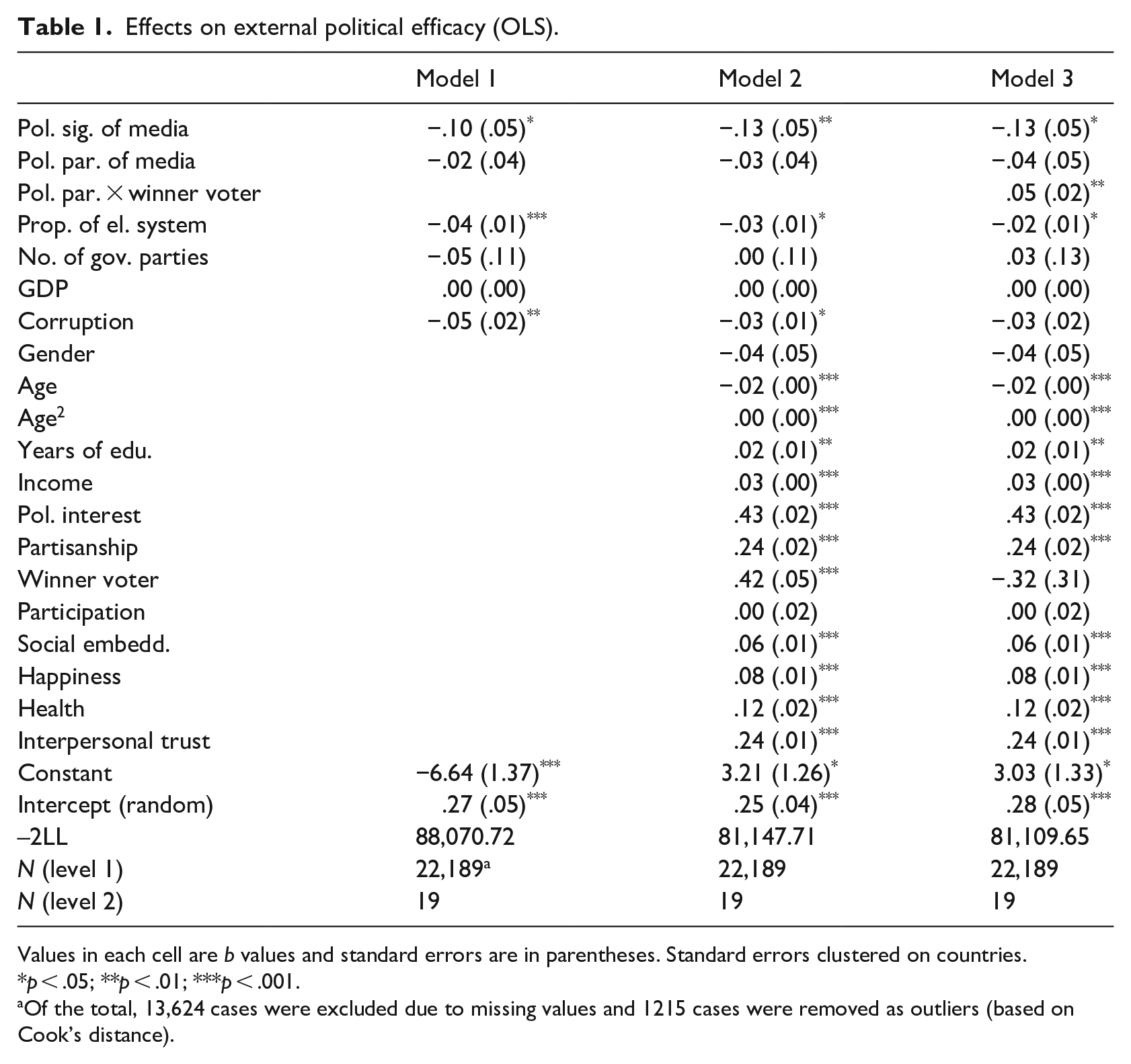
Values in each cell are b values and standard errors are in parentheses. Standard errors clustered on countries. *p < .05; **p < .01; ***p < .001.
Of the total, 13,624 cases were excluded due to missing values and 1215 cases were removed as outliers (based on Cook’s distance).
Effects on internal political efficacy (OLS).
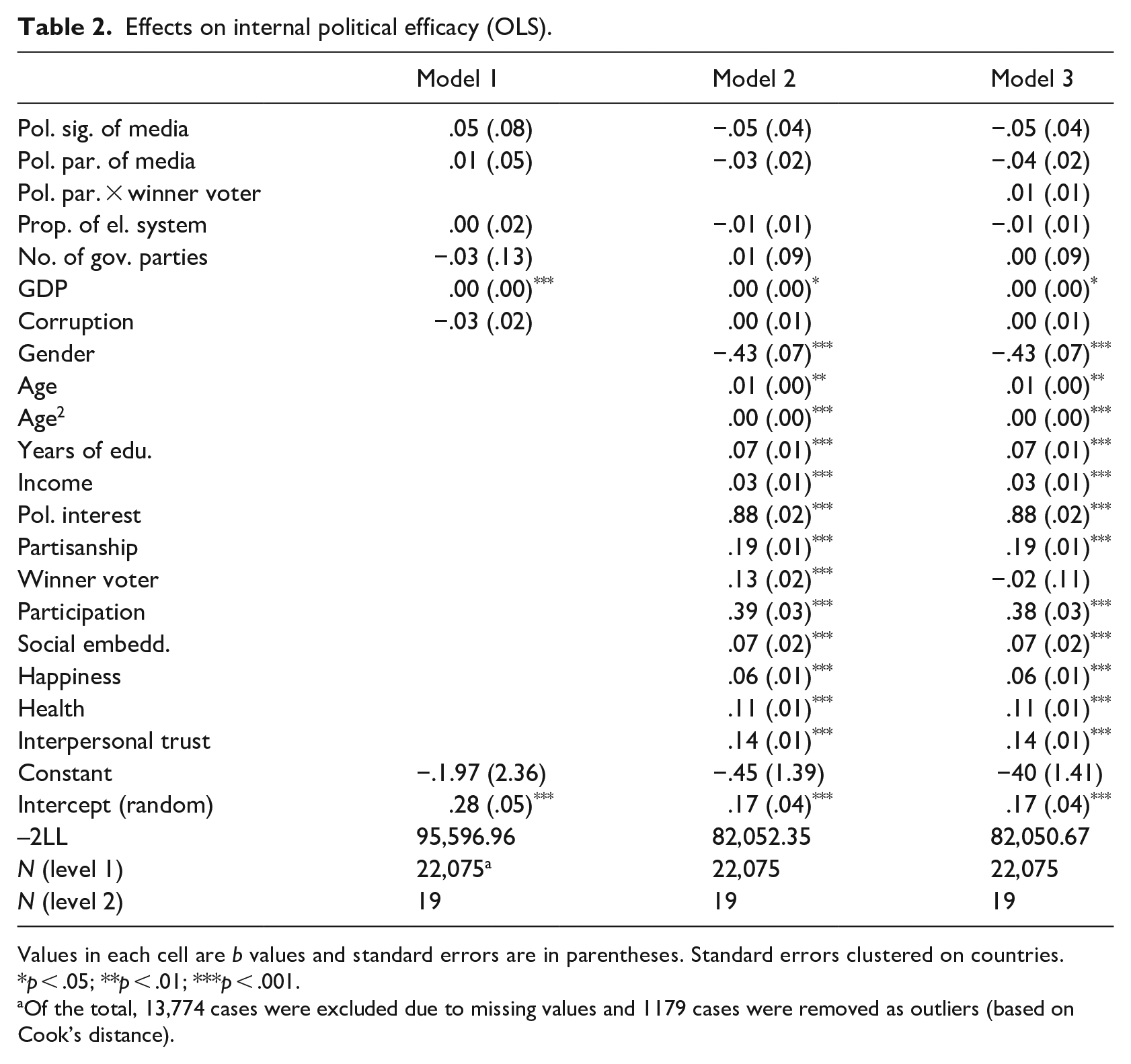
Values in each cell are b values and standard errors are in parentheses. Standard errors clustered on countries.
p < .05; **p < .01; ***p < .001.
Of the total, 13,774 cases were excluded due to missing values and 1179 cases were removed as outliers (based on Cook’s distance).
The results show that while media system variables are not directly associated with internal political efficacy, the level of external political efficacy is shaped by the political significance of the news media. In line with H1a, in countries where the news media play an important role in shaping political discourse, people perceive politics as less responsive and more difficult to affect. Figure 2 shows the predicted means in different levels of the significance of news media. The effect is not large, but substantial: there are almost one point differences in the predicted mean values of external efficacy between the lowest and highest levels of the independent variable. In contrast, H1b must be rejected. Actually, the direction of the non-significant effect is the opposite of what the hypothesis predicted: so the significance of news media is negatively associated with internal political efficacy. At the same time, the degree of political parallelism of the news media is not directly associated with political efficacy, therefore, H2a and H2b should be rejected. Moreover, the non-significant effects are negative, therefore, the predicted positive effect of political polarization is clearly not found. The interaction term is significant in the external political efficacy model: political parallelism shapes it indirectly through its interaction with the winning voter variable. While Figure 3 shows that the differences are minor, it indicates that the political parallelism of the media system matters in the case of voters who did not vote for winning parties. Their external political efficacy levels are lower in countries where highly partisan media operates than in countries with less parallelism in media. However, we need to be cautious in the interpretation of this finding due to small effect size shown in Figure 3. The significant association indicates the possibility of the existence of such effect rather than clearly demonstrate it. Nonetheless, partisan media probably amplify citizens’ pre-existing political disappointment and negative perceptions, while protecting them from attitude-challenging information. For voters of winning parties’ political efficacy, the media context seems to be indifferent. However, political parallelism has indirectly associated only with the perception of the political context, it has no direct or indirect impact on internal political efficacy. Therefore, although H3a gains moderate support, H3b should be rejected.
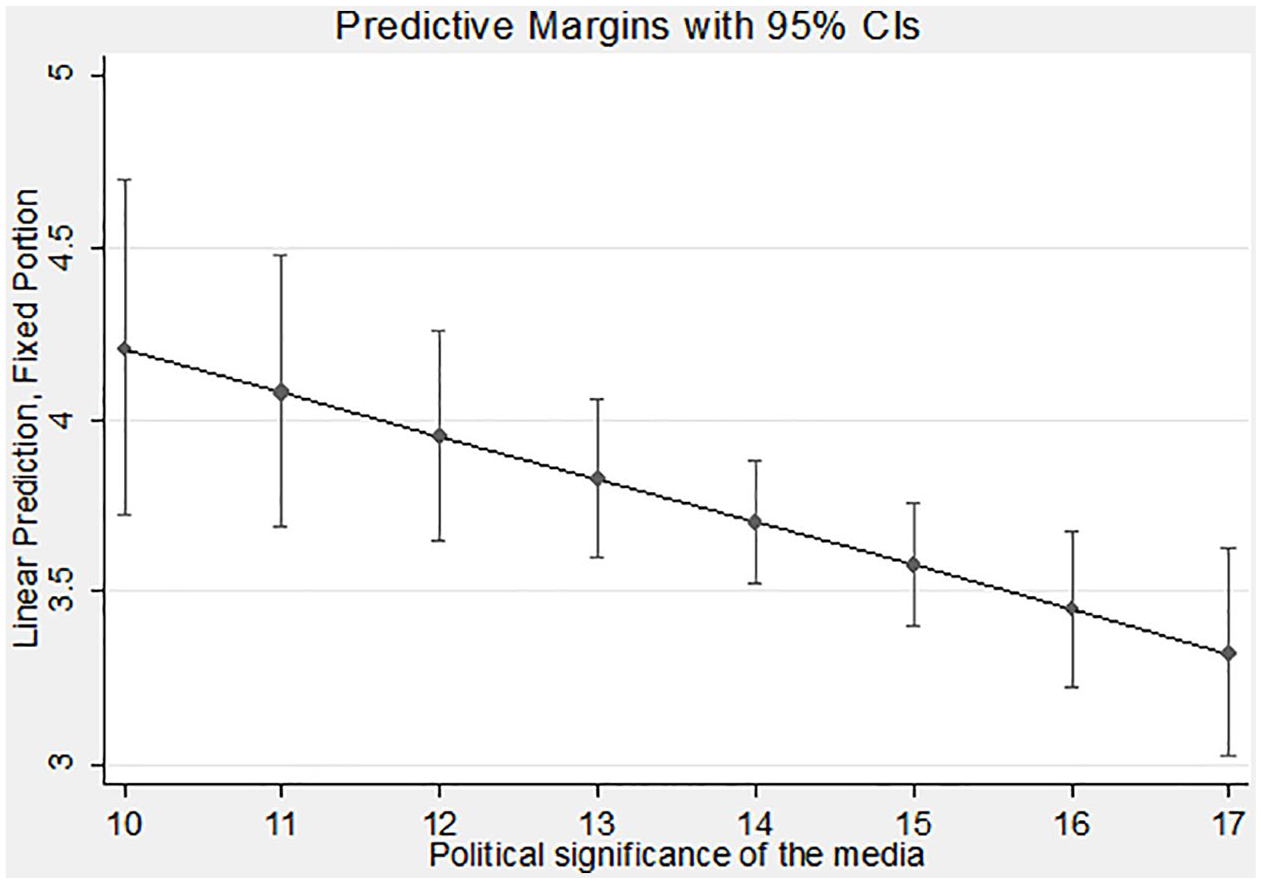
Predicted means of external political efficacy based on the political significance of news media.
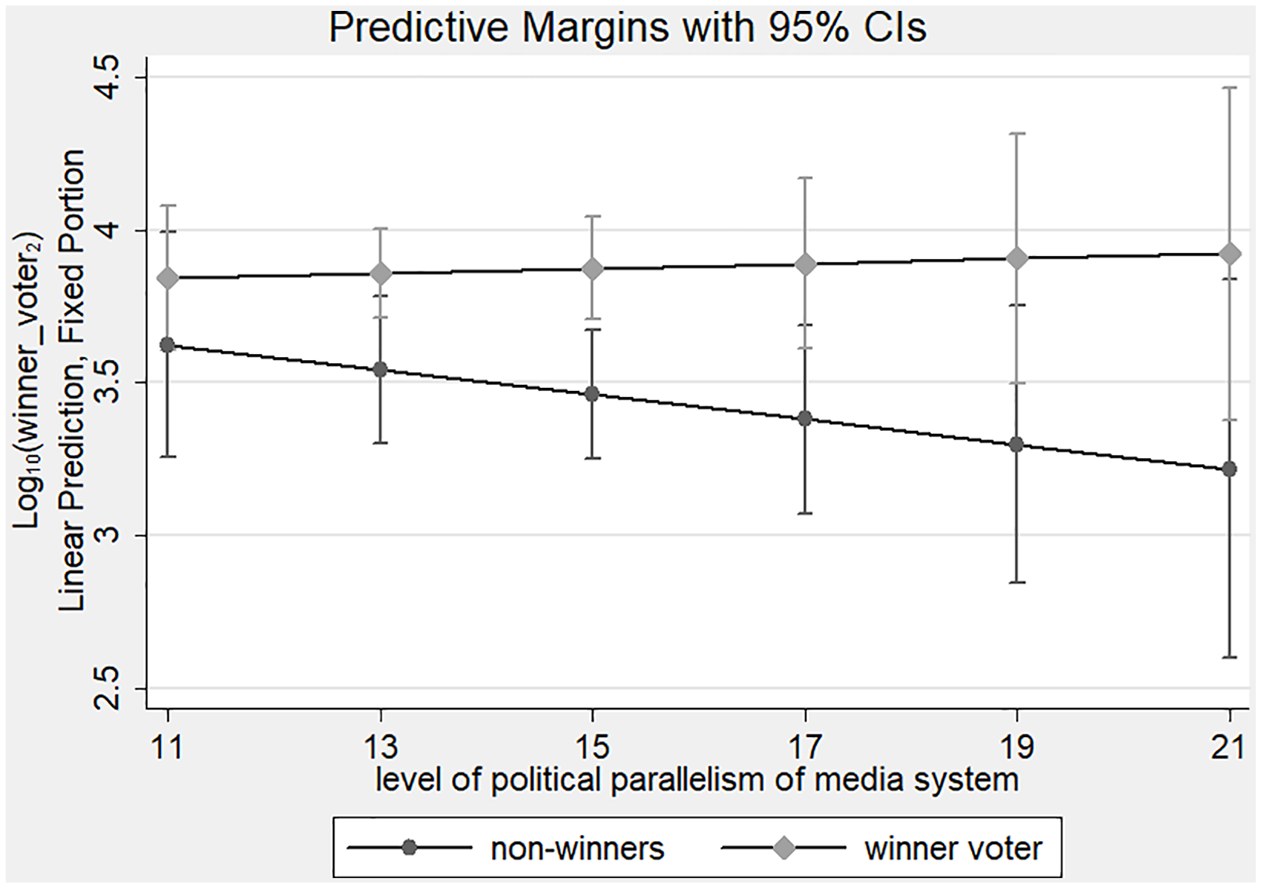
Interaction effects of winner voter and political parallelism of media system on external political efficacy.
In the light of the literature of political efficacy, it is also interesting to look at the specific factors that further shape political efficacy. As for socioeconomic variables, in line with the literature, better status goes hand in hand with significantly higher levels of both external and internal political efficacy. Note that while income is associated with both external and internal political efficacy to a similar degree, for education, the size of the effect on internal political efficacy is significantly larger than on the external dimension. Interestingly, the direction of the effects of age are reversed in cases of external and internal political efficacy. It is negatively associated with external and positively with internal political efficacy. However, none of these effects are linear as the significant effects of age 2 indicate. The older a person is, the worse her perception of the political system and the stronger her belief in her political competence, even if beyond a certain age, there are no such association. Another conflicted variable in the literature is gender. Results show that women are significantly less confident in their political competences, but there is no gender gap for external political efficacy.
Political behavior and attitude variables seem to be quite important predictors of political efficacy. More interested and partisan people have higher levels of external and internal political efficacy. However, while the level of partisanship shapes both dimensions of political efficacy to a similar degree, political interest has a stronger relationship with internal than external efficacy. Voting for the winning party is also significantly associated with the level of external and internal efficacy, but its relationship with the internal dimension is weaker. Also, when its interaction term with parallelism of the media system is entered into the model, the significances of the separate variable disappear in both models. That is, its relationship with political efficacy is conditioned on the media context. Political participation is relevant only for internal political efficacy; its external dimension is not influenced by respondents’ political activity level.
The findings support the assumption that factors related to life quality also shape political efficacy. More socially embedded respondents have higher levels of external and internal efficacy, and the degree of happiness, health, and interpersonal trust are also positively associated with both dimensions of political efficacy. Interestingly, happiness has a stronger positive relationship with people’s perceptions about the political sphere than about themselves.
Turning to the context-level variables, the type of electoral system is associated with external political efficacy. In line with the literature, people living in countries with more disproportional electoral systems perceive the political system as less responsive to citizens’ needs. Another hypothesis derived from the comparative political efficacy literature is rejected: the larger number of parties in cabinets does not decrease political efficacy; it is not significantly related to the dependent variables. A higher level of corruption erodes the belief in the responsiveness of the political sphere (external political efficacy). However, the level of GDP does not significantly shape people’s perceptions of the political system. In contrast, people living in more developed countries are more confident in their political competence (internal political efficacy). Interestingly, the level of GDP is the only context-level factor that is significantly associated with internal political efficacy.
Conclusion
Political efficacy is one of the most important determinants of political actions. People’s inner sense-making of external and personal reality affects their perception of control over their political actions and their outcome. If people feel that they can effectively shape political processes, they are more likely to carry out political actions. The level of political efficacy, however, significantly varies not only with individuals, but also with countries. This fact produces strongly divergent patterns of political behavior across nations. While a great deal of these differences may result from variations in individual-level predictors, a few papers (e.g. Karp and Banducci, 2008; Kim, 2013) demonstrated that some country-level political and economic factors also shape political efficacy. This research connects to the stream of the literature of comparative sociology that investigates context-level determinants of inner sense-making of external and personal reality (Callens and Meuleman, 2017; Davidov and Semyonov, 2017; Reeskens and Van Oorschot, 2012; Steenvoorden and Van Der Meer, 2017), but highlights elements of the political context that is almost completely neglected by the field. Although people’s perceptions of political and social reality are largely shaped by their media experiences (see Gauntlett, 2003; De Vreese and Boomgaarden, 2006), the effects of the media context on their attitudes are rarely addressed.
While a few decades ago the global convergence of media systems was a general expectation due to the Americanization of mass media all over the world (see Hallin and Mancini, 2004), now this seems to be an illusion. Now people live in strongly diverging media systems: a Swedish citizen may obtain completely different experiences about the way politics works than an Italian or a Polish resident.
Previous studies did not investigate whether context-level differences in the media system affect political efficacy. While the effects of media consumption on the individual level are thoroughly documented, features of the media system are neglected. This study is designed to fill this gap by the investigation of the effects of two context-level media system factors on the level of both dimensions of political efficacy, that is, external and internal political efficacy, drawing on the seventh round of the ESS. Also, this is the first cross-country study, to my knowledge, that examines both dimensions of political efficacy, and is not limited to the post-election period.
The findings show that the political significance of the media is significantly related to external political efficacy; the larger the role of the media in political discourses, the less responsive people perceive the political system to be. This result indicates that the way political reality is presented in the mass media may harm perceptions of the political system. Future studies should uncover the specific features of media reports that contribute to depressing external political efficacy. Nonetheless, this finding raises questions about the normative role of media in modern democracies. While critical “watchdog” journalism is usually regarded as a crucial component of democratic politics, it may also endanger democracy by alienating voters from the political system and its actors. This finding calls the attention for this potential conflict and may caution journalists and editors to rethink their normative role in our contemporary democracy. Interestingly, while previous research demonstrated the impacts of the level of political parallelism on some political behavior variables (Lelkes, 2016; Van Kempen, 2007), in case of political efficacy, it has no direct effect. However, even if the effect size is minor, it shapes external political efficacy indirectly as those who did not vote for the winning party have a bit lower levels of external political efficacy in the more partisan media context. Parallelism in the media system may reinforce the disappointment and negative perceptions of voters who did not support the incumbent parties. This conclusion supplements Lelkes’s (2016) findings showing that political parallelism in media increases the winner–loser gap when it comes to institutional trust and satisfaction with democracy. These results show that the relationship between the winner–loser gap and political parallelism extends beyond these dimensions and is valid on the level of a more general perception of the working of politics.
Overall, the findings show a rather negative picture about the role of media system in people’s political efficacy. While the research hypothesized several positive effects of media system, all of them were rejected. A larger role played by news media in political processes is not associated with more confident voters, and the more predictable and cognitively comfortable context of partisan media did not produce more efficacious citizens either. In contrast, in contexts where news media are more important and partisan, people’s external political efficacy decreases directly or indirectly. However, it is also important to highlight that the size of these significant effects are minor: the role and structure of media system matter, but the level of external political efficacy is largely shaped by other more important factors.
Several of these factors were identified by this study. Beyond the main hypotheses, it examined the effects of numerous individual- and context-level factors as control variables. While some of them are widely studied (socioeconomic variables), some count as novel (life quality variables) in the literature. In the light of previous findings, it is not surprising that higher socioeconomic status involves higher levels of both external and internal political efficacy. The findings on the effects of gender and age, however, are more remarkable. Although the gender gap still exists in the evaluation of respondents’ own political capacities, it disappears when the responsiveness of the political system is perceived. However, future research should uncover the reasons why women feel less efficacious, as this may be a crucial barrier in the way of their substantive political participation. Future work should also more specifically explore why age affects external and internal political efficacy differently. An important contribution of the present research is that it demonstrates that non-political life quality factors also shape this crucial political behavior variable. Social embeddedness, interpersonal trust, happiness, and health may provide important emotional resources for people and involve cognitive and evaluative biases that form one’s political perceptions and self-consciousness. The remaining open question is whether political efficacy is a mediating factor between the non-political life sphere and political participation.
The findings indicate that more context-level variables matter for external political efficacy than for internal political efficacy. Internal political efficacy seems to be ingrained more in individual characteristics; only the country’s level of development is significantly related to this attitude. External political efficacy, however, is significantly shaped by some contextual variables. The findings confirm previous results regarding the role of the disproportionality of the electoral system. People living in countries with more disproportional electoral systems have lower levels of external political efficacy. At the same time, a common hypothesis of the literature is rejected: several parties in the coalition do not reduce the level of political efficacy. The significant relationship between corruption and external political efficacy is not surprising. However, it is important to note that corruption erodes not only the economy and certain political actors’ image in particular, but also the political system as a whole.
The main limitation of the study is that the present analysis draws on samples from developed democratic European countries. Therefore, the findings cannot be generalized to wider circles of countries, especially to underdeveloped or non-democratic countries. As the media may play a different role in other contexts, future studies should address this question in non-western country-sample. A further limitation is the cross-sectional design of this present study. Future works should attempt to uncover if the significant and non-significant associations identified in this work change over time.
Footnotes
Appendix 1
Results of the confirmatory factor analysis (factor loadings).
| Factor loadings | |
|---|---|
| External PE | |
| How much would you say the political system in (country) allows people like you to have a say in what the government does? | .76 |
| How much would you say that the political system in your country allows people like you to have an influence on politics? | .89 |
| How much would you say that politicians care what people like you think? | .74 |
| Internal PE | |
| How able do you think you are to take an active role in a group involved with political issues? | .84 |
| How confident are you in your own ability to participate in politics? | .85 |
| How easy do you personally find it to take part in politics? | .70 |
| χ2 | 2967.33 |
| df | 8 |
| p | .000 |
| CFI | .969 |
| SRMR | .042 |
The low level of significance of χ2 test is due to the large sample (see Schermelleh-Engel et al., 2003). The other goodness-of-fit metrics (CFI, SRMR) indicate well-fitting models.
Funding
The author(s) disclosed receipt of the following financial support for the research, authorship, and/or publication of this article: This work was supported by the ÚNKP-17-3-IV-BCE-27 New National Excellence Program of the Ministry of Human Capacities and the European Union’s Horizon 2020 research and innovation programme under grant agreement No 822590 (Democratic Efficacy and the Varieties of Populism in Europe).
