




Abstract
This article analyzes the historical dynamics of state-seeking nationalism from 1492 to 2013. By synthesizing Gramsci’s insights of hegemony with world-systems perspective and historical institutionalism, I introduce a new theoretical frame that gives crisis, uneven development, and the relationship between structure and agency, a central place in conceptualizing nationalist mobilization. I also introduce a new major database, that is, The State-Seeking Nationalist Movements (SSNM) database, which includes two unique datasets for historical analysis of nationalism. The first dataset includes articles reporting on state-seeking nationalist activities throughout the world from 1804 to 2013 using international news reports. The second dataset is compiled from secondary sources and it includes revolutionary situations and conflicts involving state-seeking movements from 1492 to 1829. Combining the two original datasets, the SSNM database is a rich new empirical resource for the sociological study of state-seeking nationalism from a long term and global perspective. Historical patterns and multivariate negative binomial regression analysis suggest that SSNM are more likely to take place during periods of financialization, economic crisis, interstate wars, colonial occupation, and intense social unrest. In addition to these structural factors, the findings also bring attention to the role of agency. Nationalist organizations increase the likelihood of state-seeking nationalism but they cannot produce nationalist mobilization as they please. They do it under structural conditions beyond their control that constrain or ease their mobilization. Although I find strong evidence for historical institutionalism, the theory and findings presented in this article suggest that the accumulation of non-hegemonic state power does not help rulers contain state-seeking nationalism. I find no evidence for primordialism, economic/political modernization theories, or globalization-breeds-nationalism arguments. I conclude by discussing how the new theory and new data introduced in this article advances our understanding of the dynamics of nationalism and global governance patterns in world history.
Keywords
Introduction
From the end of the Second World War to the late 1990s, the dominant position in social science literature was that the long march of nationalism in world history was coming to an end (Carr, 1945; Deutsch, 1953; Hobsbawm, 1992; McNeill, 1986). The unexpected revival of nationalist-secessionist movements in Western Europe and North America in the 1970s, and the sudden collapse of the Union of Soviet Socialist Republics (USSR) and Eastern bloc countries in the early 1990s were largely met with surprise and inspired a fresh round of academic debates on the dynamics of nationalism (Anderson, 1991; Breuilly, 1993; Brubaker, 1996; Hutchinson, 2005), nation-state formation (Meyer et al., 1997; Roeder, 2007; Wimmer and Feinstein, 2010), and ethno-nationalist armed conflicts (Fearon and Laitin, 2003; Wimmer et al., 2009). Since then, a vast literature on nationalism emerged. This literature analyzed many interesting elements of nationalist movements including their relationship with primordial/premodern ethnic roots and identities (Gat and Yakobson, 2013; Smith, 1995; Van Den Berghe, 1987), economic modernization and industrialization (Gellner, 1983; Hobsbawm, 1992), globalization (Castells, 2004; Kaldor, 2004), political modernization and centralization of state power (Hechter, 2000; Lachmann, 2010; Mann, 1995; Tilly, 1990), and diffusion of nation-states and nationalist ideologies (Meyer et al., 1997; Wimmer, 2013).
There are two major limitations of this literature, one theoretical and one methodological. The theoretical limitation is the lack of attention paid to the relationship between crisis and nationalism. So far, no major theories of nationalism seriously undertook the task of examining how crises in economic, political, and social spheres affect nationalist mobilization at local, national, or world-systems levels. In most classical studies on the historical evolution of nationalism, the term “crisis” does not even show up as a concept, let alone as an explanatory process, mechanism, or an independent variable (e.g. Anderson, 1991; Gellner, 1983; Hobsbawm, 1992; Tilly, 1990). This is a major blind spot in the literature because many explanatory factors social scientists rely on—such as relatively stable ethno-national or religious identities, or gradual development of macro-structural historical processes such as modernity, industrialization, or globalization—cannot explain or predict successive ebbs and flows in nationalist mobilization. Since nationalist mobilization takes place discontinuously at irregular intervals, to better capture its historical dynamics, we must turn our attention to (1) multiple forms of crisis in economic, political, and social spheres, (2) uneven temporal and spatial development of historical capitalism that produces such crises, and (3) existence of organizations that turn such crises into opportunities.
The methodological limitation is linked to narrow spatial scope and short temporal span of most existing empirical analysis on the subject. Due to nationalism’s chameleon-like ability (Smith, 1995) to transform itself and adapt into very different temporal and spatial contexts, dynamics of nationalist mobilization cannot be generalized from studies that only consider particular types of nationalist movements at a given point in space and time. While such case studies and comparative analyses are invaluable to produce new perspectives and novel explanations on dynamics of nationalism at the local level, they are not very helpful in observing and identifying macro-structural factors that affect nationalist mobilization at the global level (but see Kaup and Gellert, 2017). Recently, there has been many efforts to overcome this limitation by producing long term and global datasets on nationalism (see Bergesen and Schoenberg, 1980; Gleditsch and Ward, 1999; Gurr, 1993; Wimmer and Min, 2006). Most of these datasets, however, focus on successful nation-state formation incidents, ethno-nationalist warfare or particular form of movements such as anti-colonial or ethnic forms of nationalism. Consequently, they end up excluding many instances of nationalist mobilization around the world including failed nationalist mobilizations, and movements which use a wide spectrum of action repertoires including democratic rallies, mass protests, referendums and nationalist riots.
This article aims to reconsider dynamics of nationalist mobilization in world history by overcoming these two limitations. To overcome the theoretical limitation, I will introduce the building blocks of a new alternative approach that gives crisis, uneven development, and the relationship between structure and agency, a central place in conceptualizing nationalist mobilization. Building upon Antonio Gramsci’s (1971) insights on hegemony, Giovanni Arrighi’s (1994) theory of “systemic cycles of accumulation,” and historical-institutionalist theories of nationalism (Lachmann, 2010; Wimmer, 2013), this theoretical frame aims to explain the rise and fall of state-seeking nationalist mobilization in world history by turning our attention to how crises in economic, political, and social spheres produce structural opportunities for nationalist mobilization at the local and global level.
To overcome the methodological limitation, I will extend the spatial-temporal frame of analysis beyond what is common in the literature and examine patterns of nationalist movements from 1492 to present. As I will elaborate in the following section, in this article, I conceptualize nationalism as a form of power struggle which manifests as two opposite forms of movements—state-led nationalism and state-seeking nationalism—both of which evolved side by side with historical capitalism and the modern interstate system. For the purposes of this article, I will limit my empirical analysis on state-seeking nationalist movements (SSNM), which I define as socio-political movements of stateless communities that aim to establish an independent state in an interstate system and, thus, to produce a convergence of territorial and political loyalty around their state, irrespective of competing foci of affiliation such as kinship, religion, economic interest, ethnicity, race, or language (see Haas, 1986; Tilly, 1994).
Because there is no existing dataset which focuses on SSNM for this entire period, in this article, I also will introduce a major new database on nationalist mobilization in the world from 1492 to 2013. The SSNM database consists of two original datasets compiled by the author. The first dataset includes news articles from The Guardian/Observer and The New York Times reporting on state-seeking nationalist activities—including a wide repertoire of actions used by state-seeking nationalists such as armed conflicts, pro-independence rallies and protests, referendum proposals, violent or peaceful mass movements demanding national liberation—throughout the world from 1804 to 2013. The second is compiled from secondary sources and includes a list of revolutionary situations and conflicts involving SSNM within the boundaries of the modern world-system from 1492 to 1839. Combining the two original datasets, the SSNM database is a rich new empirical resource for the sociological study of state-seeking nationalism from a long term and global perspective.
After explaining the data collection process and describing the historical trajectory and global waves of nationalism from 1492 to 2013, I will use a multivariate regression analysis to analyze factors that affect frequency of SSNM from 1816 to 2001. The analysis suggests that major waves of state-seeking nationalist mobilization on a world-scale are more likely to emerge during periods of financial expansion and world hegemonic crisis. Moreover, intense economic crises, interstate wars in the territory (manifestations of geopolitical crises) and rising social unrest (a proxy for social crisis) increase the likelihood of state-seeking nationalism. Existence of nationalist organizations, imperial dependency status, recent nation-state formation, or state-seeking nationalist mobilization in neighbor territories also increase the likelihood of state-seeking nationalism. I conclude by discussing how the new theory and new data (SSNM) presented in this article advances our understanding of the dynamics of nationalism in world history.
Conceptualizing nationalism from a world-historical perspective
One of the main problems in the literature is that the term nationalism is used to describe two different, almost opposite, types of sociopolitical phenomena. On the one hand, the term is used to describe movements by states (or state elites) which aim to accumulate more power through the combination of its subjects into a single collective body and mobilizing them against internal or external enemies or for production, protection, and administration purposes. On the other hand, the term nationalism is also used to describe movements by stateless communities aiming to produce a new state in order to emancipate themselves from an alien rule or to resolve their political, economic, and cultural problems through self-determination. These are interlinked but categorically different types of nationalist movements. Using the terminology offered by Tilly (1994: 133), I will call these two movements respectively as “state-led nationalism” and “state-seeking nationalism.”
There is an inherent antagonism between state-led and state-seeking forms of nationalism. While the former is preoccupied with preserving the territorial integrity of existing states in an interstate system, the latter challenges the integrity of states. This historical tension between these two distinct forms of nationalism is an integral part of the co-evolution of capitalist world-economy and the modern interstate system, both of which constituted what Wallerstein (1974) called as the modern world-system. Historical co-evolution of these two antithetical forms of nationalism side by side with the modern world-system affected their relationship vis-à-vis this system in opposite ways. Different manifestations of state-led nationalism evolved as pro-systemic forces that emerged as a product of the hierarchy of the interstate system (Phillips and Wallerstein, 1985; Wallerstein, 1991) and reproduced the territorially bounded nature this system in return. In contrast, different forms of state-seeking nationalism—such as national liberation movements and anti-colonial nationalism—evolved as anti-systemic movements (Wallerstein, 1983). Together with class-based social movements, SSNM posed a major threat to the integrity of existing members of the interstate system, because they “sought the creation of an entirely new state, either by secession or by merger” (Arrighi et al., 1989: 32).
The distinction between state-seeking nationalism and state-led nationalism is not necessarily a distinction between good and bad forms of nationalism. Both of these forms can be democratic or authoritarian, progressive or reactionary, reformist or revolutionary, violent or peaceful. Moreover, these two opposite forms of nationalism are dialectically related to each other as they produce and reproduce one another. One of the main paradoxes with SSNM is that as they become successful in establishing new states and joining the existing interstate system, they emulate pro-systemic, state-led nationalist forms. In doing so, in the long run, they also end up “reproduc[ing] the capitalist world-economy by extending and deepening its interstate plane of operations” (Arrighi et al., 1989: 53; also see Wallerstein, 1983: 101). Likewise, as state-led nationalists strive to accumulate more state power in the interstate system, they often end up oppressing and antagonizing geographically concentrated minority populations and plant the seeds of new of SSNM.
Hegemony, crisis, and nationalism
The struggles between rulers and geographically concentrated populations are not products of capitalism. They were in existence probably since the emergence of first known states in ancient Mesopotamia. Formation of the capitalist world-system, however, radically transformed the nature of these struggles in two ways. First, existing states began to operate within an interstate system whereby each state recognized and competed with each other. Second, rulers of these states started to deploy varying combinations of coercion and consent to exercise state power and to represent particularistic interests of their state as general interests of the people. Put differently, they began to exercise state power not through brute force but through what Gramsci (1971) called “hegemony” (pp. 57–58). These two developments reinforced each other. Counterbalancing coercion with varying degrees of consent not only helped rulers to mobilize masses more effectively for production, protection, and administration purposes, but also gave them comparative advantage in their economic and military competition against other states in the interstate system. Through competition, successful hegemony-building strategies were emulated by other rulers and adapted into new contexts.
These various hegemony-building strategies also helped rulers to produce more stable national states by more effectively containing internal threats and “national problems.” Existing comparative-historical research supports this view by suggesting that militarily suppression is not sufficient to produce stable polities and to avoid nationalist rebellions. To produce stable “national states,” rulers should also offer to their people—especially to geographically concentrated minority communities—public goods (Wimmer, 2013), political-economic rights (Gurr, 1993; Hechter, 2013), and certain degrees of autonomy (Hechter, 2000). We can consider these proposals efforts by rulers to establish different forms of “social compacts” (Milton, 2007; Silver, 2003) between the state and people. In states with active “national problems,” such social compacts can temporarily help the rulers to reduce minority groups’ demands for self-governance and independence and thus, strengthen their hegemony of the state over people (see Milton, 2007).
In a capitalist world-economy and a competitive interstate system, however, rulers cannot exercise an effective combination of coercion and consent at their will. This is because rulers’ capacity to establish social compacts depend in large measure on the resources available to rulers. Availability of such resources is closely linked to booms and bursts of historical capitalism and its uneven development on a world-scale. This is why periods of intense economic crisis and stagnation are not fertile for making new social compacts or maintaining existing ones. Even in regions with high levels of economic development, prolonged economic crisis, and stagnation can reduce available resources for redistribution and push rulers to unmake existing social compacts, reducing their capacity to contain social unrest (Silver, 2003) and nationalist movements (Milton, 2007).
In addition to economic crises and stagnation, geopolitical crises (such as interstate wars, inter-great power rivalries) also affect state-seeking nationalist mobilization by reducing rulers’ capacity to effectively combine coercion and consent. In the aftermath of major wars, as Gramsci (1971) once put it, “cracks opened up everywhere in the hegemonic apparatus, and the exercise of hegemony became permanently difficult and aleatory” (p. 80). During such crises and wars, rulers face increased difficulty in using coercion effectively against internal threats, including state-seeking nationalists’ movements. In these periods, imperial powers and rival states are more likely to provide material and logistic aid to SSNM to weaken their opponents (Gurr, 1993; Mayall, 1994), which serves as an opportunity for state-seeking nationalist mobilization. In addition, economic costs of war-making, war-time needs for centralization, and extraction of local resources can also push existing elites to unmake previously granted economic, social, and political privileges, causing major grievances that can be used by state-seeking nationalists to mobilize masses. Consequently, similar to economic crises, geopolitical crises, and wars also become fertile grounds for revolts, rebellions, and revolutions in general (Lenin, 1963; Skocpol, 1979) and for state-seeking nationalist mobilization in particular (Wimmer, 2013).
Escalation of social crisis and high levels of social unrest in a given territory can also increase the likelihood of state-seeking nationalist mobilization by weakening the hegemony-building capacity of rulers. The relationship between social movements and (state-seeking) nationalist movements is a complex one. Sometimes, these movements can reinforce each other by exchanging ideas, forms of public action, organizational vehicles, symbols, and slogans from other social movements (Markoff, 1996: 27–29) or by coalescing into a broader revolutionary force (see Silver and Slater, 1999) as the Bolsheviks successfully achieved during the October Revolution, and at a wider scale after the Baku Congress of 1920.
As William G Martin (2008) correctly observes, however, “networks and exchanges among [different types of anti-systemic] movements d[o] not always produce (as is often assumed) cooperative or felicitous relationships among movements” (p. 169). Thus, an analysis of the relationship between social movements and (state-seeking) nationalist movements must carefully consider various antagonisms between them. Stating this, we do not necessarily need to assume cooperative and felicitous relationships among movements to suggest that escalation of social movements can help state-seeking nationalist mobilization. As the more recent revival of secessionist movements in Donetsk and Luhansk after the 2013 Euro-Maidan protests and the 2014 Ukrainian revolution shows, state-seeking movements can also emerge as a reaction to existing social revolutions. Strong social movements, revolts, and rebellions can also provide a more fertile environment for state-seeking nationalist mobilization regardless of their intention, if they can destabilize existing state apparatuses (Goldstone, 2014; Skocpol, 1979). As Beissinger (2002) observes in the case of the nationalist movements in the USSR from 1988 to 1992, many SSNM can “ride the tide” of conflict generated by other actors and movements. More importantly, however, there is a finer line between social movements and state-seeking nationalism than is widely assumed in the literature. As Gramsci observes in Southern Italy, national problems do not necessarily manifest themselves directly and immediately as state-seeking nationalism but first as social movements that address existing inequalities and injustices (also see Smith, 1971: 82; Wallerstein, 1961: 48–52). To use Albert Hirschman’s (1970) famous categories, sometimes secession becomes an “exit” strategy for geographically concentrated social movements when they realize that their “voices” will not be heard by the rulers and “loyalty” is no longer an option.
Financialization and world hegemonic crisis
If these arguments are correct, then financialization periods of capitalist world-economy must also be very fertile for state-seeking mobilization. Although it is widely discussed as a recent and novel phenomenon by economists and economic sociologists, financialization actually is a recurrent feature of historical capitalism from 14th century to present. Building on observations and insights of French historian Fernand Braudel (1992), Giovanni Arrighi (1994) argues that all leading government-business enterprises of historical capitalism from northern Italian city-states in the 14th century to the United States in the 20th century led the world through a period of financialization when it became extremely difficult to sustain high-profit rates from production and trade due to increased competition or crisis of overaccumulation. These structural crises that push the leading business-government complexes of the capitalist world-economy to financialize the world-economy are known as the signal crises.
Financial expansion periods temporarily generate super profits mainly from financial speculation and intermediation and help produce a corresponding Golden Age (i.e. a belle époque) for the leading business-government complexes in the short run. However, they have several negative effects in the medium-run. In these periods, international political-economy turns into a crisis-ridden zero-sum game (Arrighi, 1994; Wallerstein, 1974), inter-enterprise competition and rivalry escalates (Arrighi, 1994; Arrighi and Silver, 1999; Go, 2011), social and political crises in the world intensify, and revolutions erupt (Silver and Slater, 1999). These interlinked crises become symptoms of world hegemonic crises (Arrighi and Silver, 1999: 21–36; Chase-Dunn et al., 2000: 81), signaling the beginning of the dissolution of world hegemonic orders. Instead of solving signal crises for good, financial expansions end up leading to a deeper crises, known as terminal crises, which mark the end of a world hegemony and the transition to a new world order. Financial expansion periods, and the attendant deepening systemic chaos, are also the periods during which the preconditions for a new material expansion, systemic cycle of accumulation, and hegemonic order as shown in Figure 1 and Table 1.
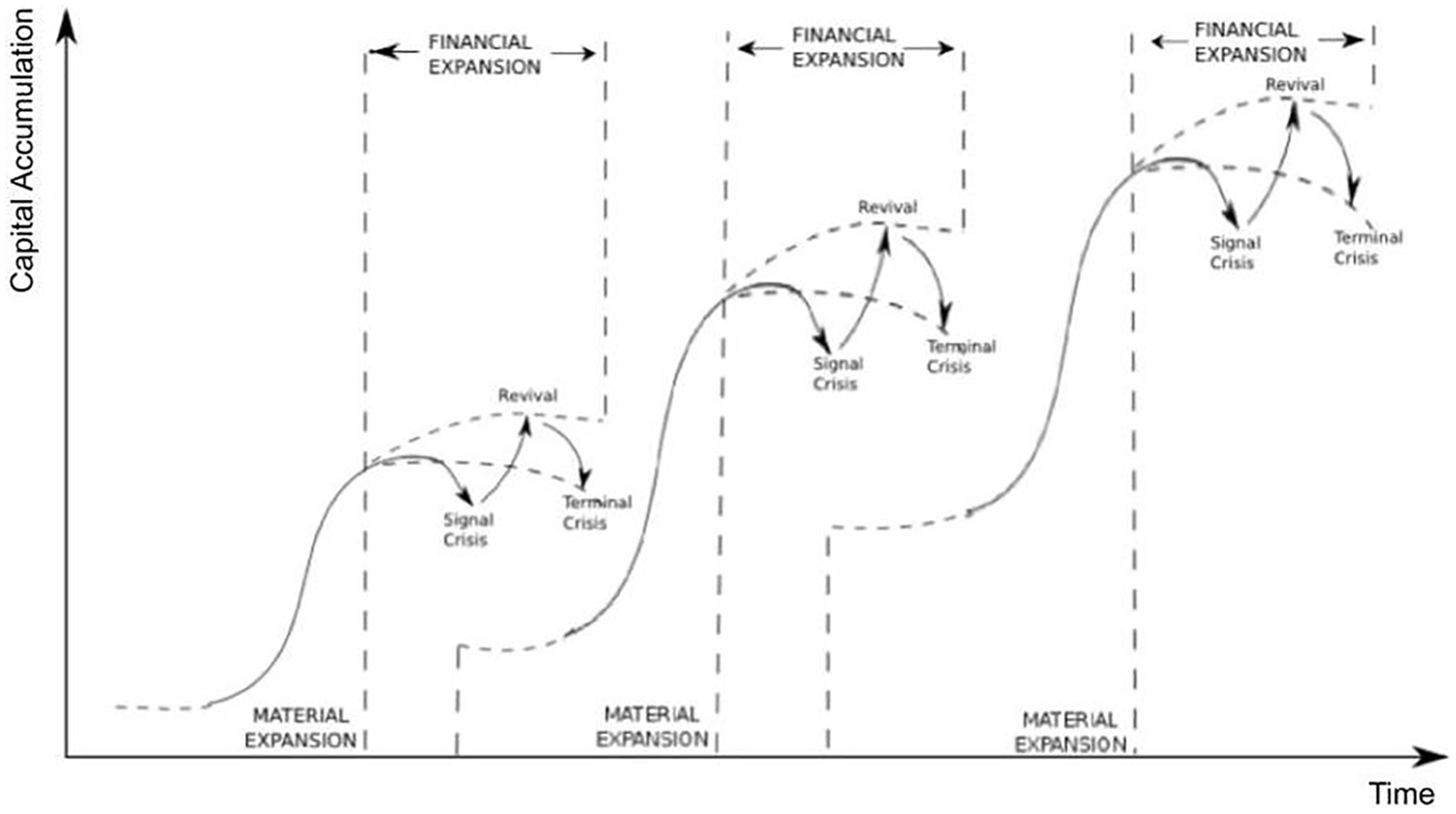
Systemic cycles of capitalist accumulation.
Approximate dates for signal crisis, terminal crisis, and the end of each period.

See Arrighi (1994) for a timeline that illustrates these periods. These are approximate dates. In the statistical analysis, to assess whether or not the findings are robust to the dates chosen, I replicated the same analysis presented in this article using alternate date combinations (±5 years). Results are robust.
Genoese-Iberian systemic cycles did not create an Iberian-centered world hegemony in the capitalist world-economy. Thus, there are no beginning and end dates for world hegemonic orders. Yet, in our analysis, to be able to compare state-seeking movements in this period to other “hegemonic consolidation” and “hegemonic transition” periods, we will treat 1492–1560 period as era, which is analogous to an era of world hegemonic consolidation; and the period from 1560 to 1648 as an era which is analogous to world hegemonic transition.
Because the crisis of the US world hegemony is an ongoing process, it is not possible to assess a date for its terminal crisis or to state whether there will be a terminal crisis. Recognizing this fact, however, Silver and Arrighi (2011) suggest that the recent 2007/2008 crisis has resemblances with terminal crisis of previous world hegemonies.
Based on these observations, I argue that financial expansion and world hegemonic crisis/transition periods should also produce a more favorable macro-structural climate for state-seeking nationalist organizations to mobilize the masses than material expansion and world hegemonic consolidation periods. This is because these periods of history reduce rulers’ capacity to use coercion and consent effectively at the local level. As shown in Figure 2, some of the effects of financial expansion/world hegemonic transition on SSNM are through the intermediation of (1) economic crises, (2) geopolitical crises, and (3) social crises at the local level. Some of its effects, however, cannot be reduced to these crises alone. Financialization periods have emergent properties. That is, the combined and interactive effects of these multiple crises and conflicts are more and qualitatively different than the sum of their effects in isolation. Financialization produces contentious conjunctures at the global level due to prolonged interactions of a series of crises in the world. These contentious conjunctures are linked but not reducible to these particular crises and conflicts. These periods signal major instability at the world-system level characterized by unmaking of social compacts, declining legitimacy of governance, rapid social change, increased economic and status-based anxieties, and perceived opportunities for independence by state-seeking nationalist organizations.
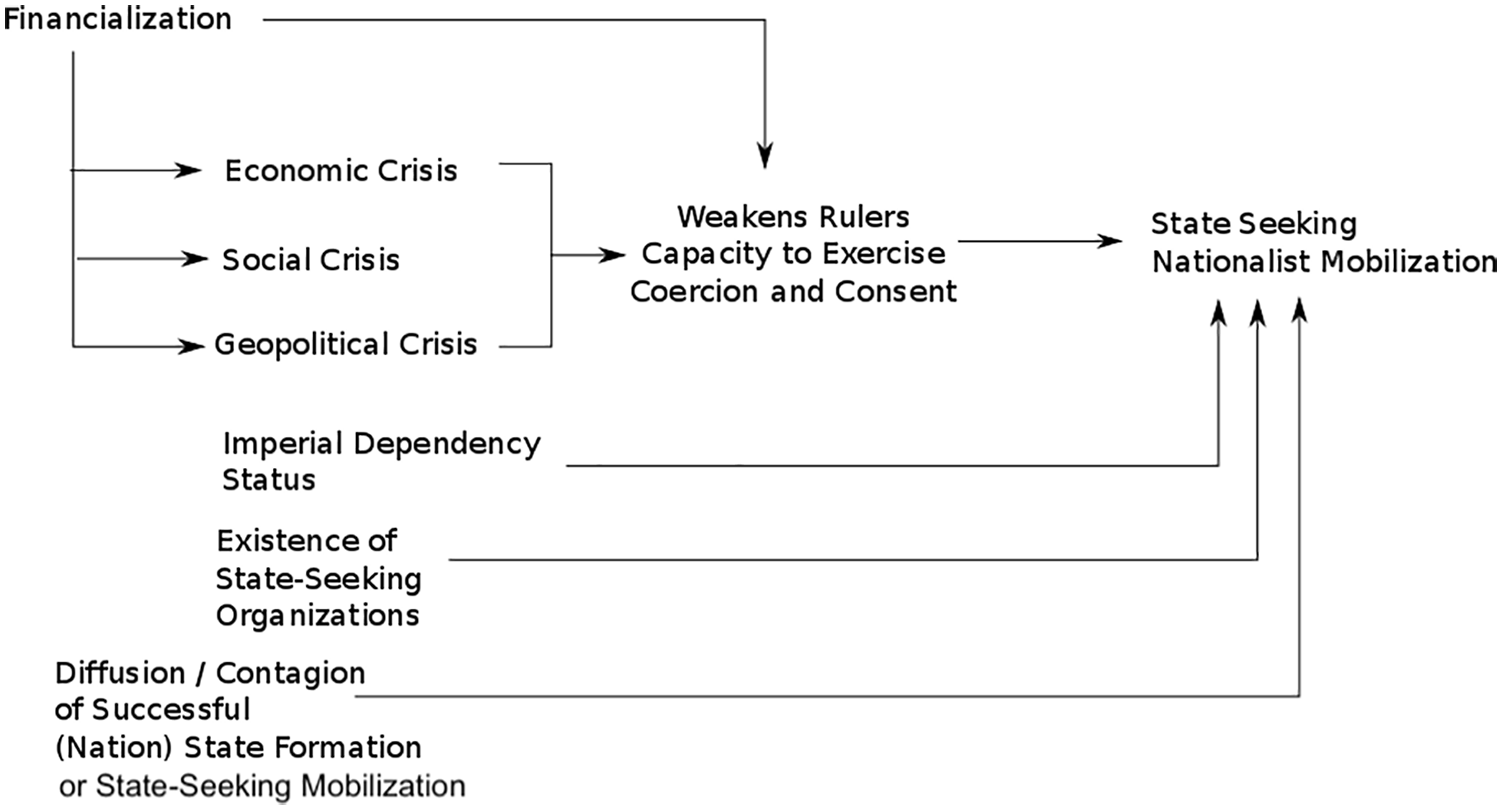
Financialization, crisis, and state-seeking nationalist mobilization.
However, these structural opportunities disappear with the emergence of a new world hegemonic order. The reconstitution of the interstate system (i.e. after the Peace of Westphalia in 1648, the Vienna Congress in 1815, or the establishment of the United Nations in 1945), the establishment of a new world hegemony (i.e. Dutch world hegemony, British world hegemony, and US world hegemony), and the simultaneous demise of financialization and the beginning of a new period of material expansion of trade and production create favorable conditions for rulers to defeat secessionist movements through brute force and/or to co-opt them through the distribution of new rights or privileges. Consequently, the frequency of SSNM declines in these periods in regions that benefit from geopolitical stability and economic growth.
In short, the regular alternation of periods of material and financial expansion (or hegemony and hegemonic crisis) at the world level produces successive global waves of SSNM over the longue durée of historical capitalism. If this argument is correct, it would bring not only a new explanation to the global clustering of nationalist movements—observed by many macro-historical sociologists such as Frank and Fuentes (1990), Calhoun (1997), Silver and Slater (1999), Boswell and Chase-Dunn (2000), and Martin (2008) to name a few—but also a new interpretation of Lenin’s (1963) theory linking the rise of national liberation movements to domination of finance capital during the age of imperialism (also see Smith, 1971: 79–71). Similar to Lenin’s theory, the perspective presented in this article also explains why periods of capitalism dominated by finance capital are prone to social revolutions and national liberation movements. Different from Lenin’s approach, however, in this conceptualization, domination of finance capital is not the highest stage but a recurrent phase of historical capitalism. Thus, instead of an age of national liberation, we see successive global waves of state-seeking nationalist mobilization.
Agency, uneven development, and colonization
It is important to note that these structural opportunities provided by multiple forms of crises will not automatically turn into SSNM unless there are existing nationalist organizations on the ground, waiting to exploit such opportunities for mobilization. Existence of nationalist organizations is necessary to articulate these problems through the lenses of a nationalist ideology (emphasizing the necessity to form a separate state as a solution), and to mobilize people for an exit strategy. However, existence of such organizations does not necessarily guarantee that people will follow these organizations. While multiplicity of crises explained above serve as important structural opportunities, another equally important aspect of such mobilization is people’s perception of independence—or formation strong movements—as an actual possibility. Historically speaking, people are more easily mobilized for independence when other nations start to gain their independence or start strong movements.
Finally, regions under imperial domination are more likely to produce SSNM because imperial domination relies mostly on coercion but not on consent. We cannot properly explain the temporal-spatial patterning of anti-colonial forms of SSNM, however, without dealing with uneven development of capitalism in space and time. The literature focusing on decolonization finds compelling evidence for an increase in decolonization movements during periods of world hegemonies (Bergesen and Schoenberg, 1980; Boswell, 1989; Strang, 1991). However, quantitative research that applies this theory to all forms of nationalism in the world-system does not find robust evidence to support these claims (Wimmer, 2013: 98). This discrepancy emerges because macro-level dynamics of peripheral decolonization cannot be directly applied to macro-level dynamics of state-seeking nationalism movements in core (or semi-peripheral) regions, because of their different structural positions in the capitalist world-economy and the interstate system. Since the peripheral regions of the world-economy do not share fully in the economic and political benefits of the material expansion (Arrighi, 1994; Wallerstein, 1974), elites in peripheral colonies are unable to increase their consent-making capacities during material expansion periods. During world hegemonies, they do not benefit from a stable geopolitical environment either. After all, when peace is established among great powers during world hegemonies, the periphery often turns into a battlefield for great power rivalries and proxy wars. Moreover, when a new world hegemony is established, new hegemonic powers attempt to liquidate the peripheral colonies of former or contemporary rival hegemonic powers and thus to weaken their opponents and to gain the leadership in a new interstate system. Hence, due to the uneven geographical development of capitalism, SSNM in peripheral regions of the world-economy—especially anti-colonial nationalist movements—do not decrease during material expansion and world hegemonic consolidation periods but further increase.
Hypotheses
All of these arguments can formally be expressed in terms of the following hypotheses:
H1. The likelihood of SSNM increases in periods of intense economic crisis.
H2. The likelihood of SSNM increases as interstate warfare increases.
H3. The likelihood of SSNM increases as social unrest increases.
H4. The likelihood of SSNM increases during financial expansion and world hegemonic crisis periods.
H5. The likelihood of SSNM increases with the existence of active state-seeking nationalist organizations.
H6. The likelihood of state-seeking nationalist mobilization increases with successful rounds of nation-state formation (and strong state-seeking nationalist mobilization) within neighbor territories.
H7a. Being an imperial colony increases the likelihood of state-seeking nationalist mobilization.
H7b. The likelihood of state-seeking nationalist mobilization in imperial colonial territories increases during periods of material expansions.
Data and methods
In order to assess the validity of these hypotheses and to examine dynamics of nationalist mobilization in the entire history of the capitalist world-economy, we need a reliable dataset of nationalist mobilization. In short of reliable datasets with sufficient temporal and geographical scope, I constructed the SSNM database through a 10 years long labor-intensive research and data collection process. This unique database of state-seeking nationalist mobilization includes two major datasets.
SSNM dataset 1
The first dataset includes articles reporting on a wide spectrum of state-seeking nationalist activities throughout the world—including democratic rallies, peaceful protests, referendum proposals, and violent actions as well as nationalist-secessionist warfare—from 1804 to 2013 using The Guardian/Observer (1804–2013) and The New York Times (1851–2013) newspapers. Among all newspapers available in the ProQuest Historical Newspapers digital archives, 1 I chose The Guardian/Observer and The New York Times as the sources of this dataset due to their (1) longer temporal scope, (2) wider geographical scope of coverage, and (3) ability to produce a higher frequency of articles published on nationalist mobilization on a world-scale. An additional consideration was that they were major newspapers of the world hegemonic powers (i.e. the United Kingdom and the United States) in the last two centuries covered by the dataset. World hegemonic powers, by definition, take the entire world as their sphere of interest or influence; hence, their major newspapers report global affairs more than newspapers of other countries (see Silver, 2003: 191).
Search strategy
The SSNM dataset 1 is compiled by (1) constructing a keyword string with Boolean operators 2 and truncation markers, (2) conducting a combination of title/abstract and full-text search in the digital archives of the selected newspapers, and (3) reading each article to identify true positives (i.e. news reports that emerge out of the search that are actually about SSNM) and to code other necessary information such as the date and location of the event, and the name of the state and stateless nation involved.
I used {secess* OR separat* OR nationalis* OR independen* OR autonom*} as the main keyword string. 3 I chose this combination from a longer list of potential keywords due to their superior capacity to (1) select new reports about state-seeking forms of nationalist activity such as secession, separation, independence, and so on, 4 and thus (b) minimize the rate of false positives (i.e. articles that include these keywords but do not provide news about state-seeking nationalist mobilization activities) in the data collection process.
After testing several alternative strategies, I decided to use a combination of headline and full-text search. The logic and procedures of this search strategy can be summarized as follows: A full-text search on {secess* OR separat* OR nationalis* OR independen* OR autonom*} produces over 2.5 million articles from The Guardian/Observer and The New York Times combined. Not only does this frequency make the strategy of non-automated coding extremely improbable, but it also is not worth the effort because overwhelming majority of these articles are false positives. My preliminary analysis showed that the probability that the keyword string produces true positives significantly increases if the keywords appear in headlines or subheads.
A simple “title” search, however, excludes important results especially from The Guardian/Observer. Although I used the same database (ProQuest archives) and identical commands (i.e. {TITLE(secess* OR separat* OR nationalis* OR independen* OR autonom*)} command), there were major differences in the results produced by The New York Times and The Guardian/Observer. The same strategy searches within headlines and subheads of The New York Times articles but only in headlines of The Guardian/Observer articles. Consequently, the same title search produces 46,939 articles from The New York Times from 1851 to 2013, and 16,525 articles from The Guardian/Observer from 1791 to 2013. In the first phase of the data collection process, I coded all these articles. The true positive rates were 27.06% and 23.22%, respectively.
To overcome potential biases that could arise from the exclusion of subheads from The Guardian/Observer, I also conducted a second phase of data collection process. My preliminary analysis showed that such exclusion not only reduced the number of articles from The Guardian/Observer but also introduced a potential temporal bias to the results. This is because in the early-19th century, many news reports about global affairs did not have conventional headlines. Most of the time, all news from a particular country or region of the world are listed under a single word headline: that is, name of that country or region such as “China,” “Spain,” “Italy,” and “Bohemia.” To overcome this problem, in the second phase of data collection, I searched the name of the nations (with their alternative spellings and territory names) in the headline and the main keyword string in the full-text of the article. Not to double count and double code the articles already coded in the first phase, I also excluded the previous headline search from the results. 5 This search strategy produced an additional 40,593 articles in The Guardian/Observer with a true positive rate of 28%. 6 Pearson’s correlation coefficient between annual frequency of true positives produced by these two newspapers (The Guardian/Observer and The New York Times) is 0.67 (p < 0.001).
Coding decisions
The news results are coded as true positives if (1) they mention the existence of SSNM, demands, mobilization efforts, threats, or outcomes, and (2) the reported event took place in the same year of the publication. The latter criterion means that if news reports published in 1960 mention a SSNM that took place in 1870, I did not code the event as a true positive by changing its date to 1870. If the news report satisfied these two conditions, information such as date, name of the state-seeking nation, name of the state against which state-seeking nationalists mobilized, and the location of the event are coded.
Because news reports from The New York Times only began in 1851, for the purposes of this article, I will use reports of The Guardian/Observer alone as the main dependent variable. The SSNM dataset 1 has 15,254 true positive news reports from The Guardian/Observer about SSNM by more than 350 subject nations from 1804 to 2013 that took place in 150 distinct territories. These “territories” are constructed based on the physical borders of the existing sovereign states in the world in 2001. However, for historical statistical analysis, they are treated merely as geographical markers and thus extrapolated back into earlier periods regardless of whether or not such states existed in that period of history. This strategy is consistent with the existing practice used by many global and historical datasets such as Maddison (2003) and Wimmer and Feinstein (2010). For instance, the SSNM dataset 1 includes territories called “Italy” or “Nigeria” in 1816, although such states did not exist in that period. Accordingly, I coded a SSNM in Sicily under the territory of “Italy” and an Ibo uprising in Biafra under “Nigeria.”
I coded a SSNM that occurred in a particular region of a historical empire (or a multinational federation that no longer exists in 2001) under the territory of the existing sovereign state in 2001. For instance, territories of protests by the Estonian state-seeking nationalist mobilization against the USSR are coded under as “Estonia” not as “Russia” or any contemporary state that belonged to the USSR at the time of the nationalist mobilization.
Likewise, if a SSNM occurred in a broader world region, which is divided into different sovereign states in 2001, it is coded separately in all of those states. For instance, a Kurdish state-seeking nationalist uprising during the late Ottoman Empire period that occurred in a region that encompasses contemporary Iraq, Turkey, Syria, and Iran, is coded under all of these geographies. In the supplementary analysis, I checked whether or not this decision affected the results. Robustness tests show that coding such movements into a single state or eliminating them altogether from the analyses does not change the findings presented in the article.
Reliability and validity of SSNM dataset 1
Data collection from newspaper archives is a widely used strategy in the social sciences (Beissinger, 2002; Franzosi, 1987; McAdam, 1982; Tilly, 1978), and some scholars find newspaper reports more reliable than official statistics and alternative methods like household surveys (Silver, 2003; Varshney et al., 2008; Wilkinson, 2006). Despite its advantages, however, use of news reports for analyzing forms of social unrest contains potential biases (Earl et al., 2004; Franzosi, 1987). While it is impossible to completely eliminate all potential biases in any data collection strategy, researchers can detect and use strategies to minimize them. Given the limited scope of this article, I will briefly mention four of these strategies I applied to assure the reliability and validity of the dataset below.
First, to avoid potential data collection bias (Earl et al., 2004: 68) due to faulty data collection schemes, I did not rely on any sampling scheme but coded all news reports produced by the keyword string. Likewise, I relied neither on indexes and subject categories produced by newspapers, nor on fully-automated data collection techniques, that can produce a high-rate of false positive results. Instead, all data are coded manually by individually reading each of these articles. To avoid potential researcher bias, I did not rely on my own knowledge on these cases but only on the information available in these news reports. To avoid other forms of researcher biases due to manual data-entry and coding errors in the data collection process (Franzosi, 1987), all articles were double-coded by the same researcher (99.9% overlap in decisions); and a randomly selected 10% of the articles were double-coded by assistant researchers who received 20-hour long training about the data collection process through coding instructions (97.3% overlap in decisions).
Second, to avoid possible description bias due to incorrect (or missing) information in news reports (Earl et al., 2004: 2–73), I did not collect information such as “who did what to whom?” “why did the conflict/protest start?” or “how many people participated (or died)?” Considering that geopolitical interests would seriously affect the way these newspapers would frame and report about the actions by SSNM in different parts of the world, I limited the data collection only to essential information—which would be reported more or less in a similar fashion by the supporters, opponents, or neutral observers of these movements—such as date, name of the state-seeking nation (including alternative names, spellings, etc.) and name of the state against which state-seeking nationalists mobilized.
Third, I constructed weights for the dependent variable to account for the potential temporal selection bias due to different frequencies of news reports produced by newspapers at different points in history. In historical research using news reports as data sources, increase in reporting capabilities of newspapers—and the corresponding increase in the number of pages and words newspapers dedicate for reporting international news—over time can be a matter of serious concern. To illustrate, on average, total number of pages of The Guardian/Observer in a given week was 12 in the 1830s, 60 in the 1880s, 130 in the 1930s, 64 in the 1950s, 160 in the 1970s, 420 in the 1990s and approximately 1000 in the 2000s. Such changes in the physical format of the newspapers can produce an arbitrary increase of the frequency of reported events. Alternatively, there are periods of history—such as during the Second World War—when newspapers’ reporting capacities decline due to various misfortunes including paper shortages.
The weighted form of the dependent variable aims to avoid any arbitrary inflation (or deflation) in frequency of SSNM due to the increasing (or decreasing) pages of newspapers over time. To establish these weights, I sampled and examined papers published from 1st June to 30th June each year (from 1804 to 2013 for The Guardian/Observer, and from 1851 to 2013 for The New York Times) and calculated their total number of pages and number of pages which report about international news. Based on my analysis, I constructed weights that are inversely proportional to the logarithm 7 of the average number of pages these newspapers had per week each year as shown in Figure 3. The statistical analysis presented in the article is conducted using both the weighted and unweighted data. Findings are robust.
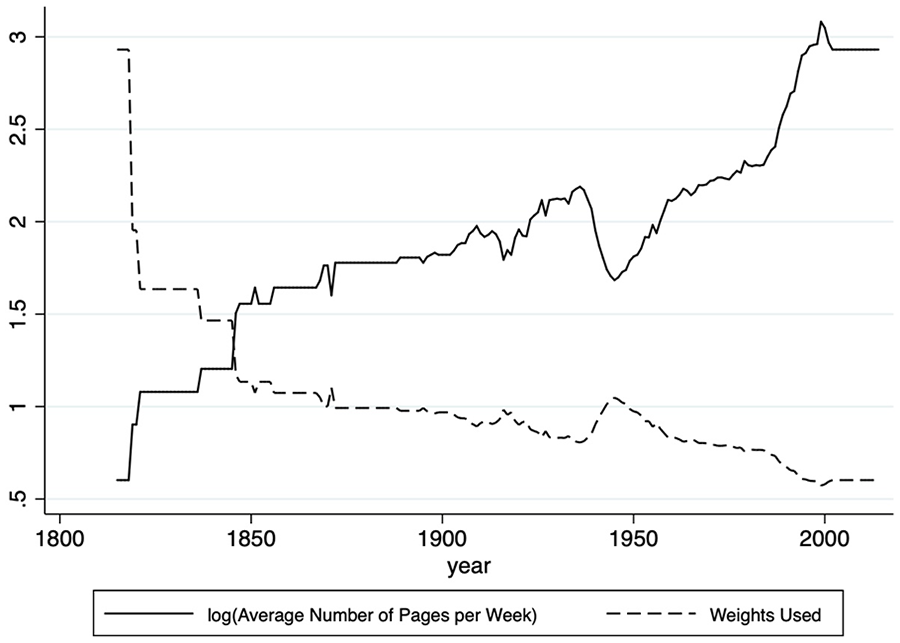
Average number of pages in The Guardian/Observer (in logarithmic scale) and weights used.
Fourth, I created a binary version of the dataset to minimize the potential geographical selection bias that can emerge due to different frequencies of news reports produced by newspapers about different countries in the world. 8 As mentioned earlier, when choosing the potential news sources for this project, I already identified the sources with the widest geographical coverage capacity. The problem is that even newspapers with the widest geographical coverage capacity might produce more news reports about some regions of the world than others. For instance, most American newspapers have the tendency to produce more news about Latin America than British newspapers. Whereas most British newspapers produce more news about their former colonies than most American newspapers. By the same logic, many French newspapers have a tendency to produce more news about North Africa, French Indochina, and French speaking parts of Europe than the American and British papers. This problem is important because if newspapers tend to report more news about some regions than others, it may arbitrarily increase (or decrease) the frequency of movements we observe in the database in such regions.
The binary version of the SSNM dataset 1 aims to account for this potential geographical selection bias. In this binary version of the dataset, SSNM in a particular territory gets a value of “1” if there is at least one mention of a SSNM in a given year, and a value of “0” if there is no mention at all. By deflating all frequencies into a binary, this version of the dataset makes sure that there are no arbitrary fluctuations in the frequency of state-seeking nationalist mobilization due to potential geographical selection bias. As I will document in the analysis section, replication of the statistical analysis using the binary version of the SSNM dataset 1 produces the same results.
Further reliability tests also show that the SSNM dataset 1 includes all incidents of state formation when states are founded by SSNM (as opposed to non-nationalist social revolutions or international agreements) and overwhelming majority of secessionist/ethno-nationalist warfare as reported by other existing datasets. 9 However, other existing datasets of state formation and ethno-national warfare do not capture majority of SSNM as reported by the SSNM dataset 1.
SSNM dataset 2
It is impossible to use the same data collection method for the period that spans from the late-15th to early-19th centuries. Hence, the second dataset of the SSNM database utilizes a different methodology. Building upon Tilly’s (1993, 1994) data on revolutionary situations in Europe, I calculated the number of revolutionary situations and high-intensity conflicts involving state-seeking movements from 1492 to 1829, using the same territorial units I used in the first dataset.
Going over each revolutionary situation in Tilly’s (1993) data from 1492 to 1829, I coded revolutionary situations involving state-seeking movements but I extended (and revised) these data in two significant ways. First, I extended Tilly’s list of “national revolutionary situations” by including instances of state formation and high-level of conflicts where subordinate groups demanded independence. For this task, I relied on four volumes of Minahan’s (2002) Encyclopedia of Stateless Nations, Brecke’s (2012) Conflict Catalog, Hewitt and Cheetnam’s (2000) Encyclopedia of Modern Separatist Movements, historical nationalist movements listed by Smith (1971) and a wide spectrum of secondary historical resources on these conflicts. Because the SSNM database focuses on state-seeking nationalism, I excluded conflicts and reactions against state-led nationalist policies of homogenization if there is no evidence for demands of independence or autonomy by subject nations. Second, Tilly’s data include Western Europe and Eastern Europe, but does not include regions in North America or Latin America that have already been incorporated into the capitalist world-economy in this era. Therefore, I expanded Tilly’s data geographically in order to include state-seeking movements in the Americas as well.
The complete list of state-seeking nationalist revolutionary situations and high-intensity conflicts from 1492 to 1829, covered by the SSNM dataset 2 can be found in Appendix A. For the purposes of this article, I aggregated the data at the territory-year level using the same territorial units used in SSNM dataset 1. The final outcome is 446 territory-years of state-seeking nationalist revolutionary situations and high-intensity conflicts produced by 86 distinct SSNM.
It is important to note that from the 16th century to the 19th century, the SSNM database includes revolutionary situations and high-intensity conflicts involving state-seeking movements. After the 19th century, however, we start to observe a wider repertoire of state-seeking activities, including protests, rallies, demonstrations, and independence referenda, as well as those secessionist armed conflicts, revolutionary situations, and secessionist wars that managed to make it into the international news reports. On the one hand, this distinction is imposed by technical and methodological difficulties, as we do not have a reliable singular news source with world-level reporting capacity for the earlier period. On the other hand, this distinction captures a major historical transformation that took place in the 19th century: the dual rise of democracy and democratic social movements from below (Markoff, 1996: 24–26). As nationalist ideologies started to spread, nationalist organizations emerged, democratization movements became successful, national self-determination was embraced as a democratic principle, and as nationalist movements became social movements, a wider repertoire of actions (including non-violent and normative ones) were used by nationalist groups and organizations. Our two datasets capture this major transformation, and the overlapping years in both datasets, the 1804–1829 period, is intentional. As Figure 4 illustrates, there is no major discrepancy in the patterning/frequency of state-seeking movements in both datasets in this overlapping period, suggesting a smooth transition from one form of action to the other.
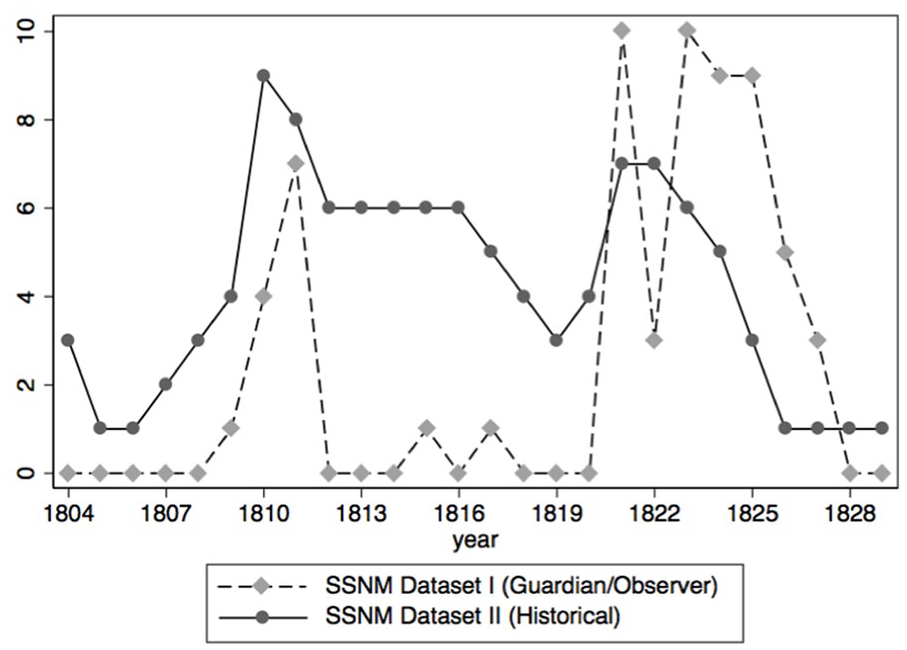
Comparison of SSNM datasets 1 and 2, overlapping period (1804–1829).
Analytical strategy
Assessing the explanatory power of competing theories of nationalism (or any other topic in social sciences) using quantitative methods is a major challenge. Although some scholars believe that large-scale datasets are becoming very helpful in falsifying theories that are not supported by empirical/historical evidence, the problem is that many serious theories of nationalism (as in many other subject matters in comparative-historical sociology) do not easily lend themselves to quantification. From Ernest Gellner to Anthony Smith, to Eric Hobsbawm, most theorists of nationalism provide us with assemblages of extremely complex arguments, insights, and observations that cannot be turned into a few testable hypotheses without oversimplifying the subject matter at hand. It is also very difficult to find high-quality historical data that can be used as variables and valid proxies in the analysis. That is why existing skepticism of some comparative-historical sociologists toward testing competing theories of nationalism using quantitative methods must not be disregarded. Rather, it must be seriously taken into consideration by making clear that the quantitative analysis used in comparative-historical studies does not aim to establish causality or to falsify existing theories in a Popperite fashion, but merely to unearth some broad patterns and relationships hidden in large-scale data, which should later be the object of a serious historical sociological inquiry. Thus, the methods and analyses used in this article must be seen as a first macro-quantitative cut for the beginning of a broader and rigorous historical and empirical inquiry, rather than the last word, on a discussion on some of the existing theories of nationalism.
With this caution in mind, I will proceed in two steps. First, I will analyze formation and dissolution of global waves of state-seeking nationalism from 1492 to present, using the two datasets of the SSNM database. In this section, both the unit of analysis and the unit of observation are the world-system observed at individual years. This analysis will provide us with a bird’s-eye view to the historical trajectory of state-seeking nationalism in the longue durée. Second, I will use SSNM dataset 1 to analyze the explanatory power of the theoretical perspective presented in this article against some of the existing approaches in the literature using multivariate regression analysis. In this section, the unit of analysis will still be the world-system but the unit of observation will be territory-year. Thus, we will explore the dynamics of state-seeking nationalism in the world by analyzing how it is affected by different variables at the local level. Statistical analysis in this section focuses on the effects of a series of covariates derived from some of the competing theories of nationalism on frequency (and hence, likelihood) of SSNM. The dependent variable is frequency of SSNM (i.e. count data), which shows properties of overdispersion (i.e. its variance is higher than its mean). Therefore, I will use a negative binomial regression analysis to estimate how independent variables affect the frequency of state-seeking movements.
Table 2 shows explanations and descriptive statistics of the variables used in the models. Most independent variables are available only for the 1816–2001 period and for 137 territories. All regression models include a 1-year lag for all independent variables. Pearson correlations (Table 3) and variance inflation factor scores (see Table 6) suggest no multicollinearity problem in the models used.
Variables and descriptive statistics.

GDP: gross domestic product; PPPs: purchasing power parities; SSNM: state-seeking nationalist movements.
Control variables are year of the analysis and regional controls (Middle East, Eastern Europe, Africa, Asia, Oceania, Latin America), where territory gets a value of 1 if it belongs to the region, and a value of 0 if it does not. Western Europe/North America is the reference group.
Correlation matrix.
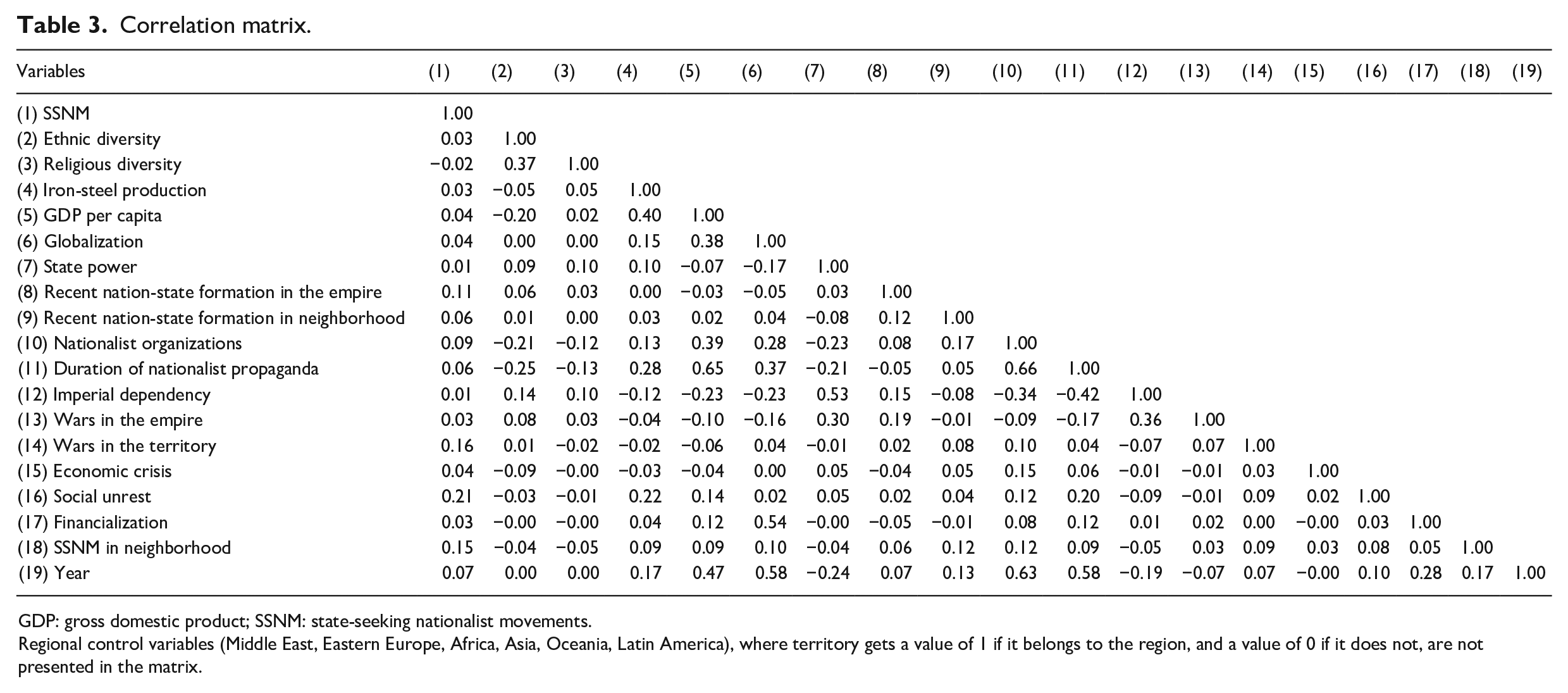
GDP: gross domestic product; SSNM: state-seeking nationalist movements.
Regional control variables (Middle East, Eastern Europe, Africa, Asia, Oceania, Latin America), where territory gets a value of 1 if it belongs to the region, and a value of 0 if it does not, are not presented in the matrix.
Results
If my fundamental premises are correct, then the periods spanning from the signal crisis to the end of the terminal crisis (i.e. 1560–1648, 1760–1815, 1873–1929/1945, and 1973/80 to present), must be extremely fertile for state-seeking nationalist mobilization because these financialization periods are characterized by interlinked crises in economic, geopolitical, and social spheres, as well as decreasing resources to produce consent of the masses and to maintain hegemony of rulers at the local level. Table 4 gives examples of such crises and historical anecdotes about expected patterns.
Financialization, crises, and unmaking of social compacts.
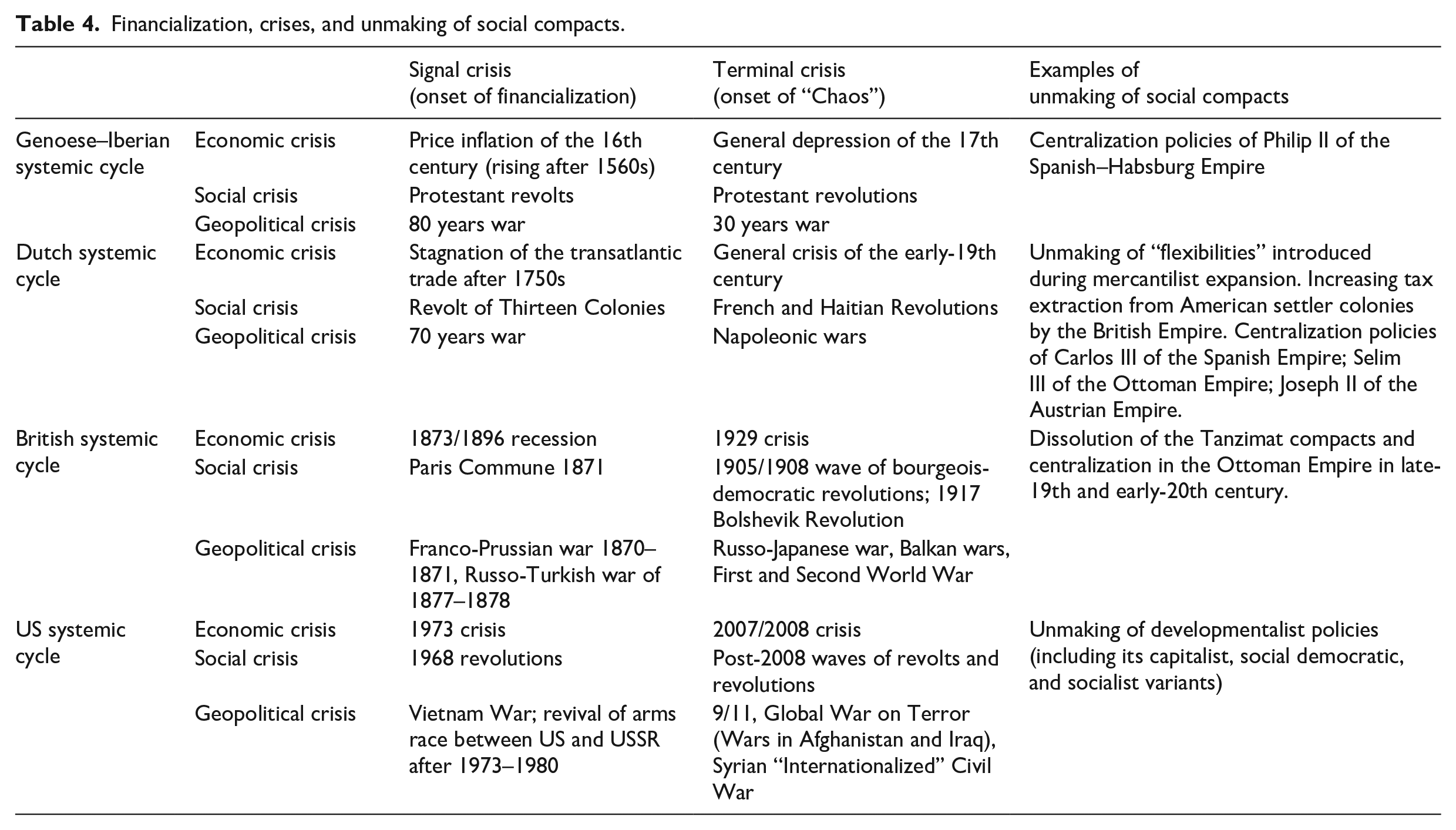
In order to evaluate if this prediction is supported by historical data, the picture of nationalist mobilization in the world, derived from the two datasets of the SSNM database, is summarized in Figure 5. This figure documents the historical trajectory of SSNM within the boundaries of the capitalist world-economy from 1492 to 2013. It shows that the distribution of state-seeking movements over time is neither uniform nor random. On the contrary, there are periods in history when state-seeking movements clustered in space and time. Figure 5 shows that periods spanning from the 1560s to 1640s, from 1780s to 1810s, from 1880s to mid-20th century, and from 1980s to present are among such historical conjunctures producing successive global waves of nationalism.
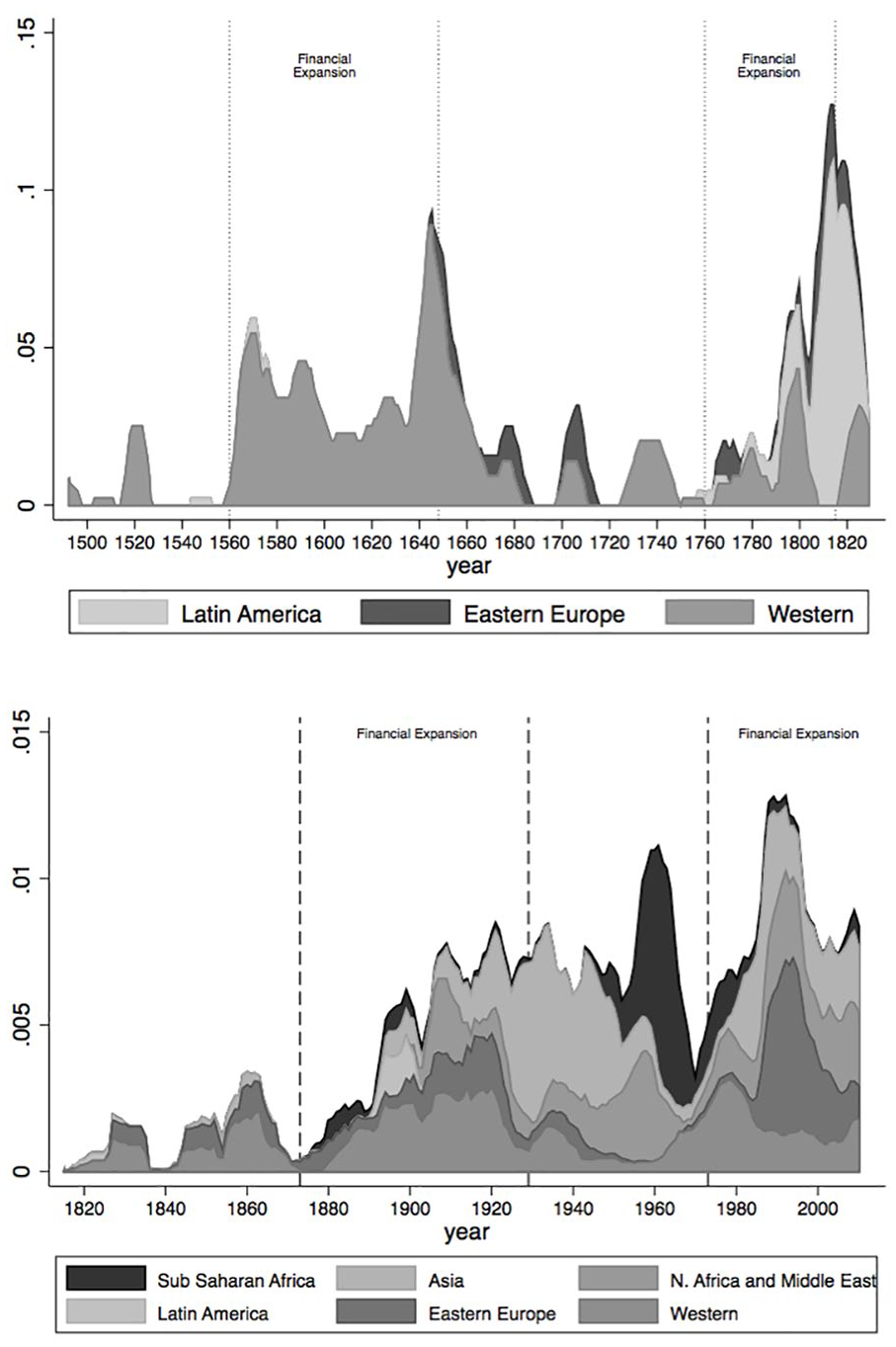
Index of state-seeking movement mobilization, 1492–2013 (9-year moving average).
Table 5 documents waves of state-seeking nationalism and their overlap with phases of systemic cycles of accumulation. It shows that while waves of nationalism can occur both during material or financial expansion periods of historical capitalism, major waves tend to emerge mostly during periods of financial expansions. In total, 14 of the 17 major waves occurred during financial expansion periods (as suggested by H4); 2 of the 3 major waves that took place during material expansion and world hegemony period are linked to decolonization of Asian and African colonies as explained in the spatial unevenness of anti-colonial nationalism section above (as also suggested by H7b).
Global waves of nationalism.
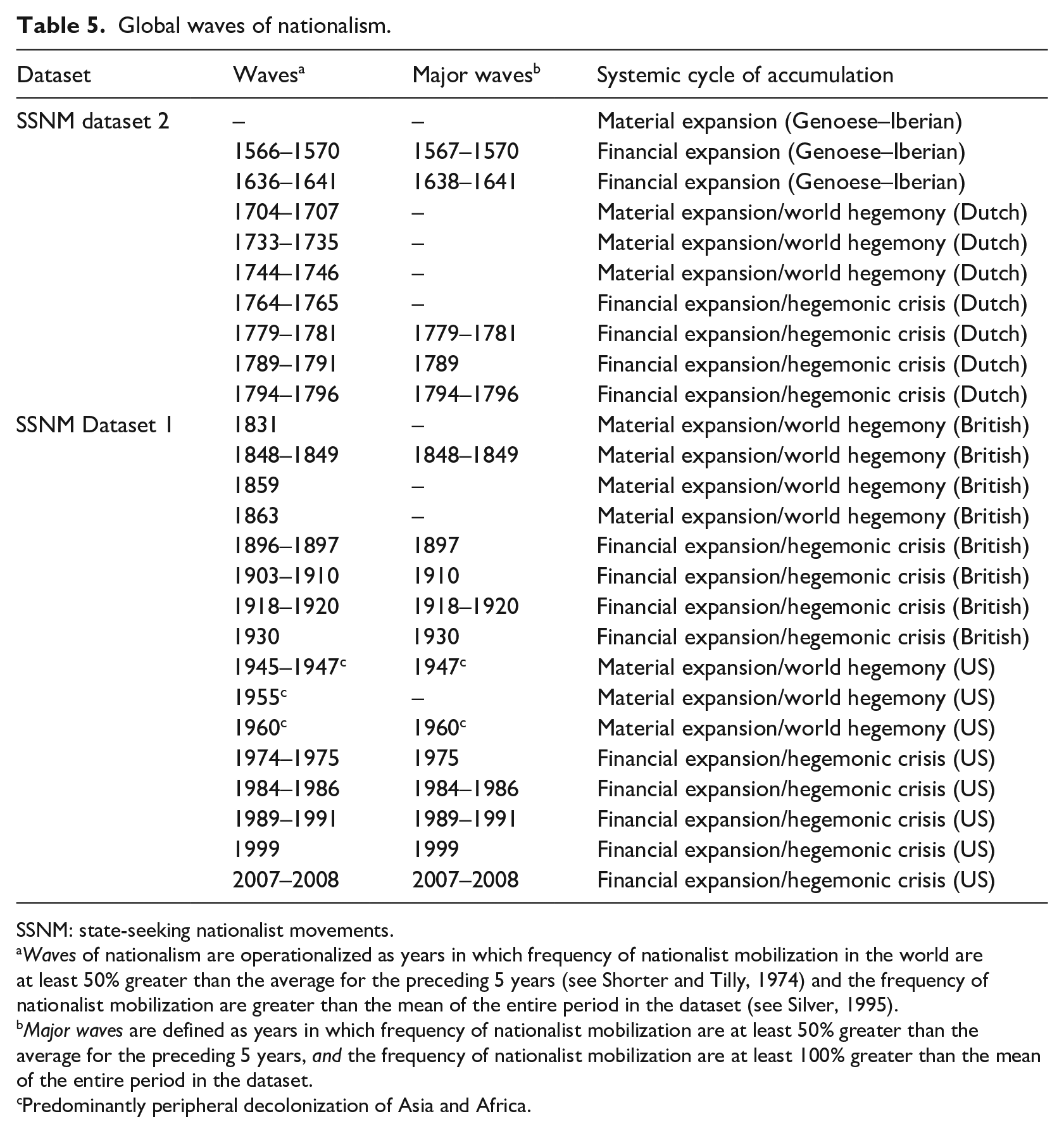
SSNM: state-seeking nationalist movements.
Waves of nationalism are operationalized as years in which frequency of nationalist mobilization in the world are at least 50% greater than the average for the preceding 5 years (see Shorter and Tilly, 1974) and the frequency of nationalist mobilization are greater than the mean of the entire period in the dataset (see Silver, 1995).
Major waves are defined as years in which frequency of nationalist mobilization are at least 50% greater than the average for the preceding 5 years, and the frequency of nationalist mobilization are at least 100% greater than the mean of the entire period in the dataset.
Predominantly peripheral decolonization of Asia and Africa.
The main exception seems to be the 1848–1849 wave, which took place during a period of material expansion and world hegemony. Interestingly, however, 1848–1849 is a unique period within British world hegemony, which includes many components of a hegemonic crisis, including intense economic crisis (as expected by H1) and intense social revolutions and labor unrest (as expected by H3). What seems to be missing is the geopolitical crisis (i.e. great power warfare). This observation also explains something interesting about the nature of “Spring of Nations” in the 1848–1849 era. While the existing crisis environment helped nationalist movements mobilize, in short of intense geopolitical crisis, existing states and empires were able to smash all nationalist revolts. Hence, none of them could succeed and spread.
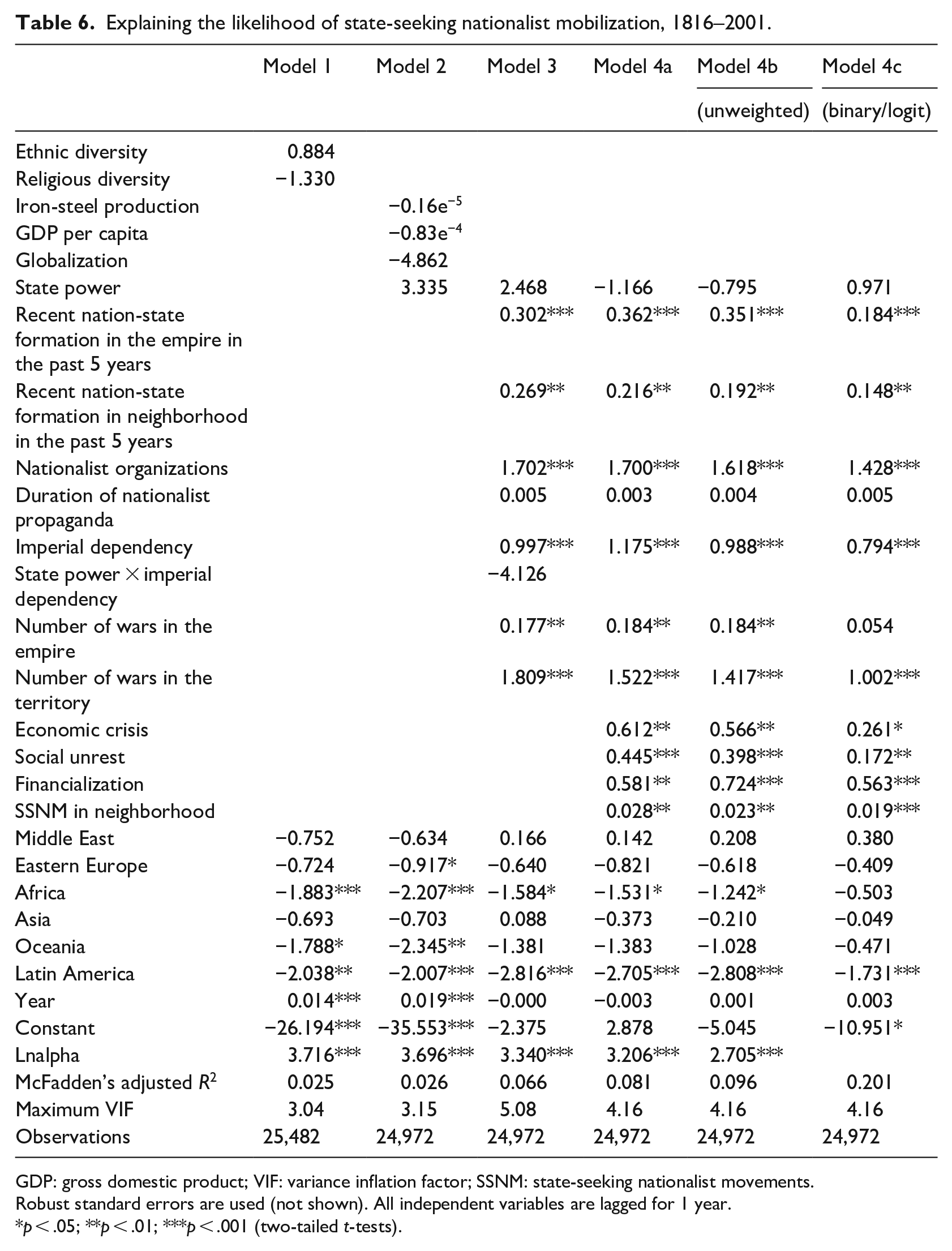
While this macroscopic view of nationalist mobilization in world history broadly overlaps with our expectations, it is not sufficient to assess the explanatory power of the theory presented in this article. To do so, as a second step, we need to go beyond these descriptive analyses at the global level and examine the dynamics of state-seeking movements using multivariate regression analysis. Table 6 presents negative binomial regression (and logit) models predicting annual frequency (and existence/absence) of SSNM at the territory-year level from 1816 to 2001.
Explaining the likelihood of state-seeking nationalist mobilization, 1816–2001.
GDP: gross domestic product; VIF: variance inflation factor; SSNM: state-seeking nationalist movements.
Robust standard errors are used (not shown). All independent variables are lagged for 1 year.
p < .05; **p < .01; ***p < .001 (two-tailed t-tests).
The theoretical perspective introduced in the earlier section of this article is tested in Models 4a–c. Models 1–3 include variables from other existing approaches in the literature as discussed in the “Introduction” section. Model 1 contains ethnic and religious diversity variables to assess whether or not state-seeking nationalist mobilization has its roots in ethnic or religious memberships as claimed by sociobiologist (Van Den Berghe, 1987) or primordialist (Connor, 1967) schools of nationalism. Neither ethnic diversity nor religious diversity variables achieve standard levels of significance. This is not surprising, since one of the main limitations of these perspectives is that they remain agnostic to dynamics of nationalist mobilization. As they focus on “stable” and “enduring” ethnic bonds spanning over millennia, most of these perspectives cannot explain any variation in the tempo and intensity of nationalist uprisings. After all, a constant cannot explain variation. Put differently, these perspectives may explain how Scottish, Catalan, Kurdish, Tibetan, or Uyghur secessionist movements today might be linked to ancient and long-standing ethnic identities, or why these groups repeatedly resisted foreign rule. However, they cannot explain why these movements occurred in certain periods of time in world history but not others, or why they started to rise recently in synchrony with many other movements around the world.
Model 2 includes variables from different modernist perspectives that associate nationalism with the advance of economic modernity, political modernity, and globalization. Variables in this model aim to take into account perspectives that link state-seeking nationalism to the transition from agricultural to industrial societies (Gellner, 1983), economic modernization that followed the rise of capitalism (Hobsbawm, 1992), anxieties associated with rapid globalization (Calhoun, 1997; Kaldor, 2004; also see Olzak, 2006; Smith, 1995) as well as reactions to increased direct rule by centralizing state structures (Hechter, 2000; Mann, 1995; Tilly, 1990). In this model, iron-steel production is used as a proxy for industrialization and GDP per capita as a proxy for economic modernization. The globalization variable—calculated as the world average of the country-level ratio of the level of external trade (e.g. imports) to the GDP—aims to capture the effects of trade globalization cycles on state-seeking nationalism. The state power variable aims to assess the effects of centralizing state structures on state-seeking nationalism. None of these variables have significant impact on state-seeking nationalist mobilization. The lack of robust evidence to support economic modernization or “globalization-breeds-nationalism” theories, is consistent with the existing literature, which finds that neither economic modernization nor globalization increases the likelihood of nation-state formation (Wimmer, 2013; Wimmer and Feinstein, 2010) or ethno-nationalist conflicts (Fearon and Laitin, 2003).
Model 3 assesses the explanatory power of an historical-institutionalist power-configuration approach, which shares some aspects of the theory presented in this article. In a nutshell, historical institutionalism argues that once the nation-state model emerged in the late-18th and early-19th centuries, it became a governance template for other elites around the world (Wimmer, 2013; Wimmer and Feinstein, 2010). As new nation-states emerged, this template diffused within empires and between neighbors, altering the existing power balance in favor of nationalists. Wars between states were instrumental in the gradual diffusion of the new nation-state model. This diffusion process was not automatic but reinforced through the spread of nationalist ideology and political propaganda by nationalist organizations (Wimmer, 2013). States with a superior military, political, and economic power, however, were able to resist nationalist challengers and reduced the likelihood of state-seeking nationalist rebellions within their territories.
I find strong, significant, and robust evidence for many elements of the historical-institutionalist power-configuration approach. Model 3 shows that the likelihood of state-seeking nationalist mobilization increases in regions (and time periods) where (and when) there are recent nation-state formation incidents in the empire and in neighbor territories (H6), wars within the empire and the neighbor territories (H2), and nationalist organizations (H5) as well as imperial dependencies (H7a). Interestingly, however, the duration of nationalist propaganda (i.e. operationalized as number of years since the first nationalist organization was founded) does not have a significant effect on the likelihood of state-seeking movements. This suggests that the effect of nationalist organizations on state-seeking nationalist mobilization does not increase monotonically over time.
More importantly, I do not find evidence that the likelihood of state-seeking movements declines as state power increases. Why does this variable not behave as historical-institutionalist power-configuration theory expects? This question is important because it turns attention to one of the key differences between historical institutionalism and the perspective presented in this article. Historical institutionalism assumes that the military power of states increases the capacity of rulers to suppress internal threats. The perspective presented in this article, however, emphasizes that domination without hegemony can be counterproductive. Accumulation of non-hegemonic state power is a double-edged sword. On the one hand, it gives rulers more resources to suppress internal threats. On the other hand, it produces grievances and reactions by masses who are forced to submit to the centralizing state. Thus effect of state power on nationalist mobilization is not straightforward. Historical-institutionalists claim that the effect of state power on containing nationalism will be more prominent in colonial and dependent territories. Put differently, for them, what actually matters is interaction between the state power and the imperial dependency status (Wimmer, 2013: 101). I find no evidence for this interaction effect either. There is, however, strong evidence to suggest that the likelihood of state-seeking movements increases in dependent imperial and colonial territories (as suggested by H7a).
Model 4a introduces variables from the theory presented in this article. Because this perspective shares many aspects of the historical-institutionalist perspective, it keeps the number of nation-states created in the previous 5 years (in the empire and in the neighborhood), the existence of nationalist organizations, and imperial dependency territory status as explanatory variables. As in previous models, these variables remain positive and significant. There is still no evidence for the effects of state power and duration of nationalist propaganda.
Other variables in Model 4a help us test Hypotheses 1–4. Periods of economic crisis has a positive and significant effect on state-seeking movements (H1). This supports our claim that during periods of intensive economic slowdown and crisis, economic resources available to rulers diminish, and the likelihood of state-seeking movements increases. These findings control for the effects of different world regions. This means that even in core regions, such as in Western Europe, state-seeking movements can take place during periods of economic stagnation and crisis. As expected by both our approach and historical institutionalism, the number of wars fought in the territory and in the empire (a proxy for geopolitical crises), increases the likelihood of state-seeking movements (H2). Moreover, increasing levels of social unrest increase the likelihood of state-seeking movements (H3) even controlling for the effects of economic and geopolitical crisis and other variables. This finding suggests that the effect of social movements on nationalist mobilization is far more pronounced than is acknowledged in the literature.
Moreover, the coefficient of the financialization variable (0.581), our proxy for world hegemonic crisis, is positive and significant. This supports our claim that during periods of financial expansion state-seeking movements are more likely to occur than in material expansion periods (H4). More precisely, controlling for everything else, during financial expansion (and world hegemonic crisis) periods expected frequency of SSNM is e0.581 = 1.79 times as high as material expansion (and world hegemonic consolidation) periods. This finding is robust to alternative cut-off points chosen for financialization periods. Since Model 4 controls for individual effects of regions, economic crisis, wars, and social unrest, it suggests that the effect of financialization on state-seeking movements cannot be reduced to the impact of particular crises in economic, geopolitical, and social spheres alone. Supporting our theoretical insights, findings suggest that financialization periods produce contentious conjunctures, characterized by sustained crises in a wider geographical and longer temporal scope whose effect is more than the sum of the individual crises in the economic, social, and geopolitical spheres. Finally, we find strong and positive effect for the contagion of SSNM from neighbor territories as expected by H6.
A comparison of McFadden’s adjusted R2 values shows that Model 4a has greater explanatory potential than its alternatives. Models 4b–c replicate Model 4a using different versions of the dependent variables (i.e. the “unweighted” and the “binary” versions) using negative binomial and logit regression analysis, respectively. Findings are similar. In supplementary analyses, I also conducted several sensitivity and robustness tests by considering new control variables (e.g. lagged dependent variable, population sizes, non-linear effects of time, oil production), new operationalization strategies for existing variables (e.g. alternative cut-off points for dates of financialization, use of railroad lengths for industrialization) and alternative regression models (e.g. random and fixed effects, Poisson distribution). Main findings presented in this article are robust to these alterations.
Conclusion and discussion
Confirming our theoretical premises, the findings show that SSNM are more likely to take place during periods of economic crisis, interstate wars (i.e. geopolitical crisis), social unrest (i.e. social crisis) and financialization (i.e. world hegemonic crisis). In addition to these structural factors, the findings also bring attention to the role of agency (i.e. nationalist organizations). While the results strongly indicate that nationalist organizations increase the likelihood of state-seeking nationalism, they also show that nationalist organizations do not produce nationalist movements as they please. They do it under circumstances beyond their control that constrain or ease their mobilization. This is why state-seeking nationalist mobilization on a world-scale is not a product of the length of nationalist propaganda, but is heavily influenced by the economic and political context these organizations operate in. In certain periods of time (e.g. periods of material expansion of trade and production and international stability), it is relatively difficult to mobilize the masses to create new states, and in other periods (e.g. financial expansion periods with interlinked crises), mass mobilization becomes relatively easier. In short, different conjunctures produced by historical dynamics of capitalism create different climates (more or less favorable) for nationalist mobilization and produce an ebb and flow of SSNM on global level. This is one of the reasons all financial expansion periods of the capitalist world-economy from the 16th century to present experienced major waves of state-seeking nationalism that challenged and transformed the configuration of interstate system of each world hegemonies. As suggested by Goertz and Mahoney (2012), these quantitative findings must not be interpreted as definitive answers but as new interesting points of departure for more rigorous case studies and comparative-historical analyses on the subject.
Resurgence of state-seeking nationalism in the 21st century
The theoretical frame and empirical evidence presented in this article brings some fresh insights to the unexpected resurgence of nationalism in recent years and decades. Our findings suggest that the unexpected escalation of SSNM since the 1970s is linked neither to “enduring ethnic identities” nor to “reactions against globalization” but is instead linked to the escalation of economic, social, and geopolitical crises that has gone hand in hand with the fourth major wave of financialization of the capitalist world-economy and the crisis of the US world hegemony.
While the unexpected resurgence of secessionism around the world in the last quarter of the 20th century was linked to the signal crisis of the US systemic cycle, the multiplicity of secessionist movements that we see in front of our eyes today appear to be linked to the terminal crisis (i.e. chaos phase) of this US-led financial expansion period. Since the turn of the 21st century, we seem to have entered into the chaos phase of the US world hegemonic decline (Silver and Arrighi, 2011), whereby existing nationalist organizations use economic crisis conditions surrounding their states to propagate the benefits of independence (as Catalan, Scottish, Padanian or Flemish nationalist are doing), struggle to turn geopolitical crisis and wars into an opportunity for independence (as Kurds in Iraq and nationalists in Donetsk and Luhansk regions of Ukraine are doing), and ride the tide of social movements (i.e. social crisis) to achieve further autonomy and independence (as nationalists in the USSR did in the 1988–1992 period, Kurds in Rojava did during the recent Syrian Arab Spring, and Donetsk and Luhansk did in the aftermath of the Euro-Maidan protests in 2014). In regions where developmentalist states collapsed in this current era of financialization, the declining legitimacy of existing regimes in the eyes of citizens also provide nationalist organizations with various structural opportunities for mobilization. If some of these movements succeed in establishing new states, it has the potential to spread especially in states and in regions with high concentrations of SSNM. A longue durée perspective on nationalism suggests that we are living in an era that is very fertile for the rapid escalation of nationalist unrest, and the reconfiguration of the interstate system that came into being during the long 20th century.
Resurgence of chauvinist, exclusionary, and authoritarian forms of state-led nationalism
While the limited scope of this article only focused on the effects of crisis and hegemonic decline on state-seeking nationalism, the theoretical approach presented in this article can also help us make sense of the sudden resurgence of aggressive, exclusionary, and expansionist forms of state-led nationalism in recent years. The current resurgence and rapid proliferation of authoritarian, right-wing populist and chauvinist movements and leaders around the world, also have its roots in the declining hegemony of the rulers. This is not the first time we have experienced such rapid revival either. On the contrary, during every world hegemonic crisis and transition period, hegemonic forms of state-led nationalism were dismantled and paved the way for more authoritarian, exclusionary, and chauvinist forms of state-led nationalism. The rise of Bonapartism during the terminal crisis of the Dutch world hegemony and the rise of Fascism during the terminal crisis of the British world hegemony were different historical examples of the same process. Today, as we enter into the terminal crisis of the US world hegemony right-wing nationalists are gaining power in many parts of the world.
This relationship is not accidental because intensification of economic, political, and social crisis and the corresponding decline in the consent-making capacity of rulers also provide opportunities for the rise of a section of state-led nationalists who rely more on coercion than consent. Because contentious conjunctures make it very difficult for rulers to maintain their hegemony on all people, it becomes attractive for factions of the ruling elite who aim to mobilize a particular section of the people (e.g. racial, ethnic, religious, or class-based groups) against others. Likewise, the co-escalation of anti-systemic social movements and state-seeking nationalist unrest in these periods pressure these elites to adopt more aggressive and authoritarian strategies to maintain their power. When we consider all these dynamics altogether, the transformative character of these intense crisis periods—such as the one we are living in right now—would become more explicit. These are periods of rapid social change whose direction is contingent on the actual struggles on the ground.
Implications for global governance patterns
The theoretical frame and the findings of this article also bring new insights into the evolution of global governance patterns. They show that unlike suggested by political modernization theories, the rise of nationalism did not cause a gradual transition from a world of empires and city-states to a world of nation-states. Rather, the rise of nationalism transformed our world through successive global waves of nationalist uprisings that occurred during contentious conjunctures of historical capitalism from the 16th century to the present. These global waves not only produced a series of quantum-leap like changes in the political-territorial landscape of the interstate system but also transformed existing conceptions of nationhood and cultural and ideological content of nationalism. Examination of these transformations is beyond the scope of this article. 10 Let me suffice to mention that the clustering of nationalist unrest during contentions conjunctures of historical capitalism produced a series of creative destructions in the modes of governance used by state elites because each global wave pressured state elites to invent new forms of hegemony-building strategies that would keep subjects loyal to their states. Consequently, nations and nationalism transformed over space and time in synchrony with systemic crises. Unlike it has generally been claimed, however, none of these processes ended up producing homogeneous nation-states on a global scale. Most SSNM ended up producing mini-empires which were almost as heterogeneous as the ones they seceded from.
Global waves of nationalism also played a key role in the formation of world hegemonic orders and global governance regimes. Waves of state-seeking nationalism led to the creation of new states in the interstate system and cycles of state-led nationalism provided existing states with greater command over production, protection, and administration, that is, greater political and economic power. Accordingly, the world hegemonic powers that aimed to lead the states in the interstate system had to expand their sphere of influence into a wider geography over time and to command over greater resources from their predecessors. This is why the increase in the size, scope, and complexity of the interstate system from one global wave to another (and from one world hegemony to another) went hand in hand with the growth in size, scope, and complexity of world hegemons over time (also see Arrighi, 1994: 217). The United Provinces was slightly more than a collection of city-states but still less than a nation-state. The United Kingdom—built upon the subjugation of Ireland, Scotland, Wales, and so on—was more than a typical nation-state that controlled a world-scale commercial and territorial empire. At the height of its hegemonic power, the United States was a huge military-industrial complex with unprecedented continental size, informal surplus appropriation networks of an empire, and direct control over a global network of military bases. None of the world hegemonic powers were nation-states. They all combined elements of national and imperial forms of rule.
Moreover, different ways in which these hegemonic powers aimed to contain national problems around the world changed the qualitative character of each world hegemonic regime. This is why it would be wrong to assume that the macro-structural dynamics of world hegemonies produce global waves of nationalism in a top-down fashion. Indeed, the direction of the relationship has always been both ways. From the 16th century to the present, nationalist movements from below (together with social movements) actively shaped the functioning of the capitalist world-economy, the interstate system, and the world hegemonic regimes. Nationalist movements were not only affected by the contentious conjunctures but they became an active agent of these vicious cycles. The recent resurgence of multiple manifestations of nationalism in our era—from SSNM demanding self-determination and independence to authoritarian, expansionary and exclusionary forms of state-led nationalism—must be interpreted from these lenses. Ongoing struggles on the ground will not only redefine what kind of relationships people will have vis-à-vis their states and vis-à-vis other groups residing in these polities, but also what kind of world we will be living in once this chaos is over.
Supplemental Material
APPENDIX_A – Supplemental material for Capitalism and nationalism in the longue durée: Hegemony, crisis, and state-seeking nationalist mobilization, 1492–2013
Supplemental material, APPENDIX_A for Capitalism and nationalism in the longue durée: Hegemony, crisis, and state-seeking nationalist mobilization, 1492–2013 by Şahan Savaş Karataşlı in International Journal of Comparative Sociology
Footnotes
Acknowledgements
The author thanks Çınar Ark and Amanda Lawrence for their excellent assistance in this project. He also would like to thank Beverly Silver, Mike Levien, Ryan Calder, Joel Andreas, Ho-Fung Hung, Rina Agarwala, Lingxin Hao, Andreas Wimmer, Şefika Kumral, Corey Payne, Rishi Awatramani, Zachary Levenson, Tad Skotnicki, Cindy Brooks Dollar, Ting Wang, Simeon Newman, Edwin Ackerman, Mathieu Desan, Eric Schoon, Jonah Stuart Brundage, Xiaohong Xu, Megan Mavrakis, David Smith and anonymous reviewers of the IJCS for their comments and feedback on different versions of this article.
Funding
The author(s) disclosed receipt of the following financial support for the research, authorship, and/or publication of this article: This research was supported by a grant from the National Science Foundation (#SES 1460434).

Supplemental material
Supplemental material for this article is available online.
Notes
References
Supplementary Material
Please find the following supplemental material available below.
For Open Access articles published under a Creative Commons License, all supplemental material carries the same license as the article it is associated with.
For non-Open Access articles published, all supplemental material carries a non-exclusive license, and permission requests for re-use of supplemental material or any part of supplemental material shall be sent directly to the copyright owner as specified in the copyright notice associated with the article.
