



Abstract
This article aims to identify the moderating effect of two dimensions of the stratification of education systems (the extent to which the first selection is based on students’ ability and the age of first selection) on social background gradient in educational attainment. Individual-level data of the European Social Survey (round 1 to 9) is complemented with new contextual indicators measuring various education systems’ characteristics. This article’s contribution to the debate is twofold. First, it simultaneously investigates two dimensions of the stratification of education systems that have never been analyzed in cross-country studies investigating long-term educational outcomes. Second, it provides a series of indicators of education systems’ characteristics collected by means of an online expert survey whose validity and reliability is also tested. Findings show that the two dimensions of the stratification of education systems have opposite effects. As the first selection is increasingly based on students’ ability, social background gradient in educational attainment increases. In contrast, postponing the age of first selection decreases social inequality in educational opportunity.
Keywords
Introduction
In recent decades, there were several comparative studies on the effect of social background on educational attainment (e.g. Blossfeld et al., 2016). In trying to address differences in social inequality, scholars mainly focused their attention on the level of stratification of education systems or tracking (Bol and Van de Werfhorst, 2013; Brunello and Checchi, 2007; Hadjar and Gross, 2016)—that is, the simultaneous availability of more than one educational path during students’ educational career. Since each specific path conveys a different curriculum, opening up a different set of subsequent options, the social selectivity involved, as well as the consequences in terms of educational attainment, increasingly attracted scholars’ attention. Following this tradition, the research question of this paper is: does the stratification of education systems affect social background inequality in educational attainment? Stated differently, this article investigates whether the stratification of education systems moderates the strength of the association between social background and education.
So far, comparative analyses predominantly investigated the age of the first selection as the only dimension linking the stratification of education systems to individuals’ outcomes (Braga et al., 2013; Brunello and Checchi, 2007; Heisig et al., 2020; Van de Werfhorst, 2019; Vogtenhuber, 2018). Along with the timing of the first selection, this article empirically measures another dimension of stratification of education systems namely, the extent to which the first selection is based on students’ ability. This dimension is important if we consider its direct consequence: the more students’ ability matters during the selection, the more students attending the same track or the same curriculum within school have homogeneous skill levels when they start their differentiated educational paths. This, in turn, has tremendous consequences for the explanation of inequalities in students’ learning opportunities (Bos and Scharenberg, 2010; De Fraine et al., 2003; Gröhlich et al., 2009; Köller et al., 2013; Neumann et al., 2007; Opdenakker and Van Damme, 2001; Scharenberg, 2014; Schiepe-Tiska, Rönnebeck, Heitmann, Schöps, Prenzel and Nagy, 2017). Peers’ achievement composition not only significantly contributes to their subsequent achievement but its effects on students’ outcomes are far more significant than instructional quality—although they are associated with each other (De Fraine et al., 2003; Scharenberg, 2014). Risking over-simplification, the main findings here show that scholastic achievement tends to improve when pupils attend schools with high-ability classmates. Accordingly, studying the consequences of ability-based selection processes on social background inequality appears quite relevant.
To identify the moderating effect of the stratification of education systems, this paper provides new empirical measures that are directly collected by means of an online expert survey questioning more than 200 experts in 34 countries. Specifically, stratification of education systems is measured by means of two dimensions: the timing and the extent to which the first selection is based on students’ ability. Both dimensions have yet to be considered in a comparative analysis on educational attainment.
The research question is investigated using microdata from round 1 to 9 of the European Social Survey (ESS), integrated with new country-level indicators on education systems. Methodologically, this paper implements a linear random effect model that accounts for the complex data structure. Finally, this paper examines the robustness of the results across different model specifications, sample selections, and indicators of education system characteristics.
Theoretical framework
To reflect the two dimensions of the stratification of education systems, this section is divided into two subsections. The first is dedicated to the extent to which the first selection is based on students’ ability while the second focuses on the timing of the first selection.
When examining the effects of ability-based first selection on the association between social background and educational attainment, Boudon’s (1974) distinction between primary and secondary effects comes to the fore. The former corresponds to the effects exerted by social background on pupils’ average levels of (demonstrated) ability while the latter refers to social background differences in choice behavior that influence young people’s choices net of achievement (Goldthorpe, 2007; Hauser, 2010).
Since the two components are considered as additive, we could expect that when scholastic performances drive the selection into tracks, the total effect of social background is entirely due to primary effects (Erikson and Jonsson, 1996; Esser, 2016; Jackson and Jonsson, 2013). In other words, the total effect of social background echoes social background differentials in pre-sorting achievement. In such a context, parents’ leeway to affect the allocation process on top of social background differences in achievement is restricted (Contini and Scagni, 2011; Dollmann, 2016; Esser, 2016; Jackson and Jonsson, 2013). Put differently,
Total effect of social background = primary effects + (secondary effects * α)
When the selection is entirely based on students’ ability (i.e. when α = 0), the above formula is equal to primary effects. In contrast, when the allocation also relies on teacher recommendations (the so-called tertiary effects 1 (see Esser, 2016)) and/or parental preferences to compute the total effect of social background on educational outcomes, the role-played by secondary effects have also to be taken into account (Dollmann, 2016; Jackson and Jonsson, 2013). Since all these components (primary and secondary effects) go in the same direction of broadening the gap between higher and lower social background groups, by adding them, the total effect of social background on educational attainment would be higher than in systems selecting only on students’ ability. Accordingly, the first hypothesis (H1) is that ability-based first selection tends to have a negative moderating effect on the social background gradient in educational attainment. In other words, with H1 I expect that the more the first selection is based on students’ ability the less educational attainment depends on social background.
Turning to the effect of the age of first selection on the social background inequality of educational opportunity, several theories stand out. The most prominent is the life course hypothesis (Blossfeld and Shavit, 1993; Müller and Karle, 1993). This theory argues that one’s social background has a greater effect on one’s educational success at a younger age and that the size of this effect decreases with age. Put differently, younger students are more dependent on their parents’ resources than older students. In an attempt to identify the reasons why we observe this decreasing effect as students grow older, we can draw from the rational action theory (Boudon, 1974; Breen et al., 2014; Breen and Goldthorpe, 1997; Gambetta, 1987). Accordingly, children and their parents choose and subsequently act, after evaluating costs, benefits, and success probabilities of various (educational) alternatives. In the case of performance uncertainty, however, it is difficult for the actors involved to form their expectations of success (Berger and Combet, 2017). This happens when parents do not have enough information about their children’s cognitive resources. In turn, this situation manifests when the first selection occurs early.
Nevertheless, regardless of the timing of the first selection, evidence shows that students from higher social backgrounds are overrepresented in the academic track (Blossfeld and Shavit, 1993; Dupriez et al., 2012). This phenomenon is noted by Berger and Combet (2017) whose explanation reports that performance uncertainty matters more for the disadvantaged than the better-off families. Why is this the case? Why are lower social background families more concerned with their children’s level of academic performance than their counterparts? A first explanation claims that, in order for parents from lower social backgrounds to send their offspring to the academic track, they require evidence of their children’s general academic abilities, as they generally underestimate their children’s academic abilities (Erikson, 2013). Such evidence, gathered, for example, through school grades, grows as students spend more time in school. A second argument points to parents’ lack of strategic knowledge and understanding of what is needed to succeed (Lareau, 2011; Lucas, 2001; Pfeffer, 2008). Parents from lower social backgrounds are accustomed neither to helping their children navigate through the system nor to providing qualified help when needed (Erikson and Jonsson, 1996; Lareau, 2011; Lucas, 2001). A third explanation focuses on social demotion (Breen et al., 2014; Breen and Goldthorpe, 1997). To obtain the same educational titles as their parents, students from higher social backgrounds need to climb the educational ladder to the top. This is an additional reason why better-off families are more likely to put less emphasis on their offspring’s scholastic performance. Regardless of their academic ability, students need to enter the academic track to fulfil intergenerational reproduction. In contrast, given the lower educational qualification of their parents, students from lower social background can be less ambitious while avoiding social demotion than their higher social background counterparts.
Considering all these arguments, the second hypothesis (H2) expects that age of first selection tends to have a negative moderating effect on the social background gradient in educational attainment. 2 In other words, with the second hypothesis, I expect the strength of the association between social background and educational attainment to be negatively affected by the timing of the first selection.
Previous findings
To properly review the previous literature that examined the effect of the stratification of education systems on inequality of educational opportunity, I first present the strand of research dealing with the effect of ability-based first selection; the rest of this section is dedicated to the age of first selection.
Three comparative studies investigated the effects of ability-based selection on social background achievement inequality exploiting PISA data. Using the school intra-class correlation coefficient as an indicator of selectivity, Marks (2005) finds that selective systems show lower levels of social background inequality than less selective systems. In contrast, Horn (2009) provides evidence that the extent to which students’ previous scholastic performance is considered in admitting students to schools does not affect social background gradient in competence acquisition. In a robustness check, the remaining study shows that the positive effect of the number of tracks available to 15-year-olds on equality of performances is amplified when schools select their students based on their previous scholastic performances (Korthals, 2012).
The effect of ability-based selection on educational transitions is investigated in Jackson and Jonsson’s (2013) meta-analysis of seven European countries and the United States. They show that the size of secondary effects is larger in less selective systems (England and the United States) while it is smaller in highly selective systems (Germany and the Netherlands). However, they did not find the same pattern in the remaining three countries (Denmark, Italy, and Sweden). While assessing the subsequent educational transition—accessing tertiary education—the authors do not find any associations between selectivity and magnitude of secondary effects.
Besides comparative research, contrasting findings also emerge in within-country studies based on Germany. Dollmann (2016) shows that institutional settings that reduce parents’ room to overrule teacher recommendations diminish social inequalities in the transition from primary to secondary education while Roth and Siegert (2016) find the opposite.
Considering the effect of age of first selection on educational attainment, comparative studies find that early tracking amplifies social background inequality of educational opportunity (Braga et al., 2013; Brunello and Checchi, 2007; Heisig et al., 2020; Österman, 2018; Van de Werfhorst, 2019). 3 Only one article shows a positive, though not statistically significant, effect (Vogtenhuber, 2018). Among the studies that employ the index of tracking, 4 two of them confirm the negative effect of tracking (Bol and Van de Werfhorst, 2013; Reichelt et al., 2019) while Ballarino et al.’s (2016) findings show no moderating effect of tracking on social background gradient in educational attainment. Finally, classifying countries into clusters based on several theoretical considerations, two other studies reach the same conclusions as to the majority of the previous studies: in stratified education systems, social background inequality of educational opportunity is higher than in weakly stratified systems (Hadjar and Becker, 2016; Pfeffer, 2008).
National studies reach the same conclusion. Focusing on one federal state which anticipated the age of first selection, Sulzmaier (2020) illustrates that earlier tracking increases intergenerational transmission of education. Another German study, exploiting the variation between federal states, concludes that later tracking decreases social inequality in educational attainment for men (Lange and Von Werder, 2017). With a similar analytical strategy, Bauer and Riphahn (2006) show that postponing the age of first selection increases educational mobility in Switzerland.
In sum, previous evidence regarding the timing of the first selection is vast and mostly points to the same conclusion: early tracking amplifies social background inequality of educational opportunity. In contrast, the effect of ability-based selection on short-term effects (competence acquisition in upper secondary education or transition probability) yields contrasting results. Furthermore, this review underlines that comparative research has not yet investigated the simultaneous effects of these two dimensions of stratification of education systems on educational attainment.
Data
Data come from the ESS. Since 2002, this survey has collected data on about 36 countries every 2 years, with each edition of the survey referred to as a “round.” The population consists of individuals aged 15 and older living in private households. Data are drawn from random probability samples within each country and round.
The analyses in this paper rely on rounds 1 to 9. 5 The cumulative dataset covering the first 8 rounds is integrated with the dataset of the last survey (ESS Cumulative File ESS1-8, 2018a; ESS Round 9: European Social Survey Round 9 Data, 2018b).
Sample selection
The sample is restricted to individuals who had turned 25 and left the education and training system and thus completed their education at the time of the survey. To integrate these data with the information on education systems’ characteristics from an expert survey, I further select respondents born between 1973 and 1995. 6 In addition, to exclude the respondents who attained their educational qualification in another country, the sample ignores first-generation migrants.
Missing values are dealt with via listwise deletion, and the analytical sample amounts to 59,066 individuals in 32 countries (see Table 1). To make sure that the complete case sample is not biased, Table 2 reports the univariate distributions of each variable with and without missing values.
Number of cases by country.

Source: ESS pooled dataset round 1 to 9.
Univariate descriptive statistics for individual-level variables.
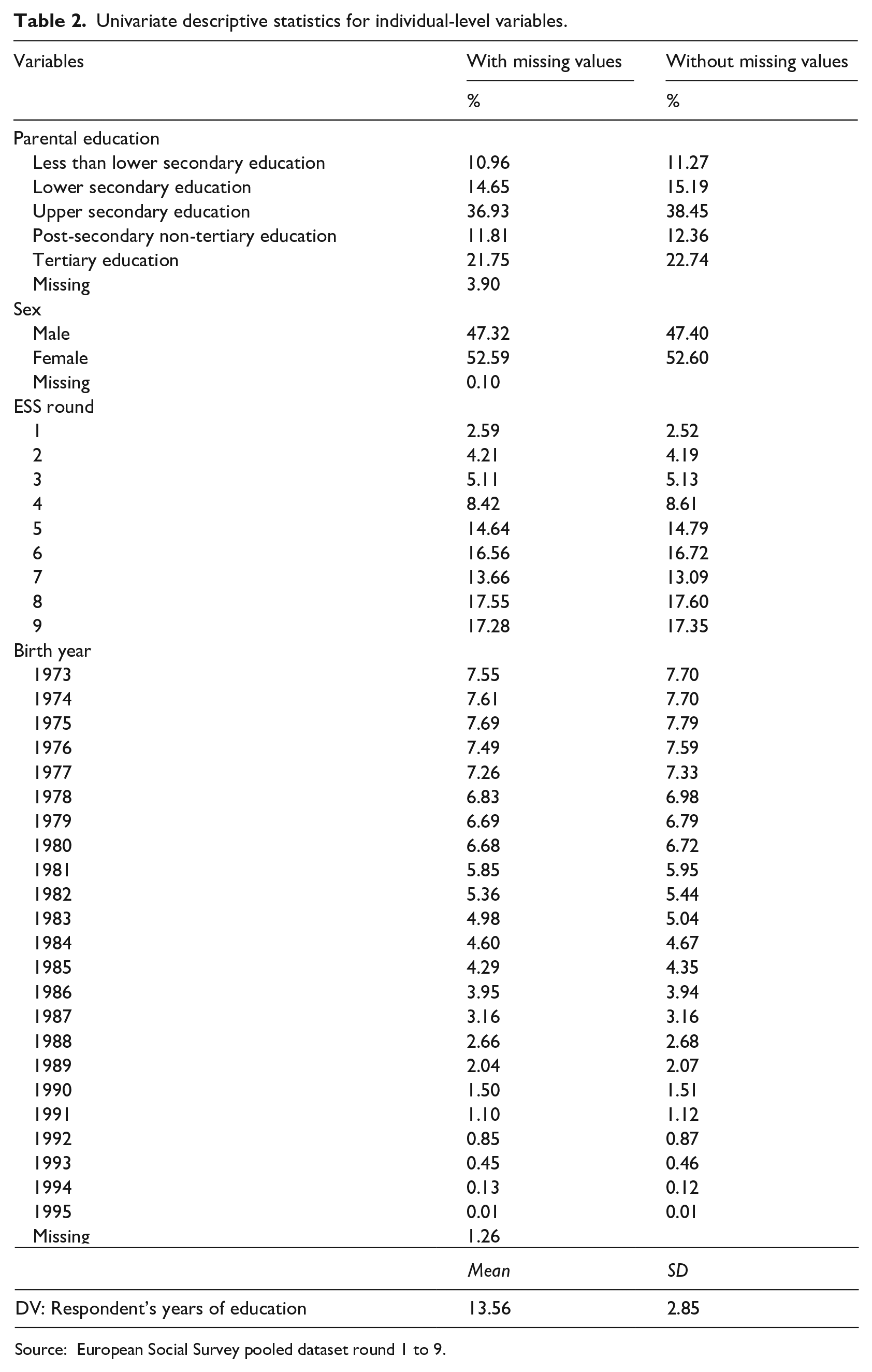
Source: European Social Survey pooled dataset round 1 to 9.
Variables
To measure respondents’ educational attainment, I employ years of education. However, instead of using the information already included in the cumulative dataset, I derived years of education from the most detailed variable available for all rounds of the ESS (but not all countries in all rounds). 7 To avoid analyzing a categorical dependent variable, I translated the educational variable distinguishing among seven categories into a continuous variable reporting the equivalent years of education. The categorical variable has seven categories: (1) less than lower secondary (European Survey version of International Standard Classification of Education (ES-ISCED) I), (2) lower secondary (ES-ISCED II, (3) lower-tier upper secondary (ES-ISCED IIIa), (4) upper-tier upper secondary (ES-ISCED IIIb), (5) advanced vocational (ES-ISCED IV), (6) lower tertiary education (ES-ISCED V1), and (7) higher tertiary education (ES-ISCED V2). To convert these categories into years of education, I follow the guidelines reported in the ISCED mapping materials (UNESCO Institute of Statistics, 2011), and the OECD manuals (OECD, 1999). When this was not possible, I consulted the national education variables available in the dataset. The disadvantage of using this dependent variable is that all the countries in the first rounds that measured educational attainment differently had to be excluded. 8 To account for this potential measurement error, sensitivity analyses omitting rounds 1 to 4 were carried out. The findings of these, available upon request, yield similar results.
Social background measures the highest educational degree achieved within the couple. 9 To retain as many observations as possible, I used the dominance approach (Erikson and Goldthorpe, 1992). Parental education has the following categories: (1) less than lower secondary education (ISCED 1), (2) lower secondary degree (ISCED 2), (3) upper secondary degree (ISCED 3), (4) post-secondary non-tertiary degree (ISCED 4), and (5) tertiary degree (ISCED 5-6).
Other controls at the individual level are ESS rounds, year of birth, and sex. Additional analyses, available upon request, show that the results are not affected by the introduction of additional micro-level controls like a dummy for second-generation migrants and parental occupational class. 10
Macro-level indicators
The country-level indicators comprise four variables: two indicators measuring the stratification of education systems (the extent to which the first selection is based on students’ ability and age of first selection) and two confounders of the association between the stratification of education systems and social background gradient in educational attainment (the linkages between education and labor market and educational expansion).
The first three indicators come from an expert survey carried out in 2016. The experts who took part are scholars and practitioners (such as school principals and staff of the ministries of education) who were selected through academic networks, reading of scholarly publications, and Internet searches to identify members of scientific associations or research institutions. To boost the number of participants, respondents were able to suggest other potential contributors. The completion rate is 27 percent, which in absolute terms translates into 206 completed questionnaires on 34 OECD countries. For each nation, at least 3 experts participated (see Table 3). To synthesize this information into one single country indicator, indexes of central tendency were computed (mode for the timing of the first selection and mean for the others). Apart from the age of first selection, the other questions asked participants to rate the provided statement on a continuum going from “not at all” (later identified as 0) to “completely” (identified as 100). To correct for individual differences in the use of response scales, each respondent’s value was centered on his or her average response before computing the within country mean. This correction was performed on all the valid responses to the questions with this same format (max of 13 questions).
Pairwise correlations between country-level variables.
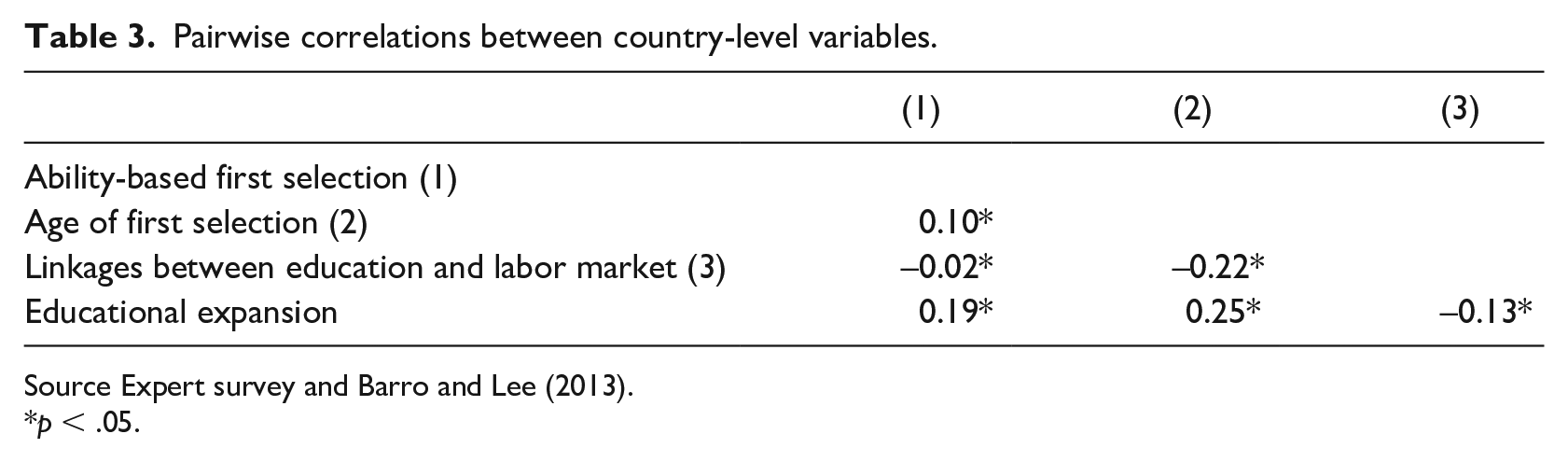
Source Expert survey and Barro and Lee (2013).
p < .05.
To make sure that the experts recognized the comparative aim of the survey, the first questions aimed at rating their educational system compared to those in Germany and the United States. The introductory page explaining this task recorded the highest number of dropouts: 94 percent. In light of the validity tests reported in the supplementary material and the replication checks, this can be seen as a signal that only the invited experts with a fair knowledge of both their country’s education system and its standing in international comparison participated in the survey.
The experts were asked to reply to the questionnaire by conveying what the education system looked like in the period between 1980 and 2000. To account for changes over time, the questionnaire inquired about major educational reforms. In the case of positive responses, experts had to provide information on each reform, specifying how the system was structured before and after the implementation of each reform. Within each country, experts agreed on reforms only for the timing of the first selection.
In the following, I report the wording of the online questionnaire while the results of the reliability and validity tests are discussed in the supplementary material (see also Tables B1 and B2). Note that Table B1 in the supplementary material also includes the country values of the indicators.
To measure how early the first selection took place, I employ the age at which the first selection occurs. In the questionnaire, after providing the following definition: “with first selection we refer to the allocation of students into different school types or different curricula within school. Such differentiation can be based on either student’s scholastic abilities or personal preferences and it lasts for all the school day and all the subjects,” experts had to reply to this question “at which age did the first selection occur?” 11
To collect information on the extent to which the first allocation is associated with student's ability, the question in the expert survey stated: “to what extent was the first selection associated with student’s scholastic abilities?”
One of the two confounders at the country level accounts for firms’ involvement in school-based vocational schools and dual-system institutions (Blossfeld, 1992). The two questions in the questionnaire asked the extent to which private industries are involved in the design of (1) school-based vocational curricula and (2) dual systems. Since there is no reason to consider one dimension more relevant than the other, the final indicator is computed as the simple average between firm involvement in school-based and dual systems. The analyses were replicated using the two components separately and these findings are consistent with those discussed in the results section.
The other macro-level confounder is educational expansion. Every 5 years, Barro and Lee (2013) recorded the percentage of people educated to tertiary level among the population aged over 24. To each respondent in the analytical sample, I assign the value of educational expansion which conveys the percentage of people with tertiary-level education when the respondent was 10 years old.
Table 3 reports the correlations between the four institutional variables. All the values are quite low, confirming that the indicators measure different aspects of the educational system and can be analyzed simultaneously.
Method
Since the respondents in the ESS pooled data are nested within 9 rounds and 32 countries, following the suggestions of Schmidt-Catran and Fairbrother (2016), I run a linear random slope model with three levels. Respondents are in the first level, the 182 combinations between country and round constitute the second level and the 32 countries and the 9 ESS rounds comprise the third level. Since not all the countries participated in every round, the model treats the 182 combinations of country and round as cross-classified within the 32 countries and 9 ESS rounds whereas respondents are hierarchically nested in the 182 combinations of country and round.
Considering that the focus of this paper is the moderating effect of stratification of education systems (which vary at the country level) on an individual-level association between social background and educational attainment, the model specification includes a random slope at the third level for parental education (Heisig et al., 2017) along with cross-level interactions between parental education and the indicators of stratification of education systems.
These interaction effects may however be biased because the stratification of education systems is correlated with country-level variables that also influence the effect of social background on educational attainment: namely, linkages between education and labor market and educational expansion (Hadjar and Becker, 2016). To obtain unbiased interaction effects, I also introduce cross-level interactions between these country-level confounders and parental education (Giesselmann and Schmidt-Catran, 2018). The complete model specification is reported below.
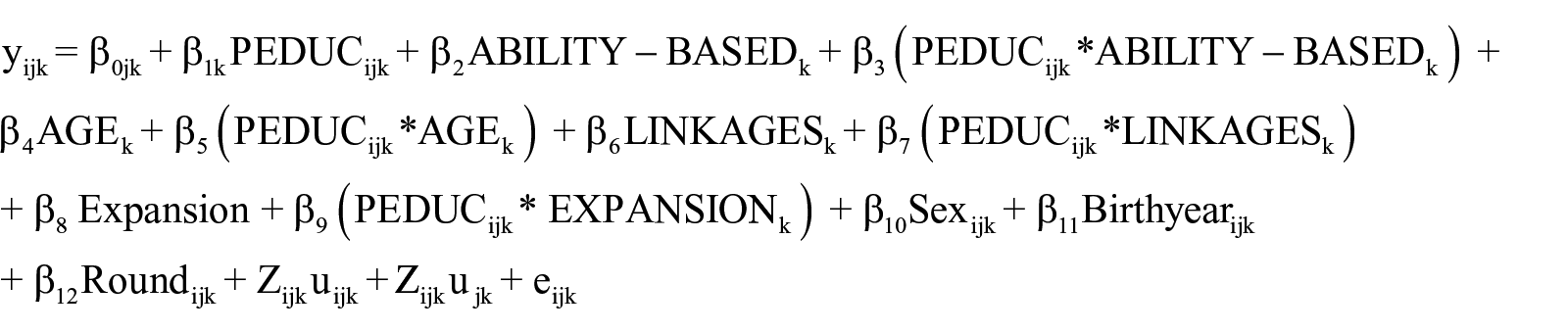
The equation estimates years of education yijk of individual i in combination country*round j in country and round k to be a function of sex, year of birth, parental education (β1), the institutional variables of interest (β2, β4, β6, β8) and their cross-level interactions with parental education (β3, β5, β7, β9). To get rid of any additional difference among ESS rounds, the equation also contains eight dummies.
Results
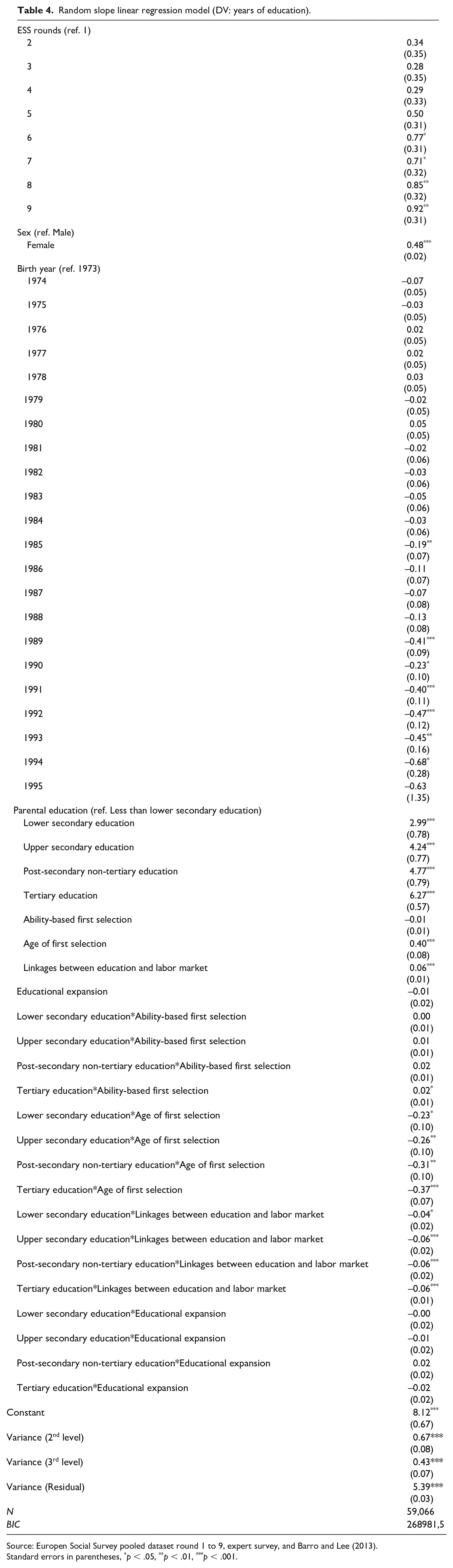
Table 4 in Appendix 1 reports the results of the linear random effect model. Unsurprisingly, parental education is strongly associated with children’s educational attainment. Advantages are particularly visible among respondents born to tertiary-educated parents, but the other categories also display higher years of attained education than individuals born to poorly educated parents.
Holding constant the effect of age of first selection and the other institutional confounders, the interaction terms between parental education and ability-based first selection show that there is a positive moderating effect for the highly educated backgrounds. This means that for these families, years of education become more dependent on parental education as the first selection is increasingly based on students’ ability. Put differently, the positive main effect of coming from a family with tertiary-educated parents (relative to lower educated parents) is 6.3. This effect refers to an educational system whose ability-based selection (and the other institutional level confounders) is at its minimum. On top of this, the advantage of coming from a tertiary-educated background is amplified as attained years of education increase by 0.02 for every unit increase in ability-based first selection (in the current sample, the latter ranges from 41-Cyprus- to 89-Bulgaria).
Considering the other dimension of stratification, age of first selection, Table 4 shows that the interactions with parental education are all significantly different from the reference category and their coefficients are negative. This means that as the age of first selection increases, social background gradient in educational attainment decreases.
To facilitate the interpretation of the cross-level interactions, Figures 1 and 2 show the predicted years of education by means of marginal effects plots. These graphs illustrate the predicted outcome (on the vertical axis) by parental education (the different lines) as the two dimensions of stratification increase (on the horizontal axis). Figure 1 shows that ability-based first selection does not impact the attained years of education of individuals born to middle educated parents. Regardless of the extent to which the education system selects based upon students’ ability, the attained years of education are 13. In contrast, ability-based first selection is associated with all the other categories, although in opposite ways. It is negatively related to middle-low and poorly educated families. For individuals coming from these backgrounds, changing from a system that does not select its students upon their ability to a system that does translates into one year less in educational attainment. The advantage gained by respondents stemming from middle-high and highly educated families is of the same magnitude but in the opposite direction. 12

Predicted educational attainment by social background at different ability-based first selection levels.

Predicted educational attainment by social background at different ages of first selection.
Figure 2 shows the effect of age of first selection on the association between parental education and educational attainment. With differing degrees, age of first selection reduces the effect of parental education on years of education. The figure also shows that the reduction is especially strong among the children of poorly educated parents. Here the increment between weakly and strongly selective education systems is two school years.
To gauge how robust these findings are, the analyses are replicated with different model specifications (results are all available upon request). To test whether the effect of ability-based first selection on social inequality in educational attainment depends on the timing of the first selection, I include a three-way interaction between parental education, ability-based and timing of the first selection to the basic model. The three-way interaction, as well as the two-way interaction between ability-based and timing of the first selection, is not statistically significant. I also include parental occupation (and its interactions with the macro-level variables) to check whether these additional model specifications would yield different results. Findings are robust.
The second series of robustness checks involve the indicators of the expert survey. Specifically, I replace the indicators collected by the expert survey with indicators used in previous studies. As for the age of first selection, I employ the measure collected by Brunello and Checchi (2007). For more information on this indicator, see the supplementary material. Results are in line with the ones discussed previously. To substitute the extent to which the first selection is based on students’ ability, I employ an indicator coming from PISA (see the supplementary material). Since in six countries the first selection takes place later than in grade 10 (when PISA is carried out), I exclude these countries from this test (i.e. Denmark, Finland, Ireland, Norway, Russia, and Sweden). The findings show that the PISA indicator has stronger negative moderating effects than the indicator collected by the expert survey. Considering that the PISA measure is collected from school principals who provide information on the selection procedure applied in their schools, this alternative indicator may suffer from measurement error, especially in decentralized systems. Nevertheless, since this robustness check yields bigger moderating effects than the ones found using expert judgment, there are no reasons to believe that the indicators of the expert survey are neither valid nor reliable.
The results discussed in this paper show that the two dimensions of the stratification of education systems (ability-based selection and timing of the first selection) moderate the association between social background and educational attainment. However, these moderating effects may, in turn, be affected by an egalitarian political ideology (Van de Werfhorst, 2019). In the third sensitivity check, I add to the model specification a measure of the ideological orientation of policy makers as well as its interaction with parental education. The indicator comes from the ParlGov database (see Döring and Manow, 2019). Results of this third robustness check do not vary from those discussed earlier.
Conclusion
Using data from the ESS round 1 to 9 on 32 countries, integrated with macro data from other sources, this analysis shows that the positive effect of social background on achieved characteristics varies with the stratification of education systems. These findings are robust to alternative model specifications and measurements. Confirming earlier studies (Braga et al., 2013; Brunello and Checchi, 2007; Heisig et al., 2020; Van de Werfhorst, 2019), current results show that the later the first selection takes place, the weaker the effect of social background is on educational attainment. Specifically, the strongest impact is the improvement of lower educated families. The second hypothesis thus finds support.
In contrast, as students’ ability becomes more important in the selection process, educational attainment becomes more dependent on social background. This is especially the case for highly educated families. Since the first hypothesis expects lower social background inequality in educational opportunity the more the first selection is based on students’ ability, I reject H1.
These findings suggest that, even in the presence of reforms limiting access to certain educational paths, families from higher social backgrounds find alternative ways to maintain and pass on their advantages to their offspring (Lucas, 2001). It may be possible that, in ability-based education systems, parents from high social backgrounds anticipate their children’s potential risk of failure and decide to invest more in their early achievement (Roth and Siegert, 2016). Other ways to boost their offspring’s academic performance may include buying houses in residential areas with good quality schools, sending their children to a private teacher, having private testing carried out (Card and Giuliano, 2016), switching to a private school (Hirschman, 1970), and influencing the advice students receive during the orientation process (Barg, 2013; Rosenbaum et al., 1996; Useem, 1991, 1992; Yonezawa, 2000).
Although more research needs to be carried out to directly test the above mentioned micro-level mechanisms, this study suggests that high social background parents actively react to institutional reforms that theoretically should decrease the effect of ascriptive traits on educational outcomes. Using Goldthorpe’s (2007: 171) words: “it is then in these ways that children of more advantaged class backgrounds are given a clear competitive edge in seemingly meritocratic selection processes.’ This positive moderating effect of ability-based first selection among privileged backgrounds provides indirect support for the latest reading of Boudon (1998), investigated by Bernardi (2012), that primary effects can be compensated for by secondary effects.
In line with the theory of compensatory advantage (Bernardi, 2014), this finding shows that this compensation occurs only among higher social backgrounds families. The previous literature suggests two reasons in support of this pattern. First, parents from privileged backgrounds are more likely to modify their investment in their children’s education due to social demotion avoidance (Boudon, 1974, 1998; Breen and Goldthorpe, 1997; Lucas, 2001). Second, parents from lower social backgrounds tend to delegate their role in children’s education to schools or to the children themselves, while families from higher social backgrounds see it as a shared responsibility with schools and teachers (Lareau, 2011).
One limitation of this article (which it shares with all the other comparative studies presented in the literature review) is that the processes of self-selection into tracks cannot be disentangled from the idiosyncratic influences of tracks (Esser, 2016). As international datasets do not contain measurements of ability pre-tracking, for the time being, such a distinction cannot be implemented empirically. However, if we consider the findings of the eduLIFE project, a comparative study that relies on national longitudinal datasets where the possibility to control for ability pre-tracking is fully exploited, we reach the same conclusions (Blossfeld et al., 2016). The concluding article of this international project is entitled: “Advantage ‘finds its way’: how privileged families exploit opportunities in different systems of secondary education” (Triventi et al., 2020: 1). Accordingly, the current findings show that social inequality of educational opportunity is only weakly altered by the stratification of education systems and not completely eliminated. From one side, age of first selection decreases social background gradient in educational attainment, while from the other side, ability-based selection increases it.
As in other cross-national comparative studies, the analyses are based on cross-sectional data making a causal interpretation problematic. Nevertheless, this study illustrates the role of different dimensions of stratification of education systems in shaping social background gradient in educational attainment. The analyses show not only that the age of first selection affects social background gradient in educational attainment, but also that, by considering the extent to which the first selection is based on student ability, the advantage of the higher background group is further amplified. Complementing quantitative studies with macro- and micro-level longitudinal data as well as qualitative studies investigating the actual strategies employed by higher social background parents might both be valuable avenues for future research.
Supplemental Material
sj-docx-1-cos-10.1177_00207152211033015 – Supplemental material for The stratification of education systems and social background inequality of educational opportunity
Supplemental material, sj-docx-1-cos-10.1177_00207152211033015 for The stratification of education systems and social background inequality of educational opportunity by Claudia Traini in International Journal of Comparative Sociology
Footnotes
Appendix 1
Random slope linear regression model (DV: years of education).
| ESS rounds (ref. 1) | |
| 2 | 0.34 |
| 3 | 0.28 |
| 4 | 0.29 |
| 5 | 0.50 |
| 6 | 0.77
*
|
| 7 | 0.71
*
|
| 8 | 0.85
**
|
| 9 | 0.92
**
|
| Sex (ref. Male) | |
| Female | 0.48
***
|
| Birth year (ref. 1973) | |
| 1974 | –0.07 |
| 1975 | –0.03 |
| (0.05) | |
| 1976 | 0.02 |
| 1977 | 0.02 |
| 1978 | 0.03 |
| 1979 | –0.02 |
| 1980 | 0.05 |
| 1981 | –0.02 |
| 1982 | –0.03 |
| 1983 | –0.05 |
| 1984 | –0.03 |
| 1985 | –0.19
**
|
| 1986 | –0.11 |
| 1987 | –0.07 |
| 1988 | –0.13 |
| 1989 | –0.41
***
|
| 1990 | –0.23
*
|
| 1991 | –0.40
***
|
| 1992 | –0.47
***
|
| 1993 | –0.45
**
|
| 1994 | –0.68
*
|
| 1995 | –0.63 |
| Parental education (ref. Less than lower secondary education) | |
| Lower secondary education | 2.99
***
|
| Upper secondary education | 4.24
***
|
| Post-secondary non-tertiary education | 4.77
***
|
| Tertiary education | 6.27
***
|
| Ability-based first selection | –0.01 |
| Age of first selection | 0.40
***
|
| Linkages between education and labor market | 0.06
***
|
| Educational expansion | –0.01 |
| Lower secondary education*Ability-based first selection | 0.00 |
| Upper secondary education*Ability-based first selection | 0.01 |
| Post-secondary non-tertiary education*Ability-based first selection | 0.02 |
| Tertiary education*Ability-based first selection | 0.02
*
|
| Lower secondary education*Age of first selection | –0.23
*
|
| Upper secondary education*Age of first selection | –0.26
**
|
| Post-secondary non-tertiary education*Age of first selection | –0.31
**
|
| Tertiary education*Age of first selection | –0.37
***
|
| Lower secondary education*Linkages between education and labor market | –0.04
*
|
| Upper secondary education*Linkages between education and labor market | –0.06
***
|
| Post-secondary non-tertiary education*Linkages between education and labor market | –0.06
***
|
| Tertiary education*Linkages between education and labor market | –0.06
***
|
| Lower secondary education*Educational expansion | –0.00 |
| Upper secondary education*Educational expansion | –0.01 |
| Post-secondary non-tertiary education*Educational expansion | 0.02 |
| Tertiary education*Educational expansion | –0.02 |
| Constant | 8.12
***
|
| Variance (2nd level) | 0.67***
|
| Variance (3rd level) | 0.43***
|
| Variance (Residual) | 5.39***
|
| N | 59,066 |
| BIC | 268981,5 |
Source: Europen Social Survey pooled dataset round 1 to 9, expert survey, and Barro and Lee (2013).
Standard errors in parentheses, *p < .05, **p < .01, ***p < .001.
Funding
The author(s) received no financial support for the research, authorship, and/or publication of this article.
Supplemental Material
Supplemental material for this article is available online.

Notes
References
Supplementary Material
Please find the following supplemental material available below.
For Open Access articles published under a Creative Commons License, all supplemental material carries the same license as the article it is associated with.
For non-Open Access articles published, all supplemental material carries a non-exclusive license, and permission requests for re-use of supplemental material or any part of supplemental material shall be sent directly to the copyright owner as specified in the copyright notice associated with the article.
