




Abstract
Corruption is seen as a political cancer that erodes the public’s trust in political system. While it is generally agreed that corruption and political trust are negatively correlated, few researchers have explored the impact of anti-corruption performance on political trust. In this article, we focus on whether combating corruption can enhance political trust and how this influencing mechanism is realized. Based on analyses of the Asian Barometer Survey and the Latino Barometer Survey, we found that political trust is affected by the evaluation of anti-corruption performance and social inequality. The evaluation of anti-corruption performance can enhance political trust directly, while social inequality undermines political trust directly. Social inequality can also moderate the positive effect of the evaluation of anti-corruption performance on political trust. This study not only fills the previous research gap in the relationship between anti-corruption and political trust but also has great practical significance.
Keywords
Introduction
Since a crisis of trust occurred in various countries in the 1970s, sources and changes of political trust have been the focus of scholars’ interests. Economic growth, social fairness, government performance, and social trust are regarded as important sources of political trust, with corruption being closely associated with these factors. Corruption acts as a stumbling block that distorts the allocation of resources and strains sustained economic growth over the long run (Mauro, 1995; Meon and Sekkat, 2005; Zhu and Shi, 2019). Indeed, it aggravates income inequality (Gyimah-Brempong, 2002; Uslaner, 2008), further resulting in a decreased belief that others are trustworthy (Richey, 2010). In the light of baneful results caused by corruption, corruption has become a factor that scholars cannot ignore when exploring the sources of political trust. From a macro perspective, citizens of countries with higher levels of corruption tend to express more suspicion and distrust (Anderson and Tverdova, 2003; Mishler and Rose, 2001). In addition, the higher the degree of corruption perceived by the public, the lower the public’s trust in political institutions (Habibov et al., 2017; Morris and Klesner, 2010).
The relationship of corruption and political trust has been supported by empirical studies. There has, however, been little discussion about the anti-corruption performance on political trust. This is because scholars have traditionally made an implicit assumption that the degree of corruption is a direct consequence of anti-corruption actions. As a result, the degree of corruption has become a substitute indicator to reflect for assessing a country’s anti-corruption performance. According to this logic, does it mean that decayed countries cannot restore public political trust, even if they adopt effective measures to beat corruption. The answer seems to be negative because this view overlooks a fact that the anti-corruption performance and the degree of corruption are not simply equivalent. On one hand, a country’s actual anti-corruption performance is not immediately reflected in its actual degree of corruption which often lags behind anti-corruption actions. On the other hand, the public’s perceived degree of corruption may not be consistent with their evaluation of anti-corruption performance. Concretely speaking, the public would give high praise to the government’s anti-corruption policies as corruption is effectively controlled. Nevertheless, with more high-profile corrupt cases exposed, a halo effect may emerge (Nisbett and Wilson, 1977), leading to a subjective opinion that corruption is even more serious (Persson et al., 2013; Zhu et al., 2013). That is known as the “double high” paradox of corruption perception and the evaluation of anti-corruption performance. For instance, the Chinese government has implemented severe measures to reduce corruption since 2012. However, instead of an immediate decrease, the degree of corruption in the country has shown a nonlinear trend: it rose for a period before slowly declining. This trend is reflected in China’s Corruption Perceptions Index: in 2012, the index stood at 39 but fell to 36 in 2014 before continuously climbing to 40 in 2016 and 42 in 2020. However, as the Chinese government intensifies its punishment of corrupt practices, citizens’ evaluations of anti-corruption performance have been improved. However, their perceived degree of corruption has not decreased as one would assume, but have remained at a high level (Li, 2022). Therefore, unlike studies that primarily focus on the relationship between the degree of corruption and political trust, this study concentrates on the effect of anti-corruption performance on public political trust. That is to say, whether anti-corruption performance repairs and enhances public political trust is taken as the first core issue. By exploring this question, the study aims to fill theoretical and empirical gaps regarding how anti-corruption performance affects public political trust. This not only holds great significance for countries that are relatively free of corruption, but is even more crucial for those that are embroiled in corrupt practices. It aims to unveil, at a deeper level, the sources and evolving trends of public political trust.
The practical experiences of countries worldwide demonstrate that both clean and corrupt countries encounter of social inequality during social and economic development. The sustained deterioration of inequality has become a societal root of the crisis in political trust, resulting in a high price paid by countries (Lipset and Schneider, 1983). Social inequality not only makes it difficult for the economy to maintain stability (Stiglitz, 2012), but also weakens or even offsets the positive impact of economic growth in enhancing political trust (Lee and Glasure, 2002). Growing inequality erodes political legitimacy and then undermines public expectations for the regime (Uslaner, 2007). As emphasized by Wegener (2000), “the stability of a society depends on a conception of justice that, if it is accepted by its members, provides legitimacy to the social institutions and the state.” This statement means social inequality threatens political stability. Moreover, social inequality may lead to further corruption, thus causing increased disillusionment with political officials (Bowler and Karp, 2004; Pharr, 2000; Wang and Dickson, 2021). Therefore, social inequality has a complex relationship with factors such as economic growth, political stability and corruption that affect political trust, thus having compounding effects on political trust.
Although there are multiple complex factors contributing to the rising inequality, corruption is one of the important incentives. In the long term, implementing robust anti-corruption measures is an effective strategy for mitigating social inequality (Ariely and Uslaner, 2016; You and Khagram, 2005). However, it is unrealistic to expect a significant reduction in inequality to be achieved immediately through a single strategy of anti-corruption actions in a short time. Consequently, social inequality not only directly undermines political trust but also affects the positive effect of anti-corruption performance as a macro exogenous variable. The second core issue of this study is the role that social inequality plays in the relationship between anti-corruption performance and political trust. The explanation of this issue can provide valuable insights into the viewpoint that social inequality weakens political trust. In addition, it can offer a useful guideline for restoring public trust and support in countries where rampant corruption poses a serious threat to the political legitimacy.
Theory and hypotheses
Theoretical framework
On the issue of explaining the origins of political trust, there are two theoretical traditions compete as explanations: institutional theories and cultural theories. Institutional theories emphasize that political trust is endogenous and results from institutional performance. In other words, political trust depends on the performance of the political system and the public’s evaluation of that performance based on rational choice (Miller, 1974; Citrin, 1974; Nye et al., 1997; Hetherington, 1998). Cultural theories emphasize that political trust is exogenous and rooted in cultural norms outside the political sphere. The early-life socialization experience (Newton, 2001), social capital (Putnam, 1995), political culture (Norris, 1999), and values (Inglehart, 1990) all implicitly shape individual’s political trust. Due to the significant differences in focus and emphasis between institutional and cultural theories, they are often considered mutually exclusive. However, subsequent researchers have come to realize that the differences and oppositions between the two theories may have been overstated. Both theories treat political trust as a product of individual experience, differing primarily in time frame. Specifically, cultural theories emphasize the importance and persistence of an individual’s early-life socialization experiences, whereas institutional theories place more emphasis on their current or recent experiences related to institutional performance. As a result, Rose and McAllister (1996) integrated both of these competing theories to construct the lifetime learning model; arguing that institutional factors significantly influence political trust over short periods of time, while cultural factors play a role in political trust over long periods of time. Subsequent researchers exploring the sources of political trust utilizing the lifetime learning model have confirmed this opinion that the influence of culture is an indirect rather than a direct one (Mishler and Rose, 1997), and that institutional performance is key to the formation of public trust in the political system (Mishler and Rose, 2001; Schoon and Cheng, 2011).
More importantly, the lifetime learning model also shows important differences between the macro and micro forms within both institutional theories and cultural theories. Research by Mishler and Rose (2001) found that there is only a weak negative correlation between a country’s macro-institutional performance and public political trust. However, when variables accounting for the public’s evaluation of institutional performance (at the micro level) are introduced, the correlation between macro-level institutional performance and political trust is greatly weakened. Subsequent empirical research on political trust has confirmed this finding, showing that individual evaluations of institutional performance have a more significant impact on political trust than macro-level institutional performance (Catterberg and Moreno, 2006; Lee and Glasure, 2002). This suggests that the macro-institutional performance only influences political trust when it is perceived by the public. In other words, macro-level institutional performance is largely adjusted and corrected through micro-level evaluations.
Specific to the core issues of this article, concepts such as anti-corruption actions or policies focus on the strategies and measures adopted by governments to combat corruption, while anti-corruption performance tends to emphasize the actual effects of these actions or policies. The anti-corruption performance can be reflected in both the degree of corruption at the macro level and the individual-level evaluation. Based on the lifetime learning model of political trust, this study incorporates micro-level anti-corruption performance (i.e. the public’s evaluation of macro-level performance) into the discussion of political trust. It particularly aims to explore the impact of public evaluations of anti-corruption performance on their political trust, as well as the role of social inequality in this process.
Research hypotheses
Anti-corruption performance and political trust
The most popular definition of corruption is the abuse of entrusted power for private gain, which is proposed by Transparency International. 1 Although scholars have still not reached any definitive agreement surrounding the applicability of this definition (Johnston, 1998), it is widely accepted by international organizations and experts worldwide. It has also been proven by theoretical research and practical experience that corruption is unfavorable to economic growth, government efficiency, political stability, and social equality. As a result, corruption can reduce governments’ outputs in various aspects, making it difficult for political institutions to effectively satisfy the public demands and then leading to negative evaluations of political systems (Anderson and Tverdova, 2003).
Countries and territories with high degrees of corruption will not just be shaped by corruption’s negative consequences on economic growth, government efficiency, social justice, and judicial fairness (Schumacher, 2013), but the overall level of political trust will also decline. From an individual perspective, the perception of the degree of corruption, as a subjective judgment of the degree of corruption in a country or region, is consistent to some extent with the actual degree of corruption (Olken, 2009; Charron, 2016). In other words, if a country’s actual degree of corruption can reduce political trust there, the same is also true for the perceived degree of corruption which that country’s citizens truly feel: it can also decrease citizens’ trust in political institutions (Chang and Chu, 2006; Kim and Voorhees, 2011). Moreover, the higher the public’s perception of actual degree of corruption, the lower their satisfaction with government’s performance, and this will, in turn, reduce their political trust (Linde and Erlingsson, 2013). Therefore, political trust can be damaged regardless of a country’s actual degree of corruption or an individual’s perception of it.
Governments beat corruption intensively to reduce the harm it does to economic development and social stability and to further maintain their political legitimacy. For most countries and territories, preferences for anti-corruption sanctioning could become a popular strategy throughout the world (Tsai et al., 2022). Although such a strategy would not immediately have a significant effect on rooting out corruption in the short time (Leff, 1964), it could still demonstrate governments’ capacity to eradicate corruption and signal a moral commitment and firm determination to root out corrupt practices, all of which would be favorable to building trust (Tsai et al., 2022). In the long run, countries and territories could generally improve their levels of incorruptibility and then enhance political trust by taking drastic measures to reduce existing corrupt instances and prevent recurrences. From a more comprehensive point of view, beating corruption contributes to economic development, political stability, social equality, and social trust, all of which are core elements essential for rebuilding trust. In that sense, the important “output” of anti-corruption actions corresponds exactly to the effective “input” of enhancing political trust. As a result, anti-corruption practices are inherently linked to political trust, both empirically and theoretically. We thus formulate our first hypothesis:
H1. The performance of anti-corruption actions positively affects political trust: the better the evaluation of anti-corruption performance, the higher the political trust.
Social inequality and political trust
Social inequality is a perennial concern of most political parties in periods of economic growth and social progress. In both developed and developing countries, people’s worries about inequality have mostly overwhelmed everything else (Atkinson, 2015). As Scheidel (2017) puts it, dangerous and rising inequality is becoming a terrifying challenge in the current era. The reason why countries across the globe are suffering such challenges is that insufficient trust causes the public to vent their anger at the government, whom they blame for causing such an unfair situation (Stiglitz, 2012). Even worse, high levels of inequality go together with weak support for democratic principles (Andersen, 2012; Krieckhaus et al., 2014).
Social inequality is also a gauge of government performance, just as economic growth is (Loveless and Whitefield, 2011). Compared with the input of a political system (democracy or despotism), its output, namely whether this system is fair or not, is even more important for gaining political trust (Rothstein, 2009). “Inequality results in citizens who are less engaged in political life, pay less attention to what political actors are doing and have fewer possibilities to voice political concerns” (Goubin, 2020). Thus, sustained deterioration of social inequality has become a societal root of a crisis in political trust that many countries in the world are now facing (Lipset and Schneider, 1983). In that sense, social equality is a prerequisite for obtaining political stability and a powerful indicator for predicting political trust.
Social inequality can be understood in terms of distinct aspects, including income distribution, supply of public services, and procedural justice. In most instances, current studies mainly focus on distributive justice (Alves and Rossi, 1978; Robinson and Bell, 1978). It is demonstrated that the overall level of inequality is negatively correlated with individual political trust. This means that unequal distributions of wealth often go hand-in-hand with low level of political trust (Uslaner, 2002). A comparative analysis of 20 European democracies confirms that citizens living in countries with high levels of income inequality are much more likely to distrust political institutions, which is especially remarkable among people on the political left (Anderson and Singer, 2008). A similar conclusion is reached in the research conducted by Goubin and Hooghe (2020), who utilized the European Social Survey (2002–2016) data to explore the influencing mechanism of social inequality on political trust. They found that differences in political trust between social strata are smaller in unequal societies than in equal societies, and that less political trust is often accompanied by continued deterioration in inequality. This linkage between social inequality and political trust can be clearly identified among many different countries, and can even vary by regions of the same country. Based on a multi-level analysis of different Chinese provinces, Zhou and Jin (2018) demonstrated that people living in areas with more unfair income distributions appear to have lower trust in local government.
H2. Social inequality is negatively correlated to political trust: in societies plagued by serious inequality, citizens tend to have lower levels of political trust.
Conditional effect of social inequality
There is a causal mechanism between corruption and social inequality. Drawing on the inequality trap thesis, corruption rests on a foundation of unequal resources that, in turn, leads to even more intense inequality (Uslaner, 2013), which is often vividly described as a vicious circle. Higher inequality leads to lower trust, resulting in more corruption and even greater inequality. First, corruption distorts markets and, in extreme cases, can even monopolize resource allocation, leading to a transfer of public resources from the masses to the elites (Tanzi, 1998). Moreover, two new types of corruption, namely state capture and influence (Hellman et al., 2000), also make the social redistribution system more biased and beneficial to the elites, putting the masses in a vulnerable position. Consequently, in highly unequal societies, elites have more resources at their disposal for engaging in corrupt practices for the sake of their private favors, while the masses are more vulnerable to bureaucratic extortion (You and Khagram, 2005). Such practices cause groups that are already at a disadvantage to end up in an even more unfair situation. Second, as corrupt practices become more frequent and spread faster, corruption becomes socialized as an accepted behavior in societies with intense inequality, thus making it easier for people to tolerate corruption (Persson et al., 2013; You and Khagram, 2005). One would expect that individuals would be more inclined to engage in corrupt practices in such an environment, further worsening social equality (Manion, 2004).
The causal relationship between corruption and social inequality could have a compounding effect on political trust. Specifically, corruption will continue to erode public trust, while increased levels of inequality will compound this effect, leading to an even greater loss of trust among the public. Therefore, it comes as no surprise that governments take anti-corruption actions for granted as a means to regain popular support. This is because effective policy efforts can not only reduce the actual degree of corruption in the long term (although cannot hope for a short-term success) but also improve social equality, thereby restoring political trust.
It is worth noting that although growing corruption has adversely affected social inequality, it is only one of the factors contributing to inequality. Combating corruption can indeed reduce inequality, at least to a certain degree, but this is a slow process rather than an immediate solution. This means that while governments are working to restore public general trust by implementing direct policy efforts, social inequality can continue to hinder the positive impact of anti-corruption efforts in enhancing trust if it is not addressed. However, maintaining and promoting equality is the inherent obligation of fighting against corruption. If the public perceives high levels of corruption and social inequality, it is possible for them to attribute some of the causes of inequality to widespread corruption. This can lead to stronger expectations and demands for anti-corruption measures. The public hopes to improve social equality by cracking down on corruption. We thus formulate our third hypothesis:
H3. Social inequality moderates the impact of anti-corruption performance on political trust. Unless there are improvements in social inequality, the boosting effect that anti-corruption performance can have on political trust will be weakened.
Figure 1 presents the research framework in order to understand the relationship between these variables clearly.
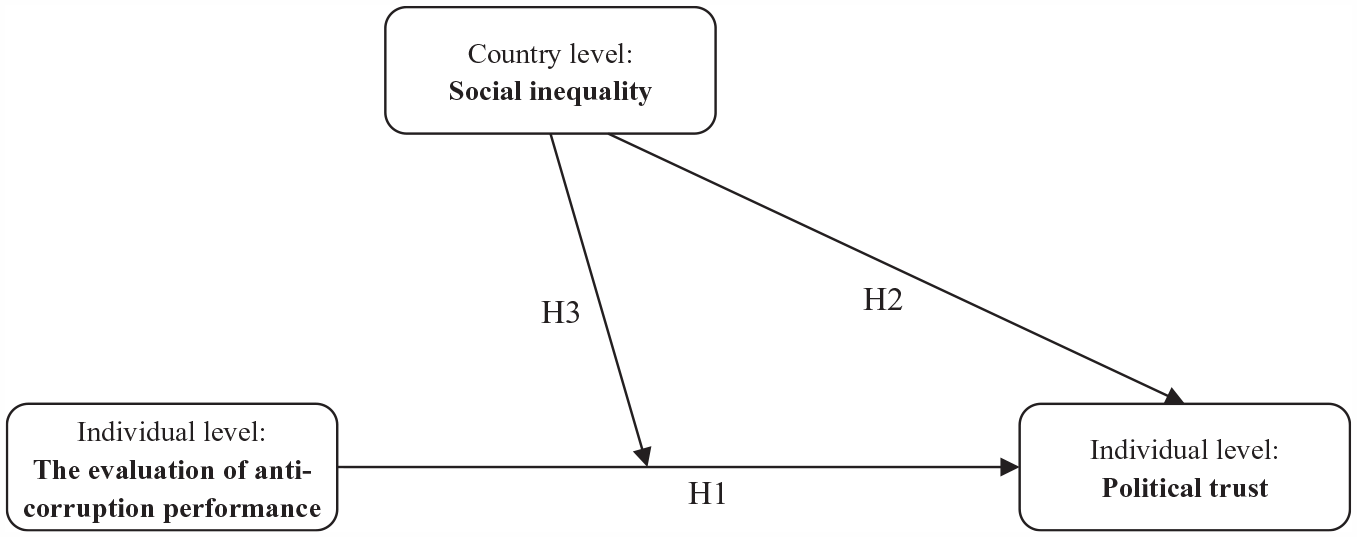
Simplified relationships among main variables and research hypotheses.
Data and variables
Data source
In order to test research hypotheses, we used two sets of cross-national surveys: the Latino Barometer Survey (LBS) and the Asian Barometer Survey (ABS). 2 There are three reasons why we did so. First, the availability of the main variables is at the top of our list of priorities. While these surveys focused on various topics, they all asked respondents for their evaluations of anti-corruption performance and their trust in institutions, which are key variables of this research. Meanwhile, they are mostly consistent in how they raise questions and set options, which makes it possible to harmonize data across different sources. Second, it is a widely accepted fact that a scientific sampling method can ensure nationally representative samples to the greatest extent possible. In this regard, the stratified random sampling method is considered as an effective statistical sampling technique that is commonly used in questionnaires. This method was utilized in both surveys mentioned above. Next, the countries involved in these two surveys exhibit marked disparity in the level of public’s political trust. Moreover, significant differences in macroscopic factors such as the degree of corruption, and social equality can also be observed across these countries (see Supplemental Appendix 1). The constructed harmonized dataset enables to avoid the homogeneity of samples, thereby making the conclusions of this research more compelling.
The merging process involved several steps. First, given that each survey had distinct starting and ending times, we selected the Latino Barometer Survey (2014–2015) and the fourth wave of the Asian Barometer Survey (2014–2016) as they covered overlapping periods of time. In addition, we presented a list of countries in Supplemental Appendix 1. Second, we picked out the dependent and independent variables, including trust in institutions, the evaluation of anti-corruption performance, and social inequality. Next, we introduced country-level and individual-level control variables. Finally, we recoded some variables so that each option was assigned a positive order.
Measurement of variables
Dependent variable
Political trust
For many decades, scholars have been arguing about how to operationalize political trust according to different understandings of the trust’s object. Some researchers view political trust as a belief that a political system, or some part of it, tends to produce preferred outcomes (Shi, 2001); others operationalize it by the item on how well the government is operating according to people’s normative expectations (Hetherington, 1998). Based on the foregoing well-accepted conceptions, two approaches are available: the indirect approach and the direct approach. The indirect approach is to evaluate individual’s rational judgments on the government and its behaviors, such as government’s ability to handle affairs, representation of public interests, and integrity of government officials. The direct way is to ask individuals about their trust in institutions such as the government, parliament, court, army, and other related departments. Subsequently, researchers can either sum up all the scores of the questions or apply factor analysis to extract a common factor as a composite indicator. However, the indirect approach has been criticized for focusing too much on the government itself generically, leading to ignorance of internal institutions and variations in trust across these different institutions (Miller, 1974; Mishler and Rose, 1997).
Scholars are now willing to utilize the direct approach, therefore, this study goes the mainstream. Respondents of two surveys were expected to show their trust in several institutions (see Supplemental Appendix 2). As concluded by Cook and Gronke (2005), one downside of the generalized confidence measure mentioned before is that it brings together so many institutions that it cannot represent trust in political institutions. Hence, we confined trust in institutions to three branches: the national government, the parliament, and the judiciary. We then coded the dependent variable ranging from 1 (no trust) to 4 (a lot of trust) for a positive sequence. We summed up the scores of three institutions in the end, and thus got a variable ranging from 3 to 12 to operationalize the dependent variable. The higher the score on this item, the higher level of political trust.
Independent variables
The evaluation of anti-corruption performance
The performance of combating corruption can be objectively assessed from the macro level, namely the degree of corruption, which is viewed as the direct result of anti-corruption actions. However, this approach ignores the significance of anti-corruption efforts in countries already trapped in corruption. The performance of combating corruption can also be subjectively assessed at the micro level by examining individual’s subjective evaluations of anti-corruption performance. Although the subjective evaluation might be influenced by personal values and preferences, it could substantially reflect the government’s achievements in anti-corruption movements. As Mishler and Rose (2001) emphasized, the effects of macro-political and economic performance on trust are indirect and mediated at the micro level by an individual’s value-laden perceptions. Therefore, we chose the evaluation of anti-corruption performance as a key indicator. All respondents were asked the same question (see Supplemental Appendix 2). The original answer options on this question ranged from “1—it is doing its best” to “4—it is doing nothing.” This item was recoded to continuous scales ranging from 1 to 4, with high scores reflecting more preference for anti-corruption efforts.
Social inequality
Social inequality can be operationalized from several aspects. Regarding its concrete contents, it refers to income inequality, public service inequality, and so on. As for its manifestation, the concept of inequality can be categorized into result inequality, opportunity inequality, and institution equality. When scholars specifically measure social inequality, however, many regard distributive justice as a standard criterion. We followed the mainstream that taking distributive inequality into consideration when measuring the level of social inequality. Several indicators are routinely used to measure income distribution: the Gini coefficient, the P90/P10 ratio, the P90/P50 ratio, and the P50/P10 ratio (Goubin and Hooghe, 2020). We relied on the World Inequality Database to collect the Gini coefficient of national income for the year in which the interviews were conducted. This index was a continuous variable ranging in value from 0 to 1. A larger score indicates that the national income distribution in that country is more unfair.
Individual-level control variables
Perception of national economic condition
National economic conditions are the cornerstones of material lives. People living in rich countries and territories have access to a high-quality life, and thereby consciously place their trust in political actors (Fu, 2018; Rothstein and Stolle, 2008). In this context, economic performance could affect the public’s level of trust in the political system (Erkel and Meer, 2016). The original question has been listed in Supplemental Appendix 2. The answers ranged from “very bad” to “very good,” which in terms of numerical values corresponded to 1 to 5, respectively. This means respondents with higher scores have a more positive outlook on the state economic condition.
Perception of household economic condition
In addition to public’s perceptions of national economic condition, their evaluations of own economic situation are highly correlated to their levels of political trust (Wroe, 2015). It is helpful for economic performance to fully reflect political attitudes by comprehensively making use of the factors above. To understanding respondents’ perceptions of household economic condition, they were all asked a pertinent question (see Supplemental Appendix 2). The options for answering this question were divided into five categories: very good, good, about average, bad, and very bad. We recoded it to get a variable scoring ranging from 1 to 5, which demonstrated that people who score highly on this question tend to be more satisfied with themselves.
Perceived democracy
Political trust probably originates from a democratic atmosphere (Catterberg and Moreno, 2006; Rainer and Siedler, 2009). This idea is probably grounded in the belief that democratic principles such as accountability, citizen participation, and checks and balances act as reassurances for the public, mitigating skepticism toward governmental bodies. Both ABS and LBS included the same question (see Supplemental Appendix 2); a score of 1 on this index means a completely undemocratic perception, while a score of 10 signifies a completely democratic evaluation.
Social trust
Traditional cultural theories offer diverging conclusions; nevertheless, most of them highlight that political trust is an extension of interpersonal trust (Mishler and Rose, 2001). This suggests that people who tend to trust others in their daily lives are also more likely to trust public institutions and their officials (Oskarsson, 2010). According to the question wording (see Supplemental Appendix 2), we made it a dummy variable with a scale of 1 (most people can be trusted) and 0 (you must be very careful in dealing with people). The higher the score, the greater the level of trustworthiness that the respondent feel.
Internet use
The Internet is an important information technology that influences people’s political attitudes. Existing research has developed three perspectives. The first holds that Internet use is believed to enhance political transparency and participation, thereby increasing political trust (Shah et al., 2005; Valenzuela et al., 2009). Another argues that Internet use may reduce trust in the political system because of the large amount of misinformation and extreme views on the Internet (Tolbert and McNeal, 2003). Still others believe that the relationship between the two is complex and may be influenced by a variety of factors such as age, level of education, or political environment (Norris, 2000). Both surveys asked respondents a similar question with respect to the frequency of using the Internet. The difference is that ABS provided eight answer options, while LBS provided only four. In order for our analysis to be effective, we collapsed the eight points of this question in ABS into four categories based on the measurement applied in LBS. Respondents with a score of 1, 2, or 3 are described as those who use the Internet every day (4—every day). If they score a 4 or 5, it means they use the Internet occasionally (3—occasionally). Similarly, respondents scoring a 6 or 7 rarely use the Internet (2—rarely), while those scoring an 8 are people who never use the Internet (1—never).
Sociodemographic variables
We also controlled for a set of sociodemographic variables that are often widely used: gender, age, and education. Gender was a dummy variable with male (1) and female (0). When it comes to education, however, a slight difference could be seen between the two questionnaires. There are 10 options in ABS provided for respondents, including the lowest level (“no formal education”), the highest level (“post-graduate degree”), and others between the two levels, which ranged from 1 to 10. In contrast, LBS contained less than ABS. To keep all answers consistent across the two questionnaires, we corded scores of 8, 9, or 10 as being 7 in ABS. In both surveys, most respondents filled out their actual age. The youngest respondent is only 16 years old, while the oldest is 108 years old.
Country-level control variables
Control of corruption
Turning to the operationalization of a country’s degree of corruption, most research are accustomed to utilizing the Corruption Perceptions Index published by Transparency International or the Control of Corruption Index published by World Bank. However, the Corruption Perceptions Index has been the subject of much criticism due to its flaws (Andersson and Heywood, 2009). Meanwhile, as a dimension of the World Governance Index conducted by World Bank, the Control of Corruption is committed to pursuing the goal of good governance and thus is more widely accepted and used. The indicator measures not only the extent to which public power is exercised for private gain, but also the strength and effectiveness of a country’s policy and institutional framework for preventing and combating corruption. This indicator is a continuous variable ranging from −2.5 to 2.5 and indicates that the higher a country’s score, the cleaner that country is.
Per adult national income
Citizens derive their political trust by evaluating the long-term macroeconomic performance within their own nation, or sometimes by contrasting it with another country’s economic track record (Uslaner, 2018). Higher income countries tend to enjoy higher levels of institutional trust than lower income countries. There are various types of indicators used to measure per capita national income, and they can be gathered from Word Bank and World Inequality Database. As we have chosen the Gini coefficient of national income from the World Inequality Database to gauge the level of social inequality, we have also selected the Per Adult National Income (with the rate expressed in current US dollars) from the same database for the sake of consistency. We logged this variable simultaneously, obtaining a scale ranging from 3.75 to 5.
Democracy index
Studies to date have suggested that living in a democratic society is more closely related to the higher level of political trust. In this study, we chose the Democracy Index from The Economist. This index consists of five parameters, namely, electoral process and pluralism, civil liberties, functioning of government, political participation, and political culture. There are 60 questions organized around these five categories, and the Democracy Index produces weighted averages based on the answers to these questions. Based on the actual survey year of the data used, we obtained this variable by consulting the Democracy Index reports for 2014, 2015, and 2016. This index ranges from 0 to 10, with a perfectly democratic country labeled as a 10, while a perfectly undemocratic country is labeled as a 0. An increased score implies a country with a high level of democracy.
Individuals using the Internet
The relationship between Internet use and political trust is a topic of research. There is a debate regarding the direction of the Internet’s effect on political trust, with some arguing that it erodes political trust while others argue that it enhances it (Cheng, 2020). The scale of Internet users reflects the development of a country’s network communication technology. Therefore, the higher the proportion of Internet users, the greater the impact of the Internet on local citizens. We included the percentage of individuals using the Internet as taken from the World Telecommunication/information and communications technology (ICT) Development Report and database. This variable is a continuous one with a percentage ranging from 11.52 to 93.18.
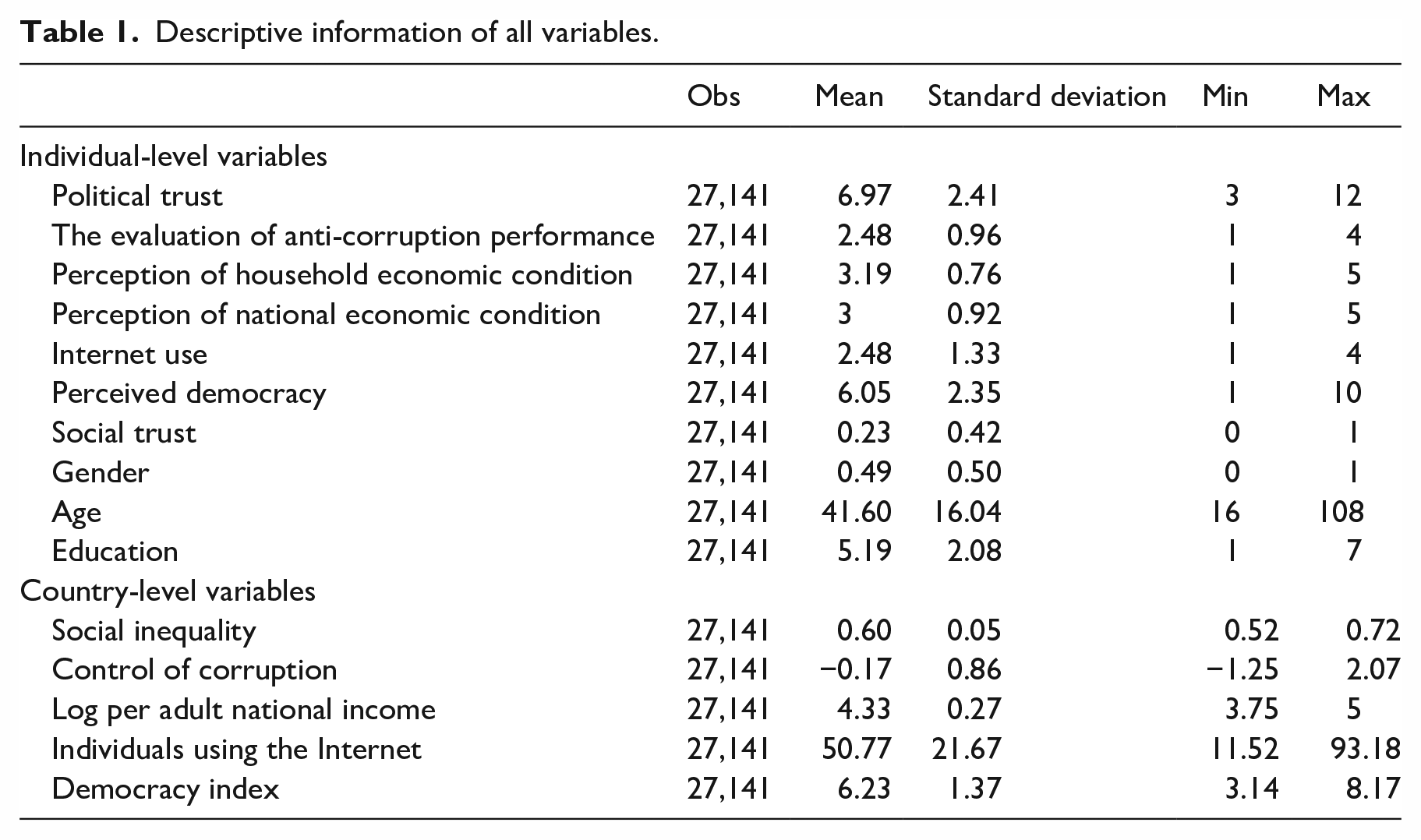
Before moving on to empirical models, we report detailed descriptive information in Table 1.
Descriptive information of all variables.
Analysis strategies
Previous empirical research pointed out political trust depends on both individual-level and country-level factors. There are differences among countries in economic development, democratic atmosphere, cultural background, and other aspects, all of which are important macroscopic sources of political trust. To account for a complex structure of the survey data, we adopted the multi-level linear analysis that considering country contexts and individual perceptions to test research hypotheses. This method views macroscopic factors as being environmental conditions for individual-level factors to work. In that sense, a potential advantage of this method is that the endogeneity problem caused by traditional linear regression could be avoided. Moreover, this method could also make full use of effective information gleaned from nested data to ensure conclusions more compelling. To be clear, it is a mixed-effects model containing fixed and random effects. In theory, the influence of public’s evaluation of anti-corruption performance on political trust may be different due to country-level characteristics. Therefore, it may be more appropriate to construct the random slope model. In comparison with the random intercept model, however, the goodness of fit of random slope model is not significantly improved. Accordingly, we utilized random intercept models.
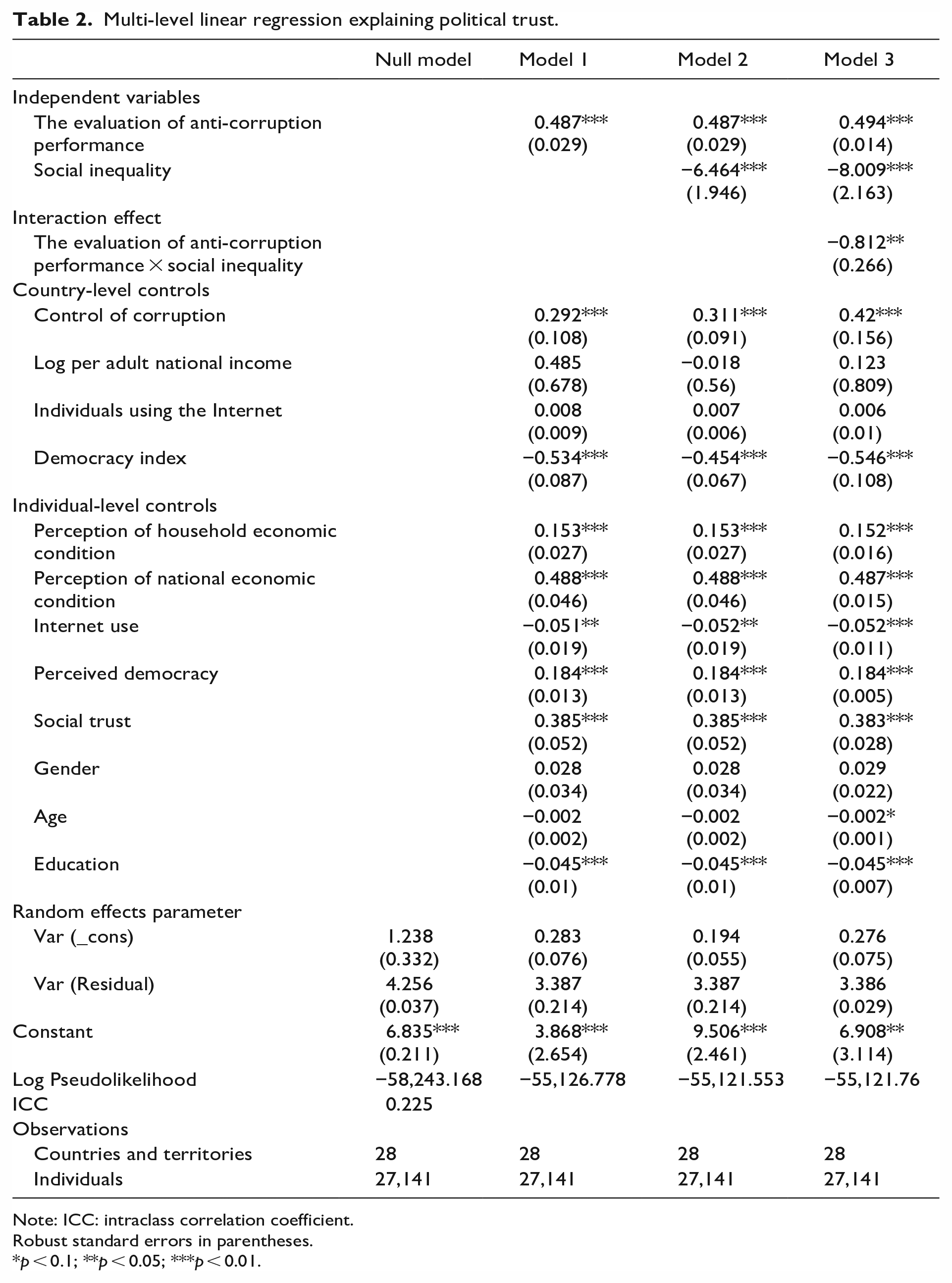
The following is idiographic modeling process: First, we estimated a Null Model containing only political trust to confirm whether there is enough variance at the country level to conduct the multi-level analysis. The intraclass correlation coefficient (ICC) of 0.225 suggests that, on average, country-level factors account for about 22.5% of the variance in political trust, while the remaining residual variance is at the individual level. In general, it is suitable for multi-level analysis if the ICC is more than 0.059, especially if it exceeds 0.138 (Cohen, 1988). Hence, a multi-level linear analysis is supposed to be conducted. Second, when estimating Model 1, we included the evaluation of anti-corruption performance, country-level and individual-level controls to test the direct impact of the evaluation of anti-corruption performance on political trust while controlling other variables. Subsequently, we estimated Model 2 containing the social inequality in order to assess the relationship between social inequality and political trust. The last model is Model 3, which examined whether an interaction effect exists. Unlike previous models, this model included not just all independent variables and control variables but also the interaction term. We list the pooled results in Table 2.
Multi-level linear regression explaining political trust.
Note: ICC: intraclass correlation coefficient.
Robust standard errors in parentheses.
p < 0.1; **p < 0.05; ***p < 0.01.
Results
Moving on to the results of Model 1, it can be observed that the evaluation of anti-corruption performance has a strong positive impact on political trust (Coeff. = 0.487, p < 0.01); consequently, Hypothesis 1 holds. Citizens who think highly of their government’s efforts to combat corruption are more likely to trust and support political institutions. To offer a detailed explanation, each unit of increase in the evaluation of anti-corruption performance contributes to an increase in political trust with a standard error of 0.487. A similar conclusion has been reached by Kang and Zhu (2020), who found that anti-corruption policies can influence political trust through direct experience and the media. Furthermore, it is worth noting that control of corruption is also positively correlated to political trust. This also suggests the cleaner a country is, the higher the political trust its citizens will have in themselves. Conversely, if a country fails to control corruption effectively, it is very likely to weaken the public’s political trust. It should be explained here that control of corruption index represents the effectiveness of a country’s anti-corruption actions at the macro level. Therefore, the necessity of anti-corruption actions in enhancing political trust can be further confirmed from the other perspective.
Empirically, Model 2 represents some potent evidence for Hypothesis 2. As seen in Table 2, social inequality does serious damage to political trust, indicating that more inequality always leads to lower political trust (Coeff. = −6.464, p < 0.01). Hypothesis 2 is well-supported. This finding also echoes previous research that reveals a correlation between social inequality and political trust (Lee, 1994; Smith and Tyler, 1996). According to the principal-agent model, citizens (the principal) hold that governments (the agent) are supposed to aim to achieve pursuits like the public interest and the provision of welfare and fairness in that they transfer and grant public power to them. In this framework, most political parties have committed themselves to defending social equality for the sake of voters’ support. Once social equality begins to break down, citizens tend to blame the government for policy failure and its inability to take responsibility, leading to a decline in political trust. Besides social inequality, Model 2 also reaffirms the effect of the evaluation of anti-corruption performance in promoting political trust insomuch as its coefficient is still salient, so the result is also robust.
Regarding the interaction effect, Model 3 examines whether such an interaction effect exists. In the light of potential multicollinearity effects, we centered the evaluation of anti-corruption performance and social inequality so that multicollinearity effects among these terms can be alleviated. The results of Model 3 clearly show that social inequality moderates the effect of the evaluation of anti-corruption performance on political trust (Coeff. = −0.812, p < 0.05). That is to say, the salutary impact of the evaluation of anti-corruption performance on political trust worsens as inequality intensifies. The relationship between the evaluation of anti-corruption performance and political trust is stronger in countries with higher levels of equality than it is in unfair areas. In light of such information, even if the government’s achievements in eliminating corruption can be perceived by citizens, the promotion of political trust as a direct result of anti-corruption actions will still vary depending on levels of social inequality. Thus, Hypothesis 3 is supported by empirical observations.
To demonstrate the moderating role of social inequality and visualize it, we plot Figure 2 so that the estimate of the interaction term can be seen clearly. As Figure 2 shows, the enhanced effect of the evaluation of anti-corruption performance on political trust worsens as social inequality becomes more extreme. More concretely, while social inequality does not change the relationship between these factors (the coefficient is still significantly positive), the promotion decreases by 35.3%. On one hand, no matter how unfair a country is, fighting corruption vigorously remains an essential strategy for restoring trust. On the other hand, most countries should pay greater attention to social inequality to prevent it from negatively offsetting the positive impact of anti-corruption efforts on political trust.
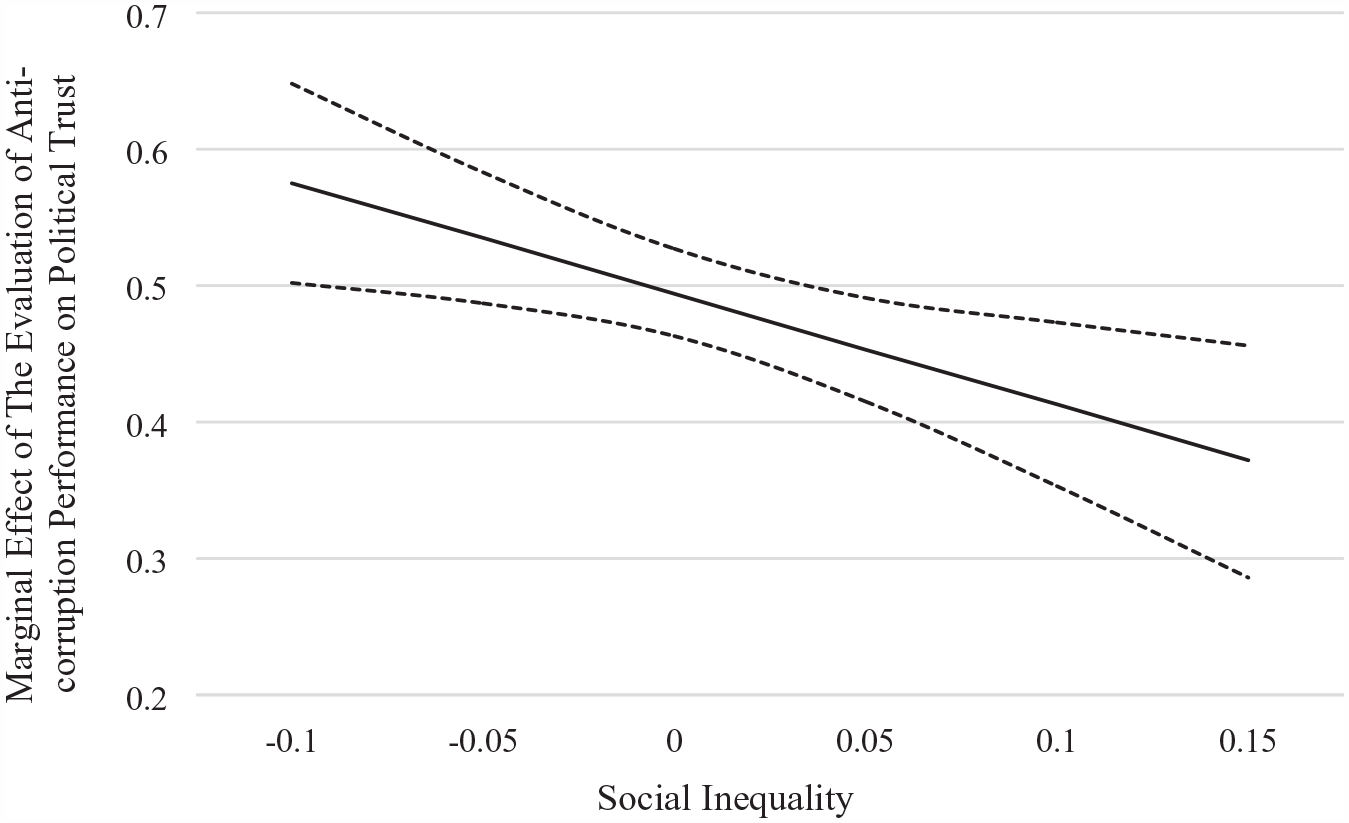
Marginal effect of the evaluation of anti-corruption performance on political trust.
The above analysis serves as a preliminary test of the existence of an interaction effect. Note that the classic linear multiplication interaction model is estimated under the linear interaction effects (LIE) assumption and the common support condition. (Hainmueller et al., 2019). However, some recent research failed in empirical practice and even overlooked these important issues. If one of those assumptions is not fully met, estimated conditional marginal effects could become fragile and highly model-dependent due to interpolation or extrapolation (King and Zeng, 2006). To assess the validity of these assumptions and calculate accurate conditional marginal effects, we conducted a liner interaction diagnosis recommended by Hainmueller et al. (2019). We divided samples into three groups of equal size based on the moderator, namely the low group, medium group, and high group. Next, we utilized the binning estimator to estimate marginal effects at low, medium, and high levels of social inequality, respectively (shown in Figure 3). It can be seen from the plot that estimates from the binning estimator are close to those from the true standard multiplicative interaction model, especially the estimate made at a high level. Based on these estimates and the histogram, the LIE assumption and the common support condition tend to be supported, providing potent evidence for the existence of an interaction effect.
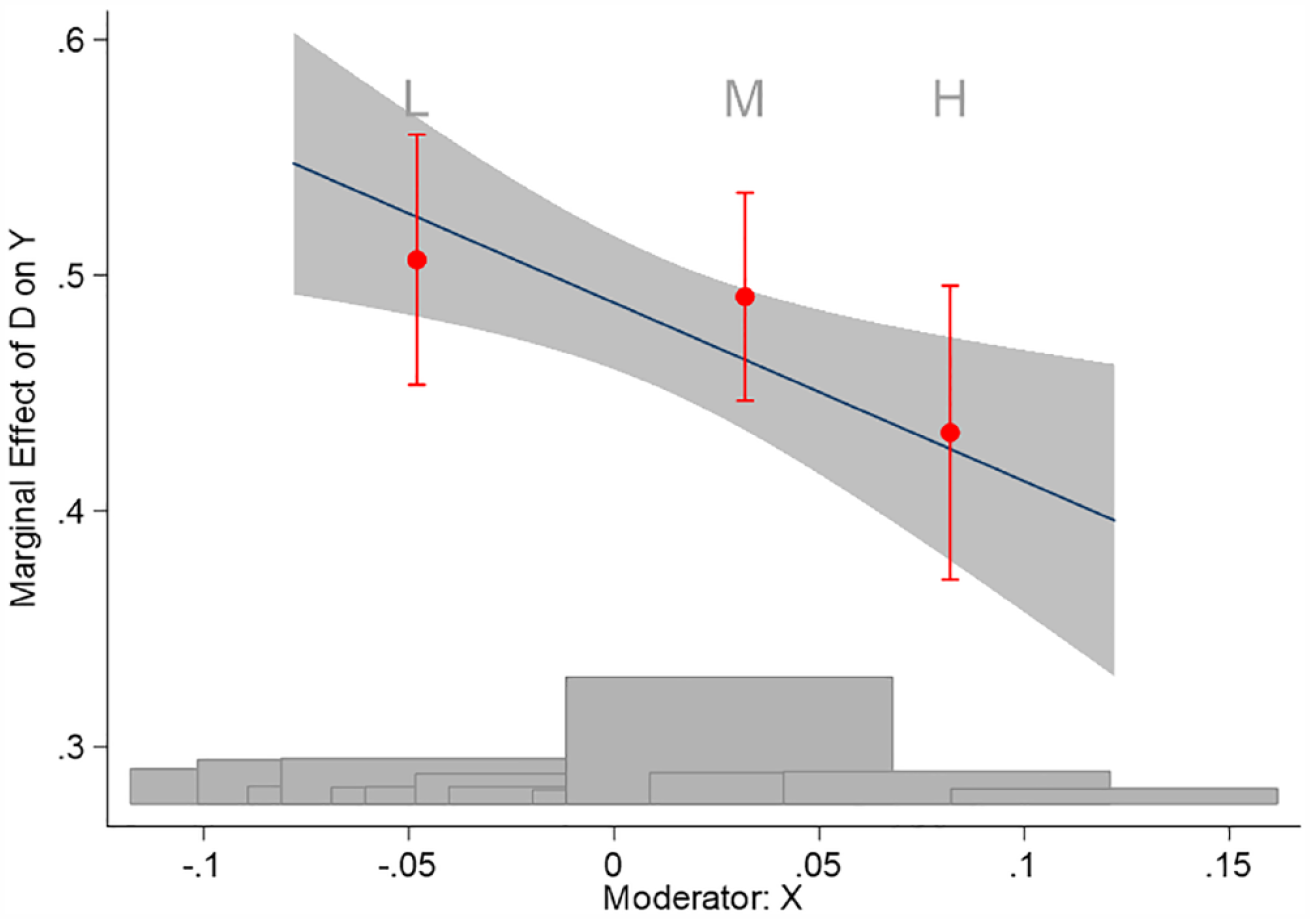
Binning estimator: Marginal effects of the evaluation of anti-corruption performance on political trust.
The above empirical results change the previous conception that the evaluation of anti-corruption performance and social inequality can each only exert a single influence on political trust. As previously noted, the causal relationship between corruption and social inequality highlights the fact that the public strongly opposes inequality, which in turn drives a strong demand for the government to conduct anti-corruption actions. In that sense, the evaluation of anti-corruption performance and social inequality alone can affect political trust, and the extent to which the evaluation of anti-corruption performance affects political trust is conditional on social inequality. Except that Hypothesis 3 is supported, the results in Model 3 also further test the robustness of the effects of the evaluation of anti-corruption performance and social inequality on political trust. There is a salient and positive relationship between the evaluation of anti-corruption performance and political trust from Models 1 to 3. At the same time, the negative impact of social inequality on political trust is depicted in Models 2 and 3. All results suggest that research findings are consistent.
The above findings lend support to all hypotheses. What need to be done now is to represent the effects of control variables on political trust. The results shown in Model 3 show that political trust can be affected by economic performance only at the individual level. Meanwhile, coefficients of perceptions of household and national economic condition are statistically significant, which are consistent with research about subjective perceptions of economic well-being (Kroknes et al., 2015; Lee et al., 2020). Nevertheless, the coefficient of per adult national income is not salient. Also, the finding that Internet use is negatively associated with political trust is essentially consistent with the views expressed in “video malaise.” 3 A possible explanation for this finding is that the presence of a large amount of false, negative, and extreme political information on the Internet may lead to public dissatisfaction toward political officials and institutions. However, individuals using the Internet do not do so in numbers great enough to achieve statistical significance. As for the role of democracy, it seems difficult to determine whether democracy promotes or erodes political trust based solely on the existing data. The results indicate that the democracy index is negatively correlated with political trust, whereas the perceived democracy is positively correlated with political trust. This issue is worth further exploration by researchers in the future. In addition, some studies to date are of the opinion that political trust is affected by social trust through the projection mechanism (Bargsted et al., 2022), which means that the more trusting a person is, the more inclined that person will be to trust their governments and public officials. Our findings also support this viewpoint based on the empirical data (coeff. = 0.383, p < 0.01 in Model 3). Unlike previous studies, to our surprise, some sociodemographic indicators in this research are not been supported. Results show that men and the young generally have more trust in the government than its counterparts, but the coefficients are not statistically significant (with the exception that the coefficient of age in Model 3 is slightly significant). Among all statistical models, only the negative effect of education on political trust can be observed. This means people with higher levels of education are more likely to distrust the government than the less educated. A possible explanation for this phenomenon is that well-educated citizens are generally equipped with extensive intelligence and professional knowledge. That means education can cultivate citizens’ capacity for acquiring and processing information (Hakhverdian and Mayne, 2012) and enable them to remain rational toward political issues, hence becoming more critical and less politically trusting.
Discussion and conclusion
It is of great theoretical and practical significance in exploring sources of political trust. However, when it comes to sources of political trust, most previous research has emphasized on the significance of corruption on political trust as the degree of corruption is often regarded as an indicator of government performance. In fact, scholars have neglected the significance of anti-corruption performance, particularly the role of subjective evaluations of anti-corruption performance in shaping political trust. Citizens are less likely to embed themselves into the trust system until they subjectively assess the services or performance of the political system and then decide whether to get involved again after careful reflection and re-evaluation (Tucker, 2004). In countries that are deeply mired in corruption, launching anti-corruption derive and winning general recognition can restore political trust, even if that trust has been severely eroded by widespread corruption. By demonstrating a commitment to reducing corruption and promoting transparency and accountability, governments can begin to rebuild the public’s faith in their ability to govern effectively and serve the common good. This process may be slow and difficult, but it is essential for restoring the state legitimacy and fostering a more stable and prosperous society. However, the compounding effects of corruption and social inequality not only weaken but accelerate the loss of political trust. If a country’s anti-corruption measures only focus on punishing corrupt practices, this approach may demonstrate the government’s resolve to eliminate corruption and garner some degree of public approval. However, the growing inequality will ultimately undermine and offset any progress made in restoring political trust through combating corruption. Therefore, addressing both corruption and social inequality is crucial for maintaining public trust in government institutions. This study seeks to investigate whether political trust can be enhanced by taking effective anti-corruption measures and further explores how social inequality works in this mechanism. A multi-level linear analysis method is applied by using a merged dataset.
This research finds that political trust is affected by the evaluation of anti-corruption performance and social inequality. First, a positive relationship exists between the evaluation of anti-corruption performance and political trust: favorable evaluation of corruption governance directly enhances political trust. In other words, a country’s firm determination to implement effective anti-corruption policies is likely to restore trust weakened by rampant corruption. When constructing an anti-corruption strategic system or implementing specific measures, authorities had better present a comprehensive overview of the penalization’s deterrent effect, the system’s preventive effect, and the culture’s leading role. At the macro level, it is imperative to continuously reduce the actual degree of corruption; at the micro level, the public’s subjective feelings cannot be ignored. Effectively, citizens’ impressions of reduced corruption are necessary to win general support and make noticeable progress. This is of particular importance for countries and territories characterized by corruption.
This study also observes an evident explanatory power of social inequality as a widely accepted cause of negative political trust. The aggravation of social disparities is responsible for damaging political trust. This is especially the case in developing countries, sustained economic growth could enhance political trust, to some extent consolidating political legitimacy; however, if economic gains do not flow to all social strata of a society, the positive effect of economic growth on political trust is likely to be ultimately offset.
Furthermore, social inequality debilitates the role of the evaluation of anti-corruption performance in improving political trust. In the long term, the most direct outcome of combating corruption certainly is the reduction of the actual degree of corruption, although this effect may not be immediately visible in a short time. However, a previously overlooked fact is that realizing the aim of equality is not only an essential requirement for fighting corruption but also acts as a lubricant to ensure a positive effect of economic growth on political trust. Hence, more attention should be paid to tackle the social impact of anti-corruption efforts in maintaining equality while striving to improve its performance, making the public perceive that fairness and justice prevail.
Despite the strengths of this study, it is important to acknowledge its limitation. Specifically, there may be reciprocal causality in the relationship between public trust in government agencies and their evaluation of anti-corruption performance. Therefore, it is necessary to select appropriate instrumental variables to address the endogeneity. However, adding instrumental variables at different levels of the multi-level model may lead to divergent results; and thus, this approach has not been widely adopted in multi-level modeling. Therefore, subsequent research in this area could utilize more advanced statistical methods in multi-level modeling to test the reliability of the conclusions drawn from this study.
Further research can delve into two aspects in greater detail. First, while this research has shown that the evaluation of anti-corruption performance plays an important role in enhancing political trust, whether in highly corrupt or relatively clean countries, a possible direction for follow-up research is to utilize a larger sample size and explore other potential influencing mechanisms. In addition, it can investigate whether there are differences in the implementation mechanisms across countries with varying degrees of corruption. Second, results confirm that social inequality diminishes the positive effect of the evaluation of anti-corruption performance on political trust at a macroscopic level. This finding necessitates further exploration of the role of unfairness perception at a microscopic level in this process. Therefore, more attention should be paid to investigating the underlying mechanism of individual perception.
Supplemental Material
sj-docx-1-cos-10.1177_00207152231211483 – Supplemental material for How anti-corruption actions win hearts: The evaluation of anti-corruption performance, social inequality and political trust—Evidence from the Asian Barometer Survey and the Latino Barometer Survey
Supplemental material, sj-docx-1-cos-10.1177_00207152231211483 for How anti-corruption actions win hearts: The evaluation of anti-corruption performance, social inequality and political trust—Evidence from the Asian Barometer Survey and the Latino Barometer Survey by Lei Yue and Qian Liu in International Journal of Comparative Sociology
Footnotes
Acknowledgements
The authors would like to thank the editors and the anonymous reviewers for their insightful comments.
Declaration of conflicting interests
The author(s) declared no potential conflicts of interest with respect to the research, authorship, and/or publication of this article.
Funding
The author(s) disclosed receipt of the following financial support for the research, authorship, and/or publication of this article: This research was supported by the China National Office for Philosophy and Social Sciences (22BZZ035) and Zhengzhou University Outstanding Young Research Team in Humanities and Social Sciences (2023-QNTD-03).

Supplemental material
Supplemental material for this article is available online.
Notes
References
Supplementary Material
Please find the following supplemental material available below.
For Open Access articles published under a Creative Commons License, all supplemental material carries the same license as the article it is associated with.
For non-Open Access articles published, all supplemental material carries a non-exclusive license, and permission requests for re-use of supplemental material or any part of supplemental material shall be sent directly to the copyright owner as specified in the copyright notice associated with the article.
