



Abstract
A pronatalist discourse and anti-abortion rhetoric used by prominent politicians in Turkey, prior to and following the proposed ban of abortion in 2012, have resulted in reports of women facing difficulty accessing safe abortion services (SAS), risking the resurgence of unsafe abortions. We conducted a qualitative study to identify the impact of the ongoing pronatalist discourse on women’s access to SAS, using semi-structured interviews with 19 experts (16 female, 3 male) in reproductive health, including academics, doctors, midwives, and health authorities. Participants from 4 cities (Ankara, Istanbul, Izmir, and Manisa) were identified through a combined snowball and purposive sampling technique. The findings show that the pronatalist discourse has directly and indirectly inhibited access to SAS. Women’s and health professionals’ perception of abortion services has been tainted by rhetoric; provision of SAS in the public sector is slowly ceasing; and health reform-related organizational changes have diminished access to family planning services and contraceptive methods. Provision of SAS in the private sector continues but is only accessible for women with sufficient financial means. Preventing women’s access to SAS risks a rise in unwanted pregnancies and—consequently—in the number of women who may seek dangerous alternatives, including unsafe, life-threatening abortions.
Access to safe abortion services (SAS) can be a matter of life or death. Historically, restrictive population policies implemented in Turkey have resulted in overwhelming numbers of unsafe-abortion-related deaths. The republican state founded in 1923 used pronatalist policies to accommodate for lives lost in World War I and the War of Independence in the early 20th century. From 1930 until the late 1950s, these pronatalist policies included a ban on contraceptive use and abortion. 1 Despite the ban on induced abortion (IA), illegal IA still persisted, and at the end of the 1950s, the number of illegal IAs was estimated to be nearing half a million per year, with around 10,000 maternal deaths annually due to abortion-related complications.2,3
In 1959, a survey conducted in 137 villages in Turkey showed that the infant mortality rate was 165 for every 1,000 live births. The maternal mortality rate was 280 for every 100,000 live births, and 53% of maternal deaths were abortion related. 4 The results of this survey prompted an initiative led by public health professionals and obstetrician-gynecologists (ob-gyns) to change the pronatalist population policy and to legalize contraception to reduce maternal deaths related to unsafe abortions. 5 In 1965 Law 557 was passed, allowing the sale and use of contraceptive methods and allowing IA under strict conditions.6,7 Although the use of family planning (FP) methods increased thereafter, in 1980 the Ministry of Health identified that 450,000 illegal abortions were being conducted annually. 8
The growing numbers of illegal abortions led to the enactment of Law 2827, which stipulates that it is legal for both ob-gyns and certified general practitioners (GPs) to terminate a pregnancy through to the 10th week of gestation on social and economic grounds. Beyond 10 weeks, abortion is legal only if the life or health of the mother is at risk or if the fetus is impaired.2,9 Additionally, FP services were also introduced into health services, reducing the unmet need for FP. The numbers of unsafe abortions and their adverse effects have since decreased sharply. 5 According to the Turkish Demographic and Health Survey (TDHS) data, the number of unsafe abortions per 100 pregnancies dropped from 19 in 1983 to 10 in 2008. 10 The rate of IAs in the 20-year period preceding 2013 has been reduced by a third, from 18 per 100 pregnancies in TDHS-1993 to 5 per 100 pregnancies in TDHS-2013. 2 In 2002 the current neoliberal and conservative government was elected. Neoliberalism has resulted in the commodification, marketization, and commercialization of health care, and the liquidation of public health services. In the field of reproductive health, one of the most critical changes has been the introduction of user fees in family planning services, which were previously free of charge. Conservatism has manifested in a neo-pronatalist discourse that targets women’s freedom, including their right to access safe abortion services.
A conservative discourse surrounding family planning services emerged in 2007 and has become increasingly prominent in the last 10 years. This coincides with a decline in family planning service provision and the use of effective contraceptive methods, reflected in the results of the last 2 TDHS. 11 The TDHS shows a plateau in contraceptive use (contraceptive prevalence was 73% in 2008 and 73.5% in 2013) and, in some cases, a decline in contraceptive use (e.g., use of IUDs was 20.2% in the 2003 TDHS and 16.8% in the 2013 TDHS, and use of the pill was 5.3% in the 2008 TDHS and 4.6% in 2013 TDHS). Thirty-two percent of married couples who no longer want to have children, or who want to extend the period between births, face difficulties accessing effective family planning methods. This consequently results in couples having unplanned, unwanted children and risks the resurgence of unsafe abortions. 2
Since its legalization in 1983, abortion had not been a serious political issue. It was in 2012 that a clear government fertility policy, favoring pronatalism, emerged. The prime minister’s speech at International Women’s Day in 2008, claiming that families should have “at least three children in order to protect the young population structure” in Turkey 12 first indicated a change from the official antinatalist policies adopted in the 1960s. 13 The emergence of an anti-abortion rhetoric abortion in 2012 emphasised this shift to pronatalism. The most prominent politicians claimed “every abortion is murder” representing “a sly plan to wipe this nation off the global stage.” 14 The Ministry of Health then announced a “Draft Law on Reproductive Rights.” The draft law proposed reducing the legal time limit of IA to 4 weeks and banning abortion completely. 5 This was heavily protested by women’s rights groups and the Turkish Medical Association (TMA), who stated that banning abortion would lead to illegal operations and an increase in maternal mortality. 15 Consequently, the proposed abortion law was not introduced. 16
Despite no legal changes made to Law 2827, in 2014 the Turkish Society of Gynecology and Obstetrics (Türk Jinekoloji ve Obstetrik Derneği) reported that some public hospitals no longer provided abortion services, without any legal basis. 17 It appeared that public insurance was no longer covering induced abortion. In Turkey, the rationing of health care has been determined through the burden of disease surveys conducted, which manifested in the Health Implementation Guide (Sağlık Uygulama Tebliği), a version of the minimum health package. Every so often, the Social Security Institution (SSI) updates the Health Implementation Guide (HIG) and determines which procedures, medications, and interventions the SSI will cover. Consequently, this has a key role in determining which services physicians offer. Services provided by hospitals need to comply with the stipulations of HIG. 18 Services included in HIG are attributed a code. Critically, without any prior warning, the medical curettage code for IA was removed from the online registration and payment system in public hospitals. This disabled doctors from offering IA, because it no longer appeared as an available procedure let alone one covered by the insurance system, preventing doctors from fulfilling their professional duties. 16
The impact of the governments pronatalist policies were also reflected in a United Nations Population Fund (UNFPA) report released in 2014. The UNFPA stated that … the pronatalistic view and statements of the current government and increasing conservatism among the public policy and decision makers put additional stress on continuity of sexual and reproductive health services (RHS) and creates a challenging environment for UNFPA to implement its activities.
19
This highlights a significant problem with potentially severe consequences to women’s health in Turkey, especially as a lack of access to SAS can lead to unsafe abortion and maternal death. 23 The aim of this research was to identify how the ongoing pronatalist discourse and rhetoric impacts women’s access to SAS and the implications if women are unable to access SAS.
Method
In summer 2016 we conducted a qualitative study, collecting data through semi-structured interviews with key actors involved in the areas of reproductive health and SAS. Prior to the commencement of the study, we obtained ethical clearance from Ege University Medical Research Ethics Committee, which approved the research protocol and the semi-structured in-depth interview guide.
A combined purposive sampling and snowball-sampling technique was used to collect data. The use of purposive sampling allowed several starting points for interviews with participants from different backgrounds. The snowball sampling technique was used to reach participants; interviewees identified and recommended other potential interviewees. This process was repeated until data saturation was reached.
To guide interviews, we prepared a semi-structured in-depth interview guide, based on a matrix of questions and interviewees, and adapted it as new themes emerged. Open-ended questions were used to address the research aims and ascertain the opinions, experience, and assessments of interviewees. Questions were designed to ensure that they were void of bias and preconceptions, avoiding any leading questions.
The interviews were conducted in Turkish and recorded once interviewee consent had been obtained. The duration of interviews was dependent on interviewee responses and ranged from 30 minutes to 1 hour. The interview recordings were then transcribed into a script format and coded using NVivo for Mac. We used an inductive approach to content and thematic analysis to identify recurrent themes.
As determinants of access to and provision of SAS are multi-faceted in nature, actors from a variety of backgrounds were interviewed to obtain a holistic appreciation of the status of abortion services in Turkey. The study population included individuals involved in the policy side of abortion services and those involved in the provision of abortion services. Thus, interviewees’ fields included academia, midwifery, general practice, forensic science, obstetrics and gynecology, professional organization representatives, civil society organizations and intergovernmental organizations in the area of family planning and reproductive health and health authorities from central and provincial state institutions who had extensive experience in reproductive health. The range of professional backgrounds provided a diverse perspective and allowed us to examine the implementation and impact of the pronatalist discourse on different levels, both locally and nationwide. The study was conducted with interviewees from 4 cities in Turkey, including Izmir (10), Ankara (5), Istanbul (3), and Manisa (1). In the interest of maintaining confidentiality, the demographic descriptions of participants have been kept intentionally vague to avoid individuals being identified.
Findings
Participant Characteristics
Participant’s professional backgrounds included academia, midwifery, general practice, forensic medicine, obstetrics and gynecology, state health authorities (central and provincial), social science, policy making, advocacy, professionals’ organizations, and intergovernmental organizations. Academics were from a variety of backgrounds, including medicine, midwifery, and social science. A total of 19 participants were interviewed: 16 female and 3 male. The years of experience in the reproductive health field ranged from 8 years to 50 years. The demographic details of participants can be seen in Table 1. As several interviewees were experienced in numerous areas of reproductive health (e.g., research and provision), the number of people under each type of reproductive health experience is greater than the sum of those interviewed. The responses of health professionals and health authorities were sometimes more specific to the city they resided in. The nationwide reach of the work of intergovernmental organization representatives, civil society organization representatives, government health authorities, and national professional organization representatives provided responses reflective of the status of abortion provision throughout Turkey.
Demographic Details of Participants.

Policy vs Practice
All interviewees were aware of Law 2827 and the stipulations under which abortion should be provided. There was a consensus among interviewees that this law had a vital role in the drastic reduction of maternal mortality and unsafe abortions in Turkey. However, health professionals, academics, social scientists, and intergovernmental organization employees highlighted that, although abortion remains legal, accessing SAS posed significant difficulties. While the aforementioned interviewees stressed the difficulties in access, health authority employees did not acknowledge any difficulties accessing abortion services. Yes, abortion is still technically legal in Turkey. However, we have knowledge that there is significant resistance in the implementation of this law and the provision of abortion services … There’s a significant difference between the number of clinics and hospitals, both public and private, that should be providing this service on paper and the reality. (Intergovernmental organization employee) I haven’t heard any complaints about a lack of access to SAS in Izmir. Maybe in other cities this might be different. In Izmir it is widely provided in the private sector. (Health authority employee)
Pronatalist Policies and Discourse
Interviewees referred to the recurrence of pronatalist rhetoric in politician’s discourse in the last 4 to 5 years. Examples of this pronatalist rhetoric included references to prominent politician’s insistence that women have a minimum of 3 (if not 5) children, with financial rewards for couples that gave birth. 24 More recent examples given by all respondents, except health authority employees, referred to the most prominent politician’s claims that “Muslim women don’t use family planning” and that “a woman without children is only half a woman.” 25
This pronatalist discourse was identified as featuring heavily in the context of prominent politicians’ rhetoric on induced abortion. Academics, social scientists, health professionals, and intergovernmental organization employees stated that prominent politicians’ repeated claims equating abortion to murder had had a serious impact—that this discourse was so powerful that the legal status of abortion became redundant. Interviewees also emphasized that the significant decline in the provision of SAS was a direct consequence of the government’s pronatalist agenda. There is no need for laws to be changed, or for the service to be unavailable. The rhetoric is enough. (Social scientist) This rhetoric came from the mouth of the most prominent politician in the country. And this was taken as the law. (Forensic medicine specialist)
Interviewees also identified that not only women but also health professionals had been influenced by this discourse,. As members of society, some interviewees observed that it was impossible for health professionals not to reflect the beliefs held by society in their profession. Consequently, interviewees identified that health professionals were reluctant to provide a service that effectively went against the government, thus presenting a key barrier to SAS provision. One colleague said this to me: “I don’t want to be known as a doctor who provides abortions.” (Doctor) They [doctors] know that abortion is still legal, they know that it’s a woman’s right … But they want to protect themselves because they are hesitant to go against the government. (Academic, midwife)
Implementation of Pronatalist Policies Through Health Reforms
Interviewees from all sectors referred to the Health Transformation Program (HTP) when asked about the provision of SAS. It was stated that the current government had used its health reform program, that is, the HTP, as an instrument for the implementation of pronatalist policies through 2 mechanisms. First, health services were restructured such that reproductive health services formerly provided were no longer offered in the new health system. As part of the HTP, health centers and maternal-child health and family planning centers (MCHFP), which provided widely accessible RHS, were abolished. During this transformation, the reproductive health functions carried out by the health centers and MCHFP were not covered by the new structures. This resulted in a lack of provision of RHS at the primary level. Second, the exclusion of family planning and SAS from the 2007 health budget law and the performance-based payment system also served as a pronatalist policy instrument. Respondents identified that this had created an effective barrier to abortion and family planning service provision. Once the Social Security Institution [which provides universal coverage to citizens] was established, manual evacuation [i.e., abortion] had no financial value under the [2007 health budget law]. (Academic, doctor) There is a premium-based system. The doctor gets a premium for the service he/she provides. That’s why safe abortion services aren’t being provided in some places. In some regions, there are no safe abortion services. (Ob-gyn, private sector) Safe abortion isn’t a service that has a high premium. Family planning services are the same. Providing FP services has no financial value for family doctors in the performance-based payment system. That’s why the provision of these services has been reduced. (Social scientist)
Access and Provision of SAS
The majority of interviewees highlighted that the decrease in SAS provision in public hospitals was so pronounced that it could be said that SAS were not being provided in public hospitals at all. However, health authorities emphasized that there had not been a political directive to doctors to stop the provision of induced abortions. At the public hospital level, there are so few safe abortion services provided that you could say there are none. (Social scientist) They closed down one hospital that used to provide the service due to the influence of the government’s politics. There’s only one public hospital that provides the procedure now. (Ob-gyn, private sector) In larger cities such as Izmir, Ankara, and Istanbul, the SAS provision in the public and private sector is so low it could be said it doesn’t exist. A woman living in another smaller city or in a more remote village in Turkey won’t be able to access these services. (Social scientist) Whether it is legal or not, women will find a way to have an abortion. This is an even greater problem for poorer women, in rural areas, who cannot access abortion services. The situation has become dire. There are reports of women carrying out dangerous self-induced abortions. (Professional organization representative)
Societal Context
Several academics, intergovernmental employees, and ob-gyns emphasized that the current government has brought conservatism to the forefront. They stated that in this conservative narrative, women who engage in sexual activity are expected to be married and, if not married, they are to be virgins. These respondents stressed that this discourse also had implications for access to birth control methods.
Academics, health professionals, intergovernmental organization employees, and social scientists referred to a woman’s perceived “role” in society and the impact of prominent politicians’ rhetoric that a woman without children is only half a woman. Academics and health professionals expressed the aim of such rhetoric was to keep women in the home, removing them from working life and encouraging them to fill the role of housewife and to fulfill the responsibility to produce children. A woman is not an individual. She is a factory belonging the state. In the same way that men serve in the army, a woman’s duty for her country is to have children. This is the discourse that’s been created and, in my opinion, it takes us back to human and women’s rights of the 1800s. (Doctor)
Implications of a Lack of Access to SAS
A lack of abortion services is equal to unsafe abortion services. Either the woman dies herself or the baby dies … I always say if a woman wants to have a child, she’ll give birth. If she doesn’t, she’ll find a way not to. (GP, public sector)
From all interviewees’ responses, it was clear that preventing access to SAS would have serious consequences. For women unable to access SAS, health professionals identified 2 options: (1) to give birth to an unwanted baby or (2) to try to terminate the pregnancy through unsafe means. Social scientists and health professionals emphasized that the risk of death for an unwanted child was much higher and that the most significant risk factor for infant mortality is unwanted pregnancy. Doctors, midwives, and academics feared that preventing access to SAS would result in a resurgence of unsafe abortions and consequent maternal deaths. The majority of interviewees expressed that diminished provision of and access to abortion services were a serious violation of women’s human rights.
Discussion
The main aim of this research was to identify how pronatalist policies impact women’s access to SAS and what the consequences are if women cannot access SAS. The findings show a clear relationship between pronatalist discourse and policies and women’s access to SAS. Pronatalist policies directly impact the provision of SAS by influencing perceptions of abortion held by women and health professionals. Pronatalist policies also indirectly influence the provision of SAS through the media and the HTP. Collectively, this impacts women’s ability to access SAS. The situation is exacerbated by diminished access to FP services and contraception, which increases the need for SAS. All interviewees conclude that the consequences of diminished access to SAS are a rise in unwanted pregnancies and unsafe abortions with life-threatening consequences.
The findings have been used to create a framework on determinants of access to SAS, depicted in Figure 1.
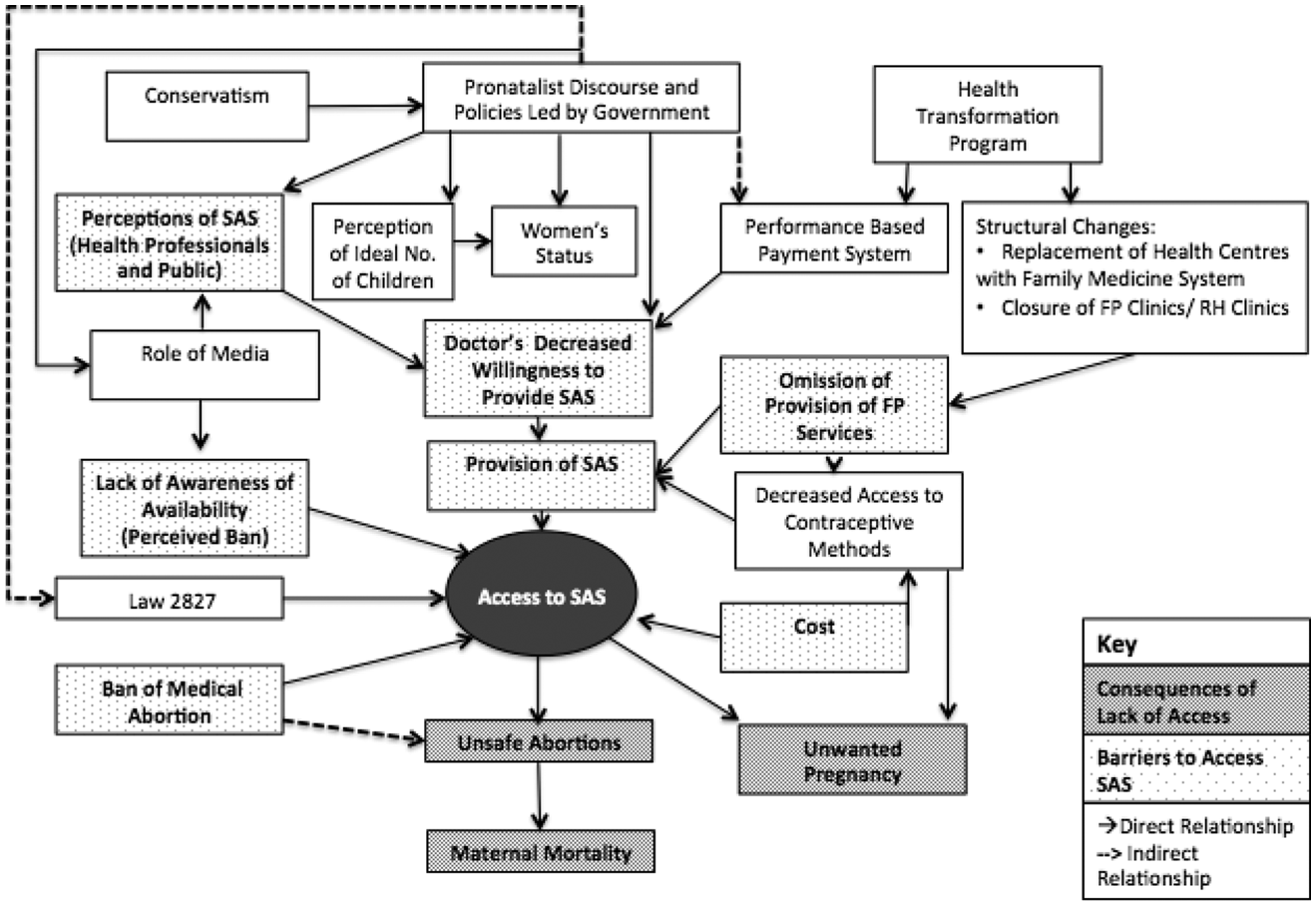
Determinants of access to SAS in Turkey. FP, family planning; RH, reproductive health; SAS, safe abortion services.
The findings of this research indicate discrepancies, on all levels, between official laws and policies and what occurs in practice. This discrepancy is largely attributed to the influence of pronatalist discourse and the implementation of subsequent pronatalist policies. Despite the shift to pronatalist policies and anti-abortion rhetoric being officially motivated by the goal of increasing the fertility rate and thus the size of the Turkish population, 1 the findings suggest that the government’s patriarchal, conservative roots are also instruments. As such, these pronatalist policies and discourse serve as a determinant of access to SAS.
Therefore, while induced abortion continues to be a right protected by Law 2827, legality does not guarantee access to SAS, particularly in a climate where the most prominent politician’s discourse and rhetoric is accepted as law. The findings show significant barriers in accessing SAS (see Figure 1).
The most prominent feature of Law 2827 is making IA services accessible to anyone who needs it, without a fee for service. The results of the TDHS conducted every 5 years between 1993 and 2013 show that the percentage of women who had an induced abortion in the public sector were 27% (TDHS 1993), 24% (TDHS 1998), 21% (TDHS 2003), 26% (TDHS 2008), and 34% (TDHS 2013).2,10,26–28 The TDHS shows that most abortion services continue to be provided through the private sector (78% in 2003 an 62% in 2013). 2 Although it is claimed the expansion of social security coverage, introduced in 2003, resulted in more services being encompassed, the percentage of abortions in the private sector vs the public sector remains unchanged. This indicates a regression in health service coverage.
The lack of coverage of abortion services through the social security institution and the exorbitant costs of SAS in the private sector mean that women from a certain socioeconomic background are excluded from accessing the service in the private sector. Taking into consideration the diminishing provision of SAS in the public sector, this will have the greatest negative impact on socioeconomically disadvantaged women’s access to SAS.
Other factors need to be considered to ensure that abortion is a legal right. These include financing of abortion services, access, societal perceptions of abortion, health professionals attitude to abortion, religious beliefs, and the provision of FP services before and after abortion. 29 However, these are all factors that have been significantly negatively impacted by the most prominent politicians pronatalist discourse.
The findings show that the influence of a pronatalist discourse on individuals’ attitudes toward, and perception of, abortion can also serve as a barrier to accessing and utilizing SAS (see Figure 1). The current political leadership of the ruling party has an influence beyond politics in Turkey. In particular, the current president, the former prime minister, is regarded as not only a political but also a cultural leader with religious values among his supporters. Thus, the pronatalist discourse used by the president and other prominent politicians, portraying abortion as “murder,” “insensitive,” and “immoral,” cultivates objections to abortion on religious and moral grounds. This leaves women who want to seek abortion services feeling guilty, creating the perception that they are doing something wrong or sinful. In this climate, women find it difficult to seek abortion services, 9 thus inhibiting access to abortion services.
Women’s lack of awareness of service availability also presents a barrier to their access to SAS (see Figure 1). Access to SAS and utilization of SAS is contingent on women’s awareness of the law (i.e., whether abortion is legal or not). 23 This research shows that health professionals, medical students, and women are under the impression that abortion is banned. This perception is partly attributed to prominent politicians’ and the health minister’s statements disseminated through the media. The proposed ban of abortion that followed prominent politicians’ claims that “abortion is murder” has created the impression that abortion is no longer legal in Turkey. This misperception is enforced by hospitals claiming that “abortion is banned” and that is why SAS is not provided. 30 The situation is further exacerbated when officials say, “abortion is not banned, society just does not want it anymore,” as noted in the findings. Thus, if an official complaint is made, officials maintain that abortion is not banned. This discrepancy between law and practice creates difficulty for those who want to advocate for SAS. The significance of this misperception that abortion is banned is critical, as women cannot fight for a right they are not aware they have. As this lack of knowledge serves as a critical barrier to accessing SAS, substantial efforts must be made to inform the public that abortion is still legal.
Consequences of a Lack of Access to SAS
This research shows that women unable to access SAS have two options: either continue with the pregnancy or terminate the pregnancy using other means. For women who are forced to continue an unwanted pregnancy to term, there are serious detrimental effects. These include consequences to mental well-being, such as the emergence of anxiety and depression; poorer quality emotional relationships between the mother and child in terms of affection and support; and increased violence and less leisure time during childhood. Furthermore, infant mortality is also a risk associated with unwanted pregnancy.31,32
Health professionals and academics emphasize that women who do not want to have a child will not. This view is echoed by Grimes et al., 23 who state: “Women have always had abortions and will always continue to do so, irrespective of prevailing laws, religious proscriptions, or social norms.” All health professionals, academics, intergovernmental organization employees, social scientists, and health authority employees agree that a lack of access to SAS leads to unsafe abortions. Again, Grimes et al. 23 share this view: without access to SAS comes the risk that women will resort to unsafe abortion, such as abortion from unqualified doctors, abortion in unhygienic conditions, or self-induced abortion. 23 The most severe consequence of unsafe abortion is maternal death. These are deaths that are both entirely preventable and unnecessary. 33
It should not be forgotten that this was the reality in Turkey prior to the legalization of abortion in 1983, where women would seek back-alley abortions or attempt to terminate the pregnancy themselves using clandestine methods. The consequent drastic increase in maternal mortality was the basis for the introduction of Law 2827, which has since had tremendous success in drastically reducing maternal deaths. 13 However, this research suggests that the current pronatalist agenda and reduced access to SAS may result in history repeating itself, at the expense of women’s lives.
Strengths
The use of in-depth interviews and the expertise and opinions of individuals from a diverse range of backgrounds have provided the comprehensive understanding of the current status of abortion and barriers preventing access to SAS in four provinces in which over 30% of the population live. The responses of the interviewees also reflect on the impact of pronatalist policies on the wider Turkish population.
Limitations
Further research needs to be carried out, across Turkey, to identify the extent of SAS provision nationwide. Snowball sampling and the nature of this research have resulted in more females being interviewed than males and is reflective of more women than men working in the area of reproductive health. The unavailability of the 2018 Turkish Demographic Health Survey Data is another limitation. It is expected that the findings of the TDHS 2018 will be published in 2019 and will provide more information on IA and contraceptive use in the last five years.
Conclusion
The findings of this research demonstrate that a combination of pro-life rhetoric and pronatalist discourse in the context of population policies has resulted in a silent ban of abortion without any changes to the law. The use of pronatalist policy as an instrument has resulted in structural modifications regarding the provision of RHS, and financial disincentives for SAS provision have influenced the professional and public opinion. This has directly and indirectly affected women’s access to SAS significantly. Furthermore, FP has also been added to the most prominent politician’s discourse. Considering that pronatalist discourse and anti-abortion rhetoric led to the silent ban of abortion, FP services face the same threat. These services are already diminished in scope and accessibility in the past years, after the structural changes of HTP.
Decreased FP services with limited access to SAS means that more women will have unwanted pregnancies, seeking to terminate pregnancy in unsafe ways or giving birth to unwanted children. This is an important threat to the health and social well-being of society and has particularly severe implications for women’s rights and women’s health, with risks of unsafe abortion and a rise in maternal mortality. Therefore, ensuring access to contraceptives, FP services, and SAS is crucial to ensuring women’s health and to securing women’s rights.
Footnotes
Acknowledgments
The authors would like to express their deepest gratitude to the interviewees for their invaluable contribution to this research.
Declaration of Conflicting Interests
The author(s) declared no potential conflicts of interest with respect to the research, authorship, and/or publication of this article.
Funding
The author(s) received no financial support for the research, authorship, and/or publication of this article.