



Abstract
The boundaries of what constitutes “sufficient” health have always been open and, as such, health care has proven to be an opportune area for profit growth. In the United States, the allure of health as a market commodity has proven very strong, but even here it cannot be a mere spontaneous product of the market. It requires government to foster and develop public policy that effectively promotes and maintains health care delivery across the population. Historically, U.S. public policy has veered away from anything akin to universal care, and it has typically been understood as an outlier among advanced industrial states. But, simultaneously, it is also the largest health care market in the world, soon to engulf a full fifth of its GDP. In this paper, I argue that the complicated dynamic between a growing market in health delivery and a patchwork of political reforms has encouraged “adaptive accumulation,” a process whereby capital secures optimized accumulation outcomes from enhanced government intervention, deriving extra-market benefits along the way. To make this argument, I explore critical components of the health system, including Medicare Advantage, Medicare Part D, as well as the Affordable Care Act and its aftermath.
The boundaries of what constitutes “sufficient” health have always been open and, as such, health care has proven to be an opportune area for profit growth. Given its immediate necessity to individual and societal well-being, there is little likelihood of waning demand in this arena. In the United States, not surprisingly, the allure of health care as a market commodity has proven considerably stronger than in other comparable countries. But even in America, broad societal health does not emerge as a spontaneous product of the market, at least not in any consistent or equitable manner. Instead, it requires government to foster and develop public policy that effectively promotes and maintains health care delivery across the population.
Historically, U.S. public policy has steered away from universal social systems, making it somewhat of an outlier among advanced industrial states. Expanding health care to the broader population has involved a series of either failed or partial reforms, stemming back to the Theodore Roosevelt administration and culminating in the awkward compromise of the Affordable Care Act (ACA) of 2010. At the same time, however, health care has become central to American society, with enormous profitability and the growth of the largest health care market in the world. Indeed, it has been estimated that by 2026, this market will constitute a full 20% of U.S. GDP, even though tens of millions of U.S. citizens will go without health care or will be grossly underinsured. 1
In this paper, I argue that the complicated dynamic between a growing market in health delivery and a patchwork of political reforms has encouraged “adaptive accumulation,” a process whereby capital secures optimized accumulation outcomes from enhanced government intervention, deriving extra-market benefits along the way. Ultimately, outside of military spending and procurement, there is now no better example of adaptive accumulation than health care delivery. It has become a truism to state that the health care system is unnecessarily disjointed, complex, and costly, but tellingly, no lobbies among its constituent parts wish to see it otherwise. It is precisely this complexity that offers up possibilities for market profitability, while also providing the ideological cover of pursuing the public good and beneficiaries’ well-being.
In making this argument, I explore critical components of the health care system to highlight the opportunistic connection of industrial actors to publicly generated health care programs. It begins with a brief conceptual discussion of adaptive accumulation, pointing to the unique strategies of corporate actors to utilize U.S. public policy in a manner that brings enhanced and stable revenues. This is followed by a consideration of select parts of U.S. health delivery, including Medicare Advantage, Medicare Part D, and the ACA, particularly its expansion and subsidization of the commercial insurance market.
Adaptive Accumulation: Public Objectives, Private Revenues
In the American context, the state is typically understood to be minimalist or subordinated with regard to capitalist producers. In relation to other OECD states, comparativist scholars have long emphasized a thin U.S. regulatory setting, as well as the robust flexibility and maneuverability of capital.2,3 However, this tradition of state-corporate relations should not be viewed as inevitable, because the contemporary historical context can and does complicate this picture. In this sense, understanding the behavior of the U.S. state demands that we allow for the prospect of change by social actors, including corporations. Critical institutionalism, as advanced by Dennis Pilon 4 and others, emphasizes the fact that institutions shape social behavior but are also subject to change through social action. This means that institutions not only set the boundaries for corporate actors, but that such actors can “in certain circumstances … reconstitute institutions.” 5 With this in mind, the portrayal of the U.S. regulatory state as “thin” can be subject to challenge, because while it accommodates capital, it does not relinquish its public interventionist role. Amid all the talk of unbridled U.S. markets, the state maintains a regulatory presence in a range of areas that not only facilitates capital but also mobilizes public spending in part for the good of capital. This is no mere historical accident, as corporations seek to influence the structure of regulatory institutions, fine tuning them for maximum profitability. In this way, the concept of adaptive accumulation highlights an important component of critical institutionalism: the moment in which corporate actors utilize and/or change the terms of state intervention, not necessarily to remove it but rather to harness it to their interests.
Adaptive accumulation moves us away from the contemporary image of neoliberal change associated only with lean regulation and state withdrawal from progressive public policy. In fact, the structures of public institutions can be an avenue for capital to create or expand profitability. Public objectives can be harnessed, such that a stable stream of revenue flows can be created or enhanced for private actors, ostensibly undertaking public tasks with a new integrity or effectiveness. None of this follows a predetermined path, and its outcomes are the subject of struggle between corporate actors and different sections of the state. Advantageous policy structures are both fought for and defended, and all parties carve out areas of profitability in ways that are “competitive, oppositional, and characterized by unequal power relations.” 6 In other words, adaptive accumulation highlights the attention corporate agents pay to read signals not only of the competitive market but also legislative and regulatory fields. The total effect of this – in health, military, education, prisons – presents an image of American capitalism that, rather than being lean and anti-interventionist, contains a strong dose of state largesse and corporate dependence.
This strategic approach to accumulation brings with it certain advantages. The first of these, somewhat obviously, is a greatly enhanced stream of corporate revenue, not just in absolute terms but also in terms of stability and expandability. The market here is not really so much the market as it is a far more predictable field of public revenues redirected into private channels. Second, corporate actors benefit from an already created social need, shaped and expanded through public action. Such programs are viewed as a political necessity, even entitlement, which creates not only larger demand and market access but also confers a kind of social legitimacy, as corporations ostensibly rush to meet societal need. Finally, adaptive accumulation taps into a strain of American political culture that disparages the role of the state, taxation, and those “undeserving” of public care. It captures both a long-term neoliberal ethic and a more recent right-wing political theme, directing blame at “lazy” sections of society, reinvigorating a call to “save” the republic through moral discipline, and delivering with the dual promise of effectiveness and efficiency.
Augmenting the Status Quo: Adapting the Component Parts of U.S. Health Care
It is often noted that U.S. health care carries with it a profound paradox: the country that leads the advanced industrial world in health technology also administers one of its least effective health delivery systems. By any metric, U.S. health care is a mess. It costs more than any other health system, with a 2017 per capita spending of $10,209, amounting to a whopping 17.1% of GDP. 7 This is twice as much spending than in other OECD countries. Worse still, the U.S. system does not bring about the health outcomes purported by its advocates. Prior to implementation of the ACA, some 52 million were without health care, with another 34 million understood as underinsured (with out-of-pocket costs acting as an impediment to care). 8 Even following the rollout of the ACA, some 27–28 million remained uninsured, with another 50 million-plus experiencing underinsured status. 9 And perhaps most damning are indicators that place the outcomes of U.S. health care (mortality, life expectancy, infant mortality, mental health, etc.) definitively low on the list among its peer countries. 10
Copious evidence to the contrary suggests that market-based health care systems (especially insurance) are detrimental to populations. The reasons for this in U.S. health care have been reviewed in more depth elsewhere, but the singular most important issue is the lack of price leverage in a free-ranging myriad of payers.11–13 Payers and providers have always been divided in the United States, both from each other and among themselves. As such, no payer possesses the structural leverage to have a meaningful impact on the prices paid for health care provision, and providers enjoy a globally unique capacity to set prices for goods and services at levels “the market will bear.” This combines with the politico-economic reality that health and health care are treated as a form of industrial and economic development in the United States, rendering costs that continue to climb faster than anywhere else.
As health care reform ebbed and flowed through the 1990s and 2000s, the growing ranks of the uninsured meant relatively fewer paying beneficiaries. And as growing premium prices could not compensate for this finite consumer base, actors within the health industry have sought out strategies to maintain their expansionary business model. This has happened in piecemeal form, as industrial players have capitalized on moments of incremental policy reform in ways that both elevate their public prominence and secure enhanced profit streams. As such, health follows the model of adaptive accumulation, where market actors provide solutions in an arena where any instability can have damning political consequences. This affords considerable leverage over government action, including the demand that market “stability” and “predictability” be built into the arrangement. The remainder of this paper highlights such arrangements, supplying a representative snapshot of the political dynamics that have furthered a highly profitable set of public-private relationships.
Medicare Advantage: Gaming the Aged
Following the downfall of the Clinton health care reform, a clear result was increased competition between insurance companies and HMOs to tap into the existent but still lucrative health domains. As Andrew Kelly has correctly identified, this created market pressure to find new sources of revenue in a tightening field of expensive premiums.
Increasing commercial penetration also sparked competition between MCOs (managed care organizations) that had spillover effects into the Medicare market. As the employer-sponsored insurance market became saturated, (managed care organizations) turned to Medicare for new sources of revenue. In the fight for beneficiaries, insurers offered richer and richer benefit packages, as well as lower cost sharing, in order to win the Medicare market – even if that meant incurring short-run losses. 14
Indeed, in a tactic that would later be used by mortgage lenders, “teaser rates” were offered to entice beneficiaries into private Medicare arrangements.14(p331) The move to utilize the public, single-payer structure of Medicare as means to realize private revenue streams started in the 1980s, expanded in the late 1990s, and was consolidated in the 2000s. This was not an unintended consequence but rather an industry-driven strategy in the face of both tightening markets and the irresistibility of adaptive accumulation strategies.
The possibility of private Medicare plans emerged with the passage of the 1982 Tax Equity and Fiscal Responsibility Act (TEFRA), which allowed private plans to vary their coverage outside of the boundaries set by traditional Medicare (TM) fee-for-service (FFS) coverage.14(p327), 16 Plans could now pull in guaranteed, government-paid premiums and arrange their risk pools in a manner that corresponded with profitability. Later, the 1997 Balanced Budget Act (BBA) formalized this process by naming the program (Medicare + Choice); recognizing its increasing significance and value in seniors’ health provision; and formally incorporating it as “Part C” of the Medicare program. In an era of government austerity, however, the BBA also sought to reduce payments to private plans, given that the growth in Medicare + plans had accelerated substantially. Prior to this, plans had utilized demographics and regional data to select the counties that attracted the highest reimbursement and lowest cost outlays – a classic case of adverse selection. 17 As such, the BBA directed the Centers for Medicare and Medicaid Services (CMS) to apply refined risk adjustment against its payments, based on beneficiaries’ diagnoses, paying more for sicker populations and reducing payments for healthier populations. This hit the mark – between 1997 and 2003, over 2 million seniors would be involuntarily withdrawn from Part C plans.17(pp309–312) Even Congress’s attempt to remedy the situation for insurers in 1999 could not overcome the trend, as risk adjustment bit into the lucrative business of selective senior health care.
With an incoming Bush administration, this situation would not be allowed to stand, as it urged passage of the Medicare Modernization Act (MMA). Best known for its drug benefit, discussed below, the MMA also recast the Medicare + Choice program as “Medicare Advantage” (MA) and aimed to enhance its attractiveness to the health industry. Payment rates were boosted to 100% of risk-adjusted, FFS rates and reached much higher de facto levels. The Republican administration intended to encourage private plans by providing more generous payment structures for those beneficiaries willing to convert to Part C arrangements. Since the passage of MMA, the extraordinary growth of this program has become impossible to ignore, and it currently constitutes 33% of all Medicare plans. The major insurers – Humana, UnitedHealth, Cigna – have very substantial stakes in this market, and industry lobbyists defend their interests vociferously. Political lobbying in this specific sector has grown dramatically to circumvent or modify any legislation that might affect payment rates to industry.14(p336)
The insurance industry’s ability to secure profit streams has been reinforced by the
political leverage that accompanies the control of large beneficiary markets. With
some 19 million enrollees, the industry’s stability and well-being has become a
matter of necessity in political circles. In keeping with adaptive accumulation,
this means that industrial players utilize a “public provider” persona to render the
bloated payment structure relatively untouchable. The structure of Medicare policy … gives [managed care organizations] the
responsibility for the direct provision of a public good that is, quite
literally, a matter of life and death to U.S. seniors. This provides MCOs
with significant and increasing policy leverage. … With the benefit of a
longer time horizon, we see that the insurance industry is, in fact, able to
draw considerable power and defensive sway from its bipartisan influence.
MCOs can withdraw from participating in MA, they can withdraw from certain
counties, or they can charge higher premiums or offer modified benefits to
the millions of seniors enrolled in their plans, the potential effect of
which is to throw a growing portion of the Medicare market into turmoil,
forcing some beneficiaries to reenroll in traditional Medicare, purchase
Medigap, find new private plans, and potentially face higher costs. The
extent of the potential disruption, and therefore the political cost, caused
by plan withdrawals or reductions increases with each new
enrollee.14(p337)
In an environment where industry possesses this kind of political leverage, corporate players are able to maneuver through regulatory constraints that might otherwise tamp down their profit expectations. CMS has long advocated the removal of MA payment incentives, and regulatory structures have been put in place to achieve such goals. 18 The abovementioned system of risk adjustment has become increasingly refined to remove imbalances between public and private coverage scenarios. Under this ever-evolving method, insurers must assign hierarchical condition categories (HCCs) to each beneficiary, and CMS uses this information to assign a quantified risk score, based on each beneficiary’s demographic and health status. This risk score “represents the expected difference in spending for each Medicare beneficiary relative to spending for an FFS beneficiary with average risk.” 15 A singular risk score for each insurance pool (usually determined at the county level) is then assigned to corporate bids to the MA program each year. CMS determines how payment to plans will be adjusted against a benchmark, risk-adjusted FFS payment structure – higher payments for higher-risk individuals, lower payments for lower-risk individuals.
How can the insurance industry engage in adaptive accumulation in such a stringently regulated payment structure? The answer is 2-fold. First, while the industry is not allowed to reject applications for MA, even in the face of chronic conditions, it is able to choose the geographic regions in which it offers coverage, as well as the structure of that coverage. Literature on advantageous selection suggests that MA attracts considerably healthier beneficiaries, and even since the stepped-up risk-adjustment formulas of MMA, with an increasingly severe “lock-in” period applied to MA enrollees, mixed evidence exists as to whether risk selection has been mitigated.19,20 It is certainly the case that beneficiaries with chronic conditions or in need of acute care tend to gravitate back to conventional Medicare. Unlike the TM model, MA plans are based on care networks, and beneficiary care is restricted within those networks. As such, potential beneficiaries with complex, chronic conditions that require extensive specialist care tend to “self-select” into TM, resulting in healthier risk pools for MA. Exploring long-term care, nursing care, and acute in-patient care, Momatazur Rahman and colleagues reported “that beneficiaries who report poorer health, use more health services, and have higher health care spending are more likely than their counterpart Medicare Advantage beneficiaries to leave Medicare Advantage plans.” 21 Risk adjustment should have strongly mitigated against selection, and it should have had the effect of equalizing payments for services between MA and TM. However, by 2009, the average overpayment to MA amounted to somewhere between 12% and 14%, totaling $12 billion in yearly additional costs for the Medicare program.17(p319)
A second and related path to adaptive accumulation involves coding practices. HCC
categories are immensely complex, accounting for demographics, region, diagnostic
classes, and aggregated individual health data. But the application of these under
risk adjustment has not been negative for corporate actors. According to Brown and colleagues, before risk adjustment MA plans fished in a pond of relatively healthy
enrollees with little cost variance. Risk adjustment allows them to fish in
a pond of enrollees who have higher costs on average but also highly
variable costs. Indeed, we find that after risk
adjustment, overpayments are higher, an increase equal to roughly 9% of
average Medicare per capita spending.19(p3338)
For its part, the Obama administration recognized overpayment to MA programs as a drain on public revenue and an undermining element of equitable Medicare delivery. Through the passage of the ACA, it intended to “ … eliminate billions in unwarranted subsidies to insurance companies in the Medicare Advantage program – giveaways that boost insurance company profits but don’t make you any healthier.” 23 Specifically, the legislation sought to pull back the perks enjoyed by industry over its public counterpart by adding increased risk adjustment modifiers, changing the structure of benchmark payments, and rolling out taxes that affected MA.
These measures should have had pronounced and rapid effects but were instead subjected to the political pressure of widespread industrial intervention. From the outset, America’s Health Insurance Plans (AHIP), the premier lobby for U.S. health insurers, made clear that “reimbursement reductions could drastically reduce enrollment in Medicare Advantage and disrupt plan offerings.” 24 Their lobbying efforts have applied maximum pressure to both Congressional and Executive arms of government, and the returns have been substantial. Under intense pressure from industry and Republican political opposition, the Obama administration soon announced the Quality-Based Bonus Payments Program (QBP), rapidly expanding a small quality incentive program built into the legislation. In the original program, insurance plans with a 4- or 5-star rating received a 1.5% bonus on their benchmark payments. QBP extended this bonus to 3- and 3.5-star ratings, awarding them a 3% and 3.5% payment bonus, respectively. And 4- and 5-star plans would now receive 4 and 5% benchmark payment increases. The impact of this 3-year program was large, exceeding $8 billion, and it amounted to a clear transitional subsidy for the insurance sector. As Kelly has pointed out, the administration’s support “contradicted its own earlier policy declarations, opened itself up to criticism, and gave back a significant source of early funding for its signature legislative achievement.”14(p342)
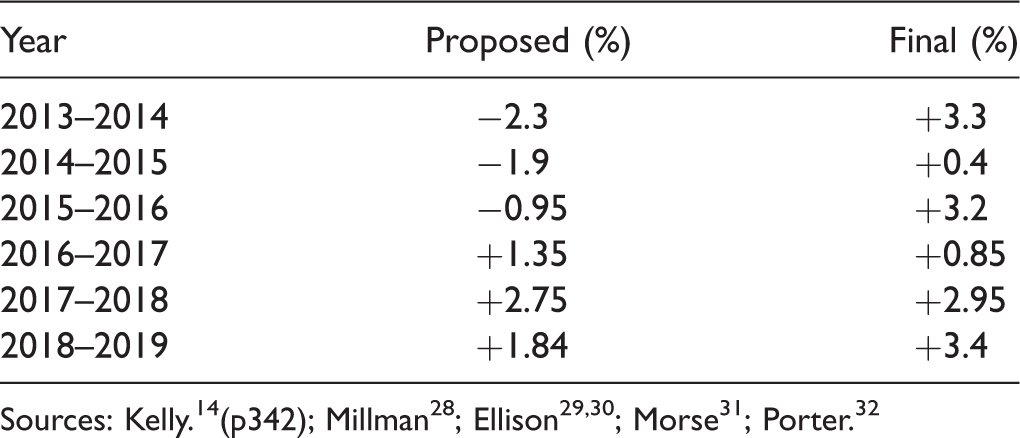
Beyond backdoor compensation, there have also been yearly policy reversals. The legislation was constructed to curb excess payments by freezing payment levels at the 2010 level and then impose incremental payment cuts from 2012 onward. The aim was to equalize reimbursement so that it would match conventional Medicare rates but also reap some $156 billion over 10 years – funds that could be used to bolster other elements of health care reform. In early 2013, CMS made good on implementation by issuing advance notice on a proposed 2014 benchmark payment reduction of 2.3%. 25 However, when the final payment rates were issued months later, a not-so-surprising reversal had occurred, as a payment rate increase of 3.3% was finalized for 2014. This 5.6% upward adjustment would portend the next 6 years of policy.
The results in Table 1 demonstrate a clear trend, in which CMS has been subject to industrial and political pressure to continue increasing benchmark payments to MA. Following the first advance notice of payment cuts in 2013, AHIP initiated an aggressive advertising campaign to depict the administration as threatening seniors’ health care, along with a stepped-up lobbying effort on Capitol Hill. 26 Having won the results it needed, ensuing years brought a preemptory strike, no longer waiting for advance notice and keeping the pressure on both Congress and the White House. 27
Percentage of Proposed and Final Adjustment Payment Rates to Medicare Advantage (2013–2019).
In the end, the Obama administration and the ACA did not make good on the promise to rein in MA program spending. The capacity of industry to secure accumulation streams from a public revenue source has proven effective and unrelenting. Not only has industry strategically grown this sector to a point that can be defended as politically sensitive, but the expected de-enrollment of seniors following the passage of the ACA simply has not come to pass. In such an environment, industrial players can defend their quasi-public role with associated leverage to some 20 million voting citizens, all the while using that same leverage to frustrate cost control aspirations of CMS officials. Market utilization in Medicare – originally intended to infuse efficiency – has been largely successful in converting public use into private gain.
Drugs, Donut Holes, and Boosting Big Pharma
The advantageous growth of Medicare Advantage was only one outcome of the MMA – a lesser-known element of the legislation at the time of its passage. The bill’s centerpiece was, in fact, a somewhat unexpected Republican-led effort to enlarge Medicare by adding a drug benefits program, since known as Medicare Part D (MpD). This did not fit the norm within U.S. political circles, as large portions of the Republican Party were politically against expanded government intervention or spending. Moderate Republican Jeff Flake (AZ) expressed a broadly felt conservative skepticism toward the legislation: “I didn’t come here to expand government like that. It will be a middle-class entitlement that will run away from us.” 33 In other words, ideological preferences do not explain MpD. Its ultimate ascension to law must account for adaptive accumulation – MpD is custom-built for industrial advantage and securing long-term drug profits.
By the outset of 2000, the question of drug pricing had become critical in the United
States, particularly for seniors. Drugs were the fastest growing component of health
care costs, and Medicare beneficiaries were among the most vulnerable to this cost
escalation. The Democrats had long since incorporated a Medicare drug program into
their party platform, and the drug re-importation question had put the issue front
and center for one of the strongest lobbies in Washington. As political pressure for
the drug benefit was growing, the Pharmaceutical and Research Manufacturers of
America (PhRMA) went into overdrive, attempting to optimize the outcome for the drug
industry. PhRMA supported more than 600 lobbyists during this period, and it doubled
its lobbying budget to this end. In this sense, the lobbying that led to beneficial
clauses in the MMA should not merely be seen as the defensive reactions of an
industry. Instead, it should be viewed as a progressive strategy of accumulative
logic. Republicans uncharacteristically enlarged an entitlement program not as
political largesse or compassion, but rather as part of an opportunity to adapt
Medicare to greater profit potential. The MMA afforded an array of groups, many of whom had unrequited agendas
deferred by past Medicare cost-containment efforts, an extraordinary
opportunity to pursue their aims with $400 billion on the table – a pursuit
made easier by the desire of both the Bush administration and Congress to
expand the private sector in Medicare …. A unified government under
Democratic Party control would likely not have been as
generous to providers, pharmaceutical companies, and private
insurers.
34
As a single-payer system, Medicare has always existed in a tense peace with private providers. It is the largest payer for health care in the United States (44 million enrollees in 2017), and it certainly retains the potential to utilize its position for price leverage. This is, of course, the advantage that most state-organized or state-run health care systems have over provider costs. With universal purchasing, there is only one buyer, and health care providers may negotiate with this buyer but ultimately are left to “take it or leave it.” In the U.S. system, especially in relation to the drug industry, this has never been the case. Purchasers are divided up between multiple parties, and no one party possesses enough leverage to exert strong downward pressure on drug prices. This has meant that pharmaceutical prices are, by a considerable margin, the most expensive in the advanced industrial world, as Figure 1 makes abundantly clear.
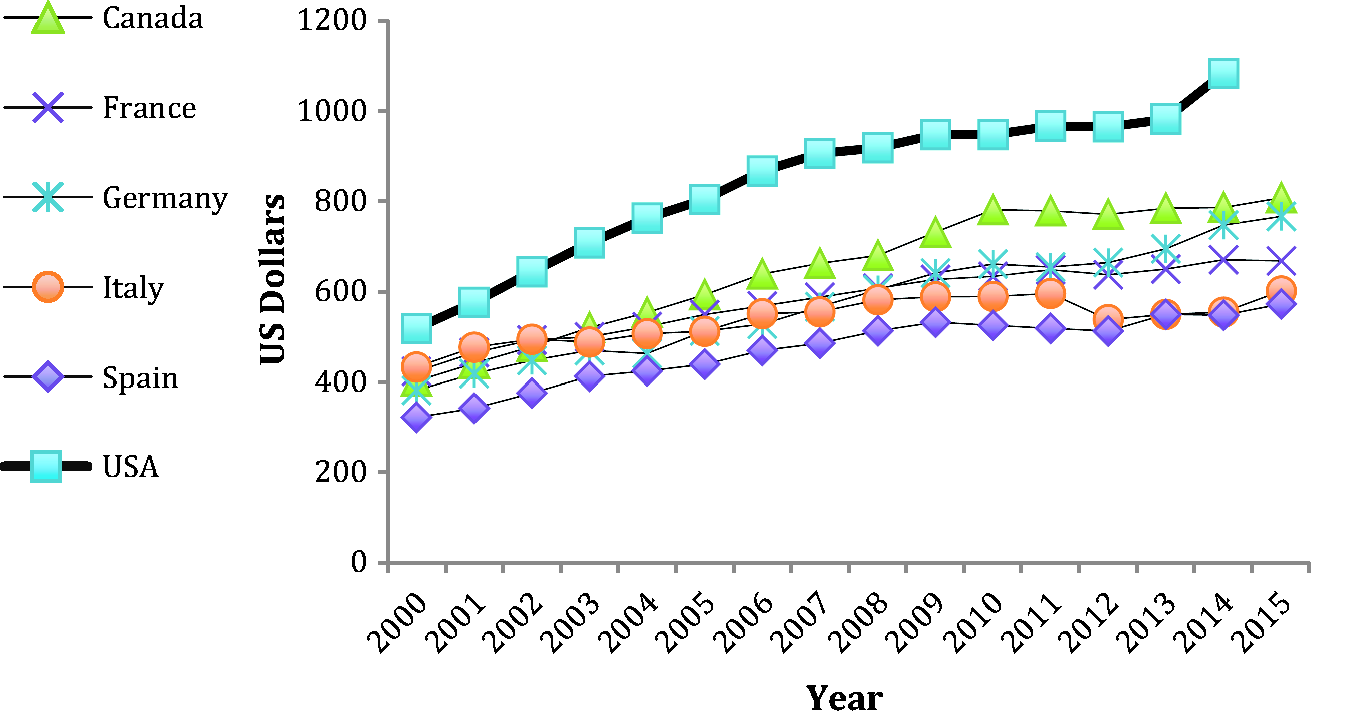
Per capita pharmaceutical spending by country, 2000–2015. Source: OECD, Health Resources – Pharmaceutical Spending – OECD Data, 2015, https://data.oecd.org/healthres/pharmaceutical-spending.htm.
The worldwide drug industry is immensely profitable, and the U.S. market for drugs is, by far, the most important element of this profitability. As such, the proposed expansion of government involvement in drug acquisition offered both possibility and danger. As the Veterans Administration (VHA) health care plan had already made clear, government leverage over this market (and provision in general) could have resounding (downward) price effects. The MMA became the available terrain on which it would be seen as necessary not only to defend that market but also to grow it in ways that would boost rather than detract from profitability. As the legislation took form, budgetary levels for prescription drug acquisition were set at $400 billion over a decade, an amount that was projected to cover one quarter of seniors’ drug costs. This limited coverage was the result of the specific structure of the benefit, presumably aimed at balancing the obvious needs of seniors with the limited resources of the federal government – the latter having gone from surplus to deficit in the wake of immense tax cuts and major military spending in both Afghanistan and Iraq. 35 Its design included what infamously came to be known as the “donut hole,” wherein the federal government would reimburse 75% of beneficiaries’ drug costs up to a stipulated level ($2,250 in 2006) and resume only after “catastrophic coverage” levels were exceeded ($5,100 in 2006). This gap in coverage was designed to grow over time, with the coverage gap tripping at $3,750 and catastrophic coverage resuming at $8,418 in 2018. 36 This front-loading of government subsidy offered an enhanced incentive for Medicare seniors to enroll in the MpD program, while it also exposed them to greater costs in stepped-up drug coverage. From the outset, MpD used government revenues to supercharge the seniors’ drug market while privatizing the lion’s share of risk.
The upshot of this injection into the prescription, generic, and biological drug market is that it enlarged the market for sales. Unlike the MA program, which offered private plans as an option, MpD could only be administered by private drug plans (PDPs). This put the insurance industry in the driver’s seat for plan administration, and it made the likelihood of serious cost control all but disappear. To reinforce this market security, the drug industry negotiated a clause within the MMA that prohibits Department of Human Health and Services (DHHS) from using its regulatory leverage to affect the pricing of drugs. Specifically, section 1860D-11(i) of the Social Security Act is amended, whereby the DHHS Secretary “(1) may not interfere with the negotiations between drug manufacturers and pharmacies and PDP sponsors; and (2) may not require a particular formulary or institute a price structure for the reimbursement of covered part D drugs.” 37 This is a remarkable clause, insofar as the government handcuffs itself with regard to the most useful tool related to policy sustainability. The results for industry, on the other hand, have been both considerable and worth defending. Spending in MpD has increased from $44.3 billion in 2006 to $92 billion in 2018, growing from 10.8% to 15.9% of Medicare spending. And this spending is projected to accelerate with a 4.7% annual growth rate until 2026, at which point it will constitute 17.5% of total Medicare spending. 38 A 2015 study suggests (1) that MpD pays at least double the OECD average for patented drugs, (2) that it pays 73% more than Medicaid and 80% more than VHA for brand name drugs, and (3) that utilizing the same Federal Supply Schedule as VHA would have saved MpD $16 billion a year. 39 Not surprisingly, the role of MpD in total U.S. prescription drug spending has increased substantially, growing from 18% of the market in 2006 to 29% in 2015 (with projected growth to 35% in 2025). 40 Finally, the growing prominence of MpD spending is not a function of enhanced competition, as just 5 firms – United Health, Cigna, Aetna, CVS Health, and Express Scripts – control over two-thirds of the market. 41
As with Medicare Advantage, the ACA, in part, was intended as a vehicle to reduce the severity of drug spending in MpD. However, this was aimed at relieving the spending burden for consumers and not addressing the structural effects of MpD on drug sales. The specific aim of this section of the ACA was to supply progressively greater subsidies that close the “donut hole” by 2020, restoring the payment balance to a 75/25 covered/out-of-pocket balance. While there is no denying that this helps beneficiaries, surely a worthy goal, it also reinforces an already heavy personal cost across the entire drug benefit (up until catastrophic costs, over $8,148 in 2018, after which enrollees pay 5%). Additionally, the ACA did impose a 50% manufacturers’ rebate on the coverage gap, meaning that government subsidies will fill the 25% remainder by 2020. But no amount of countervailing subsidy or enforced rebates will address the issue of price escalation or the basic structure of MpD. There may be an ongoing debate over ACA coverage gap subsidies, but this is an ideological battle over how much, not whether, government subsidizes a market-adapted system.42,43 There is certainly no proposal to reintroduce serious government leverage into the negotiation of drug prices, as exists in the profound majority of OECD countries. In fact, the ACA more generally works to reinforce the status quo, while trying to soften its more difficult consequences for patients. As such, it allows MpD to further adaptive accumulation, as government channels public revenues through private companies, boosting insurance, pharmaceutical, and biopharmaceutical profits.
The Affordable Care Act: A Deal They Couldn’t Refuse
Nowhere have the adaptive strategies of the health industry been more robust than in relation to the ACA, a reform that is highly amenable to commercial profits. Following the failed Clinton efforts, there emerged a distinct “prime directive of health reform: do not disturb the existing insurance system and the already insured. … Moreover, various formidable interests – insurers, employers, the medical care industry, and states – were invested in the prevailing order.” 44 However, the Democratic electoral victories of 2008 altered the political calculations around health care reform. With calls to make U.S. health care more inclusive, the health industry rallied around a new set of objectives: ensure that any reform stops short of full government administration or single-payer structure. Deftly lobbying the reform process, industrial actors structured their interests into the architecture of the ACA, ensuring the extensively fragmented state of U.S. health care was not only preserved but even extended.
For its part, the administration’s guiding theme during the negotiation process was
to bring onside all the major purchasers and providers – what John Geyman has
labeled its “surrender-in-advance” strategy.
45
This began with the
pharmaceutical and hospital industries, both of which wanted reassurances of their
position in U.S. health care delivery. In early deals, wherein both industries
pledged their support and some resources, the administration surrendered far more
valuable guarantees. The MMA’s prohibition on government involvement in pricing or
formularies was extended to the ACA, supplying extraordinary assurances for 2
industries with the fastest rate of cost increase. These industries’ negotiating
groups – PhRMA and the American Hospital Association (AHA) – were well aware that
the benefits of a government-driven, enlarged health care market would translate
into more patients/customers. As such, the up-front concessions were substantial: They limited the law’s ability to
deliver tangible benefits to the middle class and largely took off the table
tools of cost control used in other nations, such as provider rate-setting
and government negotiation of drug prices.
46
While providers fared well under the ACA, the largest changes came for payers: insurance companies formed the backbone around which the legislation would be constructed and maintained. Represented by its umbrella organization, America’s Health Insurance Plans (AHIP), the industry followed a textbook version of adaptive accumulation: accept more government regulation; attune it as much as possible to assured revenue streams; and project a public purpose in doing so. The ACA is designed for minimal disruption of the existing insurance system while seeking ways to extend coverage to the uninsured or underinsured. Expanding Medicaid furthered this goal, but so too did the extension of the individual insurance market for those without employment-based insurance or Medicaid support. State-level individual insurance “exchanges” were to offer accessible (and mandatory) plans that met federal criteria, addressing discrimination based on preexisting conditions and eliminating the heinous practice of rescission. 48 The quid-pro-quo was simple: if the industry was to expand its coverage to riskier beneficiaries with less purchasing power, it demanded an individual mandate that made the purchasing of health insurance legally compulsory, expanding the pool of paying customers. Indeed, AHIP’s stance on the emergent legislation always revolved around the strength of this mandate. As Nelson Lichtenstein has rightly pointed out, the prospect of any real free market “worried private insurers who … feared that millions of young, healthy, and/or low-income people would pay the penalty and skip coverage. They wanted more government regulation, and a stronger mandate, not less.” 49
None of this is to disparage the ACA as meaningless, but it does point to industrial strategies of both purchasers and providers, who defend the complexity and fragmentation of U.S. health care delivery, with an eye to preserving its profoundly profitable nature. Industrial lobbies, such as AHIP and ACA, have lobbied aggressively to remove the Independent Payment Advisory Board, which theoretically controls payments from Medicare to purchasers and providers alike. They have pushed back against a rule change proposed by the administration to allow small businesses to purchase “association plans,” which offer far less protection than ACA-enforced plans. 50 Similarly, the “Cadillac tax,” which taxes high-priced insurance plans, has been twice delayed and is unlikely to go into effect. 51 This preserves spending levels mandated by the ACA while eliminating its revenue-raising elements – elements that were largely taken from industrial profits. At each turn, the imperative has been clear: maintain robust government involvement while maximizing private revenue streams.
Nothing makes this clearer than the present, a period in which populist reform and legal erosion threaten to dismantle government involvement and even curb accumulative excess. AHIP’s position on Republicans’ last repeal attempt – the Graham-Cassidy bill – summed up both its position on the ACA and its fear of the alternative. It asserted that the bill would, “destabilize the individual market; cut Medicaid; pull back on protections for preexisting conditions; not end taxes on health insurance premiums and benefits; and potentially allow government-controlled, single-payer health care to grow.”52,53 When this attempt ultimately failed, Republican tactics shifted toward the elimination of the individual mandate. Defending the increasingly profitable insurance exchanges, AHIP (with other groups) warned of “serious consequences if Congress simply repeals the mandate while leaving the insurance reforms in place: millions more will be uninsured or face higher premiums, challenging their ability to access the care they need.”54,55 However, even the powerful health care lobby could not forestall Republicans’ political urge to somehow make good on 9 years of reform pledges, as the individual mandate fell victim to the very instrument that gave it life – budget reconciliation.
As it turns out, mandate repeal did not have the desired effect (insurance enrollment
did not decrease), but the ensuing attempt in Texas v. Azar to
dismantle the ACA, by declaring it unconstitutional, may have greater effect.
Plaintiffs, who have already prevailed in the District Court, argue that the entire
law hinges on the sanctity of the individual mandate, which assigned it federal
jurisdiction. Without that mandate, plaintiffs assert, the ACA is unconstitutional
in jurisdictional terms.
56
For this reason, in contrast to the unwillingness of the
Trump administration to defend the law, industrial lobbies have stepped up as
“friends of the court.” AHIP has made clear that Even assuming the Court has reservations about the constitutionality of the
individual mandate and the severability of that provision from the ACA
(either in its entirety or in part), the profound harm to the public
interest flowing from either a grant of preliminary injunctive relief or a
grant of declaratory relief – through detrimental impacts on patients,
governments, health insurance providers, medical care providers, and other
stakeholders – compels their denial.
57
Adaptive Accumulation and the Health of America
The overall picture of the U.S. health care system can be described as a patchwork of luxurious coverage for some; insufficient or uneven coverage for many; and still no coverage for far too many. But in political and industrial circles, there is little serious appetite for change. Indeed, it is precisely the overwhelming complexity and cumbersome nature of unlimited contracts in health care that makes it such a lucrative sphere of accumulation. In a market that expands with consistent price increases, questions have been legitimately raised as to why some Americans receive so much health care and others so little, even none. I have argued that it is precisely the limits of this market expansion that constitute the advantageous entry point for adaptive accumulation. Political crises around health coverage are viewed as opportunities by the health industry to “manage care” at the behest of government while expanding or carving out new accumulation outlets. From Medicare Advantage to insurance exchanges, insurers and industrial providers have carved out stabilized and expanded forms of revenue in ways that also allow them to make moral arguments surrounding the well-being of U.S. citizens and patients. Rather than the health industry being guided by governmental and public purpose, adaptive accumulation has led the U.S. government to accommodate multi-pronged industrial interests to extend an expensive and objectively ineffective form of health delivery.
Footnotes
Declaration of Conflicting Interests
The author declared no potential conflicts of interest with respect to the research, authorship, and/or publication of this article.
Funding
The author received no financial support for the research, authorship, and/or publication of this article.