




Abstract
Future physicians will be key stakeholders in the formation, implementation, and success of health care policies enacted during their careers, though little is known of their opinions of enacted and proposed policies since the 2016 U.S. presidential election. This study aimed to understand the opinions of medical students related to policies including, but not limited to, protections for people with pre-existing conditions, a public option on the private exchange, and single-payer health care. Online surveys were completed by 1,660 medical students at 7 U.S. medical schools between October 2017 and November 2017. The authors used multiple logistic regression to examine associations between student characteristics and support of policies. In total, 1,660 of 4,503 (36.9%) eligible medical students completed the survey. A majority of respondents identified 4 extant Affordable Care Act policies as important, including its protections for patients with pre-existing conditions (95.3%) and Medicaid expansion (77.8%). With respect to prospective reforms, 82.6% supported a public insurance option, and 70.5% supported a single-payer health care system. Only 2.2% supported reducing funding for Medicaid. Although views varied by sex, anticipated specialty, and political affiliation, medical students largely supported prospective policies that would expand insurance coverage and access to health care.
The Patient Protection and Affordable Care Act (ACA) increased insurance coverage and improved access to care.1–3 Since its implementation, the law has faced numerous legal and legislative challenges, including executive orders that have altered or repealed key provisions, such as the individual mandate.4–8 Furthermore, public opinion on the ACA has been mixed, with views falling mostly along partisan lines. 9
In recent years, debate over health reform has produced a wide variety of proposals. Most reforms advocated by Republicans and their conservative allies aim to reduce costs by increasing individuals’ health insurance deductibles, increasing competition among insurers, or cutting public expenditures.10,11 Democrats and liberals have focused on reforms that would expand health insurance coverage and reduce individuals’ financial risk. 10
Amidst these debates, physicians and other health care stakeholders can influence future health care reforms; 12 however, the opinions of future physicians regarding such reforms have not been assessed in several years.13,14
In light of the rapidly changing demographics of the physician workforce, including the increasing number of women in medicine, medical students’ views may offer useful insight into the policy preferences of the next generation of physicians.13,15–17 This sea change seems all the more incipient in light of the recent wave of medical student activism on health policy. 18
We surveyed medical students at 7 geographically diverse U.S. medical schools to assess opinions regarding current and prospective health care policies.
Method
Participants
We conducted an online survey of medical students at 7 U.S. medical schools: Emory University School of Medicine (Atlanta), Icahn School of Medicine at Mount Sinai (New York), Northwestern University Feinberg School of Medicine (Chicago), University of California-Davis School of Medicine (Sacramento), University of Colorado School of Medicine (Aurora), the University of Minnesota School of Medicine (Twin Cities and Duluth campuses), and the Yale School of Medicine (New Haven). We identified these institutions based on the presence of an investigator willing to take part in our study, geographic location, and public versus private designation.
Between October 12, 2017, and November 27, 2017, we distributed the survey via e-mail to all medical students (n = 4,503) enrolled at a participating institution. Survey links were unique to each study participant, and the survey could not be shared or completed more than once. Responses were anonymized and non-incentivized. We sent nonresponders up to 3 standardized reminder e-mails. Six of the 7 schools used Qualtrics (Qualtrics, Inc., Provo, Utah) to distribute the survey and manage response data. The remaining school, at the request of its Office of Medical Education, used the SurveyMonkey platform (SurveyMonkey, Inc., San Mateo, California) with formatting similar to the Qualtrics template. The Institutional Review Board at each participating institution approved the study and survey distribution.
Survey Instrument
We adapted our survey instrument from previously published surveys of medical students and physicians.13,19,20 The instrument also included several new questions that reflect policies proposed since the earlier surveys and queried students about several provisions of the ACA, access to health insurance, and several proposed health reforms. 18
Outcomes
Current policy
Respondents used a modified Likert scale (very unimportant, somewhat unimportant, neither important nor unimportant, somewhat important, very important, and don’t know) to indicate their views of the following ACA provisions: (1) expanding Medicaid eligibility to $20,783 (all dollar amounts in U.S. dollars) for a single adult and to $42,435 for a family of 4; (2) preventing insurance companies from denying coverage or charging higher prices based on pre-existing conditions; (3) allowing adults to remain on their family insurance plan until age 26; and (4) capping the amount insurers can charge older customers for health insurance compared to younger customers at 3:1. This categorization was consistent with previous studies.13,19 We aggregated “don’t know” and “neither important nor unimportant” responses.
Prospective reforms
Respondents also used a modified Likert scale (strongly disagree, somewhat disagree, neutral, somewhat agree, strongly agree, and don’t know) to indicate their views on 7 proposed reforms: (1) increase the use of high-deductible plans; (2) allow companies to sell health insurance across state lines; (3) reduce funding for Medicaid; (4) a single-payer health care system; (5) expand Medicare to 55- to 64-year-olds; (6) provide undocumented immigrants health insurance through government programs; and (7) create a public insurance option to compete with private insurance plans. We aggregated “don’t know” and “neutral” responses.
Covariates
Sex, age, race/ethnicity, year in medical school, political self-identification, and intended medical specialty were described and included as covariates in multivariable analyses. We aggregated political self-identification into 3 groups: conservative (conservative and somewhat conservative), moderate, and liberal (liberal and somewhat liberal). Career specialties were grouped into 5 categories: primary care specialties (emergency medicine, family practice, internal medicine, medicine/pediatrics, pediatrics), surgical specialties (general surgery, neurological surgery, ophthalmology, orthopedic surgery, otolaryngology, plastic surgery, urology), other specialties (anesthesiology, dermatology, neurology, pathology, psychiatry, radiation oncology, radiology, physiatry), obstetrics/gynecology, and unknown/not specified.
Statistical Analysis
We included participants for analysis if they answered at least 6 of the first 7 questions in the survey instrument. We summarized demographic information using descriptive statistics and examined frequencies of opinion of each policy. We assessed possible associations between political self-identification and opinions using χ2 tests. We used multiple logistic regression to estimate the relationships between opinions and sex, intended specialty, political self-identification, and year in medical school; all models were also adjusted for age and race. We considered P < .05 to be statistically significant. We used SAS version 9.4 (SAS Institute Inc., Cary, North Carolina) to conduct all statistical analyses.
Results
Demographic Characteristics
Of the 4,503 medical students who received the survey, 1,660 (36.9%) responded. Institutional response rates ranged from 29% to 46% (SD 6.6). Demographics of respondents have been previously described 18 and were similar to those of medical students nationwide as reported by the Association of American Medical Colleges. 21 Private schools and schools located in the Midwest and West were overrepresented.21,22 Over three-fourths of respondents identified as liberal (77.7%). Moderate and conservative students accounted for 12.2% and 7.2% of respondents, respectively (Table 1).
Demographic Characteristics of 1,660 Participating Medical Students at 7 Medical Schools Compared to National Medical Student Demographics. a

Reproduced with permission from Rook et al.18 © Wolters Kluwer Health, Inc.
Abbreviations: AIAN, American Indian or Alaskan Native; NHPI, Native Hawaiian or Pacific Islander.
a Data Source: Association of American Medical Colleges21 and Washko et al.22 Percentages may not add to 100.0 because of rounding. Not all 1,660 students answered all questions. Total respondents for each question vary. Percentages calculated from each characteristic total. Some national data unavailable.
bMD with PhD, MPH, MBA, MHS, MSCR, JD, MS, or other.
cAssociation of American Medical Colleges. Matriculating Student Questionnaire. All Schools Summary Report, 2017,21 data reported for white, Asian, and black matriculants include both Hispanic and non-Hispanic students. Hispanic status reported in addition to race/ethnicity; thus, total is greater than 100%.
dPrivate schools are Emory School of Medicine, Icahn School of Medicine at Mt. Sinai, Northwestern University Feinberg School of Medicine, and Yale School of Medicine. Public schools include University of California Davis School of Medicine, University of Colorado School of Medicine, and University of Minnesota School of Medicine – Twin Cities and Duluth campuses.
ePrimary care includes family practice, pediatrics, internal medicine, emergency medicine, and medicine/pediatrics. Surgical specialties include all surgical specialties except obstetrics/gynecology. Non-surgical specialties include anesthesiology, dermatology, radiology, pathology, physical medicine and rehabilitation, psychiatry, and radiation oncology.
fConservative status includes students who identified as somewhat conservative and conservative. Liberal status includes students who identified as somewhat liberal and liberal.
Views on Affordable Care Act Provisions Currently in Force and Proposed Reforms
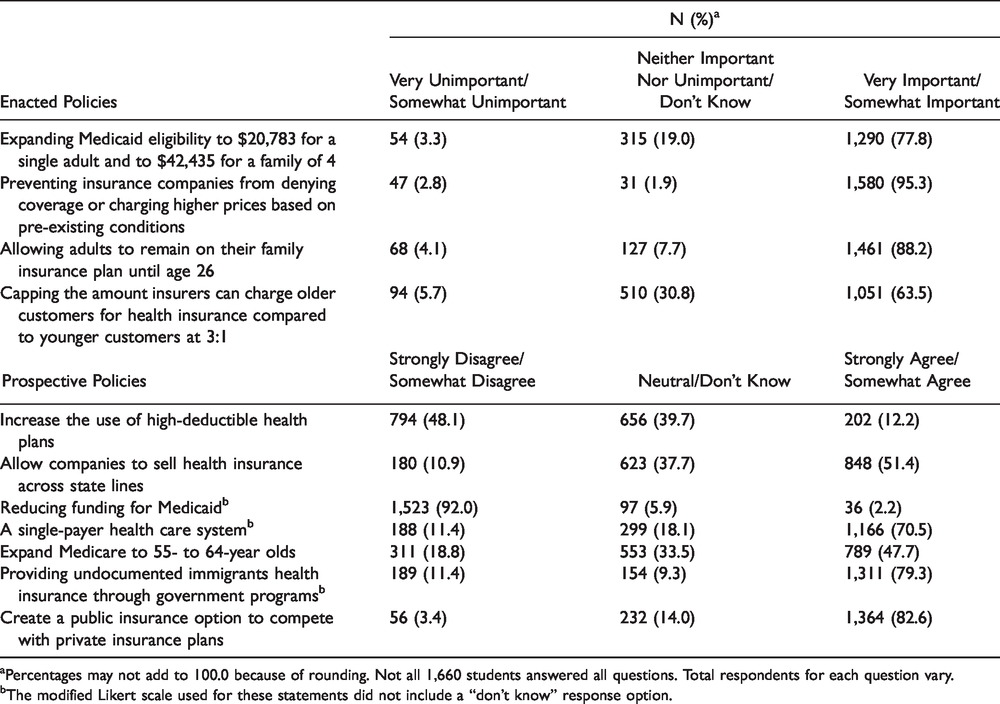
Most students described the 4 extant ACA provisions as important (63.5%–95.3%, Table 2). The most commonly supported provisions were “Preventing insurance companies from denying coverage or charging higher prices based on pre-existing conditions” (95.3%), “Allowing adults to remain on their family insurance plan until age 26” (88.2%), and the provision to expand Medicaid eligibility (77.8%).
Self-Reported Medical Student Opinions Regarding Enacted and Prospective Health Care Policies Among 1,660 Medical Students at 7 Institutions.
aPercentages may not add to 100.0 because of rounding. Not all 1,660 students answered all questions. Total respondents for each question vary.
bThe modified Likert scale used for these statements did not include a “don’t know” response option.
Respondents favored 4 of the 7 proposed reforms: “Creating a public insurance option to compete with private insurance plans” (82.6%); “Providing undocumented immigrants health insurance through government programs” (79.3%); “A single-payer health care system” (70.5%); and “Allowing companies to sell health insurance across state lines” (51.4%, Table 2). Less than half of students (47.7%) indicated agreement with “Expanding Medicare to 55- to 64-year-olds.”
Views on Affordable Care Act Provisions and Proposed Reforms Across Policy Ideology
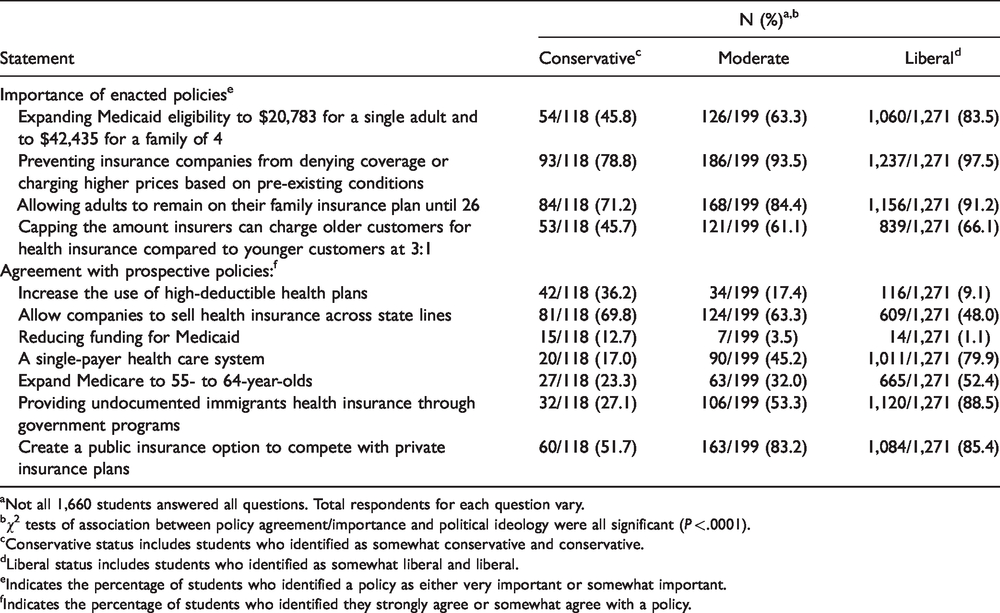
Majorities across all political ideologies described 2 ACA provisions as important: “Preventing insurance companies from denying coverage or charging higher prices based on pre-existing conditions” (78.8%–97.5%) and “Allowing adults to remain on their family insurance plan until 26” (71.2%–91.2%, Table 3). Across the political spectrum, a majority of medical students did not support increasing the use of high-deductible health plans (9.1%–36.2%) nor reducing funding for Medicaid (1.1%–12.7%); however, a majority supported a public insurance option on the health care exchange (51.7%–85.4%).
Self-Reported Medical Student Opinions Regarding Enacted and Prospective Health Care Policies by Self-Described Political Ideology Among 1,660 Medical Students at 7 Institutions.
aNot all 1,660 students answered all questions. Total respondents for each question vary.
bχ2 tests of association between policy agreement/importance and political ideology were all significant (P < .0001).
cConservative status includes students who identified as somewhat conservative and conservative.
dLiberal status includes students who identified as somewhat liberal and liberal.
eIndicates the percentage of students who identified a policy as either very important or somewhat important.
fIndicates the percentage of students who identified they strongly agree or somewhat agree with a policy.
Multiple Logistic Regression Models
Affordable Care Act provisions
Views toward enacted ACA provisions varied slightly across medical school year, anticipated medical specialty, and sex of study participants (Table 4). More marked differences existed across political self-identification. For example, when compared to self-identified liberal students, conservative students were less likely to describe each of the 4 ACA provisions as important. With the exception of the capped age rating provision, moderate students were less likely to view all ACA provisions as important relative to liberal students.
Adjusted Odds Ratios of Importance of Enacted Health Policy Provisions Among 1,660 Medical Students Surveyed at 7 Institutions.
Abbreviation: CI, confidence interval.
aLogistic regression models were run for agreement with or importance of each statement to estimate associations adjusted for the following factors: age (not reported), sex, medical school class, race/ethnicity (not reported), intended specialty, and political ideology.
bP < .001.
cP < .05.
Prospective health care policies
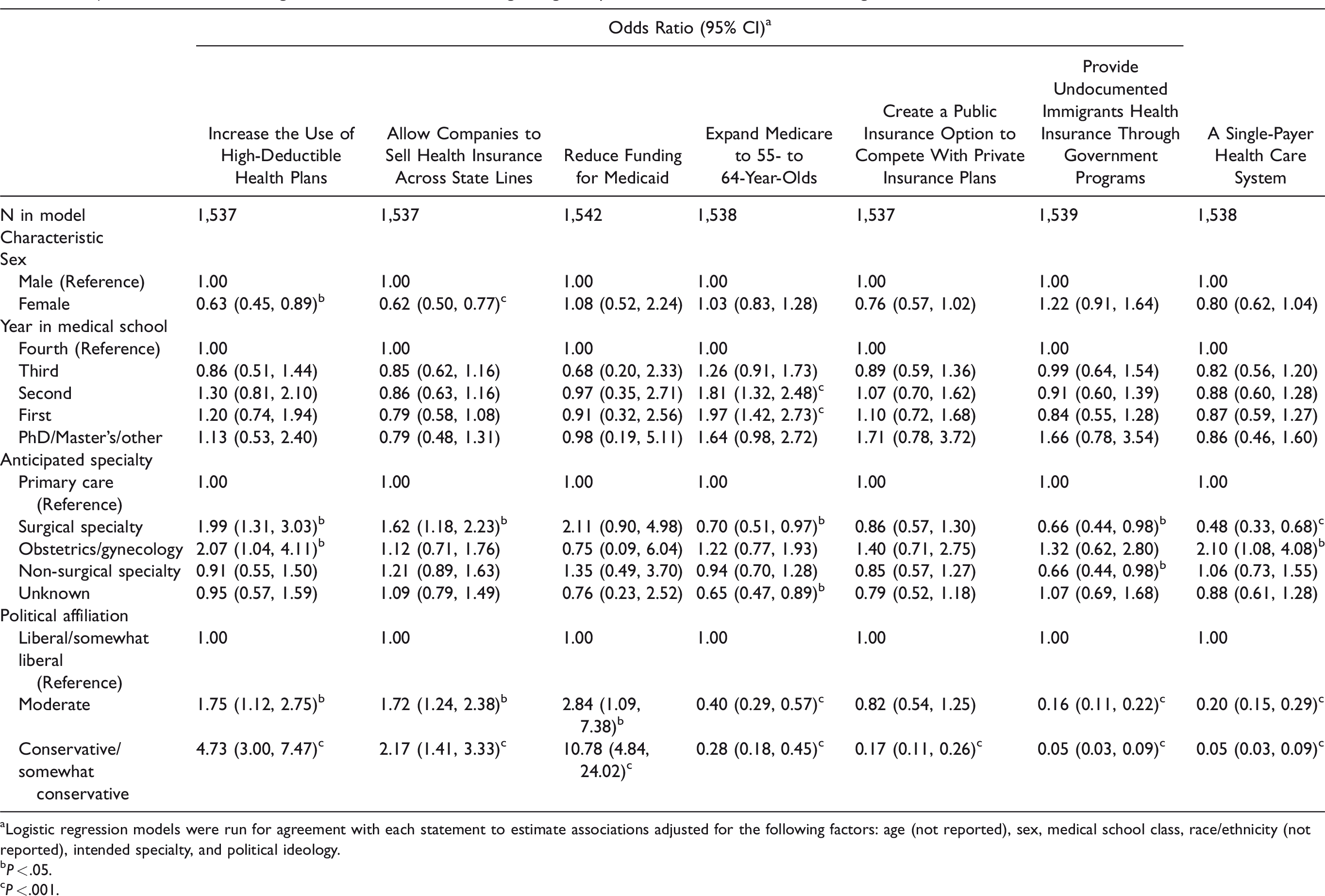
As with the ACA provisions, opinions on various prospective health care policies differed slightly across sex, year in medical school, and more prominently across political identity (Table 5). Notably, when compared to self-identified liberal students, conservative and moderate students were significantly more likely to support the use of high-deductible plans, allowing the sale of health insurance across state lines, and reduced funding for Medicaid. Both conservative and moderate students were significantly less likely to support 3 of the remaining prospective policies, including: “Expand Medicare to 55- to 64-year-olds”; “Provide undocumented immigrants health insurance through government programs”; and “A single-payer health care system.” Only conservative students, when compared to their liberal counterparts, were significantly less likely to support the creation of a public option to compete with private plans on the exchange.
Adjusted Odds Ratios of Agreement With Statements Regarding Prospective Health Care Policies Among 1,660 Medical Students at 7 Institutions.
aLogistic regression models were run for agreement with each statement to estimate associations adjusted for the following factors: age (not reported), sex, medical school class, race/ethnicity (not reported), intended specialty, and political ideology.
bP < .05.
cP < .001.
Numerous policy preferences differed by intended specialty, particularly between students intending to pursue a career in primary care and those planning to pursue a surgical specialty. The latter group was consistently inclined toward traditionally conservative policies (e.g., increased use of high-deductible plans) and less supportive of traditionally liberal ones (e.g., providing undocumented immigrants health insurance through government programs) compared to students intending to pursue a career in primary care (Table 5).
Discussion
We found strong support from medical students both for existing ACA policies and for reforms that would expand health insurance coverage. Large majorities had positive views of the ACA’s Medicaid expansion, pre-existing coverage protections, and allowing individuals to stay on their parents’ health insurance. Furthermore, a notably large number of respondents favored a single-payer health care system (70.5%), a public option (82.6%), and the provision of insurance to undocumented immigrants through government programs (79.3%). Such findings are indicative of support for reforms that advance beyond, rather than retreat from, the ACA’s coverage expansion.
Medical students’ political self-identification was an important factor in survey responses, with liberal students more supportive of proposed reforms that would expand coverage. Conservatives more frequently endorsed reforms likely to reduce access to health care, such as cutting funding to Medicaid and increasing the availability of high-deductible health plans (enrollment in Medicaid and high-deductible health plans have been associated with increased and decreased access to care, respectively).23,24 Importantly, however, most conservative respondents opposed such measures: only 12.7% and 36.2% of conservative students supported cutting funding to Medicaid and increasing use of high-deductible plans, respectively.
All of the prospective reforms assessed in this study have been proposed at the state or federal level within the past 3 years.25–31 For example, proposals to allow individuals to purchase public insurance are being debated in several states, 32 as is legislation that would confer coverage on undocumented immigrants. 29 Several 2020 Democratic presidential candidates have been supportive of Medicare-for-all reform, a version of single-payer. 33 Others support a public option reform that would allow those who want it to buy in to Medicare or an alternative coverage expansion that builds on the ACA. 34 Our results suggest that all of these proposals for expanded coverage would find support among future physicians. Importantly, we did not compare policies head-to-head and cannot infer which one(s) would be preferred.
One possible explanation for these findings is that student support for coverage expansion may mirror broader trends in the United States. For example, the Kaiser Family Foundation found that public support for a single-payer health care system increased from 39% in 2004 to 57% in 2019, 35 a trend that may reflect a generational shift, with younger generations more likely to be supportive. 36 Furthermore, the policies and programs supported by physicians are likely to change as the physician workforce reflects a broader diversity of life experiences.16,21,37
It is also possible that our results reflect a broader evolution in views within the physician workforce. Historically, professional medical organizations such as the American Medical Association have publicly opposed and lobbied against single-payer reform and a public option on the ACA exchange.38,39 The tides may be shifting. A 2017 survey of U.S. health care leaders found that 55% of physician respondents favored single-payer as an outcome of the next major reform, 40 and in early 2020, the American College of Physicians broke ranks with other large American professional medical organizations to endorse both single-payer and a robust public option. 41
This study has several limitations. First, this was a cross-sectional study and associations cannot be used to infer causal relationships. Second, while the current sample was drawn from a geographically diverse mix of public and private institutions, the institutions were not randomly selected and may not fully represent the U.S. medical student population. Of note, considerably more students identified as liberal compared to prior studies.13,15 Though we suspect this represents a general trend in the physician workforce, it could also be due to sampling bias.
In conclusion, medical students across the ideological spectrum support ACA policies and prospective reforms that would expand health insurance coverage. Future research should examine whether the views found in this study persist throughout students’ careers and whether this translates into policy changes. In the meantime, the health policy debate will surely escalate in the months leading up to the 2020 presidential election. As it does, the views of future health care professionals ought to be considered.
Footnotes
Acknowledgments
The authors wish to thank the mentors at each participating school for their contributions to data collection: Dr John Hughes, Dr Erik Wallace, Dr Meredith Lora, Dr Ann-Gel Palermo, and Dr Tonya Fancher. Thanks are also extended to Dr Priscilla Wang, Dr Andi Shahu, Dr Max Goldman, Dr Zoe Kopp, Dr Eamon Duffy, Dr Talia Robledo-Gil, and Dr Nhi Tran, who helped develop this project.
Authors’ Note
This study was presented as a poster presentation on March 29, 2018, at the Society of General Internal Medicine’s 2018 annual conference; oral presentation on October 1, 2018, at the American College of Emergency Physicians Research Forum; and oral presentation on October 23, 2018, at the American College of Surgeons Clinical Congress.
Declaration of Conflicting Interests
The authors declared no potential conflicts of interest with respect to the research, authorship, and/or publication of this article.
Funding
The authors disclosed receipt of the following financial support for the research, authorship, and/or publication of this article: Research reported in this publication was supported by the National Center for Advancing Translational Sciences of the National Institutes of Health Award Number UL1-TR002494. The content is solely the responsibility of the authors and does not necessarily represent the official views of the National Institutes of Health.
Ethical Approval
Institutional review board approval of study exemption was obtained at all participating institutions.
