



Abstract
To control pharmaceutical spending and improve access, the United States could adopt strategies similar to those introduced in Germany by the 2011 German Pharmaceutical Market Reorganization Act. In Germany, manufacturers sell new drugs immediately upon receiving marketing approval. During the first year, the German Federal Joint Committee assesses new drugs to determine their added medical benefit. It assigns them a score indicating their added benefit. New drugs comparable to drugs in a reference price group are assigned to that group and receive the same reimbursement, unless they are therapeutically superior. The National Association of Statutory Health Insurance Funds then negotiates with manufacturers the maximum reimbursement starting the 13th month, consistent with the drug's added benefit assessment and price caps in other European countries. In the absence of agreement, an arbitration board sets the price. Manufacturers accept the price resolution or exit the market. Thereafter, prices generally are not increased, even for inflation. US public and private insurers control prices in diverse ways, but typically obtain discounts by designating certain drugs as preferred and by restricting patient access or charging high copayment for nonpreferred drugs. This article draws 10 lessons for drug pricing reform in US federal programs and private insurance.
In 1990, Germany and the US per capita outpatient pharmaceutical spending were very similar, with the United States having slightly lower spending: $259 in Germany and $251 in the United States. By 2016, per capita outpatient pharmaceutical spending had risen only to $777 in Germany but increased to $1208 in the United States (see Figure 1). 1 In terms of Organization for Economic Cooperation and Development countries, per capita pharmaceutical spending in Germany was among the highest. Only Switzerland and the United States had higher per capita spending in 2018. 1 As the United States considers ways to better control pharmaceutical spending and prices while ensuring access to innovative therapies, it can learn from Germany, which in 2011 put in place significant reforms. 2

Per capita spending on outpatient pharmaceuticals 1988-2018 in constant $USD: USA and Germany with growth rates.
The German Drug Pricing System
In Germany, all individuals must be insured through a statutory or private health insurer. 3 About 90% of the German population (∼75 million) are members of one of the 103 independent statutory health insurers. 4 The remainder purchase insurance through one of 45 private health insurers. 5 The German Social Code-Book V (Sozialgesetzbuch Fünftes Buch) sets rules for the governance of statutory health insurance, including setting premiums and copayments. 6
Statutory health insurance, largely financed by premiums paid by employers and employes, is based on the solidarity principle: Every person receives all medically necessary benefits irrespective of his or her insurance premiums, income, or health risks. 7 A majority of people, including most employees, students, and the unemployed, are covered by a statutory health insurer. 8 Most full-time, self-employed workers purchase private insurance, 9 which is primarily financed through insurance premiums.
The German Pharmaceutical Market Reorganization Act Arzneimittelmarktneuordnungsgesetz (AMNOG) created a pricing system designed to curb insurance-reimbursed drug spending.10–13 Since it came into effect on January 1, 2011, drugs with new active substances are evaluated to determine maximum reimbursement for all health insurers and promote competition.10,14 New active substances (“new drugs”) are active substances whose effects are not generally known at the time of marketing authorization and require prescriptions.15,16
The German Federal Joint Committee (Gemeinsamer Bundesausschuss) (G-BA) is responsible for assessing new drugs. 17 The G-BA, the highest decision-making body of the self-governed health care system, issues guidelines specifying what services are reimbursed by statutory health insurance.18,19 Voting representatives from key stakeholders, including representatives of the National Association of Statutory Health Insurance Funds (GKV-Spitzenverband), the German Hospital Society, the National Association of Statutory Health Insurance Physicians, the National Association of Statutory Health Insurance Dentists, and impartial members, makeup the G-BA. 20 It also includes nonvoting representatives of patient advocacy organizations. 21
The G-BA typically commissions the independent Institute for Quality and Efficiency in Health Care Institut für Qualität und Wirtschaftlichkeit im Gesundheitswesen (IQWiG) to assess the new drug. 22 The manufacturer is advised which drug or other therapy is the appropriate comparator for the evaluation. 23 IQWiG then compares the new drug to the most appropriate comparator therapy (zweckmäßige Vergleichstherapie) based on evidence supplied in the manufacturer's dossier, including data from all clinical trials. 24 a IQWiG determines whether the new drug has added medical benefit (medizinischer Zusatznutzen)17,25 and more specifically, whether it is therapeutically superior to, the same as, or inferior to the comparator. It ranks drugs on a 6-point scale. The G-BA reviews the IQWiG report, as well as comments made by manufacturers and other stakeholders. 26 After review, the G-BA can modify its recommendation and renders a final decision. 27
The GKV-Spitzenverband, which constitutes the umbrella organization of statutory health insurers, and the manufacturer negotiate the maximum reimbursement, consistent with the G-BA's decision. 28 If they fail to reach an agreement, an arbitration board sets the maximum reimbursement. 29 The maximum reimbursement price also applies to private insurers and self-paying patients.10,28 The GKV-Spitzenverband also sets maximum reimbursement for drugs in reference price groups, including pharmacologically therapeutically comparable drugs.30–32
Germany's pharmaceutical pricing is characterized by 6 key elements (Figure 2) following a designated time line (Figure 3).
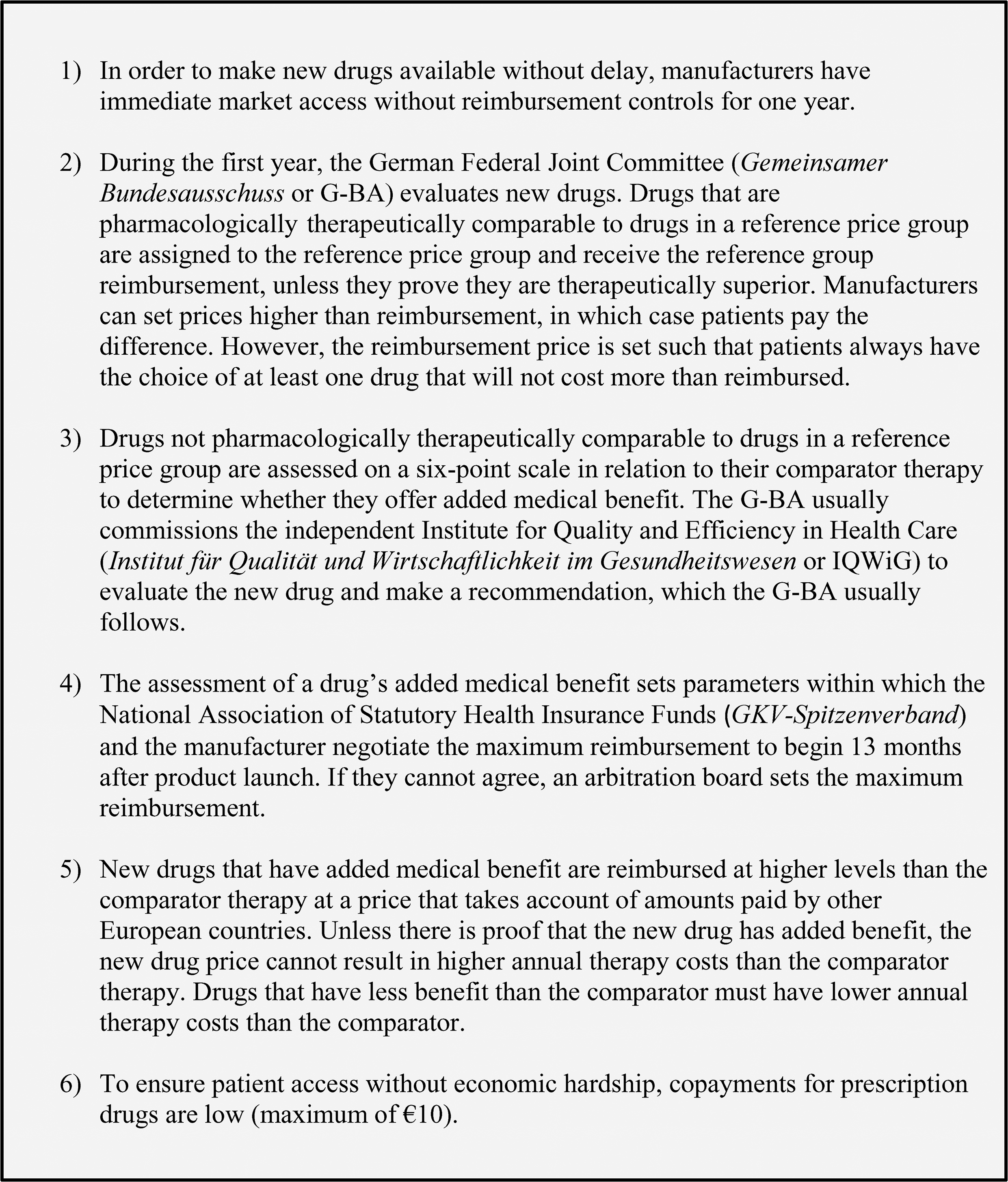
Key elements of the German's drug pricing system.

Timeline for assessing new drugs and negotiating prices.
Free Pricing for 1 Year Ensures Rapid Access, During Which Time a New Drug Is Assessed, and There Is Negotiation to Set the Maximum Reimbursement Thereafter
Prior to AMNOG, when the German parliament debated reforming pricing policies, legislators considered the tradeoff between rapid market access and controlling spending. Critics of regulation argued that capping prices would delay access to new therapies and discourage research and development. 33 Others maintained that without controls, manufacturers can set monopoly prices due to patents, and prices do not usually reflect a drug's medical benefit. 33 AMNOG struck a compromise. To ensure rapid access to new drugs, AMNOG allows manufacturers to sell new drugs without price regulation upon receiving marketing approval. Free launch pricing with guaranteed coverage ensures that manufacturers typically market in Germany before, or at the same time as, other European countries, and that patients have immediate access to new medicines. 34 There are good grounds to question the value of rapid access to all new drugs before they are assessed to determine whether they have added benefit, because studies reveal that approximately half of new drugs lack added therapeutic benefit in Germany, and studies in other countries also indicate that a large proportion of new drugs lack added therapeutic benefit. 35 36
During the first year a new drug is marketed, the G-BA compares it to the most appropriate comparator therapy. For drugs with added benefits, the GKV-Spitzenverband and the manufacturer negotiate the maximum reimbursement to begin 1 year after market launch, typically referred to as reaching a price resolution.28,37 If they fail to reach an agreement, an arbitration board sets the maximum reimbursement. 29 The arbitration board (which includes 2 representatives of each side, a neutral chair, and 2 other neutrals) 38 sets whatever maximum reimbursement it determines is appropriate. 29 Manufacturers must accept the arbitration board reimbursement or exit the market and forgo all German sales. The maximum reimbursement does not typically increase. New negotiations are possible if 1 of the parties terminates the contract, or if the G-BA conducts a new assessment and finds that the drug has greater added benefit than its initial assessment. 39 In that case, the GKV-Spitzenverband can negotiate a new price with the manufacturer.
From 2011 to 2017, the GKV-Spitzenverband reached price resolutions on 186 new drugs. Of these, 122 were negotiated agreements and 21 were set by arbitration. 40 Since AMNOG, 30 drugs have been withdrawn from the market after 1 year. 40 Exiting the market is often associated with drugs receiving a negative benefit assessment.40,41
Drugs That are Pharmacologically Therapeutically Comparable to Drugs in a Reference Price Group Are Evaluated and Priced in Relation to Such Drugs
Manufacturers of new drugs that are pharmacologically therapeutically comparable to drugs in a reference price group have to prove that they are therapeutically superior to drugs in the group or they are assigned to the reference price group and receive the same price as all drugs in the group. 42 There are distinct reference price groups for drugs that have the same active substances, pharmacologically therapeutically comparable active substances and comparable therapeutic effects. 43 Reference price group drugs constitute 80% of prescriptions and represent about 40% of sales under statutory health insurance. 44
When establishing reference group prices, the GKV-Spitzenverband must ensure that supplies are generally sufficient, appropriate, of good quality, and economical. 30 A complex formula guarantees that each reference price group will include at least 1 drug that is fully reimbursed, so the public will not be required to pay more than the token 5-10 euro copayment.45,46 b Patients who select a drug priced higher than the reference price, however, pay the difference between the selling price and the reference price. 47 Consequently, manufacturers have an incentive to lower their prices to no more than the reference price and, in fact, about 84% of manufacturers’ selling prices are at or below the reference price. 12
New Drugs not Assigned to Reference Price Group Are Assessed in Relation to a Comparator Drug. The Independent Assessment of Each New Drug's Added Medical Benefit Establishes Parameters for Setting its Maximum Reimbursement
The G-BA assesses each new drug 17 in relation to the appropriate comparator therapy 25 and ranks its added medical benefit. Manufacturers must convince the G-BA that a new drug has greater benefit than the therapy to which it is compared to obtain higher reimbursement. 48 Typically, rather than evaluate the new drug itself, the G-BA commissions the IQWiG to evaluate the new drug and make a recommendation,15,25,49 which the G-BA usually follows. 15
The G-BA ranks new drugs on a 6-point added-benefit scale denoting the extent to which the new drug improves health status, shortens the duration of illness, extends survival, reduces side effects, or improves the quality of life compared to the comparator therapy (see Figure 4).50,51 The top 3 ranks designate that a new drug has: (1) major, (2) considerable, or (3) minor added benefit. 52 The fourth rank specifies that the new drug's added benefit is not quantifiable due to data limitations. 53 The fifth rank indicates there is no evidence that the new drug yields added benefit. 54 The sixth rank stipulates that the drug has less benefit than its comparator therapy. 55 If the G-BA finds that there is added benefit (ranks 1-4), it assesses its probability in a 3-point scale: hint, indication, or proof. 56 c In general, the probability is ranked based on the reliability of the information. 57 For example, hint is usually given in the case of a small study or a study with relevant uncertainties, whereas indication is generally issued in the case of a solid, larger study. 57 The rank proof is associated with 2 or more studies or at least 1 very large, high-quality study.57,58 The drug's rank can affect the reimbursement price set by negotiation between the GKV-Spitzenverband and the manufacturer.
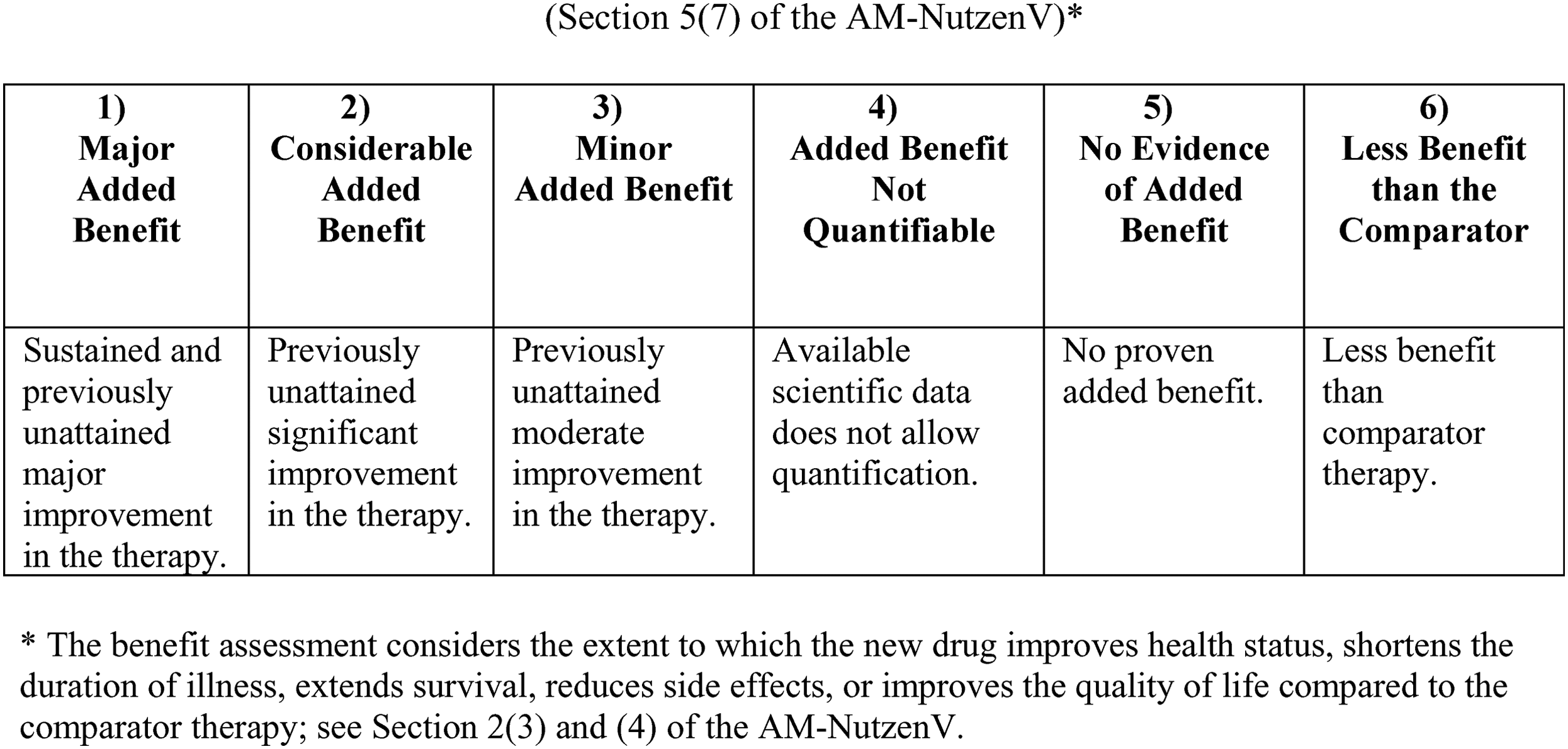
The added-benefit scale ranking added benefit of new drugs in relation to the appropriate comparator.
The G-BA ranking is based on all the evidence in the manufacturer dossier without use of an algorithm.24,59,60 It makes a positive assessment (ranks 1-4) if a drug produces an added benefit for any patient subgroup.15,61 The manufacturer has the burden of proof, except in certain cases, such as for orphan drugs and antibiotics reserved for use as a last resort for multidrug-resistant organisms.62,63 d If the manufacturer fails to submit the required evidence, in time or in full, the added benefit is deemed unproven. 64 The G-BA provides key stakeholders, such as the pharmaceutical firms concerned, representatives of associations of pharmacists, physicians, and special therapists, an opportunity to comment on the benefit assessment before it makes a final decision. 26 Through their comments, stakeholders can influence the G-BA's assessment.
New Drugs Are Reimbursed at a Higher Price Than Their Comparator Only if They Have Added Medical Benefit
The price of new drugs takes account of the drug rank on the G-BA's 6-point scale. 65 The maximum reimbursement for new drugs with added medical benefit (those ranked 1-4) is set by confidential negotiation 66 between the GKV-Spitzenverband and the manufacturer in line with a framework agreement signed by the GKV-Spitzenverband and certain associations, including those of pharmaceutical manufacturers. 48 Such drugs receive a higher price than their comparators. No algorithm specifies how much higher the price will be than the comparator, however, so the GKV-Spitzenverband and manufacturer exercise discretion in resolving the price. 59 For drugs with no evidence of added benefit (rank 5), maximum reimbursement cannot lead to higher annual therapy costs than the comparator therapy.65,67 For drugs with less benefit than the comparator therapy (rank 6), reimbursement must be less than the annual costs of the comparator therapy. 68
For drugs with added medical benefit, the maximum reimbursement is a function of 4 factors: (1) the degree of a drug's added benefit; (2) the annual therapy costs of comparator drugs; (3) reimbursement for the drug in 15 countries (Belgium, Denmark, Finland, France, Greece, Great Britain, Ireland, Italy, the Netherlands, Austria, Portugal, Sweden, Slovakia, Spain, and Czech Republic); and (4) the manufacturer's dossier.69,70 The GKV-Spitzenverband attempts to set a maximum reimbursement that is not higher than the maximum reimbursement in other European countries, unless setting it higher is justified by sales volume, the economic means of the reference price countries, and other factors. When setting the maximum reimbursement price, the GKV-Spitzenverband asks manufacturers to reveal confidential discounts offered to insurers in other countries, making adjustments if the manufacturers do not provide this information or if the information provided is not credible. 71
Germany Employs Manufacturer and Pharmacy Discounts
All statutory health insurers receive from manufacturers a statutory discount, set at 7% of sales price (excluding value-added tax) for patented drugs 72 and 6% for generics. 73 Insurers also receive an additional discount of 10% for generics. 74 Drugs assigned to reference price groups are exempt from the 6% discount. 75 The percentage discount for generic drugs in reference price groups varies with the drug's sales price.
Furthermore, individual insurers can negotiate additional discounts with the manufacturers. 76 In 2015, total discounts surpassed 10% of statutory health insurance pharmaceutical expenditures, >€3 billion.77,78 Manufacturers often offer such discounts in return for purchasing high volumes.
Germany Ensures That Patients Will Not Be Economically Burdened and Avoids Restrictions on Access
Germany's commitment to social solidarity is evidenced by removing access barriers to medical care through statutory health insurance. Drugs used in hospitals are fully covered. 2 Health insurance, both statutory and private, finances about 84% of outpatient pharmaceutical expenditures. 2 The remainder is paid as patient copayments and uncovered over-the-counter medication. 2
Additionally, Germany restricts consumer copayments. Patients pay 10% of the sales price for each drug pack, with a minimum payment of €5 and a maximum payment of €10, even for the most expensive medicines. 45 Copayments are never more than the actual sale price. 45 Children under the age of 18 are exempt. 45 The GKV-Spitzenverband also pays for over-the-counter medicines for children under 12 years and those with developmental disorders under 18 years. 45
Germany today avoids rationing medical services through budgets or physician incentives to control pharmaceutical spending, but this has not always been the case. Germany enacted legislation in the 1990s that made physicians bear part of the cost when total pharmaceutical spending exceeded a budget. Policymakers anticipated that if physicians bore financial risk for drug spending, they would be more frugal when prescribing medicines, total spending would be reduced, and perhaps pharmaceutical prices would be reduced as well. However, limits on overall spending have been abolished in Germany since 2002. 79
The 1993 Health Care Structure Act set limits on overall spending. In the event that actual spending exceeded the budget, regional physician associations were supposed to make clawback payments retroactively reducing their compensation.79,80 However, in 1996, physician associations that exceeded their budgets refused to make payments.79,80 The 1997 Second Statutory Health Insurance Restructuring Act abolished regional physician association spending caps from 1998 and replaced them with spending targets for physician specialties.79,80 The legislation set a target for spending no >125% of the budget. If any physician spending exceeded its target, the physician had to submit information justifying the overspending. Physicians would need to pay back the difference if their justifications were rejected.79,80
The 1998 Act to Strengthen Solidarity in Statutory Health Insurance reintroduced regional collective spending caps for physician drug spending, starting in 1999.79,80 The 2001 Pharmaceutical Budget Redemption Act reabolished the spending caps.79,80
Comparison to the United States
The United States lacks a uniform pharmaceutical pricing policy. No designated institution assesses the therapeutic value of all new drugs. No national policy caps purchase prices, patient reimbursement, or spending. Manufacturers set launch prices and generally can increase them at will. Each private insurer independently negotiates discounts. There are several separate policies for governmental programs. Uninsured Americans lack the discounts available to the insured.
Private insurers typically employ pharmacy benefit managers (PBMs) to manage their formularies and negotiate discounts. PBMs obtain rebates from manufacturers for insurers in return for including drugs in its formulary and/or by designating products as a preferred drug, which increases sales by removing access barriers. Patients choosing nonpreferred drugs pay higher copayments and often must secure authorization for their use. Sometimes, patients cannot be reimbursed for a nonpreferred drug unless they have already tried a preferred drug without clinical success. 81
Insurers pay PBMs a share of rebates and fees for their work. PBMs also earn fees from manufacturers, pharmacies, and other parties. Financing PBMs are characterized by conflicts of interest, and further, the grounds for formulary choices lack transparency. Critics contend that PBM policies reduce patient choice, limit access, and diminish the value of rebates they earn for insurers. Even worse, they create incentives for manufacturers to raise list prices.82,83
The federal government employs separate policies for each of its various programs. Medicaid provides insurance for individuals with low income; the income eligibility level depending on whether the state opts for expanded coverage under the Affordable Care Act or sets its own income eligibility level. The individual's age, gender, and other variables also affect income eligibility. 84 Medicaid obtains drug rebates in return for including all of a manufacturer's products in its formulary, even when there are lower cost alternatives. Purchasers agree to sell drugs at the lower of either: (1) the best price the manufacturer offers to other purchasers (with certain exceptions) 85 or (2) a 23.1% discount from the average manufacturer price for branded drugs and a 13% discount for generics. 86 Legislation also restricts price increases greater than inflation. Manufacturers must rebate Medicaid for price increases that exceed the rate of inflation, capped at 100% of the average manufacturer price. 87 The Affordable Care Act capped the total Medicaid inflation rebates at 100% of a drug's average market price. However, the American Rescue Plan Act of 2021 will, starting in 2024, cap all price increase exceeding inflation. 88 Furthermore, participating states can adopt additional policies to obtain discounts. Forty-seven states negotiate supplemental rebates, typically by designating a manufacturer's products as preferred drugs. 89
The Veteran's Administration typically negotiates greater discounts than Medicaid because it can exclude drugs from its formulary. 90 When it does not negotiate separate discounts, the Veteran's administration can purchase drugs at the same price as Medicaid.
Medicare covers virtually all Americans over age 65. It also covers people under 65 who have amyotrophic lateral sclerosis, or receive Social Security Disability Insurance, or after two years of onset of end-stage renal disease. 91 Medicare has distinct policies for drugs used in hospitals and for drugs used outside of hospitals. Drugs purchased outside of hospitals are financed through Medicare Part D, meaning the federal government cannot set pricing rules for these medications. 92 Multiple private insurers administer Medicare Part D. Each constitutes a fraction of the market, diminishing their bargaining power when they individually negotiate rebates. Furthermore, each Medicare drug plan must cover 6 protected drug classes (immune suppressants, antidepressants, antipsychotics, anticonvulsants, antiretrovirals, and antineoplastics) and 2 drugs in all other therapeutic classes, regardless of price.93,94
American policies have drawbacks. While US insurers can negotiate discounts from list prices, manufacturers anticipate that purchasers will seek discounts and launch drugs at high list prices. Manufacturers generally increase prices annually. Moreover, when negotiating discounts, insurers lack a principle, method, or rule by which they can cap their purchase prices, except when they can substitute a comparable drug. The discounts that Medicare and Medicaid negotiate are based on some index of US market prices or the best US price, but both are high compared to prices in other nations. These practices diminish the value of using discounts to reduce prices or spending. Likewise, in return for discounts, Medicaid includes all of a manufacturer's products in its formulary, even when it can procure comparable drugs at lower prices. 95 In return for obtaining discounts, insurers ordinarily must limit access to competing products by not designating them as preferred products.
Learning From Germany
As US policymakers consider reforms, several strategies employed in Germany are worth consideration.
Enact Statutes That Create Incentives for Manufacturers to Negotiate Prices
Germany pays less for new drugs than the United States because manufacturers must negotiate maximum reimbursement or lose access to a large, profitable market. During their first year, all new drugs are evaluated in relation to the nearest comparable therapy. Starting in the 13th month, manufacturers will not be reimbursed at more than the cost of the most appropriate comparator therapy, unless an independent assessment finds that the new drug offers added medical benefit. The prices of new drugs with added benefit are negotiated by the GKV-Spitzenverband and the manufacturer, and if they cannot agree, arbitrators set the price.
The United States lacks general rules that create incentives for manufacturers to negotiate prices or cap purchase prices in the absence of an agreement. Private insurers negotiate prices without federal default rules. Manufacturers lack incentive to negotiate prices for Medicare drugs outside of hospitals because Medicare must cover all drugs in 6 classes, regardless of their price. 93 Medicaid has a voluntary rebate program: Participating manufacturers agree to sell drugs at a fixed rate discount set by statute or at their best market price. In return, Medicaid agrees to purchase the manufacturer's drugs, even when less expensive therapeutic alternatives exist. Furthermore, several states require Medicaid to cover all drugs approved for treating cancer, regardless of price. 96
The US insurers would be better able to negotiate prices if Congress enacted legislation to create incentives for pharmaceutical firms to negotiate prices. For example, legislation could grant Medicare and Medicaid the option to not cover drugs unless they are cost-effective, or to pay no more than the appropriate comparator therapy, or to restrict its formulary to obtain discounts. Private insurers adopting similar policies could also pay lower prices.
Free Pricing at Product Launch and Capped Reimbursement After 1 Year Ensures Rapid Access to New Drugs
Germany encourages manufacturers to launch pharmaceuticals in Germany before or at the same time as other European countries by allowing manufacturers to set launch prices, thereby yielding rapid access to new drugs. After 1 year, Germany sets maximum reimbursement to control spending. These policies have had their intended effect. 97 Manufacturers generally launch products in Germany before other European nations. Manufacturers have not withdrawn drugs from the market after the first year, except for a few drugs that can be priced no higher than the appropriate comparator therapy because they were found to lack added medical benefit. 41 If US insurers set maximum reimbursement rates for drugs starting 1 year after product launch, that would control prices and spending without restricting access to new drugs, despite having to pay high prices for the first year.
Capping Reimbursement Based on a New Drug's Added Medical Benefit Controls Prices and Provides Appropriate Incentives for Manufacturers
Germany incentivizes the development of improved therapies by reimbursing new drugs no higher than the price of the comparator therapy, unless they yield added medical benefit. This policy rewards manufacturers that develop new drugs with added benefit, while capping the prices of other drugs.
The US researchers have developed scales to assess the comparative value of drugs. The American Society for Medical Oncology published a magnitude of clinical benefit scale to help clinicians choose among competing therapies. 98 The Institute for Clinical and Economic Review evaluates the cost-effectiveness of drugs. 99 Insurers can employ such information when negotiating prices. 94 The United States, however, lacks 2 elements present in Germany: (1) an independent institute to assess all new drugs and (2) legislation that caps drug reimbursement based on the independent assessment of each new drug's added benefit. Medicare, Medicaid, and other federal programs could obtain lower prices if legislation capped purchase prices to no more than their value, as determined by the independent assessment. Private insurers could achieve similar results if they adopted analogous policies for their own purchasing. Alternatively, legislation could require all insurers to assess a drug's added benefit and set prices in line with that assessment.
Setting Reimbursement Based on a Drug's Added Medical Benefit Can Be Combined With External Reference Pricing to Yield Prices Comparable to What Other Countries Pay
Germany employs 3 principles to set drug prices: (1) new drugs are not priced higher than existing products, unless they provide added medical benefit; (2) new drugs with added benefit receive higher prices than existing drugs; and (3) drugs with added benefit are reimbursed in line with the amount paid by other European countries. The assessment of new drugs determines whether the drug receives the same price as the existing comparator therapy, or a higher price. For new drugs with added benefit, German reimbursement is determined by negotiation, but must reflect reimbursement in 15 other European countries.
German policy shows that countries can employ multiple price and cost control strategies simultaneously and the United States can too. The United States can use an independent assessment of a drug's medical benefit to cap prices, while also employing external reference pricing to ensure that US payments are not exorbitant compared to what other countries pay. At the same time, the United States could also restrict any price increases or any price increases greater than inflation.
External Reference Pricing Should Be Based on Net Prices, Not Official Prices
Germany mandates that prices of new drugs with added medical benefit are consistent with reimbursement in other European countries. Virtually all European countries negotiate confidential discounts from official price. Therefore, the GKV-Spitzenverband requires that manufacturers disclose discounts, using this information when negotiating maximum reimbursement. If manufacturers are unable to disclose discounts offered elsewhere in Europe, or if the GKV-Spitzenverband does not find those disclosures credible, it estimates the discounts based on its own information.
From 2019 to 2020, Congressional Democrats 100 and the former Trump administration100,101 each proposed employing an international price index to cap Medicare payment for drugs (while allowing price increases for inflation). The Congressional proposal would require manufacturers to provide drugs to private insurers at the same price if they did not successfully negotiate another agreement. Under both proposals, the average price in selected countries would cap the amount that Medicare would pay for drugs. Subsequently, the Trump administration promulgated regulation that would set Medicare prices at the most-favored-nation price, namely, the lowest price the drug is sold in any designated nation.100,102 The Biden administration and the current Congress are considering both approaches as models for future reform. 103 Both the international price index proposal and most-favored-nation price regulation do not adjust official prices for the confidential discounts that European countries receive. 104 Consequently, the United States would still pay significantly more than Germany or other European countries do. If the Biden administration and Congress pursue the idea of capping US prices based on prices in other nations, they should look to net prices paid, adjusting official maximum reimbursement for discounts and rebates.
Setting Maximum Reimbursement Stops Annual Drug Price Increases
In the United States, manufacturers customarily raise drug prices annually, usually more than the rate of inflation. Among US insurers, only Medicaid caps price increases greater than the inflation rate. Germany precludes price increases after an initial price agreement between the GKV-Spitzenverband and the manufacturer, unless, for example, new evidence leads to a revised assessment of a drug's added medical benefit. Recent US legislation would cap price increases by taxing manufacturers for the full amount of any price increases greater than the rate of inflation. 105 German policy indicates that the US can go further and tax any unilateral prices increases. Similarly, US private insurers could negotiate multiple-year contracts with fixed prices to preclude annual price increases.
Capping Reimbursement Can Work in Tandem With Market Competition Where a Choice of Therapies Exists
Opponents of price regulation often argue that prices should be set by market competition, not regulation. In fact, price regulation and price competition can work in tandem. Germany employs market competition when there is a choice of products. First, drugs with no added benefit are assigned to a reference price group in which all drugs are reimbursed the same amount, regardless of the manufacturer's list price. Because patients will bear the difference between the list price and amount reimbursed, manufacturers typically compete by lowering prices. As a result, manufacturers adjust the list price of about 84% of drugs to no more than the reference price. 12 In addition, individual insurers often negotiate price discounts and purchase drugs at less than the maximum reimbursement price. These discounts are frequently provided in return for purchasing high volume. In 2015, discounts accounted for >10% of pharmaceutical expenditures under health insurance. In a similar vein, the United States could employ market competition to lower purchase prices even while it caps reimbursement.
Allowing Affected Parties to Respond to Expert Assessment of Added Medical Benefit Helps Promote Accountability
Independent assessment of a drug's added medical benefit provides an evidence-based method for capping prices. To reduce the risk that assessments and decisions might be flawed, Germany allows manufacturers and other affected parties to comment on the independent assessment before the G-BA decision and price setting through negotiation or arbitration. The ability of affected parties to comment on the independent assessment ensures a transparent process and political accountability. The US could incorporate a similar mechanism by using its long-standing notice and comment rule-making process that the federal government employs when it issues federal regulations. The Medicare program uses a similar process when it promulgates regulations for physician and hospital payment, reaffirming the feasibility of implementing this type of system.
Arbitration of Reimbursement Disputes Is a Politically Legitimate Means to Set Prices in the Absence of a Negotiated Agreement
In Germany, if the manufacturer and GKV-Spitzenverband are unable to negotiate an agreement, prices are set by arbitration rather than allowing the GKV-Spitzenverband to unilaterally set the maximum reimbursement. Arbitration constitutes a politically legitimate means to set prices in the absence of a negotiated agreement. The United States often uses mandatory binding arbitration to resolve commercial and other disputes. It could also employ binding arbitration to resolve disputes over drug pricing.
Capping Reimbursement in Line With an Independent Assessment of Each New Drug's Added Medical Benefit Can Avoid Undesirable Aspects of Pharmaceutical Cost Controls That Characterize the United States and Some Other European Countries
Germany's pharmaceutical cost controls avoid problems that frequently occur in the United States, such as high copayments and deductibles. German patients make only token copayments when there is no choice of therapeutically equivalent drugs. Nor does Germany exclude important new drugs from a formulary, nor restrict their access by placing them on a list of nonpreferred drugs, as many insurers do in the United States. Germany also avoids certain policies employed by other European countries. Unlike the United Kingdom, Germany does not restrict access for 2 years after product launch. 106 Additionally, it does employ cost-effectiveness as a criterion to cap reimbursement, unlike the United Kingdom and the Nordic countries. 107
Conclusion: Moving Toward Reform in the United States
Surveys have revealed that the US public perceives drug prices to be too high and that the cost of medicines is difficult for patients to bear.108–110 In the past decade, both Democratic and Republican members of Congress have proposed legislation to control pharmaceutical spending. 108 However, most of these proposals involved modest reforms that would nip at the edges of the problem rather than create a system that would cap purchase prices. Recent proposals also fail to employ health technology assessment as the means to control spending. 100 Currently, Congress appears to lack the political will to enact changes that would cap prices nationally. Nevertheless, if drug prices continue to be a salient issue, there will be pressure for Congress to intervene. Moreover, since 2006, Medicare has covered outpatient pharmaceuticals and, according to 1 analyst, that might unleash “a predictable cycle of high costs, budgetary pressures, and ultimately, federal price controls for prescription drugs.” 112 When the political opportunities for significant reform occur, Germany and other European countries provide models of strategies to cap drug prices and spending from which US policymakers can learn. The United States, of course, cannot adopt the health system of another country, but it can learn from its experience and adopt certain of its strategies in its own system.
Footnotes
Declaration of Conflicting Interests
The authors declared no potential conflicts of interest with respect to the research, authorship, and/or publication of this article.
Funding
The authors disclosed receipt of the following financial support for the research, authorship, and/or publication of this article: The work of Marc Rodwin was funded in part by a research fellowship at the IMéRA Institute for Advanced Study, Marseille, France, and the integrated cancer research site. Kyla Goolsby provided assistance with references and Ryan Nagy assisted with WHO data and figure 1. Michael Ermisch provided comments on a draft.
