



Abstract
Precarious employment as a determinant of health remains on the rise in Europe, in contrast to the European Pillar of Social Rights. Research in epidemiology, public health, and occupational health research has debated the health impacts of precarious employment. A number of studies have concluded that precarious employment contributes to poor health. More recent research has focused on the contextual influences of the association between precarious employment and health. Accordingly, we argue that the welfare state and the specific institutional arrangements on the national level determine and mediate the extent of the association between precarious employment and health. This research synthesis: (a) debates explanations for the rise of precarious employment in Europe, (b) illustrates how precarious employment has risen in Europe since the 1980s, (c) indicates empirical findings of the association between precarious employment and health in Europe, (d) discusses how research explains between-country differences of the association between precarious employment and health, and (e) presents empirical findings on the contextual determinants of the association between precarious employment and health in Europe.
The European Pillar of Social Rights—proclaimed on November 17, 2017, by the European Union—serves as a reference framework for binding and non-binding measures in the field of European employment and social policy in order to create equal opportunities and access to the labor market, fair working conditions, and adequate and sustainable social protection for all citizens of the European Union. 1 It thus also refers to a new form of work that has gained relevance in many European countries and worldwide since the 1980s: precarious employment. 2
Socio-historically and in terms of a society as a whole, precarious employment is located between inclusion through normal working conditions with social insurance claims on the one hand and exclusion in solidified unemployment on the other. 3 In the social and economic science, precarious employment can be defined along three dimensions: (a) employment insecurity (e.g., fixed-term contracts, own account workers, temporary employment agency workers, involuntary part-time, perceived job insecurity), (b) income adequacy (e.g., low wage, working poverty), and (c) lack of rights and social protection (e.g., low representation by unions, low social protection).3–5 These dimensions can be present simultaneously in the context of employment, but not all of them have to be met in order to define precarious employment. Precarious employment occurs across all sectors and can affect not only employees but also the self-employed. 6 People with low qualifications, young adults, women, and migrants are increasingly affected by precarious employment. 2 The cause of the rise in precarious employment is often attributed to the crisis of the Fordist “golden age” in the 1970s, which was associated with economic shocks, global shifts in economic production, accelerated global market competition, and high and persistent levels of unemployment.7,8 However, the respective manifestation of precarious employment within a country is strongly influenced by contextual factors, such as the flexibilization and deregulation of labor market and social policy, the decline in the trade union position, the increase in female employment, and the increased unemployment. These contextual factors vary in their form and in their temporal course within Europe, so that the appearance of precarious employment varies in its extent and temporal dynamic between the countries of Europe.
In the past several decades, epidemiology, public health, and occupational health research have analyzed precarious employment as a determinant of health. 3 Literature has shown that dimensions of precarious employment such as non-standard working time arrangements,3,9,10 working poverty,11–15 or low-wage jobs16–19 are related to poor physical and mental health. Moreover, studies that integrate different dimensions of precarious employment into a multidimensional scale found higher risks of poor health among precarious employees. 20 Recent studies also point to a consolidation of precarious employment, resulting in a polarization in health between precarious and non-precarious workers.12,21 The association between precarious employment and health is explained at the individual level by two mechanisms.3,22 A first explanatory approach considers the physical and psychosocial burdens at the workplace and at the household level of precarious employees as central risks for poorer health. In contrast, a second explanatory approach considers detrimental health conditions as a determinant of precarious employment.
While this research is mainly about the mechanisms explaining the association between precarious employment and health on the micro-level, a body of cross-national research has placed a larger focus on variations in the association between precarious employment and health. These indicate cross-national variations in the association between precarious employment and health between European countries, depending on the dimension of precarious employment considered. In order to explain these cross-national variations, a perspective has developed that considers the wider context determining precarious employment and its association with health within a country. In particular, a contextual perspective has been developed to understand how the economic, political, institutional, social, and cultural spheres of a country determine and mediate the extent of different dimensions of precarious employment and their association with health. In this context, various studies show that different contextual factors—such as welfare state arrangements, institutional arrangements related to the labor market, public health policies, trade unions, and the level of unemployment within a country—shape the association between precarious employment and health within a country. This results in a complex picture of the relationship between different forms of precarious employment and health and its contextual determinants, which the following study attempts to draw.
The current research synthesis focuses on theoretical explanations and empirical findings on the contextual factors explaining the association between precarious employment and health in Europe. In more detail, this study: (a) debates explanations for the rise of precarious employment in Europe, (b) illustrates how precarious employment has risen in Europe since the 1980s, (c) indicates empirical findings of the association between precarious employment and health in Europe, (d) discusses how research explains between-country differences of the association between precarious employment and health, and (e) presents empirical findings on the contextual determinants of the association between precarious employment and health in Europe. Based on this synthesis, research gaps will be identified and approaches reducing health differences by precarious employment will be discussed.
Explaining the Rise of Precarious Employment in Europe
The oil crisis in the 1970s is seen in the literature as the decisive starting point of a transformation process that had a major impact on labor markets and the rise of precarious employment worldwide and in Europe. In general, three factors are cited as being largely responsible for the rise of precarious employment in Europe since the 1980s: (a) the flexibilization and deregulation of labor market and social policy in many European countries, (b) the decline in the trade union position in Europe, and (c) the increase in female employment. The influence of these factors varies between European countries, is based on different welfare state, economic, technical, and demographic conditions, and—also in the context of international interdependencies—is subject to a complex interplay, not only within but also between the countries of Europe.
The flexibilization of European labor markets is considered in the literature to be particularly important for the increase of precarious employment in Europe. It was seen as a key response to changing market conditions and increasing economic uncertainty caused by the crisis of Fordism,7,8 as well as increasing globalization and competition since the 1970s and 1980s.23–25 It was argued that a flexible labor market allows companies to better adapt to changing market conditions so that they remain competitive even in times of economic crisis.26,27 It was also considered an adequate instrument for reducing structural unemployment, 28 and was promoted by institutions such as the Organisation for Economic Co-operation and Development (OECD) 29 and the European Union. 30 A flexibilization of the labor market, which often goes hand in hand with an active labor market policy, should counteract structural unemployment and secure jobs even in times of economic crisis. The pioneer model in this respect was the United Kingdom, which since the beginning of the 1980s has promoted the flexibilization of its labor market by, among other things, severely limiting the power of the trade unions, dissolving active commissions for minimum wage negotiations, reducing the period for which unemployment benefits are paid, and differentiating labor market regulations. 31 The Anglo-Saxon experiences formed the basis for employment strategies in many European countries, such as the Netherlands, 32 Denmark, 33 and Germany, 34 which have more or less an extensively flexible labor market and social policies.
The flexibilization of European labor markets did not occur to the same extent and at the same time, but also considered welfare state traditions, which determined and limited the political scope for implementing flexible labor market policies. 35 While Great Britain, for example, implemented its flexibilization policies against the background of a liberal welfare state principle, which provides, among other things, for low social entitlement rights, similar reforms in Denmark and the Netherlands, which follow a social democratic or Scandinavian welfare state principle, were carried out under the flexicurity approach. 36 This approach relies on a flexible labor market (e.g., liberal employment protection regulations), an active labor market policy, and high levels of social protection (e.g., a high level of wage replacement in the event of unemployment) (the so-called golden triangle).
In parallel with the flexibilization of labor markets, the influence and position of trade unions in Europe declined. Trade unions preserve economic and working conditions within the framework of institutional negotiation processes and, thereby, directly influence the extent of precarious employment. It is argued that due to various factors, union representation and collective bargaining have been weakened over time, contributing to the rise of precarious employment. 37 For example, Checchi and Visser found that union density declined because, among other factors, employees were recruited into (precarious) jobs that were less covered by trade unions. 38 The fact that precarious workers are less often organized in and represented by trade unions is also shown by recent studies. 39 Some authors have argued that trade unions have directly contributed to the rise of precarious employment by securing the working conditions of their core workforce to the disadvantage of precarious employees.40,41 According to this thesis, flexibilization policies has been implemented in specific European countries in agreement with the trade unions because they only affected the margins while protecting the core workforce and union members. However, recent research shows that institutional arrangements strongly undermine unions’ associational power related to union representation and collective bargaining.42–44 Therefore, protecting the core workforce is a second best option as unions, such as in Germany, no longer have the strength to protect all workers with encompassing regulations. 45 Recent research shows that unions in Europe have responded to these challenges with various measures, such as organizing and recruiting union members, revising internal structures, developing new industries, and initiating various social and political policies and interventions.39,46–48
The flexibilization and deregulation of labor markets and social policies and the decline in union power are associated with two narratives: precarization and dualization.49,50 Precarization theory largely discusses the increasing precarization of work in general and the insecurities associated with it. Scholars use precarization to describe a transformation process of work and labor markets since the 1970s that results in an increasing precariousness of work and a general rise in insecurity on the labor market.51–56 This form of precarization is understood by some scholars not only as a return to a form of employment that was forgotten during the Fordist period, but as a new and all-encompassing phenomenon of insecurity that reaches across all social strata and exists in both subjective and objective terms. 56 Dualization theory stressed the segmentation of labor markets, consisting of a primary segment associated with protected workers at the core and a secondary segment associated with precarious employment at the insecure margins. 57 Accordingly, only the secondary labor market segment was affected by the process of precarization and did not affect the entire labor market. This process was institutionally driven (e.g., labor market flexibilization, dismantling of social protection arrangements) and deprived precarious employees of employment security, financial security, and social rights and protection.58,59 This divide was also described by Standing, 60 who noted that a new social class, the precariat, has been established, where precarious employment is no longer a short period in one's life but a permanent state over the life course.
Finally, the increasing participation of women in many European labor markets has also had a decisive influence on the rise of precarious employment especially when they take part-time employment on a voluntary basis. 61 For example, according to a study by Kretsos and Livanos 62 with data from 15 European countries from the 2009 Labor Force Survey, women are on average 12 percent more likely to be in precarious employment than men (6%).
According to the literature, all of the above-mentioned factors have contributed to the rise of precarious employment in its diverse forms in modern Europe. Whether the emergence of precarious employment describes a new unprecedented phenomenon could be questioned. 63 However, in many European countries, it represents a phenomenon of insecurity, which in its manifestations contradicts the requirements of a social Europe.
Empirical Findings on the Rise of Precarious Employment in Europe
The rise of precarious employment in Europe can be observed through various dimensions. In Europe, a complex picture emerges of the various forms of precarious employment, which are influenced by varying contextual conditions such as different welfare state, economic, technical, and demographic conditions. These different influential conditions and characteristics of precarious employment in Europe complicate their systematic assessment in country and time comparison.
First, with the increase of atypical forms of employment in Europe, employment insecurity as a dimension of precarious employment has become more relevant (see Figure 1). Allmendinger and colleagues 64 used data from the European Labor Force Surveys from 1996 to 2011 and show that in countries such as Germany, Austria, the Netherlands, and Italy, atypical employment increased by between 8 percent and 15 percent, while it remained unchanged in the Scandinavian countries and in Belgium, France, Great Britain, the Czech Republic, Spain, Greece, and Hungary. In 2019, involuntary part-time work was a widespread form of atypical employment in the southern European countries and in France, Croatia, Lithuania, Romania, Slovakia, and Finland (see Figure 1). In Hungary, Malta, the Netherlands, and the United Kingdom, solo self-employment was above the E.U. average of about 8.4 percent in 2019 (see Figure 1). High levels of fixed-term employment above the E.U. average existed in the southern European countries and in France, Croatia, the Netherlands, Poland, Slovenia, Finland, and Sweden. Temporary agency work plays a rather minor role in Europe, with an average of 1.8 percent in 2019, with higher rates (> 4.0%) in Spain, Slovenia, and Slovakia. Perceived job insecurity has also increased in Europe. In a comparison of 2004 and 2010, Lübke and Erlinghagen 65 show with data from the European Social Survey that perceived job insecurity rose sharply, particularly in Ireland, Greece, the Czech Republic, and Hungary, with growth rates of up to 11.4 percent. In 2015, the European average was 15.8 percent and was particularly high (> 20%) in Ireland, Greece, the Czech Republic, Slovakia, and France. In the Scandinavian countries, as well as in Estonia and Slovenia, the perceived job insecurity was below 10 percent (see Figure 1).

Forms of employment insecurity in Europe.
Secondly, income adequacy related to low wage and working poverty is on the rise in Europe. 66 Beringer and Schröder 67 show with data from the Linked-Employee Data Set that the share of low wages in normal employment in Germany rose from 19.0 percent to 29.0 percent between 1996 and 2008. According to Applebaum and Schmitt, 68 the Netherlands and the United Kingdom expanded their low-wage sectors in the early 1980s. With the exception of the Scandinavian countries, this expansion can be observed in almost all European countries and, according to Goos and colleagues, 69 was accompanied by a dualization of the European employment structure in which low- and high-skilled work increased over time and employment relationships at the medium qualification level decreased. In 2018, 16.3 percent of employees in Europe received an income below two-thirds or less of the national median gross hourly earnings (see Figure 2). Above this average of low-wage earners in Europe were Bulgaria, Germany, Estonia, Ireland, Greece, Croatia, Cyprus, Latvia, Lithuania, Luxembourg, Netherlands, Poland, Romania, and the United Kingdom.
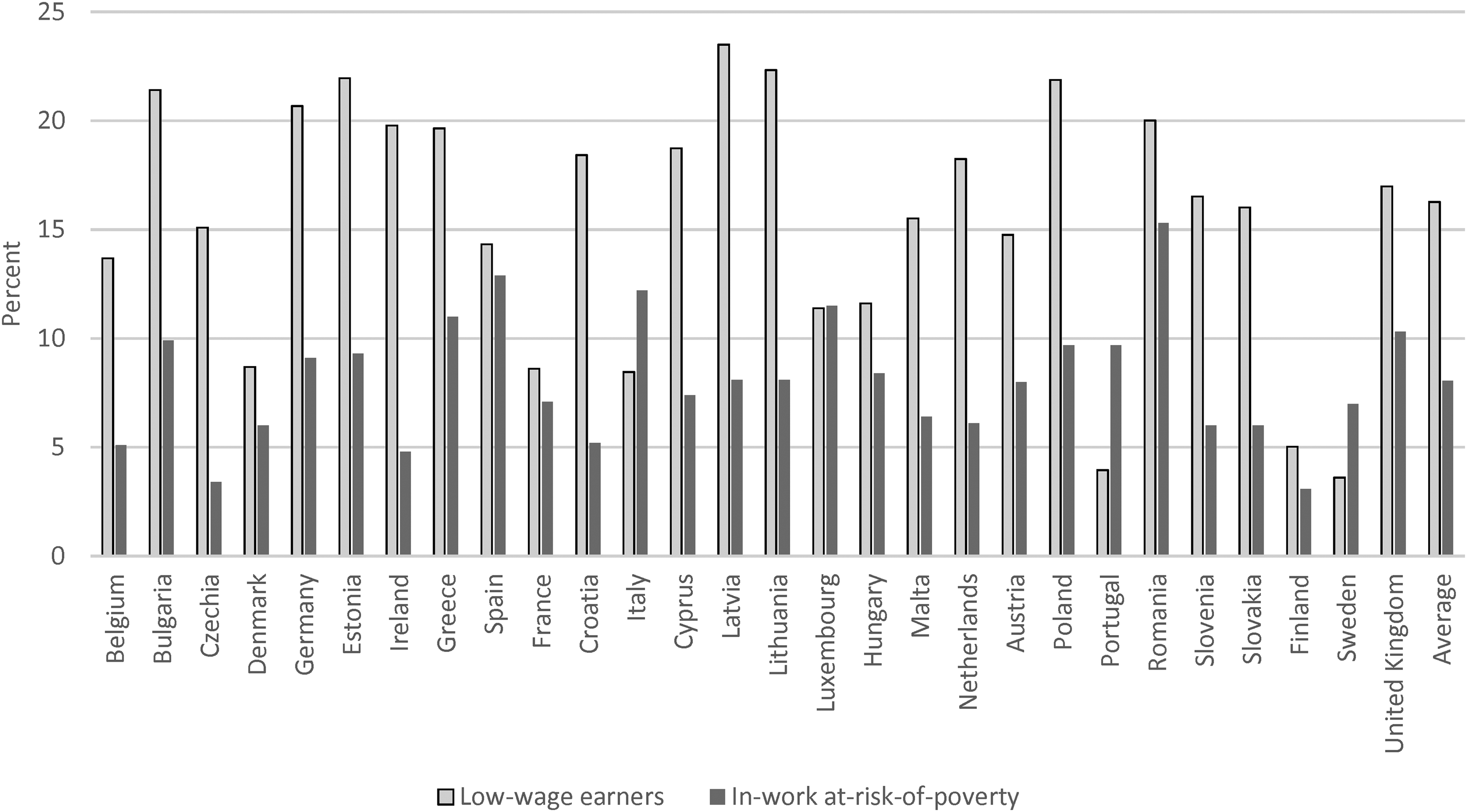
Forms of income adequacy in Europe.
While low income reflects inequality in market earnings, working poverty indicates how well a state succeeds in compensating for this inequality by means of social transfers. Working poverty indicates which employees, after deduction of taxes and addition of social transfers, are below the poverty-risk line—defined at 60 percent of the average income in a country. In this context, the Scandinavian countries, Belgium, Czechia, Malta, Ireland, Croatia, Cyprus, the Netherlands, and Slovenia in particular stand out for their high redistribution measures, as their working poverty rates were below the European average compared to their low-wage rates in 2018 (see Figure 2). Above the European average of 8.0 percent in 2018 were the Southern European countries as well as United Kingdom, Bulgaria, Germany, Estonia, Luxembourg, Poland, and Romania.
Third, a further dimension of precarious employment refers to low social rights and security. An insight into the extent to which precarious workers in the labor market are affected by low social rights and protection can be assessed, among other indicators, by the union density, collective bargaining coverage rate, and the extent of employment protection legislation in place within a country (see Figure 3). A decline in the trade union position in negotiating working and wage conditions in Europe has been observed since the 1970s. 70 As Visser shows, union membership as a share of salaried workers sharply declined in Europe between 1990 and 2016, with the exception of the Scandinavian countries. 71 According to the most recent available data from 2018 (or the latest years available), the average level in trade union density in Europe was at 28.0 percent and above 50.0 percent in Norway, Malta, Belgium, Denmark, Finland, Sweden, and Ireland (see Figure 3).
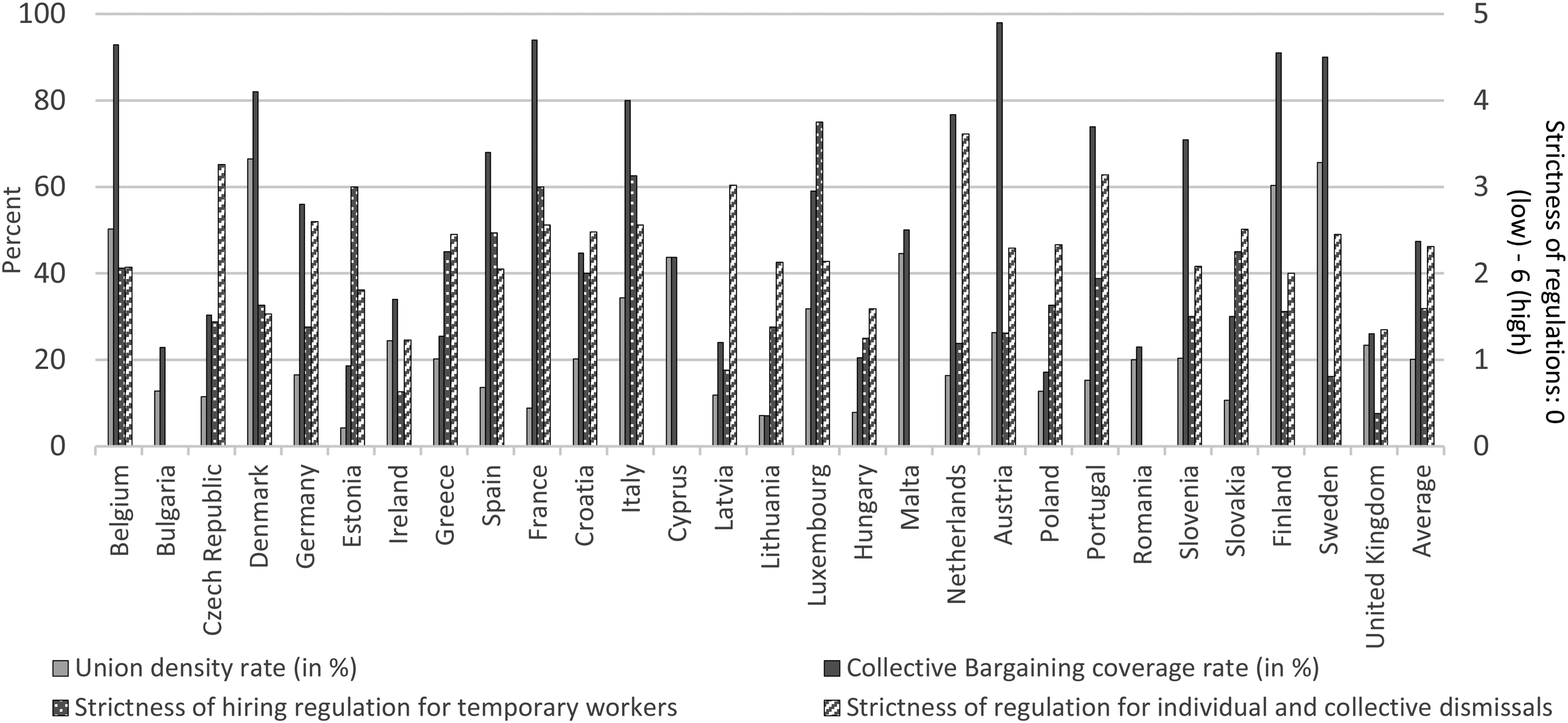
Forms of rights and social protection of employees in Europe.
In contrast, in 2018 (or the latest years available), the proportion of employees covered by one or more collective bargaining agreements was much higher in Europe, at 47.4 percent (see Figure 3). In Belgium, France, Austria, Finland, and Sweden, more than 90 percent of the workforce was covered by a collective agreement, while a large proportion of Eastern European workers was not. The strictness hiring regulation for temporary workers also varied strongly in Europe in 2019 (see Figure 3). Strongest regulations were found in Estonia, France, Italy, and Luxembourg, whereas the regulations for temporary workers were comparatively lax in Ireland, Latvia, Sweden, and United Kingdom. Variation in strictness of regulation for individual and collective dismissals were more pronounced in Europe in 2019 (see Figure 3). Comparatively strict regulations were found in Czech Republic, Latvia, Netherlands, and Portugal, whereas regulations were relatively lax in Ireland, United Kingdom, Denmark, and Hungary. Countries with strict regulations for individual and collective dismissals of workers on regular contracts and lax regulations for hiring temporary workers promote the dualization of their labor market, such as found in Czech Republic, Germany, Latvia, Sweden, Portugal, and the Netherlands. A labor market is described as dualized when a group of workers are systematically excluded from regular employment, whereas regular workers are protected from the consequences of market fluctuations. 21 This dualization of labor markets is policy-based and has been institutionalized since the 1980s in various countries such as France, Germany, Italy, the Netherlands, Poland, Portugal, Slovenia, Spain, and Sweden. 72
Empirical Findings on the Association Between Precarious Employment and Health in Europe
Cross-national studies on the health situation of precarious employees in Europe are rather rare. They usually only include individual dimensions of precarious employment and often only allow a comparison between welfare state regimes. Furthermore, variations in the database, the methodology used, and the health outcomes make it difficult to compare studies. Nevertheless, the study situation suggests that precariously employed people have a higher risk of health impairments and that this association varies between European countries.
The first study that used a multidimensional indicator of precarious employment examined the extent to which the degree of precarious employment is associated with various health outcomes in Europe. The study was based on a multi-level generalized linear model and data from the sixth European Working Conditions Survey (2015). The results show that higher levels of precarious employment were associated with higher prevalence of bad health status, headache, skin and hearing problems, anxiety, fatigue, backache, upper and lower muscular pain, and injuries. The study does not specify which country differences emerged in the associations found. The second study that used a set of indicators to measure quality of employment of the waged and self-employed and its association with self-rated health and mental well-being was also based on the sixth European Working Conditions Survey (2015). The study results show that insecure self-employment, small trades and farming, precarious waged jobs, precarious unsustainable jobs, and dependent self-employment had on average the worst health scores in Europe. The third study that has used a multidimensional indicator of precarious employment (EPRES scale) and examined it in relation to different health outcomes from a cross-welfare regime perspective was based on a multi-level analysis with data from the Flash Eurobarometer 398 from 2014. 73 The study shows that in the 28 European countries, precariously employed workers were at higher risk of depression, musculoskeletal disorders, infectious diseases, respiratory diseases, accidents, allergies, and absenteeism. The health risks for precarious workers were particularly pronounced in countries with a continental European welfare regime, followed by countries that can be classified as belonging to the Anglo-Saxon and Eastern European welfare state regimes.
Most of the existing studies on precarious employment and health focus on individual dimensions of precarious employment, such as part-time employment, temporary employment, fixed-term contracts, or job insecurity. A systematic review by Kim and colleagues 74 shows that the vast majority of the studies considered did not find a significant link between job insecurity and health in the Scandinavian countries. In contrast, there were significant associations in the Anglo-Saxon countries and in the Southern, Eastern, and continental European countries. The systematic review also shows that temporary and fixed-term employees in the Scandinavian countries had better health than employees in normal employment. In the rest of Europe, however, according to the evaluation of existing studies by Kim and colleagues, 74 temporary and fixed-term employees posed a risk to mental and physical health. According to a recent study using EU-SILC data from 2009–2012, part-time employment was significantly associated with poor self-rated health in the 27 countries included in the study. 75 If the countries were assigned to the classic welfare regime types, only the Scandinavian and Eastern European countries showed significant associations between part-time employment and poor self-rated health.
The study by Oke and colleagues 76 suggests that there may also be variations within the countries of a welfare regime typology. This study shows that the associations of precarious employment with health (here: absenteeism) varied significantly between the Scandinavian countries depending on the dimension of precarity considered. Accordingly, a low wage in all four countries, involuntary part-time employment only in Norway, and low health education at the workplace and little opportunity to influence one's own working hours only in Sweden were associated with a higher risk of absenteeism. On the other hand, a low risk of absenteeism was found for fixed-term employees in Denmark, Sweden, and Norway; for flexible working hours without compensation in Sweden and Norway; and for low support from supervisors in Norway.
Finally, various studies exist that have examined the relationship between precarious employment and health in Europe in a comparison of welfare states and on the basis of a gender perspective. These studies show that the relationship between precarious employment and health varied according to the form of precarious employment, gender, and welfare state. Moortel and colleagues 77 used data from the European Social Survey 2010 to examine associations between a different set of indicators of precarious employment (contract type, income, irregular and/or unsocial working hours, employment status, training, participation, and representation) and mental well-being across gender and welfare regimes. The study results indicate gender differences in the association between forms of precarious employment and mental health by welfare state type. For example, they found that women's mental health was more vulnerable to an insufficient household income when they were the main earner in the household, especially in traditional family and Southern European countries. Moreover, women were more vulnerable to irregular and/or unsocial working hours in traditional family, contradictory, and market-oriented countries, whereas men were more vulnerable to a lack of representation in Southern European countries and when holding a non-permanent contract in traditional family welfare regimes. Padrosa and colleagues 78 used data from the sixth European Working Conditions Survey (2015) and a multidimensional indicator to measure precarious employment. They found that the association between precarious employment and mental health was stronger for men compared to women. Welfare regime differences were only found for women when indicating a stronger association between precarious employment and mental health in Central Eastern European countries compared to continental welfare regime countries. Moreover, Fujishiro and colleagues 79 show with data from the European and American Working Conditions Surveys (2015) that associations between precarious employment and health were stronger for men in countries that support traditional gender roles with high state expenditure and labor markets that penalize women.
Explaining Cross-National Variations in the Association Between Precarious Employment and Health: A Micro-Macro Level Model
Several approaches have emerged that put the association between precarious employment and health in a wider political, economic, and social context.3,80–83 Accordingly, a micro-macro level model as theoretical framework is needed to understand how various contextual conditions are intertwined and determine the mechanisms that impact precarious employees’ health on the individual level. Figure 4 provides a conceptual model combining and extending existing concepts and perspectives on the contextual and individual determinants of precarious workers’ health.
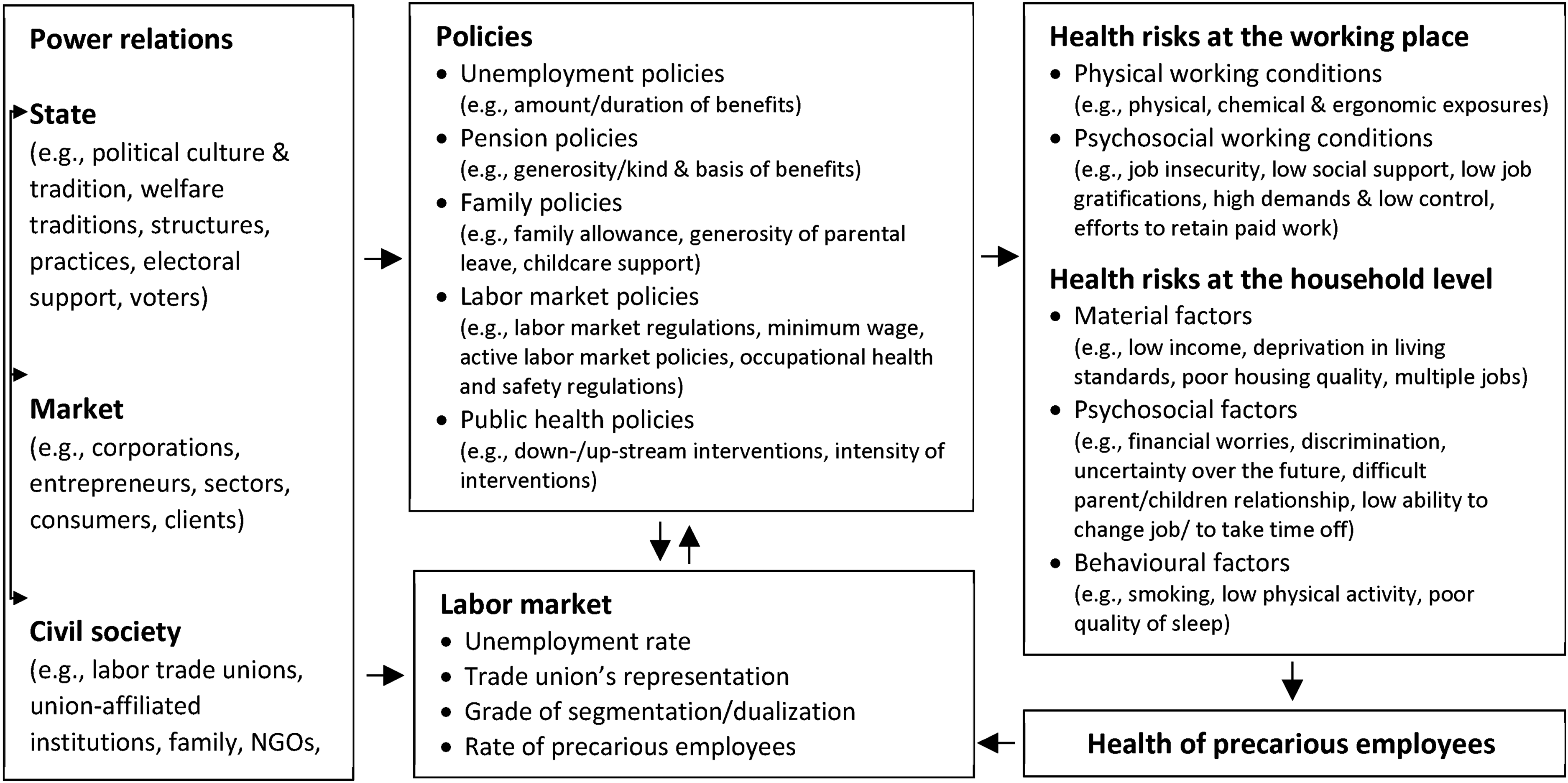
A conceptual model of the contextual and individual determinants of precarious workers’ health.
The theoretical model is based on the findings of Muntaner and colleagues, 83 which emphasize the role of power relations between state, market, and civil society. Power in the representation and realization of political, economic, and social interests directly affects policy choices and the labor market, with important consequences for precarious employees. The institutional policies and labor market conditions are intertwined and determine the health risks of precarious employees differently. For example, it has been highlighted that unemployment rates can lead to increased feelings of job insecurity due to perceptions of replaceability from precarious employees. On the other hand, it was emphasized that comprehensive unemployment policies can buffer financial worries associated with perceptions of job insecurity from precarious employees. Moreover, on the contextual level, the unemployment rate influences unemployment and labor market policies and vice versa.
A more complex picture emerged focusing on gender differences in the association between precarious employment and health. As the study of Fujishiro and colleagues 79 indicates, the orientation of family and labor market policies also supports traditional gender roles in the organization of work and can thus lead to role conflicts among precariously employed men and women, which have a negative impact on their health. These examples illustrate the complex interplay between the contextual level and the health risks of precariously employees, which has to be taken into account when studying the contextual influences of the health risks of precarious employees.
The health risks of precarious employees at the individual level emerge both at the workplace and in the household.3,22 The two are closely intertwined in that, for example, workplace strains are carried into the family or workplace conditions define family life and vice versa. For example, in the absence of family policy support, single parents’ family status increases the risk that they will have to take up or remain in precarious employment, which further increases the general burden on single parents. The study of health risks of precarious workers therefore needs to take into account the workplace and household conditions in order to better understand and model the realities of the lives of precarious workers and the contextual factors that determine them. Finally, health status itself may be a determinant of unemployment and precarious employment. Longitudinal studies of workers have found evidence for the healthy worker effect (social selection), which implies that healthy workers move “up” in employment status and less healthy workers move “down” into precarious employment or unemployment.84–86 The conceptual model in Figure 4 is intended as an overview and basis for further elaborating the various contextual influences on the living and working conditions of precariously employed workers and their health.
Empirical Findings on the Contextual Influences of the Association Between Precarious Employment and Health
The studies published to date provide initial indications that the association between precarious employment and health is influenced by contextual factors on the national level. Whether and to what extent precariously employed persons are impaired in their health and to what extent they are exposed to adverse living and working conditions, therefore, also depends on the country in which they work. Research has identified several factors on the contextual level that contribute to cross-national variations in the association between precarious employment and health.
A first stream of research examined the role of different welfare state arrangements in the patterning of population health and health inequalities. This research found evidence that inequality in health is lower in countries with a higher degree of welfare state generosity and social protection policies.87–89 Policies on unemployment, pensions, and family are particularly relevant for the relationship between precarious employment and health. First, it has been argued that unemployment policies can mitigate the mental distress of precariously employed people associated with the threat of unemployment. 74 Initial studies show that the association between job insecurity and health and life satisfaction is less strong in countries that offer a higher level of social protection in the event of unemployment (including the amount and duration of unemployment benefits).90–92 Second, the buffering effect of welfare state arrangements of social security on the health situation of precariously employed persons is also postulated against the background of existing pension policies (e.g., basic pensions of persons with no or low earnings; income pensions given on the basis of work contribution). 3 In principle, pension entitlements have an influence on the health of retirees, but they can also affect mental health during employment through concerns about financial security in old age.93,94 Research indicates that precarious employment is more often related to limited pension benefits or no pension plan, which have been shown to be negatively associated with health. 95 However, to what extent pension generosity and kind of pension benefits on the national level are associated with differences in health by precarious employment status has not been analyzed yet. Third, family policies could play a decisive role when considering gender-specific differences in health of precarious employees. Mothers, in particular, face the problem of coping with the competing demands of employment and family care, and have a higher risk of precarious employment, interrupted employment, and loss of earnings over their lifetime. 96 Family policy arrangements that respond to these competing demands through social protection and support measures (including family allowances and tax benefits, paid parental leave, childcare support, or child benefit) can help to alleviate the uncertain living and working conditions of precarious mothers and their health. 97 Studies show that the level of social security (e.g., government spending on early childhood education, childcare, and parental leave) is associated with positive maternal health.98–101 The health situation of precariously employed parents, and in particular of single parents, could therefore be better in countries that have a higher level of social protection and support as part of their family policy.
A second stream of cross-national research examines how institutional arrangements related to the labor market impacts the relationship between precarious employment and health. These include labor market regulations, wage policies, active labor market policies, and occupational health and safety. The labor market regulations refer, among other things, to criteria for regulating protection against dismissal, fixed-term employment, mass dismissals, and rigidity of working hours. They thus make direct reference to the flexibility of the labor market. A first cross-national study that also considers labor market regulations examined the influence of flexicurity on the association between temporary work and self-rated health based on the European Social Survey. 102 For this purpose, different country clusters of “flexicurity” for Europe were formed using the Employment Protection Legislation Indicator of the OECD and the extent of welfare state expenditure on active labor market policies and unemployment benefits. The four clusters identified (low protection and strict regulation, low protection and flexible regulation, high protection and strict regulation, and high protection and flexible regulation) were not significantly related to the relationship between temporary employment and health.
Wage policies have been discussed as an influential factor on the living conditions of precarious employees, as they can determine the amount of wage that an employee receives. It has been argued that raising wages improve psychological well-being and job satisfaction, increase the opportunity cost of engaging in unhealthy habits, and expand the ability to delay gratification. 103 Recent studies relate to the health effects of a minimum wage, indicating a positive effect on adult and child health.104–106 In contrast, Horn and colleagues 107 found that an increased minimum wage leads to worsening general health among less-skilled workers. Accordingly, the evidence is inconsistent and should be expanded to include precarious workers, who are more likely to experience working poverty and low wages.
Active labor market policies aim at (re-)integrating unemployed people into the labor market through various measures. 108 It has been argued that active labor market policies also reduce the health consequences of precarious employment. 109 The literature already provides comprehensive evidence that active labor market policies contribute to the (re-)integration of unemployed people into the labor market and thus to their health. 110 However, it is unclear whether and to what extent they also contribute to an improvement in the health situation of precariously employed persons. Initial studies show that the association between job insecurity and health and life satisfaction is less pronounced in countries that invest more in active labor market policies.90,92 However, this also applies to the investment in passive labor market policies, which indicates that a general investment in labor market policies might contribute to the health situation of precariously employed persons. However, since active labor market policies are also discussed as a driving force of the precarious employment sector, it must be critically questioned whether active labor market policies are actually accompanied by better health and improved working and living conditions of precariously employed individuals.
Another aspect that influences the health-related working conditions of precarious workers refers to the occupational health and safety regulations (OHS). 3 It has been argued that precarious employees are affected by lower standards of OHS regulations and show less knowledge about the existence of such regulations, which contributes to their detrimental working conditions. 111 A first intra-European study on this topic shows that workers in lower occupational positions are less likely to be aware of the applicable OHS, but that this association is lower in countries where OHS is more frequently monitored by official authorities. 112 However, whether and to what extent this aspect is also associated with improved working conditions for precarious workers and their health has not yet been investigated from a cross-national perspective.
A third stream of research discusses how public health policies might have a significant impact on the health of precariously employed persons. 87 According to Scott-Marshall and Tompa, 95 engaging unhealthy behaviors might be a strategy for coping with the precarious living and working conditions of precarious employees. Public health measures that focus on these unhealthy behaviors, such as smoking or alcohol consumption, might therefore reduce inequalities in health behaviors related to precarious employment. However, they also might contribute to an increase of inequalities in health related to precarious employment, when privileged groups benefit from interventions more than disadvantaged ones do. Findings on general populations indicate that downstream preventive interventions (e.g., media campaigns on smoking, workplace smoking bans) seemed to be more likely to increase health inequalities than upstream interventions (e.g., structural workplace interventions, provision of resources, and fiscal interventions, such as tobacco pricing).113,114 Comparative studies within Europe focusing on precarious employment are not known.
A fourth stream of research discusses the influences of trade unions on the relationship between precarious employment and health.115,116 Trade unions have a decisive influence on wage policy within a country and thus can also determine the level of income-related inequalities in health. 116 Studies show that unions ensure higher wages both for their members and for employees under collective bargaining agreements, and that union members are more likely to have a retirement or pension plan than workers who are not members of an union.117,118 Unions also play a decisive role in negotiating and enforcing standards for working conditions, which might protect precarious employees from physical and psychosocial exposures at the workplace. 119 Unions are associated with higher OHS levels, 120 more effective workplace health and safety committees, 121 stricter enforcement of OHS regulations, 119 and higher psychosocial safety climate. 122 Moreover, literature suggest that trade unions reduce perceptions and objective levels of job security, which disproportionately affects precarious workers. 123 Levels of job insecurity might be lower since trade unions implement individual and collective agreements against dismissals and represent union members in the case of threatened job loss. First studies indicate that workers who belong to unions or work in unionized firms feel more secure in their jobs,124–126 and that average levels of workers’ perceived job insecurity are lower in countries with a higher union density.127–129 Finally, trade unions are also considered to have a social support function that counteracts the feeling of powerlessness to which precariously employed persons are often exposed. 124 Overall, the available studies indicate that trade unions have a positive effect on the health of employees. 130 According to Brugiavini and colleagues, 131 trade unions are the precursors of the modern welfare state as they define, set, and enforce certain social standards and mobilize for the expansion of social rights. For this reason, precarious workers from countries where unions are more strongly represented should have better health, regardless of whether they are union members or protected by collective agreements.
Finally, the fifth stream of research focuses on the level of unemployment prevailing in a country as a determinant of the association between precarious employment and health. Unemployment can be regarded as a general indicator of the labor market condition indicating the probability of (re-)employment.80,132 The job-specific unemployment rate plays a particularly important role as it reflects the relationship between labor supply and labor demand in a specific occupation. If the (occupation-specific) unemployment rate is high, perceived job insecurity, the sense of guilt toward those who are laid-off, and risks to stay in stressful jobs instead of quitting them might increase among precarious employees. 133 Research has shown that rising unemployment is associated with a higher risk of work-related mental health problems, job insecurity, absenteeism, and presenteeism among employees, and that occupation-specific unemployment drives this relationship.128,129,134,135 Whether and to what extent (occupation-specific) unemployment rate contributes to differences in health by precarious employment status has not been analyzed yet.
Discussion
Precarious employment is a growing form of employment in Europe and is associated with a variety of social and health-related uncertainties. It is opposed to the European Pillar of Social Rights, which aims to provide every European citizen equal opportunities and access to the labor market, fair working conditions, and adequate and sustainable social protection. 1 Political, economic, social, and cultural factors contributed significantly to the rise of precarious employment in Europe. In particular, institutional arrangements had a direct influence on the emergence of precarious employment, as they—by means of policies—have shaped the labor market conditions and, for example, contributed to the rise of a low-wage sector in Germany. 11 However, institutional arrangements do not emerge in a vacuum, but are shaped by power relations between state, market, and civil society. They also have a different impact on the emergence and extent of the various forms of precarious employment. At present, different forms of precarious employment can be found in Europe, and the extent to which they are represented varies from country to country. Therefore, when explaining variations in the form and extent of precarious employment, a holistic understanding is needed that considers the specific institutional arrangements and policies within a country.
The theoretical and empirical examination of the contextual determinants of the health risks and health of precarious employees is still in its infancy. There are conceptual models of the relationship between precarious employment and health that also consider contextual factors and, in particular, welfare state and labor market policy arrangements.3,80–83 In this context, welfare state arrangements with regard to unemployment, family, and pensions can mitigate the insecure life situation of precariously employed people and thus also have a preventive effect on health. Although the first studies provide initial evidence in this regard, the current state of research is limited. A similarly limited body of research can also be found with regard to the effects of labor market policies on the association between precarious employment and health. These include labor market regulations, wage policies, active labor market policies, and occupational health and safety, which also might impact precarious employees’ health by shaping their living and working conditions. Finally, public health measures, trade unions, and the existing unemployment in a country might have a health impact on precarious employees by influencing their health behaviors, living and working conditions, and perceptions of insecurity. All these factors individually, but also in interaction with each other, can significantly determine the health situation of precariously employed people and thus might also contribute to the creation of equal and fair health opportunities.
Despite the number of excellent studies that have addressed the effect of individual contextual factors on health of precarious employees, the conceptual models that puts the association between precarious employment and health in a social, political, and economic context are still in their infancy. They are often limited in their depth and do not include postulates about the specific mechanisms linking the contextual to the individual level. The approaches considered provide only limited explanations of how and in what ways the welfare state and the specific institutional arrangement influence the health of precarious workers through contextual conditions and how these contextual conditions are interrelated. The conceptual model offered here served as an overview and basis for further elaborating the various contextual influences on the living and working conditions of precariously employees and their health. Therefore, further studies need to extend and address the theoretical pathways between policies, labor market conditions, and the association between precarious employment and health. Moreover, theoretical debates should explore how to include factors such as life course, 136 migration, 137 or gender, 138 which play an important role when explaining the extent and form of differences in health by precarious employment. This requires an interdisciplinary work between scholars from occupational health research, medical sociology, public health, politics, psychology, and epidemiology.
Conclusion
Precarious employment as a determinant of health remains on the rise in Europe and contrasts the European Pillar of Social Rights. Although there are a comprehensive number of studies on the relationship between precarious employment and health on the individual level, there is still a lack of studies on its contextual determinants, which are identified in particular in the welfare state and institutional arrangements. Future research efforts should continue to address the contextual determinants of the relationship between precarious employment and health in order to provide important insights into improving the health of precarious workers.
Footnotes
Declaration of Conflicting Interests
The author(s) declared no potential conflicts of interest with respect to the research, authorship, and/or publication of this article.
Funding
The author(s) disclosed receipt of the following financial support for the research, authorship, and/or publication of this article: This work was supported by the Deutsche Forschungsgemeinschaft, (grant number 388147695)
