




Abstract
Background:
The majority of studies show a substantially higher consumption of anxiolytics and antidepressants among women than among men and in the age bracket above 45 years.
Aims:
To analyse association between the use of hypnotics/anxiolytics, and various characteristics of Polish women, including health-related quality of life.
Method:
One thousand, five hundred and sixty (1,560) women aged 45–60 years completed a questionnaire dealing with the use of hypnotics/anxiolytics, demographic characteristics, environmental and work stress exposure, and self-reported quality of life (SF-36 form).
Results:
The following variables were revealed as the predictors of hypnotic/anxiolytic use on univariate analysis: age; social pension; stress at work and environmental stress; hormone replacement therapy; headache; palpitations; mood swings or increased muscular tension; anger; duration of symptoms longer than one week; consulting a specialist; and low physical and mental health-related quality of life. The significant protective factors included: vocational and tertiary education; job satisfaction; and home as place of rest. The independent predictors of anxiolytic/hypnotic use included consulting a specialist and symptoms lasting more than one week, while job satisfaction and home as place of rest were the independent protective factors.
Conclusions:
The use of hypnotic/anxiolytic medication is strongly associated with environmental and psychosocial characteristics of women between 40 and 65 years of age.
Introduction
The majority of studies on the determinants of use of anxiolytics and antidepressants show their substantially higher consumption among women than among men and in the age bracket above 45 years (Colman, Croudace, Wadsworth & Jones, 2008; Van der Heyden et al., 2009). In the case of women, the age of 45–60 years is met by greater requirements both career-wise and in family life. The women are forced to face problems connected with their contemporary fast-paced lives, with longer working hours leaving less time for family life. Their situation is sometimes complicated by having to take care of multiple generations, including their children, grandchildren, and their own parents or other elderly family members. Maintaining a balance between their domestic and professional obligations induces stress, which may lead to the use of sedatives and antidepressants, aside from their health needs. Some studies conclude that there is a pattern of social variables that define a particular use of medicines, such as socio-economical standing, access to health care, employment status or education (Daban et al., 2010). Clinical characteristics such as the severity of concomitant disorders and specific symptoms have been linked to help-seeking behaviours and treatment with psychotropic medications (Bebbington et al., 2000; Burns et al., 2003). However, the effects might also work in the opposite direction (Nicol-Smith, 1996). Furthermore, little research has examined whether these associations were present in Eastern European countries, where challenges of everyday life changed after the market economy had been firmly established. Furthermore, there is no available data on the effects of anxiolytics and hypnotics use on the health-related quality of life in women.
The aim of this study was to identify the factors associated with anxiolytic or hypnotic drug use in Polish women, by means of a cross-sectional approach. We also investigated mental and physical health-related quality of life differences in the association between the use of anxiolytic and hypnotic drugs.
Method and subjects
Study population
This is cross-sectional descriptive study using the snowball recruitment method (Etter & Perneger, 2000). The sample consisted of 1,560 women, aged between 45 and 60 years, recruited in eight different sites located in different regions of Poland. Approximately 200 women were invited into the study from each region. The eligibility criteria to participate in the study included being 45–60 years of age, and the ability to meet or perform study requirements (e.g. to complete self-administered questionnaires). Nurses and other health professionals affiliated with research centres were engaged in the recruitment process. Representatives of these professions are able to reach populations that are normally difficult to identify and contact due to being under-served or vulnerable. The sample size was computed so that the study had power of 80% to reject the null hypothesis assuming that difference between hypothetical and true proportion of anxiolytic or hypnotic drug use was lower than 3%.
Variables
The survey consisted of two questionnaires: the first dealing with social and clinical characteristics; the second focusing on health-related quality of life. The data were collected using specific self-report questionnaires between January 2009 and March 2009. The questionnaires were developed and validated at one of the participating centres (Kolarzyk, 2009). The first questionnaire included 16 questions related to socio-economic aspects, lifestyle, clinical symptoms, prescription medication use and health services utilization. Medications described in the questionnaire included hypnotics and anxiolytics (sedatives, sleep- inducing or anxiety-relieving medications); neither chemical nor trade names were used. Clinical symptoms listed in questions included headache, palpitations, mood swings, increased muscular tension and anger, as well as the duration of symptoms. In the second part of the examination, the standardized SF-36 questionnaire was used for physical and mental self-perceived health assessment (Ware & Sherbourne, 1992). Using at least one hypnotic/anxiolytic medication was an independent variable in this study.
Statistical analysis
The data were presented as mean ± standard deviation (M ± SD) and as a percentage. For continuous variables with a normal distribution, the Student’s t-test for independent samples was applied. If variables did not follow a normal distribution, the Wilcoxon test was used for the comparison of independent measurements. Differences between categorical variables were tested by means of the χ 2 test. The odds ratios (OR) and 95% confidence intervals (95% CI) were calculated in a univariate analysis, as well as for variables that were included in a multivariate model. Multiple logistic regression analysis was applied to all variables that had at least a marginal univariate predictive value (p < .2). Variables with a significant independent predictive value (p < .05) were identified. A probability (p) value of < .05 was regarded as statistically significant. Low physical and mental health-related quality of life was defined when the corresponding result of SF-36 was below the 25th percentile. Statistical analysis was performed with STATA software (STATA 11.0, STATACorp, Texas, USA).
Results
The prevalence of hypnotic and anxiolytic use was 23%. Characteristics of women using this kind of medicines and non-users are presented in Table 1.
Characteristics of study participants with regard to use of anxiolytics or hypnotics.
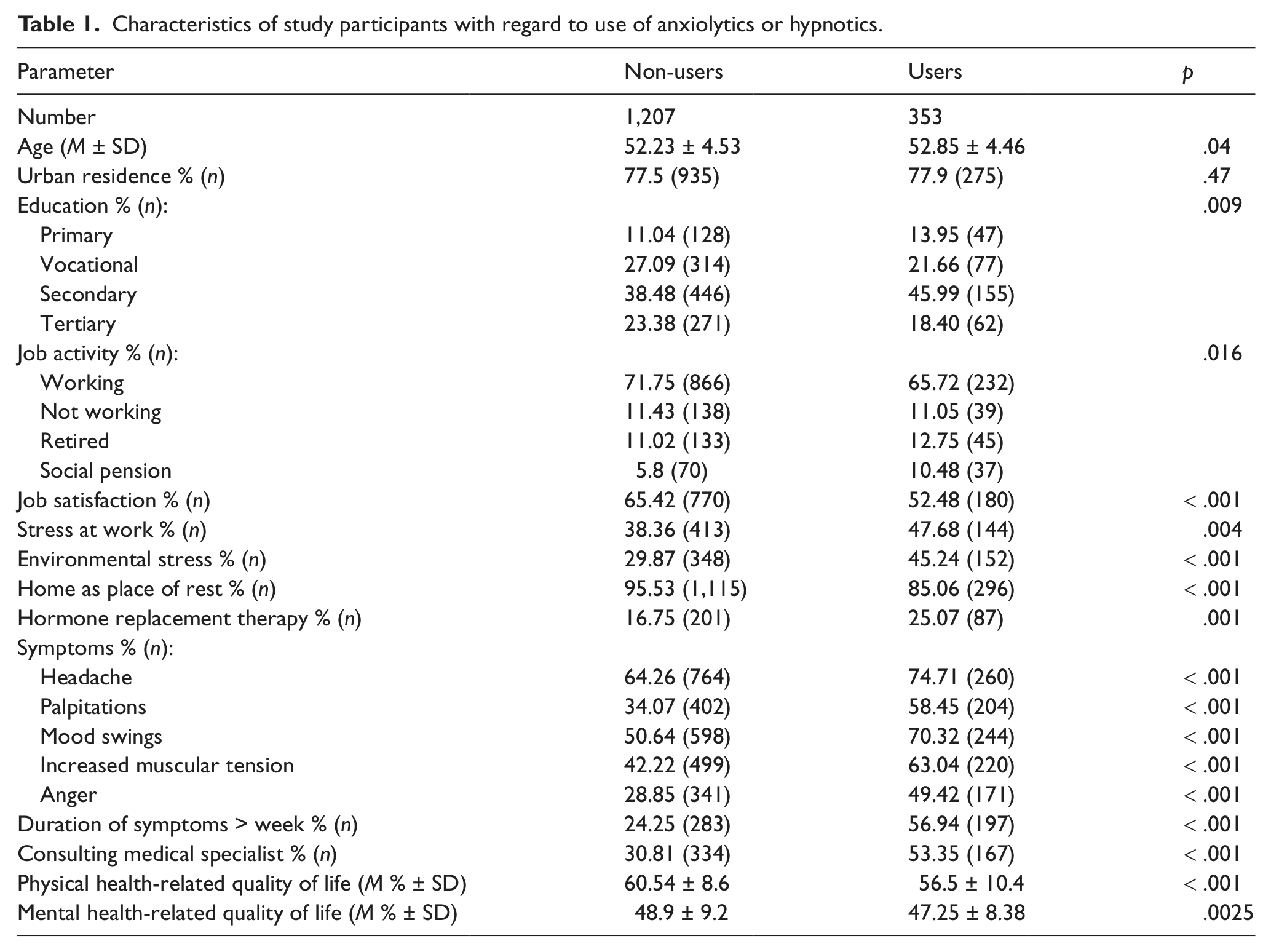
The following variables were revealed as the predictors of hypnotic/anxiolytic use on univariate analysis: age; social pension; stress at work; environmental stress; hormone replacement therapy; headache; palpitations; mood swings or increased muscular tension; anger; duration of symptoms longer than one week; and consulting a specialist. Additionally, low values of physical and mental health-related quality of life were associated with hypnotic/anxiolytic use. In turn, the significant protective factors included: vocational and tertiary education; job satisfaction; and home as place of rest (Table 2).
Univariate and multivariate odds ratios (ORs) with 95% confidence intervals (95% CI) for use of anxiolytic/hypnotic medication with regard to analysed factors.
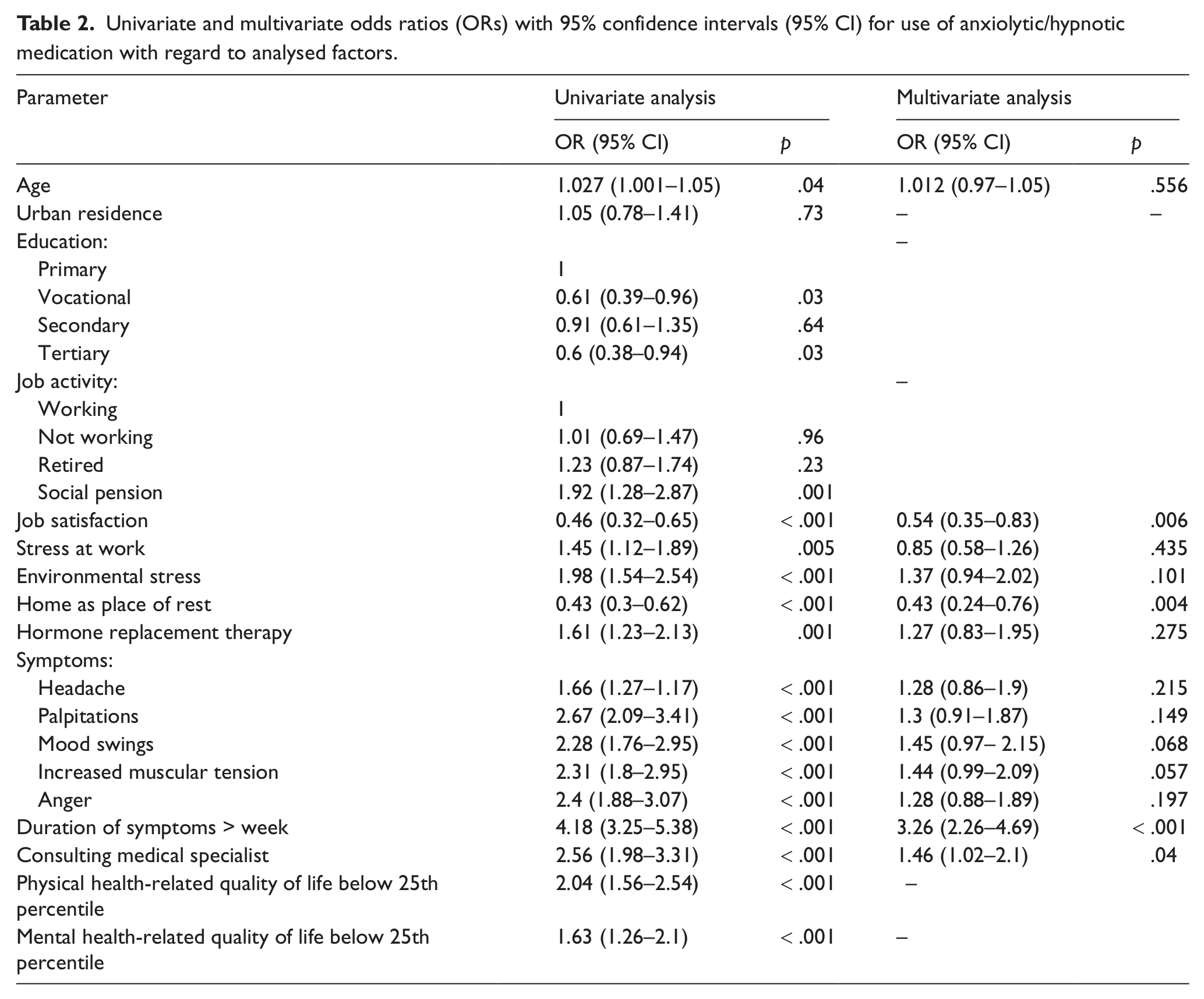
Quality of life measures were not included in the final multivariate model since they can act as potential confounders and should be considered intermediate steps in the causal pathway between medication use and analysed variables. Nevertheless, the quality of life indicators did not prove independent predictors of hypnotic/anxiolytic use when included in the multivariate model (not shown). Among other psychosocial and clinical factors, only a few were independently associated with anxiolytic/hypnotic medication use. The independent predictors of anxiolytic/hypnotic use included consulting a specialist and symptoms lasting more than one week, while job satisfaction and home as place of rest were revealed as the independent protective factors (Table 2).
Discussion
Summary of main findings
In this study, the estimated prevalence of hypnotics/ anxiolytics use in Polish women aged 45–60 was 23%. The independent predictors of anxiolytic/hypnotic use included consulting a specialist and symptoms lasting more than one week, while job satisfaction and home as place of rest were revealed as the independent protective factors. However, one should be aware of the fact that consulting a specialist and long duration of symptoms may reflect the severity of the underlying disease.
Strengths and limitations of the study
This is the first study exploring the determinants of anxiolytic and hypnotic use in Polish women. This is also the first quantitative demonstration of the relationship between anxiolytic and hypnotic use and the health-related quality of life in women. Our findings are consistent with those reported in other publications pointing out the role of social factors in therapy involving anxiolytic and hypnotic drugs in western societies (Colman et al., 2008; Daban et al., 2010). One limitation of this study is the lack of information regarding the coexistence of other diseases, which could be an additional source of stress and could enhance the aforementioned disorders. Such diseases may skew results, especially when there is a strong relationship between the lower quality of life, which would arise as a consequence of health problems, and the analysed medications, as well as the cross-sectional character of this study. Another limitation is the lack of information about the social deprivation level or income of the participants. However, education-related data were included in our analysis.
Comparison with existing literature
A relatively high prevalence of hypnotic or anxiolytic use was found among Polish women aged 45–60 (23%), compared to similar data from western populations (Zandstra et al., 2002). The risk of unemployment and joblessness may cause depression, fear and poorer health-related quality of life (Axelsson, Andersson, Edén, & Ejlertsson, 2007; Lewis, 1998; Montgomery, Cook, Bartley & Wadsworth, 1999). Health conditions, lack of social safety and deprivation may cause women to seek help from medical doctors, who recommend anxiolytics and hypnotics (Bocquier, Bezzou, Nauleau, & Verger, 2008; Johnell, Merlo, Lynch, & Blennow, 2004; Tsimtsiou, Ashworth & Jones, 2009). Our findings show that low levels of mental and physical health-related quality of life are associated with anxiolytic use, which is in accordance with the conclusions of a longitudinal study on the increased risk of chronic benzodiazepine use among individuals with poor mental and physical health (Luijendijk, Tiemeier, Hofman, Heeringa, & Stricker, 2008). Medication, in addition to other therapies, is an important element in responding to mental health problems and disorders. In 2006, mental and behavioural problem-treating drug sales, including anxiolytics/hypnotics, totalled US$ 4.7 billion in 16 Organisation for Economic Co-operation and Development (OECD) countries (Armesto, Medeiros, & Wei, 2008). Over-the-counter (OTC) drugs, which may be sold directly to a consumer without a prescription from a health care professional, play a special role when compared to prescription drugs, which may be sold only to consumers possessing a valid prescription. Russia and Poland are the largest OTC markets in all Central and Eastern European (CEE) countries. In 2009, as in previous years, almost half of the entire OTC product market value was generated by Russia. In 2009, Poland was the second-largest OTC market in the region, with a proportion of total sales of all OTC products amounting to approximately 20%. On 12 January 2011, Poland’s Chief Pharmaceutical Inspector contested the legality of OTC drug sales by the Polish online auction website Allegro, the most popular auction site in Poland for online sales of this group of medication.
Epidemiological studies indicate that the subjective assessment of happiness is associated with satisfaction at work and family life (Ballas & Dorling, 2007; Clark & Oswald, 2002). Our analysis confirmed a correlation between factors conditioning good quality of life and the lack of need to use anxiolytics and hypnotics. However, further studies are still required in order to assess if this type of association has a cause–effect relationship.
With the progress in medicine, it gradually becomes apparent that the ultimate purpose of health intervention is to enhance the quality of life rather than to simply prolong human existence. Over the last two decades, this concept has been applied to almost all aspects of health care. Despite debates on definition and components, it is now widely agreed that physical and mental components of quality of life issues are central to health care, including mental health care, according to statement: add life to years and not only years to life (Debasish, 2004).
Finally, our finding that occupational satisfaction and support at home limit the use of hypnotics or anxiolytics in women indicates that more awareness is needed for the role of patients’ social characteristics in the prescribing practice of Polish doctors.