




Abstract
Background:
The Great Recession has caused worldwide tangible costs in terms of cuts in employment and income, which have been widely recognised also as major social determinants of mental health. Italy has not been spared from the financial crisis with severe societal and mental health consequences. In addition, a strong earthquake hit the province of Modena, Italy, in 2012, that is, amid the crisis.
Aims:
In this study, we explored and investigated the possible additional impact of concurrent events such as economic crisis and a natural disaster.
Methods:
Our analysis elaborated data from two local surveys, ICESmo2 (2006) and ICESmo3 (2012), and a national survey carried out in 2013 by the Italian National Institute of Statistics (Istituto Nazionale di Statistica (ISTAT)). A regression model was adopted to distinguish the effect of the crisis and the earthquake.
Results:
Our analysis confirmed the negative effect of the economic crisis on psychological wellbeing, but within the province of Modena such an effect resulted as even stronger compared with the rest of Italy, particularly within those areas struck by the earthquake.
Conclusion:
Being hit by a combination of two major negative events might have a significantly increased negative effect on psychological health. The higher repercussion observed is not only attributable to the occurrence of a natural disaster but can be reasonably related to the additional effect of unemployment on psychological dimensions.
Introduction
A consistent body of evidence has recognised the importance of social determinants in shaping mental health. Social, economic and environmental factors, both at macro-level (e.g. socio-economical conditions) and at individuals level (e.g. adverse/traumatic experiences), are recognised as major causative agents of psychological distress and psychiatric disorders (Allen, Balfour, Bell, & Marmot, 2014; CSDH, 2008).
Since the beginning in 2008, the Great Recession has caused worldwide tangible costs in terms of cuts in employment and income. Uncertainties linked to decreased job opportunities and the spread of insecure employment conditions have been reported as determinants of poor mental health (Cagney, Browning, Iveniuk, & English, 2014; Fountoulakis et al., 2015; McKee-Ryan, Song, Wanberg, & Kinicki, 2005; Paul & Moser, 2009; Roca, Gili, Garcia-Campayo, & Garcia-Toro, 2013).
In addition, many studies have documented the incidence of large disparities in unemployment rates between people with and without mental illness in times of crisis (Mechanic, Blider, & McAlpine, 2002; Wahlbeck & McDaid, 2012). Unemployment per se might have a significant negative impact upon the course and the outcome of mental illness (Warner, 2004). In addition, it may represent a critical determinant in the genesis of social exclusion and marginalisation. On the other hand, unemployment may act as a specific hurdle to prevent recovery in mental illness (Bush, Drake, Xie, McHugo, & Haslett, 2009; Drake, Bond, Thornicroft, Knapp, & Goldman, 2012).
Economic recession may represent a particularly difficult experience for people with mental illness; on one hand, they do present higher risks of losing their jobs, and on the other, it may be difficult for them to be re-employed within the context of a highly competitive labour market (Sharac, McCrone, Clement, & Thornicroft, 2010).
The negative impact of austerity measures on public health services (Kentikelenis, Karanikolos, Reeves, McKee, & Stuckler, 2014) and the detrimental impact of cutting back on health care and social welfare measures in times of crisis have also been widely emphasised. Accordingly, countries with higher and favourable scores in mental health are those ensuring the strongest social safety net (Van Hal, 2015).
Recently, the Great Recession has disproportionately affected the most vulnerable part of society of the whole Eurozone (Evans-Lacko, Knapp, McCrone, Thornicroft, & Mojtabai, 2013). Across Europe, an increase in suicides and deaths rates due to mental and behavioural disorders was reported among those who lost their jobs, houses and economic activities as a consequence of the crisis (De Vogli, 2014).
Along with many other Countries, Italy has been severely hit by the economic crisis showing overtime a significant increase in unemployment rates: 6.7% in 2008, 8.4% in 2010 and 12.2% in 2013.
An increase in psychological distress and psychiatric morbidity has also been reported in individuals exposed to natural disasters (Goldmann & Galea, 2014). Studies concerning the aftermath of natural catastrophes have reported, among other problems, an increased incidence of posttraumatic stress disorder (PTSD), depression and suicidality (Hyodo et al., 2010; Suzuki et al., 2011; Wu et al., 2006). Exposure to natural disasters has a damaging impact on physical and mental health as well as on general lifestyle and quality of life of the population (Momma & Nagatomi, 2015).
To the best of our knowledge, however, despite the amount of evidence available regarding immediate and long-run socio-economic consequences of natural catastrophes (duPont Iv, Noy, Okuyama, & Sawada, 2015), no studies have investigated the possible additional independent impact of concurrent events such as an economic crisis and an earthquake. As a matter of fact, the negative cascade effect of an earthquake on economic loss, life satisfaction and mental health has been described only from the point of view of a secondary dependent variable (Huang, Wong, & Tan, 2015).
The focus of our research has been the province of Modena, Italy, which, amid the acme of the financial crisis, has been struck in 2012, by a devastating earthquake.
Methods
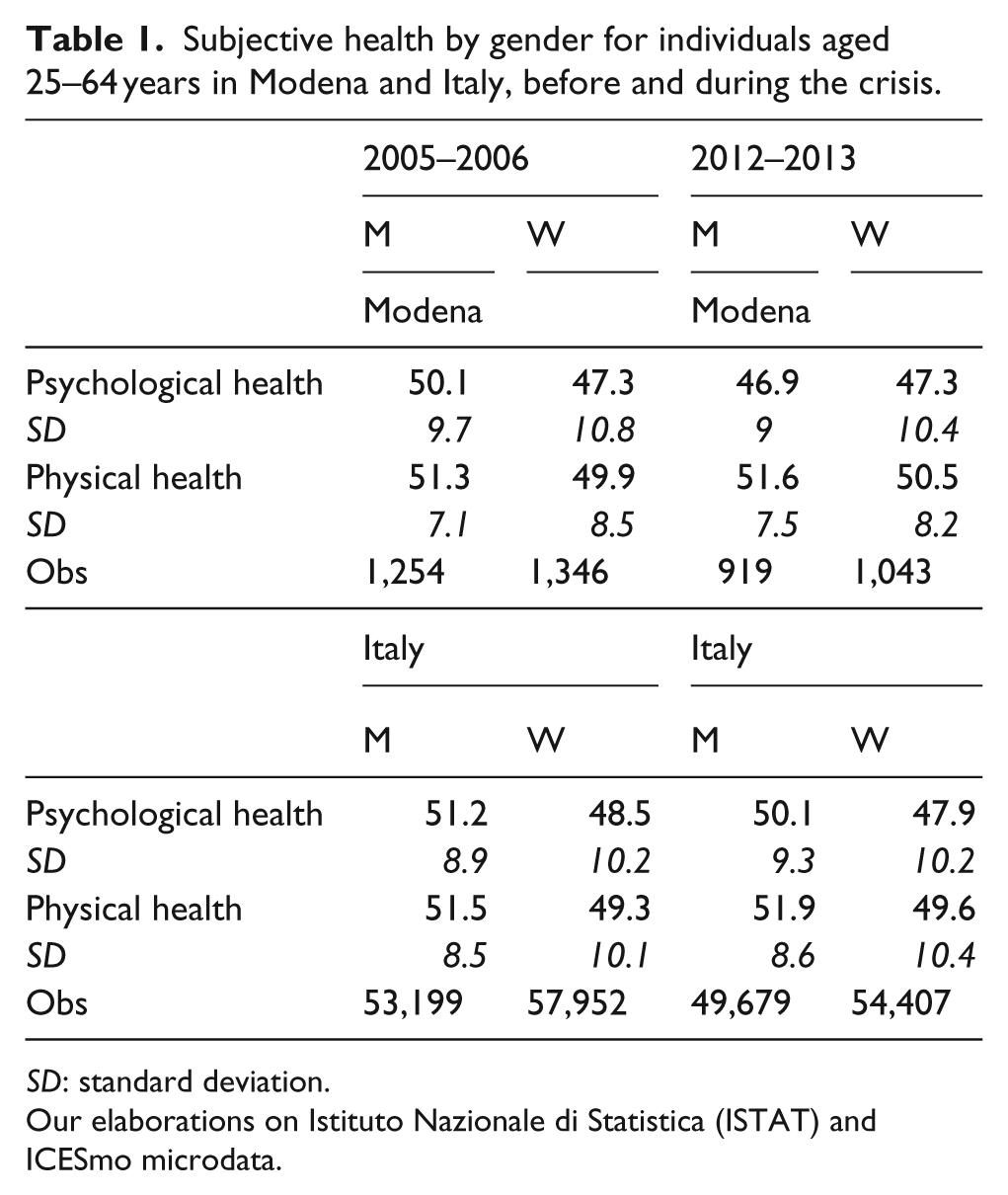
We provide descriptive statistics comparing data from two local surveys ICESmo2 (2006) and ICESmo3 (2012) (Centre for the Analysis of Public Policies (CAPP), 2013) and the national surveys carried out in 2004–2005 and in 2013 by the Italian National Institute of Statistics (Istituto Nazionale di Statistica (ISTAT), 2013), which reported indexes of physical and mental health status of the population (Table 1).
Subjective health by gender for individuals aged 25–64 years in Modena and Italy, before and during the crisis.
SD: standard deviation.
Our elaborations on Istituto Nazionale di Statistica (ISTAT) and ICESmo microdata.
Physical and mental health indicators were measured by means of the Short Form-12 (SF-12) (Kiely and Butterworth, 2015; Burdine, Felix, Abel, Wiltraut, & Musselman, 2000; Salyers, Bosworth, Swanson, Lamb-Pagone, & Osher, 2000; Schofield & Mishra, 1998), which enables to investigate two concise indexes: Physical Component Summary (PCS) for physical health and Mental Component Summary (MCS) for mental state. Both indexes may range from 0 to 100, where increasing values indicate worse levels of mental and physical health.
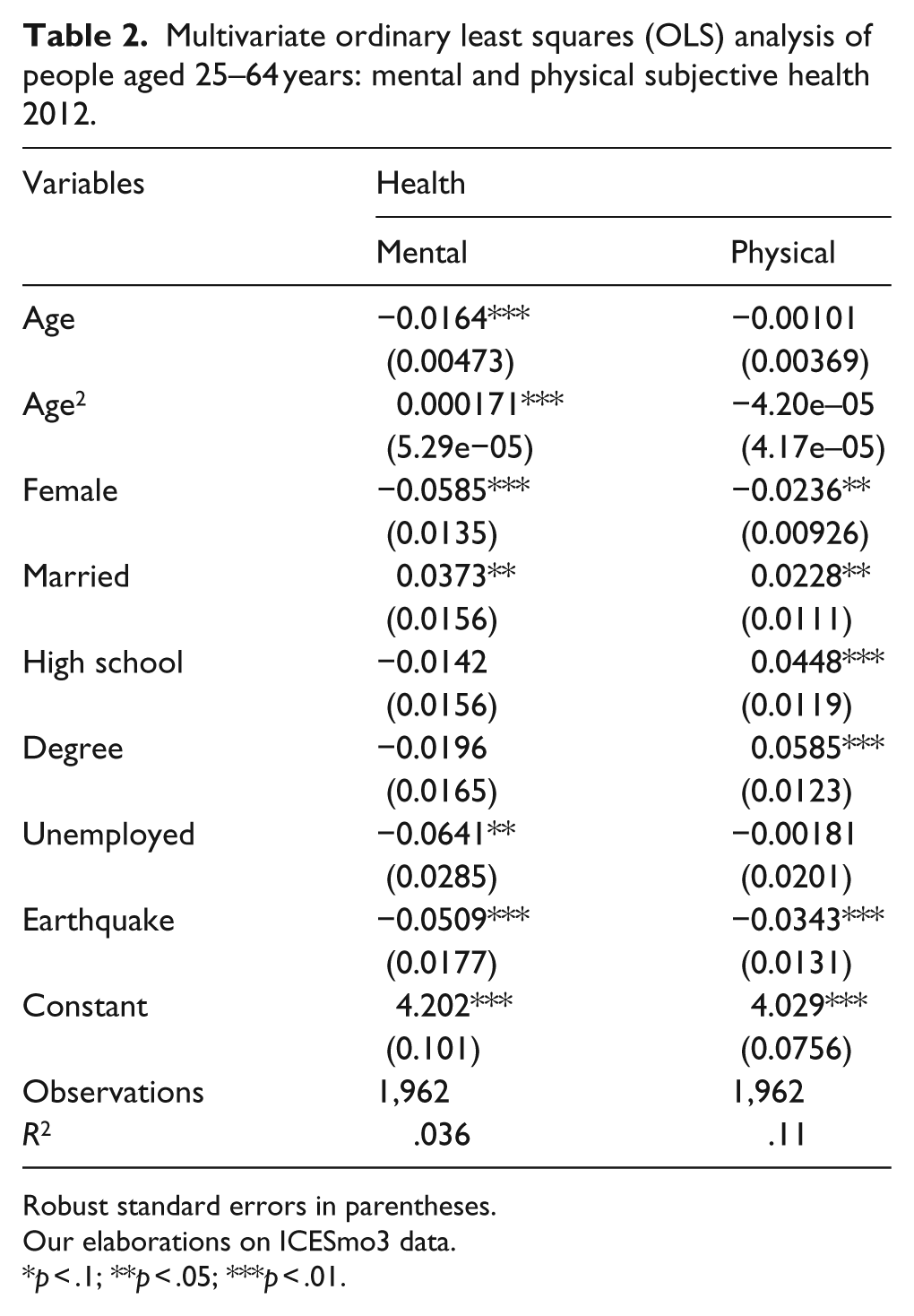
In the attempt to distinguish the effect of economic crisis and the 2012 earthquake, with regard to psychological health indicators, we set up a regression model where we assumed as two determinants of psychological health, job loss and, as a variable taking the value of 1, the fact that the subjects lived in an area of the province that had been hit by the earthquake within the Modena district (Table 2).
Multivariate ordinary least squares (OLS) analysis of people aged 25–64 years: mental and physical subjective health 2012.
Robust standard errors in parentheses.
Our elaborations on ICESmo3 data.
p < .1; **p < .05; ***p < .01.
Results
In 2012, psychological health decreased by 3.2 for men and by 2.7 for women in Modena, whereas on average, it decreased only by 1 and by 0.6 for men and women in the rest of Italy (Table 1).
In 2012, Modena showed 3 percentage points lower degree of psychological health score compared to the rest of the Country: the mean psychological health score for women was 47.3 in Modena and 47.9 in Italy, while for men was 46.9 in Modena and 50.1 in Italy.
The differences in health scores from our data were confined to the psychological health dimension, considering that, in terms of physical health, the statistical outlook was similar for men and, unexpectedly, even better for women in the context of the province of Modena compared to the rest of the Country (Table 1).
We have therefore carried out a multivariate analysis for year 2012 for the Modena district that has been hit by a severe earthquake in some municipalities. The data set collected by the CAPP (2013) allowed us to distinguish those areas in the district that have been hit by the earthquake from the others. Our results indicate that in 2012 statistically significant variables associated with a disadvantage in terms of mental health were female gender, older age, unemployment and exposure to the earthquake (Table 2).
However, the results of our multivariate analysis for year 2012 (Table 2) show important differences of the two events on the population living in the district. Living in a municipality that has been affected by the earthquake deteriorated both physical and mental health, although the effect is higher for mental health. Being unemployed has a negative effect only on psychological health, and the effect is higher than the one of the earthquake. Being unemployed decreases mental health by 6.4 percentage points, and living in a municipality within the district hit by the earthquake decreases mental health by 5 percentage points. Further analyses carried out by the Authors on 2006 data (before the crisis hit the district of Modena too) revealed a non-significant effect of unemployment status on people’s mental health.
Older age has a significant negative effect within the age group analysed only for mental health. Being female is found to have a negative effect both on mental and on physical health, the effect being higher for mental health. Being a woman deteriorates mental health by 5.9 percentage points and physical health by 2.4 percentage points.
Being more educated has a positive effect only on physical health (+4.5 percentage points if the person has a high school level of education and +5.9 percentage points if with a degree).
Discussion
Many studies have documented the role played by different social determinants in shaping physical and mental health. Economic downturn, unemployment and cut back in social welfare showed an association with decreased levels of mental health. Likewise, the occurrence of a natural disaster has been acknowledged as a major determinant of psychological distress and psychiatric morbidity. Nevertheless, our analysis represents the first attempt to provide evidence regarding how two concurrent events, such as financial crisis and an earthquake, can affect, as additional independent variables, indexes of mental health in the population.
In actual fact, on one hand, we were able to confirm the negative overall effect of the economic crisis on psychological wellbeing between 2006 and 2012; we observed how, within the province of Modena, such an effect was stronger when compared to the rest of Italy. Moreover, the detrimental impact of the crisis was even worse when we considered those areas struck by the earthquake.
The results of our multivariate analysis in terms of negative impact of unemployment and earthquake, as possible independent determinants of psychological health in Modena, showed a larger effect of unemployment status on mental health.
We may therefore conclude, according to our evidence, that being hit by a combination of two major negative events might have a significantly increased negative effect on psychological health. The higher repercussion observed in the context analysed is not attributable merely to the occurrence of a natural disaster but can be reasonably related to the additional effect of unemployment on psychological dimensions.
Conclusion
As a final consideration, we do believe that these results should bring the attention of policy-makers back to the importance of ensuring sufficient funding to mental health services, as well as promoting and supporting psychosocial interventions and social networks for people with mental health problems. This is particularly true in times of economic crisis, when too often these resources are at risk of being cut down.
On the other hand, professionals should be aware that similar psychopathological patterns may be the results of different determinants, whose assessment is essential to provide personalised care.
Footnotes
Declaration of Conflicting Interests
The author(s) declared no potential conflicts of interest with respect to the research, authorship and/or publication of this article.
Funding
The author(s) received no financial support for the research, authorship and/or publication of this article.