




Abstract
Background:
Mental health can help explain how social inequalities impact on health. Many current public health challenges are shaped by social, economic and environmental conditions that take a mental toll on society.
Purpose:
This article describes a conceptual framework illustrating the psychosocial pathways that link the wider conditions to health behaviours and outcomes. It draws out implications of this framework for mental health practice that aim to support policy and decision-making on future action to reduce health inequalities and presents practical examples of what can be done.
Methods:
This article expands on a report commissioned by Public Health England. A narrative review and synthesis of relevant evidence built on existing research by the Institute of Health Equity. A conceptual framework was developed and a consultation exercise with stakeholders helped to revise and illustrate it with practice examples.
Conclusions:
The field of mental health has much to contribute to prevention, not just of mental illness but also of physical health conditions and reduction of inequalities in life expectancy and healthy life expectancy, especially through collaborative public health action.
Introduction
No Health without Mental Health has become the cornerstone of national and international mental health policy dialogue. In England, recent emphasis has been on achieving parity of esteem: with the aim of giving equal attention and proportionate resources to mental health and physical health (HM Government, 2011, 2012; NHS England, 2016). Extensive evidence and advocacy, resonating with lived experience, has rightly pushed mental health up the public health agenda. Less attention has been paid to the role of mental health and wellbeing, and the determinants of mental health and wellbeing, in shaping the distribution of health outcomes. This article aims to fill that gap by providing a conceptual framework that focuses on social determinants of health and their relationship with mental health and wellbeing in the context of tackling health inequalities and presenting practical implications of the model.
It is widely understood in practice that inequity in distribution of power, money and resources leads to inequity in health outcomes (Commission on Social Determinants of Health (CSDH), 2008). However, the role of mental health as an intrinsic part of this causal pathway is less explicitly recognised in policy and practice (Friedli, 2009; Kelly & Russo, 2018; Royal College of Psychiatrists, 2010). Psychosocial pathways describe how social and material conditions affect health via states of mind (Marmot, 2005). Therefore, psychosocial pathways are an important part of the framework of causes that lead from social determinants to inequalities in health (CSDH, 2008; Marmot, Allen, Bell, Bloomer, & Goldblatt, 2012). Recognising the breadth of this causal framework, in particular the influence of psychosocial pathways, provides a comprehensive understanding of improving physical health and reducing health inequalities and the influence of mental health in achieving that.
This article is based on a report on psychosocial pathways (Bell, 2017), commissioned by Public Health England (PHE) from the Institute of Health Equity (IHE) at University College London (UCL). The report presents a conceptual model illustrating the psychosocial pathways between factors associated with social, economic and environmental conditions, psychological and psychobiological processes, health behaviours and mental and physical health outcomes. The report is part of a series of evidence reports on local action to reduce health inequalities in England through action on the social determinants of health. The report was launched as part of a new national programme of work on the prevention of mental health problems and promotion of good mental health, known as the Prevention Concordat for Better Mental Health (PHE, 2017).
Awareness of psychosocial pathways is important in addressing the full complexity of causation because it will help to avoid the ‘lifestyle drift’ of public health policy and practice which focus predominantly on individual behaviours with insufficient attention paid to the contexts that shape individual behaviours (Popay, Whitehead, & Hunter, 2010). In addition, embedding this awareness will support positioning mental health and wellbeing in all public health policies and practices and tackling the root causes of health inequalities. While good mental health and wellbeing is often recognised as a population health outcome, the report (Bell, 2017) collates and synthesises evidence on mental health and wellbeing as a determinant of physical health, summarised here below. This article expands on the implications for mental health action at the local level, drawing on existing practice examples that recognise and address psychosocial mechanisms within the causal pathway.
Method
The article is based on research carried out at the UCL Institute for Health Equity for a national publication, commissioned by PHE. The report included a narrative review and synthesis of relevant evidence, building on existing IHE work and work carried out for the World Health Organization (WHO) CSDH, the Marmot Review, the WHO European Review of Social Determinants and the Health Divide and related work. A conceptual model was developed (Figure 1), drawing on the conceptual framework developed by the CSDH, and literature searches were carried out on combinations of terms in the framework – examining relationships between inequalities in social determinants, psychosocial factors, health behaviours and health outcomes.
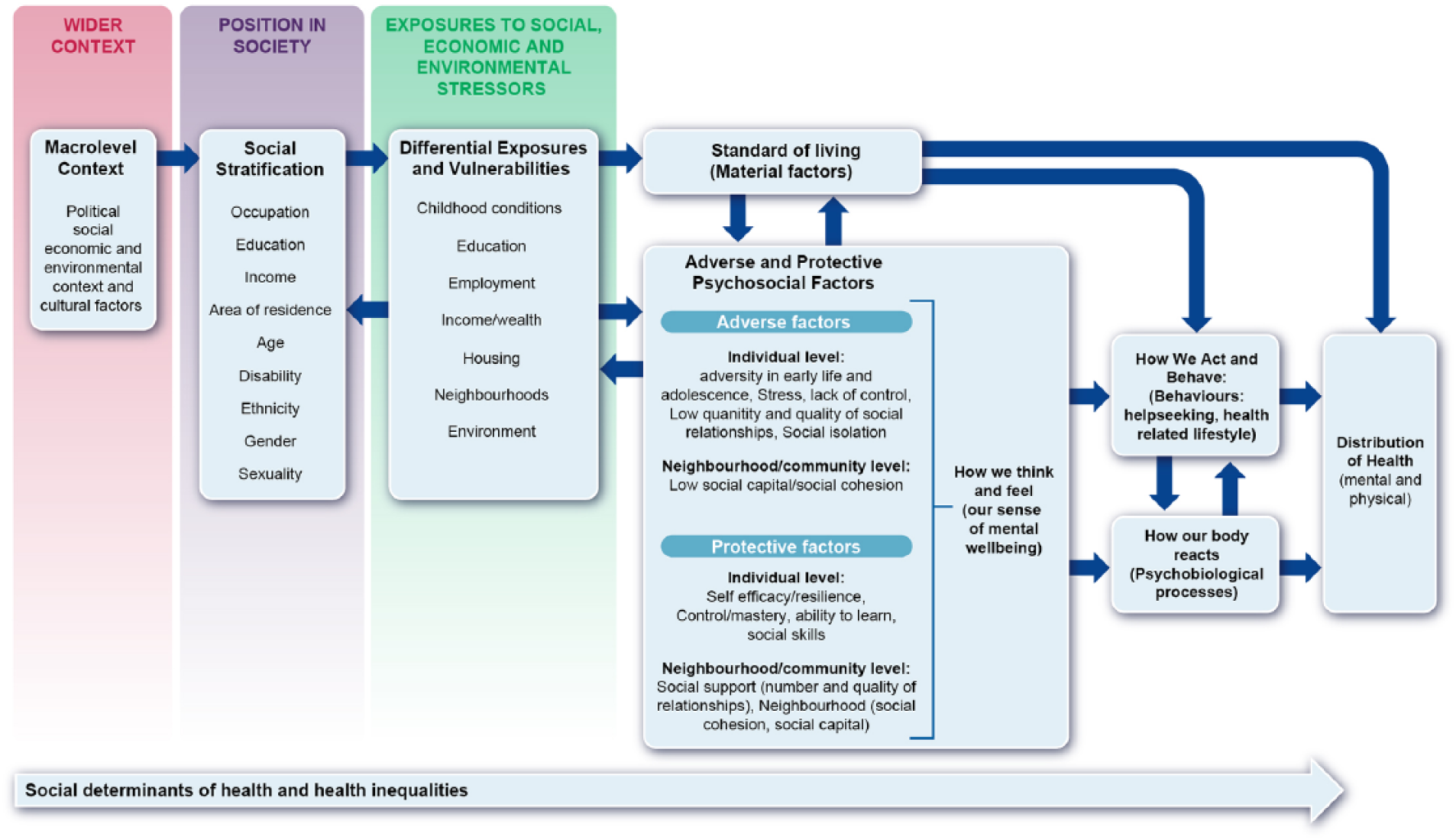
Psychosocial pathways: linking social determinants with psychobiological processes, health behaviours and distribution of health outcomes.
A consultation exercise was carried out with experts, including academics and practitioners. This helped to revise and develop the framework and gather practice examples of how comprehensive approaches across the causal pathway are being implemented. The consultation helped to develop recommendations and implications for practice. While the publication is focussed on local practice, there is also much to consider for national-level action.
A conceptual model
The term ‘psychosocial’ connects the social environment to psychological states that constitute aspects of mental wellbeing. ‘Psychosocial factors’ are understood as encompassing the nexus between social conditions and experiences and psychological states (Martikainen, Bartley, & Lahelma, 2002; Singh-Manoux, 2003). Figure 1 presents the links between social determinants, psychosocial factors, mental health and wellbeing, health-related behaviours and physical health.
Mental wellbeing is both a cause and consequence of poor physical health and lifestyle behaviours. However, the emphasis here is in describing the distal and proximal influences on physical health outcomes. Therefore, the model has been simplified into a linear diagram for ease of explanation while understanding that the pathway is a complex, dynamic and interactive network of relationships, not all visualised in Figure 1. There are many overlapping and bi-directional interactions in the pathways, for example, between health outcomes, social determinants and behaviours. This remains an active area of research.
Explaining the conceptual model from left to right, the macro-level national, political, social, economic and environmental context and cultural and social norms, shape the extent of social stratification within a country across a number of dimensions, including education, occupation, income/wealth, area of residence, age, disability, ethnicity, gender identity and sexuality (CSDH, 2008).
National-level contextual factors, including the economic climate, unemployment or insecure employment terms and conditions and poverty levels, affect people’s mental health and wellbeing (Parmar, Stavropoulou, & Ioannidis, 2016; Stuckler, Basu, Suhrcke, Coutts, & McKee, 2009). National and local responses to these macro-level influences affect the conditions in which people live and have a long-term impact on mental and physical health (CSDH, 2008).
Macroeconomic and social policies and social norms and practices influence the experiences of groups within social hierarchies (CSDH, 2008). Social stratification results in groups experiencing differential exposures and vulnerabilities to social determinants of health including conditions in childhood, education and employment as well as housing, neighbourhoods and the built and natural environment in which people live. The effects of these social determinants on health are mediated by psychosocial factors at individual and community levels. These include sense of control (Marmot, 2005; Whitehead et al., 2016), self-efficacy (Bandura, 2012), social connectedness (Berkman, Glass, Brissette, & Seeman, 2003; Holt-Lunstad, Smith, & Layton, 2010; Umberson & Montez, 2010), social capital and cohesion (Chuang, Chuang, & Yang, 2013; Uphoff, Pickett, Cabieses, Small, & Wright, 2013), belonging (Hystad & Carpiano, 2012; Ross, 2002) and discrimination (Krieger, 2014). Psychosocial pathways can be protective where they help build resilience and supportive social environments, or adverse, which can contribute to psychosocial stress. Combinations of protective and adverse experiences shape our mental wellbeing (Foresight Mental Capital and Wellbeing Project, 2008).
Stressors can take many forms, including adverse experiences in early life, difficult relationships, ill health, poor working and employment conditions, debt, neighbourhood deprivation and housing problems. Prolonged stress, if unmitigated by protective factors, has impacts on the nervous, cardiovascular, metabolic and immune systems that can affect health (Brotman, Golden, & Wittstein, 2007; McEwen, 2012). Stress and the wider conditions and opportunities that people experience, shape motivation, sense of control, self-efficacy, and in turn, health behaviours (Michie, van Stralen, & West, 2011). These include smoking, drug and alcohol use, healthy eating and physical activity, all of which are lifestyle factors contributing to risk of illness and premature mortality.
The focus of this conceptual model is on prevention, rather than treatment, and on the psychosocial pathways of physical morbidity rather than psychiatric morbidity.
Implications for action
The evidence suggests that psychosocial pathways are important to health inequalities and should be explicitly considered in efforts to reduce these inequalities (Bell, 2017). Some of the key messages for mental health action include the following:
Comprehensive action on health inequalities
Understanding the impact of psychosocial pathways enables a comprehensive approach to the complex network of factors that shape health. By this, we mean an approach that, among other things, recognises the significance of psychosocial pathways in mediating the effects of social determinants on health. One example of comprehensive action comes from Sandwell, in the West Midlands. The Sandwell model is innovative in that it represents a strategic and comprehensive approach at the city level that includes addressing social isolation and loneliness, control, resilience and wellbeing alongside wider determinants and lifestyle factors. Experience from Sandwell shows that this approach is feasible in practice, and it promises sustainable improvements in mental wellbeing as well as health inequalities (Sandwell Health and Wellbeing Board, 2016).
Mental health in all policy
Understanding the importance of psychosocial pathways can help to embed mental health and wellbeing into all policy. Health in All Policy provides a practical approach to consider the impacts of policy and programmes on health to create healthy public policy (PHE/Local Government Association (LGA), 2016). This should include wider determinants, psychosocial factors and pathways to health and health equity.
Mental health in all policy approaches have much to offer here. For example, the Mental Wellbeing Impact Assessment Toolkit (Cooke et al., 2011) addresses the wider determinants of mental health as well as key protective factors of control, resilience and capabilities, participation and inclusion. It has been used on local initiatives as well as broader strategies to help understand psychosocial pathways and embed action on mental wellbeing (Burford et al., 2017).
Reducing mental health inequalities
Reducing mental health inequalities, like physical health inequalities, requires addressing the social determinants of health (Marmot Review Team, 2010). While attention is paid to the differences in lifestyle behaviours observed among people with mental health problems compared to the general population, including higher smoking rates, obesity and lower physical activity levels, it is also necessary to understand the differences in intermediary factors such as social connections, control, neighbourhood cohesion and social capital as well as wider determinants such as warm homes, good jobs and adequate income, to address the causal pathway. A danger is that action to reduce the high premature mortality rates experienced by people with mental illness is concentrated on the proximal individual factors without addressing root causes or the psychosocial mechanisms that link them. Both approaches are necessary and prove complementary in improving outcomes.
For example, the Sheffield Mental Health Citizens Advice Bureau has provided welfare support to patients using secondary mental health services which has also led to reductions in inpatient care and the prevention of relapse and homelessness (Parsonage, 2013). This research by the Centre for Mental Health recommended that mental health service providers should recognise the important role of welfare advice in helping achieve improved social outcomes such as secure incomes and stable housing.
Trauma-informed care for treatment and prevention
The combined effect of stressors and trauma on population mental and physical health and wellbeing is substantial. Stressors exert effects from early childhood, throughout life, and therefore, a life course perspective is important. The prevention of mental health problems in particular requires action early in the life course, when many problems experienced later in life begin to develop.
Service responses such as trauma-informed mental health care (Sweeney, Clement, Filson, & Kennedy, 2016) and Routine Enquiry about Adversity in Childhood (REACh) across a wider workforce (Lancashire NHS, 2016) are emerging examples of practice in increasing practitioner awareness of adversity, its prevalence and impact and in re-orienting practice to respond appropriately. The REACh programme has trained practitioners and put an enquiry tool in place (McGee et al., 2015).
A systematic approach to prevention from the early years of life also includes addressing root causes notably reducing child poverty, creating health-enhancing school and family environments, enabling resilient family relationships and good parenting and providing psychologically informed support services and early intervention (IHE, 2014a, 2014b; Marmot Review Team, 2010; National Institute for Health and Care Excellence, 2012).
Promoting protective factors
The evidence suggests that protective factors can help buffer stress and so are important areas for action alongside reducing exposure to risk. Mental health promotion involves action to boost the factors that create good health and wellbeing and many of these exist at the community level. Mental health promotion interventions that build protection are relevant across the whole population and also for those experiencing mental health problems (PHE, 2015; Royal College of Psychiatrists, 2010).
Individual characteristics such as control, self-efficacy and resilience as well as the social characteristics described as ‘social capital’, such as social networks and participation, can protect health from the effects of stressors in some circumstances, and thus, positively influence health outcomes. Creating environments that promote mental health in schools, neighbourhoods and workplace environments is also important in this context.
Community-centred approaches can help to build empowerment, connectedness, participation, belonging and cohesion (PHE/NHS England, 2015). These are important for public health and also for providing effective, accessible and relevant services, including within mental health care (Power to Change, 2017).
The workplace is also a key setting for adult mental health, and while much emphasis is placed on supporting people with mental health problems into work, good management practices are conducive to creating a mentally healthy working environment that prevents problems arising, although more research in this area is needed (Bhui, Dinos, Stansfeld, & White, 2012). Local areas and employers can improve psychosocial working conditions by ensuring good-quality working conditions and good employment conditions (IHE, 2014c).
Psychosocial care pathways
Psychosocial pathways directly impact on physical health outcomes and also influence health-related behaviours. The evidence on the associations of stressors with high blood pressure, development of diabetes and ischemic heart disease suggests more holistic practice would be beneficial, such as the integration of psychosocial aspects within all care pathways. This is sometimes confined to early identification of mental health problems but could be much broader to include the promotion of mental wellbeing of all patients, including meeting social needs via approaches such as social prescribing and signposting to support services.
Strategies and services to prevent risk and disease such as cardiovascular disease (CVD) or diabetes can also do more to embed mental health and consider action to address psychosocial factors as well as wider determinants of health. For example, Integrated Wellness Services (Gate et al., 2016; LGA, 2017; Live Life Well Sunderland, n.d.) are an emerging model that connects services across healthy lifestyle, mental wellbeing, self-care and social determinants. They operate in community settings (e.g. Live Life Well in Sunderland) or in health care (Gate et al., 2016). Bringing mental and physical health and social wellbeing together can help promote multi-disciplinary practice with potential to strengthen parity of esteem.
Conclusion and recommendations
In summary, the importance of psychosocial pathways means that the field of mental health has much to contribute to prevention, not just of mental illness but also of physical health conditions and overall health inequalities, especially through collaborative public health action.
Efforts to reduce health inequalities require action across the causal pathway, specifically to the social determinants of health and mental health impacts.
Alongside the six actions outlined above, the significance of psychosocial pathways has implications for (a) the health and social care workforce development (PHE, 2015) – ensuring staff are equipped to address the root causes of health and the psychosocial factors; (b) knowledge and intelligence – improving analysis of data on psychosocial factors and pathways alongside the wider determinants of health. This will increase understanding of the causal pathways to disease and prevention, for example, the adverse and protective factors and (c) research and development – to further understand the complex systems of causation, life-course and prevention solutions.
Footnotes
Funding
The author(s) received no financial support for the research, authorship and/or publication of this article.