



Abstract
Background:
Korea has the highest rate of suicide in the world and has held this rank for the last decade. Suicide has risen especially sharply among 45- to 54-year-old Koreans; there were about 32.1 suicides per 100,000 individuals in 2015, and this contributed significantly to the rising suicide rate in Korea. Recently, adverse work conditions, including insecure employment and shift work, have been suggested as a suicide risk factor. However, little is known about the influence of insecure employment on suicidal ideation among middle-aged adults. Furthermore, prior research has examined the association between shift work and suicidal ideation only among individuals engaged in specific jobs, such as police work or firefighting, and those investigations have not focused on middle-aged adults.
Aim:
This study investigated the influence of employment status and shift work on suicidal ideation among middle-aged adults.
Methods:
The sample comprised waged, middle-aged adult employees (n = 2,364) aged 45–64 years who had participated in the cross-sectional Korea National Health and Nutrition Examination Survey 2015. Using multivariate logistic regression analyses, this study evaluated the associations of employment status and shift work with suicidal ideation among middle-aged adults.
Results:
The major finding was that insecure employment status was independently associated with suicidal ideation in middle-aged adults (odds ratio (OR) = 2.50, 95% confidence interval (CI) = [1.27, 4.94]) and that shift work was significantly associated with suicidal ideation among middle-aged adults (OR = 2.30, 95% CI = [1.14, 4.66]).
Conclusions:
The findings of this study highlight the need for multidimensional interventions regarding suicide, especially for middle-aged adults engaged in insecure jobs and shift work. Multidimensional interventions, including early screening for suicidal thoughts during routine medical check-ups, readily available work-based counselling programmes and regular monitoring, are likely to be useful.
Introduction
Suicide rates have decreased steadily in most developed nations, falling by close to 30% between 1990 and 2015 (Organisation for Economic Co-operation and Development [OECD], 2017). However, Korea’s suicide rate has risen sharply, from 8.8 per 100,000 individuals in 1990 to 28.7 per 100,000 individuals in 2015, an increase of almost 280% (Korea National Statistical Office, 1991, 2016). Korea now has the highest rate of suicide in the world, and it has held that rank for the last 10 years (OECD, 2016). Suicide has risen especially steeply among 45- to 54-year-old Koreans and was about 32.1 per 100,000 individuals in 2015, contributing significantly to the rising suicide rate in Korea (Kang & Lee, 2010; Korea National Statistical Office, 2016).
Recently, adverse work conditions, including insecure employment and shift work, have been suggested as a suicide risk factor. Lack of job security, one of the most salient phenomena affecting mental health, is associated with increased risk of suicide (Dalglish, Melchior, Younes, & Surkan, 2015; Mewes, Rief, Martin, Glaesmer, & Brähler, 2013; Woo & Postolache, 2008). In recent years, the prevalence of insecure employment (i.e. temporary or daily work) has been particularly noteworthy due to the economic recession in Korea. During the last 50 years, following the Korean War in 1953, Korea has achieved one of the world’s highest rates of economic growth, a so-called economic miracle, leaping from nonindustrial to industrial status. The per capita gross national product (GNP) increased dramatically, from US$80 in 1960 to US$28,000 in 2015 (Bank of Korea, 2016). However, the 1997 and 2008 economic crises in Korea had adverse impacts on employment status, especially among middle-aged adults. For instance, in 2015, 32% of wage workers in their 40s were employed in temporary jobs. Furthermore, insecure employment has become a long-term situation; for instance, only 22.4% of temporary workers move into a full-time or permanent position within 3 years (Korea National Statistical Office, 2017). Meanwhile, Korea’s social security system is inadequate; for instance, only 45% of temporary and daily workers, who are most in need of income security, are covered by the National Pension Program (Kwon & Holliday, 2007). An insecure employment status in midlife cannot ensure financial stability in later life. Thus, middle age is a crucial time for establishing one’s professional career (Erikson, 1963; Sterns & Huyck, 2001), and secure employment status may therefore be more important for middle-aged adults than for other age groups. However, little is known about the influence of insecure employment on suicidal ideation among middle-aged adults. Previous studies have focused on all age groups (Kim, Muntaner, Khang, Paek, & Cho, 2006; Mewes et al., 2013; Woo & Postolache, 2008) or only on young adults (Dalglish et al., 2015; Mann et al., 2005; Nock et al., 2008).
Meanwhile, the expansion of alternative work schedules, such as shift work, has become increasingly unavoidable due to globalisation and increasing competition (Costa et al., 2004; D’Souza, Strazdins, Lim, Broom, & Rodgers, 2003). In Western societies of today, only a quarter of the employed workforce are engaged in regular day work (Costa et al., 2004), whereas about one in five workers is a shift worker (Kantermann, Juda, Vetter, & Roenneberg, 2010; Vogel, Braungardt, Meyer, & Schneider, 2012). Shift work is itself a demanding work condition, and irregular job schedules are a stress factor in work-related environments that may negatively affect psychological well-being (Driesen, Jansen, van Amelsvoort, & Kant, 2011; Nakata, 2011). Previous studies have documented the association between shift work and suicidal ideation only among individuals engaged in specific jobs, such as police officers (Stanley, Hom, & Joiner, 2016; Violanti et al., 2008) and firefighters (Barros, Martins, Saitz, Bastos, & Ronzani, 2013).
Suicidal ideation is one of the strongest predictors of suicidal behaviour (Suominen, Isometsä, & Suokas, 2004; Wang & Mortensen, 2006). About 90% of unplanned and 60% of planned first suicide attempts occurred within the first year after the onset of suicidal ideation (Kessler, Borges, & Walters, 1999). Similarly, 31.3% of individuals who acknowledged suicidal ideation still endorsed these thoughts 2 years later, and 7.4% reported having made a suicide attempt in that time (ten Have et al., 2009).
Although associations of certain work conditions, including insecure employment and shift work, with suicidal ideation have been investigated previously, these studies did not focus on middle-aged adults. Given the marked increase in suicide among Koreans aged 45–54 years, investigations of the influence of work conditions on suicidal ideation among middle-aged adults may be particularly important for predicting suicidal behaviour.
The aim of this study was to investigate the influence of employment status and shift work on suicidal ideation among middle-aged adults. The major hypothesis of this study was that suicidal ideation is significantly associated with insecure employment status and participation in shift work.
Methods
Subjects
Waged middle-aged adult employees (n = 2,364) aged 45–64 years were recruited through the Korea National Health and Nutrition Examination Survey 2015 (KNHANES), which was performed by the Korea Centers for Disease Control and Prevention. Participants’ mean age was 44.7 ± 11.7 years.
Procedures
The raw data were acquired from KNHANES 2015, a cross-sectional study conducted by the Korea Centers for Disease Control and Prevention. Based on the National Health Promotion Act, KNHANES has been repeated at 3- to 4-year intervals since 1998; it uses a nationally representative sample to examine the health status and practices of Koreans. Since 2007, the interval between KNHANES studies has alternated to every year. KNHANES 2015 comprised four sections: a health interview, a health examination, a survey assessing health attitudes and behaviour and a nutrition survey.
To obtain a representative sample of the population, this study used a stratified multistage probability sampling method based on age, gender and geographical location using the 2010 Korean National Census Registry. The participants’ data were assigned weights to ensure equal sampling probabilities. Within the primary sampling units, investigators selected 3,153 households consisting of 9,505 individuals. From January 2015 to December 2015, a total of 6,704 individuals completed face-to-face interviews, a response rate of 70.5%. The sample was weighted to adjust for over-sampling and non-responders. The remaining 7,946 individuals included 1,525 individuals <20 years of age, 1,242 young adults 20–39 years of age, 3,631 middle-aged adults 40–64 years of age and 1,548 older adults ⩾65 years. The data analysis was limited to the 2,364 people who were waged, middle-aged employees.
Measures
Outcome measure
The dependent variable, suicidal ideation, was assessed using the following question: ‘During the past 12 months, did you ever seriously consider suicide?’ This question was answered with a ‘yes’ or ‘no’ response.
Work conditions measures
Work conditions were measured using two variables: employment status and shift work. Among waged employees, employment status was assessed by asking, ‘What is your current employment status?’ Respondents could select one of the following choices: (1) full-time work, (2) temporary work and (3) daily work. Responses regarding employment status were dichotomised for statistical analysis as ‘secure employment’ (full-time/permanent work) and ‘insecure employment’ (temporary/daily work). Shift work was evaluated by asking, ‘During the past 12 months, did you work during the day, or did you have other working hours?’ Respondents could select from the following choices: (1) day work, (2) regular day and night shifts, (3) 24-hour shifts and (4) irregular shift work. Responses regarding shift work were dichotomised for statistical analysis as ‘non-shift work’ (day work) and ‘shift work’ (regular day and night shifts/24-hour shifts/irregular shift work).
Sociodemographic measures
Participants were dichotomised by sex (men and women) and marital status (married or unmarried). The ‘married’ group included legally married couples, and the ‘unmarried’ group included single, divorced, separated and widowed individuals. Educational attainment was classified as ‘middle school or less’, ‘high school graduate’ and ‘college graduate or higher’. Household income was classified as ‘low’, ‘medium’ and ‘high’. Occupational category was classified as ‘manual or blue collar’ and ‘non-manual or white collar’.
Health behaviours and status measures
Health behaviours included smoking, alcohol use, stress, experience of depressed feelings for at least 2 weeks and self-rated health. Smoking was classified as ‘non-smoker’, ‘ex-smoker’ and ‘current smoker’. Level of alcohol use was classified into ‘never’, ‘low’ (less than once per week), ‘moderate’ (one to three times per week) and ‘high’ (nearly every day). Perceived stress was dichotomised by asking respondents whether they experienced ‘light or no’ stress or ‘some or heavy stress’ due to everyday events or circumstances (0 = no or nearly no stress, 1 = some or very much stress). Depressed feelings were evaluated by asking participants to answer ‘yes’ or ‘no’ to the question, ‘Have you experienced continuous feelings of sadness or depression that have affected your everyday life for 2 weeks or more during the past year?’ Self-rated health was assessed by asking participants how they perceived their current health status. The level of self-rated health was dichotomised into ‘excellent or good’ and ‘fair or poor’.
Data analysis
Bivariate analyses using the chi-square statistic were performed to assess suicidal ideation according to work condition, sociodemographic status and health behaviours and status. These assessments were followed by multivariate logistic regression analyses to evaluate the influence of independent variables on suicidal ideation. The odds ratio (OR) was used as a measure of association. All of the analyses demonstrated sufficient goodness-of-fit (Hosmer–Lemeshow test, p > .10). All statistical analyses were conducted using SPSS (version 20.0, SPSS, Inc., Chicago, IL, USA).
Results
Table 1 shows the prevalence of suicidal ideation during the past year in terms of work conditions. Middle-aged adults with insecure employment were more likely to experience suicidal thoughts, and engaging in shift work was significantly associated with suicidal ideation among middle-aged adults. The relationship between sociodemographic status and health behaviours and status was statistically significant (Table 2). Middle-aged adults who had less education (middle school or lower), who had lower household incomes and who engaged in manual work (blue-collar jobs) were more likely to report suicidal ideation. In addition, suicidal ideation was significantly associated with health behaviours. The current smokers among these middle-aged adults were more likely to have suicidal thoughts than were the non-smokers and ex-smokers. Perceptions of high levels of stress and experiences of depressed feelings for 2 weeks or more were significantly related to suicidal ideation among middle-aged adults.
Suicidal ideation among 2,364 waged employee among middle-aged adults in South Korea, according to work conditions.
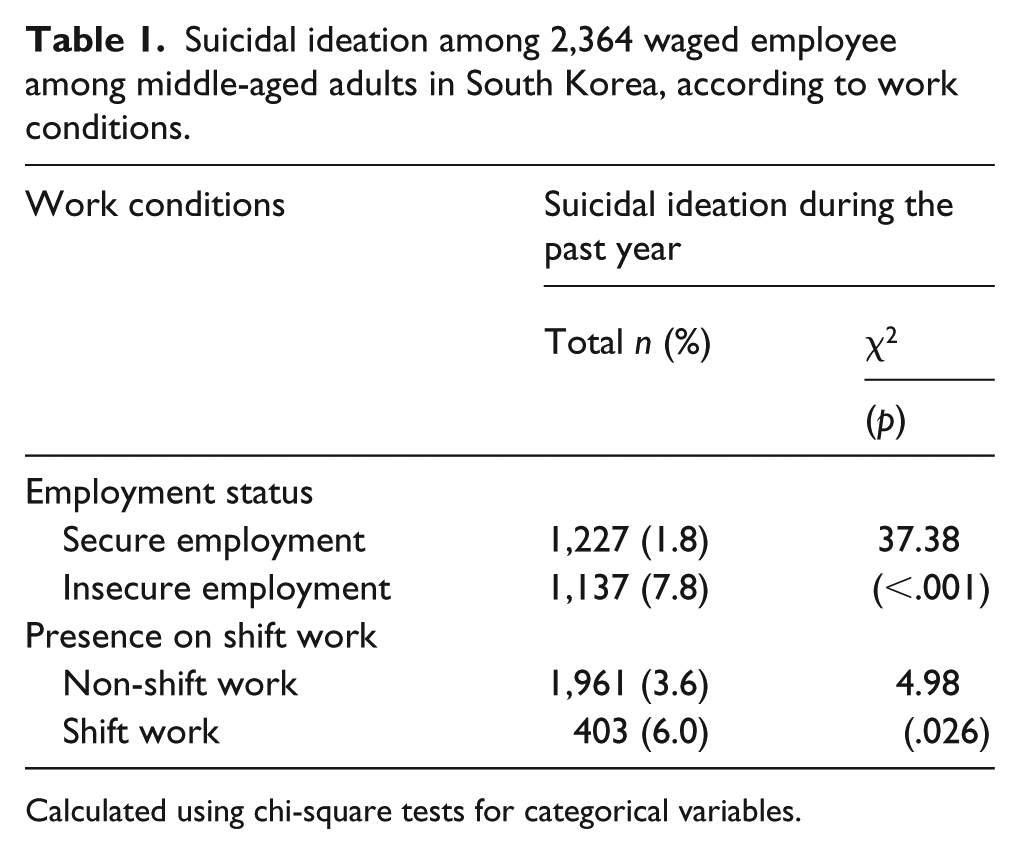
Calculated using chi-square tests for categorical variables.
Prevalence of suicidal ideation of 2,364 waged employee among middle-aged adults by sociodemographic status, health behaviours and health status in South Korea.

Calculated using chi-square tests for categorical variables.
To assess relationships between work conditions and suicidal ideation specifically, multivariate logistic regression analyses were performed (Table 3). After controlling for the influences of other covariates, the results showed that insecure employment status was independently associated with suicidal ideation in middle-aged adults (OR = 2.50, confidence interval (CI) = [1.27, 4.94]). Engaging in shift work was significantly associated with suicidal ideation among middle-aged adults (OR = 2.30, CI = [1.14, 4.66]).
Adjusted odds ratio (95% confidence interval) for suicidal ideation by employment status and shift work among 2,364 waged employee among middle-aged adults in South Korea.
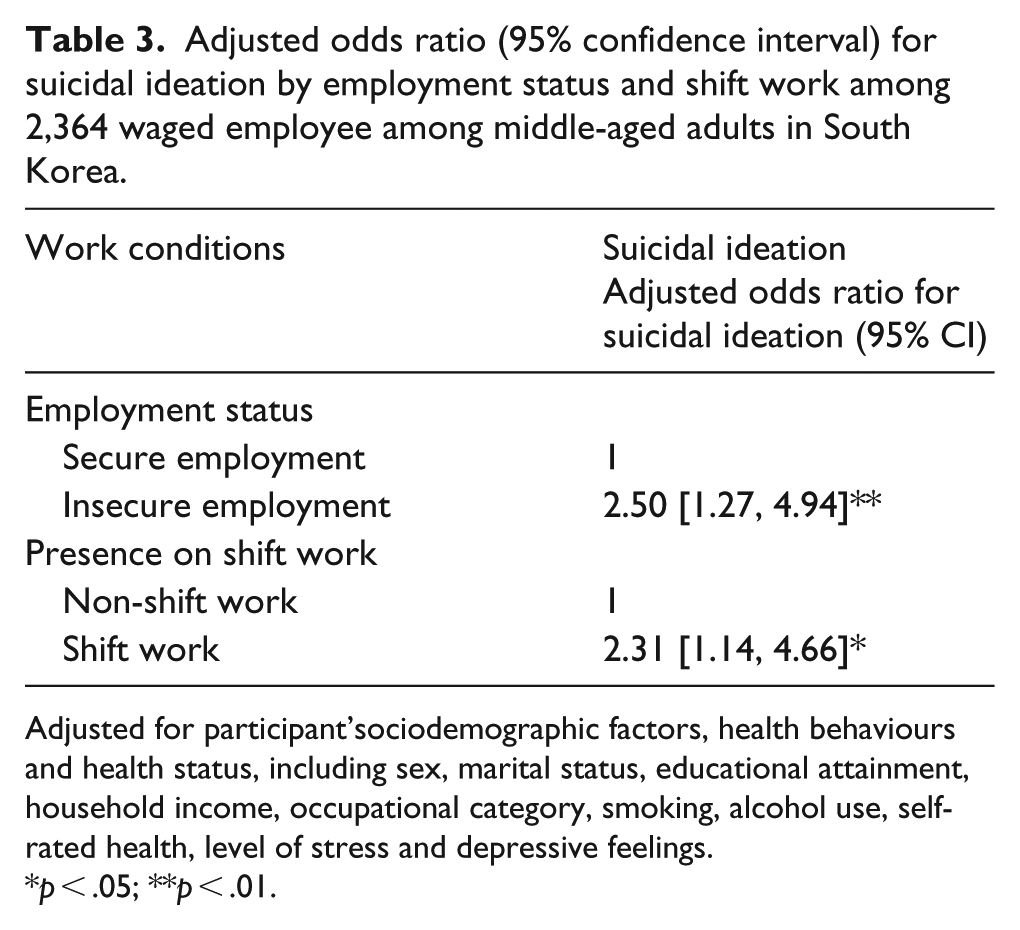
Adjusted for participant’sociodemographic factors, health behaviours and health status, including sex, marital status, educational attainment, household income, occupational category, smoking, alcohol use, self-rated health, level of stress and depressive feelings.
p < .05; **p < .01.
Discussion
The purpose of this study was to identify the effects of work conditions, especially employment status and shift work, on suicidal ideation among middle-aged Korean adults. The results supported the study hypothesis, revealing significant associations of suicidal ideation with both insecure employment and participation in shift work. The notable findings of this study concerned the significant influences of insecure employment status and shift work on suicidal ideation among middle-aged adults.
Insecure employment status and suicidal ideation among middle-aged adults
The results of this study showed that the highest rate of suicidal ideation was experienced by middle-aged workers engaged in insecure jobs. This finding has two potential explanations. First, psychological distress due to an insecure employment status may increase suicidal ideation among middle-aged adults. Unstable or insecure employment implies both the threat of job loss and uncertainty regarding future employment (Dalglish et al., 2015; D’Souza et al., 2003). Job insecurity was associated with a 33% greater risk of a common mental disorder (Gunnell, Platt, & Hawton, 2009; Stansfeld & Candy, 2006). Previous studies have demonstrated that insecure employment status was strongly associated with emotional distress (Mewes et al., 2013; ten Have, van Dorsselaer, & de Graaf, 2015; Woo & Postolache, 2008). Compared with permanent workers, temporary workers felt more depressed and reported more negative emotions, such as anxiety (Boyce, Ryan, Imus, & Morgeson, 2007; Witte, 1999). In terms of the family life span, as the middle generation between children and elderly parents, the midlife adult is the major provider of support for the family. Adults in midlife may be faced with multiple financial burdens, including rent or a mortgage, child care, medical bills and loans to family members (Lachman, 2004; McAdams, 2001; Rook, 2003; Walen & Lachman, 2000). Therefore, work and employment status are likely to be central for middle-aged adults (Erikson, 1963; Sterns & Huyck, 2001). The results of the present study showed high rates of suicidal ideation in middle-aged adults engaged in insecure jobs (i.e. temporary or day work) after controlling for psychological conditions, such as stress and depression. Although identifying a direct pathway between factors related to insecure employment and suicidal ideation is difficult, psychological distress and mental disorders other than stress and depressed feelings may lead to suicidal thoughts among middle-aged adults working in insecure jobs. Second, an adverse psychosocial work environment may induce suicidal ideation among middle-aged adults engaged in unstable jobs. Temporary work is characterised by low decision latitude, an effort–reward imbalance due to low salaries and low self-esteem (Taris & Kompier, 2003; Tennant, 2001). Previous studies have found a significant increase in emotional exhaustion and job dissatisfaction among those with temporary jobs (Mewes et al., 2013; Witte, 1999; Woo & Postolache, 2008). The deleterious psychosocial work surroundings associated with insecure employment may also result in diminished psychological well-being among middle-aged workers, which can lead to suicidal ideation.
Shift work and suicidal ideation among middle-aged adults
In this study, the multivariate analysis showed that engaging in shift work was significantly associated with suicidal ideation among middle-aged adults. This finding has at least two possible explanations. First, shift work may lead to isolation from family members or interfere with formal and informal social participation, which may negatively influence the psychological well-being of middle-aged adults. Previous studies have demonstrated that shift workers who experienced feelings of disconnection from their family or peer group reported higher suicidal ideation (Skipper, Jung, & Coffey, 1990; Violanti et al., 2008). The interpersonal-psychological theory of suicide suggests that the weakening of interpersonal relationships increases the risk for suicidal ideation (Joiner, 2005; Miller, Esposito-Smythers, & Leichtweis, 2015). Therefore, a lack of social interaction may, in part, account for suicidal ideation among shift workers in midlife. Second, physiological disturbances, including interruption of the circadian rhythms and sleep cycle, may increase suicidal ideation in middle-aged adults engaging in shift work. Shift workers are exposed to light even at night, which disrupts the circadian system and normal melatonin secretion (Schernhammer & Schulmeister, 2004; Violanti et al., 2008). Low levels of melatonin due to shift work may induce or aggravate mood disorders and increase suicidal risk (Hickie & Rogers, 2011; Woo & Postolache, 2008). In addition, sleep disturbance may increase suicidal ideation in shift workers during midlife. Shift work disrupts sleep and alert cycles, resulting in disturbed daytime sleep and excessive sleepiness during the work shift. Sleep impairment due to shift work is a potential risk factor for suicidal ideation (Vargas de Barros, Martins, Saitz, Bastos, & Ronzani, 2013; Wright, Bogan, & Wyatt, 2013; Yoon, Bae, Kang, & Yoon, 2015). Previous studies have demonstrated that the prevalence of suicidal thoughts increased by 13% among workers engaging in shift work compared with non-shift worker (Barros et al., 2013; Stanley et al., 2016).
Limitations
The limitations of this study should be considered when interpreting the results. First, as the data in this study were cross-sectional, the causal direction of the association of insecure employment and shift work with suicidal ideation was not definitely established. Second, the possibility of selection bias cannot be ruled out because the sample was limited to only 2,364 middle-aged waged employees 40–64 years of age. The participants were selected from a total of 3,631 middle-aged adults, and the exclusion of others may have given rise to a biased study sample. Third, the single-item assessments may have limited the reliability of the data on suicidal ideation and depressive feelings. These variables could not be subdivided because the 2015 KNHANES used only a single question to measure this issue. In the future, a longitudinal study with more specific structured interview instruments should be performed to clarify the degrees or levels of suicidal ideation and depressive feelings. In addition, it is necessary to consider the history of suicide attempts to take into account the fluctuating nature of suicidal ideation. Fourth, the observed relationships of insecure employment and shift work with suicidal ideation may have been confounded by unmeasured factors related to the work environment. For instance, the characteristics of the physical agents (e.g. lighting, noise, temperature) and the degree of exposure to chemical substances (e.g. pollutants, chemosensory factors) and biological elements (e.g. infectious agents, allergens) may directly or indirectly affect the psychological well-being of insecure and shift workers. Poor working environments may be conductive to mood disorders and a wide range of mental health problems, including suicidality (Boker, Leibenluft, Deboeck, Virk, & Postolaceh, 2008; Morrow, Stein, Bagovich, Condray, & Scott, 2001; Woo & Postolache, 2008). In a future study, consideration of a broader range of work environment-related factors could clarify the associations of insecure employment and shift work with suicidal ideation among middle-aged adults.
Conclusion
In conclusion, the findings of this study highlight the need for multidimensional interventions regarding suicide, especially among middle-aged adults who engage in insecure jobs and shift work. Multidimensional interventions, including early screening for suicidal thoughts during routine medical check-ups, easy access to work-based counselling programmes and regular monitoring, are likely to be useful. In addition, education aimed at raising awareness of the risks of insecure employment and shift work may contribute to the prevention of suicide among middle-aged adults. In addition, it is necessary to focus suicide prevention measures on middle-aged workers who are experiencing insecure employment and shift work.
Footnotes
Acknowledgements
The author would like to give special thanks to Professor Dinesh Bhugra and an anonymous reviewer for valuable comments. The author acknowledges the support provided by the Hanyang Women’s University (2019-1).
Funding
The author received no financial support for the research, authorship, and/or publication of this article.