



Abstract
Background:
Socio-political circumstances, including security, poverty, national wealth, income inequality, social integration and political conflicts, determine population health. Anticipated socio-political developments refer to the perceived improvement/deterioration in these circumstances in the future year.
Aims:
This study tested relationships between this anticipation and population mental health (probable depression/depressive symptoms and life satisfaction) and the mediation roles of negative personal responses toward socio-political situations (frustration, emotional disturbance, self-efficacy in political involvement, perceived sense of security, and satisfaction about societal ability in fulfilling individuals’ needs) in explaining these relationships.
Method:
The telephone survey randomly interviewed 420 (59.5% female) adults in Hong Kong. Questionnaire included scales assessing the aforementioned variables.
Results:
Most participants (71.7%) had pessimistic anticipations over socio-political developments; 11.3% of the participants were classified as having probable depression. Anticipated deterioration in socio-political developments was significantly associated with depressive symptoms and life satisfaction; emotional disturbance, sense of security and need satisfaction were partial mediators of these relationships. Need satisfaction and sense of security showed the strongest mediation effects both for mediations that involved depressive symptoms and life satisfaction.
Conclusion:
Both politicians’ awareness and mental health promotion are required to alleviate the negative impact of negative socio-political perception on mental health.
The socio-ecological model indicates that besides individual and inter-personal factors, structural factors are important determinants of population health (Richard, Gauvin, & Raine, 2011). Examples of structural socio-political factors include security, poverty, national wealth, income inequality, social integration and political conflicts (Cooper, 2011; Dawes, 1985; Stanley, Hensher, Stanley, & Vella-Brodrick, 2011). These factors are social determinants that affect distributions of political power, resources and health status (Commission on Social Determinants of Health & World Health Organization, 2008).
There is a dearth of studies that investigated relationships between perceptions on socio-political developments and population mental health. Hou et al. (2015) found that perceived loss of personal, social and economic resources were significantly associated with depression and anxiety during the Occupy Central movement that occurred in Hong Kong in 2014. Previous work by the authors showed that negative personal responses related to the movement (e.g. worry about safety) and concerns about local political situations were significantly associated with depression, anxiety and negative affect.
Few studies investigate the underlying mechanisms between perceptions on socio-political developments and population mental health. Such relationships are potentially supported by two theories. The social stress theory suggests that problematic social organizations/structures/circumstances would enhance stress and aggravate negative feelings and poor mental health (Aneshensel, 1992). For instance, the racial segregation policy caused stressful life experiences that diminished psychological well-being among South Africans (Dawes, 1985); unemployment and poverty elevated stress which increased prevalence of suicide, mental health problems and risk behaviors (Cooper, 2011). The self-determination theory (Deci & Ryan, 1985) suggests that individuals try to control their social environment to satisfy psychological needs, including the perceptions of competence, relatedness and autonomy. Failures in meeting these needs will reduce psychological well-being. For instance, perceived deterioration of the democratic electoral system may reduce satisfaction of needs such as political efficacy and mastery of the environment (Karp & Banducci, 2008); group conflicts, social exclusion and inequality reduced minority groups’ sense of relatedness and population mental health (Stanley et al., 2011). The theories imply that personal responses to socio-political situations (e.g., emotional responses and political self-efficacy) would mediate the associations between anticipated socio-political developments and population mental health.
In Hong Kong, many citizens expressed doubt about the twenty-year-old ‘One Country, Two Systems’; a small group of citizens even pledged independence (Yuen, 2015). Conflicts among political parties, interest groups, and ethnic groups have intensified (So, 2014). Frequent filibustering (labu) has affected efficiency in legislation and citizens’ daily livelihood (So, 2014). Real estate and rental costs are the least affordable in the world (Yau & Zhou, 2017). Riots and violent demonstrations occurred, and sense of security may have diminished. International rankings for important socio-economic parameters (e.g., quality of life, media freedom and global competitiveness) have dropped but the Gini index has increased (Yau & Zhou, 2017). Local surveys showed that the government is lowly supported by the general public (The University of Hong Kong, Public Opinion Programme, 2017). A local survey conducted during the Occupy Central movement in 2014 (Center for Communication and Public Opinion Survey, 2014) showed that most residents were pessimistic about Hong Kong’s future socio-political developments. The Occupy Central movement and recent protest against extradition law have drawn international attention.
Given the background, we investigated levels/direction of the Hong Kong Chinese general public’s perceptions of socio-political developments, and five types of related personal responses (i.e. frustration, emotional disturbance, self-efficacy in political involvement, perceived sense of security, and satisfaction about societal ability in fulfilling individuals’ needs). In addition, we tested relationships between these perceptions and mental health (i.e. depressive symptoms and life satisfaction) and potential mediators. We hypothesized that anticipated deterioration in socio-political developments would be associated with higher likelihoods of depression and lower life satisfaction, and vice versa, and such associations, if any, would be mediated by the aforementioned five types of personal responses.
Methods
Study design
In March 2017, a cross-sectional population-based telephone survey interviewed Chinese-speaking people aged ⩾18 years in Hong Kong between 6 and 10 p.m. to avoid over-sampling non-working individuals. Telephone numbers were randomly drawn from the most updated residential telephone directory. Eligible household members whose birthday was closest to the survey date were invited to join the study. Two follow-up calls were conducted for unanswered calls. Verbal informed consent was obtained from the participants. The anonymous interview took 10–15 minutes. No incentive was given to the participants. Of the 632 eligible participants identified, 420 completed the interviews. The response rate was 66.5%. Ethics approval was obtained from the authors’ university.
Measures
Background characteristics: Information about participants’ socio-demographics, child, religious beliefs and voting behavior was obtained.
Probable depression/depressive symptoms
The 20-item Center for Epidemiologic Studies Depression Scale (Radloff, 1977) was used (Likert-type scales of 0–3). Higher summative scores reflect more depressive symptoms. A cut-off point (⩾16) has been used to denote probable depression, which was significantly associated with clinical assessments (Amtmann et al., 2014). The Chinese version has been validated and widely used in Chinese populations (Cheung, Liu, & Yip, 2007). The Cronbach’s alpha was .79 in the present study.
Life satisfaction
It was assessed by the item ‘In general, to what extent you feel satisfied with your life’ (1 = strong dissatisfaction to 7 = strong satisfaction) (Andrews & Withey, 2012), which has been widely used in Chinese populations (Chen & Davey, 2008; Leung & Zhang, 2000).
The anticipated socio-political development scale
Participants rated anticipated socio-political developments in Hong Kong (next 12 months). The 29 items were created by an interdisciplinary team. They cover various domains of socio-political developments (economy, freedom, equity and equality, care for youth and elderly, security, social harmony, rule of law and democratic election) (Cooper, 2011; Dawes, 1985; Commission on Social Determinants of Health & World Health Organization, 2008). The statements were rated on Likert-type scales (1 = becoming much worse to 5 = becoming much better). Scores above the mid-point reflected anticipated improvements and vice versa. Half of the data were randomly selected for exploratory factor analysis (EFA). Using the maximum likelihood method with varimax rotation and Kaiser normalization and based on eigenvalues (>1) and screen plots, eight factors (73.8% of the variance explained) were identified (KMO = .89; Bartlett’s test, χ2(406) = 3,770.08, p < .001, k = 9.3). A second-order confirmatory factor analysis was applied to another half of the data. The model fit was acceptable, χ2(406) = 839.57, p < .001, comparative fit index (CFI) = 0.89, non-normed fit index (NNFI) = 0.88, and root mean square error of approximation (RMSEA) = 0.07. All factor loadings were statistically significant and larger than 0.4. Results confirmed that the theorized construct loaded into these factors well, and an overall scale score obtained by summarizing all item scores can be used in data analysis. Cronbach’s alpha was .94.
Personal frustration over socio-political developments
The Socio-Political Frustration Scale was adapted from Peters, O’Connor, and Rudolf’s (1980) scale, which was developed in the context of job frustration. The three items are the following: ‘Trying to get the socio-political situations in Hong Kong changed was a very frustrating experience’, ‘Being frustrated comes with the socio-political situations in Hong Kong’, and ‘Overall, I experienced very little frustration on the socio-political situations in Hong Kong (reverse scored)’ (1 = strongly disagree to 7 = strongly agree; Cronbach’s alpha = .72).
Emotional disturbance
Two items assessed emotional disturbance regarding current and future socio-political situations: ‘Do you experience emotional disturbance due to the current/future socio-political situations in Hong Kong’ (1 = never to 3 = always), used in previous work by the authors. Higher scores represent greater emotional disturbance. The two items were positively correlated with each other (r = .79, p < .001).
Societal satisfaction over individuals’ needs
A single item was used: ‘I can get what I need from the Hong Kong society’ (1 = strongly disagree to 4 = strongly agree).
Sense of security
A single item was used: ‘In general, I possess a good sense of security living in Hong Kong’ (1 = strongly disagree to 7 = strongly agree).
Perceived self-efficacy in political involvement
A single question was used: ‘People like me are in general eligible to participate in the political activity and decision making in Hong Kong’ (1 = strongly disagree to 5 = strongly agree).
Statistical analysis
Associations between background variables and dependent variables were tested by logistic regression for the binary variable of probable depression, and linear regression for the continuous variables of depressive symptoms and life satisfaction. Adjusted for significant background variables, multiple logistic and linear regression models were fit for probable depression and depressive symptoms/life satisfaction, respectively. Mediation effects were tested, using Baron and Kenny’s method and Sobel test. SPSS 16.0 was used for data analyses; p values <.05 were taken as statistically significant.
Results
Descriptive statistics
In Table 1, 59.5% of the participants were female, 56.8% aged <60 years and 75% were currently married. The majority had had secondary school education or below (73.1%), no religious belief (72.1%) and no child aged <18 years (84.5%). Prevalence of mild to severe probable depression was 11.3% (CESD ⩾ 16), and 10.7% scored 1–3 in the life satisfaction scale (range from strongly disagree to slightly disagree).
Background characteristics of the participants (n = 420).

In Table 2, the mean of the anticipated socio-political developments score (78.3) was much lower than the mid-point that reflected neutral anticipation (87.0), with 71.7% scored below the mid-point. Many participants also scored above/below the neutral mid-points of some scales in the direction that reflected negative responses toward socio-political situations (62.1%, 42.6% and 60.0% for scales reflecting frustration, societal ability in fulfilling needs and perceived self-efficacy in political involvement respectively). Overall, 93.3% showed either at least one scale score that reflected negatively anticipated socio-political developments or at least one related to negative personal responses.
Means and standard deviations of anticipated socio-political developments and related personal responses.
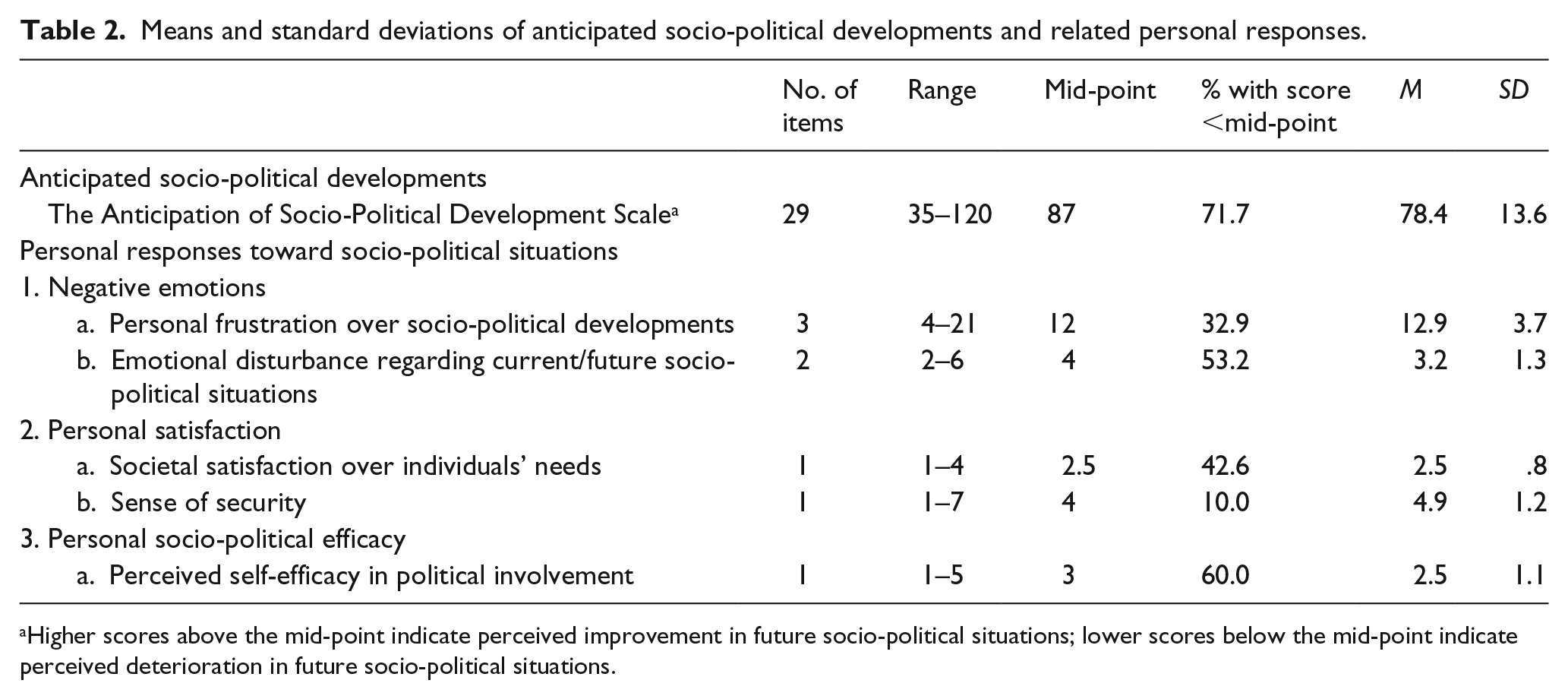
Higher scores above the mid-point indicate perceived improvement in future socio-political situations; lower scores below the mid-point indicate perceived deterioration in future socio-political situations.
Factors associated with mental health measures
The significant background factors of dependent variables included age and current marital status. Age was positively associated with life satisfaction (B = .09, beta = .20, p < .001). Being currently married (reference: being single/divorced/separated/widowed) was associated with less depressive symptoms (B = −3.11, beta = −.21, p < .001) and probable depression (odds ratio (OR) = .32, p < .001) and more life satisfaction (B = .49, beta = .19, p < .001).
In Table 3, adjusted for significant background variable(s), lower anticipated socio-political development scores (i.e. more negative anticipations) were associated with more depressive symptoms and lower life satisfaction. All the five types of negative personal responses toward socio-political situations were significantly associated with more depression symptoms and lower life satisfaction scores, respectively. Similar adjusted analysis showed that probable depression was significantly associated with lower anticipated socio-political development scores, greater emotional disturbance, and lower satisfaction about societal ability in fulfilling needs, but not with frustration, sense of security and self-efficacy.
Adjusted associations between variables related to anticipated developments/related personal responses and probable depression/depressive symptoms/life satisfaction.
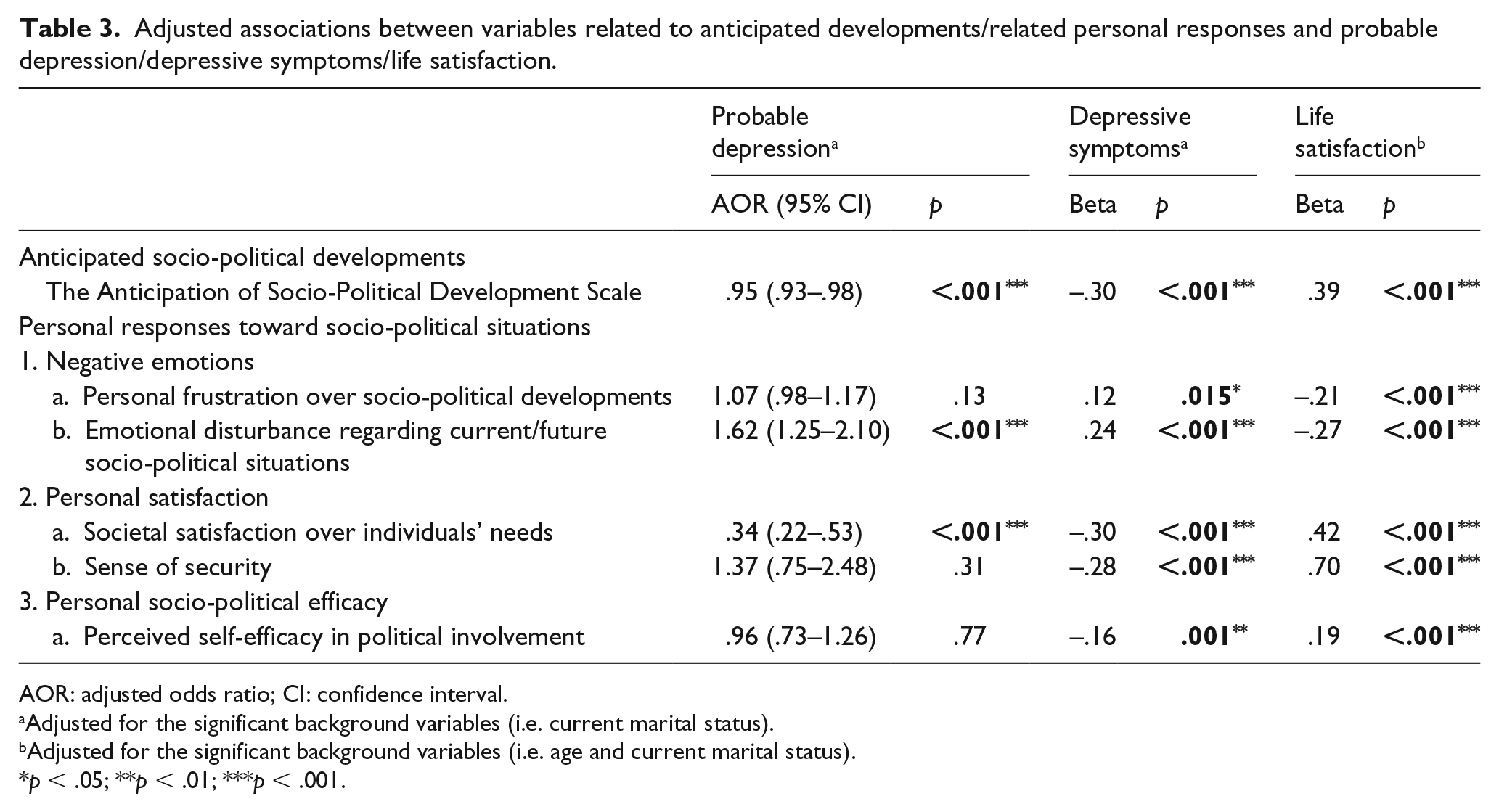
AOR: adjusted odds ratio; CI: confidence interval.
Adjusted for the significant background variables (i.e. current marital status).
Adjusted for the significant background variables (i.e. age and current marital status).
p < .05; **p < .01; ***p < .001.
In backward regression analysis (Table 4), (1) the model of depressive symptoms retained anticipated socio-political developments (–), emotional disturbance (+), satisfaction about societal ability in fulfilling needs (–), sense of security (–) and perceived self-efficacy in political involvement (+; which had the largest beta; R2 = .21). (2) The model of probable depression retained anticipated socio-political developments (–) and satisfaction about societal ability in fulfilling needs (+). (3) The model of life satisfaction retained frustration over socio-politics (–), satisfaction about societal ability to fulfill needs (+), sense of security (+ and with the largest beta) and self-efficacy in political involvement (+) (R2 = .51).
Backward multiple regression analysis for factors of probable depression, depressive symptoms and life satisfaction.

AOR: adjusted odds ratio; CI: confidence interval; the ‘–’ denotes excluded variables.
Adjusted for the significant background variable (i.e. current marital status).
Adjusted for the significant background variable (i.e. age and current marital status).
p < .05; **p < .01; ***p < .001.
Testing mediation effects
To avoid presenting too many models, we did not test probable depression as an outcome in the mediation models. The variable of anticipated socio-political developments was significantly associated with depressive symptoms, life satisfaction, and all but one (self-efficacy) potential mediators (r = .44–.51, p < .001). Adjusted for anticipated socio-political developments, three personal response variables (emotional disturbance, societal satisfaction over individuals’ needs, and sense of security) were significantly associated with depressive symptoms and life satisfaction (Table 5). Six mediation hypotheses that involved these three potential mediators hence fulfilled Baron and Kenny’s requirements, and were tested. All the six tests were statistically significant (Sobel test: p < .05) and showed partial mediations, with indirect mediation effects ranged from 18.6% to 31.9% for mediations of depressive symptoms and 13.8% to 68.3% for mediations of life satisfaction. Satisfaction about societal ability in fulfilling needs and sense of security showed the strongest mediation effects both for mediations that involved depressive symptoms and life satisfaction.
Testing mediation effect of personal responses related to socio-political situations for the associations between anticipated socio-political developments and depressive symptoms/life satisfaction.

1a–4a: mediation models with depressive symptoms as dependent variable; 1b–4b: mediation models with life satisfaction as dependent variable.
Adjusted for the significant background variable (i.e. current marital status).
Adjusted for the significant background variables (i.e. age and current marital status).
Reduction in beta = difference in beta as compared to those shown in Table 3.
p < .05; **p < .01; ***p < .001 (Sobel test).
Discussion
Socio-political tension depletes individuals’ internal and external resources and induces negative feelings. Anticipated deteriorations in socio-political developments may have led to substantial mental health distress. This study is the first attempt to test such anticipations as independent variables and depression and well-being as outcomes. Anticipated deteriorations in socio-political developments may be a new structural factor of mental health problems. Our results provide new evidence about such under-emphasized relationships. Furthermore, the study suggests potential mechanisms to understand these associations by testing the mediation roles of negative personal responses to socio-political situations. It potentially unfolds a relatively new research direction. Longitudinal and cross-cultural studies are warranted.
Consistent with those previous studies based on the same assessment tool conducted in Hong Kong (Yau & Zhou, 2017) and other countries (Vilagut, Forero, Barbaglia, & Alonso, 2016), about 10% of the participants were probable mild to severe depression cases in the general population. Corroborating previous studies, single/divorced/separated/widowed participants or younger participants reported more depressive symptoms and lower life satisfaction than others (Jang et al., 2009; Mroczek & Spiro, 2005). Mental health promotion should pay attention to these sub-populations.
Importantly, we observe relatively high levels of socio-political discontent which was expressed as anticipated negative socio-political developments and negative personal responses toward socio-political situations. Consistently, 70.5% of the participants of a survey conducted during the Occupy Central movement in 2014 (Center for Communication and Public Opinion Survey, 2014) were pessimistic about Hong Kong’s future socio-political developments. The strong socio-political tension in Hong Kong is unlikely to wane in the recent future. It is warranted to set up a surveillance system to track changes in levels and direction of anticipated socio-political developments and related negative responses, as our study shows that such perceptions have important potential negative impact on population mental health.
The findings support the contention that the intensifying socio-political tension in Hong Kong has possibly formed a ‘new’ structural stressor that negatively impacts mental health of the general population (Lau et al., 2017). The factor would exert additional load on the already heavy burden of mental health distress in the general population. Furthermore, personal negative responses toward socio-political situations were significantly associated with higher risk of depression and lower life satisfaction; such results also corroborate previous studies (Hou et al., 2015; Lau et al., 2017). Prior to the handover to mainland China, Hong Kong people were known to be indifferent to politics and emphasize improvement of family well-being (Siu-Kai & Hsin-Chi, 1995). Politics and responses to politics may have played new and increasingly important roles in people’s life in Hong Kong. A recent report reported that prevalence of depression of Hong Kong residents increased during the recent anti-extradition bill protests (‘Depression Numbers Now at a 10-Year High’, 2019). The trends of societal polarizations, heated debates, confrontations and even violence in Hong Kong have affected people’s daily lives; such shocking and unpleasant experiences might have led to anticipated negative developments and negative responses.
The importance of personal negative responses to socio-political situations is further supported by their mediation effects for the significant association between anticipated socio-political developments and mental health. The findings imply that anticipated negative socio-political developments might induce negative personal responses, which might increase depressive symptoms and reduce life satisfaction. It is important that interventions would reduce the size of the mediators (i.e. negative personal responses) in face of anticipated negative socio-political developments. The mediation findings hence provide new insights and research questions on how anticipated socio-political developments could affect personal mental health. Such causal relationships, however, need to be confirmed by longitudinal studies. Furthermore, the observed significant mediations, in general, support the social stress theory (Aneshensel, 1992) and the self-determination theory (Deci & Ryan, 1985). The findings therefore may have significant theoretical implications, although we do not intend to test the theories formally.
Some mediation hypotheses were, however, not supported by our data. Self-efficacy in political involvement was not a significant mediator, as it was not significantly associated with anticipated socio-political developments. Our overall measurement of anticipated socio-political developments did not focus specifically on anticipation on political participation. The relationship between overall anticipated negative socio-political developments and specific self-efficacy in political involvement is thus unclear. Furthermore, frustration due to the socio-political situations was not a mediator because its associations with depressive symptoms and life satisfaction became non-significant when anticipated socio-political developments were adjusted for, although the correlations among the three variables were statistically significant. Statistically, it is plausible that anticipated socio-political developments mediated the associations between frustration and depressive symptoms/life satisfaction instead. Such alternative models require further studies and were not tested in this study in the absence of theoretical support and consideration of complexity of the article.
Our findings have important public health implications. First, all stakeholders (e.g. politicians, officials, and media and health care workers) should be made aware that many Hong Kong citizens anticipate negative socio-political developments, which may have lasting negative impact on population mental health; their political actions need to take such social cost into account. Second, citizens need to learn to live with political disputes and develop effective positive copings toward the ‘new’ structural socio-political stressors. World Health Organization (2012) has highlighted the importance of mental health promotion programs in facilitating individuals’ adjustments to structural changes and adverse structural environments. For those seriously troubled by anticipated socio-political developments, programs for mental health promotion may be needed by increasing their ability to cope positively with socio-political stressors and reduce negative personal responses. For example, cognitive behavioral therapy may be potentially useful to change the pessimistic socio-political perception and alleviate harms of anticipated negative developments.
Future studies should be extended to other socio-demographic subgroups. The Occupy Central movement was largely led by youths and students (Yuen, 2015) and exerted stronger influence on mental health among younger people than older people (Lau et al., 2017). Besides youth, similar research should be conducted among subgroups with high and low socio-economic status and religions. Variations in findings are expected and health promotion would require different strategies.
The findings also have important global implications as pessimism and uncertainties in socio-political developments are common and spreading world-wide. It is warranted to recognize and understand the global impact of the proposed ‘new’ emerging structural factor of anticipated socio-political developments and confirm existence of the associations found in this study through longitudinal studies to be conducted across countries. It is warranted to monitor global trends and perform cross-country comparisons. The scales developed in this study can be modified for cross-country comparisons.
An obvious limitation of this study is that causality cannot be established as this was a cross-sectional study. It is also possible that the relationship goes the other way, that is, depression causing people to have pessimistic attitudes toward socio-political developments. Longitudinal studies are warranted. Second, a non-diagnostic screening tool was used for assessment of depression although the scale has been widely used. In the absence of existing tools, some scales related to the anticipated socio-political developments and personal responses to socio-political situations were constructed for this study and need to be validated in future studies. Some potential confounders, such as perceived stress, socio-economic status and perceived importance of socio-political developments, had not been included in this study. The relatively high non-response rate may also have introduced selection bias, although it is comparable to those of other local (Chan, So, Wong, Lee, & Tiwari, 2007) and international telephone surveys (Dillman et al., 2009). It is possible that people with depression or who did not concern about political issues were less likely to participate in this study. Thus, the depression level might be underestimated. The sample was over-represented by older participants, as 9% of the participants aged 18–30 years old but 40% aged over 60 years old, compared to the Census data of 16% and 30%, respectively (Census and Statistics Department, Government of the Hong Kong Special Administrative Region, 2017). Since age may be correlated with the levels of depression and concerns about political issues, caution is needed when generalizing the results. In addition, sampling might exclude those without landline telephone and those who were not at home during the survey period. It might also affect the representativeness of our sample. These issues are worthy of future explorations.
In summary, negative perceptions on socio-political developments are ‘new’ potential structural factors of mental health in the general population; mediators include negative personal responses such as emotional disturbance, needs satisfaction and sense of security. Both politicians’ awareness of the problem and mental health promotion are required to alleviate the negative impact. We contend that the findings are potentially applicable to other countries and advocate monitoring and comparisons over time and across countries.
Supplemental Material
supplementary_material_3 – Supplemental material for Anticipated socio-political developments and related personal responses as structural determinants of mental health problems: A population-based study
Supplemental material, supplementary_material_3 for Anticipated socio-political developments and related personal responses as structural determinants of mental health problems: A population-based study by Xue Yang, Rui She, Mason MC Lau and Joseph TF Lau in International Journal of Social Psychiatry
Footnotes
Conflict of interest
The author(s) declared no potential conflicts of interest with respect to the research, authorship, and/or publication of this article.
Ethical approval
The manuscript does not contain clinical studies or patient data. The study procedures were carried out in accordance with the Declaration of Helsinki. Ethics approval was obtained from the Survey and Behavioral Ethics Committee, the Chinese University of Hong Kong.
Funding
The author(s) received no financial support for the research, authorship, and/or publication of this article.

References
Supplementary Material
Please find the following supplemental material available below.
For Open Access articles published under a Creative Commons License, all supplemental material carries the same license as the article it is associated with.
For non-Open Access articles published, all supplemental material carries a non-exclusive license, and permission requests for re-use of supplemental material or any part of supplemental material shall be sent directly to the copyright owner as specified in the copyright notice associated with the article.
