



Abstract
Background:
The present study addressed the effects of child abuse in early adulthood.
Aims:
The purpose of the study was to determine the direct and indirect effects of child abuse on self-esteem, depression, anxiety and stress levels.
Method:
The participants of the study were 636 students (477 females and 159 males) studying at three different state universities in Turkey. Data were collected through ‘Childhood Trauma Questionnaire’, ‘Depression Anxiety Stress Scale (DASS)’, ‘Two-Dimensional Self-Esteem Scale (Self-Liking/Self-Competence)’ and ‘Demographic Information Form’. The obtained data were analyzed with Pearson product-moment correlation coefficient and path analysis techniques via SPSS 23 and AMOS 22.
Results:
Considering the relationship between the variables, child abuse was found to be negatively correlated with self-esteem, while it was positively correlated with depression, anxiety and stress. As a result of the path analysis, it was observed that child abuse affected self-esteem directly in the negative way. Throughout the analysis, self-esteem was found to have a direct and negative effect on depression, anxiety and stress, respectively. Child abuse was also found to have an indirect effect on depression, anxiety and stress.
Conclusion:
Self-esteem had full mediation effect between child abuse, and depression, anxiety and stress.
Introduction
Academic efforts to better understand abuse of children have increased and multiplied in the last 30 years (Gabrielli & Jackson, 2019). With the increase in importance attached to children’s rights, it is notable that tolerance of abuse of children in the past has begun to deviate from acceptable behavior. The most concrete examples are that abuse cases are not ignored or hidden when seen in many different forms within families and society and are reported to the media and necessary judicial authorities.
The destructive and negative effects of abuse of children may be unexaggeratedly deep and long term. After this negative experience, children may be seen to have many serious physical, emotional and behavioral problems. When long-term effects are considered, studies have shown that a history of child abuse represents a serious risk for mental health problems in adulthood. In addition, reports based on symptoms emphasize the potential seriousness of child abuse in the development of psychopathologic disorders in future periods (Ju & Lee, 2010; Lee & Kim, 2014).
Previous studies about the negative effects of maltreatment of children have revealed it does not just cause internalized problems, like depression, anxiety and low self-esteem, but causes externalized problems like aggressiveness, risk-taking and self-harm (Bruffaerts et al., 2010; Cicchetti et al., 2007; Hahm et al., 2010; Kwon et al., 2013; Lamont, 2010; Odacı & Berber Çelik, 2017). This study deals with the effect of more internal problems like depression, anxiety and stress due to maltreatment of children. The results of many studies have revealed the basis of mental problems like depression and anxiety observed in adulthood is formed by the effect of abuse experiences from the childhood period (Ethier et al., 2004; Kim & Cicchetti, 2006; Lee & Kim, 2014). Research has reported that negative situations like a tendency toward depression, anxiety and fear, aggressiveness, interpersonal problems, self-harm and violence may be observed in the childhood period when abuse is experienced, not just in the adult period (Jonson-Reid et al., 2012; Kim & Chung, 2013; Li et al., 2016; Malinosky-Rummell & Hansen, 1993).
A comparative study revealed that those with abuse experience in childhood displayed more depressive symptoms, anxiety, psychiatric disorders, emotional and behavioral problems and tendency toward suicide and crime compared to those who were not abused (Silverman et al., 1996). The study results show that maltreatment of children has negative effects in the short and long term. In addition, these effects may not always occur as direct symptoms. A variety of variables that may mediate these effects should be considered, and developmental trajectories should be examined to deal with the outcomes of maltreatment of children in depth. Long-term studies examining mediating effects show that exposure to maltreatment in childhood has permanent effects, and these negative effects continue from childhood into adulthood (Currie & Widom, 2010). However, one of the topics which need to be investigated is how long and with what severity this effect continues. Research by Reuben et al. (2016) on this topic stated the opinions of individuals at young ages about negative experiences in the childhood period and evaluations of the childhood period at adult ages are moderately correlated. Another noteworthy finding of this study is that individuals evaluating high levels of negative experiences in the childhood period at adult ages are more neurotic; however, adults evaluating the childhood period less negatively are more agreeable. This leads to the consideration that the form of evaluation in the adult period of maltreatment in the childhood period creates different reflections in the adult life of the individual. This supports the idea that some mediating variables come into play.
When research related to the topic is investigated, the mediating effect of self-esteem is observed. Self-esteem is a general self-value concept and represents a person’s comprehensive evaluation of themselves (Cast & Burke, 2002). These evaluations may be positive or negative. When a difficult or dangerous situation is encountered, for example, if a child is exposed to abuse, it may strengthen negative concepts related to the self, like feelings of insufficiency and guilt, not feeling worthy of love and perception of being a bad child (Ju & Lee, 2010). As the person’s negative perceptions are strengthened, self-esteem reduces and the ground is prepared for other negative symptoms that may occur in the future. Studies about this topic support these considerations. A study investigating self-esteem and depression symptoms in abused children revealed that as physical abuse increased, self-esteem reduced and that self-esteem may be an important protective intervention between emotional abuse and depression (Kim & Cicchetti, 2006). It appears that self-esteem has a significant mediating effect on the negative effects that may occur after experience of abuse. If self-esteem is high, in other words, if the person’s positive conception of themselves is strengthened, it may reduce depression, anxiety and stress symptoms that may occur in the future (Hong, 2010).
This study aims to investigate the direct and indirect effects of maltreatment of children on self-esteem, depression, anxiety and stress. In addition, an attempt is made to identify whether self-esteem has a mediating effect between maltreatment in childhood and depression, anxiety and stress. Thus, an important concept will be identified for use in intervention programs to reduce the negative effects of maltreatment of children.
Method
Population and sample
The population in this study, designed in accordance with the structural model, comprised a total of 6,000 students attending education faculties in three different state universities in Turkey. The sample group comprised a total of 636 university students, 477 female (75%) and 159 male (25%). Ages of participants varied from 17 to 27 years, with mean age of 20.47 years (χ2 = 20.52, standard deviation (SD) = 1.88).
Of the educational faculty students participating in the research, 231 were from state university I (36.3%), 209 were from state university II (32.9%) and 196 were from state university III (30.8%). In terms of the class level, 227 students were in the first year (35.7%), 155 were in the second year (24.4%), 141 were in the third year (22.2%) and 113 were in the fourth year (17.8%). When the maternal educational level of participants is examined, 487 had mothers with middle school or lower education (76.6%), while 149 had mothers with high school or higher education (23.4%). When the paternal educational level is examined, 313 students had fathers with middle school or lower education (49.2%) and 323 students had fathers with high school or higher education (50.8%). When the socioeconomic level of participants is investigated, 156 stated their income was higher than outgoings (24.5%), 411 stated their income and outgoings were equal (64.6%) and 69 stated their income was less than outgoings (10.8%).
Data collection tools
When performing this study, three different scale tools and a demographic information form were used.
Childhood Trauma Questionnaire
Developed by Bernstein et al. (1994), the Turkish adaptation of the scale was completed by Aslan and Alparslan (1999). The scale, developed to screen for traumatic experiences in childhood, has 40 items and is a 5-point Likert-type scale. The scale comprises three subscales of emotional abuse and emotional neglect, sexual abuse and physical abuse. High points show that this type of abuse was experienced more often in childhood or adolescence. Validity and reliability studies for the scale were completed with a group of drug addicts with the Cronbach alpha coefficient varying from .79 to .94 (Aslan & Alparslan, 1999).
Depression Anxiety Stress Scale
Developed by Lovibond and Lovibond (1995), the adaptation of the scale was completed by Akın and Çetin (2007). The scale has a 4-point Likert-type with evaluation of (0) does not apply to me, (1) applies to me slightly, (2) applies to me considerably and (3) applies to me very much. The Depression Anxiety Stress Scale (DASS) comprises a total of 42 items, with 14 related to depression, 14 to anxiety and 14 to stress. High points for each of the depression, anxiety and stress dimensions reveal the individual has the related problem. The scale has Cronbach alpha internal consistency coefficient of .89, with item total correlations from .51 to .75. The test repeat test and two halves reliability points for the scale were determined as .99 and .96.
Two-dimensional Self-Esteem Scale (Self-Liking/Self-Competence)
Turkish adaptation of this scale, developed by Tafarodi and Swan (2001), was completed by Doğan (2011). The self-report, 16-item scale has 5-point Likert-type evaluation. The scale measures self-esteem in two dimensions named ‘self-liking’ and ‘self-competence’. The Cronbach alpha internal consistency coefficient for the self-liking subdimension was .83, with the value for the self-competence subdimension found to be .74. The two-factor structure of the scale was investigated with confirmatory factor analysis and fit indices were as follows: adjusted goodness of fit index (AGFI) = 0.91, goodness of fit index (GFI) = 0.94, comparative fit index (CFI) = .97, normed fit index (NFI) = .95, and root mean square error of approximation (RMSEA) = .49. For both subdimensions it was found as .72.
Demographic information form
This form prepared by the researchers included questions about gender, age and university attended.
Procedure
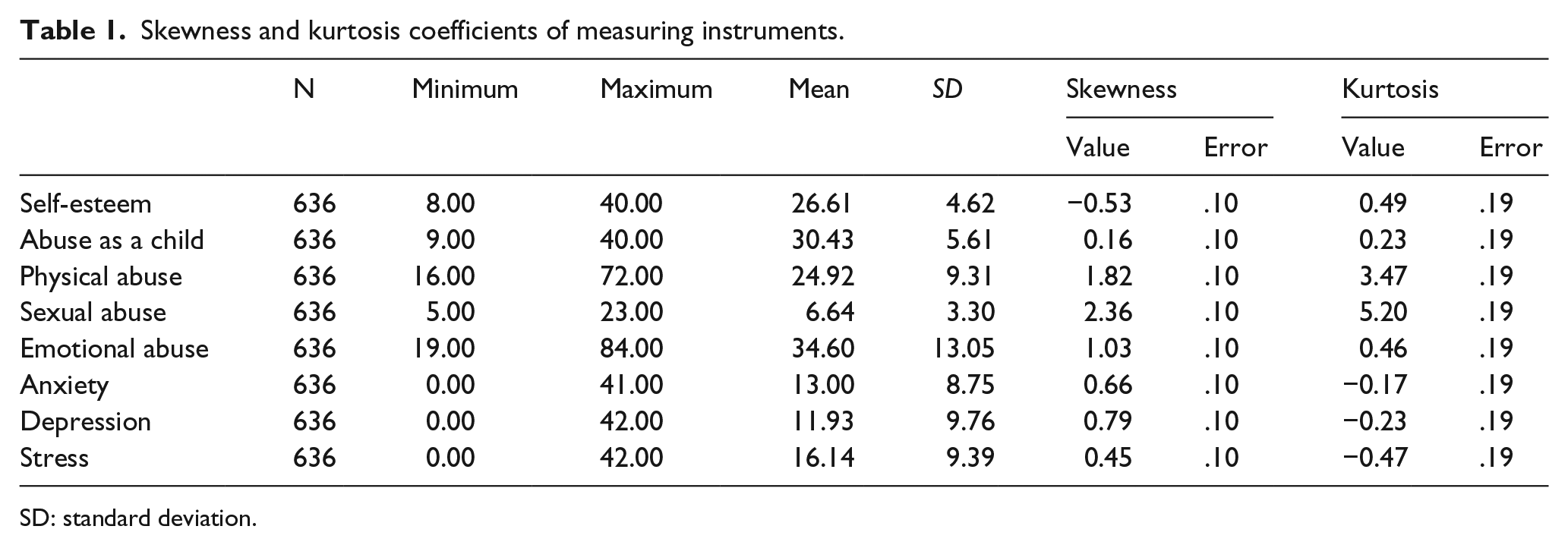
To administer forms to university students, initially ethics committee permission and necessary permission was obtained from the universities where data were collected. Scale tools were applied on a voluntary basis to participants in groups after necessary explanations. Several steps were followed to analyze the data obtained. First, frequency, minimum and maximum values of the dataset were used to check the data. Later, data cleaning and screening procedures were performed to define missing values and check normality. Second, descriptive statistics were analyzed (mean, SD, skewness and kurtosis values). Accordingly, the skewness values varied from −0.51 to 2.36, while the kurtosis values varied from −0.47 to 5.20. These results are interpreted to show the data related to the variables had normal distribution as skewness is within the normality criteria of ±2 and kurtosis is within the normality criteria of ±7 as stated by Finney and DiStefano (2006). In addition, according to Kline (2011), if the skewness coefficient is less than |3.0| and the kurtosis coefficient is less than |10.0|, it is a marker of normality. When Table 1 is investigated, the skewness coefficients appear to be less than |3.0| and the kurtosis coefficients appear to be less than |10.0|. According to these values, the points are accepted as abiding by normality. Pearson moments multiplication correlation coefficients were used to determine the correlations between variables. For these analyses, the significance level was accepted as 0.05 and 0.01. Later, the mediating role of self-esteem between maltreatment of children and depression, stress and anxiety was tested. For this, SPSS 23.00 program and AMOS 23.0 (Arbuckle, 2014) were used.
Skewness and kurtosis coefficients of measuring instruments.
SD: standard deviation.
Results
Correlation analysis results
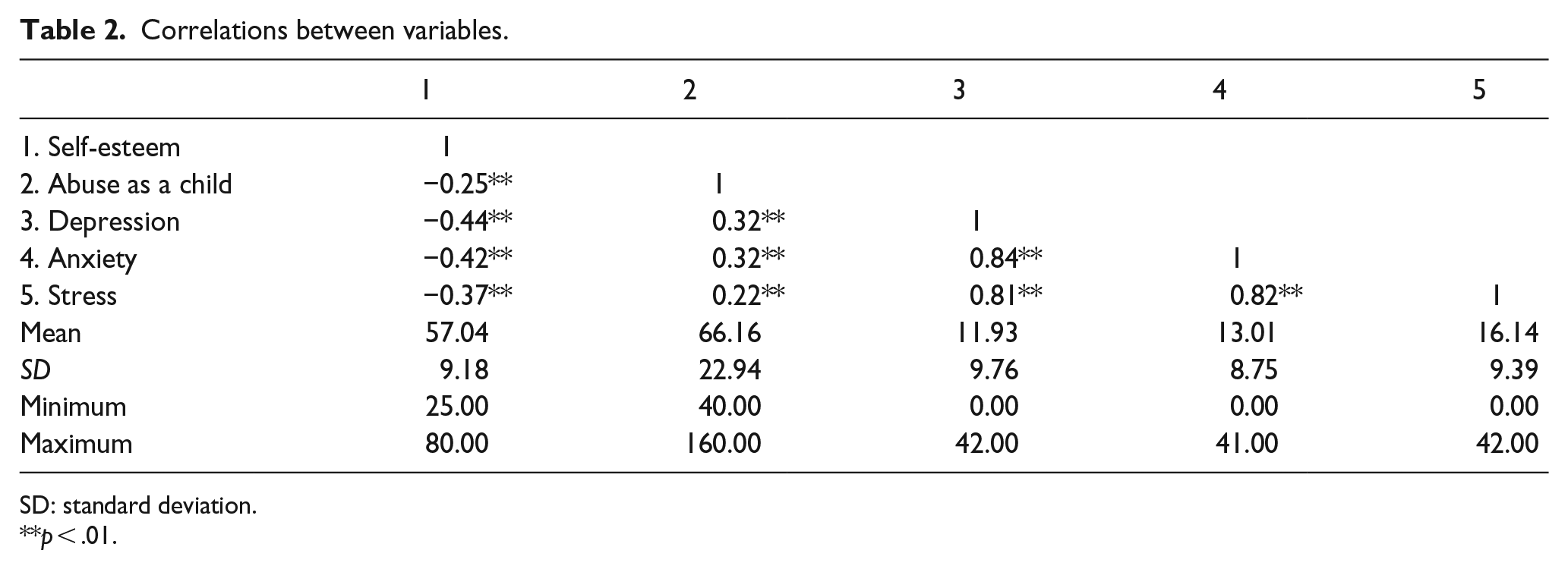
Identification of relationships between all variables in the study calculated the Pearson moment multiplication correlation coefficients. The correlations between the total points obtained from the scales used to measure the research variables are given in Table 2.
Correlations between variables.
SD: standard deviation.
p < .01.
When the correlations between variables are investigated, there appeared to be a negative significant correlation between maltreatment as a child and self-esteem (self-liking and self-competence) (r = −.25, p < .01), and a positive significant correlation between maltreatment as a child and depression (r = .32, p < .01), anxiety (r = .32, p < .01) and stress (r = .22, p < .01). In addition, there was a negative correlation identified between self-esteem (self-liking and self-competence) with depression (r = −.44, p < .01), anxiety (r = −.42, p < .01) and stress (r = −.37, p < .01).
Measurement models and structural model
The mediating role of self-esteem was tested using a two-stage structural equivalence analysis procedure. First, analysis was performed to reveal the representation of every hidden variable in the measurement model by the observed variables. After observing that the values in the measurement model were compliant, the structural model was tested using maximum probability estimation on AMOS graphs. To evaluate the general fit of the model to the data, several indices recommended by Hu and Bentler (1999) were calculated in the study. The χ2/SD, standardized root mean square residual (SRMR), RMSEA, CFI and NFI values were calculated with the aim of identifying the best model. Fit indices for the measurement model were x2 = 2882,698; SD = 1,024, x²/SD = 2.815, NFI = .90, CFI = .90, RMSEA = .053 (LO = .51, HI = .56) and SRMR = .041. When fit indices are investigated after the analyses, it is understood the created measurement model has good level of fit to the obtained data (Bayram, 2013; Meydan & Şeşen, 2011; Tabachnick & Fidell, 2014). In situations where the measurement model does not have good fit values, it means moving onto the structural model is meaningless (Şimşek, 2007). After identifying that the measurement model has good fit values, the transition to the structural model was made.
Testing the structural model
After analysis of the measurement model, first, the full mediating role of self-esteem between maltreatment as a child and depression, stress and anxiety was tested (Model A). The fit indices for this model were x2 = 88.265, SD = 18, χ2/SD (37) = 4.904, NFI = .97, CFI = .98, RMSEA = .078 (LO = .06, HI = .09) and SRMR = .042. These values indicate the model has good fit (28, 29, 30). There is no way in which the tested structural model is statistically insignificant. Later, the model with paths between maltreatment in childhood and depression, stress and anxiety was tested (Model B). The fit indices for this model were x2 = 57.136, SD = 15, χ2/SD (37) = 3.809, NFI = .95, CFI = .95, RMSEA = .080 (LO = .07, HI = .09) and SRMR = .053. These paths were not found to be statistically significant. In conclusion, according to Model A, self-esteem has a full mediating role between exposure to maltreatment in childhood and depression, anxiety and stress. Information about the path coefficients can be seen in Figure 1.
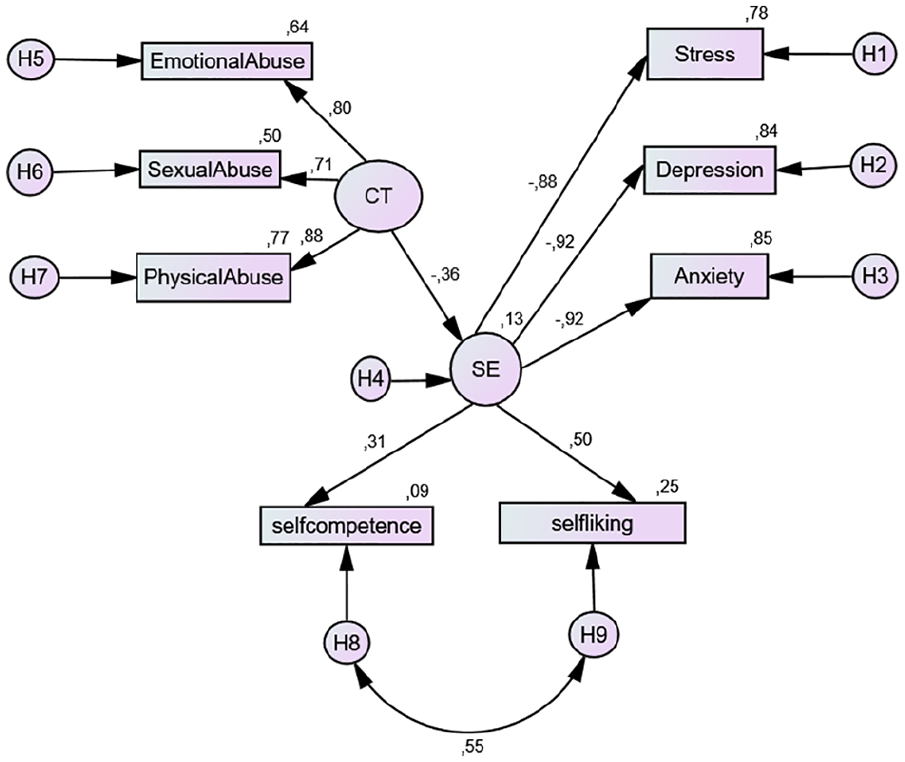
Path analysis.
The bootstrap method was used to test the significance of the mediating role of self-esteem between maltreatment as a child and depression, anxiety and stress. Table 3 shows the direct and indirect paths and the values in the 95% confidence interval for these paths. Analysis showed that self-esteem is a full mediator between maltreatment in childhood and depression; in other words, the effect of maltreatment seen in childhood on depression occurs through self-esteem, and this effect appears to be statistically significant (β = .33, confidence interval [.26, .40], p = .000). Analysis showed that self-esteem is a full mediator between maltreatment as a child and stress; in other words, the effect of maltreatment in childhood on stress occurs through self-esteem and this effect appears to be statistically significant (β = .32, confidence interval [.25, .39], p = .000). Analysis showed that self-esteem is a full mediator between maltreatment in childhood and anxiety; in other words, the effect of maltreatment seen in childhood on anxiety occurs through self-esteem, and this effect was proven to be statistically significant (β = .33, confidence interval [.26, .40], p = .000).
Confidence intervals.
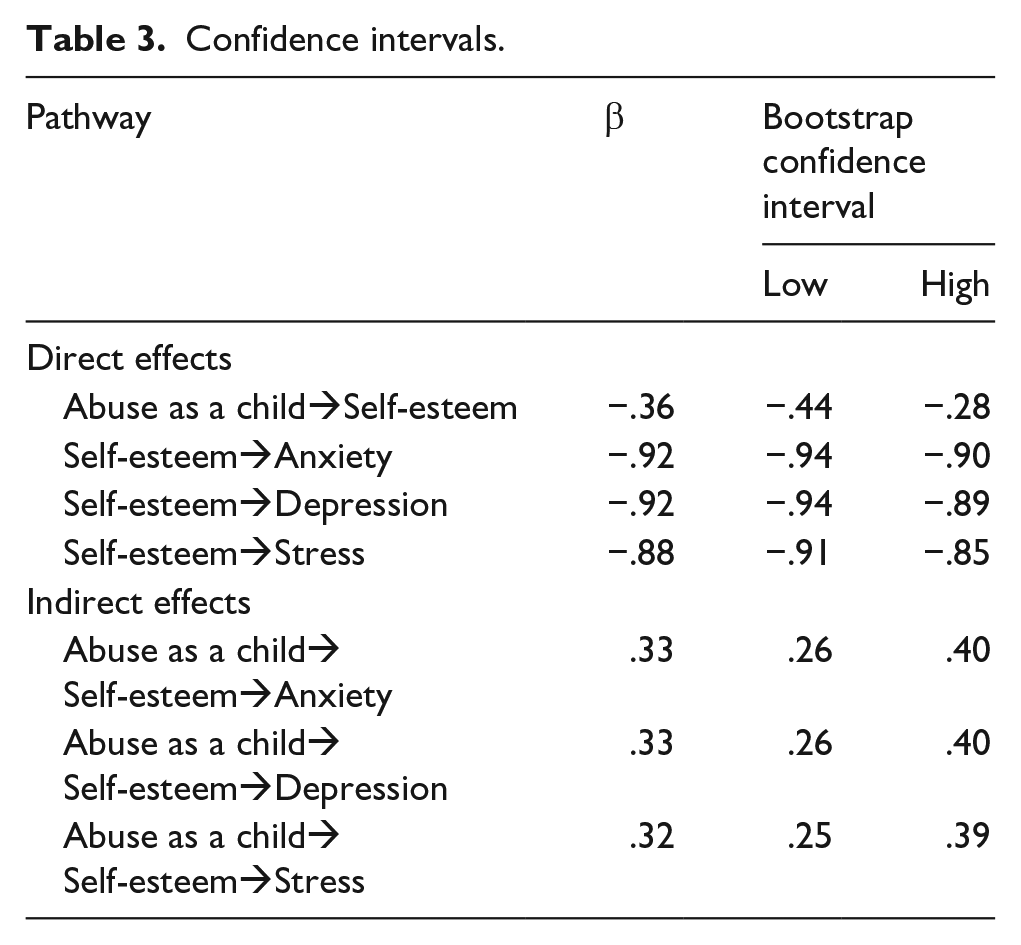
The direct and indirect effects were investigated as a result of pathway analysis. According to the analysis results, maltreatment experienced in childhood (β = −.36, p < .001) directly negatively affects self-esteem. When the obtained effect size is evaluated, it appears the maltreatment in childhood has a moderate level of effect on self-esteem. According to Cohen (1992), if the effect size value is lower than .2, the effect level is weak; if the effect value is between .3 and .5, the effect is moderate; and if the effect value is .8 and above, the effect level is high. In addition, maltreatment experienced as a child affects self-esteem and appears to explain 13% of the variation occurring in self-esteem (R2 = .13).
During the analysis, self-esteem was observed to have a direct negative effect on depression (β = −.92, p < .001), anxiety (β = −.92, p < .001) and stress (β = −.88, p < .001), respectively. In addition to this information, there was an indirect effect of maltreatment experienced in childhood on depression (β = .33, p < .001), and along with the direct effect of self-esteem, this explained 84% of the variation in depression (R2 = .84). When the table is further investigated, there was an indirect effect of exposure to maltreatment as a child on anxiety (β = .33, p < .001), and along with the direct effect of self-esteem, this explained 85% of the variation in anxiety (R2 = .85). Finally, there was an indirect effect of maltreatment as a child on stress (β = .32, p < .001), and with the direct effect of self-esteem, this explained 78% of the variation in stress (R2 = .78).
Discussion
In this study, the effects of maltreatment experienced in childhood on self-esteem, depression, anxiety and stress were investigated, and the mediating role of self-esteem between maltreatment as a child and depression, stress and anxiety was tested. Analysis identified that self-esteem has a full mediating role between abuse in childhood and depression, anxiety and stress. In other words, the effect of maltreatment experienced in childhood on depression, anxiety and stress occurs through self-esteem. When literature is investigated, there is research which supports the results of this study. A study in South Korea identified that self-esteem had a mediating role between the physical abuse subdimension of abuse and depressive symptoms (Park & Kim, 2018). Other research found a correlation between increased experience of abuse in the childhood period with reduced self-esteem, with the increase in self-esteem significantly reducing depression and anxiety. Stated differently, self-esteem was revealed to have a full mediating effect between maltreatment in childhood and depression and anxiety (Ju & Lee, 2018). A study with only males in the sample group identified that self-esteem has a mediating effect between abuse and depression (Provencio-Vasquez et al., 2017). Exposure to abusive experiences as a child in the early period is known to cause negative outcomes like internalization, anxiety and fear, aggressiveness, interpersonal problems, self-harm and violence (Jonson-Reid et al., 2012; Kim & Chung, 2013; Li et al., 2016; Malinosky-Rummell & Hansen, 1993). These unwanted outcomes cause strengthening of negative conceptions related to the self in the child. As negative perceptions strengthen, self-esteem reduces in the person and may prepare the ground for negative situations, like depression, anxiety, stress and so on, that may occur in the future.
Another finding in the research is the observation of a direct effect of maltreatment as a child on self-esteem. According to attachment theory, exposure to maltreatment as a child causes weakened perception of the self and emotional problems, threatening the development of healthy psychological development in the future (Toth et al., 2000). In other words, children who are abused have low possibility of perceiving themselves as valuable and important (Harter, 1998). Research supports this opinion. Comparative research identified that children with abusive experiences had higher levels of negative self-assessment and could not deal with emotional problems compared to those without abusive experience (Cole et al., 2008; Hymowitz et al., 2017). These findings support the view that negative experiences in the early period have negative effects on self-conception and perception which begin to form during this early period.
Finally, the study found a direct negative effect of self-esteem on depression, anxiety and stress and an indirect effect of maltreatment as a child on depression, anxiety and stress. Analysis of research results of 77 depression and 18 anxiety studies identified a negative effect of self-esteem on depression and anxiety levels (Sowislo & Orth, 2013). A different study determined repeated applications to two large groups in the 15- to 21-year and 18- to 21-year age groups and determined low self-esteem was a predictor of depression at different levels (Orth et al., 2008). Short- and long-term research results related to stress show that self-esteem has an effect on stress, in parallel with other studies (Lee-Flynn et al., 2011). Findings in the research overlap with the results in literature showing that self-esteem is a significant variable in negative changes occurring in psychopathologic disorders like depression, anxiety and stress.
A comparative study revealed that those with experience of abuse in childhood displayed more depressive symptoms, anxiety, psychiatric disorders, emotional and behavioral problems and tendency toward suicide and crime compared to those with no experience of abuse (Silverman et al., 1996). Based on the research results of the fifth Korean Child and Youth Panel, a study in South Korea checked all socio-demographic variables and observed that physical and emotional abuse and neglect increased behavioral problems like depression, aggressiveness, smoking and alcohol use (Cho et al., 2018). These studies show that maltreatment in childhood is effective, especially in depression but also anxiety and other disorders.
Conclusion
The general conclusion obtained from the results of the research is that exposure to maltreatment in the childhood period is correlated with reduced self-esteem, with the increase in self-esteem causing a significant reduction in depression, anxiety and stress. In other words, self-esteem creates a mediating effect between these variables. These negative experiences in the childhood period create a negative reflection in the future. However, the most important finding in this and other studies is that self-esteem has a reducing effect on problems that may be experienced in adulthood. This offers a focal point for intervention services for abused children because positive self-esteem is encountered as a significant protective factor to largely reduce many problems like depression, anxiety and stress. The inclusion of activities to strengthen self-esteem during interventional services for adolescents or adults exposed to abuse in the childhood period will lead to positive adaptation. There is a need for interventional studies about strengthening positive perceptions of the self and developing a healthy self-concept not just for those who have experienced abuse, but also for normal individuals.
In addition to this study presenting important information to experts working in the field, it may guide intervention programs to be prepared about this topic as it reveals the mediating role of self-esteem in the correlation between exposure to maltreatment in the childhood period and depression, anxiety and stress. However, there are a range of limitations to the study. Leading these is that the sample group in the study was limited to university students in a certain age group. It is notable there are comparative studies about the evaluation of maltreatment in the childhood period both at early ages and at adult ages in recent times (Reuben et al., 2016). This study may be repeated with a variety of sample groups including high school and university students and adults. Longitudinal studies revealing the periodic effects of maltreatment in childhood (encompassing advanced childhood, adolescent and adult periods) may be performed. Another limitation is that the scale tools used in the study were based on self-reports. However, the results obtained comply with literature which strengthens the study.
