



Abstract
Background:
Depression is a common disorder that can lead to suicidal behaviours among the geriatric population.
Aim:
We aimed to assess depression, hopelessness, and suicidal ideation among the elderly population of Kashmir.
Methods:
A community-based cross-sectional study was conducted in three districts of Kashmir between June and August 2019. The sample consisted of 200 persons aged >65 years. Beck’s Depression Inventory, Beck’s Hopelessness Scale, and the Beck Suicide Ideation scale were used to determine depression, hopelessness, and suicide ideation. Pearson’s correlation was performed to assess the relationships between depression, hopelessness, and suicide.
Results:
The prevalence of severe depression with a score of ⩾31 on Beck’s Depression Inventory was 56% among the studied population. Most of these elderly were found to have moderate levels of suicidal ideation (62.5%) and hopelessness (61%). Depression had a positive correlation with suicidal ideation (r = 0.35). Hopelessness and suicidal intent had a more significant positive correlation (r = 0.54), as compared to depression and hopelessness (r = 0.43).
Conclusion:
More than half of the older persons in Kashmir had depression with superimposed hopelessness which is an important risk factor of suicidal ideation.
Introduction
Elderly age is seen as a period of intensifying emotional sufferings and changes that prove to be demanding on the mental health of the people in this age group. Apart from physical illness, psychological illnesses are quite common in this age group (Gorman, 2017). Depression is a common psychological illness associated with the ageing population (Ganatra et al., 2008). The prevalence of depression in the elderly population is reported to be 8.9% to 62.2% in community-based studies and 42.4% to 72% in clinic-based studies (Grover & Malhotra, 2015). Understanding factors associated with depression among ageing population is essential to develop preventive strategies. However, depression in the geriatric age group is quite complex, and can be difficult to diagnose due to the presence of co-morbid conditions like chronic physical illnesses and dementia syndrome (Grover & Malhotra, 2015). Chronic illness, disability, pain, disturbance with limitations in activities of daily living (ADL), personality traits, adverse life events, and lack of adequate social support are various factors that increase depression risk in the elderly population (Barua & Kar, 2010).
Depression in geriatric age is a topic of increased interest as it leads to significant morbidity and increased rates of suicide (Barua & Kar, 2010). 60% of suicide occurs due to major depressive disorder and other mood disorder. Family studies have found strong genetic linkage between suicide and depression. Suicidal patients were assumed to share the negative thinking of depression patients (Henriksson et al., 1993). Hopelessness may also contribute to suicide, independent of depression, as patients with hopelessness misinterpret the environment in a negative way, often times exacerbating the problems reportedly being experienced (Beck et al., 1993).
In Kashmir, the mental health of the elderly people is neglected, and natives often consider areas with denser populations of these older people to be a burden to the society (Grover et al., 2010). The association of depression, hopelessness, and suicidal ideation are not known in Kashmir among the elderly. Hence, identification of hopelessness and suicidal ideation in depression is of immense significance. Further, there is a need to understand the link between depression, hopelessness and suicidal ideation among older adults of Kashmir. Hence, this study aimed to assess the prevalence of depression, hopelessness and suicidal ideation among elderly population in Kashmir and examine their relationships.
Methods
Study design
We conducted a cross-sectional, community-based study in three different districts of Kashmir (Srinagar, Kulgam, Kupwara) between June and August 2019. The study participants were selected purposively based on the following inclusion criteria: living in Srinagar, Kulgam, or Kupwara district in Kashmir, aged >65 years. Participants were excluded if they were critically ill based on medical or surgical condition (n = 13). Face-to-face interviews were conducted by trained enumerators in the home of the respondents in the selected districts.
Instruments
Data collection
Trained enumerators administered a structured interview where the inventory and scales were presented. The subjects were approached personally and instructed to give their responses on a questionnaire booklet. The questionnaire booklet was in local Kashmiri language, and was presented before being provided the respondents. After motivating the respondents, the questionnaire booklet was provided to each respondent and necessary help was provided by the researchers to assist participants with limited reading and writing ability. The questionnaire booklet contained socio demographic variables and responses of subjects from various scales. The assignment ensured the anonymity of the subjects by replacing patient names with unique identifying numbers before the statistical procedures began. Assurance of confidentiality was given to the respondents to boost their motivation and reduce bias.
Statistical analysis
Statistical analysis was performed using the SPSS, version 16.0 for Windows. A secure computerised database was established and maintained throughout the study. Continuous variables were reported as mean (standard deviation). In order to find the mean differences between various groups, Student’s t-test was used. Pearson’s Correlation was used to determine the relationship between different variables. Besides for comparison of percentages Z test was used.
Ethical considerations
This study was approved by the local ethics committee at District Hospital, Kulgam (DHK-2019) with waiver of informed consent, and was performed in accordance with the Declaration of Helsinki, 1964.
Results
In total, 200 elderly people of Kashmir participated in this study (100 females), and the age range was 65–86 years. The mean age of the entire study cohort at the time of the patients’ presentations was 74.3 (±12.4) years. The age between males and females did not differ significantly. There is significant difference between living with partners and single individuals, rural and urban areas and between literates and illiterates (p < 0.05). Patients’ marital status, place of residence, and education are included in Table 1. The majority of the respondents (56%) had higher levels of depression, suicidal ideation (62.5%) and hopelessness (61%).
Characteristics of the respondents (n = 200).
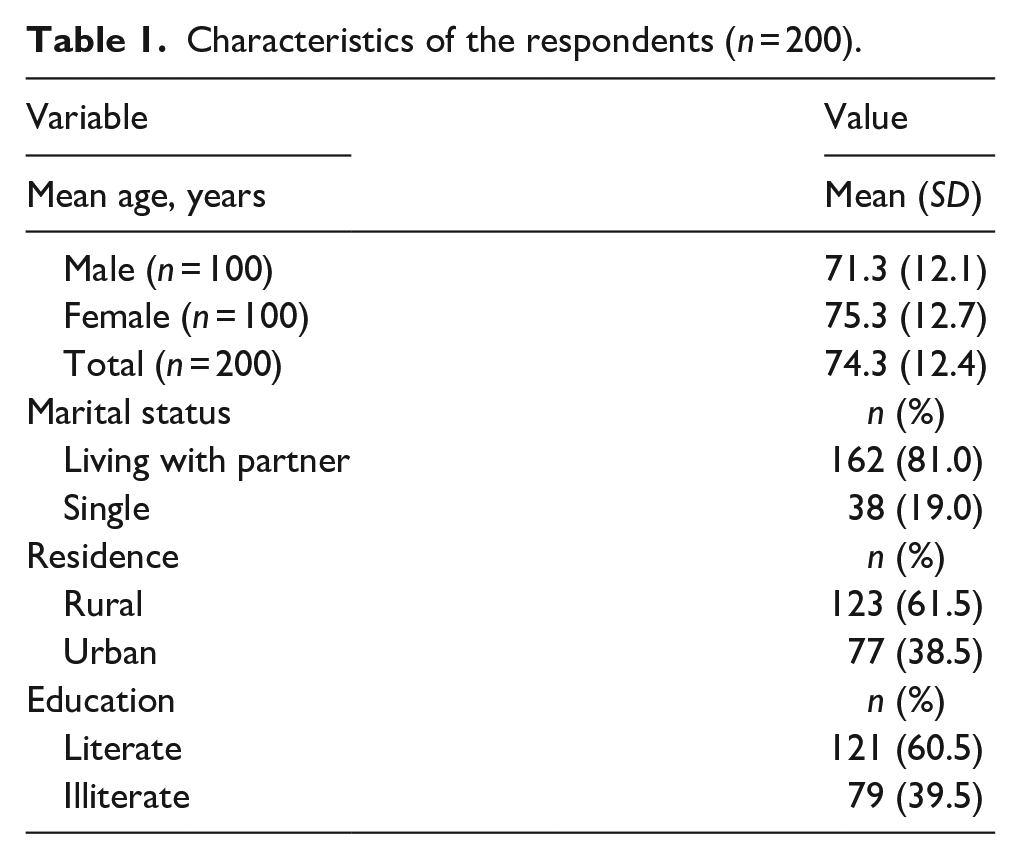
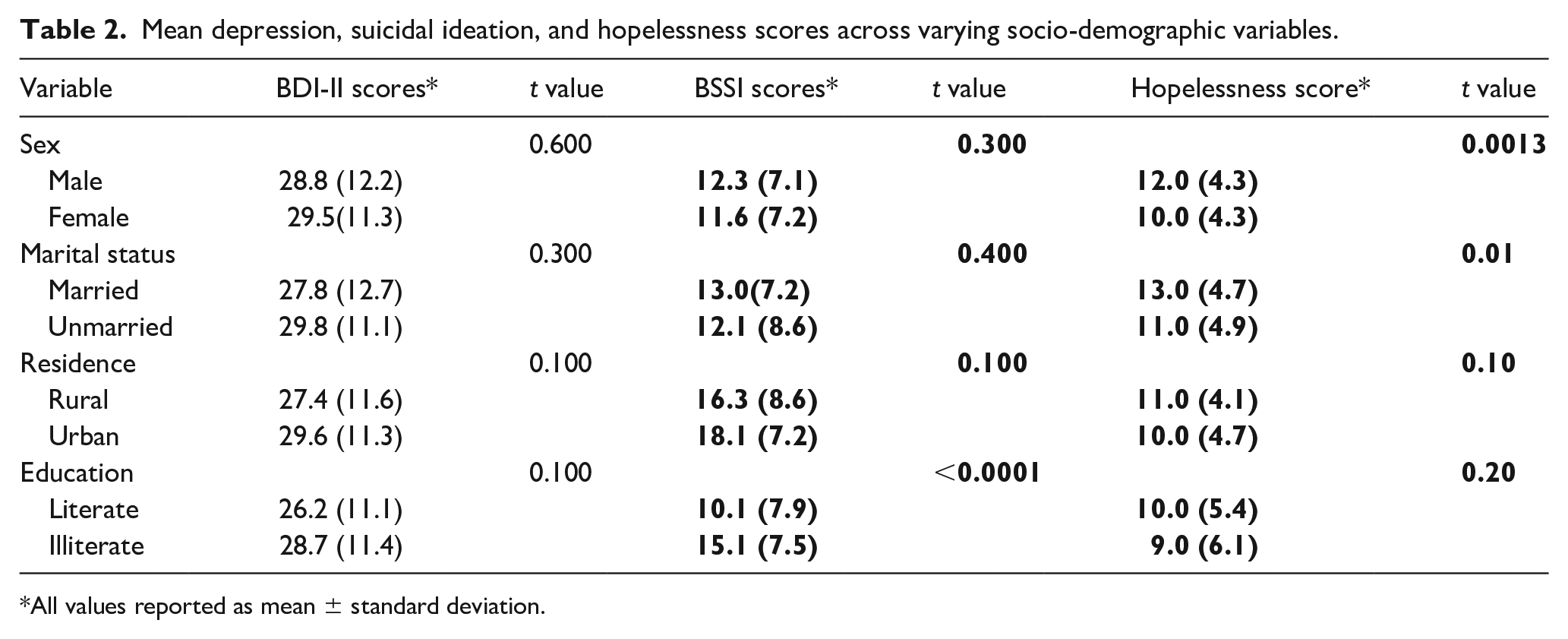
Table 2 shows the mean depression, suicidal ideation, and mean scores of hopelessness with respect to various socio-demographic variables. The mean depression score for the study population was 29.1 (±11.8). There was no significant difference in the depression level of men and women, between married and single or literate and illiterate participants. The mean suicidal ideation score for the study population was 11.8 (±7.2). The suicidality score was significantly different between the literate and illiterate elderly people, but was not statistically significant for all other variables, including sex, place of residence, and marital status. The mean hopelessness score for the total study population was 11.0 (±4.3). Men experienced significant (t<0.05) more hopelessness compared to women.
Mean depression, suicidal ideation, and hopelessness scores across varying socio-demographic variables.
All values reported as mean ± standard deviation.
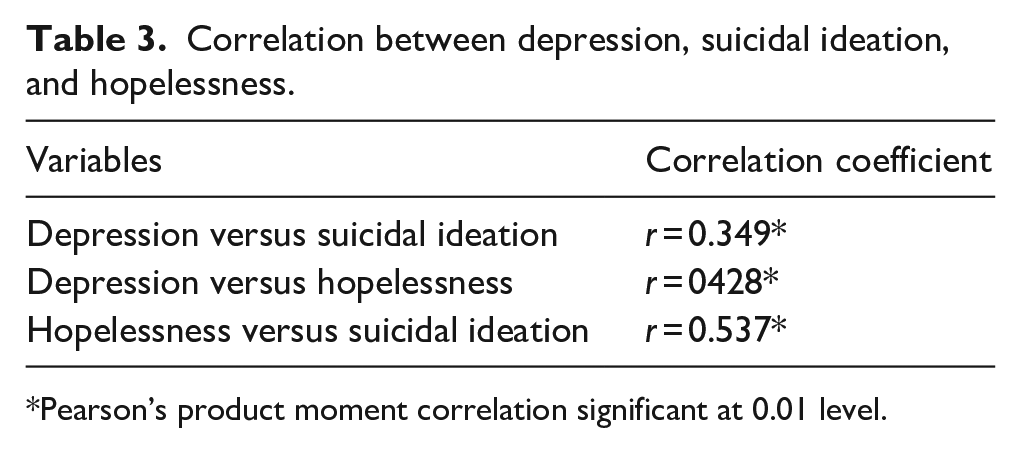
Table 3 presents the results determining the relationship between depression, suicidal ideation, and hopelessness, revealing that there was significant positive correlation between depression and suicidal ideation (r = 0.33), depression and hopelessness (r = 0.43), and lastly, hopelessness and suicidal ideation (r = 0.54).
Correlation between depression, suicidal ideation, and hopelessness.
Pearson’s product moment correlation significant at 0.01 level.
Discussion
The findings of our study reveal that the majority (56%) of older adults ages 65 years and above had higher levels of depression, suicidal ideation (62.5%) and hopelessness (61%). Our prevalence rate (56%) was significantly more than median prevalence of 21.9% for India, as reported by Barua et al. (2010) and which was significantly higher than the rest of the world (5.4%) (Paykel & Priest, 1992). The higher percentage of depression in our study is further supported by the findings of previous investigations that established increasing age as a major predictor for depression (Gottfries, 2001; Shoib & Kim, 2019). Furthermore, a large proportion (88%) of these elderly adults was found to have moderate to high levels of suicidal ideation. These findings are in consonance with the findings of those who concluded that suicide rates increase with age (Howard, 2000). Cost-effective interventions (screening and early treatment) are available, but do not often reach those who need them because of a number of overwhelming challenges in low resource countries, such as the lack of facilities and trained mental health personnel, questions about effective population-based screening, and the general stigma surrounding mental disorders. These obstacles are likely contributory to the higher rates of depression in the elderly population, in spite of the social support.
The high rates of depression in our study participants could be attributed to poverty, chronic disease, disability, pain, frustration with limitations in Activities of Daily Living (ADL), and adverse life events including divorce and bereavement (Grover & Malhotra, 2015; Pilania et al., 2013). Kashmir is a region located at the border area of India and Pakistan. Due to the rampant political and military conflict in the region, there have been reports of manifestations of psychological problems in all age groups of the population in Kashmir (Mushtaq et al., 2016). There have been a few studies demonstrating a link between depression and suicide in the younger population (Barua & Kar, 2010; Gottfries, 2001; Shoib et al., 2012). However, no study has been conducted to examine the relationship between depression, hopelessness, and suicidal ideation levels among the older population of this region.
The most important finding from the present study was that there is a positive correlation (0.35) between depression and suicidal ideation, suggesting that the greater the depression severity, the higher likelihood an individual will have suicidal ideation; in other words, we can conclude that depression acts as risk factor for suicidal ideation at ages 65 years and older. These research findings are substantiated by earlier findings which identified depression as the most consistent risk factor of suicidal ideation in old age (Arsenault-Lapierre et al., 2004; Khan et al., 2005).
Suicidal ideation in itself is a significant health problem in Kashmir, and the number of suicidal attempts has increased significantly compared with rates pre-turmoil, as the number of psychiatric disorders is on a rise in Kashmir in the past two decades (Shoib et al., 2015). Support systems for the elderly population, as well as less competitive lifestyles, theoretically offer protection from certain risk factors leading to depression (Grover & Malhotra, 2015; Pilania et al., 2013). This system is quite contrary to Western cultures, where family support is not generally present in the geriatric population due to the concept of nuclear families. Hopelessness and suicidal intent had a more significant positive correlation than depression measured with hopelessness. Thus, suicidal ideation is significantly more common among the elderly with hopelessness. These findings indirectly denote that hopelessness may be considered a predictor of suicidal intent, independent of the presence of depression.
Strengths
Possibly this is the first study in Kashmir, India assessing the depression, hopelessness, and suicidal ideation among the elderly population. Our findings emphasise the importance of evaluation of elderly patients reporting feelings of hopelessness.
Recommendations
Mental health professionals should pay particular consideration to geriatric patients and screen them for prevention of suicide especially in people facing stressful life events (Innamorati et al., 2014). Early recognition, as well as timely treatment, is a necessary element for the management of depression in elderly patients.
Limitations
This study has certain limitations. Firstly, purposive sampling was chosen during data collection. Secondly, the instruments were not culturally validated. Thirdly, the sample size was relatively small. We suggest that future studies should overcome these limitations by conducting a robust survey with appropriate sample size, and with representative sampling.
Conclusion
Suicidal ideation, coupled with depression, is common in the elderly population. This evidence emphasises the need to search for those people who are depressed and experiencing suicidal ideations, especially in the geriatric age. High suicidal ideation and hopelessness in this population suggests a need for specific preventive measures, as well as community mental health programs operating to improve mental health and prevent suicide.
