



Abstract
Background:
Although previous meta-analyses were conducted to quantitatively synthesize the relation between problematic social media (SM) use and mental health, they focused on Facebook addiction.
Aims:
The purpose of this meta-analysis is to examine this relation by extending the research scope via the inclusion of studies examining problematic use of all platforms.
Method:
One hundred and thirty-three independent samples (N =244,676) were identified.
Results:
As expected, the mean correlations between problematic SM use and well-being are negative, while those between problematic SM use and distress are positive. Life satisfaction and self-esteem are commonly used to represent well-being, while depression and loneliness are usually used to indicate distress. The mean correlations of problematic SM use with life satisfaction and self-esteem are small, whereas those of problematic SM use with depression and loneliness are moderate. The moderating effects of publication status, instruments, platforms and mean age are not significant.
Conclusions:
The magnitude of the correlations between problematic SM use and mental health indicators can generalize across most moderator conditions.
Social media (SM) is defined as ‘Internet-based channels that allow users to opportunistically interact and selectively self-present, either in real-time or asynchronously, with both broad and narrow audiences who derive value from user-generated content and the perception of interaction with others’ (Carr & Hayes, 2015, p. 50). Popular SM platforms are such as WhatsApp and social networking sites (SNSs; e.g. Facebook). Widespread use of SM means that problematic SM use has become a serious problem. For example, the Bergen Facebook Addiction Scale (Andreassen et al., 2012) conservatively estimated that 3.3% of Italian users were addicted to Facebook (Biolcati et al., 2018). Vangeel et al. (2016) found that 7.1% of secondary school students in Belgium were addicted to Facebook, with compulsive users spending 2 hours 38 minutes on a school day and 4 hours and 35 minutes on a holiday. A French study found a 10% rate of Facebook addiction (Chabrol et al., 2017). A study found that 18% of Turkish college students were classified as disordered SM users (Kircaburun, Demetrovics, & Tosuntaş, et al., 2019). A rate of 26.2% was found in college students in US, 29.4% in Singapore, and 44.5% in China (Tang et al., 2017).
Empirical evidence revealed that compulsive social networking site (SNS) use was related to physical (Moqbel & Kock, 2018) and mental health (Frost & Rickwood, 2017; Pontes, 2017; Ryan et al., 2014). Researchers have paid increasing attention to excessive SM use, and have performed meta-analyses (Marino et al., 2018a, 2018b) about the relationships of compulsive SM use with mental health, psychological distress and well-being. While these meta-analyses have improved the understanding of the relation between SM addiction and mental health, they do not address some salient issues. For example, these meta-analyses focused narrowly on Facebook addiction. The present meta-analysis extends the concern to problematic use of all SM platforms.
Problematic SM use
Several terms are used to describe problematic SM use. Addiction (Ryan et al., 2014) is one common term. Chamberlain et al. (2016) defined the core factors of behavioral addiction as inability to control of use, functional impairment and continuing involvement in the behavior regardless of its negative impacts. Some researchers (Caldiroli et al., 2018; Miele et al., 1990) used the term ‘dependency’ to describe problematic SM use. Dependence was defined as an indispensable behavior to achieve goals, while addiction refers to failure to control leading to impairment of personal or work lives (Ferris & Hollenbaugh, 2018). Hence, addiction has an absolutely negative effect, while dependence does not necessarily. Other terms, such as compulsive use (Aladwani & Almarzouq, 2016; De Cock et al., 2014), excessive use (Wang et al., 2016), and disordered use (van den Eijnden et al., 2018), were also used. Problematic use was chosen in this study because it is broad enough to incorporate different levels of excessive use (Lee et al., 2017).
Empirical studies
Previous empirical studies were conducted in various research contexts, and have different findings about the strength of the relation between problematic SM use and mental health. For example, Kircaburun (2016) sampled 1,130 Turkish secondary school students and found that the relation between problematic SNS use and self-esteem was r = −.09. Turel and Qahri-Saremi (2016) also found a small relation between problematic Facebook use and self-esteem at r = .01 for a pilot sample of 60 undergraduate students, and r = −.05 for 341 Facebook users from a large university in North America. A moderate correlation (r = −.24) was found in Aladwani and Almarzouq (2016) who used a sample of 407 undergraduate students in Kuwait. Biolcati et al. (2018) also found support for a moderate effect. On the other hand, a large correlation between problematic Facebook use (r = −.43) and self-esteem was found in Baturay and Toker (2017) who sampled 120 college students in Turkey.
Findings about other mental health indicators were also inconsistent. For example, the relation between problematic SM use and depression was from small (r = .13; Kircaburun, 2016) to large (r = .45; Błachnio et al., 2015). As both empirical studies varied in research situations, and research findings were not consistent, moderator effects are worth investigating.
Publication status
Publication bias refers to the unrepresentativeness of included studies that can be caused by availability and accessibility (McShane et al., 2016). For example, conference papers have more limited availability than journal papers. The inaccessibility of relevant studies (e.g. unpublished manuscripts) can lead to unrepresentative data in a meta-analysis. To explore this possibility, the mean correlations among publication outlets were examined.
Study country
Caldiroli et al. (2018) suggested that the problem of technology addiction was especially serious in China, South Korea and Taiwan. As the prevalence of technology addiction varies with country, the relation between problematic SM use and mental health may vary with country or culture. To examine the possible country effect, Marino et al. (2018a) examined the country effect on the relation between problematic Facebook use and psychological distress, and found that the correlation was likely to be higher in studies from Western countries compared to that from Asian countries. As Marino et al. (2018a) had a small number of effect sizes, and thus low generalizability of findings, the country effect is worth re-investigation.
Measures of problematic SM use
Researchers have used several instruments to measure problematic SM use. The most popular measure is the Bergen Facebook Addiction Scale (Andreassen et al., 2012), which assesses six key components, namely salience, mood modification, tolerance, withdrawal, conflict and relapse. Each component is initially assessed by three items. After the deletion of items with relatively low item-total correlations, one item for each component is retained. The one-factor solution is supported by the confirmatory factor analysis. The Bergen Social Media Addiction Scale (Andreassen et al., 2017) is a modified version to measure problematic SM use in general by replacing ‘Facebook’ with ‘social media’ in each item.
The Facebook Intrusion Questionnaire (Elphinston & Noller, 2011) is composed of eight items measuring cognitive salience, behavioral salience, interpersonal conflict, conflict with other activities, euphoria, loss of control, withdrawal and relapse. Each item is assessed on a seven-point Likert scale. A unidimensional model was supported by exploratory factor analysis (Elphinston & Noller, 2011).
The Social Media Disorder Scale (SMDS; van den Eijnden et al., 2016) was developed in the Netherlands, and is based on the DSM-5 criteria, namely preoccupation, tolerance, withdrawal, persistence, displacement, problem, deception, escape, and conflict. Initially, three items are developed for each of the nine components, and the item with the highest factor loading within each of the nine criteria is selected.
Other researchers (Baturay & Toker, 2017; Hong et al., 2014) adapted the Internet Addiction Test (IAT, Young, 1998) to measure problematic Facebook use or general problematic SM use. As these problematic SM use measures assess different components, the relation between problematic SM use and mental health may vary as a function of measures of problematic SM use.
Measures of mental health
Empirical studies have examined several positive indicators of mental health, such as self-esteem (e.g. Choi & Lim, 2016), life satisfaction (e.g. Hawi & Samaha, 2018), well-being (e.g. Verma & Kumari, 2016), happiness (e.g. Satici & Uysal, 2015), and positive affect (e.g. Satici, 2018). Self-esteem is the most common indicator of well-being. The most popular instrument to measure global self-esteem is the Rosenberg Self-Esteem Scale (Rosenberg, 1965) which consists of 5 positively-worded and 5 negatively-worded items. Due to brevity and easy administration, this scale has been adapted into more than 50 different languages (Schmitt et al., 2005). A shorter instrument to measure global self-worth is the Single Item Self-Esteem Scale (SISES; Robins et al., 2001) comprised of the item, ‘I have high self-esteem’, on a 7-point Likert scale.
Life satisfaction is another common indicator of well-being, and the most popular measure is the Satisfaction with Life Scale (Diener et al., 1985), which consists of 5 items with 7 response categories ranging from 1 to 7. Thus, the total score ranges from 5 to 35. Total scores of 5 to 9 are viewed as ‘extremely dissatisfied’, 15 to 19 as ‘slightly dissatisfied’, 21 to 25 ‘slightly satisfied’, and 26 to 30 ‘satisfied’ (Pavot & Diener, 1993).
Negative indicators of mental health can be represented by anxiety (e.g. Durak, 2018), depression (e.g. Worsley et al., 2018), loneliness (e.g. Yu et al., 2016), suicidal ideation (e.g. Jasso-Medrano & López-Rosales, 2018), distress (e.g. Laconi et al., 2018) and negative affect (e.g. Satici, 2018). Depression is the most examined indicator, with common measures such as the Patient Health Questionnaire-9 (PHQ-9; Kroenke et al., 2001), the Center for Epidemiologic Studies Depression Scale (CES-D; Radloff, 1977), the depression subscale of the Depression Anxiety Stress Scales-21 (DASS-21; Lovibond & Lovibond, 1995), the depression subscale of Short Depression-Happiness Scale (SDHS; Joseph et al., 2004), Hamilton Depression Rating Scale (HAM-D; Hamilton, 1960, 1967), Montgomery–Åsberg Depression Rating Scale (MADRS; Montgomery & Åsberg, 1979), and Beck Depression Inventory (BDI; Beck, & Steer, 1987). The PHQ-9 assesses 9 depressive symptoms in primary care settings over the last two weeks with 4 response categories, 0 for ‘not at all’, 1 for ‘several days’, 2 for ‘more than half the days’, and 3 ‘Nearly every day’. Thus, the total score of the PHQ-9 ranges from 0 to 27. The cutoff scores for mild, moderate, moderately severe and severe depression are 5, 10, 15, and 20, respectively (Kroenke et al., 2001). On the other hand, the CES-D assessing depressive symptom for general population over the past week consists of 20 items on a 4-response scale, ranging from 0 to 3. The total score is from 0 to 60. An arbitrary cutoff score of 16 or higher is considered to indicate possible depression requiring clinical assessment (Radloff, 1977).
The depression subscale of DASS-21 measures depressive emotional state over the past week, and consists of 7 items, each on a 4-point scale, ranging from 0 to 3 (Szabó, 2010) Scores of 10, 14, 21, and 28 indicate mild, moderate, severe and extremely severe depression (Lovibond & Lovibond, 1995). The depression subscale of the SDHS consists of 3 items with 4 response categories. The items are, ‘I felt dissatisfied with my life’, ‘I felt cheerless’, and ‘I felt that life was meaningless’. Cutoff scores for the depression subscale are not provided in Joseph et al. (2004).
The HAM-D has 6-, 17-, 21-, and 24-item versions, and is often used to measure treatment effect instead of state of depression (Santen et al., 2008). The most popular version, consisting of 17 items, is on a 3- or 5-point scale. The multidimensional factor is supported, but the number of factors varies across studies (Bagby et al., 2004). Another popular measure for assessing change of depressive symptoms in clinical trial research is the MADRS, which comprises 10 items chosen by reliability and validity from an original set of 17 items from the Comprehensive Psychopathological Rating Scale (Montgomery & Åsberg, 1979). The factor structure of the MADRS varied across patient groups (Ketharanathan et al., 2016). As both HAM-D and MADRS were usually used in clinical research, their scores are strongly correlated (Heo et al., 2007).
The BDI consisting of 21 items on a 4-point scale is a self-reporting measure to assess depression for adolescents and adults (Beck & Steer, 1987). The latest version of the BDI, the Beck Depression Inventory–II (BDI–II), is derived from DSM-IV (American Psychiatric Association, 1994), with the items of Body Image Change, Work Difficulty, Weight Loss and Somatic Preoccupation in the BDI replaced with Agitation, Worthlessness, Loss of Energy, and Concentration Difficulty in the BDI–II. The items of Changes in Sleeping Pattern and Changes in Appetite have seven response categories, and the remaining 19 items have four (Beck et al., 1996).
The most prevalent measure to assess loneliness is the UCLA Loneliness Scale (Russell et al., 1980), consisting of 10 positive-worded and 10 negative-worded items, each item on a 4-point Likert scale. The UCLA Loneliness Scale has sound psychometric properties (Hartshore, 1993), and the 3-factor (isolation, relational connectedness, and collective connectedness) structure was supported (Dussault et al., 2009).
Platform
Some researchers focused on problematic use of SM in general. For example, Worsley et al. (2018) examined the relation between problematic use in general and depression for 1029 university students in UK, and found that the relation was r = .27. Some researchers focused specifically on problematic Facebook use. Steggink (2015) used a sample of 315 users recruited online with mean age of 28.74 years, and found that the correlation between problematic Facebook use and depression was r = .10. Whether the magnitude of correlation varied with platform was unknown, and this meta-analysis addressed this possibility.
Participant age
Few longitudinal and cross-sectional studies have been conducted to examine the age effect on the relation between problematic SM use and mental health. van den Eijnden et al. (2018) adopted a three-wave design with a one-year interval between adjacent assessments for a sample of 543 teenagers with mean 12.9 years at study inception. The correlations of problematic use of SNSs assessed at time 1 with life satisfaction assessed at times 2 and 3 for boys were r = −.21 and r = −.11, respectively. The corresponding correlations of time 2 problematic use of SNSs with time 2 and 3 life satisfactions for boys were r = −.33 and r = −.09, respectively. For girls, the correlation of time 1 problematic use of SNSs with time 2 and 3 life satisfaction were r = −.43 and r = −.33, respectively and those of time 2 problematic use of SNSs with time 2 and 3 life satisfaction were r = −.48 and r = −.55, respectively. The age effect seemed to be supported in the cross-sectional study. Kanat-Maymon et al. (2018) found that the relation between problematic Facebook use and self-esteem for an online adult sample with mean age of 33.36 years was r = −.52. The corresponding correlation for a sample of 80 undergraduate students was only small, at r = −.05.
The age effect on the relations of problematic Facebook use with psychological distress and well-being were not supported in Marino et al. (2018a). The number of effect sizes in that meta-analysis was small and non-significant findings can be caused by low statistical power.
Participant gender
Griffiths (2000) revealed that technology addicts are usually male. Some researchers examined the relation between problematic SM use and mental health especially for males. For example, Kim and Park (2015) found that the correlation between problematic SNS use and self-esteem among 213 male middle-school students was r = −.38. Some researchers examined the moderating effect of gender on the relation between problematic SNS use and mental health. For example, van den Eijnden et al. (2018) examined the moderating effect of gender for teenagers, and found that the correlation between problematic SNS use and life satisfaction was r = −.48 for girls and r = −.33 for boys. Walburg et al. (2016) selected 115 boys and 171 girls, and found that the correlations of problematic Facebook use with depression and suicidal ideation were r = .37 and r = .23 for boys, and r = .10 and r = .20 for girls.
Marino et al. (2018a) examined the gender effect represented by the proportion of female users on the relations of problematic Facebook use with psychological distress and well-being and the gender effects were not significant. Re-examination of the gender effect is prominent for three reasons. First, the small number of effect size in Marino et al. (2018a) could lead to a low statistical power. Second, empirical studies rarely address the issue of gender effect on the relation between SM addiction and mental health. Third, empirical studies mentioned above seemed to demonstrate a potential gender effect.
Previous reviews and meta-analyses
Frost and Rickwood (2017) reviewed the relation between Facebook addiction and mental health based on 5 cross-sectional and 1 longitudinal studies. They concluded that Facebook addiction was associated with poor mental health. Ryan et al. (2014) identified three studies (Hong et al., 2014; Koc & Gulyagci, 2013; Uysal et al., 2013), and reported that Facebook addiction was related to depression and anxiety. Another review by Keles et al. (2019) that identified three articles also supported that addiction to SNSs was related to depression.
Marino et al. (2018a) identified 23 samples that examined the relations of problematic Facebook use with psychological distress and well-being. The mean correlation between problematic Facebook use and psychological distress was r = .29, and the correlation corrected for attenuation was ρ = .34. The correlations for specific factors were r = .30 and ρ = .35 for depression; r = .29 and ρ = .33 for anxiety; r = −.19 and ρ = −.22 for general well-being; r = −.16 and ρ = −.19 for life satisfaction. Marino et al. (2018b) meta-analyzed 8 correlations between problematic Facebook use and self-esteem, and found that the mean correlation was r = −.23. No moderator analyses were conducted for this correlation.
As two previous meta-analyses (Marino et al., 2018a, 2018b) specifically focused on problematic Facebook use, their conclusions may not be valid for studies addressing problematic use of other SM or general problematic use of SM. The current meta-analysis aimed to conduct a comprehensive analysis of accumulating empirical evidence obtained by studies examining the association between problematic SM use and mental health.
Method
Literature search
To identify relevant studies, the ERIC, PsycINFO and ProQuest Dissertations and Theses Global databases were searched using SM terms (namely, Facebook, Twitter, Instagram, MySpace, ‘social media’, ‘online social network*’, and ‘social network* site*’) and problematic use terms (addict*, abuse, misuse, overuse, intrusion, ‘problematic use’, ‘excessive use’, ‘compulsive use’, ‘pathological use’, ‘disordered use’) through July 19, 2020. The ERIC, PsycINFO and ProQuest databases yielded 157, 1,553 and 287 articles, respectively. The reference lists for eligible articles and previous meta-analysis (Marino et al., 2018a, 2018b) were then examined. The author screened each article by reviewing the title and abstract. The full texts of studies passing the initial screening were then identified to determine eligibility based on three inclusion criteria. First, studies should provide sufficient statistics to compute the correlation between problematic SM use and mental health. Second, studies should report the sample size. Lastly, the study should be published in English. Four unpublished datasets in Marino et al. (2018a) were not available because they did not report titles, sources or manuscripts.
Analysis
The Pearson Product-Moment correlation between problematic SM use and mental health was coded. The distribution of r depends on the population correlation, ρ, and sample size. Unless the sample size is sufficiently large, the distribution of sample correlation is skewed (Card, 2012). To normalize the sample correlation, the correlation r was converted to Zr using the Fisher’s transformation equation. The inverse variance (N-3) was used as a weight to compute the mean correlation. Random-effects were used.
Results
This study included 123 articles presented in the Appendix. Andreassen et al. (2016) and Andreassen et al. (2017) analyzed the same data, yielding 122 studies. Of these 122 studies, 111 were published in journals, 5 in doctoral dissertations, 3 in Master theses, 2 in conferences, and 1 in a book chapter. Eleven studies each consisted of 2 samples, and thus 133 independent samples involving 244,676 participants were analyzed in the subsequent analyses. Table 1 presents the descriptive statistics of the 133 samples. When multiple indicators of mental health, multiple platforms, or multiple measures of problematic use SM were assessed, all relevant effect sizes were coded. The summary of all effect sizes were presented in Table 2.
Descriptive statistics of the 132 independent samples included in the meta-analysis.
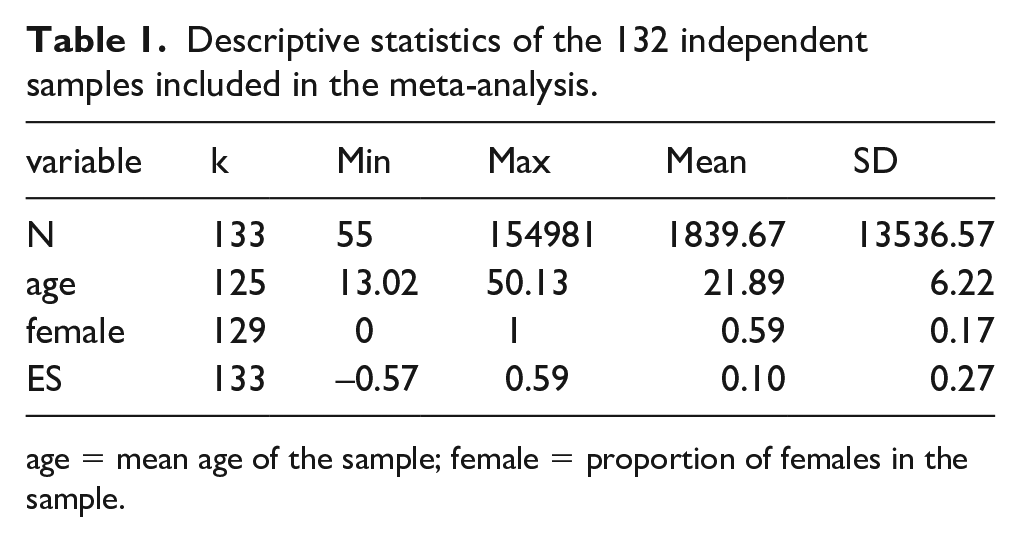
age = mean age of the sample; female = proportion of females in the sample.
Summary of samples examining the problematic social media use and mental health.
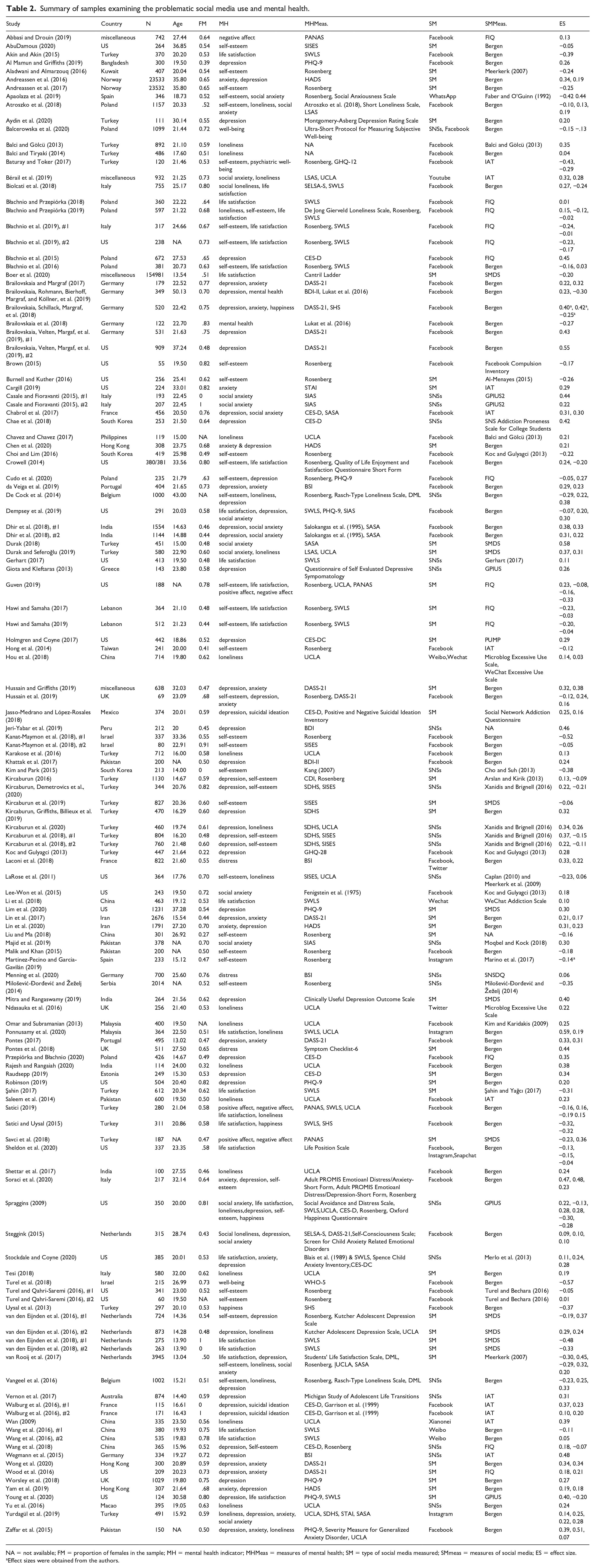
NA = not available; FM = proportion of females in the sample; MH = mental health indicator; MHMeas = measures of mental health; SM = type of social media measured; SMmeas = measures of social media; ES = effect size.
Effect sizes were obtained from the authors.
Mean correlation between problematic SM use and mental health
The same sample analyzed in Andreassen et al. (2016) and Andreassen et al. (2017) had over 23,000 participants, and that in Boer et al. (2020) had 154,981 participants. As the inverse variance (N-3) was used as a weight to compute the mean correlation, these two studies would receive extremely large weights. However, the common winsorization method, which recodes the sample size at two or three standard deviations above the mean (Lipsey & Wilson, 2001) was not appropriate, as the standard deviation shown in Table 1 was also extremely large (13,536.57). The sample sizes of these two samples were set at 3 times the mean (5,519).
Table 3 lists the weighted mean correlations between problematic SM use and mental health indicators. Eighty-five effect sizes were related to well-being. Of these, 4 were for happiness, 30 for life satisfaction, 3 for positive affect, 2 for mental health, 42 for self-esteem, 3 for overall well-being and 1 for psychiatric well-being. As expected, the correlations between problematic SM use and well-being indicators were negative, ranging from −.11 to −.30. The mean correlations of problematic SM use with happiness, life satisfaction, positive affect and self-esteem were significantly different from 0. The homogeneity test for the correlation between problematic SM use and self-esteem was significant, indicating significant between-study variation.
Summary of mean correlations between problematic social media use and mental health.
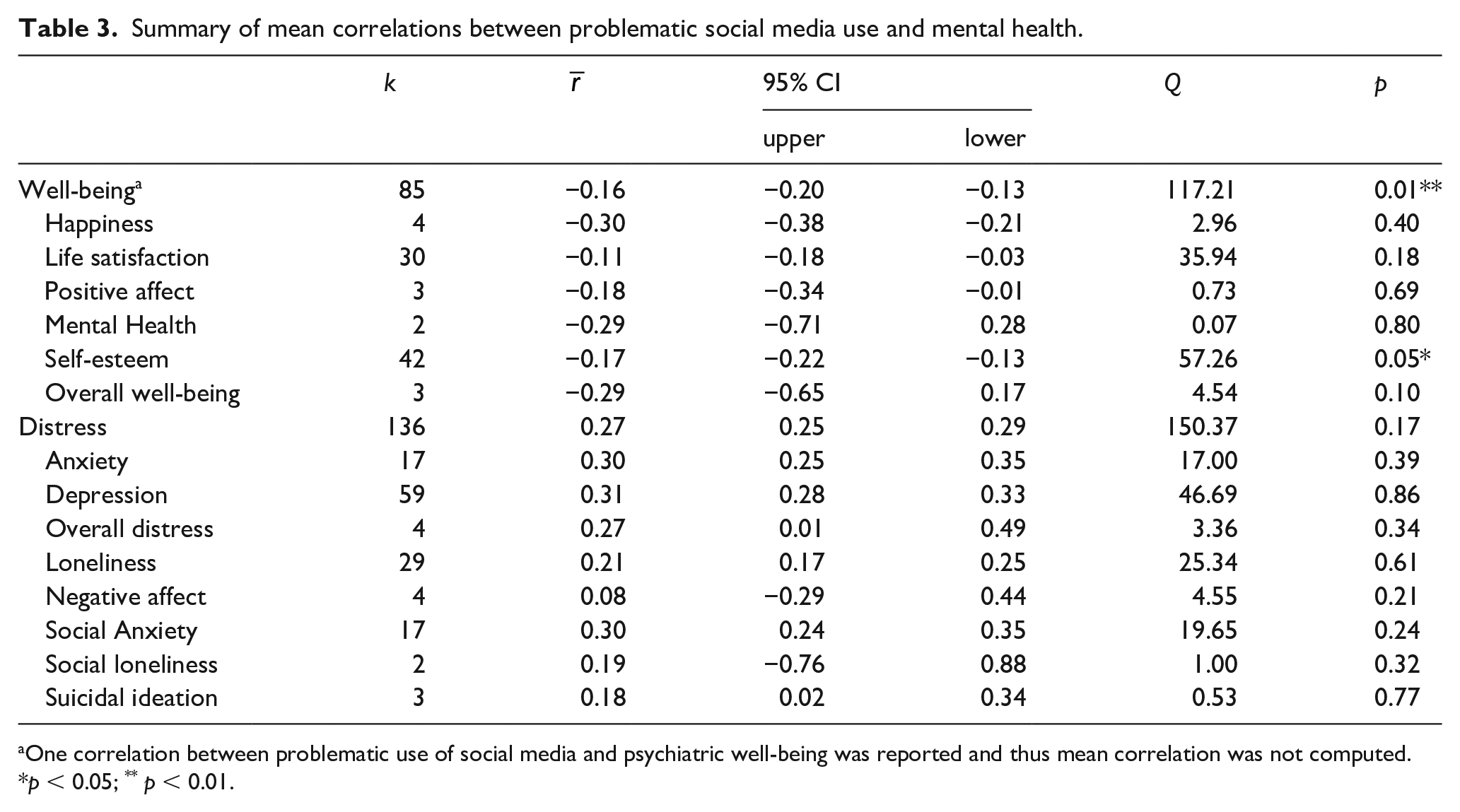
One correlation between problematic use of social media and psychiatric well-being was reported and thus mean correlation was not computed.
p < 0.05; ** p < 0.01.
Many studies examined the correlations between problematic SM use and distress indicators, and all mean correlations were positive. The relation between problematic SM use and depression attracted most research attention. The mean correlation was moderate at
Moderator analyses of the relation between problematic SM use and self-esteem
Due to insufficient numbers of effect sizes, moderator analyses were conducted for correlations of problematic SM use with self-esteem (k = 42), life satisfaction (k = 30), depression (k = 59), and loneliness (k = 29). The mean correlations were computed for categories of moderators with at least 4 effect sizes. Table 4 lists the categorical moderator effects on the relation between problematic SM use and mental health. Regarding publication outlet, 1 correlation between problematic SM use and self-esteem was reported in a book chapter, 1 in a conference, 1 in a Master’s thesis, 4 in Doctoral dissertations and 35 in journals. The effect of publication outlet was not significant with QB = 3.43, indicating the absence of a file-drawer problem. For the country effect, 17 countries reported the relation between problematic SM use and self-esteem, and 3 of them had at least 4 effect sizes. Again, QB = 1.32 was not significant, indicating that the mean correlations of US, Poland, and Turkey were comparable.
Categorical moderator effects on the relations between problematic social media use and mental health.
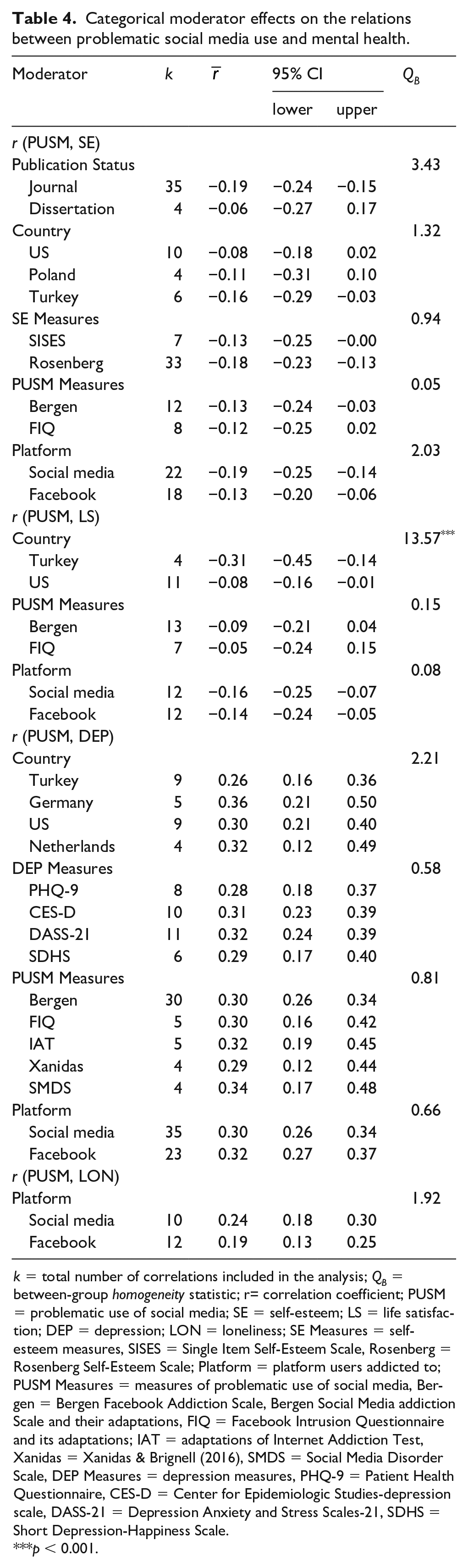
k = total number of correlations included in the analysis; QB = between-group homogeneity statistic; r= correlation coefficient; PUSM = problematic use of social media; SE = self-esteem; LS = life satisfaction; DEP = depression; LON = loneliness; SE Measures = self-esteem measures, SISES = Single Item Self-Esteem Scale, Rosenberg = Rosenberg Self-Esteem Scale; Platform = platform users addicted to; PUSM Measures = measures of problematic use of social media, Bergen = Bergen Facebook Addiction Scale, Bergen Social Media addiction Scale and their adaptations, FIQ = Facebook Intrusion Questionnaire and its adaptations; IAT = adaptations of Internet Addiction Test, Xanidas = Xanidas & Brignell (2016), SMDS = Social Media Disorder Scale, DEP Measures = depression measures, PHQ-9 = Patient Health Questionnaire, CES-D = Center for Epidemiologic Studies-depression scale, DASS-21 = Depression Anxiety and Stress Scales-21, SDHS = Short Depression-Happiness Scale.
p < 0.001.
The majority of studies used the Rosenberg Self-Esteem Scale (Rosenberg, 1965) to assess global self-worth, and the mean correlation for these studies was
Twenty-two effect sizes were related to problematic use in general; 18 were for problematic Facebook use; 1 for problematic Twitter use, and 1 for problematic WhatsApp use. The platform to which users were addicted did not exert a significant effect on the relation between problematic SM use and self-esteem.
Table 5 presents the effects of mean age and gender composition of the sample on the correlations between problematic SM use and mental health indicators. The mean age was reported in 38 samples, and the age effect was not significant. The effect of gender composition was significant, and the meta-regression model was
Effects of continuous moderators.
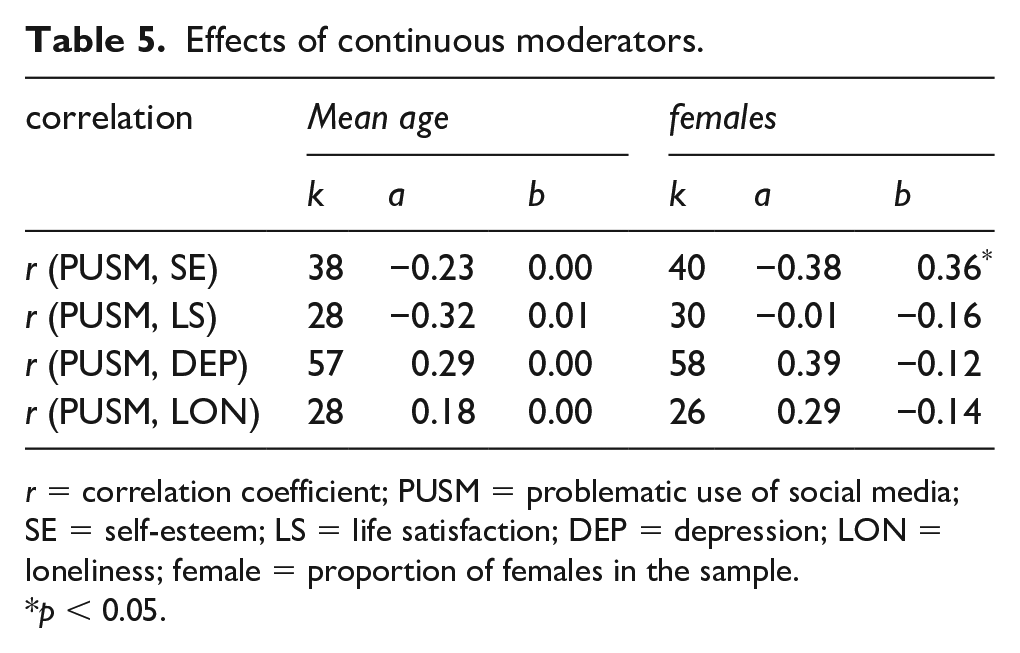
r = correlation coefficient; PUSM = problematic use of social media; SE = self-esteem; LS = life satisfaction; DEP = depression; LON = loneliness; female = proportion of females in the sample.
p < 0.05.
Moderator analyses the relation between problematic SM use and life satisfaction
The effect of publication status was not examined, because journal articles were the only outlet having more than 3 effect sizes. For the country effect, Turkey and US are the only two countries with more than 3 effect sizes and the mean correlations were moderate and small, respectively (
Moderator analyses the relation between problematic SM use and depression
The effect of publication status cannot be examined, because 56 effect sizes were reported in journal articles, and 1 effect size was each reported in a book chapter, thesis, and dissertation. As shown in Table 4, four countries, namely Turkey, Germany, US and Netherlands, had more than 3 effect sizes, and the mean correlations for these countries were about moderate. The effect of study country was not significant.
The included studies used 19 depression measures, of which 4 had more than 3 effect sizes. The effect of depression measure was not significant, and mean correlations for these measures were comparable. Regarding measures of problematic SM use, most studies used the Bergen Social Media Addiction Scale, Bergen Facebook Addiction Scale and their adaptations. The effect of measure of problematic SM use was minimal as the mean correlations were similar.
Most studies assessed global problematic use, and Facebook was the only specific platform attracted many researchers’ attention. Again, the platform did not moderate the relation between problematic SM use and depression. The effect of mean age was minimal and not significant, as the regression coefficient was close to 0. Similarly, gender composition was not related to the magnitude of the correlation between problematic SM use and depression.
Moderator analyses the relation between problematic SM use and loneliness
Journal articles had 24 effect sizes, and other publication outlets had less than 4 effect sizes. Therefore, the effect of publication status was not examined. Similarly, the effects of study country and measures of loneliness and problematic SM use were not examined, as only one category of moderators had sufficient effect sizes. As shown in Table 4, the effect of platform was not related to the magnitude of the correlation between problematic SM use and loneliness. As shown in Table 5, the mean age and gender composition of the sample did not exert a significant effect.
Discussion
The psychological and social impact of problematic SM use has drawn widespread research attention. Although previous meta-analyses (Marino et al., 2018a, 2018b) were conducted to quantitatively synthesize these empirical findings, they did not address some research gaps. Those meta-analyses were narrow in scope, as they focused on problematic Facebook use. This study broadened the research scope by including studies examining problematic use of all platforms. This undertaking leaded to the number of included studies is more than 5 times of that in Marino et al. (2018a) and more than 15 times that in Marino et al. (2018b). As this study has a large number of effect sizes, it has more stable estimates of mean correlations than previous research. Furthermore, as the number of effect size was small in previous meta-analyses and thus they examined a limited number of moderator effects. For a complete assessment of moderators, moderators including measures of problematic SM use and mental health, and platform to which users were addicted were incorporated to understand whether research contexts can moderate the correlation. Finally, a small number of mental health indicators were included in the previous meta-analyses. For example, Marino et al. (2018a) examined only 5 indictors, namely psychological distress, depression, anxiety, general well-being and life satisfaction. The mean correlations of 14 indicators were computed in this study. Thus, the current meta-analysis has significant contributions beyond previous research.
The findings of this meta-analysis support a detrimental effect of problematic SM use. Specifically, the correlations between problematic SM use and various well-being indicators were negative, ranging from small to moderate (Cohen, 1992). The correlations between problematic SM use and various distress indicators were positive and also ranged from small to moderate (Cohen, 1992). The correlations of problematic SM use with anxiety, depression, and distress were comparable to those in Marino et al. (2018a).
The correlations of problematic SM use with self-esteem, life satisfaction, loneliness and depression had sufficiently large numbers of effect sizes, so their moderator effects were examined. The magnitude of correlation between problematic SM use and self-esteem was stronger for samples with more male participants. This finding indicates the negative effect of problematic SM use on self-esteem is relatively severe for males, and thus they are especially in need of help. Previous research (Pluhar et al., 2019; Stevens et al., 2019; Winkler et al., 2013) shows cognitive behavioral therapy, dialectical behavior therapy, group therapy and multidimensional treatment were effective in treatment of Internet addiction and online gaming addiction. These treatments can be considered and modified to treat male users at high risk of SM addiction.
The study country was related to the correlation between problematic SM use and life satisfaction. The correlation was moderate for Turkey, and small for US. Although the country effect on the relation between problematic Facebook use and psychological distress was significant, Marino et al. (2018a) found that Western countries had larger effect sizes than Asian countries. The inconsistent findings can be caused by the composition of both the Western and Asian country categories in Marino et al. (2018a). In Marino et al. (2018a), US only contributed one effect size in the Western country category, and Asian countries included Turkey, Taiwan and Thailand.
Implications, limitations, and future directions
This meta-analysis has important implications for practice and research. As the magnitudes of correlations varied by mental health indicator, future practitioners and researchers should use multiple indicators for a comprehensive assessment of the effect of problematic SM use on well-being and distress. The magnitudes of these correlations did not vary with publication status, instruments, SM platforms or mean age. The strength of correlation between problematic SM use and mental health was similar in most research conditions. Thus, the magnitude of these correlations can generalize across most moderator conditions, supporting the stability of correlations between problematic SM use and mental health indicators in most research conditions. Moreover, the moderating effect of study country was investigated to examine possible cultural differences. Turkish studies revealed a relatively strong correlation between SM use and life satisfactions. Since some countries had few studies, more international research should be conducted to examine the possible country effect.
This study searched articles published in English. Different languages or countries might have different dominant SM platforms. Few included studies investigated main SM platforms other than Facebook from different countries (e.g. WeChat in China). Therefore, future research should examine whether the moderating effect of SM platform is different across cultures. As each SM platform has distinctive features, the country effect may be confounded with platform effect.
One limitation of this study was that it treated multiple effect sizes from a single sample independent. For example, correlations between multiple measures of problematic SM use and multiple mental health indicators were all coded. Moreover, some moderator effects could not be examined, because those moderators did not have enough effect sizes to warrant stable estimates of mean correlations. Lastly, systematic reviews tend to use multiple reviewers or readers (Buscemi et al., 2005). Only one reader performed data extraction and coding, possibly leading to errors.
Footnotes
Appendix
Funding
The author(s) disclosed receipt of the following financial support for the research, authorship, and/or publication of this article: Funding for this study was provided by Ministry of Science and Technology (MOST) of the Republic of China, Taiwan Grant No. 108-2511-H-018-026.
