




Abstract
Background:
Homelessness among people with mental illness has grown to become a common phenomenon in many developed and developing countries. Just like in any other country, the living conditions of homeless people with mental illness in Ghana are unwholesome. Despite the increased population of these vulnerable individuals on the streets, not much is known about the perspectives of the general public towards this phenomenon in Ghana.
Aim:
This research was conducted to explore the perspectives of community members on homeless people with mental illness. The main study objectives were (a) to find out the impacts of the presence of persons with mental illness on the streets and (b) to ascertain the reasons accounting for homelessness among persons with mental illness.
Method:
Utilizing a qualitative research design, twenty community members were sampled from selected suburbs in Nsawam and interviewed with the use of a semi-structured interview guide. The audio data gathered from the interviews were transcribed verbatim and analysed thematically.
Results:
Majority of the participants asserted that homeless people with mental illness had no access to good food, shelter, and health care. They further stated that some homeless people with mental illness perpetrated physical and sexual violence against the residents. Moreover, the participants believed that persons with mental illness remained on the streets due to neglect by their family members, and limited access to psychiatric services.
Conclusion:
This paper concludes by recommending to government to make mental health services accessible and affordable to homeless persons with mental illness nationwide.
Introduction
Homelessness has evolved to become a major social and developmental issue across the globe. Out of the estimated 150 million homeless people in the world (Chamie, 2017), it is reported that Ghana hosts over 100,000 of this population (Komla, 2013). The presence of homelessness suggests that society is not able to properly care for its poor and marginalised citizens. Research establishes a strong correlation between homelessness and mental illness as some studies have revealed that persons with mental illness account for a substantial proportion of the homeless population in various settings (Fekadu et al., 2014; Hwang et al., 2012; Yim et al., 2015).
Depression, family disintegration, and economic hardships could give rise to homelessness because they have the tendency of triggering mental illness, and consequently, functional impairment in people (McNaughton, 2008; Moyo et al., 2015). In addition, some homeless people become mentally ill when they are already on the streets due to their exposure to unwholesome living conditions and societal stigma (Perry & Craig, 2015; Sullivan et al., 2000a). Since the nature of mental illness makes it challenging for homeless individuals to access the necessary basic needs (Ambrosino et al., 2008), they are likely to experience a deterioration in their overall wellbeing. In Ghana, while some of them pick food to eat from the garbage, others are also seen in either tattered clothes, or completely naked on the streets. Also, these individuals are vulnerable to criminal victimization, as well as sexual and physical assaults (Maniglio, 2009; Sullivan et al., 2000b). Furthermore, there is a high chance for some persons with mental illness to exhibit disruptive or aggressive behaviour due to their medical condition (Barke et al., 2011), so it is possible for this group of people on the streets to inflict harm on community members.
Mental wellness is essential for securing a stable employment and harmless interpersonal networks with people (Winiarski et al., 2020). Consequently, there is the need to provide homeless individuals with mental disorders with the requisite care to facilitate their recovery. In Ghana, there has been a report of plans to gradually decentralize psychiatric healthcare and make it more accessible to the general public, especially for people with mental illness on the streets (Walker & Osei, 2017). However, it seems that no progress has been made to implement this plan because anecdotal evidence suggests that the population of people with mental illness on the streets of Ghana is on the ascendancy. Besides, there are still some existing problems, such as insufficient human and financial resources, and public stigma that have to a large extent, exposed the inadequacy of the country’s mental health services (Doku et al., 2011).
Family members usually assume primary caregiving roles for most people with mental illness (Ventriglio et al., 2015), but in their quest to provide support to their sick members, they are likely to experience depression, low quality of life (Stanley et al., 2017), and self-humiliation due to societal stigma (Chiu et al., 2013). These factors could compel some families to stop supporting their relatives with mental illness, and this might cause their sick members to move to the streets.
Given the scarcity of empirical evidence on homeless persons with mental illness in low and middle income countries (Smartt et al., 2019), this study was conducted with the aim of contributing knowledge to this research area. To the best of our knowledge, only few studies like that of Aikins and Ofori-Atta’s (2007) have been conducted to explore the relationship between homelessness and mental health in Ghana. It is further suprising that not much is known about the perspectives of community inhabitants on this growing phenomenon in the country. Community members are relevant stakeholders of mental health initiatives, hence, insights from them are equally essential for ensuring sustainable development of mental health services. Since community perception of mental health is different across cultures (Arnault, 2009), the conceptualization and perceived cause of homelessness among persons with mental illness is also likely to vary from one locality to the other. Therefore, we are of the view that more contextual and culturally sensitive studies are needed to reflect the precise circumstances of homeless people with mental illness in each locality. With this goal in mind, we interviewed residents of the Nsawam community to solicit their perspectives about homeless people with mental illness with the guidance of the following research questions:
What are the impacts of the presence of people with mental illness on the streets?
What reasons account for homelessness among people with mental illness?
Study area
This study was conducted in Nsawam, the capital town of the Nsawam-Adoagyiri municipality in the Eastern Region of Ghana. Nsawam is occupied by a population of about 32,531 people (Eastern Regional Coordinating Council, 2016), with majority of its inhabitants belonging to the Akan ethnic group. Although the population of homeless people with mental illness in this community is not documented, anecdotal evidence suggests that these individuals are gradually securing a permanent spot in the streets of some suburbs of Nsawam.
Methods
Study design
A qualitative research design guided the conduct of this study. Utilizing this approach offered an in-depth understanding of the opinions of the community members, and created an avenue for the researchers to have access to valuable data with substantial meaning (Silverman, 2011). Additionally, it enabled the researchers to understand the topic under study from the perspectives of the research participants rather than generalized results (Hammarberg et al., 2016).
Sample recruitment and eligibility criteria
This study involved twenty purposively selected community members from certain suburbs in Nsawam where homeless people with mental illness are usually spotted. To be able to participate in this study, participants had to be adults who had lived in Nsawam for more than 5 years, had known about this phenomenon throughout this period, and or even had some form of encounter with homeless people with mental illness. This was to ensure that research participants had insightful knowledge to share on the topic of discussion. In recruiting participants for this study, the researchers approached several community members at their homes, on the streets, and in their shops at the market, and explained the intended purpose of the research to them. Once we confirmed that a community member we contacted met the inclusion criteria, we proceeded to finding out if he or she was interested in participating in our study. Upon agreeing to partake in the research, we scheduled a date, time and place suitable for the participant to be interviewed.
Ethical consideration
The informed consent of participants was sought before they were engaged in the study. Participants were also informed that they could opt out from partaking in the research at any point in time because their participation was voluntary. In addition, the names of the research participants were replaced with pseudonyms to keep their identities anonymous.
Data collection
Data for this study were collected through semi-structured in-depth interviews, with the use of a semi-structured interview guide. Involving research participants in this style of interview allowed the researchers to further probe and explore participants’ narratives using the follow-up questions technique (Marvasti, 2004). Before each interview session began, information about the study was explained to the participants and their informed consents to participate in the study were obtained. Participants were also made aware that they had the right to discontinue their participation in the study without consequences. The interviews were conducted at locations proposed by the participants, and each interview session lasted between 40 and 60 minutes. Interviews with the research participants started from August, 2020 to November, 2020. All interviews were conducted in English and with the permission of the participants, the interviews were audio recorded.
Data analysis
The audio data were transcribed verbatim, and the transcribed data were checked against the audios for precision and accuracy. Some of the tenses used by participants during the interviews were grammatically incorrect so such quotes were rephrased and corrected. The data was then analysed using the six-step thematic analysis guidelines proposed by Braun and Clarke (2006). Using this method of analysis provided an avenue for a systematic analysis of the data to uncover emerging notions and patterns. In the first stage, we repeatedly read the transcribed interviews to familiarize ourselves and identify the main ideas that ran through the data. Subsequently, we generated initial codes that could be assessed meaningfully from the data. In the third stage, we classified the coded data in common themes. After a thorough discussion between the researchers, the identified themes were further refined into more exact themes, and in accordance with the objectives of this study, the relevance of each theme, as well as the aspect of the data it captured was identified. Thus, we re-looked at the data excerpts for each theme and categorized them in similar, coherent groups. The reviewed themes that emerged from the data are presented as the results of the study.
Results
Demographic characteristics of participants
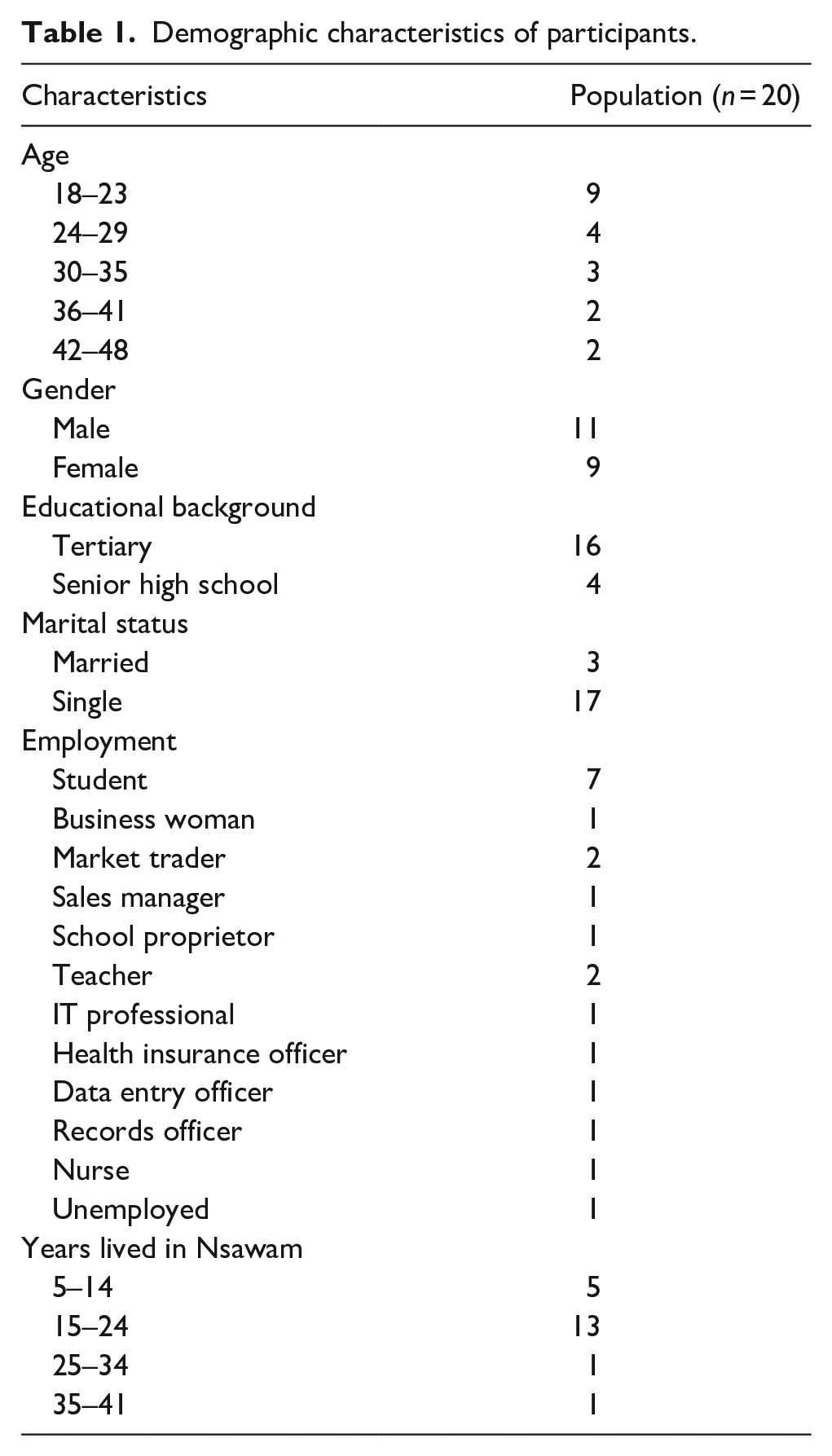
Out of the twenty participants, eleven were males and nine were females. Additionally, the ages of the participants ranged from 18 to 48 years. Majority (16) of the participants had acquired tertiary education, while the remaining participants had completed senior high school. With regards to their employment status, seven participants were students, twelve were employed in various professions, while one was unemployed. Furthermore, majority of the participants were single, and the number of years for which participants had lived in Nsawam ranged from 5 to 41 years. Table 1 represents the characteristics of the participants.
Demographic characteristics of participants.
Impacts of the presence of people with mental illness on the streets
The findings under this objective have been categorized into two main themes and presented below.
Perceived impacts on the wellbeing of homeless people with mental illness
Majority of the research participants shared that homeless people with mental illness lacked proper care, good food, housing, and medical attention. The participants added that these vulnerable individuals were also subjected to ridicule, abuse and discrimination in the community. This is what one participant had to say:
If they (people with mental illness) are on the streets, no one takes care of them, especially when it comes to their physical upkeep. I doubt they take their bath or eat a balanced diet. Their circumstance is not good for their health. Also, they have no access to medication to help them recover from their mental conditions, and this is disturbing. (Female Participant 1).
Another participant also explained that homeless people with mental illness had no access to medical care, and other basic needs, such as food and shelter:
Their presence on the street shows that they are receiving no treatment for their condition. They are on their own, and they are responsible for providing for themselves what they will eat and where they will sleep. Whenever it rains, they have nowhere to go so they are beaten by the rain. When the sun is too hot, they barely get a shade to hide under. This is not good for them. (Male Participant 1).
As part of the impacts of their circumstance on their wellbeing, some participants shared that persons with mental illness on the streets of Nsawam experienced social isolation and stigma. One participant said that most residents refrained from interacting with people with mental illness on the streets:
Due to the societal stigma attached to these individuals, people do not talk to them or offer them any help so they are always by themselves. (Female Participant 2).
Another participant explained that people did not interact with individuals suffering from mental disorders for the fear of being abused by them:
People are afraid to go close to these individuals with mental issues because they believe that their conditions make them very aggressive and violent towards people. Therefore to avoid being injured, the residents do not go close to them (Female Participant 5).
Furthermore, some participants mentioned that persons with mental illness on the streets were physically and sexually abused by some of the residents. This is what one participant had to say:
I have witnessed a lot of these individuals being chased and brutally beaten for picking up things that did not belong to them. . .The females among the homeless people with mental illness in this community suffer a lot because they are usually raped. To make matters worse, they are unable to seek treatment for any harm incurred after being sexually abused. (Male Participant 9).
The evidence presented above suggests that the presence of people with mental illness on the streets might have no other implication other than depriving these individuals their inherent right of having access to the necessary basic needs to maintain a good standard of living.
Threat to the safety of residents
Some research participants disclosed that persons with mental illness found on the streets perpetrated physical and sexual violence. Additionally, they broke into homes and took people’s belongings. One participant gave an account of a rape incident he witnessed:
I have witnessed a male with mental illness rape a woman in the market during the night. It took the intervention of some of the residents to save her from this unfortunate incident. I learnt according to our law, such a culprit cannot be penalized because he is not mentally sound. This woman who got raped was about to have her wedding but after her husband-to-be heard about the incident, he refused to marry her. (Male Participant 2).
Another participant shared his encounter of being physically violated by a person with mental illness on the streets:
I remember being slapped by one of these sick individuals on my way home from the market. He just approached me and slapped me in the face. (Male Participant 4).
In addition, a female resident of Nsawam provided details on the aggressive behaviour displayed by one individual with mental illness:
I saw one of them seriously beating a pregnant woman. He really beat that woman. Another day too, I saw this same man throwing stones to smash someone’s glass store. I don’t know what really triggered him to do any of these things. (Female Participant 6).
Another research participant gave an account of an event where a person with mental illness unlawfully entered his premises and stole from him:
At times, they can enter into your residence without your permission while you are away and take your belongings. Recently, one of them entered into my house and stole one of my hens. This is what most of them have been doing in the area. (Male Participant 4).
Reasons for their presence on the streets
Neglect by family members
Community members who provided information on this reason perceived that some family members abandoned their sick relatives because of the shame and stigma associated with mental illness in the community. A participant stated that some families viewed having a relative with mental illness as a disgrace:
Some families feel like it is a shame to even have such a relative amongst them. In this society, some families believe that having a relative with a mental condition puts a dent on the reputation of the family. So what some people normally do is to leave their sick relative to himself/herself and when he/she happens to end up on the streets, the family feels relieved. (Male Participant 5).
Furthermore, a participant revealed that it was normal for people to shun homeless persons with mental illness:
It has become a normal thing in our Ghanaian society to avoid persons with mental illness. As soon as we see such individuals, whether they are our relatives or not, we neglect them and offer them no help. Instead of family members of these vulnerable persons to send them to the psychiatric hospital for treatment, they refuse to do that and leave them to roam on the street (Male Participant 3).
Limited access to formal healthcare
Majority of the research participants opined that it was difficult to assist these individuals to get medical assistance due to issues, such as the lack of a psychiatric hospital in the community. They further added that, some families who cared about the wellbeing of their sick relatives were unable to afford the costs of psychiatric care. According to the participants, the above mentioned issues has caused most families to leave their members with mental illness to their fate on the streets. One participant emphasized on the fact that there was no psychiatric hospital in Nsawam:
No psychiatric hospital has been established in this community to attend to them. Besides, there are only three psychiatric hospitals in the whole country. How does the government expect these three facilities to address the mental health needs of a country of about 30 million settlers? So it is not surprising that most of them roam on the street. (Male Participant 5).
The issue of family members’ inability to afford mental health services for their relative with mental illness was mentioned by another participant:
Some relatives of these individuals with mental illness have no money to support them, so they just leave them to roam about. It is also surprising that no government support is provided to aid these homeless persons with mental illness to have access to mental health care. (Male Participant 10).
Similarly, a community member mentioned that some family members were unable to send their unwell relatives to the hospital for medical treatment due to low finances:
Most families are unable to send any relative of theirs with a mental condition to the hospital due to financial issues. When they are able to locate and visit a psychiatric hospital, they return with their sick relatives to the house because they were unable to afford the medical costs. They then leave them to roam on the streets. (Male Participant 8).
Discussion
This study explored the perspectives of community members on homeless people with mental illness. Community members engaged in this study opined that homeless people with mental illness were deprived of essential amenities, such as food, shelter, and medical aid that could help them maintain a desirable standard of living. This finding did not come as a surprise because it corroborates existing evidence that indicates that most persons with mental illness are incapable of securing for themselves the necessary basic needs that would enhance their livelihoods due to their health condition (Ambrosino et al., 2008). This finding further suggests that persons with mental illness on the streets are likely to experience a continuous deterioration in their overall health.
Furthermore, community members’ perspective on distancing oneself from homeless individuals with mental illness mainly revolved around the belief of being abused by them. In Ghana, it is common to witness stigmatization against people with mental illness (Barke et al., 2011). Although some persons with mental illness may exhibit aggressive behaviour, having stereotypes as these towards them and not offering any support could deny them access to those social opportunities, like health care and accommodation that would improve their circumstances (Corrigan, 2004). Like other studies (Maniglio, 2009; Sullivan et al., 2000b), this study also found that some community inhabitants could commit physical and sexual abuse against homeless people with mental illness. The study findings further highlighted that homeless females with mental illness were more vulnerable to sexual violence.
According to the community members, some persons with mental illness perpetuate physical and sexual violence, and also break into people’s homes to take their belongings. This finding is quite peculiar to this study as most studies indicate that it is people with mental illness that are usually at the receiving end of abuse (Khalifeh et al., 2016; Maniglio, 2009; Sullivan et al., 2000a). Nonetheless, people with mental illness have the tendency of exhibiting aggressive behaviour due to their medical condition (Barke et al., 2011), so it is possible for them to perpetrate violence. The evidence presented thus far suggests that the presence of persons with mental illness on the streets may not be unfavourable to them alone, but also to members of the society. Therefore, appropriate measures should be implemented by the state to get them off the streets and given the necessary support to recover.
Also, the study participants shared that most families neglect their relatives with mental illness to avoid stigmatization and humiliation. Research shows that family members are primarily involved in providing long-term care to their relatives with mental illness (Han et al., 2019). Hudson (2019) also argues that the involvement of family members in the care of persons with mental illness is a step to the decentralization of mental health service delivery. However, in order to avoid self-stigmatization due to public stigma (Chiu et al., 2013), it is possible for most families to desist from caring for their sick relatives and this could lead to them ending up on the streets. This finding highlights the need for people to unlearn all societal stigmas attached to mental illness. Thus, it would be useful if mandated state institutions embark on sensitization exercises to create awareness on mental health issues and urge the public to assist homeless persons with mental illness to access mental health care.
Furthermore, the study participants revealed that low finances and the lack of proximity to psychiatric facilities could deter some families from supporting their unwell relatives to access health care. In Ghana, there are only three psychiatric hospitals, and the mental units located in communities like Nsawam only provide out-patient services. Some reports also reveal that the cost of mental health care in Ghana, particularly the prices of medication, is expensive and most Ghanaians are unable to afford it because they earn low wages (Addo et al., 2013; Boye, 2017). These situations can hinder people’s ability to access mental health services in the country. In order to address these issues, the government should provide subsidies for mental health services to make it more affordable. Additionally, more psychiatric hospitals should be established nationwide so that homeless people with mental illness can have easy access to psychiatric services.
Limitations of the study
This study presents information on homeless people with mental illness from the perspectives of a small sample of people who are predominantly of middle class status in Nsawam. Given this, the views expressed might not reflect the opinions of all people living in the community, hence, the findings of this study cannot be generalized. Furthermore, we were unable to recruit a larger sample size for this research as many potential participants who were contacted to participate in the study declined to meet with us to be interviewed for the fear of the covid-19 pandemic. Future research of similar kind should engage a larger sample size to increase the depth of information and analysis that could emerge from the data. Future studies should also consider recruiting people (e.g. market traders, street vendors, etc.) that are likely to have more day to day contacts with homeless people with mental illness as they may have different perspectives from those of the sample presented in this study.
Conclusion
This study provides insights into the perspectives of community members on homeless people with mental illness. Our results suggest that not only are homeless people with mental illness likely to have no access to basic needs including food, shelter, and healthcare, but they could also pose threat to the safety of community members. It is also inferred from the study findings that issues, such as neglect by family members and limited access to psychiatric services could account for the presence of people with mental illness on the streets. Therefore, measures should be taken by the government to make psychiatric services accessible and affordable to homeless people with mental illness as this would go a long way to help facilitate their recovery.
