



Abstract
Background:
Mass media has an important role in influencing the suicidal behavior of the general population. However, the quality of news reporting of suicide has not been assessed in Iraq.
Aim:
We aimed to assess the quality of news reports in Iraq while reporting the suicidal behaviors.
Methods:
The search was done on Google in November and December 2020 with the search term ‘suicide news in Iraq’ and accessible news reports distributed in Kurdish, Arabic, and English languages were taken out. We scrutinized the news reports to identify the reporting characteristics and compared them with the World Health Organization (WHO) guidelines.
Results:
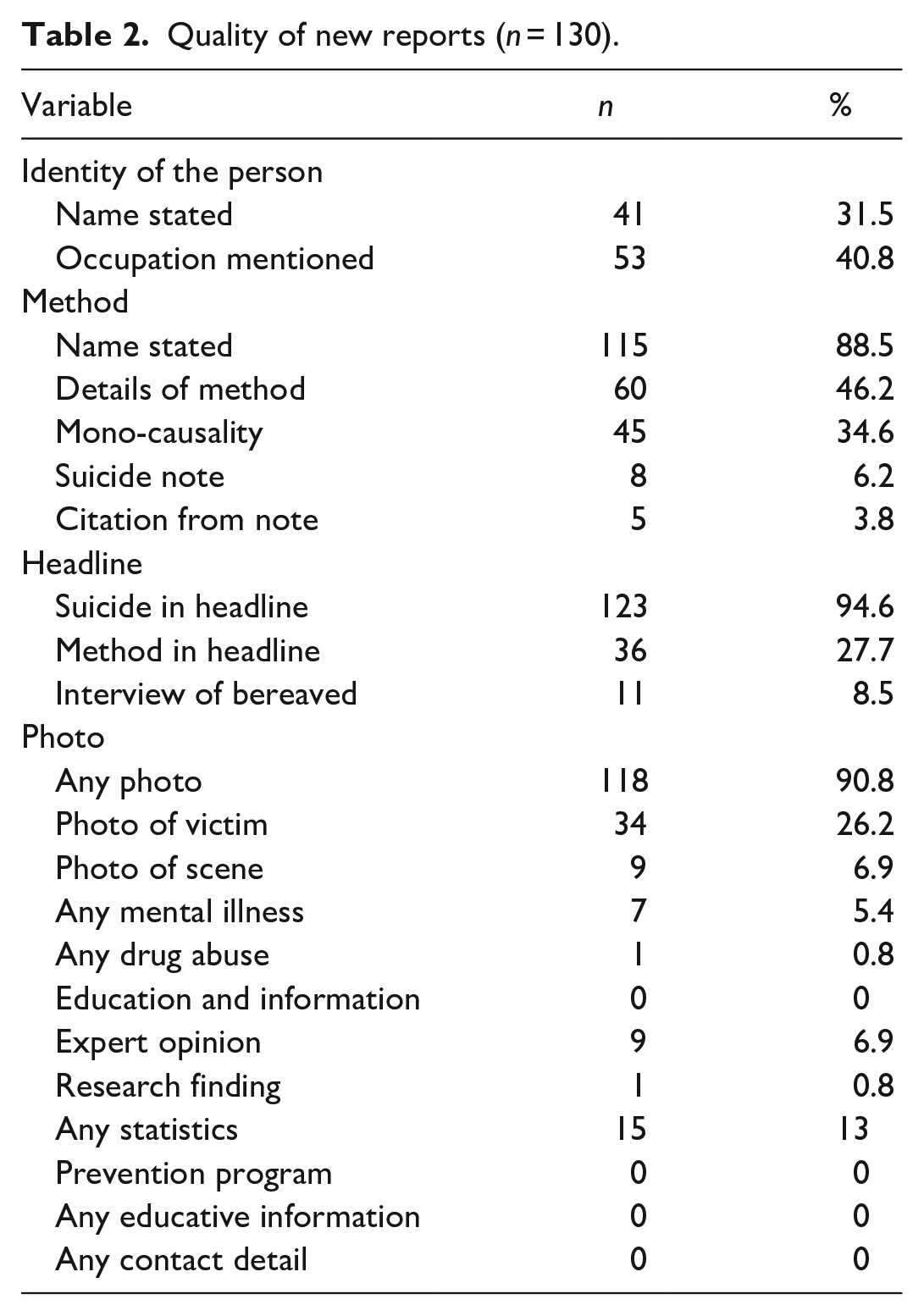
A total of 130 news reports were analyzed; among them 23.8% were Kurdish, 63.8% were Arabic, and 12.3% were in the English language. About 31.5% of the reports mentioned the name and 40.8% mentioned the occupation. The name of method was mentioned in 88.5%, mono-causality was found in about 34.6%, the term ‘suicide’ was mentioned in the headline in 94.6%, and method of suicide was mentioned in the headline of about 27.7% of the reports. Only 5.4% of the reports traced mental illness, 6.9% mentioned expert opinion, and none of the reports mentioned prevention program, and educative information.
Conclusion:
The study revealed that news reports of suicidal behavior in Iraq are poorly adherent to the WHO reporting guidelines. Further studies are warranted to identify the responsible factors and culture-specific prevention strategies.
Introduction
Suicide is a grave public health problem throughout the world, and it is hidden and silent especially in the Muslim majority countries due to several attributing factors (El Halabi et al., 2020; World Health Organization [WHO], 2017, Zalsman et al., 2016). Media has both protecting and harmful effects on suicidal behavior in the general population (Niederkrotenthaler et al., 2020; WHO, 2017; Zalsman et al., 2016). Recent research has shown the implication of suicide contagion with sensational media reporting (WHO, 2017; Zalsman et al., 2016). This phenomenon is further authorized by copycat or imitation of suicides (Stack, 2005; Yip et al., 2006), and sensationalized suicide report (Sudak & Sudak, 2005). There are different guidelines given by international organizations like the World Health Organization (WHO) and the International Association for Suicide Prevention (IASP) for media professionals across the world (WHO, 2017) to reduce inappropriate reporting. The poor adherence to the media reporting guidelines on suicide is reported in the majority of the countries, globally including the Muslim prominent countries like Bangladesh, Pakistan, Indonesia, Malaysia, and Egypt (Arafat, Kar, et al., 2020; Arafat, Menon, et al., 2020; Arafat, Shoib, et al., 2020; Kamboh & Ittefak, 2019; Mesbah, 2014; Nisa et al., 2020; Shoib & Arafat, 2021).
The Middle Eastern countries have been facing suicide as a major problem evident by about 26,000 suicide deaths in 2016 in the Eastern Mediterranean Region (El Halabi et al., 2020). The Arabic culture and religion shape the perception of mental health, illness, and suicide (El Halabi et al., 2020). Iraq is a Muslim majority country of the Middle East with varied mental health issues since 1921 because of political instability and the economic situation (Bolton, 2013; Sadik & Al-Jadiry, 2006). The rate of suicide per 100,000 in Iraq was 1.09 and 1.31 in 2015 and 2016 respectively which is lower than the global rate (Abbas et al., 2018). However, there are strong chances of under-reporting of suicide due to stigma and lack of quality suicide data. There has been no report assessing the quality of media reporting of suicide in Iraq. Therefore, we aimed to assess the quality of news reporting on suicide in Iraq which would serve as a baseline study in the country as well as in the Middle East region.
Materials and methods
Data collection
An explorative search was done on Google in November and December 2020 with the search term ‘suicide news in Iraq’ and accessible news reports distributed in Kurdish, Arabic, and English languages were taken out. Likewise, the content analysis method was utilized in analyzing the quality of the news and reports distributed in Kurdish, Arabic, and English languages on Iraqi media channels and websites, as well as the content, quality of reports, and linguistic aspects of media reports related to suicide problems, have been analyzed. However, the comparative method has been used to compare reports about suicide cases in Iraq in all three languages: Kurdish, Arabic, and English.
Inclusion and exclusion criteria
We included the news of those specifically reported suicide and suicide attempts of Iraqi people currently living in Iraq. The news covering the suicide bombing, suicide terror attacks, and reports with controversy were excluded from the study.
Instrument
We used an instrument that was structured and utilized in previous studies assessing the quality of media reports in Bangladesh and a part of India (Arafat et al., 2019; Shoib & Arafat, 2021). The instrument followed the WHO media guidelines for reporting suicides (WHO, 2017). We checked the variables related to suicidal behavior, the potentially harmful, and potentially helpful reporting characteristics of the WHO guidelines (WHO, 2017). We scrutinized the potentially harmful characteristics of WHO media guidelines such as mentioning the identification of the deceased (name, occupation), identification and details of the means of suicide, assessing the headlines of the news for checking the term ‘suicide’ in it, mentioning the method in it, and mentioning the life event it, and posting photographs of the deceased. We also scrutinized the potentially helpful characteristics of WHO media guideline like included mentioning the role of mental illness and addiction, providing education regarding suicide and suicide prevention, expert opinions on suicide, discussing research findings, explaining the suicide statistics, mentioning the available prevention programs, and supporting contact information for suicide prevention.
Statistical analysis
Data were analyzed with the help of the Statistical Program for the Social Science (SPSS) version 24 and the Microsoft Excel 2010 version. The data were coded, cleaned, tabulated, and presented in a descriptive form.
Ethical statement
We analyzed the already publicly available news reports and no institutional ethical clearance was sought. However, we complied with the declaration of Helsinki.
Results
Distribution of the news reports
A total of 130 news reports was retrieved from 14 online portals reports and analyzed; among them, 23.8% were Kurdish, 63.8% were Arabic, and 12.3% were in the English language (Table 1). The Kirkuk has published the highest number of news reports and the Baghdad Post has published the lowest number of news reports (Table 1). The majority of the reports (80%) reported fatal attempts whereas the rest 20% mentioned non-fatal attempts. In 3.8% of cases, the suicide pact was reported, and 4.6% of reports identified suicide-related homicide.
New reports (n = 130).

Quality of news reporting
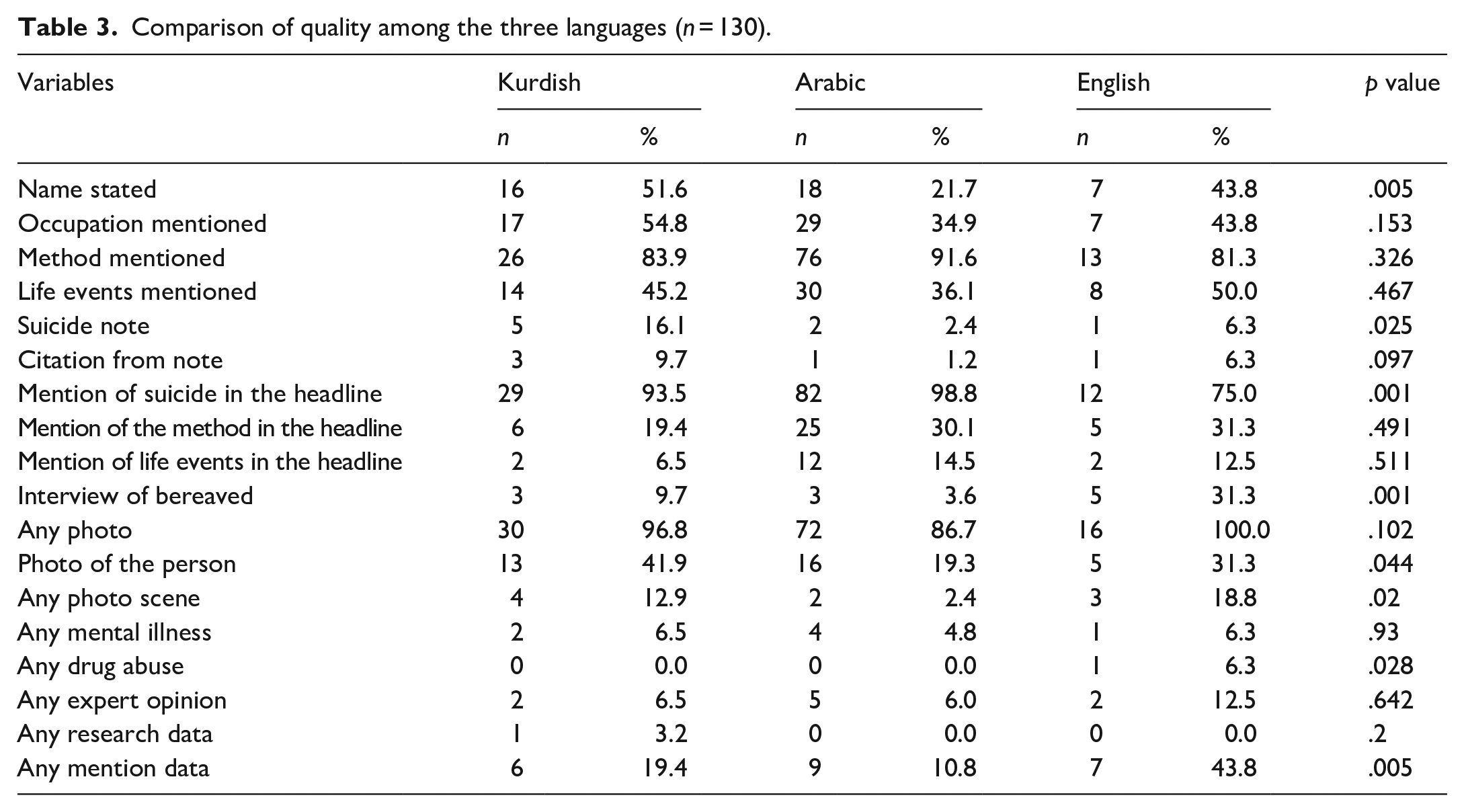
About 31.5% of the reports mentioned the name and 40.8% mentioned the occupation of the victims. The name of the method was listed in 88.5%, mono-causality was found in about 34.6%, the word ‘suicide’ was mentioned in the headline in 94.6%, and the suicide method was mentioned in the title of about 27.7% of the studies (Table 2). In 6.2% (n = 8) reports, suicidal notes were found and in 3.8% (n = 5) reports, quotes from those notes were reported. Approximately 90.6% (n = 118) of the reports provided photos in the reports, about 26.2% (n = 34) of the reports posted images of victims of suicide, and the rest of the reports provided different images such as scene, material, and symbolic photos. Only 5.4% of the reports traced mental illness, 6.9% mentioned expert opinion, and none of the reports mentioned prevention program, and educative information (Table 2). There are statistically significant variations in some reporting characteristics among the three languages (Kurdish, Arabic, and English) such as mentioning the name, suicide note, suicide in the headline, and drug abuse (Table 3). The English news reports reported the potentially helpful characteristics than the Arabic and Kurdish news reports and the difference was statistically significant (Table 3).
Quality of new reports (n = 130).
Comparison of quality among the three languages (n = 130).
Discussion
Main findings of the study
Our findings show that media suicide reporting in Iraq is poorly adherent to international media reporting guidelines. Potentially harmful reporting violations were commonly seen; in contrast, there was practically no focus on including educational and preventive information in the suicide stories. English language reports were more likely to include helpful educational information compared to the Kurdish and Arabic language reports.
Implication of study findings
Our findings concur with prior reviews that assessed the quality of media reporting of suicide from South-East Asia (Arafat, Kar, et al., 2020) and Muslim countries (Arafat, Shoib, et al., 2020). Overall, they suggest a poor awareness of the crucial role of media in suicide prevention and inadequate focus on media as a key population-level suicide prevention strategy; the latter may in part be driven by a dearth of systematic studies on media reporting of suicide from individual nations that may inform corrective strategies.
More than one-third of suicide reports used inappropriate language to report the identity of the person; these figures are comparable to studies from India (Chandra et al., 2014; Menon et al., 2020) but much higher than developed nations (Carmichael et al., 2018; McTernan et al., 2018; Pitman et al., 2015). Similarly, reporting suicide methods both in the headline and body of the report were common breaches, comparable to reports from India and South East Asia. This practice is concerning because explicitly naming and describing suicide methods may trigger imitative suicidal behavior among those vulnerable (Fink et al., 2018; Hegerl et al., 2013; Koburger et al., 2015).
More than 90% of the reports illustrated their stories with photographs with over a quarter including a photo of the person in contravention of reporting guidelines. Vivid, inappropriate imagery and content can influence vulnerable readers; in particular, media reporting of suicide locations and ‘hot-spots’ may attract vulnerable individuals to such locations to take their own life (Reisch et al., 2005; The Samaritans, 2013). Therefore, it is necessary to curb this practice. Mono-causal explanations were implied in more than half of the suicide reports; these figures were comparable to previous Indian (Armstrong et al., 2018; Chandra et al., 2014; Kar et al., 2021) and Asian studies (Arafat, Khan, et al., 2020; Arafat, Menon, et al., 2020; Arafat et al., 2019; Brandt Sørensen et al., 2019; Kamboh & Ittefaq, 2019) though such reporting trends were less prevalent in Europe (Niederkrotenthaler et al., 2020; McTernan et al., 2018). Suicide is a complex behavior with many psychosocial determinants and interacting factors; hence, reporting a single cause of suicide is neither likely to be valid or accurate (Hawton & Van Heeringen, 2009). On the contrary, reporting a single cause for suicide, such as financial debt, may have several negative ramifications; it may promote identification with the deceased among those going through similar problems and increase family members’ distress (The Samaritans, 2013).
Amidst these undesirable reporting trends, there was very little focus on including information that provides help and hopes to readers. Potentially helpful reporting practices such as discussing links with mental health or drug-related issues, including expert opinions and suicide-related statistics were rarely practiced. Of especial concern, none of the reports included contact details of suicide support services such as helplines/hotlines. Whereas reporting of suicide-related educational and preventive information has been less than optimal in India (Menon et al., 2020), Asia (Arafat, Khan, et al., 2020; Arafat, Menon, et al., 2020; Brandt Sørensen et al., 2019; Marthoenis et al., 2020; Nisa et al., 2020), and elsewhere (Niederkrotenthaler et al., 2010; Roškar et al., 2016;Tatum et al., 2010), one area where relatively better compliance has been reported before is including information on helplines (Armstrong et al., 2018; Chandra et al., 2014); this is of particular relevance to readers who may be contemplating suicide and hence must be adhered to while reporting suicide. In this regard, English language reports fared better than vernacular news reports. Though these observations are consistent with prior reports (Chandra et al., 2014; Kar et al., 2021; Menon et al., 2020), the reasons for this discrepancy are not immediately clear. We speculate that these differences may be related to better awareness of reporting guidelines among journalists attached to English language dailies.
There is a paucity of literature on media reporting of suicide in Muslim countries. A recent review identified such studies only from five Muslim nations and none from the Middle-East, a Muslim-dominated part of the globe (Arafat, Shoib, et al., 2020). More regional studies are needed from Muslim majority nations because of two reasons; first, though suicide is proscribed in Islam, variations in suicide rates do exist between Muslim nations with some reporting suicide rates higher than the global average (WHO, 2018); and second, there are socio-cultural, ethnic and economic differences between Muslim and non-Muslim nations with possible differences in suicide-related risk and protective factors (Lester 2006). Further, the practice of religion is anchored in culture and social contexts; this may explain the variations in the practice of Islam and theological orientation between Muslim nations. In support of this observation, a prior media reporting study from Egypt (Mesbah, 2014), a nation bracketed together with Iraq in the ‘Middle East’, showed fewer reporting violations and better adherence to reporting guidelines though an emphasis on educational content was similarly low. This highlights the need for more regional studies which may assist the formulation of region-specific media reporting guidelines that are sensitive to local barriers and challenges in adherence to reporting guidelines.
Responsible factor and possible way outs
Possible reasons for sub-optimal adherence to media reporting guidelines may include reduced awareness of best practices of safe reporting of suicide, constant pressure on journalists to create newsworthy content thereby leading to detailed and sensationalized portrayal of suicide, lack of systematic data on suicide burden, and media’s contribution to suicide prevention due to the absence of national surveillance system in Iraq, and finally, the close involvement of crime beat reporters with police, who are mandated to investigate every case of suicide in Iraq (Abbas et al., 2018), which leads to routine incident report style coverage with a higher emphasis on breaking news quickly than getting all the facts about the suicide incident correct the first time; qualitative studies of media professionals suggest as much (Armstrong et al., 2020). Framing the country-specific reporting guidelines and proactively promote and reinforce them, commissioning of a national media monitoring agency, regular training, and monitoring, and enduring collaboration among public health experts, journalists, and government, and other stakeholders have been advocated to improve the status quo (Arafat, Khan, et al., 2020; Menon et al., 2021).
Strengths of the study
This is the first study assessing the quality of news reporting in Iraq as well as in the Middle East region and one of the few studies conducted in the Muslim majority courtiers.
Limitations
Several limitations should be mentioned for the study such as relatively smaller sample size, data were collected from online media reports by Google search, and the search was performed in a short period of time.
Conclusion
The study revealed that news reports of suicidal behavior in Iraq are poorly adherent to the WHO reporting guidelines. Further studies are warranted to identify the responsible factors and culture-specific prevention strategies.
Footnotes
Author contributions
SMYA contributed to the concept, design, and writing. ARA, HRM, and HMK contributed to data collection and writing. All authors contributed to manuscript writing, revision, read, and approved the submitted version.
Data availability statement
The raw data supporting the conclusions of this article will be provided on request to the corresponding author.
Funding
The author(s) received no financial support for the research, authorship, and/or publication of this article.
