



Abstract
Background:
This study reviewed the psychological consequences of the novel coronavirus disease COVID-19 and the challenges that face post-traumatic interventions. COVID-19 pandemic has multifaceted psychological effects extending social stigmatization to COVID-19 patients, resulted in delaying in medical care and hiding important medical history, particularly of travel, this in turn will increase the risk of transmission.
Objectives of the study:
To explore if there is significant impacts of public health emergency COVID-19 on mental health among clients attending Al/Karkh Care centers.
Methods:
Cross-sectional study describes the mental health status among clients attending Al-Karkh Health Centers during the COVID-19 pandemic, using mental health reports from Mental Health Unit/Al-Karkh Health Directorate, which were collected from January to August. Using (SPSS25) for statistical analysis. Statistical test Chi-square used and p value of ⩽.05 was considered significant.
Results:
The percentages of psychological disturbances among clients is higher throughout the first 7 months of 2019 than 2020, till August the percentage of psychological disturbances started to hike up in 2020 than in 2019 (6%), (5.4%) respectively. Throughout the months of 2020 up to August there was significant difference between male and female clients in mental disturbances p value <.0001.
Conclusion:
The current study found that COVID-19 pandemic is expected to raise great challenges for mental health services in health care centers and constitute a mental health risk especially to women and girls compared to men.
Keywords
Introduction
Human civilization probably is passing through the most critical stage of this era; COVID 19 outbreak has been declared an international public health emergency on 30th of January, 2020 by the World Health Organization. COVID-19 not only threaten people’s physical health, but also affect people’s mental health, especially in terms of emotions and cognitions (Dubey et al., 2020; Li et al., 2020). After the implication of restrictions due to varying degrees of confinement such as banning public transport, restricting movement, and imposing a 14-day quarantine after travel, many people were still not working or exercising which may have associated implications on health and wellbeing (Zhang et al., 2020).
COVID-19 pandemic has many effects, first disease-associated stigmatization among the sufferers from 2003 SARS outbreak was remarkably evident even after years of exposure, making it difficult for many when restarting the usual customs of day to day life. A stigmatized community will cause delay in seeking medical care and hide important medical history, particularly of travel. This behavior, in turn, will increase the risk of community transmission (Dubey et al., 2020). Second, studies have suggested that the psychological impact of COVID-19 may be different among healthcare workers, the general public, and patients (Luo et al., 2020). Also its effect differs among different age groups. Third in Iraq, as elsewhere, the corona virus pandemic is having severe impacts on the whole population, but women and men are affected in different ways. This gender analysis shows that women are facing an increase in the burden of domestic work and caring responsibilities, a heightened risk of domestic violence and gender-based violence, and greater loss of economic livelihoods and autonomy than men. They also face greater difficulties in accessing healthcare and support services, due to restrictions on movement and constrictive social norms, have limited decision-making power, and lack the information on corona virus itself which should help keep them safe (Rivera et al., 2020).
Therefore, outbreak of COVID-19 has raised great challenges in mental health services for older adults in the community, and for that reason it is important to resolve this barrier in order to provide high-quality, timely crisis psychological services to community-dwelling older adults.
The aim of this study is to explore:
The characteristic of psychological distress across Al-Karkh health center’s clients.
If there is significant impacts of public health emergency COVID-19 on general population’s mental health in Baghdad Al/Karkh.
The effect of lockdown on general population mental health.
If there is difference in mental disorder cases between Al-Karkh health districts.
Subject and methods
Study design and duration
Cross-sectional study describes the mental health status and psychosocial problems among clients attending Al-Karkh Health Centers during the COVID-19 pandemic.
Study setting
The study was conducted using Mental Health data from Mental Health Unit/Non communicable disease Branch/Public Health Department/Al-Karkh Health Directorate, which were collected from (10 ) Al/Karkh Health Districts.
Sample size
All patients with mental health problems attending Al/Karkh Health Centers during the period (January–August).
Inclusion criteria
All patients diagnosed with mental health problem.
Data collection and analyses
Mental Health Reports for the months (January–August) from Al/Karkh Health Care Centers.
Ethical considerations
Ethical approval for the study was obtained from the Public Health Department/Al-Karkh Health Directorate.
Limitations of the study
A. Inclusion of few variables in the study because the source of data was from the formal mental health report, so that (residency, education, marital status, monthly income) couldn’t be assessed.
B. Short time for conducting the study because of no part-time employment resulted in not including other months of the year 2020.
Statistical analysis
Data was stratified according to (age, gender, mental health problem, districts), using statistical package for social science version (SPSS25) was used for statistical analysis of the data. Statistical test Chi-square test used and p value of ⩽.05 was considered significant.
Results
Psychological disturbances among Al-Karkh PHCs clients
The percentages of psychological disturbances among clients attending Al-Karkh Health Directorate’s PHCs is higher throughout the first 7 months of 2019 than 2020, till August the percentage of psychological disturbances started to hike up in 2020 than in 2019 (6%), (5.4%) respectively (Figure 1).
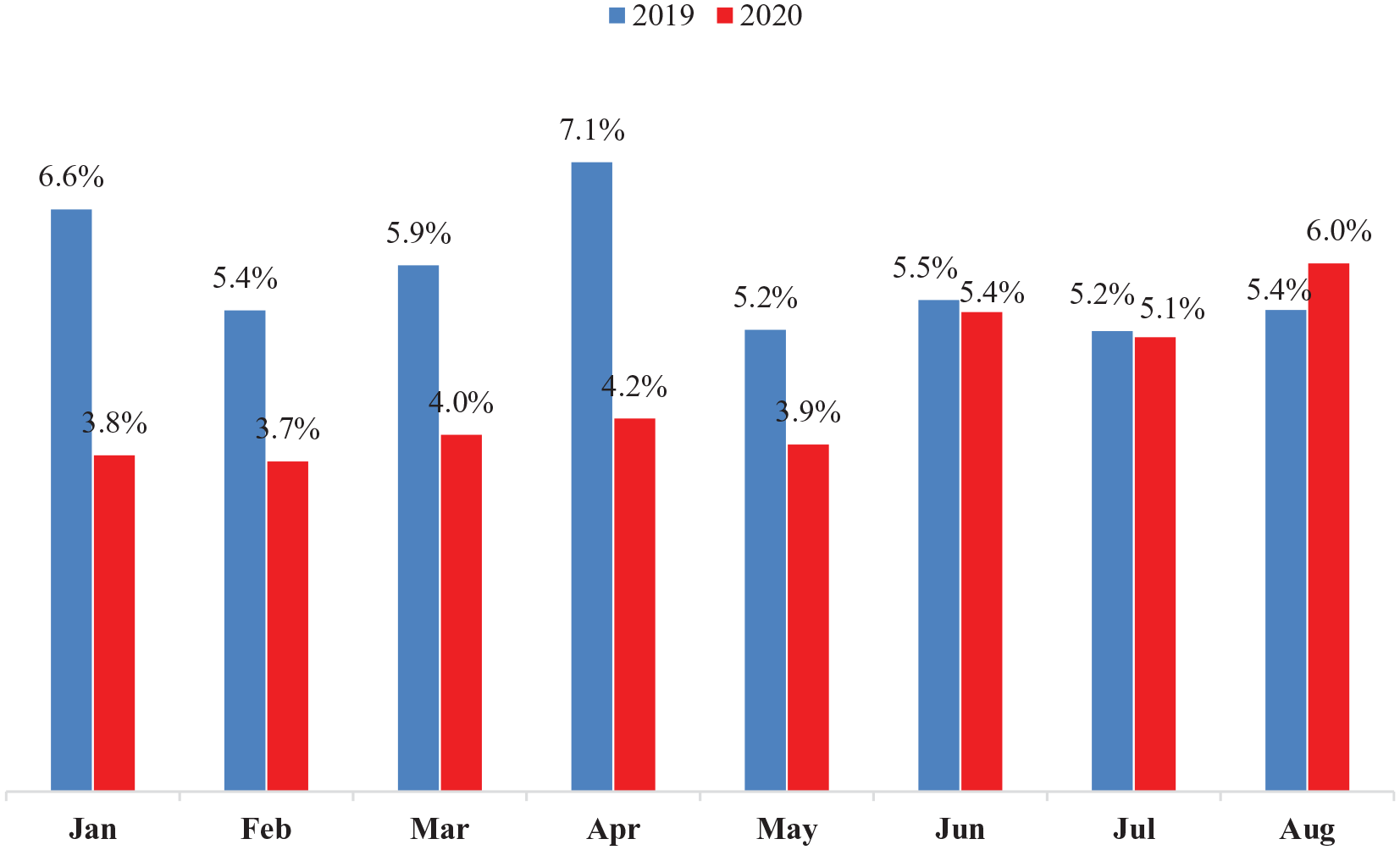
Psychological disturbances among Al-Karkh PHCs clients.
Depression among Al-Karkh PHCs attendants
The least number of depressive clients during 2020 was in April (623). Since February the number of cases started to decrease with two small peaks in May (900), June (909). The number of cases started to increase abruptly till it reached (887) in August (Table 1).
Anxiety, depression, PTSD, behavioral disorders among Al-Karkh PHCs attendants.

General anxiety disorder among Al-Karkh PHCs’s clients
The greatest number of general anxiety disorder among Al-Karkh PHC’s clients cases was in January (2673), and the lowest number was in April (1680). Started gradual increment till reached abruptly to (1917) in August (Table 1).
Post traumatic stress disorder among Al-Karkh PHCs clients
The number of clients with post-traumatic stress disorder decreased in wavy manner since January (529), till it reaches to (226) in July, yet it rose up in August (266) (Table 1).
Behavioral abnormalities among Al-Karkh PHCs’s clients
The greatest number of behavioral abnormality cases was in February (267) in both. The least number of behavioral abnormality cases was in July (59) and August (53) (Table 1).
Mental disorders during 2019 versus 2020
The current study highlighted significant statistical difference between August 2020 and 2019 in the percentage of Al-Karkh PHC clients with mental disorder, anxiety, PTSD, depression, substance use disorder, violence. The p value (<.001) (Table 2).
Mental disorders in August 2020 versus 2019.

Body dysmorphic disorders among clients/Al-Karkh PHCs
The number of clients with somatoform disorders shows wavy decrements since January (634), throughout the next months of 2020 reaching to (349) case in August (Figure 2).

Psychosis and body dysmorphic disorder among clients/Al-Karkh PHCs.
Psychosis among clients/Al-Karkh PHCs
The study appealed since February the number of clients with psychosis (49), the number of cases started to decrease in wavy manner till August (49) case of psychosis (Figure 2).
Gender and mental health problems among Al-Karkh PHCs clients
Throughout the months of 2020 up to August there was significant difference between male and female clients in Mental disturbances, p value <.0001 (Table 3).
Gender and mental disturbances among Al-Karkh PHCs clients.

Significant at .01 level by Pearson’s Chi-square.
Discussion
Psychological disturbances among Al-Karkh PHCs clients
Psychological disturbances among Al-Karkh PHCs clients
In the current study we can notice that in one hand comprehensive view to the total numbers of mental health problems during 2020 up to August reflect decrement in the frequency of Al-Karkh health centers clients than 2019. This might be due to lock down and home confinement strategies in the months preceding August that prohibit patients with psychological disturbances to attend health centers, even public transport in many regions has been suspended to lower the risk of disease transmission in addition to unstable security situations before that date. This is similar to previous outbreaks have reported that psychological impact of quarantine can vary from immediate effects, like irritability, fear of contracting and spreading infection to family members, anger, confusion, frustration, loneliness, denial, anxiety, depression, insomnia, despair, to extremes of consequences, including suicide (Dubey et al., 2020).
On the other hand the percentages of psychological disturbances among clients attending Al-Karkh Health Directorate’s PHCs significantly hiked up during August 2020 more than in August 2019, this mostly attributed to the dependence of the strategy of (containment of the epidemic) so no more lockdown and the clients can easily attend the health centers, especially with existence of the miss interpretation of the removal of lockdown as the end of COVID-19 pandemic and returning back to normal life, in addition long term lockdown causes unavailability of community services and collapse of many industries, consequently negative impact on local and national economic stabilities. Furthermore, the affected people with COVID-19 were subjected to social rejection, discrimination and stigmatization making them more vulnerable to get psychological problems. Also, more people bereaved from the death of dear friends, colleagues, and loved ones due to COVID-19 can result psychological trauma and long-term psychiatric problems. Other possible reason for hiking up of number of clients in August 2020 was that psychiatric patients were more prone to develop recurrences or deterioration of the preexisting signs and symptoms. Therefore because of the above enlisted causes, immediately after removal of lockdown the number of clients attending mental health unit hiked up. This is consistent with the results of study conducted in Spain revealed that about 36% of the participants reported moderate to severe psychological impact, 25% showed mild to severe levels of anxiety, 41% reported depressive symptoms, and 41% felt stressed (Rodríguez-Rey et al., 2020).
Depression among Al-Karkh PHCs attendants
The least number of depressive clients during 2020 was in April this might be attributed to fueling of this period by an infodemic spread via different platforms of social media and outburst of myths that the COVID-19 virus will fade out immediately after Ramadan in addition to absence of universities and schools consequently no stress of courses and no exams, since lockdown was persistent during this period. The number of cases started to increase abruptly in August this might be attributed to the prolonged effect of lockdown in the previous months intensifying the negative emotions experienced by the general population during the COVID-19 pandemic.
A study conducted in India by Chakraborty and Chatterjee (2020) about the psychological impact of COVID-19 pandemic on general population noted that the majority of the responders felt worried about financial restraint during lockdown.
General anxiety disorder among Al-Karkh PHCs’s clients
The greatest number of general anxiety disorder among Al-Karkh PHC’s clients was in January, this is similar to the results of study conducted in China by Li et al. (2020) determined that anxiety have been increased after declaration of COVID-19 on January 20, 2020.
The number of general anxiety disorder cases among Al-Karkh health centers’ clients gradually increased abruptly in August. This might be due to prolonged period of lockdown with their uncertainty about their health status in addition considerable number of clients developed obsessive-compulsive symptoms, such as repeated temperature checks and hands sterilization, those are more likely to misinterpret harmless bodily symptoms and feelings as the evidence of acquiring COVID-19. This, in turn, imposing unnecessary burden to public health care. (Chen et al., 2020)
Post traumatic stress disorder among Al-Karkh PHCs clients
The mass fear of COVID-19, rightly termed as ‘coronaphobia’, in our study the cases of PTSD abruptly increase in August, his might be due to the increased numbers of death, and rapid acceleration in the number of new cases with expansive media attention about the uncertain character of the virus, unpredictable course of the disease can heighten people’s fears and stress.
Psychosis and behavioral abnormalities among clients/Al-Karkh PHCs
In our study both Psychosis and behavioral abnormalities showed remarkable decrease in cases during months preceding August this could be attributed to regulations regarding transport and quarantine can abruptly discontinue the therapeutic counseling schedules and impose utmost difficulties upon access of prescribed psychiatric medications.
Gender and mental health problems among Al-Karkh PHCs clients
In our study there was significant difference between male and female clients in (mental disturbances, depression, violence, anxiety, post-traumatic stress disorders).
Women and girls face specific and often disproportionate economic, health, and social risks due to deeply entrenched inequalities, social norms and unequal power relations. Understanding the gender – differentiated impacts of the COVID-19 crisis through gender disaggregation data is fundamental to strengthen women’s agency and building a more just and resilient world (Rivera et al., 2020).
Conclusion
It is clearly demonstrated that strict social distancing measures imposed during this global health crises have elicited significant psychological distress.
Abrupt increase in cases of (GAD, Depression, PTSD, Violence) in August after complete removal of COVID-19 lockout, consistent with warning from mental health experts about an (echo pandemic) in the long term.
The least numbers of anxiety and depression was in April.
During the period of lockout the number of body dysmorphic disorders decreased gradually, even after the removal of lockout.
Lockout significantly affect client attendance to health care centers.
The potential for adverse psychological effects of COVID-19 is amplified by the unstable security situation.
Mental – health help – seeking are important correlates of the incidence of anxiety, depression, violence and PTSD.
Inspite of decreased numbers of clients with psychosis and behavioral disorders throughout the months after February, yet it returns back to its realistic number of health care attendance in August.
The current study found that COVID-19 pandemic is expected to constitute a mental health risk especially to women and girls compared to men.
Recommendation
Multidisciplinary collaboration to provide high quality, timely crisis psychological services.
Appropriate applications of internet services and social media to curb pandemic and infodemic.
Online social networks can potentially generate ‘real-time maps’ which should be considered important tools for tracking a pandemic and for making interventions when needed.
Social media is to be used in good sense, to educate people on transmission dynamics, symptoms of disease, and time when exact medical consultations are needed. To protect social media from devaluations, strict government laws, and legislation regarding fake news, social media rumors, disinformation, and misinformation are to be implemented.
follow-up studies are needed to obtain a clear picture of the magnitude of the psychological impact of COVID-19 pandemic.
Online mental health surveys associated with COVID-19 outbreak target different populations including medical staff, patients with COVID-19, students, and general populations.
Publishing books on COVID-19 prevention, control and providing mental health education free electronic copies to the public.
Prioritization of needs of women, children, and older people in its response to COVID pandemic.
Footnotes
Funding
The author(s) received no financial support for the research, authorship, and/or publication of this article.

Ethical approval
Obtained.
Consent to participate
Obtained.
Consent for publication
Obtained.
Availability of data and material
Available.
Code availability
Available.