



Abstract
Background:
Psychiatry’s evidence-, implementation-, and treatment-gaps.
Aims:
The aim of this study is to uncover current trends and gaps in psychiatric research. Understanding where psychiatric research is going and where there might be blind spots is important to better align it with global mental health challenges and with service users’ needs.
Method:
10 top-ranking scientific journals (highest impact factors) in psychiatry were identified for 3 years (1999, 2009, 2019) using Clarivate Analytics. Metadata of all papers published by these journals in the index years were downloaded, and the relevance and relatedness of terms from all titles and abstracts were computed and visualized using VOSviewer.
Results:
In 1999, prominent themes included schizophrenia and novel antipsychotics as well as research on families. Ten and 20 years later, neurobiological research, especially genetic and animal studies, had gained importance. Social and psychological themes were less present across all three time points.
Conclusions:
In high-ranking psychiatric journals, neurobiological research appears to gain importance while social themes are under-represented. In view of challenges such as implementation gaps, marginalization of people with severe mental illness and mental health risks through social inequality, there seems to be a dissociation between research and patient needs. We suggest a systems approach to bring together different kinds of knowledge.
Keywords
Introduction
The aim of this study is to uncover current trends and gaps in psychiatric research, using a data mining approach applied on bibliographic metadata. Understanding where psychiatric research is going and identifying blind spots is important to better align the research agenda with global mental health challenges and with service users’ needs. However, this is a difficult task for two reasons: (a) psychiatry’s complexity, and (b) large numbers of psychiatric research publications.
What makes psychiatry such a complex medical specialty is its ongoing struggle to define the nature of mental illness with divergent answers within the biopsychosocial model (Davies & Roache, 2017). Psychiatry’s identity lies anywhere between clinical neuroscience (Insel & Quirion, 2005) and cultural science (Bormuth, 2010), to name just two ends of a spectrum. Accordingly, psychiatric research is producing a plethora of results with different methods of investigation. Analysing this divergent research field poses challenges: (i) how to oversee the whole field of psychiatric research; (ii) how to integrate research findings from different domains; (iii) how to know which findings will translate into usable strategies to help mentally ill people; and (iv) how to judge what research is missing.
Some facts will highlight the scope of these challenges. A PubMed-search on December 14, 2020 yielded 850,957 results for the truncated search term psychiat* and 1,321,710 results for mental illness with an exponential growth of papers beginning in the 1940s. As no person can have an overview of all this literature, data mining can help to visualize themes in psychiatric research (Wigand & Ursin, 2020).
Attempts have been made to find consensus about the most important challenges and research priorities for improving the lives of people with mental illness. One leading example is the ‘Grand Challenges in Global Mental Health initiative,’ a consortium of 422 diverse mental health experts and other stakeholders from 60 different countries, who defined six major goals and four summary principles in a Delphi process (Collins et al., 2011). These goals and principles can serve as a matrix to judge whether urgent research gaps are addressed and which topics are underrepresented.
In this study we focus on papers published by high-ranking psychiatric journals in the last 20 years to answer these questions: Which themes are prominent and growing, which are receding, and which are lacking? Are the prominent and growing research themes in line with goals and principles defined by the ‘Grand Challenges in Global Mental Health initiative’?
Methods
Using the InCites Journal Citation Reports by Clarivate Analytics, we identified the 10 journals with the highest impact factor (IF) in the field of psychiatry for the years 1999, 2009, and 2019. We exported metadata of all papers published by these 10 journals in each index year respectively from Web of Science.
Using the VOSviewer tool (version 1.6.15), we computed and visualized the relevance and relatedness of terms extracted from the publications’ titles and abstracts for each index year. We focused on analysing bibliographic metadata, as titles and abstracts are rich in key information (Nishioka et al., 2015), sufficient for profiling tasks (Mai et al., 2018), and openly available. Based on the state-of-the-art natural language processing (NLP) library Apache OpenNLP (https://opennlp.apache.org/), VOSviewer constructs bibliometric networks (van Eck & Waltman, 2014) using NLP features such as detected noun phrases, reducing plurals to singular, filtering too general adjectives, and others. This allows to extract key information from the publications’ titles and abstracts and remove information of low relevance. The extracted terms are related based on co-occurrence, that is, the number of publications in which the terms or noun phrases occur together. VOSviewer is then used to visualize the term co-occurrence network in clusters, where closeness of clusters is an indicator of semantic relatedness (van Eck & Waltman, 2014).
Results
Table 1 gives an overview of the 10 journals with the highest IF (rank 1 to rank 10) in the field of psychiatry for the three index years. Four journals fulfilled the criterion in all index years (Schizophrenia Bulletin, British Journal of Psychiatry, American Journal of Psychiatry, and Archives of General Psychiatry, renamed in JAMA Psychiatry). Table 2 shows the top-ranking terms per index year. Figures 1 to 3 show network visualizations of major themes by index year.
The ten journals with the highest impact factor in the field of psychiatry.

Source. InCites Journal Citation Reports (Clarivate Analytics), accessed November 18, 2020.
The 30 terms with most occurrences in all three index years, calculated by VOSviewer.

Note. Number of occurrences and relevance values are given.
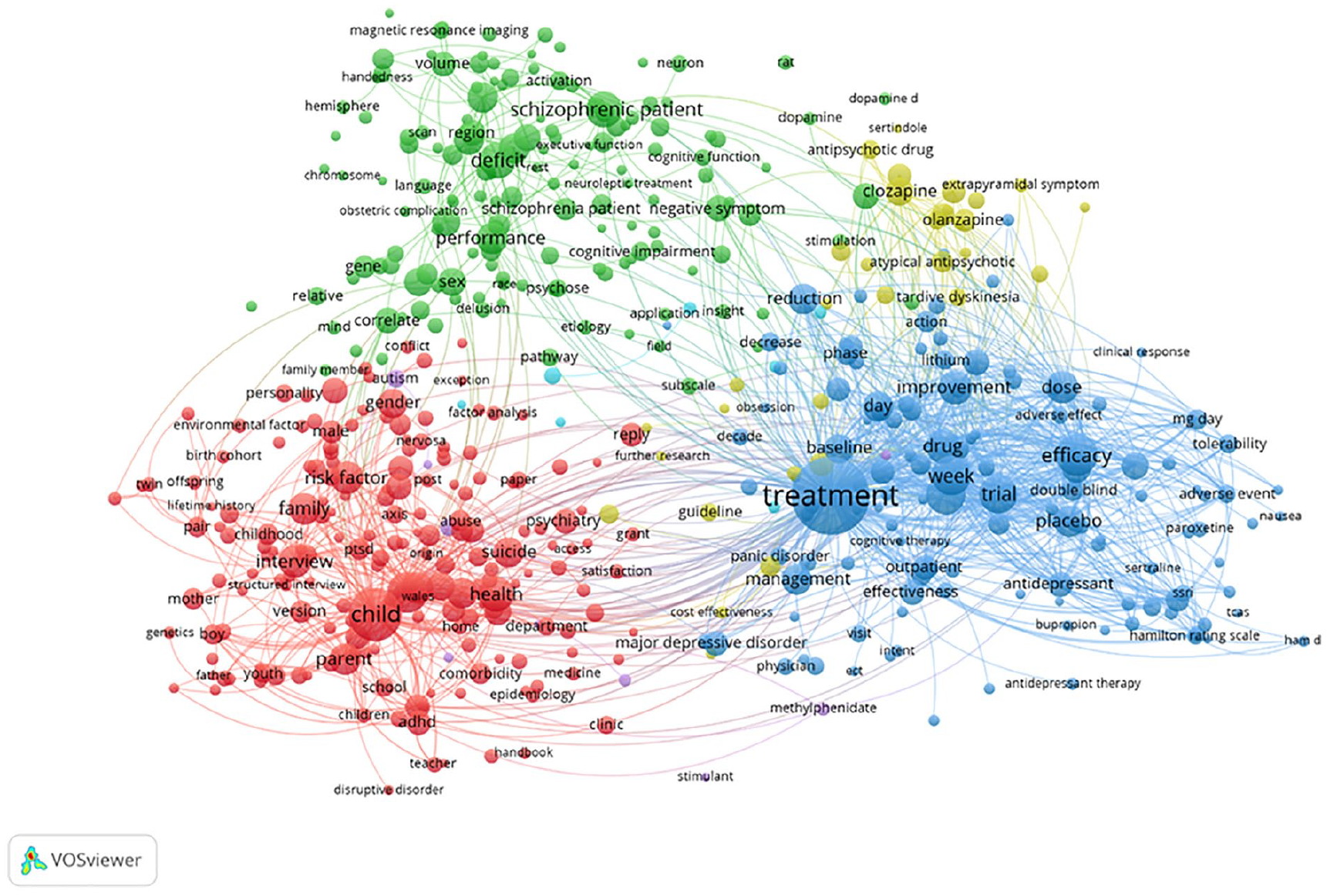
Visualization of relevant terms and their relatedness from titles and abstracts of all papers published by the 10 journals with the highest Impact Factor in 1999.
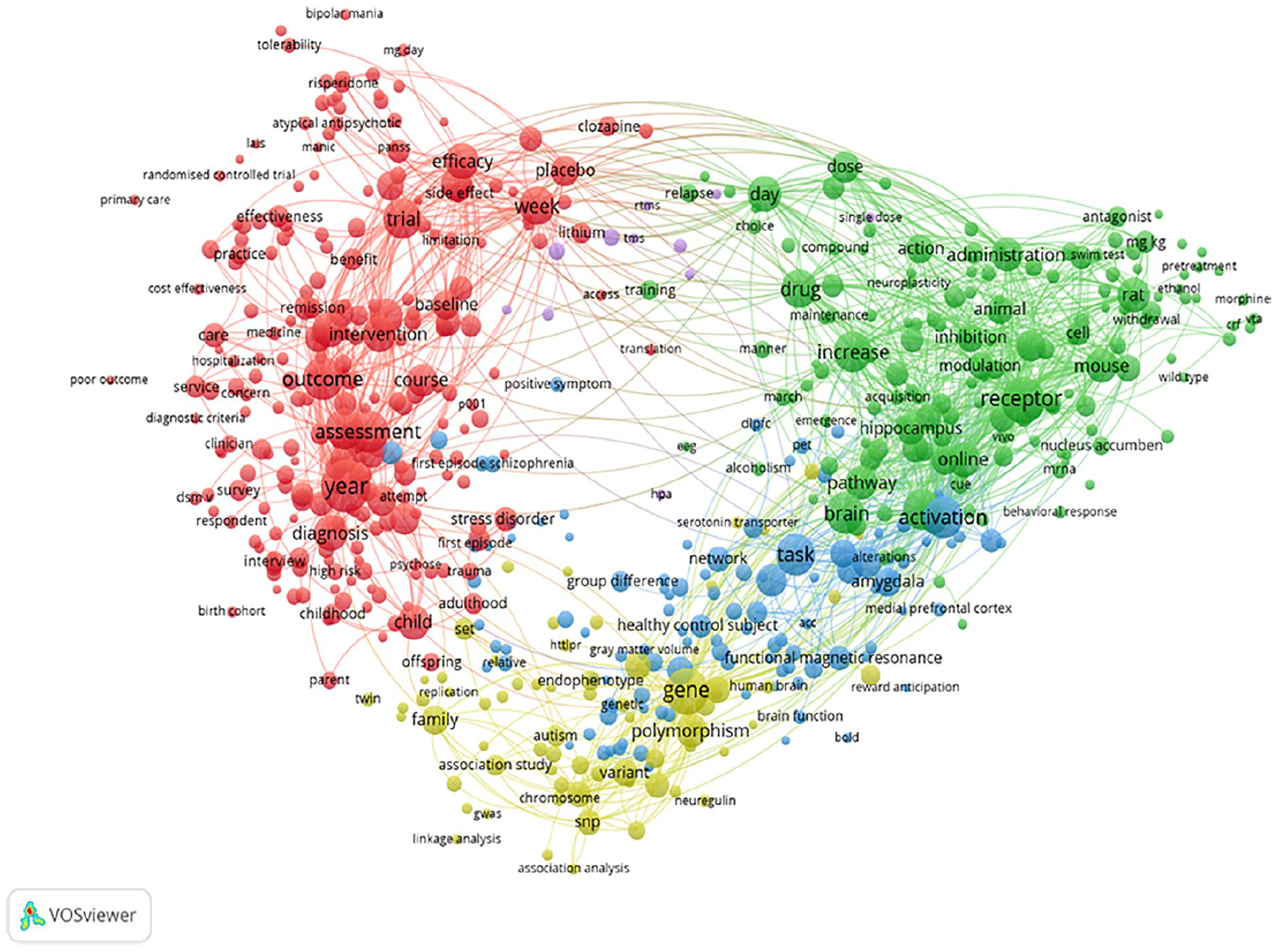
Visualization of relevant terms and their relatedness from titles and abstracts of all papers published by the 10 journals with the highest Impact Factor in 2009.
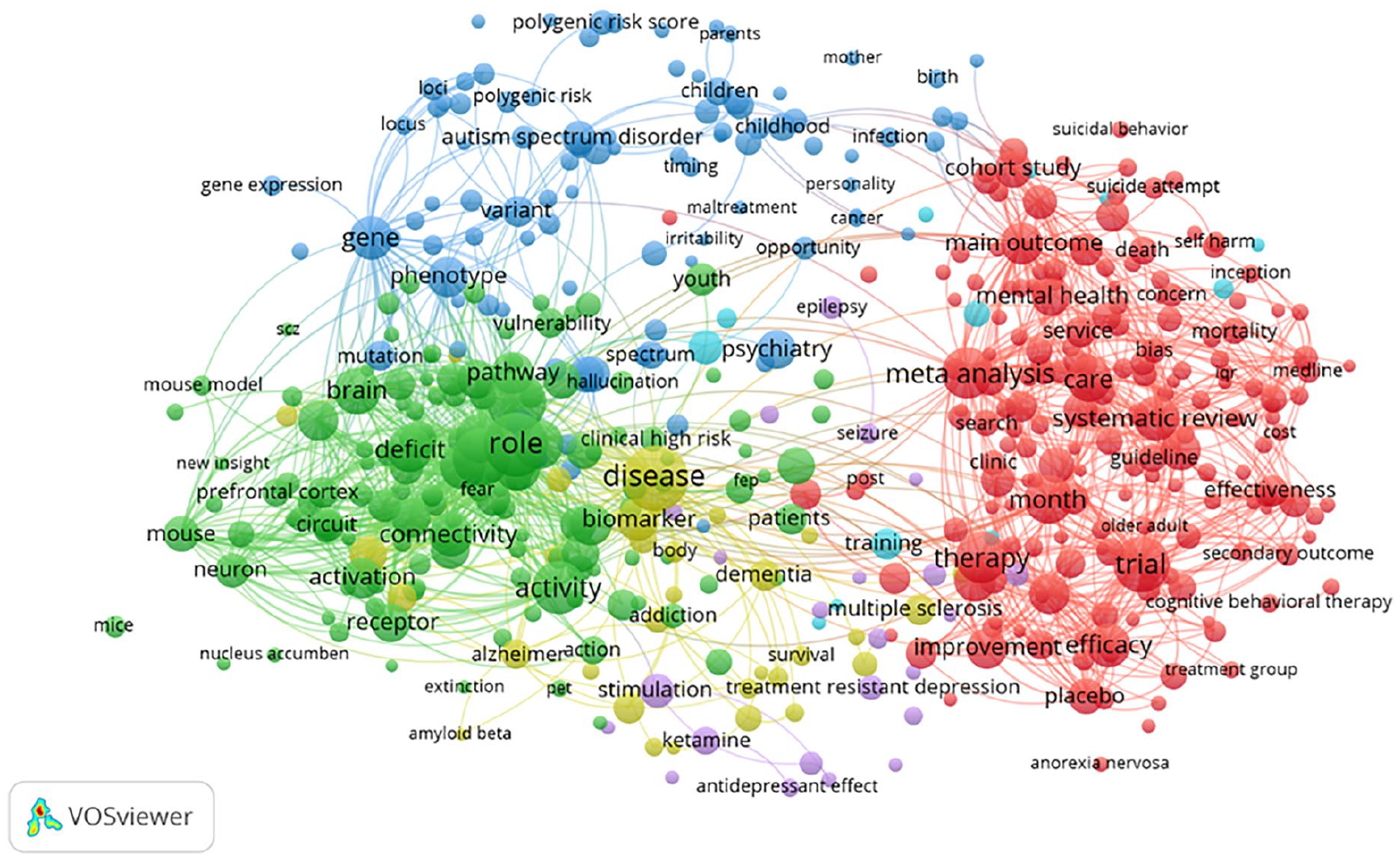
Visualization of relevant terms and their relatedness from titles and abstracts of all papers published by the 10 journals with the highest Impact Factor in 2019.
In 1999, VOSviewer identified 27,343 terms, of which 854 met the threshold of a minimum of 10 occurrences and of which 512 (60%) were selected based on the relevance score (VOSviewer standard thresholds). In 1999 treatment, especially of schizophrenia, is a major issue. The blue cluster is dominated by the term ‘treatment’ (n = 592 occurrences) and contains terms such as ‘drug’ (n = 117), ‘placebo’ (n = 102), and ‘improvement’ (n = 113). At the bottom of this cluster, some antidepressants and the term ‘Hamilton rating scale’ (n = 29) can be found. We find a green cluster around terms pertaining to schizophrenia (e.g. ‘schizophrenic patient’ n = 131; ‘schizophrenia patient’ n = 54; ‘schizophrenic’ n = 49; total number of terms and noun phrases with the root ‘schizophren’ n = 283). Between these two clusters there is a yellow cluster containing (mostly atypical) antipsychotics (e.g. ‘clozapine’ n = 83; ‘risperidone’ n = 56). Terms like ‘dopamine’ (n = 20; ‘dopamine d’ n = 17), and ‘negative symptom’ (n = 71) connect these two clusters. The red cluster centers on terms like ‘family’ (n = 98), ‘child’ (n = 281), and ‘risk factor’ (n = 107). This cluster remains largely unchanged even if the two journals featuring child and adolescent psychiatry are removed (data not shown).
In 2009, VOSviewer identified 35,846 terms, of which 972 met the threshold of a minimum of 10 occurrences and of which 583 (60%) were selected based on the relevance score. We see a red cluster featuring terms pertaining to clinical trials such as ‘outcome’ (n = 189), ‘assessment’ (n = 179), and ‘efficacy’ (n = 134). The term ‘atypical antipsychotic’ (n = 26) appears in this cluster and ‘risperidone’ (n = 34) as well as ‘clozapine’ (n = 40) are mentioned, but on a relatively smaller scale compared to 1999. The green cluster features neurobiological models and animal studies with words like ‘receptor’ (n = 218), ‘hippocampus’ (n = 94), ‘cell’ (n = 61), ‘mouse’ (n = 114), and ‘rat’ (n = 122). Next to it is a blue cluster concerning imaging techniques (e.g. ‘fmri’ n = 41; ‘fmri study’ n = 37; ‘functional magnetic resonance imaging’ n = 61) and results, and a yellow cluster concerned with genetic studies (‘gene’ n = 222; ‘gene expression’ n = 44; total n = 266) can be identified.
In 2019, VOSviewer identified 33,234 terms, of which 817 met the threshold of a minimum of 10 occurrences and of which 490 (60%) were selected based on the relevance score. There are two clusters in close proximity that can be labeled neurobiological and genetic clusters (green and blue, respectively). Central to the green cluster are terms such as ‘neuron’ (n = 69), ‘brain’ (n = 122; ‘brain development’ n = 21; ‘brain region n = 33; ‘brain structure’ n = 26; total n = 202), ‘circuit’ (n = 54), and ‘connectivity’ (n = 104). The blue cluster contains words such as ‘gene’ (n = 105; ‘gene expression’ n = 25; ‘genetic factor’ n = 14; ‘genetic risk’ n = 25; ‘genetic variant’ n = 23; ‘genome wide association study’ n = 29; ‘gwas’ n = 22; ‘genotype’ n = 19; total n = 262), and ‘phenotype’ (n = 92), but also ‘autism spectrum disorder’ (n = 68). There is a yellow cluster centerd on the words ‘disease’ (n = 235) and ‘biomarker’ (n = 102) dealing mostly with organic disorders from the fields of psychiatry and neurology such as ‘Alzheimer’ (n = 50) and ‘multiple sclerosis’ (n = 55). There is a red cluster dealing with ‘therapy’ (n = 147) and ‘trial’ (n = 171), featuring ‘meta analysis’ (n = 144), and ‘systematic review’ (n = 111). On a smaller scale, ‘care’ (n = 112), ‘mortality’ (n = 39), ‘death’ (n = 45), ‘self harm’ (n = 24), and terms from the semantic field of ‘suicide’ (n = 61; ‘suicide attempt’ n = 26; ‘suicide risk’ n = 14 and related terms) appear in this cluster.
Discussion
Data mining can help to visualize where psychiatry, in terms of frequently used research terms, has come from in recent history and where it stands today. Understanding psychiatric research trends is important in order to show how current research themes are aligned with global mental health challenges and where there might be blind spots (Wigand & Ursin, 2020). One limitation of the approach chosen in this study lies in the fact that only top-ranking journals were included which might not be representative of the entire field. The impact factor (which we used to rank scientific journals) might be a biased proxy of the actual impact of articles as it also reflects processes in publication business. However, the journals thus identified do have a special influence on psychiatry, professionals and stakeholders. The fluctuation in journals between the three time points of analysis is not a limitation of this study but rather reflects how the field of psychiatry is evolving.
The results of this study suggest the continuation of a trend toward neurobiology in psychiatric research that began with the biological revolution of the late 1970s and early 1980s (Harrington, 2019) and was taken up by politicians such as former US president George Bush when he proclaimed the 1990s to be ‘The Decade of the Brain’, focusing on ‘a three-pound mass of interwoven nerve cells that controls our activity’ (Bush, 1990). While neurobiological themes are prominent in high-ranking psychiatric journals, especially in 2009 and 2019, they only comprise a small part of the ‘Grand Challenges’: within Goal A (‘Identify root causes, risk and protective factors’), there are two challenges containing neurobiological themes, namely ‘Identify modifiable social and biological risk factors across the life course’ and ‘Identify biomarkers’ (Collins et al., 2011).
The other ‘Grand Challenges’ focus on themes such as global awareness and prevention of mental illness as well as implementation and affordability of mental healthcare. They include social and political aspects such as ‘the impact of poverty, violence, war, migration and disaster’ (Collins et al., 2011). Our data suggest that all these themes have been underrepresented in top-ranking psychiatric journals within the last 20 years. Also, transcultural elements of ‘the stigma, discrimination and social exclusion of patients and families’ (Collins et al., 2011) as identified in one ‘Grand Challenge’ cannot be found in our data, the terms ‘stigma’ or ‘culture’ not appearing among the top 30 terms in any index year (see Table 2). Implementation gaps for existing therapies, including psychosocial interventions (Lyon & Bruns, 2019), is an important global issue. Even in high-income countries in which citizens could be in a position to access recommended therapies, only a small fraction actually receive adequate treatment (Thornicroft et al., 2017; Wiegand et al., 2020).
One other major challenge is to bring together knowledge from different fields of inquiry within mental health research, sociology and political sciences to help persons with mental illness. ‘System-wide approaches to address suffering’, defined as one of the four ‘summary principles’ by the ‘Grand Challenges’ initiative (Collins et al., 2011), might help to bring together research from different methods and thought collectives, a term coined by Ludwik Fleck (Fleck, 2008). An eagle’s eye perspective such as Luhmann’s systems approach (Novella, 2010) might help to move forward in understanding and closing the gaps between academic concepts, psychiatric research, publishing practices and routine mental health care.
Our future contribution could be to refine the methods used in this study and to extend the use of such methods beyond top-ranking journals, automatizing the data harvesting process and including grey literature from pre-print servers. This would allow earlier detection of trends and developments. Research could also aim to embed psychiatric research publications in the fast-growing network of OpenCitations (https://opencitations.net/), an infrastructure organization for opening up bibliographic metadata and citation data by the use of technologies from the Semantic Web.
Conclusion
In conclusion, the field of psychiatry requires reflection on the research process itself to understand blind spots in the behavioural sciences (Devereux, 1967). We need a sound qualitative analysis of influential research papers to uncover implicit assumptions on the nature of mental illness, its antecedents, causes and consequences. Further research should include both grey literature and research grant awards because they reflect priorities within academia in terms of money awarded for specific scientific projects rather than others. Initiatives in and decisions on research may also be influenced by the socio-political climate in which research is performed (Fleck, 2008). Finally, qualitative interviews with researchers and service users will be helpful in order to better understand the mismatch between psychiatric research and mental health needs.
Footnotes
Acknowledgements
We thank Markus Kösters for helpful discussion and advice.
Author’s note
Part of this research has been presented at the 25th meeting of German speaking social psychiatrists.
Funding
The author(s) disclosed receipt of the following financial support for the research, authorship, and/or publication of this article: MEW was supported by the Clinician Scientist Programme of the Medical Faculty of Ulm University. The funding source had no role in any aspect pertinent to this article.
