



Abstract
Background:
During the Great Recession of 2008 many of the European and other western economies had been affected with the unemployment rising and income shrinking. Daily lives of a country’s citizens always are affected by an economic downturn in various ways and mental health problems are expected to be worsen.
Aim:
The aim of this systematic review is to identify to what extent the economic crisis of the last decade has influenced mental health issues in daily life, by offering an in-depth analysis of such effect.
Methods:
PRISMA guidelines were followed and PubMed platform was used for the literature research. There were included articles that were published between 2009 and 2019. The search terms used were economic crisis and mental health. An extraction sheet was created to collect the results.
Results:
Thirty-five studies from several countries were included in this review. The results from this articles point out that specific social groups are more vulnerable during periods of economic crisis in terms of mental health impact. Depression, anxiety and stress are some of the most common outcomes. However, not all the evidence sources agree.
Conclusions:
Despite the disagreements, the economic downturn and its outcomes can effect negatively the psychological state either of the population as a whole or of specific subgroups. Mental health is largely affected by economy and regulatory adjustments of supportive care services are needed to buffer negative effects. Primary care could be a ‘remote access server’ of specific interventions designed to target vulnerable population groups. The development of strategies at a country level is essential in order to support the most vulnerable groups of the population during a recession period.
Introduction
During the great recession of 2008 many of the European and other western economies had been affected with the unemployment rising and income per capita shrinking. According to Eurostat (2019) unemployment in the 28 European Union countries rose from 7.0% in 2008 to 10.8% in 2013. Accordingly, the U.S. Bureau of Labor Statistics (n.d.) mentions that unemployment reached 9.9% on April 2010 significantly higher from the 5.0% on April 2008. Unemployment and lower socioeconomic conditions found to be correlated to suicides (Beautrais et al., 1998a, 1998b) while data from 26 European Union countries, suggest that unemployment as an outcome of the economic crisis, result increase in suicides as well as in alcohol abuse (Stuckler et al., 2009). More specifically, it was pointed out that when unemployment increases more than 3%, results a rise on suicides in people under 65 years old and on alcohol abuse mortality (4.45% and 28.0% respectively) (Stuckler et al., 2009). High risk of mental health disorders can be related to social, environmental and economic factors. As World Health Organization (WHO, 2014) summarize, in European countries there has been found that common mental disorders such as depression and anxiety are associated with low educational level, resources disadvantage and unemployment. Additionally, individuals living in impoverished conditions and being disadvantaged suffer disproportionately from depression and anxiety and their consequences (WHO, 2014). Moreover, several factors, such as age, gender, income. or social relations, seem to be associated with overall health (including mental health) in periods of financial crisis (Glonti et al., 2015).
In studies performed outside Europe, it is mentioned that economic downturns could increase depression and anxiety and therefore the demand for psychotropic drugs (Bradford & Lastrapes, 2014). The Millennials found to be more affected compare to Gen X or Baby Boomers and a connection is highlighted concerning social and economic vulnerability and substance use (Yang et al., 2018). The study of Nour et al. (2017) support that the recession was correlated with increased odds of reporting anxiety and mood disorders, 25% and 12% respectively. Other studies point out that the recession is possible to be related with the increasing prevalence of major depressive disorder (Wang et al., 2010) and to affect negatively health, mental health and health behaviors that can lead to poorer health status (Tsai, 2015).
Apart from that, an economic crisis seems also to have an effect on suicide rates since it is stressed out that suicide rates can be increased significantly by austerity, escalating unemployment rates, economic decay and reduced fertility rate (Antonakakis & Collins, 2014). Rather than that, another study also showed that individuals with mental health issues prior the recession can be more severely affected by the crisis than people without mental health issues (Evans-Lacko et al., 2013).
The aim of this systematic review is to detect to what extent the economic crisis has influenced mental health issues in daily life, by offering an in-depth analysis of such effect.
Methods
In order to implement this report we followed the PRISMA guidelines for systematic reviews. PubMed platform was used for the literature search from 01/01/2009 to 31/12/2019. The keywords used were ‘economic crisis’ and ‘mental health’ and the timeline was from 2009 to 2019. The language of the full text was English and Greek. The research strategy as appeared in PubMed was: ‘economic crisis’ [All Fields] AND ‘mental health’ [All Fields] AND (‘2009/01/01’ [PDAT]: ‘2019/12/31’ [PDAT]).
At first, title and abstract, of all articles found, were reviewed in order to exclude the irrelevant studies. Secondly, the selection of the studies included was made after reading full text. Then some additional articles were included in the analysis from the references of the original articles chosen at the previous stage.
For the inclusion criteria the research was mainly focused on the global financial crisis of 2008 but there were also included other recession periods such as the one in Sweden and in South Korea. The search was also focused on the general population or specific subgroups. We concentrated on changes in psychotropic drug consumption, consequences on mental health (depression, anxiety, stress), suicidal attempts or suicides and demand on mental health services. There were not included studies that examined the effects of financial downturn on health care system or health care professionals. The type of studies included were quantitative studies such as cross-sectional, case-controls, cohorts and systematic reviews.
Synthesis of results
A data extraction sheet was developed. For each article there were collected the following information. Name(s) of author(s), country, year of publication, journal, type of study, care determinant, main findings, implications for future research, and impact for care use. Due to the heterogeneity of the studies, meta-analysis is not applicable.
Results
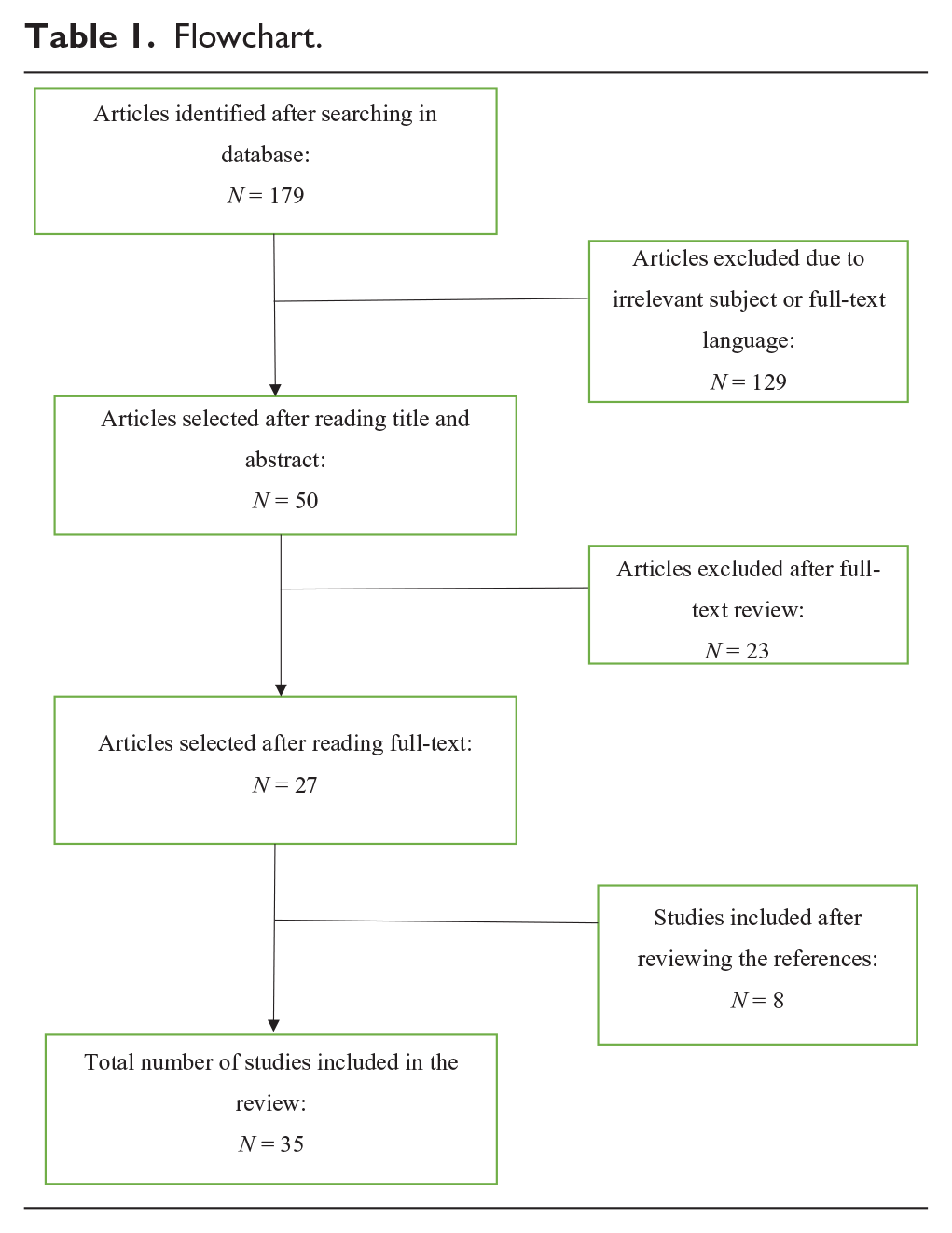
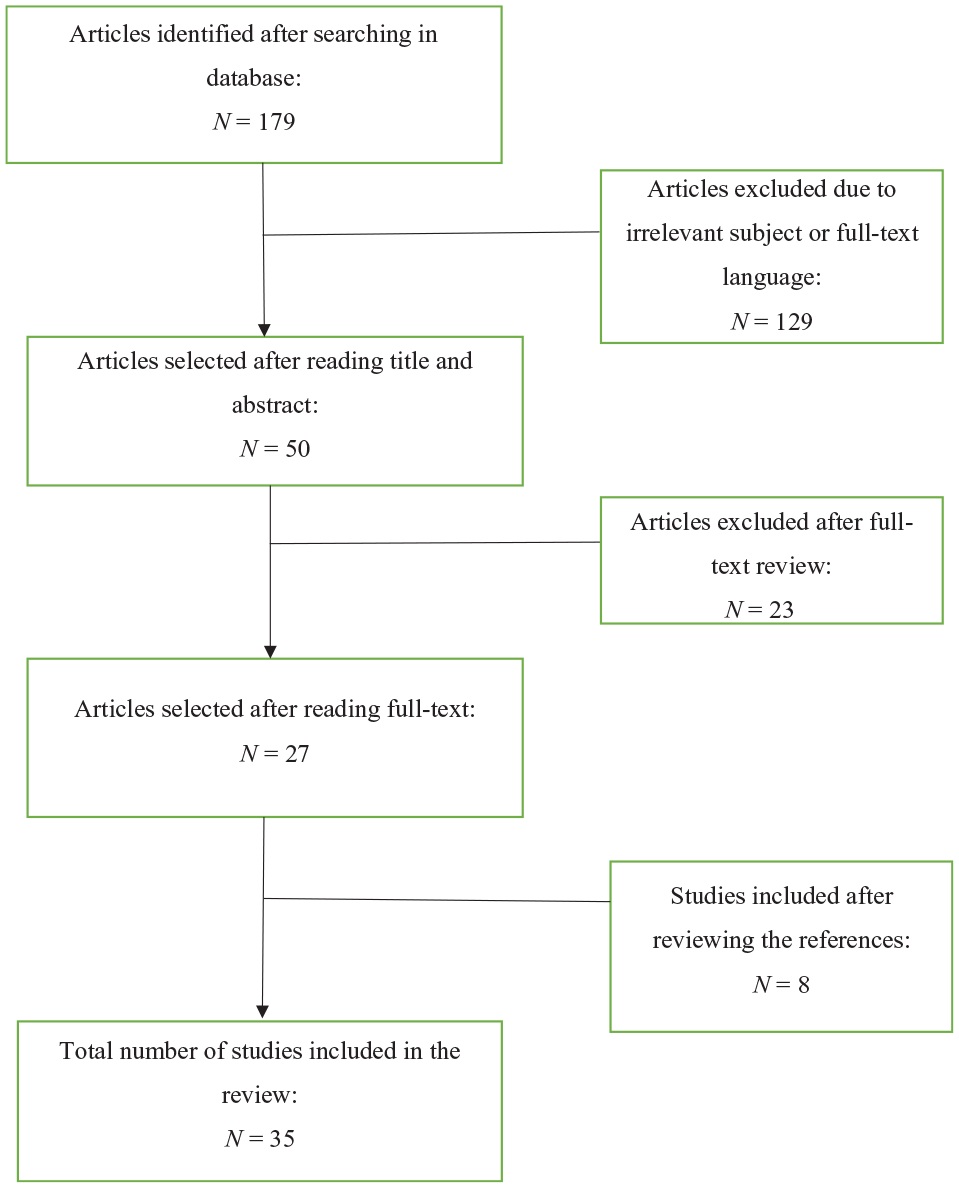
The research in PubMed produced 179 articles. After reviewing the title and the abstract 50 articles were remained. Finally, 27 articles were selected after full text reading. Further 8 articles were selected from the references of the included articles. The total number of the reviewed articles is 35. There were found 34 studies in English and 1 in Greek (Table 1).
Flowchart.
The studies were conducted mainly in European countries (nine in Spain, nine in Greece, five in Italy, one Cyprus, one Sweden, one Portugal, while three included samples from several European countries). In addition, there were two studies implemented in the Republic of China, two in Australia, one in South Korea and one worldwide (Table 2).
Results.

Note. The presented studies are all included in the reference list.
Impact of economic recession on mental health
The Global Financial Crisis of 2008 and its effects, like higher levels of unemployment, seem to have a negative effect on mental health either on the general population or on some specific subgroups and this can be confirmed by studies conducted in Spain (Córdoba-Doña et al., 2016; Tamayofonseca et al., 2018; Utzet et al., 2016), Greece (Drydakis, 2015), Italy (Odone et al., 2017; Starace et al., 2017) and one that includes information from more European countries (Buffel et al., 2015a). Furthermore, findings from a study in China shows that unemployed migrant workers can have more severe mental health problems than unemployed natives (Chen et al., 2012). However, a study in Spain explored the role of social support and found out that it can be a protective factor toward the detrimental outcomes of financial downturn on mental health (Fernandez et al., 2015).
Findings of a cohort study in Sweden- which was investigating the impact of the economic crisis in the country during the 90s- points out that unemployment was connected with a higher risk of getting a mental diagnosis despite the country’s unemployment rate (Thern et al., 2017).
Impact on depression, anxiety, and stress
According to our research, several studies in different countries agree that during the economic crisis the prevalence of major depressive episodes and major depressive syndromes increased in the general population in the years following the Great Recession of 2008. More specifically, evidence from Greece (Economou, Madianos, Peppou, Patelakis, & Stefanis, 2013; Madianos et al., 2011) Spain (Gili et al., 2012; Sicras-Mainar & Navarro-Artieda, 2016), Italy (Mucci et al., 2016), Cyprus (Stavrou et al., 2016), and the Republic of China (Lee et al., 2010) suggest what is mentioned above. Apart from that, unemployed, unskilled workers, bankrupt citizens and people who lost their previous social status during the recession seem to be more vulnerable in terms of psychological health, chronic stress and psychological distress (Zissi & Stalidis, 2017). Additionally, an article that studied the consequences of South Korean economic recession in the 00s reports that depression, suicide attempts or suicidal ideation are more likely to be found among people with lower income (Hong et al., 2011).
However, studies that contain samples from several European countries report that depression did not increase in Europe in general but only in men aged 35 to 49 and in the countries that have been heavily affected by the recession (Buffel et al., 2015b; Reibling et al., 2017). Another study from Greece agrees that lower earnings can be a risk factor for major depression in men (Economou et al., 2019).
An interesting aspect can be found in two studies, one in Greece (Economou et al., 2014) and one in Portugal (Viseu et al., 2018), which take into account the effects of cognitive social capital and social support accordingly. More specifically, Economou et al. (2014), mention that cognitive social capital works as a protective factor against major depression in people undergoing low economic hardship. However, this protective factor does not help people facing high financial burden (Economou et al., 2014). Regarding the social support, Viseu et al. (2018) point out that depression, anxiety and stress were stronger related with economic hardship and financial threat when social support was absent.
Outside of Europe, in Australia the findings are quite different. One article supports that there was an increase in anxiety and depression during the crisis of 2008 but demographic or socioeconomic factors could not justify these findings (Sargent-Cox et al., 2011). Furthermore, another study found no difference in levels of depression and declined levels of stress and psychological distress while part-time employed showed an increase in anxiety (Shi et al., 2011).
Impact of economic crisis on psychotropic drug consumption
There are some studies which searched about the associations of the crisis and the use of psychotropic drugs. Only one out of four found an increase in psychotropic drug consumption during the economic crisis but it was considerably higher to the individuals who used to consume psychotropic drugs before 2009 (Barceló et al., 2016). The other three studies stressed out that certain subgroups are more vulnerable. Vittadini et al. (2014) and Arroyo et al. (2019) mention that women in retirement or aged >55, being long term unemployed or having a blue collar job are at higher risk of using psychotropic drugs. One the other hand, the last study points out that males who experienced job loss have higher possibilities to receive psychotropic medication while it agrees with the previous two studies regarding the blue collar workers (Cornaggia et al., 2017).
Impact on suicides and suicide attempts
There is much written regarding suicide attempts, suicidal ideation and suicides and their relationship with the financial downturn. A study in Greece and especially in Crete (a region with a quite high suicide mortality rate compare with the national mean) shows that there is no overall increase in suicide rates although there in a rise in middle aged and elderly men and a decrease in women (Basta et al., 2018). However, a worldwide report shows that there was an increase in suicides in men in 27 European and 18 American countries after the 2008 global financial crisis (Chang et al., 2013). Finally, two other articles show that between the years of 2009 and 2011 there was an increase in suicidal ideation and suicidal attempts (Economou, Madianos, Peppou, Theleritis, et al., 2013) and that low earnings impacted negatively suicidality in men but not in women (Buffel et al., 2015b).
Impact on mental health care demand
The effect of the economic crisis to the demand for mental health care services was strongly discussed the previous years. According to a study in Spain, increase in unemployment had a decrease in mental health demand while increased living cost had a weakly positive correlation (García et al., 2014). On the other hand, another study in Greece (a country that was heavily affected by the economic crisis) shows that despite the fact that new cases decreased, there was a rise in the waiting time of new cases and the number of sessions of old cases (Pikouli et al., 2019).
Discussion
According to this review it seems that economic downturn and its outcomes can effect negatively the psychological state either of the population as a whole or of specific subgroups. Some studies focused on mental health problems in general (Buffel et al., 2015a; Chen et al., 2012; Córdoba-Doña et al., 2016; Drydakis, 2015; Odone et al., 2017; Starace et al., 2017; Tamayofonseca et al., 2018; Utzet et al., 2016) while others focused on more specific issues such as depression, anxiety and stress (Economou, Madianos, Peppou, Patelakis, & Stefanis, 2013; Gili et al., 2012; Lee et al., 2010; Madianos et al., 2011; Mucci et al., 2016; Sicras-Mainar & Navarro-Artieda, 2016; Stavrou et al., 2016; Zissi & Stalidis, 2017). All of those studies agree that in some way there is a positive correlation regarding the financial crisis and mental health issues which means that the deeper the economic crisis, the grater is the effect on population’s mental health.
Findings from Australia showed that the prevalence of mental health disorders was higher after and not during the economic crisis (Sargent-Cox et al., 2011). In the effort to interpret this observation, the authors refer to the ‘social norms’. It is suggested that during the crisis, when unemployment is higher in the general population and therefore is considered a ‘social norm’ it is easier for a person to initially accept becoming unemployed and handles this situation as ‘socially expected’ (Sargent-Cox et al., 2011). Of course, when a situation is prolonged and severe, beliefs of an unmodifiable negative situation can be installed with uncertainty and increasing economic pressure, capable to translate a collective problem to personal drama. Apart from the effects of economic recession to mental health well-being, leading to depression and anxiety, the crisis seems to have a negative impact also on physical health conditions such as cardiovascular morbidity, respiratory health problems, hypertension or diabetes (Astell-Burt & Feng, 2013; Modrek & Cullen, 2013). Physical health conditions can also be negatively affected by social isolation and the sense of loneliness and consequently the Personal Sociability and Connections Scale (PeSC) can help in order to detect such cases (Symvoulakis et al., 2021). Rather than that, other mental health problems can also be connected with the economic downturn effects, such as somatoform disorders, panic attacks or alcohol abuse (Gili et al., 2012). The most negative aspect of such conditions is that can be evolved silently and undetected, till a sinister event seriously threats life.
Regarding the psychotropic drug consumption the studies show that only specific parts of the population are prone to use them as a result of the recession without necessarily agree on which groups are more vulnerable (Arroyo et al., 2019; Barceló et al., 2016; Cornaggia et al., 2017; Vittadini et al., 2014). Moreover, there are studies suggesting that during the recession there was an overall increase in suicides, suicide attempts and suicidal ideation (Chang et al., 2013; Economou, Madianos, Peppou, Theleritis, et al., 2013) but not all of them are in the same page (Basta et al., 2018). An interesting aspect is discussed by the study of Chan et al. (2014), as it is stressed out that rising unemployment rates can lead to higher suicidality not only between the unemployed but also among people with higher job positions such as well-paid managers and highly skilled employees. The authors mentioned that this could be the consequence of uncertainty to lose job and escalated workload in a context of a downsizing economy (Chan et al., 2014). So, one can think that both very low and too high income groups may become vulnerable in the economy pyramid, when unemployment weakens the entire working chain. Other than that, it is important to mention that psychological and social factors are also considered to be linked with suicides, through a complex pattern of social and moral reasoning (Giddens, 1966). In some societies, suicide is not linked with mental health morbidity or emotional control loss, rather, it represents a culturally driven radical choice to specific dilemmas. Without any intention to dilute meanings, it is thought-provoking the complexity with which interact social, cultural and behavioral drivers of life to strongly influence decisions in terms of self-conservation.
Another interesting finding is that social support could be a protective factor toward mental health problems and depression, anxiety and stress in times of financial crisis (Fernandez et al., 2015; Viseu et al., 2018). Additionally, a research suggests that cognitive social capital can also be a protective element against depression but only in cases of low economic hardship (Economou et al., 2014). Moreover, it is crucial to refer to ways that can alleviate the consequences of the economic recession on mental health. It is supported that provision of welfare benefits, enhancement of labor-market programs, design of culture-specific intervention and reinforcement of mental health resilience could buffer the negative outcomes of the economic crisis (Christodoulou & Christodoulou, 2013).
Apart from that, there were reviewed two articles from other financial crisis periods, one in Sweden and one in South Korea in different times. In these two cases it was found out that the effects of a financial downturn is possible to be related to mental health issues (Thern et al., 2017), suicides or suicidal ideation (Hong et al., 2011). Findings are consistent with a previous study supporting that rise in mental health conditions, mainly leading to increased suicide mortality rates, are linked to the Asian Financial Crisis of 1997 affected many eastern Asian countries, due to increase in unemployment rates (Uutela, 2010). Regarding the demand of mental health services, a study in Greece suggests that the old cases have a need for more sessions while there is an increase on waiting time for new sessions (Pikouli et al., 2019). However, another study in Spain does not agree with these findings suggesting that there was a decrease (García et al., 2014). An explanation can be given by Cooper (2011), since it is mentioned that during the economic downturn many countries re-schedule the budgets of public mental health services as a part of vertical austerity program adjustments that they endorse. Therefore, the access to those services is limited, despite the fact that, during (and immediately after) the recession, the need for public mental health services is more than indispensable (Cooper, 2011).
According to what is written in the above it is obvious that the researchers argue about the exact effects of an economic crisis to the population. However, it is evident that despite the disagreements, an economic downturn creates situations that can be harmful for the population’s mental health as a whole or for the mental health of specific social groups. An interesting part of the findings is that the consequences on mental health seem to be moderated by variables such as culture, social norms, general economic condition of the country, trust to the country’s economy and existence of an adequate health care system. In accordance with some of these findings Anyfantakis et al. (2015) note that people with high religiosity/ spirituality are less likely to develop depressive symptoms. An older study from India also suggests that religiosity can play a significant role in regards to better mental health outcomes (Verghese et al., 1989). Other studies found out that in India, which is a developing economy, follow-up of mental health cases was considered adequately addressed even though mental health care settings were not labeled as ideal and the outcomes of schizophrenia were found to be better compared to Western countries (Thara, 2004; Thara et al., 1994). Additionally, traditional healers also are respected by some communities and sometimes are preferred in comparison to mental health professionals, probably due to less stigma, and in some cases, people try to gain benefits from traditional and modern health care (Saravanan et al., 2008; Thara et al., 2004), by installing a helpful balance which may be somehow protective. Of course, this issue differs from country to country and much skepticism can feed this discussion. Therefore, there is a need of planning community and culturally specific mental health care systems, through tailored initiatives (Saravanan et al., 2008), and by re-purposing own community assets and measuring benefits. Moreover, the most of the studies suggest that in order to mitigate the impacts of the recession, policy makers and health care professionals have a substantial role to play. Overall, it can be noted that after an economic crisis there is a need of discovering new readjustments in population’s daily life in order to overcome possible mental health issues.
Primary care could intervene in the early stages of a mental health problem and either address to it or refer to another professional. Furthermore, it shows the importance of the development of strategies at a country level in order to support the most vulnerable groups of the population particularly during a recession period. Calibrating services by taking into consideration emerging needs is imperative. Easy contact can function as case finding privilege (Box 1).
Key messages.

One of the strengths of this study is the range content of the articles included in the review. This way we can present several aspects of the global economic crisis of 2008. The results give us the most recent information regarding the influence of the recession in the daily life of different subgroups. However, the study has several limitations. First of all, it includes results only from one database and full texts mainly in English language. Secondly, there are not represented all the areas of the globe but the majority includes samples from Europe. Rather than that, the most of the studies reviewed are cross-sectional and they do not allow to identify the direction of associations. Furthermore, it is not feasible from this research to discriminate effect size across developing and developed countries. However, Razack and Thimmaiah (2014) stressed out that developing Asian countries, during the recession, had to face increasing food and fuel prices which, along with inflation, resulted to social turmoil and mental health consequences. Furthermore, financial downturn seems to circuitously affect the working conditions and that is connected to a rise of negative mental health outcomes (Mucci et al., 2016). Additionally, many countries, in an attempt to keep their debit viable, re-budget the funding of health care services which eventually can influence the quality of health care provision (Mucci et al., 2016), and health system service access. Lastly, economic crisis seems to affect various aspects of daily life, not necessarily translated into major negative outcomes.
Further longitudinal studies are needed in order to discover the long term effects of the economic crisis in mental health especially now that another financial crisis appears due to the pandemic of COVID-19.
Conclusions
To sum up, this literature review shows that mental health is largely affected by economy and regulatory adjustments of supportive care services are needed to buffer negative effects. Culture, social norms, general economic condition of the country, trust to the country’s economy and existence of an adequate health care system can work as protective factors in some cases. A country’s services should be adjusted by taking into consideration the emerging needs of the population. Primary care could be a ‘remote access server’ for specific interventions designed to target vulnerable population groups. Further longitudinal studies are needed in order to discover the long term effects of the economic crisis in mental health and to draw causations.
Footnotes
Authors’ contribution
PV and EKS conceived and designed the study together. PV performed the acquisition of data and their analysis and interpretation. Both authors contributed in order to draft the manuscript. EKS offered intellectual input and revised the manuscript. All authors (PV and EKS) approved the final version of the manuscript to be published.
Funding
The author(s) received no financial support for the research, authorship, and/or publication of this article.
