



Abstract
Background:
Smartphone addiction is considered currently as a public health concern especially among university students.
Aim:
The study assesses the prevalence of smartphone addiction and its sociodemographic and psychiatric correlates among Egyptian university students.
Methods:
A random sample of 1,380 undergraduate Egyptian university students from different universities were assessed using the smartphone addiction short scale, Beck depression Inventory, Beck anxiety Inventory, Pittsburgh sleep Quality Index, and Columbia suicide severity scale.
Results:
About 59% are smartphone addicts without any gender difference, we find a highly significant relation between smartphone addiction and depression, anxiety, sleep disturbance, smoking, and suicide.
Conclusion:
our study adds to the existing literature regarding the magnitude of smartphone addiction and its relationship with different psychiatric disorders.
Introduction
The 21st century has been associated with many technological advances that changed our life and smartphones became the most important one of these inventions (Kim et al., 2014).
Studies have shown that 54% of people in developing countries reported using the Internet or owning a smartphone, while 87% of people reported the same across developed countries (Pew Research Center, 2016). Smartphones can provide many functions, for example users can capture photos and videos it also provides the user with many applications such as games, social-networking sites, movies, and GPS, (Abu-Jedy, 2008).
However, because of prolonged presence of smartphone in our lives, disadvantages of such devices have been noticed. Smartphones have been linked to both physical and mental hazards for example Smartphone use is associated with neck pain (Shan et al., 2013), hand dysfunction (İnal et al., 2015), increased car accidents (Cazzulino et al., 2014), depression, anxiety, insomnia, and suicide (Demirci et al., 2015; Kim et al., 2019).
As a result, terms such as “Smartphone addiction” (Kwon et al., 2013), “mobile phone addiction” (Szpakow et al., 2011), “problematic mobile phone use” (Billieux et al., 2008) have been used to describe the same phenomenon in which individual inability to regulate his smartphone use to the extent that it affects other aspects of life. The problem has emerged worldwide to the degree that World Health Organization (WHO, 2015) have considered smartphone addiction as public health concern that needs more research for better understanding of such phenomena. Interestingly, recent study showed that Smartphones are more reinforcing than food for students (O’Donnell & Epstein, 2019).
Smartphone addiction could be categorized as a behavioral addiction, behavioral and chemical addictions have seven core symptoms in common, that is, salience, tolerance, mood modification, conflict, withdrawal, problems, and relapse (Griffiths, 2005). Currently, the Diagnostic and Statistical Manual does not recognize smartphone addiction as a disorder.
University students may be especially vulnerable to experience negative consequences of high frequency smartphone use (Lepp et al., 2014). Several studies have investigated the prevalence of smartphone addiction among university students which shown different results across different countries, for example Saudi Arabia 36% (Alhazmi et al., 2018), China 29.8% (Chen et al., 2017),Turkey 39.8% (Demirci et al., 2015).
In Egypt a country of more than 100 million population most of them are youth and young adults (World Bank, 2021), the number of smartphone users in Egypt is estimated to be around 23.6 million (ElAydi, 2018) which carries a higher risk of smartphone addiction. Several studies have investigated such problem however studies are usually of small sample size and confined to single college major, the aim of this study is to investigate the prevalence of smartphone addiction among diverse Egyptian university students and to find its sociodemographic and psychiatric correlates.
Materials and Methods
Participants
Undergraduate students of 18 years or more of both genders at Ain Shams University (ASU), Cairo, Egypt were recruited from four different faculties, two practical faculties (medicine, engineering) and two theoretical faculties (commerce, literature).
Students were selected from university campus randomly. Students are invited to complete a traditional paper-and-pencil survey, including their sociodemographic data and questionnaires regarding smartphone addiction and a group of psychiatric disorders. Collection of data took place between July 2019 and March 2020.
Data were collected in an anonymous manner (i.e. no names, identification numbers, or any other personal identifiers were requested) to ensure that the students feel safe to share their real information. All participants were asked to sign an informed consent explaining the purpose of the study, stating their approval to participate in the study and ensuring confidentiality of their information.
The study was approved by Ain-Shams University research and ethical committee and the scientific committee of neuropsychiatric department. Moreover, all data were stored on a password protected computer in a locked office of the research team and access was strictly limited to study investigators.
Procedures
All university students in the above-mentioned universities were assessed by the research team in the following steps.
1. Sociodemographic data
Sociodemographic data collection was done through a sheet designed by the researcher team including age, sex, faculty, and academic year.
2. The Smartphone Addiction Scale, Short version (SAS-SV) (Arabic version) (Sfendla et al., 2018).
It is a ten items questionnaire used to assess levels of smartphone addiction established in South Korea. Participants are asked to rate on a dimensional scale how much each statement relates to them, (1 “strongly disagree” to 6 “strongly agree”). Smartphone addiction cut-off values of ⩾ 31 and ⩾ 33 for male and female participants respectively were applied (Kwon et al., 2013).
An Arabic version of SAS-SV was used in our study was translated and validated by Sfendla et al. (2018), the Arabic version shows excellent validity and reliability, the Cronbach’s alpha value of the Arabic version was .94
3. Beck’s Depression Inventory (BDI I) (Arabic version). (Abdel-Khalek, 1998)
The Beck’s Depression Inventory (BDI I) is a tool used to assess the severity of depressive symptoms. The BDI I consist of 20 items rated on a 4-point scale. The total score ranges from 0 to 63, as higher scores indicated higher levels of depression.
Participants with scores 10 to 16 were classified as mild depression, 17 to 29 classified as moderate depression, 30 to 63 classified with severe depression (Beck et al., 1961). A validated reliable Arabic version of the Beck Depression Inventory-I Scale was used with Cronbach’s alpha values ranging from .67 to .89 (Abdel-Khalek, 1998).
4. Beck anxiety inventory (BAI) (Arabic version) (Al-Shatti, 2015).
The BAI, developed by Beck et al. (1988), measures the frequency of one’s experiencing anxiety symptoms (Beck et al., 1988). The scale, consisting of 21 items, provides Likert-type measurement (0 = none, 3 = intensive). Scores of 8 to 15 indicate mild anxiety 16 to 25 indicate moderate anxiety, & 26 to 63 indicate severe anxiety. A validated Arabic version by Al-Shatti (2015) was used with Cronbach’s alpha values ranging from .83 to .90.
5. Pittsburgh Sleep Quality Index (PSQI) (Arabic version) (Suleiman et al., 2010).
Sleep quality was assessed using the PSQI (Buysse et al., 1989). It consists of 19 self-rated questions and five questions rated by the bed partner. The 19 items are grouped into scores with the seven following components: subjective sleep quality, sleep latency, sleep duration, sleep efficiency, sleep disturbances, use of sleep medication, and daytime dysfunction. The PSQI score ranges from 0 to 21. PSQI scores of above five were taken as abnormal. A validated, reliable Arabic version of PSQI was used with Cronbach’s alpha value of .65 (Suleiman et al., 2010).
6. Fagerström Test for Nicotine Dependence (FTND) (Arabic version) (Kassim et al., 2012)
(FTND) is a six-item instrument, ranging from 0 (least dependent) and 10 (most dependent), to assess levels of nicotine dependence (Heatherton et al., 1991). An Arabic version of FTND was developed by Kassim et al. (2012) with good validity and reliability, with Cronbach’s alpha value of .68.
7. The Columbia Suicide Severity Rating Scale, (C-SSRS) (Arabic version) (Posner et al., 2011).
C-SSRS is a suicidal ideation and behavior rating scale created by researchers to evaluate suicide risk. It rates an individual’s degree of suicidal ideation on a scale, ranging from “wish to be dead” to active suicidal ideation with specific plan and intent and behaviors.
The C-SSRS has been found to be reliable and valid in the identification of suicide risk (Posner et al., 2011). An Arabic version of C-SSRS was used obtained from the original author Ponser et al. (2011)
Statistical analysis
Descriptive statistics for the total sample were performed, Quantitative and qualitative measurements were summarized as mean ± standard deviation and n (%), respectively. We performed comparisons of continuous and categorical variables by using Chi square and t-test, Spearman correlation coefficients were used to evaluate the association among the different variables. Statistical analyses were performed using the Statistical Package for Social Sciences (SPSS) version 22 for Windows. A p-value less than .05 was considered statistically significant.
Results
The study included a total number of 1,600 undergraduate students, 1,380 students agreed to complete the study with response rate of 86%.
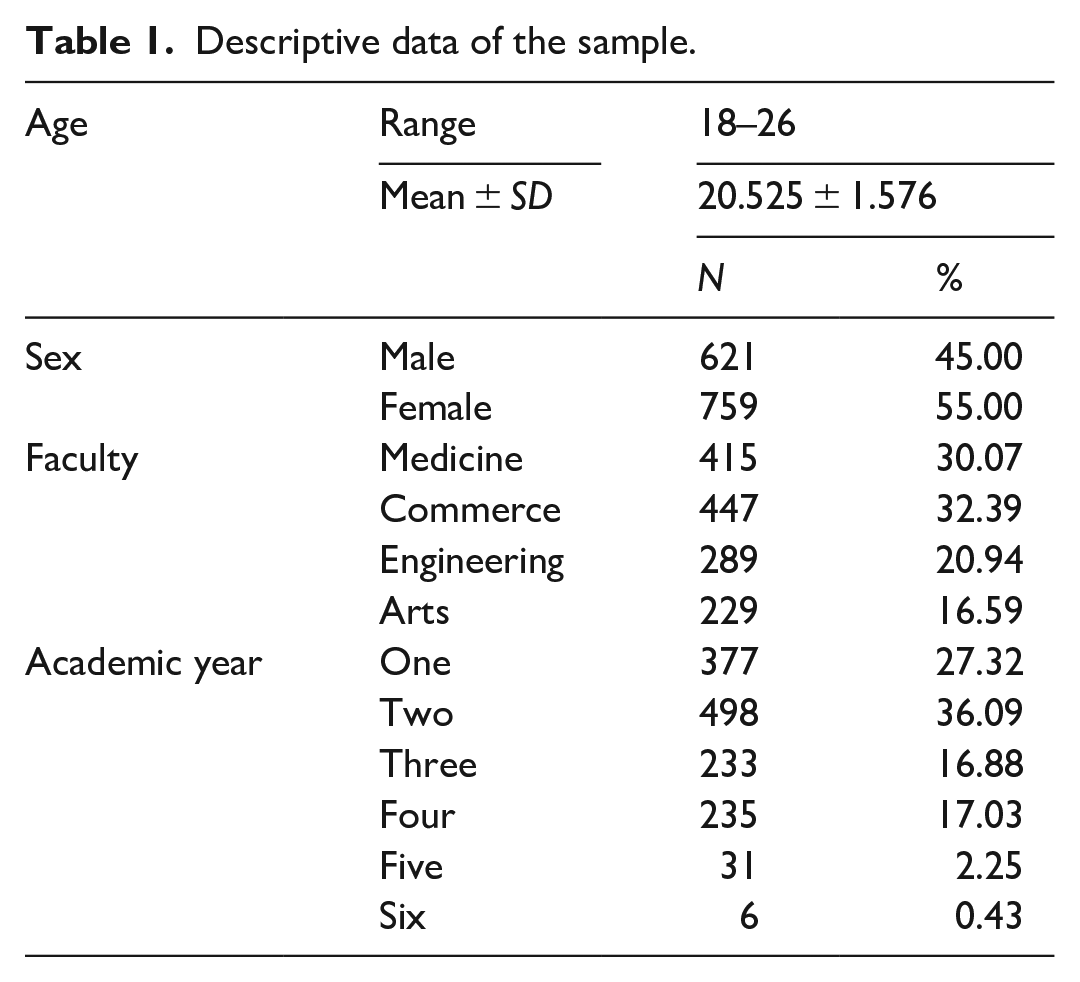
In our study, 45% were males and 55% were females, distribution of different universities and academic years is shown in (Table 1).
Descriptive data of the sample.
According to (Table 2), 59.57% of university students fulfill criteria of smartphone addiction, with mean score of SAS-SV 38.07 ± 12.95. Regarding depression and anxiety, 50.72% have symptoms of depression and 58.99% have symptoms of anxiety. Severity of depression and anxiety is illustrated in Table 2.
Descriptive data of smartphone addiction and psychiatric disorders.

Regarding sleep disturbance and nicotine dependence, 55.07% have sleep problems with mean score of 6.044 ± 4.383 and 15.80% of students are smokers while 84.20 are non-smokers.
On assessing Suicidal thinking, behavior, and non-suicidal self-injury (NSSI), 26.59% of students reported having suicidal thoughts in the last month, 10.51% of students reported having suicidal behaviors in the last 3 months while 13.84% reported having NSSI in the last 3 months.
Our results showed there was not a significant relation between the type of faculty and smartphone addiction.
According to (Table 3), also there is a highly significant relation between having positive result in SAS-SV (being smartphone addict) and having positive results on BDI, BAI PSI, and smoking, regarding suicide there is a significant relation between having positive result in SAS-SV and having suicidal thoughts, behaviors, and non-suicidal self-injury (NSSI).
Relationship between the prevalence of different psychiatric disorders and the prevalence of smartphone addiction.

Also, there is a highly significant correlation between scores of smartphone addiction and that of BDI, BAI.
Discussion
To the best of our knowledge this is the largest study to investigate problem of smartphone addiction in Egypt. Adolescents today belong to the first generation that has raised in the era of smartphones (Song et al., 2007). They have a greater ability and access to learn new technologies more easily than adults (Kim et al., 2014), so they are more vulnerable to addiction (Lopez-Fernandez et al., 2014).
University students are at greater risk of mental health disorders (Auerbach et al., 2018).This can be explained by the fact that the transition to university coincides with a range of challenges such as change in residence, financial stressors, leaving family, and friends (Hershner & Chervin, 2014).
In our study 59.57% of university students fulfill criteria of smartphone addiction, this result is similar to other studies such as Tossell et al. (2015) which reported prevalence of smartphone addiction in USA is 62% and Venkatesh et al. (2017) which reported prevalence of smartphone addiction in young adults of Saudi Arabia to be around 71%.
On the other hand some studies reported lower prevalence rate for smartphone addiction than our study for example Yildirim et al. (2016) which reported prevalence of smartphone addiction in Turkish adolescents to be around 42%, also Hawi and Samaha (2016) reported prevalence of smartphone addiction in Lebanese adolescents to be around 44%.
These variations in numbers are explained by a group of factors as the use of different scales for assessment and the different rates of smartphone ownership between different countries through years (Pew Research Center, 2019) and lastly economic differences between different countries which influence smartphone ownership abilities and access to internet (Pew Research Center, 2016).
Regarding depression, in our study 50.72% of students have symptoms of depression, compared to previous studies these results are comparable for example (Yousif & Khamis, 2017) reported that prevalence of depression in Egyptian university students is 60%, also Lu et al. (2015) reported that prevalence of depression in Chinese university students is 65%.
However recent meta-analysis reported lower prevalence around 24.4% (Akhtar et al., 2020), this much lower prevalence is best explained by the fact that part of our study was done during the first wave of COVID19 pandemic, which was associated with a massive impact on mental health of general population.
This opinion is supported by two Bangladesh studies investigating prevalence of depression in university students before COVID19 pandemic and during pandemic and the results were 52% and 87% respectively (Islam et al., 2020; Mamun et al., 2019).
In our study 58.99% of students have symptoms of anxiety, these results are consistent with previous Egyptian study which reported prevalence of 64% (Yousif & Khamis, 2017), however data regarding prevalence of anxiety symptoms worldwide are very variable for example Musumari et al. (2018) reported prevalence of anxiety in university students as low as 7.8% in Thai students and 7.2% in French students (Tran et al., 2017).
on the other hand, Shamsuddin et al. (2013) reported prevalence of anxiety symptoms as high as 63% also Iqbal et al. (2015) reported similar prevalence of 66% in an Indian study.
In our opinion these inconsistent numbers are due to two reasons firstly use of different scales as BAI, Depression Anxiety Stress Scales, Generalized Anxiety Disorder 7-item Scale, secondly different cutoff values used within the same scale to diagnose anxiety in different studies.
On assessing the suicidal risk, 26.59% of students reported having suicidal thoughts which is consistent with e previous literature for other Arab countries and worldwide for example Eskin et al. (2019) reported prevalence of suicidal thinking in Saudi Arabia, Jordon, Palestine and Tunisia to be 20%, 29%, 25%, and 20% respectively, moreover similar numbers are reported in USA and China (Becker et al., 2018; Horgan et al., 2018).
As regard suicidal behaviors our study reported prevalence of 10.5%, our results are consistent with previous studies a recent large study involving 8,417 University Students in 12 Muslim-Majority Countries including Egypt reported prevalence of suicidal behavior to be around 8.6% and specifically in Egypt to be 7% (Eskin et al., 2019).
An important point to consider is the role of religion in prevalence of suicidal behaviors in which cultures with more religious components usually show a lower rate of suicidal behaviors (Gearing & Lizardi, 2009).
Regarding NSSI, our study reported prevalence of 13.84% which is consistent with previous studies which reported prevalence of 15.3% among 14,372 American university students (Whitlock et al., 2006). Of note this’s the first study to measure prevalence of NSSI among Egyptian university students.
The nicotine dependence assessment revealed that 15.80% of students are smokers, these results are consistent a recent Serbian study investigating the prevalence of cigarette smoking among 1940 university students found that 18% of students smoke cigarettes (Vukomanovic et al., 2017). Also, Nasser et al. (2020) reported prevalence of cigarettes smoking to be around 12.5% in Yemeni students and 14% in Tunisian students (Maatouk et al., 2011).
Regarding sleep disturbance measured by Pittsburgh sleep quality index, 55.07% have sleep Problems, this is supported by previous studies addressing this issue for example two large American studies reported prevalence of 64% 57%, for sleep disturbance respectively among American university students (Becker et al., 2018; Levenson et al., 2016) and in Arab countries studies showed similar rates as in Egypt 53% (Elwasify et al., 2016) and Saudi arabia 69.9% (AlAmer et al., 2020).
The results of the study showed no significant gender differences in the prevalence of smartphone addiction 49.7% in males, 50.2% in females, This finding is in line with Chen et al. (2017), Çağan et al. (2014), and Sahin et al. (2013) which reported no gender differences for smartphone addiction.
Some previous studies have shown higher prevalence of smartphone addiction among females as Billieux et al. (2008), this can be explained by the fact that the older generations of smartphones was used more for communication which attract more females while the newer generations of smartphones promote excessive use in video games which is more favorable by males making a balance between smartphone use in both genders and sometimes moving toward more male use (Ko et al., 2005).
As regard relation between smartphone addiction and different psychiatric correlates, our study showed that there is a highly significant relation between having positive result in SAS-SV and having positive results in BDI, BAI, and PSI also there’s a highly significant correlation between scores of smartphone addiction and that of BDI, BAI, and PSI.
These results were consistent with multiple previous studies in both Arab countries and internationally for example Mohamed and Mostafa (2020) found a highly significant relation between smartphone addiction and symptoms of depression in Egyptian students also Grant et al. (2019), Gaur (2019), support such finding in different countries worldwide.
Moreover, two recent Lebanese studies have found a highly significant relation between smartphone addiction and symptoms of anxiety students (Hawi & Samaha, 2017), (Matar Boumosleh & Jaalouk, 2017), internationally Kim et al. (2015) found strong relationship between smartphone addiction and anxiety.
There are some possible explanations for the current findings. First, addictive use of internet and smartphones can increase interpersonal problems, which is related to depression and anxiety, such as family conflicts, lack of off-line relationships. Secondly, an association between smart phone addiction and altered lifestyle habits was found, with higher tendency among smart phone addicts to skip meals, to eat unhealthy diets, to gain weight, compared to less addicted smartphone users. These can be accounted as predisposing factors to depression (Kim et al., 2017). Others postulate that smartphone use can serve to relieve negative effect in depression or anxiety prone individuals through enhancing dopamine reward system and thus produce addictive patterns (Demirci et al., 2015).
Regarding sleep disturbance, Zhang and Wu (2020) found Smartphone addiction was associated with poor sleep quality among Chinese university students which was supported by Ozcan and Acimis (2021), this can be explained that the electromagnetic fields emitted by mobile phones could negatively influence serum melatonin and cerebral blood flow (Shrivastava & Saxena, 2014).
Regarding suicide, our study found that there is a significant relation between having positive result in SAS-SV and having suicidal thoughts, behaviors and NSSI which is the first study in Arab countries to report such relation however internationally, Kim et al. (2019) have shown that adolescents with increased use of smartphones are more likely to report a suicide attempt.
Regarding smoking, there is a significant relation between having positive result in SAS-SV and being smoker, this was supported by many previous studies for example Kim et al. (2019) found that there is a strong relation between smartphone addiction and smoking among Korean adolescents, in contrast Haug et al. (2015) reported no such relation in Swiss adolescents.
Limitations
Despite the large sample size and students at different faculties were assessed yet our study has limitations. our study was confined to single governmental university in Egypt capital Cairo which still cannot be generalized to universities in smaller cities or private universities, more research is still needed in this area
Footnotes
Acknowledgements
The authors want to thank all students who participate in this study, they have provided us with valuable information which gave us a picture about the magnitude of the problem of smartphone addiction in Egypt.
Conflict of interest
The authors declare no conflict of interest and this research received no specific grant from any funding agency
Funding
The author(s) received no financial support for the research, authorship, and/or publication of this article.
