



Abstract
Background of the study:
Instrumental activities of daily living (IADL) are activities that are needed to live an independent life. Psychotic disorders are associated with deficits in everyday functioning, causing impairment/disability in activities of daily living. Activities play a crucial role to measure functional health or disability. People with Schizophrenia often present difficulties in social and occupational reintegration that may be associated with problems in performing daily activities, including independent living, education, working, and socializing. Activities of daily living and instrumental activities of daily living (life skills training) including leisure and social skills training intended to reintegrate the patient into the community to lead an everyday life.
Aim:
The aim of this review was to identify the effect of skill-based interventions on independent functioning in persons with Schizophrenia.
Methods:
The authors conducted database searches of Google Scholar, PubMed, Science Direct, ProQuest, EBSCO from 1st January 1992 to 31st December 2020. The researcher extracted data, and the quality of included studies was rated by two authors independently. We used the Cochrane Risk of Bias (ROB) tool for assessing the quality of selected studies. The search identified nine studies that met the inclusion criteria with 655 participants. The outcome measure was independent functioning skills.
Results:
The interventions in the review were multifaceted with different combinations of psychoeducation, cognitive-behavioral methods, training in social skills, and IADL. The interventions resulted in significant improvement in functioning skills and reduction in relapse rates.
Conclusion:
Results of this review have revealed moderate to strong evidence for skills training, either behavioral or social skills to improve social and independent functioning, reduce caregiver burden, and improve negative symptoms. The review also supported that interventions could be generalized across settings.
Keywords
Introduction
According to the World Health Organization (WHO, 2017), more than 500 million people experience mental health disorders worldwide (D’Amico et al., 2018). Schizophrenia is a mental disorder present in 1% of the population, representing an important source of costs for the health system and society (Gibson et al., 2011). Although societal mental health needs continue to be on the rise, resources such as mental health providers and quality mental health care programs remain limited (D’Amico et al., 2018).
Psychotic disorders are associated with deficits in everyday functioning (Viertiö et al., 2010), causing impairment/disability in activities of daily living. Activities play a crucial role to measure functional health or disability (Linden et al., 2009).
People with Schizophrenia often present difficulties in social and occupational reintegration that may be associated with problems in performing daily activities, including independent living, education, working, and socializing. Executive dysfunction is one of the factors associated with these difficulties (Macedo et al., 2018). One of the main features of Schizophrenia is its impact on reducing the psychosocial functioning of the individual, including self-care skills, skills needed for an independent and competent lifestyle, quality of social relationships and family life, and occupational performance (Arbesman et al., 2012; Rus-Calafell et al., 2014). The negative symptoms and cognitive dysfunction seen in Schizophrenia may lead to deterioration in the life skills of the patient (Samuel et al., 2018).
Neuroleptic drugs help in clinical improvement but may not help in improving role behaviors, interpersonal, and social skills (Koujalgi et al., 2014).
Medication is commonly used for the management of symptoms, but the social disability which often accompanies the illness can require a variety of psychological, nursing, and occupational therapies (Tungpunkom et al., 2012). Activities of daily living and instrumental activities of daily living (life skills training) including leisure, social skills training are intended to reintegrate the patient into the community for leading an everyday life.
Impairments in higher mental functions lead to difficulties in Instrumental Activities of Daily Living (IADL), complex tasks that require interaction with the environment. Performance levels in IADL are indicative of independent functioning and strong predictors of rehabilitation outcomes and quality of life among different clinical populations (Josman et al., 2009).
The current antipsychotic drugs have limited efficacy in ameliorating cognitive and negative symptoms. Therefore some schizophrenia patients continue to have significant functional impairment and disability. They continue to be dependent on their caregivers in the domains of daily living, medication, jobs, and finances (Ravindren et al., 2018).
However, several studies with Level I evidence comparing the results of skills training specific to self-management, medication management, and community living expectations with results of a comparison program found that participants receiving skills training integrated more quickly and more successfully into the community (Gibson et al., 2011).
There is a growing commitment to evidence-based practices in psychiatric rehabilitation (Pathak & Chaturvedi, 2015). Previous reviews have included different levels of studies (I–IV). The reviews considered interventions like social skills training, IADL skills neurocognitive training, client-centered intervention, cognitive remediation, psychoeducation, cognitive behavior therapy, supported employment, supported housing, supported education, and self-management education intervention. The outcome variables in previous reviews have focused on recovery, community integration, reducing relapse, hospital readmission, psychosocial functioning, medication adherence, and occupational performance. The results indicated evidence of the effectiveness of interventions as moderate to strong (D’Amico et al., 2018; Gibson et al., 2011; Ikiugu et al., 2017; Morin & Franck, 2017; Pathak & Chaturvedi, 2015; Tungpunkom et al., 2012; Van’t Leven et al., 2013). However, one of the reviews concluded that there was no good evidence at the time of conducting the review to suggest that life skills programs were effective for people with chronic illness (Tungpunkom et al., 2012).
We have included only level I studies (RCTs), which strengthens the evidence of the studies. We have focused on specific interventions relevant to domains of IADL, adding evidence to the existing literature and updating the previous reviews.
Hence, the researchers have done this review with an objective to identify the effect of skill-based interventions on independent functioning in persons with Schizophrenia.
The specific question to be answered by this systematic review of randomized controlled trials (RCTs) is: Do IADL interventions improve functional outcomes in persons with Schizophrenia?
Materials and methods
Inclusion criteria
We adhered to the PRISMA reporting guidelines (Moher et al., 2009). A systematic search for all randomized controlled trials evaluating the effects of instrumental activities of daily living on functioning in persons with Schizophrenia published from 1st January 1992 till 31st December 2020 was included to encompass a wide range of literature.
The primary author conducted the preliminary search on 16th February 2019 and an updated search on 1st December 2020 in the following databases: Google Scholar, PubMed, Science Direct, ProQuest, EBSCO. Search terms included: ‘schizophrenia’, ‘activities of daily living’, ‘domestic skills’, ‘occupational intervention’, OR instrumental activities of daily living, money management, cooking, OR ‘psychoeducation’, OR ‘social skills training’.
AJ screened titles and abstracts and selected articles that met the inclusion criteria. AJ & KP reviewed the full texts of these articles and excluded papers that did not meet the inclusion criteria. The authors discussed any discrepancies and arrived at a consensus. The studies were included if they were randomized controlled trials (RCTs) that examined interventions facilitating independent living (Instrumental activities of daily living) like food preparation, money management, communication skills, transportation, shopping, medication management, psychoeducation, along with some components of cognitive behavior therapy and social skills. The primary outcomes considered were functional independence in the participants.
The studies were excluded if they were single group studies, single case presentations, and unpublished literature such as presentations, conference proceedings, dissertations, and theses.
These selection criteria were first applied to the title. When the title did not present exclusion criteria (e.g. non-RCT, no intervention) or was inconclusive, the articles’ abstracts were read, and from the selected abstracts, the full articles were reviewed. Finally, the reference list of selected articles was searched for relevant cross-references to be included in the review.
Two reviewers (AJ and KP) independently extracted relevant data from included trials. They checked for treatment approach, intervention components such as psychoeducation, IADL interventions, treatment format (group vs. individual), intervention provider, length of intervention, participants’ characteristics, and comparison intervention. The researchers assessed the trials against the following quality criteria: random sequence generation, allocation concealment, masked assessment of outcomes, and the number of withdrawals, intention-to-treat analysis, and manual-based intervention. AJ and KP assessed the risk of bias (ROB) independently according to the revised Cochrane risk-of-bias tool for randomized trials and categorized the articles into those with low, some concerns or high risk of bias. Disagreements between authors were resolved by consensus (Figure 2, Appendix 1).
Literature search and study selection
The literature search identified 458 references from five databases, including titles and abstracts. Figure 1 shows the PRISMA flow chart of the selection process. Studies that focused on non RCTs, interventions that did not include the components of IADL were excluded. This resulted in 22 studies fulfilling the criteria. Further 13 studies were excluded after reading the full text, wherein the participants were not randomly assigned to the experimental and control group, outcomes were not focused on independent functioning. Finally, nine RCTs were included in this review.

PRISMA flow chart.

Risk of bias for the nine studies included in the review (McGuinness & Higgins, n.d.).
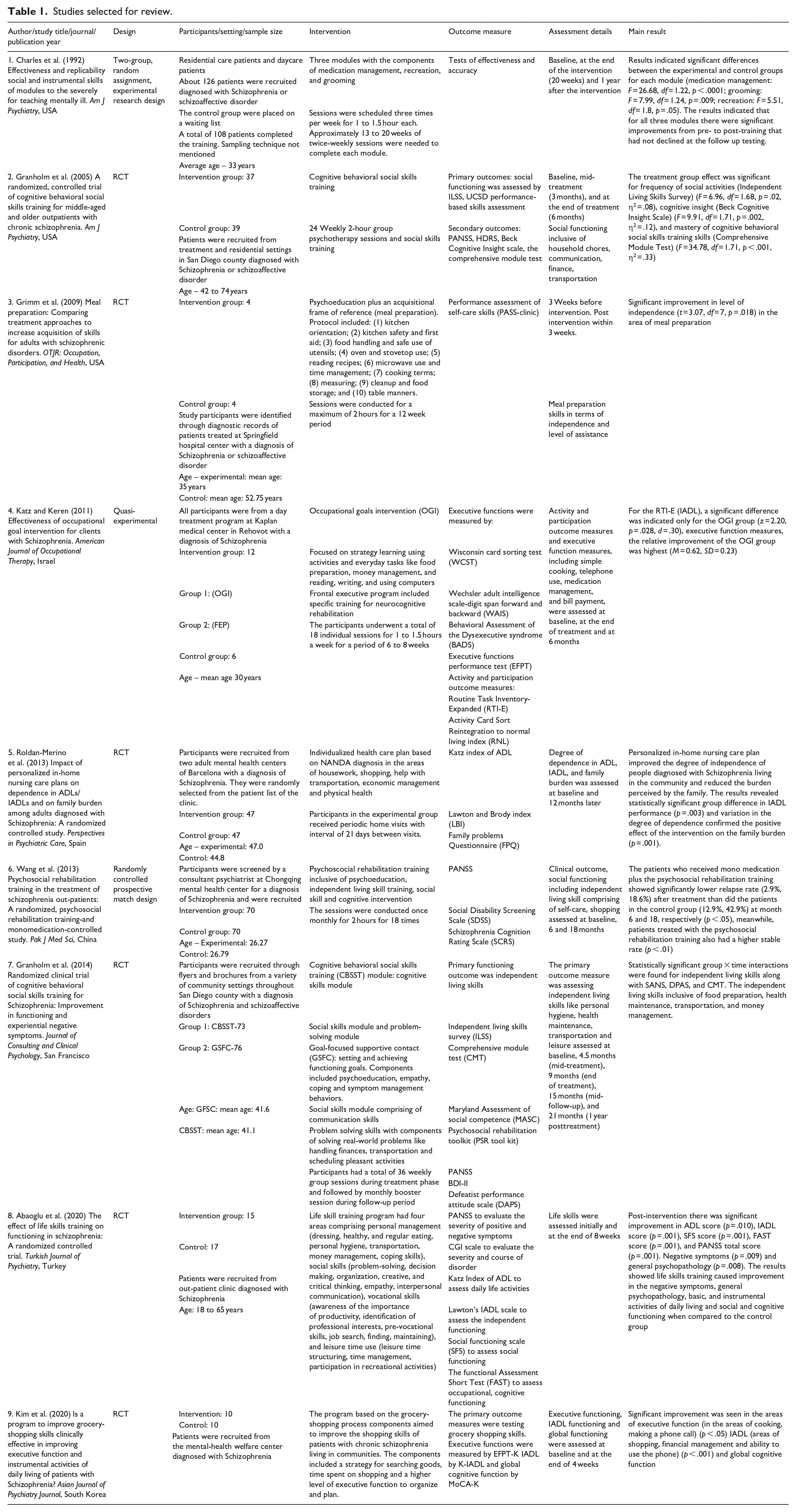
The details of the studies included in the review are given in Table 1.
Studies selected for review.
Results
The studies in the review included interventions comprising of:
Psychoeducation includes information on illness, symptom management, and medications to ensure medication compliance and reduce relapse (Wang et al., 2013).
Cognitive behavior social skill training comprises a cognitive skills module, social skills module, and problem skills module to improve cognitive skills, communication skills, and solve real-world problems (Granholm et al., 2005, 2014).
Occupational goal intervention emphasizes the use of functional activities in three main domains: food preparation, money management, and reading, writing, and using the computer for information seeking (Grimm et al., 2009; Katz & Keren, 2011).
Personalized in-home nursing care plan adopted based on Marjory Gordon’s Functional Pattern (Roldán-Merino et al., 2013).
Grocery shopping skills program aimed to improve the shopping skills. The components included strategies for internal or external memory for searching for goods, time spent on shopping, and organizing and planning the above strategy (Kim et al., 2020).
Life skills training designed to address four performance areas, including personal management (dressing, healthy, and regular eating, personal hygiene, transportation, money management, coping skills), social skills (problem-solving, decision making, organization, creative and critical thinking, empathy, interpersonal communication), vocational skills (awareness of the importance of productivity, identification of professional interests, pre-vocational skills, job search, finding, maintaining), and leisure time use (leisure time structuring, time management, participation in recreational activities) (Abaoglu et al., 2020).
Study characteristics
A total of 655 participants with schizophrenia spectrum disorders were represented across the included studies. Of the studies that provided information on gender, males were more when compared to females. Studies that reported age identified the range from 16 to 74 years. The intervention components mainly included behavioral and cognitive strategies. Psychiatrists, psychologists, nurses, and occupational therapists provided interventions. The details of these interventions are presented in Table 1. Independent living skill was identified as the primary outcome measure in most of the studies (7), one study has also looked at family burden (Roldán-Merino et al., 2013), and another study has also examined clinical outcomes and relapse rates besides primary outcome variables (Wang et al., 2013). The studies were conducted in the USA – (4), Israel – (1), Spain – (1), China – (1), Turkey – (1), and South Korea – (1).
Interventions
Interventions included cognitive behavior therapies and social skills training comprising cognitive skills module, social skills module, and problem-solving module (Granholm et al., 2014). Other skills included were training in household work, shopping, transportation (Roldán-Merino et al., 2013), medication management module (Blackwell et al., 1992), meal preparation (Grimm et al., 2009); training in money management (Katz & Keren, 2011); and psychoeducation; Life skills training comprised of four performance areas including personal management, social skills vocational skills, and leisure time use (Abaoglu et al., 2020); grocery shopping skills like selecting suitable products, checking for the price, managing time spent on shopping (Kim et al., 2020).
The training mode included role-plays, videos, demonstrations, homework assignments, individual counseling sessions, and group discussions. Some of the modules also had practical workbooks and instructions to use the module (Blackwell et al., 1992; Granholm et al., 2005, 2014; Grimm et al., 2009). One study also had written and oral instructions, photographs in addition to video demonstrations and training in real-life situations (Abaoglu et al., 2020).
Only two studies in the review included family members (Roldán-Merino et al., 2013; Wang et al., 2013). The studies focused on the practice of these skills in daily life and their usual environment.
Interventions lasted between 4 weeks and 12 months with efficacy measures after the intervention. Follow up period ranged from 3 weeks to 12 months after the intervention. The trials were conducted in out-patient, residential care, and home care settings. All trials had patients with a diagnosis of Schizophrenia compared to the treatment as usual group. Most of the reviewed studies have shown significant results with interventions compared to the treatment as usual groups (TAU). Studies have reported improvement in the areas of medication management (p < .0001) (Blackwell et al., 1992), independent living skills (p = .02) inclusive of household chores, transportation, finance, and communication (Granholm et al., 2005), meal preparation (p = .018) (Grimm et al., 2009), IADL performance (p = .003) (Roldán-Merino et al., 2013), executive function, IADL, and global cognitive function (Kim et al., 2020), negative symptoms (p = .009), general psychopathology (p = .008), basic (p = .015)and instrumental activities of daily living (p = .001)and functioning outcomes (p = .001) (Abaoglu et al., 2020).
Follow-up
Two studies evaluated post-intervention, 4 and 8 weeks (Abaoglu et al., 2020; Kim et al., 2020). Two studies incorporated follow-up up to 6 months (Granholm et al., 2005; Katz & Keren, 2011), two studies followed till 12 months (Blackwell et al., 1992; Roldán-Merino et al., 2013) one study had a follow up to 15 months (Granholm et al., 2014). The studies’ results revealed that the skills were maintained or there were significantly greater improvements over time in the functioning capacity.
This review highlighted that interventions in persons with Schizophrenia improved their independent functioning, which may have helped reduce relapse rates and the revolving door phenomenon.
Discussion
In this review, exploring the IADL domains, one study assessed medication management (Blackwell et al., 1992), two studies assessed household chores and transportation (Abaoglu et al., 2020; Granholm et al., 2014; Roldán-Merino et al., 2013), money management was assessed in three studies (Abaoglu et al., 2020; Granholm et al., 2005, 2014; Katz & Keren, 2011) meal preparation in two studies (Grimm et al., 2009; Katz & Keren, 2011), psychoeducation was a component in three studies (Granholm et al., 2005; Katz & Keren, 2011; Wang et al., 2013), three studies had independent living skill training including shopping (Abaoglu et al., 2020; Kim et al., 2020; Wang et al., 2013). All these interventions were interwoven with cognitive behavior therapy, social skills training, and independent living skill training. It was evident that interventions combined with cognitive behavior therapy bring significant improvement in psychosocial functioning (Granholm et al., 2014).
However, all the studies have shown interventions to be effective in terms of social functioning, independent functioning, reducing relapses, reducing caregiver burden, and improving negative symptoms. This is irrespective of the duration of the intervention. The review also has brought to the forefront that training may be effective in any of the settings viz. out-patient, residential setting, and home care setting.
Participants
The participants in all the studies were homogenous in terms of diagnosis. All the studies have recruited patients diagnosed with schizophrenia spectrum disorders, and the majority of the participants were males. This could be because studies report that the incidence of Schizophrenia is higher in men and premorbid functioning and social functioning seem to be better in females than males (Ochoa et al., 2012).
IADL interventions
A few components of IADL have been included in some of the studies, and also only a few studies have used IADL performance as an outcome measure (Abaoglu et al., 2020; Gibson et al., 2011; Kim et al., 2020). For example, the study by Roldán-Merino et al. (2013) has exclusively used IADL performance as an outcome measure. The other studies (Blackwell et al., 1992; Granholm et al., 2005, 2014; Grimm et al., 2009; Katz & Keren, 2011; Wang et al., 2013) have included few IADL components along with behavioral and social skills components.
The interventions in these studies were delivered individually (Abaoglu et al., 2020; Granholm et al., 2014; Roldán-Merino et al., 2013) or in groups (Blackwell et al., 1992; Granholm et al., 2005; Grimm et al., 2009; Katz & Keren, 2011; Kim et al., 2020; Wang et al., 2013). Psychotherapy interventions were delivered in groups, and skill training was delivered individually and in groups; however, the number of participants in the group ranged from a minimum of 2 to a maximum of 10. The small number in the group would have given scope for personalized attention; however, the review could not conclude which was effective as no comparisons were made.
A study by Roldán-Merino et al. (2013) reports that patients receiving individualized interventions show improvement in the degree of independence.
In contrast to our results, a systematic review (Tungpunkom et al., 2012) concluded that there is no good evidence to suggest that life skills programs are effective for people with chronic mental illnesses. The life skills in their review included components of communication and financial awareness, competence in domestic tasks, and personal self-care.
A study conducted by Patterson et al. (2006) reported Functional Adaptation Skill Training intervention and demonstrated significant improvement in everyday living skills and social skills but not medication management skills.
The interventions were delivered by professionals from varying backgrounds, viz: psychiatrists, nurses, clinical psychologists, and occupational therapists with professional experience and also were trained to carry out the intervention, which reflects that these interventions could be delivered by a multidisciplinary team and not restricted to a particular category of personnel.
Interventions were a combination of psychoeducation, skills training, and cognitive behavior therapy. Studies have reiterated incorporating cognitive behavior therapy techniques and skills training to reduce positive symptoms and better functionality (Granholm et al., 2005). Skills varied across the studies (cooking, leisure activities, recreation, money management, transportation, grocery shopping, medication management, and household chores). Including psychoeducation and skills training may help the patients in self-management ability of medicine and aid in treatment adherence. This could reduce relapses (Wang et al., 2013).
The comparison groups continued with treatment as usual with medications; one study (Granholm et al., 2014) had a goal-focused supportive contact program for the comparison group with minimal therapist guidance. The intervention included components of psychoeducation, coping, and symptom management; no skill training was given to this group. However, three studies (Granholm et al., 2014; Grimm et al., 2009; Katz & Keren, 2011) did not vary in duration and number of sessions when compared to the experimental group. The comparison group in one study received conventional rehabilitation consisting of physical exercise, social skill training, and social adaptation training initially, and after the completion of the study, they received the same shopping program as the experimental group (Kim et al., 2020). In another study, the comparison group was given single-session awareness training to increase their independence in daily living activities (Abaoglu et al., 2020).
Effects of intervention
Outcome studies examining skills training indicate that people with Schizophrenia can learn and retain target skills (Brown et al., 2002). Results from this review showed there is evidence suggesting that skills training improves functionality in persons with Schizophrenia. Though the intervention components varied across the studies, the outcomes included improvement in functional skills.
One study in the review supports programs using psychoeducation methods to improve and maintain IADL performance (Wang et al., 2013). The findings of a meta-analysis conducted on self-management education interventions for persons with Schizophrenia have revealed fewer relapses and better adherence to medication (Zou et al., 2013).
Studies in the review revealed that with training in meal preparation, the participants’ level of independence improved, indicating that clients required less assistance after the intervention (Grimm et al., 2009). Similar findings are reflected in a study that reported that training patients in cooking activities showed improvement in working memory, verbal fluency, and overall cognitive function scores (Ohno & Inoue, 2014). In a study to assess if grocery shopping skills were clinically effective in improving executive functioning and instrumental activities of daily living, it was reported that IADL skills significantly improved in the experimental group (Kim et al., 2020).
Both individual and group formats seem to give similar results; in addition, the intervention providers varied with respect to the level of training and expertise, indicating that the format of intervention may be suited according to the feasibility and that people with varied training backgrounds can easily provide these interventions (Abaoglu et al., 2020; Blackwell et al., 1992; Granholm et al., 2005, 2014; Grimm et al., 2009; Katz & Keren, 2011; Kim et al., 2020; Roldán-Merino et al., 2013; Wang et al., 2013). Though it is not possible to pinpoint the components that may be useful, largely, it seems like behavioral methods of training would work (Granholm et al., 2005, 2014; Wang et al., 2013).
Liberman et al. (1998) reported that patients who received skills training showed significantly greater independent living skills during a 2-year follow-up. This review also revealed that different forms of interventions, including behavioral and skill training, were useful for promoting independent living in persons with Schizophrenia. It has also shown that pharmacotherapy may control the symptoms; however, behavioral skill training is necessary to make the individual independent. The review also gives information that the studies were feasible to conduct in out-patient, residential, and home care settings (Blackwell et al., 1992; Granholm et al., 2005, 2014; Grimm et al., 2009; Katz & Keren, 2011; Roldán-Merino et al., 2013; Wang et al., 2013).
Quality of the studies
The quality of included studies was high, most probably because of the stringent inclusion criteria used for the study. Studies determined to be level I (RCT) were included.
There was a disparity in the reporting of sequence generation, allocation concealment, also blinding of participants and personnel in the included studies.
Future research and clinical implications
Future research may focus on RCTs to investigate the advantages of interventions in different domains such as cognition, social, and occupational functioning, and quality of life. The review results have revealed moderate to strong evidence for skills training, either behavioral or social skills.
Based on the results of the review, further investigation of the broader benefits of training persons with mental illness in specific instrumental activities of daily living are required using well-designed research. Despite the limitations, studies across the globe have shown that interventions, when combined with pharmacotherapy, yielded results in the area of independent functioning in persons with Schizophrenia.
Implications for practice
People with Schizophrenia often present with negative symptoms of amotivation, avolition, and anhedonia, which results in their poor functioning. Most of the patients may be independent with their ADL; nonetheless, they may have deficits with their IADL, which are needed for functioning independently. When implemented with support from the caregiver, the interventions yield a better outcome. Hence, considering the effectiveness of interventions, the health care provider may seek support from caregivers for the delivery of the interventions. This will have a lasting implication on the patient.
Strengths of the study
This review gives a broad indication of the effectiveness and potential value of interventions for people with Schizophrenia. This review’s major strength is the generalizability of the findings across various settings from out-patient to residential care to home settings. It also includes the selection of RCT studies with sound methods. The quality of all trials was assessed using the robust Cochrane handbook for systematic reviews of interventions and the ROB-2 tool.
Limitations of the study
The limitations of this review were that it included nine studies with limited sample sizes. We also found a risk of bias in sequence generation, allocation concealment; hence the likelihood of bias influencing the current results was moderate to high. The heterogeneity involved in the interventions and evaluation measures cannot generalize a particular intervention to be effective and hence do not lend themselves to meta-analysis.
The review does not reflect on developing countries’ training patterns as studies from developed countries only were included. This could be because of a lack of studies from developing countries. The vast majority of people with mental illness in LAMIC (Low and Middle-income countries) do not have access to evidence-based treatments. This is due to chronic underinvestment and a severe shortage of mental health facilities and specialists (Asher et al., 2017). For any multicenter research, money, manpower and technical expertise are essential, and these have always been scarce in low- and middle-income countries, especially for mental health. This is one of the reasons for the few studies on outcome in these countries (Isaac et al., 2007). Moreover, the majority of the studies are from high-income countries.
In the high-income countries, many patients reside in assisted living facilities whereas in low- and middle-income countries the majority live in the community and are cared for by family members (Isaac et al., 2007). Family plays a crucial role in the recovery of patients. Especially in a country like India, where family forms the major support system, family involvement for the intervention may ensure continuity of care and retention of skills. However, this review has included only two studies where family members were a part of the intervention.
The review was not registered with PROSPERO
Future research
In terms of future research, demonstrating a clear effect on independent functioning is likely to require large, robust trials that exclusively include this outcome. Research may also be done to analyze differences among different settings, numbers, and duration of intervention sessions.
Conclusion
Our updated systematic review provides further support and evidence for the effectiveness of interventions, including shopping skills, cognitive behavioral training, social skills training and psychoeducation in helping to improve independent functioning. However, it was difficult from the data to favor one method of intervention over others. The review highlights the potential benefits of existing interventions and suggests the need for more evidence-based interventions on Instrumental Activities of Daily Living in persons with schizophrenia.
Footnotes
Appendix
ROB-domain wise.

| Domains | Charles et al. (1992) | Granholm et al. (2005) | Zielinski et al. (2009) | Katz and Keren (2011) | Merino et al. (2013) | Wang et al. (2013) | Granholm et al. (2014) | Abaoglu et al. (2020) | Kim et al. (2020) |
|---|---|---|---|---|---|---|---|---|---|
| D1: Bias arising from the randomization process | |||||||||
| 1.1 | NI | Y | NI | N | PY | Y | Y | Y | Y |
| 1.2 | NI | Y | NI | NI | NI | PN | Y | NI | NI |
| 1.3 | PN | N | N | PN | N | PY | N | N | N |
| 1. Overall risk | L | L | L | SC | L | L | L | L | L |
| D2: Bias due to deviations from intended intervention | |||||||||
| 2.1 | PY | PY | PY | PY | PY | NI | PY | PY | PY |
| 2.2 | PY | Y | N | PY | PY | NI | Y | NI | NI |
| 2.3 | PN | N | NA | PN | N | PN | N | NI | NI |
| 2.4 | NA | NA | NA | NA | NA | NA | NA | NA | NA |
| 2.5 | NA | NA | NA | NA | NA | NA | NA | NA | NA |
| PART 1 (2.1–2.5) | L | L | L | L | L | L | L | SC | SC |
| 2.6 | Y | Y | PY | PY | Y | N | Y | N | N |
| 2.7 | NA | NA | NA | NA | NA | PY | NA | N | N |
| PART 2 (2.6–2.7) | L | L | L | L | L | L | L | SC | SC |
| (2.1–2.7) | L | L | L | L | L | L | L | SC | SC |
| 2.1 | PY | PY | PY | PY | PY | NI | PY | PY | PY |
| 2.2 | PY | Y | N | PY | PY | NI | Y | NI | NI |
| 2.3 | NA | NA | NA | NA | NA | NA | NA | Y | Y |
| 2.4 | PN | PN | PN | NA | NA | PN | N | N | N |
| 2.5 | PN | N | PN | N | NI | N | N | N | N |
| 2.6 | PY | PY | PY | Y | NA | N | Y | NA | NA |
| (2.1–2.6) | L | L | L | L | L | L | L | L | L |
| 2. Overall risk | L | L | L | L | L | L | L | L | L |
| D3: Bias due to missing outcome data | |||||||||
| 3.1 | Y | Y | PY | Y | Y | PY | Y | Y | Y |
| 3.2 | NA | NA | NA | NA | NA | NA | NA | NA | NA |
| 3.3 | NA | NA | NA | NA | NA | NA | NA | NA | NA |
| 3.4 | NA | NA | NA | NA | NA | NA | NA | NA | NA |
| 3.Overall risk | L | L | L | L | L | L | L | L | L |
| D4: Bias in measurement of the outcome | |||||||||
| 4.1 | N | N | N | N | N | N | N | N | N |
| 4.2 | N | N | N | N | N | N | N | N | N |
| 4.3 | N | N | PN | NI | NI | NI | N | NI | NI |
| 4.4 | NA | NA | NA | PY | PY | NI | NA | NI | NI |
| 4.5 | NA | NA | NA | PN | NI | PN | NA | NI | NI |
| 4.Overall risk | L | L | L | L | L | SC | L | H | H |
| D5: Bias in selection of the reported result | |||||||||
| 5.1 | Y | Y | PY | Y | PY | PY | Y | Y | Y |
| 5.2 | N | N | N | N | PN | PN | N | N | N |
| 5.3 | N | N | N | N | PN | PN | N | N | N |
| 5.Overall risk | L | L | L | L | L | L | L | L | L |
| Overall risk of bias | |||||||||
| 1 | L | L | L | SC | L | L | L | L | L |
| 2 | L | L | L | L | L | L | L | L | L |
| 3 | L | L | L | L | L | L | L | L | L |
| 4 | L | L | L | L | L | SC | L | H | H |
| 5 | L | L | L | L | L | L | L | L | L |
| OVERALL | L | L | L | SC | L | SC | L | H | H |
Note. N = No; PN = probably no; Y = yes; PY = probably yes; NI = no information; NA = not applicable; L = low risk; H = high risk; SC = some concerns.
Funding
The author(s) received no financial support for the research, authorship, and/or publication of this article.
