



Abstract
Background:
There has been very limited data describing the psychological aftermath of the Beirut blast.
Aims:
This qualitative pilot study aimed to explore the psychological and physical reactions to the trauma experienced by Beirut blast survivors, as well as their coping strategies.
Methods:
From November 2020 to February 2021, in-depth, semi-structured interviews were conducted with eight Lebanese citizens who were within a 4 km radius of the Beirut port at the time of the explosion. A thematic analysis was adopted.
Results:
Three themes were identified: (1) the blast; (2) life after the blast: extended trauma; (3) coping strategies. First, almost all participants vividly remembered the moment of the blast and referred to it as a turning point in their lives. They also remembered being on an emotional rollercoaster, feeling physically numb, worried about another explosion and finding God in the midst of tragedy. Second, all participants reported several negative experiences in their post-blast life, which may have enhanced/prolonged their trauma, including losses of different kinds (of a country, home, loved ones, hope, safety/security, culture and heritage), the cumulative impact of the blast, the impossibility to ever return to ‘normality’, persistent survival guilt and somatisation. Lastly, different coping strategies were adopted to deal with trauma, such as talking it out, establishing a consistent daily routine, helping the community, overworking and detachment.
Conclusions:
This study highlights the many layers of psychological suffering of Beirut blast survivors in the current context of collective distress dominating Lebanon.
Introduction
One of the most powerful non-nuclear explosions in history took place on August 4, 2020 at 6:08 PM in Beirut, Lebanon (El Hajj, 2021; El Sayed, 2020). On that horrific day, two consecutive explosions, a smaller one that was followed seconds later by a much larger blast, shook the port of the Lebanese capital, resulting in over 200 deaths, 7,500 injured and an estimated 300,000 displaced people (Kerbage & Elbejjani, 2021; Ramzy & Peltier, 2020). The second explosion was so powerful that it generated seismic waves equivalent to a 3.3-magnitude earthquake and was felt in Cyprus, more than 100 miles away from Beirut (El Hajj, 2021; El Sayed, 2020; Ramzy & Peltier, 2020). In the moments before the second massive explosion, many Beirut residents heard, and in some cases, saw low-flying military aircraft, making them fear that it could be an attack from Israel (Flanagan & Jones, 2020; Meuse, 2020). The event was later linked to 2,750 t of ammonium nitrate that had been unsafely stored in the port, adjacent to residential areas, for the previous 6 years and with the full knowledge of several Lebanese government officials (El Hajj, 2021; Kerbage & Elbejjani, 2021). However, up to now, the direct cause of this incident remains under investigation, with theories ranging from a deliberate attack on the storage site to an accidental explosion resulting from the Lebanese government’s negligence (El Sayed, 2020; Ramzy & Peltier, 2020).
The Beirut port explosion has revived previous traumas experienced by generations of Lebanese citizens who suffered from a civil war (1975–1990), the 1982 Israeli invasion of Lebanon, the Israeli occupation of Southern Lebanon (1985–2000), a series of bombings and assassinations from 2005 and the 2006 July war (El Hajj, 2021; Kerbage & Elbejjani, 2021; Rayes, 2021). Arguably, the explosion could not have come at a worse time for the country. Indeed, the recent years have been particularly difficult for Lebanon, starting with a large humanitarian crisis brought on by the influx of over 1.5 million Syrian refugees, followed by mass anti-government demonstrations since October 2019, and a protracted economic crisis that saw the Lebanese pound lose over 80% of its value in under a year (Bizri et al., 2021; El Hajj, 2021; Rayes, 2021). Lebanon’s deterioration has been further aggravated by the COVID-19 outbreak, which reached its worse peak following the August 4 Beirut blast leading to the implementation of strict lockdown measures (El Hayek & Bizri, 2020; Fares et al., 2021).
The repetitive exposure to all of these highly distressing traumatic events and Lebanon’s ongoing multi-layered crisis have created a palpable sense of collective uncertainty, anger and anxiety in the country (Bosqui, 2020). However, in the face of collective trauma that has affected several generations of Lebanese over the past half-century, the construct of psychological resilience, or the ability to ‘bounce back’ after adversity, may inadvertently promote acceptance of the status quo rather than positive recovery (El Hayek & Bizri, 2020). This can lead to different trajectories of trauma progression following the Beirut blast, such as the development of chronic or delayed post-traumatic stress disorder (El Hayek & Bizri, 2020). So far, however, there has been very limited data describing the psychological aftermath of the Beirut blast, mainly coming from news articles and press releases. Hence, to fill this research gap, the aim of the present qualitative pilot study was to explore the psychological and physical reactions to the trauma experienced by Beirut blast survivors, as well as their coping strategies. Findings from this study can inform psychosocial interventions to facilitate recovery from post-traumatic symptoms among people affected by the Beirut blast.
Methods
Study design and participants
This exploratory qualitative study used Colaizzi’s phenomenological method, which focuses on the lived experiences and feelings of participants and finds shared patterns rather than individual characteristics in the study participants (Edward & Welch, 2011). Participants for this study had to be Lebanese adult citizens who were within a 4 km radius of the Beirut port at the time of the explosion. The exclusion criteria were being non-Lebanese and having a previous diagnosis of any severe psychopathologies (psychosis, personality disorders, etc.).
Purposive sampling was employed to recruit study participants because it allows careful selection of cases which are information-rich (Palinkas et al., 2015). Overall, 11 potential participants were invited to take part in this study, but 3 of them declined, leaving 8 meeting the eligibility criteria in the study sample. The study was reviewed and approved by a local research ethics committee.
Data collection
In-depth, semi-structured, one-on-one interviews were chosen as the data collection tool, since they are particularly useful for investigating complex behaviours and emotions and for collecting information on a diverse range of experiences (Longhurst, 2009). Due to the continuing COVID-19 restrictions, the interviews were conducted via Zoom from November 2020 to February 2021. All interviews were performed in Lebanese Arabic, and were recorded, anonymised, transcribed verbatim and then translated into English. The interviews ranged in duration from 20 to 74 minutes, with a mean duration of 45 minutes. All interview recordings and transcripts have been stored on a secure, password-protected and encrypted server.
Prior to conduct of the interviews, an informed consent was obtained from each respondent. A detailed explanation of the study purpose was also provided to the participants. During the interviews, participants were given ample opportunity to ask questions, were reminded that the study was completely voluntary and that they could withdraw at any stage without prejudice. The interview structure was largely flexible. However, a topic guide of seven open-ended questions with probes was used during the interviews to investigate the impact of the August 4 Beirut blast on the participants’ lives. The topic guide included the following questions: (1) Can you tell me about your experience of the blast? (2) What has changed in your life after the blast? (3) Can you describe a recent episode where you had an unpleasant memory of the blast? (4) What happens when you are reminded of the blast? (5) What coping strategies do you use to deal with your trauma? (6) Are there things you do not do anymore? (7) How has your way of thinking or mind pattern changed when compared with before the blast?
Data analysis
Thematic analysis was adopted based on Colaizzi’s seven-step phenomenological method (Edward & Welch, 2011). In brief, after reviewing the interview texts several times, significant statements were extracted and meanings were formulated from the significant statements. These formulated meanings were then organised into themes and subthemes (Edward & Welch, 2011).
After producing the final themes and subthemes, all interview transcripts were reviewed again to make sure that the final results reflected the overall feel of the original data. Participants were de-identified throughout the analysis, and codes were used (the first interviewee was P1 for Participant 1).
Results
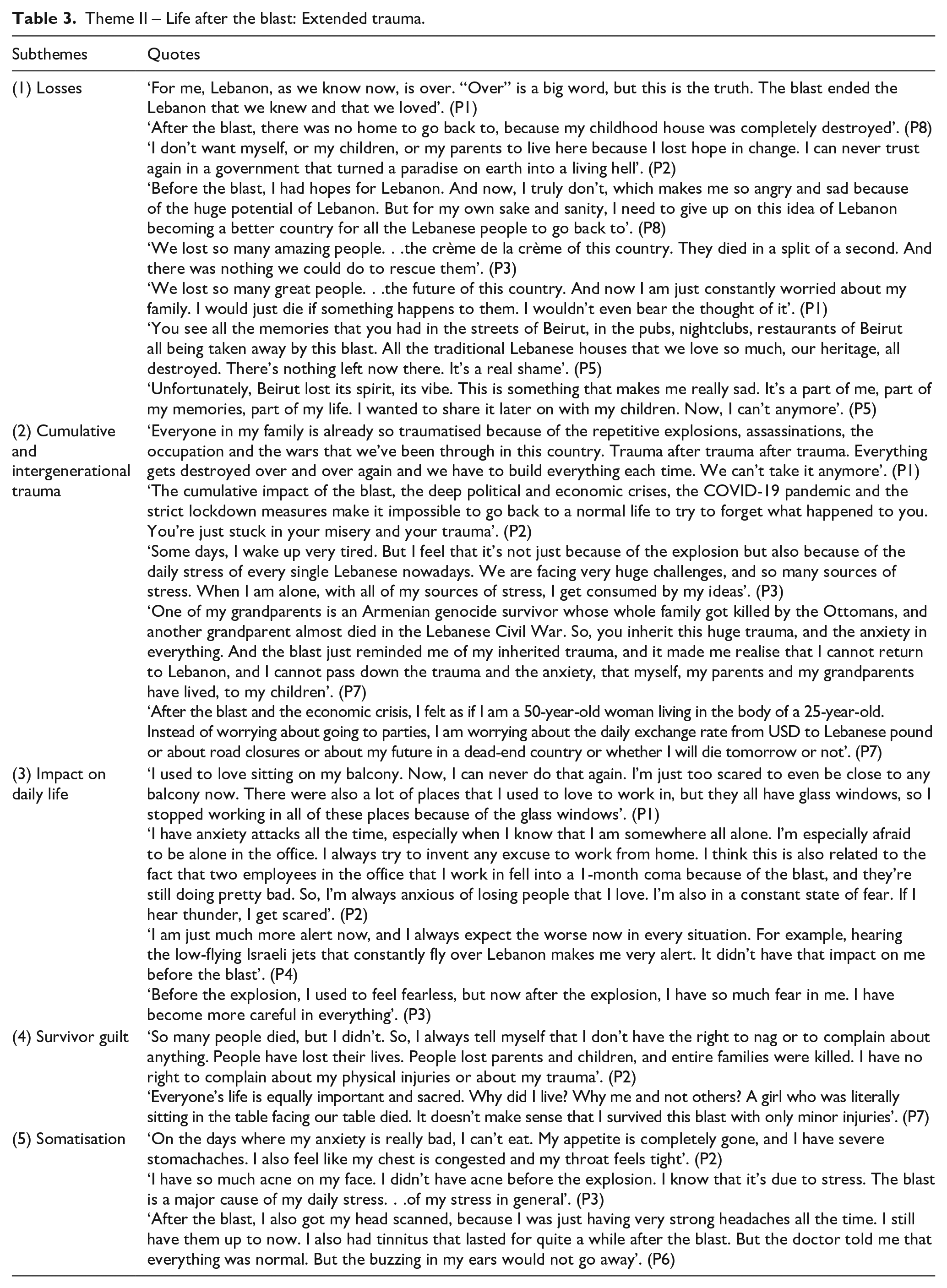
Characteristics of the study participants, who were between the ages of 24 and 40 with a mean age of 27, are presented in Table 1. All the participants, three of whom were men and five were women, were employed full-time at the time of the Beirut blast, and they all had completed university education. P6 was married with children, while the rest of the participants were unmarried without children. All, but one participant (P4), were severely injured following the Beirut blast, with four participants (P1, P5, P6 and P8) needing more than 40 stitches. Three participants emigrated from Lebanon after the blast, and the rest had been planning or thinking of leaving the country. Three overarching themes summarising the survivors’ reflections of the Beirut blast and its psychological aftermath were identified: (I) the blast; (II) life after the blast: extended trauma; (III) coping strategies. Exemplar quotes for each theme are displayed in Tables 2 to 4.
Participant characteristics.

Theme I – The blast.

Theme II – Life after the blast: Extended trauma.
Theme III – Coping strategies.

Theme I: The blast (Table 2)
All participants, with the exception of P6, vividly remembered the moment of the blast and referred to it as a turning point in their lives. They also remembered being on an emotional rollercoaster at the time of the blast, and feeling scared, sad, frustrated, angry and disgusted with the Lebanese political class, hopeless, shocked, confused, guilty, anxious and grateful. In addition, two participants (P5 and P8) reported having an out-of-body experience, in which they felt that their consciousness was separate from their body and it was as if they were outside themselves. Participants also commonly reported not feeling any physical pain or being physically numb, despite having sustained serious physical injuries. Following the second massive explosion, half of the participants remembered feeling worried that a third explosion might occur, as they thought at the time that the two consecutive explosions were due to bombardment by Israel. Moreover, half of the participants reported feeling God’s presence in the midst of tragedy, and attributed their survival to God or the Universe.
In the weeks and months following the Beirut explosion, participants often experienced, or still experienced, very distressing nightmares and flashbacks. According to the participants, the flashbacks could be triggered by thunderstorms, the sound of low-flying planes, by being alone in a quiet place (i.e. during night-time) or by seeing footage of the blast on social media or on television.
Theme II: Life after the blast: Extended trauma (Table 3)
Throughout all interviews, participants reported several negative experiences in their post-blast life, which may have enhanced/prolonged their trauma and hindered their psychological recovery. Following the Beirut blast, all participants were grappling with losses of different kinds, namely the loss of a country/homeland, of a home, of hope/faith, of loved ones, of safety/security and of culture and heritage. Moreover, all participants referred to the cumulative impact of the Beirut blast, as Lebanese communities were already overburdened with spiralling economic and political crises in addition to the COVID-19 pandemic. According to the participants, this blast exacerbated the collective suffering of the Lebanese people and added new wounds to the old psychological scars left by the continuous conflict that Lebanon has been under for more than four decades.
Participants also mentioned the impact of the Beirut blast on their daily life, and reported being much more fearful and alert as a result of the blast. They thought that it was impossible to ever return to ‘normality’ and to the routine activities of daily life, as activities like sitting on a balcony, being in the office alone or driving can be very distressing for some participants. Additionally, half of the participants expressed persistent survivor guilt, as they viewed their survival of the Beirut blast as ‘unfair’ because others had died. There was also salient evidence of somatisation (i.e. nausea, severe stomachaches, chest congestion, acne, headaches, tachycardia, tinnitus, dyspnoea and fatigue) identified in most participants.
Theme III: Coping strategies (Table 4)
Different coping strategies and defence mechanisms were adopted by the participants to deal with the trauma of the Beirut blast. Some of these strategies were however rather unhealthy. For instance, forgetting and detachment were commonly used among the participants to cope with their trauma. In P6, this forgetting was unconscious, as it was caused by a brain injury as a result of the blast that led to temporary memory loss and a ‘blackout’ of most of what had happened that day. By contrast, P1 described his conscious attempts to forget about the Beirut blast, through thought suppression. Detachment was also mentioned by most participants, and it was either an emotional detachment from the situation in Lebanon or a physical detachment through the immigration to another country within the 3 months following the blast. Overworking was another unhealthy coping strategy reported by two participants (P1 and P6).
Healthy coping mechanisms or strategies included ‘putting things into perspective’ and feeling ‘very lucky’ to be ‘given a second chance at life’. Processing the trauma, by talking about what happened with friends and family, was also considered helpful by several participants. Likewise, establishing a consistent daily routine and helping the community, by clearing debris, covering broken windows and doors and offering water and food to those affected by the Beirut blast, were described as ‘therapeutic’ coping strategies.
Discussion
The present study offers insight into the many layers of the psychological suffering of Beirut blast survivors and how they cope while living in a social context of collective trauma. Capturing the psychological aftermath of a nuclear-like explosion is very difficult, particularly in a complex setting like Lebanon, which has a populace that has faced and is still facing numerous traumatic events. However, and perhaps unsurprisingly, the findings of this study are in line with other studies investigating the traumatic experiences of survivors of mass trauma events including the atomic bombings of Hiroshima and Nagasaki occurring on August 6 and August 9, 1945, respectively (Ohta et al., 2000; Sawada et al., 2004), the September 11, 2001 (9/11) terrorist attacks (North et al., 2015) and the Norway terror attacks of July 22, 2011 (Aakvaag et al., 2014; Bugge et al., 2019; Jensen et al., 2015; Thoresen et al., 2012).
Similarly to the current study, the survivors of these aforementioned attacks all had vivid and long-lasting memories of the attack they have lived through and of the immediate disaster timeframe, with their rumination on their personal experience being a reflection of the severity of the horror and terror they experienced during the attacks (Bugge et al., 2019; North et al., 2015; Sawada et al., 2004). They also reported a significant impact of these attacks on life afterwards, with a wide array of psychological concerns such as survivor guilt, difficulty of daily life, worries about the future, altered perceptions of safety and chronic stress (Aakvaag et al., 2014; Bugge et al., 2019; North et al., 2015; Ohta et al., 2000; Sawada et al., 2004; Thoresen et al., 2012). Likewise, news articles published after the August 4 Beirut port explosion reported findings consistent with the current study, in which interviewed survivors of the Beirut blast described an impossibility to ever return to ‘normality’, a constant fear of losing loved ones, and a heightened sense of alertness, with thunderstorms and the sound of the Israeli warplanes that regularly violate and fly low through Lebanon’s airspace being particularly alarming (Associated Press, 2021).
In this study, somatisation (i.e. nausea, severe stomachaches, chest congestion, acne, headaches, tachycardia, tinnitus, dyspnoea and fatigue) has been found to be a prominent part of the reaction to the Beirut blast trauma. This finding is not surprising, given that in the Lebanese culture, expressing post-traumatic stress symptoms through somatic complaints is considered socially acceptable, since it is uncommon to express psychological distress for fear of stigmatisation (Farhood et al., 2014). Somatisation has also been frequently reported in survivors of the 9/11 attacks (Alper et al., 2020), of the Hiroshima and Nagasaki bombings (Yamada & Izumi, 2002) and of the 2011 Norway attacks (Stensland et al., 2020). The presence of somatic symptoms is particularly concerning, as it might hinder recovery from post-traumatic stress, since it can (a) lead to excessive functional impairment, (b) function as a potent reminder of persistent threat, (c) reflect more extensive underlying neurobiological adaptive or maladaptive responses to trauma exposure or (d) impact access to or efficiency of early interventions (Stensland et al., 2020).
Given the painful history of Lebanon, the Lebanese people live in constant anticipation of violence and war (Moghnieh, 2015). This was reflected in the present study, as half of the participants were worried that a third explosion might occur following the second massive Beirut port explosion. In addition, all study participants reported that the Beirut blast had a cumulative impact, exacerbating the collective suffering of the Lebanese people. Collective trauma can shape a society’s identity. According to König and Reimann (2018), there are three interconnected ‘collective identity markers’, which are all highly present in the Lebanese society and which were somewhat reflected in the present study. These are: (1) collective narratives of loss and despair, of victimhood and of guilt and shame; (2) collective emotions dominated by mistrust, insecurity, exaggerated fear and anger; (3) collective mental models or belief systems that are characterised by rigid thinking, scapegoating and prejudices. Hence, in this context of collective trauma, it is important that mental health professionals in Lebanon go beyond the individualistic clinical models used to currently treat mental disorders, and integrate community interventions that can target social distress and that can acknowledge the structural drivers of the collective suffering of the Lebanese people (Bosqui, 2020; Kerbage & Elbejjani, 2021).
With collective trauma comes collective action. In the present study, the participants reported using different coping strategies, and this ability to flexibly use many coping strategies has been argued to be helpful in adjusting to trauma (Bonanno & Diminich, 2013). Among the mentioned coping strategies was offering help to others affected by the Beirut blast. Engaging in collective actions has always been common in Lebanon, and can be seen as an example of the Lebanese resilience. In the aftermath of the Beirut port explosions, community-oriented behaviours have been widely observed, with hundreds of volunteers from all over the country doing the Lebanese government’s work by rebuilding Beirut and providing help to affected people (Bosqui, 2020). In addition, the collective processing of events, through the sharing of stories, perspectives and thoughts, has also been intensely observed in the days, weeks and months following the explosion (Bosqui, 2020). This collective trauma processing was also highlighted in the present study, as several participants reported that it was helpful to talk about what happened with friends and family. These collective coping strategies of helping others and of sharing one’s experience with others are consistent with a recent qualitative study from Gaza Strip, in which collective action was found to create community solidarity, to facilitate Palestinian coping with stress and traumatic experiences and to provide protection against fear and helplessness (Afana et al., 2020).
Avoidance coping, through distraction by overworking or through active efforts to avoid unwanted emotions, thoughts and memories in the aftermath of the Beirut blast, has been commonly described in the present study. The choice of coping strategies is thought to be influenced by the degree of perceived control, and a situation viewed as outside of one’s control is more likely to induce avoidance coping strategies (Jensen et al., 2015). Since the Beirut blast was a situation in which the victims had little control, the use of avoidance coping strategies is expected. However, this finding is worrying, since avoidance coping has been linked to more severe post-traumatic stress symptoms and slower recovery patterns (Steil & Ehlers, 2000).
Although this study is one of the very first studies focussing on the traumatic experiences of Beirut blast survivors and their coping mechanisms, several limitations should be acknowledged including the use of a small and purposive sample which limits the transferability of the results, as well as social desirability and recall biases. We tried to reduce social desirability bias by asking neutral questions. Recall bias on the other hand was mitigated by completing the in-depth interviews within 6 months of the Beirut blast. It is nevertheless important to have more solid, longitudinal research data in large populations in order to better understand the course, prognosis and severity of post-traumatic stress disorder in the Lebanese population.
In conclusion, this qualitative explorative study highlights the broad spectrum of post-traumatic behaviours and symptoms experienced by survivors of the 2020 Beirut blast. In the current context of collective loss and distress dominating Lebanon, both person-focussed and community-focussed multicomponent psychosocial interventions are needed to heal individual and collective trauma layers. In addition, by strengthening adaptive responses that are already present in the Lebanese people, positive psychosocial outcomes may be fostered. Findings from this qualitative pilot study also underscore the urgent need for further large-scale studies in the greater population of Lebanon.
Footnotes
Acknowledgements
A big thanks goes to the individuals who participated in this study for their cooperation.
Conflict of interest
MEH is a Partner 4 Health employee.
Funding
The author received no financial support for the research, authorship, and/or publication of this article.
Ethical approval
The study was reviewed by a local research ethics committee, and informed consent was obtained from all participants.
