



Abstract
Background:
This study explores the lasting mental health impact of the Syria-Turkey earthquakes in 2023 on a population affected by conflict and trauma. It analyzes pre- and post-event mental health and sleep quality differences, identifying predictors of outcomes.
Aims:
Studying the 2023 Syria-Turkey earthquakes’ enduring mental health impact on conflict-affected individuals, this research informs better support and interventions for disaster survivors.
Methods:
This longitudinal, cross-sectional study examined the enduring mental health impact of the Syria-Turkey earthquakes. The present study involved N = 1,413 Syrian survivors, aged 18 years or older, who actively participated by contributing both pre- and post-earthquake data. A meticulously designed digital questionnaire with established metrics assessed sleep disturbances, depressive symptoms, and anxiety levels. Stratification variables (age, gender, education, marital status) were used for subgroup analysis. Arabic versions of PHQ-9, PSQI, and GAD-2 proved reliable for measuring depression, sleep quality, and anxiety.
Results:
The majority of participants were female (73.6%) with tertiary education (83.3%). Post-earthquake, a higher percentage reported poor sleep quality (67.7% vs. 59.7%, p < .001) and increased prevalence of MDE (66.1% vs. 56%, p < .001). GAD did not differ significantly. Post-earthquake, women had a higher likelihood of poor sleep quality (OR: 1.58, 95% CI [1.19, 2.10], p < .001) and MDE (OR: 1.55, 95% CI [1.18 to 2.04], p = .003). Predictors varied before and after earthquakes; age and education were significant predictors of poor sleep quality, MDE, and GAD.
Conclusion:
This study reveals higher rates of poor sleep quality and major depressive episodes among earthquake-affected individuals, especially women. Age, education, and gender contribute to these outcomes. Targeted interventions and comprehensive mental health support are crucial for post-earthquake recovery.
Keywords
Introduction
As we go about our daily lives, it is easy to forget just how tenuous our hold on this world truly is. The ground beneath our feet, once a source of stability and comfort, can become a force of destruction in the blink of an eye. When disaster strikes, the aftermath can be devastating, leaving a trail of rubble and heartache in its wake. For those who survive, the psychological toll can be just as overwhelming as the physical damage. Sleepless nights, debilitating depression, and crippling anxiety are just a few of the mental health issues that can plague disaster survivors (Arnberg et al., 2015; Bavafa et al., 2019; Montazeri et al., 2005; Navarro-Mateu et al., 2017; Sezgin & Punamäki, 2012). The Turkey-Syria earthquakes of February 2023 were a stark reminder of this fact, unleashing a wave of destruction on a region already ravaged by years of conflict (Genc, 2023) (Ahmed et al., 2023).
The early hours of February 6, 2023, will forever be etched in the memories of those who experienced the 7.8 magnitude earthquake that struck the city of Gaziantep, followed by a 7.5 magnitude earthquake in the Elbistan district just hours later. The impact of these earthquakes was felt far and wide, affecting over 26 million people across Syria and Turkey directly and countless more indirectly (Turkey and Syria Earthquake: Latest News, n.d.). The devastation was widespread, with thousands of homes destroyed, roads and hospitals badly damaged, and even neighboring countries like Iraq, Jordan, Lebanon, and Cyprus impacted (Ahmed et al., 2023; Turkey and Syria Earthquake: Latest News, n.d.). The death toll was staggering, with over 35,000 individuals reported dead in Turkey and an estimated 5,000 in Syria, a number that is expected to be much higher given the lack of official statistics in Syria ( Ahmed et al., 2023; Genc, 2023; Turkey and Syria Earthquake: Latest News, n.d.). In the face of this tragedy, thousands of individuals have sought refuge in temporary shelters and schools, with over 380,000 seeking safety in educational facilities (Ahmed et al., 2023; Turkey and Syria Earthquake: Latest News, n.d.). The scope of this disaster is difficult to comprehend, but it serves as a stark reminder of the fragility of our world and the importance of coming together in times of crisis.
The recent earthquakes in Syria have struck a population already burdened by years of conflict and trauma, compounding the existing mental health challenges faced by those affected (Genc, 2023) (Ahmed et al., 2023; Turkey and Syria Earthquake: Latest News, n.d.). The people of Syria have endured unthinkable hardships, from displacement and loss of loved ones to the destruction of their homes and communities. The earthquakes have added another layer of complexity to an already fraught situation, exacerbating the mental health burden of those impacted (Ahmed et al., 2023; Turkey and Syria Earthquake: Latest News, n.d.).
While the world watched in horror as the Syrian public grappled with the immediate aftermath of the disaster, the long-term mental health impacts have remained largely unexplored. This research paper seeks to shine a light on this critical issue, examining the before-and-after differences in mental health and sleep quality among those affected by the earthquakes. The findings of this study have the potential to inform policymakers, mental health professionals, and disaster response teams, providing valuable insights into the challenges faced by survivors of natural disasters. By identifying predictors of mental health outcomes, such as age, education level, and sex, we can develop more effective interventions and support systems for those in need. In a world that seems increasingly uncertain, it is essential to recognize the importance of mental health and to provide resources to support those affected by traumatic events. This study is a step toward that goal, a beacon of hope in the face of adversity, and a reminder that resilience and healing are possible even in the darkest of times.
Methods
Participants and research procedure
The study conducted a longitudinal, cross-sectional investigation in two discrete temporal intervals among the general populace of Syria from January 6th to March 6th. The first phase occurred one month prior to the most recent earthquake, which took place on February 6th, 2023 (Bethke & Shankiti, n.d.). Following the earthquake, the study was suspended for 1 month until March 6th, 2023. Data collection resumed one month post-incident among earthquake survivors and continued for 1 week.
Commencing the study prior to the seismic event allowed for the comparison of two distinct samples at separate time points: pre- and post-earthquake. Eligible participants were Syrian earthquake survivors over 18 years of age who experienced physical or mental repercussions. The recruitment strategy adopted a multifaceted online approach for inclusive and diverse participant representation. Random sampling ensured broad geographic and demographic coverage, primarily leveraging online platforms. Targeted outreach through digital channels and collaborations with community centers aimed to engage participants with varying online accessibility. This comprehensive strategy sought to capture a diverse cross-section of the Syrian population, enhancing the study’s findings’ generalizability and robustness. The questionnaire had an average completion time of approximately 6 minutes. A substantial sample size was obtained both prior to (n = 402) and following (n = 1,001) the earthquake. Informed consent was procured from all participants, and confidentiality and non-disclosure of personal information were assured. Participants who expressed misgivings about participation or failed to complete the questionnaire were excluded from the study.
The study employed multiple internationally recognized metrics to examine sleep disturbances, including the Pittsburgh Sleep Quality Index (PSQI), while the PHQ scale was used to assess the prevalence of depressive symptoms and the GAD scale was utilized to gauge levels of anxiety. The study was conducted in adherence to the principles outlined in the Declaration of Helsinki and obtained approval from the scientific council at Aleppo University’s Faculty of Medicine, under the serial number (1468/3688).
Psychological afflictions, including depression, generalized anxiety, and sleep disturbances resulting from the earthquake, had significant impacts on all residents post-earthquake, whether they were in physically affected areas or unscathed. This was due to the pervasive fear of injury, building destruction, and the omnipresence of mortality.
Consequently, it was crucial to conduct the study with the widest possible array of residents across all Syrian provinces. The use of an electronic questionnaire facilitated streamlined data collection and dissemination across all official communication channels, reaching the entirety of the Syrian populace.
Measures
To further enhance the understanding of how the earthquake impacted different subgroups within the population of Syria, the sample was stratified by age, gender, education level, and marital status. This provided a more nuanced understanding of the impacts of the earthquake on psychological health and helped identify any specific groups that may require targeted interventions or support.
PHQ-9
The Patient Health Questionnaire-9 (PHQ-9) was used to assess symptoms of depression. The PHQ-9 is a self-report measure that consists of 9 items, each of which corresponds to one of the DSM-5 criteria for major depressive disorder. Participants were asked to rate how often they had experienced each symptom over the past 2 weeks on a scale from 0 (not at all) to 3 (nearly every day). Total scores on the PHQ-9 range from 0 to 27, with higher scores indicating greater severity of depressive symptoms. Based on these scores, depressive symptoms could be divided into ‘none or minimum’ (0–4), ‘mild’ (5–9), ‘moderate’ (10–14), ‘moderately severe’ (15–19), and ‘severe’ (20–27).
The Arabic PHQ-9 Questionnaire has been shown to be a reliable and valid measure of depression in a variety of populations, including primary care patients and individuals with chronic medical conditions. Taking the 10 points recommended by the original maker of PHQ-9 as the screening cut-off value. The PHQ-9 showed good internal consistency with Cronbach’s alpha of 0.857 (AlHadi et al., 2017).
PSQI
The Pittsburgh Sleep Quality Index (PSQI) was used to assess sleep quality in the current study. The PSQI is a self-report measure that assesses various aspects of sleep quality over the past month, including sleep duration, latency, efficiency, disturbances, and daytime dysfunction. It consists of 19 items, which are used to calculate seven component scores (sleep quality, sleep latency, sleep duration, habitual sleep efficiency, sleep disturbances, use of sleep medication, and daytime dysfunction) and a total score ranging from 0 to 21, with higher scores indicating poorer sleep quality.
Participants were asked to rate their experiences on each item using a 4-point Likert scale, with higher scores indicating worse sleep quality. The PSQI has been shown to have good reliability and validity in previous studies and is widely used in research on sleep disorders.
The results of this study suggest that the Arabic version of the PSQI can be considered a reliable and valid tool for identifying individuals with sleep disorders, by using a cut-off score of 5 (Suleiman et al., 2010).
GAD-2
The Generalized Anxiety Disorder 2-item Scale (GAD-2) was used to assess symptoms of anxiety in the current study. The GAD-2 is a brief, self-administered measure that consists of two items that ask about the frequency of feeling nervous, anxious, or on edge, and the frequency of not being able to stop or control worrying over the past 2 weeks. Participants were asked to rate each item on a 4-point Likert scale, with responses ranging from 0 (not at all) to 3 (nearly every day). Total scores on the GAD-2 range from 0 to 6, with higher scores indicating greater severity of anxiety symptoms.
The GAD-2 has been shown to be a reliable and valid measure of anxiety in various populations, including primary care patients and individuals with chronic medical conditions. Its brevity and ease of administration make it a convenient measure for use in clinical and research settings where time and resources are limited. The GAD-2 is a brief adaptation of the GAD-7 survey, comprising its initial two items [16]. Scores on the GAD-2 range from 0 to 6, with a cut-off score of ⩾3 considered indicative of clinical anxiety. Notably, the Arabic version of the GAD-2 has exhibited high internal consistency, with a reported alpha coefficient of 0.98 in prior research studies (Soqia et al., 2022).
Data analysis
Google forms was used to collect data online. Prevalence rates were calculated based on the recommended cut-offs for probable PSQI, MDE, and GAD. Differences in probable prevalence rates of PSQI, MDE, and GAD before and after the earthquake were assessed using chi square analyses. Separate logistic regressions were conducted to identify predictors of poor sleep quality (using PSQI), depression, and GAD, respectively. In each regression gender, age, marital status, and highest level of education were entered as predictors.
Results
Demographic characteristics
Data of N = 1,413 participants was collected. As outlined in Table 1, 73.6% were female (n = 1,040), 83.3% (n = 1,177) had a tertiary education, and 69.1% (n = 976) were single. Before the earthquake group contained 402 participants, while after the earthquake group contained 1,011 participants. Further details, characteristics, and differences in participants between the two groups are outlined in Table 1.
Characteristics of each sample (before and after earthquakes).

Prevalence of mental health outcomes
Table 2 presents the frequencies of reported poor sleep quality (based on PSQI), MDE, and GAD according to the exposure to the earthquakes (before and after). In terms of poor sleep quality, more participants in after the earthquake (67.7%) group reported poor sleep quality than those in before the earthquake (59.7%) group (X2 (1, N = 1,413) = 8.04, p < .001). Similarly, participants in after the earthquake (66.1%) group were more likely to report a probable diagnosis depression than participants in before the earthquake (56%) group (X2 (1, N = 1,413) = 12.62, p < .001). However, no significant differences were found when it comes to GAD across different groups (X2 (1, N = 1,413) = 1.46, p = 0.227).
Poor sleep quality (PSQI), depression, and general anxiety disorder.

Note. Chi square was used in this table to demonstrated statistical significant differences. PHQ-9 was used for depression, and General anxiety disorder 2-item was used for General anxiety disorder. PSQI = Pittsburgh Sleep Quality Index.
Gender and mental health outcomes
Table 3 presents the rates of mental health and sleep quality outcomes by gender. Women after the earthquakes were significantly more likely to poor sleep quality (71.5% vs. 61.2%) (OR: 1.58, 95% CI [1.19, 2.10], p < .001), and MDE (67.9% vs. 57.7%) (OR: 1.55, 95% CI [1.18, 2.04], p = .003) than women before the earthquakes. However, there were no significant differences between men and women in probable GAD.
Odds ratio between females before earthquakes and females after earthquakes with poor sleep quality (PSQI), depression and general anxiety disorder.

Note. PHQ-9 = The Patient Health Questionnaire-9 was used for depression, GAD-2 = General anxiety disorder 2-item was used for general anxiety disorder, and unadjusted odds ratios were used in this table. PSQI = Pittsburgh Sleep Quality Index.
Predictors of poor sleep quality and mental health outcomes
Table 4 presents the adjusted ORs (before and after the earthquakes) for poor sleep quality, MDE, and GAD. Poor sleep quality before the earthquakes was predicted by age, and tertiary education. While, after the earthquakes was only predicted by female sex. On the other hand, MDE before the earthquakes was only predicted by age, while after the earthquakes it was predicted by female sex, and tertiary education. Lastly, GAD before the earthquakes was not predicted by any factor, whereas after the earthquakes it was predicted by female sex and tertiary education.
Binary regression to determine the adjusted odds ratio of PTSD, depression, and general anxiety disorder with multiple variables.
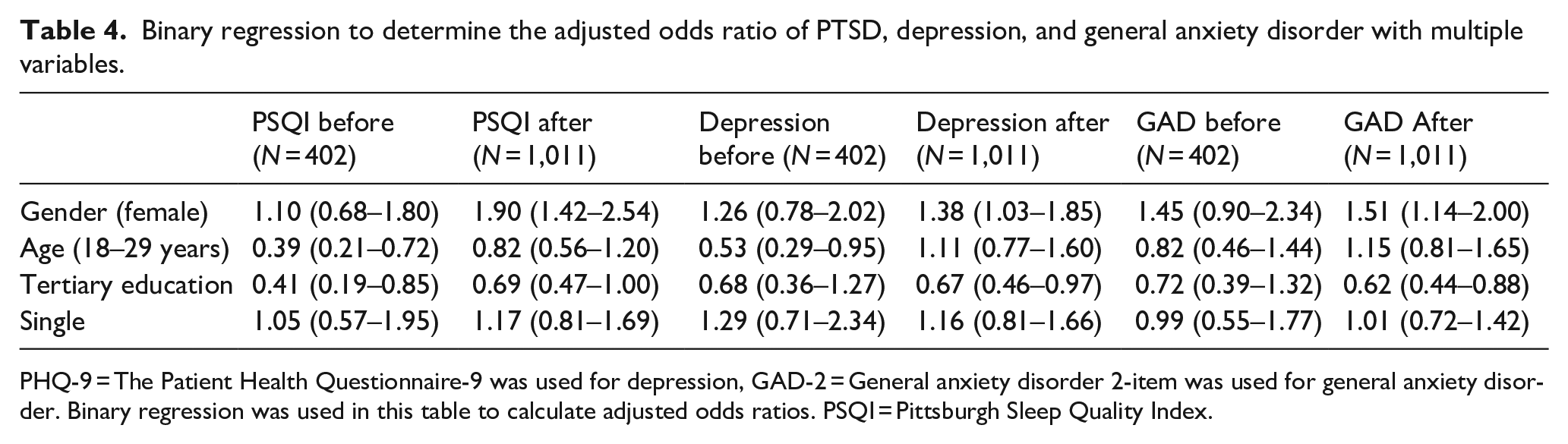
PHQ-9 = The Patient Health Questionnaire-9 was used for depression, GAD-2 = General anxiety disorder 2-item was used for general anxiety disorder. Binary regression was used in this table to calculate adjusted odds ratios. PSQI = Pittsburgh Sleep Quality Index.
Discussion
Seismic events, such as earthquakes, give rise to extensive devastation, a substantial loss of lives (Trichopoulos et al., 1983), and both immediate and prolonged physical and psychological afflictions for survivors (Bland et al., 1996). The primary focus of this study is to compare the psychological well-being of individuals in Syria before and after the catastrophic Turkey-Syria earthquake in 2023, with particular emphasis on key psychological concerns, namely, disrupted sleep patterns, depressive symptoms, and generalized anxiety disorder. The incidence of post-traumatic stress disorder (PTSD) and other psychological disorders demonstrates an escalating trend parallel to the severity of the calamity’s impact (Parvaresh & Bahramnejad, 2006). According to a study conducted by Ommeren et al., the prevalence of mental health issues in affected regions of the United States was twice as high as that in normal circumstances (Van Ommeren & Saxena, 2005). Our study’s findings align with prior research, as we observed a substantial increase in the prevalence of depression and disrupted sleep patterns among individuals following the earthquake compared to the pre-disaster period, while the proportion of individuals with generalized anxiety disorder exhibited no discernible change.
This investigation sought to explore the impact of diverse demographic attributes on the severity of psychological disorders subsequent to an earthquake. The outcomes indicated noteworthy variances in relation to gender, age, and educational attainment, implying that these factors significantly contribute to the development of psychological problems in the aftermath of an earthquake. Sleep disturbances, known to potentially precipitate other physiological and psychological disorders, stand out as a prominent psychological consequence stemming from earthquakes (Lemma et al., 2012). Depression and anxiety, being the most prevalent mental disorders worldwide, can both be triggered by personal stressors, societal challenges, or the occurrence of natural disaster (Makwana, 2019).
In our investigation of the psychological ramifications following the earthquake in Syria, an examination of past psychological issues in both genders revealed a notable gender disparity, with women experiencing a higher prevalence of poor sleep quality, depression, and generalized anxiety disorder. Substantial evidence from various studies corroborates our findings. For instance, W. Tang et al. (2018), in a similar study investigating sleep problems after the 2013 Ya’an earthquake, demonstrated that females encountered significantly greater difficulty sleeping post-disaster compared to males. This gender discrepancy may be attributed to hormonal and physiological variations. Morssinkhof et al. synthesized research exploring the link between sex hormones, sleep, and depression (Morssinkhof et al., 2020). Following the Jiuzhaigou earthquake in China, Junjun et al. discovered that females exhibited a higher likelihood of experiencing post-earthquake depression relative to males (Qi et al., 2020). This gender disparity might be associated with the elevated stress and trauma experienced by females in the aftermath of a calamity. Females are more susceptible to the impact of stress, as evidenced by Dell’Osso et al.’s study (Niederkrotenthaler et al., 2022). The increased incidence of depression among women may be ascribed to stress, which has been consistently linked to depression. Furthermore, W. Tang et al. (2020) found that females display a greater propensity for anxiety compared to males.
The prevalence of the aforementioned psychological disorders among females was not confined to the post-earthquake period but also encompassed the pre-earthquake timeframe, during which we observed instances of sleep disorders and depression. This may be elucidated by the interplay of lifestyle factors, fluctuations in mental states, and the influence of the luteal phase characterized by elevated progesterone levels (Kravitz et al., 2005; Shechter et al., 2012). Exposure to the disaster exacerbated the severity of both poor sleep quality and depression. However, we did not identify any statistically significant differences in the incidence of generalized anxiety disorder before and after the disaster. This observation may be attributed to a theoretical proposition suggesting that women, following a catastrophic event, exhibit heightened communal resilience and avail themselves of social support networks, thereby mitigating the psychological impact of the incident. Moreover, the prioritization of caregiving responsibilities among women may foster a propensity to attenuate stress and anxiety, ultimately minimizing the full impact of their psychological disorders. Age and level of education represent additional prominent variables that contribute to an elevated risk of developing pre-existing psychological issues subsequent to a disaster, as supported by statistical data.
In relation to education, our investigation revealed that achieving an advanced level of education was associated with an elevated incidence of poor sleep quality prior to the catastrophe. This observation could be attributed to the academic and psychological stress induced by examinations during that period. However, the level of education did not exert any influence on sleep disturbances experienced after the earthquake. Nevertheless, individuals with higher education were less prone to both anxiety and depression compared to non-university students in the aftermath of the earthquake. B. Tang et al.’s (2014) research substantiates this finding, suggesting that individuals with higher educational attainment are better equipped to cope with the repercussions of catastrophes, thereby reducing their susceptibility to depression. This may be attributed to their heightened awareness of the disaster, access to information regarding psychological disorders, adaptability in managing symptoms of mental disorders, and ability to navigate disaster response efforts. A study conducted by Patria B. identified a significant relationship between levels of educational achievement and physical as well as mental health. Furthermore, the study indicated that attaining a high level of education particularly contributes to a lower prevalence of depression (Patria, 2022). These findings corroborate our own. However, Bonanno et al. (2007) observed that the level of education may present challenges in dealing with disasters.
In relation to age, our findings indicate that young adults (18–29 years) exhibited a heightened susceptibility to poor sleep quality following the earthquake. This outcome aligns with several previous studies, such as the investigation conducted by Yu Itoh, et al., which elucidated the changes in insomnia prevalence and its underlying factors subsequent to the Great East Japan Earthquake in 2011. They observed no significant disparities between the younger and older age groups prior to the earthquake, but the risk of insomnia significantly increased among the younger cohort at both 4 months and 18 months post-earthquake compared to the older group (Itoh et al., 2022). Although the precise cause of this elevated incidence of post-disaster insomnia among the younger age group remains unclear, it is plausible to speculate that the psychological distress associated with rebuilding their lives, managing familial concerns, and seeking employment opportunities may have been more pronounced for the younger individuals compared to the retired older group, who were financially stable with pensions (Itoh et al., 2022). Similarly, Amir Bavafa et al., documented significant differences in sleep quality among various age groups in their study exploring the relationship between the severity of psychological symptoms and sleep quality in earthquake survivors in Kermanshah in 2017. However, their findings diverged from ours as they reported a decline in sleep quality with advancing age (Bavafa et al., 2019). They attributed this result to factors such as reduced melatonin hormone levels, neuronal degeneration, neurological issues, medication usage, and other variables that can impact sleep quality in older individuals (Bavafa et al., 2019). Strikingly, age did not exhibit any influence on the overall incidence of depression or general anxiety disorder following the earthquake. These findings regarding age contrast with several previous reviews that identified age as a significant factor contributing to the occurrence of depressive and anxiety symptoms (Gao et al., 2019; Xi et al., 2020). Li et al. (2020), demonstrated an increasing likelihood of depression in older age groups after the Lushan Earthquake in China in 2013. Likewise, Qi et al. (2020) investigated the prevalence of post-traumatic stress disorder (PTSD) and depression across different age groups, and their results indicated no significant differences in psychological outcomes, aligning with our own findings. The disparity between these findings could potentially be explained by variations in sample sizes, which might have influenced the outcomes. In our study, marital status did not elevate the risk of experiencing any of the aforementioned psychological disorders. However, numerous studies disagree with our findings. According to the research conducted by Zhou et al., unmarried individuals were more susceptible to adverse mental health effects such as post-traumatic stress disorder, depression, and anxiety following exposure to a disaster (Zhou et al., 2013). Furthermore, in another study, Pearlin et al. found that married individuals tend to experience greater psychological well-being compared to unmarried individuals (Pearlin & Johnson, 1977).
The study’s findings are subject to several important limitations that warrant consideration. One crucial factor is the reliance on participants’ responses to a digital questionnaire, introducing the potential for social desirability bias and not fully capturing the complexity of mental health experiences. Additionally, the generalizability of the results to other earthquake-affected populations or trauma scenarios is limited, particularly given the specific circumstances of the Syria-Turkey earthquakes. The overrepresentation of young participants further raises concerns about extending conclusions to broader age groups. The observed mental health impacts may be more applicable to the younger population affected by the earthquakes, and caution should be exercised when extrapolating to diverse age groups.
Furthermore, the study’s cross-sectional design poses limitations in establishing causal relationships between earthquakes and mental health outcomes. While the research is longitudinal, incorporating pre- and post-event data could enhance causal inference. Cultural considerations also play a role, as the study may not fully address cultural nuances influencing mental health perceptions and reporting across diverse populations.
Another set of limitations arises from the study’s sample characteristics. The pre-earthquake sample size was relatively small, limiting heterogeneity between groups and hindering the generalizability of findings to a broader population. The cross-sectional nature of the design prevents establishing a definitive causal relationship between identified mental disorders and demographic characteristics. The study’s reliance on electronic questionnaires, although valuable, lacks clinical diagnoses and comprehensive evaluations. Additionally, the predominant female composition of the sample introduces potential gender bias, reflecting the impact of male migration following the war in Syria. Consequently, caution is essential when interpreting the study’s conclusions in light of these various limitations.
Conclusion
This study elucidates a significant elevation in the prevalence of poor sleep quality and major depressive episodes (MDE) among individuals following exposure to earthquakes. Remarkably, gender disparities have been observed, wherein women manifest heightened vulnerability to these deleterious mental health outcomes. Furthermore, age and educational attainment have emerged as predictive factors for both poor sleep quality and MDE, while gender demonstrates an influential role in predicting MDE and generalized anxiety disorder (GAD) subsequent to seismic events. These compelling findings underscore the imperative of targeted interventions and provision of support within post-disaster contexts. Effective strategies encompass the recognition and amelioration of enduring mental health consequences associated with earthquake exposure, with specific emphasis on addressing disturbances in sleep patterns and depressive symptomatology. Tailored support services, adeptly accommodating the unique requirements of women during post-earthquake recovery, warrant implementation. Notably, the design of interventions aimed at fostering resilience necessitates the consideration of age, educational attainment, and gender. Ultimately, comprehensive mental health support assumes a pivotal role in facilitating the well-being and enduring recuperation of earthquake-affected populations.
Footnotes
Acknowledgements
Not applicable.
Authors contribution
All authors have participated in writing the manuscript, and reviewing the literature. JS analyzed the data statistically and created tables. JA critically and linguistically revised the manuscript. JA contributed to the revision and preparation of the manuscript. JA and MM conceived and supervised the conduct of the study. All authors read and approved the final manuscript.
Availability of data and materials
All data generated or analyzed during this study are included in this published article.
Conflict of interest
The author(s) declared no potential conflicts of interest with respect to the research, authorship, and/or publication of this article.
Ethical approval and consent to participate
All experimental protocols were approved by the ethical committee in the Faculty of Medicine at Aleppo University, Syria with serial number (1468/3688). Written informed consent was collected from the participant or their parents if they are younger than 18 years old. The study complied with the principles of the Helsinki Declaration.
Funding
The author(s) received no financial support for the research, authorship, and/or publication of this article.

Provenance and peer review
Not commissioned, externally peer reviewed.