



Abstract
Introduction:
Income inequality, a pivotal determinant of general and mental health, operates through intricate mechanisms at various geographical scales. While established at country or region levels, the impact of lower-level (municipal or neighborhood) inequality remains inconsistent. This study explores the influence of regional- and municipal-level income inequality on individual psychological distress during the COVID-19 pandemic in Italy, employing a multilevel data analysis.
Materials and methods:
In a post hoc analysis of data from the first wave of the pandemic (March to April 2020), three hierarchical levels were considered: individual participants, municipalities, and regions. Depressive and anxiety symptoms were measured using the PHQ-9 and GAD-7 scales, while the Gini coefficient gauged income inequality at municipal and regional levels. The analysis incorporated demographic variables as potential confounders.
Results:
The study encompassed 21 regions, 3,900 municipalities, and 21,477 subjects. Income inequality at both regional and municipal levels exhibited associations with distress scores, suggesting independent effects. Notably, higher distress scores were identified in southern regions with elevated inequality, despite a more substantial COVID-19 impact in the north.
Discussion:
Findings contribute to existing literature by emphasizing the independent impact of lower-level (municipal) and higher-level (regional) income inequality on population psychopathology. The study supports theories suggesting diverse pathways through which inequality at different levels influences health, such as potential associations with healthcare system dysfunction at the regional level and welfare dysfunction at the municipal level. The observed north-south gradient in distress scores highlights the need for psychosocial interventions to alleviate income inequality, especially in historically disadvantaged southern regions. Future research should explore the nuanced interplay between income inequality and various ecological variables to provide a comprehensive understanding of its health impact.
Introduction
Income inequality is a crucial social determinant of general and mental health (Ribeiro et al., 2017; Wilkinson & Pickett, 2017), with complex mechanisms dependent on ecological nature and geographical levels of measurement (e.g. neighborhood, province, region, and country). Recent meta-analysis confirms effects at all geographical scales, albeit more pronounced at larger scales (Tibber et al., 2022). While country or region-level inequality’s impact on mental health is established, lower-level (municipal or neighborhood) effects are inconsistent due to limited outcome variance and the significant impact of absolute poverty (Patel et al., 2018; Pickett & Wilkinson, 2010). However, understanding smaller-scale inequality is crucial, as many psychosocial mediators are inherently individual (Layte & Whelan, 2014) and influenced by contextual factors (Rossi et al., 2021). Proposed mechanisms include stress-related processes operating both at the individual, and at the neighborhood levels, alongside factors such as status anxiety, and social capital. At the regional or national level, the most accounted model is the neo-materialist one, which suggests greater inequality corresponds to extensive material deprivation, affecting housing, welfare, healthcare, education, and justice (Layte, 2012; Ribeiro et al., 2017; Wilkinson & Pickett, 2007, 2017).
In light of the observed north-south gradient in mental health outcomes during the COVID-19 pandemic in Italy (Rossi et al., 2020), historically characterized by a sharp north-south economic gradient, this study explores the impact of regional and municipal-level income inequality on individual psychological distress. The hypothesis is that such inequalities independently explain the observed north-south gradient in mental health outcomes. To do so, we relied on multilevel data analysis, which is currently considered state-of-the-art in addressing the role of ecological risk factors (Ribeiro et al., 2017; Tibber et al., 2022).
Materials and methods
In a post-hoc analysis of data collected online during the first wave of the COVID-19 pandemic in Italy (March to April 2020), with approval from the University of L’Aquila’s local ethics committee (protocol n. 25/2020), participants provided online consent. We built a multilevel model, where data were structured into three levels: individual participant (level 1), municipality (level 2), and region of residence (level 3). The dependent variable, a composite of depressive and anxiety symptoms, was assessed using the 9-item Patient Health Questionnaire (PHQ-9) and the 7-item Generalized Anxiety Disorder scale (GAD-7). Income inequality at municipal and regional levels, measured by the Gini coefficient (GC), served as the independent variable. GC values ranging from 0 to 1 indicated higher income inequality. Data for GC at levels 2 and 3 were obtained from Italian public repositories (ISTAT – www.istat.it; UrbanIndex – www.urbanindex.it). Age, gender, and education were included as potential confounders.
Results
Our final sample included 21,477 subjects in 3,900 municipalities and 21 regions. The mean observation number for the municipality level was 5.5 (min = 1, max = 3,129); for the region level, it was 1022.7 (min = 76, max = 3,129). In the total sample, the mean age was 39.23 (SD = 12.93), with a large unbalance in gender ratio (females = 17,772, 80.65%; males = 4,263).
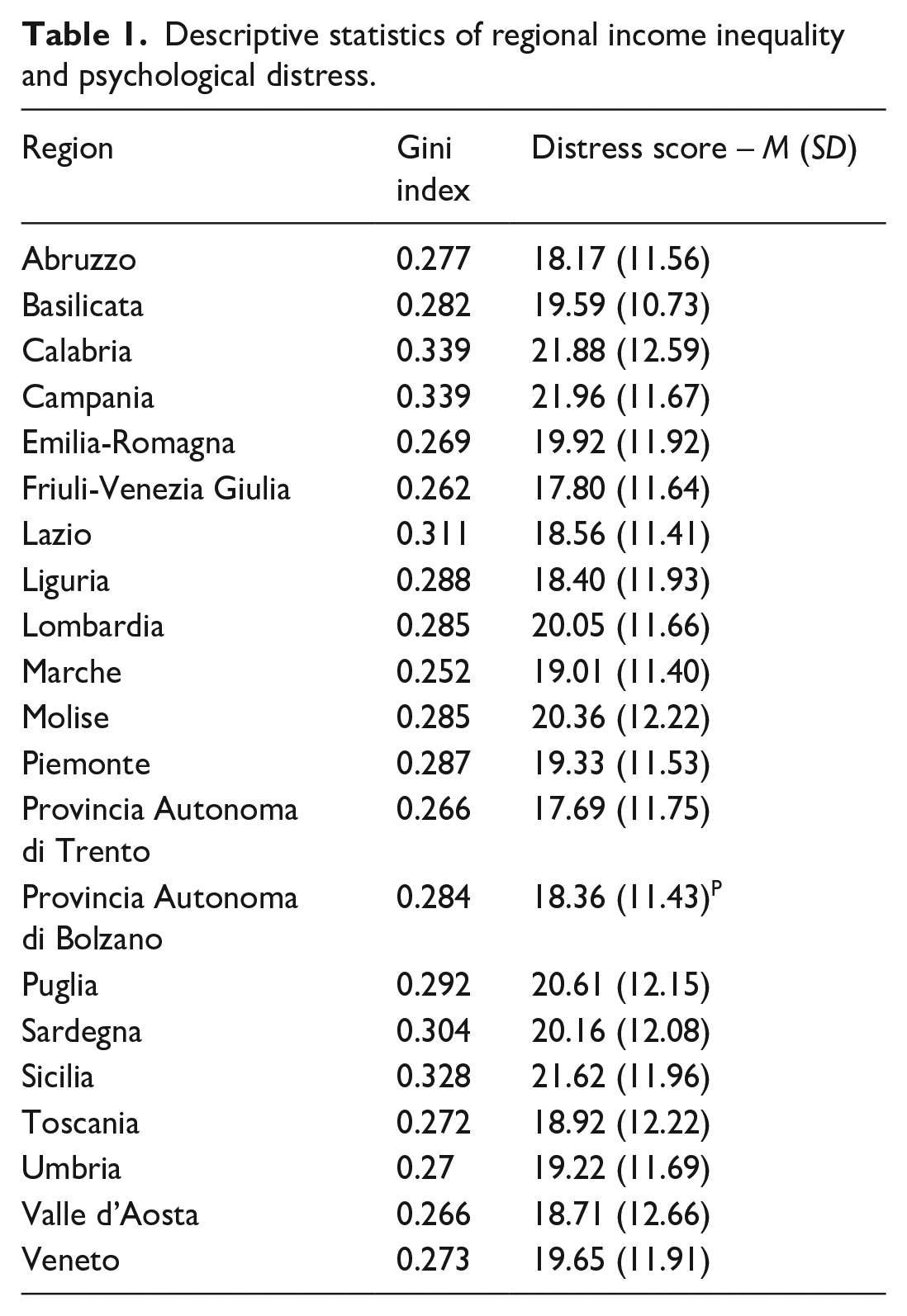
Mean distress scores at a regional level varied between a minimum of 17.69 (SD = 11.74) in the Autonomous Province of Trento and 21.96 (11.67) in Campania (Table 1, Figure 1). The Gini coefficient ranged between .25 in the Marche region and .33 in Campania and Calabria. Pearson correlation coefficient was r = .61 (p < .001; Figure 2).
Descriptive statistics of regional income inequality and psychological distress.
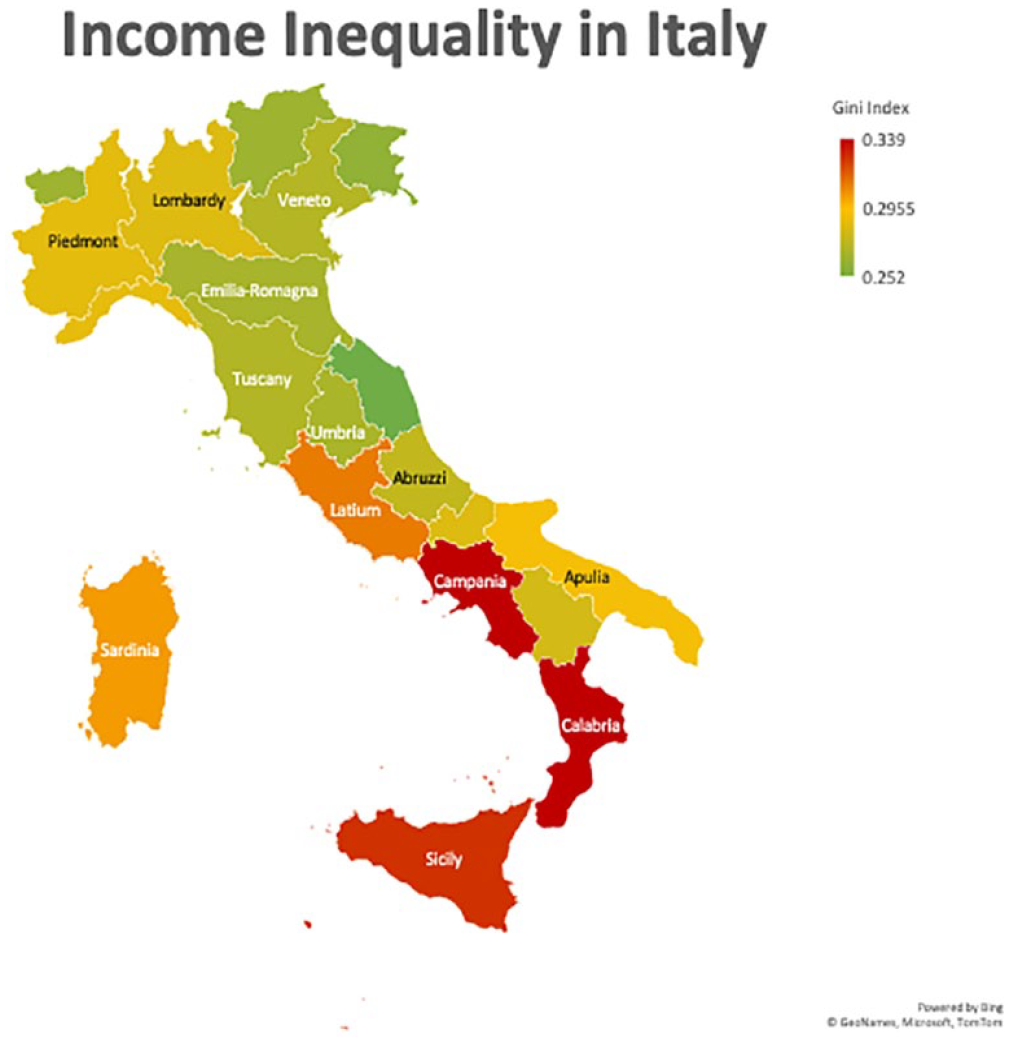
Heat map of income inequality in Italy.

Correlation between income inequality and psychological distress across Italian regions.
The multilevel mixed effect model showed that income inequality measured at the regional and municipality levels were associated with distress scores, with coefficients respectively of 27.12 [12.42, 41.81] and 9.48 [0.41, 18.54] (Table 2).
Multilevel linear regression estimates.

Discussion
Results reveal an association between psychological distress and income inequality at both regional and municipal levels, even after controlling for potential overlapping effects (Figure 2). Interestingly, higher psychological distress scores were found in high-inequality southern regions, despite a higher COVID-19 impact in the north. Data contribute to existing literature, highlighting the independent effects of lower-level (municipal) and higher-level (regional) inequality on population psychopathology. While the correlation between large-scale inequality and psychopathology is well-established, evidence for small-scale income inequality remains mixed (Farmer et al., 2022; Fone et al., 2013; Lowe et al., 2021; Pickett & Wilkinson, 2010; Tibber et al., 2022).
Our results support theories suggesting multiple pathways through which inequality measured at various levels impact health. One possible explanation for our results is that our different levels of analysis correspond to different public institutions, that is, regions and municipalities, which are respectively responsible for healthcare policies, social services, and welfare. It is possible that regional income inequality could be associated with a healthcare system dysfunction, whereas a welfare dysfunction might reflect municipal inequality. Indeed, Italy’s healthcare quality and welfare expenditures show a robust north-south gradient, with northern regions performing better in healthcare and spending more on welfare than southern ones (Franzini & Giannoni, 2010).
Another explanation for our results regards small municipalities’ role as main generators of social capital (Uphoff et al., 2013). Small-scale income inequality and eroded social capital has been related to the so-called neighborhood disorder, i.e., a set of social disruptions within a community that ultimately affects social connectedness, social support, and mental health. Given the small population of many municipalities in Italy, much of the effect associated with this level is due to community dynamics. This hypothesis would, however, depend on the size of the community addressed. For this reason, we highlight that one limitation of this study is not being able to break up data from large municipalities into smaller neighborhoods.
Other limitations include the lack of adjustment for absolute deprivation at the area level. However, our analyses controlled for individual education as a confounder, which can be considered a proxy for personal socio-economic status.
In conclusion, these observations are important as they further support the need for psychosocial intervention to mitigate income inequality in Italy in light of the historical disadvantage of southern regions.
Further studies will need to address the interplay between income inequality and other ecological variables gathered at various levels to provide a more fine-grained description of the mechanisms underpinning the impact of inequality on health, including environmental descriptors of micro-community level dynamics as well as higher-level economic determinants of mental health.
Footnotes
Funding /Support
This study was supported by: Territori Aperti, a project funded by the Fondo Territori Lavoro e Conoscenza of the Confederazione Generale Italiana del Lavoro, the Confederazione Italiana Sindacati Lavoratori, and the Unione Italiana del Lavoro, and #NEXTGENERATIONEU (NGEU) and funded by the Ministry of University and Research (MUR), National Recovery and Resilience Plan (NRRP), project MNESYS (PE0000006) – (DN. 1553 11.10.2022)..
