




Abstract
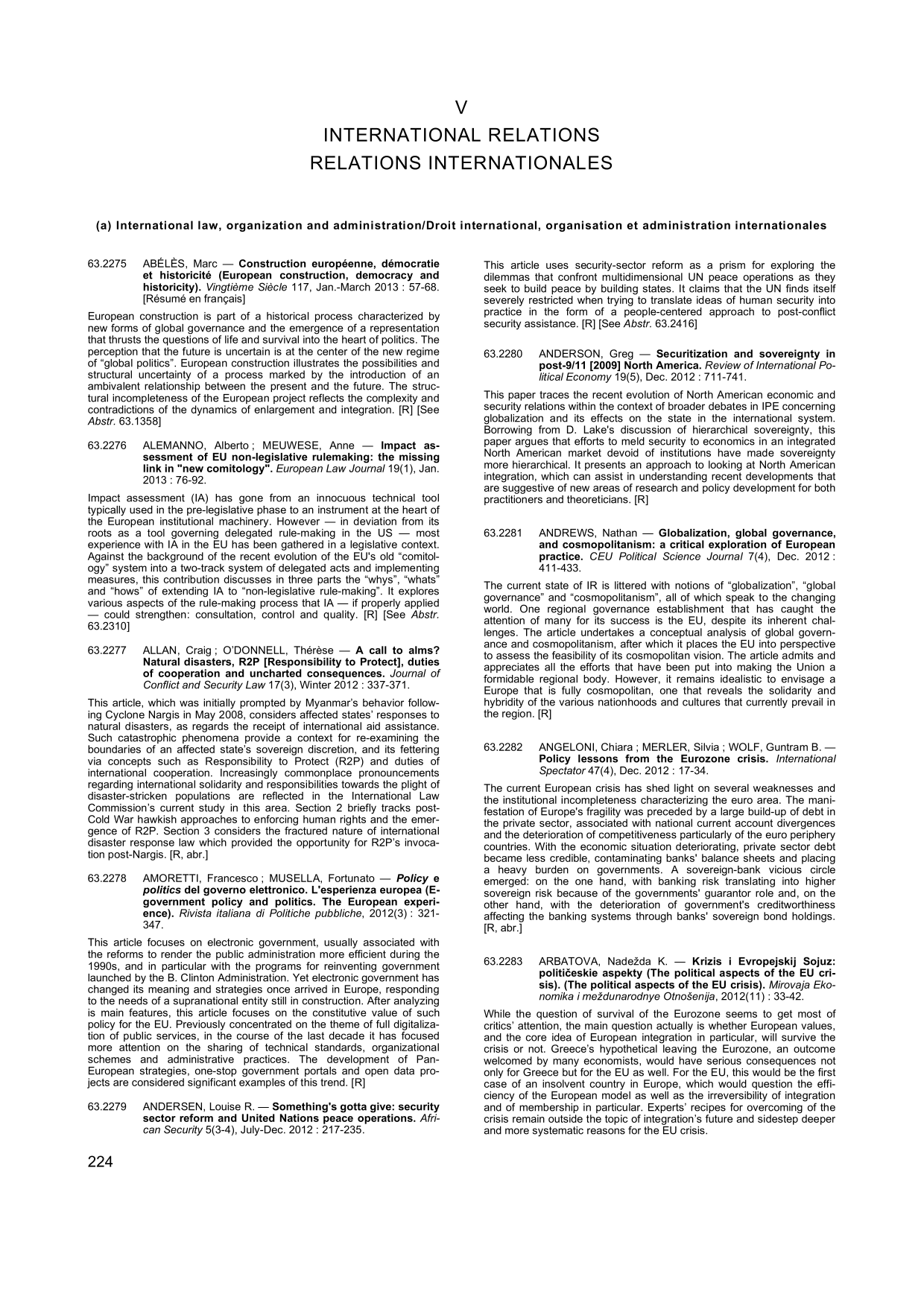
(a) International law, organization and administration/Droit international, organisation et administration internationales
63.2275 ABÉLÈS, Marc —
European construction is part of a historical process characterized by new forms of global governance and the emergence of a representation that thrusts the questions of life and survival into the heart of politics. The perception that the future is uncertain is at the center of the new regime of “global politics”. European construction illustrates the possibilities and structural uncertainty of a process marked by the introduction of an ambivalent relationship between the present and the future. The structural incompleteness of the European project reflects the complexity and contradictions of the dynamics of enlargement and integration. [R] [See Abstr. 63.1358]
63.2276 ALEMANNO, Alberto; MEUWESE, Anne —
Impact assessment (IA) has gone from an innocuous technical tool typically used in the pre-legislative phase to an instrument at the heart of the European institutional machinery. However — in deviation from its roots as a tool governing delegated rule-making in the US — most experience with IA in the EU has been gathered in a legislative context. Against the background of the recent evolution of the EU's old “comitology” system into a two-track system of delegated acts and implementing measures, this contribution discusses in three parts the “whys”, “whats” and “hows” of extending IA to “non-legislative rule-making”. It explores various aspects of the rule-making process that IA — if properly applied — could strengthen: consultation, control and quality. [R] [See Abstr. 63.2310]
63.2277 ALLAN, Craig; O'DONNELL, Thérèse —
This article, which was initially prompted by Myanmar's behavior following Cyclone Nargis in May 2008, considers affected states' responses to natural disasters, as regards the receipt of international aid assistance. Such catastrophic phenomena provide a context for re-examining the boundaries of an affected state's sovereign discretion, and its fettering via concepts such as Responsibility to Protect (R2P) and duties of international cooperation. Increasingly commonplace pronouncements regarding international solidarity and responsibilities towards the plight of disaster-stricken populations are reflected in the International Law Commission's current study in this area. Section 2 briefly tracks post-Cold War hawkish approaches to enforcing human rights and the emergence of R2P. Section 3 considers the fractured nature of international disaster response law which provided the opportunity for R2P's invocation post-Nargis. [R, abr.]
63.2278 AMORETTI, Francesco; MUSELLA, Fortunato —
This article focuses on electronic government, usually associated with the reforms to render the public administration more efficient during the 1990s, and in particular with the programs for reinventing government launched by the B. Clinton Administration. Yet electronic government has changed its meaning and strategies once arrived in Europe, responding to the needs of a supranational entity still in construction. After analyzing is main features, this article focuses on the constitutive value of such policy for the EU. Previously concentrated on the theme of full digitalization of public services, in the course of the last decade it has focused more attention on the sharing of technical standards, organizational schemes and administrative practices. The development of Pan-European strategies, one-stop government portals and open data projects are considered significant examples of this trend. [R]
63.2279 ANDERSEN, Louise R. —
This article uses security-sector reform as a prism for exploring the dilemmas that confront multidimensional UN peace operations as they seek to build peace by building states. It claims that the UN finds itself severely restricted when trying to translate ideas of human security into practice in the form of a people-centered approach to post-conflict security assistance. [R] [See Abstr. 63.2416]
63.2280 ANDERSON, Greg —
This paper traces the recent evolution of North American economic and security relations within the context of broader debates in IPE concerning globalization and its effects on the state in the international system. Borrowing from D. Lake's discussion of hierarchical sovereignty, this paper argues that efforts to meld security to economics in an integrated North American market devoid of institutions have made sovereignty more hierarchical. It presents an approach to looking at North American integration, which can assist in understanding recent developments that are suggestive of new areas of research and policy development for both practitioners and theoreticians. [R]
63.2281 ANDREWS, Nathan —
The current state of IR is littered with notions of “globalization”, “global governance” and “cosmopolitanism”, all of which speak to the changing world. One regional governance establishment that has caught the attention of many for its success is the EU, despite its inherent challenges. The article undertakes a conceptual analysis of global governance and cosmopolitanism, after which it places the EU into perspective to assess the feasibility of its cosmopolitan vision. The article admits and appreciates all the efforts that have been put into making the Union a formidable regional body. However, it remains idealistic to envisage a Europe that is fully cosmopolitan, one that reveals the solidarity and hybridity of the various nationhoods and cultures that currently prevail in the region. [R]
63.2282 ANGELONI, Chiara; MERLER, Silvia; WOLF, Guntram B. —
The current European crisis has shed light on several weaknesses and the institutional incompleteness characterizing the euro area. The manifestation of Europe's fragility was preceded by a large build-up of debt in the private sector, associated with national current account divergences and the deterioration of competitiveness particularly of the euro periphery countries. With the economic situation deteriorating, private sector debt became less credible, contaminating banks' balance sheets and placing a heavy burden on governments. A sovereign-bank vicious circle emerged: on the one hand, with banking risk translating into higher sovereign risk because of the governments' guarantor role and, on the other hand, with the deterioration of government's creditworthiness affecting the banking systems through banks' sovereign bond holdings. [R, abr.]
63.2283 ARBATOVA, Nadežda K. —
While the question of survival of the Eurozone seems to get most of critics' attention, the main question actually is whether European values, and the core idea of European integration in particular, will survive the crisis or not. Greece's hypothetical leaving the Eurozone, an outcome welcomed by many economists, would have serious consequences not only for Greece but for the EU as well. For the EU, this would be the first case of an insolvent country in Europe, which would question the efficiency of the European model as well as the irreversibility of integration and of membership in particular. Experts' recipes for overcoming of the crisis remain outside the topic of integration's future and sidestep deeper and more systematic reasons for the EU crisis.
63.2284 ATAÇ, C. Akça —
Despite its crucial role in sustaining better integration, multilingualism is not discussed as widely as the other topics of multiculturalism within the context of the EU enlargement. The accession process requires Turkey to take notice of the opportunities and shortcomings as well as the challenges of European multilingualism and to communicate the relevance of the Turkish language to the completeness of European multiculturalism. The article assesses the EU language policy in light of the future imperative of incorporating Turkish into Europe's linguistic family by referring to the EU's laws, norms, and values as well as NGOs' reports and opinion papers. [R]
63.2285 BAFOIL, François —
The enlargements in the 1990s and the 2000s of both ASEAN and EU have led to considerable changes of these regional organizations. In both cases, the new member states were considered to be “backward states” and “weak states”. However, far from being marginalized, new member states were paradoxically able to reinforce their sovereignty. In this context, this article argues that new member states were able to limit the hegemony exerted by old member states, by insisting on shared regional values and identities. Thereby, they transformed their initial “weakness” into “strength”. [R]
63.2286 BALZACQ, Thierry —
In contrast to many influential accounts which assume that formal norms and national predispositions frustrate the development of shared security principles and commitments, contributions to this issue of Études internationales suggest that an analysis of concrete practices underpinning CSDP evidences the emergence of a genuine strategic culture. The aim of this essay is to put in relief and, simultaneously, investigate the different arguments structuring this outcome. The author emphasizes the specifies of the various articles and argues that the evolution of CSDP depends upon, as much as it expresses three major features that enable them to hang together: (1) the way in which the EU designs policies that are constitutive of its CSDP; (2) the processes that the EU singles out; (3) the mechanisms through which its power is wielded. [R] [See Abstr. 63.2338]
63.2287 BAŠARAT'JAN, M. M. —
Although the UN and the Organization for Security and Co-operation in Europe (OSCE) have similar aims, their operation in Central Asia is quite different: the UN deals with problems of global security, while the OSCE pays more attention to the problem of human rights and to the development of western-type democracy. [R]
63.2288 BAUER, Sibylle; DUNNE, Aaron; MIĆIĆ, Ivana —
The international debate and associated activity regarding the proliferation of weapons of mass destruction have moved on from the traditional focus on controlling exports to encompass a wider range of activities reflecting the evolving nature of procurement and the need to adopt new legal concepts and enforcement tools. To implement UN Security Council resolutions and wider trade control corms, countries have started to enhance and expand domestic and international capacity-building efforts. Coercive measures designed to change the behaviors of states and non-states actors that pose threats to international security have also evolved. These include measures to counter proliferation finance and interdict the movements of proliferation-related items. [R]
63.2289 BELLAMY, Alex J. —
The norm of civilian immunity, which holds that civilians must not be intentionally targeted in war or subjected to mass killing, is widely supported and considered a jus cogens principle of international law. Yet not only does mass killing remain a recurrent feature of world politics, but perpetrators sometimes avoid criticism or punishment. This article argues that the paradox can be explained by understanding that civilian immunity confronts a protracted struggle with competing ideologies, some of which have proven resilient, and that decisions about how to interpret the norm in specific cases are subject to intervening contextual variables. [R]
63.2290 BELLAMY, Richard; CASTIGLIONE, Dario —
The EU's political system represents European citizens through the EP; indirectly through their governments in the Council; and through domestic elections, which hold these last democratically accountable to national parliaments or citizens. However, these channels involve different and incompatible types of representation and forms of democracy, reflecting divergent conceptions of political community. The first channel seeks to represent the common good of a European people; the second, the mutual self-interest of the single member states. We argue the first lacks social and political legitimacy, while the second proves insufficient to tackle collective European problems equitably or effectively. We propose reinforcing the third channel so as to modify these other two and produce a European “demoi-cracy” able to sustain the form of representative democracy we associate with a civicity. [R, abr.] [See Abstr. 63.2337]
63.2291 BERLING, Trine Villumsen —
This article takes the failure to grasp fully the paradigmatic case of European security after the Cold War as an example of how IR would benefit from reformulating not only its empirical research questions but also several of its central conceptual building blocks with the aid of Bourdieusian sociology. The separation between theory and practice and the overemphasis on military power and state actors blind IR from seeing the power struggles that reshaped European security. Instead, a Bourdieusian reformulation adds new types of agency, focuses on the social production of forms of power, and stresses the processual rather than the substantive character of social reality. [R]
63.2292 BIALASIEWICZ, Luiza, et al. —
This article engages with the most recent spatial fantasy for the making of “EU”ropean space: the idea of trans-European macro-regions, currently in vogue in the policy literature. In particular, we focus on the imaginings of a Mediterranean macro-region as the latest incarnation of the macro-regional fad, but also as a useful prism for reflecting on some of the underlying conceptual as well as political and geopolitical challenges of the on-going remaking and rescaling of “EU”ropean space. The policy literature generated by EU “macro-regional experts” appears to entirely ignore these debates, professing an understanding of regions that is a conceptual pastiche at best, and that entirely occludes the political and geopolitical implications of region-making within, at, and beyond “EU”rope's borders. [R, abr.] [See Abstr. 63.1623]
63.2293 BIELER, Andreas —
In 2006, the EU launched its new free trade strategy Global Europe with the explicit goal of increasing European competitiveness. This article explores the positions of trade unions and other social movements on Global Europe. While Northern social movements and trade unions from the Global South reject Global Europe due to its impact of deindustrialization on developing countries, European trade unions support it, insofar as it opens up new markets for the export of European manufactured goods. This has to be understood against the background of the dynamics underlying the global economy and uneven development. Due to the uneven integration of different parts of the world into the global economy, workers in developed countries may actually benefit from free trade, while workers in the Global South are more likely to lose out. [R, abr.]
63.2294 BISHOP, Matthew Louis; HERON, Tony; PAYNE, Anthony —
The Economic Partnership Agreement (EPA) signed in October 2008 between the Caribbean and the EU has been the subject of much controversy. There has been a marked split within the Caribbean between the officials and politicians who negotiated the EPA and the wider academic and civil society community that subjected it to heavy criticism. The paper examines these debates in detail and situates them within the broader intellectual and practical panorama of Caribbean development alternatives. Specifically, it discusses how the terrain upon which development has been both theorized and practiced in the region has narrowed significantly since the 1980s, with the EPA being the latest manifestation of this evolving trend. [R, abr.]
63.2295 BOLLEYER, Nicole; TRUMM, Siim; BANDUCCI, Susan A. —
Which parties represented in the EP are able to extract regular donations from their MEPs' salaries and, if they extract donations, how great are they? In the literature on party finances, there has been a lack of attention paid to the use of salaries of elected representatives as a source of funding. This is surprising given that the national headquarters of many parties in Europe regularly collect “party taxes”: a fixed (and often significant) share of their elected representatives' salaries. In filling this gap, this article theoretically specifies two sets of party characteristics that account for the presence of a taxing rule and the level of the tax, respectively. The framework is tested through a selection model applied to a unique dataset covering the taxing practices in parties across the EU Member States. [R, abr.]
63.2296 BONO, Giovanna —
This article evaluates the disputed relationship between the doctrines of the responsibility to protect and humanitarian military intervention and their impact through a case study of the EU and UN military and policing operations in Chad, EUFOR Chad, and the UN Mission in Central African Republic and Chad, MINURCAT. It shows that the power of the discourse of politics of protection needs to be studied carefully. It suggests that the EUFOR mission had a negative impact on the protection dynamics of the conflict. EUFOR contributed to a worsening of the human rights and security situation, strengthened the authoritarian rule of President Déby, and promoted political irresponsibility by providing indirect backing for the Justice Equality Movement. [R] [See Abstr. 63.2416]
63.2297 BOTELHO, Teresa —
The Obama administration has been significantly engaged in changing its relationship with the UN, recovering much of the diplomatic prestige lost by the previous administration. Nevertheless, in the current debate about the enlargement of the Security Council and UN reform, its requirements do not differ substantially from those adopted by the Bush administration in 2005. The article analyzes the history of Security Council reform until the present round of negotiations, and discusses the evolution of the official position of US diplomacy, its criteria for an enlargement that will not put into question the efficiency of the UN, and the domestic constraints that shape the current stance. [R] [First article of a thematic issue on “Obama's foreign policy and the [US] presidential elections”. See also Abstr. 63.2429, 2456, 2461, 2508, 2518]
63.2298 BRILL, Alex —
Multilateral institutions have become increasingly important, despite detractors' legitimate concerns over their effectiveness. But corruption, lack of legitimacy, poor management, and ill-defined missions in many current multilateral institutions diminish their ability to facilitate cooperation and communication among countries interested in the pursuit of shared objectives. This paper examines the Group of 20 (G20), calling attention to its strengths as a relatively new, unburdened, and nimble organization but also noting widespread concerns about the legitimacy of its membership. To bolster the group's legitimacy, the paper outlines a set of mission-based, quantitative criteria on which G20 membership could be based. After assessing the impact on the G20 of applying these criteria, the paper recommends purpose-driven criteria as a framework for new multilateral organizations, to both promote effectiveness and bolster confidence in their legitimacy. [R, abr.] [See Abstr. 63.2564]
63.2299 BROMMESSON, Douglas; FERNROS, Henrik Friberg —
This article addresses the question of whether an expanded regime on the use of force, based on the report The Responsibility to Protect (R2P) of the International Commission on Intervention and State Sovereignty (ICISS) of 2001, would be feasible. Our analysis of feasibility is based on three logics of human action: the logic of consequence, logic of appropriateness and logic of arguing. We argue that each of these logics contains aspects that must be observed before a regime can be considered feasible. These logics are coupled with three mechanisms of socialization of norms: strategic calculation, role-playing and normative suasion. We construct a minimal standard for a feasible regime by deducing requirements from the logics and their mechanisms, and then apply that standard to the content of the ICISS report. [R, abr.]
63.2300 BROSIG, Malte —
This article critically reviews the European compliance literature. As this literature is dominated by a rational and positivist understanding of normadherence primarily emphasizing domestic implementation costs, administrative capacities or external incentives during EU enlargement, this paper reinvigorates a constructivist epistemology of norm-compliance in contrast to the analytical limitations of the rational approach. [R] [First article of a thematic issue on “The implementation trap? Trajectories of minority rights issues in Europe”, edited and introduced, pp. 385–389, by Timofey AGARIN and the author. See also Abstr. 63.1743, 1830, 1854, 1874, 1922, 2381]
63.2301 BÜRGIN, Alexander —
Despite diverging preferences concerning the role of the EP in the institutional architecture of the EU, the EU member states have accepted a significant increase of its power in the Lisbon Treaty. This paper argues that bargaining power alone cannot explain this result. Instead, it postulates the importance of normative pressure: arguments based on shared norms of democratic governance at the national level add legitimacy to the preferences of the supporters of a parliamentarization of the EU and mobilize social pressure on opponents of the empowerment of the EP. The impact of norms as negotiation resource is demonstrated in an analysis of three controversies in the European Convention: the appointment and budget competences of the EP and the role of national parliaments. [R]
63.2302 BUSUIOC, Madalina —
The new European Financial Supervisory Authorities have received much attention in the literature, particularly due to their exceptional emergency decision-making powers. By contrast, this article explicitly focuses on these agencies' less explored yet equally crucial role: their (quasi-)rule-making responsibilities. While less striking at first sight than their emergency counterparts, these rule-making powers are considerable, carry significant consequences, and raise some interesting dilemmas and concerns. This article complements the previous contribution by going at a lower level of specification and zooming in on a crucial case for studying rule-making by agencies as the Authorities constitute a culmination of agency rule-making powers, as well as agency powers, more broadly. The article analyzes the Authorities' main (quasi-)rule-making powers and the relevant procedures. [R, abr.] [See Abstr. 63.2310]
63.2303 CASAS-CORTES, Maribel; COBARRUBIAS, Sebastian; PICKLES, John —
This paper highlights the ways in which the emerging models of migration-management are producing new geographies of the EU's borders that complicate notions of a tightly bounded and easily delineated “Schengen space” or “Fortress Europe”. Under policy frameworks such as the European Neighborhood Policy and the EU's Global Approach to Migration, a process of economic and political regional integration is under way that is beginning to transform the ways in which non-accession neighbors and neighbors of neighbors in North Africa and beyond are articulated with the EU. Central to these changes are programs, institutions and practices of both regional economic development and border routes management. This changing approach to regional integration and the nature of European borderlands has at its heart a series of new spatial imaginaries, institutional actors and cartographic experiments. [R, abr.] [See Abstr. 63.1623]
63.2304 CHITI, Edoardo —
This article identifies European agencies' rule-making powers, mapping the procedures through which such powers are exercised and assessing the existing procedural arrangements. The first section analyzes the main forms of European agencies' rule-making. It shows, on the one hand, that not all European agencies are actually engaged in the adoption of administrative rules, on the other hand, that European agencies carrying out rule-making activities tend to converge on two specific forms of rule-making, namely participation in the adoption of binding implementing rules and regulation by soft law. The second section, devoted to mapping the procedures through which rule-making powers are exercised, argues that the two main types of European agencies' rule-making cannot be said to be subject to a really common procedural framework. [R, abr.] [See Abstr. 63.2310]
63.2305 CHRISTIANSEN, Thomas; DOBBELS, Mathias —
The reform of comitology and the introduction of the new instrument of delegated acts in the Lisbon Treaty were followed by protracted negotiations on the implementation of both articles. This article examines the resultant system that has emerged for both types of non-legislative instruments. In the area of implementing acts, a new regulation sets out important changes: a reduction in the number of procedures, the extension of the scope to trade defense measures and the replacement of a referral to the Council with a new appeal committee. With respect to delegated acts, the search for an overarching framework resulted in a Common Understanding. Our analysis emphasizes the importance of informal procedures and non-binding agreements in fully assessing the nature of non-legislative rule-making in this area. [R, abr.] [See Abstr. 63.2310]
63.2306 CLARK, Ian; REUS-SMIT, Christian —
Liberal internationalism represents a package of evolving and contending commitments, and this article traces the development within it of one practice with a longer history: the allocation of special responsibilities. Responsibilities, internationally, have negotiated between sovereign equality and material inequality, in search of a means of more effectively dealing with global problems. The definition of these responsibilities generates an intense politics and these are reviewed through the remit of the Security Council. The article considers the basis for the allocation of traditional special responsibilities for security to the Council and then tracks their extension in recent years to the issue of humanitarian protection. The vehicle for this has been the transformation of a practice about the use of the veto, towards one that calls for its non-use in humanitarian cases. [R, abr.] [See Abstr. 63.1440]
63.2307 COOLEY, Laurence —
This article challenges a core assumption: that the EU's approach aims at the transformation of conflicts over and above their management. It analyzes the EU's engagement with the process of constitutional reform in Bosnia and Herzegovina. I argue that the EU's approach is based on the acceptance and attempted accommodation of distinct and antagonistic ethnic identities rather than any attempt at their transformation. EU officials view Bosnia through an “ethnic conflict” paradigm that sees resistance to constitutional reform by nationalist elites as an inevitable symptom of deeper divisions in Bosnian society. Based on this reading, I conclude that EU conflict-resolution policy is much more conservative than those stressing the Union's transformative power in conflict situations envisage. [R, abr.]
63.2308 COOMANS, Fons —
The UN and its specialized agencies play a key role in international economic and social cooperation — e.g., the promotion of higher standards of living, solutions to health related problems and universal respect for and observance of human rights. Over the years many UN agencies, such as UNDP, UNICEF, UNAIDS and the FAO, have adopted a human right-based approach which is supposed to underlie the carrying out of their mandate. Part of that approach is to clearly spell out the specific human rights that are at stake and frame policies and programs by using human rights language. The question addressed is to what extent UN (specialized) agencies have adopted and are using language on economic, social and cultural rights as a framework or basis for their policies and programs. [R, abr.]
63.2309 COOPER, Andrew F. —
Cooperation is not the same as consensus. Maintaining cooperation over the long run faces enormous obstacles due to policy differences and a lack of like-mindedness that separates the members of the traditional establishment of wealthy countries and the ascendant countries in the BRICS (Brazil, Russia, India, China, and South Africa). As a result of the financial crisis, the international system can move forward in one of two ways: one in which the G20 shifts from being a focused crisis committee toward the role of a more ambitious steering committee, or one in which the BRICS offer a parallel and competitive agenda in terms of the global political economy. Both of these options present considerable challenges to cooperative and leadership practices in the international system. [First of a series of articles on “Continued consensus? The financial crisis and a new world order”. See also Abstr. 63.1494, 1781, 1850, 1885, 1921]
63.2310 CURTIN, Deirdre; HOFMANN, Herwig; MENDES, Joana —
The existence or non-existence of procedural rules for executive rule-making in the EU is not merely a “technical” question free of constitutional value choices. This article argues that constitutional principles, such as transparency, openness and participatory democracy, highlighted by the Treaty of Lisbon [2007] constitute decisive normative standards for the design of administrative procedures in the EU, with a considerable impact on substantive outcomes. We apply such principles to executive rule-making procedures in the EU, highlight the salience of this discussion and argue that systematization of executive rule-making procedures is needed in order to implement constitutional principles in a complex and plural environment. [R] [First article of a thematic issue on rule-making. See also Abstr. 63.1640, 2276, 2302, 2304, 2305, 2354, 2382]
63.2311 DAKHLALLAH, Farah —
This article examines the historical role of the League of Arab States in regional security through the prism of order and sovereignty in the Arab states system. It argues that the League is a product of the dilemma between state sovereignty and Arab nationalism that beset the Arab regional order for decades. Strained by role conflict, Arab rulers opted for a weak inter-regional organization that they subsequently undermined, exploited or promoted for statist purposes. However over time, the consolidation of state sovereignty and the decline of pan-Arabism have led to the emergence of a more stable regional order. This creates more opportunities for the development of a collective security framework, in which the Arab League could play an important role. [R]
63.2312 DANY, Charlotte —
Since the 1990s, the increased participation of non-state actors in international organizations and global governance processes has usually been analyzed with a focus on the enabling conditions for the influence of NGOs. This article argues against this dominant view that the increasingly institutionalized opportunities for NGO-participation have ambivalent effects. How the influence of NGOs is limited by the participative governance-framework is empirically demonstrated in the case of the UN World Summit on the Information Society (WSIS, Geneva, 2003 and Tunis, 2005). Specially, I reveal three limits and reconstruct how these were ignited by structural institutional and self-organizational processes under conditions of extensive participation: NGO opportunities for influence decrease in the course of the negotiation process, are confined to rather irrelevant NGO-demands and, furthermore, available for only selective NGO actors. [R]
63.2313 DAVIDSHOFER, Stephan —
This paper aims to analyzing the mergence of European militaries capabilities — understood as a tool incorporated in a wider security continuum — as the expansion of European bureaucratic struggles towards new arenas. Drawing on sociological work in EU studies and in International relations, it presents an account of the EU-UN cooperation as a central locus enabling the construction of CSDP. The argument is articulated through a dual-dynamic of internationalization and autonomization and on the role played by the former High Representative for CFSP, Javier Solana, and his staff. [R] [See Abstr. 63.2338]
63.2314 DUPONT, Pierre-Emmanuel —
The article revisits the relationship between countermeasures and the collective security system embodied in the UN Charter, through the case study of the economic measures targeting Iran agreed by the EU Member States in early 2012. This case concerns measures enacted motu proprio in the framework of a regional organization against a country which has already been targeted by sanctions adopted by the UN Security Council. The unprecedented extent of these new EU measures raises various issues regarding their lawfulness under international law. [After] reviewing the background of the Iranian nuclear controversy, I first characterize these measures, in order to determine the applicable legal framework. Then, their lawfulness is assessed with respect to the relevant rules governing their use. [R, abr.]
63.2315 EDWARDS, Jason A. —
This essay examines UN Secretary-General Ban Ki-Moon's rhetoric concerning the Responsibility to Protect doctrine (R2P). It rhetorically maps the arguments concerning the nature of R2P and its specific components. Specifically, I argue that Ban Ki-Moon's rhetoric serves to redefine and update sovereignty and the responsibilities of statehood for a 21st-c. world. The rhetoric of R2P has important implications for the debates surrounding military intervention on “humanitarian” grounds. [R]
63.2316 FIOTT, Daniel —
The newly agreed operational rules for Frontex allow the Agency to buy or lease its own equipment for missions and/or to do so in co-ownership with the Member States and to request national seconded staff for its operations. [Although] a major step forward in further developing Frontex's resources, this progress has not been matched when it comes to the CSDP. This article asks why, given that each policy area is ultimately aimed at the defense and security of the EU, are the innovations agreed for Frontex not equally applicable to CSDP? Why have Member States increased cooperation under Frontex without equivalent or similar progress under the CSDP? This article [examines] the differences and similarities of the two policy domains in order to see if a “Frontex formula” could be applicable to the CSDP. [R, abr.]
63.2317 FRANZIUS, Claudio; PREUSS, Ulrich —
The joy was great when the EU received the Nobel Peace Prize. However, the current treatment of the idea of European unification hardly warrants any laurels. The European crisis is also a crisis of democratic legitimacy. The solution can come only from a new normative concept of unification, to lay the foundations for a democratic EU.
63.2318 FURNESS, Mark —
This article uses a principal-agent framework of analysis to discuss the European External Action Service's (EEAS) institutional design and policy mandates. Can the EEAS act autonomously with regard to the Commission and Member States? Are there policy areas in which the EEAS has greater decision-making autonomy than others? These discussions are central to understanding the post-Lisbon Treaty EU's external policy-making system and its potential strengths as an international actor. [R]
63.2319 GAUTTIER, Pascal —
The external action of the EU requires to adopt a holistic approach to be properly understood: the notion of human security makes such an approach possible. This notion can be defined as an ideal situation characterized by the effectiveness of human rights. Yet, it is striking to observe that EU institutions have endorsed the notion of human security in the key texts of the European external action, in particular in the revised European Security Strategy (2008). Besides, EU external policies have a common goal consisting in protecting and operationalizing human rights. Thus, we can assert that the EU acts implicitly on the international stage as if it complies itself to an human security-driven approach. [R] [See Abstr. 63.2338]
63.2320 GEDDES, Andrew; TAYLOR, Andrew —
How and with what effects have three South-East European countries (Greece, Slovenia and Croatia) responded to the EU's migration and border security acquis? The paper shows that European integration can strengthen central state actors, but can also change the constellation of actors and resources in trans-boundary policy sectors such as international migration and border security. To demonstrate these effects, the paper specifies functional, political and administrative dimensions of the EU's migration and border security “capacity bargain”. It also specifies the limits of an EU approach to migration and border security — and associated capacity-building — that has a strong regulatory focus on the EU's external frontiers with less attention paid to more complex regulatory and distributive dynamics that arise once migrants are “in”. [R]
63.2321 GÓMEZ URQUIJO, Laura —
This article focuses on the contributions of the TSCG, explaining it a part of a whole range of economic policy decisions that have directed the European guidelines and solutions proposed for the crisis. This is possible in a given economic framework: the EMU, a peculiar and incomplete frame as it lacks a common fiscal policy. All this leads to a change in the model of solidarity and social cohesion of the EU, which is accompanied by other developments in this area proposed by the Commission to counteract the effects of the crisis. [R]
63.2322 GONG Ting; SCOTT, Ian, eds. —
Articles by GONG Ting and REN Jianming, “Hard rules and soft constraints: regulating conflict of interest in China”, pp. 1–17; Andrew WEDEMAN, “The challenge of commercial bribery and organized crime in China”, pp. 18–34; KO Kilkon and ZHI Hui, “Fiscal decentralization: guilty of aggravating corruption in China?”, pp. 35–55; YU Chilik, CHEN Chun-Ming and LIN Min-Wei, “Corruption perception in Taiwan: reflections upon a bottom-up citizen perspective”, pp. 56–76; Ian SCOTT, “Institutional design and corruption prevention in Hong Kong”, pp. 77–92; YU Eilo Wing-Yat, “Anti-corruption approaches in Macao: lawmaking and legal enforcement”, pp. 93–108.
63.2323 GOODLIFFE, Gabriel; SBERRO, Stéphan —
The failure of the Los Cabos summit to satisfactorily address the European sovereign debt crisis and ominous world economic outlook, let alone agree on concrete measures to improve the oversight and functioning of the global economy, appears to confirm the diminishing effectiveness and relevance of the G20 as an organ of international governance. While few accomplishments were achieved in the area of global governance during the Mexican presidency, acute collective action problems, made worse by the present economic crisis, paralyzed the G20 in the lead-up to and during the Los Cabos summit. These problems and the ensuing failure of global governance are attributable to the absence of leadership evident at both the global and European levels, which testifies to the excessive dispersion of state economic and political power within the international system. [R]
63.2324 GOUCHA SOARES, António —
This article is about the euro crisis. It presents a small contribution concerning the political interests that guided member states on the issue of monetary cooperation, from the “snake” to the European monetary system, and later on the creation of the monetary union. It then concentrates on the crisis of the euro to identify the interests that prevailed on what was done by the euro area countries to overcome the current crisis, and also on what remains to be done. It ends with a reflection on the political effects of the euro crisis on the EU balance of power. [R] [See Abstr. 63.2397]
63.2325 GUIRAUDON, Virginie, ed. —
Editor's introduction, pp. 7–32. Articles by Adrian FAVELL; Mathilde DARLEY; Nora EL QADIM; Pierre MONFORTE.
63.2326 HALL, Peter A. —
This article addresses puzzles raised by the euro crisis: why was EMU established with limited institutional capacities, where do the roots of the crisis lie, how can the response to the crisis be explained, and what are its implications for European integration? It explores how prevailing economic doctrines conditioned the institutional shape of the single currency and locates the roots of the crisis in an institutional asymmetry grounded in national varieties of capitalism, which saw political economies organized to operate export-led growth models joined to others accustomed to demand-led growth. The response to the crisis is explained in terms of limitations in European institutions, divergent economic doctrines and the boundaries of European solidarity. Proposed solutions based on deflation or reflation are assessed from a varieties-of-capitalism perspective and the implications for European integration reviewed. [R, abr.]
63.2327 HANK, Rainer —
A Europe that would enforce the “no bailout” principle (Maastricht Treaty) would in fact restore the liberal order of free markets and competition. A ban on “solidarity” provides protection against other states and finally safeguards national sovereignty. No troika should hold the power to challenge the fiscal monopoly of a state, nor push an association of governments to grant solidarity. Those who think that such a measure is coldhearted should remember the virtue of personal responsibility.
63.2328 HART, John; CLEVESTIG, Peter —
In 2010, states continued to develop strategies to prevent and remediate the effects of the possible misuse of toxic chemical and biological materials for hostile purposes. The parties to the Biological and Toxic Weapons Convention prepared for the seventh conference. The head of the Organization for the Prohibition of Chemical weapons established an advisory panel on how its activities should be structured after the destruction of chemical weapon stockpiles ends. Determining what constitutes non-compliance with a legal obligation is a recurring theme that states must address. Scientific and technological developments, especially the increasing overlap between chemistry and life sciences, are a related challenge. [R]
63.2329 HAWKES, Shona; PLAHE, Jagjit Kaur —
This article explores the implications of the WTO's Agreement on Agriculture for the right to food in the global South. In a context in which a worldwide backlash has developed against the WTO, the politics of the Doha Round negotiations are analyzed from a food rights perspective. It is argued that since 2004 attention in the WTO has shifted from overarching human rights concerns toward a focus on technical detail constraining developing countries from acting to respect, protect, and fulfill the right to food. [R]
63.2330 HE Baogang —
With the rise of China the strategic competition between the US and China has gained momentum over the last 10 years and is likely to continue in the near future. To deal with this challenge, H. White has proposed a concert of powers in Asia. White's proposal, however, has not received sufficient attention in Asia and is likely to be a failure if Asia does not take it seriously. This article examines the problematic assumptions of White's proposal and argues that his proposal needs to incorporate the important role of ASEAN, an existing de facto Asian concert of powers. It shifts the idea of a concert of powers towards a new hybrid regionalism, identifies its key components and discusses how this hybrid regionalism can dilute the strategic conflict between China and the US. [R] [See Abstr. 63.2446]
63.2331 HILLEBRECHT, Courtney —
In their rulings, international human rights tribunals frequently ask states to engage in costly compliance measures ranging from paying reparations to victims to changing domestic human rights laws and practices. The tribunals, however, have little enforcement or oversight capacity. The responsibility for compliance falls to domestic actors: executives, legislators, and judiciaries. Through nuanced case studies of the compliance process in Argentina, Brazil, and Colombia, this article suggests that compliance with the Inter-American human rights tribunals' rulings depends on executives' political will for compliance and their ability to build pro-compliance coalitions with judges and legislators. [R]
63.2332 IWILADE, Akin; AGBO, Johnson Uchechukwu —
This article [examines] the role of the Economic Community of West African States (ECOWAS) in the regulation of regional security in West Africa. It takes a critical look at the internal dynamics of West Africa and how they shape the organization, as well as at ECOWAS's responses to a highly volatile and unpredictable region. It also examines the responses of ECOWAS to some of the security challenges it has faced and attempts to determine to what extent the organization has been able to act as a regional regulator of security. The article uses two critical case studies; (1) Liberia, which represents the nature of responses in the immediate post-Cold War era; and (2) Côte d'Ivoire, wich represents the evolution of ECOWAS's security thinking and architecture in the contemporary period. [R, abr.]
63.2333 JOUANNET, Emmanuelle —
Following the Cold War, the global society has had to face cultural and identity claims which created new tensions within legal equality and cultural differences. Disadvantaged states, but also minorities of all kinds (natives, ethnic groups and women), feeling stigmatized, tend today to have their own dignity, their identity and their specific rights acknowledged. Some are even looking for compensation arising from infringements of their identity and forfeiture of their properties. To provide an answer to those claims, subjects of the international society have built up a new area of law, the “international law of recognition”. [R, abr.]
63.2334 KATCHERIAN, Jeff Edmund —
I examine subsidiarity within the EU as a practice, investigating bureaucratic conceptions and bureaucrats' embodied experiences with subsidiarity as it influences perceptions of culture, policy, and integration. What is borne out of attempts to manage subsidiarity, often discussed by EU bureaucrats as well as members of civil society, are three discursive modes — the cultural, the moral, and the temporal — that both promote and confuse how “Europe” is conceptualized via policy production. These discursive modes shed light upon how subsidiarity, in fact, limits diversity via the notion of competence within the EU. I argue that subsidiarity, understood in terms of competence, has become a pragmatic endeavor employed more to organize, manage, and govern culture than to create cultural inclusion, further promoting a more exclusive conceptualization of community and diversity. [R, abr.]
63.2335 KELLE, Alexander —
States parties to the Chemical Weapons Convention (CWC) will convene for the Third Review Conference of the treaty in April 2013. With the destruction of chemical weapon stockpiles more than 75 per cent complete and ongoing changes in the scientific, industrial and security environment in which the CWC operates, some have argued that major adaptations in the implementation of the treaty are required. However, on the basis of regular participant observation at CWC meetings of states parties and extensive document analysis, this article argues that changes in treaty implementation will be only of an incremental nature with the Organization for the Prohibition of Chemical Weapons (OPCW) taking on new tasks in the areas of chemical terrorism and safety and security, alongside traditional core areas of activity in CWC implementation. [R, abr.]
63.2336 KHANOM, Sufia —
This paper analyzes the issues and outcomes of the seventeenth SAARC Summit which took place in the Maldives [in] November 2011, with a special reference to Bangladesh in the context of regional cooperation. Though the Summit came up with some promising mutual agreements, its success will depend on their proper and timely implementation. The lack of political will, problem of poor governance, weak economy and disparity, crisis of political leadership, ethnic, socio-cultural and religious divisions, challenges of non-state actors, transnational security challenges are considered to be the major hindrances to the success of regional integration. [R, abr.]
63.2337 KRÖGER, Sandra; FRIEDRICH, Dawid —
While the Lisbon Treaty embraces representative democracy and political equality, a clear division or hierarchy of competences is absent. The Treaty distinguishes between an electoral, a territorial, a functional and a direct channel of representation, without clarifying the relationship between them. Moreover, the current system of representation has two different normative subjects: the individual and the state. We argue that these two kinds of subjectivity relate to political equality in different ways, and that they are mixed within the same channels of representation. The mix of these two forms of subjectivity in the different channels of representation contributes to the blurring of political equality for each of the subjectivities. We disagree with the interpretation of the EU's compound system of representation as being democratic, therefore. [R, abr.] [First article of a thematic issue on “The representative turn in EU studies”, introduced, pp. 155–170, by the authors. See also Abstr. 63.1431, 1839, 2290, 2347, 2356, 2369]
63.2338 LACHMANN, Niels —
The EU's external action is supposed to be inspired by effective multilateralism, a commitment to cooperate with other multilateral actors and to strengthen them. A study of the EU's Common Security and Defense Policy's articulation with those organizations that are identified as its partners for international crisis management shows however the institutional dynamics to be much more ambiguous. This ambiguity appears in both the EU's strategic culture concerning the use of force in its external action, and the communities of practice formed by personnel from the organizations or their members. [R] [First article of a thematic issues on “European security through the prism of practices”, edited and introduced, pp. 501–527, by Antoine RAYROUX and Amélie FORGET. See also Abstr. 63.2286, 2313, 2319, 2342, 2357]
63.2339 LACHOWSKI, Zdzislaw —
In 2010, improved relations between Russia and the US, the signing of the New START treaty and efforts to surmount obstacles on the European security agenda “reset” conventional arms control and confidence- and security-building measures (CSBMs). Proposals made in 2010 on the two tracks of European arms control dialogue, the Treaty on Conventional Armed Forces in Europe regime and the Vienna Document on CSBMs, will inform future work. Arms control in Europe depends on the strategic interests of its main actors. Elsewhere, the relevance of the Treaty on Open Skies was reaffirmed at its second review conference. [R]
63.2340 LANDESMANN, Michael A. —
Although the crisis started in the US, its impact seems to be the most durable in Europe. The key feature is the increase of structural deficits and the debt burden. Although Poland, Slovakia and the Czech Republic were not concerned, the PIGS and most of southern Europe and the Baltic States suffer from unsustainable imbalances. The vicious circle of rising debt and dire prospects for growth entail more unemployment and less consumption.
63.2341 LANGE, Anne —
The planning of any peacekeeping operation should ideally be based on complete, accurate and timely information on the realities in the prospective mission area. Yet, the information needs of decision-makers in the UN headquarters are not sufficiently supplied by the few, small information-gathering and analysis units scattered in the Secretariat because of their limited intelligence mandate and lack of resources. This can be explain ed as a conscious decision of member states with the most powerful states defending their leading role in the global intelligence game and developing countries fearing to provide the UN with a mandate to investigate into their internal affairs. As a consequence, DPKO-led mission planning is largely shaped around national, strategic interests and less so on solid information. [R]
63.2342 LAVALLÉE, Chantal —
The adoption of the defense package, including defense inside the EU internal market, raises the question of the role of the European Commission in this sensitive field. This article combines a holistic security approach with the notion of field and sheds light not only on the Commission's position, but also on its relations with other actors in the establishment of the European Defense Market. Analyzing the practices and their effects, it is argued that this market is not the result of the convergence between national policies but a space of struggles and strategies among actors, state and non-state, to be well-positioned in European field of security and defense. [R] [See Abstr. 63.2338]
63.2343 LIBMAN, Alexander; VINOKUROV, Evgeny —
This paper focuses on post-Soviet regional integration as a special case where integration projects are established by countries that originally comprised a single political entity after its collapse. In this framework, the existing economic ties between countries are likely to affect adversely the interest of functional bureaucracy to support regional integration given that cutting existing connections is often more promising from the point of view of the budget expansion. Hence, the interaction of national and supranational bureaucracies is unlikely to generate impetus for increasing regional cooperation, which, surprisingly, can, however, be supported by adverse economic shocks. [R, abr.]
63.2344 LIE, Jon Harald Sande —
Drawing on fieldwork from different operational levels of UNMIS [UN Missions in Sudan], this article moves beyond the formal renderings of the protection of civilians. It explores protection as a discursive battlefield of knowledge in which different actors vie over its meaning and moral affiliation. There exists no unambiguous definition of what protection means and entails in practice. Rather, the protection discourse is interpreted contextually drawing on involved actors' mandate and institutional culture. This protection battlefield transcends its humanitarian legacy and reflects a discourse relinquishing its erstwhile regulatory hold over conceptual and practical borders, once separating the various segments of the international community. [R] [See Abstr. 63.2416]
63.2345 LIM, Daniel Yew Mao; VREELAND, James Raymond —
The authors investigate whether Japan leverages its privileged position at the Asian Development Bank (ADB) to facilitate project loans for the elected Asian members of the UN Security Council (UNSC), a platform from which it seeks to shape global affairs. Analyzing panel data of ADB loan disbursements to twenty-four developing member-countries from 1968 to 2009, the authors find that temporary UNSC membership increases ADB loans, particularly during the pos-1985 period, when Japan asserted greater influence in multilateral organizations. Because of Japan's checkered history of imperialism, the ADB provides a convenient mechanism by which the government can obfuscate favors for politically important countries. Acting through this regional organization enables Japan to reconcile a low-key approach to foreign affairs with the contradictory goal of global activism — leading without appearing unilateralist. [R, abr.]
63.2346 LONGO, Francesca —
This article investigates the role of the external dimension of Justice and Home Affairs (JHA) policy in the process of defining a new security concept in the EU. This new security concept is based on the indivisibility of the domestic and external aspect of security and it is designing the notion of “holistic security”. [R]
63.2347 LORD, Christopher —
Much is known about the voting behavior of representatives in the EP. However, less has been done to investigate the role of the EP in “speaking up” for different points of view. This contribution uses a philosophical analysis of the role of justification in representation to propose standards that can be used to evaluate the quality of justification in legislative bodies. It then applies those standards to a study of debates in the 2004–2009 European Parliament. [R] [See Abstr. 63.2337]
63.2348 LOVEC, Marko; ERJAVEC, Emil —
In 2008, the EU ministers of agriculture made a political agreement on the Common Agricultural Policy reform, also known as the Health Check. The reform coincided with the ongoing Doha round of the WTO negotiations; political pressures to limit the costs of the policy financed from the common budget; and various “new” policy issues. Rational institutional and constructivist approaches, often viewed as theoretical alternatives with each explaining some aspects of the reform, have employed simplified and narrow abstractions in conceptualizing the role of these policy contexts. We propose a critical realist approach, arguing that the relationship among the trade negotiations, budget bargaining, new issues and the policy reform can be explained by theoretically endorsing the asymmetrical development of the agricultural production factors and of production relations. [R, abr.]
63.2349 MADER, Oliver —
According to Article 227 of the Treaty on the Functioning of the European Union and Art. 44 of the Charter of Fundamental Rights, citizens of the Union have the right to address petitions to the European Parliament. From the perspective of the Parliament, this fundamental right corresponds to its duty to receive petitions, and then, provided that they are admissible, to examine their contents, and provide petitioners with substantive opinions. Admittedly, the latter are not entitled to remedies in relation to the matters raised. Nevertheless, certain elements of the fundamental right of petition can be enforced before the EU judge. Unjustified refusal to deal with the substance of an admissible petition is a case in point, because such refusal prejudices effective exercise of the right of petition. Rejection of a petition on grounds of inadmissibility can be checked. [R, abr.]
63.2350 MARTÍN Y PÉREZ DE NANCLARES, José —
On 2 March 2012, twenty-five of the twenty-seven EU member states (all except the UK and the Czech Republic) signed [in Madrid] the Treaty on Stability, Coordination and Governance in the Economic and Monetary Union (TSCG). Its aim is to endow the EU with the economic “leg” that it was not politically possible to include in the Maastricht Treaty and the negative consequences of which have emerged dramatically during the current economic and financial crisis. The main novelty of the TSCG is the peculiar legal path through which it was drawn up, by disregarding the mechanisms for reforming the constitutional treaties of the EU expressly provided for ad hoc in art. 48 of the Treaty of the EU. [R, abr.]
63.2351 MEHLER, Andreas —
In its resolution 1975 (2011), the UN Security Council opened the way for the provision of decisive support to the forces close to A. Ouattara to win the Ivorian power struggle. The deployed peacekeepers had a mandate “to protect civilians under imminent threat of physical violence”. A second reason frequently given was the necessary enforcement of the popular will expressed during the presidential elections in 2010. Ever since a low-intensity civil war broke out in September 2002, the different military engagements by various international players were justified by (1) protection concerns and/or (2) the preservation of democratic achievements. In the end, the justification of intervention by the “protection of civilians” argument received a larger consensus than the democratic norm. This article compares changing justifications for intervention with real achievements. [R] [See Abstr. 63.2416]
63.2352 MEKONNEN, Daniel R.; VAN REISEN, Mirjan —
This paper examines the scope of legality of EU-Eritrea development cooperation under the relevant treaty obligations of the EU, particularly under the legal framework of the Treaty of Lisbon. Concluding that EU aid to Eritrea is indeed contributing to the sustainment of dictatorship in the country, we argue in favor of a revised policy for EU-Eritrea development cooperation. We also call for the EU to strengthen positive aid measures, such as helping refugees and supporting democratic organizations of the Eritrean diaspora, while ending direct support to the government of Eritrea, such as bilateral aid, until the government of Eritrea can improve conditions so that essential criteria (respect for human rights, democratic accountability, and the rule of law) can be met, as stipulated by the main EU treaties and the Cotonou Agreement. [R, abr.]
63.2353 MELLONI, Erica —
European Impact Assessment (IA) has been in place for ten years. By and large, this is deemed best practice within the context of the various experiences related to “better regulation” which have flourished in [recent] years internationally. IA is based on common guidelines for all Commission services; the sharing of methodologies for impact analysis of the proposals; various forms of cooperation among General Directorates. This article argues that IA has supported the strengthening of a coordination role of the General Secretariat and a more integrated decision making process within Directorates. These outcomes have been favored by a bundle of mechanisms triggered by the design of the procedure. [R]
63.2354 MENDES, Joana —
The reform of non-legislative acts introduced by Articles 290 and 291 of the Treaty on the Functioning of the EU was guided by concerns regarding the democratic legitimacy of (lato sensu) implementing acts of the Union. However, it has ignored the centrality of transparency in the Union's democracy and the role of participation as a complementary source of democracy. This article argues that the procedures leading to the adoption of delegated and implementing acts are subject to the treaties' provisions on transparency and participation, and should be shaped by them. It analyzes the constitutional choices underlying Articles 290 and 291, with a view to assessing whether and to what extent the material, organic and functional profiles of delegated and implementing acts condition procedural rules on transparency and participation to be followed in their adoption. [R] [See Abstr. 63.2310]
63.2355 MENÉNDEZ, Agustín José —
The management of the manifold European crisis has unleashed a process of constitutional mutation in Europe and particularly of the EU. The many ad hoc decisions and structural reforms by which European leaders have tried to mitigate the effects of the crisis and overcome the very crises, have resulted in a deep transformation of the structural and substantive principles of European constitutional law. This paper seeks to provide a systematic reconstruction of the constitutional changes and a normative analysis of how the government of the crises has affected the regulatory ideal of the social and democratic Rechtsstaat, and in particular each of its three components of that state model. [R]
63.2356 MICHAILIDOU, Asimina; TRENZ, Hans-Jörg —
Unlike the institutional and constitutional set-up of the compound system of EU political representation, the politicized and mass-mediated aspects of EU representative politics have only recently started to receive scholarly attention. We argue for a reconceptualization of EU political representation as a triadic and mediatized communicative act between political agents, constituents and the audience. We then apply the notion of “audience democracy” to the representative politics of the EU, which after decades of operation with in the parliamentary and political party spheres with the “permissive consensus” of its citizens, are in the last few years increasingly and decisively carried out in the (mediatized) public sphere. Last but not least, we discuss the role of “audience democracy” in constraining or enriching the democratic legitimacy of the EU. [R] [See Abstr. 63.2337]
63.2357 MORSELLI, Valentina —
The analysis of the commitment of European Member States and European institutions to the reinforcement of the UN Interim Force in Lebanon (UNIFIL) (2006) allows highlighting elements in the discussion concerning the (non-)existence of a European strategic culture. Taking as a starting point the gaps in the classical analyses of the European strategic culture, which focus on its divergent national roots, we consider necessary to also take into account the normative origin of a European strategic culture at the international level, outside the EU. At this level, the European political and military elites are socialized, thus permitting the construction of a shared security and defense vision, before it being clearly codified in the CSDP. [R] [See Abstr. 63.2338]
63.2358 MURDOCH, Zuzana; TRONDAL, Jarle —
Over the past two decades, reliance on short-term contracted staff has increased in government institutions across the Western world. This article [asks]: (1) does “contracted government” lead to civil servants less loyal and attentive to the concerns of “their” government institutions? (2) What factors shape the behavioral perceptions of contracted government staff? Benefiting from a new, full-scale survey among seconded national experts in the European Commission, this study shows that contracted Commission staff are largely integrated and committed to the Commission and its administrative sub-units. When under contract, contracted personnel seem mainly loyal and attentive to the concerns of the government institution under which they formally serve. This finding dispels fears that contracted government officials may serve several masters. [R, abr.]
63.2359 MURPHY, Ray —
A major challenge to contemporary peace operations is the need to protect civilians. The UN Peacekeeping Force in Lebanon (UNIFIL) has been criticized for being ineffective and risk-averse. The protection of Lebanese civilians became an issue of concern when their treatment by Israeli forces in the aftermath of the 1982 Israeli invasion was brought to the attention of the Security Council. Since the invasion had transformed the situation on the ground, safeguarding the civilian population provided an interim solution to the disregard of UNIFIL's authority by Israel. While the performance of humanitarian tasks as an interim measure was a worthwhile attempt to ease the plight of the local population, the loss of face and inability to prevent Israeli incursions damaged both the credibility and morale of UNIFIL. [R, abr.]
63.2360 NAPOLI, Christopher —
Many argue that Kyoto's failure is due to deficiencies in the structure of the agreement, such as the exemption of developing countries from reductions requirements, or the lack of an effective emissions-trading scheme. Using a game theoretic framework and evidence on pollutionemission trends between 1990–2010, this paper suggests that structural imperfections are symptoms of a deeper problem of collective action. While pollution-reductions may be beneficial for global society in the long run, states will choose to abate pollution only if the short-term net benefit of abatement is positive from a national perspective. In most cases, the benefits of abatement are diffuse and realized only in the long term, while the costs are concentrated and incurred in the short term. [R, abr.] [See Abstr. 63.2564]
63.2361 NARINE, Shaun —
In recent years, ASEAN has implemented numerous organizational reforms designed to rejuvenate its institutional structures and international reputation. Among these reforms has been the introduction of the ASEAN Intergovernmental Commission on Human Rights (AICHR), to monitor and promote human rights norms and practices among the ASEAN states. It has been criticized, however, as lacking the power to force state compliance. This paper argues that ASEAN's apparent willingness to entertain a more robust institutional human rights regime is properly understood as part of its effort to rehabilitate the organization's international credibility as opposed to an indication of a substantive normative shift in the outlook of key ASEAN members. The paper examines the circumstances around the creation of the AICHR and considers the ongoing state-building problems faced by most ASEAN states. [R, abr.]
63.2362 NITOIU, Cristian —
Since the 1990s, the notion of the public sphere has been seen as a central feature of European democracies, shaping the coherence of political systems and decision-making processes. There has also been a tendency to perceive the European public sphere (EPS) as having positive effects on the EU by endowing it with legitimacy and providing a space where its institutions and leaders can be made more transparent and accountable. What is disputed throughout this scholarship is the possibility of creating an overarching European public sphere that would act as a transnational discursive space uniting various communication fluxes and actors from all strata of society. However, the answers provided by scholars are at most ambiguous or undecided and seem to be torn between viewing the EPS as aspiration, myth or reality. [R, abr.]
63.2363 OBYDENKOVA, Anastassia —
How can the experience of the CIS contribute to the literature on regional cooperation in general and multi-level governance in particular? The article adopts a deductive approach, focusing on the experience of the CIS and then conceptualizing it. Conceptualizing the benefits and deficits of the CIS, identifying favorable and unfavorable factors at work, it contributes to studies on regional cooperation world-wide. The study identifies some of the explanatory factors for the development of Eurasian regionalism. Finally, the comparative reference to the EU is almost inevitable when analyzing regionalism elsewhere in the world. [R, abr.]
63.2364 OFFE, Claus —
The debt crisis holds sway over Europe. The political efforts show at best a very limited impact. The birth defect of the monetary union is the lingering discrepancy between what is economically necessary and the politically possible, as well as the inadequate mechanisms of control and regulation. In order to avoid a breakup of the Eurozone, more solidarity and democracy are needed, on the EU as well as on the national level.
63.2365 ONURSAL BEŞGÜL, Özge —
This study analyzes the European education policy and traces its evolution, specifically focusing on the Bologna Process that was launched in 1999. The study answers two questions: how is the European education space constructed and on which narrative is it built? The article also discusses how the concept of European citizenship is defined in educational documents. It argues that the narrative of education policy initially had a regional focus, which later gained an international dimension. [R]
63.2366 OSLÉ, Rafael Domingo —
Emer de Vattel (1714–1767), in his influential work The Law of Nations [1758], established a new international statist paradigm which broke with the classical partition of the law into the three realities of “persons, things and actions”. This new paradigm substituted the state for the person, downgraded the generic concept of “things” to the obligations among states in their relations, and changed the focus of the concept of “action” to that of “war” as a legal remedy to resolve conflicts between and among states. This international paradigm, a product of the Enlightenment, has survived almost up to our time in international practice. The transformation of the law that governs the international community (international law) into a law capable of properly ordering the new global human community (global law) demands the creation of a new paradigm, originating in the following conceptual triad: global human community, global issues, and global rule of law. In the construction of this new global paradigm, cosmopolitan constitutionalism could play a key role. [R, abr.]
63.2367 PEERS, Steve —
The “Treaty on Stability, Coordination and Governance in the Economic and Monetary Union” was signed on 2 March 2012 by 25 EU member states — all except the UK and the Czech Republic. The treaty not only requires (in principle) constitutional changes in each of the signatory states, but also raises significant questions about its relationship with EU law and the extent of the discretion left to member states to make fundamental decisions about taxation and spending. This paper focuses upon the relationship between the stability treaty and substantive EU law, examining also its impact upon member states' economic decision-making. The treaty also raises fundamental questions about its impact upon national constitutional law and the constitutional law of the EU. [R]
63.2368 PHILLIPS, Lauren M. —
Drawing on existing political economy theories of sovereign debt and several examples, this article argues that enhancing debt commitments through alliances and guarantees is an alternative and highly effective way to generate credibility. The rapid and dramatic convergence of Eurozone sovereign borrowing rates to those akin to Germany at the outset of the euro project is a prime example of the market assuming a higher level of financial support than existed in practice. In this context, the article analyzes the bonds issued in 2011 through the European Financial Stability Mechanism to finance the support packages for Ireland and Portugal. The objective is to determine how these bonds are being priced and traded by market participants in order to help gauge the potential impact and success of future European joint sovereign bonds. [R, abr.] [See Abstr. 63.2564]
63.2369 PIATTONI, Simona —
This contribution tackles the issue of EU democracy from the point of view of representation. Building on the discussion of “political” and “democratic” representation offered, respectively, by H. Pitkin and N. Urbinati, it argues that at the heart of some of the most prominent analyses of EU democracy — those offered by A. Moravcsik, G. Majone and F. Scharpf — lies instead a particularly restrictive notion of “representation as delegation”. Starting from a principal-agent model of democracy, all three authors end up endorsing a notion of representation as delegation that both Pitkin and Urbinati would find insufficient and ultimately undemocratic. I argue that representation as delegation is insufficient to legitimate the EU and that the rescue of the full notion of political and democratic representation is necessary. [R, abr.] [See Abstr. 63.2337]
63.2370 PICKERING, Jonathan; VANDERHEIDEN, Steve, eds. —
Articles by Jonathan PICKERING, Steve VANDERHEIDEN and Seumas MILLER, “‘If equity's in, we're out’: scope for fairness in the next global climate agreement”, pp. 423–444; David SCHLOSBERG, “Climate justice and capabilities: a framework for adaptation policy”, pp. 445–462; Steve VANDERHEIDEN, “Coaxing climate justice policy leadership”, pp. 463–480.
63.2371 PIQANI, Darinka —
[This article examines]: relations between national constitutions and EU law; constitutional conflict; the role of national institutions in avoiding constitutional conflict; a need for a holistic approach in European constitutionalism; constitutional courts put forward constitutional requirements next to constitutional reservations; the need to bring constitutions in line with EU law before accession; the role of parliaments and governments in avoiding conflict when implementing EU law; the role of national institutions in decision-making at EU level. [R]
63.2372 POIARES MADURO, Miguel —
The article first provides the historical context of the adoption of the Treaty of Stability. Acknowledging the political irreversibility of its approval, it assesses the problems posed by a number of its clauses, namely their legal interpretation. It then evaluates the political inability of the EU has shown to overcome the Eurozone crisis. A series of measures are highlighted as feasible ways of ensuring the democratic legitimacy of a future economic governance of the euro. [R] [See Abstr. 63.2397]
63.2373 PREUNKERT, Jenny —
The EU was significantly affected by the financial crises of 2007–2009. However, it is questionable, how sustainable and systemic the political consequences of the crises turned out. This article develops an institutional approach of crises, defined as exogenous shocks which in the actors' perception threaten the continuity of certain institutions. From the actors' perspective, crises create a highly increased, yet rather short-termed pressure for political crisis-management. Yet, after overcoming the acute danger of a crisis, this pressure to act rapidly declines. Based on such an understanding of crises, it is argued that in the area of European financial regulation, even though far-reaching reforms were proposed, mainly path-dependent institutional changes have been realized in the aftermath of the subprime-crisis. The result: new structures were introduced, while the major spheres of competences remained largely unaffected. [R, abr.]
63.2374 PRONTERA, Andrea —
The architecture of global energy security governance is very complicated. This article uses complex regime theory as a framework for the analysis of that institutional scheme. This framework is used to address the genesis, development and interplay of the regimes composing the energy regime complex. The focus is on three main dimensions of international energy governance: the institutions involved in oil-supply security (IEA and OPEC); the regimes involved in energy trade and investment protection; and the global fora for energy policy coordination (G8, etc.). In the second part, the concept of regime effectiveness at the impact level is used to review the performance of the architecture of international energy security governance and to underline the new threats to its capacity. [R]
63.2375 RADAELLI, Claudio M.; MEUWESE, Anne C. M. —
Drawing on recent literature on regulatory constitutionalism, this article examines the EU regulatory state in comparative perspective, using the US regulatory state as contrast case. We find that while most observers were preoccupied with high-level constitutional politics and the EU Treaty of Lisbon, a quiet constitutional change was under way in the EU, triggered by mundane procedural requirements concerning rule-making. We compare change first by explaining the factors behind the institutionalization of rule-making requirements; and then by discussing the constitutional effects of regulatory change. [R]
63.2376 RAIMONDO, Fabián —
The article revisits the question of the Falklands-Malvinas and investigates how international law rules and mechanisms could facilitate a peaceful settlement of the dispute. The focus of this article will be on the UN as an international organization established and endowed precisely with the task of facilitating the peaceful settlement of international disputes that are likely to endanger international peace. The article provides a historical record of the UN actions in relation to the question at hand and offers some overarching observations on the adequacy of the UN in facilitating the settlement of territorial disputes. [R, abr.]
63.2377 ROBERT, Cécile, ed. —
Editor's introduction, pp. 7–38. Articles by Henri BERGERON; Anne-Cécile DOUILLET and Jacques de MAILLARD; Marie HRABANSKI; Åse GORNITZKA and Ulf SVERDRUP.
63.2378 SATTLER, Stephan —
Does the European project have to fail because of the debt crisis, financial markets or the distance from the US or Asia? The clumsy crisis-management has averted an economic crisis, a disaster that nobody can really appreciate. A certain amount of reason among the Eurozone governments is already enough to improve the European situation, i.e., to balance the national interests in the context of the common good. But as long as the European countries only represent themselves, only reasonable compromise is possible.
63.2379 SCHLENKER, Andrea —
This article analyzes the relationship between European identity and cosmopolitanism by looking into the commonalities and boundaries of the former. Building upon socio-psychological approaches as well as different constructions of national identity, the content of European identity is analyzed. Concerning its boundaries, we differentiate between external and internal boundary drawing, operationalized by looking at attitudes towards potential or new member states, and those towards immigrants of different origin. Empirically, Eurobarometer data from the last decade covering the 27 member states are used. A structural equation model rounds up the analyzed relationships between identity patterns. The results show a strong and positive relationship between European identity and cosmopolitanism. However, the kind of European identity construction makes a difference. [R, abr.] [See Abstr. 63.1607]
63.2380 SCHMIDT, Vivien A. —
Scholars of the EU have analyzed the EU's legitimacy mainly in terms of two normative criteria: output effectiveness for the people and input participation by the people. This article argues that missing from this theorization is what goes on in the “black box” of governance between input and output, or “throughput”. Throughput consists of governance processes with the people, analyzed in terms of their efficacy, accountability, transparency, inclusiveness and openness to interest consultation. This article defines and discusses this third normative criterion as well as the interaction effects of all three normative criteria. It does so by considering EU scholars' institutional and constructivist analyses of EU legitimacy as well as empirical cases of and proposed solutions to the EU's democracy problems. [R, abr.]
63.2381 SCHNELLBACH, Christoph —
The article examines and compares the impact of NGO advocacy in the EU enlargement process with a focus on Roma policy. EU enlargement shows that compliance with EU norms can be enforced through transnational advocacy networks (TANs), lobbying on behalf of an ethnic minority. While in non-discrimination, a causal relationship between the advocacy of intermediary institutions and policy reform can be detected, NGOs seem to have less influence on special minority rights. Moreover, the emergence of TANs formed around the issue of the Roma demonstrates that advocacy groups appear to substitute other “normentrepreneurs” like kin states or minority parties. [R, abr.] [See Abstr. 63.2300]
63.2382 SENDEN, Linda —
The Commission's soft post-legislative rule-making by way of communications, notices, codes and similar instruments has become an increasingly important tool for the adequate functioning of the system of shared administration in the EU. However, the development of its legal framework has not kept pace with this, as [neither] the Treaty on the EU nor the Treaty on the Functioning of the EU (TFEU) recognizes this regulatory phenomenon. As a result, its current procedural control is of a very ad hoc nature. The time is ripe for a more stringent and consistent procedural control of soft post-legislative rule-making. [R, abr.] [See Abstr. 63.2310]
63.2383 SHARQIEH, Ibrahim —
This article examines the potential of the OIC to contribute to mediation of conflicts in the Muslim world. Based on interviews with OIC senior officials and government officials from Iraq and the Philippines, as well as research involving other primary and secondary sources, the author analyzes four cases in which the OIC participated in mediation efforts: the Philippines, Thailand, Iraq, and Somalia. The article assesses the advantages and challenges of including the OIC in such mediation efforts, as well as recommendations related to capacity-building and inter-organizational partnerships that might enhance the potential for the OIC to play a constructive role in conflicts involving the Muslim community. [R]
63.2384 SIDOROV, Andrej A. —
The US and eight countries of the Asia Pacific region are engaged in the negotiations which would lead to the emergence of a new trade grouping — the Trans-Pacific Partnership (TPP). This paper examines the US approaches of formation of TPP in the context of establishing a new international architecture in the Asia Pacific. [R]
63.2385 SLAUGHTER, Steven —
Because of increasing forms of public contestation, the broadening agenda of the G8 and G20 and the uncertain status of global cooperation, the legitimacy of the “G” system is being questioned. It is appropriate to consider deliberative avenues whereby public views could be considered by the G20 in a systematic way to foster forms of accountability. This consideration is animated by deliberative democracy theory and republican theory which advance a normative agenda which seeks to transform governance structures by enhancing the role of deliberation and public reasoning in political life. The article outlines the development of the “G” system's legitimacy, considers possible modes of accountability and public involvement with respect to the G20 and examines the implications of more formalized public deliberation with respect to the G20. [R, abr.]
63.2386 SMITH, Karen E. —
The EU should be well-placed to exercise influence at the UN, as it is endowed with many power resources to win approval for its positions and proposals. Yet it encountered hostility when it sought enhanced observer status in the General Assembly and it has often been isolated at the Human Rights Council. The EU's failures to translate its putative power resources into influence in international affairs are often attributed to a lack of unity within the EU, but even when the EU is united at the UN, it may not win support. To help explain why, this article focuses on the UN as a locus of the international politics of legitimization, where UN Member States seek approval for their positions and policies, and base their appeals for support on competing principles and values. [R]
63.2387 SPIJKERS, Otto —
After a conceptual examination of global values and their role in international law, this article examines the role of the UN, especially the General Assembly, in the translation of globally shared values into legally binding international commitments. This process already commenced with the UN Conference on International Organization, held in 1945 in San Francisco, where the UN Charter was born. The way this process functions is illustrated by using the global value of social progress and development as an example. First, it is shown how this value ended up in the UN Charter in 1945. This is followed by a description of this value's evolution, especially the inclusion of a “sustainability element”, which took place at the General Assembly and various global conferences organized under the auspices of the UN. [R]
63.2388 SUN Xuefeng —
After the end of World War II, East Asia gradually formed what can be referred to as a quasi-anarchical regional order, possessing the characteristics of both anarchy and hierarchy in terms of security relations among states. The states in a quasi-anarchical order can be differentiated into three types according to the method through which they seek security. They comprise that of self-help states, the state that provides security guarantees to client states (security guarantor), and states that receive security protection from the security guarantor (client states) within the quasi-anarchy. The standard security relationship between states consists of two types: a competitive security relationship; [and] a security-dependent relationship. The quasi-anarchical order in East Asia has restricted the continuance and positive effect of a rising China's reassurance policy through three mechanisms: dependence, reliance on support, and imitation. [R, abr.] [First article of a thematic issue on “Japan-China fragile partnership: at fortieth anniversary of diplomatic normalization”, introduced, pp. 1–7, by Takashi INOGUCHI. See Abstr. 63.2148, 2462, 2496, 2528, 2688]
63.2389 SUOMINEN, Kati —
Despite rising back to prominence during the global economic turmoil, the IMF remains under severe pressure over its lack of legitimacy and effectiveness. It is surrounded by increasingly vibrant and potentially competing systems of regional financial arrangements. But while it is feared that regional arrangements can undermine the global financial order, they can also help buttress the multilateral institutions that are struggling to manage an increasingly complex global economy. This article draws on trade, exploring the decades-long efforts to ensure compatibilities between regional trade agreements and the multilateral trading system, to offer lessons to financial policy-makers. [R]
63.2390 ŠVARC, Jadranka; LAŽNJAK, Jasminka; PERKOVIĆ, Juraj —
The paper discusses the barriers to cooperation of Western Balkan countries and Turkey (WBC&T) in EU Framework Programs (EU FP). WBC&T and member states of EU share a very similar pattern of barriers dominated by “project managing weaknesses” and “bureaucratic barriers of the European Commission”. However, same barriers present much greater difficulties to researchers from WBC&T due to low intensity in international research cooperation, weak mobility and specific sociopolitical factors like political instability and scientific inferiority. The weak participation of WBC&T in FP is an obstacle not only to integration of WBC&T into the ERA but also slows down overall cohesion process that is nowadays dependent on human capital and innovation capacities supported by research. Therefore, the balance between social cohesion policy and scientific-merit research policy should be put in place. [R, abr.]
63.2391 TATHA, Michaël —
Literature on substate mobilization in Europe has provided some useful insights into the factors and mechanisms shaping territorial interest representation in Brussels. Although recent studies have enhanced our understanding of the determinants of cooperative and bypassing paradiplomacy, those underpinning conflict have remained rather obscure. Using a new data-set with information on more than 100 substate offices in Brussels, this article [examines] the determinants of conflict between member state diplomacy and substate paradiplomacy. It argues that they are very different from those of bypassing and cooperation and that resource richness and diplomatic accreditation significantly affect its frequency. These findings not only are robust to multilevel modeling and nonparametric bootstrapping but also are of theoretical import as they highlight that devolution and party political incongruence fail to affect the frequency of conflict in Brussels. [R]
63.2392 TUBILEWICZ, Czeslaw —
This article examines the China-Taiwan diplomatic truce through the prism of Taiwan's post-2009 participation in the WHO. It argues that Taipei's inclusion in the International Health Regulations (IHR) and its observer status at the World Health Assembly (WHA) did not signify a suspension of the cross-Strait dispute over Taipei's capacity to participate in international affairs independently of Beijing. While Taipei ostensibly sought a WHA observership to strengthen Taiwan's health security, it also wished to validate Taiwan's international legal sovereignty. Beijing, for its part, appeared to have compromised its claim over Taiwan's sovereignty by abandoning the diplomatic isolation of Taiwan in international organizations (IGOs), but in practice enforced its sovereign claim by denying Taiwan unrestricted access to activities of the WHO and other IGOs. [R, abr.]
63.2393 UDOVIĈ, Boštjan; SVETLIĈIĈ, Marjan —
The article presents recent findings on the functioning of the Trio in managing the EU Council presidency with special focus on Slovenia, which chaired the Council in the first half of 2008. The analysis [asks]: (1) does the Trio represent a substantial assistance mechanism for the new member states? (2) Does the role of the Trio change at different stages of the Presidency? (3) Are there any asymmetries among the Trio members, and how can these asymmetries be overcome? The article concludes that the Trio was more important during the preparation stages, and less important during the operational stage where the presiding state is “basically left on its own”. [R, abr.]
63.2394 VARNAVSKIJ, Vladimir G. —
What is currently happening in the eurozone is not really a financial crisis, or a crisis in the periphery of the currency union or in individual member-countries. It is rather a systemic crisis of the EU Economic and Monetary Union, a unique political project, brought to life through halfway policies and sometimes mistaken economic reforms. The crisis includes a series of spheres, such as production and finance, labor and social relations, government and politics. Most of all, it is a crisis of the ideas and the identity that generate all these elements.
63.2395 VINES, Alex —
This article examines how the African Union (AU) has handled Africa's peace and security challenges since 2002, defines what has been successful and what remains aspirational. It examines how the AU has responded, from using sanctions against coups, to deploying peacekeeping missions and mediating in conflicts. An African Peace and Security Architecture (APSA) has developed since 2002, including a Peace and Security Council, an African Standby Force, a Continental Early Warning System and a Panel of the Wise. This sounds impressive, but the operationalization record is patchy: AU-deployed missions have been fully dependent on external donors; harmonization is a major problem; serious questions remain over AU capacity; and some of the Regional Economic Communities (RECs) are developing at a quicker pace than the AU. [R, abr.]
63.2396 VIOLA, Eduardo; LESSA, Antônio Carlos, eds. —
Editors' introduction, pp. 5–8. Articles by Eduardo VIOLA, Matías FRANCHINI and Thaís LEMOS RIBEIRO, “Climate governance in an international system under conservative hegemony: the role of major powers”, pp. 9–29; Hans Guenter BRAUCH, “Climate paradox of the G-8: legal obligations, policy declarations and implementation gap”, pp. 30–52; Kathryn Ann HOCHSTETLER, “The G-77, BASIC, and global climate governance: a new era in multilateral environmental negotiations”, pp. 53–69; Nicole de PAULA DOMINGOS, “Fighting climate change in the air: lessons from the EU on global aviation”, pp. 70–87; Solange REIS FERREIRA, Kelly FERREIRA and Tullo VIGEVANI, “An overview of domestic aspects in US climate policy”, pp. 88–103; HUNG Ming-Te and TSAI Tung-Chieh, “Dilemma of choice: China's response to climate change”, pp. 104–124; Carolina B. PAVESE and Diarmuid TORNEY, “The contribution of the European Union to global climate change governance: explaining the conditions for EU actorness”, pp. 125–143; Fernanda Viana de CARVALHO, “The Brazilian position on forests and climate change from 1997 to 2012: from veto to proposition”, pp. 144–169; Cristina INOUE, “Governance of global climate change in the Brazilian Amazon: the case of Amazonian municipalities of Brazil”, pp. 170–189.
63.2397 VITORINO, António —
Since 2009, with the eruption of the Greek part of the crisis, and until the European Council of December 2011, the European crisis has known three different moments. The first concerns “Greece as an isolated case”, the second is related with a possible contagion to Ireland and Portugal, and the third refers to short term crisis management and the concomitant need to adopt structural solutions for the future. [R] [First of a series of articles on “The European challenges”. See also Abstr. 63.1524, 2324, 2372]
63.2398 VOLZ, Ulrich —
This article provides an overview of the current state of financial regionalism in East Asia and discusses why and how the East Asian countries should go forward in terms of financial and monetary regionalism. It highlights intra-regional exchange-rate stability as an important regional public good and makes the case for greater exchange-rate cooperation. East Asian countries should gradually reduce their exposure to the US dollar and move towards currency basket regimes which would sustain relative intra-regional exchange rate stability while allowing for sufficient flexibility to accommodate idiosyncratic shocks. Against the backdrop of the global and European financial crisis, the article also urges a reconsideration of the costs and benefits of international — and regional — financial integration and calls for a further strengthening of East Asia's regional financial architecture. [R]
63.2399 WEILER, Joseph H. H. —
The author discusses various controversial arguments on the EU structural and background weaknesses which have led to crises such as the current euro crisis. [R]
63.2400 WEISS, Moritz —
This article explains the establishment of the ESDP in 1998–1999 and its institutional design. I argue that both the soft balancing explanation and the “second wave” of approaches fall short. In contrast, the article shows that liberal-institutionalist thought and transaction-costs economics offer a heuristically promising perspective. Most crucially, the pivotal concept of asset-specificity provides explanatory leverage. The combination of risks of opportunism and the non-specificity of ESDP's ultimate assets explains why and how the major European powers designed the EU's security and defense pillar in 1998–1999. Empirically, I trace how the UK and France were gradually confronted with not fully credible commitments within NATO for crisis-management in Europe. [R, abr.]
63.2401 WISNIEWSKI, Elisabeth —
Since its beginnings, the Member States of the European Communities have tried to establish and [yet] were reluctant to implement a common foreign policy. Only the Maastricht Treaty introduced an institutional framework. However, the emerging CFSP has been criticized for its lack of democratic legitimacy, since it has been dominated by the Member States at the expense of democratic control by the EP. Therefore, it is puzzling that the Lisbon Treaty implemented new powers for the EP in external relations. Derived from New Institutionalism, content-analyses of inter-institutional documents on the construction of the new European External Action Service suggest that the strong democratic profile of the EP as well as intra-institutional dynamics within the political system of the EU translated into institutional powers of the EP even further than the Lisbon Treaty in tended. [R]
63.2402 WOLL, Cornelia —
How can we explain an international agreement that appears to run counter to the declared objectives of one of the key players? This article examines the US-EU Open Skies agreement signed in 2007 and asks why Europeans accepted the agreement after having rejected a comparable version three years earlier. Theoretical approaches that explain time-inconsistency in international negotiations tend to focus on reasons why states can be constrained to accept suboptimal solutions. In multilevel bargaining, principal-agent and bureaucratization theories focus on loss of control and constructivists suggest that governments can become trapped in rhetoric. This article shows that paradoxical agreements can be voluntary and explains them by showing the rationale behind multigames that include ambiguity about the future. [R, abr.]
63.2403 WOUTERS, Jan; RAUBE, Kolja —
The EU's Common Security and Defense Policy (CSDP) requires parliamentary accountability. At present, as CSDP-related decisions are increasingly taken in the framework of the UN or the EU, neither the EP nor national parliaments are able to hold decision-makers accountable. Interparliamentary cooperation can provide added value in bringing about parliamentary scrutiny of CSDP. Nevertheless, despite an official agreement, the EP and national parliaments have different views on what such interparliamentary cooperation entails. There are five conditions — cooperation and complementarity among parliaments, conferential dialogues, coordinated agendas, and comprehensive and comparative scrutiny — that have to be fulfilled to create added value for interparliamentary cooperation on CSDP matters. [R]
63.2404 YEE Sienho —
This editorial comment calls for (1) greater attention to the dynamic interplay between the interpreters of a [UN] Security Council resolution and those of a possible future resolution and its negative effect on the ground in peacekeeping operations, (2) abandoning the expansionist interpretation of Security Council resolutions, and (3) putting on hold any political or ideological differences and favoring the inclusion in a resolution of language that would tend to promote the protection of civilians. [R]
63.2405 YILDIZ, Uĝur Burç —
This article explains the reasons behind the failure of the Union for the Mediterranean and in what ways the EU can make it effective. The Union failed first due to the Arab-Israeli conflict, which led to the collapse of the leading institutions of the new initiative. Other regional conflicts, such as those between Morocco and Algeria, Turkey and the Greek Cypriots, and Turkey and Israel, have limited the development of common projects that would have enabled the Union for the Mediterranean to achieve its aims. In addition to these regional conflicts, lack of trust between the two shores of the Mediterranean and the traditional negative approach of Israel to the EU's Mediterranean cooperation policies are serious problems for developing cooperation under the Union for the Mediterranean. [R, abr.]
63.2406 ZENG Ka —
This paper examines US-China trade disputes under the WTO and argues that both countries are increasingly resorting to the WTO's dispute-settlement mechanism to target issues of most critical concern to their respective domestic constituencies. While the US's WTO complaints against China tend to challenge Chinese industrial policy, cases involving anti-dumping and countervailing duties dominate China's WTO disputes against the US. In addition, the significant expansion of bilateral trade relations in the past decades has provided opportunities for Chinese leaders to identify or to threaten retaliation against anti-protectionist groups in the US in order to mobilize them against the disputed measure. [R, abr.]
63.2407 ZIELONKA, Jan —
This article focuses on two cases of the EU's efforts to promote its values and norms in its immediate neighborhood, first in central and eastern Europe after the fall of communism, and then in North Africa and the Middle East after the fall of oppressive regimes there. These two neighborhoods are seen as the EU's peripheries that need to be taken care of lest they become a source of political or economic instability. This explains the use of the imperial paradigm for analyzing the content of the EU's normative power discourse. The article shows numerous parallels between the rhetoric of EU officials and the writings of leading philosophers in the Enlightenment period. The Arab world seems less eager to “import” European norms for a variety of reasons analyzed in the article. [R, abr.]
(b) Foreign policy and international relations/Politique étrangère et relations internationales
63.2408 AHMED, Ali —
India's conventional war doctrine has been extensively discussed over the past decade. It has been dubbed Cold Start, though the term has been dropped from usage recently. The article discusses India's limited-war doctrine in its origin, impetus behind it, tenets, and reasons for the current distancing from the doctrine. The doctrine was India's rekindling of its conventional deterrent in the face of Pakistani subconventional proxy warfare. Its implications in terms of escalation possibilities to the nuclear level attracted considerable attention. Its “quick on the draw” nature added to concerns on crisis stability. These conspired to shift the latest doctrinal movement in India away from default reliance on traditional conventional operations to a proactive strategy that includes in addition punitive military response options. [R]
63.2409 ALDEN, Chris; SCHOEMAN, Maxi —
South Africa is finding its distinctive national voice. Emboldened by the invitation to join the BRICS grouping, [and] membership of the G20, Pretoria is beginning to capitalize on the decade of continental and global activism undertaken to assume a position of leadership. Gone is the defensive posturing which characterized much of the ANC's postapartheid foreign policy, replaced by an unashamed claim to African leadership. The result is that South Africa is exercising a stronger hand in continental affairs, ranging from a significant contribution to state-building in the Democratic Republic of the Congo and South Sudan, to an unprecedented assertiveness on Zimbabwe. But this new assertiveness remains constrained by the unresolved issue of identity, domestic constraints linked to material capabilities and internal politics, and the divisive continental reaction to South African leadership. [R, abr.]
63.2410 ALHIMENKOV, Mihail A. —
The author describes American exceptionalism as deriving from a messianic religious perception and analyzes the political consequences of the religious “awakening” in the US since the 1970s. The influence of the “Religious Right” was particularly significant at the time of R. Reagan and G. W. Bush. The Obama administration faces the growing moral opposition of Conservative Protestants and Republican Party. [R]
63.2411 ALTUNISIK, Meliha; TÜR, Özlem —
This article analyzes Turkey's relations with Syria since March 2011, the beginning of the Syrian uprising. After looking at the 2000s, when the Turkish-Syrian relations were deepened, the article focuses on Turkey's stance towards the Syrian crisis. The Syrian uprising has been important in demonstrating the limits of the close relationship between Turkey and Syria of the 2000s, underlining the weaknesses in Turkey's Middle East policy and creating important challenges for Turkey's foreign policy as well as domestic politics. [R] [First of a series of articles on “The Syrian crisis”, edited by Stéphane VALTER. See also Abstr. 63.1977, 2146, 2417, 2561, 2659]
63.2412 ANWAR, Muhammad Azfar; RAFIQUE, Zain —
Defense spending of Pakistan remains high in order to sustain a credible deterrence, significant geopolitical position in Afghan wars and combat terrorism. This article analyzes the defense spending in light of perceived and real threats to Pakistan's security proclaimed as military security element of national security and examines its linkages with economic growth. By developing a theoretical framework to explore the different dimensions of national security, the article empirically investigates the relationship between defense spending and national security by assembling fifty structured interviews from armed forces officers, civil bureaucrats, and experts to analyze and bargain the gap between theory and practice and to carve a national counter terrorism policy. The article recommends that trust deficit, less trade openness, and high defense spending are all conflict-enhancing elements. [R, abr.]
63.2413 AYSON, Robert —
The international mood in favor of steep US and Russian nuclear cuts is unlikely to spread to Asia, where nuclear arsenals remain comparatively modest and where regional allies rely on Washington for extended deterrence. This does not render nuclear arms-control irrelevant in Asia, where there is a modest but significant tradition based on informal and unilateral restraint rather than formal agreement. But as more of Asia's nuclear programs have come out of the closet and as great power relationships intensify, the region needs to look nuclear arms-control more squarely in the eye. For arms control to have real purchase in tomorrow's Asia, China and the US will need to find an understanding based on increased nuclear transparency which also restrains their potentially escalatory competition in advanced conventional war-fighting abilities. [R, abr.]
63.2414 AYSON, Robert —
Australia's profile as one of Washington's leading allies in the Asia Pacific has grown due to the B. Obama Administration's rebalancing strategy. While New Zealand is both unable and unwilling to match the intensity of its neighbor's relationship with the world's leading power, its own strategic ties with Washington have strengthened considerably in recent times. While Australia's alliance with the United States may raise future challenges vis-à-vis its increasingly important relationship with a rising China, New Zealand also has a balancing act to maintain, not least because of its close economic ties with the People's Republic. In different ways both Australia and New Zealand may currently be reducing their room for maneuver if and when the contest between the US and China becomes more severe. [R, abr.]
63.2415 AZAD, Shirzad —
Despite conventional assumptions, a different pattern of alliances and incompatible political ideologies, Iran has been among the few countries in the world that has maintained close and continuous relations simultaneously with both South and North Koreas, forging a surprising web of complex connections on the Korean Peninsula for some decades. This research argues that the peculiarity in Iran's interactions with the two Korea can be attributed to a pragmatist approach that has strived to balance the dominant systemic factor and the secondary yet influential domestic variable. This is done in order to achieve the intended foreign policy goals according to each party's relative status and capabilities within the international system. The study probes major developments in Tehran's bilateral relations with Seoul and Pyongyang, focusing particularly on five distinctive periods. [R, abr.]
63.2416 BACHMANN, Jan; GELOT, Linnéa —
This issue analyzes tensions that have arisen in a number of recent security interventions in sub-Saharan Africa. The character of international peace and security missions in the Global South has changed significantly [since] the Cold War. On the one hand, we witness a greater willingness to engage in order to terminate or prevent violent conflict. This willingness is grounded in a broader understanding of security in which the protection of the population is prioritized over the claim to security of a sovereign state. A state's sovereignty is increasingly interpreted as entailing a responsibility to protect the citizenry. On the other hand, a broadened international will to intervene in conflicts in the Global South raises a number of controversial questions regarding when and how and on whose behalf to intervene. [R, abr.] [Introduction to a thematic issue of the same title, edited by the authors. See also Abstr. 63.2279, 2296, 2344, 2351, 2572, 2607, 2611]
63.2417 BERTHELOT, Pierre —
The violent insurgency facing Syria since March 2011 quickly found an extension in Lebanon. After recalling its consequences, various assumptions that could prevail in Syria are considered (collapse followed by an Islamist political alternation, anarchy without a winner or loser, minimum maintenance of the regime) and especially how they may or not impact the importance of the relations between the two countries. [R] [See Abstr. 63.2411]
63.2418 BLANCHARD, Jean-Marc F.; LU, Fujia —
This article critically reviews the literature on China and soft power. Among other themes, it tackles the conceptualization and operationalization of soft power, measurement of the effectiveness of Chinese soft power, and the analysis of variables that intervene between China's soft-power tools, realized images, and policy influence results. [R] [Introduction to a thematic issue on “China and soft power”, edited by the authors. See also Abstr. 63.2445, 2511, 2552, 2556]
63.2419 BOSE, Meena, ed. —
Articles by Stephen SCHLESINGER, “US presidential leadership at the United Nations: evaluating the past and looking ahead to the 21st century governance”, pp. 233–238; Meena BOSE, “Classifying the changing role of the US permanent representative to the United Nations in presidential policy making”, pp. 239–260; Courtney B. SMITH, “The impact of dues withholding on the US-UN relationship”, pp. 261–282; Andrew D. BARNES and Mary E. STUCKEY, “Rhetorical constructions of global community: presidents and the UN”, pp. 283–304.
63.2420 BOSE, Meena, ed. —
Articles by Paul FRITZ, “The American president and the United Nations Security Council: why bigger may be better”, pp. 307–224; Colleen J. SHOGAN, “Presidential leadership and UN activities to end violence against women”, pp. 325–344; Alexander THOMPSON, “Why did Bush bypass the UN in 2003? Unilateralism, multilateralism and presidential leadership”, pp. 345–364; Jay M. PARKER, “Concluding observations and comments”, pp. 365–370.
63.2421 BOUCHET, Nicolas —
This article proposes a three-level analysis of the democracy tradition in American foreign policy that identifies its ideational, strategic and policy dimensions and situates B. Obama's presidency to date within it at each level. The motivations and practice of US democracy-promotion are shaped by its ideas about national identity, political order, national interest and international relations. This ideational source of the democracy tradition has led increasingly to decision-makers setting strategic goals that include democratization abroad as a facilitator of other US goals. Only slowly has this led to the development of specific policies to that end, though, and democracy-promotion as a discrete policy field mostly developed from the 1980s onwards. It is clear that Obama and his administration belong firmly in the democracy tradition at the ideational, strategic and policy level. [R, abr.]
63.2422 BOYLE, Michael J. —
The Obama administration has dramatically increased the number of drone attacks. The conventional wisdom holds that these weapons are highly effective in killing terrorist operatives and disabling terrorist organizations, while killing fewer civilians than other means of attack. [However,] much of the debate operates with an attenuated notion of effectiveness that discounts the political and strategic dynamics — such as the corrosion of the perceptions of competence and legitimacy of governments where drone strikes take place, growing anti-Americanism and fresh recruitment of militant networks — that reveal the costs of drone warfare. Focusing particularly on drone use in Pakistan, Yemen and Somalia, the article suggests that the Obama administration's counterterrorism policy provides a steady flow of arms and financial resources to build up governments whose legitimacy it systematically undermines by conducting unilateral strikes on their territory. [R, abr.]
63.2423 BRAUN, Aurel —
Russian ambitions and unrealistic expectations of regaining superpower status together with the belief that there may even be a shortcut to that restoration by manipulating the Western European powers, encouraging divisions within NATO and the EU and isolating Eastern Europe or at least some of the states in the region, not only increases regional mistrust but ironically also diverts Russia away from the much needed fundamental economic and political changes that could transform it into a truly modern and successful state and a better neighbor and partner. [R, abr.] [See Abstr. 63.2510]
63.2424 BROOKS, Stephen G.; IKENBERRY, G. John; WOHLFORTH, William C. —
Most security studies scholars argue that the US should curtail or eliminate its overseas military presence, abolish or dramatically reduce its global security commitments, and minimize or eschew efforts to foster and lead the liberal institutional order. An evaluation of these arguments requires a systematic analysis that directly assesses the core claim of retrenchment advocates that the current “deep engagement” grand strategy is not in the national interests of the US. This analysis shows that advocates of retrenchment radically overestimate the costs of deep engagement and underestimate its benefits. We conclude that the fundamental choice to retain a grand strategy of deep engagement after the Cold War is just what the preponderance of IR scholarship would expect a rational, self-interested leading power in America's position to do. [R, abr.]
63.2425 BROOKS, William L. —
The US-Japan security alliance faced major challenges when the liberal Democratic Party of Japan (DPJ) replaced the conservative Liberal Democratic Party (LDP) as ruling party in 2009. This paper traces the evolution of the DPJ's alliance-management from brash idealism to sober pragmatism as the party was forced to discard campaign promises to “equalize” and “reassess” the alliance, and came to realize that the changing security environment required a stronger alliance and not a diminished one. A major turning point was the unprecedented massive joint cooperation by US and Japanese troops to respond to the 2011 earthquake disaster. The paper concludes that the alliance is as operationally strong now as it was under the LDP, but that the same problems exist, too, particularly the inability to resolve contentious issues regarding US bases in Okinawa. [R] [See Abstr. 63.2564]
63.2426 BUTFOY, Andrew —
President B. Obama came to office promising to make abolition of nuclear weapons a central policy goal. Conventional explanations for the arguably poor progress made here (explanations which focus on political and bureaucratic processes) fail to capture an important part of the story. This is that the president comes from a political tradition marked by exceptionalist assumptions. This tradition encompasses a distinctly American attempt to converge idealism and realism; it seeks change, but also constrains aspirations within conservative limits. His conception of exceptionalism is based on a presumption of American moral leadership integrated with a requirement for continued American strategic primacy. As a result, his view of abolition requires global acceptance of American conventional military superiority, reinforcing doubts about the vision's prospects. [R]
63.2427 CABESTAN, Jean-Pierre —
Since 1995, China and Ethiopia have gradually forged close relations. On both sides, the establishment of this partnership was motivated as much by diplomatic strategic, and even ideological considerations as by economic ones. For Beijing, economic and trade cooperation with Addis Ababa is a means rather than an end in itself. For Ethiopia, however, partnership with China mainly serves the internal political and economic purposes of the regime in place since 1991, under Prime Minister M. Zenawi for 20 years and, since August 2012, under his successor H. Desalegn. The relationship is characteristic of the special but asymmetrical links Beijing has sought to establish with countries of the South that are strategically important but economically backward. It also illustrates the attraction the “Chinese model” of development holds in Africa and elsewhere. [R] [See Abstr. 63.1979]
63.2428 CABESTAN, Jean-Pierre —
English version: see Abstr. 63.2427.
63.2429 CARRIÇO, Alexandre —
The article analyzes Sino-American insecurity perceptions, and argues that a more strategically stable relationship, although difficult to achieve, is not impossible to achieve. What seems to lack in the bilateral dialogue is an integrative and comprehensive concept of interaction capable of incorporating the common concepts necessary to deal with the growing complexity and multiplicity of the current political, economic, military and technological challenges. The conciliation of the two versions of exceptionalism is the greatest challenge to the bilateral relationship in the 21st c. [R] [See Abstr. 63.2297]
63.2430 CARTY, Victoria —
While the G.W. Bush administration was able to garner some support [for a coalition of the willing], the coalition eventually unraveled and all troops were to depart by 2011 in what is perceived by many as a failure of US foreign policy. This article discusses how different strands of social movement theory, including resource-mobilization and the political process model, can be combined to examine how the coalition of the unwilling emerged and what effect it had on the failure of the US to sustain support for the Iraq war. It contributes to the literature on social movements by assessing the ways in which structural and micro-level mobilization efforts are often interconnected in order to explain both the how and the why of social movements, usually treated separately in much of the extant research. [R, abr.]
63.2431 CHAKMA, Bhumitra —
This article assesses the significance of American diplomatic intervention in the de-escalation of two South Asian nuclear crises: the 1999 Kargil conflict and the 2001–2002 military stand-off. The American role is often referred to as crisis-manager in the context of the region's strategic and crisis stability. A careful analysis of American diplomatic interventions, however, reveals that the role is much greater, conceptualized here as deterrence diplomacy: intense, focused diplomatic activity specifically to forestall crisis-escalation and the outbreak of large-scale Indo-Pakistani war. The US was integral in the crisis strategies of both countries. It played a pivotal role preventing crisis-escalation and the outbreak of large-scale conflict between India and Pakistan in both confrontations. And the American role was instrumental in the termination of those confrontations, particularly the Kargil conflict. [R, abr.] [First of two articles on “Avoiding war in South Asia”. See also Abstr. 63.2479]
63.2432 CHANG LIAO Nien-chung —
This article employs reassurance theory to explore the question of how trust can be built between China and Taiwan, suggesting that a major breakthrough in cross-Strait relations will not be possible unless these two historical rivals reassure each other through costly signals. This paper tentatively assesses a number of costly signals that Beijing or Taipei might make to elicit trust from the other side. Given that China's political system has an intrinsic credibility problem, Beijing will have to bear more costs than Taipei if its reassurances are to be credible. However, China's superior power gives it more leverage in promoting a cross-Strait trust-building process. Although such an approach would entail certain costs and risks, it is a worthwhile enterprise for the sake of peace and reconciliation across the Taiwan Strait. [R]
63.2433 CHELLANEY, Brahma —
Half a century after China and India fought a bloody Himalayan war, the two demographic titans have gained considerable economic heft and are drawing increasing international attention. Their rise highlights the ongoing shifts in global politics and economy. This growth has been accompanied by rising bilateral tensions, with Tibet remaining at the core of their divide and India's growing strategic ties with the US increasingly rankling China. China has frittered away the political gains it made by decisively defeating India on the battleground. In fact, as military tensions rise and border incidents increase, the China-India relationship risks coming full circle. The future of the Asian economic renaissance and peace hinges on more harmonious relations between the important powers, especially China and India. [R, abr.] [See Abstr. 63.2564]
63.2434 CIMBALA, Stephen J. —
The US-Russian impasse over the B. Obama missile defense plan for Europe is a composite of both technology and politics. Russian threat assessments offer a pessimistic view of NATO enlargement into former Soviet security space and the deployment of any missile defense elements there. Russian objections to NATO European missile defenses have an aspect of attempted “reflexive control” over foreign and domestic audiences, but analysis shows that US and NATO missile defenses even if improved are unlikely to pose a threat to Russia's strategic nuclear deterrent. [R]
63.2435 COOK, James L. —
Regardless of whether one is a supporter or a critic, some additional analysis regarding the formulation of the new defense strategic guidance is useful to better understand the rationale for changing defense priorities, the magnitude and impact of these changes within the Department of Defense (DOD), and the review process itself. Specifically, three questions warrant further examination: (1) Why was a DoD-level defense strategy review necessary, given the 2010 Quadrennial Review? (2) What are the implications of this new strategic guidance for the DoD? (3) What are the strategic risks? These questions are addressed by assessing the defense strategic guidance through the lens of strategy and its components: ends, ways, means and risk. [R]
63.2436 CVETKOVA, Natal'ja A. —
The article reviews both trends and outcomes of the American policy in the field of democracy promotion in Russia during the period 1992–2012. A number of projects of the US public diplomacy in Russia in this period are still awaiting scholarly attention. The strategy of American public diplomacy in Russia has endured profound transformations since 2004 that must be evaluated. The author reviews American diplomacy through the Russian Internet (RuNet). [R]
63.2437 CYR, Arthur I. —
The fiftieth anniversary of the October 1962 Cuban missile crisis is an appropriate time to review the events, which arguably were the closest the world has come to general nuclear war. The crisis was preceded by growing tensions between Moscow and Washington, and increasing Cuba emphasis in US domestic politics. Analysts have differed on motives for trying to place long-range missiles in Cuba; Soviet officials consistently emphasized defense of Cuba. Revelations since the crisis indicate war was even closer than realized at the time. President J.F. Kennedy deserves considerable credit for resisting military pressures. [R]
63.2438 D'ANIERI, Paul —
In the early years of independence, Ukraine's crucial accomplishment was the establishment a degree of sovereignty and independence that few thought possible. Since that time, Ukrainian foreign policy has largely stagnated. Despite attempts of various internal leaders to adopt decisive policies, and despite significant external pressure, Ukraine has done very little. This paper reviews the first twenty years of Ukrainian foreign policy and accounts for the inertia that has developed. Ukraine's foreign policy passivity results from three uneasy balances: an external balance between the pulls of Russia and the West; an internal balance between Ukraine's regions, and an internal balance between forces of democracy and authoritarianism. [R, abr.] [See Abstr. 63.1831]
63.2439 DADWAL, Shebonti Ray —
This article looks at relations between Iran and India, with a focus on energy, in the past as well as currently. It examines the state of the energy sector in Iran in light of the US-sponsored sanctions imposed on the Islamic Republic and the Iranian threat to close off the Strait of Hormuz to shipping. It analyzes what this portends for Iran's position in the international oil and gas market, and the impact this may have on larger India-Iran relations, given that energy is a core factor in their bilateral ties. [R] [See Abstr. 63.2567]
63.2440 De SOYSA, Indra; MIDFORD, Paul —
The rise of China has led to a spate of scholarly and journalistic speculation about the future of a liberal world order. Apparently, the rise of a nondemocratic, Asian rival to US hegemony potentially undermines the growth of democracy throughout the system. Many see a resource-hungry China engaging itself globally out of purely self-interested motives, and Chinese business and aid offer a viable alternative to Western influence. Using the SIPRI data on arms-transfers since the end of the Cold War, we test the proposition empirically by assessing the nature and strength of Chinese politico-military support, measured as conventional arms transfers, globally and to African regimes. In short, we find that China relative to the US transfers greater amounts of arms to democracies rather than autocracies, whereas the US seems to prefer more autocratic regimes. [R, abr.]
63.2441 DEMIR, Sertif; VARLIK, Ali Bilgin —
Turkey's exclusive relationship with Afghanistan has led to Turkey to conduct a peculiar type of peace support operation in this country, which is quite different from the other PSOs carried out. The article examines what enabled Turkish peacekeeping efforts in Afghanistan to be successful. Turkey's peacekeeping efforts have gained success in Afghanistan mainly because of “background conditions”, which are a common geography, common faith, common wishes, the legitimacy of the operation, availability of sufficient forces, respecting values of Afghans, and not carrying imperial aims. The article focuses on analyzing the background conditions, with major inferences from the Turkish peacekeeping endeavor in Afghanistan. [R]
63.2442 DENNEY, Lisa —
It is increasingly recognized that informal actors, including chiefs, are dominant providers of services and need to be factored into overwhelmingly state-focused programs. This article looks at the ability of the UK's Department for International Development to engage with the chieftaincy system in Sierra Leone through its security sector reform program — a relationship which poses important political challenges. [R]
63.2443 DeVORE, Marc R. —
The post-Cold War development of European armaments organizations has impressed social scientists and policy-makers alike as a momentous development. However, prior analyses of armaments organizations err in their focus on recent organizations of a European character. The narrow focus on institutions tied to the EU has led scholars to neglect the long-term and incremental dynamics driving the development of armaments organizations on both a transatlantic and European basis. In fact, European states' participation in international armaments organizations is neither a recent phenomenon nor one that has historically been distinctly rooted in broader processes of European integration. By examining the development of European and transatlantic armaments organizations prior to the European Defense Agency (EDA), this article sheds new light on how this domain of international organization emerged and is likely to develop. [R, abr.]
63.2444 DIETL, Gulshan —
The article traces India's relations with Iran in the post-Cold War period, identifies the highs and lows in its contours and analyzes the current situation. No country, however powerful, can formulate and implement its policy towards another in a total vacuum. India's Iran policy, as well as its foreign policy on the whole, reflects its domestic and external concerns and compulsions. India's need to secure its interests and broaden its options is unexceptionable. However, abstaining on Iran's nuclear issue and declining to launch the Israeli spy satellite to monitor Iranian territory would have been well within India's interests and external expectations. [R] [See Abstr. 63.2567]
63.2445 DING Sheng —
This article analyzes Chinese soft power through the lens of human rights. First, it discusses the conceptual connection between Chinese human rights and the attractiveness of Chinese soft power as well as some important methodological questions. Second, it takes a comprehensive look at China's record of defending and promoting human rights. Third, it analyzes China's role in the international human rights discourse. [R] [See Abstr. 63.2418]
63.2446 DITTMER, Lowell —
Since the 1990s, Australia has become increasingly concerned about a perceived incongruence between its booming economic relationship with China and its security alliance with the US. There have been dire warnings that the future will be marked by an inevitable increase in tensions between China and the US as the former threatens to overtake and surpass the latter in aggregate GDP and in military force projection capability. This combination of bilateral tensions and concomitant pressures from each side for Australia's support could force Canberra into a difficult choice: renounce its economic relationship with China to side with an economically moribund West, or betray old alliance commitments in pursuit of a lucrative relationship with a rising but ideologically alien new hegemon. The framework provided here can perhaps elucidate the stakes. [R, abr.] [First of two articles on “Power shift”, introduced by Baogang HE. See also Abstr. 63.2330]
63.2447 DÖRRE, Andrei; KRAUDZUN, Tobias —
This paper examines persistence and change in the Soviet Union's and then Russia's relations with Afghanistan with respect to development and security. First, a detailed analysis of the promise and reality of Soviet development assistance reveals conceptual shortcomings in their attempt to induce economic development in Afghanistan. The Soviet Union's heritage is then revealed in order to understand Russia's current perception of post-Taliban Afghanistan as well as Russia's emerging interests and commitment to Afghanistan's economic development. This paper argues that Russia will most likely replicate standard industrialization development approaches in contributing to Afghanistan's development. [R, abr.]
63.2448 DOWNS, Erica —
This article examines three elements of the popular narrative of China's involvement in the development of Afghanistan's vast natural resource wealth. It argues that Chinese companies invested in Afghanistan's minerals and energy in the pursuit of their own corporate interests rather than at the direction of a Chinese government concerned about resource security. To be sure, the Chinese firms did have a leg up on their Western competitors by virtue of their state ownership. However, the infrastructure packages they offered as part of their bids are consistent with a shift in the global mining industry away from enclave private-sector developments and towards leveraging mineral development to benefit the broader economy, which is being driven largely by Chinese companies. Finally, the mining and energy investments made by Chinese companies could well end up advancing US goals. [R, abr.] [See Abstr. 63.2564]
63.2449 DREYER, June Teufel —
China's rapid rise in economic and military power has occurred alongside the apparent decline of Japan, which has traditionally been America's closest ally in the post-World War II era. These shifting fortunes have led policy-makers in all three capitals to reassess security relationships with the other two. This article predicts that, absent marked changes in the current distribution of power, Washington must deal with China as an equal partner while expecting that Japan will try to placate both sides even as it remains closer to Washington. [R]
63.2450 DUNNE, Michale —
For over fifty years relations between the US and Cuba have been antagonistic, with each side blaming the other for the continuing impasse. Since the early 19th c., Washington has sought to control Cuba; and the US conditions for relaxing its pressure on present-day Cuba continue this tradition, itself part of a broader ideology which sees the western hemisphere as America's legitimate and exclusive “sphere of interest”. This article examines a number of recent works dealing both with the US-Cuban relationship, placing this relationship in historical and geopolitical contexts, and with the impact on Cuban society of the economic crisis of the 1990s caused by the collapse of the Soviet Union. [R, abr.]
63.2451 EFREMENKO, Dmitry V. —
As a Euro-Pacific nation, Russia needs a sustainable presence in the Asia-Pacific region — a key part of the world in the 21st c. However, it is still early to say that Russian political leaders have a holistic view of the role of Russia in the Asia-Pacific region. Rather, the perception of the increasing importance of the Asia-Pacific sector of Russian foreign policy is a kind of puzzle, shaped by such components as a general understanding that the center of world economic power is shifting to the Asia-Pacific region, fears and hopes related to the rise of China, reliance on potential improvement of Russia-US relations, the need to reduce tension on the Korean Peninsula as well as number of other problems. [R, abr.]
63.2452 ELLIS, R. Evan —
This article examines the little-covered relationship between the People's Republic of China and the Republic of Suriname as a relative outlier with respect to the dynamics of globalization. In contrast to its engagement with other nations, China's investments in Suriname's primary product sector and its sales of manufactured products to the country have been modest. Moreover, Chinese loan-backed construction work has not advanced as rapidly as assumed by some. Rather, Chinese presence consists of a rapidly expanding Chinese ethnic community which faces often tense relations with other parts of Suriname's polyethnic society. This article aims to qualify the way in which the story of globalization is often told, and highlights emerging challenges accompanying the expansion of Chinese populations and businesses. [R] [See Abstr. 63.2564]
63.2453 EPSTEIN, Charlotte; BARCLAY, Kate —
We consider how states wield shaming strategies to “be green” and to try to influence other states to “become green” — environmentally responsible states. We compare Australia-Japan relations in the international politics of whales and tuna, respectively, and show that only at the level of norms and identities, rather than material interests, can two seemingly contradictory behaviors be reconciled, where a country shames another in one case (whales) and deliberately spares it from shaming in another (tuna). We argue that each issue reveals two different ways in which Australia seeks to construct itself as an environmentally responsible state, following a “preservationist” and a “conservationist” paradigm, respectively. We thus contribute to the constructivist understanding of the role of norms of global environmental politics and of the links between norms, identities, and the choice of shaming as an instrument of foreign policy. [R]
63.2454 FACKRELL, Bud E. —
With increasing energy consumption from emerging economies, there will be a growing need for new fossil fuel resources and transportation routes, despite the growth in renewable in recent years. Turkey, as a fast growing economy, will likewise require more access to fossil fuel resources to meet its increasing demand for energy. Given Turkey's location, oil and gas from the Caspian region will become very important, and could also allow Turkey to become an energy transit country and energy hub for deliveries to Europe, thereby increasing its international influence. [R] [See Abstr. 63.2651]
63.2455 FIAMMENGHI, Davide; PASQUAZZI, Simone —
What should be done to improve the European position in the international arena? The often-prescribed remedy is to build up military capabilities, in a classic Realpolitik scheme of diplomatic counterpoise vis-à-vis other powers, such as the US. We argue that investing in military capabilities is neither possible nor desirable, due to both domestic and external constraints. Then we describe how investment in civilian capabilities might represent a much more fruitful approach to European foreign policy. We lay down a game-theoretical model in order to show the role of civilian power in political bargaining with America. Our central thesis is that civilian power can exert a great impact upon transatlantic relations, and be the basis of a growing division of labor [between] Europe and America. [R, abr.]
63.2456 FREIRE, María Raquel —
This paper analyzes the US-Russia relationship in the changing context of growing challenges that have marked the mandates of B. Obama and D. Medvedev. It traces the context in which Obama and Medvedev come to power, and the reduction of the tensions that were very much present in their relationship, particularly in 2007 and 2008, leading to the Georgia war and the (US) reset policy. The reset policy allowed the revision of procedures and the consolidation of trust. Effective coordination of policies and practices between Russia and the US is still far from a reality. [R] [See Abstr. 63.2297]
63.2457 FRÜHLING, Stephan —
As a close US ally, Australia is often seen as a recipient of US extended deterrence. This article argues that in recent decades, Australian strategic policy engaged with US extended deterrence at three different levels: locally, Australia eschews US combat support and deterrence under the policy of self-reliance; regionally, it supports US extended deterrence in Asia; globally, it relies on the US alliance against nuclear threats to Australia. In none of these policy areas does the Australian posture conform to a situation of extended deterrence proper. Moreover, when the 2009 White Paper combines all three policies in relation to major power threats against Australia, serious inconsistencies result in Australia's strategic posture — a situation the government should seek to avoid in the White Paper [currently] being drafted. [R]
63.2458 FUENTES VERA, Cristián —
The article examines the concept of open regionalism used in Chile's foreign policy, as its characteristics coincide fully neither with the Asian model nor with that of CEPAL. [R, abr.]
63.2459 GANOR, Boaz —
Inarguably, the Islamist revolutions in the Arab countries' neighboring Israel, and the Muslim Brotherhood's rise to power in these countries, presents Israel with many, perhaps unprecedented, political and security challenges. However, in assessing the threat to its southern border, Israel must analyze in depth the intra- and extra-organizational influences on Hamas's motivation to attack, and formulate a responsible policy to ensure the safety of its citizens. Israel must use every means at its disposal to influence and pressure Hamas's leadership to choose responsibly, and avoid dangerous military “adventures”. [R]
63.2460 GINDARSAH, Iis —
This article studies the impact of domestic politics on Indonesia's foreign policy-making. Serving as a non-permanent member of the UN Security Council (UNSC) from 2007 to 2008, Indonesia voted on two key resolutions concerning the Iranian nuclear issue. While approving international sanctions against Iran under UNSC Resolution No. 1747, the Indonesian government abstained from voting on Resolution No. 1803, which imposed additional sanctions on Tehran. This article argues that the country's changing response to the Iranian nuclear issue was a consequence of domestic opposition. The case-study specifically identifies the Muslim-majority population, religious mass organizations, and political parties, as key factors which weighed upon the “risk calculus” behind Indonesia's foreign policy-formulation. [R, abr.]
63.2461 GOMES ANDRÉ, José —
This paper examine the potential impact of the midterm elections of 2010 — which produced a new Republican majority in the House of Representatives and a more balanced Senate — on the Obama administration's foreign policy. We analyze the themes in which a significant change has occurred and the areas which have remained essentially unaltered [R, abr.] [See Abstr. 63.2297]
63.2462 GRIES, Peter Hays; SU, Jenny —
This article presents results from a nationally representative survey conducted in Taiwan in November 2011 that explores Taiwanese attitudes toward China and the world. It demonstrates that while “blue” (KMT) and “green” (DPP) supporters maintained different attitudes towards China, few Taiwanese supported reunification. Taiwanese attitudes towards other countries, the sources of Taiwanese party identification, and policy implications for cross-Strait relations are also explored. [R] [See Abstr. 63.2388]
63.2463 GRIMM, Jannis Julien —
The coming to power of the Muslim Brotherhood in Egypt has provoked fears of an “Islamization” of the Egyptian foreign policy. In fact, President M. Morsi has lifted the spell of inertia that dominated the country's foreign affairs under the Mubarak regime. However, the new president's foreign agenda is not primarily shaped by ideology. This article illustrates how both economic calculations and logics of domestic legitimation are governing Egypt's foreign affairs today. Moreover, it examines the influence of the Muslim Brotherhood on the country's foreign relations. [R]
63.2464 GUÉROT, Ulrike —
France and Germany have very different views when it comes to economics and the preferred forms of European integration. Germany fears that France is not making the necessary structural reforms with respect to its economy, and is surprised that its proposals for political union have not elicited any response from France. Paris and Berlin should together develop proposals to integrate both economic and political issues and generate a new European project. [R] [See Abstr. 63.2541]
63.2465 GÜNEY, Nurşin Ateşoĝlu —
If the international community cannot dissuade Iran from becoming either a nuclear threshold country or an explicit nuclear power, then the manner in which deterrence is extended is of utmost importance to Turkish security. The credibility of extended deterrence will surely be the key factor in averting regional decisions to opt for nuclear status in the face of a likely threshold nuclear Tehran. Current proposals regarding missile defense and precision guided weapons as optimum tools of deterrence fall short as alternatives compared with a credible reliable nuclear deterrence. So as long as NATO maintains a credible mix of nuclear and conventional means of deterrence, and guarantees allied security via strengthened extended assurance, Turkey will be comfortable when confronted with new nuclear states in its region. [R, abr.]
63.2466 GUZANSKY, Yoel —
The momentary thaw between Israel and the Gulf countries in the wake of the Madrid conference was quickly ended by the failures of the peace process. A number of links, sometimes narrow and almost always secret, however, exist between Israel and these countries, whether they concern economics or issues of security. The threat from Iran is a common one, and has become today a factor of rapprochement, even if the establishment of formal relations remains dependent on a comprehensive solution to the Israeli-Palestinian problem. [R]
63.2467 HERMAN, Edward S.; PETERSON, David —
[Since] June 2003, the IAEA has published thirty-eight full written reports on Iran's nuclear program and conducted numerous inspections in the country. Yet although the Agency has never determined that Iran is pursuing nuclear weapons, Iran has never been able to free itself from the relentless US campaign against its nuclear program. This article shows how the US has mobilized the multilateral institutions to place Iran's nuclear program on the international stage and kept it there. It also examines the parallel role played by the news media, which helped Washington make a fraudulent case for invading Iraq on “weapons of mass destruction” grounds. The essay contends that the alleged Iranian nuclear weapons threat is a US and Israeli propaganda construct intended to mask their own real threat to attack Iran. [R, abr.]
63.2468 HOFFMAN, F. G. —
Many commentators now contend that America's power is in relative or absolute decline. However, Declinists overstate their argument, as America has both a commanding amount of residual power and many enduring strengths. Decline, absolute or relative, is not predetermined. However, retaining our influence and preserving our ability to protect and advance US interests does require addressing key shortfalls in strategic priorities to ensure synergies among the components of US national power. A variety of strategies — particularly Offshore Balancing — have been offered to better balance ends, ways and means. These alternatives suffer from policy, historical and implementation challenges. A hybrid solution, Forward Partnering, avoids these deficiencies and is presented as an alternative grand strategy. [R]
63.2469 HOOK, Glenn D.; SON Key-Young —
This article illustrates the trajectory of Japan's security identity transposition. It focuses on the constitutive roles of norms regulating Japan's overseas dispatches of the Self-Defense Forces (SDF). While keeping the identities of “a peace state” and “a civilian power”, Japan has crafted a new security identity [since] the Cold War and the 9/11 [2001] terrorist attacks: “an international humanitarian power”. As evidence of this transposition, we illustrate a dramatic increase in the number of overseas SDF dispatches on humanitarian missions, and the shift of domestic and foreign responses to it. There is still a long way to go before Japan emerges as a normal state because of the presence of many domestic and structural barriers, especially multiple identities defining the Japanese state. [R, abr.]
63.2470 HUGHES, Geraint —
As the tenth anniversary of the US-UK invasion of Iraq approaches, and with the findings of the Chilcot Inquiry yet to be published, public debate is likely to focus once again on the events surrounding the political decision to go to war. However, many argue that this will overshadow the most important lessons for the UK: those that can be drawn from the conduct of military operations in southeastern Iraq, in the period between 2003 and 2007. [I explain] why Operation Telic must not be forgotten, surveying the British experience of the conflict in Iraq at the political, strategic and military levels. [R]
63.2471 HUSSAIN, Mushtaq —
India and Iran have shared a rich history of civilizational ties for many centuries. The close historical relations were, however, ruined by the British rule and the subsequent loss of contiguity owing to the creation of Pakistan. Iran's alliance with the Western bloc and India's adherence to the principles of non-alignment, albeit with leanings towards the Soviet Union, were the major determinants of Indo-Iranian bilateral relations until 1979. Pakistan, and its impression on the successive Iranian regimes, also played a major role in this relationship. The Islamic Revolution of 1979 changed the situation dramatically, with Iran overnight becoming a staunch US foe. The ensuing Iran-Iraq war and the Soviet Union's invasion of Afghanistan then acted as further spoilers for the development of cordial ties between India and Iran. [R, abr.] [See Abstr. 63.2567]
63.2472 JEONG Il-Young —
Based on the situation in Northeast Asia, this article makes three points to solve the security dilemma, primarily between North Korea and Japan. First, North Korea should solve the uncertainties about the nuclear program, and long-range missiles and the matter of Japanese abductees, suspected of still being in North Korea. Second, both countries should separate the two issues in order to effectively resolve them. There should be one issue on every negotiation table especially for nuclear weapons, missile launches, and the issue of Japanese abductees. Third, political pressure is necessary to solve the commitment problem. China and the US should uphold all agreements made with both countries including during the Six-Party Talks. [R, abr.]
63.2473 JONES, Alun; CLARK, Julian —
We explore the current politico-economic tensions surrounding Iceland's application for EU membership provoked by the state's financial trauma of 2008. We examine the difficulties for both sides of overcoming the country's long-standing antipathy towards European political integration and appeasing the vociferous sectoral interests, especially in farming and fisheries, ranged against membership. This national drama is given greater political salience as it is projected against the backdrop of EUrope's own existential struggles over the post-1945 political project of integration currently under way. Ultimately the saga of Iceland's membership of the EU may be a relatively short one if Iceland refuses “EUrope”, which would effectively mark the final frontier of “EUropean” expansion northwards. [R, abr.] [See Abstr. 63.1623]
63.2474 KAMRAVA, Mehran —
Saudi Arabia has positioned itself among the primary mediators in some of the Middle East's most intractable conflicts, having played central mediatory roles in Lebanon, Palestine, and in Arab-Israeli conflict. Compared with the mediation efforts of Qatar, Saudi mediation initiatives tend to be more institutionally grounded and are less personal in nature, and often involve less fanfare and are more discreet. Although such efforts have seldom resulted in successful resolution of conflicts among the disputants involved, the Kingdom has used mediation to successfully further its twin objectives of ensuring and furthering state and regime security, while also playing a central coordinating role in regional affairs. [R, abr.]
63.2475 KAYNAK, Bahadir —
Recent political developments in Turkey's neighborhood brought foreign policy into the center of public discussions. In the 1990s, T. Özal's activist policies were subject to criticism but the intensity of the debates was carried to a new level under the AKP government. Foreign Minister A. Davutoglu based the new policy on a historically and culturally based understanding of the political realm. Critics claimed that the policy conduct of AKP government was ideologically motivated and disregarded Turkey's vital interests. Those controversies, though valuable in lying out the theoretical foundation for the new Turkish diplomacy, misses the impact of structural changes taking place on a global scale. This paper [asserts] that Turkey's new policy initiatives starting with Özal and culminating during AKP government are a response to those fundamental changes. [R]
63.2476 KAZANTSEV, Andrey —
This paper analyzes why formation of policy networks, which is an effective tool of European policy in different spheres, have lost significant part of its positive functions from the point of view of guaranteeing European energy security in case of European-Russian gas policy networks. This can be explained by the absence of effective international regime in gas trade as well as by failed transition to democracy, market economy and rule of law in Russia. As a result of this, German, Italian and French leaders involved into European-Russian gas policy networks face serious moral, legal and political dilemmas. [R] [See Abstr. 63.2477]
63.2477 KAZANTSEV, Andrey; SAKWA, Richard —
The paper presents the materials of the special issue offering various interdisciplinary perspectives on EU-Russia relations. The positions of the authors are analyzed in the context of both Western and Russian literature on EU-Russia relations. In this context, the emergence of new dividing lines in Europe is considered as the result of crisis of trust and institutional crisis in EU-Russia relations. The recent literature on the roots of European-Russian conflict, on connections between Russian domestic and foreign policy, on value-interest dilemma in Western-Russian relations, on the new Cold War/Cold Peace theory, on the structure of EU policy towards Russia and internal splits inside EU is reviewed. [R, abr.] [First article of a section on “Institution building in post-Soviet Russia”, edited by the authors. See also Abstr. 63.1790, 2476, 2529, 2531, 2630, 2666, 2679; and Abstr. 63.2665]
63.2478 KERTZER, Joshua D. —
Political scientists have long been interested in the American public's foreign policy mood, but they have typically separated the microlevel question (who's more likely to support isolationism?) from the macrolevel one (when does isolationism's popularity increase?), even though public opinion is inherently a multilevel phenomenon, as the answers to these two questions interact. Showing how multilevel models can deal with the effects of time rather than just space, I find that both guns and butter drive foreign policy mood, but in different ways. When economic assessments sour, the public's appetite for isolationism increases, but the impact of these individual-level perceptions is constrained by aggregate economic conditions, which are sufficiently salient that they are accessible irrespective of knowledge. [R, abr.]
63.2479 KHAN, Zafar —
A reaction by the Indian military to a series of violent crises with Pakistan, beginning with the Kargil conflict of 1999, Cold Start Doctrine (CSD) envisions limited attacks on Pakistan territory as non-nuclear retaliation against asymmetric and proxy attacks. Cold Start Doctrine and Pakistani responses show that the South Asian region is still adjusting to the consequences of overt nuclearization in 1998. India and Pakistan remain prone to arms-racing and vulnerable to destabilization. CSD is part of an action-reaction process, increasing risks of war and the risk that nuclear weapons would be used should war occur. It worsens the natural tension between India's desire for resolution through conventional conflict and Pakistan's declared willingness to escalate to nuclear first use. [R, abr.] [See Abstr. 63.2431]
63.2480 KILE, Shannon N. —
In 2010, new momentum drove global efforts to promote nuclear disarmament and non-proliferation. Russia and the US completed the New START treaty, mandating further verified reductions in their deployed strategic nuclear forces. At the eighth Review Conference of the Non-Proliferation Treaty the parties adopted a final document containing recommendations for advancing the Treaty's principles and objectives. The nuclear programs of Iran and North Korea continued to raise concerns. North Korea revealed that it had constructed a previously undeclared uranium enrichment plant. In Iran, the International Atomic Energy Agency (IAEA) remained unable to resolve questions about nuclear activities with possible military dimensions. [R]
63.2481 KLINGNER, Bruce —
Two decades of negotiations by the US and South Korea have failed to achieve North Korean denuclearization. Many pundits have long blamed the lack of progress on the US and South Korean policies. But Pyongyang's firm rejection of President B. Obama's proffered open hand of dialogue led to a dramatic reappraisal. Most analysts now assess that North Korea is not only unlikely to ever abandon its nuclear weapons arsenal, but that Pyongyang never intended to do so. The regime was able to obscure its true intentions through a sophisticated, comprehensive negotiating strategy that enabled it to develop its nuclear weapons capability while still retaining sufficient strategic ambiguity to derail international efforts to prevent it. [R, abr.]
63.2482 KOETH, Wolfgang —
In February 2012, Serbian and Kosovo-Albanian negotiators reached an EU-mediated agreement on the representation of Kosovo in regional fora. The European Commission also delivered a Feasibility Study on the conclusion of a Stabilization and Association Agreement (SAA) between Kosovo and the EU, which concluded that there would be no legal obstacles for the EU to sign an SAA (a mandatory pre-requisite for EU accession) with Pristina, in spite of the non-recognition by five EU Member States. However, it can be asked whether these measures were genuine diplomatic victories for Pristina or just rather symbolic measures without a real potential of opening a realistic accession perspective for both Kosovo and Serbia. [R, abr.]
63.2483 KOO Min Gyo; JHO Whasun —
We develop an expanded two-level game-analysis of trade negotiations between South Korea and the US, with an emphasis on the important cases of beef and automobiles. The theoretical background is that the chief negotiator is not always an honest agent with no independent motive. We find that small perceived win-sets during the beef and automobile negotiations in the 1990s created problems at the negotiation stage (as already predicted by Putnam), while large perceived win-sets during the Korea-US free trade agreement (KORUS FTA) negotiations produced unexpected, but eventually resolved, problems at the ratification stage. Our analysis shows when and why larger perceived win-sets emerge despite the greater risk of failed ratification. [R, abr.]
63.2484 KÜÇÜKCAN, Talip; KÜÇÜKKELEŞ, Müjge —
This article examines how the European elite views new parameters of Turkey's increasing activism in the Middle East with special emphasis on county's role in the Middle East in the context of claims of shift of axis on ideological grounds and Turkey's relations with the EU, Iran and Israel. It is demonstrated that the emerging European perception among policy analysts and scholars regarding Turkish foreign policy is generally positive, and recent changes do not mean a shift in country's foreign policy orientation. Turkey is still perceived to be part of the Western alliance, but it is now seen more confident in taking initiatives and more eager to develop a regional approach. [R] [See Abstr. 63.2651]
63.2485 KUMARASWAMY, P. R. —
India's bilateral relations with both these countries. While one offers energy security, the other provides military-security capability towards ensuring greater Indian influence in the Middle East. Conscious of their relative advantages and challenges, India has managed to maintain a fine balance in its relations with Iran and Israel. Despite the suspected involvement of Iranian citizens in the 13 February 2012 terror attack on the Israeli embassy vehicle in New Delhi, Israel could continue to be a marginal player in Indo-Iranian relations. The same, however, will not be true for the US, which seeks to limit and if possible change the substance and direction of Indo-Iranian relations. [R] [See Abstr. 63.2567]
63.2486 KUTLAY, Mustafa —
The current literature mainly concentrates on the role of economy in the new Turkish foreign policy within a descriptive framework rather than adopting a critical approach. Therefore, this study emphasizes the constraints of the Turkish economy to be employed as a practical hand in Turkish foreign policy. It highlights the importance of the transformation of Turkish political economy into a “proactive state” structure in order to operationalize economy as a sustainable vehicle in foreign policy. It discusses the three fundamental constraints: (1) lack of comprehensive industrial strategy, (2) asymmetric structure of foreign trade and (3) social polarization/lack of synergy. [R, abr.]
63.2487 KUZIO, Taras —
Since V. Yanukovych's election in 2010, Ukraine's politics and national security policies have become increasingly similar to those in Russia under V. Putin. The influence of the siloviki in Ukraine is at its greatest, parliament is marginalized for the first time and the country's democratization is under threat. These policies are a product of the authoritarian neo-Soviet political culture in the Party of Regions and unreformed siloviki, such as the Security Service (SBU), and with the goal of preventing a second Orange Revolution. Ukraine is also different from Russia in terms of the inability of the ruling party to use nationalism, weak national resources and regional diversity. [R]
63.2488 LEBL, Leslie S. —
The EU, the Muslim Brotherhood, and the Organization of Islamic Cooperation (OIC) are locked in a struggle for the future of Europe that encompasses very different visions. The EU aims for a highly sophisticated Western civilization; the Brotherhood and OIC see Europe as part of a future global Caliphate, an Islamic empire governed by an Islamist version of traditional Islamic law, or sharia. This competition extends to the UN where the OIC is seeking to enforce global prohibitions on criticism of Islam. A comparison of the EU's actions with those of the US federal government shows that US policy-makers, in confronting a similar challenge, are making many of the same errors as their European counterparts. [R]
63.2489 LEE Min Yong —
This paper [examines] the main factors that steered North Korea in determining its provocations against South Korea. We first survey what actually happened in the Yeonpyeong Island crisis to detect any driving forces for North Korea to go for provocation. We confirmed that it was an internal factor that provoked North Korea to open fire on Yeonpyeong Island. We also referred to the garrison state model to explain the reason behind the provocation, based on the hypothesis that North Korea is likely to provoke according to shifts in the military's status in North Korea. We analyzed North Korea's state system as it corresponds with the garrison state model. Then, we inferred the circumstances that made it possible for the North Korean military to carry out this act of provocation. [R, abr.]
63.2490 LEFEBVRE, Jeffrey A. —
The US has faced at times the policy dilemma of seeing conflict erupt between two countries with which it maintains friendly diplomatic relations. In the early 1960s, the Africa Bureau adopted a pro-Ethiopia bias that shaped American policy in the Horn of Africa. This analysis explores how the “Ethiopia imperative” affected three inter-related American policy decisions in the Horn of Africa in the early 21st c.: the decision to support Ethiopia despite its refusal to abide by a legally binding decision that favored Eritrea following the 1998–2000 Eritrea-Ethiopia border war; to give Ethiopia what amounted to a “blank check” to invade Somalia in December 2006 and overthrow the Council of Islamic Courts (CIC); and to confront and isolate Eritrea diplomatically for waging proxy war against Ethiopia in Somalia. [R, abr.]
63.2491 LELLOUCHE, Pierre —
Though balanced in the past, Franco-German relations have been profoundly affected by the end of the Cold War, an event that enhanced the economic dimension of power. France now suffers from serious economic stalling and Germany remains highly uncertain of itself. This has produced a double denial: France refuses to adapt to the global economy and Germany refuses to assume the international responsibilities conferred by its new power. [R] [See Abstr. 63.2541]
63.2492 MALAZOGU, Leon; BIEBER, Florian —
The article is based on a policy paper written for the Kosovo think tank “Democracy for Development” on the negotiations between Serbia and Kosovo. It analyses the agreements reached between the two parties in the multiple rounds of dialogue between March 2011 and the change of government in Serbia during the Summer of 2012. While substantial agreements were reached, their implementation has failed and both parties have used the agreements to bolster their own views. As a result, more emphasis needs to be put not just on reaching agreements between Serbia and Kosovo, but also on ensuring implementation and matching expectations. [R, abr.]
63.2493 MALYŠEVA, Dina B. —
The biggest failure of Western military actions in Afghanistan was not their doomed attempt to defeat the Taliban, or to take drugs traffic under control, but their incapacity to reach a consensus about peace in the region. They relied exclusively on themselves and did not trust their Asian strategic partners. Whatever the endgame in Afghanistan turns out to be, its outcome will be crucial for the ensuring security in both South and Central Asia. Whether the endgame initiates a safe development there depends to a large extent on the strategy chosen by the US.
63.2494 MARSH, Kevin —
The Defense Strategic Guidance (DSG), released by the White House in January 2012, was widely acknowledged as the most significant reassessment of America's strategic posture in a decade. Sustaining US Global Leadership: Priorities for 21st Century Defense is not simply a response to systemic-level threats and interests, but reflected principles best articulated by neoclassical realism (NCR). By examining systemic, domestic, and elite influences affecting the US in 2012, this article demonstrates that the DSG illustrates the core principles of neoclassical realism. The strategy reflected the B. Obama administration's filtration of systemic-level imperatives through elite perceptions and domestic politics. The DSG is realist because it sought foremost to address systemic challenges, including American relative decline. It is neoclassical realist because the strategy was markedly influenced by elite perceptions and domestic politics, resulting in deliberate gambles. [R, abr.]
63.2495 MASON, Robert —
Under Presidents V. Putin and D. Medvedev, Russian Middle East policy has shifted from confrontation to cooperation with the US, largely based on accommodation over the Iranian nuclear program. However, with Putin back in the Kremlin for a third term in 2012, there is potential for a Russian backlash encouraged by an assertive US policy on Syria and increasing US penetration into Russian traditional spheres of influence. This paper argues that the US policy towards Syria and Iran represents threats to the US “reset” policy with Russia. Therefore, a range of transnational issues are at stake, from missile defense to military cooperation on Afghanistan. Finding common ground and win-win solutions in the Middle East are therefore vital to advancing bilateral agreements and international treaties, most importantly those relating to arms reduction and nuclear policy. [R, abr.]
63.2496 MASUO, Chisako T. —
Since the boat clash incident in September 2010, tensions have persisted between Japan and China over the sovereignty of the Senkaku/Diaoyu Islands. The Japanese and Chinese administrations will find it difficult to extricate themselves from the current deadlock if each party merely continues to assert its sovereignty over the islands. This study examines the possibility of expanding both countries' common interests in the East China Sea by focusing on the fisheries issues that triggered the 2010 incident. However, the Japan-China Joint Fisheries Committee has not worked to prevent overexploitation and to maintain sustainable development of fishery stocks in the zones. Thus, this paper proposes that Japan and China launch an initiative for effective control of fishing resources in the East China Sea, most preferably in collaboration with related neighboring parties. [R, abr.] [See Abstr. 63.2388]
63.2497 MATSUDA, Yasuhiro —
Foreign policy strategy toward China has always been a priority for the Japanese. Following the Taiwan Strait Crisis between 1995 and 1996, the conceptualization of China as a threat began to gain even more traction in Japan. This paper argues that the perception of China as a threat has led the Japanese to incorporate a “hedging” strategy into its policy of engagement with China. This “hedging” strategy has included strengthening Japan's alliance with the US, and building a multilayered security framework that gives China incentives to conform its external behavior to “international standards”. The author warns that a mixed strategy could be ineffective, and recommends that Japan attract the cooperation of China and the world through long-term investments in institutions and technology, traditional areas of Japanese strength. [R, abr.] [See Abstr. 63.2564]
63.2498 MELAKOPIDES, Costas —
Having previously applied the concept of pragmatic idealism to the “like-minded middle powers” during the Cold War, the author now extends its application to great powers and even superpowers. This essay challenges the stereotypical realist conception of Russia's Cyprus policy, demonstrating that, besides its pragmatic features, it reveals idealistic motives, especially since 1991. These motives issue from a rich nexus of historical, religious, and cultural bonds, resulting in support for essentially idealist legal norms and ethical values that defend the rights of the Republic of Cyprus. Moreover, since [US] President B. Obama's world-view is widely, and properly, perceived to exhibit pragmatic idealism, it should follow that Washington's own Cyprus policy should be refashioned along such principled lines. [R]
63.2499 MILLS, Robin M. —
The autonomous Kurdistan region of Iraq has emerged in recent years as a potentially significant supplier of oil and gas. This makes it of economic and strategic interest to Turkey in particular. However, its geography and a continuing dispute between the Kurdish region and the central government in Baghdad have so far prevented the construction of oil and gas export pipelines. This leads to a complicated three-way balancing act between Turkey, Iraq's Kurdish region, and Baghdad. [R] [See Abstr. 63.2651]
63.2500 MIRANDA, Roberto —
One of the most important concerns Argentina has to face in its relations with the world is her insertion in it. Both Carlos Menem's and Nestor Kirchner's administrations have attempted to respond to that concern, so through a strong domestic policy. Though they belonged to the same political party their foreign policies were quite different. Each had his own project of insertion. The international setting they had to face was propitious but also demanding. One major aspect was the lack of construction of sufficient personal power to achieve their purposes in foreign affairs. [R, abr.]
63.2501 MISHRA, Atul —
For the longest part of the two decades since the end of the Cold War, there were mostly Indian perspectives, rather than debates, on Iran and bilateral relations. Domestic debates on Iran began in 2005 and continued until mid-2008, reaching a crescendo during this period and dissipating soon after. The debates, when they took place, were not about influencing the government's Iran policy. Rather they were the necessary oppositions that emerged from specificities of India's domestic politics in which coalition compulsions, parliamentary democracy and ideological differences played their part. [R] [See Abstr. 63.2567]
63.2502 MISKIMMON, Alister —
German foreign policy has come under scrutiny due to its decision to abstain in the vote on UN Security Council Resolution 1973 in March 2011 on the Libyan no-fly zone. Germany's decision not to support France, the UK and the US ensured that no common EU position emerged and NATO's response to the crisis proved difficult. German foreign policy was caught between enlarging its influence and role in crisis-management and reserving the right to reject involvement in operations that do not fit with its national interest. Drawing on the work of R. Gilpin, the article argues that Germany's decision to abstain on UN Security Council Resolution 1973 can be explained by understanding the cost/benefit calculations of the German government, pressured by the protracted Eurozone crisis. [R]
63.2503 MOHAN, C. Raja —
Despite the prospects for a new Cold War in Asia between the US and China, the region might continue to witness strong tendencies towards multipolarity. India, which in the past marginalized itself from the security politics of East Asia, is acquiring a greater salience in the region, thanks to accelerated economic growth and expanding military capabilities. Delhi is likely to reflect the region's reluctance to be strait-jacketed by a bipolar framework between Washington and Beijing. India will seek simultaneous improvement in its relations with both Washington and Beijing, and might not accept calls for choosing between them. India recognizes the limits of security regionalism in Asia and could be interested in a sustained triangular dialogue with the US and China in addressing regional and global problems. [R]
63.2504 MOHAN, Giles; LAMPERT, Ben —
Most analyses of China's renewed engagement with Africa treat China as the driving force, and little recognition is given to the role of African agency, especially beyond the level of state elites. This article investigates the extent of African agency in engagements with China and argues that at various levels African actors have negotiated, shaped, and even driven Chinese engagements in important ways. Suggesting a theoretical framework that captures agency both within and beyond the state, the article provides an empirical analysis of African agency first by showing how elements of the Angolan state created a hybrid set of institutions to broker Chinese investment projects, and second by discussing how African social actors have influenced and derived benefits from the activities of Chinese migrants in Ghana and Nigeria. [R, abr.]
63.2505 MOKHEFI, Mansouria —
Once fairly quiet in terms of foreign policy, Qatar intends, since the Arab uprisings of 2011, to occupy a central role in reshaping the geopolitics of the region. It is hoping to make use of its considerable financial resources. Systemic interventions could however be a problem for those countries of the region which aspire to the position of regional leader (Egypt, Saudi Arabia) as well as for external powers traditionally intervening in the region. [R]
63.2506 MONCRIEFF, Richard —
This article assesses the record of French President N. Sarkozy in Sub-Saharan Africa. Significant reforms were made to France's role on the continent, most notably in the re-structuring, and reducing, of France's military presence. However expectations of less military intervention were met, as the French armed forces have been active in three very different crises — in Côte d'Ivoire, Chad and the West African Sahel. Equally, Sarkozy did not make a clear break with past practices of support for undemocratic leaders, nor did he end the exceptional status of Africa in French diplomacy. The article considers African perspectives on France's role, both popular resentment and elite level strategies. Finally, it provides a preliminary assessment of French policy in the first 100 days of F. Hollande's presidency. [R]
63.2507 MORAN, Matthew; HOBBS, Christopher —
The past year has seen a steady rise in tensions with regard to Iran's nuclear program. Iran's economy is being crippled by far-ranging sanctions and the threat of an Israeli attack on Iranian nuclear facilities looms large on the horizon. Yet the country's nuclear program marches on, stoking fears that Iran may indeed be seeking to cross the nuclear weapons threshold. In this context, it is timely to consider how key regional players would respond to a nuclear-armed Iran. Many argue that an Iranian bomb would prompt a proliferation cascade in the Middle East. However, a closer examination of the drivers for key regional players shows that this is not necessarily the case. There is a range of non-proliferation tools that could be applied by the West and others to offset this risk. [R]
63.2508 MOREIRA DE SÁ, Tiago —
The strategic debate in the US presidential elections is ruled by two distinct schools of thought about what should be the US Grand Strategy. The first, academically represented by Christopher Layne and championed by B. Obama, believes that a transition is under way, in the international system, from unipolarity to multipolarity, as a result of the US's relative decline and the “rise of the rest”, and advocates a Grand Strategy of Offshore Balancing. The second, headed by scholars such as Robert Kagan and seconded by Mitt Romney, rejects the assumption of a shift in power and advocates a Grand Strategy of Global Dominance or Global Hegemony. [R] [See Abstr. 63.2297]
63.2509 MÜLLER, Nina Julia —
The review article focuses on the objectives set by the EU in the Cyprus conflict to reconcile the island, promote cross-border collaboration, and end the isolation of the Turkish Cypriots. Subsequently, it assesses in how far these objectives correspond to the measures taken and how far the aims have actually been met. It concludes that EU measures generally do not always meet the set objectives, because of a lack of coherence between the measures taken in the north and in the south of the island as a result of often poorly implemented regulations, as highlighted in the reports of the European Commission. [R]
63.2510 NATION, R. Craig —
Despite some notable accomplishments, the effort under way since 2008 to “reset” US-Russian relations on a foundation of mutual interests is far from secure. In the past, the Russian Federation and the US have moved through a number of cycles where phases of rapprochement have given way to intensified strategic competition. This pattern could reproduce itself if a momentum of expanded cooperation is not sustained. Today, in critical areas such as democratization and respect for human rights, arms control, counter proliferation, energy security, and regional stability, conflict is becoming more pronounced. If the reset agenda is to lead forward to a more substantial redefinition of the US-Russian relationship these underlying sources of conflict will need to be addressed. [R, abr.] [First article of a section on “Medvedev's and Putin's foreign policies”, introduced by Carol R. SAIVETZ. See also Abstr. 63.2423, 2530; and Abstr. 63.2665]
63.2511 NORDIN, Astrid —
Examining three key symbols and three key practices at Expo 2010, this article argues that if we read these symbols and practices with sensitivity to their plural messages, the traditional binaries of hard and soft power become unworkable. Expo's symbols contain possible messages of the harmony, benevolence, and legitimacy of China's rise, but one can simultaneously read them to express violent harmonization, coercion, and illegitimacy. There are implications here for policy-makers and researchers. [R] [See Abstr. 63.2418]
63.2512 ONDERCO, Michal —
Compliance with universal norms is one of the most important aspects of the global order. Iran, through the conduct of its nuclear program, is seen as a challenger of the global non-proliferation norms, which enjoy almost universal recognition. South Africa's policy on Iran has been extremely puzzling — a rising power in the international system, subscribing to a global norm of nuclear non-proliferation, but challenging the interpretation and application of that norm. This contribution asks why this is the case, and demonstrates that South Africa's policy towards the Iranian nuclear program has been clearly marked by a strongly held belief regarding the value of negotiations, a distrust of the global North, and a preference for a wide multilateral approach in institutions. [R]
63.2513 PAK Kiejoon —
The in-depth cost-benefit analysis of a unified Korea from China's perspective demonstrates: China's expected benefit from business cooperation and investments with a unified Korea would be far greater than its incremental cost from the increased military deployment along the border after unification. Some Asia studies experts even claim that Beijing might allow North Korea to collapse if a unified Korea under Seoul would be more favorably disposed toward Beijing. To this end, Korea must gain the endorsement of China's powerful military leaders who have become more outspoken and influential on foreign policy. [R]
63.2514 PANTIN, Vladimir I.; LAPKIN, Vladimir V. —
Ukraine's prospects for integration in Russia or the EU are very much the results of domestic and international factors. Ukraine's membership in international organizations, such as the Commonwealth of Independent States (CIS), the GUUAM (Georgia, Ukraine, Uzbekistan, Azerbaijan, and Moldova), and the CEI (Central European Initiative), among others, has a markedly superfluous character, which corresponds to Ukraine's desire not to get involved in serious foreign political and economic obligations. Other significant limitations include the struggle within the Ukrainian elite as well as the continuous schism in Ukrainian society concerning territorial and linguistic problems. Any movement towards either Russian or EU integration immediately causes counter-reactions from opponents, which has a negative effect on the country's political and economic situation.
63.2515 PAYNE, John David —
How can states that are the targets of terrorism best persuade sponsors to cease? Case studies comparing American and Soviet responses to Cuban sponsorship of terrorism support the hypothesis that states sponsor terrorism because they are motivated for conflict but constrained against it, and because they lack accountability. To hold sponsor states accountable, target states must have knowledge, capability to sanction, a clear commitment, and credibility. Because sponsor states have few ties with their targets, they are less vulnerable to the sanctions of target states. Target states thus may wish to develop stronger relationships with the peers of sponsor states. [R]
63.2516 PAYNE, Keith B.; SCHEBER, Thomas K.; GUTHE, Kurt R. —
A commonly held view is that non-state actors cannot be deterred. A historical review of deterrence vis-à-vis non-state actors, however, shows that deterrence can be applied successfully to terrorist groups for some purposes and at some times. An examination of the sensitivities, vulnerabilities, and other characteristics of the core al-Qaida group suggests a combination of denial and punitive deterrent measures could be used to discourage this non-state actor from attempting a mass-casualty attack. [R]
63.2517 PILZ, Volker —
There is only one case in which an international treaty was denied by the German Bundestag based on Article 59 of the German Basic law: Fifty years ago the Franco-German Treaty of 31 July 1962 was signed. According to that treaty the Mundatwald, a piece of forest in the south of Rhineland-Palatinate west of Karlsruhe, was to become part of the French territory. The Committee on Foreign Affairs declined to ratify the treaty due to serious objections and did not pass the Consent Act to the Bundestag's plenary assembly. That case and the lessons learnt by the government are outlined here in more detail. [R]
63.2518 PIRES DE LIMA, Bernardo —
This article analyzes the negotiation concerning the American withdrawal from Iraq, to understand the American position between the postintervention chaos and the 2007 surge, and evaluates President B. Obama's foreign policy towards Iraq and the Middle East. It seeks to explore some of its consequences for regional balance, US influence and Iraqi stability. [R] [See Abstr. 63.2297]
63.2519 POUPONNEAU, Florent —
This article examines the French foreign policy toward the Iranian nuclear program between 2002 and 2006. For French leaders, this action is an opportunity to demonstrate their ability to play a substantial role in the regulation of international affairs. However, our demonstration, paying attention to the evolution of transatlantic relations, underlines that agents learn, in a practical way, the boundaries of their field of actions. The hypothesis of a functional differentiation in the international political system can explain this gap between actors' intentions and their actual outcomes. It also provides us a way to empirically grasp the structural effects of the international system. [R]
63.2520 PURUSHOTHAMAN, Uma —
India's ties with Iran have become an irritant in the India-US relationship. This article examines three cases in which the US is said to have influenced India's position: the Iran-Pakistan-India (IPI) pipeline; India's votes against Iran at the International Atomic Energy Agency; and the Reserve Bank of India's guidelines of December 2010, which stopped oil payments to Iran through the Asian Clearing Union. While American pressure on India in each of these cases was tremendous and might have had some influence on India's position, this alone was not the decisive factor that determined India's stance. Given its well-documented tradition of maintaining strategic autonomy in its foreign policy, India would not have taken the positions it did if it had fundamental disagreements with the US on these issues. [R, abr.] [See Abstr. 63.2567]
63.2521 QUINSAAT, Sharon Madriaga —
This article explores the emergence and development of the Philippine coalition-building strategy in the WTO from the Uruguay Round to the Doha Development Agenda. Coalition-building is an outcome of social learning, adaptation, and bounded rationality of trade negotiators based on years of working within the norms of the WTO. [R]
63.2522 RAMANA, Siddharth —
India's relationship with Iran has been uneven owing to external factors. This article traces the role of the Pakistan factor in this relationship, wherein the religious identity of a fellow Islamic nation, the strategic outlook towards Afghanistan, and energy relations between the three countries are discussed. The article outlines the Pakistani primacy in the India-Iran strategic relationship and showcases how Afghanistan is the glue for India-Iran relations despite the breaks in their continuing relationship. The article provides an overview of this unique triangular relationship, assessing the wider interests of the parties involved. [R] [See Abstr. 63.2567]
63.2523 RAPPORT, Aaron —
The G.W. Bush administration's assessments of challenges that might come after the fall of Saddam Hussein's regime in Iraq were wide of the mark, but it is unclear why this was the case. Institutional biases and civil-military friction may have led actors to privilege certain information and plans over others. Although plausible, these hypotheses cannot account for the substance of most senior policy-makers' assessments, which were optimistic when late-stage operations were considered but not when combat plans were deliberated. An established psychological theory that describes how people mentally represent distant future actions explains the nature of strategic assessment in the Iraq case. As individuals think about actions at the end of a sequence of events, the desirability of their goals becomes increasingly salient relative to the feasibility of achieving them. [R, abr.]
63.2524 REEVES, Jeffrey —
With the publication of its 2010 National Security Concept and its 2011 Foreign Policy Concept, Ulaanbaatar has formalized a shift in foreign policy that has been readily apparent since 2000. Whereas Mongolia's foreign policy for the 1990s was formulated around an omni-enmeshment strategy, its foreign policy from 2000 onward is best conceptualized as an amalgam of omni-enmeshment and balance of influence. Ulaanbaatar's new foreign policy strategy implicitly identifies China as the country's largest security concern. This sense of a China “challenge” is mirrored in Ulaanbaatar's post-2000 foreign policy relations. [R]
63.2525 ROGERS, James —
The melting of the Arctic ice has seen a renewed focus on the High North by many countries seeking influence there, including the UK. However, UK policy-makers should now look beyond this region to the emerging “Wider North”, to which the UK will eventually be connected by sea as the Arctic opens up further. If it is to become the “strategic pivot” of this new geopolitical grouping, the UK should actively foster stronger ties with both the Northern European countries of the Wider North as well as those in Asia, like Japan and South Korea. [R]
63.2526 ROOS, Ulrich —
The issue of continuity and/or change in Germany's foreign policy turns out to be a recurring theme of scientific debate. The article presents the findings of a long-standing research project concerning that question. By contrasting these findings with competing interpretations, an ongoing process of de-idealization and disillusionment accompanied by an increasing influence of classical realist thought becomes visible as a key-property of Germany's foreign policy. At the outset the article presents the project's research design as well as its theoretical foundation. [R]
63.2527 ROY, Meena Singh —
Most of the discourses on India-Iran relations are focused on either cultural and civilizational links with Iran or its relevance as an energy-rich nation. Its transit potential in providing India with access to Central Asia has not received adequate attention. What is little known is: to what extent has India been able to realize Iran's transit potential and what are the major bilateral, regional and international challenges faced by both these countries for realizing that potential? The article argues that despite Iran's geostrategic location as well as regional complexities, the Iran-US standoff, security challenges and lack of adequate economic resources constrain India's efforts to maximize the potential offered by the various land, sea and rail routes connecting India to the Eurasian region through Iran. [R, abr.] [See Abstr. 63.2567]
63.2528 ROZMAN, Gilbert —
In 2010–2012, Sino-Japanese relations deteriorated without the Yasukuni Shrine or Chinese human rights violations in the forefront. To improve relations, attention should turn to the ideological, sectoral, and horizontal dimensions of a national identity gap between these countries. They have each figured in the decline and offer more promise than the temporal and vertical dimensions. The sectoral dimension comprises political, economic, and also cultural national identity, each of which has grown more intense in China, while cultural identity is still a force in Japan. With South Korea, their partner in trilateralism and North Korea's transformation at the crux of all three of these dimensions, this paper emphasizes the way divergent views of the peninsula keep growing in importance for bilateral relations. It suggests ways to reframe relations through cooperation over Korea. [R, abr.] [See Abstr. 63.2388]
63.2529 RUTLAND, Peter —
This article examines some of the implications of current debates in international relations for Russian foreign policy. The focus is on Russian foreign policy analysis and not the international relations debates per se. The article discusses the way Russian policy is fractured along the dimensions of security, economics and cultural identity — each corresponding to a different geopolitical vector. The second half discusses how recent developments in international security impact on Russian foreign policy debates. [R] [See Abstr. 63.2477]
63.2530 SAIVETZ, Carol R. —
[In] his presidential campaign, Russian President V. Putin published an article calling for a Eurasian Union among the states of the former Soviet Union. This article evaluates the several overlapping organizations promoted by Moscow to bring the ex-Soviet republics closer together. It looks specifically at the Shanghai Cooperation Organization, the Collective Security Treaty Organization, the Eurasian Economic Community, and finally the hopes for a Eurasian Union. The article analyzes the multipronged approach, combining military cooperation through the CSTO and the hoped-for Customs Union and broader Eurasian Union. Using energy politics as a case study to explore the extent and limitations of Russia's influence over the policies of the other states, the article illustrates how resources and domestic politics create either strengths or vulnerabilities for them. [R, abr.] [See Abstr. 63.2510]
63.2531 SAKWA, Richard —
On a range of structural and ideological issues, Russia and Europe are increasingly mutually dependent, as in the energy sector, as well as in security matters and a number of other issues, but this has not generated interdependence. The paper asks why, providing historical and theoretical context, but above all it looks at some of the ideas now advanced that could transcend the present impasse. An international regime is emerging in response to Russian aspirations for some sort of greater European community, the EU's complex pattern of external governance, and the need to integrate third parties (notably Turkey) into an extended network of relations that falls short of full-scale accession but gives form to aspirations for pan-European unity. [R, abr.] [See Abstr. 63.2477]
63.2532 SALLEH, Mohd Afandi; ZAKARIYA, Hafiz —
This study examines the relationship between religious belief and interest group activism in influencing American foreign policy-making by highlighting a group within the American Evangelical Christians, CUFI. At present, the organization is actively involved in lobbying for influence over American foreign policy towards the Middle East in general and Israel in particular. This study explores the background and strategies of CUFI, by discussing how its underpinning religious beliefs (notably Eschatology and attitude towards End-Time) provide the basis of support for the state of Israel. It contends that the activism of the organization demonstrates how religious beliefs can constitute a strong factor in motivating lobbying activities for a potential impact on US foreign policy-making. [R]
63.2533 SAMUEL, S.; RAJIV, C. —
Efforts undertaken to address concerns generated by the Iranian nuclear issue have primarily followed a dual-track approach made up of punitive non-proliferation and economic sanctions at the multi-lateral and unilateral levels and diplomatic-political engagement across the bilateral, trilateral and multi-lateral spectrum. These have, however, not been successful in “forcing” cooperation from Iran on core issues of concern, including in such activities as the stopping of uranium enrichment activities. This is in part due to the mutually reinforcing antagonistic nature of the two-track strategy. While Iranian intransigence has attracted increasingly tough punitive measures, these measures have in turn hardened Iranian positions. They have also been hostage to the nature and content of bilateral relationships that Iran shares with its major interlocutors. [R, abr.] [See Abstr. 63.2567]
63.2534 SANDERS, Deborah —
As a powerful littoral state with important security interests in the Black Sea, Russia has the ability to use the maritime domain to advance and protect its interests, which will affect regional and international security. Using the currently available literature, this essay examines the three factors that shape and affect Russia's maritime power in the Black Sea: quantitative factors such as the number and capability of maritime platforms as well as access to maritime infrastructure; qualitative factors such as the morale of maritime personnel; and the strategic context in which Russia exercises its maritime power. It argues that Russian maritime power is likely to decline significantly. [R, abr.]
63.2535 SANDERS, Paul J.; SIMES, Dimitri K. —
Like his post-Cold War predecessors, President B. Obama has pursued a foreign policy that can be characterized as cautious, tactical and reactive. But today's fast-changing international system and manifold global threats call for a more proactive and strategic approach focused particularly on four pressing issues: China, Iran, Israel, and the tension between US values and interests. [R]
63.2536 SCHOMERUS, Mareike; TITECA, Kristof —
Since Sudan's Comprehensive Peace Agreement (CPA) was signed, its border with Uganda has become a hub of activity. Contrasting developments on the Ugandan side of the border with those on the South Sudanese side, the paper draws on empirical fieldwork to argue that the CPA has created new centers of power in the margins of both states. However, South Sudanese military actors have become dominant. In the particular case of Arua and the South Sudan-Uganda border, past wartime authority structures determine access to opportunities in a tightly regulated, inconclusive peace. This means that small-scale Ugandan traders — although vital to South Sudan — have become more vulnerable to South Sudan's assertions of state authority. The experience of Ugandan traders calls into question the broad consensus that trade across the border is always beneficial for peace-building. [R, abr.]
63.2537 SEBENIUS, James K.; SINGH, Michael K. —
Varied diplomatic approaches by multiple negotiators over the past several years have failed to conclude a nuclear deal with Iran. No mutually acceptable deal may exist. Focusing on whether a “zone of possible agreement” exists, a graphical negotiation analysis precisely relates input assumptions about the parties' interests, their no-deal options, and possible deals. Under a plausible, mainstream set of such assumptions, the Iranian regime's no-deal options, at least through the fall of 2012, appear superior to potential nuclear agreements. Opening space for a mutually acceptable nuclear deal — one that avoids both military conflict and a nuclear-armed or nuclear-capable Iran — requires relentlessly and creatively worsening Iran's no-deal options while enhancing the value of a deal to the Iranian regime. [R, abr.]
63.2538 SEROKA, Jim —
Since the 1990s, the threats posed by the Western Balkans to European security have greatly diminished. While the Balkans no longer represents a serious security threat to Europe or to each other, the region has not been able to form an integrated regional partnership. The process of integration initiated more than a decade ago with the cooperation of the US, NATO, and EU has reached an impasse. It is necessary for the international partners and the regional governments to reinvigorate the integration process and to help bind the region more closely as a cohesive unit within the European collective security framework. [R]
63.2539 SHEN, Simon; TAYLOR, Ian —
Despite endeavoring to construct an image as a contributor to a “harmonious world” China faces criticism for bringing neocolonialism back to Africa. This case study of Uganda offers a quantitative and qualitative basis for examining how young Ugandans understand and interpret “China” and “the Chinese”. It also suggests how these perceptions could be applied to Sino-African relations in general and the Beijing-Kampala relationship in particular. [R]
63.2540 SNYDER, Quddus Z. —
Why have non-Western powers, such as China, pursued a grand strategy of commercial integration into the liberal system? In developing a general theory of competitive pressure, this article builds upon a growing body of literature that seeks to develop a liberal systemic theory. Powerful network externalities — system-level pressures and incentives — have emerged as a by-product of the highly integrated liberal core. Outsiders have been moved by an interest in accessing these network benefits as well as a fear of falling behind in the struggle for relative power. In a plausibility probe, the article explores China's decision to join the world. [R]
63.2541 SOUTOU, Georges-Henri —
The “Franco-German couple” asserted itself in the 1950s, especially through Ch. de Gaulle and K. Adenauer. V. Giscard d'Estaing and H. Schmidt, F. Mitterrand and H. Kohl later provided diverse interpretations that deepened the relationship, despite the ulterior motives of each and interpellations of history, especially during German reunification. The “couple” may seem today to be less decisive and less centralized in an enlarged Europe where it must face globalization and the crisis. [R] [First of a series of articles on “France and Germany. Fifty years after the Treaty of the Elysée [1963]”. See also Abstr. 63.2464, 2491, 2542]
63.2542 STARK, Hans —
The Franco-German relationship is embodied in various declarations, celebrations, and even more numerous cooperative structures. The whole has however failed to adequately close the significant cultural gaps between the two countries. Persistent differences in their philosophies, and therefore policies, are illustrated particularly by the difficulties of security and defense cooperation and the growing divergence of their economic choices. [R] [See Abstr. 63.2541]
63.2543 STEINBERG, Alan —
Space assets represent the most critical undefended resource of the US. Every day these assets become more critical, and the threats against them are growing in kind. The US must address these threats in order to prevent potential future issues in regard to military command and control, as well as the American way of life. This article not only outlines threats to space assets but proposes means by which US space assets could be protected. Such protection comes not only from technology, which has been capable for years of doing the job, but from policy choice as well. In regard to policy, increasing research and development for space-based weapons, reevaluating existing treaties, and increasing interagency cooperation are all needed to better protect US space assets. [R, abr.]
63.2544 SWEIG, Julia E. —
[US] President B. Obama entered office determined to chart a new course in Latin America. But too often his lack of sustained commitment to doing so and Cold War legacy issues impeded this goal. In his second tern, he should move toward rapprochement with Cuba and adjust his drug and gun-control policies in order to free up diplomatic capital in the region to move forward on a host of other areas of common concern. [R]
63.2545 TAKEUCHI, Hiroki —
This article explores the cross-industrial variation in trade protectionism in the 1990s, when the Chinese government was negotiating for accession to the WTO. It demonstrates that the major incentive of the Chinese government for trade protectionism was political, involving such factors as the state sector's inefficiency, the ease with which workers could organize to rebel, and bureaucratic organizations' pressure on the government on behalf of certain industries. The Chinese government chose to protect certain industries to prevent free trade from exacerbating social instability in the 1990s. [R, abr.]
63.2546 TAN See Seng —
M. Leifer's intellectual influence is apparent in the way analysts of different theoretical persuasions continue to grapple with and debate over the problem of regional order in Southeast Asia. In so doing, they rely on terms of reference originally defined by M. Leifer. This article reviews and assesses a number of noteworthy insights from Leifer's oeuvre against the contemporary political-strategic situation of Southeast Asia and its immediate extra-regional context. The insights include the elusiveness of regional order, the primacy of the balance of power, and the emphasis on conservation rather than innovation in the management of regional security in Southeast Asia. While Leifer's ideas are by no means timeless, they continue nonetheless to speak in telling ways to the security challenges facing Southeast Asia today. [R, abr.]
63.2547 THOMSON, Alex —
This article offers an analysis of US policy in the wake of the Comprehensive Anti-Apartheid Act (CAAA), covering the 1986–1994 period. It charts the adaption of the R. Reagan Administration's constructive engagement policy, and then considers how Washington DC engaged South Africa's negotiation process and this country's transition to a new non-racial democratic state. In contrast to US policy prior the CAAA, Washington's post-sanctions strategy proved effective. By building a working relationship across South African society, US diplomats were able to play a useful role in apartheid's endgame. [R, abr.]
63.2548 TOLKSDORF, Dominik —
In October 2012, US Secretary of State, H. Clinton, and EU High Representative for Foreign Affairs and Security Policy, C. Ashton, jointly visited Bosnia and Herzegovina in order to demonstrate their united vision of the country's Euro-Atlantic integration. Although the cooperation between the EU and the US in the Balkan state can generally be considered as good, some disagreements between the transatlantic partners remain, particularly with regards to the closure of the Office of the High Representative (OHR). The paper reflects these controversial issues as well as the current attempts to support constitutional reform in Bosnia. being a highly sensitive topic, close transatlantic cooperation on the issue seems indispensable. [R]
63.2549 TRENIN, Dmitri —
Over the past two decades, Turkey and Russia have managed to normalize their bilateral relationship. Trade is flourishing, and human contacts are multiplying. Turkey and Russia also share a vast neighborhood, over which the Ottoman and the Romanov empires used to fight in the past. Now, the region from the Black Sea to the Hindu Kush features a number of active and potential conflicts. Could the happier relationship between Ankara and Moscow form the basis for their cooperation on regional issues or would the difference of interests turn them into rivals again? [R] [See Abstr. 63.2651]
63.2550 ULGEN, Sinan —
Over the course of a decade, Turkey has transformed itself from a status quo-oriented, peripheral member of NATO to an emerging power with an ambition to shape regional power dynamics. This transformation was accomplished in two phases. In the first phase, backed by its impressive economic performance, Turkey emerged as an influential regional actor, prioritizing its soft power. The second, ongoing phase was prompted by the Arab Spring and Turkey's need to respond to these changes. This paper examines the drivers of both transformation phases and evaluates the consequences for Turkey's relations with its neighbors. [R] [See Abstr. 63.2564]
63.2551 VILLAMIZAR LAMUS, Fernando —
The article describes China's policy vis-a-vis Latin America and the Caribbean, and asks if this is a case of “smart power”. [R, abr.]
63.2552 WEI Liang —
China's economic initiative in Africa has been advanced by its imagebuilding efforts, though there are limits to the utility of China's soft power. Currently, mutually penetrating economic relations are at the core of China's soft power. However, the efficacy of Chinese soft power depends upon the broader applicability of its attractive elements, including culture, political values, and economic model. Fortunately for China, its attractive soft-power elements resonate in Africa. [R] [See Abstr. 63.2418]
63.2553 WOLF, Reinhard —
Will the US manage to avoid a strategic confrontation with a dynamic China which keeps catching up without turning into a liberal democracy? The article analyzes four fundamental scenarios for future transpacific relations. None of the three peaceable scenarios looks plausible when both powers' status ambitions and resource needs are taken into account: Beijing will not indefinitely accept US regional predominance, Washington will not agree to withdraw from the Western Pacific, and a cooperative condominium is bound to fail as long as major domestic and economic trends persist. Accordingly, a contentious Sino-American relationship remains the most plausible scenario. Germany and its European partners thus need to prepare for a world in which the US will further reduce its European engagement while global governance will become even more difficult. [R]
63.2554 YOUSUF, Abu Salah Md. —
The US says that the objective of sanctions is to prevent Iran from nuclearization. But, Iran considers it as a conspiracy against the Iranian government and the state. Against this backdrop, the paper [examines] the underlying objectives of sanctions by the US and the West against Iran, and evaluates the effectiveness and the implications of those sanctions. The paper discusses theoretical debates in IR about the success of sanctions. It evaluates the domestic, regional and global implications of sanctions relating to Iran. [R, abr.]
63.2555 YUAN I —
This paper examines the important case of cross-Strait relations from the perspective of a major school of IR theory, norm-centered social constructivism. It examines the cases of two international conventions — the Nuclear Nonproliferation Treaty and the Chemical Weapons Convention — with the aim of determining how they are amenable to calls to further changes. The cross-Strait relationship in the context of these two conventions is relatively productive of international norms of the type that constructivist theory considers important. This is a subject that is of potential importance both to Taiwan and to the international system more generally. [R]
63.2556 ZHANG Wanfa —
This study addresses the issue of the effectiveness of China's soft power. Focusing on China's management of soft power over the past five years, the article distinguishes between the strategic and tactical levels to measure soft-power efficacy, with the strategic level judged to be more successful. Overall, China's policy has well served the interests of it and the world. As long as China perceives that the benefits of peaceful integration with the international system outweigh the risks and costs of revisionist behavior, it will hold on to its policy of tapping soft power and continue on the course of a peaceful rise. [R] [See Abstr. 63.2418]
63.2557 ZHAO Hong —
The South China Sea dispute has always been a negative factor in the development of China-Philippines relations. Although China-Philippines relations have continued to improve, there is still outright anxiety and concern about the possible regional uncertainties stemming from the rise of China. The degree of wariness toward this major power increased as the tension about the South China Sea heightened. How has the South China Sea dispute affected the Philippines' ties with China, and can their bilateral relations move beyond the South China Sea dispute? [R]
63.2558
A thematic issue devoted to the 50th anniversary of the 1963 Elysée Treaty. Articles by Ulrich PFEIL; Clemens KLÜNEMANN; Corine DEFRANCE; Wolfram HILZ; Daniela SCHWARZER; Claire DEMESMAY; Gregory DUFOUR; Ansbert BAUMANN.