



Abstract
This article addresses three related issues about the role and functions of government in East Asia in general and Japan in particular. First, it tries to describe the important function of national bureaucracy in Japan’s economic growth, a development mode that has often been labelled ‘statism’ or ‘administrative centred government’. The first section delineates how this model became entrenched in the country. Second, the article highlights several reform attempts to alter this basic configuration of Japanese government power, through efforts to dilute the control of bureaucracy and replace it with an ‘executive centred government’. The second section dwells on this transition and evaluates the results of different reform efforts. Finally, the article examines the effect of the disasters in March 2011 on these aspects of the country’s leadership, noting that the incumbent party leaders had little faith in the wisdom of mandarins, and planned to resolve the ongoing crises by themselves. The final section of the article deals with the schisms and fissures of the interface between electived members and non-elected administrators within the context of Japan’s crises.
Points for practitioners
The article first describes the ‘statism’ traditional in Japan. How Japanese bureaucrats devised a method to foster rapid development of the country during the 1960s and the early 1970s is the central focus of this section. Subsequently, this article examines the Hashimoto and Koizumi administrations and discusses to what extent they succeeded in entrenching ‘an executive centred government’ to replace the traditional statism mode of management. Later, the article touches on the mammoth earthquake that struck northern Japan on 11 March 2011. The Democratic Party of Japan had to deal with the crises within the confines of the statism legacy.
Keywords
Introduction
To re-examine the role and function of government in East Asia in general and Japan in particular, this article first discusses Japan’s post-war success from the 1960s to 1980s, then the downturn in the last two decades, with a focus on reform efforts by several Japanese governments. This article refers to the Japanese traditional model of management as an ‘Asian model’, a fairly realistic label, as Japanese bureaucracy originally developed the method that was later emulated by other states in this part of the world. Japan’s method of expansion in the post-war period has often been categorized as ‘statism’ or ‘an administrative centred approach’, because the central government played a key role in expediting the country’s economic transformation. The Republic of Korea, Taiwan, and Malaysia later adopted this same Asian method to facilitate their growth programmes. In Japan, statism became well established as the country’s policy-making system in the 1960s and early 1970s, when the Japanese economy expanded, effectively under the direction of trained mandarins. Japan’s success during this period was attributed to the leading role that the country’s bureaucracy had assumed. For this achievement, the public officers in Japan’s central government received much international recognition.
When Japan’s economic expansion came to a standstill at the beginning of the 1990s, praise for the administrative centred approach in Japan was replaced by criticism, both internal and external. Many Japanese claimed that the high mandarin profile seemed to be part of the problem in the country’s economic downturn. An increasing number of Japan watchers overseas echoed these domestic opinions, some stating that the administrative centred government in Japan had only provided a ‘haven’ for a few bureaucrats, but had done little to improve the general welfare of the nation. In view of these growing criticisms against public officials, several subsequent administrations insisted that their elective members take more active roles in leading the country. Especially noteworthy in this respect were two prime ministers from the Liberal Democratic Party (LDP), Hashimoto Ryutaro (January 1996–July 1998) and Koizumi Junichiro (April 2001–September 2006). 1 Both attempted to dilute the statism legacy, intending to reform government and put ‘an executive centred government’ in place in Tokyo.
Against this backdrop, the article initially describes the essential features of statism in Japan. How Japanese mandarins devised a method to foster rapid development of the country during the 1960s and the early 1970s is the central focus of this section. Subsequently, the article examines two different administrations, Hashimoto and Koizumi, and discusses to what extent they succeeded in entrenching ‘an executive centred government’ to replace the traditional statism mode of management. This section also describes the limits of their reform initiatives. In addition to these discussions, this manuscript also touches on a more recent development: the mammoth earthquake that struck northern Japan on 11 March 2011, generated a lethal tsunami, and resulted in destroying the Fukushima nuclear power plants. The giant tremor, the deadly tsunami and the nuclear plant debacle are generally referred to as ‘the Triple Disasters’, the most devastating calamity the country has experienced in the post-war period. By the time the disasters occurred, the protracted LDP rule had ended: at the end of August 2009, the Democratic Party of Japan (DPJ) became the governing party. Thus it was a DPJ government that was required to deal with the crises within the confines of the statism tradition.
‘Asian model’: the traditional mode of decision-making in Japan’s central government
The size of central government in Japan
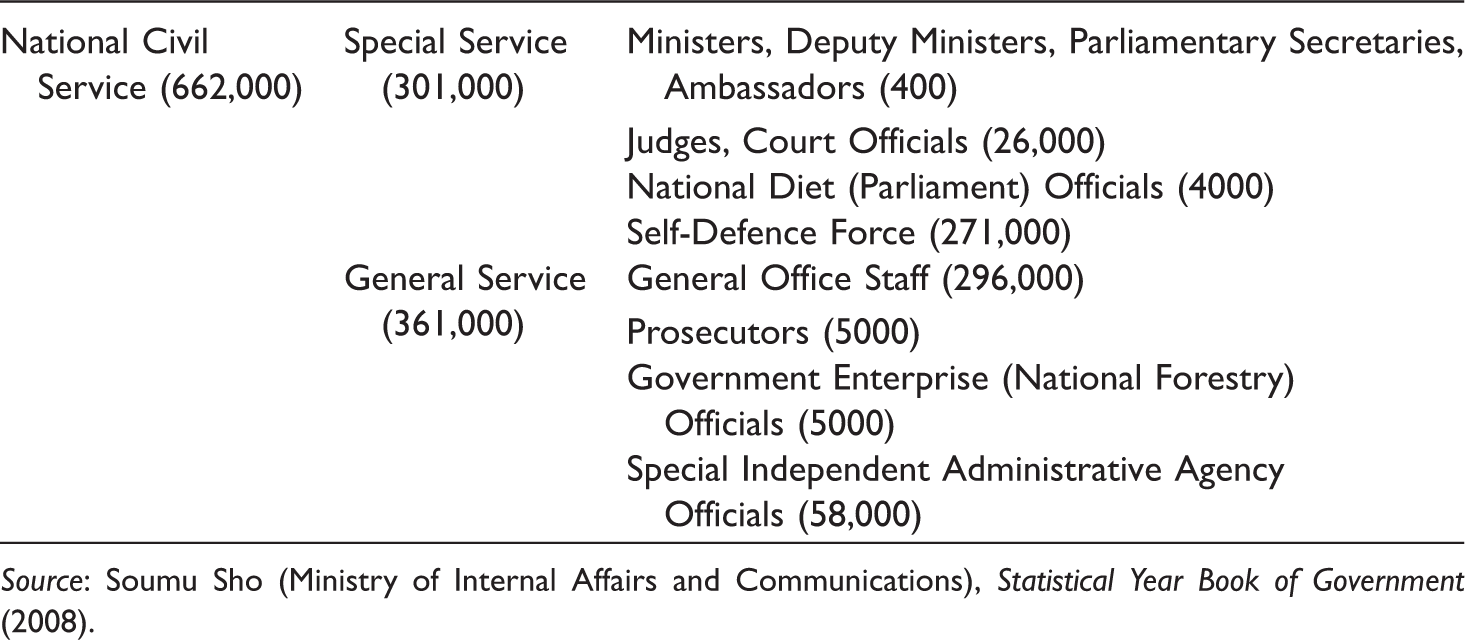
Source: Soumu Sho (Ministry of Internal Affairs and Communications), Statistical Year Book of Government (2008).
In the national policy-making domain, only some of the elite are critical, fast track streamers who move up the official ladder and eventually reach the top echelons of officialdom. They then come to play a major role in making policy decisions for the country. This practice was especially conspicuous during the 1960s and early 1970s, when Japan experienced rapid economic growth. The country started to expand in 1960, and by the early 1970s had become a major international economic power. It is important to note that this development was made possible by the role of the central government in general and a restricted cohort of elite officials in particular.
Two names stand out as the architects of Japan’s post-war growth: Shimomura Osamu and Okita Saburo. Both were influential bureaucrats in the Ministry of International Trade and Industry (MITI) and were close to numerous prime ministers of that time. It was fundamentally the efforts of these two leading public officials and MITI that engineered and crafted the growth plan. Under the leadership of MITI, the Japanese economy made substantial strides, particularly during the 1960s and early 1970s. In 1960, Premier Ikeda Hayato (July 1963–November 1964), who instructed the bureaucrats to explore methods for growth, pledged to double the average Japanese income by the end of the decade. Thanks mostly to government efforts, this objective was achieved by 1968, when the country’s GDP increased more than 18.6 percent compared to the prior five years (Johnson, 1982: 3–34). 2
This form of policy-making process became entrenched in Japan during these periods of expansion, leading to administrative centred government developing into one of the most salient features of the Japanese policy process. Until 2009, when the new Democratic Party of Japan took control, several legal issues seemed to strengthen this management style, and to help minimize the political profile of the chief executive and his cabinet.
One provision in the Cabinet Act of 1947 (Article 3, Clause 1) stipulated that each minister should be accountable for overseeing the affairs of his/her agency, thus responsibility for government administration was left in the hands of each minister. This stipulation signified that the management of government issues was not centralized but divided and devolved to different ministers. Consequently, the chief executive was not allowed to meddle in the specifics of various agencies. In addition, two other provisions in the same law also contributed to the prime minister’s lack of power. Article 4, Clause 1 stated that cabinet members, including the chief executive, would have to adhere to their own collective decisions. On many policy issues, then, the prime minister would be bound by this provision and could not initiate any independent action. Further, Article 6 provided that the cabinet must make all decisions by unanimous consent, which restricted the prime minister’s discretionary powers (Fukuoka, 2007: 121–155; Sakurai, 2010: 3–15).
The power of Japan’s prime minister and his cabinet also dwindled because of the important role that administrative deputy ministers played. Each central ministry had two deputy ministers: administrative and political. Of the two, the administrative deputy minister carried more import: in fact, the post was reserved for Japan’s highest ranking public officials. The other deputy minister was a political appointee chosen among the members of the governing party. Administrative deputy ministers customarily represented their agencies’ interests, while also circumventing any outside intrusions into their offices and jurisdictions.
Until 2009, administrative deputy ministers met regularly on Mondays and Thursdays. The meetings were set on these two specific days because the prime minister convened regular cabinet meetings twice a week on Tuesdays and Fridays. This arrangement tended to make the political status of administrative deputy ministers very important: they would discuss and try to resolve any policy conflict prior to the twice-weekly cabinet meetings. Also significant was the way in which they made final decisions: similar to the requirement for cabinet meetings, deputy ministers eschewed voting, and preferred unanimous consent.
At the end of their twice-weekly conferences, administrative deputy ministers collectively set an agenda for the cabinet gathering to be held the following day. For many years, this well-established political tradition dictated that once the agenda was formulated, not even the prime minister could deviate from it, but had to adhere to this established programme. No new or different items could be added to the settled agenda. Should a cabinet member violate this rule, his/her opinion was considered ‘irregular’ and deleted from the minutes of the meeting (Furukawa, 2005: 2–23).
The new DPJ government initially eliminated the regular conference of deputy ministers in September 2009, as soon as it came into government, although the tradition was revived under the new Noda administration in 2011. At the beginning of its reign, the DPJ tried to reduce the role of the deputy ministers’ meeting, and to enlarge the role of the cabinet meeting. For many years, prior to the DPJ forming the government, cabinet meetings were constrained by rigid rules and regulations, which produced a host of troubling issues. Among the most serious problems was that the rigid conference procedures and restrictions reduced the cabinet meetings to form rather than substance. Under the traditional formula, long before the prime minister convened the cabinet meeting, most critical policy issues had already been resolved by the deputy ministers. The cabinet meeting performed only a rubber stamping function (Fukuoka, 2007: 121–156).
If a member of cabinet wished to advance a substantive policy proposition, he had to commence with several political moves, beginning with subtle, behind-the-scenes negotiations with other political figures, including the prime minister. Further, he would have to arrange for his proposition to be on the table at the deputy ministers’ meeting, or his new policy idea, however important, would most likely be shelved, and not be permitted to move forward to the cabinet meeting.
The issue of making decisions by unanimous consent also caused a serious leadership problem in government. Even now, various organizations in Japan ordinarily prefer unanimity to a ‘taking a vote’, possibly reflecting a culture which tends to favour group harmony and cohesion. Nevertheless, the requirement for unanimity frequently put unreasonable pressure on decision-makers in organizations. Upholding this rule meant that only one opposing vote in either the cabinet or deputy ministers’ meeting could kill a new or innovative policy initiative. If unanimity was not reached among the group, the whole plan would collapse; therefore, prolonged discussion was the rule, until everyone agreed to the agenda. This required rule often made it very difficult, if not impossible, for the chief executive to hand down a critical policy decision at a single stroke.
In the British parliament, the government and the party in power usually agree and vote to pass their favoured policy in the legislature. In Japan, on the contrary, especially under the LDP reign, legislators usually demanded that all government proposals be scrutinized by the party before being transferred to the national Diet. The Policy Affairs Research Council (PARC) of the LDP was the core venue for this screening process. The PARC had several divisions, corresponding to different ministries. The agricultural and fishery division, for instance, would study any policy agenda formulated by the Ministry of Agriculture, Fishery and Forestry. Once the division approved the policy, it would move to the Executive Council of the LDP for further discussion before proceeding to the floor of the Diet.
These practices, known as the LDP’s ‘Preliminary Screening’, seriously limited and undermined the power of the chief executive and the cabinet. Although the government leader and the party members belonged to the same party, the LDP’s preliminary examination practice tended to make party power more authoritative than that of the chief executive and the cabinet. Thus consolidation of executive centred government became extremely difficult to realize (Nakamura, 1984: 3–63).
On rare occasions, the prime minister would introduce a policy of his own and try to carry it through the legislature. One example of this occurred in 1972, when Prime Minister Tanaka Kakuei single-handedly determined to start a new diplomatic relationship with the People’s Republic of China. Very few in government knew Tanaka’s new policy direction beforehand; it was kept secret, because many LDP members were pro-Taiwan, and strongly opposed terminating the relationship with this island state. When Tanaka returned to Tokyo, having signed the new treaty with Premier Zhou Enlai, a group of angry pro-Taiwan LDP members awaited him in party headquarters. Tanaka held a prolonged debate with them and at last managed to prevail, thus starting a new era with China. Tanaka’s approach remained, nevertheless, an exception to usual Japanese politics (Fukui, 1977: 60–102).
Demise of the traditional model and consolidation of executive leadership in Japan
Japan’s prosperity peaked in the mid-1980s, when the country experienced an unprecedented ‘economic bubble’. Unfortunately, this period of expanding affluence did not last long. By the end of the 1980s, the bubble had burst, and the economy started to plummet. Accordingly, the administrative centred statism responsible for Japan’s growth strategy began to lose its lustre; in fact, the reputation of Japan’s public management diminished as well, and was increasingly considered responsible for the lack of continuing economic expansion. Criticism of bureaucrats particularly centred on the lack of innovation in their approaches to generate an economic recovery. As they had in the past, the national agencies kept pumping substantial government funds into huge public works projects such as the construction of highways and hydraulic dams. These policies failed to reinvigorate the slumping economy and only increased the national debt. By the beginning of the 1990s, government bonds issued to cover budget deficits rose to 64 percent of Japan’s GDP and have increased by a substantial proportion ever since. In 2011, the national debt reached a high of JP 662 trillion (approximately US$6 trillion). This figure equals 220 percent of Japan’s GDP, the worst record among the OECD member countries (Keizai Kikaku, 1999: Naikakufu, 2011).
In addition, several unique management styles of the country including life-time employment, the seniority system of payment and the bottom-up style of decision-making, were frequently singled out as examples of government inertia. A Dutch journalist, Karel van Wolferen, was an ardent critic of Japanese government. In several provocative books (1989, 1994), he identified several management flaws including an entrenched post-retirement job security practice among government officials in Japan. In his view, these traditional modes of Japanese management worked only for the benefit of public officials, and not for the ordinary public. Van Wolferen contended that the Japanese system should not become the model for any other state. In a similar vein, many foreign observers increasingly tended to urge Japan to eliminate the administrative centred approach; instead, they wanted the country to move towards a market-driven model of public management.
Revelations of misconduct among principal bureaucrats in central government added to the growing public mistrust of the state. A scandal involving the Ministry of Health and Welfare offers a representative example. During the 1980s, the agency allowed hospitals to treat haemophilia patients with a vaccine injection, intended to improve bleeding rates. However, patients later learned that the injection had been contaminated by the HIV virus and had infected them with this incurable, communicable disease. In 1989, several infected people initiated law suits. For many years, the ministry insisted that there had been no wrong-doing and kept the information and data hidden. Not until 1996 did the truth about this significant and regrettable event come to light. Newly-appointed Health Minister Kan Naoto, a non-conformist who later became the second prime minister in 2010 under DPJ rule, publicly revealed the misdeeds that the Health Ministry had committed and then had denied. This disclosure subsequently facilitated legal settlements in 2002 (Yakugai Kanen Sosho Zenkoku Bengodan, 2006).
In view of this disgraceful policy malfeasance, Prime Minister Hashimoto Ryutaro (January 1966–July 1998) finally decided to radically reform the government. The major objective was to curtail administrative centred management and to increase the power of the chief executive. On 21 November 1996, shortly after taking office, he designed an Administrative Reform Council to undertake three related tasks. They were: (1) to examine the proper function of government in the next century; (2) based on their findings, to draw up a new organizational format for Japan’s central government; and (3) to come up with a system for augmenting the Prime Minister’s authority.
Approximately one month later on 13 December 1996, the government announced the make-up of the 15-member council. The list took both media and academics by surprise. Unprecedented in the country’s post-war history, the prime minister himself decided to chair the group, with the Minister of Management and Organization on the panel as a vice-chair. This arrangement reflected the resolve of Japan’s chief executive. For both political and practical reasons, Prime Minister Hashimoto appeared to be convinced that the country needed a sweeping overhaul of public management (Tanaka, 2006: 23–51).
Apart from these politicians, the council included six academics, three journalists, and one labour union leader, as well as the presidents of Toyota, Mitsubishi Heavy Industries, and Chichibu Cement Corporation. None of the council members were experts in public administration or management. The six academics were in the fields of international relations, physics, or administrative law. Conspicuously missing from the list were bureaucrats, who would be the first to be affected by government reform.
In December 1997, after successive fact-finding investigations, the council presented its final report. It provoked some LDP party members and certainly a large number of bureaucrats, as it called for considerable change in the status quo for the first time in recent history. The panel recommended reducing national agencies from the existing total of 22 to 13, and revamping such mighty ministries as Construction; Agriculture and Fishery; International Trade and Industry; and Posts and Telecommunications. These would be replaced with 10 ministries and two agencies (National Public Safety and Defence).
In addition, the panel proposed a restructuring of the Prime Minister’s office. To expand the power of the chief executive, the final plan proposed a new Cabinet Office, comprising the Prime Minister’s Office, the Economic Planning Agency, and the Okinawa Development Agency. This Cabinet Office would become the command organization of the central administration. To realize this aim, the position of the office was raised to stand above the rest of the agencies. The proposal envisaged that the Cabinet Office would engineer and develop critical policy ideas for the country as a whole, while each agency was expected to put these general concepts into practical policies. As a superior organization, the Cabinet Office was also expected to perform a coordinating function among different central agencies.
The reform plan was likewise intended to cement the power of the Cabinet Secretariat, enlarging the role of the chief executive, and creating an additional assistant secretary general and two deputy assistant secretaries who would assist the Chief Cabinet Secretary. Together, these core members of the Cabinet Secretariat would extend logistical support to the prime minister. Under the reformed system, policy initiatives would come from the top and centre, and not from various central agencies from below. The prime minister was thereby empowered to initiate his own agenda in cabinet meetings, unprecedented in previous administrations. The reform also changed the voting rule in the cabinet from unanimous consent to majority. These measures comprised the reform programme and started to be implemented in April 2001 (Tanaka, 2006: 23–51).
Concomitant with these reforms, the legislators themselves began to change the traditional mode of deliberation in the Diet. Up until the end of 1999, unlike the British parliamentary system, the government of Japan customarily asked the speakers of the houses to name several high-ranking bureaucrats as ‘designated government members’. These included administrative deputy ministers and other executive bureau chiefs in different ministries. Once the roster was approved, they became the support staff of incumbent cabinet ministers. This practice was well entrenched, dating back to the mid-nineteenth century when the parliamentary system was initially introduced into Japan. The basic format had since remained unchanged: in 1964, 148 elite bureaucrats were selected; by 1988, the number had increased to 351 (Tokyo Shimbun, 12 October 1997).
As in the British system, the prime minister and other cabinet ministers responded to inquiries raised by elected members who were out of power; answers were usually general and broad in nature. In Japan’s legislature, elite officials such as administrative deputy ministers and bureau chiefs usually provided detailed answers to legislative inquiries, rather than cabinet ministers. One Diet committee, which deliberated finance reform in March 1997, exemplifies this situation. The committee deliberated for nine days, during which 29 bureaucrats, as ‘designated government members’, replied 410 times to various inquiries by the committee. This exceeded the number of replies by cabinet ministers, who responded 337 times to questions from the opposition (Tokyo Shimbun, 12 October 1997).
For many years, Japanese lawmakers were highly dependent on these professional bureaucrats for their technical expertise and know-how. Questions that the opposition raised on the floor of the chamber were usually engineered and formulated by national public officials; these same central bureaucrats then wrote the answers to the questions on behalf of the government. The cabinet ministers later read these responses in the legislative session as if they were their own. Naturally, the situation created awkwardness, in that it frequently disclosed a lack of knowledge on the part of cabinet ministers.
In one Diet deliberation in the late 1980s, a newly appointed Defence Minister responded to a question on the floor of the national legislature by saying, ‘Because the matter is so important and critical for the security of the country, I shall let the Administrative Deputy Minister of Defence explain the situation.’ As in this case, many instances of ineptitude among cabinet members have often been exposed, and continue even to this date. As recently as 2011, an incoming Defence Minister in the Noda cabinet (September 2011–) openly acknowledged that he knew nothing about the defence issues. He became a laughing stock and the national legislature passed a censorship motion to reprimand this problematic minister (Yomiuri Shimbun, 13 January 2012).
In 1999, lawmakers themselves began to question the established procedures. In fact, leading members of Japan’s national legislature started to take a negative attitude towards the entrenched legislative method. Two specific reasons appeared significant. First, the legislators gradually recognized that the frequent use of bureaucrats in legislative sessions could be self-destructive, that Japanese voters might think that elected legislators had relinquished their power to bureaucrats. Second, they also feared that a perceived lack of integrity on the part of lawmakers had contributed to growing pessimism towards politics among Japan’s electorate. Primarily for these reasons, national legislators contrived their own reform plan: they tried to end the tradition of bureaucrats responding to questions on behalf of the cabinet members on the floor. Henceforth, all Diet deliberation would involve only the elected members, and the cabinet ministers would be accountable for responding to various enquiries. In addition, the legislators also introduced ‘Question Time’, a British-style open debate between two party leaders: the Prime Minister began to face the leader of the opposition in the chamber. They exchanged heated questions and held discussions on various policy issues before the ranking legislators.
The legislators also created new posts: deputy ministers and parliamentary secretaries, both to support cabinet ministers, and at the same time abolished the traditional post of political deputy ministers (see Figure 1). Under the new arrangement, the minister, deputy ministers and parliamentary secretaries, known as ‘the trio in charge of government affairs’, constitute the core of a ministry, responsible for formulating policy in their respective agencies (Horitsu Dai 116 Go).
3
Government structure in Japan (as of January 2012) Source: Gyosei Kanri Kenkyu Senta, Gyosei Kikozu (Government Organization) (2012)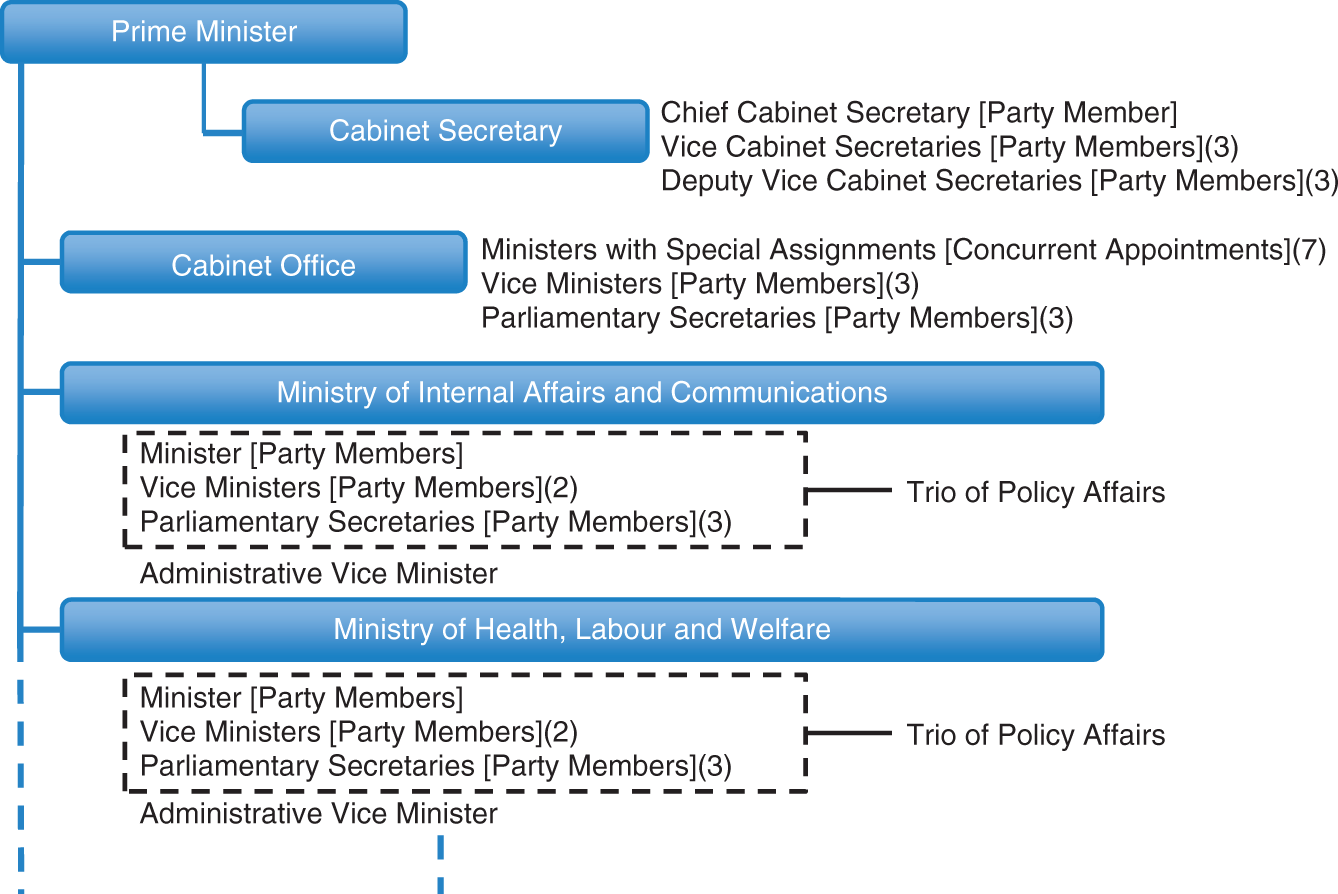
Prime Minister Hashimoto’s reform period from 1996 to 1998 produced several important achievements. Although his main intent was to improve the power and position of the chief executive, the changes were also aimed at streamlining the traditional structure of Japan’s government bureaucracy. These developments gave hope that a new style of politics would set in and enhance the commanding role of both the prime minister and the cabinet members. However, the reform plan did not move forward as expected, chiefly for a number of cultural reasons. Two examples may help highlight the intrinsic problems in Japanese public administration.
To solidify executive power, the reform proposal recommended a system of special assistants to the Prime Minister, quite similar to that in the US political system, where assistants apparently act as a policy consulting body to the president. This concept works well in the US because people can frequently change professions with few or no encumbering resume problems. In Japan, lifetime employment remains the rule: a college professor, for example, who left academic life to become a ministerial assistant would not be able to return to academe, nor would those who work in the private sector. Given these cultural constraints, few people, however competent, would willingly serve as assistants.
One rare exception to this custom exists, however. Takenaka Heizo, an economist at Keio University, served as an adviser to several LDP governments, and played a critical role in the Koizumi administration, facilitating the privatization of Japan’s postal service. He received mixed public appraisal: some abhorred his arrogance and considered him incompetent, while others greatly admired his administrative skills. Whichever assessment one makes, the fact holds true that Takenaka’s case was special in Japanese circumstances: normally, only bureaucrats are actually able to take an assistant’s post. Subsequently, the reform did not radically improve the power of the chief executive and his cabinet: the role and function of the prime minister underwent relatively little change. 4
Similarly, the change to majority rule voting in Japanese cabinet meetings also failed to enhance the power of the prime minister. In Japan, cabinet members usually maintained a close rapport with the heads of several administrative agencies, as they would frequently speak for the benefit of specific offices or groups in the cabinet meeting. Under these circumstances, majority rule can transform cabinet meetings into a battleground for rival and competing agencies, rather than producing rational and objective decisions (Itoh, 2005: 87–107).
In addition to Hashimoto, Koizumi Junichiro (April 2001–September 2006) also tried to consolidate his leadership, using two approaches. First, he targeted the Ministry of Finance, long regarded as the ‘agency of agencies’ in Japan’s central bureaucracy. This ministry controlled public tax administration and private financial affairs, in addition to the government’s revenue and expenditure. Koizumi divided the Ministry of Finance into two different segments: the Financial Service Agency (Kinyu Cho), to oversee private monetary and financial issues, and the Treasury Ministry (Zaimu Sho), for national tax administration and public financial affairs.
At the same time, the Koizumi administration decided to make full use of a Consultative Economic Affairs Committee (Keizai Zaisei Shimon Kaigi), established in 2001 as a part of the Cabinet Office. Chaired by the Prime Minister himself, the committee comprised 10 members: the Chief Cabinet Secretary, Finance Minister, Economic, Trade and Industry Minister, Governor of the Bank of Japan, and two business people and two academics. One of the most important objectives of this high-ranking organization was to put the executive leadership on a solid foundation. In so doing, the committee issued policy guidelines long before ministries began to formulate their annual budget. These agencies were expected to respect the prime minister’s policy orientation and reflect this in their respective budget proposals (Shiroyama, 2006: 63–70; Kikuchi, 2010: 223–24).
In addition, Koizumi became earnest about de-bureaucratizing government, as another critical means to reinforce the power of the chief executive and end the longstanding power of public officials. In April 2001, the Koizumi administration implemented several measures for this purpose, one of which was the introduction of government deregulation. In New Public Management (NPM) fashion, the taxi industry was deregulated, and part-time employment by private industries was also removed from government control. As a result, all train terminals in major metropolitan areas suddenly had a long line of vacant taxis waiting for passengers, a situation unseen for many years. Previously, the government had strictly regulated the number of taxis allowed to do business in town, and getting a taxi in such places as downtown Tokyo had been extremely difficult. Deregulation alleviated the shortage of taxis; at the same time, it produced many towns over-supplied with idle cabs.
Deregulation also influenced the private sector in other ways. Prior to deregulation, Japanese companies were required to hire only permanent staff members; however, this began to change. Many firms no longer hired costly permanent workers; they were replaced by temporary staff with a limited tenure of employment and low wages. Some heralded Koizumi’s deregulations as a major reform achievement, critical for containing the power of the bureaucracy, and an important programme to reinvigorate the ailing economy (Kubota, 2009: 3–15).
Others argued, however, that deregulation would contribute to increased income disparity within the population. In fact, government statistics in 2009 showed the total Japanese workforce as 52 million people, of which 34.4 million (66 percent) were permanent employees, while 17.6 million (34 percent) were non-permanent temporary workers. Temporary staff included part-timers called Pato, mostly housewives, as well as students, and those working on a contract basis as labourers dispatched from a temporary agency. Of these 17.6 million temporary workers, 3.5 million (20 percent) could not find permanent positions; the rest preferred temporary work. Data from the Labour and Welfare Ministry in 2009 showed that more than 230,000 temporary workers lost their jobs between October 2008 and September 2009, while 15.8 million (90 percent) retained their temporary positions. As these records indicate, the actual number of temporary workers dismissed was not substantial; however, the situation received enough media attention that it grew into an issue that tarnished the political image of the governing party. The public equated the problem of temporary workers with Koizumi reforms and became increasingly negative towards the LDP (Naikakufu, 2011).
In the final analysis, the enhancement of executive political leadership has two different aspects. On the one hand, strong leaders exhibit determination, decisiveness and commitment to carry out their policies and programmes. In the past, Japanese prime ministers have frequently lacked these leadership qualities; previous leaders have often been overwhelmed by the tenacious control of bureaucrats. Some leaders have tried to improve this tradition or imbalance by expanding the power structure of the chief executive. In this regard, Hashimoto made considerable gains, although public officials often sidetracked his reform efforts.
Koizumi presented other strategies for government reform and, despite much opposition even within his own party, was determined to implement his pre-set reform plans. Perhaps the chief executive with the most fortitude and resolve, Koizumi has been regarded as an exceptional leader in Japanese politics. Nonetheless, as in many other democracies, a strong leader often creates strong adversaries and opponents, and Koizumi, with many political foes to confront, was no exception in this regard. As soon as he stepped down, his reforms were weakened or eliminated by his successors, who were all short of leadership qualities. Both Hashimoto’s and Koizumi’s efforts have run their course, and Japan has once again been faced with the lack of a strong chief executive.
Unsettling government management of the Democratic Party of Japan and the Fukushima debacle
In August 2009, the Democratic Party of Japan (DPJ) displaced the lengthy rule of the LDP and took control of government for the first time in more than 50 years. As soon as he came into power, the DPJ Prime Minister, Hatoyama Yukio (September 2009–June 2010) proclaimed the start of an executive centred government. To achieve this objective, he immediately initiated steps to reduce the power of bureaucrats. For instance, the twice weekly meetings of the administrative deputy ministers were abolished; instead, in the new government, ‘the trio of government affairs’ (the minister, deputy ministers, and parliamentary deputy ministers) began to perform a central role in decision-making as well as policy formulation.
In addition, taking a cue from the British experience, the DPJ administration also forbade ranking party members to confer on policy issues with public officials. In a similar vein, the Hatoyama government intended to synchronize the policy direction of the government and the DPJ, and suspended the function of the Policy Affairs Research Committee. Under LDP rule, the party had screened all policy matters before they went to the floor of the chamber. This practice often resulted in a policy discrepancy between the cabinet and the party.
To avoid this gap, Hatoyama restructured and centralized the processing of policy requests from the ranking members of the party. Under the new procedure, ranking members had to meet with and address policy requests to the secretary general of the party. The secretary general of the party, Ozawa Ichiro, one of the leading members of the DPJ, would then send the policy requests to the chief executive and the cabinet. Under this arrangement, no ranking member would be able to confer with the executive members of government, allowing the chief executive to produce different policy options without outside political interference (Mainichi Shimbun, 5 September 2009).
With this change and through other means, the Hatoyama cabinet intended to consolidate executive centred government and to strengthen the power and profile of the chief executive. In the new political setting, the leading bureaucrats in the central government were forced to keep their distance from the party leadership and had to wait for signals from the chief executive and his cabinet members before they could take any action. However, a few months after the new government came to power, ‘Hatoyama fever’ started to decline. Several reasons may account for the reduction in public support for the new governing party. Ironically, a lack of leadership seemed to be one of the most important: Hatoyama Yukio lost public trust due to his indecisive posture towards the issue of relocating American bases in Okinawa. Similarly, the DPJ administration failed to reinvigorate the country’s sluggish economy. In light of these untoward political circumstances, few Japanese were surprised when Hatoyama decided to step down in June 2010.
Hatoyama’s successor was Kan Naoto (June 2010–September 2011), and it was during his tenure that Japan was engulfed by the triple disasters. On 11 March 2011, a major magnitude 9 earthquake struck the northern part of the country. This severe jolt caused a giant tsunami which killed approximately 15,000 people; at the time of writing, more than 5000 residents are still missing. Unfortunately, these natural disasters knocked out the nuclear power plants in Fukushima prefecture, a region about 250 kilometres north of Tokyo. The International Atomic Energy Agency labelled the Fukushima nuclear catastrophe a Level 7, only one point below the Chernobyl accident in 1986.
In containing the crises, DPJ has regrettably exposed several shortcomings. These were mostly connected to the party’s promises at the time of the election two years before. One of the most significant party platforms was to consolidate the executive centred government and the party-controlled administration. This was a direct antithesis to Japan’s protracted Asian model of management. This pledge seemed to have become a major impediment for the DPJ especially during the crisis situations. In the aftermath of the nuclear plant accident, the Kan government tried not to depend on the country’s bureaucracy for policy advice and support, and instead mobilized party members and attempted to deal with the nuclear plant emergency by themselves. However, as a series of major crises started to unravel, it became increasingly clear that Kan’s approach was a grave mistake. Certainly the DPJ members were politically competent and administratively shrewd, but they were uninformed on atomic issues, and non-professionals in crisis management. Nonetheless, a cohort of DPJ top leaders seemed confident, and believed that they could manage the continuing problems. 5
One of the public officials involved in crisis management for the Kan government later noted that in the midst of the turmoil, consultative committees suddenly mushroomed. He and other officials were constantly required to attend these meetings and spend substantial time on prolonged discussions. According to his perspective, there was a major problem in that these conferences most often failed to generate policy decisions. He observed that, with little or no precise policy orientation from the chief, the government only wasted time and was late in bringing forth a plan to deal with the disasters. In fact, nearly a year after the fiasco the DPJ government has not yet created a public agency charged with the rehabilitation of disaster sites: this vital agency remains in limbo. 6
Another source indicated that, in the Kan administration, decision-making tended to be diversified and divided among at least nine centres. Principally, these included: the prime minister and his cabinet secretariat, the Economy, Trade and Industry Ministry, the Education and Science Ministry, the Agriculture and Forestry Ministry, the Land and Infrastructure Ministry and – significantly – the Tokyo Electric and Power Company (TEPCO). This fragmentation of decision-making among different centres was obvious when three different agencies held press conferences without mutual coordination a day after the disaster. The Nuclear and Industrial Safety Agency (NISA), which regulates the nuclear energy programme as an administrative arm of the Ministry of Economy, Trade and Industry, publically acknowledged that meltdown had occurred in the nuclear generators in Fukushima. Countering this official disclosure, both the Chief Cabinet Secretary and the TEPCO officer denied NISA’s assessment and insisted that no meltdown had occurred in the atomic generators. Subsequently, the NISA official who made the original statement in the conference was reprimanded and dismissed from his post, and has been nowhere to be seen since. It was not until a few months later in June that the Chief Cabinet Secretary and TEPCO disclosed for the first time that the meltdown had taken place right after the tsunami struck (Asahi Shimbun, 3 May 2011).
On yet another occasion, the Chief Cabinet Secretary issued a warning on TV that those with infants should avoid giving them tap water, and use bottled water instead. Ten minutes after this public announcement, bottled water disappeared from the shelves of all supermarkets and convenience stores, especially in the northern part of Japan. Pandemonium naturally ensued. Noting this, the Chief Cabinet Secretary appeared on TV again the following day, and amended his previous warning. He stated that, ‘If a family could not secure bottled water, use tap water,’ and, added, ‘It should cause no harm for the babies at least for the time being.’ Many families with infants wondered what ‘at least for the time being’ meant. Perhaps in part because of these unsettling government announcements, a survey comparing ‘public trust in government before and after the disasters’ found that the number of people who trusted the national government began increasingly to decline after the fiasco (see Figures 2 and 3). Interestingly, in contrast to the decrease of trust in central government, trust in local governments started to steadily increase after the disaster. One of the reasons for this trend lies in the active and robust relief activities that many local governments initiated. Residents in the disaster areas appreciated their neighbourhood authorities more than the central government primarily because the community governments provided food and shelter for those victims in need.
Trust in central government before and after the disasters Source: The survey research on ‘Public Trust in Government’ by Akira Nakamura (principal investigator) in partnership with Ken’ichi Ikeda, Masao Kikuchi, et al. (Unpublished). (2011) Public trust in local government before and after the disasters Source: The survey research on ‘Public Trust in Government’ by Akira Nakamura (principal investigator) in partnership with Ken’ichi Ikeda, Masao Kikuchi, et al. (Unpublished). (2011)

Many residents in Japan had already been psychologically and mentally affected by this tragedy, and felt very insecure. The unsettling government statements intensified the general concerns and did great harm to the public’s trust in the DPJ government in general and the Kan administration in particular. According to several experts, one of the reasons for the government confusion stemmed from Kan’s resolve not to make use of opinions and evaluations of bureaucrats. His confidence in the DPJ leadership only served to disclose the level of amateurism of the party members on the nuclear issue and seemed to undermine the public’s perception of the prime minister’s integrity and leadership.
The recent triple disasters that engulfed Japan may have revealed a number of important government management issues. The DPJ government has been trying to consolidate an executive centred form of government, and to achieve this objective tried to eschew dependence on bureaucrats for disaster management. However, many DPJ members lacked critical experience in running government, and took important public positions without prior knowledge and expertise. This situation differs from when the LDP was in power, when it would take more than 10 years before anyone could become a state minister. Training and experience was called for prior to taking a cabinet position.
Without these practical foundations, the DPJ ministers looked unstable and uncertain. Part of the problem is that they have not been allowed to seek advice and opinions from professional bureaucrats and, consequently, their decisions often do not seem relevant to the crisis situations or reflect the immediate needs of the public. In this regard, the DPJ has been too hasty and impatient to ensconce executive style government. Especially in the wake of the recent catastrophe, the party should perhaps have taken advantage of knowledge and expertise that the national bureaucrats have accumulated over the years. Instead, the DPJ has avoided professional know-how and tried to carry out crisis management by itself. As a result, this party with a lot of non-professionals has been unable to deal with overwhelming issues and devastation in the aftermath of the March 2011 triple disasters. This appears highly unfortunate for the country, because Japan needs rehabilitation of the disaster regions more than anything else at this time.
Facing mounting public denunciations, Prime Minister Kan resigned from his post on 3 September 2011, after being in office for only 452 days. The incoming premier, Noda Yoshihiko (September 2011–) seems to have learned several lessons from his predecessors. Prime Minister Noda has reinstalled the regular meetings of the administrative deputy ministers and also the preliminary screening of the party. Unlike his forerunner, the Noda government has tried to utilize central bureaucrats as it sees fit. These decisions have created an ironic problem: as Noda has tried to change the political style of the DPJ, his administration has increasingly appeared similar to the LDP. The political fortunes of the new prime minister, therefore, remain uncertain and problematic, as the fragile executive leadership situation should continue to be an issue for years to come in Japan.
Concluding remarks
This article has focused on the concept and utility of the Japanese mode of public management over the last few decades, describing the traditional style as the ‘Asian model’. Under this administrative centred system, Japan successfully expanded its economy during the 1960s and early 1970s. However, the functionally efficient and effective statism approach began to founder as the economic bubble burst at the end of the 1980s. Ever since, the Japanese have been struggling to overcome the resultant economic standstill, even as a horde of problems have hounded the country, particularly after the Lehman Brothers fiasco in 2008.
Amidst these economic problems, several political leaders tried to alter the statism style of public management. The article has described how they attempted to limit the power of public officials and solidify executive centred government in the country. Both the Hashimoto and Koizumi administrations put a number of concrete policies in place to increase the power of the chief executive. However, these trials did not bear fruit as originally hoped because of other domestic policy issues. Also, any discussion to improve the power of the chief executive must consider one major aspect: the character of the prime minister. Government reform could perhaps alter the institution; however, the prime minister as an individual is a different story. Even under the enhanced power of the office, the country would still look for an individual who could lead the government with fortitude and determination.
The Japanese experience indicates that it is very difficult, if not impossible, to dilute the power of the bureaucracy. Despite many attempts to do so, the national bureaucracy remains strongly present in many facets of Japanese society, although the degree of power has been in decline over the years. In fact, a study has shown that the elite bureaucrats themselves feel that their position of power has been sliding over the years. These officials more commonly believe that the influence of party members could expand in the future (Muramatsu, 2010: 217–245). On this issue, Asians need more cross-cultural studies to dissect the changing interface between politicians and administrators in different settings.
In the case of Japan, the Democratic Party took control of government in August 2009, and seems to have been too hasty in curtailing the statism tradition. The new government attempted to reduce dependence on the bureaucracy for policy advice and direction, believing that party members would be able to run government without outside support and assistance. This strategy, however, proved to be wrong, as the country encountered the worst tragedy in its post-war history. In the aftermath of the three disasters, the DPJ government floundered badly, and exposed many gross policy errors to the public, thus generating confusion and uncertainty among the population. From this vantage point, the party should have taken advantage of public official know-how, experience, and expertise. This decision would not necessarily have diluted the executive centred form of government: on the contrary, a government that displayed fortitude and knowledge would cement public trust in DPJ governance. In the final analysis, there is a pendulum swing: too much dependence on central bureaucracy can generate problems, while disregarding the central agencies and professionals can also impede a reliable and democratic system of government. This seems to be one of the critical evaluations of the study of the ‘Asian model’ of public management.