




Abstract
This article examines Brazil’s experiences with anti-poverty and progressive social change, and spells out possible lessons for emerging economies with similar challenges. It draws on the Bolsa Familia conditional cash transfers (CCT) and the continuous cash benefits programmes and discusses important aspects of programme leadership, management and coordination. After a brief discussion of poverty, it presents a framework synthesizing key success factors for effective and sustaining programme implementation. Brazil does not offer a ‘blueprint’ for other countries to copy; only lessons from experience. Therefore the article concludes by discussing key ongoing challenges and suggests areas for future research, focusing on comparative studies across countries.
Progress has been made against global poverty, notably in countries experiencing sustained economic growth like Brazil. In spite of these remarkable efforts, challenges remain especially for countries which focus only on macroeconomic growth but not equity or inclusive development. Growth without equity does not eradicate poverty. Accordingly, emerging economies are being urged to pursue multipronged strategies: crafting innovative public policies, reshaping institutions for macroeconomic management, reaching out and engaging target communities, democratization, legislated and constitutionally mandated progressive social change. This article provides practical lessons from experience from Brazil, which practitioners from other emerging economies can adapt to their own circumstances for the effective and sustaining implementation of anti-poverty and progressive social change. It also provides a holistic framework for better understanding the institutional context, leadership, management, inter-government and cross-sectoral coordination and private sector participation. Finally, it identifies some of the key ongoing challenges in Brazil, and suggests areas for applied comparative research.
Keywords
Introduction
Addressing the United Nations International School (UNIS) on pledges to meet the Millennium Development Goals (MDGs) and in line with the United Nations’ ‘End of Poverty Now’ campaign, the UN Secretary General Ban Ki-Moon stated on 16 October 2009 that poverty is the biggest global challenge because ‘more than 1 billion people are still in extreme poverty and over 70 million children cannot go to school’ (see www.endpoverty2015.org). 1 In 1970, Myrdal published The Challenge of World Poverty: A World Anti-poverty Program in Outline and exposed the weaknesses of the then Western countries’ trade and aid policies towards developing countries. He observed that while aid may be strategically and contingently necessary, it is not sufficient to lift millions out of poverty. Developing countries needed to do more in terms of political, economic and social reform and change. About the same time, Pearson and other World Bank Commissioners published Partners in Development (1969), calling for more multilateral foreign aid to developing countries. Today, almost half a century later, the debate still rages on with no end in sight.
The world is sharply divided among those who believe in foreign aid, charity and the Millennium Development Goals (MDGs) as the solution to global poverty (e.g. Sachs, 2005), those who believe in the market and private enterprise (e.g. Hubbard and Duggan, 2009; Prahalad, 2006), and those who prefer to isolate themselves from the global economy and global society (e.g. North Korea). Although the ‘good cop–bad cop’ approach to this debate is tempting and attention grabbing, experience, especially from the more successful countries in South-East Asia, shows that the truth is much more nuanced (e.g. Landes, 1999; Narayan et al., 2009; Rodrik, 2007; Smith, 2005); what works is much more contextualized, bounded by time, geography and culture; oftentimes moderated by natural or chance events (e.g. location, war, charisma, natural disasters, world events). Still what countries do or do not do – governments, businesses, civil society and ordinary citizens – together with the international community, makes a difference. It is with this background that this article looks at Brazil and its potential lessons from experience for other countries. It is important to note, however, that this is not a comprehensive review or evaluation of Brazil’s anti-poverty policies and programmes – several of these already exist in the literature (e.g. Bastagli, 2008; Hall, 2006; Lindert et al., 2007). Rather, the objective is to draw out lessons from experience, potentially applicable to other emerging economies.
The state of poverty in Brazil
According to the World Bank’s Growth Commission Report (2008), Brazil is one of only 13 ‘success story’ economies in the world to have achieved high sustained growth in the post-war period of at least 7 percent annual GDP growth continuously for at least 15 years (1950–80 for Brazil). Brazil is the sixth biggest economy in the world with an estimated total GDP of $2.5 trillion (2011), and one of the most attractive economies for foreign investment. Yet, Brazil is also one of the most unequal nations in the world. Brazil’s inequality is comparable to some of the poorest countries in Africa and Asia. With a national Gini index of 0.61 – a measure of income inequality – the country’s richest 1 percent of the population – less than two million people – have 13 percent of household income, while about 50 percent of the population – over 90 million people – share only 13 percent of household income. (Comparable Gini indices for other countries are: China, 0.47; India, 0.368; Indonesia, 0.343 and South America and the Caribbean, 0.615.) About 22 percent of the population – about 42 million people – are below the national poverty line (Beghin, 2008). According to data provided by the country’s Institute of Applied Economic Research (www.ipear.gov.br), about 11.5 percent of the population – over 20 million people – are categorized as very poor. Brazil has large rural–urban income inequalities and unequal access to land, housing, infrastructure, water and other social and economic services and opportunities such as education, health, employment, credit, extension services, Internet, etc.
The debate about poverty and inequality in Brazil and globally

It is important to note that although poverty and inequality are both repugnant, they are conceptually and empirically different. For example, using World Bank data in a study of 130 developing countries, Ferreira and Ravallion (2008) found strong positive relationships between economic growth rates and poverty reduction. This means that high rates of sustained economic growth can lift people out of poverty. The study, however, also found no significant relationships between economic growth and changes in inequality. This means that by itself alone, economic growth does not necessarily lead to reductions in economic inequality. Inequality is a factor in moderating the relationships between economic growth rates and poverty reduction. In the short run, it is more prudent to tackle poverty first. Experiences from Brazil and other emerging economies (e.g. China, India) suggest that sequencing is important for lifting millions out of poverty; fighting poverty first, then inequality. Societies coming out of poverty seem to have high tolerance for inequality (Whyte, 2010).
Table 1 summarizes the debate about the conceptual definition and measurements of poverty and inequality in Brazil and globally. The concepts of poverty and inequality are complex and multidimensional; they mean and manifest themselves differently in different settings. This is particularly the case for large and diverse emerging economies such as Brazil undergoing fundamental political and socioeconomic transformations at different rates across the population. This explains why different organizations and jurisdictions use different definitions, methods and mix of variables to measure and track the effects of poverty and inequality. For example, Brazil’s Bolsa Familia and Mexico’s Oportunidades both focus on human development by including health and education, the UNDP (United Nations Development Programme) includes measures related to gender (development, empowerment), and the Development Assistance Committee of the OECD (Organization for Economic Cooperation and Development) includes child mortality to reflect changes in Millennium Development Goals (MDGs). In spite of these conceptual and methodological challenges, measures of poverty and inequality provide useful indicators of human development and well-being within and between countries and over time.
With such a gloomy situation of poverty and inequality, it would appear that Brazil has nothing positive to share with the rest of the world when it comes to fighting poverty and advancing social justice. Yet Brazil has a history of fighting poverty and inequality, advancing democratic political reform, progressive socioeconomic development and, over the years, accumulated lessons from experience, which when carefully studied can prove potentially useable for other countries with similar challenges (Kinzo and Dunkerley, 2003; Skidmore, 2007). The World Bank’s World Development Report on tackling poverty rightly states in its opening sentence that ‘poverty amid plenty is the world’s greatest challenge’ (World Bank, 2001: v). Therefore, experiences gained in one country are instructive in others.
This article is based on the belief that sustained achievement of the Millennium Development Goals will depend not only on increasing resources but also on renewed commitment to adapt and accelerate implementation of successful approaches both within and across countries. This is consistent with several ongoing initiatives by the international community to find solutions to global poverty. For example, the Shanghai Conference and Agenda on Poverty Reduction (26–27 May 2004), drawing on case studies from different countries, provided a unique opportunity to learn from the rich and diverse experiences on growth and poverty reduction – both successes and failures – and to explore ways in which ingredients of success at the project, country and global levels can be built upon and adapted to scale up progress on poverty reduction in all parts of the world.
Why focus on Brazil?
Why focus on Brazil if other countries have anti-poverty and progressive social change programmes? For example, in a relatively short period of time, China has lifted almost 400 million citizens out of poverty. South Africa has halved the murder rate, virtually eliminated malnutrition for under-fives, increased school enrolment for 7–15-year-olds to almost 100 percent, set up the world’s biggest antiretroviral treatment programmes for HIV/AIDs, and is addressing intergenerational transfer of poverty and inequality (The Economist, 5 June 2010; Samson, 2009). Others such as Bangladesh, India, Indonesia, Malaysia, Thailand and Zambia are aggressively pursuing anti-poverty policies and inclusive development (The International Policy Centre for Inclusive Growth, www.ipc-undp.org). Like Brazil, many of these countries are in the midst of one of humanity’s greatest transformations and, within the realities of their unique contexts, they have much to learn from one another.
Brazil is a good country to study and from which to draw out lessons from experience for others to learn from for a variety of reasons. The country has one of the world’s largest public conditional cash transfers to the poor, diffused in different states, municipalities and reaching an estimated 44 million people or 24 percent of the national population (Bastagli, 2008). The country’s anti-poverty and progressive social policies, programmes and experiments have attracted attention nationally, in South America and globally. International (e.g. the World Bank, UNESCO, UNDP and FAO) and faith-based organizations continue to provide material and moral support, including international recognition and awards (Sugiyama, 2007). They are encouraging other countries (e.g. Ghana, Mozambique) to take advantage of Brazil’s experiences.
Brazil shares many of the characteristics and challenges facing other emerging economies including uneasy combinations of high levels of economic growth, deep poverty and extreme inequalities, and growing risks to economy and society associated with climate change (Brainard et al., 2009; World Bank, 2009). Many emerging economies are big in size (population and geography), diverse economically, socially, geographically and demographically (by race, colour, creed, ethnicity, ideology, etc.). They have decentralized federal systems of governments and are democratizing and undertaking other forms of political and institutional reforms, often after long periods of dictatorship and human rights abuses. Brazil has maintained a prolonged period of relative peace both within its borders and with its neighbours. Countries are better able to sustain focused attention on anti-poverty and progressive change when they are experiencing internal harmony and peace with others (Myrdal, 1970). This is particularly relevant for conflict, post-conflict and fragile countries (e.g. Afghanistan, Burma, Ethiopia, Colombia, DRC, Iraq, Liberia, Nigeria, Pakistan, Sri Lanka, South Sudan, Uzbekistan and Zimbabwe) and those going through popular political transformations (e.g. Egypt, Libya, Tunisia, Yemen).
The country is credited with pursuing growth policies and institutional development aimed at achieving economic convergence with living standards of advanced industrialized economies. It is also credited with a deep appreciation of the fact that the challenges of igniting growth differ significantly from those for sustaining it (Rodrik, 2007). Over time, the country has managed to mobilize a national network of individuals, groups, organizations, institutions and communities from both the public and private sectors to work together to advance anti-poverty and progressive social change. The network includes public agencies at different levels of government, faith-based organizations (e.g. the Roman Catholic Church), trade unions, professional associations, universities (e.g. the Six Citizens’ Universities), state-owned enterprises, NGOs and political parties. This has allowed the country to create a national deliberative platform for dialogue and consensus on policies relating to anti-poverty and progressive change. Brazil’s anti-poverty programme is much more broadly based and embedded in institutions, families and communities (Saxby, 2004, 2011).
Brazil and Mexico’s Oportunidades compared
Oportunidades is the principal anti-poverty programme of the Mexican government. Originally known as Progresa, it started in 1997 only in rural areas, but was extended to include the urban poor in 2002. It helps poor families to invest in human capital by improving children’s education, health and nutrition, and giving them the opportunity to escape intergenerational poverty. It provides CCTs as incentives to keep children in school, promote preventive health care, improve food consumption, and nutrition for infants and pregnant and lactating women. Monthly CCTs are paid to the mothers in the household on condition that children and adolescents attend school, infants receive micronutrient supplements, mothers attend sessions on nutrition and health practices, and all family members have regular health check-ups. It was conceived and is managed by highly educated and experienced federal government officials, with strong support from the President. There is strong coordination among the key federal government ministries of education, finance and social security. In 1999, its budget was only 0.2 percent of Mexico’s GDP (compared to about 1 percent of GDP for Brazil). It now covers about 4 million families, over 60 percent of them rural. It benefited from a well-designed evaluation study by an external independent US organization, the International Food Policy Research Institute (Gertler, 2000; Skoufias, 2005), which found that after only three years, poor rural Mexican children on Oportunidades were better off than the control group. Specifically, school enrolment improved 20 percent for girls, 10 percent for boys, with better balanced diets, better medical attention received, and new-born children grew better with reductions in child stunting. This prestigious evaluation study gave the programme credibility both domestically and internationally, making it possible for President Fox to extend and modify it to include the urban poor, and introduce education grants to high school students with a new component called ‘Youth with Opportunity’ (Jovenes con oportunidades). Mexico’s experience points to the importance of undertaking early, independent monitoring and evaluation so as to demonstrate results for lessons from experience.
Although Mexico’s Oportunidades has been deemed successful, the Brazilian anti-poverty programme is different and better in several respects. In terms of size and scope, Brazil’s programme is among the biggest in the world, and right from the beginning it covered both urban and rural areas. Skoufias (2005) found that targeting poor families in rural areas created tensions between those who are included or excluded from receiving CCTs. This may be due to the fact that poor rural families tend to be more closely connected, making it socially unacceptable for government to choose between winners and losers. In poor rural communities, it may be preferable to include all residents in the programme instead of discriminating among households. This problem was not apparent in Brazil, especially in the urban areas – highlighting differences between rural and urban anti-poverty strategies.
Brazil is mainly urban with about 80 percent of the population living in urban areas. Although the rural population tends to be poorer, developments in agriculture and agribusiness, especially in the Midwest states, have modernized the countryside and helped to close the rural–urban income gap. After the 2008–09 financial crisis, the economy is growing again, unemployment is low (about 6 percent) and millions of Brazilians are now actively participating in the economy as wage earners, producers and consumers. A growing number of hard-working families are moving out of favelas (urban slums) and joining the growing middle class in better serviced neighbourhoods (Perlman, 2010). Bolsa Familia has been instrumental in improving family well-being and helping children to do better in school – thus reducing intergenerational transfer of poverty. Internal migration away from the biggest cities has helped to keep unemployment levels low, reduced concentration of poor people in urban slums, and made it easier for social services to reach the poor and those in most need (Andrews, 2011, personal communication). Similar changes have not taken place in Mexico.
The Brazilian programme also differs from Mexico in the way it is managed and coordinated. Mexico’s Oportunidades is essentially owned and managed by the federal government. Brazil’s programme is much more decentralized, jointly owned and implemented by the three levels of government – federal, state and local – civil society and the private sector. Lula da Silva, the former charismatic president, was perceived as more of a champion for the poor than President Fox. While the Mexican programme is horizontally decentralized and coordinated within federal government ministries, in Brazil, the programmes are both horizontally (within federal government) and vertically decentralized and coordinated with state, municipal and non-government stakeholders. In Brazil, more so than in Mexico, urban citizens are much more actively involved in anti-poverty activism. For example, the 2005 Carnival in Rio de Janeiro was used as a platform for promoting awareness among the citizens of the MDGs in partnership between the UNDP and the local Portela samba schools (Thomas, 2006: 40).
Grassroots support helps to protect the long-term financing of anti-poverty programmes and avoid policy reversal, especially when governments change or budgets are cut. Mexico appears to depend more on remittances than publically funded conditional cash transfers, while in Brazil it is the other way round. Mexico’s remittance inflows were US$22.6 billion compared to only US$4.3 billion for Brazil (World Bank, 2011a). We do not know the relative importance of remittances and conditional cash transfers for reducing poverty and inequality. We speculate, however, that large and growing remittance inflows may reduce pressure on governments to use public finances such as CCTs to address poverty and inequalities. President Dilma Rousseff has introduced a multibillion dollar plan called Plano Brazil sem Miseria (Brazil without Misery) to complement BFP by targeting 16 million citizens living in extreme poverty, promising to eliminate extreme poverty in four years. However, continuing incidents of corruption leading to resignations of ministers and senior public servants, growing budgetary pressures, and a strong currency reducing exports and threatening jobs, all detract from needed anti-poverty and progressive social change (The Economist, 20–26 August 2011: 36–37).
Methods
This article is part of the author’s ongoing work on improving South–South cooperation by drawing out lessons from experience across countries, sectors or globally significant cross-cutting issues such as poverty and inequality. It is based on the belief that countries of the South are better able to effectively address their development challenges by learning and drawing lessons from experience among themselves. The article draws on the growing literature on poverty reduction programmes in emerging economies with a focus on Brazil. It is based on a rather limited and focused review of the literature, unpublished institutional reports and studies, visits to Brazil, and ongoing contacts with Brazilians working on issues of poverty, inequality, NGO management, and democratic development and social justice. Unpublished studies include doctoral theses (e.g. Bastagli, 2008; Sugiyama, 2007); World Bank reports (e.g. Lindert et al., 2007); and the International Poverty Centre (Medeiros et al., 2008), whose work is supported by the UNDP. While in Brazil, the author conducted unstructured interviews and discussions with the staff of the Federal School of Public Administration, academics, graduate students and community leaders. Contacts and consultations continue by email and occasionally face-to-face meetings and conferences.
The article benefited from the different perspectives provided by representatives from government, civil society organizations and academics. For example, government officials are knowledgeable about policy development, resource mobilization, programme management and the challenges of vertical and horizontal coordination within ministries and across levels of government. NGO and community leaders provided useful information about how the NGO and business sectors work together to mobilize both governments (federal, state and municipal) and the population, especially in poor isolated, underdeveloped parts of the country such as the Northeast. Senior officials with experience working in the Federal government office of the Presidency, state-owned enterprises such as FURNAS, and NGOs like COEP provided useful insights on the challenges of keeping public institutions such as universities and municipalities focused on issues of social justice when they are not directly related to revenue generating projects. In addition to sharing some of their ongoing research and unpublished work, academics who acted as advisers, consultants and advocates provided insights on the role public institutions like universities can play to strengthen anti-poverty coalitions at national, state and community levels.
Yet this approach has several limitations. This is not an exhaustive review of the literature or assessment of Brazil’s or any other country’s poverty reduction programmes. The article is not an evaluation of Bolsa Familia or conditional cash transfers in general (e.g. see Bastagli, 2008), nor is it a comparison of Brazilian and other countries’ poverty reduction programmes. Rather, the purpose of the article is to draw out lessons from experience from Brazil’s poverty reduction programmes for other emerging countries to learn from, reflect and adapt to their own national, local, institutional or policy situations. Although the article is based on selected, targeted and limited studies and personal contacts in Brazil, at the time of the study these were among the most informed and authoritative sources.
Brazil’s Bolsa Familia (BFP) and Beneficio de Prestacao Continuada
The two most prominent anti-poverty programmes in Brazil are BPC (Continuous Cash Benefits) and Bolsa Familia (Family Grant, BFP). Bolsa Familia combines four components, previously administered by separate ministries, ranging through education, health and mines and energy. The four pre-existing programmes and their respective ministries were: Bolsa Escola (Education), Bolsa Alimentacao (Health), Cartao Alimentacao, Fome Zero (Health), and Auxilio Gas (Mines and Energy). This functional–sectoral differentiation resulted in several drawbacks relating to programme management and coordination. Separate bureaucratic structures resulted in high implementation costs, political interference and lack of focus on the needs of the poor. There were problems of inter-ministerial coordination, as each ministry worked within its own hierarchy, protected its own mandate, power, influence and resources. By bringing all the components together under a single Bolsa Familia programme, integration helped reduce costs, standardize procedures and outcomes, and improve targeting (reducing undercoverage and leakage), scaling up and coordination. In 2004, the creation of a new ‘super’ Ministry of Social Development and Fight against Hunger (MSD), and the transfer of management and executive responsibilities from the President’s Office to the new ministry, brought together and improved coordination under one structure for all anti-poverty and social programmes (Hall, 2006). Zero Hunger, an earlier component of Bolsa Familia, integrated about 50 policies and programmes ranging from direct financial aid to small farmers to low-cost restaurants all aimed at feeding the poorest and alleviating extreme poverty.
Brazil’s anti-poverty programme is both centralized and decentralized. While Bolsa Familia is funded by the Federal Government, it is implemented at the municipal level. Each municipality is required to set up a social council (Counselhode controle Social), which oversees the administration of the programme. The council is responsible for the registration of potential beneficiaries under a single registry (cadastro unico), data collection, monitoring and enforcing programme conditionalities. Members of the council are appointed by elected civic officials.While this may cause undue influence or political interference from the mayor’s office, it enhances community participation and ownership.
Reviews of the benefits of these programmes have been quite positive. The International Poverty Centre (Medeiros et al., 2008) found that the programmes are accomplishing their goals of reducing poverty and inequality, have no negative effects on incentives to work and contributions to the pension system, and their impact on the national budget is manageable. A World Bank review of Bolsa Familia commended the decentralized approach and recommended the programme to other countries (Lindert et al., 2007). Others have been more critical, referring to BFP as ‘charity for beggars’ (Andrews, 2004; Hall, 2006: 707).
Summary of key facts about the two CCT programmes (BPC and BFP)
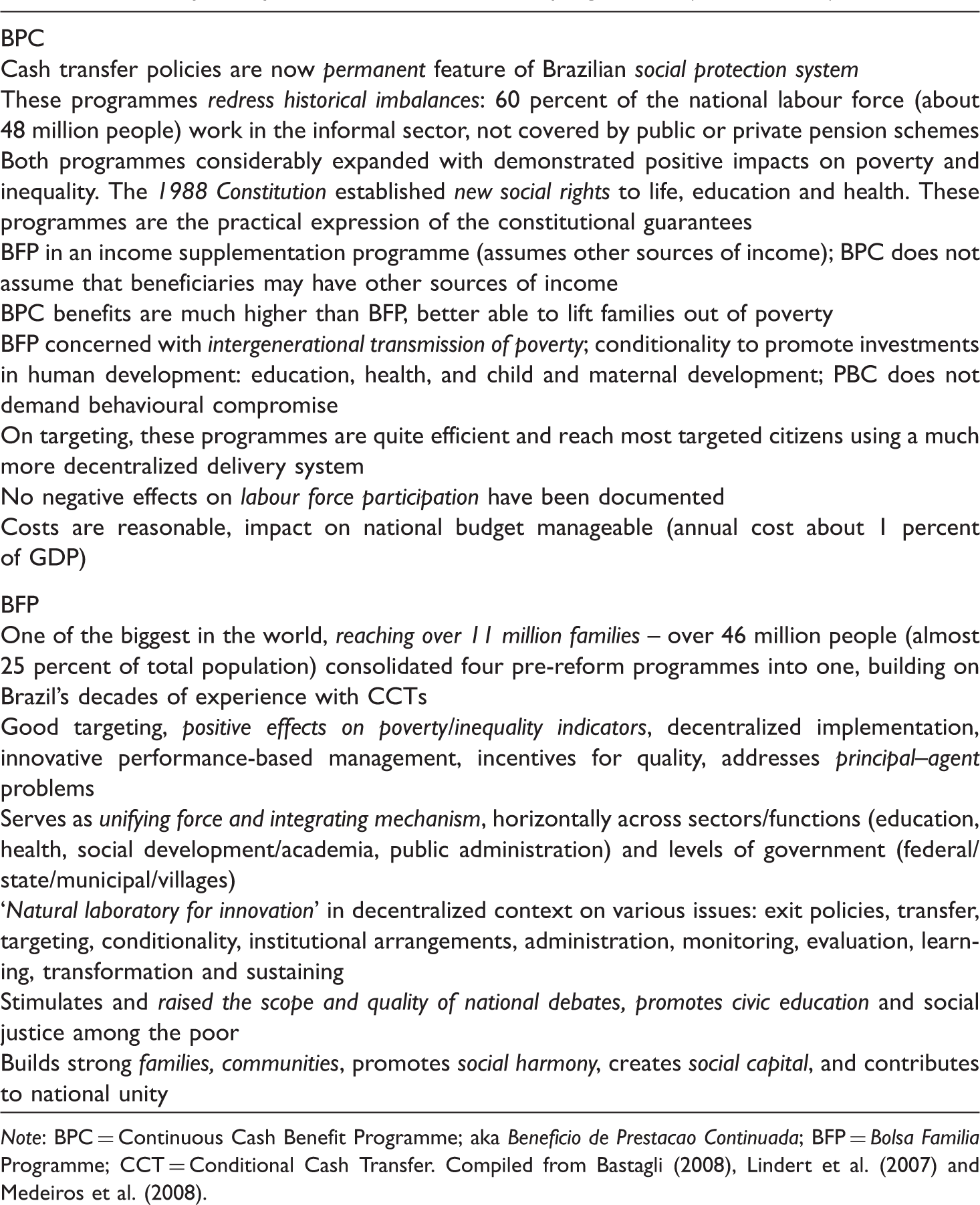
Note: BPC = Continuous Cash Benefit Programme; aka Beneficio de Prestacao Continuada; BFP = Bolsa Familia Programme; CCT = Conditional Cash Transfer. Compiled from Bastagli (2008), Lindert et al. (2007) and Medeiros et al. (2008).
The programme has provided the country with the opportunity to develop policy and operational coordinating and integrating mechanisms, horizontally across sectors and functions such as education, health, social child protection and development, and vertically across different levels of government. Lessons from experience gained here can be instructive for other countries whose governments wish to avoid the rigidities of bureaucratic silos and develop synergistic leadership, programme management and coordination. Over time, Brazil has developed a ‘natural laboratory for social innovation’ in areas of anti-poverty, social policy debates, development and decentralization. These cover a range of issues including conditionality, targeting, sequencing, exit policies, centralized–decentralized programme management, coordination, incentivizing, monitoring, learning, enforcement and avoiding policy reversals.
Open discussions of poverty, inequality and social justice by different political parties at different levels of government, professionals, academics, NGOs, the media and faith-based organizations within the country have stimulated and raised the level and quality of public debate, especially relating to the Brazilian essence of the state (raison d’Etat), and greater awareness by the poor in terms of their rights and responsibilities as citizens. The high quality of public debate contributes to good governance, widens and enriches the national policy community, and sets the stage for more transparent and accountable public administration. Lack of open quality debate leads to state capture, poor policy options and greater abuse of power. When the poor and marginalized are aware of their citizenship rights and the obligations of public officials, they are more likely to hold public agencies accountable. Civic education protects against ignorance, poverty, inequality, marginalization, discrimination and injustice. It is an effective mechanism for mobilizing the poor to protect their rights, educate themselves, hold governments to account and sustain progressive social change. According to the work done by COEP in the north-eastern part of the country, NGOs routinely provide civic education to the poor regarding their constitutional rights under Bolsa Familia and similar social programmes. Informed citizens receiving social benefits are more likely to stay in the programme and to observe the necessary conditionalities (Saxby, 2004, 2011).
Programme management and coordination
Bolsa Familia: summary of lessons from experience

At the local level, three interrelated factors have contributed to the success of progressive change in Brazil: first, the 1988 progressive constitution, which introduced new citizens’ rights to life and entrenched progressive social change. Second, the transition to democracy; creating deliberative space for the development of associative and networking communities, mobilizing the poor, providing protection against policy reversal and state capture because of frequent elections and because voting is mandatory. Third, the successful diffusion of social change resulting from shared ideology and social networking among various political, administrative, religious, civic and professional organizations. Diffusion of progressive social change occurs in Brazil when elected officials feel ideologically compelled to replicate successful programmes tried elsewhere, and when policy professionals both in government and in the private sector engage in relevant networks that promote socially progressive professional norms (Sugiyama, 2007). Here we see the need for the convergence between the interests and beliefs (ideology) of the political leaders and those of the professional class, resulting from the development of organized professionalism and professional norms of conduct, networking and shared values (ideology) among various segments of society. Therefore, countries undertaking administrative reforms need to pay more attention to the development of professionalism and professional associations and associative communities among various professions in both the public and private sectors.
Organizations from different sectors and mandates contribute different resources, competencies, values, management and coordinating tools. They need time (about ten years) to learn how to work effectively together and achieve synergy. One of the coordinating mechanisms among these organizations is the shared belief that poor communities must be empowered to define their own development needs, actively participate in setting priorities, mobilizing resources, implementing programmes, sharing lessons from experience and learning together. Corporations in energy like FURNAS (www.furnas.com.br) and natural resources with experience working in rural, isolated and poor communities are actively involved in progressive social development as part of their corporate social responsibility (CSR), developing sustainable communities in the areas where they do or expect to do business. Faculty and students (e.g. the Six Citizen Universities) are actively involved in advancing anti-poverty and progressive social change, not only as researchers, educators and consultants, but, more importantly, as advocates and activists. Fighting poverty and injustice is everyone’s business (see Table 3).
Under the Cabinet Office, MSD has the overall responsibility for policy and supervision, including horizontal and vertical coordination with other ministries and agencies, sub-national governments, civil society organizations and the private sector. MSD as a ‘super ministry’ created organizational management challenges such as redefining and aligning mandates, roles and responsibilities, pooling resources, coordination and standardization. It needed a strong and influential Minister close to the President to manage the transformation. The Bolsa Familia Secretariat (Secretaria Nacional de Randa de Cidadania; SENARC) oversees overall programme management and registry.
In order to link BFP beneficiaries to other complementary services within a more comprehensive social protection framework, SENARC works very closely with the National Secretariat for Social Assistance (Secretaria Nacional de Assistencia Social; SNAS), which deals with specific vulnerable groups such as the elderly and disabled, the National Secretariat for Food Security, which focuses on hunger and food security for the poor, and the Secretariat for Institutional Articulation and Partnerships (Secretaria de Articulacao Institucional e Parcerias; SAIP), which coordinates inter-government and inter-ministerial partnerships and outreach with NGOs relating to workers and incomes. Three federal control agencies, the General Controller’s Office, Federal Audit Court and the Office of Public Prosecutor, together are responsible for formal programme oversight and coordinate control functions of finance, accounting, audit and enforcement. The management and coordination of the programme works on the principle that what gets measured gets attention, what gets rewarded gets reinforced and what gets punished tends to disappear.
Within this decentralized environment, state governments play a significant role providing technical assistance and building capacities for municipalities, especially those with limited resources. State governments support training of municipal employees and help prevent abuse by providing identification and documentation for individuals and families in the cadestro unico. Although municipalities have direct responsibilities for programme implementation, they do not all have adequate resources or capabilities. Participating private sector and civil society organizations provide resources and checks on corruption and abuse. For example, Caixa, with country-wide coverage, provides financial services such as payments systems, maintenance and upgrading of the registry. Private sector participation promotes competition, innovation and diffusion.
Tools for programme management and coordination
Various factors contribute to the challenges of managing and coordinating the programme. It is large, growing and comprehensive, attempting to reach previously underserved citizens in remote villages or urban favelas, with limited physical and institutional infrastructure. The multidimensional nature of the programme with multiple objectives and multiple sectors adds to its complexity. Various government and private sector participating organizations, each with their own mandate, leadership style, value chains, institutional arrangements, operating systems and ideological biases all add to the challenges; so do distances among participating organizations and different types of beneficiaries.These distances may be physical (geography, infrastructure, rural–urban), economic (income, wealth, opportunities), socio-cultural (e.g. human development, family structure, language, ethnicity, illiteracy), or political (e.g. ideology). Differences in size and power among the different municipalities contribute added challenges. For example, mayors of smaller municipalities with limited resources resent the power and influence of mayors of bigger cities, municipalities and officials from the more powerful state governments. While frequent elections at different levels of government help to strengthen democratic support for the programme, they also inject a dose of uncertainty in terms of differences in ideology, policies, political support, personal leadership style, trust and relationships when governments change.
Programme management and coordination tools and their applications

Effective programme management and coordination combines legal, constitutional and hierarchical formal mechanisms with the more informal or organic tools, strengthening programme implementation both vertically and horizontally. The Decentralization Management Index (Indice de Gestao Descentralizada) was designed by the Federal Government to monitor and evaluate the quality of implementation of each municipality on four measures: (1) The share of families registered with a valid registry to measure consistency and completeness of information; (2) The share of families with registries updated at least within the past two years; (3) The share of BFP children with complete information on compliance with education conditionalities; and (4) The share of families with complete information on compliance with health conditionalities (see Lindert et al., 2007: 26). This and similar formal tools are designed to ensure national standards and to help weaker municipalities to acquire the necessary resources, build and utilize capacities and competencies to achieve national standards. This fosters unity in a vast and diverse country, characterized by inequalities at all levels of society.
Lessons in civic education for individuals and families about their rights and responsibilities as citizens and their programme entitlements, facilitate building local capacities to effectively access and utilize programme benefits. BFP is seen by the people not only as an anti-poverty programme, but also as a social contract, a unifying force for the country’s overall social policy reform, democratization, human rights and overall progressive social development. This provides informal but powerful tools for social cohesion and shared values, thus helping the citizens to accept ownership and internalize programme goals and successful implementation. Local leadership provides ongoing programme support and coordination by way of frequent contacts and lobbying politicians of major political parties at different levels of government and senior public servants, mainly through their professional associations. Access to the Internet connects and empowers poor people.
These findings are consistent with the literature on management in developing countries. Within organizations, simple routine tasks are coordinated by simple coordinating mechanisms such as hierarchy, rules and standardization, and MSD uses many of these. Complex policy or strategic management tasks are coordinated using correspondingly complex and informal integrating mechanisms such as shared values. Where two or more organizations are involved, integration is achieved by applying inter-organizational coordination such as the establishment of joint management agreements among the three levels of government, mayors of participating municipalities, or the private sector.The more complex coordinating mechanisms are more difficult to manage and require advanced management capabilities (Kiggundu, 1989: 130–141).
A model for progressive social policy
Drawing on the analysis of the Brazilian experience and the wider literature, we have identified four key factors which help to explain and possibly predict effective and sustaining anti-poverty strategies and progressive social change. These factors, shown in Table 5, are:
Contextualized enabling environment Reaching out and engaging the community Policy, programme design, management and coordination, and Institutional and constitutional entrenchment Drivers of anti-poverty and progressive social change
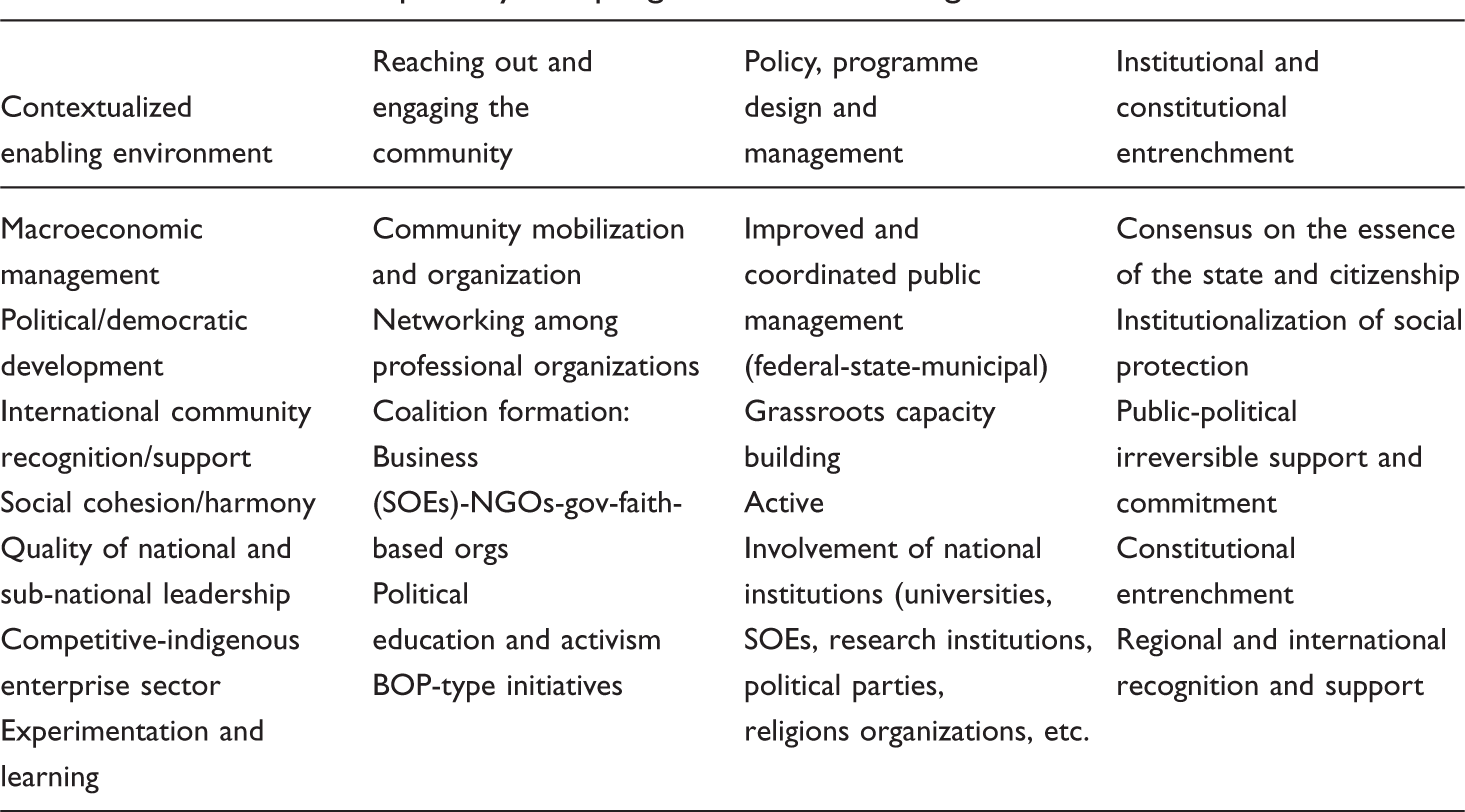
While these drivers appear intuitive, the important lesson is not to see them in isolation. Rather, they must be seen as holistic, interdependent and mutually reinforcing. For example, constitutionalism or macroeconomic management individually do not lead to sustaining anti-poverty and progressive social change. Exclusive focus on internal aspects of programme management and coordination without careful consideration of the effects of the nature and constraints of the external environment would undermine the long-term success and support for the programme. Reaching poor underserviced citizens or the bottom billions is a serious challenge for Brazil and other emerging economies (Collier, 2007; Kiggundu, 2009; Prahalad, 2006). The challenge programme managers face is to continually align management and coordination with the changing programme context and participants at different stages of implementation.
The key drivers necessitate building national and local capacities for effective macroeconomic management for growth with equity, political and democratic development, social cohesion, leadership, reaching out and engaging communities, policy and programme management, and institutional and constitutional entrenchment. The national constitution defines citizens’ rights to life and responsibilities to vote and participate in the political process. Macroeconomic management is important because without a functioning, productive and globally competitive economy, it is not possible to sustain anti-poverty and progressive social change (World Bank, 2005). Social cohesion facilitates peaceful coexistence, shared learning, equality, and a non-discriminating ‘harmonious’ society based on the rule of law for all, development and preservation of social capital (Aga Khan, 2008; Putman, 1993).
Finally, effective, credible and ethical leaders are needed at all levels of government, society and the economy (e.g. political, administrative, business, faith-based, military, academic). This involves a good mixture of charismatic, wise, decisive, technocratic, advocacy and spiritual leadership at different stages. Leadership is needed beyond those holding political office. Different leadership styles are needed at different stages of programme inception and implementation. At the beginning, there is a need for strong charismatic leadership, ideologically driven to give the programme vision, public support, legitimacy, and overcome opposition, resistance or distortions. During the early stages of implementation, there is need for technocratic leadership to mobilize resources, build systems and capacities for programme management. Administrative tools and control systems (e.g. registration, monitoring, enforcement) and ICT (information and communications technology) are critical for all participating organizations. Leadership is also needed to build a ‘smart government’ for progressive social change (Kliksberg, 2000). The next stage requires institutional building leadership for institutionalizing the programme: consolidation, scaling up, deeper penetration, more precise targeting, depoliticization and sustainability; avoiding policy reversal, neglect or institutional decay.
Summary and discussion
This article provides lessons from experience relating to policy and programme leadership, management, coordination and the context within which anti-poverty programmes are implemented. Still, much remains unknown and there are always ongoing challenges. For example, Borins (2001) identified five generic challenges of innovation and diffusion in government including the use of the systems approach and information technology, process reengineering and improvement, the involvement and participation of the private or voluntary sector, and empowerment of communities, citizens and staff. All these five apply to the challenges of managing anti-poverty programmes and driving social change in Brazil and elsewhere.
Finally, the key challenge that motivated this article relates to the need for cross-country fertilization: experimentation, drawing out evidence-based lessons from experience, shared learning and adaptation according to country-specific conditions. The idea is not to blindly copy policies or implementing modalities from other countries. Rather, the objective is to undertake serious analyses of experiences, especially in countries from the South with sound field experimental approaches to progressive social change, identify key success factors (what works, what doesn’t), the conditions under which these factors work or do not work, and compare with one’s own country-specific conditions. Based on this knowledge, one can adapt appropriate context-specific policies and design implementing strategies and tools, and continue experimenting. This approach eliminates some of the guessing and wasteful trial-and-error initiatives.
One interesting area for further research is the study of incentives, disincentives, sanctions and enforcements in the management and coordination of anti-poverty and progressive social change. The Brazilian programme applies a variety of tools for incentivizing and sanctioning programme participants in government (e.g. public officials), among beneficiaries (e.g. lactating mothers) and private sector organizations (e.g. Caixa). Incentives and sanctions can have intended or unintended consequences, especially when applied in diverse and changing circumstances. Looking ahead, we follow Riggs by calling for comparative studies of anti-poverty and progressive social change among developing countries and emerging economies. Such studies must be empirical, nomothetic, and ecological (Riggs, 2010: 758).