



Abstract
It can be argued that because of the rise of New Public Management and the growing dominance of labor law and HRM practices, the so-called ‘traditional’ public law formulation of the position of civil servants has come under pressure in a number of Western European countries in recent decades and have shaken the ‘bargain’ agreed between the political and administrative leaders since the Second World War. By contrast, in Central and Eastern Europe and Britain, new Weberian-type civil service legislation has been introduced. In this analysis, we examine both apparent opposites from a public sector bargains perspective and find that European countries are at a crossroads in their reflection on the ‘bargain’.
For practitioners in this field two considerations are important to note. The first is that while the discussion about the (legal) position of civil servants within their political-administrative system may seem to be a national debate, in essence it forms part of a more general debate that is conducted all across Europe. The second is that both theoretically and empirically, two dimensions of the bargain have to be distinguished, namely on the one hand the material labor conditions (pay, job protection, etc.) and on the other hand the values of bureaucracy (impartiality, integrity, loyalty, etc.). As our empirical analysis shows, these two dimensions have become increasingly independent from each other in the discussions and reforms in various countries over recent decades. In other words, managerial reforms in terms of material labor conditions have in practice been paired with the renewed emphasis on Weberian values of bureaucracy. Whether this decoupling is sustainable from a policy point of view in the long run (i.e. whether Weberian-style labor conditions are or are not conditional for high levels of Weberian values of bureaucracy), remains to be seen.
Keywords
Introduction
The formal and informal arrangements determining the position of civil servants and the relationships with their political principals have come to be described in terms of public sector bargains, or PSBs (Savoie, 2003; Hood and Lodge, 2006). The idea of such bargains encompasses a wide variety of dimensions, i.e. conventions about accountability, recruitment, career, political neutrality, duty, mandates. A more general tension in contemporary public administration is reflected in the discrepancy between managerial employment arrangements vs Weberian civil service values: governments and governmental organizations are required to satisfy two opposing sets of demands; the first set is a managerial set of demands (effectiveness, efficiency, flexibility and managerial discretion), and the second set is a set of Weberian demands (integrity, non-discrimination, rule-based conduct, risk-avoidance and frugality).
In this article, we focus on the perspective of employment security and professional and ethical norms related to political neutrality and integrity. The reason for this is that both topics have been major issues in many European countries over recent decades. Moreover, the centrality of employment security is also relevant from an analytical point of view: this particular angle connects the idea of bargains to the discourse on managerialist HRM arrangements and flexibility in the personnel system. In addition, it addresses the essential question of the degree to which civil servants should enjoy a more protected employment position than employees in the private domain.
The direct motivation for this study is empirical: the resurgence of the debate on the legal position of civil servants in the Netherlands has given rise to questions of a cross-national comparative nature. In the Netherlands, the debate is closely connected to the question of the specific character of the public sector and working for the government vis-à-vis working in the private sector (i.e. the distinct nature approach), or the idea that there is (or should be) no fundamental difference between a job performed for the government and a job performed for a private corporation (i.e. the harmonization approach, as it has become known in the Dutch context).
A quick scan across a set of European countries suggests that over the past 15 years, many countries have arrived at a similar juncture regarding the position of civil servants. We hypothesize that for countries at this crossroads, there have been three broad paths available. The first is a left turn that reinforces the ‘distinct character approach’ to the legal arrangements regarding the civil service. This approach implies that working in the service of the state entails working in a political, democratic and legalistic environment, and that therefore arrangements for civil service will differ from labor arrangements in the private sector. The second path maintains the status quo without any real decisions or changes. The third path is a right turn towards the elimination of special civil service rights and responsibilities.
In this analysis, we investigated the experiences of nine Western European countries, plus Central and Eastern European countries, as a more or less homogeneous group of states. After discussing some considerations on the historical roots and challenges for comparison, we present our findings first for the Netherlands, a country which seems to have made a right turn and sought to alter the special bargain it has struck with its employees. Then follows a cluster of countries that took a similar route (Sweden, Denmark, Italy and Switzerland). The second cluster of countries (Germany, Belgium and France) have chosen to maintain the status quo. Lastly, we turn to countries that have taken a left turn, i.e. in which the distinctiveness of public sector work has become increasingly emphasized in the past 15 years: the Central and Eastern European Countries and Britain. To conclude, we analyze and review our findings in terms of changing bargains.
Our study demonstrates that each country’s political culture and experience over the past 25 years influenced the direction that country ultimately chose. For this analysis, we use secondary material, mainly single case studies by country and some comparative studies, which have covered multiple countries in this analysis.
Public Sector Bargains and the challenges of comparison
It is almost a cliché to state that, notwithstanding a myriad of technologies, public administration is, first and foremost, a matter of human interaction. Nonetheless, it signifies that the quality of public administration depends to a great extent on its administrators: politicians and civil servants. The position of both groups of officials is defined through a multitude of institutional arrangements and, in a formal sense, through legislation. Their positions are the products of an evolutionary process in which formal and informal rights and obligations have been defined through the interaction of a wide variety of actors. Our analytical focus is on the changing (legal) position of public employees; conceived as a changing public sector bargain. The public sector bargain perspective is essentially focused on implicit or explicit outcomes in which politicians gain some degree of loyalty, expertise and competency from civil servants. In return, those civil servants obtain a place in the government structure, responsibility and rewards (Hood, 2001; Hood and Lodge, 2006).
Hood (2001) distinguishes between two main types of bargains, systemic bargains and pragmatic bargains. The most important difference is that systemic bargains refer to systems where the public service is part of a fundamental constitutional settlement, while pragmatic bargains refer to systems where public servants’ rights and duties are a more or less convenient agency arrangement between politicians and bureaucrats. The systemic bargain is divided into two subtypes: the consociational and the Hegelian bargain. The pragmatic bargain consists of three types: the Schafferian, the hybrid and the managerial bargain (see Hondeghem and Van Dorpe, and Hansen and Steen, in this issue).
Hood suggests that a shift is occurring, at least for civil service systems of the Westminster type in terms of pragmatic bargains, particularly as governments move from Schafferian bargains to managerial bargains. The managerial bargain involves:
a ‘turkey race’ with respect to rewards (agreement to rewards based on individual competition); a deliverer attitude with respect to competence (provision of the ability to get things done); and an executive type of loyalty (the civil servants acts to pursue defined goals in some limited and revocable space of action).
Hood’s suggestion may seem plausible in the light of the many NPM-inspired reforms in most of the European countries over the past 25 years. However, it should not automatically be assumed that change occurs in each country in the same direction, let alone in the same way or at the same speed. First of all, the question is whether the change processes in countries with a systemic type of bargain are similar to those in countries with pragmatic bargains. If bargains in all countries are moving towards the managerial type, does that mean that the systemic types of bargains (consociational and Hegelian) are slowly disappearing? In this article, we explore the shifts in bargain types for a number of European countries that originally had systemic and pragmatic bargains.
Before embarking on the empirical analysis, it is important to note that the debate on the separate legal definition of the position of civil servants is complicated by the wide variations in concepts, definitions and demarcations across the countries. The great variety of terms and definitions given the specific and unique character of the system of public governance in each country may result in a comparison of apples to oranges. Given the variety in the usage of terms, the terminological discussion about the definition of government personnel, civil servants and civil servant status is challenging even within one country. This confusion becomes even greater when we involve a cross-national comparison. For instance, the Dutch term ambtenaar does not signify the same thing as the French fonctionnaire, the British civil servant or the German Beamte. There is a danger of treating the substantive characteristics of a term in one of the various languages as the standard against which the terms from other national systems are measured. There is no such thing as a standard description of a ‘real civil servant’. Sometimes, comparative civil service system research efforts remain unsatisfactory as a result of a confusion of terms (see Demmke and Moilanen, 2010). There is a tendency to reserve the concept of civil servant only for those staff members who are employed within the so-called classical Weberian career bureaucracy. This approach might be somewhat too Franco-German inspired. We use the terms civil servant and the civil service in a more general way: they refer to public officials and public service regardless of the employment sector or political-administrative and legal regimes (Demmke and Moilanen, 2010).
The legal translation of these bargains will vary according to the country and its political institutional system. They might be laid down in statutory law or in government prerogatives (or both). They might be codified or not. The legislation might be established in a framework or a comprehensive law. They might be enshrined in constitutional law with or without qualified change mechanisms. These different forms have considerable consequences for changing and altering these bargains thereby delivering additional bargaining instruments and influencing the bargaining game.
The turn to the right
The Netherlands
When the modern Dutch constitution was debated (1848) its drafter, Johan Rudolf Thorbecke, and most legal experts emphasized the importance of a (constitutional) legal anchoring of a professionalized civil service. Yet, Parliament refused, partly because of fear of rising financial costs (Stekelenburg, 1999). Fifty years later, pressure by public sector labor organizations and constitutional lawyers resulted in a civil service law. The Civil Service Act (Ambtenarenwet) was adopted in 1929. The accompanying by-law (ARAR) for central government was issued in 1931. These laws regulate and define the constitutional and legal position of civil servants. Under the scope of these laws, civil servants enjoy so-called ‘public law status’. Since 1931, in cases of labor disputes, civil servants have been able to access administrative legal courts and procedures instead of using administrative appeal procedures (Van IJsselmuiden, 1988; Stekelenburg, 1999). So, the bargain that developed in the Netherlands in the pre-Second World War period is most similar to the Schafferian Public Sector Bargain. In the post-Second World War period, other elements were added to the Dutch bargain. In the 1970s and 1980s, when representativeness in the civil service became a priority, elements of the consociational bargain were added. Later, in the 1980s and 1990s, reforms also included the addition of some elements of the managerial bargain.
Most material provisions accompanying the CSA 1929 are established in (decentralized) by-laws, reflecting the decentralized nature of the Dutch state. As such, the CSA has the character of a framework law. Each government employer has separate by-laws regulating material provisions with regard to rights, duties and rewards, and each government agency determines its regulations. Since 1993, umbrella organizations for government employers and trade unions have worked together and bargain in a decentralized bargaining system (the labor sector model consists of 14 sectors). Employers and trade unions meet each other (rarely nowadays) in a council on public personnel issues (ROP) and cooperate and meet informally in the Center for Public Labor Relations (CAOP) (Dijkstra and Van der Meer, 2011).
Since the late 1950s, the issue of the use and necessity of a separate arrangement for civil servants has been a regular feature of the political agenda. Constitutional and administrative lawyers have typically favored maintaining the status quo, while labor law experts favored drastically reforming the arrangement, especially with respect to rewards, employment security and social security. Nevertheless, the system has been maintained – with the single exception of harmonizing the social security system with that of the private sector. Recently, substantive discussions have started anew. The 2010 coalition document (in which the coalition parties set the government’s policy agenda for its term) included an announcement stating the government’s intention to abolish the public law appointment and administrative legal protection. And in November 2010, two MPs (Fatma Koser Kaya – Liberal Democrats, and Eddy van Hijum – Christian Democrats) submitted a bill abolishing the public law position of civil servants and harmonizing it with private sector labor law. 1 After revisions, the scope of the bill was limited to the rules of appointment, termination of employment and administrative legal review. The CSA and other non-substantive provisions would be maintained and elaborated by the Ministry of the Interior. Other public law regulations would remain in force.
Interestingly, recent debates on reviewing the status of public servants have almost exclusively focused on labor law and managerial aspects of the public status (Van Peijpe, 2005). In the earlier stages of the debate (in the 1950s and 1960s), the constitutional and public administration aspects of the issue received the most attention (but see Van der Meer et al., 2012). Proponents of abolishing the public law status seem to downplay aspects such as the public legal codes relating to integrity, anti-corruption and political-administrative interaction and the basic rights of civil servants. Yet public administration experts, constitutional lawyers and notably the Council of State have stressed the importance of these neglected issues.
The Dutch Council of State, the highest body advising Parliament and the Government on the quality and feasibility of proposed legislation, has expressed its formal opinion on the harmonization bill in the most critical terms. The Council argues that the bill neglects the distinct character of employment within a political and governmental context. Furthermore, the Council sees no reason to expect the type of flexibility and cost reductions the bill’s authors foresee.
The above discussion shows that the debate regarding the legal position of civil servants has regained significance in recent years. Although the public law system has been maintained, the major exception has been the equalization of the social security system with that in force in the private sector. This can be explained in part by the increased attention given to labor market regulations in general, but there is also a clear element of a revival of attention to the Weberian principles of bureaucracy. Therefore, we conclude that although no final decision has been taken regarding the reform of the legal status, the discussion is of significance in itself, independent of the final outcome.
The status of public servants as perceived by interested parties in the Netherlands
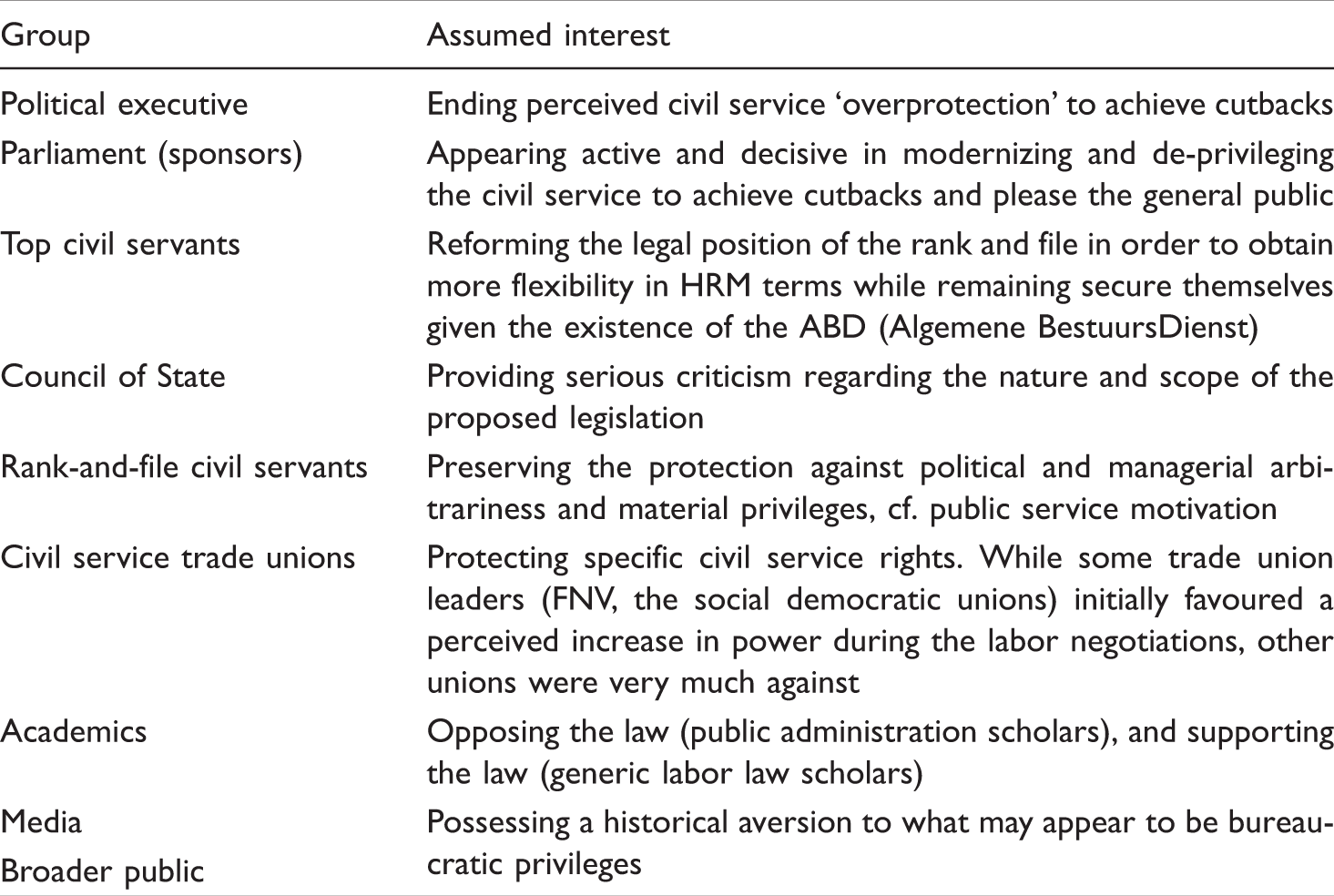
Scandinavian countries: Denmark and Sweden
In Denmark, the majority of governmental personnel work in the service of the state on the basis of a collective labor agreement. Just as in Germany (section on Germany below), Denmark has Beamter, and staff who work for the state but do not have the status of a Beamte. Beamter include senior civil servants, judges, police, prison and defense staff, and high officials in the State Church. While other public sector employees are not formally appointed as civil servants, the Civil Service Act and the Civil Service Pensions Law apply to them. Other labor arrangements such as the Holiday Act, the Equal Treatment Act and parental leave apply equally to both public and private sector employees. This constellation has been in force since 1 January 2001 (Minister of Finance, 2005). It is important to note here that although Denmark has partially normalized the legal position of a large part of the public sector personnel, there is an additional, parallel system in operation that has remained untouched (see also Niessen, 2010: 25). Also, it is interesting to see which categories are considered part of the inalienable domain of the state, and which categories fall outside of it.
In Sweden, civil service status was abolished during the heyday of NPM in the 1990s, and the legal position of the large majority of public employees was equalized with private sector employees. Like Denmark, Sweden has crafted an exception to the judiciary. Moreover, we have to consider that egalitarian and cooperative (neo-corporatist) labor relations are part of the typical features of the Swedish societal model. In cases of involuntary termination of employment, the legislator takes a restricted role. The 1970 Termination of Employment Act provides possibilities for redress against firing and for rescinding the involuntary termination; in cases of employer non-compliance, this can even result in financial compensation to the employee. Employers and employees enjoy a substantial degree of discretion in composing their collective labor agreements (Heemskerk, 2009). In the Swedish model, an independent agency manages the negotiation process, and the government is only involved at a distance. It is important to note that this seemingly depoliticized model has its drawbacks, for example, concerning the politicization of the civil service and the preservation of a certain esprit-de-corps among civil servants.
Thus, the developments in Denmark and Sweden signify a turn to the right: due to the relatively recent reforms in both countries, the bargain between politicians and civil servants has developed more in the direction of a managerial bargain, at least with regard to employment relations.
Italy
Italy took a turn to the right 20 years ago as the public law status of labor relations for senior civil servants was eliminated in 1993 as part of reforming the perceived defunct political-administrative system. Turning to NPM solutions, the legal position is now organized under private law. The aim of this reform was to neutralize the civil service in a political sense, to generate more mobility, to clarify the separation of roles between politicians and civil servants, and to enable a degree of accountability for the individuals involved in terms of their compliance with these norms. The emphasis in Italy is clearly on professional quality, integrity and political impartiality, as opposed to financial savings or the application of market mechanisms to HRM within the government (Gualmini, 2012). The bargain was changed in 2002 when it was decided that top civil servants (secretary-general level) would again be appointed by decree (a unilateral public decision) (Ongaro, 2009). In doing so, the privatization of the top civil servants’ positions has been partially reversed. Under the revised policy, their appointment is under public law, but their salary is determined on an individual basis by private legal contract once every three years.
Therefore, the public service bargain has evolved with greater emphasis on the non-material aspects of the civil service. Professionalism, integrity and political neutrality, and not managerialism, were the main drivers of reform for the public law status of senior civil servants. We conclude that Italy has taken a turn to the right, but partly reversed this reform for the category of top civil servants, thereby rehabilitating the Schafferian bargain for the top managers.
Switzerland
Switzerland is often cited as an example of a normalized system. In 2001, a referendum resulted in a new Federal Personnel Act which replaced the old Civil Service Statute. The executive relied on anti-bureaucratic sentiments among the general public, and the referendum proved them right. Thus, the instrument was used to change the PSB in legal terms. The referendum allowed the executive to circumvent the resistance of the public sector trade unions, and the decision attained additional direct democratic legitimacy. In this manner, the bargaining position of trade unions was undercut. Also, at the Canton level the status of Beamter had been removed in a number of cases, and as a result, civil servants have to be reappointed to their position every four years, a time-consuming and inefficient process that has since been eliminated. Moreover, a number of categories of Swiss civil servants have remained – also under the new regime – under public law. Article 8 of the Bundespersonalgesetz states: 1 Das Arbeitsverhältnis ist öffentlich-rechtlicher Natur (The labor relations (for federal government staff) is of a public law nature). The elimination of the Beamtenstatus has not resulted in the elimination of the special legal position for these civil servants. The elimination can better be understood as a measure to promote the efficiency of HRM policies and civil service professionalism as opposed to equalizing the legal position of civil servants with private sector employees. Moreover, public sector employees continue to enjoy greater employment protection than private sector employees.
In short, the reforms in Switzerland seem to imply a relatively fundamental modernization along the lines of New Public Management, since the substantive meaning of the term Beamte has changed, but at the same time this change has not involved a real movement towards a managerial bargain.
Maintaining the bargain
Germany
We now shift to the cluster of countries that appear to have continued on the same path, i.e. the position of the civil service remains largely unchanged. Germany is considered an exemplary country with respect to the distinct status of its civil servants. Germany has both Beamter, who are employed by the state and fall under public law, and ordinary public sector personnel, whose employment is arranged according to private law (Angestellten). Historically, Beamter have enjoyed a special legal position since their relationship with the state is more extensive than the average citizen. Beamter are positioned closer to the state, and they are the representatives of the state vis-à-vis society. Beamter owe the state special service and loyalty, and in return, they are granted certain privileges (with the exception of the politische Beamte). These include life-time employment in terms of salary, compensation in case of illness, and retirement pension.
After the Second World War, the Allied Forces abolished the Beamtentum in West Germany; holding this institution (partly) responsible for German aggression and not only failing to uphold the rule of law in times of totalitarianism but in fact for supporting totalitarian rule. However, this legal position under public law was reinstated in 1950. In recent decades, the number of Beamter in relation to the general public service has decreased slightly, but this is primarily a by-product of the privatization and the fact that no new Beamter have been appointed within the formerly state-owned enterprises (aviation, post, railways). Individuals who worked for the organization at the time of privatization have maintained their status of Beamter. Also, in public organizations such as independent public bodies, the number of appointed Beamter has decreased given the changing position and status of these organizations.
The majority of the German governmental personnel are not Beamter, but Angestellten. The Angestellten are employed by the government on the basis of a labor contract. Reforms affecting both groups have been carried out in recent years. The aim of these reforms has been to create more transparency and standardization within the HRM system, but in Germany, the principle of a separate status for servants of the state (albeit for a select group within the larger apparatus) and the underlying consideration have not changed; and among the dominant group of academics (the constitutional lawyers), it is still the formal doctrine. The 2006 Constitutional (federalization) Reform has had consequences for civil service legislation. Although civil service unions resisted, the Federal and Länder governments agreed to replace the old framework with a Beamtenstatusgezetz; a Bundesbeamtengesetz for the federal level and Landesbeamtengesetzes for the Länder level. These instruments decentralized career, pension and remuneration issues to the Länder with due consequence for position (particularly regarding flexibility of the career system by combining or abolishing the different Laufbahngruppen (career systems) of Beamter at the municipal level (see for instance Bavaria and Rhineland-Palatinate) and salary differences among the Länder on these issues given the financial situation of the Länder (Goetz, 2011). Still, as in Belgium, why do some functions in organization A receive Beamte status while the same functions in organization B receive Angestellte status as is the case between various municipal governments? In the municipalities (but not so much the Länder) of the former GDR, there is no historical distinction between Beamter and Angestellten. The proportion of Beamter is believed to be lower than in the Western parts of Germany, though both in absolute and relative terms their number is increasing even in the East.
In terms of public sector bargains, in Germany the systemic type of bargain is still in place. While some elements of the managerial bargain may be visible in the German context, there has been no system-wide change in terms of job protection, neutrality expectations, or salary adjustment mechanisms. Therefore, there are insufficient grounds to conclude that in Germany the public sector bargain is moving towards a pragmatic bargain type.
Belgium
The vast majority of governmental personnel in Belgium have a statutory appointment under public law. In addition to these civil servants, there are also contract employees who are employed on the basis of private labor law. While labor conditions in the private and public sectors have become increasingly similar, values such as ethics, impartiality and civil service professionalism have progressively become part of the discussion. At the federal level, 27 percent of civil servants have a contractual appointment (Hondeghem, 2011). There is less outsourcing for lower-level functions compared to other countries. Besides basic functions, contracts are also used for flexible and technical jobs (Janvier and Peeters, 2005). In local and provincial authorities, more individuals work on the basis of a labor contract.
After an initial, dramatic increase in contract employees, proportions have stabilized since 2005. Often, contracts are used for obligatory job placements or subsidized jobs (both of which may be permanent in nature) and functions at lower levels. Sometimes, the criteria are less clear. There is an ongoing discussion about the rights of contract employees vis-à-vis civil servants since the former enjoy less protection (also see De Becker, 2011, for a political point of view) and have fewer career opportunities (Hondeghem, 2011). For this reason as well as NPM and performance management reasons, the issue of a single unitary statute for all public sector personnel has been raised in academic public management and HRM circles (see, among others, for the local and provincial levels: Janvier and Janssens, 2003; Janvier and Henderickx, 2010). This has not yet led to concrete results although both the Flemish government and the unions want to address the most negative aspects of the divide between statutory and contractual public officials. An important consideration in explaining Belgian inertia is the division in Belgian labor organizations between blue- and white-collar workers unions and a stalemate in politics and administration due to the numerous political divisions and neo-corporatist relationships.
Recently, the Belgian federal government has re-fuelled the debate by arguing that the differences between statutory and contract public sector employees should be decreased. It also argued that such a decrease should not lead to abolition of the public law status of statutory civil servants. This implies that the Belgian federal position is that it would rather widen than narrow the group of civil servants with public law status (De Standaard, 14 August 2012).
France
The French Constitution states that Parliament is in charge of the protection of servants in the military and public service. The Constitution, however, is not explicit about whether employees in the public service should have a distinct status under public law. The legal basis for appointments (which, given its public law nature, is necessarily unilateral) is established in ordinary legislation. A contractual appointment in the French public service is only possible if (a) there are no civil servants who can fulfill the position, and (b) the position is temporary or the position is included in a list composed by the Conseil d’Etat for this specific purpose. All other employees in the French public service fall under public law. There are three so-called fonctions: the central level, the decentralized level and health care. One of the typical features of the discussion in France is the position of the Corps (see Van den Berg, 2011). France has a corporate organization based on a career system categorized by profession. The advantage of this system is professional expertise and the emphasis on specialists. A disadvantage is the large degree of fragmentation and corps particularism, especially with respect to the power of the so-called Grands Corps. On this point, policies are oriented towards minimizing the disadvantageous effects by limiting the power of the corps and corps mergers (Bezes and Jeannot, 2011). In reforming any of these areas, the powerful French unions must be taken into account. According to Jeanne Siwek-Pouydessau (2010), civil service unions follow a threefold strategy: ‘resistance without concessions (Force Ouvrière), defense of a civil service that serves citizens (CGT) or analyses focused on methods that are deemed to be inadequate (CFDT union)’.
So, from a PSB perspective here has been a considerable degree of stability in France: the changes that occurred have been within the boundaries of the systemic bargain that was in place.
The turn to the left
East European countries
In this cluster of countries the distinct nature of public sector service has been emphasized more in the past 15 years than ever before. The former communist countries of Central and Eastern Europe have adopted a distinct position in this debate. In the communist era, civil service systems were heavily controlled by the dominant party; there was no separate legal position for the civil service, and they had little power to counteract this dominating influence of party and political officeholders (Dimitrova, 2002). The system at the time was also heavily affected by personal relations originating from the (political and party) top down, resulting in nepotism and favoritism. After the fall of communism, initiatives have started to equip the administrative organization with a solid foundation that allows expertise and (political) neutrality to become more prominent. These reforms were encouraged by the accession process to the European Union (Verheijen, 1999). This has led to a legislative process in which new (public law) civil service acts have been developed. The reform of the public service in these accession countries was one of the most important prerequisites in the period following the Copenhagen (1993) and Madrid (1995) EU summits. Additional criteria state that there will be a professional civil service that is depoliticized and merit based, and that this civil service should work according to formalized standards of integrity. In this way, EU accession criteria have contributed to Weberian-inspired civil service legislation in these countries (Goetz, 2001). However, it appears that political leaders have tried to circumvent these arrangements and delay their implementation.
In Central and Eastern European countries, most of the public sector reforms have been broadly oriented towards creating modern civil service systems that benefit from the experiences of NPM in a number of Western (mainly Anglo-Saxon) countries. Yet when it comes to the efforts to institutionalize specific values of ethics and professionalism, the choices that have been made by the governments and those that have been made for them by the older members of the European Union reveal a clear penchant towards Weberian norms which stress the distinctiveness of working in the political and legal context of the public sector (Verheijen and Rabrenovic, 2007). In this sense, the Central and Eastern European countries have opted for a systemic rather than pragmatic type of bargain.
Britain
Britain is often hailed as an example of a state without statutory civil service provisions. This case shows a wide range of public officials governed by different employment schemes and regulations depending on the level of state, the level of the public service, etc. Focusing on the civil service, there has been a formalization of the position of these civil servants with the adoption of the Constitutional Reform and Governance Act 2010. The background to this formalization is that the former arrangement had come under pressure, partly due to New Public Management-style reforms. For participants in the bargain (primarily civil servants and ministers), it had become increasingly unclear how roles and responsibilities should best be fulfilled. A reconsideration of the arrangements followed. Interestingly, the reforms involved in the Governance Act are much like the proposals that Northcote and Trevelyan formulated in 1854 as part of their Report on the Organisation of the Permanent Civil Service, but thus far had not been put into practice.
The present Governance Act provides the British civil service with a legal basis by formally establishing the core values of the civil service – i.e. impartiality, integrity, honesty and neutrality – and the principle of merit-based appointment. The Act also establishes rules concerning the ‘special advisers’ and the Civil Service Commission, the institution that is responsible for policies concerning government personnel and recruitment procedures.
The effects of the Constitutional Reform and Governance Act can be seen as a step in the direction of a Weberian rule of law model of civil service legislation – even though until recently British attitudes appeared to be fervently opposed to the codification of these types of norms. The absence of such legislation has traditionally been seen as one of the defining features of the British civil service and a matter of course, given the typically British state- and governmental tradition which was thought to be much less legalistic than the various Continental-European administrative traditions.
This is interesting for two very different reasons. First, developments in Britain may serve as an indicator for cross-national convergence in how the legal position of civil service has been organized in the various EU member states: the fact that Britain moved towards a more or less Weberian conception of the civil service reduces the fundamental differences across the countries of Europe. Models that used to be starkly different seem to be converging: the continental systems adopt elements of the Anglo-Saxon system (less protection in material terms and more similarities with the labor conditions of the private sector) while Britain adopts elements of the continental tradition (codification of core values and constitutional obligations). On the other hand, the introduction of this act in Britain can be seen as a modern response to the important questions concerning the expanding number of special advisors, who are not bound to the norm of political neutrality, and who have become increasingly influential over recent years – usually at the expense of the position of impartial career civil servants (Peters and Pierre, 2004; Van den Berg, 2011).
Second, various aspects of the developments in Britain seem contrary to the privatizing reforms that have taken place in countries such as Italy, Sweden and Denmark. In Britain, the special public, legal nature of the civil service is given greater emphasis.
Trends in rethinking the bargain
This tour of a number of European countries demonstrates that the debate about civil servants’ legal position in a changing societal and governmental context is on Europe’s agenda. It also shows that the discussion is not limited to labor law, but that it also includes the legal position of public sector employees as part of a broader debate about the role and position of the civil service. The discussions in the various countries revolve around professionalism, interactions with and relations to politics and society, and the degree of independence within the bureaucratic organization. A transformation from the ‘distinct nature of the public sector’ bureaucracy and deployment system towards an administrative apparatus ‘equalized’ with that of the private sector looks like a shift from Schafferian bargains towards more managerial-oriented bargains. However, the movement in the various countries mentioned above seems to be contradictory to this presumed trend.
Generally speaking, it seems that decision-makers have increasingly let the labor conditions and social security issues in the public and private sectors become more similar. By contrast, the issue of ‘normalization’ of civil service rewards is explicitly avoided in most cases, given the political and societal sensitivity of public sector rewards in general (see Peters and Brans, 2011). There is ample attention given to a public law arrangement relating to integrity, moral competency, political neutrality and the protection of civil service professionalism, which are closely related to the other issues mentioned; but again, this goes against a pure managerial bargain and more towards a hybrid bargain.
This implies that the two main aspects of public service bargains that we have examined, the legal arrangement surrounding employment and the ethical and professional norms regarding civil service integrity and political neutrality, are quite independent from one another. While we see a movement towards the managerial bargain on the substantive side, on the ethical side we witness a move in the opposite direction. For instance, in the Netherlands, where employment arrangements are undergoing reform following the harmonization model, ethical and professional norms are still very much stressed. One could even argue that the discussion concerning abolishing a special civil service status has led to a reformulation of the importance of that status by the opponents of these proposals. Even in Britain, where ethical norms are increasingly made explicit and codified in rules, employment arrangements are not following the same path away from the traditional British model.
We suggested earlier that despite some discrepancies in the context and time of origin, all European countries have developed extensive legal and more or less formalized frameworks for their public service over the past 150 years. This development can be seen as part of a bureaucratic revolution that is strongly associated with the development of the rule of law (Van der Meer, 2009).
Analyzing the relationship between politicians and civil servants in PSB terms (Hood and Lodge, 2006), a civil service law framework formalizes public sector labor relations (and ensuing bargains) into law. Through this legal entrenchment, these relationships were made more durable, they limited the room for interpretation and they provided bargaining power in future encounters. All of these features depend on the nature of the translation from law into the formal and informal elements of the public sector bargains.
According to the PSB concept, these bargains are the implicit or explicit outcomes consisting of two sides: politicians gain some degree of loyalty, expertise and competency from civil servants, and civil servants secure a position in the government structure, responsibility and rewards. In the legal framework, the (formalized) bargained outcomes are made explicit in legal rules. Changes in the legal frameworks thus mirror changing bargains. The (legal) translation of the bargains varies based on differences in political institutional systems in each country.
The term bargain suggests (two) directly involved (contractual) parties: politicians and civil servants. What became clear in this study is that in effect, many other actors are directly and indirectly involved in the bargains. First, it is a misconception to view both groups as unitary players. These players consist of a variety of actors with their own interests, rationales and bargaining positions forming temporal associations and fluid coalitions. For instance, within the group of politicians, ministers should be distinguished from members of parliament and party officials. The same applies to other levels of state and, in some cases, to various sectors. Within the category of civil servants, there is a multitude of relevant lines of separation including government level and functional sector but also across hierarchical levels involving top and senior civil servants and the ‘rest’, and between functionally politicized and functionally bureaucratized senior civil servants (Van den Berg, 2011). Second, the civil service unions play a role depending on their (formal) inclusion in the government–labor relation mechanisms, the rate of membership mobilization, and the degree of ‘radicalism’. Besides the ‘usual suspects’ (executive officeholders and civil servants), other influential actors should not be disregarded: international organizations and institutions (EU and OECD primarily in the European cases) and the ILO and Human Rights institutions and courts at various levels. In addition, in some countries, professional associations, academics (in this case labor and constitutional law and political scientist and public administration experts) play a role.
A PSB perspective in this case seems particularly appropriate when examining the definition and the redefinition of the (legal) position of public employees within the wider political administrative system of a particular country. In the past, the reasons for a formalized construction under public law have been argued in terms of a fairly simple bargain. A structured rewards system, an ordered system of tenure, promotion, protection against nepotism and political interference were offered by the political system, and rewards and a place within the administrative system were offered in exchange for loyal support.
From discussions in political, professional and academic quarters, the suggestion might arise of a movement towards what has been termed the normalization or harmonization of the (legal) position of public employees copying private sector standards. Some very fundamental assumptions regarding the nature of government in society and relatedly the nature of public employment underlie what might be considered a primarily legal debate. The movement towards normalization is inspired by ideas concerning the generic nature of public and private employment. Private employment schemes could make public employment more flexible and more adaptable to political needs given the diminished level of protection, increasing professional autonomy and the use of private sector incentives.
We have found a recent movement towards equalizing civil service personnel policies and practices with those in the private sector, the normalization of civil service laws and regulations in countries such as Sweden, Denmark, Italy and, with regard to the last two elements, to a much lesser extent in the Netherlands and Switzerland. Given this evidence, it is often argued that there is a trend towards a managerial bargain. Nevertheless, the analysis shows that this movement is somewhat fragmented and even incomplete in these countries. Other countries have maintained the status quo (Germany, Belgium, France). A third set of countries followed a path in which Weberian principles were introduced or reinforced (Central and Eastern European countries and Britain). For two reasons, the British case is of particular interest in this regard. First, it has had a longstanding attachment to an alternative type of bargain different from the Weberian-inspired bargains that developed on the European continent. Recent developments in Britain can be interpreted as an end to British exceptionalism vis-à-vis the rest of Europe and a discovery of some of the aspects central to the Weberian kind of civil service arrangements. At any rate, an essential rethinking of the bargain has been taking place in Britain. Second, the form that these arrangements are taking in Britain is interesting. While the British bargain was always more informal and not enshrined in the law, a legal text has now been adopted and enacted to define the position of the civil service and the principles underpinning that position. So, besides a substantive rethinking, the long-cherished flexibility of an uncodified bargain has been limited.
We have pointed to the introduction of (public law) arrangements for handling issues relating to integrity, moral competency, political neutrality and the protection of civil service professionalism given government’s role model and existing budgetary problems limiting civil service pay. Often, normative aspirations of creating managerial flexibility and a modern outward-looking public service are unsupported or even conflict with the available facts. This makes managerial bargaining more complex.